Archive for the ‘IPT Reports’ Category

Blacklit Images

Sunday, June 14th, 2009
Blacklit Coastal Brown Bear, Katmai National Park, AK.  See the image below for the techs.   And do click on each image to view a larger version.

Blacklit Coastal Brown Bear, Katmai National Park, AK. See the image below for the techs. And do click on each image to view a larger version. I created the opening image from the image below.

This image was created with the Canon 800mm f/5.6L lens, the 1.4X II TC, and the EOS-1D MIII. ISO 640. Evaluative metering -1/3 stop (to preserve detail in the rim-lit fur): 1/200 sec. at f/9.

This image was created with the Canon 800mm f/5.6L lens, the 1.4X II TC, and the EOS-1D MIII. ISO 640. Evaluative metering -1/3 stop (to preserve detail in the rim-lit fur): 1/200 sec. at f/9.

The second image represents what I saw in the field, the first image is the one that I visualized.   It is much better to create an image with the histogram well to the right (as in the second image) than to try and create the opening image in camera.   Your files will contain much more info by following this approach.
Here is how I created the opening image.  First, I converted the RAW file in ACR.  (When you do this, be sure that the rim-lit fur is not flashing.)  Next, I did a Levels adjustment by pulling the left-hand slider far to the right while holding down the Alt key (until the shape of the bear appeared almost solid black). Then I moved the middle-tone slider to the right to make the image even darker. I do these two things often to create blacker SILHs. Then I added Black to the Blacks and to the Neutrals in Selective Color as described in Digital Basics: https://store.birdsasart.com/shop/item.aspx?itemid=252
This particular image was inspired directly by Miguel Lasa’s BBC honored blacklit Polar Bear image.  (I thought that it deserved top honors….)   You can see Miguel’s winning image (in the Creative Visions of Nature category) here:  http://www.nhm.ac.uk/visit-us/whats-on/temporary-exhibitions/wpy/photo.do?photo=2428&category=50&group=1  It would be interesting to see the RAW file. 
I first came across the term “black light” in Andy Rouse’s latest and highly inspirational book, “Concepts of Nature.”   The opening image is a combination of Andy’s “Black Light” and his “Atmospheric Ring of Fire” concepts.  You can learn more about this great book here: https://store.birdsasart.com/shop/item.aspx?itemid=53.   I have long pitched the idea that in order to improve folks need to look at as many great natural history images as possible, and in Concepts of Nature Andy has made that easy to do.  I was so taken with the words and the pictures that we ordered fifty copies of Concepts of Nature so that the serious photographers on this side of the pond could take advantage of Andy’s brilliance.   
Here is an abstract black-lit image of the backlit hump and back of a big bear.  It was created with the same gear as the image above.  ISO 500.  Evaluative metering -2 1/3 stops, again to prevent flashing highlights in the rim-let fur: 1/800 sec. at f/11.

Here is an abstract blacklit image of the backlit hump and back of a big bear. It was created with the same gear as the image above. ISO 500. Evaluative metering -2 1/3 stops, again to prevent flashing highlights in the rim-let fur: 1/800 sec. at f/11.

I take pride in the fact that I have coined many terms commonly used by today’s nature photographers.  Even though the opening image was jointly inspired by MIguel and Andy I will take credit for coming up with the term “blacklit.”  I will be back soon to share more images from my Alaska trip.

Planes, Boats, and SUVs….

Thursday, June 11th, 2009

This coastal Brown Bear was photographed with the Canon 800mm f/5.6L lens, the 1.4X II TC, and the EOS-1DMIII (while I was lying flat on my belly in the mud).  ISO 400.  Evaluative metering +2/3 stop: 1/400 sec. at f/8.  When working large subjects with large subject-to-camera distances the wide open aperture will offer sufficient depth-of-field; when working with small subjects close to minimum focusing distance you need to use smaller apertures in order to attempt to have enough depth-of-field to cover the entire subject.   This grizzled old boar with a muddy forehead showed lots of character.

This coastal Brown Bear was photographed with the Canon 800mm f/5.6L lens, the 1.4X II TC, and the EOS-1D MIII (while I was lying flat on my belly in the mud). ISO 400. Evaluative metering +2/3 stop: 1/400 sec. at f/8. When working large subjects with large subject-to-camera distances the wide open aperture will offer sufficient depth-of-field; when working with small subjects close to minimum focusing distance you need to use smaller apertures in order to attempt to have enough depth-of-field to cover the entire subject. This grizzled old boar with a muddy forehead showed lots of character. As always you can click on each image to see a larger version.


Well, the bear boat trip turned out to be quite a travel adventure.   We awoke at 3:30am on June 4 to catch the 6:15 am flight to Kodiak where we would meet the boat.  We took off on time.  It was very foggy in Kodiak but as the plane descended we were thrilled to see the ground, but seconds later the pilot pulled up and began to circle; he had been unable to see the runway in front of him.   We went round and round for about 25 minutes before heading back to Anchorage.  We all got on the 3:00pm flight, but it was put on a weather hold.  We finally departed at 4:15 pm, made it through an opening in the fog, and landed on Kodiak a bit after 5pm.   By 6pm we had all of our bags and gear in an SUV and were headed for Anton Larson Bay to meet the boat. 


After about 30 minutes of driving we were about 3 miles from the dock when the engine of the SUV simply quit.   We spotted some folks down the road apiece and they agreed to ferry us and our gear for $100.   It would have taken them about 3 or 4 trips as they had only a small vehicle, but just after they left for their first run our captain/guide Chuck and his girlfriend Olga drove up looking for us as we had been seriously delayed.  We packed everything into the back of his pickup, climbed in, and headed for the boat. 


By 8pm, after a great dinner, we were in the skiff photographing otters.   All was well with the world.  We photographed the otters again the next morning and then crossed the Shelikof Strait.  It was quite windy and several of us wound up feeling a bit queasy.  Multiple IPT veteran and dear friend Jim Heupel did get seasick, that after surviving a Drake Passage crossing with 40 foot waves this past winter.  Go figure!  Once we got into the bay at Katmai things calmed down and we wound up photographing two four or five five year old bears playing. 


Skip ahead a few days.  Our group of five and Chuck were surrounded by several coastal Brown Bears when we noticed that the wind had picked up considerably.  Chuck had anchored both of his 65 foot boats—his next group was nine and he would need both boats—on a single anchor.  He mentioned that he was a bit concerned that the boats might drag the anchor in the high winds but that he knew that his mate would have alerted him had there been a problem.  (His radio, however, had been turned off….)  A while back, I had noticed the mate and our cook in the skiff nearby and thought nothing of it, but when Chuck mentioned his concern I told him that his crew was in the skiff right offshore of where we were.   He walked very quickly to the skiff, climbed aboard, and headed for the two boats.  


We were able to see the two vessels through our long lenses and it looked as if they were in great danger.  Had they come hard aground after smashing into each other?  As it turned out, the anchor had dragged but the boats were both in navigable waters without any damage to either one.  Whew!


On our next to last morning I realized, as I stepped off the skiff at high tide, that I had forgotten to put my NEOS overshoes on.   As Chuck pulled away in the skiff I noted that I would be pretty much stuck in one spot as I would be unable to cross any of several fairly deep streams.  I raised Chuck on the radio and asked him to bring me a pair of hip waders and he said that he would.  Within 20 minutes he was back with the waders.  He left the skiff, ran to shore to hand me the hip boots, and made his way back to the skiff.   The only problem was that the tide had been dropping so fast the skiff was now barely afloat as the tide steamed out.  I quickly put on my boots and joined Chuck in attempting to push the huge (about 25 feet) skiff into deeper water.  It was rough going for several minutes as we strained with all of our might, Chuck having a lot more might than I. The boat was actually on the bottom several times and we had to push from the rear while lifting the skiff; finally the boat was floating with Chuck at the helm.   (I knew that Chuck had a ton of work to do that day; if the skiff had been grounded we would all have been stuck there for about ten hours until the tide came back in.)  Whew again!


On 10 June, as we started our long journeys home, our bags—as a result of float plane delays—did not get to the Kodiak airport in time for our 4:45pm Alaska Airlines flight.  All five of us were switched to the 7:45 ERA flight and will make our red-eye connections later tonight.   Our plans to grab a day room at the Dimond Center Hotel for a quick shower and a nap did not materialize.  All of us (but for George Brunt, who is laying over in Anchorage) are looking forward to getting home safely on the eleventh.   


It is now the morning of 11 June and I am sitting bleary-eyed in the lounge at the Minneapolis airport after the red-eye flight from Anchorage.   I will be back soon with tales of bears and eagles and of course, with more new images. 

This adult Bald Eagle was photographed with the Canon 800mmm f/5.6L IS lens and the EOS-1D MIII.  ISO 400.  I metered the blue sky just above the horizon and added 2/3rds of a stop of light:  1/2000 of a second at f/7.1.  A quick check of the histogram showed a perfect exposure.  We had many great opportunites to photograph eagles on this trip.

This adult Bald Eagle was photographed with the Canon 800mmm f/5.6L IS lens and the EOS-1D MIII. ISO 400. I metered the blue sky just above the horizon and added 2/3rds of a stop of light: 1/2000 of a second at f/7.1 set manually. A quick check of the histogram showed a perfect exposure. We had many great opportunites to photograph eagles on this trip.

Some SW FLA Presidents Week IPT Images

Tuesday, March 17th, 2009

brown-pelican-landing-1-8-sec-blur-_mg_6835-little-estero-lagoon-ft-myers-beach-flc

On a nice afternoon at Little Estero, the fog swooped in like some mythic creature.  Rather than quit, I suggested that we begin making intentional blurs explaining that getting one great one was like winning the lottery.  The image above was created with 70-200mm f/4L IS lens handheld at 78 mm with the 50D.    Evaluative metering + 1 1/3 stops in TV mode: 1/8 second at f/29.   Much better would have been to have had the correct 9-stop neutral density filter for the 70-200 f.4; then I could have used a much wider aperture to avoid maximizing the few dust spots.  A start in that direction would have been to go from ISO 400 to ISO 2oo.

brown-pelican-splashdown-_mg_6143-placida-flc

 When an IPT visits the Venice Rookery in the morning I have a great afternoon spot about an hour away for both Brown and White Pelicans.    The green swatch in the water (that I love by the way) is the reflection of a pressure treated piling..   This image was made with the much maligned 100-400 IS L zoom lens handheld at 120mm with the EOS-50D.  ISO 400.  Evaluative metering -1/3 stop: 1/1600 at f/7.1 in Av Mode. 

great-blue-heron-silh-yellow-orange-1-10-sec-_d4i0110-little-estero-lagoon-ft-myers-beach-flc1

Early on still mornings at Estero can be magic but only if you are in the right spot at the eastern end of the lagoon where the sun comes up over the Gulf and a distant spit.  This image was created with the Canon 800mm f/5.6L IS lens with the EOS-1D Mark III.  ISO 800.  Evaluative metering +2/3 stop: 1/10 sec. at f/5.6.  The 800 features a new 4-stop IS system that at times seems close to miraculous.  I have made sharp images at shutter speeds as slow as 1/6 sec. 

snowy-egret-flying-in-800mm-miii-_d4i9930-little-estero-lagoon-ft-myers-beach-flc

Being at Little Estero Lagoon on a low tide with little wind and the sun just coming over the condos can be pure magic, especially when there is a natural feeding spree.  This Snow Egret was photographed on just such a morning with the tripod-mounted Canon 800mm f/5.6L IS lens and the EOS-1D Mark III.  ISO 400.  Evaluative metering +2/3 stop: 1/1250 sec. at f/8. 

More Bosque Post-NANPA Images

Friday, March 13th, 2009

sandhill-cranes-migrating-north-at-dawn-_10j8223-bosque-del-apache-nwr-nm

Sandhill Crane flock at sunrise, Bosque Del Apache, NWR, NM
Image Copyright 2009: Arthur Morris/BIRDS AS ART
Canon 70-200mm f/4L IS lens handheld at 135mm with the EOS-1D Mark III.  ISO 400.  Evaluative metering +2 stops: 1/400 sec. at f/5. 
Mid-rage telephoto zooms  are extremely valuable at Bosque.  This group of cranes was heading north for good so we were actually watching migration in progress. 
northern-pintail-drake-feeding-while-swimming-_10j7825-bosqque-del-apache-nwr-nmc
Northern Pintail, hen swimming, Bosque Del Apache, NWR, NM
Image Copyright 2009: Arthur Morris/BIRDS AS ART
Canon 800mm f/5.6L IS lens with the EOS-1D Maark III on the Mongoose M3.5 atop the Gitzo 3530LS CF tripod.  ISO 400.  Evaluative metering +2/3 stop:  1/200 sec. at f/10. 
Most folks do not realize that you can get some nice reflections and killer backgrounds by photographing from the far right-hand end of the flight deck just after the sun has come up.  When the main impoundment has high water levels and is clear of vegetation as it was this year, the ducks are constanly swimming back and forth right down sun angle.
cloudy-morning-_10j7028-bosque-del-apache-nwr-nm
Nine Ducks on Cloudy Morning, Bosque Del Apache, NWR, NM
Image Copyright 2009: Arthur Morris/BIRDS AS ART
 
 
Canon 24-105mm lens handheld at 28mm with the EOS-1D Mark III.  ISO 400.  Evaluative metering +1/3 stop: 1/125 sec. at f/22. 
 
 
Many folks are turned off when conditions are not spectacular. ”Gray clouds instead of red and orange and yellow….  Nine swimming ducks instead of 10,000 geese in flight….   Jeez, what luck.  Things are lousy.”  Good photographers think more in terms of making soup from a stone.   And so should you.  Just open your eyes, note the things that interest you, see the patterns, select the best tool (lens) for the job, and get to work making pleasing, effective images. 
 

The Bosque Post-NANPA IPT Report

Thursday, March 12th, 2009
After I attended the NANPA Summit in Albuquerque, I led a 2 1/2 DAY IPT to one of my soul places, Bosque del Apache NWR in San Antonio, NM.  As always, we stayed at the Socorro Super 8 in the north end of town and ate lunch and conducted our classroom sessions at KBob’s right next door-the fajitas are great.   When you visit Bosque, be sure to patronize these two establishments; each hosted the NANPA High School Program;  K-Bob’s provided complimentary meals and the Super 8 provided lodging for the students and the instructors at no charge.
 
When I scheduled this IPT I knew that there was a small chance that most of the geese and cranes would be gone.  There are usually lots of geese and cranes present well into the last week of February but we ran into bad luck.   There were few cranes at the refuge during the IPT and while there had been 20,000 geese blasting off on Saturday there were only a few thousand present at dawn on our first morning, Monday, February 23, and just a handful on the next morning.  We switched to plan B, enjoyed some great duck photography both at local ponds and off the Flight Deck, got lucky with some point-blank Ross’s Geese, had fun with a cooperative Roadrunner, had some interesting sunrises and sunsets, concentrated on making soup from stones, and took advantage of every teach-able moment both in the field and in the classroom. 
 
NANPA High School Scholarship student Liam Cofell-Dwyer joined the group as my guest and retired USAF Chief Judge Jim Heupel served as my much appreciated co-leader.  Jim was a perfect fit as he is well versed in landscape photography; this came in handy often as at times there were simply no birds <smile>  Most of the group went home happy; multiple IPT veteran and good friend Lou Newman of Sarasota, FL said that it was the best IPT he had ever been on.
rosss-goose-head-portrait-w-flash-at-1-stop-_mg_0192-bosqque-del-apache-nwr-nmc
Ross’s Goose Head Portrait, Bosque Del Apache, NWR, NM
Image Copyright 2009: Arthur Morris/BIRDS AS ART
Canon 800mm f/5.6L IS lens with the EOS-50D on the Mongoose M3.5 atop the Gitzo 3530LS CF tripod.  ISO 400.  Evaluative metering +1 stop: 1/400 sec. at f/9.  Fill flash at -2 stops with Better Beamer.
In all of my years at Bosque I had never been anywhere near this close to a Ross’s Goose. Note the field marks: short, stubby bill with greenish warts at the base.
arthur-morris-liam-_10j7104-bosqque-del-apache-nwr-nm1
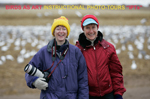
Liam and the Old Man
Image copyright 2009 and courtesy of Greg Ferguson
I pretty much use a lens hood only when it is raining or when I am photographing from a vehicle in a dusty environment.  I am pictured here with the 800 f/5.6L IS.
american-coot-and-wake-silh-_10j6966-bosque-del-apache-nwr-nm
American Coot at dawn, Bosque Del Apache, NWR, NM
Image Copyright 2009: Arthur Morris/BIRDS AS ART
 
Canon 800mm f/5.6L IS lens with the EOS-1D Mark III on the Mongoose M3.5 atop the Gitzo 3530LS CF tripod.  ISO 400.  Evaluative metering +2/3 stop: 1/160 sec. at f/22. 
 
Here, I used the central sensor along with AI Servo AF to focus in the center of the wake.  I knew that conditions were bright enough to stop down a lot while still maintaining a shutter speed that would likely yield a sharp image.  This decision and many others like it was, and need to be, made in one or two seconds in order to capture the image in your mind’s eye. 
greater-roadrunner-on-road-_mg_0389-socorro-nm1
Greater Roadrunner on road (where else?), Bosque Del Apache, NWR, NM
Image Copyright 2009: Arthur Morris/BIRDS AS ART
 
Canon 800mm f/5.6L IS lens with the EOS-50D on the Mongoose M3.5 atop the Gitzo 3530LS CF tripod.  ISO 400.  Evaluative metering +1/3 stop: 1/400 sec. at f/11. 
 
This bird was tame when we encountered it on the IPT but always sat in a tree on the wrong side of the road (and the light).  On the day after the IPT, both Jim and I were thrilled to find it sunning on the road in early morning light.  The background was out-of-focus salt cedar.   It was far enough away that I new I could use f/11 to render the bird sharper without bringing up unwanted background detail.
More images tomorrow.