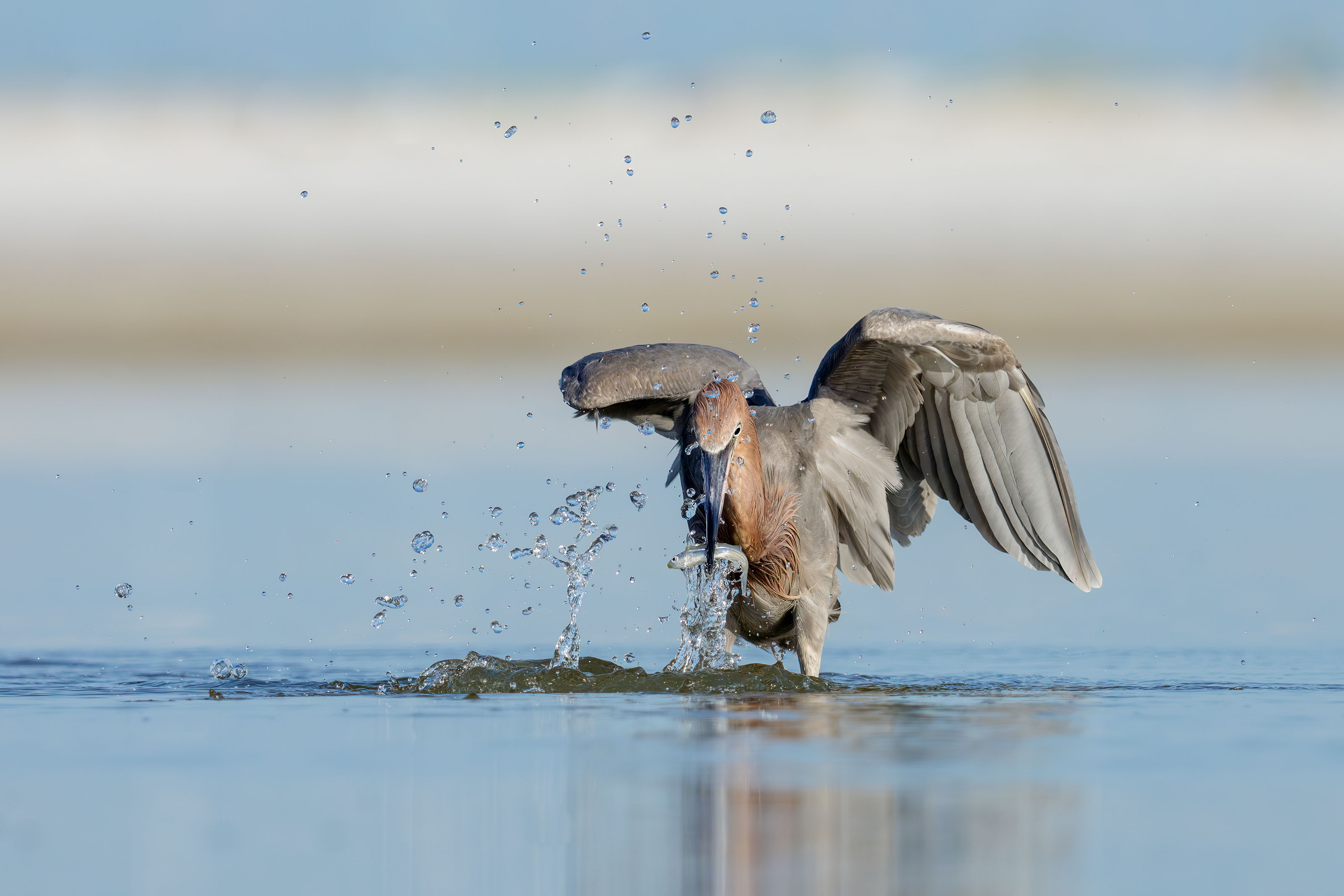
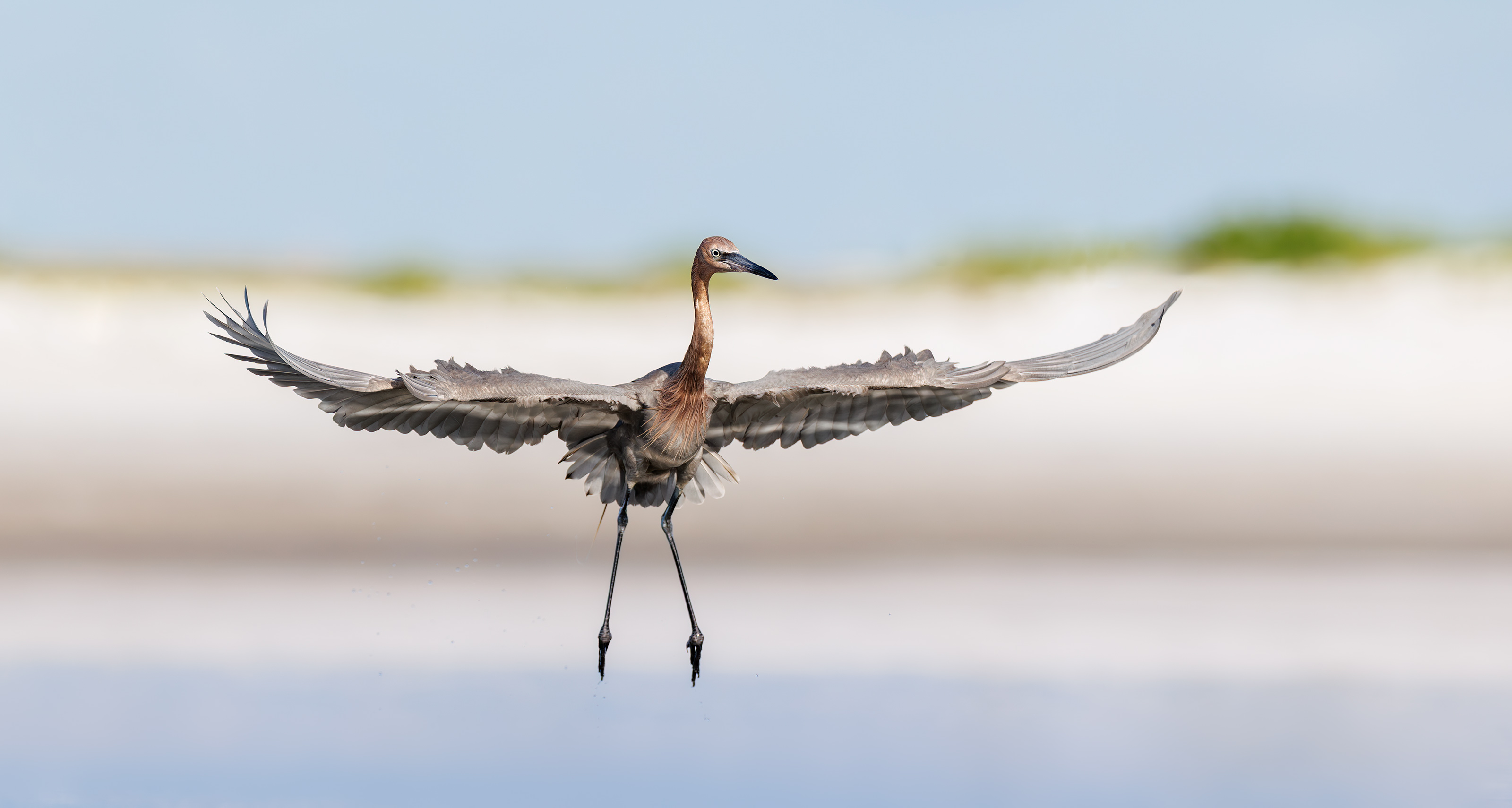
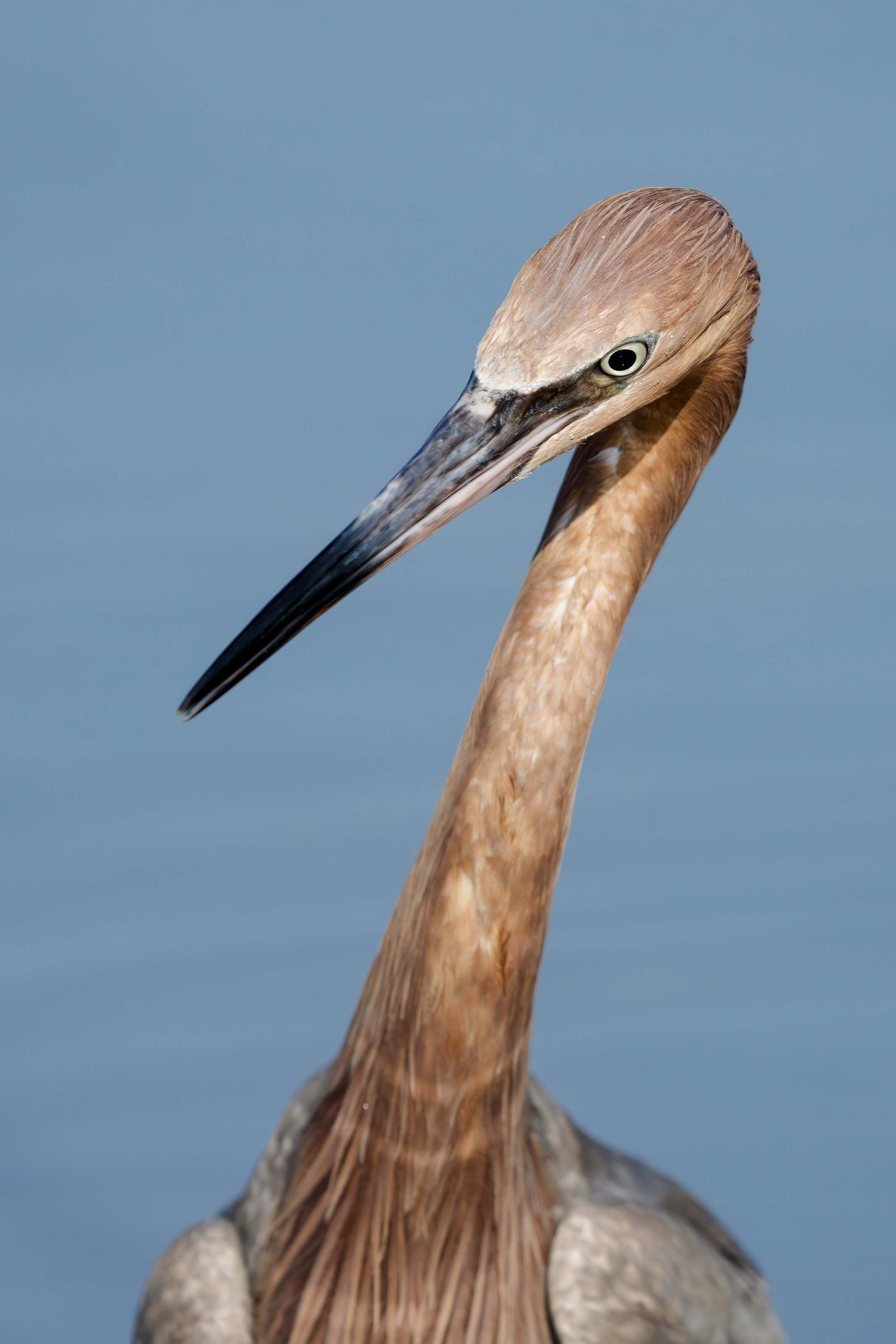
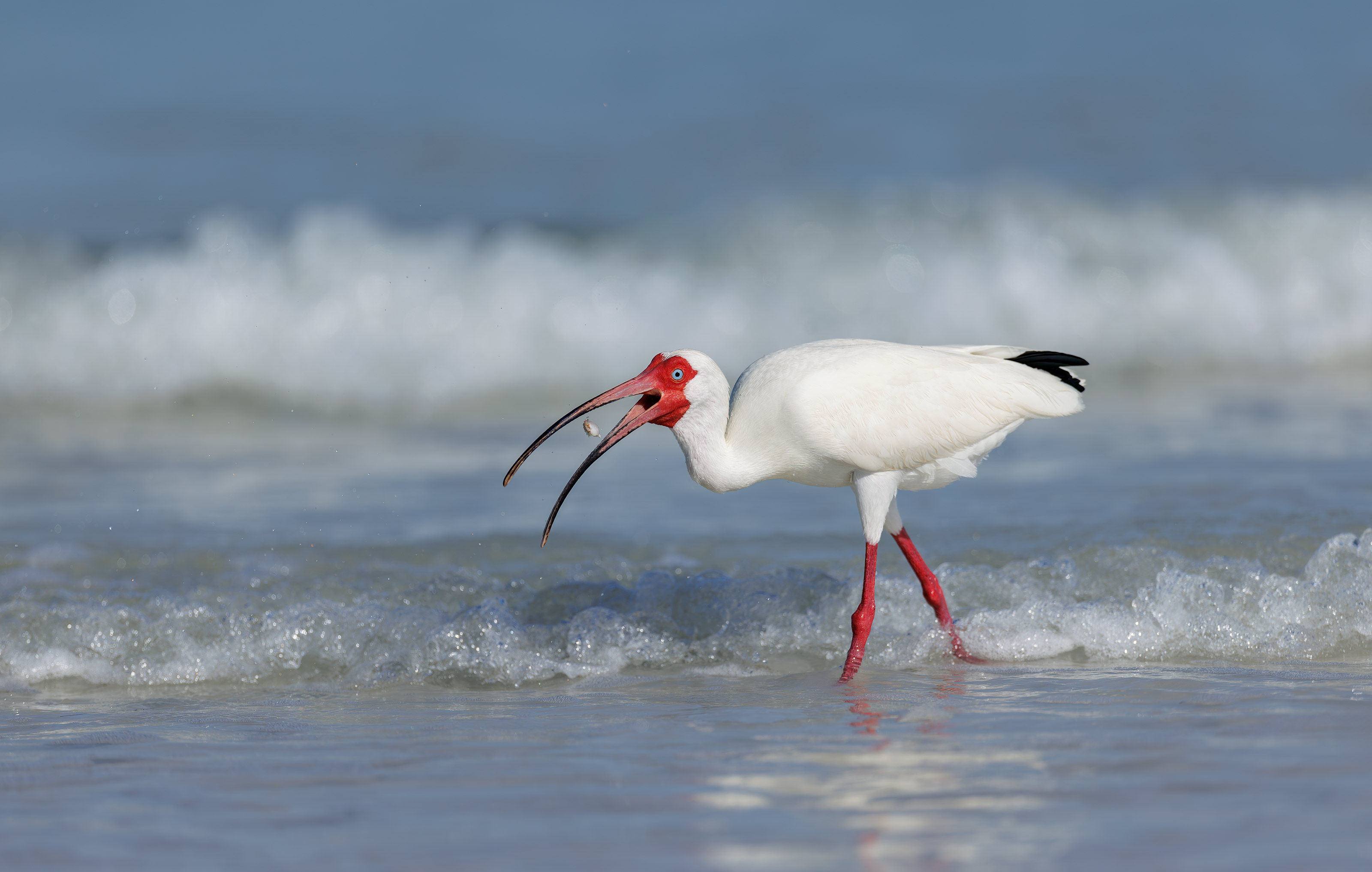
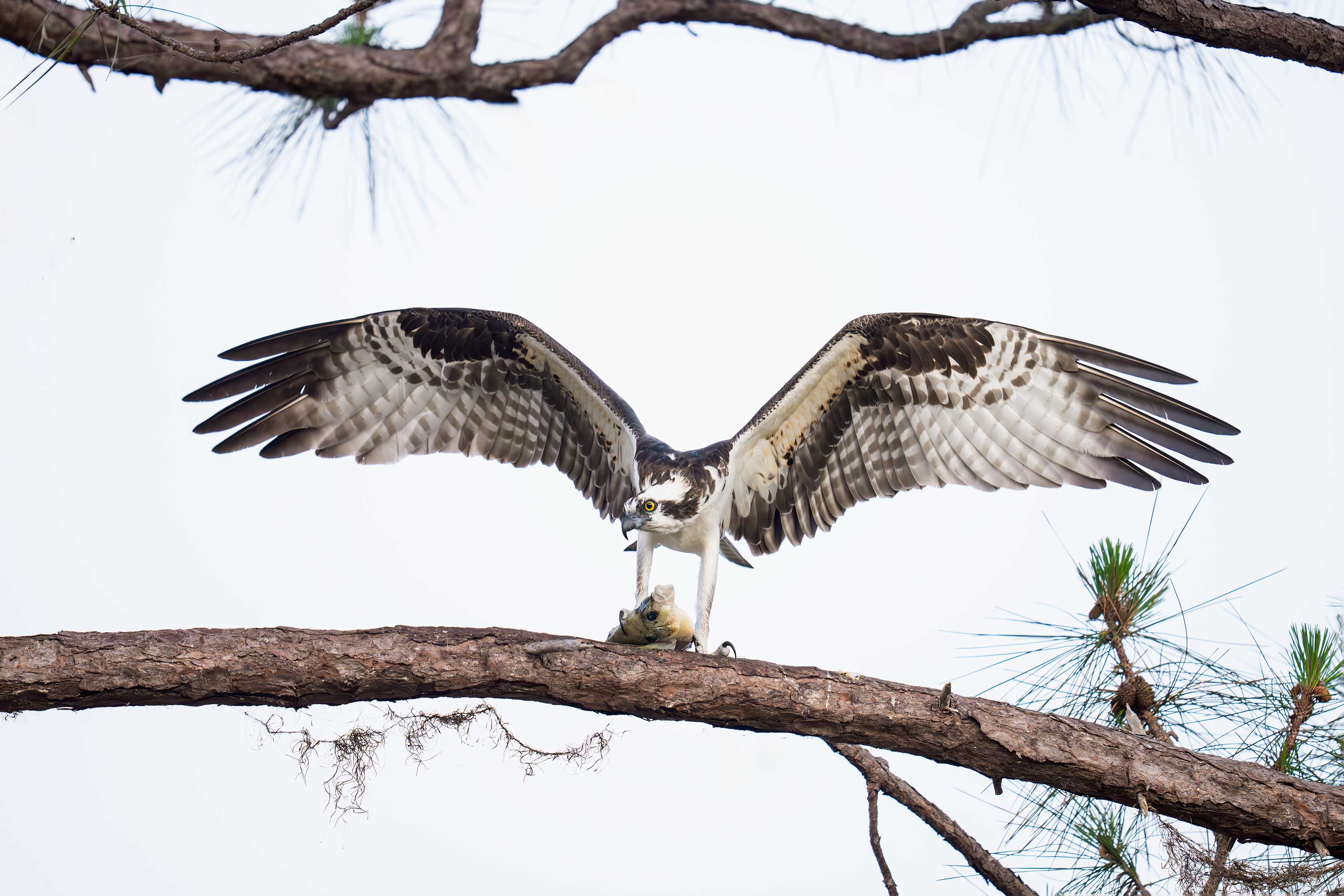
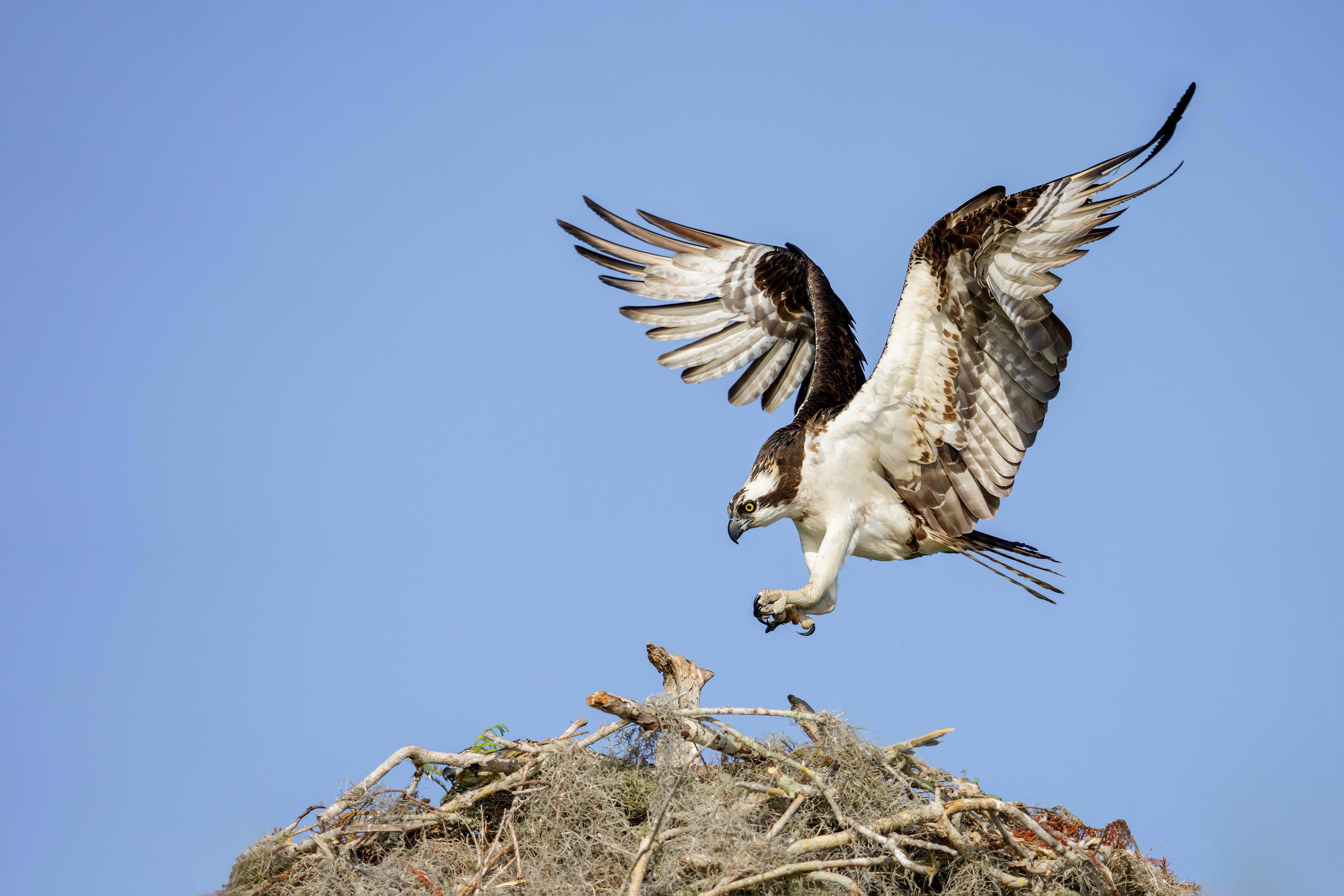
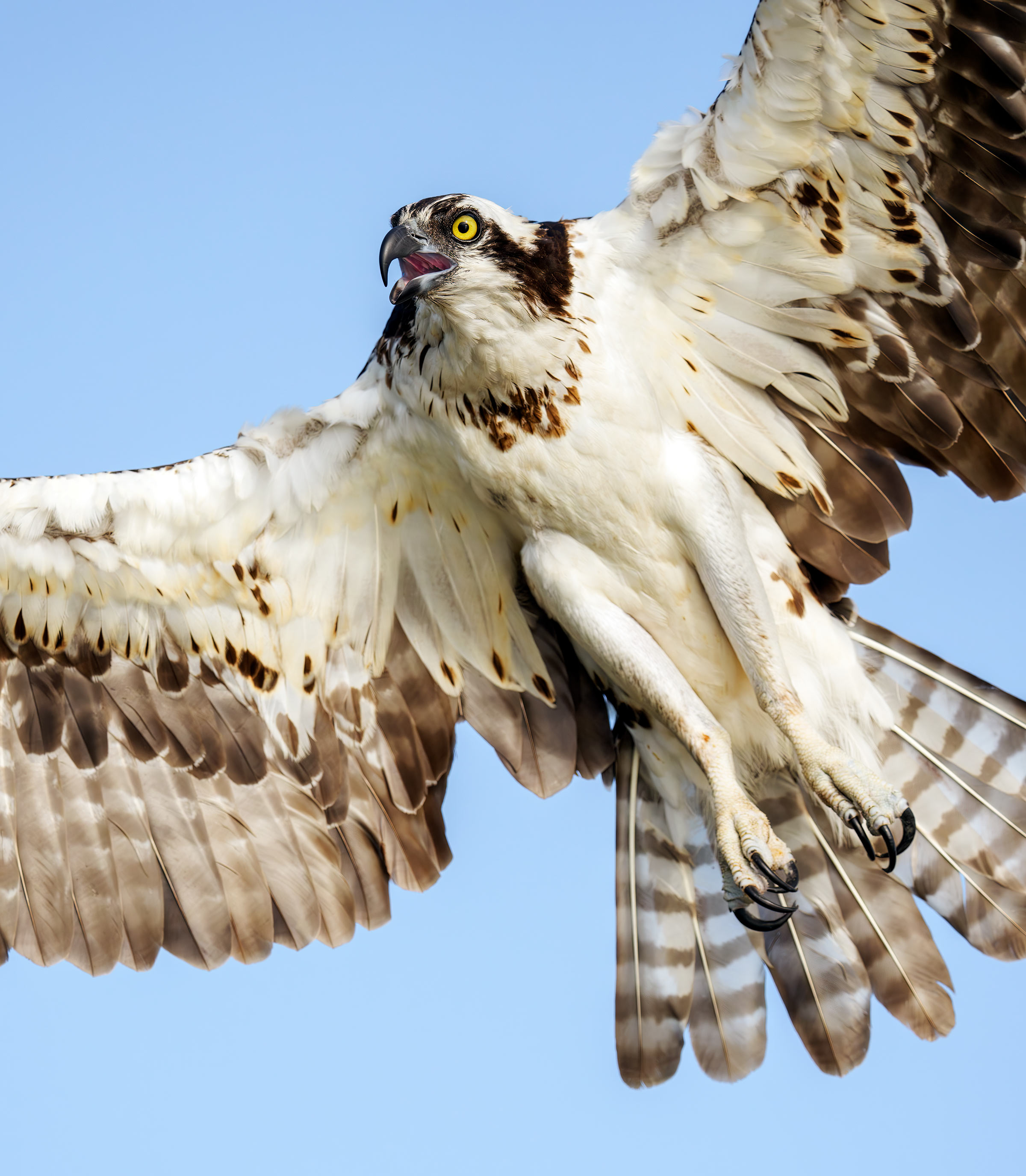
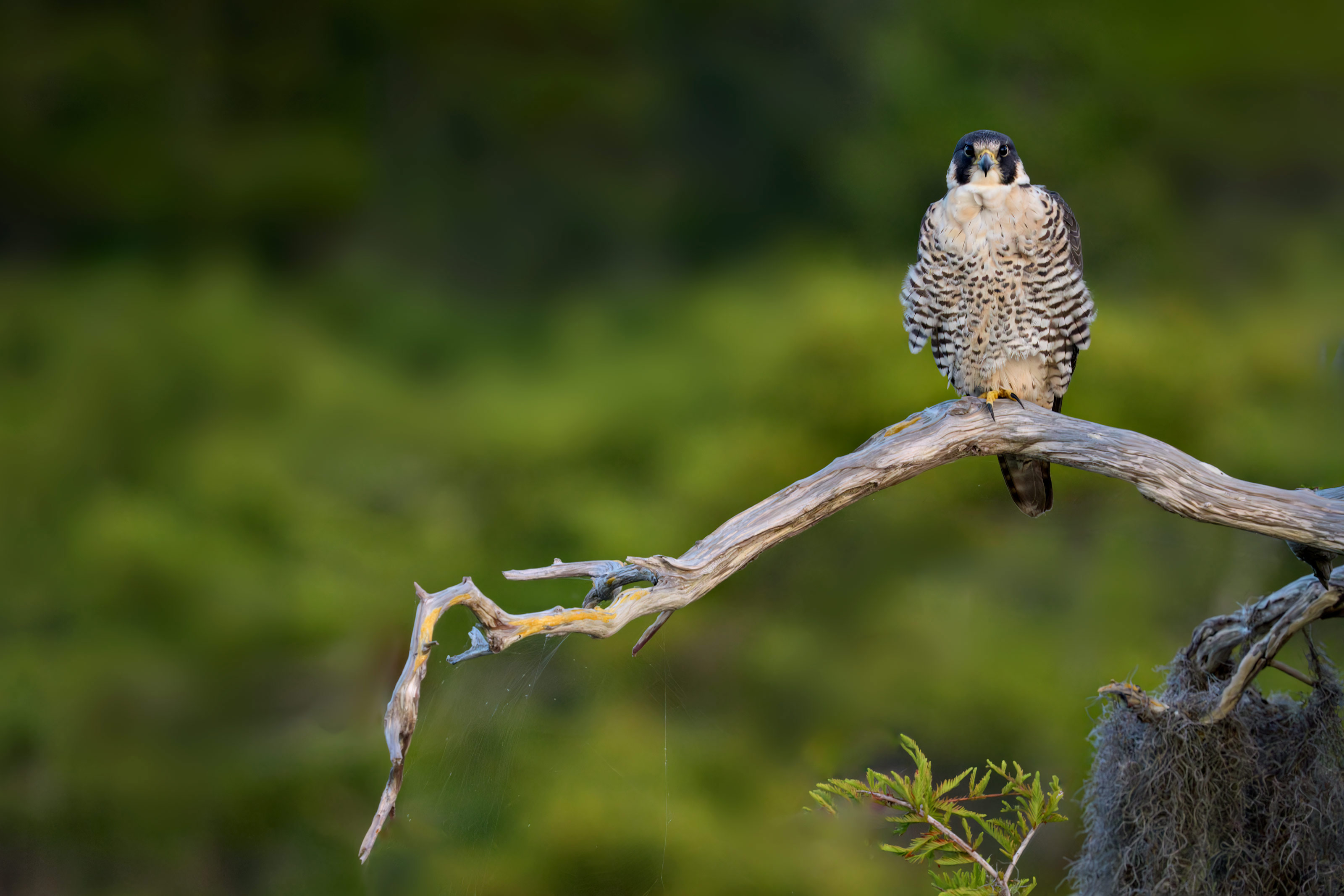
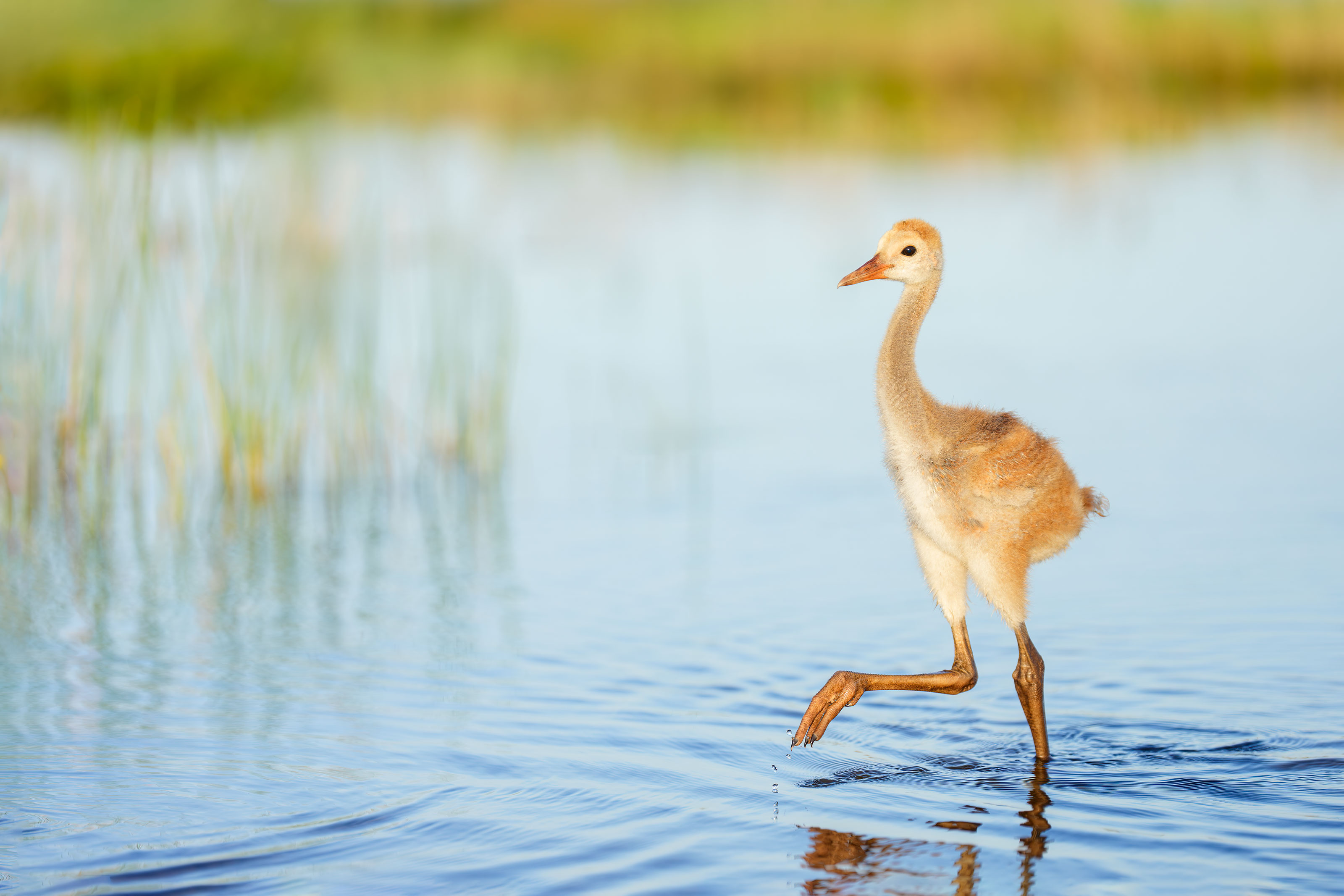
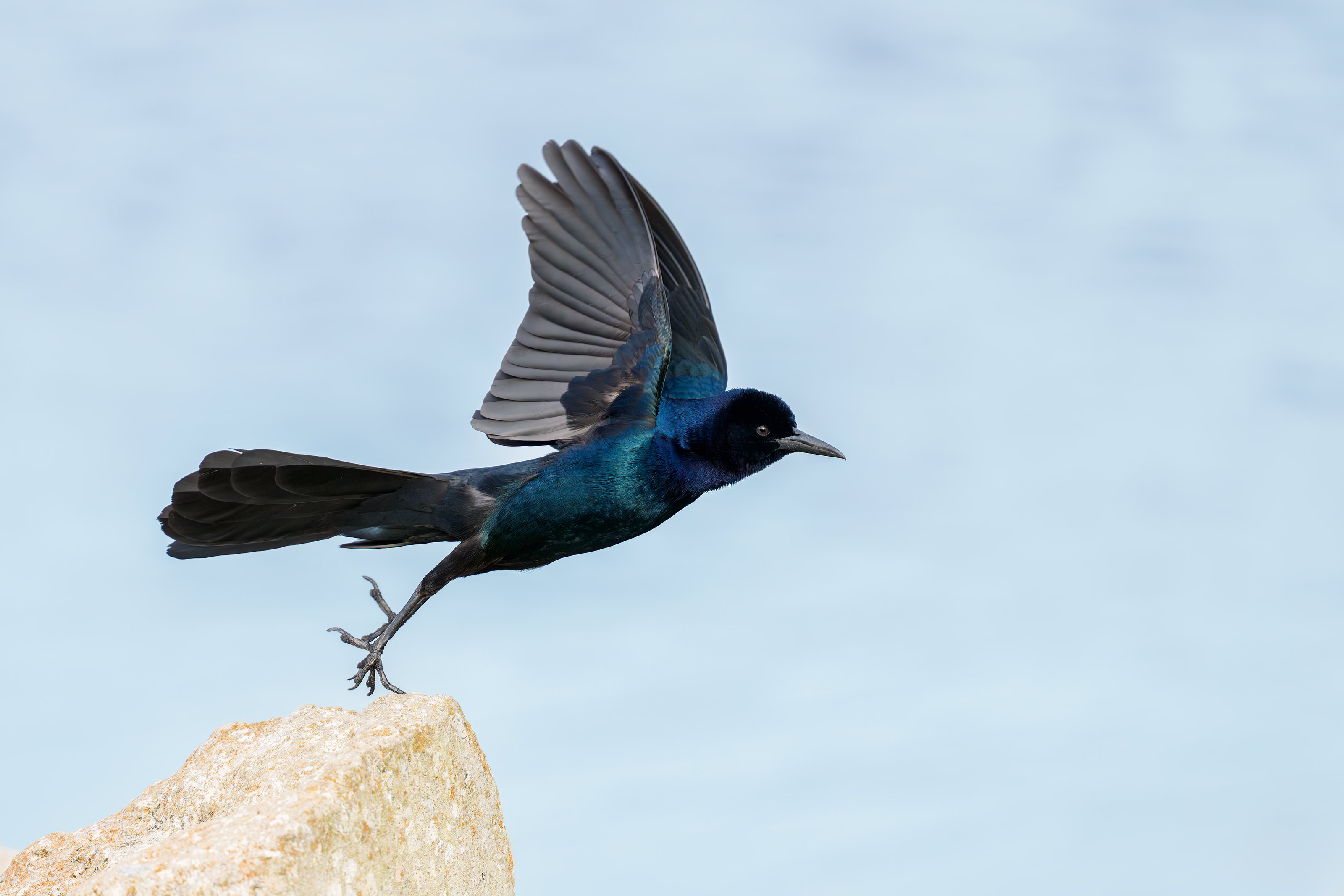
In the last blog post, Image #5 was the top choice (though very few folks commented). Dan Cadieux figured out two of the three images that had some significant Photoshop work done on them (though he did not see any evidence). I liked all of the images with #5 also my favorite, that followed by Image #4. I loved the neatly edged feathers of the juvie Ospreys. Only one person– thanks for trying, Elinor, took a shot at this rather softball question:
After checking the EXIF for Image #3, how do we know for sure that the bird in Image #2 was actually taking fight?
Answer: The EXIF shows that the two images were created in the same second at 7:05:38am.
What’s Up?
Early on Tuesday morning was gorgeous at ILE. The water in South of Pier Bay was like a mirror. A young Great Egret, an adult Snowy Egret, and a very handsome pied (admixed white and indigo blue feathering) juvenile Little Blue Heron that has been eluding me for weeks foraged in the still water bathed in butter light and accompanied by their perfect reflections. Five more Great Egrets and a Limpkin were perched on the pier railing. I put the 600 with the 2X on the BLUBB, stayed well back so as not to flush any of the birds, and pulled in close to the pier with the car angled at about 30°to get on sun angle for the juvie Little Blue. Then, every bird flew away as a pier-walking neighbor waved a friendly hello and said, “Good morning.” I wanted to reply, “It was till you came along” but I stifled the thought and drove away to looking for something to photograph.
After hearing that Clemens (Van der Werf) had had a great afternoon at DeSoto last week, I grabbed an AirBnB in St. Pete for two nights on a whim and Jim and I drove over on on Tuesday afternoon. I found the oystercatcher chicks easily but both chicks had been banded that morning 🙁 I walked north all the way to the inlet and saw pretty much nothing. Almost back to the car I came across a Least Tern fishing. It hovered right in front of me right down sun angle for five minutes as I created more than a thousand images. I really liked one and will share it with you here soon.
There were very few birds at DeSoto on Wednesday morning. The wind was supposed to be southeast (OK) but had already switched to southwest by sunrise (bad). I met Matt Milnes visiting from Georgia and we spent most of the morning together. Matt had kindly helped me with some ILE turtle nest questions a few years back. Out of desperation, we headed to my morning backup location where we found nothing as well. On our way back to the parking lot we came upon three White Ibises feeding in the shallow surf. One was quite bright red so we worked it for about twenty minutes. Realizing after that that I had I lost my prescription reading glasses somewhere near the Gulf, I headed back to North Beach to look for them. Matt kindly joined me to help, but we came up empty.
I made a rookie mistake on Wednesday afternoon. Having struck out the previous afternoon, I decided not to take my fanny pack with extra cards and batteries. So, of course, with a gorgeous breeding plumage Dunlin and a handsome Semipalmated Plover right in front of me, and a Reddish Egret dancing in the distance right down sun angle — all is sweet late afternoon light of course, the dreaded ‘card full” message popped up on the back of my a-1 ii. I filled the 160GB card. My Delkin Black 960GB CF Express A card accidentally wound up in the a-1 body that is sitting on my desk 🙁
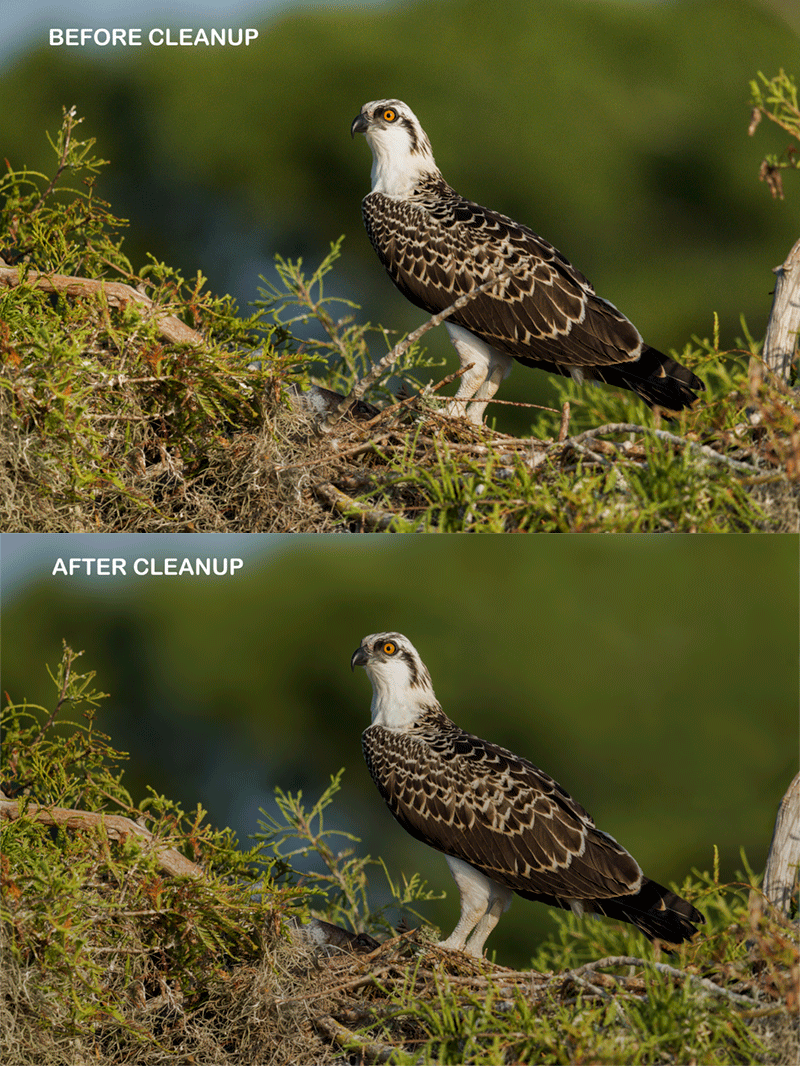
Overlapping Sticks
The twigs and sticks that overlapped the handsome young Osprey really bugged me. Removing them with the Clone Stamp Tool is tedious work and the results are iffy at best. The relatively new Remove Tool is the way to go. The clean-up took some time and effort but the results are superb. Most of the time, the Remove Tool does a great job blending the surrounding areas. I was not happy with one spot that had turned the feather to mush so I painted a small Quick Mask of a feather tip and moved it into place to complete the repair.
If anyone can shed some Lightroom light on the Remove Tool please leave a comment. My understanding is that at best, it is difficult to access it (in LR).
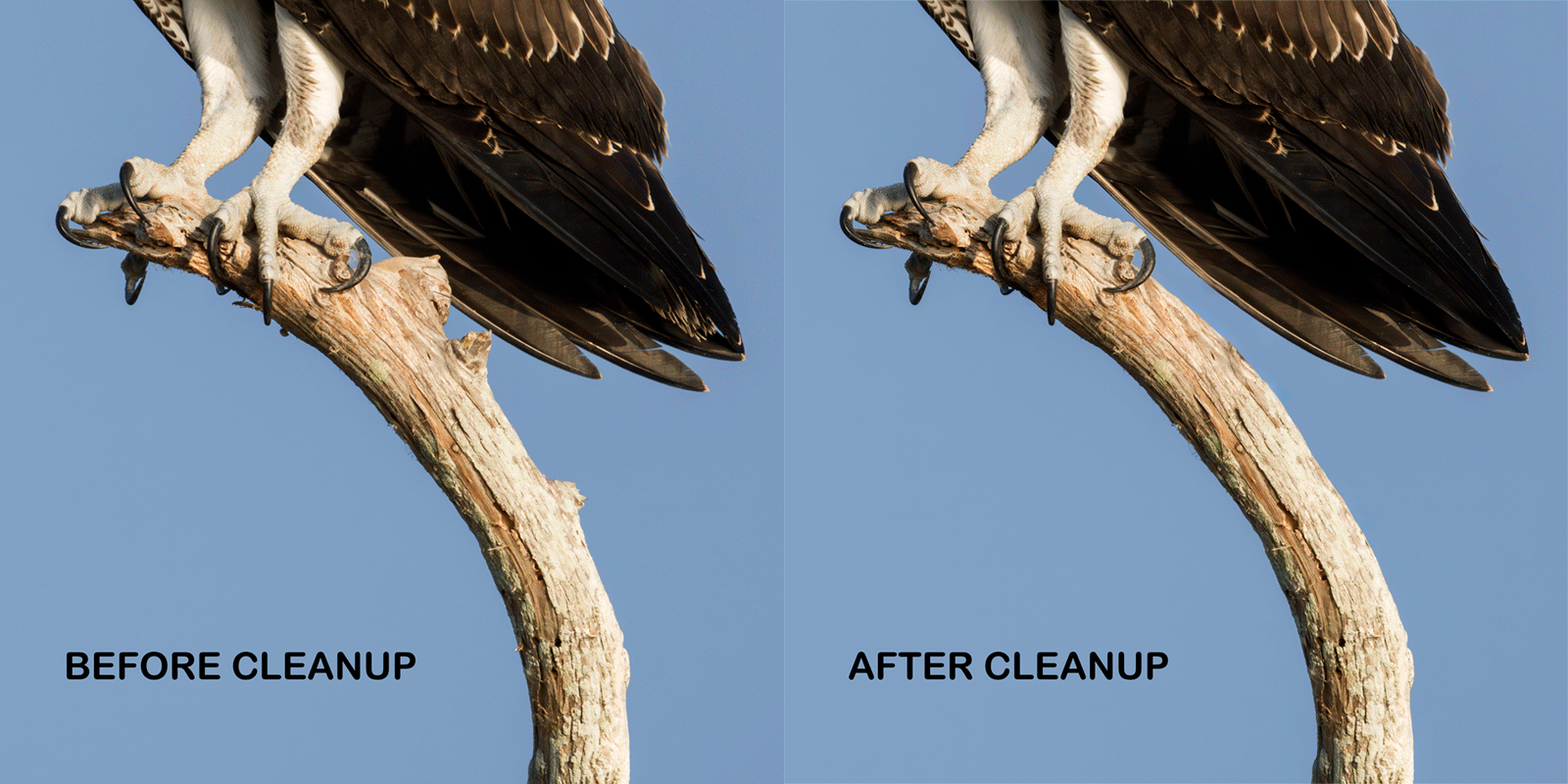
Bump on the Perch
I did not care for the two chunks of wood that merged with the primaries of the Osprey’s far wing. I used the Divide and Conquer technique to separate the chunks into smaller, easier to eliminate sections. The free floating chunks were then removed using the Patch Tool. Those that abutted the wing feathers were easily removed via the Remove Tool as it is superb whenever edges are involved.
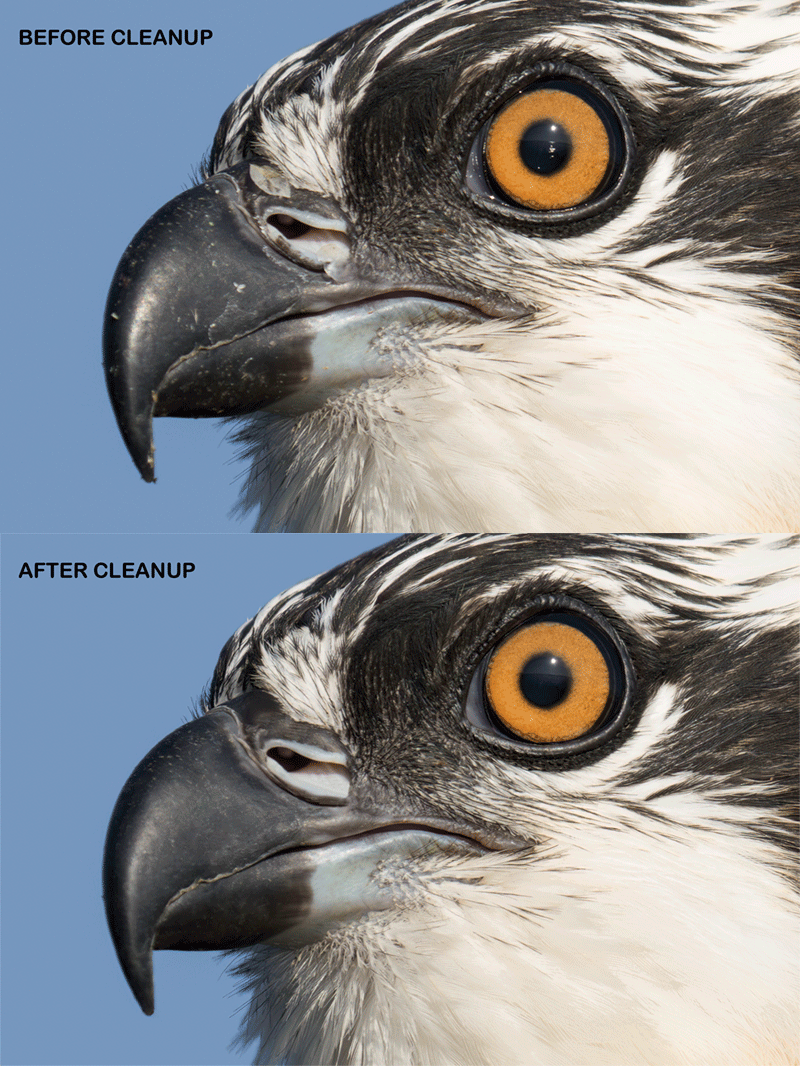
Bill Cleanup
You guessed it. The Remove Tool makes bill cleanup child’s play. All you need to do is work large. Here’s a high level tip for dealing with strips of specular highlights on a bird’s bill:
1- Complete your bill cleanup work without touching the strip of specular highlights.
2- Add a new layer.
3- Use one swipe of the Remove Tool and paint over the strip of specular highlights.
4- Now, reduce the Opacity of the top layer to taste, usually between 40 and 60%. You will still see the strip but it will be reduced in intensity.
The BIRDS AS ART Current Workflow e-Guide (Digital Basics II).
You can order your copy from the BAA Online Store here, by sending a PayPal for $40 here, or by calling Jim or Jennifer weekdays at 863-692-0906 with your credit card in hand. Be sure to specify Digital Basics II.
The BIRDS AS ART Current Workflow e-Guide (Digital Basics II)
The techniques mentioned above and tons more great Photoshop tips and techniques — along with my complete digital workflow, Digital Eye Doctor Techniques, and all my personalized Keyboard Shortcuts — are covered in detail in the BIRDS AS ART Current Workflow e-Guide (Digital Basics II), an instructional PDF that is sent via e-mail. Note: folks working on a PC and/or those who do not want to miss anything Photoshop may wish to purchase the original Digital Basics along with DB II while saving $15 by clicking here to buy the DB Bundle.
Please note: the Divide and Conquer technique was inadvertently omitted from DB II. It is detailed in a free excerpt in the blog post here.
Folks who learn well by following along rather than by reading can check out the complete collection of MP 4 Photoshop Tutorial Videos by clicking here. Note: most of the videos are now priced at an amazingly low $5.00 each.
You can learn how and why I converted all of my Canon digital RAW files in DPP 4 in the DPP 4 RAW Conversion Guide here. More recently, I became proficient at converting my Nikon RAW (NEF) files in Adobe Camera Raw. About three years ago I began converting my Nikon and Sony RAW files in Capture One and did that for two years. You can learn more about Capture One in the Capture One Pro 12 Simplified MP4 Video here. Today, I convert my Sony raw files in Photoshop with Adobe Camera Raw.
You can learn advanced Quick Masking and advanced Layer Masking techniques in APTATS I & II. You can save $15 by purchasing the pair.
The Digital Basics III Video Series
The Digital Basics III Video Series
I realized more than a year ago that my digital workflow had changed significantly and was toying with the idea of writing a Digital Basics III. More recently, I learned and begun working with two great new Photoshop Tools, the Remove Tool and the Luminance Targeted Adjustment Tool. The former is like a smarter Spot Healing Brush Tool on steroids and the latter is a step up from the fabulous Color Mixer Tool. During that same time frame, I came up with a new and improved 2-step noise reduction technique. I still use Divide and Conquer, Quick Masks, Layer Masks, an expanded array of personalized keyboard shortcuts, and tons of other stuff from both versions of Digital Basics.
As soon as I realized that I did not want to take on another large writing project, I realized that by creating a series of videos I could much more easily share all the details of my current digital workflow and much more easily incorporate additional new tips, techniques, and tools as I went. And so, The Digital Basics III Video Series was born.
You can save recipe all five videos in Volume I by clicking here. The videos will be most valuable for folks using the latest version of Photoshop (2024) or Lightroom along with Topaz DeNoise AI and Topaz Sharpen AI.
Preserving the Natural History Moment
Note that in each of the three images, the natural history moment depicted by the original raw files has been preserved. Each looks just a bit better and makes me a bit happier. Please remember that JIJO applies — junk in equals junk out.
Typos
With all blog posts, feel free to e-mail or to leave a comment regarding any typos or errors.
Which two of today’s seven featured images are your favorites? Why do you like each of them? I will share my top two picks with you here in the next post.
If you see any evidence of Photoshop foul play in one or more of today’s seven featured images, please identify them by Image # and state your evidence for each. By my standards, there are two that fit the category. Confessions in the next post.
In the Last Blog Post
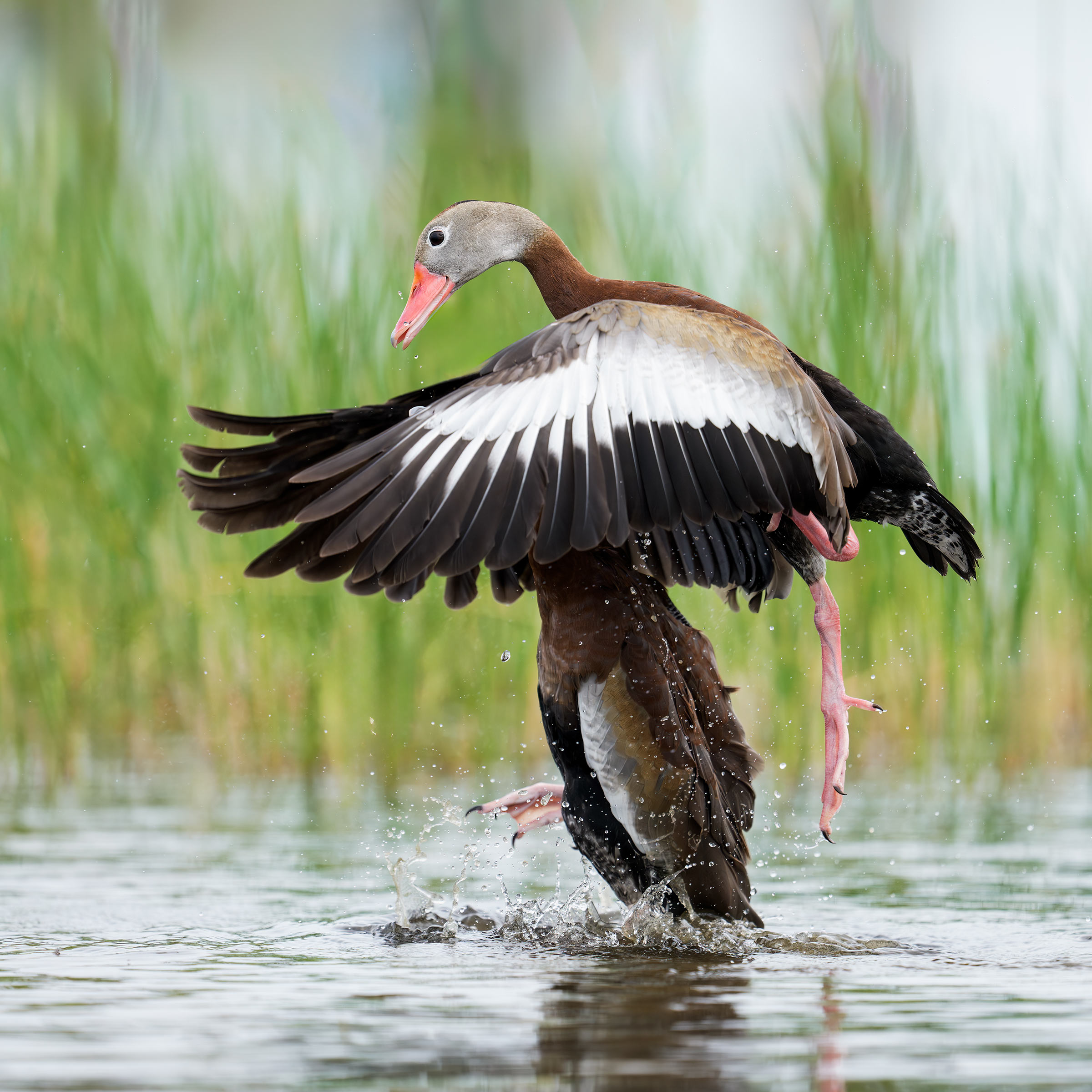
In the last blog post, the main reason I drove up on the hill was to separate the duck’s head from the vegetation. Well done Bob Eastman. Learn more by reading my responses to the four comments here.
What’s Up?
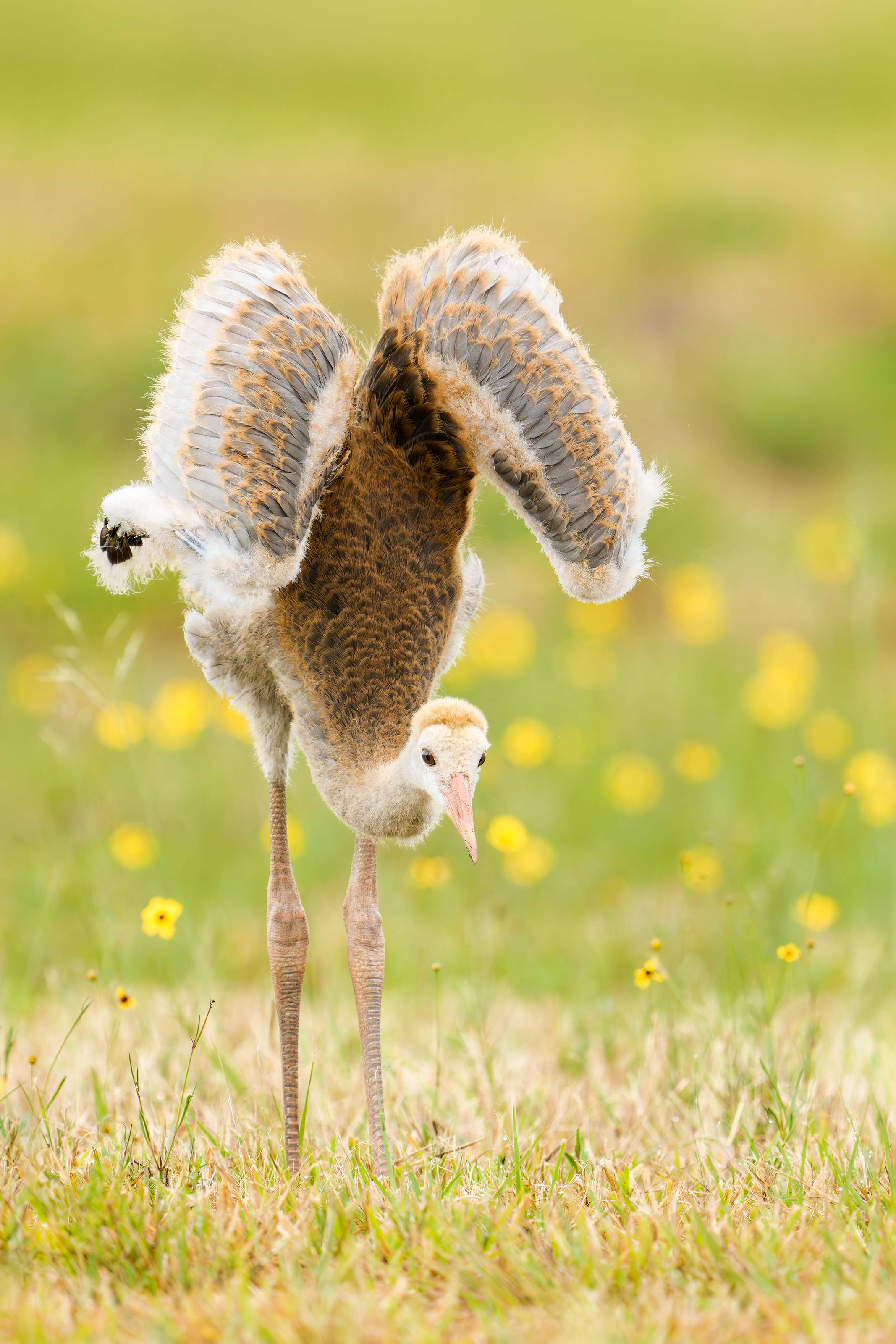
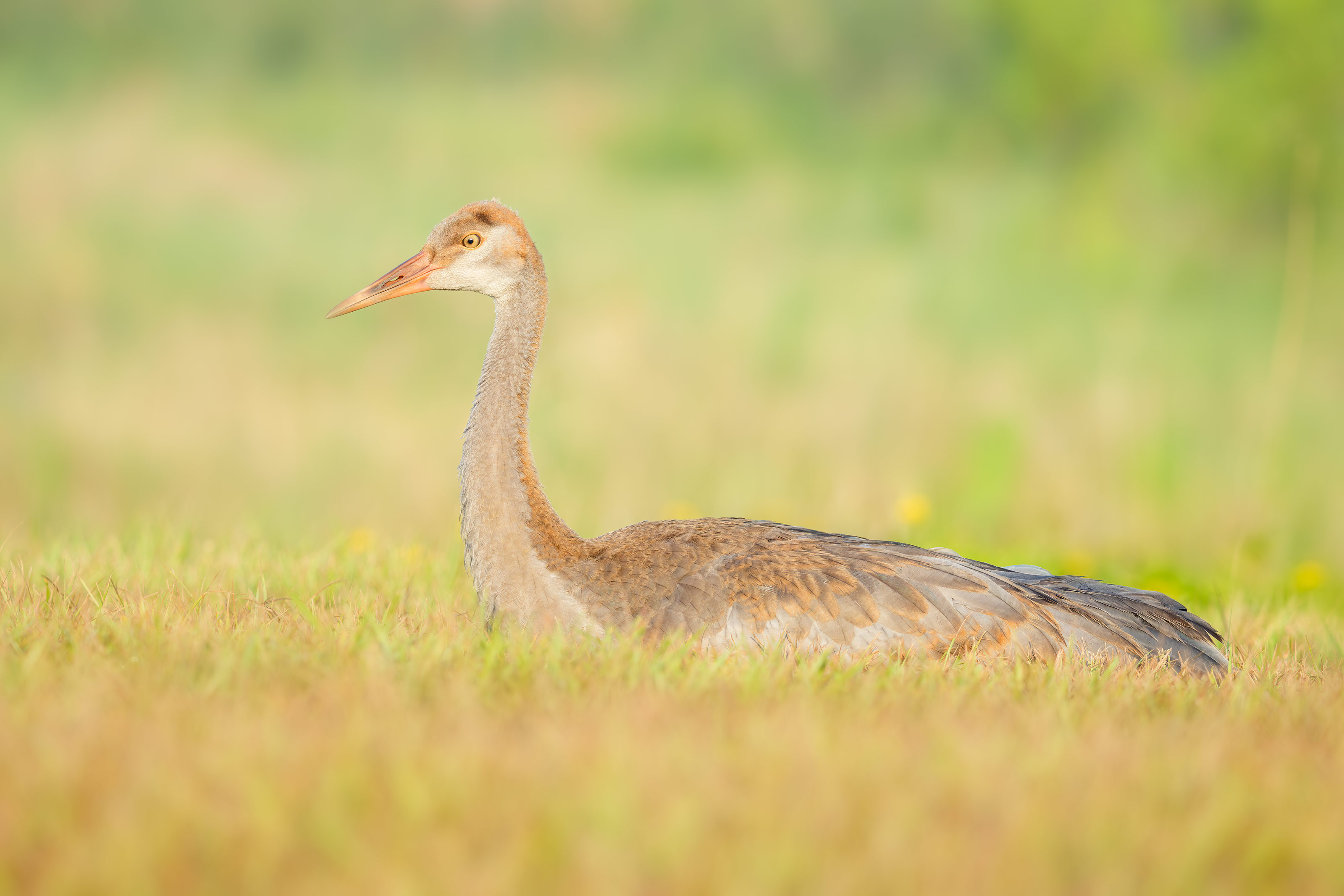
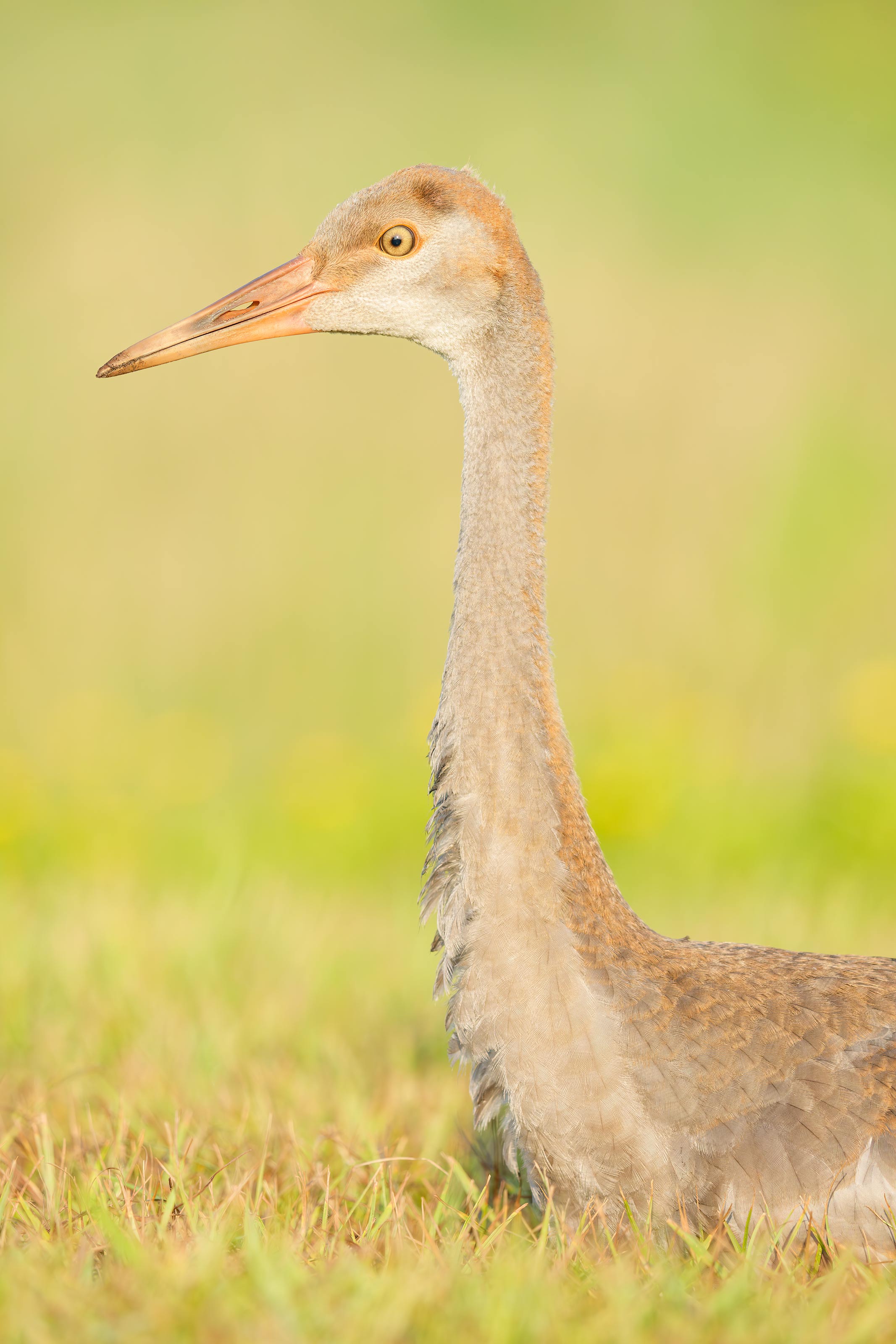
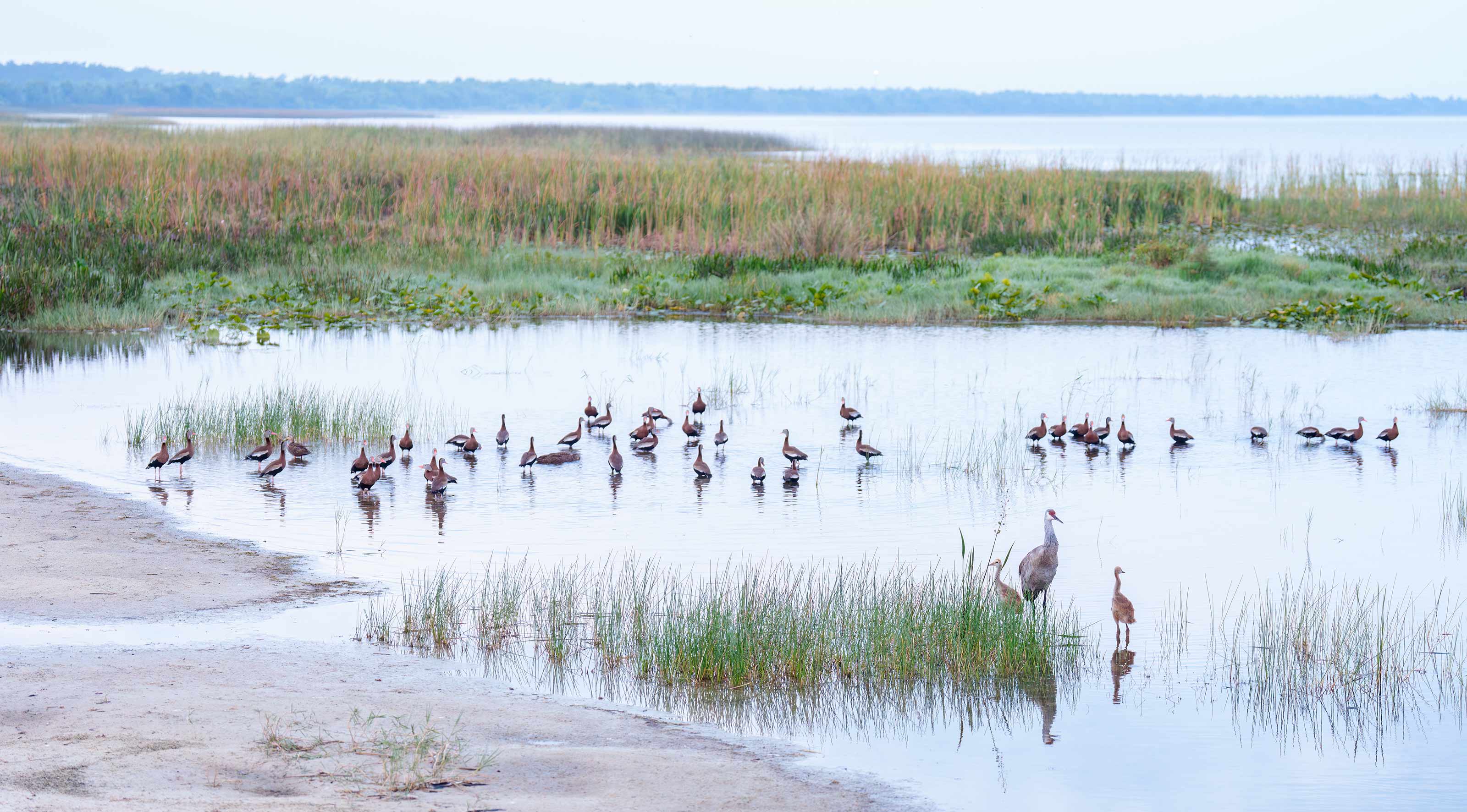
Photographic opportunities at ILE continue to decline with the near complete absence of Black-bellied Whistling Ducks and the fact that the six or seven surviving crane colts get bigger every day and are spending lots of time foraging in inaccessible backyards. I still get out every morning. On Monday morning, I made some nice images of a handsome young Great Egret in a field of tickseed blossoms and solved a White Balance riddle that had been bugging me. I have seen only two young Ospreys in the seven nests along the lakeshore. Several Killdeer families are doing well and the pair that hatched three of four eggs by the bathrooms have laid two new eggs in the same nest, i.e., double clutching.
On Sunday morning past, Clemens Van der Werf and his Canon gear (and two cycling friends from Tampa) joined me for the morning on Lake Blue Cypress. Our main targets were the fledged and nearly-fledged juveniles; we had lots of good chances and had a great time as well. Clemens and Anita North are my two most talented (former) students. You can see Clemens’s eclectic work here and check out Anita’s great images on her IG page.
If you are in the a-1 Firmware Update Group or my a-1 ii Group and would like to receive my latest, updated CAMSET.DAT file, please shoot me an e-mail and LMK which you need. Speaking of my Sony Camera Users Groups, I got this nice e-mail from long-ago IPT veteran Keith Kennedy yesterday:
Artie,
Today I successfully loaded your latest CAMSET file to my new a-1 ii. I followed your explicit directions and the installation was flawless! Thank you so much for doing such a great job; it is very much appreciated.
Keith
Today is Tuesday 27 May 2025. I will be heading down to the lake early as usual. Whatever you opt to do, I hope that you too choose to have a wonderful and productive day. Do remember that happiness is a choice — Byron Katie, The Work.Com.
If an item — a Delkin flash card or a Levered-clamp FlexShooter Pro — for example, that is available from B&H and/or Bedfords, is also available in the BAA Online Store, it would be great, and greatly appreciated, if you would opt to purchase from us. We will match any price. Please remember also to use my B&H affiliate links or to earn 3% cash back at Bedfords by using the BIRDSASART discount code at checkout for your major gear purchases. Doing either often earns you free guides and/or discounts. And always earns my great appreciation.
Don’t Just Shoot: Learn
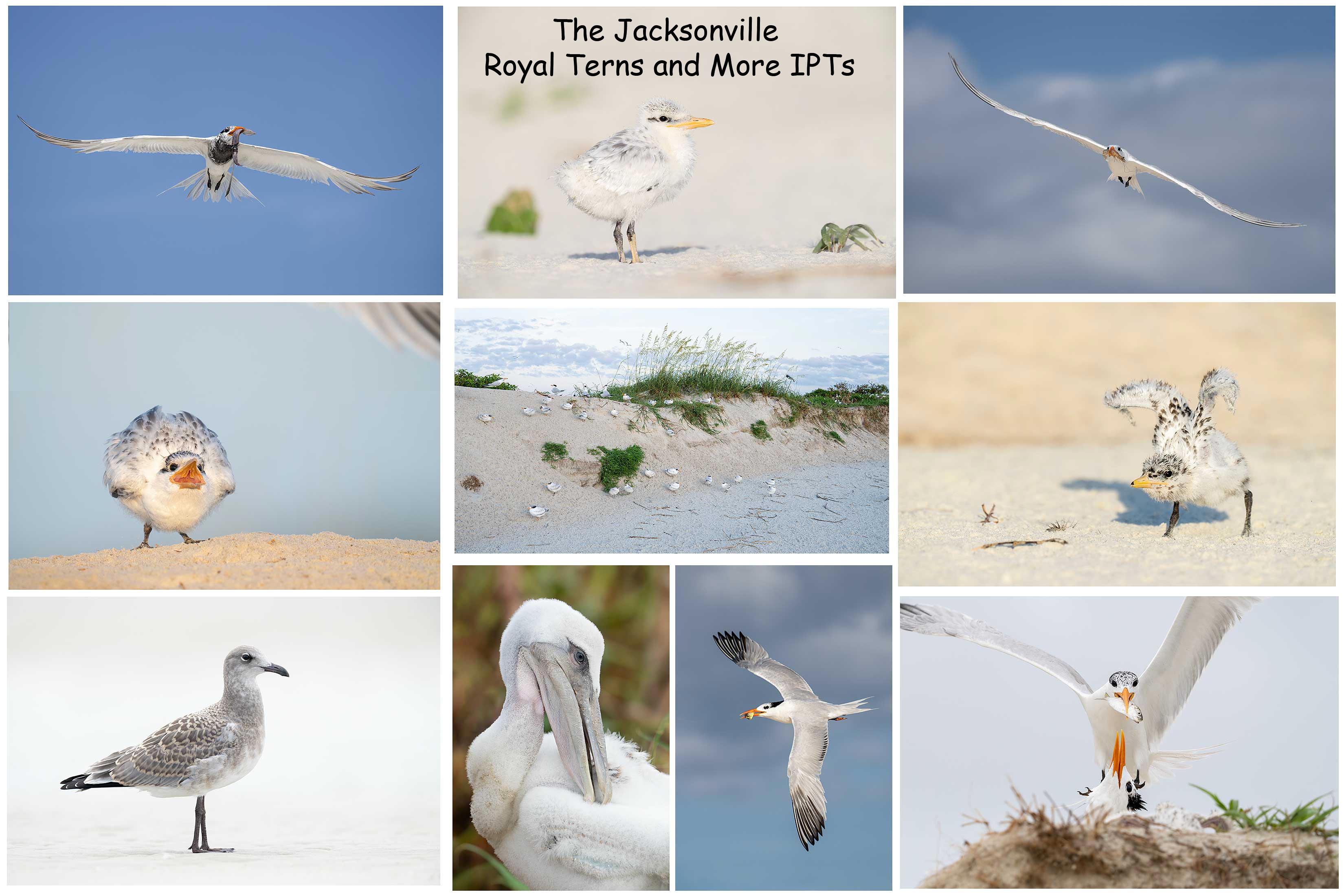
To learn of the late-registration discounts and AirBnB availability for the Jacksonsville Royal Terns with chicks and more extended IPT late June/early July, or If you are interested in changing your life and becoming a better photographer by joining me on an Extended IPT at Sebastian Inlet for Ospreys and more (SEPT 25 to NOV 24, 2025) or in San Diego for Pacific-race Brown Pelicans and more (JAN 6 to FEB 2, 2026), please e-mail for dates, rates, terms, and additional information. Or shoot me a text to 863-221-2372. Both offerings include options for shared AirBnB lodging and ground transportation during your stay.
BILD EXPO Presented by B&H
Why Attend? BIRDS AS ART Appearances, Speakers, Gear, Deals, and More!
I am pleased to announce that I will be doing portfolio reviews and four round table sessions at BILD this June. Here are the round table topics:
1- Systems, Lenses, and Camera Bodies for Bird Photography
2- Creating Sharp Bird Photographs
3- Bird Photography Hotspots
4- Creating Bird Photographs that depict Flight, Action, and Behavior
Stay tuned for a definitive schedule. I hope to see you there.
Bild Expo is back! Join us at The Javits Center in New York City for an unforgettable event featuring 100+ expert speakers, 250+ exhibitors, hands-on experiences, and the world’s greatest creative community. B&H’s incredible show specials will be the icing on the cake! Whether you’re a seasoned pro, an enthusiast, or a beginner, at Bild you will get inspired, learn, meet like-minded people, and celebrate being part of this amazing world of creativity.
Click here or on the logo link above for more information.
To ensure that I get credit for your B&H purchases, you can always click here. The tracking is invisible but greatly appreciated. And, you can use your PayBoo card. You must use the website to order. You cannot get your free guides if you make a phone order. Once you have an item in your cart, you must complete the order within two hours. Huge thanks!
Bedfords Simplified
Click here to start your search. Choose standard shipping, and when you get to the payment page, enter BIRDSASART in the discount code box and hit apply. You will be upgraded to free second day air Fed-Ex and receive 3% cash back on your credit card once your stuff ships. Either is greatly appreciated by yours truly.
B&H
Many folks have written recently stating that they purchased a Sony a1 from B&H and would like their free membership in the Sony 1 Info and Updates Group, a $150.00 value. But when I check my affiliate account, their orders have not been there. When I let them know that they get credit for B&H purchases only if they use one of the many B&H affiliate links on the blog or begin their searches with this link, they are always disappointed. If in doubt, please contact me via e-mail and request a BH link. I am always glad to help and to guide you to the right gear.
Bedfords Amazing BAA Discount Policy
Folks who have fallen in love with Bedfords can now use the BIRDSASART coupon code at checkout to enjoy a post-purchase, 3% off-statement credit (excluding taxes and shipping charges) on orders paid with a credit card. The 3% credit will be refunded to the card you used for your purchase. Be sure, also, to check the box for free shipping to enjoy free Second Day Air Fed-Ex. This offer does not apply to purchases of Classes, Gift Cards, prior purchases.
Visit the Bedfords website here, shoot Steve Elkins an e-mail, or text him on his cell phone at (479) 381-2592.
Gear Questions and Advice
Too many folks attending BAA IPTs and dozens of photographers whom I see in the field and on BPN, are — out of ignorance — using the wrong gear, especially when it comes to tripods and more especially, tripod heads. And the same is true in spades when ordering new camera bodies or lenses. My advice will often save you some serious money and may help you avoid making a seriously bad choice. Please know that I am always glad to answer your gear questions via e-mail. If you are desperate, you can try me on my cell at 863-221-2372. Please leave a message and shoot me a text if I do not pick up.
Sony Alpha 1 (a-1) Mirrorless Camera Body
Price reduced $100.00 on 26 May 2025
Multiple IPT veteran and longtime BAA friend Pat Fishburne is offering a rarely used Sony a-1 (ILCE-1) mirrorless camera body in excellent plus condition for a BIRDS AS ART record low $3198.00 (was $3,298.00). This body has been updated to Firmware 3.00 that reportedly improves Bird Face-Eye tracking to levels attained by the a1-ii. The camera has my latest a-1 set-up on it. The sale includes the current Buttons and Dials Guide and the Info Sheet, the original product box, one battery, the charger, the camera strap, and insured ground shipping via major courier to lower-48 US addresses only. Your item will not ship until your check clears unless other arrangements are made.
I used Sony a-1 bodies as my workhorse camera bodies for more than three years. They produce stunning 51MP files with vivid natural colors. The AF system is superb. They are rugged and dependable and 30 frames per second is nothing to sneeze at. With a brand new a-1 ii going for $6498.00, you can save an even $3200.00 by grabbing Pat’s nearly as good as new a- copy ASAP. Right now, B&H is offering a used Sony a-1 in the same condition, 9+, for $4,674.95 here. Don’t believe me? Click the link. Prices of some used gear items like the Sony a-1 are actually rising in anticipation of the coming tariff.
Used Induro GIT 505 XL Tripod Bargain
Price reduced $100.00 on 26 May 2025
Your truly, Arthur Morris/BIRDS AS ART, is offering a rarely used Induro Stealth GIT 505XXL in like new condition for $425 (was $525.00). This is the monster of all tripods. It offers maximum strength and rigidity and can support 88.2 pounds of gear with ease. It stands 81.3″ tall with the legs fully extended. It is perfect for folks desiring maximum stability in windy conditions, those working from a fixed position with very slow shutter speeds, and in situations where you need to get very tall such as when working a tree nest possibly while standing on a ladder. This is not a tripod that you want to be carrying around in the field unless you are Superman. The sale includes only the legs and insured ground shipping to your lower 48 address. Please contact artie via e-mail. I could not find a single one for sale anywhere in the world. I paid B&H $802.50 for it when purchased new in 2021.
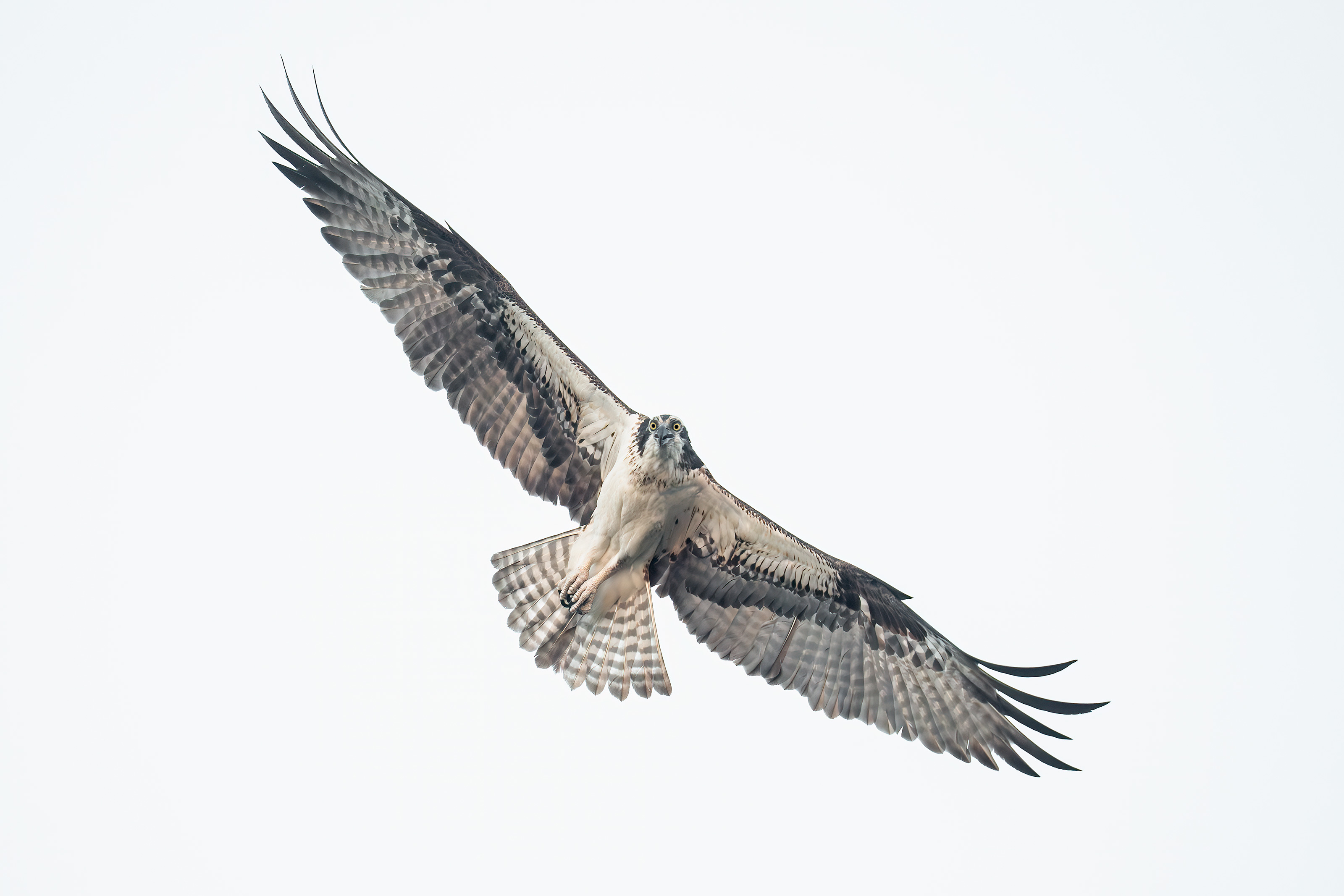
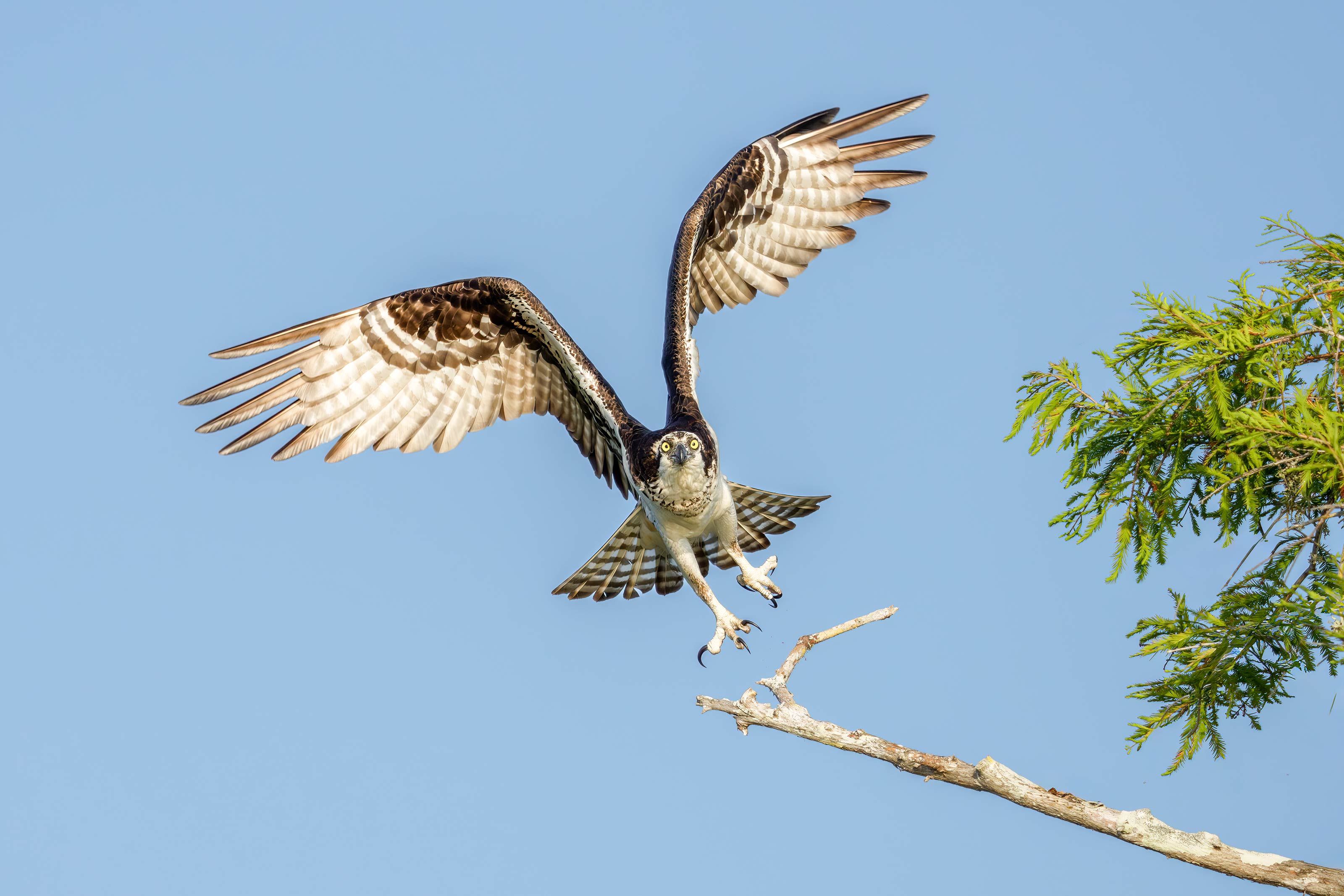
This image was created on 25 May 2025 at Lake Blue Cypress, FL. Standing on a pontoon boat, I used the hand held Sony FE 400mm f/2.8 GM OSS Lens and The Latest Greatest Sony Flagship Body, the a1 II Mirrorless Camera. The exposure was determined via Zebras with ISO on the thumb dial. ISO 5000: 1/2500 sec. at f/2.8 (wide open) in Manual mode. RawDigger showed that the exposure was perfect. AWB at 6:39:39 ten minutes after a hazy, well-muted sunrise.
Tracking: Spot XS/AF-C with Bird Eye/Face Detection enabled performed perfectly. Click on the image to see a larger, sharper high resolution version
Image #1: Osprey — adult in flight
Image copyright 2025 Arthur Morris/BIRDS AS ART
Early on a Muted Sunrise Morning
As you make your way through this blog post, note my choice of rigs as the lighting conditions change. Early on, the sun was barely making it through a light fog bank to the east. In need of light, I grabbed the 400mm f/2.8 GM lens primarily for speed and, when compared to the lighter 300mm f/2.8 GM, for reach. I kept metering the white sky and adding 2 2/3 stops of light. Though ISO 5000 is not a favorite, it enabled me to create a decent image for web presentation. I used my usual double noise reduction technique on this image but switched from Low Light to Clear as the latter looked a lot better.
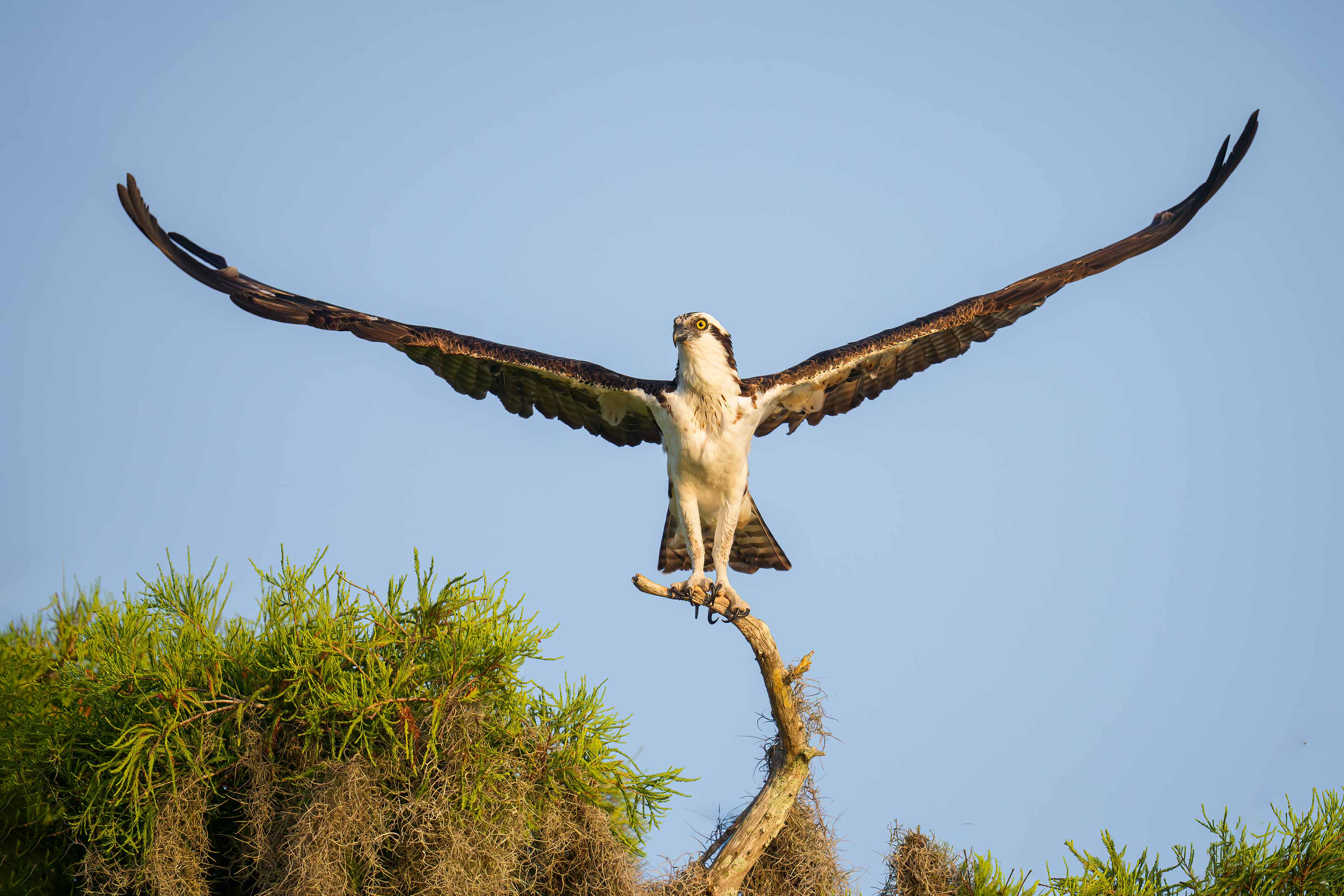
This image was also created on 25 May 2025 at Lake Blue Cypress, FL. Standing on a pontoon boat, I used the hand held Sony FE 400mm f/2.8 GM OSS Lens with the Sony FE 1.4x Teleconverter and The Latest Greatest Sony Flagship Body, the a1 II Mirrorless Camera. The exposure was determined via Zebras with ISO on the thumb dial. ISO 1250: 1/4000 sec. at f/4 (wide open) in Manual mode. RawDigger showed that the exposure was perfect. AWB at 7:05:38am on a sunny but haze morning.
Wide/AF-C with Bird Eye/Face Detection enabled performed perfectly. Click on the image to see a larger, sharper high resolution version
Image #2: Osprey — adult lifting off
Image copyright 2025 Arthur Morris/BIRDS AS ART
Once the Sun Brightened
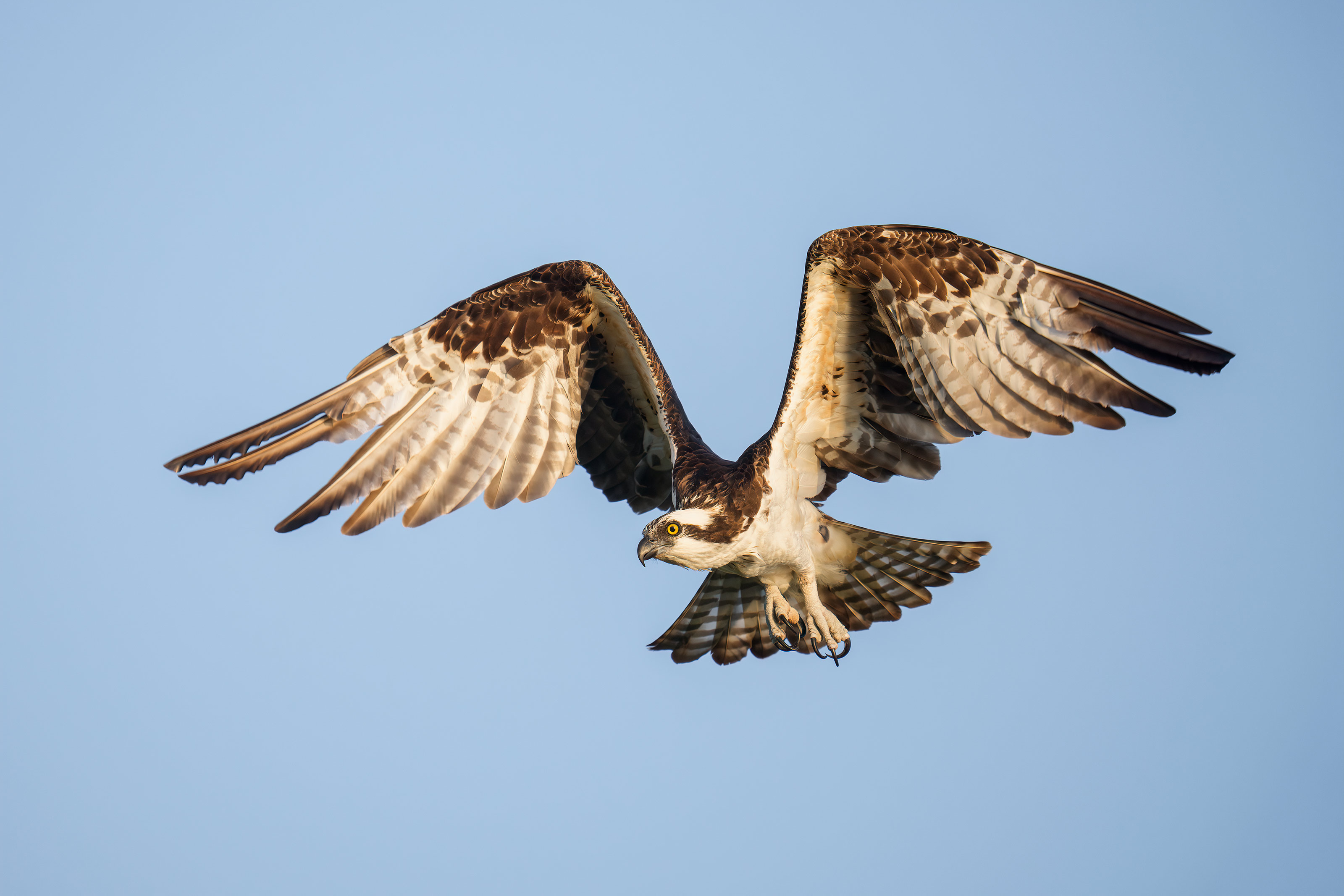
It was still early — about 35 minutes after sunrise, once the sun fought its way through the fog. When it did, I had enough light to add the 1.4X TC to get to 560mm and 1/4000 sec. without having to go to a ridiculously high ISO. Looking at Image #2 alone, it looks as if the bird might simply be raising its wings. After checking the EXIF for Image $3, how do we know that the bird in Image #2 was actually taking fight?
In any case, score another one for Pre-capture.
This image was also created on 25 May 2025 at Lake Blue Cypress, FL. Standing on a pontoon boat, I used the hand held Sony FE 400mm f/2.8 GM OSS Lens with the Sony FE 1.4x Teleconverter and The Latest Greatest Sony Flagship Body, the a1 II Mirrorless Camera. The exposure was determined via Zebras with ISO on the thumb dial. ISO 1250: 1/4000 sec. at f/4 (wide open) in Manual mode. RawDigger showed that the exposure was perfect. AWB at 7:05:38am on a sunny but haze morning.
Wide/AF-C with Bird Eye/Face Detection enabled performed perfectly. Click on the image to see a larger, sharper high resolution version
Image #3: Osprey — adult having just taken flight
Image copyright 2025 Arthur Morris/BIRDS AS ART
Hand Holding the 400mm f/2.8 GM Lens
Even though the Sony 400mm f/2.8 GM lens is only 4 ounces lighter than the 600mm f/4 GM, I find it much easier to hand hold (albeit only for short periods for flight photography) than the 600. Why? It is physically smaller and with much of the weight to the rear of the lens, better balanced.
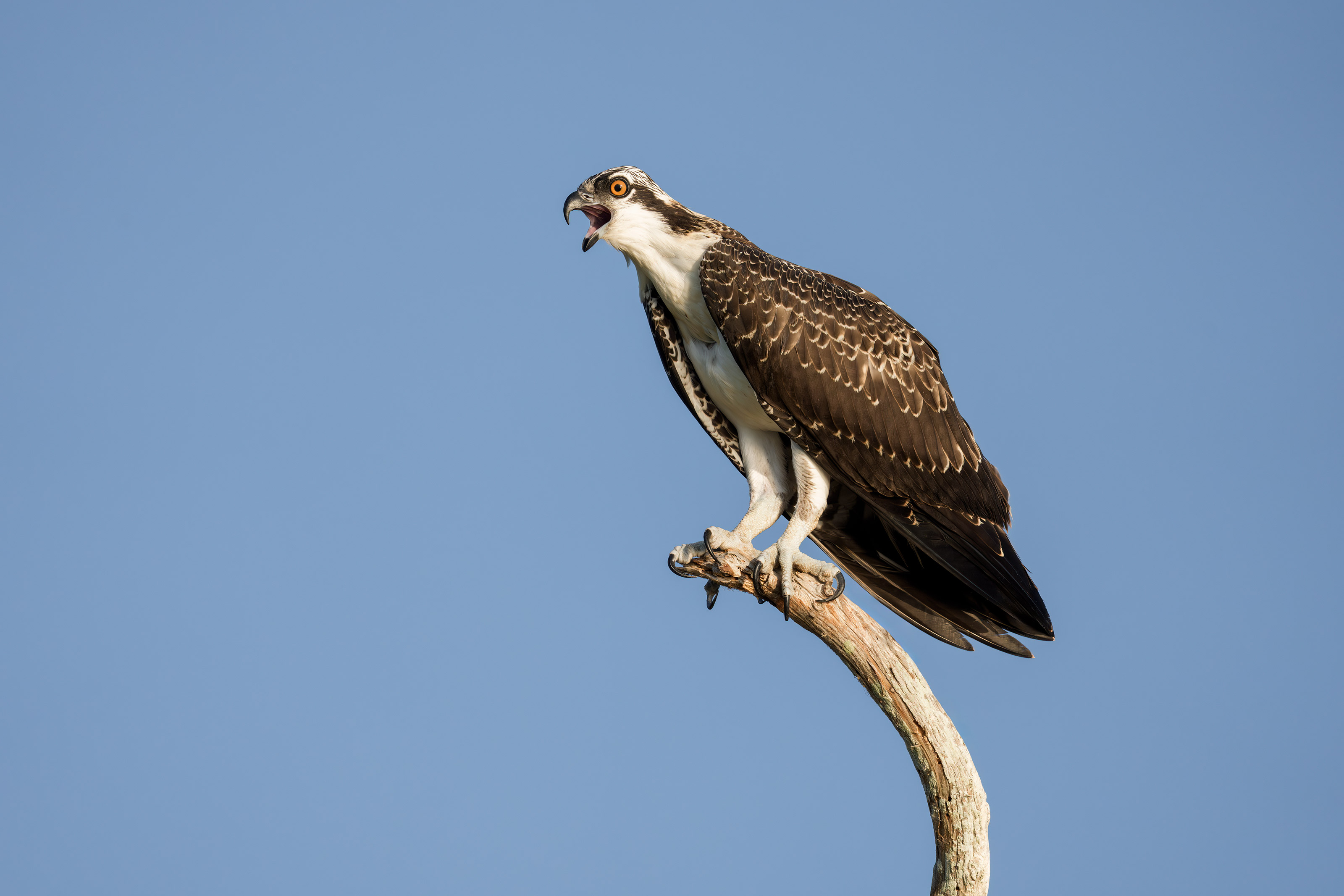
This image was also created on 25 May 2025 at Lake Blue Cypress, FL. Standing on a pontoon boat, I used the hand held Sony FE 400-800mm f/6.3-8 G OSS lens (Sony E) (at 760mm) and The Latest Greatest Sony Flagship Body, the a1 II Mirrorless Camera. The exposure was determined by Zebras with ISO on the rear wheel: ISO 2000: 1/3200 second at f/8 (wide open) in Manual mode. RawDigger showed that the exposure was dead solid perfect. AWB at 7:24:48am on a then sunny morning. Detection performed perfectly.
Wide AF-C with Bird Eye/Face Detection enabled performed perfectly. Click on the image to see a larger, sharper high resolution version
Image #4:Osprey — fresh juvenal plumage, calling
Images copyright 2025: Arthur Morris/BIRDS AS ART
As the Sun Approached Full Strength …
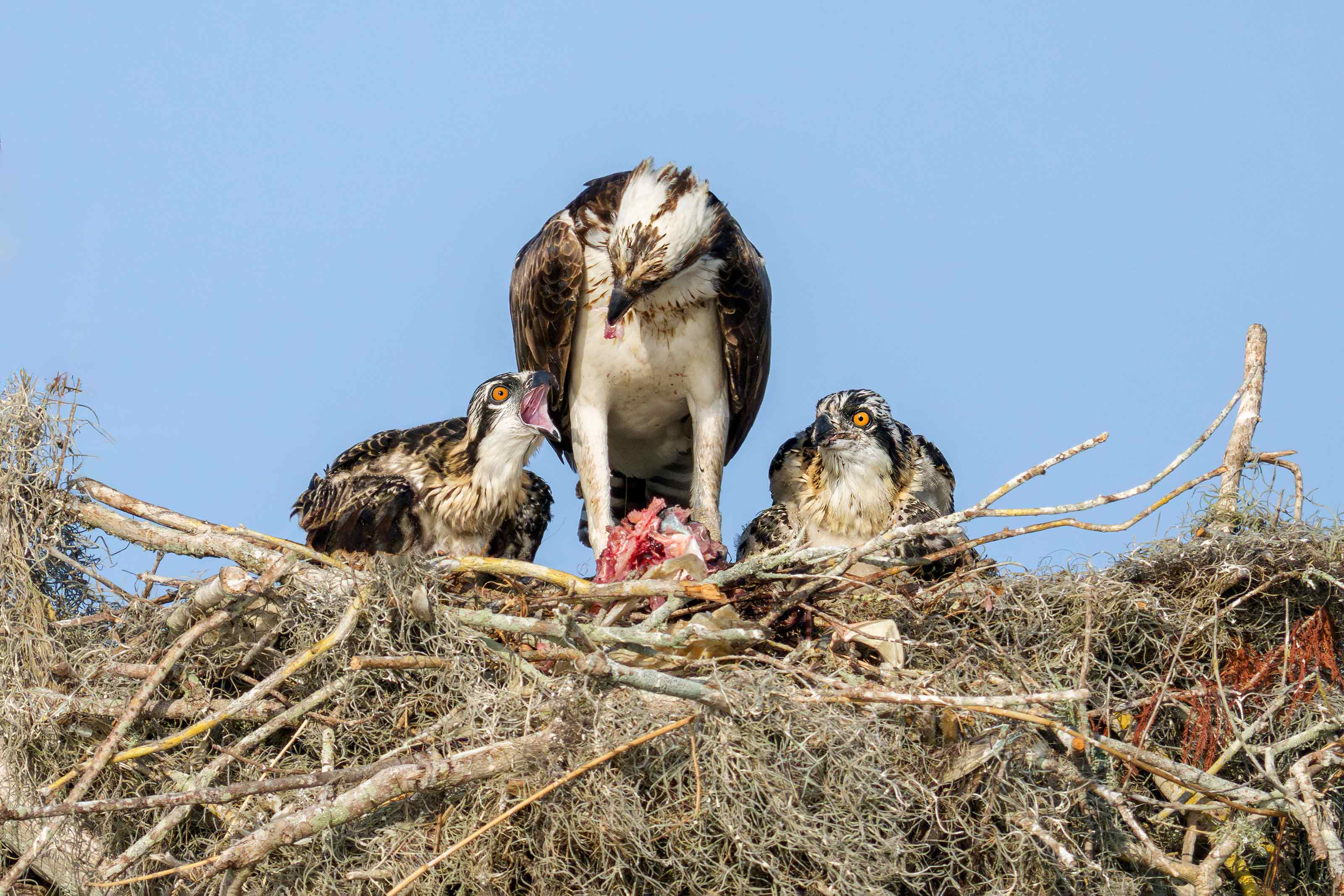
As the sun approached full strength, I put the 400 foot/2.8 away and grabbed the 400-800 for its versatility, its additional reach, its smaller size, and its lighter weight. It light years easier to hand hold the 4-8 than it is too hand hold the larger, heavier 600mm f/4 with the 1.4X TC added (to reach 840mm).
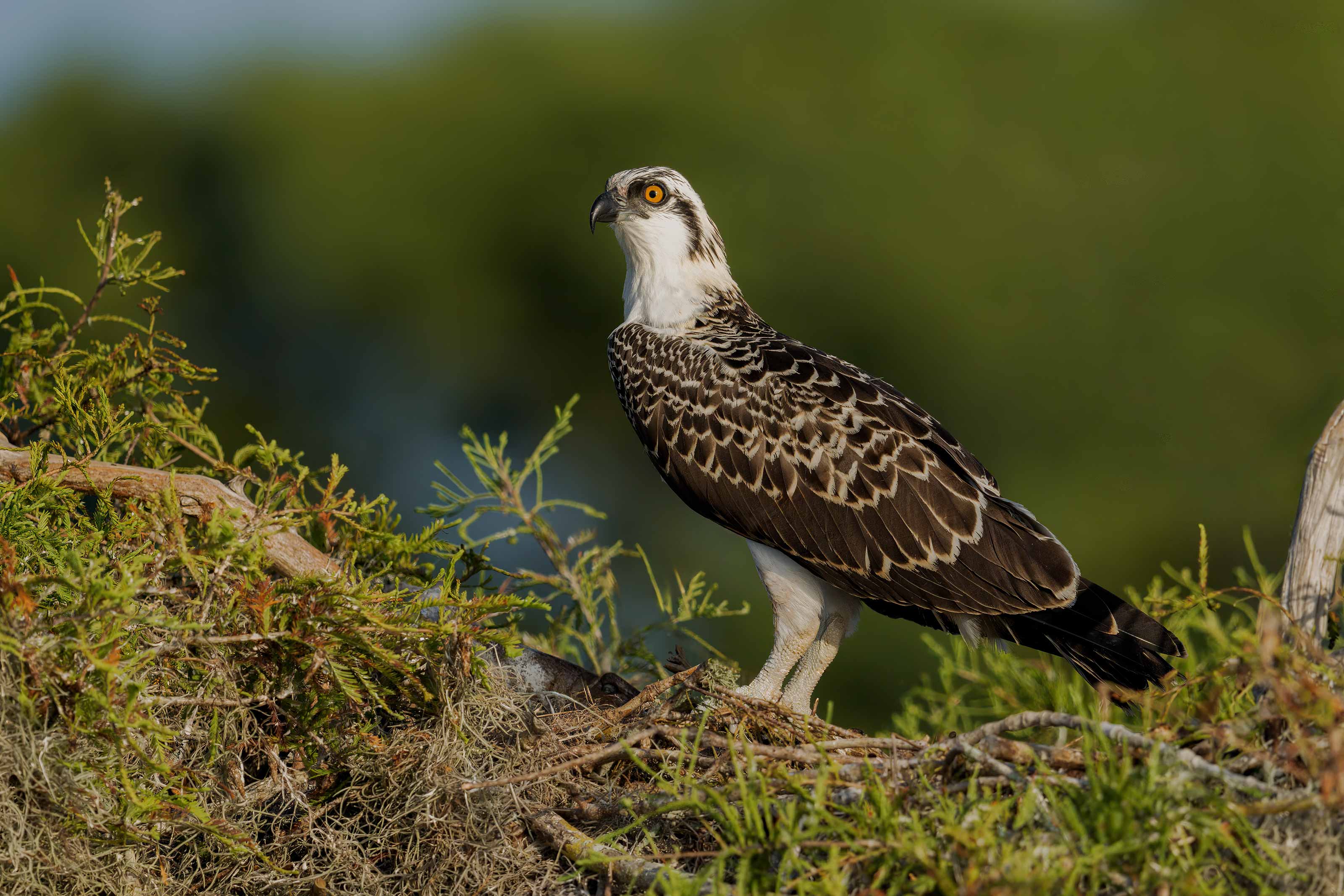
This image was also created on 25 May 2025 at Lake Blue Cypress, FL. Standing on a pontoon boat, I used the hand held Sony FE 400-800mm f/6.3-8 G OSS lens (Sony E) (at 730mm) and The Latest Greatest Sony Flagship Body, the a1 II Mirrorless Camera. The exposure was determined by Zebras with ISO on the rear wheel: ISO 2000: 1/4000 second at f/8 (wide open) in Manual mode. RawDigger showed that the exposure was dead solid perfect. AWB at 7:36:06am on a then sunny morning. Detection performed perfectly.
Wide AF-C with Bird Eye/Face Detection enabled performed perfectly. Click on the image to see a larger, sharper high resolution version
Image #5: Osprey — fresh juvenal plumage, on nest
Images copyright 2025: Arthur Morris/BIRDS AS ART
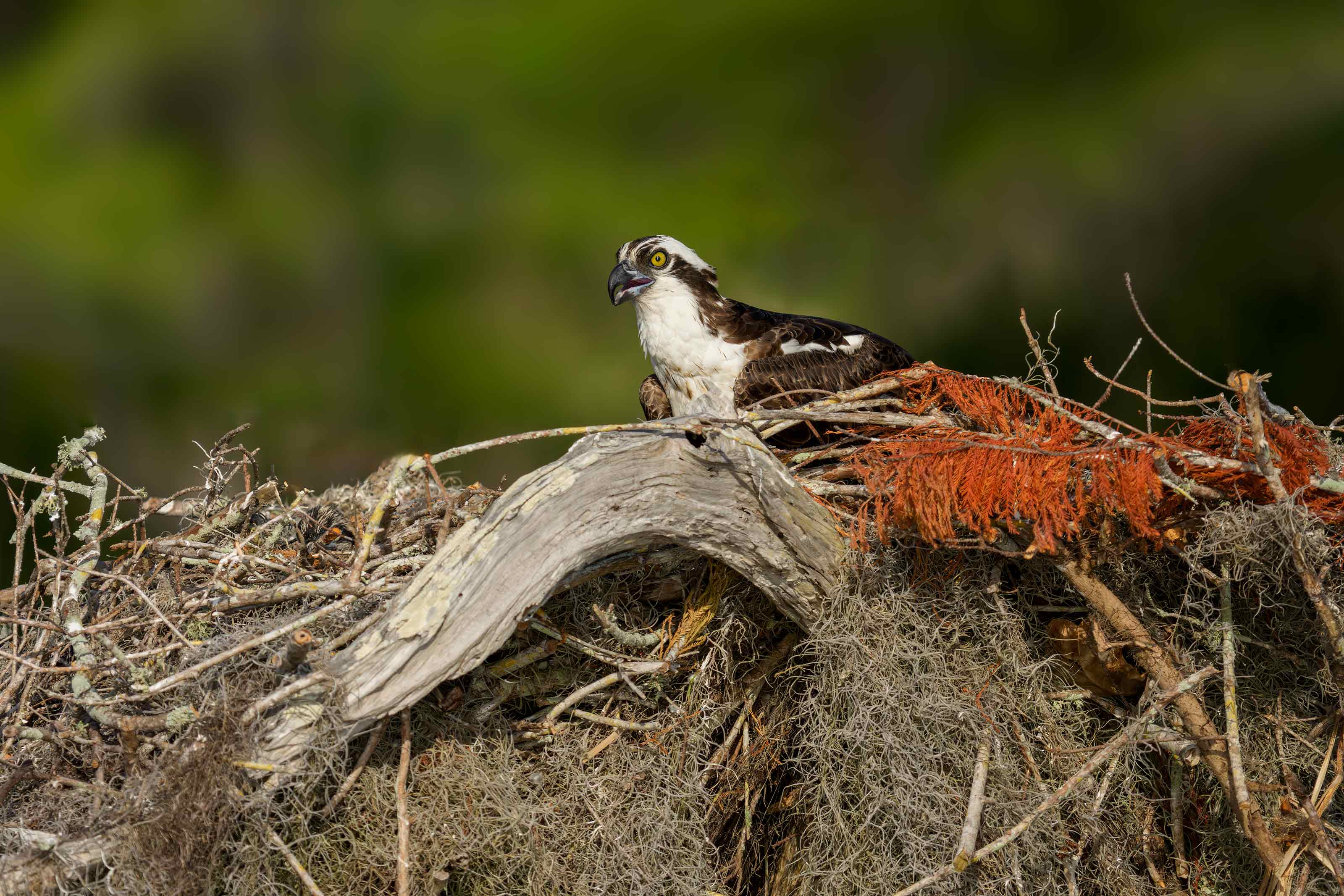
Positioning the Pontoon Boat
To get the green background, we directed Don, our skipper/guide, to position the boat so that the nest lined up with some distant trees. Such backgrounds, however, do not last forever as the boat drifts even in a light wind. Locals who wish to join me for a morning of In-the-Field Instruction on Lake Blue Cypress in early June with a wind from the east should contact me via e-mail.
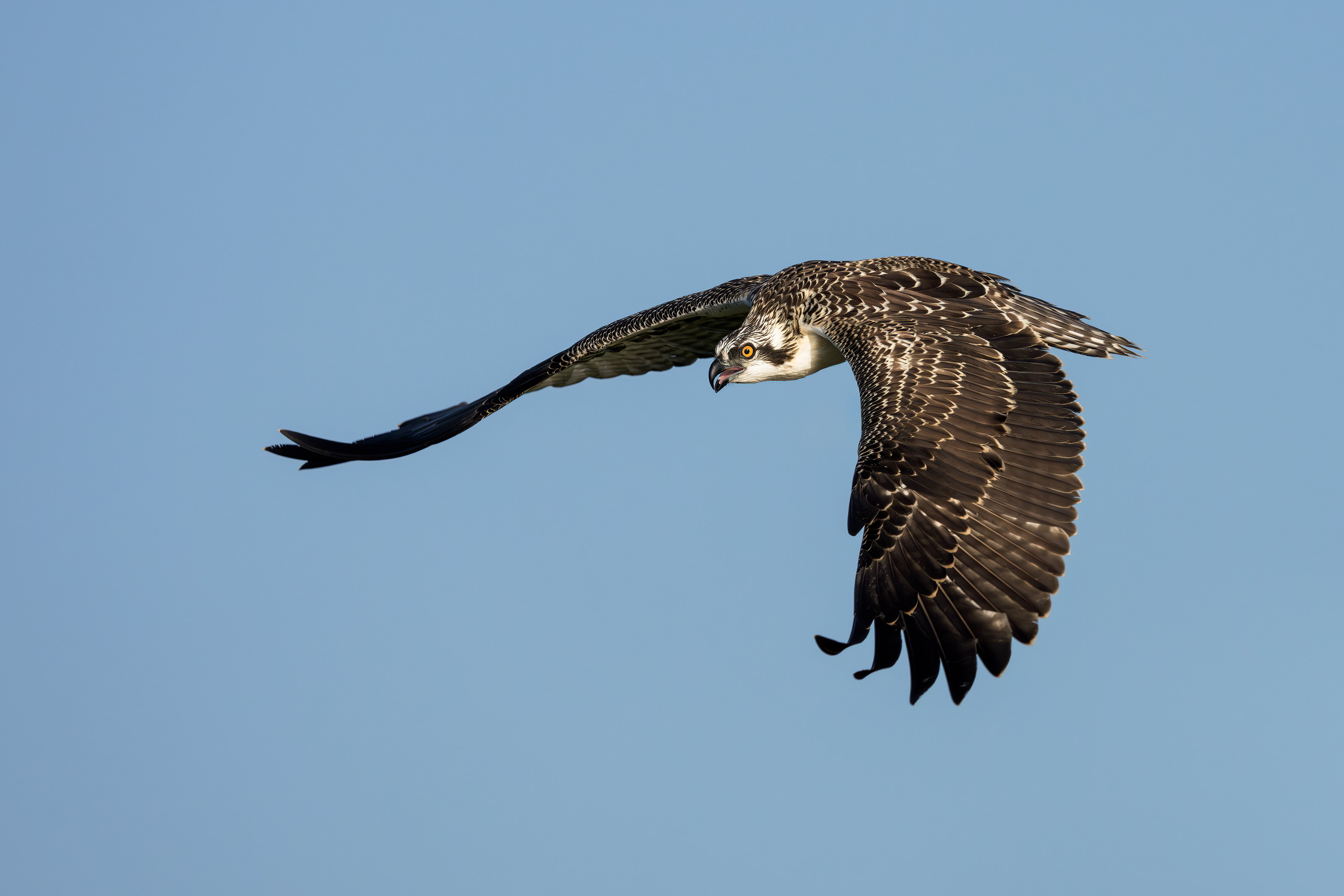
This image was also created on 25 May 2025 at Lake Blue Cypress, FL. Standing on a pontoon boat, I used the hand held Sony FE 400-800mm f/6.3-8 G OSS lens (Sony E) (at 400mm) and The Latest Greatest Sony Flagship Body, the a1 II Mirrorless Camera. The exposure was determined by Zebras with ISO on the rear wheel: ISO 1250: 1/4000 second at f/8 (wide open) in Manual mode. RawDigger showed that the exposure was dead solid perfect. AWB at 7:41:16am on a then sunny morning. Detection performed perfectly.
Wide AF-C with Bird Eye/Face Detection enabled performed perfectly. Click on the image to see a larger, sharper high resolution version
Image #6: Osprey — fresh juvenal plumage, in flight
Images copyright 2025: Arthur Morris/BIRDS AS ART
400-800 Versatility
Being able to zoom out smoothly and quickly to 400mm saved the day with this flight image. I would never have come close to fitting the bird in the frame at 800mm. Remember that the size of the bird in the frame is a function of the square of the focal lengths; in this case, 64 to 16.
Canon RF 200-800mm f/6.3-9 IS USM Lens (Canon RF)
I have been wanting to get my hands on this lens since a guy took me to task with his comment at a YouTube video. I was a bit surprised when Clemens showed up with is brand new Canon RF 200-800mm f/6.3-9 IS USM Lens (Canon RF) at Lake Blue Cypress. I have previously referred to this lens as an abomination because it changes length dramatically when zoomed in or out. The zoom mechanism was a bit smoother than I expected (as compared the Canon RF 100-500). The Sony 400-800 requires about an 80° twist of the wrist to get from 400 to 800mm or back again. With the Canon 200-800, getting from the wide end to the short end requires about a 120° turn. It is, therefore, impossible to get from one end to the other with a single motion.
Clemens of course realizes the limitations while stating, “It’s all they’ve got, but it is very sharp.” At only $1899.00, the 200-800 is priced $1400.00 less than the Sony 400-800 at $3298.00. He has of course, made some great images with the lens at Fort DeSoto. Most of the time, however, he reverts to using his 600mm f/4 with at 1.4X TC on a tripod. He loves his Canon EOS R5 Mark II Mirrorless Camera.
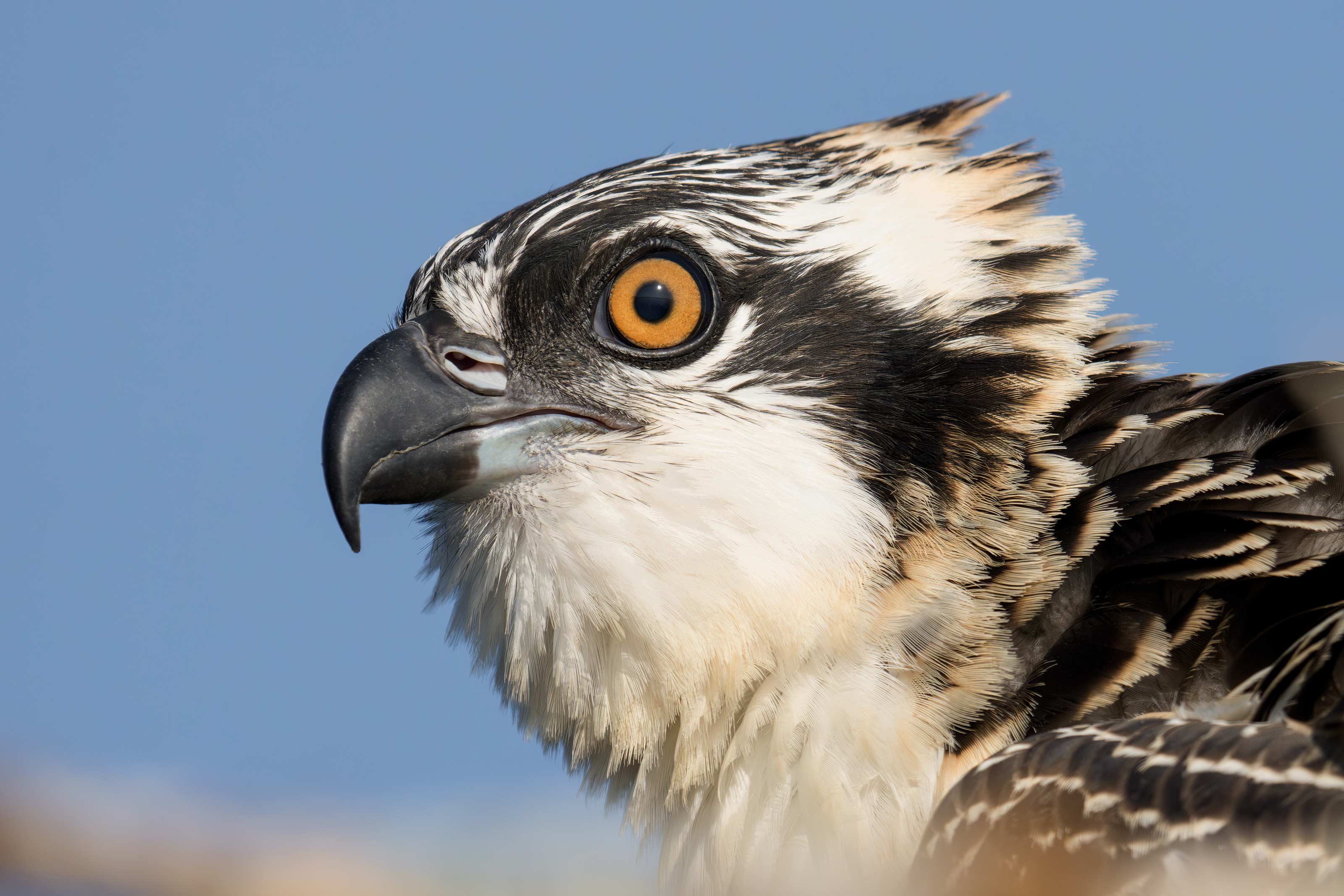
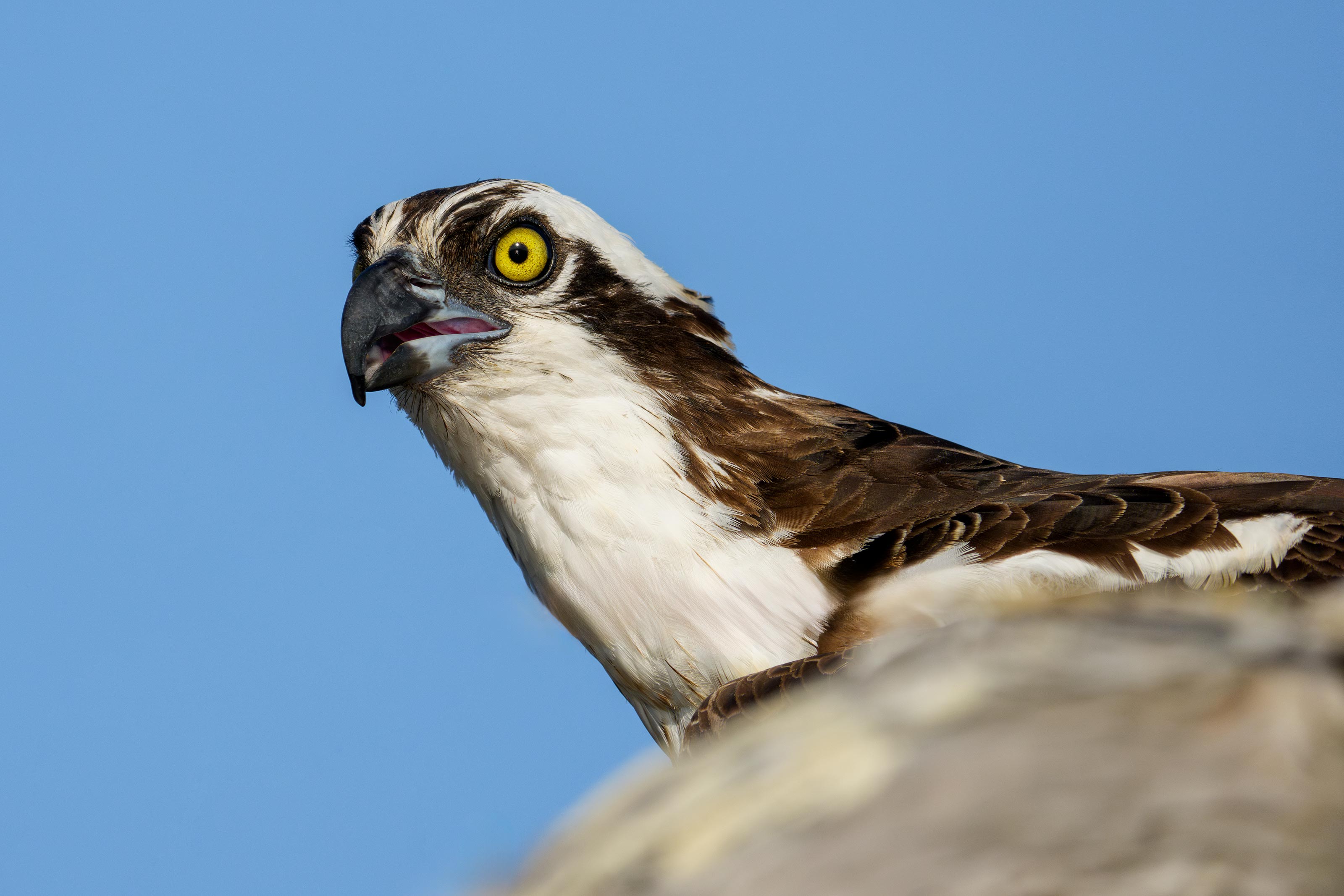
This image was also created on 25 May 2025 at Lake Blue Cypress, FL. Standing on a pontoon boat, I used the hand held Sony FE 400-800mm f/6.3-8 G OSS lens (Sony E) (at 800mm) and The Latest Greatest Sony Flagship Body, the a1 II Mirrorless Camera. The exposure was determined by Zebras with ISO on the rear wheel: ISO 1600: 1/4000 second at f/8 (wide open) in Manual mode. RawDigger showed that the exposure was dead solid perfect. AWB at 8:10:19 am on a still sunny morning.
Wide AF-C with Bird Eye/Face Detection enabled performed perfectly. Click on the image to see a larger, sharper high resolution version
Image #7: Osprey — fresh juvenal plumage, tight face portrait
Images copyright 2025: Arthur Morris/BIRDS AS ART
400-800 Minimum Focusing Distance (MFD)
At 800mm, the Sony 400-800 focusing down to 11.5 feet. I was not much farther away than that when I created this image at a fortunately low nest.
The BIRDS AS ART SONY 400-800mm f/6.3-9 G Super-telephoto Zoom Lens Guide
When I borrowed this lens from Sony, I assumed that at 5.45 pounds it was too heavy to handhold for long and that at f/8 at the long end (800mm,) it was too slow for most bird photography applications. In short, I did not want to like the lens. After a month of using it, I cannot live without it. After returning the loaner, I was miraculously able to get my own from Bedfords on 16 April 2025. In this guide I share everything that I have learned about using the 400-800. For best results, you need to know exactly what you are doing to get the most out of this zoom lens. It would be best, therefore, to consider and study the material in the guide so that you can begin making great images with your new lens.
You will learn how to deal with the relatively show apertures: f/6.3, f/7.1, and f/8 when working in Manual mode.
You will learn how to ensure that you are working at the widest aperture by working in Shutter Priority mode with AUTO ISO.
If you are able to hand hold the lens, you will learn proper hand holding techniques.
If you can’t, you will learn when, why, and how to employ other options. Those include:
1- The knee-pod, heel-pod, and toe-pod techniques
2- Using the lens on a monopod.
3- The best lens plate for your 4-8.
4- The best tripod and head for the 4-8 and how best to utilize them.
5- How to use the lens from your vehicle while supporting it on a BLUBB (or not and why not).
6- Detailed instructions on how to set and use the lens controls and buttons:
a- AF/MF
b- DMF Switch
c- Limit Range Switch
d- OSS (Optical Steady Shot) Switch
e- OSS Mode Switch
f- Focus Hold Buttons
The guide also includes a Hand Holding Shutter Speed Primer and an illustrative, educational, and inspiring image gallery.
Free to folks who use one of my two affiliate links to purchase their Sony 400-800 G lens. Otherwise, please send a PayPal for $115.43 to birdsasart@verizon.net and include the words “400-800 Lens Guide” in your e-mail.
Typos
With all blog posts, feel free to e-mail or to leave a comment regarding any typos or errors.
About a week ago, I had three Greater Yellowlegs fly in left of the pier as I was driving away 🙁 I had never seen even one before. On Tuesday and Wednesday, a first-ever Sanderling visited the beach left of the pier, SOP (South of Pier) Bay. It has been difficult to keep track of the crane colts as some of the families are beginning to disperse. I am pretty sure that at least seven of the 12 chicks that hatched this season are doing well.
While clearing space on my laptop, I checked my ILE folders from last spring and learned that I was right: good sized flocks of Black-bellied Whistling Ducks were present until early July. They have been very scarce for the past two weeks but I did have some good flight chances when a small group flew in at about 7:30am on Friday morning.
Today is Saturday 24 May 2025 and I will be heading down to the lake early as is usual when I am home. Whatever you opt to do, I hope that you too choose to have a wonderful and productive day. Do remember that happiness is a choice — Byron Katie, The Work.Com.
If an item — a Delkin flash card or a Levered-clamp FlexShooter Pro — for example, that is available from B&H and/or Bedfords, is also available in the BAA Online Store, it would be great, and greatly appreciated, if you would opt to purchase from us. We will match any price. Please remember also to use my B&H affiliate links or to earn 3% cash back at Bedfords by using the BIRDSASART discount code at checkout for your major gear purchases. Doing either often earns you free guides and/or discounts. And always earns my great appreciation.
Don’t Just Shoot: Learn
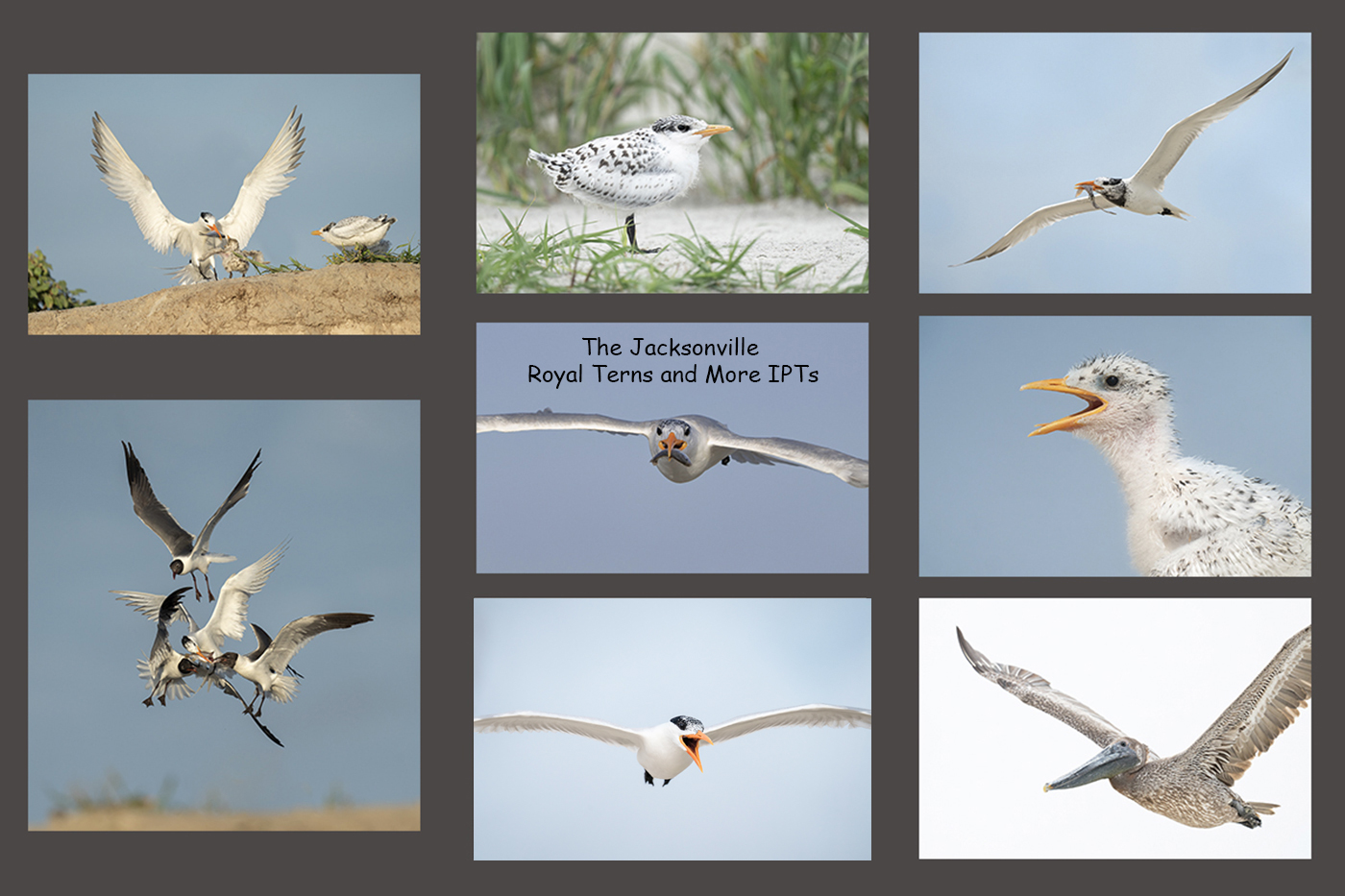
To learn of the late-registration discounts and AirrBnB availability for the Jackonsville Royal Terns with chicks and more extended IPT late June/early Julyl, or If you are interested in changing your life and becoming a better photographer by joining me on an Extended IPT at Sebastian Inlet for Ospreys and more (SEPT 25 to NOV 24, 2025) or in San Diego for Pacific-race Brown Pelicans and more (JAN 6 to FEB 2, 2026), please e-mail for dates, rates, terms, and additional information. Or shoot me a text to 863-221-2372. Both offerings include options for shared AirBnB lodging and ground transportation during your stay.
BILD EXPO Presented by B&H
Why Attend? BIRDS AS ART Appearances, Speakers, Gear, Deals, and More!
I am pleased to announce that I will be doing portfolio reviews and four round table sessions at BILD this June. Here are the round table topics:
1- Systems, Lenses, and Camera Bodies for Bird Photography
2- Creating Sharp Bird Photographs
3- Bird Photography Hotspots
4- Creating Bird Photographs that depict Flight, Action, and Behavior
Stay tuned for a definitive schedule. I hope to see you there.
Bild Expo is back! Join us at The Javits Center in New York City for an unforgettable event featuring 100+ expert speakers, 250+ exhibitors, hands-on experiences, and the world’s greatest creative community. B&H’s incredible show specials will be the icing on the cake! Whether you’re a seasoned pro, an enthusiast, or a beginner, at Bild you will get inspired, learn, meet like-minded people, and celebrate being part of this amazing world of creativity.
Click here or on the logo link above for more information.
To ensure that I get credit for your B&H purchases, you can always click here. The tracking is invisible but greatly appreciated. And, you can use your PayBoo card. You must use the website to order. You cannot get your free guides if you make a phone order. Once you have an item in your cart, you must complete the order within two hours. Huge thanks!
Bedfords Simplified
Click here to start your search. Choose standard shipping, and when you get to the payment page, enter BIRDSASART in the discount code box and hit apply. You will be upgraded to free second day air Fed-Ex and receive 3% cash back on your credit card once your stuff ships. Either is greatly appreciated by yours truly.
B&H
Many folks have written recently stating that they purchased a Sony a1 from B&H and would like their free membership in the Sony 1 Info and Updates Group, a $150.00 value. But when I check my affiliate account, their orders have not been there. When I let them know that they get credit for B&H purchases only if they use one of the many B&H affiliate links on the blog or begin their searches with this link, they are always disappointed. If in doubt, please contact me via e-mail and request a BH link. I am always glad to help and to guide you to the right gear.
Bedfords Amazing BAA Discount Policy
Folks who have fallen in love with Bedfords can now use the BIRDSASART coupon code at checkout to enjoy a post-purchase, 3% off-statement credit (excluding taxes and shipping charges) on orders paid with a credit card. The 3% credit will be refunded to the card you used for your purchase. Be sure, also, to check the box for free shipping to enjoy free Second Day Air Fed-Ex. This offer does not apply to purchases of Classes, Gift Cards, prior purchases.
Visit the Bedfords website here, shoot Steve Elkins an e-mail, or text him on his cell phone at (479) 381-2592.
Gear Questions and Advice
Too many folks attending BAA IPTs and dozens of photographers whom I see in the field and on BPN, are — out of ignorance — using the wrong gear, especially when it comes to tripods and more especially, tripod heads. And the same is true in spades when ordering new camera bodies or lenses. My advice will often save you some serious money and may help you avoid making a seriously bad choice. Please know that I am always glad to answer your gear questions via e-mail. If you are desperate, you can try me on my cell at 863-221-2372. Please leave a message and shoot me a text if I do not pick up.
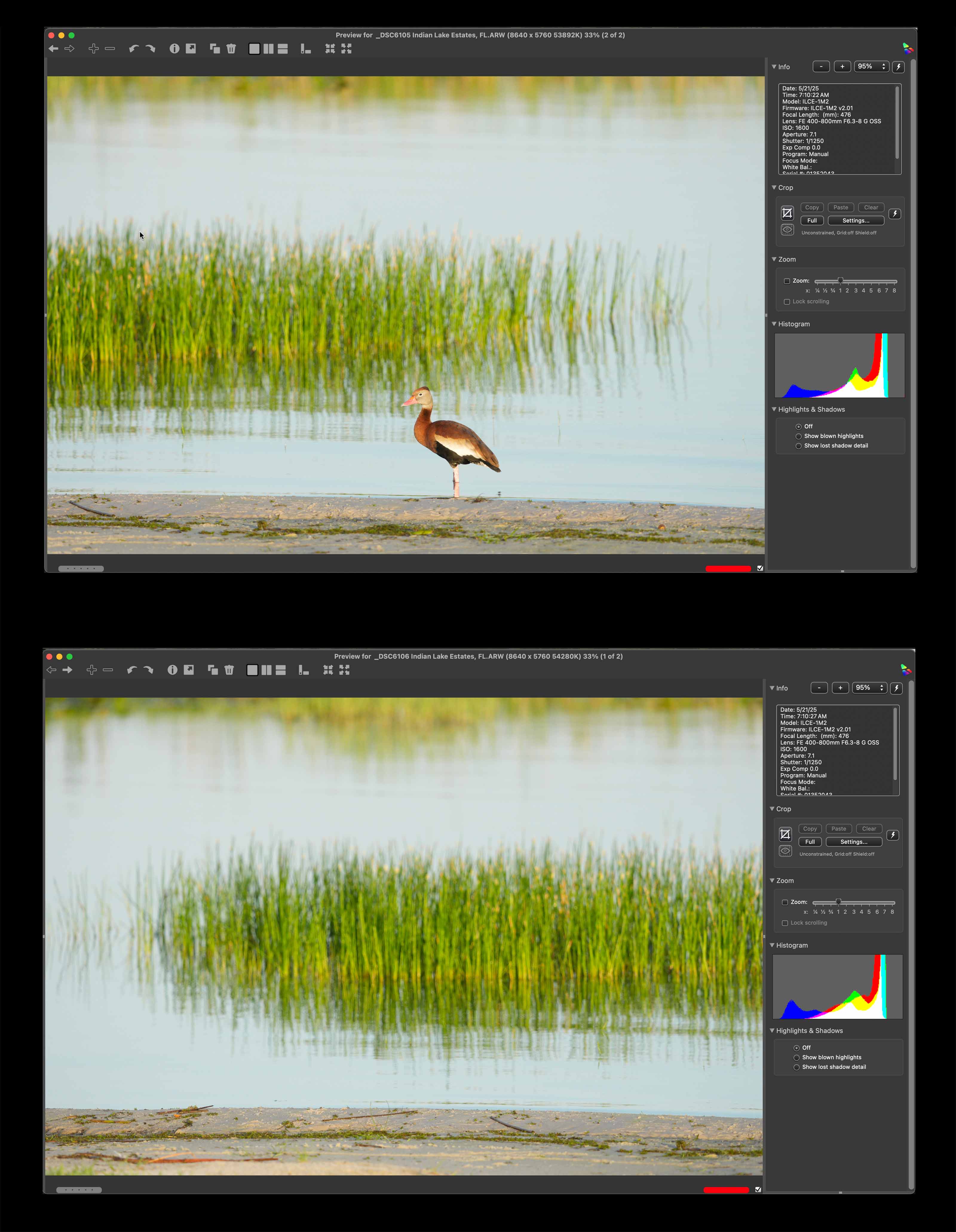
These two images were created on 21 May 2025 down by the lake near my home at Indian Lake Estates, FL. Working from the driver’s seat of my SUV, I used the BLUBB-supported/hand held Sony FE 400-800mm f/6.3-8 G OSS lens (Sony E) (at 476mm) and The Latest Greatest Sony Flagship Body, the a1 II Mirrorless Camera. The exposure was determined by Zebras with ISO on the rear wheel: ISO 1600: 1/1250 second at f/7.1 (wide open) in Manual mode. RawDigger showed that the exposure was dead solid perfect.
Top image: AWB at 7:10:22am on a windless, hazy, sunny morning. Tracking: Spot XS AF/C with Bird-Eye/Face Detection performed perfectly
Bottom image: AWB at 7:10:27am on a windless, hazy, sunny morning. Manual focus
Click on the composite to better be able to read the fine print
Image #1:The two raw files for the Black-bellied Whistling Duck stitched pano below
Images copyright 2025: Arthur Morris/BIRDS AS ART
Creating a 2-Frame Stitched Panorama with a Super Telephoto or Super-telephoto Zoom Lens
1- Visualize the image.
2- Set the exposure in Manual mode.
3- If using a zoom lens, zoom to the desired focal length.
4- Create the frame with the bird in it with autofocus active, i.e., turned on. Note that for frame _DSC6105 I used the joystick to move the AF point to cover the bird.
5- Being careful not to change anything, move the AF switch to Off, reframe, and create the second image after allowing for 15% or so overlap.
6- Use your post processing skills to bring the two images together seamlessly. As below.
Note: this is a lot easier to do when you are on using a zoom lens on a tripod than when hand holding or working on a BLUBB- as there is less chance of changing the focal length when you move the AF switch to go to Manual focus. The added advantage of being on a tripod is that it is much easier to keep the lens square to the world when you pan.
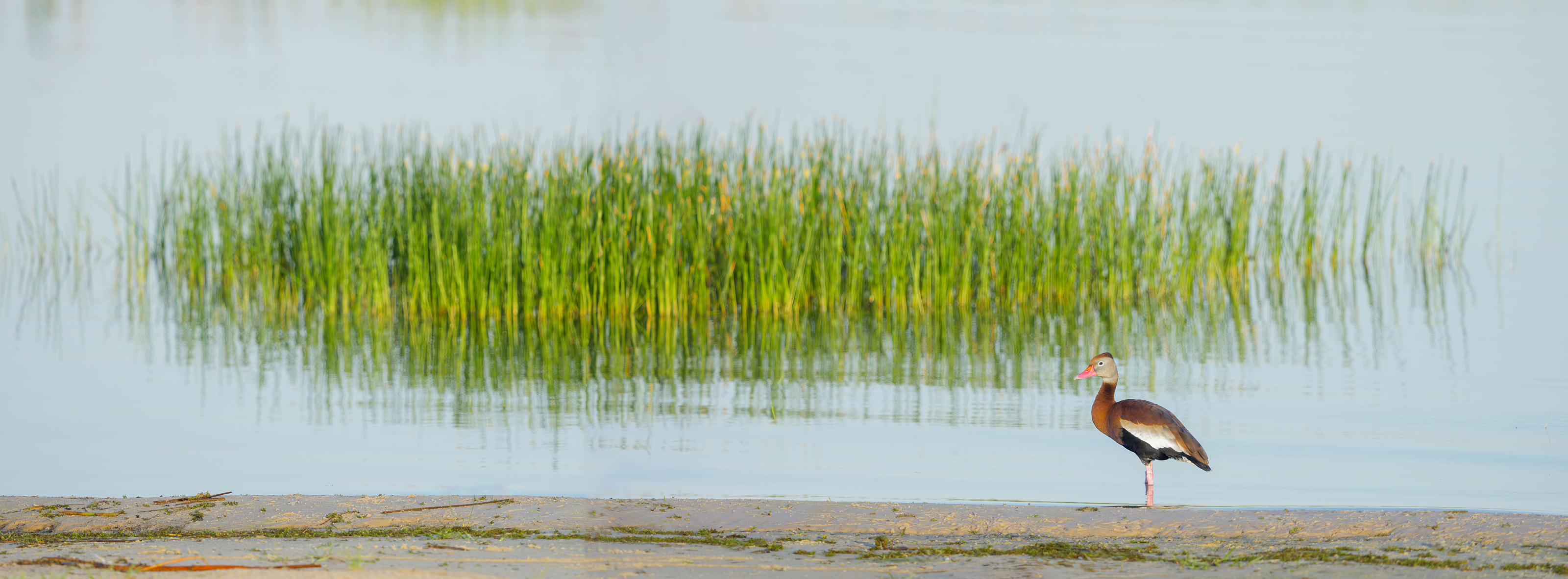
These two images were created on 21 May 2025 down by the lake near my home at Indian Lake Estates, FL. Working from the driver’s seat of my SUV, I used the BLUBB-supported/hand held Sony FE 400-800mm f/6.3-8 G OSS lens (Sony E) (at 476mm) and The Latest Greatest Sony Flagship Body, the a1 II Mirrorless Camera. The exposure was determined by Zebras with ISO on the rear wheel: ISO 1600: 1/1250 second at f/7.1 (wide open) in Manual mode. RawDigger showed that the exposure was dead solid perfect.
Top image: AWB at 7:10:22am on a windless, hazy, sunny morning. Tracking: Spot XS AF/C with Bird-Eye/Face Detection performed perfectly.
Bottom image: AWB at 7:10:27am on a windless, hazy, sunny morning. Manual focus.
Click on the image to view the larger, inexplicably sharper high res version
Image #2: Black-bellied Whistling Duck stitched pano
Images copyright 2025: Arthur Morris/BIRDS AS ART
Elevation Question
When I visualized this two-frame stitched pano, my vehicle was on the beach. Fortunately, there is a small hill, perhaps 10 or 12 feet high, behind the bathroom building near the parking circle. Most conveniently, the hill was right on sun angle. What is the main reason that I drove to the top of the hill to create the two images that I needed to create the stitched panorama?
Note: I could have grabbed the 70-200, made a single image, and cropped to a pano? I did not that for two closely related reasons:
1- to get a lot more pixels on the subject.
2- to create a much larger image file.
Typos
With all blog posts, feel free to e-mail or to leave a comment regarding any typos or errors.
Sony FE 50-150mm f/2 GM Lens (Sony E) in Stock Tomorrow at Bedfords
Order your copy of this super-fast zoom lens right now from Bedfords by clicking here and be sure to add the BIRDSASART discount code at checkout to get 3% back on your credit card and free second day air FedEx shipping. It will show as a back order but Steve assured me that you will get yours this week.
High-Speed Portrait Zoom
Uniquely fast and versatile, the Sony FE 50-150mm f/2 GM Lens (Sony E) is a normal- to short-telephoto zoom distinguished by its impressively bright f/2 constant maximum aperture. Ideal for portraiture, weddings, events, and indoor and close-range sports, this lens is also a good choice for photographers and videographers looking to replace a handful of primes with a single fast zoom without sacrificing on speed.
G Master Performance
Sony’s G Master designation is reserved for its highest performing optics, those that offer the greatest sharpness, smoothest bokeh, utmost speed, and best overall performance. This 50-150mm f/2 checks all of these boxes as it sets out to be a single lens replacement for several primes.
Constant f/2 maximum aperture is a full stop faster than an f/2.8 lens, helping this zoom to further excel in low-light conditions and offering even greater control over depth of field and subject-background separation.
XA, Super ED, aspherical, and ED elements yield high sharpness and smooth rendering that suits subjects ranging from architecture and landscape to portraiture and weddings.
Internal focusing design promotes quicker focusing speeds and maintains the lens length during use.
Internal zoom maintains the overall length of the lens during operation, as well as keeps a consistent center of gravity for easier use on a gimbal or tripod.
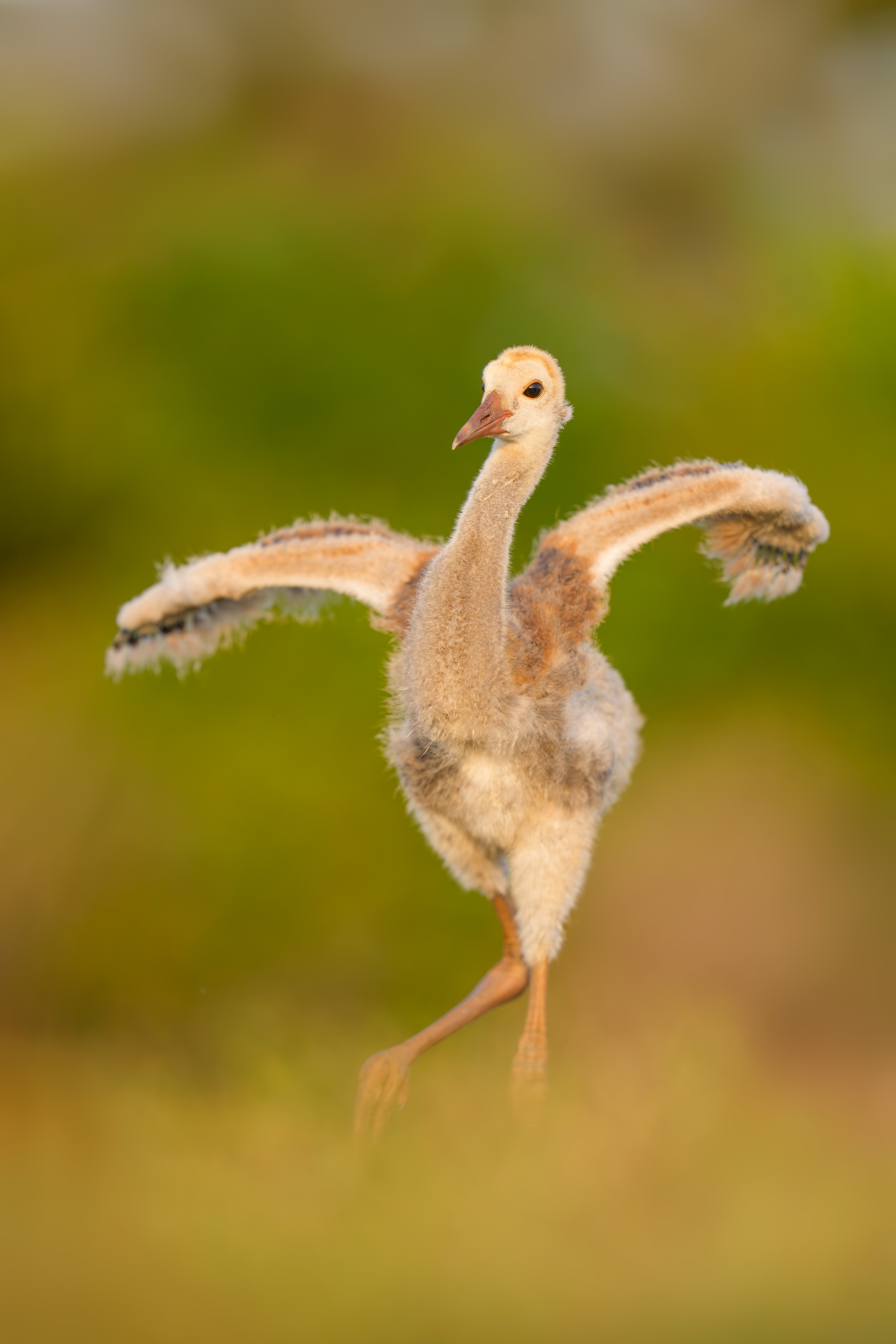
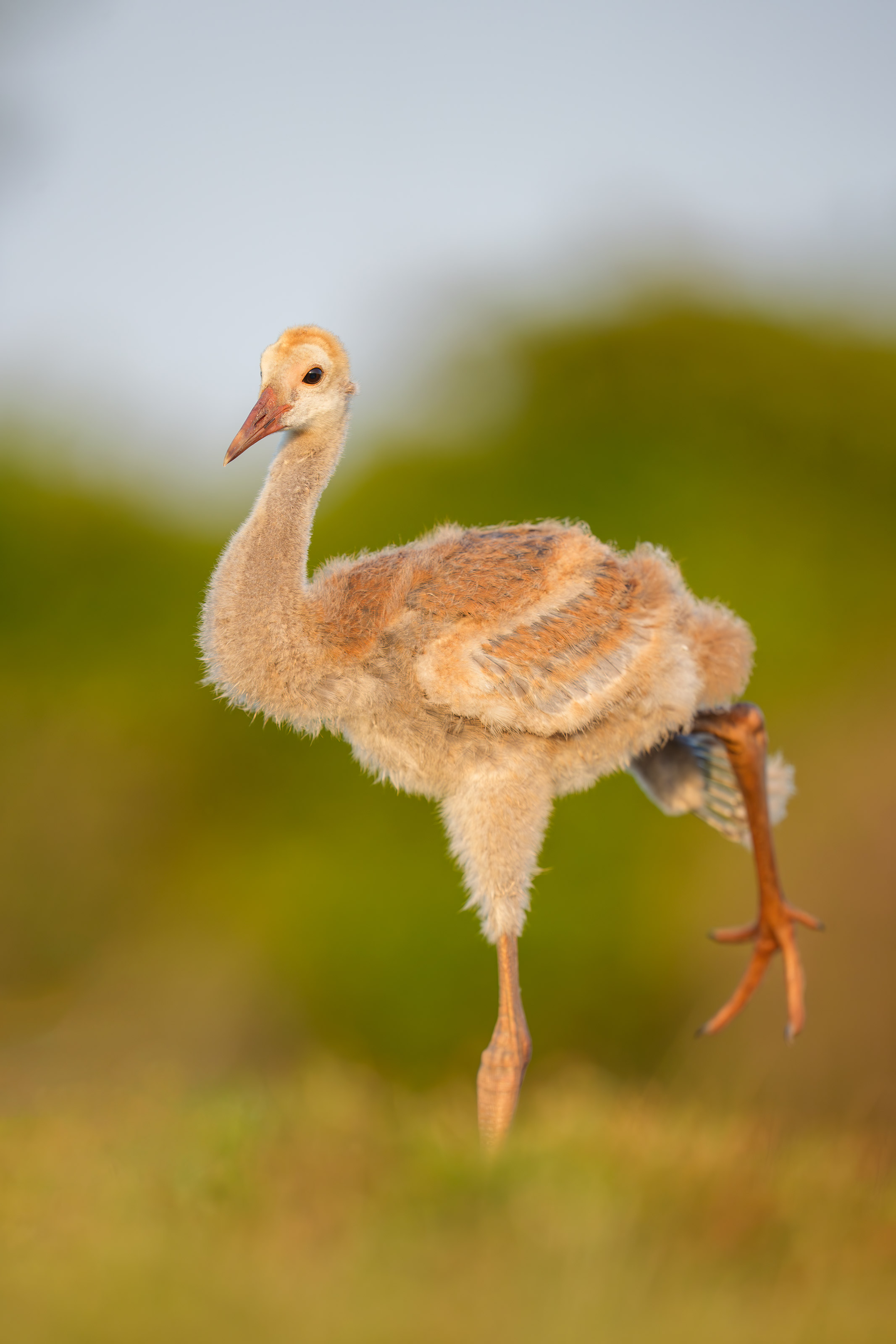
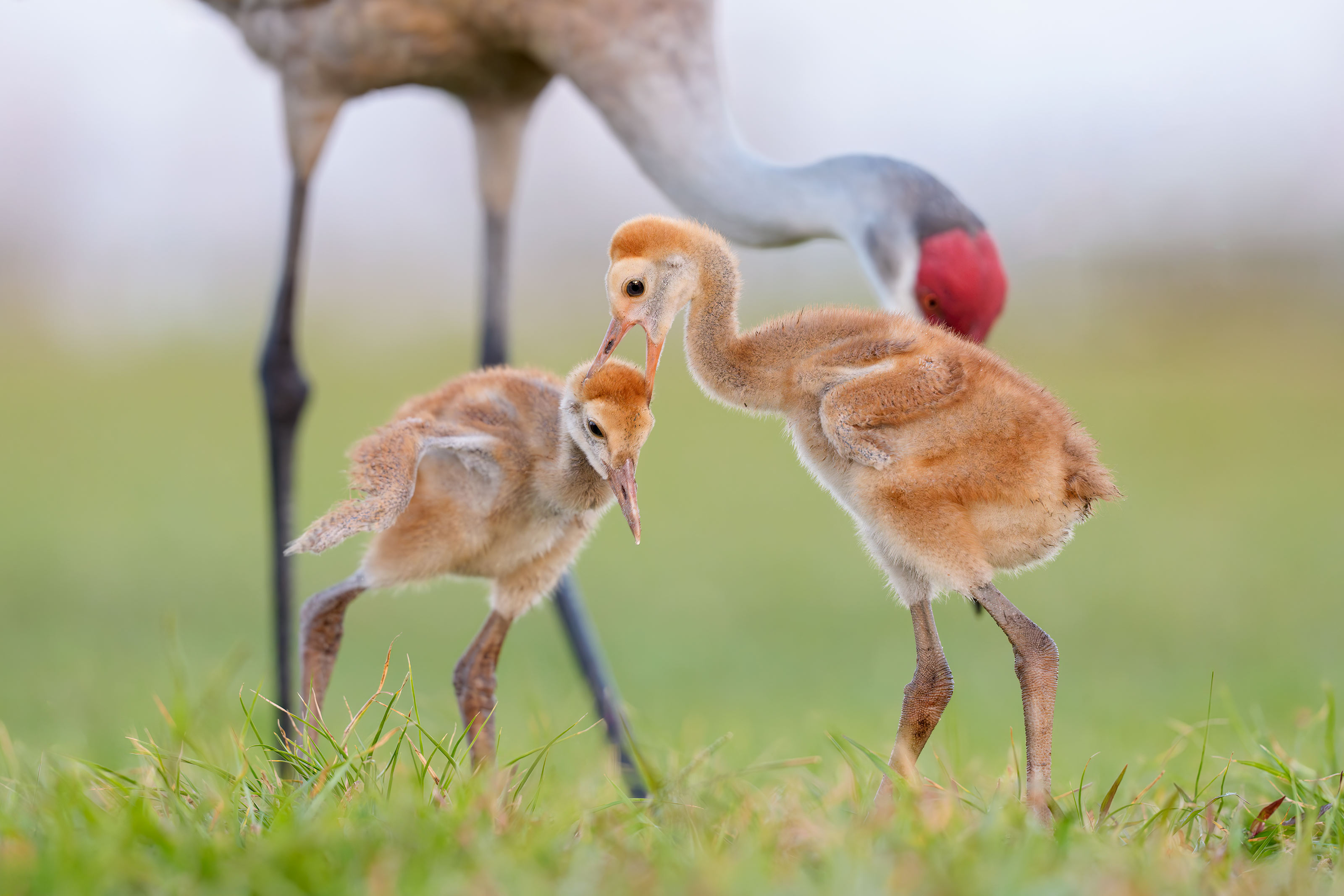
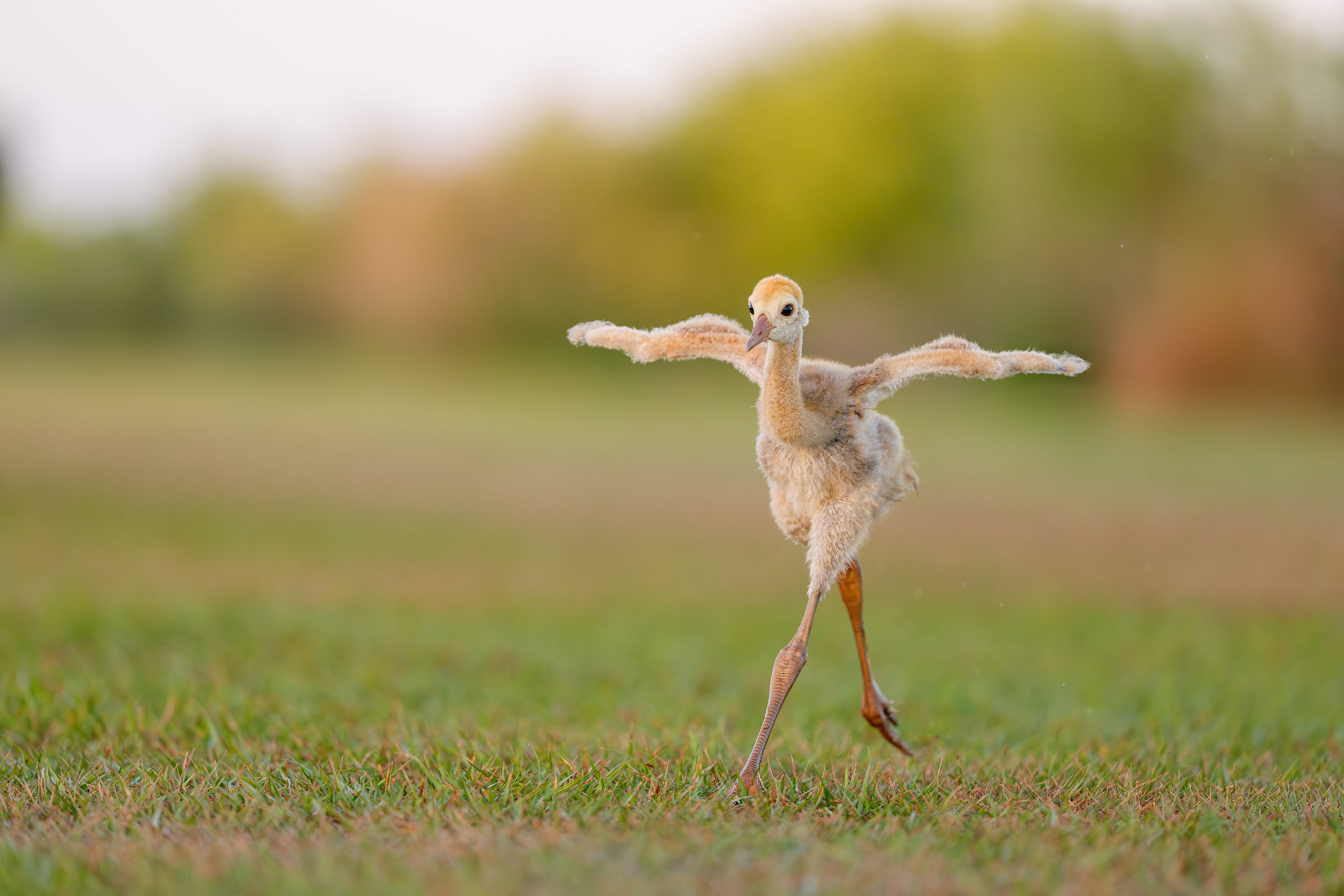
Crane Colt Picking Your Keepers by Arthur Morris/BIRDS AS ART
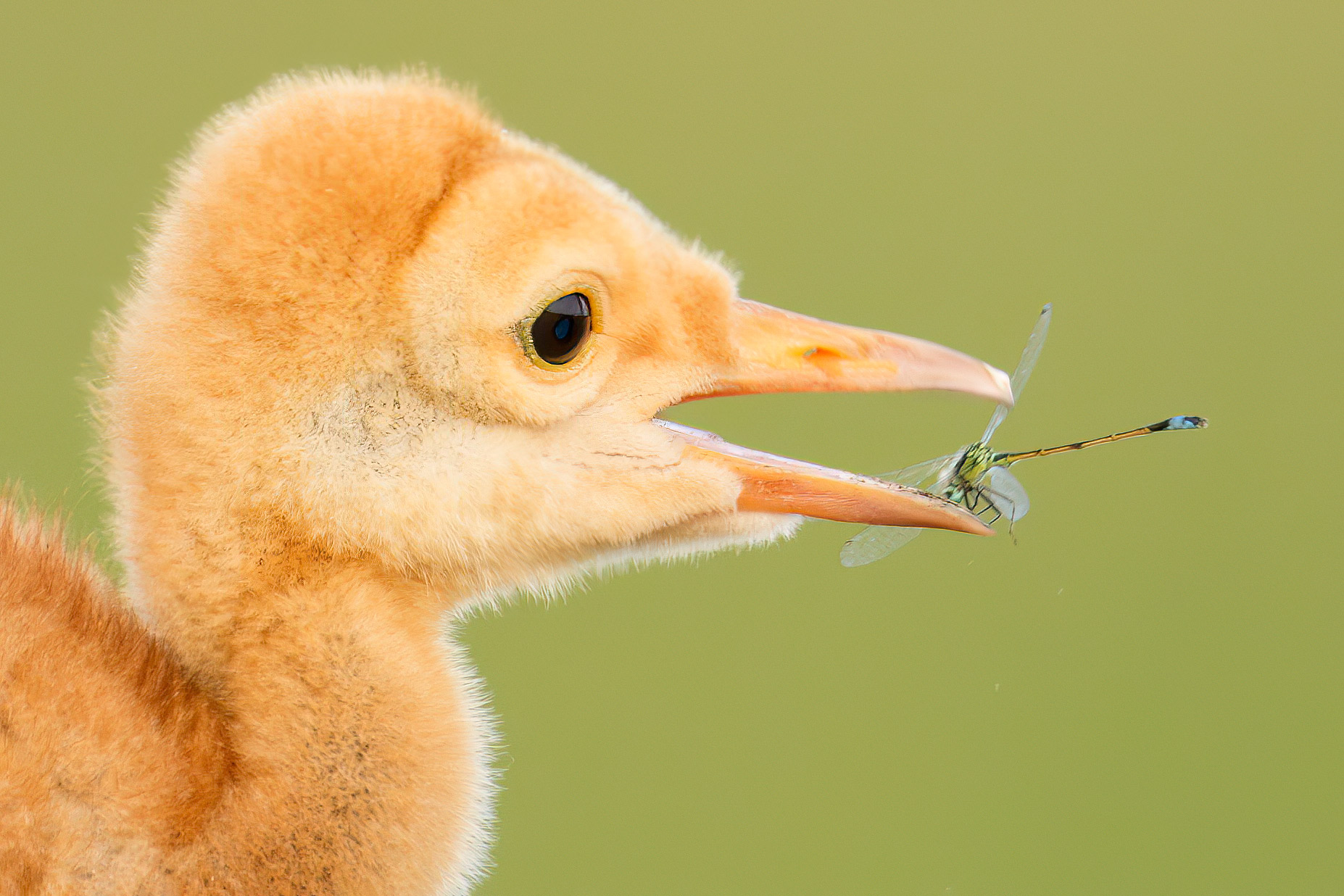
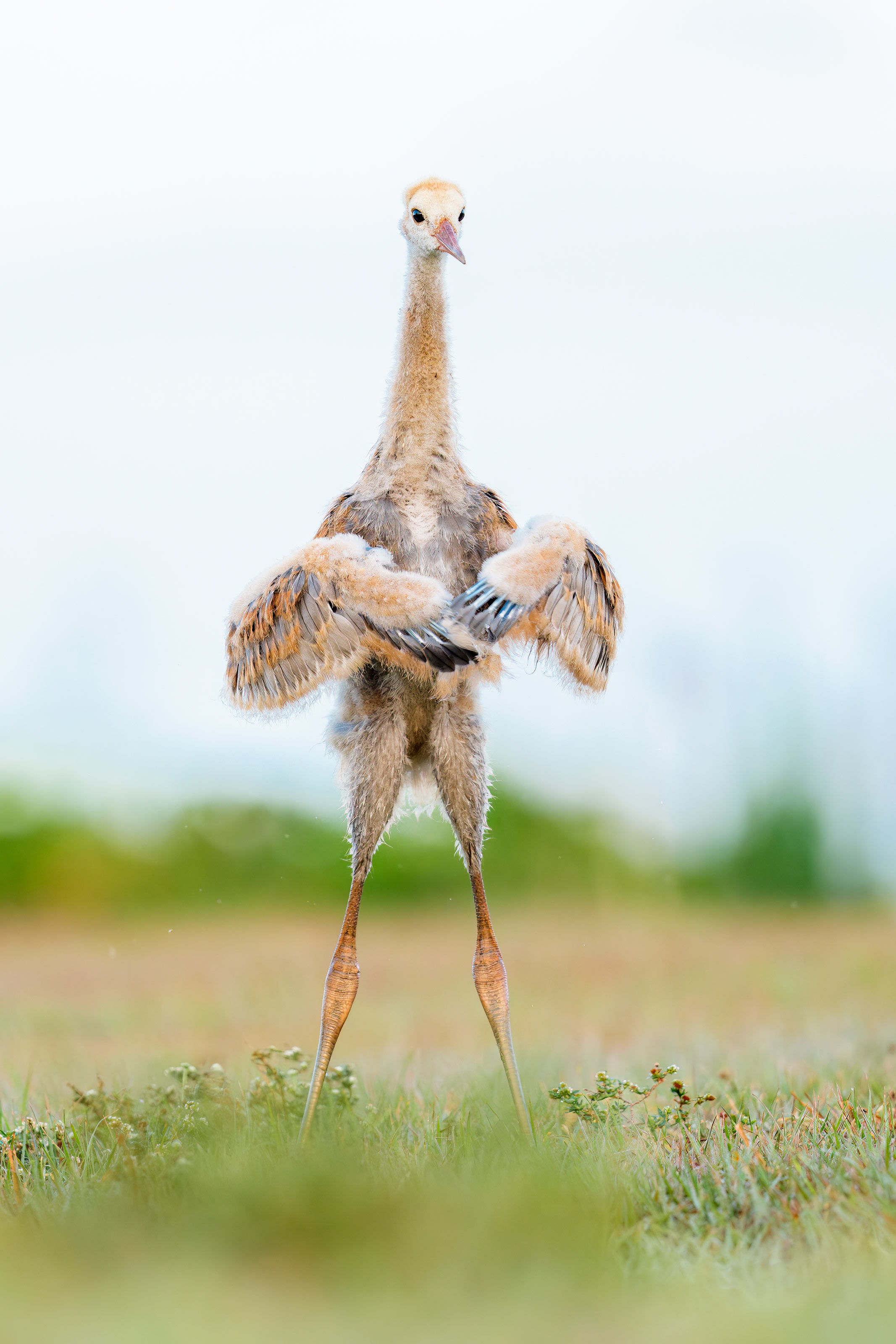
A handsome Sandhill Crane colt posed for almost two minutes while I created about 180 very similar photos. In this very short video check out six of my favorite keepers and learn why I deleted three and why I kept three To learn how to add or subtract color to your backgrounds by changing your elevation, keep reading below.
Your Call?
Which is the stronger of today’s two featured images? Why did you make your choice?
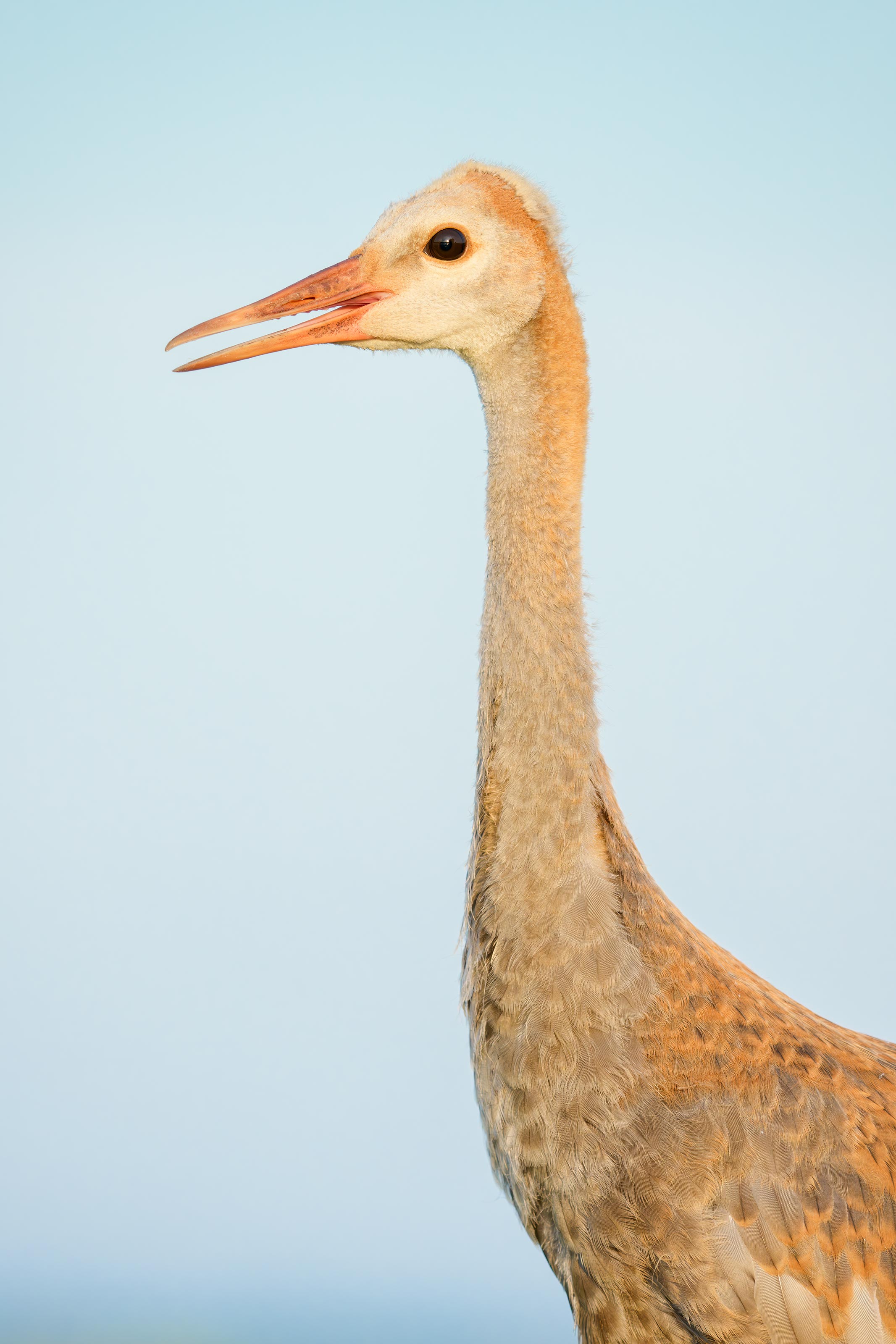
This image was created on 20 May 2025 down by the lake near my home at Indian Lake Estates, FL. Standing at full height, I used the hand held Sony FE 400-800mm f/6.3-8 G OSS lens (Sony E) (at 400mm) and The Latest Greatest Sony Flagship Body, the a1 II Mirrorless Camera. The exposure was determined by Zebras with ISO on the rear wheel: ISO 2500: 1/800 second at f/8 (wide open) in Manual mode. RawDigger showed that the exposure was perfect. AWB at 7:18:32am on a then windless, hazy, sunny morning.
Wide AF/C with Bird-Eye/Face Detection performed perfectly. Click on the image to enjoy an inexplicably sharper high-res version.
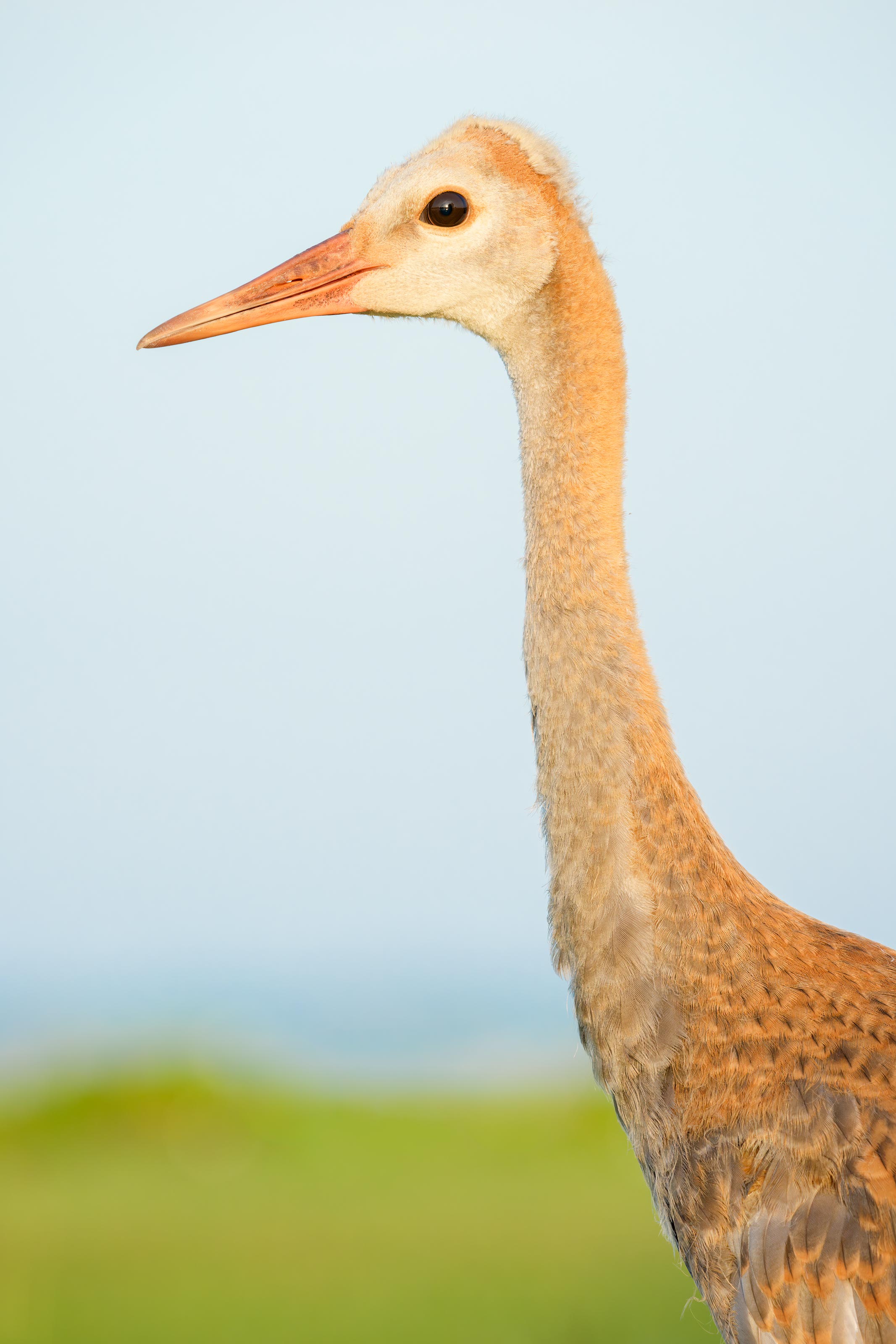
Image #1: Sandhill Crane colt about 8 weeks old with bill open; all sky background
Image copyright 2025: Arthur Morris/BIRDS AS ART
Sky Background
I made my way down the gentle slope that abuts the South Canal. The curious colt — the surviving sibling from the Middle Pair, — walked right up to me and posed. I stayed low to get the sky background. Notice in EXIF for each image in the YouTube video that after the first two frames that I kept I stopped down one full stop from f/8 to f/11. Why? Because I was quite close to the bird and wanted a bit of extra depth of field.
This image was created on 20 May 2025 down by the lake near my home at Indian Lake Estates, FL. Standing at full height, I used the hand held Sony FE 400-800mm f/6.3-8 G OSS lens (Sony E) (at 400mm) and The Latest Greatest Sony Flagship Body, the a1 II Mirrorless Camera. The exposure was determined by Zebras with ISO on the rear wheel: ISO 2500: 1/800 second at f/11 (stopped down one stop) in Manual mode. RawDigger showed that the exposure was dead solid perfect. AWB at 7:19:06am on a then windless, hazy, sunny morning.
Wide AF/C with Bird-Eye/Face Detection performed perfectly. Click on the image to enjoy an inexplicably sharper high-res version.
Image #2: Sandhill Crane colt about 8 weeks old; marsh added to lower background
Image copyright 2025: Arthur Morris/BIRDS AS ART
Add Green Whenever Possible
To add some of the distant green marsh to the bottom of the frame, I simply took one small step up the slope. I changed the elevation to change the background, in this case, by adding green. In short, I got higher to add color below.
Depth of Field Question
Considering the fact that I was working at f/11, why is the marsh so pleasingly smooth and defocused?
This image was created on 15 May 2025 by Mishael Voison during an In-the-Field session at Fort DeSoto Park, Tierra Verde, FL. Standing at full height, he used the hand held Canon RF 400mm f/2.8 L IS USM Lens with the Canon Extender RF 2x and the Canon EOS R5 Mark II Mirrorless Camera. ISO 1000; 1/4000 second at f/6.3 (stopped down 1/3 stop) in Manual mode. RawDigger showed that the exposure was perfect. AWB at 7:53:31am on a variably sunny morning.
Whole Area AF with Animal Detection.
Image #3: Great Egret bird of the year
Image courtesy of and copyright 2025: Mishael Voison
Image optimization by Arthur Morris/BIRDS AS ART
The Answer to the Important Question for Misha and for You
In the previous blog post, I wrote:
Misha was standing at full hight when he created this image. What should he have done to gotten more of the beautiful blue water in the frame?
Only a single reader, newcomer Alessio V. Pelella, took a stab at the question but was initially off target with his reply. With Image #2, above, I wrote, I changed the elevation to change the background, in this case, by adding green. In short, I got higher to add color below. With Misha’s image, the converse applied. To add more blue, he need to change elevation to change the background; but since the color he was after was above the bird, he needed to get lower to add the blue color above.
So, all that Misha needed to do was to get a bit lower by crouching. Though this seems like a very simple principle, many beginning and intermediate photographers struggle to understand and apply it. On a related note, the image would have been stronger if he had placed the subject higher in the frame thus eliminating some of the negative space above the subject.
As a general rule, getting lower will move the background farther from the subject thus rendering it more defocused and more pleasing. That principle, however, was not relevant to any of today’s featured images.
Typos
With all blog posts, feel free to e-mail or to leave a comment regarding any typos or errors.
A DeSoto Morning with the Sony 400-800 & the a-1 II By Arthur Morris/BIRDS AS ART
I did not want to like the Sony 400-800 when I borrowed one from Sony to try at Stick Marsh. It was too heavy at 5.45 pounds and too slow at f/8 at the long end. Instead, I fell in love with its incredible versatility and reach. Check out the Bird Face-Eye accuracy and the befores and afters of my favorites from that morning in this short video. Heck, by DeSoto standards, it was a pretty poor morning. And be sure to learn more about the creation of each image and see three of Mishael Voison’s three fine Canon photos from that same morning below.
Sony Alpha 1 (a-1) Mirrorless Camera Body
Multiple IPT veteran and long time BAA friend Pat Fishburne is offering a rarely used Sony a-1 (ILCE-1) mirrorless camera body in excellent plus condition for a BIRDS AS ART record low $3,298.00. This body has been updated to Firmware 3.00 that reportedly improves Bird Face-Eye tracking to levels attained by the a1-ii. The camera has my latest a-1 set-up on it. The sale includes the current Buttons and Dials Guide and the Info Sheet, the original product box, one battery, the charger, the camera strap, and insured ground shipping via major courier to lower-48 US addresses only. Your item will not ship until your check clears unless other arrangements are made.
I used Sony a-1 bodies as my workhorse camera bodies for more than three years. They produce stunning 51MP files with vivid natural colors. The AF system is superb. They are rugged and dependable and 30 frames per second is nothing to sneeze at. With a brand new a-1 ii going for $6498.00, you can save an even $3200.00 by grabbing Pat’s nearly as good as new a- copy ASAP. Right now, B&H is offering a used Sony a-1 in the same condition, 9+, for $4,674.95 here. Don’t believe me? Click the link. Prices of some used gear items like the Sony a-1 are actually rising in anticipation of the coming tariff.
I-Phone image
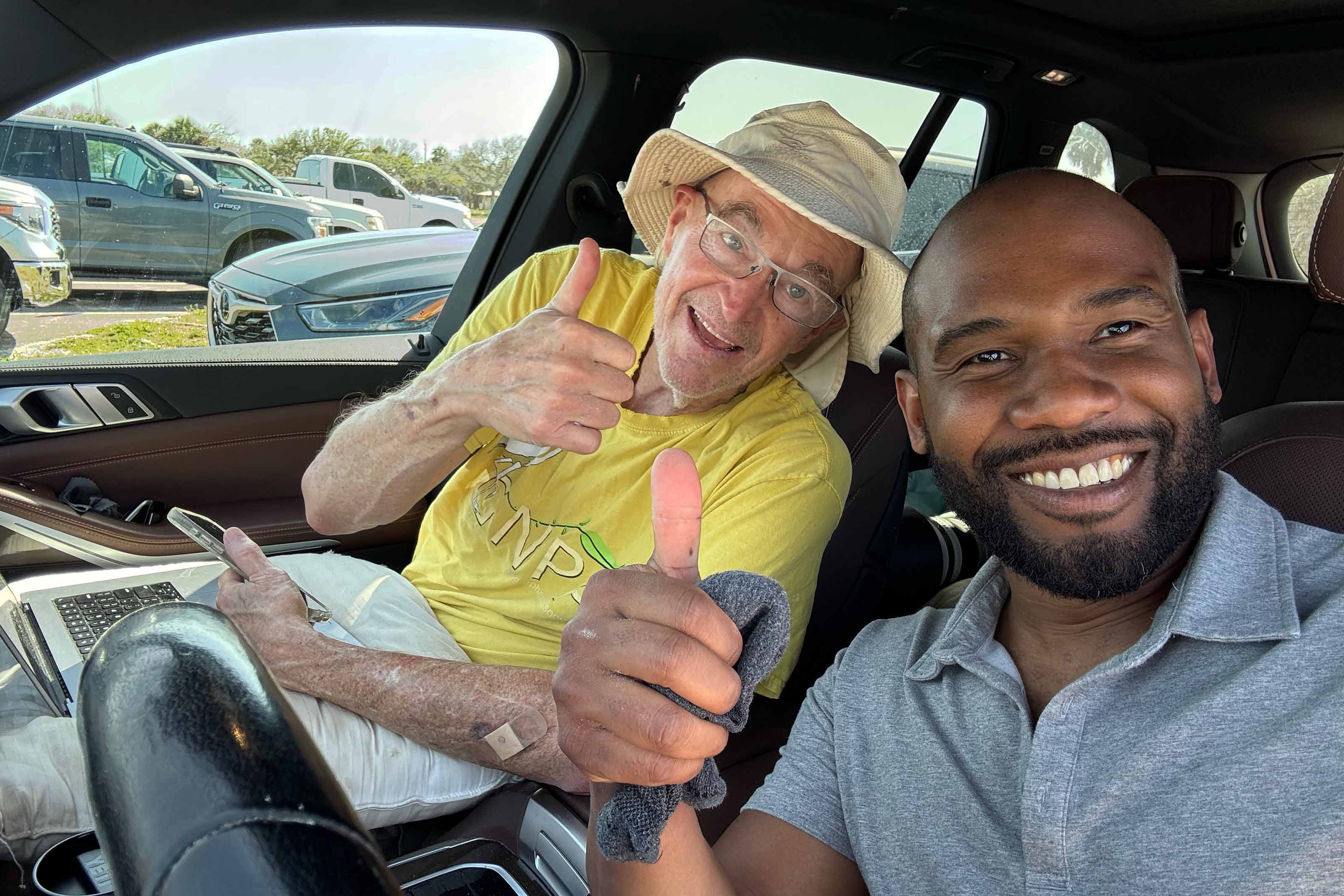
artie and Misha leaving DeSoto after a morning of sun and fun and learning
Image copyright 2025: Mishael Voison
Misha and artie
We had a fun week and enjoyed lots of good chances. Misha sent me this text on his drive to Miami: Hey Art,Thank you so much for the invitation to come to ILE, your hospitality, and persistent coaching. I’ve learnt so much in these past 4 days it’s amazing! Can’t wait to meet up again. In the meantime God bless and keep you my brother. Much love, Mishael
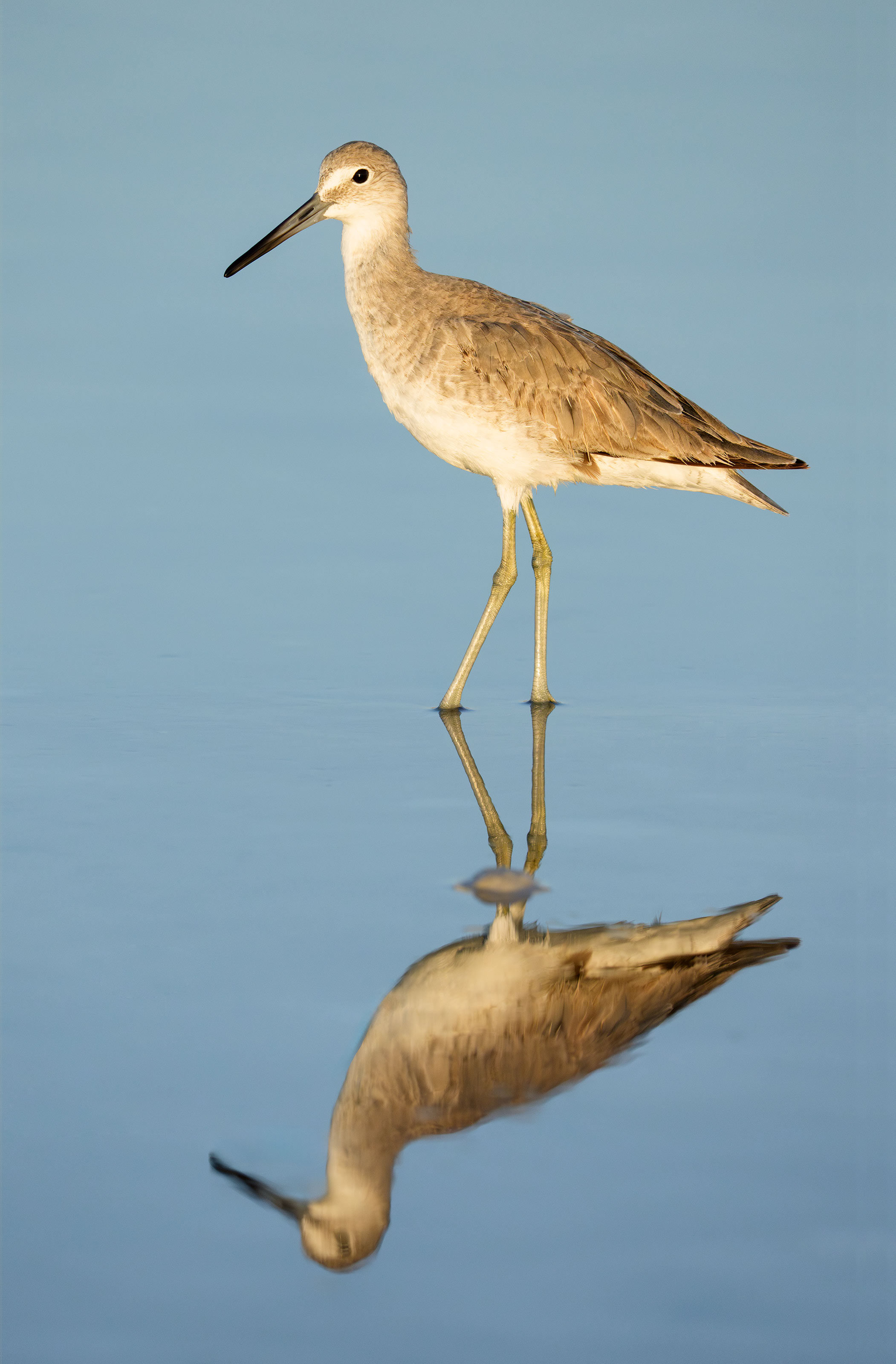
This image was created on 15 May 2025 at Fort DeSoto Park, Tierra Verde, FL. Standing at full height, I used the hand held Sony FE 400-800mm f/6.3-8 G OSS lens (Sony E) (at 670mm) and The Latest Greatest Sony Flagship Body, the a1 II Mirrorless Camera. The exposure was determined by Zebras with ISO on the rear wheel: ISO 2500: 1/2500 second at f/8 (wide open) in Manual mode. RawDigger showed that the exposure was dead solid perfect. AWB at 7:19:06am on a then windless sunny morning.
Wide AF/C with Bird-Eye/Face Detection performed perfectly. Click on the image to enjoy the larger, inexplicably sharper high-res version.
Image #1: Winter plumage Willet with its reflection
Image copyright 2025: Arthur Morris/BIRDS AS ART
The Very First Image of the Day
As we approached some shorebirds feeding on a shallow flat, I noted a Willet standing in still water with a nice reflection. As I had set up for a white bird in flight (just to be ready for anything) I simply reduced my shutter speed by 1/3 stop and made this image before getting down on the ground. It is rare that the very first frame of the day is a keeper but that was the case here as this one featured the best framing.
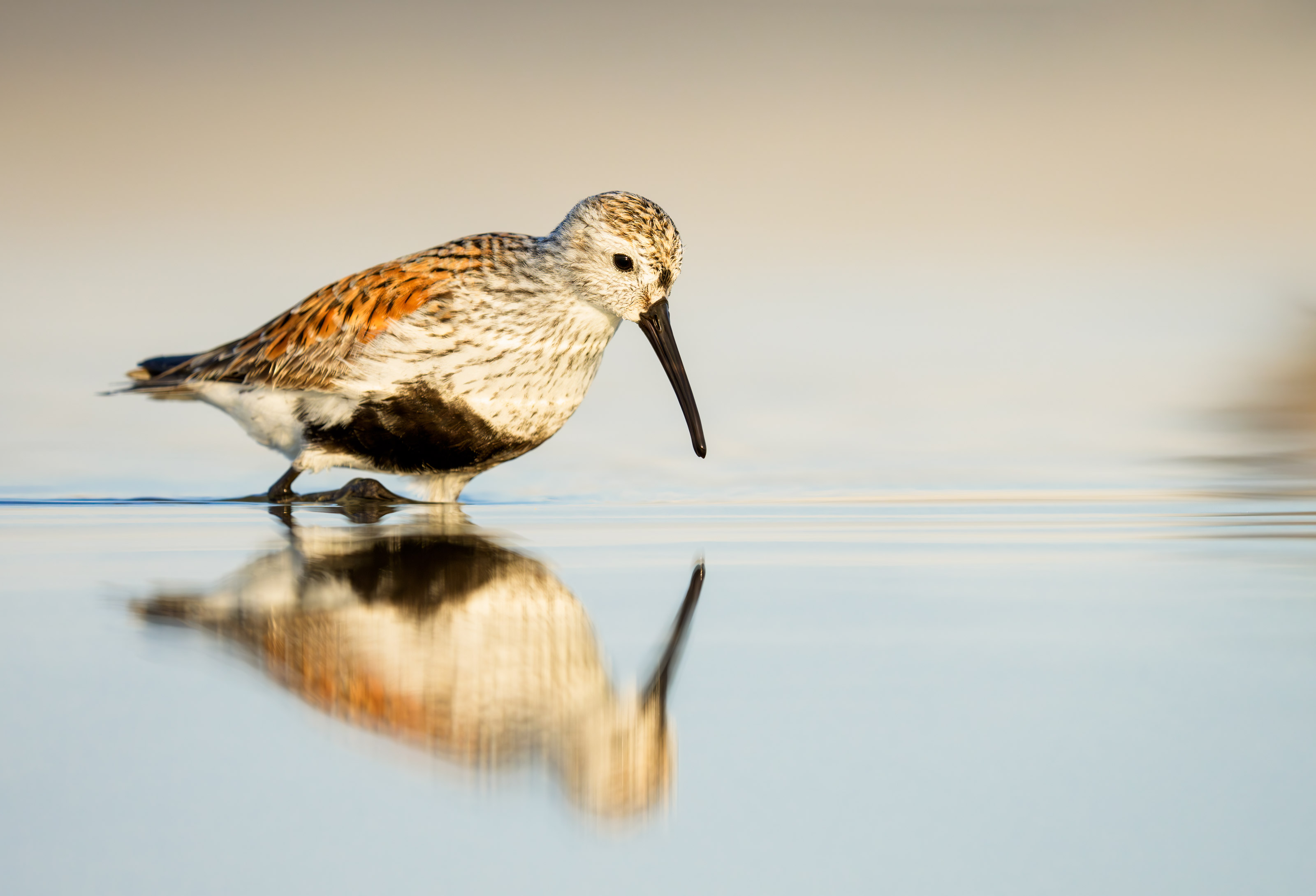
This image also was created on 15 May 2025 at Fort DeSoto Park, Tierra Verde, FL. Seated on damp sand, I used the knee-pod technique with the hand held Sony FE 400-800mm f/6.3-8 G OSS lens (Sony E) (at 800mm) and The Latest Greatest Sony Flagship Body, the a1 II Mirrorless Camera. The exposure was determined by Zebras with ISO on the rear wheel: ISO 2500: 1/2000 second at f/8 (wide open) in Manual mode. RawDigger showed that the exposure was dead solid perfect. AWB at 7:22:44am on a then windless sunny morning.
Wide AF/C with Bird-Eye/Face Detection performed perfectly. Click on the image to enjoy the larger, inexplicably sharper high-res version.
Image #2: Dunlin molting into breeding plumage foraging for invertebrates
Image copyright 2025: Arthur Morris/BIRDS AS ART
Tips on Shooting Feeding Shorebirds in Still Water for Misha and for You
1- Get low.
2- Aquire focus.
3- Keep the bird up in the frame so as to include the whole reflection.
4- When the bird is relatively square to the back of the camera press and hold the shutter button and hope for the best. If you wait to see the perfect shot you will have missed it.
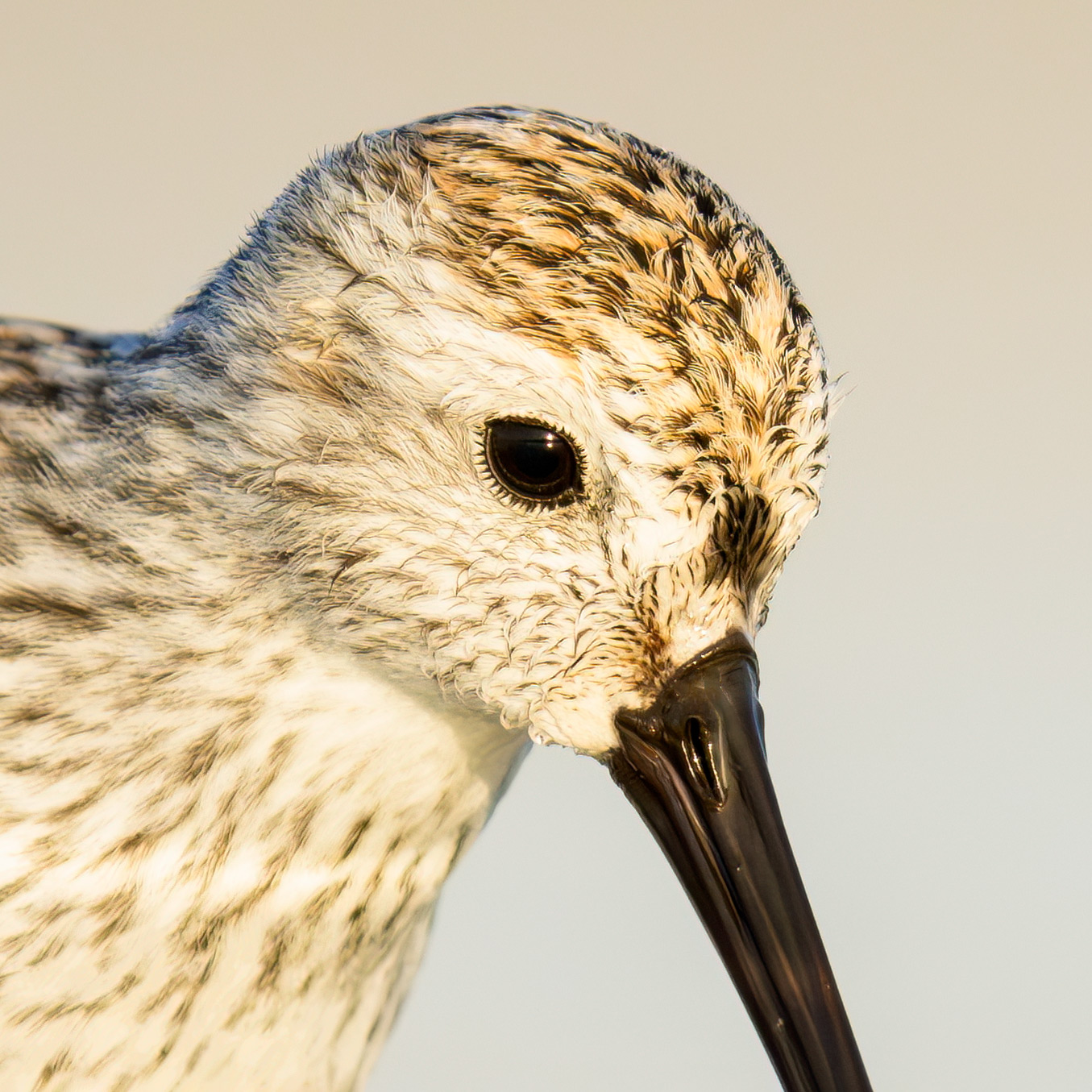
Image #2A: Unsharpened 100% Crop of the Dunlin molting into breeding plumage foraging for invertebrates image
Image copyright 2025: Arthur Morris/BIRDS AS ART
Cripsy Eye Skins
When your feeding shorebirds images feature crisp, sharply focused eye skins you know that you are focusing accurately, have a sharp lens, and are using a fast enough shutter speed.
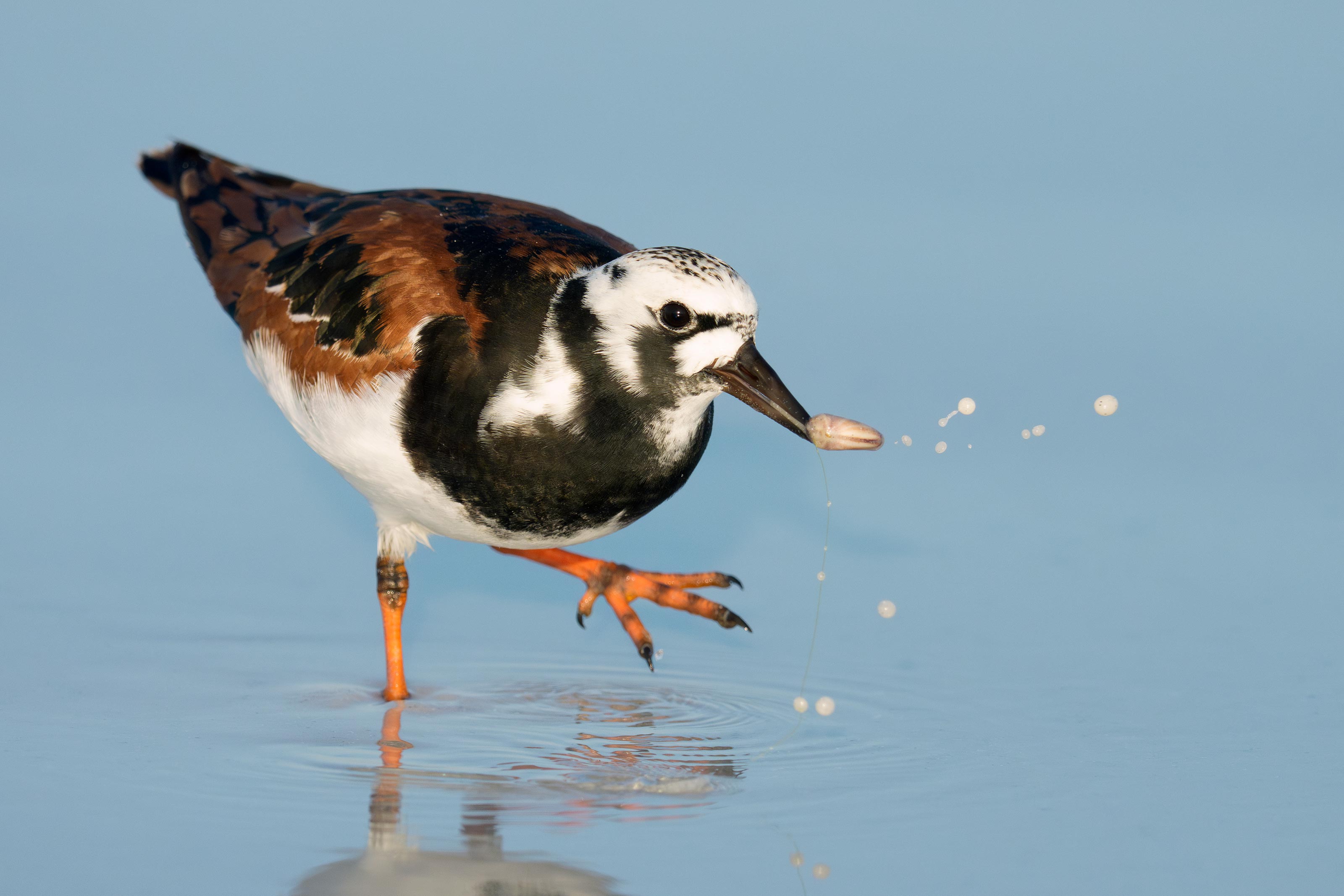
This image also was created on 15 May 2025 at Fort DeSoto Park, Tierra Verde, FL. Seated on dry sand, I used the knee-pod technique with the hand held Sony FE 400-800mm f/6.3-8 G OSS lens (Sony E) (at 674mm) and The Latest Greatest Sony Flagship Body, the a1 II Mirrorless Camera. The exposure was determined by Zebras with ISO on the rear wheel: ISO 2000: 1/3200 second at f/8 (wide open) in Manual mode. RawDigger showed that the exposure was dead solid perfect. AWB at 7:37:17am on a sunny morning.
Wide AF/C with Bird-Eye/Face Detection performed perfectly. Click on the image to enjoy the larger, inexplicably sharper high-res version.
Image #3: Ruddy Turnstone male in breeding plumage with tiny bivalve (mollusk)
Image copyright 2025: Arthur Morris/BIRDS AS ART
Good Foot/Bad Foot
Misha, just to my right, created an almost identical frame of this bird at this exact instant. This handsome turnstone was missing a toe or two on its right foot so we were lucky that the bad foot was partially buried in the wet sand while the good foot was nicely raised.
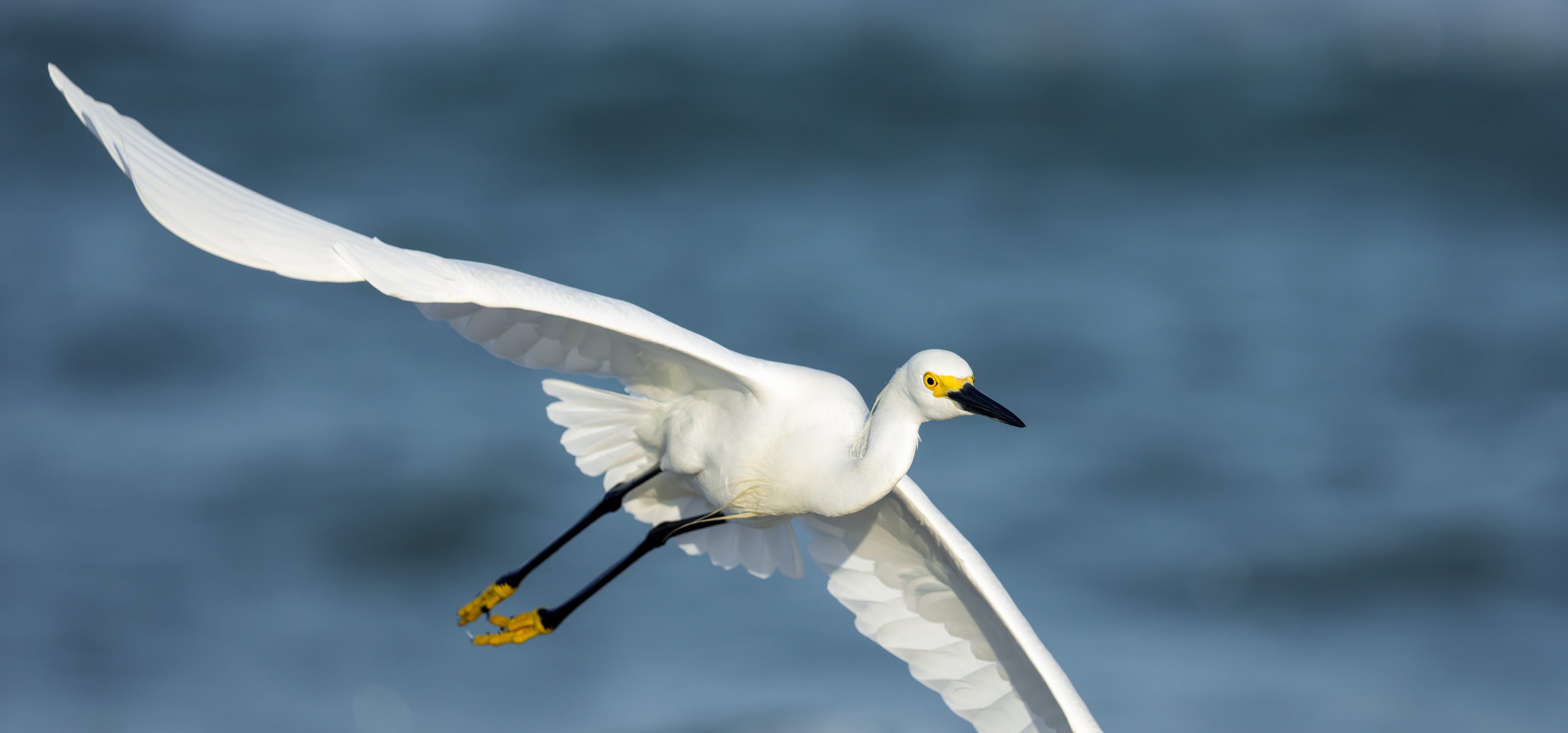
This image also was created on 15 May 2025 at Fort DeSoto Park, Tierra Verde, FL. Standing at full height, I used the hand held Sony FE 400-800mm f/6.3-8 G OSS lens (Sony E) (at 689mm) and The Latest Greatest Sony Flagship Body, the a1 II Mirrorless Camera. The exposure was determined by Zebras with ISO on the rear wheel: ISO 1600: 1/4000 second at f/8 (wide open) in Manual mode. RawDigger showed that the exposure was perfect. AWB at 7:43:03am on a sunny morning.
Wide AF/C with Bird-Eye/Face Detection performed perfectly. Click on the image to enjoy the larger, inexplicably sharper high-res version.
Image #4: Snowy Egret in flight
Image copyright 2025: Arthur Morris/BIRDS AS ART
Tight Flight Shots
If a flight shot is exceptionally sharp on the eye but I have badly clipped a wing, I will always look for a pleasing crop. Such images show more detail than a flight image with the whole bird in the frame.
This image was created on 15 May 2025 by Mishael Voison during an In-the-Field session at Fort DeSoto Park, Tierra Verde, FL. Standing at full height, he used the hand held Canon RF 400mm f/2.8 L IS USM Lens with the Canon Extender RF 2x and the Canon EOS R5 Mark II Mirrorless Camera. ISO 1000; 1/4000 second at f/6.3 (stopped down 1/3 stop) in Manual mode. RawDigger showed that the exposure was perfect. AWB at 7:53:31am on a variably sunny morning.
Whole Area AF with Animal Detection.
Image #5: Great Egret bird of the year
Image courtesy of and copyright 2025: Mishael Voison
Image optimization by Arthur Morris/BIRDS AS ART
An Important Question for Misha and for You
Misha was standing at full hight when he created this image. What should he have done to gotten more of the beautiful blue water in the frame?
This image also was created on 15 May 2025 at Fort DeSoto Park, Tierra Verde, FL. Seated on damp sand I employed the toe-pod technique with the hand held Sony FE 400-800mm f/6.3-8 G OSS lens (Sony E) (at 544mm) and The Latest Greatest Sony Flagship Body, the a1 II Mirrorless Camera. The exposure was determined by Zebras with ISO on the rear wheel: ISO 1600: 1/3200 second at f/8 (wide open) in Manual mode. RawDigger showed that the exposure was dead solid perfect. AWB at 8:26:18am on a sunny morning.
Wide AF/C with Bird-Eye/Face Detection performed perfectly. Click on the image to enjoy the larger, inexplicably sharper high-res version.
Image #6: Reddish Egret catching silversides
Image copyright 2025: Arthur Morris/BIRDS AS ART
Failure to Zoom In
Using the toe-pod technique to photograph this bird dancing with raised wings I was zoomed out to between 500 and 600mm for almost every frame. Image #6 is a large crop. Had I zoomed in to 800mm I would have had a lot more pixels on the subject.
This image was created on 15 May 2025 during an In-the-Field session at Fort Desoto Park, Tierra Verde, FL by Mishael Voison. Seated on damp sand, he used the hand held Canon RF 400mm f/2.8 L IS USM Lens with the Canon EOS R5 Mark II Mirrorless Camera. ISO 500; 1/4000 second at f/4 (stopped down one stop) in Manual mode. RawDigger showed that the exposure was perfect. AWB at 8:33:53am on a sunny morning.
Whole Area AF with Animal Detection.
Image #7: Reddish Egret basic plumage dancing
Image courtesy of and copyright 2025: Mishael Voison
Image optimization by Arthur Morris/BIRDS AS ART
Score One for Misha and Canon
I was quite impressed with the autofocus system of the R5 II; while reviewing Misha’s dancing Reddish Egret images, pretty much every one was sharp on the bird’s eye or eyes. When he joined me for a day at Stick Marsh in April, he was not even aware of sun angle. But he is obviously a quick learner and he nailed this one just to the right of perfect — note the bit of a shadow on the right on the bird’s upper neck.
This image also was created on 15 May 2025 at Fort DeSoto Park, Tierra Verde, FL. Crouching a bit, I used the hand held Sony FE 400-800mm f/6.3-8 G OSS lens (Sony E) (at 800mm) and The Latest Greatest Sony Flagship Body, the a1 II Mirrorless Camera. The exposure was determined by Zebras with ISO on the rear wheel: ISO 2000: 1/4000 second at f/8 (wide open) in Manual mode. RawDigger showed that the exposure was dead solid perfect. AWB at 8:26:18am on a sunny morning.
Wide AF/C with Bird-Eye/Face Detection performed perfectly. Click on the image to enjoy the larger, inexplicably sharper high-res version.
Image #8: Reddish Egret basic plumage eyeing baitfish — head and neck vertical portrait
Image copyright 2025: Arthur Morris/BIRDS AS ART
What You Do Not Want to See If You are a Baitfish
If you are a baitfish swimming along peacefully you do not want to look up and see a Reddish Egret looking down right at you with a hungry look in its eyes.
This image was created on 15 May 2025 during an In-the-Field session at Fort Desoto Park, Tierra Verde, FL by Mishael Voison. Kneeing on dry sand, he used the hand held Canon RF 400mm f/2.8 L IS USM Lens with the Canon EOS R5 Mark II Mirrorless Camera. ISO 100; 1/4000 second at f/2.8 (wide open) in Manual mode. RawDigger showed that the exposure was dead solid perfect. AWB at 9:19:32am on a sunny morning.
Whole Area AF with Animal Detection.
Image #9: White Ibis grabbing mole crab in surf
Image courtesy of and copyright 2025: Mishael Voison
Image optimization by Arthur Morris/BIRDS AS ART
When the Light is Bright …
When the light is bright, get low and work right on sun angle. The tighter the better. This image was made nearly 2 1/2 hours after sunrise on a clear sunny day yet the light looks just fine. Nice job Misha! And great timing getting the mole crab in midair.
This image also was created on 15 May 2025 at Fort DeSoto Park, Tierra Verde, FL. Seated on very wet sand, I used the hand held Sony FE 400-800mm f/6.3-8 G OSS lens (Sony E) (at 705mm) and The Latest Greatest Sony Flagship Body, the a1 II Mirrorless Camera. The exposure was determined by Zebras with ISO on the rear wheel: ISO 1250: 1/500 second at f/8 (wide open) in Manual mode. RawDigger showed that the exposure was dead solid perfect. AWB at 9:26:28am in the shade on a sunny morning.
Wide AF/C with Bird-Eye/Face Detection performed perfectly. Click on the image to enjoy the larger, inexplicably sharper high-res version.
Image #10: Snowy Egret hunting in the shade of a pier
Image copyright 2025: Arthur Morris/BIRDS AS ART
Subject in Shade, Background in Sun
Learn where I found shade at the beach on a bright sunny day in the YouTube video above. White subjects in the shade with the background in bright sun presents a difficult exposure challenge. With Sony it was easy by going for lots of Zebras on the background.
Typos
With all blog posts, feel free to e-mail or to leave a comment regarding any typos or errors.
On a perfectly clear and sunny morning, the 400-800 was superb at Fort DeSoto on Thursday. I continue to be astounded by the sharpness of this G lens, the accuracy of the AF system with Bird Face-Eye enabled, and its incredible versatility — especially with a dancing Reddish Egret that we photographed for nearly an hour; every single image was sharp on the eye despite the birds unpredictable gyrations. Mishael was using his Canon RF 400mm f/2.8 and had to change or remove teleconverter seemingly every few minutes as the bird cavorted near and far. That while I simply zoomed in and out quickly. At the long end, the 4-8 was deadly on foraging shorebirds. I am more convinced than ever that this lens can be a life-changer for folks who cannot afford $11 to $13K or do not want to lug around a tripod and a fast super-telephoto lens like a 400mm f/2.8 or a 600mm f/4.
What’s Up?
On Wednesday morning past Mishael and I fed the big catfish that had been dropped out of a tree by one of the local young Bald Eagles to the local vultures. They made short work of it. The fish had been residing in my freezer for the past ten days. We did some crane colts and some Black-bellied Whistling Ducks as well. That evening, we worked the 3-day old killdeer chicks from my SUV at 1200mm. On a very sad note, we were checking out crane resting on the grass colt just before sunset on Wednesday. When the bird, about eight weeks old, stood up, we were aghast; it’s right wing was hanging down and dragging on the ground, it had been almost completely ripped off. As the colt was too young to fly, the injury could not have come from flying into an overhead wire. Bald Eagle? Bobcat? Coyote? Florida Panther? Dog? Did I miss a possibly? We will never know.
On a whim, we woke early and headed over to Fort DeSoto Park early on Thursday morning. It’s a good thing that there were very few birds there as we made more than 11,000 photos between us (3782 for me). (See the lead item above for more on our DeSoto visit).
On the way home we stopped at Jack’s Skyway Restaurant in St. Pete for some yummy, down-home omelettes. Huge thanks to Mishael for getting us there and back safely while I worked on my laptop; he drove all the way, both ways! I finished editing the flight guide and added several dozen images. It now tips the scales at 243 pages with 166 inspirational images each with an educational caption. I’ll be sending the Word file to co-author Arash Hazeghi soon; he will surely be adding some additional photos of his. It will be available here for purchase fairly soon.
We had fresh flounder for dinner and Mishael prepared a scrumptious broccoli salad for us. I thought that it was from some secret Trinidadian family recipe but it turns out the he found a recipe on line and added a few twists of his own. He made a huge salad bowl full and we just about polished it off.
Today, Friday 16 May 2025, is Mashael’s last morning. We are both excited as we are putting out a 3 foot long young American Alligator for the vultures. I found it — freshly dead, in the shallow water just south of the pier on Wednesday morning. I put a slit in the belly, hopefully to help the vultures get started on the carcass. I hope that you too opt to enjoy life and have a wondrous day.
There is still AirBnB room at Jacksonville from Thursday 26 June until 1 July. If you would like to change your life, please get in touch via e-mail. You can see the complete trip info here.
If an item — a Delkin flash card, or especially, a Levered-clamp FlexShooter Pro tripod head -— for example, that is available from B&H and/or Bedfords, is also available in the BAA Online Store, it would be great, and greatly appreciated, if you would opt to purchase from us. We will match any price. Please remember also to use my B&H affiliate links or to earn 3% cash back at Bedfords by using the BIRDSASART discount code at checkout for your major gear purchases. If you are making a major purchase from B&H be sure to get in touch with me via e-mail if you would like to learn how to save some serious dollars on a B&H transaction. Doing either often earns you free guides and/or discounts. And always earns my great appreciation.
B&H Simplified
To ensure that I get credit for your B&H purchases, you can always click here. The tracking is invisible but greatly appreciated. And, you can use your PayBoo card. You must use the website to order. You cannot get your free guides if you make a phone order. Once you have an item in your cart, you must complete the order within two hours. Huge thanks!
Bedfords Simplified
Click here to start your search. Choose standard shipping, and when you get to the payment page, enter BIRDSASART in the discount code box and hit apply. You will be upgraded to free second day air Fed-Ex and receive 3% cash back on your credit card once your stuff ships. Either is greatly appreciated by yours truly.
B&H
Many folks have written recently stating that they purchased a Sony a1 from B&H and would like their free membership in the Sony 1 Info and Updates Group, a $150.00 value. But when I check my affiliate account, their orders have not been there. When I let them know that they get credit for B&H purchases only if they use one of the many B&H affiliate links on the blog or begin their searches with this link, they are always disappointed. If in doubt, please contact me via e-mail and request a BH link. I am always glad to help and to guide you to the right gear.
Bedfords Amazing BAA Discount Policy
Folks who have fallen in love with Bedfords can now use the BIRDSASART coupon code at checkout to enjoy a post-purchase, 3% off-statement credit (excluding taxes and shipping charges) on orders paid with a credit card. The 3% credit will be refunded to the card you used for your purchase. Be sure, also, to check the box for free shipping to enjoy free Second Day Air Fed-Ex. This offer does not apply to purchases of Classes, Gift Cards, prior purchases.
Visit the Bedfords website here, shoot Steve Elkins an e-mail, or text him on his cell phone at (479) 381-2592.
Gear Questions and Advice
Too many folks attending BAA IPTs and dozens of photographers whom I see in the field and on BPN, are — out of ignorance — using the wrong gear, especially when it comes to tripods and more especially, tripod heads. And the same is true in spades when ordering new camera bodies or lenses. My advice will often save you some serious money and may help you avoid making a seriously bad choice. Please know that I am always glad to answer your gear questions via e-mail. If you are desperate, you can try me on my cell at 863-221-2372. Please leave a message and shoot me a text if I do not pick up.
Image #1: Sandhill Crane colt about 8 weeks old running
Image courtesy of and copyright 2025: Misheal Voison
Image optimization by Arthur Morris/BIRDS AS ART
Score one for the Canon Student
It goes without saying the Mishael has been learning a ton. About sun angle, about head angle, about choosing the best perspective, and about exposure to mention only a few. On Wednesday, I discovered that he did not have Highlight Alert enabled on his R5 ii; that is a cardinal sin for Canon folks. Anyhoo, we got it straightened out. When one of the parent birds grabbed a morsel and offered it to the colts, this one ran right to it. For some unknown reason, I zoomed in instead of out, clipped everything in sight, and did not wind up with a single useable frame. Misheal had several really good ones with Image #1 being the best of the lot.
Every afternoon we do a lengthy image review and Photoshop session. I am very proud of Mishael for improving his exposure skills so quickly; he nailed this one every which way but loose. So far, we have optimized seven of his best images; he will be leaving with a detailed screen recording of each of those. We still have two more sessions in store.
This image was created on 14 May 2025 at Indian Lake Estates, FL. Working from the front seat of his SUV, artie used the BLUBB--supported Sony FE 600mm f/4 GM OSS lens with the Sony FE 2x Teleconverter, and The Latest Greatest Sony Flagship Body, the a-1 II Mirrorless Camera. The exposure was determined by Zebras with ISO on the rear wheel. ISO 1250: 1/1600 second at f/8 (wide open) in Manual mode. RawDigger showed that the exposure was perfect. AWB at 7:28:30am on sunny afternoon.
Wide/AF-C with Bird-Eye/Face Detection performed perfectly. Click on the image to enjoy the inexplicably sharper high-res version.
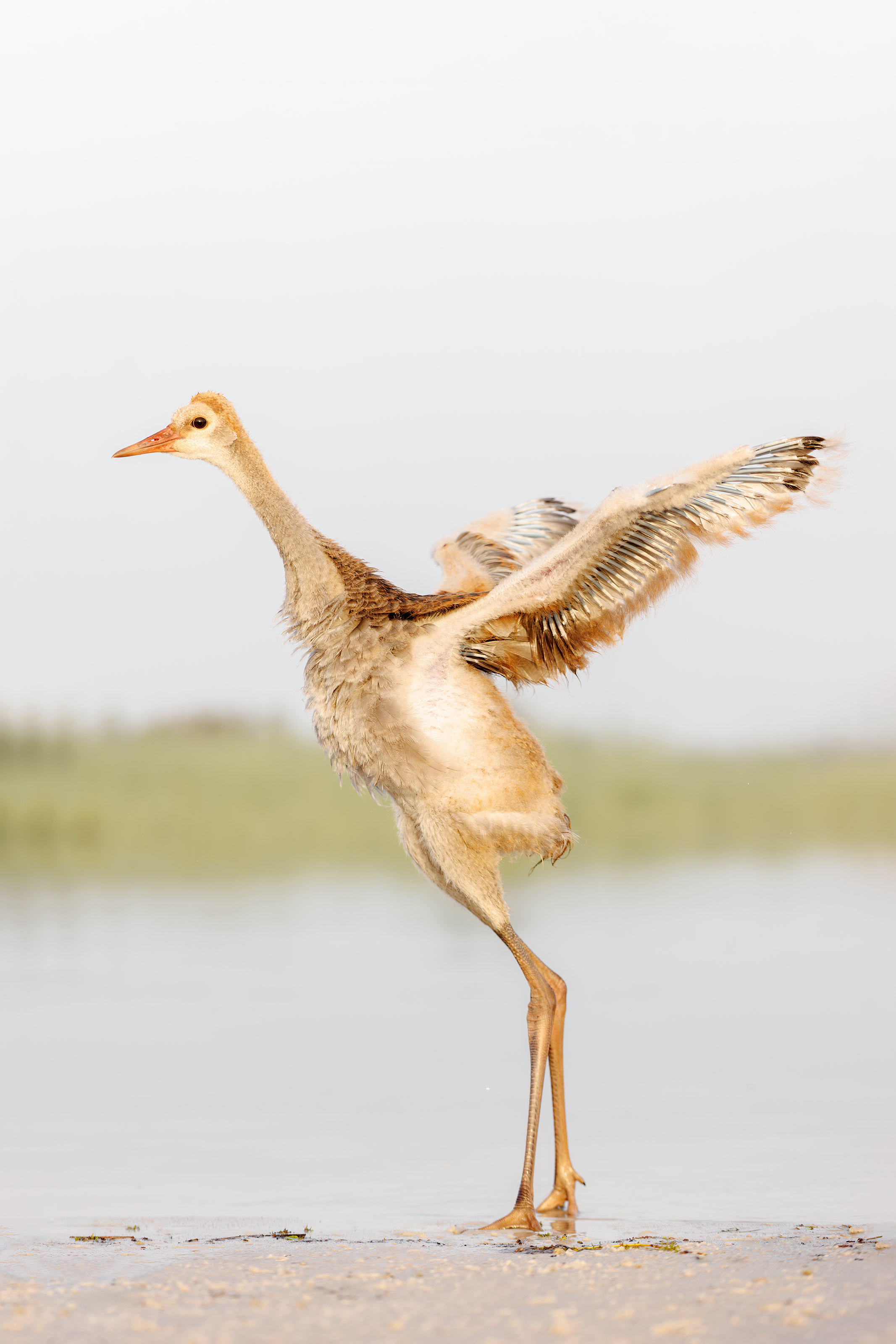
Image #2: Sandhill Crane colt about 11 weeks old strengthening its wings while running
Image copyright 2025: Arthur Morris/BIRDS AS ART
1200mm Action
With Mishael in the back seat and the North Field too flooded to drive on, I explained to him that we could make some nice photos from the road at 1200mm while working with a shallow angle of declination. With such a long focal length, the images will not look as if you were shooting steeply down at the subject.
Misheal was shooting horizontals and I was shooting verticals. When the bird ran forward to exercise its wings, we were both so tight that we clipped the wings badly in all but one of our images. That being Image #2 created by yours truly. Working horizontally, Mishael pretty much had zero chance. Score one for the instructor. Following action while using a BLUBB- is somewhat of a challenge. Remember that you need to have DMF turned off or risk inadvertently throwing off the focus.
Typos
With all blog posts, feel free to e-mail or to leave a comment regarding any typos or errors.
If you have a Canon EOS R5 MkII (in Excellent plus or better condition) and the matching battery grip BG-20 sitting on a shelf gathering dust and would like to sell it for a fair price, please get in touch me via e-mail and I will put you in touch with the interested party.
What’s Up?
After flying from Saskatoon, Saskatchewan, Canada to Orlando International Airport with lots of Canon gear, Mishael Voisin arrived at ILE safely on Monday afternoon for a week of photography instruction; he heads to Miami and Grand Cayman after our morning session on Friday. As it was cloudy after our early pool deck dinner, we began with a long afternoon session that went quite well and ended with a decent sunset. Tuesday morning was fabulous as the pier crane colts fed in the shallow bay left of the pier. That afternoon, our chances were looking slim at best until we found the three recently hatched Killdeer chicks near the Lakefront Pavilion. After several days of torrential rain, the 100% guaranteed Black-bellied Whistling Ducks abandoned SOP (South-of-Pier) Bay to feed in the flooded North Field. Bummer on that.
Today is Wednesday May 14, 2025. We headed down to the lake at 6:15am and enjoyed yet another successful session. Whatever you choose to do, I hope that you opt to enjoy life and have a wondrous day. There is still AirBnB room at Jacksonville from Thursday 26 June until 1 July. If you would like to change your life, please get in touch via e-mail. You can see the complete trip info here.
If an item — a Delkin flash card, or especially, a Levered-clamp FlexShooter Pro tripod head -— for example, that is available from B&H and/or Bedfords, is also available in the BAA Online Store, it would be great, and greatly appreciated, if you would opt to purchase from us. We will match any price. Please remember also to use my B&H affiliate links or to earn 3% cash back at Bedfords by using the BIRDSASART discount code at checkout for your major gear purchases. If you are making a major purchase from B&H be sure to get in touch with me via e-mail if you would like to learn how to save some serious dollars on a B&H transaction. Doing either often earns you free guides and/or discounts. And always earns my great appreciation.
B&H Simplified
To ensure that I get credit for your B&H purchases, you can always click here. The tracking is invisible but greatly appreciated. And, you can use your PayBoo card. You must use the website to order. You cannot get your free guides if you make a phone order. Once you have an item in your cart, you must complete the order within two hours. Huge thanks!
Bedfords Simplified
Click here to start your search. Choose standard shipping, and when you get to the payment page, enter BIRDSASART in the discount code box and hit apply. You will be upgraded to free second day air Fed-Ex and receive 3% cash back on your credit card once your stuff ships. Either is greatly appreciated by yours truly.
B&H
Many folks have written recently stating that they purchased a Sony a1 from B&H and would like their free membership in the Sony 1 Info and Updates Group, a $150.00 value. But when I check my affiliate account, their orders have not been there. When I let them know that they get credit for B&H purchases only if they use one of the many B&H affiliate links on the blog or begin their searches with this link, they are always disappointed. If in doubt, please contact me via e-mail and request a BH link. I am always glad to help and to guide you to the right gear.
Bedfords Amazing BAA Discount Policy
Folks who have fallen in love with Bedfords can now use the BIRDSASART coupon code at checkout to enjoy a post-purchase, 3% off-statement credit (excluding taxes and shipping charges) on orders paid with a credit card. The 3% credit will be refunded to the card you used for your purchase. Be sure, also, to check the box for free shipping to enjoy free Second Day Air Fed-Ex. This offer does not apply to purchases of Classes, Gift Cards, prior purchases.
Visit the Bedfords website here, shoot Steve Elkins an e-mail, or text him on his cell phone at (479) 381-2592.
Gear Questions and Advice
Too many folks attending BAA IPTs and dozens of photographers whom I see in the field and on BPN, are — out of ignorance — using the wrong gear, especially when it comes to tripods and more especially, tripod heads. And the same is true in spades when ordering new camera bodies or lenses. My advice will often save you some serious money and may help you avoid making a seriously bad choice. Please know that I am always glad to answer your gear questions via e-mail. If you are desperate, you can try me on my cell at 863-221-2372. Please leave a message and shoot me a text if I do not pick up.
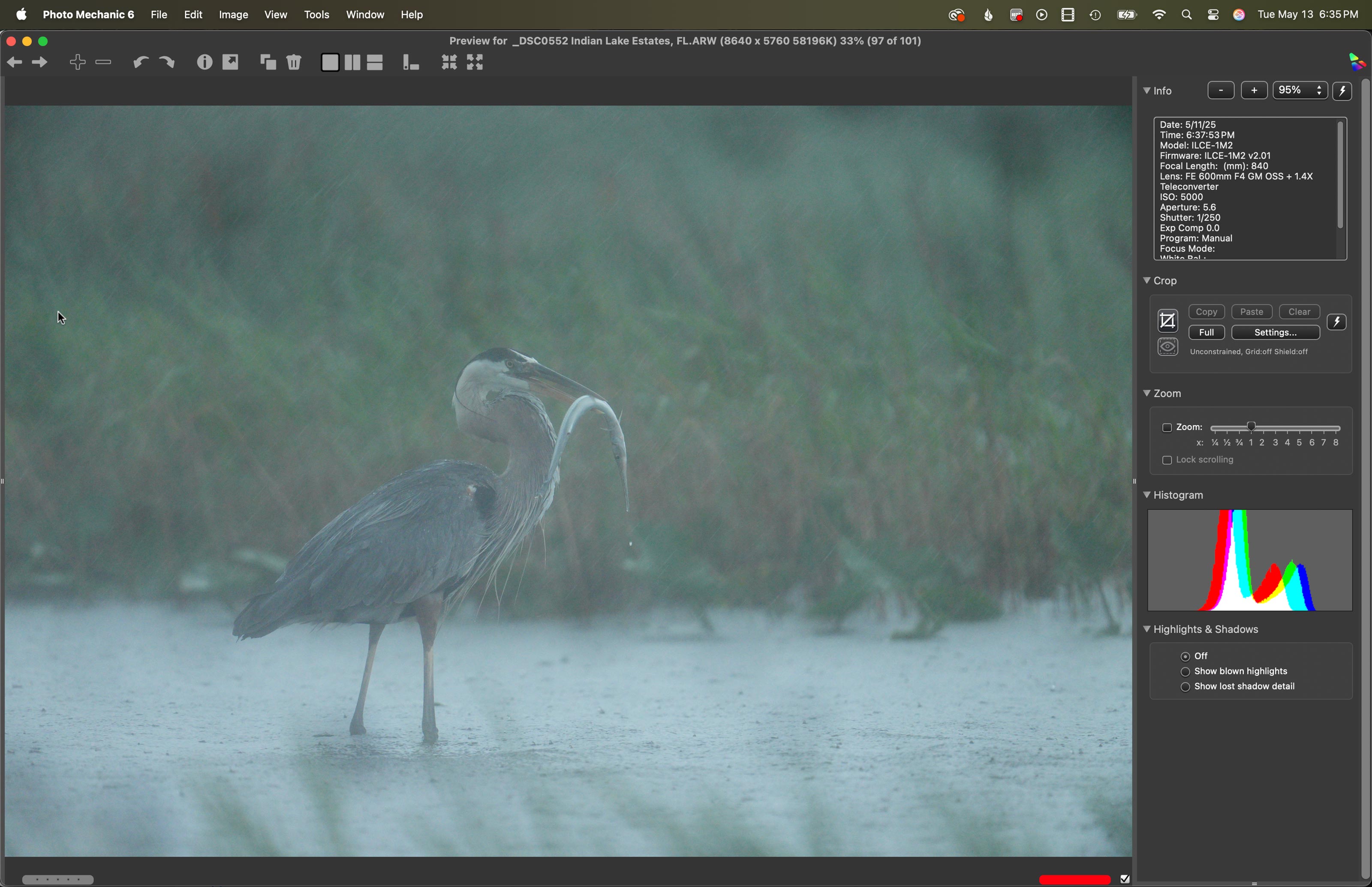
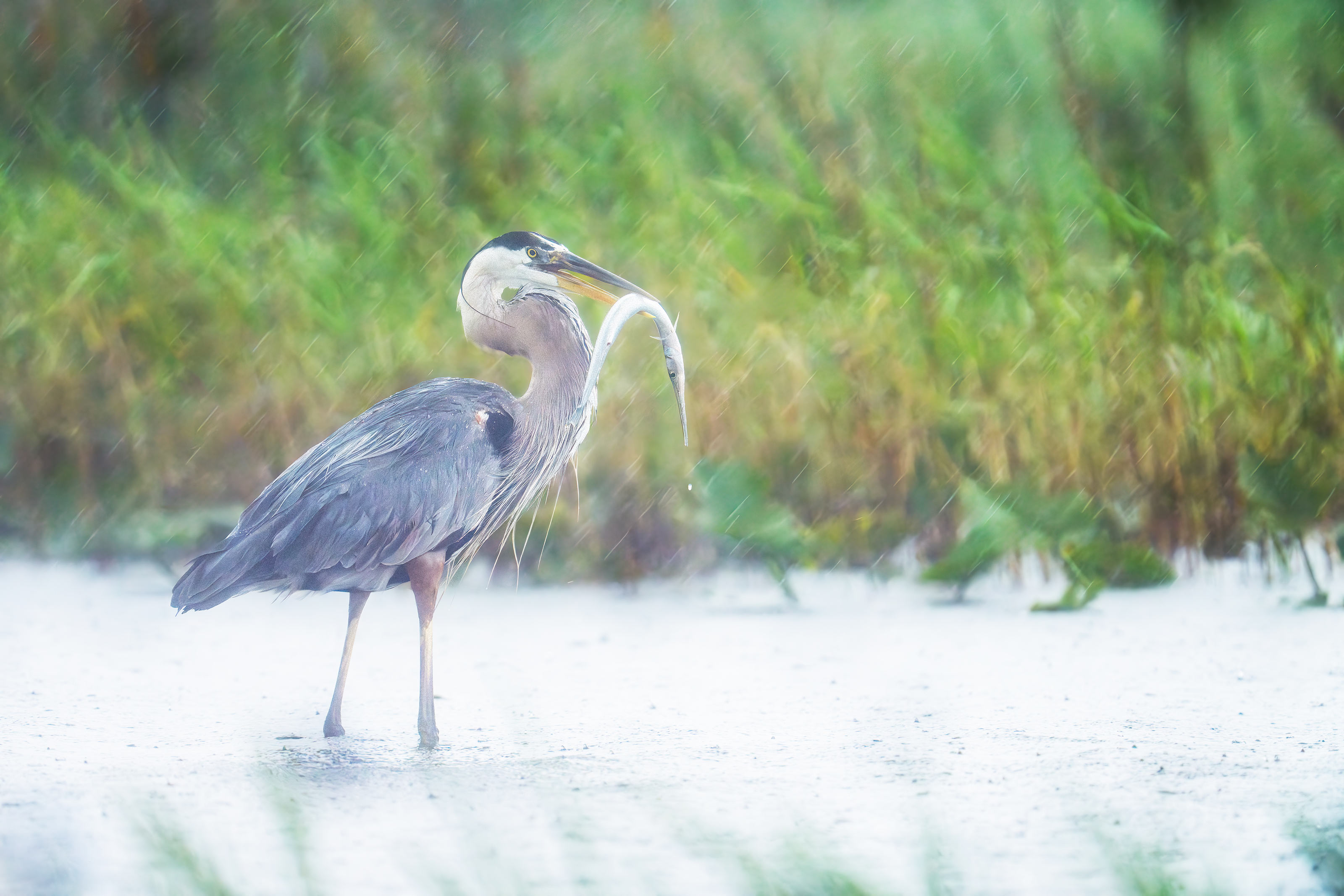
This image was created on 11 May 2025 down by the lake near my home at Indian Lake Estates, FL. Working from the front seat of my SUV in a driving rain, I used the BLUBB--supported Sony FE 600mm f/4 GM OSS lens with the Sony FE 1.4x Teleconverter and The Latest Greatest Sony Flagship Body, the a1 II Mirrorless Camera. The exposure was determined via Zebras with ISO on the thumb dial. ISO 5000: 1/250 sec. at f/5.6 (wide open) in Manual mode. RawDigger showed that the raw file brightness was 1 1/2 stops too dark. AWB at 6:37:53am on a dark, stormy afternoon.
Wide/AF-C with Bird Eye/Face Detection enabled performed adequately. Click on the image to see a larger, sharper high resolution version
Image #1: Photo Mechanic Screen Capture for the Great Blue Heron with Atlantic Needlefish image
Image copyright 2025 Arthur Morris/BIRDS AS ART
I Could Barely See the Bird Thru the Torrential Downpour
Would you try to optimize the raw file above?
It was raining. A brisk wind below from the west. It was very dark and getting darker. I was photographing the Black-bellied Whistling Ducks frolicking in the deluge. I am not sure what made me look across the breadth of the bay to the south of the pier, but to my surprise, I spotted a Great Blue Heron with a fish in its bill about 60 yards away. Reluctant to go below 1/250 sec. or above 5000 ISO, I knew that the image would be under-exposed. It was. I created more than 500 photos in a very few minutes despite that fact that I knew the heron’s head was angled away in most every frame. I got luck with this one.
I was sure that I was looking at a needlefish but was pretty sure that the live only in saltwater. AI Overview turned up this:
“Atlantic needlefish (Strongylura marina) can be found in freshwater in Florida, according to the Fisherman and the Florida Springs Institute. While they are typically marine and estuary species, they are known to venture into freshwater rivers, streams, and springs in Florida. Research also indicates that they can spawn in both freshwater and saltwater habitats.”
Live and learn. Thanks to blog regular David Policanksy, AKA Dr. Fish, for confirming the ID.
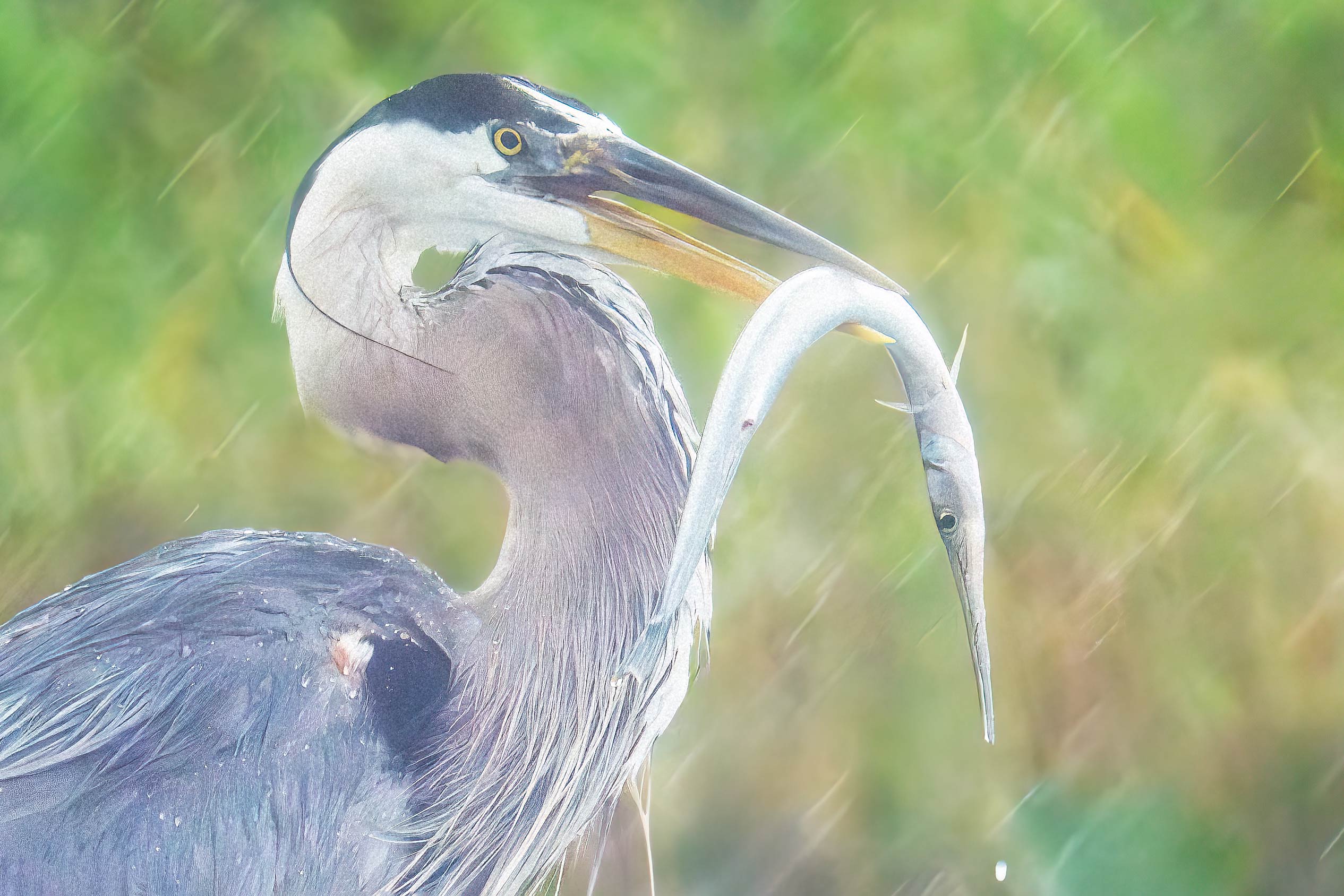
Image #1A: Great Blue Heron with Atlantic Needlefish image
Image copyright 2025 Arthur Morris/BIRDS AS ART
The Optimized .TIF Master File
After increasing the exposure by 0.70 stops and moving the contrast slider to +59, most of the rest of the image optimization was straightforward as detailed in both the Digital Basics II PDF and the Digital Basics III Video Series. You can learn more about these offerings or purchase them here.
Considering the abject conditions, I was quite happy with the final result. See below for the single negative.
Image #1B: 100% crop of the Great Blue Heron with Atlantic Needlefish image
Image copyright 2025 Arthur Morris/BIRDS AS ART
The Big Problem with an ISO 5000 Under-exposure
The single biggest problem with being 1 1/2 stops too dark with an ISO 5000 raw file is the almost complete loss of fine feather and other detail. I tried to rectify that to some degree by selecting the subject, taking the image back into Adobe Camera Raw, adding Grain, applying a bit of Sharpening under the Detail tab, and moving the Dehaze slider to +8. As you can see, those effort were not very successful as the bird’s feathers look quite like wax.
The BIRDS AS ART Current Workflow e-Guide (Digital Basics II).
You can order your copy from the BAA Online Store here, by sending a PayPal for $40 here, or by calling Jim or Jennifer weekdays at 863-692-0906 with your credit card in hand. Be sure to specify Digital Basics II.
The BIRDS AS ART Current Workflow e-Guide (Digital Basics II)
The techniques mentioned above and tons more great Photoshop tips and techniques — along with my complete digital workflow, Digital Eye Doctor Techniques, and all my personalized Keyboard Shortcuts — are covered in detail in the BIRDS AS ART Current Workflow e-Guide (Digital Basics II), an instructional PDF that is sent via e-mail. Note: folks working on a PC and/or those who do not want to miss anything Photoshop may wish to purchase the original Digital Basics along with DB II while saving $15 by clicking here to buy the DB Bundle.
Please note: the Divide and Conquer technique was inadvertently omitted from DB II. It is detailed in a free excerpt in the blog post here.
Folks who learn well by following along rather than by reading can check out the complete collection of MP 4 Photoshop Tutorial Videos by clicking here. Note: most of the videos are now priced at an amazingly low $5.00 each.
You can learn how and why I converted all of my Canon digital RAW files in DPP 4 in the DPP 4 RAW Conversion Guide here. More recently, I became proficient at converting my Nikon RAW (NEF) files in Adobe Camera Raw. About three years ago I began converting my Nikon and Sony RAW files in Capture One and did that for two years. You can learn more about Capture One in the Capture One Pro 12 Simplified MP4 Video here. The next step would be to get a copy of Arash Hazeghi’s “The Nikon Photographers’ Guide to Phase One Capture One Pro e-Guide” in the blog post here. Today, I convert my Sony raw files in Photoshop with Adobe Camera Raw.
You can learn advanced Quick Masking and advanced Layer Masking techniques in APTATS I & II. You can save $15 by purchasing the pair.
The Digital Basics III Video Series
The Digital Basics III Video Series
I realized more than a year ago that my digital workflow had changed significantly and was toying with the idea of writing a Digital Basics III. More recently, I learned and begun working with two great new Photoshop Tools, the Remove Tool and the Luminance Targeted Adjustment Tool. The former is like a smarter Spot Healing Brush Tool on steroids and the latter is a step up from the fabulous Color Mixer Tool. During that same time frame, I came up with a new and improved 2-step noise reduction technique. I still use Divide and Conquer, Quick Masks, Layer Masks, an expanded array of personalized keyboard shortcuts, and tons of other stuff from both versions of Digital Basics.
As soon as I realized that I did not want to take on another large writing project, I realized that by creating a series of videos I could much more easily share all the details of my current digital workflow and much more easily incorporate additional new tips, techniques, and tools as I went. And so, The Digital Basics III Video Series was born. The videos will be most valuable for folks using the latest version of Photoshop (2024) or Lightroom along with Topaz DeNoise AI and Topaz Sharpen AI.
Typos
With all blog posts, feel free to e-mail or to leave a comment regarding any typos or errors.
Using the Crop Tool Creatively to Get to the Crux of an Image
Learning to see the image within an image is an important skill. Check out the before and after photos in this short video to see how artie uses the Crop Tool to eliminate clutter, expand canvas when needed, and get right down to the essence of his raw files. In addition, learn about using the Remove Tool to smooth out distracting background elements while maintaining the integrity of the natural history moment you have photographed.
Learn about Digital Basics II and the Digital Basics III Video Series here.
Your Call?
Which two of today’s featured images are your favorites and why did you make your choices?
In the Last Blog Post
In the last blog post, Things You Might Not Realize …, here, my two favorite images were Image #10: Black-bellied Whistling Duck vertical with complete reflection, and Image #12: Sandhill Crane colt about 8 weeks old — head and neck portrait. The former for its perfection and the latter for all the detail and the sweet light. Thanks to the few who commented.
What’s Up?
As you will see below, photography at ILE has continued to be excellent. The whistling ducks are piling in next to the pier early and late and the crane colts are growing by leaps and bounds. At least two, however, have perished. The Middle Pair on the South Peninsula lost one, as did the Shy Pair on the North Field. On average, about 50% of the crane chicks that hatch do not make it to fledging.
Until two days ago, it had not rained in Central Florida for about two months — bone dry. And sunny and hot. On Friday and Saturday afternoon it poured and filled up my pool. On Sunday evening at about 5:30, it quit drizzling so I headed down to the pier to take a walk. Before I got there it started raining and then it poured and let up and then another monsoon. And so on and so fourth. Shooting from my SUV for the next 75 minutes, I created 1487 photos and had more fun than should be legal. Additional details and photos at some point. That is, if any are worth keeping.
Today is Monday 12 May 2025. The forecast is for SSE at 10mph with continued rain early turning cloudy. I cannot wait to get down there! Mishael Voisin is flying in from Saskatchewan today to join me for a week of photography here at ILE. He did a single morning with me at Stick Marsh and was quite impressed with the instruction that he received. We spoke today and I told him that he was welcome to postpone the trip or join me in Jacksonville because the wind forecast for this week is looking mostly west, less than ideal. And with morning sun, that is pretty bad for bird photography. But as he wants to learn, he would not be deterred. I for one am glad that he is coming. Him too!
Whatever you choose to do I hope that you choose to have as much fun as I will be having.
If an item — a Delkin flash card, or a tripod head — for example, that is available from B&H and/or Bedfords, is also available in the BAA Online Store, it would be great, and greatly appreciated, if you would opt to purchase from us. We will match any price. Please remember also to use my B&H affiliate links or to earn 3% cash back at Bedfords by using the BIRDSASART discount code at checkout for your major gear purchases. Doing either often earns you free guides and/or discounts. And always earns my great appreciation.
B&H Simplified
To ensure that I get credit for your B&H purchases, you can always click here. The tracking is invisible but greatly appreciated. And, you can use your PayBoo card. You must use the website to order. You cannot get your free guides if you make a phone order. Once you have an item in your cart, you must complete the order within two hours. Huge thanks!
Bedfords Simplified
Click here to start your search. Choose standard shipping, and when you get to the payment page, enter BIRDSASART in the discount code box and hit apply. You will be upgraded to free second day air Fed-Ex and receive 3% cash back on your credit card once your stuff ships. Either is greatly appreciated by yours truly.
B&H
Many folks have written recently stating that they purchased a Sony a1 from B&H and would like their free membership in the Sony 1 Info and Updates Group, a $150.00 value. But when I check my affiliate account, their orders have not been there. When I let them know that they get credit for B&H purchases only if they use one of the many B&H affiliate links on the blog or begin their searches with this link, they are always disappointed. If in doubt, please contact me via e-mail and request a BH link. I am always glad to help and to guide you to the right gear.
Bedfords Amazing BAA Discount Policy
Folks who have fallen in love with Bedfords can now use the BIRDSASART coupon code at checkout to enjoy a post-purchase, 3% off-statement credit (excluding taxes and shipping charges) on orders paid with a credit card. The 3% credit will be refunded to the card you used for your purchase. Be sure, also, to check the box for free shipping to enjoy free Second Day Air Fed-Ex. This offer does not apply to purchases of Classes, Gift Cards, prior purchases.
Visit the Bedfords website here, shoot Steve Elkins an e-mail, or text him on his cell phone at (479) 381-2592.
Gear Questions and Advice
Too many folks attending BAA IPTs and dozens of photographers whom I see in the field and on BPN, are — out of ignorance — using the wrong gear, especially when it comes to tripods and more especially, tripod heads. And the same is true in spades when ordering new camera bodies or lenses. My advice will often save you some serious money and may help you avoid making a seriously bad choice. Please know that I am always glad to answer your gear questions via e-mail. If you are desperate, you can try me on my cell at 863-221-2372. Please leave a message and shoot me a text if I do not pick up.
This image was created on 9 May 2025 down by the lake near my home at Indian Lake Estates, FL. Seated on a pillow on the sand, I used the hand held Sony FE 300mm f/2.8 GM OSS Lens (Sony E) with the Sony FE 1.4x Teleconverter and The Latest Greatest Sony Flagship Body, the a1 II Mirrorless Camera. The exposure was determined via Zebras with ISO on the thumb dial. ISO 3200: 1/1600 sec. at f/4 (wide open) in Manual mode. RawDigger showed that the exposure was dead solid perfect. AWB at 7:04:04am on a faintly sunny morning.
Wide/AF-C with Bird Eye/Face Detection enabled performed adequately. Click on the image to see a larger, sharper high resolution version
Image #1: Black-bellied Whistling Duck taking flight
Image copyright 2025 Arthur Morris/BIRDS AS ART
The 300mm f/2.8/1.4X/a-1 ii Rig
Of the four gear combos that were used to create today’s eight featured images, the 300 is the easiest to use and by far, the easiest to hand hold for extended periods. It is just about my favorite flight lens as long as the birds are reasonably close.
This image was also created on 9 May 2025 down by the lake near my home at Indian Lake Estates, FL. Again, seated on a pillow on the sand, I used the hand held Sony FE 300mm f/2.8 GM OSS Lens (Sony E) with the Sony FE 1.4x Teleconverter and The Latest Greatest Sony Flagship Body, the a1 II Mirrorless Camera. The exposure was determined via Zebras with ISO on the thumb dial. ISO 3200: 1/3200 sec. at f/4 (wide open) in Manual mode. RawDigger showed that the exposure was perfect. AWB at 7:07:18am on a then cloudy morning.
Wide/AF-C with Bird Eye/Face Detection enabled performed adequately. Click on the image to see a larger, sharper high resolution version
Image #2: Black-bellied Whistling Ducks squabbling
Image copyright 2025 Arthur Morris/BIRDS AS ART
Them’s Fighting Words
The BBWDs sing like songbirds. It seems strange, therefore, that they are so pugnacious. For the last few days, I have witnessed several fights, some of them lasting as long as a minute or two. Most begin with both bird flying up and flailing at each other with their feet. Some luck is required to isolate the combatants and wind up with a decent look at both heads.
As I mentioned in the video, this pair battled well left of sun angle but I went for it anyway, in part because of a bit of cloudiness to the east that softened the light.
This image was also created on 9 May 2025 down by the lake near my home at Indian Lake Estates, FL. Seated on a pillow left of the pier, I used the hand held Sony FE 400-800mm f/6.3-8 G OSS lens (Sony E) (at 800mm) and The Latest Greatest Sony Flagship Body, the a1 II Mirrorless Camera. The exposure was determined by Zebras with ISO on the rear wheel — ISO 2500: 1/4000 second at f/8 (wide open) in Manual mode. RawDigger showed that the exposure was dead solid perfect. AWB at 8:15:06am on then mostly sunny morning.
Wide AF/C with Bird-Eye/Face Detection performed perfectly. Click on the image to enjoy the larger, inexplicably sharper high-res version.
Image #3: Black-bellied Whistling Duck flapping after bath
Image copyright 2025: Arthur Morris/BIRDS AS ART
Late to the Party
I was looking to my right when I noticed this bird flapping after its bath right down sun angle (to my left). I framed and acquired focus as quickly as possible and the bird wound up a bit lower in the frame than I would have preferred. It was a bit of work to add canvas to the bottom.
This image was also created on 9 May 2025 down by the lake near my home at Indian Lake Estates, FL. Seated on a pillow left of the pier, I used the hand held Sony FE 400-800mm f/6.3-8 G OSS lens (Sony E) (at 400mm) and The Latest Greatest Sony Flagship Body, the a1 II Mirrorless Camera. The exposure was determined by Zebras with ISO on the rear wheel — ISO 2000: 1/3200 second at f/8 (wide open) in Manual mode. RawDigger showed that the exposure was dead solid perfect. AWB at 8:48:46am on then mostly sunny morning.
Wide AF/C with Bird-Eye/Face Detection performed perfectly. Click on the image to enjoy the larger, inexplicably sharper high-res version.
Image #4: Black-bellied Whistling Duck braking to land
Image copyright 2025: Arthur Morris/BIRDS AS ART
Zoom Lens Flight Versatility
I was lucky to be at only 400mm for this image. Had I zoomed in even a bit, I would have clipped a wing for sure.
This image was created on 10 May 2025 down by the lake near my home at Indian Lake Estates, FL. Seated on grass in the North Field, I used the knee-pod technique with the hand held Sony FE 400mm f/2.8 GM OSS Lens with the Sony FE 1.4x Teleconverter and The Latest Greatest Sony Flagship Body, the a1 II Mirrorless Camera. The exposure was determined via Zebras with ISO on the thumb dial. ISO 2500: 1/1600 sec. at f/4 (wide open) in Manual mode. RawDigger showed that the exposure was perfect. AWB at 8:05:20am on a cloudy morning.
Wide/AF-C with Bird Eye/Face Detection enabled performed adequately. Click on the image to see a larger, sharper high resolution version
Image #5: Sandhill Crane colt foraging
Image copyright 2025 Arthur Morris/BIRDS AS ART
Why Not the Toe-Pod Technique?
I went with the knee pod technique to avoid the straight line of the bottom edge of the marsh vegetation that would have cut the bird somewhere had I gotten lower. Even at f/4 that can be a distraction. Lower is not always better.
This image was created on 10 May 2025 down by the lake near my home at Indian Lake Estates, FL. Seated on a pillow left of the pier, I used the hand held (!) Sony FE 600mm f/4 GM OSS lens and The Latest Greatest Sony Flagship Body, the a1 II Mirrorless Camera. The exposure was determined via Zebras with ISO on the thumb dial. ISO 2000: 1/4000 sec. at f/4 (wide open) in Manual mode. RawDigger showed that the exposure was perfect. AWB at 8:41:21am on a cloudy morning.
Wide/AF-C with Bird Eye/Face Detection enabled performed adequately. Click on the image to see a larger, sharper high resolution version
Image #6: Black-bellied Whistling Ducks squabbling
Image copyright 2025 Arthur Morris/BIRDS AS ART
Things Got Really Violent
After I made several images with the engaged ducks somewhat isolated, one bird bit the neck of its opponent and refused to let go. I got lots of acceptably sharp images but without a clean look at at least one face, I deleted them all.
This image was also created on 10 May 2025 down by the lake near my home at Indian Lake Estates, FL. Again, seated on a pillow left of the pier, I used the hand held (!) Sony FE 600mm f/4 GM OSS lens and The Latest Greatest Sony Flagship Body, the a1 II Mirrorless Camera. The exposure was determined via Zebras with ISO on the thumb dial. ISO 2000: 1/4000 sec. at f/4 (wide open) in Manual mode. RawDigger showed that the exposure was perfect. AWB at 8:42:54am on a cloudy morning.
Wide/AF-C with Bird Eye/Face Detection enabled performed adequately. Click on the image to see a larger, sharper high resolution version
Image #7: Black-bellied Whistling Duck beat-down
Image copyright 2025 Arthur Morris/BIRDS AS ART
Crops from Horizontal Images Can Save the Day
As you saw in the video, there are lots of ducks too close together near the pier. Isolating a fight is a big challenge. With several of today’s images, a variety of crops (vertical, square, or boxy) were used to create a cleaner looking more focused image.
This image was created on 11 May 2025 down by the lake near my home at Indian Lake Estates, FL. Working from the front seat of my SUV, I used the BLUBB--supported Sony FE 600mm f/4 GM OSS lens with the Sony FE 1.4x Teleconverter and The Latest Greatest Sony Flagship Body, the a1 II Mirrorless Camera. The exposure was determined via Zebras with ISO on the thumb dial. ISO 2000: 1/500 sec. at f/5.6 (wide open) in Manual mode. RawDigger showed that the exposure was perfect. AWB at 8:29:49am on a cloudy morning.
Wide/AF-C with Bird Eye/Face Detection enabled performed adequately. Click on the image to see a larger, sharper high resolution version
Image #8: Sandhill Crane colt double overhead wing stretch
Image copyright 2025 Arthur Morris/BIRDS AS ART
Why Not Get Down on the Ground?
The answer here is the same as it was with Image #5. By shooting from a relatively elevated position, I avoid the straight horizontal line depicting the bottom edge of the bushes and tall grasses that border the marsh.
Typos
With all blog posts, feel free to e-mail or to leave a comment regarding any typos or errors.
For me, the Sony 400-800mm is an auxiliary lens (incredibly versatile as is it). But for many folks, a 600mm f/4 or a 400mm f/2.8, both priced well north of $10K, are simply not in the budget. For them, the 400-800 can be their primary workhorse lens for only $3K. As you will learn below, that will open up a new world of super-telephoto photography for them. Please remember to write for one of my affiliate links to earn a free copy of the BAA Sony 400-800mm Lens Guide.
Your Calls?
For me, two of today’s 12 featured images stand out as best. Which ones do you think that I like best? And which two do you prefer? Why for all?
This image was created on 7 May 2025 down by the lake near my home at Indian Lake Estates, FL. Seated on the grass on the South Peninsula, I used the knee-pod technique with the hand held Sony FE 400-800mm f/6.3-8 G OSS lens (Sony E) (at 469mm) and The Latest Greatest Sony Flagship Body, the a1 II Mirrorless Camera. The exposure was determined by Zebras with ISO on the rear wheel — ISO 1600: 1/1000 second at f/8 (wide open) in Manual mode. RawDigger showed that the exposure was dead solid perfect. AWB at 7:54:42am on early sunny smoke/fog morning.
Tracking: Spot XS AF/C with Bird-Eye/Face Detection performed perfectly. Click on the image to enjoy the larger, inexplicably sharper high-res version.
Image #1: Sandhill Crane colt (about ten weeks old) resting
Image copyright 2025: Arthur Morris/BIRDS AS ART
You Might Not Realize That You Can Use Your Vehicle as an Exit Blind
When working from your car, you are usually shooting down at your subjects But if you simply get out with the intention of sitting on the ground, the bird or bird might fly away, or as was the case with Image #1, stand up. There are two ways to use your car as an exit blind:
1- If you think that the bird or birds are not super-skittish, pull the car to sun angle with your open window facing the subject. It is usually a good idea to make a few images off the BLUBB before attempting to get out. That also gives the subject a chance to get used to the lens to some degree. Next, open your door very slowly and wait a minute or so, again to get the bird accustomed to your presence. Then, ever-so-slowly, while holding your lens, get your feet on the ground and maneuver even more slowly onto the ground. This is much easier to do without a tripod than with a tripod so either the knee-pod or toe- or foot-pod techniques are often perfect. As the young crane was on a rise, I went the knee-pod route. Had I gone toe-pod, the lower half of the bird would have been hidden behind the grasses. So yes, it is possible to be too low.
2- If the bird or birds are super-skittish, get into position just short of sun angle with the driver’s side of the vehicle facing the sun rather than facing the subject as in #1 above. This time when you exit, you will be hidden behind your vehicle. Then, again, ever-so slowly, get on the ground and butt-crawl just past your vehicle. You should be very close to sun angle and ready to get to work.
In either case, if your stalking (and butt-crawling) skills are top-notch, you are often able to approach the subject as desired.
This image was created on 7 May 2025 down by the lake near my home at Indian Lake Estates, FL. Seated on the grass on the South Peninsula, I used the knee-pod technique with the hand held Sony FE 400-800mm f/6.3-8 G OSS lens (Sony E) (at 689mm) and The Latest Greatest Sony Flagship Body, the a1 II Mirrorless Camera. The exposure was determined by Zebras with ISO on the rear wheel — ISO 1600: 1/1000 second at f/8 (wide open) in Manual mode. RawDigger showed that the exposure was dead solid perfect. AWB at 7:54:42am on early sunny smoke/fog morning.
Wide AF/C with Bird-Eye/Face Detection performed perfectly. Click on the image to enjoy the larger, inexplicably sharper high-res version.
Image #2: Sandhill Crane colt (about ten weeks old) — vertical head and neck portrait of resting bird
Image copyright 2025: Arthur Morris/BIRDS AS ART
You Might Not Realize That You Can Soften the Background Simply by Zooming to a Longer Focal Length
Note above that though I made both images from the same spot at the same aperture, f/8, the background in #2 is much smoother and de-focused than in #1. Why? In such situations, the longer focal length — 689mm, will always result in a more pleasing background than the shorter focal length — 469mm.
This image was also created on 7 May 2025 down by the lake near my home at Indian Lake Estates, FL. Seated on the sand on the beach left of the pier, I used the hand held Sony FE 400-800mm f/6.3-8 G OSS lens (Sony E) (at 474mm) and The Latest Greatest Sony Flagship Body, the a1 II Mirrorless Camera. The exposure was determined by Zebras with ISO on the rear wheel — ISO 2500: 1/4000 second at f/8 (wide open) in Manual mode. RawDigger showed that the exposure was perfect. AWB at 8:40:38am on then mostly sunny morning.
Wide AF/C with Bird-Eye/Face Detection performed perfectly. Click on the image to enjoy the larger, inexplicably sharper high-res version.
Image #3: Black-bellied Whistling Duck splashing down
Image copyright 2025: Arthur Morris/BIRDS AS ART
You Might Not Realize That Sony a-1 ii Bird Face-Eye Tracking is Far Superior to Sony a-1 Bird Face-Eye Tracking
The difference in fact, is startling. Another thing that you might not realize, is that when photographing most species of birds in flight (like the BBWD above), Bird Face-Eye Tracking rarely misses even when you are late getting on the subject. But with a very few species, most notably Roseate Spoonbill and Osprey (in my experience) the performance of the AF system of the a-1 ii is far from perfect even when you are on the subject early.
Note that with perched subjects or birds on the ground or swimming, the a-1 ii is virtually perfect with all species 100% of the time.
This image was created on 5 May 2025 down by the lake near my home at Indian Lake Estates, FL. Seated on the sand on the beach left of the pier, I used the toe-pod technique with the held Sony FE 400-800mm f/6.3-8 G OSS lens (Sony E) (at 488mm) and The Latest Greatest Sony Flagship Body, the a1 II Mirrorless Camera. The exposure was determined by Zebras with ISO on the rear wheel — ISO 1250: 1/1250 second at f/11 (stopped down one full stop) in Manual mode. RawDigger showed that the exposure was perfect. AWB at 7:57:33am on a sunny morning.
Tracking: Spot XS AF-C with Bird-Eye/Face Detection performed perfectly. Click on the image to enjoy the larger, inexplicably sharper high-res version.
Image #4: Black-bellied Whistling Duck pair
Image copyright 2025: Arthur Morris/BIRDS AS ART
You Might Not Realize That Stopping Down One Full Stop With a Super-Telephoto Lens Usually Does Not Help Much
With Image #4 (while focused on the eye of the right hand bird), I stopped down one full stop from f/8 to f/11 in hopes of rendering the face and eye of the left hand bird sharp. That approach did not work. I tried a contrast mask and some Topaz AI sharpening. The latter helped a bit.
This image was created on 23 April 2025 down by the lake near my home at Indian Lake Estates, FL. Seated on the sand left of the pier, I used the knee-pod technique with the hand held Sony FE 400-800mm f/6.3-8 G OSS lens (Sony E) (at 607mm) and The Latest Greatest Sony Flagship Body, the a1 II Mirrorless Camera. The exposure was determined by Zebras with ISO on the rear wheel — ISO 1600: 1/3200 second at f/8 (wide open) in Manual mode. RawDigger showed that the exposure was dead solid perfect. AWB at 8:21:50am on a sunny morning.
Tracking: Spot XS AF/C with Bird-Eye/Face Detection performed perfectly. Click on the image to enjoy the larger, inexplicably sharper high-res version.
Image #5: Crested Caracara and Turkey Vulture squabbling over eel carcass
Image copyright 2025: Arthur Morris/BIRDS AS ART
You Might Not Realize That the Canon RF 200-800 is an Abomination
The Sony 400-800mm lens features internal focusing — the length of the lens does not change as you zoom in or out. Zooming is super-smooth and a quarter-turn twist of the wrist gets you quickly and smoothly from 800 to 400 and then back again. Though it is a pound lighter and $1,000 less than the Sony 4-8, I am baffled every time that I see someone using the Canon RF 200-800. When you zoom this lens from 200 to 800 the length of the lens increase by a whopping four inches (to more than 16 inches) making it impossible to balance on a tripod and causing huge handling problems as well when hand holding. Not to mention that it takes several turns of the zoom ring to get from 200 to 800. And even worse is the fact that the zoom mechanism is stiff even when the tension ring is set to smooth. Just like the RF 100-500. As I said, an abomination. At times, I am amazed by the power of brand loyalty.
Quickly zooming out to 607mm when the two birds in Image #5 began to go at it saved the day.
This image was created on 23 April 2025 down by the lake near my home at Indian Lake Estates, FL. Seated in the driver’s seat of my SUV, I used the BLUBB-supported/hand held Sony FE 400-800mm f/6.3-8 G OSS lens (Sony E) (at 696mm) and The Latest Greatest Sony Flagship Body, the a1 II Mirrorless Camera. The exposure was determined by Zebras with ISO on the rear wheel — ISO 1600: 1/3200 second at f/8 (wide open) in Manual mode. RawDigger showed that the exposure was dead solid perfect. AWB at 7:45:50am on a sunny morning.
Wide AF/C with Bird-Eye/Face Detection performed perfectly. Click on the image to enjoy the larger, inexplicably sharper high-res version.
Image #6: Bald Eagle in fresh juvenal plumage with wings raised
Image copyright 2025: Arthur Morris/BIRDS AS ART
You Might Not Realize the Cause of the Shadow Under the Bird’s Near-Wing
The shadow was — Unfortunately — caused by a branch well above the bird. Bad luck.
This image was created on 23 April 2025 down by the lake near my home at Indian Lake Estates, FL. Seated on the sand left of the pier, I used the knee-pod technique with the hand held Sony FE 400-800mm f/6.3-8 G OSS lens (Sony E) (at 720mm) and The Latest Greatest Sony Flagship Body, the a1 II Mirrorless Camera. The exposure was determined by Zebras with ISO on the rear wheel — ISO 1600: 1/3200 second at f/8 (wide open) in Manual mode. RawDigger showed that the exposure was dead solid perfect. AWB at 7:40:46am on a sunny morning with a faint cloud covering the sun.
Wide AF/C with Bird-Eye/Face Detection performed perfectly. Click on the image to enjoy the larger, inexplicably sharper high-res version.
Image #7: Crested Caracara juvenile in shallow water and the edge of Lake Walk-in-Water
Image copyright 2025: Arthur Morris/BIRDS AS ART
You Might Not Realize How Easy it is to Properly Optimize an Image that is Exposed Well to the Right
RawDigger showed that the brightness of the raw file was dead solid perfect. The raw file, however, looked washed out at best. The key to success — creating a pleasing vibrant master .TIF master file was simply adjusting the sliders under the Light tab as the first step of the raw conversion in Adobe Camera Raw. As detailed in both Digital Basics II and the Digital Basics III Video Series.
This image was created on 8 May 2025 down by the lake near my home at Indian Lake Estates, FL. Working from the front seat of my SUV, I used the BLUBB-supported Sony FE 400-800mm f/6.3-8 G OSS lens (Sony E) (at 800mm) and The Latest Greatest Sony Flagship Body, the a1 II Mirrorless Camera. The exposure was determined by Zebras with ISO on the rear wheel — ISO 1000: 1/1000 second at f/9 (stopped down 1/3-stop) in Manual mode. RawDigger showed that the exposure was perfect. AWB at 7:56:52am on a sunny morning with a faint cloud covering the sun.
Upper center Tracking: Spot XS AF/C with Bird-Eye/Face Detection performed perfectly. Click on the image to enjoy the larger, inexplicably sharper high-res version.
Image #8: Turkey Vulture adult preening neck feather
Image copyright 2025: Arthur Morris/BIRDS AS ART
You Might Not Realize This Use for the Vello Cable Release
With the lens firmly stabilized atop the BLUBB, my bum right shoulder cannot take minutes on end of being raised to keep my index finger on the shutter button. Especially when creating verticals — as a weight-saving measure, I never use a vertical grip with my super lightweight Sony mirrorless bodies.
And I do the same thing often when waiting for a great pose or action when working on a tripod.The Vello Cable release costs only a fraction of the various Sony versions; that’s why I can afford to own several. And, they work great all the time.
Image #8A: Unsharpened 100% crop of the Turkey Vulture adult preening neck feather image
Image copyright 2025: Arthur Morris/BIRDS AS ART
You Might Not Realize How Sharp the 400-800 G Lens Is
Sony GM lenses are supposed to be sharper than Sony G lenses. Arash Hazeghi, who used a large quality monitor to optimize his very fine images, feels that the Sony 600mm f/4 is noticeably sharper than his 400-800. I do all of my work on a MacBook Pro and can’t see any difference in the sharpness of 400-800 images when compared to images made with my 600mm f/4 GM lens.
Wide AF/C with Bird-Eye/Face Detection performed perfectly. Click on the image to enjoy the larger, inexplicably sharper high-res version.
Image #9: Bald Eagle fresh juvenal plumage perched on dead pine tree branch
Image copyright 2025: Arthur Morris/BIRDS AS ART
You Might Not Realize That the the Sony 400-800 Can Be Effective on Cloudy Days and in Low Light
On cloudy days you need to pick your spots with the relatively slow (f/6.3 to f/9) 400-800. In order to create sharp images at relatively slow shutter speeds you need to employ excellent sharpness techniques and have the lens firmly supported. I exited my vehicle and grabbed my tall tripod so that I could reduce the angle of inclination to the young eagle perched well up on the pine tree that held the previous year’s nest by getting my lens as elevated as possible.
This image was created on 5 May 2025 down by the lake near my home at Indian Lake Estates, FL. Seated on the sand beach left of the pier, I used the toe-pod technique with the held Sony FE 400-800mm f/6.3-8 G OSS lens (Sony E) (at 800mm) and The Latest Greatest Sony Flagship Body, the a1 II Mirrorless Camera. The exposure was determined by Zebras with ISO on the rear wheel — ISO 800: 1/1250 second at f/9 (stopped down 1/3-stop) in Manual mode. RawDigger showed that the exposure was perfect. AWB at 8:20:19am on a sunny morning.
Wide AF-C with Bird-Eye/Face Detection performed perfectly. Click on the image to enjoy the larger, inexplicably sharper high-res version.
Image #10: Black-bellied Whistling Duck vertical with complete reflection
Image copyright 2025: Arthur Morris/BIRDS AS ART
You Might Not Realize That the Size of the Subject in the Frame is a Function of the Square of the Focal Length
If you are currently one of the 180- or 200-600 zoom lenses, your maximum focal length is 600mm. If you switch to a lens that reaches to 800mm (disregarding focus breathing), the size of the subject in the frame will be nearly doubled; the bird will be 1.77 times larger at 800mm than at 600mm. How is this possible when the focal length has only been increased by 33.55%? Because the size of the bird in the frame, the area is covers, is a function of the square of the focal length: 6 squared is 36, 8 squared is 64, and 64/36 =1.778 1.77. QED.
This image was created on 5 May 2025 down by the lake near my home at Indian Lake Estates, FL. Seated on the sand beach left of the pier, I used the held Sony FE 400-800mm f/6.3-8 G OSS lens (Sony E) (at 800mm) and The Latest Greatest Sony Flagship Body, the a1 II Mirrorless Camera. The exposure was determined by Zebras with ISO on the rear wheel — ISO 2500: 1/2500 second at f/8 (wide open) in Manual mode. RawDigger showed that the exposure was perfect. AWB at 7:53:28am on a sunny morning.
Wide AF-C with Bird-Eye/Face Detection performed perfectly. Click on the image to enjoy the larger, inexplicably sharper high-res version.
Image #11: Black-bellied Whistling Duck braking to land
Image copyright 2025: Arthur Morris/BIRDS AS ART
You Might Not Realize Why Zoom Lenses Can Be So Effective for Flight Photography
When utilizing the longest focal length of your telephoto zoom lens for flight photography — in this case 800mm, proper technique involves first zooming out to 600 or 700mm and then zooming in to 800mm (if needed). This technique makes it far easier to find and frame the bird and acquire focus.
This image was created on 7 May 2025 down by the lake near my home at Indian Lake Estates, FL. Standing on the sloped that leads down to the South Canal, I used the held Sony FE 400-800mm f/6.3-8 G OSS lens (Sony E) (at 800mm) and The Latest Greatest Sony Flagship Body, the a1 II Mirrorless Camera. The exposure was determined by Zebras with ISO on the rear wheel — ISO 2000: 1/1000 second at f/9 (stopped down 1/3-stop) in Manual mode. RawDigger showed that the exposure was perfect. AWB at 7:45:44am on a sunny morning.
Wide AF-C with Bird-Eye/Face Detection performed perfectly. Click on the image to enjoy the larger, inexplicably sharper high-res version.
Image #12: Sandhill Crane colt about 8 weeks old — head and neck portrait
Image copyright 2025: Arthur Morris/BIRDS AS ART
You Might Not Realize the Importance of Subject to Sensor Plane Juxtaposition
When working at close range, the best way to have sufficient depth of field to cover the subject is to make the image when the bird is exactly parallel to the imaging sensor. Not that stopping down 1/3-stop to f9 helped only marginally. It was very nice of this colt to pose for ten seconds as it searched for its next invertebrate meal.
Typos
With all blog posts, feel free to e-mail or to leave a comment regarding any typos or errors.
@davidthomasmartin1075 left a comment at the video here.
Ah c’mon now Arthur. Not so long ago now you were raving about the Induro tripod. So much so that I actually took your advice and went and spent a heck of a lot of money and bought one with great shipping expense. Eventually it transpired that Induro was the American equivalent to Benro which was a fraction of the cost. I was so annoyed to discover that.
A great tripod, don’t get me wrong and I still use it before any other but now, as a result I find it difficult to believe anything I see now on YouTube.
I really enjoy your photography and your technique and I will continue to watch your videos. I thank you for that.
Are you paid to recommend products? How does that work? Do you get equipment free to keep on your recommendations? None of my business perhaps.
I just wanted to say that it would be best to inform people of product similarities to other manufacturers products in order to make people aware that they have other options. Comparison’s should be made and mentioned. Thank you for all your advice.
My Reply (@arthurmorris4932)
@davidthomasmartin1075. You are free to believe what you want. I first started with the Induro GIT 304L in 2014. 11 years ago. It was then the best option. And they were always priced far lower than the Gitzos or Really Wrong Stuff tripods. And the MacGroup offered decent repair service. Then they went out of business. As it says in the title, “right now,” Robus is the best available and the leg locks are far superior to anything else out there at any time past or present. For the past three decades at least, BIRDS AS ART had done well because of the (hard-earned) trust that folks have placed in me and the information that I provide. with love, artie.
ps: I just read the rest of your comment. Thanks for your kind words about my educational videos. I would recommend that you visit and subscribe to my blog at www.BIRDSASRT-Blog.com. I am not paid to review products by Robus or anyone else.And since you asked, I never received a penny from The Mac Group, AKA, Induro. In fact, for my kind words I was black-balled from becoming an Induro dealer by a camera store owner from New England. Continuing one, yes, I get to keep stuff that I review. As far as I can figure, I did mention the other top brands. Gitzo has totally gone down the tubes over the past decade and Really Wrong Stuff costs 2-3X as much as Robus. The later is a quality product, but is not as good as Robus. Even worse, not that you asked, are their BH-55 ballheads; . When compared to the Levered-Clamp FlexShooter Pro heads they should best be used a deep water cod fishing sinkers.
What’s Up?
Photograph at ILE continues to thrill me every morning. Yesterday (Monday) I was able to get out of my vehicle to photograph Black-bellied Whistling Ducks from a ground level perspective using variations of the toe-pod technique with the Sony 400-800mm G lens.
Today is Tuesday 6 May 2025 and I will of course be headed down to the lake as soon as I hit Publish. Whatever you plan on doing, I hope that you too opt to have a wonderful day. Do remember that happiness is a choice — Byron Katie, The Work.Com.
If an item — a Delkin flash card, or a Levered-clamp FlexShooter Pro head — for example, that is available from B&H and/or Bedfords, is also available in the BAA Online Store, it would be great, and greatly appreciated, if you would opt to purchase from us. We will match any price. Please remember also to use my B&H affiliate links or to earn 3% cash back at Bedfords by using the BIRDSASART discount code at checkout for your major gear purchases. Doing either often earns you free guides and/or discounts. And always earns my great appreciation.
Supporting My Efforts Here
If you enjoy and learn from the blog, are all set for gear, or live overseas, consider leaving a BAA Blog Thank You Gift here.
If you enjoy and learn from the blog, please consider using one of my affiliate links when purchasing new gear. It will never cost you a single penny. To support my effort here, please order from B&H by beginning your search here. Or, click here, to order from Bedfords and enter the discount code BIRDSASART at checkout to receive 3% cash back to your credit card and enjoy free Second-Day Air Fed-Ex shipping. It is always best to write for advice via e-mail.
In many cases, I can help you save some serious dollars. And/or prevent you from purchasing the wrong gear from the wrong shop. And with many items, you can earn a free BAA Gear Guide by using one of my affiliate links.
Flight Photography at Jacksonville Till You Can’t Lift Your Lens!
Join me on the beach at Huguenot Memorial Park to learn about photographing terns and gulls. With 40 to 50,000 birds at the location, there is always lots of flight action. Learn about how the relationship between the wind and the sun impacts flight photography and about how best to use your gear for shooting birds in flight.. Note that all the images in the video were created with the Sony a1 (and a variety of lenses). Join me on a workshop at Jacksonville this summer. See the details below.
Clockwise from upper left corner around to center: ink-stained Royal Tern with squid for chicks; fluffy white Royal Tern Chick about two weeks old; Royal Tern with shrimp for chicks; 3-4 week old Royal Tern chick; incoming adult Royal Tern with greenback; Royal Tern in flight with juvenile mahi-mahi; large Brown Pelican chick preening; field guide portrait of fresh juvenile Laughing Gull; Royal Tern chick begging for fish from incoming adult.
Join me at Huguenot Memorial Park this Summer
The 2025 Jacksonville, FL Royal Terns and more With Chicks Extended IPT
June 26 – July 6, 2025. Limit four photographers; openings three
I have an AirBnB checking in on the late afternoon of Thursday 26 June and checking out on Sunday 6 July 2025. If you are looking to improve your bird photography by leaps and bounds, consider joining me. I have room for one more person at the AirBnB and for one more person in my vehicle. Instruction is available on a sliding scale; the longer you stay, the lower the daily rate. For pricing and AirBnB INFO, please shoot me an e-mail. Out of town folks can fly in and out of Jacksonville International Airport (JAX).
Clockwise from upper left corner around to center: Royal Tern chick feeding frenzy; Royal Tern nearly fledged chick; ink-stained Royal Tern with squid for chicks; Royal Tern chick begging; Brown Pelican immature tight flight; Royal Tern adult screaming — tight flight; Laughing Gulls mobbing Royal Tern to steal fish; Royal Tern with fish for chicks.
Join me at Huguenot Memorial Park this Summer
Huguenot Memorial Park in Early Summer
Driving on the beach at Huguenot Memorial Park in early summer is a bird photographer’s delight. You park this side of the last rope on the beach and you are within 100 yards of the Royal Tern colony atop the dunes. There are also tens thousand pairs of Laughing Gulls and a few Sandwich Terns breeding as well. In some years, there are some Brown Pelican nests on the ground! .
In late June and early July, the tern chicks begin to make their way down to the flats to bathe and drink in tidal pools and the Atlantic Ocean and get fed by the parents. On the way, they spend a lot of time on the face of the dune where they are easy to photograph at eye level. They may also gather in fairly large groups at the base of the dunes.
Flight photography both in the mornings and the afternoons can be quite excellent as the terns are carrying all manner of marine life to sustain the rapidly growing chicks: the adults are often seen flying around in search of their chicks with all sorts of small baitfish as well as immature fish, large shrimps, baby crabs, and even squid in their bills. The squid will squirt ink on the tern’s breast’s in protest. So if you see an adult Royal Tern flying around with a black necklace you can understand why.
I first visited the beach nesting bird colony at Jacksonville in late June 2021. I was astounded. There were many thousands of pairs of Royal Terns nesting along with about 10,000 pairs of Laughing Gulls. In addition to the royals, there were some Sandwich Terns nesting. And there were several dozen pairs of Brown Pelicans nesting on the ground. Flight photography was non-stop astounding. And photographing the tern chicks was relatively easy. Folks could do the whole trip with the Sony 200-600, the Canon 100-500 RF, or the Nikon 500 PF or one of the many new Z telephoto lenses or zooms. Most of the action is within 100 yards of where we park (on the beach). As with all bird photography, there are times when a super-telephoto lens with either TC is the best tool for the job.
Morning sessions will average about three hours, afternoon sessions at least 1 1/2. On cloudy mornings with favorable winds, we may opt to stay out for one long session in the morning and skip the afternoon, especially when the afternoon weather forecast is poor. Brunch and daily image review and Photoshop sessions are included on all but the last day of your stay and will take place at my AirBnB (whether or not you opt to stay there with Vasili Chernishof and me. This year’s AirBnB is only nine minutes from the park entrance. Please note that we need to be off the beach by 7pm daily.
What You Will Learn on a Jacksonville IPT
1- First and foremast you will learn to become a better flight photographer. Much better.
2-You will learn the basics and fine points of digital exposure. Nikon and Canon folks will learn to get the right exposure every time after making a single test exposure, and SONY folks will learn to use Zebras so that they can be sure of making excellent exposures before pressing the shutter button.
3- You will learn to work in Manual exposure mode even if you fear it.
4- You will learn to evaluate wind and sky conditions and understand how they affect bird photography, especially the photography of birds in flight.
5- You will learn several pro secrets (for each system) that will help you to become a better flight photographer.
6- You will learn to zoom out in advance (because the birds are so close!) 🙂
7- You will learn how to approach free and wild birds while minimizing disturbance.
8- You will learn to spot the good and the great situations.
9- You will learn to understand and predict bird behavior.
10- You will learn to design pleasing images by mastering your camera’s AF system.
11- You will learn to choose the best perspective.
12- You will learn to see and control your backgrounds.
13- You will learn to see and understand the light.
14- You will learn to see and create pleasing blurs in pre-dawn situations.
15- You will learn to be ready for the most likely event.
And the best news is that you will be able to take everything you learn home with you so that you will be a better photographer wherever you are and whenever you photograph.
Flight Photography at Jax
There is a ton of great flight photography at Huguenot. You can use a handheld intermediate telephoto lens or a faster, longer fixed focal length lens mounted on a tripod with a Levered-Clamp FlexShooter Pro. We will get to photograph the Royal and Sandwich Terns, Laughing and other gulls, and Brown Pelicans, all in flight on most days.
Lenses for Flight Photography at Jax
While a handheld or tripod mounted 500 or 600mm f/4 lens can be quite useful for flight photography on the beach, handhold-able intermediate and zoom telephoto lenses like the Sony 200-600mm or the 400-800 G lenses, the Canon RF 100-500 or 200-800, and any one of the Nikon intermediate telephoto or zoom lenses can often be the ticket to success when flight shooting. I did quite well on my last visit handholding the Sony 300mm f/2.8 GM lens usually with the 1.4X teleconverter.
Consider changing your life by joining me at Jacksonville in late June 2025.
This image was created on 17 July 2024 at Huguenot Memorial Park on the 2024 Jacksonville IPT. Standing at full height, I used the hand held Sony FE 300mm f/2.8 GM OSS Lens (Sony E) with the Sony FE 1.4x Teleconverter and the ridiculously amazing Sony a9 III Mirrorless Camera. The exposure was determined via Zebra technology with ISO on the Thumb Dial. ISO 1600: 1/4000 sec. at f/4 (wide open) in Manual mode. When evaluated in RawDigger, the raw file brightness was determined to be perfect. AWB at 5:38:51pm on a cloudy afternoon.
Tracking Zone/AF-C with Bird Face/Eye detection enabled performed to perfection. Be sure to click on the image to enjoy the larger, inexplicably sharper high-res version.
Image #1: Royal Tern/post-breeding adult in flight with baitfish for chicks
Image copyright 2025: Arthur Morris/BIRDS AS ART
Flight Photography on a Jacksonville IPT
With about 8000 pairs of Royal Terns, 10,000 pairs of Laughing Gulls, and several dozen pairs of Sandwich Terns, there are birds in the air all the time, often carrying various types of fish and crabs and other invertebrates for their young. There is, of course, a ton of flight photography. The best news on that is that you do not need a long, heavy super-telephoto lens to succeed. All of today’s featured images were created at 420mm. Any mid-length or zoom telephoto lens will be quite adequate. Heck, on the 2024 IPT, Sandra Calderbank made some excellent flight shots with her lightweight, hand held Sony 70-200mm f/2.8 GM II lens and her a-1 (with either teleconverter).
This image was also created on 17 July 2024 at Huguenot Memorial Park on the 2024 Jacksonville IPT. Again, standing at full height, I used the hand held Sony FE 300mm f/2.8 GM OSS Lens (Sony E) with the Sony FE 1.4x Teleconverter and the ridiculously amazing Sony a9 III Mirrorless Camera. The exposure was determined via Zebra technology with ISO on the Thumb Dial. ISO 1600: 1/3200 sec. at f/4 (wide open) in Manual mode. When evaluated in RawDigger, the raw file brightness was determined to be perfect. AWB at 5:47:47pm on a cloudy afternoon.
Tracking Zone/AF-C with Bird Face/Eye detection enabled performed to perfection. Be sure to click on the image to enjoy the larger, inexplicably sharper high-res version.
Image #2: Laughing Gull fledged flying young in flight
Image copyright 2025: Arthur Morris/BIRDS AS ART
Wing Positions
With the latest high-end mirrorless camera bodies offering superb AF system, there is a lot more to making successful flight photos than having the bird in the frame and the eye sharp. It is the wing positions and flight poses that make or break good flight shots.
Image #1 features a decent wings down flight pose with the bird angling slightly toward us and a good look at the near dorsal wing detail. Image #2 has the bird angling 45° toward us. With the wings fully raised, we have a nice look at the near underwing detail and the dorsal surface of the far wing. Image #5 also has the bird angling toward us and with the bird relatively high in the sky we have a nice view of both underwings.
This image was created on 17 July 2024 at Huguenot Memorial Park on the 2024 Jacksonville IPT. Seated on dry sand using the knee–pod technique, I used the hand held Sony FE 300mm f/2.8 GM OSS Lens (Sony E) with the Sony FE 1.4x Teleconverter and the ridiculously amazing Sony a9 III Mirrorless Camera. The exposure was determined via Zebra technology with ISO on the Thumb Dial. ISO 1250: 1/2500 sec. at f/4 (wide open) in Manual mode. When evaluated in RawDigger, the raw file brightness was determined to be dead-solid perfect. AWB at 6:32:36pm on a cloudy afternoon.
Tracking Zone/AF-C with Bird Face/Eye detection enabled performed to perfection. Be sure to click on the image to enjoy the high-res version.
Image #3: Royal Tern/half-grown chick begging
Image copyright 2025: Arthur Morris/BIRDS AS ART
When I Am Feeling Lazy
When I am feeling lazy at JAX, I will often leave the 600mm f/4 and the 400mm f/2.8 in the rear compartment of my SUV and grab the far lighter 300mm f/2.8 GM lens with the 1.4X TC in place. No tripod, no worries, and the 420mm makes a great lens for flight in addition to being an excellent chick lens. I can’t wait for some clouds this season so that I can go to my a-1 ii that allows for lots more pixels on the subject and thus larger crops with much higher image quality than with the a9 III.
At f/4, the 300 with the 1.4X TC excels on cloudy days when compared to the much slower zoom lenses.
This image was also created on 17 July This image was also created on 17 July 2024 at Huguenot Memorial Park on the This image was also created on 17 July 2024 Jacksonville IPT. Again, seated on dry sand using the knee–pod technique, I used the hand held Sony FE 300mm f/2.8 GM OSS Lens (Sony E) with the Sony FE 1.4x Teleconverter and the ridiculously amazing Sony a9 III Mirrorless Camera. The exposure was determined via Zebra technology with ISO on the Thumb Dial. ISO 2000: 1/2500 sec. at f/5.6 (stopped down one stop!) in Manual mode. When evaluated in RawDigger, the raw file brightness was determined to be dead-solid perfect. AWB at 6:39:03pm on a cloudy afternoon.
Tracking Zone/AF-C with Bird Face/Eye detection enabled performed to perfection. Be sure to click on the image to enjoy the high-res version.
Image #4: Royal Tern/fledged and flying chick on beach
Image copyright 2025: Arthur Morris/BIRDS AS ART
My Absolute Favorite Chick Plumage
Royal Tern chicks of all ages feature a great variety of plumages and color schemes. The very small chicks may be pure white or pure gray and there are even some blonde ones. As they age, the feathering changes rapidly. The large chicks may be on the plain side as seen in Image #3 but again, there are lots of variations. I call my favorite plumage at that stage “bright checkerboard” for the neat pattern of the back feathers. The more contrasty, the better.
This image was created on 18 July 2024 at Huguenot Memorial Park on the 2024 Jacksonville IPT. Standing at full height, I used the hand held Sony FE 300mm f/2.8 GM OSS Lens (Sony E) with the Sony FE 1.4x Teleconverter and the ridiculously amazing Sony a9 III Mirrorless Camera. The exposure was determined via Zebra technology with ISO on the Thumb Dial. ISO 640: 1/4000 sec. at f/5 (stopped down 2/3-stop) in Manual mode. When evaluated in RawDigger, the raw file brightness was determined to be dead solid perfect. AWB at 7:45:43am on a variably sunny morning.
Tracking Zone/AF-C with Bird Face/Eye detection enabled performed to perfection. Be sure to click on the image to enjoy the larger, inexplicably sharper high-res version.
Image #5: Sandwich Tern/post-breeding adult in flight with storm cloud background
Image copyright 2025: Arthur Morris/BIRDS AS ART
Storm Clouds!
If the wind is right, I get excited by the presence of dark storm clouds as they provide dramatic backgrounds for white birds in flight. And early summer at Huguenot Memorial Park is prime time for thunderstorms and dark clouds. As you park on the beach only yards from the action, safety from lighting is never far away. When you see lightning, get into your car ASAP. No image is worth getting fried.
Typos
With all blog posts, feel free to e-mail or to leave a comment regarding any typos or errors.
Robus, Right Now, the World’s Best Tripods for Telephoto Lenses
A Brand New YouTube Video from Arthur Morris/BIRDS AS ART
Watch the video to pick up some great tripod handling tips and learn which of the three featured Robus tripods would be best for you.
While the current rage is to hand hold everything, nearly all serious photographers know that to consistently create sharp images using relatively long focal lengths and slow shutter speeds while avoiding ridiculously high ISO settings, a sturdy tripod is an absolute must for 99% of the nature photographers out there. Both Gitzo and Really Wrong Stuff tripods are vastly over-priced and vastly over-rated. Robus offers three truly great carbon fiber models that operate smoothly and efficiently, are relatively inexpensive yet rugged, and stand up to sand and even saltwater without blinking. I have advised B&H that the Robus tripods are underpriced! I have been using Robus for three years and am totally in love with them.
If you would like some advice on which of the three might be best for you, shoot me an e-mail with the words “Which Robus Tripod for Me? cut and pasted into the subject line. Please include your height and your longest super-telephoto lens. I may be able to save you a few bucks.
The Tripod Leg Tabs
The Tripod Leg Tabs
As touched upon in the video, the leg tabs on your tripod can be a bird photographer’s best friend. In a perfect world, they will — like those on the Robus tripods, pull out smoothly and easily so that you can quickly adjust the leg angles as needed. If you are photographing on a level surface it is best to have all the leg tabs in the In position with the legs of the tripod fully spread and the stops firmly against the stops.
If you need to get a foot or so lower, pull out the leg tab of the forward-facing tripod leg and the lower the angle of that leg. If you are in a pinch and pressed for time, you can do the same thing with two or three of the legs. Beware, however, when using slow shutter speeds as the stability of the tripod will be reduced (as compared to working with all of the leg tabs in the In position with the tabs flush against the stops).
When working on a slope with some sort of sidehill lie (as was the case when I created today’s featured images), proper technique calls for having all three leg tabs pulled out so that you can work the leg angles to level the tripod platform. (Note: the tripod “platform” is the circular plate above the tripod legs onto which you mount your tripod head. If I am not pressed for time in similar situations, I will first level the tripod platform and then take a moment to fine-tune the leveling by centering the bubble in the scribed circle of the world’s best tripod head, the Levered-Clamp FlexShooter Pro.
If the leg tabs on your tripod have become sticky over time, lubricating them with either WD-40 or Lock-Ease will usually help.
Robus Tripod Chart
Which is the Best Robus Tripod for You?
For the past three years, I have been blessed to own and use all three of the Robus tripods detailed in the YouTube video. Again, if you are unsure of which one would be best for you, shoot me an e-mail with the words “Which Robus Tripod for Me? cut and pasted into the subject line. Please include your height and your longest super-telephoto lens.
What’s Up?
Photography at ILE this spring continues to be excellent. On Thursday morning, I ignored all the young crane families and sat on a pillow atop a milk crate to the left of the pier to try for incoming Black-bellied Whistling Ducks (BBWDs). Not much luck there, but I had some good chances with Mottled Duck, Tricolored Heron, Boat-tailed Grackle, and Common Moorhen.
On Friday morning I did get some nice stuff on the incoming whistling ducks and a vulture on The Perch II put on a very nice wingstretch show. I’ve been getting lots of work done on the BAA 400-800mm Lens Guide. As was the case with the BAA 300mm f/2.8 GM Lens Guide, I have learned a ton about this amazingly versatile lens that I had not been aware of at first glance.
Two Surprises
1- For the first time in 25 years at ILE, I heard a gator booming.
2- I was working from my car shooting the perched vulture out of the opened, west-facing driver’s side window. I had opened the passenger side window hoping for a bit of a cooling breeze. Out of nowhere, the deafening sound of birdsong filled the inside my vehicle. The only explanation was that somehow I-Bird had opened on my iPhone and was playing the song of a very loud species via Car Play. As I turned to my right, I saw a Northern Mockingbird flying away; it had perched on the opened, east-facing window and sang for a second or two. The inside of my X5 had acted like an echo chamber!
Today is Saturday 3 May 2025. I will be heading down to the lake early to try for the BBWDs. Whatever you plan on doing, I hope that you too opt to have a wonderful day. Do remember that happiness is a choice — Byron Katie, The Work.Com.
If an item — a Delkin flash card, or a Levered-clamp FlexShooter Pro head — for example, that is available from B&H and/or Bedfords, is also available in the BAA Online Store, it would be great, and greatly appreciated, if you would opt to purchase from us. We will match any price. Please remember also to use my B&H affiliate links or to earn 3% cash back at Bedfords by using the BIRDSASART discount code at checkout for your major gear purchases. Doing either often earns you free guides and/or discounts. And always earns my great appreciation.
In the Last Blog Post
In the last blog post, Five Lenses On the Front Passenger Seat of My X5 SUV!, my two favorites were #1, The Venerable Orchestra Conductor, #4, Black-necked Stilt adult calling in flight, and #5, Osprey taking flight from the shallow water. Yes, I know that I’ve listed three favorites but I could not in good conscious leave any one of those out. Thanks to all who commented.
Supporting My Efforts Here
If you enjoy and learn from the blog, are all set for gear, or live overseas, consider leaving a BAA Blog Thank You Gift here.
If you enjoy and learn from the blog, please consider using one of my affiliate links when purchasing new gear. It will never cost you a single penny. To support my effort here, please order from B&H by beginning your search here. Or, click here, to order from Bedfords and enter the discount code BIRDSASART at checkout to receive 3% cash back to your credit card and enjoy free Second-Day Air Fed-Ex shipping. It is always best to write for advice via e-mail.
In many cases, I can help you save some serious dollars. And/or prevent you from purchasing the wrong gear from the wrong shop.
If an item — a Delkin flash card or a Levered-clamp FlexShooter Pro — for example, that is available from B&H and/or Bedfords, is also available in the BAA Online Store, it would be great, and greatly appreciated, if you would opt to purchase from us. We will match any price. Please remember also to use my B&H affiliate links or to earn 3% cash back at Bedfords by using the BIRDSASART discount code at checkout for your major gear purchases. Doing either often earns you free guides and/or discounts. And always earns my great appreciation.
Tracking: Spot XS/AF-C with Bird-Eye/Face Detection performed perfectly. Click on the image to enjoy the larger, inexplicably sharper high-res version.
Image #1: Sandhill Crane 4-day old chick with damselfly
Image copyright 2025: Arthur Morris/BIRDS AS ART
Working With a Sidehill Lie
In golf, sidehill lies are quite difficult. And the same is true with bird photography. I was on a fairly steep slope with the chick atop the berm getting fed by the adult. I was concerned with sun angle even though the shadows were fairly faint. Every time I moved, it was necessary to adjust the height of the tripod in addition to dealing with varying degrees of slope. The huge trick in these situations (as noted above) is to pull out all the leg tabs so that you can do most of your adjusting by changing the angle of the each of the three legs independently so that the tripod platform at least approximates being level.
Tracking: Spot XS/AF-C with Bird-Eye/Face Detection performed perfectly. Click on the image to enjoy the larger, inexplicably sharper high-res version.
Image #2: Sandhill Crane 4-day old chick with damselfly (huge crop)
Image copyright 2025: Arthur Morris/BIRDS AS ART
Seven Frames Later …
Seven frames later, in the same second, I had a perfect look at the damselfly. Unfortunately, the baby crane had turned its head away from me to grab the small flying insect. Image #2 is obviously a huge crop that shows what you can do with a sharp a-1 ii raw file. Sharp, in part, because I was on a sturdy Robus tripod. Though some can do it, I would not want to be hand holding at 840mm for a relatively static subject even at a fast shutter speed! My left arm begins to ache when I just think about doing that.
Typos
With all blog posts, feel free to e-mail or to leave a comment regarding any typos or errors.
I think that two of today’s five featured images stand out clearly above the rest as the picks of the litter. All are invited to leave a comment and let everyone know which are their two favorites and why they made their choices. I will share my thoughts with you here in the next blog post.
First off, thanks to the many who commented. Most folks went with the sinister gator, Image #1 and the chick feeding shot, Image #4. Numbers 5 and 8 each got a mention as well. Nobody went with my mythical Cypress Tree Osprey. My absolute favorite was the American Alligator in black water (the result of tannin from the Cypress Trees); those creepy eyes and the swirly greens put that one at the top of the list. I liked several others for second place for a variety of reasons.
What’s Up?
As you will see while perusing today’s featured images, photography at ILE this spring continues to be excellent.
Today is Thursday 1 May 2025. I will be heading down to the lake early. Again. Whatever you plan on doing, I hope that you too opt to have a wonderful day. Do remember that happiness is a choice — Byron Katie, The Work.Com.
If an item — a Delkin flash card, or a Levered-clamp FlexShooter Pro head — for example, that is available from B&H and/or Bedfords, is also available in the BAA Online Store, it would be great, and greatly appreciated, if you would opt to purchase from us. We will match any price. Please remember also to use my B&H affiliate links or to earn 3% cash back at Bedfords by using the BIRDSASART discount code at checkout for your major gear purchases. Doing either often earns you free guides and/or discounts. And always earns my great appreciation.
Supporting My Efforts Here
If you enjoy and learn from the blog, are all set for gear, or live overseas, consider leaving a BAA Blog Thank You Gift here.
If you enjoy and learn from the blog, please consider using one of my affiliate links when purchasing new gear. It will never cost you a single penny. To support my effort here, please order from B&H by beginning your search here. Or, click here, to order from Bedfords and enter the discount code BIRDSASART at checkout to receive 3% cash back to your credit card and enjoy free Second-Day Air Fed-Ex shipping. It is always best to write for advice via e-mail.
In many cases, I can help you save some serious dollars. And/or prevent you from purchasing the wrong gear from the wrong shop.
Five Lenses On the Front Passenger Seat of My X5 SUV!
I usually keep four lenses on the front passenger seat of my SUV, but lately — on occasion — I’ve gone for the whole enchilada by keeping five lenses next to me; the 600mm f/4, 400mm f/2.8, 400-800mm f/6.3-f/8, 300mm f/2.8, and the 70-200mm f/2.8 GM II. (That said, the 200-600 has been on the floor of my garage since I got the 4-8.) And yes, I am quite blessed to own so many great lenses. Though I’ve never used all five of them on the same day, it is great to have them all handy so that I can grab the right lens when I need it. Most mornings I wind up using two or three of them. Today, I am posting one image made with each lens from my last four morning sessions at ILE. For each image, I explain the rationale of my lens, focal length, and shutter speed choices.
This image was created on 28 April from the pier at the lake near my home at Indian Lake Estates, FL. Standing, I used the hand held Sony FE 70-200mm f/2.8 GM OSS II Lens (at 88mm) and The Latest Greatest Sony Flagship Body, the a1 II Mirrorless Camera. The exposure was determined by Zebras with ISO on the rear wheel — ISO 3200: 1/60 second at f/2.8 (wide open) in Manual mode. RawDigger showed that the exposure was perfect. AWB at 6:40:05am about 20 minutes before the time of sunrise.
Tracking: Spot XS/AF-C with Bird-Eye/Face Detection performed perfectly. Click on the image to enjoy the larger, inexplicably sharper high-res version.
Image #1: Sandhill Crane with two small colts, flock of Black-bellied Whistling Ducks, and the marsh on the edge of the lake
Image copyright 2025 Arthur Morris/BIRDS AS ART
The View from the Pier
In the pre-dawn light, I grabbed the 70-200mm f/2.8 GM II lens primarily for its super-wide aperture but also for its relatively wide focal length range. Don’t forget that for me, a 70-200 is a wide angle lens. I got up onto the pier so that I could look down on the birds and see more of the marsh; getting lower would have flattened the elements of the composition.
I used (center) Tracking: Spot XS to focus on the adult crane and then recomposed by pointing the lens up and to the left.
Why 88mm?
With very little light and a nice scene before me, the wide view was the way to go. In addition, it is easier to create sharp images with shorter focal lengths than it is with longer focal lengths.
This image was created on 29 April down by the lake near my home. Standing on the slope that leads down to the South Canal, I used the hand held Sony FE 300mm f/2.8 GM OSS Lens (Sony E) and The Latest Greatest Sony Flagship Body, the a1 II Mirrorless Camera. ISO 3200. Exposure determined via Zebras with ISO on the Thumb Wheel; 1/1000 sec. at f/2.8 (wide open) in Manual mode. RawDigger showed that the exposure was dead solid perfect: AWB at 7:01:03am on a then partly cloudy morning.
Wide/AF-C with Bird Eye/Face Detection enabled performed perfectly.
Image #2: Sandhill Crane small colt flapping wings
Image copyright 2025 Arthur Morris/BIRDS AS ART
The Venerable Orchestra Conductor
This is my favorite image from a 12-frame, all-razor-sharp-on-the-eye sequence; the dorsal view of the growing wings is the bomb. Note that three rows of secondary wing coverts have grown in completely while primary coverts are only fluff and the primaries are merely pin feathers. Tired of getting too much motion blur on the running colts at 1/500 sec. I bit the bullet and went to 1/1000 sec. while doubling the ISO to 3200.
Why 300mm?
When the crane chicks and small colts are up top on the South Peninsula and I am down the slope, 300mm can be a great focal length for both verticals and horizontals.
This image was created on 29 April down by the lake near my home. Seated in the driver’s seat of my SUV I used the BLUBB-supported Sony FE 400mm f/2.8 GM OSS Lens and The Latest Greatest Sony Flagship Body, the a1 II Mirrorless Camera. ISO 800. Multi-metering +2.3 stops in Shutter Priority mode with Exposure Compensation (EC) on the Thumb Dial. AUTO ISO set ISO 5000: 1/250 sec. at f/2.8 (wide open) in Shutter Priority mode. RawDigger showed that the exposure was 1/2 stop short of perfect. AWB at 6:38:57am about ten minutes before the time of sunrise.
Wide/AF-C with Bird Eye/Face Detection enabled performed perfectly.
Image #3: Osprey with fresh caught crappie on branch near nest
Image copyright 2025 Arthur Morris/BIRDS AS ART
A New Osprey Behavior for Me
It was just beginning to get light when I got down to the lake on Thursday morning past. I noticed an Osprey with a fish kiting (hovering) far above its mate in their natural nest on the corner of Park Avenue and Palmetto Drive. The bird would fly a short distance and then call again while kiting. After about a half dozen times, the bird swooped down and landed on its favorite breakfast branch with a whole crappie. I am not sure why I had grabbed the 400 f/2.8 that morning but am sure glad that I did as it was the perfect and — with its super-wide aperture, pretty much the only lens for the extreme low light situation.
Even though this was a long and well established pair, the new behavior that I witnessed was surely a courtship display.
As I had been set up for blurs, I opted to stay in Shutter Priority so that I could get some images before poppa Osprey ripped the lips and head off the fish. In the dim light and with the somewhat loose framing, I knew that +2.3 stops of EC would not quite be enough. I did not, however, wish to go beyond ISO 5000. My choice of shutter speed was an interesting one. I figured that 1/250 would get me mostly sharp eyes with perhaps a bit of wing blur when the bird flapped for balance. I am glad to report that my decision was spot on. For more on shutter speeds for bird photography, check out the YouTube video here.
Why 400mm?
400mm turned out to be the perfect focal length for this situation as it allowed for sufficient pixels on the subject while ensuring that I would not be clipping any wings when the bird held them out for balance (as it did quite a bit).
This image was created on 30 April 2025 down by the lake near my home. Standing on the beach left of the pier, I used the hand held Sony FE 400-800mm f/6.3-8 G OSS lens (Sony E) (at 563mm) and The Latest Greatest Sony Flagship Body, the a1 II Mirrorless Camera. The exposure was determined by Zebras with ISO on the rear wheel — ISO 1600: 1/3200 second at f/8 (wide open) in Manual mode. RawDigger showed that the exposure was dead-solid perfect. AWB at 7:39:01am on a sunny morning.
Wide/AF-C with Bird-Eye/Face Detection performed perfectly. Click on the image to enjoy the larger, inexplicably sharper high-res version.
Image #4: Black-necked Stilt adult calling in flight
Image copyright 2025: Arthur Morris/BIRDS AS ART
Why 563mm (when I had 800mm available)?
With Image #4, 54% of the original pixels were cropped away and discarded leaving a 63.6M (.TIF) master file. Because Black-necked Stilts are fast and erratic flyers, it is much easier to zoom out a bit, say to 563mm, than to try to follow and keep the bird in the frame at 800mm. So, that is what I did. The good news is that it is only natural to zoom out in such situations. Don’t be too greedy or you will wind up clipping wings, feet, and heads.
Though the original was sharp, this one required some extensive Eye and Face Doctor work. It will be included in the upcoming Digital Basics IV Video Series.
This image was created on 28 April 2015 down by the lake near my home. Seated in the driver’s seat of my SUV I used the BLUBB-supported Sony FE 600mm f/4 GM OSS lens with the Sony FE 2x Teleconverter and The Latest Greatest Sony Flagship Body, the a1 II Mirrorless Camera. ISO 1000. The exposure was determined by Zebras with ISO on the rear wheel: 1/2000 second at f/8 (wide open) in Manual mode. RawDigger showed that the exposure was dead solid perfect. AWB at 7:53:22am on sunny morning.
Tracking: Zone/AF-C with Bird-Eye/Face Detection performed perfectly. Click on the image to enjoy the high-res version.
Image #5: Osprey taking flight from the shallow water
Image copyright 2025: Arthur Morris/BIRDS AS ART
Lucky with a Marginal Shutter Speed. Again!
With birds taking flight, I like to ensure a sharp image by being at 1/2500 sec. at a minimum; 1/3200 or 1/4000 sec. is ideal. For Image #5, I was quite happy to get the Osprey’s eye sharp at only 1/2000 sec.
Why 1200mm?
When the ILE Ospreys land in the small bay to the left of the pier to bathe, they are always quite wary. The best strategy is to go with your longest focal length, keep your vehicle well back from the shoreline, and drive to sun angle very slowly (while uttering sweet nothings to the bird entreating it to stay put).
Typos
With all blog posts, feel free to e-mail or to leave a comment regarding any typos or errors.
Which two of today’s nine featured images are your favorites? Why do you like each one?
Thanks to the many who commented at the last post. The majority picked the first images as best while admitted that they loved the second image, the goofy looking crane colt staring right at me. I will follow up Cliff Beittel’s excellent suggestion that I lighten the irises of the colt in the vertical.
Tariff Warnings
In the face of tariff concerns, there is lots online about possible huge price increases for photography equipment — cameras and lenses and more. There was one doomsday report on Facebook stating definitively that a $700 price increase on the Sony 400-800 lens is already in place. That is pure BS. When Dr. Cliff Oliver posted that he ordered one on Wednesday from Bedfords using the BIRDSASART discount code, received the lens on Friday for the current price — $2898.00, got his BAA discount and free second-day air Fed Ex shipping, his comment was of course deleted.
I spoke to Steve Elkins last week and he stated that as long as Sony does not raise the prices on future delivered stock items that he will honor the currently posted prices. If Sony jacks up the current prices, buyers will be notified of the price increase and asked if they would like to go through with their purchase.
B&H states clearly that if you place an order at a given price, they will honor that price when your item or items are delivered even if Sony raises the price. And the same, of course, goes with backordered stuff including and especially the Sony a-1 ii and the 400-800.
So, if you are considering purchasing a Sony a-1 ii, a Sony 400-800, or any camera, lens, or accessory, my advice at this minute is to stop what you are doing and place your order right now (using one of my two affiliate links of course). Or risk paying appreciably more at some point. Please remember that you only live once.
As noted the other day, the pipeline on the a-1 ii is beginning to open up and you can get a 400-800 soon with a bit of luck.
Very recently Patrick Sparkman, Geri Georg, Charlie Curr, and Bryan Love received their a-1 ii bodies and Cliff Oliver and Ramona Boone got their 400-800s, all from Bedfords. Bedford’s wait lists are always shorter than the B&H lists.
What’s Up?
Friday morning on the Osprey boat was fabulous with a brisk east wind and some sweet light. Saturday morning began well but when the wind died, so did the action. Clemens Van der Werf joined Anita North and me both days.
In the very early mornings when I am done trying to create a good pleasing blur or two, I go to either the 300mm f/2.8 GM or the 400mm f/2.8 GM when I start trying to create sharp images. Those often with the 1.4X TC in place. But as soon as it is bright enough to work with my favorite new lens, I grab the 400-800 and get to work. Be sure to check out the amazing variety of images that can be made with Sony’s fabulous new monster zoom.
On Sunday morning Anita and I headed down to Lake Walk-in-Water to check on the baby cranes and lots more. A flock of about 80 Black-bellied Whistling Ducks flew in left of the pier very early; we got some nice stuff on them in the low light before they flew off. Last year this species provided a ton of action in May and early June and things are looking very positive for a 2025 repeat. Neighbor Ron told us weeks ago that the had seen eleven young cranes this year. I did not believe him until this morning when I saw all eleven! We photographed several pairs of chicks and small colts.
Today in Monday 28 April 2028. We will, of course, be heading down to the lake in the dark to see what’s around. Whatever you opt to do, I hope that you too choose to have a wonderful and productive day. Do remember that happiness is a choice — Byron Katie, The Work.Com.
If an item — a Delkin flash card or a Levered-clamp FlexShooter Pro — for example, that is available from B&H and/or Bedfords, is also available in the BAA Online Store, it would be great, and greatly appreciated, if you would opt to purchase from us. We will match any price. Please remember also to use my B&H affiliate links or to earn 3% cash back at Bedfords by using the BIRDSASART discount code at checkout for your major gear purchases. Doing either often earns you free guides and/or discounts. And always earns my great appreciation.
Don’t Just Shoot: Learn
If you are interested in changing your life and becoming a better photographer by joining me on an Extended IPT at Sebastian Inlet for Ospreys and more (SEPT 25 to NOV 24, 2025) or in San Diego for Pacific-race Brown Pelicans and more (JAN 6 to FEB 2, 2026), please e-mail for dates, rates, terms, and additional information. Or shoot me a text to 863-221-2372. Both offerings include options for shared AirBnB lodging and ground transportation during your stay.
Indian Lake Estates BAA Baby Crane In-the-Field Sessions
I am currently available for morning BAA Baby Crane In-the-Field sessions on the following dates: April 29-30 and at least the first half of May. Please e-mail for costs and additional information. Or, shoot me a text to 863-221-2372.
BILD EXPO Presented by B&H
Why Attend? Speakers, Gear, Deals, and More!
Bild Expo is back! Join us at The Javits Center in New York City for an unforgettable event featuring 100+ expert speakers, 250+ exhibitors, hands-on experiences, and the world’s greatest creative community. B&H’s incredible show specials will be the icing on the cake! Whether you’re a seasoned pro, an enthusiast, or a beginner, at Bild you will get inspired, learn, meet like-minded people, and celebrate being part of this amazing world of creativity.
Click here or on the logo link above for more information.
This image was created on 18 April 2025 at Lake Blue Cypress. I used the hand held Sony FE 400-800mm f/6.3-8 G OSS lens (Sony E) (at 678mm) and The Latest Greatest Sony Flagship Body, the a1 II Mirrorless Camera. The exposure was determined by Zebras with ISO on the rear wheel — ISO 1250: 1/1600 second at f/8 (wide open) in Manual mode. RawDigger showed that the exposure was perfect. AWB at 9:20:30 am on a bright sunny morning.
Tracking: Spot XS/AF-C with Bird-Eye/Face Detection performed perfectly. Click on the image to enjoy the larger, inexplicably sharper high-res version.
Image #1: American Alligator head and snout portrait
Image copyright 2025: Arthur Morris/BIRDS AS ART
Lissy’s Favorite
Younger daughter Alissa was thrilled to see this nine foot gator after we got off the Osprey boat on the family outing nine days ago. When I first spotted it basking on the exit road, I grabbed my 400-800 for the reach. It turned out to be the perfect lens choice.
This image was created on 25 April 2025 at Lake Blue Cypress. I used the hand held Sony FE 400-800mm f/6.3-8 G OSS lens (Sony E) (at 455mm) and The Latest Greatest Sony Flagship Body, the a1 II Mirrorless Camera. Multi-metering +2.7 stops in Shutter Priority mode with Exposure Compensation (EC) on the Thumb Dial. AUTO ISO set ISO 4000: 1/10 sec. at f/6.3 (wide open) in Shutter Priority mode.
Wide/AF-C with Bird-Eye/Face Detection performed perfectly. Click on the image to enjoy the larger, inexplicably sharper high-res version.
Image #2: Mythical Cypress Tree/Osprey landing on water
Image copyright 2025: Arthur Morris/BIRDS AS ART
Mythical Cypress Tree/Osprey
Creating blurs is like a box of chocolates. You never know what you’re going to get. As I do not like to sit around doing nothing in extreme low light situations with a camera and lens in my hands. Waiting around for enough light to create sharp images is a complete waste of time. Thus, I am a huge fan of trying to create pleasing blurs. I was working on jiggle blurs of the Cypress Trees at 1/10 second. I kept four traditional jiggle blurs plus this totally serendipitous one.
Not only does this mythical bird have two wings, it even has the crest of feathers that can be seen at times on the back of an Osprey’s head.
This image was created on 25 April 2025 from a pontoon boat at Lake Blue Cypress. I used the hand held Sony FE 400-800mm f/6.3-8 G OSS lens (Sony E) (at 423mm) and The Latest Greatest Sony Flagship Body, the a1 II Mirrorless Camera. The exposure was determined by Zebras with ISO on the rear wheel — ISO 2500: 1/4000 second at f/8 (wide open) in Manual mode. RawDigger showed that the exposure was perfect. AWB at 7:52:11am on a sunny morning.
Wide/AF-C with Bird-Eye/Face Detection performed perfectly. Click on the image to enjoy the larger, inexplicably sharper high-res version.
Image #3: Osprey — female taking flight
Image copyright 2025: Arthur Morris/BIRDS AS ART
400-800 at the Short End
The incredible versatility of the 4-8 makes up for its lack of speed (f/6.3 to f/8). Zooming out practically all the way was the winning move for this image. A quarter-turn twist of the wrist get you from 400mm to 800mm and back again just as easily.
This image was created on 25 April 2025 from a pontoon boat at Lake Blue Cypress. I used the hand held Sony FE 400-800mm f/6.3-8 G OSS lens (Sony E) (at 800mm) and The Latest Greatest Sony Flagship Body, the a1 II Mirrorless Camera. The exposure was determined by Zebras with ISO on the rear wheel — ISO 2000: 1/5000 second at f/8 (wide open) in Manual mode. RawDigger showed that the exposure was perfect. AWB at 8:12:39am on a sunny morning.
Tracking: Spot XS/AF-C with Bird-Eye/Face Detection performed perfectly. Click on the image to enjoy the larger, inexplicably sharper high-res version.
Image #4: Osprey feeding two chicks
Image copyright 2025: Arthur Morris/BIRDS AS ART
A Huge Crop
With a fairly brisk wind and the boat rocking considerably, I was having trouble keeping the adult bird in the middle of the frame and acquiring and maintaining focus. I did manage to create more than a few sharp frames; this was the best of the lot. Clemens was shooting at 1200mm and Anita wound up at 1600mm (400-800 at 800mm with the 2X TC at f/16!). I am not sure how they did it, but they both made some very good images.
Sharp a-1 ii raw files allow for very large crops and that is exactly what I needed to create a presentable image.
This image was created on 25 April 2025 from a pontoon boat at Lake Blue Cypress. I used the hand held Sony FE 400-800mm f/6.3-8 G OSS lens (Sony E) (at 800mm) and The Latest Greatest Sony Flagship Body, the a1 II Mirrorless Camera. The exposure was determined by Zebras with ISO on the rear wheel — ISO 1600: 1/5000 second at f/8 (wide open) in Manual mode. RawDigger showed that the exposure was perfect. AWB at 8:27:18am on a sunny morning.
Wide/AF-C with Bird-Eye/Face Detection performed perfectly. Click on the image to enjoy the larger, inexplicably sharper high-res version.
Image #5: Osprey in nest adorned with fall color Cypress bough
Image copyright 2025: Arthur Morris/BIRDS AS ART
Fall Color Nest
A very few nests had orange sprigs of left-over fall color mixed in with the sticks and the Spanish moss. Staying well back and working at 800mm allowed for a rather shallow angle of inclination and the handsome Osprey was the icing on the cake. The performance of Wide/AF-C with Bird-Eye/Face Detection enabled is quite remarkable. It is so good that I have eliminated both Zone and Tracking: Zone on nothing of my a-1 ii bodies. That leaves me with only two check-boxed AF patterns — Wide and Tracking: Spot XS.
This image was created on 25 April 2025 from a pontoon boat at Lake Blue Cypress. I used the hand held Sony FE 400-800mm f/6.3-8 G OSS lens (Sony E) (at 800mm) and The Latest Greatest Sony Flagship Body, the a1 II Mirrorless Camera. The exposure was determined by Zebras with ISO on the rear wheel — ISO 1600: 1/5000 second at f/8 (wide open) in Manual mode. RawDigger showed that the exposure was perfect. AWB at 8:27:50am on a sunny morning.
Wide/AF-C with Bird-Eye/Face Detection performed perfectly. Click on the image to enjoy the larger, inexplicably sharper high-res version.
Image #6: Osprey — head portrait of bird in nest
Image copyright 2025: Arthur Morris/BIRDS AS ART
Same Bird
The bird in Image #5 is the very same bird in the very same spot as the bird in Image #4. Only the perspective is different. Despite the steep angle of inclination, I find this one pleasing. And again, we see the amazing versatility of the Sony 400-800.
This image was created on 25 April 2025 from a pontoon boat at Lake Blue Cypress. I used the hand held Sony FE 400-800mm f/6.3-8 G OSS lens (Sony E) (at 604mm) and The Latest Greatest Sony Flagship Body, the a1 II Mirrorless Camera. The exposure was determined by Zebras with ISO on the rear wheel — ISO 2000: 1/5000 second at f/8 (wide open) in Manual mode. RawDigger showed that the exposure was perfect. AWB at 8:39:37am on a sunny morning.
Wide/AF-C with Bird-Eye/Face Detection performed perfectly. Click on the image to enjoy the larger, inexplicably sharper high-res version.
Image #7: Osprey — male landing at nest
Image copyright 2025: Arthur Morris/BIRDS AS ART
A Very Good Wind
The wind was close to perfect on Friday morning, 12-15mph from the east with a touch of south in it as the morning wore on. The result: lots of action and lots of take-offs and landings.
This image was created on 25 April 2025 from a pontoon boat at Lake Blue Cypress. I used the hand held Sony FE 400-800mm f/6.3-8 G OSS lens (Sony E) (at 414mm) and The Latest Greatest Sony Flagship Body, the a1 II Mirrorless Camera. The exposure was determined by Zebras with ISO on the rear wheel — ISO 2500: 1/4000 second at f/8 (wide open) in Manual mode. RawDigger showed that the exposure was perfect. AWB at 8:45:24am on a partly sunny morning.
Wide/AF-C with Bird-Eye/Face Detection performed perfectly. Click on the image to enjoy the larger, inexplicably sharper high-res version.
Image #8: Osprey — female taking flight from a vertical original
Image copyright 2025: Arthur Morris/BIRDS AS ART
Trying for Vertical Takeoff Shots
When most birds take flight, their first move is often to raise both wings straight overhead. So, when working at fairly close range, it often pays to try for the vertical take off shot. With the bird well up in the original frame, I went to a full width square crop with this one.
This image was created on 26 April 2025 from a pontoon boat at Lake Blue Cypress. I used the hand held Sony FE 400-800mm f/6.3-8 G OSS lens (Sony E) (at 800mm) and The Latest Greatest Sony Flagship Body, the a1 II Mirrorless Camera. The exposure was determined by Zebras with ISO on the rear wheel — ISO 6400: 1/1000 second at f/8 (wide open) in Manual mode. RawDigger showed that the raw file brightness was two stops too dark. AWB at 6:55:46am — five minutes before sunrise with single cloud on the eastern horizon.
Wide/AF-C with Bird-Eye/Face Detection performed perfectly. Click on the image to enjoy the larger, inexplicably sharper high-res version.
Image #9: Peregrine perched in Cypress tree
Image copyright 2025: Arthur Morris/BIRDS AS ART
Whoa, Don. Stop the Boat!
We were cruising slowly looking for good situations in the extreme low light of dawn when I spotted the distinctive shape of a Peregrine perched low in a small Cypress tree. As I was in a bit of a hurry as the captain approached the falcon, I grabbed the 400-800 that was set up for doing blurs, switched to Manual mode, set 1/1000 sec. as my hopefully-sharp-enough-shutter speed, raised the ISO to 6400 (knowing that I would be way under-exposed but not wanting to go any higher), and created a few frames. This one was the sharpest of the lot.
If I had had time, it would have been better to grab the 400mm f/2.8 and add the 2X TC to save one full stop of ISO. As my late Mom used to say, “Oh well.”
The Sony 400-800mm G Zoom Lens — Slow, a Bit on the Heavy Side: But With New, Different, and Spectacular Results!
I did not think that I would like this lens — too heavy, too slow. Instead, I have fallen in love with it.
I learned three new things about Sony’s big zoom last Monday:
1- It is the first and, as far as I know, the only Sony G lens to offer a Direct Manual Focus (DMF) switch. This is a huge plus as it allows you to pre-focus manually with the AF switch set to AF. All GM super-telephotos have a DMF switch. The 200-600 G lens does not have a DMF switch.
2- Sony switched the design of the mounting holes on the new lens. It will take some research to come up with a suitable low foot. Note: the lower the foot, the better the performance of the lens on a tripod topped by a Levered-clamp FlexShooter Pro.
3- Optically, the 4-8 with the 1.4X TC is superb. At f/11, this is of course a very slow combination, but on sunny days, brilliant results can be achieved. Note that at 1/500 second, I needed ISO 2000 to come up with a perfect exposure, that despite the abundance of sunshine. More recently, Anita North made some sharp Osprey feeding young images with here 4-8 with the 2X TC at 1600mmm at f/16. From a rocking boat!
I’ve continued to use the new 4-8 more and more at various locations. Working in Manual mode, I need to be at f/8 to avoid any exposure screw-ups. The high shutter speeds needed for flight and action find me working with ISOs ranging from 1600 to 2500 (or more for dark subjects) even in bright conditions. It goes without saying, however, that the relatively low maximum aperture of f/8 is a handicap in cloudy conditions. But the images are the payoff.
Huge thanks to Anita North, Larry Master, and Pamela Viale, who each used A BAA affiliate link to order their Sony FE 400-800mm f/6.3-8 G OSS lenses. Pam is pairing her 4-8 with her 300mm f/2.8 (plus both TCs); that seems like a perfect marriage to me. Each of them and everyone else who uses either my B&H link or the BIRDSASART discount code at checkout with Bedfords to purchase their 400-800 will receive a free lens guide in approximately three weeks. If you are confused as to using the links, please e-mail for details.
Those who do not use a BAA affiliate link to purchase their 400-800s will be able to purchase the 400-800 lens guide by sending a PayPal for $101.43 to birdsasart@verizon.net. I am bringing my 400-800 to the Alligator Farm and will be using it on a tripod for the first time. For now, the Wimberley P-35 Plate is the best option.
Should You Upgrade to or Purchase a Sony a-1 ii?
I received my second a-1 ii two weeks ago. I continue to be amazed by speed and accuracy of the Bird Face-Eye tracking in AF-C and the overall performance of the camera. I feel blessed every time I pick one up.
Aside from the improved ergonomics as compared to the a-1, other nice features include the fact that the rear screen tilts both ways. Pre-capture has proven to be a huge plus; in my opinion, the Speed Boost feature is a total waste for bird photography. In addition, the resolution on the rear monitor has been improved dramatically (not that I would notice). Bird Face-Eye tracking on the a-1 ii is vastly improved as compared to both the a-1 and the a9 iii and the 51MP files are to die for.
So, the big question is, is the a-1 ii “worth” a gear upgrade. Remember that I can never know whether or not something is worth it to for someone else. I can say that I was not floored when first using my a-1 ii. The differences between the a-1 ii and the original a-1, seemed to be neither huge nor eye-opening. But over time, I came to realize that I was 100% wrong.
The huge difference between the new camera body and the older a9 iii is, of course, the 51MP a-1 raw files (as compared to the 24MP files rendered by the a9 iii). That said, Pat’s image above stood up quite well to a rather substantial crop from below and from our left.
With the price of a brand new a-1 having recently dropped $1500.00 to $4,998.00, the decision for new Sony buyers is a tough one. The a-1 ii sells new for $6,498.00. And the price of used a-1 bodies will continue to drop (but surely not as much as I had thought before using the a-1 ii). But for me, the a-1 ii is clearly far superior to the original a-1 for bird photography.
If you do purchase an a-1 ii, be sure to use one of my two affiliate links so that you will receive my a-1 ii settings (in the form of a CAMSEa1ii.DAT file), the Buttons and Dials Guide, and an Info Sheet. Folks who do not purchase their new a-i ii using my B&H link or from Bedfords here and entering the BIRDSASART discount code at checkout will be able to purchase the a-1 ii guide for $227.43. If you are at all confused and do not want to screw up your order, please get in touch via e-mail.
Typos
With all blog posts, feel free to e-mail or to leave a comment regarding any typos or errors.
Which of today’s two featured crane colt images is the strongest? Why did you make your choice?
What’s Up?
On Wednesday morning there were several vultures chowing down on the skinless carcass of a very large, very dead eel. They were soon joined by a young Crested Caracara. I created more than 5500 images; Anita made about twice that many. Our favorites were of the occasional squabbles between the Turkey Vultures and the caracara. Occasionally, the small pier family colts wandered by to have their photos taken.
On Thursday morning I put out a Mottled Duck carcass that I found last week on the pier after it had been beheaded by one of the local Bald Eagles. I defrosted it on Wednesday afternoon. While waiting for the action to develop, we photographed two families of baby cranes by the South Canal. Later on, one of the families made its way to the pier and obliged us by feeding in the shallows along the edge of the lake. Then the vultures came to feast; the caracara never showed its face. Vulture pix here soon.
Both mornings were virtually without a breath of air.
Today is Friday 25 April 2025. Anita and I have scheduled four morning pontoon boat trips on Lake Blue Cypress beginning this morning so we will be up early. Another of my top former students, Clemens Van der Werf, will be joining us for at least the first morning. Whatever you opt to do, I hope that you too choose to have a wonderful and productive day. Do remember that happiness is a choice — Byron Katie, The Work.Com.
If an item — a Delkin flash card, or a tripod head — for example, that is available from B&H and/or Bedfords, is also available in the BAA Online Store, it would be great, and greatly appreciated, if you would opt to purchase from us. We will match any price. Please remember also to use my B&H affiliate links or to earn 3% cash back at Bedfords by using the BIRDSASART discount code at checkout for your major gear purchases. Doing either often earns you free guides and/or discounts. And always earns my great appreciation.
Don’t Just Shoot: Learn
If you are interested in changing your life and becoming a better photographer by joining me on an Extended IPT at Sebastian Inlet for Ospreys and more (SEPT 25 to NOV 24, 2025) or in San Diego for Pacific-race Brown Pelicans and more (JAN 6 to FEB 2, 2026), please e-mail for dates, rates, terms, and additional information. Or shoot me a text to 863-221-2372. Both offerings include options for shared AirBnB lodging and ground transportation during your stay.
Indian Lake Estates BAA Baby Crane In-the-Field Sessions
I am currently available for morning BAA Baby Crane In-the-Field sessions on the following dates: April 29-30 and at least the first half of May. Please e-mail for costs and additional information. Or, shoot me a text to 863-221-2372.
BILD EXPO Presented by B&H
Why Attend? Speakers, Gear, Deals, and More!
Bild Expo is back! Join us at The Javits Center in New York City for an unforgettable event featuring 100+ expert speakers, 250+ exhibitors, hands-on experiences, and the world’s greatest creative community. B&H’s incredible show specials will be the icing on the cake! Whether you’re a seasoned pro, an enthusiast, or a beginner, at Bild you will get inspired, learn, meet like-minded people, and celebrate being part of this amazing world of creativity.
Click here or on the logo link above for more information.
To ensure that I get credit for your B&H purchases, you can always click here. The tracking is invisible but greatly appreciated. And, you can use your PayBoo card. You must use the website to order. You cannot get your free guides if you make a phone order. Once you have an item in your cart, you must complete the order within two hours. Huge thanks!
Bedfords Simplified
Click here to start your search. Choose standard shipping, and when you get to the payment page, enter BIRDSASART in the discount code box and hit apply. You will be upgraded to free second day air Fed-Ex and receive 3% cash back on your credit card once your stuff ships. Either is greatly appreciated by yours truly.
B&H
Many folks have written recently stating that they purchased a Sony a1 from B&H and would like their free membership in the Sony 1 Info and Updates Group, a $150.00 value. But when I check my affiliate account, their orders have not been there. When I let them know that they get credit for B&H purchases only if they use one of the many B&H affiliate links on the blog or begin their searches with this link, they are always disappointed. If in doubt, please contact me via e-mail and request a BH link. I am always glad to help and to guide you to the right gear.
Bedfords Amazing BAA Discount Policy
Folks who have fallen in love with Bedfords can now use the BIRDSASART coupon code at checkout to enjoy a post-purchase, 3% off-statement credit (excluding taxes and shipping charges) on orders paid with a credit card. The 3% credit will be refunded to the card you used for your purchase. Be sure, also, to check the box for free shipping to enjoy free Second Day Air Fed-Ex. This offer does not apply to purchases of Classes, Gift Cards, prior purchases.
Visit the Bedfords website here, shoot Steve Elkins an e-mail, or text him on his cell phone at (479) 381-2592.
Gear Questions and Advice
Too many folks attending BAA IPTs and dozens of photographers whom I see in the field and on BPN, are — out of ignorance — using the wrong gear, especially when it comes to tripods and more especially, tripod heads. And the same is true in spades when ordering new camera bodies or lenses. My advice will often save you some serious money and may help you avoid making a seriously bad choice. Please know that I am always glad to answer your gear questions via e-mail. If you are desperate, you can try me on my cell at 863-221-2372. Please leave a message and shoot me a text if I do not pick up.
This image was created on 24 April 2025 right down by the lake near my home at Indian Lake Estates, FL. Seated on the sand beach left of the pier with my eye at the viewfinder, I used the hand held Sony FE 70-200mm f/2.8 GM OSS II Lens (at 152mm) and The Latest Greatest Sony Flagship Body, the a1 II Mirrorless Camera. The exposure was determined by Zebras with ISO on the rear wheel — ISO 500: 1/3200 second at f/2.8 (wide open) in Manual mode. RawDigger showed that the exposure was dead solid perfect. AWB at 7:38:58am on a still, sunny morning.
Wide/AF-C with Bird-Eye/Face Detection performed perfectly. Click on the image to enjoy the larger, inexplicably sharper high-res version.
Image #1: Sandhill Crane small colt high stepping
Image copyright 2025: Arthur Morris/BIRDS AS ART
Avoiding the Intersecting Horizon Line
Rather than work off the tilted rear screen with my reading glasses on, I opted to work with my eye to the viewfinder to avoid having some sort of horizon line cut through the bird and to eliminate the chance of having to deal with the pier in the background. As I was seated, the perspective was low enough for me. And I like the strip of green along the upper frame edge.
This image was created on 24 April 2025 right down by the lake near my home at Indian Lake Estates, FL. Seated on the sand beach left of the pier and working off titled vertical rear screen with the camera held just inches above the ground, she used the hand held Sony FE 70-200mm f/2.8 GM OSS II Lens (at 142mm) and The Latest Greatest Sony Flagship Body, the a1 II Mirrorless Camera. The exposure was determined by Zebras with ISO on the rear wheel — ISO 500: 1/3200 second at f/2.8 (wide open) in Manual mode. RawDigger showed that the exposure was dead solid perfect. AWB at 7:39:12am on a still, sunny morning.
Wide/AF-C with Bird-Eye/Face Detection performed perfectly. Click on the image to enjoy the larger, inexplicably sharper high-res version.
Image #2: Sandhill Crane small colt standing tall
Image copyright 2025: Arthur Morris/BIRDS AS ART
Does the Grass Behind the Colt’s Body Bother You?
Why or why not?
Super-Narrow Depth of Field
Note that with the colt’s left leg pulled back slightly the left leg is not covered by the f/2.8 depth of field. The young bird’s right leg (on our left) is in sharp focus.
Image #2A: IEDT Viewer Screen Capture showing AF point
Trusting a-1 ii AF
When you are working off the tilted rear monitor, either horizontally or vertically, you must learn to trust the AF system unless you have superman vision. As my eyes are generally at least 14 inches from the monitor, I am unable to see the tiny green eye tracking AF box — even with my readers on. I must, therefore, trust the AF system. That is rather easy to do with the a-1 ii.
Note that I added a bit of canvas all around to create the optimized version.
As A7 INFO does not support the a-1 ii, I turned to Viewer in Sony’s Imaging Edge Desktop app. It is a real shame, heck, almost criminal, the Sony does not allow users to examine the raw file data and determine what AF method they were using for a given image. Both Canon and Nikon make it easy in their respective apps. When speaking with a Sony Pro Support rep last week, I could not stop laughing when he stated that the reason that users cannot learn the AF method after the fact was because Sony was protecting it Intellectual Property. Have you ever hear anything that ludicrous? I asked him how users were supposed to learn the intricacies of their camera’s AF systems without knowing the AF pattern they were using. He was stumped.
Please note that at times, the team as Sony Pro Support can be amazingly helpful.
Typos
With all blog posts, feel free to e-mail or to leave a comment regarding any typos or errors.
If you can keep your head when all about you
Are losing theirs and blaming it on you;
If you can trust yourself when all men doubt you,
But make allowance for their doubting too;
If you can wait and not be tired by waiting,
Or, being lied about, don’t deal in lies,
Or, being hated, don’t give way to hating,
And yet don’t look too good, nor talk too wise;
If you can dream—and not make dreams your master;
If you can think—and not make thoughts your aim;
If you can meet with triumph and disaster
And treat those two impostors just the same;
If you can bear to hear the truth you’ve spoken
Twisted by knaves to make a trap for fools,
Or watch the things you gave your life to broken,
And stoop and build ’em up with wornout tools;
If you can make one heap of all your winnings
And risk it on one turn of pitch-and-toss,
And lose, and start again at your beginnings
And never breathe a word about your loss;
If you can force your heart and nerve and sinew
To serve your turn long after they are gone
And so hold on when there is nothing in you
Except the Will which says to them: “Hold on”;
If you can talk with crowds and keep your virtue,
Or walk with kings—nor lose the common touch;
If neither foes nor loving friends can hurt you;
If all men count with you, but none too much
If you can fill the unforgiving minute
With sixty seconds’ worth of distance run—
Yours is the Earth and everything that’s in it,
And—which is more—you’ll be a Man, my son!
What can I say? Kipling had a way with words. By the way, his first name was Joseph. Rudyard was actually his middle name. Please note that the poem is in the public domain.
In the Last Blog Post
In the last blog post, Teacher & Student Burrowing Owl Successes at Cape Coral, here, thanks to the very few folks who left a comment. I loved #4, the alarmed baby owl for the posture and the wide-eyed look. #2, “The Lineup” was very special as well. As was Pat’s image. Perhaps my very favorite was #5, Burrowing Owl large chick stretching one wing; I love the wing stretch, the composition-balancing stalk in the upper right, and the overall softness of the image. Everyone I’ve shared the image had a very positive reaction to this photo. Thus, I was quite surprised that one commenter went out of her way to state this about Image #5: … doesn’t do a lot for me.
I guess that there is no accounting for taste.
What’s Up?
We had a fabulous Monday morning with Pat Fishburne at Cape Coral. I was headed home, exhausted, to ILE before 11:00am. Tuesday morning at ILE was quite excellent as well. We saw seven of the nine young cranes and photographed six of them. We also got to photograph two Cattle Egrets standing in the water along the shore of Lake Walk-in-Water (AKA Lake Weohyakapka) along with a very handsome juvenile Crested Caracara.
The a-1 ii pipeline is opening up a bit. I was glad to learn yesterday that Rupert (Charlie) Curry and Geri Georg got their a-1 ii bodies from Bedfords. The previous week Larry Master and Robin Roberts got theirs from B&H. I spent lots of time updating my a-1 ii bodies to Firmware 2.01 and my remaining a-1 body to Firmware 3.01. I also got a bit more work done on the BAA 400-800mm Lens Guide (free to all who use one of my two affiliate links to purchase their 4-8; otherwise, $101.43 via PayPal to e-mail.) Right now, it is very difficult to get your hands on either a 400-800 or an a-1 ii. Be sure to use one of my two affiliate links to earn your free lens or camera guide. The latter includes my settings in the form of a .DAT file, instructions on getting that onto your camera, a Button and Dials Guide, and a detailed INFO sheet.
This rather short blog post took more than two hours to create including the time spent on the image optimizations.
Today is Wednesday 23 April 2025. We will be headed down to the lake in the dark to practice shooting the baby cranes at ISO 25600. No kidding. Then, I will be working on the Buttons and Dials Guides and the INFO Sheets for both the a-1 and a-1 ii Firmware updates. Whatever you opt to do, I hope that you too choose to have a wonderful and productive day. Do remember that happiness is a choice — Byron Katie, The Work.Com.
If an item — a Delkin flash card, or a tripod head — for example, that is available from B&H and/or Bedfords, is also available in the BAA Online Store, it would be great, and greatly appreciated, if you would opt to purchase from us. We will match any price. Please remember also to use my B&H affiliate links or to earn 3% cash back at Bedfords by using the BIRDSASART discount code at checkout for your major gear purchases. Doing either often earns you free guides and/or discounts. And always earns my great appreciation.
Don’t Just Shoot: Learn
If you are interested in changing your life and becoming a better photographer by joining me on an Extended IPT at Sebastian Inlet for Ospreys and more (SEPT 25 to NOV 24, 2025) or in San Diego for Pacific-race Brown Pelicans and more (JAN 6 to FEB 2, 2026), please e-mail for dates, rates, terms, and additional information. Or shoot me a text to 863-221-2372. Both offerings include options for shared AirBnB lodging and ground transportation during your stay.
Indian Lake Estates BAA Baby Crane In-the-Field Sessions
I am currently available for morning BAA Baby Crane In-the-Field sessions on the following dates: April 24, 29-30, and at least the first half of May. Please e-mail for costs and additional information. Or, shoot me a text to 863-221-2372.
These two image were created on 22 April down by the lake near my home at Indian Lake Estates, FL. Standing on the slope leading down to the South Canal, I used the hand held Sony FE 300mm f/2.8 GM OSS Lens (Sony E) and The Latest Greatest Sony Flagship Body, the a1 II Mirrorless Camera. ISO 320. Exposure determined via Zebras with ISO on the Thumb Wheel; 1/2500 sec. at f/2.8 (wide open) in Manual mode. RawDigger showed that the exposure was dead solid perfect: AWB at 8:11:22am on a variably sunny morning.
Wide/AF-C with Bird Eye/Face Detection enabled performed perfectly.
Image #1: A Two-frame Composite
Image copyright 2025 Arthur Morris/BIRDS AS ART
Wide Autofocus Tip For All (especially Mirrorless) Systems
I am pretty sure that all high-end mirrorless and most of the more recent dSLR camera bodies offer some sort of broad or wide AF patterns that cover nearly all of the frame. In addition, most of the bodies mentioned previously have some smaller zone AF coverage choices. In the situation that I was faced with above — one bird on my right and two on my left, the trick to getting the camera to focus where you want it to is to place the desired subject or subjects in the center of the frame, acquire focus, and then recompose.
I was using Wide AF-C with Bird Face-Eye enabled. As the single bird on my right was slightly closer to me than the adult and the large chick on my left, I first centered the single large chick on my right in the center of the frame (and thus in the center of the AF coverage), half-pressed the shutter button to acquire focus, and then moved the lens to the left so as to include the other two birds in the frame. That of course is the image on our left above.
Then I had a brilliant thought — focus on the two birds on the left and create an image that could be focus stacked with the first image. So I followed the same procedure as above: I first centered the two cranes on my left in the middle of the frame (and thus in the center of the AF coverage), half-pressed the shutter button to acquire focus, and then moved the lens to the right so as to include the single young bird in the frame. That of course is the image on our right above.
This image was created from the two images above — a sort of crude, two-frame focusing stacking. Be sure to click on the image to view the larger, inexplicably sharper high-res version.
Image #2: Sandhill Crane adult feeding one of its two chicks
Image copyright 2025 Arthur Morris/BIRDS AS ART
The Image Optimization
I converted both images using the same settings (via Apply Previous Settings, of course). Then I painted a Quick Mask of the single bird, the sky, and the foreground grass in _DSC2519 and moved it roughly into place atop _DSC2522. After fine tuning the placement, I added a Regular Layer Mask and brushed away some of the upper layer to minimize the depth of field mismatch in the foreground grass. After flattening the top two layers, I ran a 65-pixel Gaussian Blur on a new layer, hid that with an Inverse (Hide-all, or Black) Mask, and incrementally painted in some blur on the grasses in front of the sharp bird. I was more than happy with the result.
Note that I added a bit of out of focus greenery to the left of the feeding to balance the image design. I used the Remove Tool to eliminate a very few sharp blades of grass. The whole image optimization process will be part the Digital Basics IV Video Series that will hopefully be available at the end of May. 2025.
Compare the two originals and note that because I was hand holding, the framing of the two images was different.
h2>Image #3: A 100% crop of the Sandhill Crane adult feeding one of its two chicks image
Image copyright 2025 Arthur Morris/BIRDS AS ART
You Gotta Be Kidding Me
This tight, 100% crop of the feeding shows the incredible detail that comes with every sharp Sony a-1 ii raw (ARW) file.
Should You Upgrade to or Purchase a Sony a-1 ii?
I received my second a-1 ii two weeks ago. I continue to be amazed by speed and accuracy of the Bird Face-Eye tracking in AF-C and the overall performance of the camera.
Aside from the improved ergonomics as compared to the a-1, other nice features include the fact that the rear screen tilts both ways. Pre-capture has proven to be a huge plus; in my opinion, the Speed Boost feature is a total waste for bird photography. In addition, the resolution on the rear monitor has been improved dramatically (not that I would notice). Bird Face-Eye tracking on the a-1 ii is vastly improved as compared to both the a-1 and the a9 iii and the 51MP files are to die for.
So, the big question is, is the a-1 ii “worth” a gear upgrade. Remember that I can never know whether or not something is worth it to for someone else. I can say that I was not floored when first using my a-1 ii. The differences between the a-1 ii and the original a-1, seemed to be neither huge nor eye-opening. But over time, I came to realize that I was 100% wrong.
The huge difference between the new camera body and the older a9 iii is, of course, the 51MP a-1 raw files (as compared to the 24MP files rendered by the a9 iii). That said, Pat’s image above stood up quite well to a rather substantial crop from below and from our left.
With the price of a brand new a-1 having recently dropped $1500.00 to $4,998.00, the decision for new Sony buyers is a tough one. The a-1 ii sells new for $6,498.00. And the price of used a-1 bodies will continue to drop (but surely not as much as I had thought before using the a-1 ii). But for me, the a-1 ii is clearly far superior to the original a-1 for bird photography.
If you do purchase an a-1 ii, be sure to use one of my two affiliate links so that you will receive my a-1 ii settings (in the form of a CAMSEa1ii.DAT file), the Buttons and Dials Guide, and an Info Sheet. Folks who do not purchase their new a-i ii using my B&H link or from Bedfords here and entering the BIRDSASART discount code at checkout will be able to purchase the a-1 ii guide for $227.43. If you are at all confused and do not want to screw up your order, please get in touch via e-mail.
Typos
With all blog posts, feel free to e-mail or to leave a comment regarding any typos or errors.
I lucked out on Saturday morning by finding a flock of about 200 Red Knots feeding on a west-facing Gulf shore at Fort DeSoto. About 30% of the birds were molting in their spectacular alternate (breeding) plumage, and some were almost there. I ignored a large flock of Black Skimmers but when the knot flock flew off to the east, I worked some Royal Terns. Many pairs were copulating right down sun angle but I was not able to isolate any of them.
On Saturday afternoon, I met up with Pat Fishburne. We worked on tripod handling skills and then headed out to find a decent Burrowing Owl nest or two. We found one decent nest with several chicks and worked them for more than an hour. After an early start, Sunday morning started off slowly. We returned to a nest we had found earlier, got into position, and got lucky with the family in Image #2. As Pat was having some trouble getting consistent exposures when working in Manual mode, I got her set up in Shutter Priority mode with AUTO ISO and Exposure Compensation on the Thumb Dial. She worked at +0.7 before the sun came up and +0.3 with sun on the birds. With the relatively light-toned birds and the consistently light-toned subject, her exposures were quite consistent.
Sincere thanks to Pat for inviting Anita North and me for a great salmon dinner on Sunday afternoon at her home at Shell Point in Fort Myers. Shell Point is a CCRC, one of the top continuing care retirement communities in the US.
Today is Monday 21 April 2025. We are meeting Pat early again for our last session and then heading back to ILE. Whatever you opt to do, I hope that you too choose to have a wonderful day. Do remember that happiness is a choice — Byron Katie, The Work.Com.
Yesterday, I did some more work on the BAA 400-800mm Lens Guide (free to all who use one of my two affiliate links to purchase their 4-8; otherwise, $101.43 via PayPal to e-mail.) Right now, it is very difficult to get your hands on either a 400-800 or an a-1 ii. Be sure to use one of my two affiliate links to earn your free lens or camera guide. The latter includes my settings in the form of a .DAT file, instructions on getting that onto your camera, a Button and Dials Guide, and a detailed INFO sheet.
If an item — a Delkin flash card, or a tripod head — for example, that is available from B&H and/or Bedfords, is also available in the BAA Online Store, it would be great, and greatly appreciated, if you would opt to purchase from us. We will match any price. Please remember also to use my B&H affiliate links or to earn 3% cash back at Bedfords by using the BIRDSASART discount code at checkout for your major gear purchases. Doing either often earns you free guides and/or discounts. And always earns my great appreciation.
Don’t Just Shoot: Learn
If you are interested in changing your life and becoming a better photographer by joining me on an Extended IPT at Sebastian Inlet for Ospreys and more (SEPT 25 to NOV 24, 2025) or in San Diego for Pacific-race Brown Pelicans and more (JAN 6 to FEB 2, 2026), please e-mail for dates, rates, terms, and additional information. Or, shoot me a text to 863-221-2372. Both offerings include options for shared AirBnB lodging and ground transportation during your stay.
Your Call
Which of today’s five featured Burrowing Owl images do you think is the strongest? Warning: they are all pretty darned good. Please let us know why you made your choice.
Indian Lake Estates BAA Baby Crane In-the-Field Sessions
I am currently available for morning BAA Baby Crane In-the-Field sessions on the following dates: April 22-24, 29-30, and the first half of May. Please e-mail for costs and additional information. Or, shoot me a text to 863-221-2372.
Fresh caught Alaskan seafood caught sustainably. Save $20 on your first order by clicking here.
Wild Alaska Salmon and Seafood Company
Ever since my two daughters sent me a big box of salmon filets and sea scallops from Wild Alaska Salmon and Seafood Company for my birthday a few years ago, I have been ordering salmon and scallops from them. Now that Junior’s Fish Market in Lake Wales is closing, I will be depending on Wild Alaska every month. I always order Sockeye filets and the Sea Scallops. The stuff comes frozen solid, is easy to prepare, and tastes pretty much as good as the fresh stuff would.
You can save $20 on your first order by clicking here. Eating wild caught seafood is about as healthy as you can go. The scallops are a real treat. When you sear them, be sure to cook them in the liquid that comes in the bag and be sure not to overcook them. I bake or broil the lightly seasoned salmon filets skin side down in olive or coconut oil.
Buy Direct from the Fisherman
Captain Tony has been fishing in Alaska since 1990. Wild Alaska is famous for their wild caught Sockeye and King Salmon! All of our other fish, including Ahi Tuna, Shrimp, Scallops, Cod, etc., are responsibly sourced, caught the right way and closely inspected by Capt. Tony to meet our high standards of quality and freshness. They catch and process all 5 species of wild pacific salmon, and source our other seafood products from high quality sustainable fisheries.
The stuff tastes great and is good for you. Internet orders to the continental United States are shipped from their fulfillment center in the Midwest allowing their seafood products to reach US customers in perfect condition. The flavor and texture of their salmon and other products remain fresher than fresh is because the stuff is frozen the same day it is caught.
Note
Nutritionally, if you are eating farm-raised salmon, you might as well be eating pop tarts. Sockeye salmon has the highest amount of Omega 3 of any fish with approximately 2.7 grams per 100-gram portion. Therefore, just one serving of Alaska salmon per week can help to lower cholesterol and the risk of heart disease. Scallops are widely considered one of the healthiest seafoods. Made up of 80% protein and sporting a low fat content, they can help you feel fuller longer and are rich in vitamins and minerals. They are also a great source of antioxidants. Dr. Morris 🙂
Wide/AF-C with Bird-Eye/Face Detection performed perfectly. Click on the image to enjoy the high-res version.
Image #1: Burrowing Owl adult yawning
Image copyright 2025: Arthur Morris/BIRDS AS ART
Sleepy 1200mm Success
Though the Sony 600mm f/4 with the 2X TC is incredibly sharp and AF performance (especially with the a9 ii) is superb, very few folks who own the 600 opt to work with the 2X TC. I use this combination quite often in quest of clean, tight, and graphic. I got lower than standing to move the background farther from the subject; that approach worked quite well. I created dozens of head portraits but when the bird yawned, I was quite happy. The bird held the yawn for several seconds so I was confident that my shutter speed of 1/250 second had been fast enough.
Tracking: Spot XS/AF-C with Bird-Eye/Face Detection performed perfectly. Click on the image to enjoy the high-res version.
Be sure to click on the image to view a larger high res version.
Image #2: Burrowing Owl family pano
Image copyright 2025: Arthur Morris/BIRDS AS ART
Rare for Me: Stopping Down 2 1/3 Stops
We got low and advanced slowly on our butts into position for the family portrait so as not to have any of the chicks dive into the burrow. Seeing that I would be doing a group shot I had already removed the 2X TC to work at 600mm. The owls changed position frequently and blessed us with many nice arrangements. On rare occasion, they all opened their eye at the same time. I stopped down 2 1/3 stops (seven clicks) to have enough depth of field to cover all four birds. It worked! And by being low, we still got to enjoy smooth, defocused backgrounds. As I have written here often, When you are trying to create smooth, distraction-free backgrounds, the distance from the subject to the background is a more important factor than the aperture.
A Note On Photographing Burrowing Owls
Cape Coral, Florida is home to an estimated 1,000 nesting pairs of Burrowing Owls, making it the largest population of this species in the state. A 2024 census counted more than 5,000 owls!
It is easy to drive around Cape Coral and find dozens of Burrowing Owl nest complexes without much effort. Nearly all of the burrows are marked and surrounded by white PVC posts and wooden crosses. The trick is to recognize the superb situations and visit them at the best times: early sun, late sun, or cloudy. We were very lucky during our first two sessions to find one great afternoon nest on Saturday and one great morning nest on Sunday. If you will be visiting Cape Coral soon and would like directions to the two great locations we have found, please send a PayPal for $20 to birdsasart@verizon.net with the words APRIL 2025 CAPE CORAL BURROWING OWL INFO.
This image was created on 20 April 2025 at Cape Coral, FL by 87-year old Pat Fishburne, longtime friend and multiple IPT veteran (with beloved late husband Stokes). Seated on dry grass behind her lowered tripod topped by a Mongoose M3.6.1, she used her Sony FE 300mm f/2.8 GM OSS Lens (Sony E) with the Sony FE 2x teleconverter and the ridiculously amazing Sony a9 III Mirrorless Camera. Multi-metering +0.7 stops in Shutter Priority mode with Exposure Compensation (EC) on the Thumb Dial. AUTO ISO set ISO 400: 1/1600 sec. at f/5.6 (wide open) in Shutter Priority mode. AWB at 8:01:40am early on a hazy morning.
Tracking: Expand Spot AF/C with Bird-Eye/Face Detection performed perfectly. Click on the image to enjoy a high-res version.
Image #3: Two large Burrowing Owl chicks
Image courtesy of and copyright Patricia Fishburne
Image optimization by Arthur Morris/BIRDS AS ART
One of Pat’s Best
We called the bird on the left “Perky.” It was active, very curious, and almost always wide-eyed. For obvious reasons, we named the bird on our right “Sleepyhead.” With the light-toned birds and backgrounds, Pat did much better exposure-wise working in Shutter Priority with AUTO ISO and EC on the Thumb Dial that she did working in Manual mode with ISO on the Thumb Dial.
Wide/AF-C with Bird-Eye/Face Detection performed perfectly. Click on the image to enjoy the high-res version.
Image #4: Burrowing Owl wide-eyed juvenile
Image copyright 2025: Arthur Morris/BIRDS AS ART
Woof Woof!
A blonde lady was walking a huge mastiff on the road by the nest we were working. The dog was pulling her down the street while barking at us; the owls reacted. One parent bird flew off and two of the three youngsters dove into one of the nest holes; the brave bird pictured in Image #3 stood its ground but was very obviously distressed. Isolating a single large chick, however, was no longer a problem.
Within a few minutes, the gang was back together. Above ground.
Wide/AF-C with Bird-Eye/Face Detection performed perfectly. Click on the image to enjoy the high-res version.
Image #5: Burrowing Owl large chick stretching one wing
Image copyright 2025: Arthur Morris/BIRDS AS ART
Sunday Afternoon
After our wonderful dinner on Sunday at Pat’s wonderful home, I reviewed a few of Pat’s images from our morning session, picked one of my favorites, and created a Camtasia video of the image optimization. Then we drove back to the best Saturday afternoon nest. The birds were not nearly as active as they had been the day before. And the young ones sat in front of a fairly large, rather unattractive rock that sat right being their favorite nest hole.
As the light was fading fast, I saw the possibility of a 1200mm vertical of the one chick that had moved ever-so-slightly to out right of the rock. I decided to switch to Shutter Priority with Exposure Compensation (EC) on the Thumb Dial and AUTO ISO so that I did not have to keep raising the ISO every two minutes. And with little light, I went down to 1/250 second to save on ISO.
Then, I got lucky. I had placed the subject on the left side of the frame in order to include the stalk to our right of the young bird in the image. When the plump little bird stretched its right wing, I quickly decided not to recompose and made a series of images with the young owl looking out of the frame on my left. When the bit held the pose and turned its head to look to my right, I was a very happy man.
Should You Upgrade to or Purchase a Sony a-1 ii?
I received my second a-1 ii two weeks ago. I continue to be amazed by speed and accuracy of the Bird Face-Eye tracking in AF-C and the overall performance of the camera.
Aside from the improved ergonomics as compared to the a-1, other nice features include the fact that the rear screen tilts both ways. Pre-capture has proven to be a huge plus; in my opinion, the Speed Boost feature is a total waste for bird photography. In addition, the resolution on the rear monitor has been improved dramatically (not that I would notice). Bird Face-Eye tracking on the a-1 ii is vastly improved as compared to both the a-1 and the a9 iii and the 51MP files are to die for.
So, the big question is, is the a-1 ii “worth” a gear upgrade. Remember that I can never know whether or not something is worth it to for someone else. I can say that I was not floored when first using my a-1 ii. The differences between the a-1 ii and the original a-1, seemed to be neither huge nor eye-opening. But over time, I came to realize that I was 100% wrong.
The huge difference between the new camera body and the older a9 iii is, of course, the 51MP a-1 raw files (as compared to the 24MP files rendered by the a9 iii). That said, Pat’s image above stood up quite well to a rather substantial crop from below and from our left.
With the price of a brand new a-1 having recently dropped $1500.00 to $4,998.00, the decision for new Sony buyers is a tough one. The a-1 ii sells new for $6,498.00. And the price of used a-1 bodies will continue to drop (but surely not as much as I had thought before using the a-1 ii). But for me, the a-1 ii is clearly far superior to the original a-1 for bird photography.
If you do purchase an a-1 ii, be sure to use one of my two affiliate links so that you will receive my a-1 ii settings (in the form of a CAMSEa1ii.DAT file), the Buttons and Dials Guide, and an Info Sheet. Folks who do not purchase their new a-i ii using my B&H link or from Bedfords here and entering the BIRDSASART discount code at checkout will be able to purchase the a-1 ii guide for $227.43. If you are at all confused and do not want to screw up your order, please get in touch via e-mail.
Typos
With all blog posts, feel free to e-mail or to leave a comment regarding any typos or errors.
Nine of this year’s ten young cranes continue to survive, flourish, and grow. The two 2-chick families on the South Peninsula continue to cooperate beyond all expectations. On Wednesday morning past, the two fairly large colts at the north end did the same. Even the very oldest largest colt at the south end is becoming easier to work with on some mornings.
Wanted to Buy
I have a friend looking to purchase a used Sony a9 iii. If you have one in excellent or better condition sitting on a shelf somewhere doing nothing and would like to get a fair price for it, please get in touch with me via e-mail. And if you are looking for a piece of used gear, do the same and LMK what gear you are seeking.
Sony Alpha 1 (a-1) Mirrorless Camera Body
Multiple IPT veteran and longtime BAA friend Pat Fishburne is offering a rarely used Sony a-1 (ILCE-1) mirrorless camera body in excellent plus condition for a BIRDS AS ART record low $3,298.00. This body has been updated to Firmware 3.00 that reportedly improves Bird Face-Eye tracking to levels attained by the a1-ii. The camera has my current a-1 set-up on it. The sale includes the current Buttons and Dials Guide and the Info Sheet, the original product box, one battery, the charger, the camera strap, and insured ground shipping via major courier to lower-48 US addresses only. Your item will not ship until your check clears unless other arrangements are made.
I used Sony a-1 bodies as my workhorse cameras for more than three years. They produce stunning 51MP files with vivid natural colors. The AF system is superb. They are rugged and dependable and 30 frames per second is nothing to sneeze at. With a brand new A-1 ii going for $6498.00, you can save an even $3200.00 by grabbing Pat’s nearly as good as new a- copy ASAP. Right now, B&H is offering a used Sony a-1 in 9+ condition for $$4,507.95 (here). Prices of some used gear items are actually rising in anticipation of the tariff wars coming.
artie
What’s Up?
On Thursday morning, photography at ILE continued to be excellent. All of the record nine young cranes are doing fabulously well. After we did the chicks we had an Osprey on a branch near its natural nest devouring a huge crappie. Several bold and brazen Fish Crows were attempting to steal scraps of fish from the rather large by comparison raptor. Just as I took my eye from the viewfinder for a moment to scratch my ear, a crow swooped in from above; Anita created a wonderful series of images depicting the theft.
On Friday morning, older daughter Jennifer and her husband Erik and younger daughter Alissa along with her younger son Idris joined Anita North and me for a very early morning sail on Lake Blue Cypress. The weatherman lied again. The forecast called for an east wind at 5 mph. Instead, we had death on bird photography conditions: a NW wind at about 10mph that had all the Ospreys landing away from us. Being out on the lake early, however, was wonderfully peaceful as the lake is gorgeous. Despite the very tough conditions Anita and I made a very few good images. Amazingly, my son-in-law Erik, photographing birds for the first time in 30 years, hand held my Sony 200-600 with an a-1 ii and made three very excellent photos. Yes, with only a modicum of instruction.
After a BBQ chicken pool deck brunch with a big salad and Anita’s fabulous homemade cole slaw, Anita and I drove to the Brandon Mall to visit the Apple Store where we each had a genius bar appointment. Each of our MacBook Pros had a single sticking key. Both of our keyboards were cleaned and my”1″ key was replaced. With clear blue skies, bright sun, and a brisk east wind, we took the afternoon off rather than head to Tampa for an afternoon at the North Tampa Rookery.
Today is Saturday 19 April 2025. We will wake early and head to Fort DeSoto to see if things there have improved after the last two big hurricanes. Then it is on to Cape Coral for two days of In-the Field Instruction with longtime friend and student Pat Fishburne and the Burrowing Owls. Whatever you opt to do, I hope that you too choose to have a wonderful day. Do remember that happiness is a choice — Byron Katie, The Work.Com.
Yesterday, I did some more work on the BAA 400-800mm Lens Guide (free to all who use one of my two affiliate links to purchase their 4-8; otherwise, $101.43 via PayPal to e-mail.) Right now, it is very difficult to get your hands on either a 400-800 or an a-1 ii. Be sure to use one of my two affiliate links to earn your free lens or camera guide. The latter includes my settings in the form of a .DAT file, instructions on getting that onto your camera, a Button and Dials Guide, and a detailed INFO sheet.
If an item — a Delkin flash card, or a tripod head — for example, that is available from B&H and/or Bedfords, is also available in the BAA Online Store, it would be great, and greatly appreciated, if you would opt to purchase from us. We will match any price. Please remember also to use my B&H affiliate links or to earn 3% cash back at Bedfords by using the BIRDSASART discount code at checkout for your major gear purchases. Doing either often earns you free guides and/or discounts. And always earns my great appreciation.
Don’t Just Shoot: Learn
If you are interested in changing your life and becoming a better photographer by joining me on an Extended IPT at Sebastian Inlet for Ospreys and more (SEPT 25 to NOV 24, 2025) or in San Diego for Pacific-race Brown Pelicans and more (JAN 6 to FEB 2, 2026), please e-mail for dates, rates, terms, and additional information. Or, shoot me a text to 863-221-2372. Both offerings include options for shared AirBnB lodging and ground transportation during your stay.
Your Call
Which of today’s six featured baby crane images do you think is the strongest? Warning: they are all pretty darned special. Please let us know why you made your choice.
Indian Lake Estates BAA Baby Crane In-the-Field Sessions
I am currently available for morning BAA Baby Crane In-the-Field sessions on the following dates: April 22-24, 29-30, and the first half of May. Please e-mail for costs and additional information. Or, shoot me a text to 863-221-2372.
This image was created on 15 April 2025 down by the lake near my home at Indian Lake Estates, FL. Seated on dry sand, I used the heel pod technique with the hand held Sony FE 300mm f/2.8 GM OSS Lens (Sony E) and The Latest Greatest Sony Flagship Body, the a1 II Mirrorless Camera. ISO 1250. Exposure determined via Zebras with ISO on the Thumb Wheel; 1/1250 sec. at f/2.8 (wide open) in Manual mode. RawDigger showed that the exposure was dead solid perfect: AWB at 7:39:34am early on a partly cloudy morning.
Wide/AF-C with Bird Eye/Face Detection enabled performed perfectly.
Image #1: Sandhill Crane chick foraging in heaven (no pier)
Image copyright 2025 Arthur Morris/BIRDS AS ART
The Pier Chicks
I am pretty sure that the chicks from the crane family that hangs out by the ILE pier were the last to hatch. They have been incredibly tame, even curious, since day one. In Image #1, I think that the chick is about three weeks old, perhaps less a very few days.
The big challenge with photographing the chicks and colts is controlling the background. A big consideration there is how low you position the lens. We strive to avoid any sort of sharp horizon line bisecting the subject or subjects.
This image was created on 16 April 2025 on the North Field down by the lake near my home at Indian Lake Estates, FL. Seated on damp grass, I used the knee-pod technique with the hand held Sony FE 400mm f/2.8 GM OSS lens and The Latest Greatest Sony Flagship Body, the a1 II Mirrorless Camera. ISO 800. Exposure determined via Zebras with ISO on the Thumb Wheel; 1/2000 sec. at f/2.8 (wide open) in Manual mode. RawDigger showed that the exposure was dead solid perfect: AWB at 7:42:11am on a sunny morning.
Wide/AF-C with Bird Eye/Face Detection enabled performed perfectly.
Image #2: Sandhill Crane colt stretching near wing
Image copyright 2025 Arthur Morris/BIRDS AS ART
The North End Colts
There a two handsome colts at the north end of the North Field. As they spend a lot of time in the various backyards, it was a real pleasure to find them foraging in the open field last Wednesday morning early on when the light was gorgeous. I barely fit this bird in the frame when it stretched its wing. The chest and a foot of one of the parents was in the upper right corner of the frame. I eliminated the adult bird, expanded canvas all around, and spent 20 minutes trying to smooth the background in the upper right corner. Without success. Anita North saved the day by suggesting that I used the mask feature in Adobe Camera Raw to get the job done.
Is there any sound evidence in the optimized version above of the presence of the adult in the original frame? If yes, what are you seeing?
This image was also created on 16 April 2025 on the North Field down by the lake near my home at Indian Lake Estates, FL. Seated on damp grass, I used the toe-pod technique with the hand held Sony FE 400mm f/2.8 GM OSS lens and The Latest Greatest Sony Flagship Body, the a1 II Mirrorless Camera. ISO 800. Exposure determined via Zebras with ISO on the Thumb Wheel; 1/2500 sec. at f/2.8 (wide open) in Manual mode. RawDigger showed that the exposure was dead solid perfect: AWB at 7:42:52am on a sunny morning.
Wide/AF-C with Bird Eye/Face Detection enabled performed perfectly.
Image #3: Sandhill Crane colt running with wings raised
Image copyright 2025 Arthur Morris/BIRDS AS ART
Sony 400mm f/2.8 Bokeh
The background here is 100% natural. I love the softness surrounding the bird below and above. As the bird was on a slight rise and the lens nearly on the ground, the foreground is beautifully blurred.
This image was also created on 16 April 2025 on the North Field down by the lake near my home at Indian Lake Estates, FL. Seated on damp grass, I used the toe-pod technique with the hand held Sony FE 400mm f/2.8 GM OSS lens and The Latest Greatest Sony Flagship Body, the a1 II Mirrorless Camera. ISO 800. Exposure determined via Zebras with ISO on the Thumb Wheel; 1/2500 sec. at f/2.8 (wide open) in Manual mode. RawDigger showed that the exposure was dead solid perfect: AWB at 7:42:52am on a sunny morning.
Wide/AF-C with Bird Eye/Face Detection enabled performed perfectly.
Image #4: Sandhill Crane colt stretching far wing
Image copyright 2025 Arthur Morris/BIRDS AS ART
Speed Demon with Sky in the Background
It is hard to believe that Image #4 was created a mere three seconds after Image #3, but the EXIF never lies. In that time, I needed to re-frame, acquire focus, re-level the shot, and press the shutter button. I guess that you might say that I was quick on my toes. The speed of initial focusing acquisition with the a-1 ii was an important factor in pulling off the second image. Note that there is some sky in the background because the bird in Image #4 was closer to me than in the previous image and thus the lens was angled up a bit more.
This image was created on 17 April 2025 on the South Peninsula down by the lake near my home at Indian Lake Estates, FL. Standing on the slope that leads down to the South Canal, I used the hand held Sony FE 300mm f/2.8 GM OSS Lens (Sony E) and The Latest Greatest Sony Flagship Body, the a1 II Mirrorless Camera. ISO 4000. Exposure determined via Zebras with ISO on the Thumb Wheel; 1/640 sec. at f/2.8 (wide open) in Manual mode. RawDigger showed that the exposure was dead solid perfect: AWB at 7:02:23 am early on what would become a sunny morning.
Wide/AF-C with Bird Eye/Face Detection enabled performed perfectly.
Image #5: Sandhill Crane chick biting sibling’s head
Image copyright 2025 Arthur Morris/BIRDS AS ART
Squabbling Chicks
When the crane chicks are small, they squabble often. Getting two halfway decent head angles is a huge challenge. Wide AF grabbed the head of the biting bird and since they were very close to being on the exact same plane, the faces of both birds are sharp. In the extreme low light conditions (ISO 4000 at f/2.8!), I was glad to create a sharp image at only 1/640 second.
Part of the key to the success of this image was lightening the iris of the parent bird using Tim Grey Dodge and Burn.
This image was also created on 17 April 2025 on the South Peninsula down by the lake near my home at Indian Lake Estates, FL. Standing on the slope that leads down to the South Canal, I used the hand held Sony FE 300mm f/2.8 GM OSS Lens (Sony E) and The Latest Greatest Sony Flagship Body, the a1 II Mirrorless Camera. ISO 4000. Exposure determined via Zebras with ISO on the Thumb Wheel; 1/2500 sec. at f/2.8 (wide open) in Manual mode. RawDigger showed that the exposure was dead solid perfect: AWB at 7:12:01am early on what soon became a sunny morning.
Wide/AF-C with Bird Eye/Face Detection enabled performed perfectly.
Image #6: Sandhill Crane chick running toward adult
Image copyright 2025 Arthur Morris/BIRDS AS ART
f/2.8 and Be There
Note that each of today’s featured images was created with a super-fast telephoto lens wide open at f/2.8. For nearly the past 43 years I have been working at the wide open aperture and focusing on the bird’s eye with zero regard for the narrow depth of field. This tack has served me so well that I have no reason to consider changing now. When working at point blank range I will stop down a bit if I have sufficient light to do so.
a-1 ii AF
Image #6 was my slight favorite from a 40-frame burst that saw the tiny green eye-tracking box squarely on the chick’s left eye. That as verified in Viewer, part of Sony’s Imaging Edge Desktop application.
Typos
With all blog posts, feel free to e-mail or to leave a comment regarding any typos or errors.
I have a friend looking to purchase a used Sony a9 iii. If you have one in excellent or better condition sitting on a shelf somewhere doing nothing and would like to get a fair price for it, please get in touch with me via e-mail. And if you are looking for a piece of used gear, do the same and LMK what gear you are seeking.
Sony Alpha 1 (a-1) Mirrorless Camera Body
Multiple IPT veterans and long time BAA friend Pat Fishburne is offering a rarely used Sony a-1 (ILCE-1) mirrorless camera body in excellent plus condition for a BIRDS AS ART record low $3,298.00. This body has been updated to Firmware 3.00 that reportedly improves Bird Face-Eye tracking to levels attained by the a1-ii. The camera has my current a-1 set-up on it. The sale includes the current Buttons and Dials Guide and the Info Sheet, the original product box, one battery, the charger, the camera strap, and insured ground shipping via major courier to lower-48 US addresses only. Your item will not ship until your check clears unless other arrangements are made.
I used Sony a-1 bodies as my workhorse cameras for more than three years. They produce stunning 51MP files with vivid natural colors. The AF system is superb. They are rugged and dependable and 30 frames per second is nothing to sneeze at. With a brand new A-1 ii going for $6498.00, you can save an even $3200.00 by grabbing Pat’s nearly as good as new a- copy ASAP. Right now, B&H is offering a used Sony a-1 in 9+ condition for $$4,507.95 (here). Prices of some used gear items are actually rising in anticipation of the tariff wars coming.
artie
In the Last Blog Post
I the last blog post, Robus MonoPodding With the Sony 400-800 G Lenshere, the few folks who commented liked Image #2, Great Egret breeding plumage adult with stretched wing best. Because of the elegance and the lovely reptilian green lores, I would have to agree. For me, Image #1, Great Egret breeding plumage adult with twig for nest, was a very close second.
BTW, the stretched wing in the background of Image #2 did not belong to the subject bird; we are seeing the covert feathers on the dorsal surface of an egret wing. That stretched wing was the wing of the subject bird’s mate.
What’s Up?
Photography for the last two mornings at ILE has been excellent. All nine of the record young cranes are doing fabulously well. On Tuesday, Anita North and I had a first-ever for me at ILE Solitary Sandpiper; I was thrilled to create a sharp image of the bird jumping forward at 1200mm off the BLUBB. On Wednesday, we concentrated on the super-cuddly orange colts at the north end of the North Field; they are getting larger every day. I went with the 400mm f/2.8 hand held while sitting on the ground and was more than happy with what I got. Some of those images here soon.
I will be down to the lake early to see what’s around. Whatever you opt to do, I hope that you too opt to have a wonderful day. Do remember that happiness is a choice — Byron Katie, The Work.Com.
Yesterday, I sent the updated BAA 300mm Lens Guide PDF to all on the list. If you did not receive yours, please shoot me an e-mail and let me know. In addition, I began work on the BAA 400-800mm Lens Guide (free to all who use one of my two affiliate links to purchase; otherwise, $101.43 via PayPal to e-mail.)
Right now, it is very difficult to get either a 400-800 or an a- ii. Be sure to use one of my two affiliate links to earn your free lens or camera guide. The latter includes my settings in the form of a .DAT file, instructions on getting that onto your camera, a Button and Dials Guide, and a detailed INFO sheet.
On Friday morning, older daughter Jennifer and younger daughter Alissa along with her younger son Idris will be joining Anita North and I for a very early morning sail on Lake Blue Cypress. After that, we head to Tampa for an afternoon at the North Tampa Rookery and Saturday morning at Fort DeSoto. From there, I head to Cape Coral for two days of In-the Field Instruction with longtime friend and student Pat Fishburne and the Burrowing Owls.
If an item — a Delkin flash card, or a tripod head — for example, that is available from B&H and/or Bedfords, is also available in the BAA Online Store, it would be great, and greatly appreciated, if you would opt to purchase from us. We will match any price. Please remember also to use my B&H affiliate links or to earn 3% cash back at Bedfords by using the BIRDSASART discount code at checkout for your major gear purchases. Doing either often earns you free guides and/or discounts. And always earns my great appreciation.
This image was created on 15 April (Fabulous Wednesday) by Anita North down by the lake near my home at Indian Lake Estates, FL. Seated on the sand beach left of the pier and working off the rear monitor with the camera held just inches above the ground, she used the hand held Sony FE 70-200mm f/2.8 GM OSS II Lens (at 148mm) and The Latest Greatest Sony Flagship Body, the a1 II Mirrorless Camera. The exposure was determined by Zebras with ISO on the rear wheel — ISO 640: 1/1000 second at f/2.8 (wide open) in Manual mode. RawDigger showed that the exposure was perfect. AWB at 7:40:02am on a cloudy morning.
Wide/AF-C with Bird-Eye/Face Detection performed perfectly. Click on the image to enjoy the larger, inexplicably sharper high-res version.
Image #1: Sandhill Crane small chick with mayfly and ILE pier
Image courtesy of and copyright 2025: Anita North
Anita North ILE Crane Chick & Pier Without Peer
One of the two crane families with two still small chicks often hangs out on the sand beach south of the ILE pier. We usually strive to avoid having the pier in the backgrounds of our images. When Anita shared this one with me on her laptop, I was floored by her creativity. Including the angled, completely defocused wooden structure as a major element of the composition was a stroke of brilliance. Anita often shoots low angle perspectives by lying on her back. For this one, however, she sat and hand held her 70-200 just an inch or two above the sand (working of course, off the tilted rear monitor). She says that the key to the success of her relatively short lens/super-low perspective images is trusting Wide AF with the Sony a-1 ii.
The relatively sharp line of grasses adds a lot. And the super-sharp mayfly in the chick’s bill is the cherry on top.
Your Thoughts?
What are your thoughts on this image? Would you chance anything at all?
The BAA Middle of Florida Photographic Site Guide
You can purchase your copy here in the BAA Online Store.
The BAA Middle of Florida Photographic Site Guide
126 pages, 87 photographs by Joe Przybyla and Arthur Morris.
The PDF for this e-Guide is an electronic download sent via e-mail.
I had thought about doing a guide to some of the great but little-known photo hotspots around central Florida for about a decade, but those plans never came to fruition. I met Joe online in the Avian Forum at BirdPhotographer’s.Net about two years ago. Joe’s photography has improved tremendously over the past few years; he credits the BAA blog, my books and PDFs, and his participation on BPN. The one thing that I learned right from the get-go about Joe is that he is a hard and tenacious worker, always striving to improve his skills and to grow his knowledge base. As he knew of more than a few good spots in central Florida, I broached the idea of us doing a photographic site guide that covered many of the little-known photographic hotspots from Brandon to Lakeland to Joe Overstreet Road to Indian Lake Estates (my Florida home for the past 20 years or so). After more than many, many dozens of hours of effort, The BIRDS AS ART Middle of Florida Photographic Site Guide is now a reality. Thanks to Joe’s wife Dottie for her review of our writing. We all learned once again that writing is a process, a back-and-forth process. All thanks to the white pelicans of Lakeland. Below are the locations that are detailed in this e-Guide. Please note that last season, Gatorland did not offer a Photographer’s Pass.
Indian Lake Estates: Sandhills Cranes with chicks and colts, lots of vultures, and Ospreys up the kazoo!
Gatorland, Kissimmee: Learn to make great images of wading birds in a cluttered rookery. Note: Gatorland no longer offers a Photographer’s Pass.
The Brandon Rookery: Great for nesting Wood Storks, Great Egrets, and more.
Circle Bar B Reserve, Lakeland: Here you will find a great variety of avian subjects in a great variety of habitats.
Lake Morton, Lakeland: There are lots of silly tame birds here including and especially American White Pelican during the colder months.
Lake Mirror, Lakeland: Tame Anhingas, Limpkins, and a zillion White Ibises at times.
West Lake Parker, Lakeland: Here, if you are lucky, you will have a chance for two difficult birds: Snail Kite, and Purple Gallinule.
Joe Overstreet Road, Kenansville: Crested Caracara, meadowlarks, Loggerhead Shrike, and much more on the fenceposts and barbed wire.
Each location includes a map, a detailed description of the best spots, best season, light and time of day instructions, the expected species, and an educational and inspirational gallery that is designed to open your eyes as to the possibilities.
You can purchase a copy here in the BAA Online Store.
Typos
With all blog posts, feel free to e-mail or to leave a comment regarding any typos or errors.
In the last blog post, Why Photograph Boat-tailed Grackle?here, I could not pick a favorite; I love them both for the action they depict and the sharpness. Not to mention that Pre-Capture on the Sony a-1 ii is the bomb!
Your Call?
Which of today’s five featured images do you feel is the strongest? Why did you make your choice?
What’s Up?
Photography at ILE in the mornings has been very good. All nine young cranes continue to survive and grow. There are flocks of feeding Cattle Egrets in the fields; some are looking pretty spiffy. And the two fledged Bald Eagles have provided a few good chances as well.
Today is Tuesday 15 April 2025. I will be down to the lake early to see what’s around. Whatever you opt to do, I hope that you too opt to have a wonderful day. Do remember that happiness is a choice — Byron Katie, The Work.Com.
Yesterday, I finished updating the BAA 300mm Lens Guide. Today, I will send the greatly improved revision to those who used my link to purchase their Sony 300mm GM using one of my two affiliate links and to those who purchased the guide. Right now, it is very difficult to get either a 400-800 or an a- ii. Be sure to use one of my two affiliate links to earn your free lens or camera guide. The latter includes my settings in the form of a .DAT file, instructions on getting that onto your camera, a Button and Dials Guide, and a detailed INFO sheet.
On Friday morning, older daughter Jennifer and younger daughter Alissa along with her younger son Idris will be joining Anita North and I for a very early morning sail on Lake Blue Cypress. After that, we head to Tampa for an afternoon at the North Tampa Rookery and Saturday morning at Fort DeSoto. From there, I head to Cape Coral for two days of In-the Field Instruction with longtime friend and student Pat Fishburne and the Burrowing Owls.
If an item — a Delkin flash card, or a tripod head — for example, that is available from B&H and/or Bedfords, is also available in the BAA Online Store, it would be great, and greatly appreciated, if you would opt to purchase from us. We will match any price. Please remember also to use my B&H affiliate links or to earn 3% cash back at Bedfords by using the BIRDSASART discount code at checkout for your major gear purchases. Doing either often earns you free guides and/or discounts. And always earns my great appreciation.
BILD EXPO Presented by B&H
Why Attend? Speakers, Gear, Deals, and More!
Bild Expo is back! Join us at The Javits Center in New York City for an unforgettable event featuring 100+ expert speakers, 250+ exhibitors, hands-on experiences, and the world’s greatest creative community. B&H’s incredible show specials will be the icing on the cake! Whether you’re a seasoned pro, an enthusiast, or a beginner, at Bild you will get inspired, learn, meet like-minded people, and celebrate being part of this amazing world of creativity.
Click here or on the logo link above for more information.
To ensure that I get credit for your B&H purchases, you can always click here. The tracking is invisible but greatly appreciated. And, you can use your PayBoo card. You must use the website to order. You cannot get your free guides if you make a phone order. Once you have an item in your cart, you must complete the order within two hours. Huge thanks!
Bedfords Simplified
Click here to start your search. Choose standard shipping, and when you get to the payment page, enter BIRDSASART in the discount code box and hit apply. You will be upgraded to free second day air Fed-Ex and receive 3% cash back on your credit card once your stuff ships. Either is greatly appreciated by yours truly.
B&H
Many folks have written recently stating that they purchased a Sony a1 from B&H and would like their free membership in the Sony 1 Info and Updates Group, a $150.00 value. But when I check my affiliate account, their orders have not been there. When I let them know that they get credit for B&H purchases only if they use one of the many B&H affiliate links on the blog or begin their searches with this link, they are always disappointed. If in doubt, please contact me via e-mail and request a BH link. I am always glad to help and to guide you to the right gear.
Bedfords Amazing BAA Discount Policy
Folks who have fallen in love with Bedfords can now use the BIRDSASART coupon code at checkout to enjoy a post-purchase, 3% off-statement credit (excluding taxes and shipping charges) on orders paid with a credit card. The 3% credit will be refunded to the card you used for your purchase. Be sure, also, to check the box for free shipping to enjoy free Second Day Air Fed-Ex. This offer does not apply to purchases of Classes, Gift Cards, prior purchases.
Visit the Bedfords website here, shoot Steve Elkins an e-mail, or text him on his cell phone at (479) 381-2592.
Gear Questions and Advice
Too many folks attending BAA IPTs and dozens of photographers whom I see in the field and on BPN, are — out of ignorance — using the wrong gear, especially when it comes to tripods and more especially, tripod heads. And the same is true in spades when ordering new camera bodies or lenses. My advice will often save you some serious money and may help you avoid making a seriously bad choice. Please know that I am always glad to answer your gear questions via e-mail. If you are desperate, you can try me on my cell at 863-221-2372. Please leave a message and shoot me a text if I do not pick up.
YouTube Video: Tips and Thoughts on Using a Monopod with Big Glass
After 39 years, I finally tried using a monopod with a big lens for the first time in July 2022, more than three years ago. Pretty much everything that I share in the video remains accurate. Sadly, Joe Pryzbyla passed away about two years ago. This 6 1/2-minute video was created by Anke Frohlich. I talk about setting up, using, and carrying a monopod and cover lots of the positives and negatives in the video. I did forget to mention one problem when using a monopod at the beach: if you want to use the knee-pod, ankle-pod, or foot-pod techniques, you may have a hard time finding a place to put the monopod. You can order your Wimberley MonoGimbal head here. Note that in the video I was using the Robus RCM-633, the 6-section version. Today, I far prefer the Robus RCM-439, the 4-section model.
To learn more about using a monopod, check out the Tips and Thoughts on Using a Monopod with Big Glass. And a Compendium: Everything you wanted to know about using a monopod but were afraid to ask blog post here.
Wide/AF-C with Bird-Eye/Face Detection performed perfectly. Click on the image to enjoy the larger, inexplicably sharper high-res version.
Image #1: Great Egret breeding plumage adult with twig for nest
Image copyright 2025: Arthur Morris/BIRDS AS ART
Robus MonoPodding With the Sony 400-800 G Lens
As regular readers know, I have never been a huge fan of monopods. But I brought my Robus RCM-439 4-Section Carbon Fiber Monopod, 65 topped by a Wimberley MonoGimbal Head and gave it a whirl with my new favorite lens, the relatively slow and relatively heavy Sony FE 400-800mm f/6.3-8 G OSS lens (Sony E). It turned out to be a match made in heaven. Working in the shade at 1/500 hand held in the vicinity of 800mm would yield spotty results in terms of sharpness. But with the monopod, most every image at 1/500 second is sharp but for rapid subject movement.
When your lens is too heavy to hold in place for more than a few seconds and you need to be maneuverable, a monopod is clearly the best option. And the Robus RCM-439 is clearly the best on the market. Not to mention that a Robus Monopod/Wimberley MonoGimabl head rig weighs only a small fraction of a sturdy Robus tripod topped by a Levered-clamp FlexShooter Pro setup.
Monopod Stability Tip
When working with a monopod on a boardwalk, stabilize the monopod by placing it strategically against the railing. At the St. Augustine rookery, there are fenceposts every few inches; it was easy to wedge the monopod between adjacent posts to further increase stability.
Wide/AF-C with Bird-Eye/Face Detection performed perfectly. Click on the image to enjoy the larger, inexplicably sharper high-res version.
Image #2: Great Egret breeding plumage adult with stretched wing
Image copyright 2025: Arthur Morris/BIRDS AS ART
The Robus Monopod Twist Leg Locks
Like the Robus tripods that I love and use every day, both Robus monopods feature twist leg locks that are thicker and grippier and stickier (they tighten more snugly) than the legs locks on competing brands. So what’s good about that? They are far easier to loosen and tighten than then slimmer, more slippery-slidey legs locks of other brands. With just a quick flip of the wrist, the locks loosen and tighten instantly without your have to exert undo pressure. Older folks with hand and wrist strength or arthritic problems will find the Robus grips a blessing. Anita North struggles mightily with the leg locks on Induro and Gitzo tripods but has zero problems with Robus leg locks.
Younger, fitter folks will enjoy the speed and ease involved when shortening or lengthening the leg sections on a Robus monopod. As with the Robus tripods, the sturdy construction of the monopods stands up well to rain, sand and other grit, and even salt spray. A quick rinse with fresh water after exposure to the latter is of course advised.
Wing Question
Does the wing in the background belong to the subject bird? How do you know?
This image was created on 12 April 2025 down by the lake near my home at Indian Lake Estates, FL. Standing at the bottom of a slope that leads down to the South Canal I used the Robus RCM-439 4-Section Carbon Fiber Monopod, 65/Wimberley MonoGimbal Head-supported Sony FE 400-800mm f/6.3-8 G OSS lens (Sony E) (at 800mm) and The Latest Greatest Sony Flagship Body, the a1 II Mirrorless Camera. The exposure was determined by Zebras with ISO on the rear wheel. ISO 1250: 1/320 second at f/8 (wide open) in Manual mode. RawDigger showed that the exposure was dead solid perfect. AWB at 7:59:52am on sunny morning.
Wide/AF-C with Bird-Eye/Face Detection performed perfectly. Click on the image to enjoy the larger, inexplicably sharper high-res version.
Image #3: Sandhill Crane 8-week old colt in the shade on a sunny day
Image copyright 2025: Arthur Morris/BIRDS AS ART
The Monopod Saves the Day
With the shy colt in the shade and working at 800mm, I needed the relatively slow shutter speed of 1/320 second to come up with a decent exposure. The ground on the slopes is quite uneven and broken after being visited relentlessly by ILE’s brush hog machine. Setting up a monopod in such conditions takes only a moment. While a tripod is surely sturdier in the long run than a monopod, setting one up on a slope on rough ground is a time-consuming chore even for those with superb tripod-handling skills.
This image was created on 12 April 2025 down by the lake near my home at Indian Lake Estates, FL. Standing at the bottom of the slope that leads down to the South Canal I used the Robus RCM-439 4-Section Carbon Fiber Monopod, 65/Wimberley MonoGimbal Head-supported Sony FE 400-800mm f/6.3-8 G OSS lens (Sony E) (at 615mm) and The Latest Greatest Sony Flagship Body, the a1 II Mirrorless Camera. The exposure was determined by Zebras with ISO on the rear wheel. ISO 1250: 1/1250 second at f/8 (wide open) in Manual mode. RawDigger showed that the exposure was dead solid perfect. AWB at 8:06:37am on sunny morning.
Wide/AF-C with Bird-Eye/Face Detection performed perfectly. Click on the image to enjoy the larger, inexplicably sharper high-res version.
Image #4: Sandhill Crane 8-week old colt
Image copyright 2025: Arthur Morris/BIRDS AS ART
Superior Monopod Mobility
When the colt moved into the sunlight, it was far easier for me to move well to my right to stay on sun angle than if I had been working with a tripod.
It quickly extends to a eye level for me with three simple turns of the twist-locks. The 4-section design provides a strong platform with no bending or bowing and the sturdy, smooth sliding 10x carbon fiber tubes offer rigidity and strength for a stable platform. It supports equipment weighing up to 39 pounds and comes with interchangeable rubber and spiked feet. I use only the rubber foot. This model folds down to 21.1″ for easy portability and storage. It weighs only 1.22 pounds and sells for a ridiculously low $139.95.
This 6-section design seems lighter than the 4-section model above as the tubes are thinner, but in fact, it tips the scales at 1.27 pounds, just a bit more than the RCM-439. I would recommend this model only for folks who are dressed for packing space as it offers a smaller collapsed size. The maximum height and low price are the same as with the 4-section model.
Wide/AF-C with Bird-Eye/Face Detection performed perfectly. Click on the image to enjoy the larger, inexplicably sharper high-res version.
Image #5: Bald Eagle in fresh juvenal plumage with wings raised
Image copyright 2025: Arthur Morris/BIRDS AS ART
Setup Speed
When speed is of the essence (as is often the case with bird photography), you can set up a monopod more quickly than you can set up a tripod. With my tripod in the trunk right next to the monopod, that is why I went with the monopod when I got out of my SUV to do the perched baby eagles. The action began a moment after I got set up and in position. Note that proper technique had me leaning slightly back against the door of my car to increase stability.
The Wimberley MonoGimbal Head
Kudos to Clay Wimberley on the brilliantly clever design of the Wimberley MonoGimbal Head. With Clay’s gimbal design, lens flop is a thing of the past and lens handling is a dream. I strongly recommend placing the clamp on your right. With the 400-800, this allows easy access to both the zoom ring and the focusing ring. From where I sit, nothing– even those priced two to three times more, even qualifies for second place.
More On Monopods
Here are some facts, “artie-facts” if you would. (Thanks, Gill Arden.)
1- A tripod will always be more stable than a monopod.
2- When seated, using the knee-pod technique is at least as stable a using a shortened monopod.
3- When using a monopod to keep your lens on this or that subject for extended periods, the monopod supports the weight of your lens and camera body. Note, however, that fatigue will become a factor over time as it requires some effort on your part to stabilize the rig, to hold the monopod and keep it in the same spot. Lactic acid will build up, especially in your left arm. With a tripod the three legs provide the support needed to keep the lens in the exact same spot with no effort required on your part.
4- You cannot shoot at ground level with a monopod.
5- Unlike a tripod, you cannot use your monopod as a clothes horse on which to hang your vest (if you wear one). In the same vein, simple tasks that are easily done when working on a tripod are more difficult to execute when working on a monopod. These tasks include adding or removing teleconverters, switching cards, or changing a battery. Why? You need to hold onto the monopod while executing the chore. You do not need to hold a tripod.
6- If you are doing flight photography at the beach with the monopod and you want to switch to the knee-pod technique, finding a good spot for the monopod can be difficult. I just plunk mine down in the sand without any ill effects.
7- If you are close to your vehicle and waiting for action in an otherwise static situation, say at an eagle or Osprey nest, for example, choosing a monopod over a tripod is insanity (unless you are pressed for time or keen on experimenting with the former).
8- (Former) blog regular Adam posted this comment at the original monopod post: I returned to the redtail nest the next day with a big lens and a monopod — I didn’t want to drag the tripod through the overgrown field. I regretted every moment of as one of the fledglings kept making high speed passes at me; tracking the bird was problematic with the lens on the monopod. Once I went to handholding, there was no problem keeping the bird in the viewfinder.
Adam is 100% correct. If you are capable of hand holding a big lens (or an intermediate telephoto lens for that matter) for short periods of time, most folks will generally do a lot better handholding than working off a monopod or a tripod. But, here are the buts:
a- Many folks are simply not capable of handholding a 600mm f/4 lens, even the latest greatest lightest versions, for even a few moments.
b- Most folks, including all mortals, handholding a big lens for extended shooting sessions is simply not possible. You will never see folks like Arash Hazeghi using a monopod as at present, he is more than strong enough to hand hold a 600 f/4 for hours of flight photography.
9- Here is the great news. I have developed a new technique for shooting flight with big glass on a monopod. It’s like handholding with the lens on a sky hook. It is much easier to shoot flight off the monopod using this method than it is when working off a tripod. At places like Jacksonville, where the flight photography is nonstop, but you want and need to be light and mobile, this new technique will be a Godsend. I used this setup and technique every morning at Jacksonville. Be sure to watch the YouTube video that opens this post.
10- Folks who work with intermediate telephoto lenses who walk and stalk and point and shoot (can you say warblers and songbirds?) and have trouble with the weight of their rigs, may very well do much better with a monopod than with straight handholding. They too will benefit from the information in the Monopod/Monoball Video.
11- I have removed the hand strap from my Robus RCM-439 4-Section Carbon Fiber Monopod, 65 because I have no use for it and it occasionally gets in the way. On a related note, if you have a camera strap on your camera body when using any telephoto lens, ditch it fast.
12- When doing pure flight, I lengthen the monopod so that the viewfinder is right at eye-level.
13- The Robus RCM-439 4-Section Carbon Fiber Monopod, 65 is 65 inches tall. It should be good for flight for folks as tall as about 6-foot 3 or 4 inches tall. The only viable option that I can find for super-tall folks is the Gitzo GM4552L Series 4 Carbon Fiber Monopod. At nearly 75 inches tall, this one would work for flight for all but the very tallest NBA players, those over 7-foot 1 or 2 inches tall. It is, however, a Series 4 model that weighs 1.6 pounds, 1/2-pound heavier than the recommended Robus model. And it cost $300.88 more than the RCM-439 4.
Additional Monopod Comments
I forgot to mention that if you are using a ballhead atop your monopod rather than the Wimberley MonoGimbal Head you are making your life very difficult. For no reason at all.
It is obvious that you can get lower when using the toe-pod or foot-pod techniques and working off the tilted rear monitor than you can when working off a shortened monopod. In addition, I feel using the knee-pod technique is more stable than using a shortened monopod. At DeSoto, I will explore the possibility of using a hybrid technique: the shortened monopod/knee-pod technique. The big advantage there (if it wires!) would be that you do not have to find a parking spot for your monopod.
The Monopod Calming Effect
One thing seems perfectly clear to me: approaching a bird is a lot easier with a monopod-mounted lens than it is with a tripod-mounted lens. Most of the Great Blue Herons that sit on the pier railings at ILE do not allow a close approach. They tend to fly off when you are a mile away. Perhaps the monopod/monoball combo has some sort of tranquilizing effect on the birds at ILE.
Conclusion
I will not be selling my Robus tripods or my Levered-clamp FlexShooter Pros any time soon. I will continue to use a tripod for most of my bird photography when I am not hand holding. I have learned, however, as noted several times above, that the Robus RCM-439 4-Section Carbon Fiber Monopod (65″) is the often the best tool for the job at hand. I look forward to doing more Robus MonoPodding at places like Jacksonville, Fort DeSoto, and San Diego.
Typos
With all blog posts, feel free to e-mail or to leave a comment regarding any typos or errors.
If you are interested in changing your life and becoming a better photographer by joining me on an Extended IPT at Sebastian Inlet for Ospreys and more (SEPT 25 to NOV 24, 2025) or in San Diego for Pacific-race Brown Pelicans and more (JAN 6 to FEB 2, 2026), please e-mail for dates, rates, terms, and additional information. Or, shoot me a text to 863-221-2372. Both offerings include options for shared AirBnB lodging and ground transportation during your stay.
Your Call
Which of today’s featured extreme images do you like best? Why did you make your choice?
In the Last Blog Post
In the last blog post, Drizzly Morning Baby Cranes and a Colt at ILEhere, Image 2, 3, and 4 were my favorites with 5 & 6 right behind them. Several folks really dug Image #3 for the perspective.
What’s Up?
As noted in the last post, photography at the St. Augustine Alligator Farm was challenging as expected, and, as is usual at wading bird rookeries, extremely difficult; there is no better place to make thousands of very bad images. I still have 2300 images to get through. As those include some very good ones, you will see some of the images here soon. As I was able to put together a small group at the last moment, we were able to enter at 7:00am, one hour before the masses. Thanks Pat Fishburne! One hour of soft light each morning before the blasting sun rose came over the trees was a huge blessing I made it back to ILE on the afternoon of Friday 11 April exhausted and promptly took a two hour nap.
Today is Saturday 11 12 April 2025. Despite the death forecast for morning bird photography — NW at 8mph with clear skies, I will be heading down to the lake early to check on the five Sandhill Crane families.
Maury Neipris
I first met Maury on numerous calls to the Camera Bits (Photo Mechanic) help line; he worked there for nearly three years. He was always knowledgeable and helpful and would go out of his way to help you solve problems where others might have said, “That’s a Mac problem …” or offered another lame excuse. He left Camera Bits about a year ago to continue his education and to pursue new employment. Since then, I have called him numerous times with a sticky Photo Mechanic problem. I have yet to stump him. Maury and his Dad visited ILE last May for a pool deck dinner. Aside from his birds, Maury is an excellent photographer. You can see some of his fine work here.
A e-Mail from Maury
Hi Artie,
I’ve attached my resume.
I am not sure of any specific roles or titles that match what I am looking for at this time. Most of my career has been in photography but am open to roles that may be a good fit for me. I have experience in technical support, digital asset management, content management systems, Linux operating systems, and command line.
I would like to work with people. I have worked remote since COVID lockdowns in 2020. While I prefer the “no long commute” aspect, I recognize now that I thrive with more enjoyable human interaction at work whether that’s in person, a reasonable amount of video call meetings or personable coworkers to talk to via direct messages. I value collaboration, teaching, and working with other people.
As you know, I love photography. It is a skill and a passion that allows me to create art and document moments and experiences. I love creating and sharing images of people and seeing that person enjoy the photo of themselves. I appreciate the thoughtful design, engineering, and ergonomics that goes into quality, professional equipment, created by people for people that rely on their gear day after day. I also value using digital asset management for image files. It is important to assign metadata like AP style captions and keywords to image files so that the images are searchable and usable later on.
I am also interested in information and communication technology. I passed the Cisco Certified Network Associate exam on August 13, 2024. I wanted to learn how computer networking works in more detail for many years. I am more interested in a collaboration/communication/teaching role within IT than an operations role, though I recognize having operations experience will provide credibility in the collaboration/teaching role.
Collaborative information and communication technology professional with 3 years of technical support and 10+ years of customer service experience through photography. Avid learner and creative problem solver who enjoys teaching others.
EXPERIENCE
Freelance Photographer, Self August 2024-Present
· Portrait and athletics event photography for the University of Portland Pilots Athletics De-partment
· Tag student-athletes in images uploaded to OpenDorse, a DAM and Name, Image, Like-ness (NIL) platform
Information Technology Trainee, Self March 2024-Present
· Studied for the Cisco Certified Network Associate(CCNA) certification, completed Aug. 13:
o Topics include: TCP/IP Networking, LAN, WLAN, IPv4/IPv6 Addressing and Routing, Security and IP Services, Network Architecture, and Network Automation
· Massive Open Online Courses completed:
o RH094x: Fundamentals of Ansible
o Introduction to IT Asset Management (ITAM)
Technical Support Representative, Camera Bits May 2021 – March 2024
· Provided guidance and problem solved with customers via email tickets, phone calls, and re-mote screen-sharing with setup, activation, and troubleshooting of photo software – Photo Mechanic
· Assisted in the creation and updating of support articles for web-based knowledge base
· Developed workflows for working photographers to help speed up their culling process as well as quickly assigning metadata such as captions and keywording for digital asset manage-ment
· Served as liaison between customer and development team by attempting to replicate re-ported software bugs and submitting software bug reports
· Tested bug fixes and feature additions
· Used Figma to create mockups of potential features
Information Technology Trainee, Self September 2020 – April 2021
· Worked through The Odin Project’s Ruby Programming and Databases paths.
· Massive Open Online Courses completed:
o Linux Foundation: Introduction to Linux
o Red Hat: Fundamentals of Red Hat Enterprise Linux
o Red Hat: Fundamentals of Containers, Kubernetes, and Red Hat OpenShift
Photographer/Media Specialist II, University of Tennessee Athletics Aug 2018 – Aug 2020
· Photographed sporting events and live transmit images via FTP for use in social media and post-game stories
· Ingested image files, added metadata and keywords, edited in Adobe Creative Suite soft-ware, and uploaded to Asset Bank, the University of Tennessee’s digital asset management software
· Researched and implemented networking infrastructure needs for live transfer of photos dur-ing events
· Managed scheduling and photographer assignments using Atlassian’s Trello Kanban board
· Maintained Tennessee Orange branding by ensuring proper white balance and color editing
· Helped recruit and teach student photographers
· Collaborated with graphic design, social media, and VFL Films on creative projects
Owner, Maury Neipris Photography LLC Feb 2017 – Ju-ly 2018
· Completed freelance contracts for sports, portraits, and event photography
· Clients included: Nova Southeastern University Athletics, Florida State University Athletics, and The Seminole Tribune
Co-Owner, Whereable Prints Company Nov 2017 – Aug 2018
· Manipulated digital images of South Florida landscapes into graphic patterns in PhotoShop for use in a line of eco-friendly athletic apparel
· Leggings were made from Repreve, a yarn made from recycled plastic bottles
· Coordinated orders with a fabric supplier and a local printing-and-sewing company
· Designed and managed e-Commerce website using Shopify
· Organized and sponsored intracoastal waterway cleanups in partnership with local paddle board rental business
Photographer, Broward College Athletics Oct 2016 – Feb 2017
· Posed teams for individual and group portraits
· Photographed Seahawks athletic games
Digital Media, South Beach Photobooth Co. Dec 2015 – Feb 2016
· Created imagery of events for marketing
· Designed modern, responsive WordPress CMS site for sister company
· Developed email marketing content for sister company
Cisco Certified Network Associate 08/13/2024-08/13/2027
FAA Remote Pilot (Commercial UAS) Certificate 12/23/2024-12/23/2026
EDUCATION
Degree: B.S., Information & Communication Technology, 2015
Florida State University
This image was created on 12 March 2025 at Lakeland, FL. Working from the front seat of my SUV, I used the BLUBB-supported Sony FE 600mm f/4 GM OSS lens with the Sony FE 1.4x Teleconverter, and The Latest Greatest Sony Flagship Body, the a1 II Mirrorless Camera. The exposure was determined by Zebras with ISO on the rear wheel: ISO 1600; 1/4000 second at f/5.6 (wide open) in Manual mode. RawDigger showed that the exposure was perfect. AWB at 7:40:59am just before sunset.
Wide/AF-C with Bird-Eye/Face Detection performed perfectly. Click on the image to enjoy the larger, inexplicably sharper high-res version.
Image #1: Boat-tailed Grackle taking flight at sunset
Image copyright 2025: Arthur Morris/BIRDS AS ART
Why Photograph Boat-tailed Grackle?
Boat-tailed Grackle is a dirt bird. There are hundreds of them down by the lake every day. They are abundant along all southeastern coasts and inland as well. They are often seen foraging in gas stations and 7-11 parking lots.
Why photograph them? Even better, why should you photograph any very common bird species?
Here’s why:
1- Pushing the shutter button is fun.
2- It is possible to create superb photographs of all bird species.
3- Photographing common birds gives you a chance to hone your skills in the following areas:
a- exposure
b- shutter speed choices and sharpness techniques
c- image design
d- autofocus and pre-capture choices and settings
e- camera and lens handling
f- understanding bird behavior
4- Doing so will make you a better bird photographer
This image was created on 28 March 2025 on a Stick Marsh Extended IPT. Seated on a pillow atop a sturdy milk crate, I used the hand held Sony FE 300mm f/2.8 GM OSS Lens (Sony E) with the Sony FE 1.4x Teleconverter and the Latest Greatest Sony Flagship Body, the a1 II Mirrorless Camera. ISO 4000. Exposure determined via Zebras with ISO on the Thumb Wheel; 1/4000 sec. at f/4 (wide open) in Manual mode. RawDigger showed that the exposure was dead solid perfect: AWB at 8:51:33am on a partly sunny morning.
Wide/AF-C with Bird Eye/Face Detection enabled performed perfectly.
Image #2: Boat-tailed Grackle male taking flight
Image copyright 2025: Arthur Morris/BIRDS AS ART
Sony a-1 ii Pre-Capture
Pre-capture was 100% responsible for creating both of today’s featured images. Pre-capture, however, does not do a thing for you unless you have the right settings, are actively focusing (by keeping the shutter button half-presses), and fully understand the process. In both situations, when I felt that a take-off was imminent, I took a moment to increase the Pre-Capture time from my default setting of 0.2 sec. to a full 1.0 sec. And in both cases, I was late pressing the shutter button due to my slow reflexes and reaction time, yet having mastered the skills needed to take advantage of this amazing technology, I got the shot. Heck, with the second image I created a second stellar image.
Amazingly, the a-1 ii nailed the bird’s eye in both of today’s featured images. How does the system detect the eye of a bird in silhouette or a grackle’s dark eye on a black head? Beats me. I you purchase an a-1 ii or any other new gear, please write for advice and my affiliate links. Tanks for that.
Typos
With all blog posts, feel free to e-mail or to leave a comment regarding any typos or errors.