
Your Call?
Which three of today’s six featured images do you think are the strongest? Why?
My Call
In the Which is Better: More Pixels on the Subject or More Perch? blog post here, my favorite image by a mile was the wider view that included much of the color and detail on the v-perch. (Thanks to Bob Eastman!) I loved the overall feel of the image, the soft light, the image design, the compositional balance, and the far shoreline that served to anchor the image. The right-down-the-lens-barrel stare was another plus. Huge thanks for all the fabulous comments at that post. Keep up the good work here today.
If …
If you have a favorite image of a bird made with the Sony 200-600, you are invited to shoot me a sharpened JPEG via e-mail. Please size your JPEG at 2400 pixels on the long side and less than 600KB.
Solo Beatle Hits
While mindlessly scrolling through YouTube or Facebook or Instagram posts (I cannot remember which), I came across one that asked about the last #1 solo record by one of the Beatles. While I always loved the song above, I never realized that “I Got My Mind Set on You” was by George Harrison. The impressive flip in the video was of course done by a stunt double.
Below, in no particular order, are a few of my other favorite solo Beatle hits.
1- “Imagine” – John Lennon (A global anthem for peace)
2- “Maybe I’m Amazed” – Paul McCartney (A powerful ballad, often cited as his best)
3- “My Sweet Lord” – George Harrison (Harrison’s massive spiritual hit)
4- “Band on the Run” – Paul McCartney & Wings (A signature Wings epic)
5- “It Don’t Come Easy” — Ringo Starr (a statement on life’s struggles, paying your dues, and finding peace, delivered with Ringo’s signature warmth)
If I missed on that you love, please be so kind as to leave a comment.
What’s Up
Photography here at Indian Lake Estates has — somewhat unexpectedly for December — been very good to excellent. With the Sandhill Cranes being so tame, I have been using the 200-600 a great deal as I can handhold it easily and get myself where I need to be to make the shot. That while four other more expensive super-telephoto lenses sit by idly. Of note was a flock of 20 migrant sandhills on Friday morning — they were quite skittish, an ILE first-ever Lesser Scaup hen that same morning, and an ILE first-ever Yellow-bellied Sapsucker on Saturday morning. Today is Sunday 14 December 2025. I will be headed down to the lake early again 🙂 And then spend a good deal of the rest of the day watching various NFL games. Whatever you opt to do, I hope that you too choose to have a wonderful and productive day and that you have fun too. Do remember that happiness is a choice — Byron Katie, The Work.Com.
If an item — a Delkin flash card or reader, a Levered-clamp FlexShooter Pro, or a Wimberley lens plate or low foot — for example, that is available from B&H and/or Bedfords, is also available in the BAA Online Store, it would be great, and greatly appreciated, if you would opt to purchase from us. We will match or beat any price. Please remember also to use my B&H affiliate links or to earn 3% cash back at Bedford by using the BIRDSASART discount code at checkout for your major gear purchases. Doing either often earns you free guides and/or discounts. And always earns my great appreciation.
Gear Questions and Advice
Too many folks attending BAA IPTs and dozens of photographers whom I see in the field and on BirdPhotographer’s.Net, are — out of ignorance — using the wrong gear, especially when it comes to tripods and more especially, tripod heads. And the same is true in spades when ordering new camera bodies or lenses. My advice will often save you some serious money and may help you avoid making a seriously bad choice. Please know that I am always glad to answer your gear questions via e-mail. If you are desperate, you can try me on my cell at 863-221-2372. Please leave a message and shoot me a text if I do not pick up.
B&H Simplified
To ensure that I get credit for your B&H purchases, you can always click here. The tracking is invisible but using my affiliate links is greatly appreciated. And, with B&H, you can use your PayBoo card. You must use the website to order. You cannot get your free guides if you make a phone order. Once you have an item in your cart, you must complete the order within two hours. Huge thanks!
B&H
Many folks have written recently stating that they purchased a Sony a1 from B&H and would like their free membership in the Sony 1 Info and Updates Group, a $150.00 value. But when I check my affiliate account, their orders have not been there. When I let them know that they get credit for B&H purchases only if they use one of the many B&H affiliate links on the blog or begin their searches with this link, they are always disappointed. If in doubt, please contact me via e-mail and request a BH link. I am always glad to help and to guide you to the right gear.

Bedfords Simplified
Click here to start your search. Choose standard shipping, and when you get to the payment page, enter BIRDSASART in the discount code box and hit apply. You will be upgraded to free second day air Fed-Ex and receive 3% cash back on your credit card once your stuff ships. Using either my affiliate links is greatly appreciated and will often earn you free guides or discounts. To receive a free guide or free entry into a Sony Set-up and Info Notes e-Mail group, you need to shoot me your receipt via e-mail. The B&H receipts need to include the order number.
Bedfords Amazing BAA Discount Policy
Folks who have fallen in love with Bedfords can always use the BIRDSASART coupon code at checkout to enjoy a post-purchase, 3% off-statement credit (excluding taxes and shipping charges) on orders paid with a credit card. The 3% credit will be refunded to the card you used for your purchase when your product ships. Be sure, also, to check the box for free shipping to enjoy free Second Day Air Fed-Ex. This offer does not apply to purchases of Classes, Gift Cards, or prior purchases.
You can visit the Bedfords website here, shoot Steve Elkins an e-mail, or text him on his cell phone at (479) 381-2592.

|
|
This image was created on 11 December along the lakeshore near my home at Indian Lake Estates, FL. Standing at full height on a slope that leads to the South Canal, I used the handheld Sony FE 200-600mm f/5.6-6.3 G OSS lens (at 321mm) and The Latest Greatest Sony Flagship Body, the a1 II Mirrorless Camera. The exposure was determined by Zebras with ISO on the rear wheel — ISO 2500: 1/3200 second at f/6.3 (wide open) in Manual mode. RawDigger showed that the exposure was dead solid perfect. AWB at 7:49:02am on a then sunny morning. Wide/AF-C with Bird-Eye/Face Detection performed perfectly. Click on the image to enjoy the larger, inexplicably sharper high-res version. Image #1: Sandhill Crane pair — female in front looking up
|
Love is in the Air
The Sandhills at Indian Lake Estates usually lay eggs in February and Marsh. They began their courtship behaviors about two weeks ago. Making my way down the slope that leads down to the South Canal enables me to get down to the bird’s eye level. When the female sky pointed, I figured that either she was about to take flight or would be inviting the male to copulate with her. With the male coming up right behind her, I figured that the latter was a good bet.

|
|
This image was created less than three seconds after Image #1 on 11 December along the lakeshore near my home at Indian Lake Estates, FL. Standing at full height on a slope that leads to the South Canal, I used the handheld Sony FE 200-600mm f/5.6-6.3 G OSS lens (at 321mm) and The Latest Greatest Sony Flagship Body, the a1 II Mirrorless Camera. The exposure was determined by Zebras with ISO on the rear wheel — ISO 2500: 1/3200 second at f/6.3 (wide open) in Manual mode. RawDigger showed that the exposure was dead solid perfect. AWB at 7:49:05am on a then sunny morning. Wide/AF-C with Bird-Eye/Face Detection performed perfectly. Click on the image to enjoy the larger, inexplicably sharper high-res version. Image #2: Sandhill Crane pair — female inviting copulation
|
I’m Gonna Be Famous!
When the female began to spread her wings, I was thinking, “I am gonna be famous.” An eye-level series of cranes facing me while copulating in morning sun. Are you kidding me? And then the male walked away. So much for fame.
Maybe this morning.

|
|
This image was created on 11 December along the lakeshore near my home at Indian Lake Estates, FL. Seated on the South Peninsula I used the handheld Sony FE 200-600mm f/5.6-6.3 G OSS lens (at 241mm) and the Sony a-1 (now replaced by The Latest Greatest Sony Flagship Body, the a1 II Mirrorless Camera). The exposure was determined by Zebras with Exposure Compensation (EC) on the thumb wheel. Multi Metering +0.3 stops. AUTO ISO set ISO 800: 1/3200 second at f/8 (wide open) in Shutter Priority mode. RawDigger showed that the exposure was dead solid perfect. AWB at 5:21:41pm just before sunset. Wide/AF-C with Bird-Eye/Face Detection performed perfectly. Click on the image to enjoy the larger, inexplicably sharper high-res version. Image #3: Sandhill Crane grass tossing courtship display
|
Don’t Be A Square. Or Not?
While showing off the dancing crane image to some fisherman on the pier on my iPhone, I noticed that it looked much stronger as a tight square crop. And that brings us to Image #3 immediately above.
At the last blog post, Steve Schiff came up with one of the greatest ever comments when he wrote, “You were experiencing an avian solar eclipse.”

|
|
This image was on 12 December along the lakeshore near my home at Indian Lake Estates, FL. Crouching a bit while facing the South Canal, I used the handheld Sony FE 200-600mm f/5.6-6.3 G OSS lens (at 200mm) and The Latest Greatest Sony Flagship Body, the a1 II Mirrorless Camera. The exposure was determined by Zebras with Exposure Compensation (EC) on the thumb wheel. Multi Metering -1.0 stop. AUTO ISO set ISO 100: 1/250 second at f/14 (wide open) in Shutter Priority mode. RawDigger showed that the exposure was dead solid perfect. AWB at 7:32:27am on a then sunny morning. Spot S (small)/AF-C with Bird-Eye/Face Detection performed perfectly. Click on the image to enjoy the larger, inexplicably sharper high-res version. Image #4: backlit vegetation along the edge of the South Canal
|
The Illusion of Height
On Friday morning it was downright chilly here at ILE — 41° at 7am. There was fire-in-the-mist fog on all of the canals. As the sun rose, the scene became spectacular. And the mist was so thick that it looked pretty good for more than 30 minutes. The crane family that I had photographed the previous morning was elsewhere and I was looking for something, anything to photograph against the orange mist. I created lots of images of the vegetation in Image #4. I varied my image designs by zooming in an out. For the last few that I made I moved back and zoomed out to 200mm. What I love most about this image is the feeling that you are in a tall forest looking up at the crowns of delicate trees.

|
|
This image was on 13 December along the lakeshore near my home at Indian Lake Estates, FL. Crouching a bit while facing the South Canal, I used the handheld Sony FE 200-600mm f/5.6-6.3 G OSS lens (at 481mm) and The Latest Greatest Sony Flagship Body, the a1 II Mirrorless Camera. The exposure was determined by Zebras with Exposure Compensation (EC) on the thumb wheel. Multi Metering +2.0 stops. AUTO ISO set ISO 6400: 1/800 second at f/6.3 (wide open) in Shutter Priority mode. RawDigger showed that the exposure was dead solid perfect. AWB at 7:13:52am on a then cloudy morning. Wide/AF-C with Bird-Eye/Face Detection performed perfectly. Click on the image to enjoy the larger, inexplicably sharper high-res version. Image #5: Sandhill Crane with pink sky background
|
As Noted Here Often
On clear or relatively clear mornings the sky opposite the sunrise, in this case the western sky, is often pink tinged. On dead clear mornings, I call that the pink/purple/blue effect. Ten minutes after the time of sunrise on Saturday, there was a light cloud in the western sky, colored pink. The background in this image is the reflection of that cloud in the still water of the lake.
The relatively new masking feature in Adobe Camera Raw allows making changes to the background alone easy as pie. Easier, in fact. In Volume III of the Digital Basics IV Video Series I introduced and discussed a variety of ACR mask selection options including Subject, Background, Sky, Brush, and Linear Gradient. I the last two volumes I will cover creating Radial Gradient, Object (beyond amazing!), and both Color Range and Luminance Range masks.
The more I use and experiment with the Masking feature in ACR the more neat tricks I come up with.

|
|
This image was on 13 December along the lakeshore near my home at Indian Lake Estates, FL. Standing on the beach south of the pier, I used the handheld Sony FE 200-600mm f/5.6-6.3 G OSS lens (at 600mm) and The Latest Greatest Sony Flagship Body, the a1 II Mirrorless Camera. The exposure was determined using Zebra technology with ISO on the Thumb Wheel. ISO 1000: 1/3200 second at f/6.3 (wide open) in Manual mode.RawDigger showed that the exposure was perfect. AWB at 8:34:18 am on a then sunny morning. Wide/AF-C with Bird-Eye/Face Detection performed perfectly. Click on the image to enjoy the larger, inexplicably sharper high-res version. Image #6: Turkey Vulture braking to land
|
Grab Flight Shots
Standing on the South Jetty at Sebastian Inlet with a 15 mph wind at your back is a great flight shooting situation. Standing in front of the Bridge Club in La Jolla on morning with a brisk breeze from the northeast, the prevailing wind direction by the way, is a great flight shooting situation.
So what, exactly, is a grab flight shot? Grab flight shooting situations pop up unexpectedly when you are least expecting them. You are busy looking for subjects on the ground or in the water, and suddenly there is a bird in flight in a pretty decent position. There is only one course of action — raise your lens, acquire focus, and create a short sequence. That is exactly what happened as I was head back to my SUV that I had parked on the grass just south of the base of the pier.
The best way to be prepared to make some good images when a grab shot situation materializes. When you are walking around doing nothing you must first know exactly what your settings are. To be prepared for action, you will want to set a fast shutter speed, usually from 1/2500 to 1/4000 second (or higher) on sunny days. In lower light situations, you might be able to get away with 1/2000 or even 1/1600 second. That said, on occasion, miracles do occur — you acquire and fire with a low shutter speed and create an image that is unexpectedly sharp on the eyes. But it is best, however, not to depend on luck — walk around after setting a fast shutter speed.
Whether you are in Manual mode (as is usually best for flight) or Shutter Priority mode, you will likely need to make almost instantaneous adjustments to your exposure settings. In Manual mode, you do that by changing the ISO in response to varying subject tonalities. In Shutter Priority mode you change the EC in response to varying subject/background tonalities. That is why Manual mode is generally best by far when doing flight photography.
What Bugs Me About This Image?
There is one thing about this image that really bugs me. Is there anything that bugs you? If so, please leave a comment.
|
|
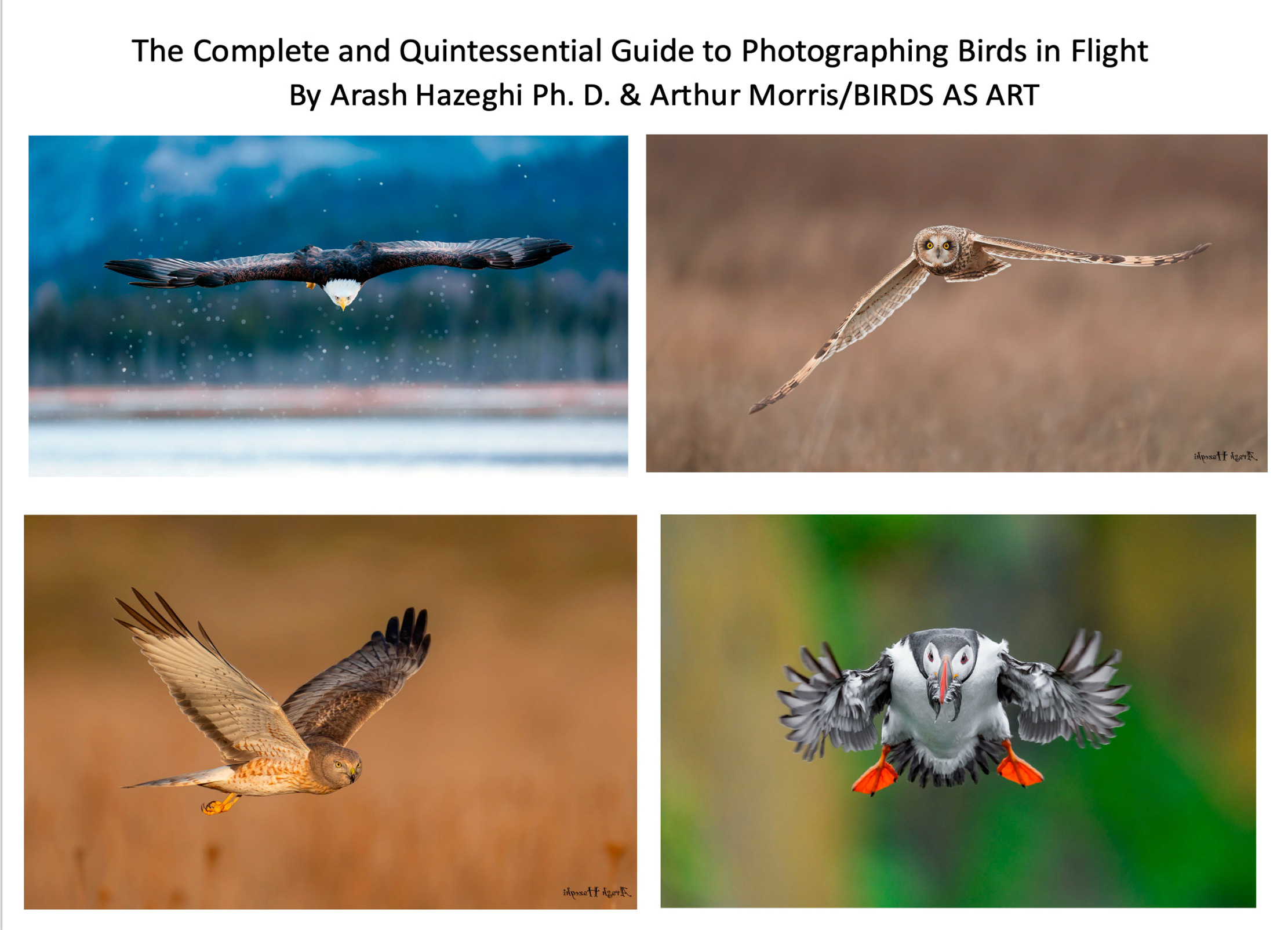
The title says it all. Purchase your copy here. The Complete and Quintessential Guide to Photographing Birds in Flight
|
The Complete and Quintessential Guide to Photographing Birds in Flight: $99.00
I had long dreamed of becoming a great flight photographer. When using dSLR gear, making sharp images was a huge problem. Most of the time, the camera bodies simply were not up to snuff. Things have changed dramatically with mirrorless technology. The high-end mirrorless camera bodies now feature science fiction-like autofocus systems and frame rates of 30, 40, and even 125 fps. Nowadays, getting the eye sharp is no longer a problem. The problem more often involves selecting the strongest image from a long series of sharp images.
The truth, however, is that there is a lot more than owning a Canon EOS R1, a Nikon Z9, or a Sony a-1 ii to consistently creating great photographs of birds in flight. Some of the biggest factors to success include gear choice, shooting strategies, and understanding the importance of sky conditions and wind speed and direction. Once you have the techniques and technical aspects down pat and can routinely create sharp images, learning the importance of flight poses, wing positions, backgrounds, and subject placement and image design enable you to create and then select superb flight images. And you guessed it, each of those topics and tons more are covered in detail in The Complete and Quintessential Guide to Photographing Birds in Flight.
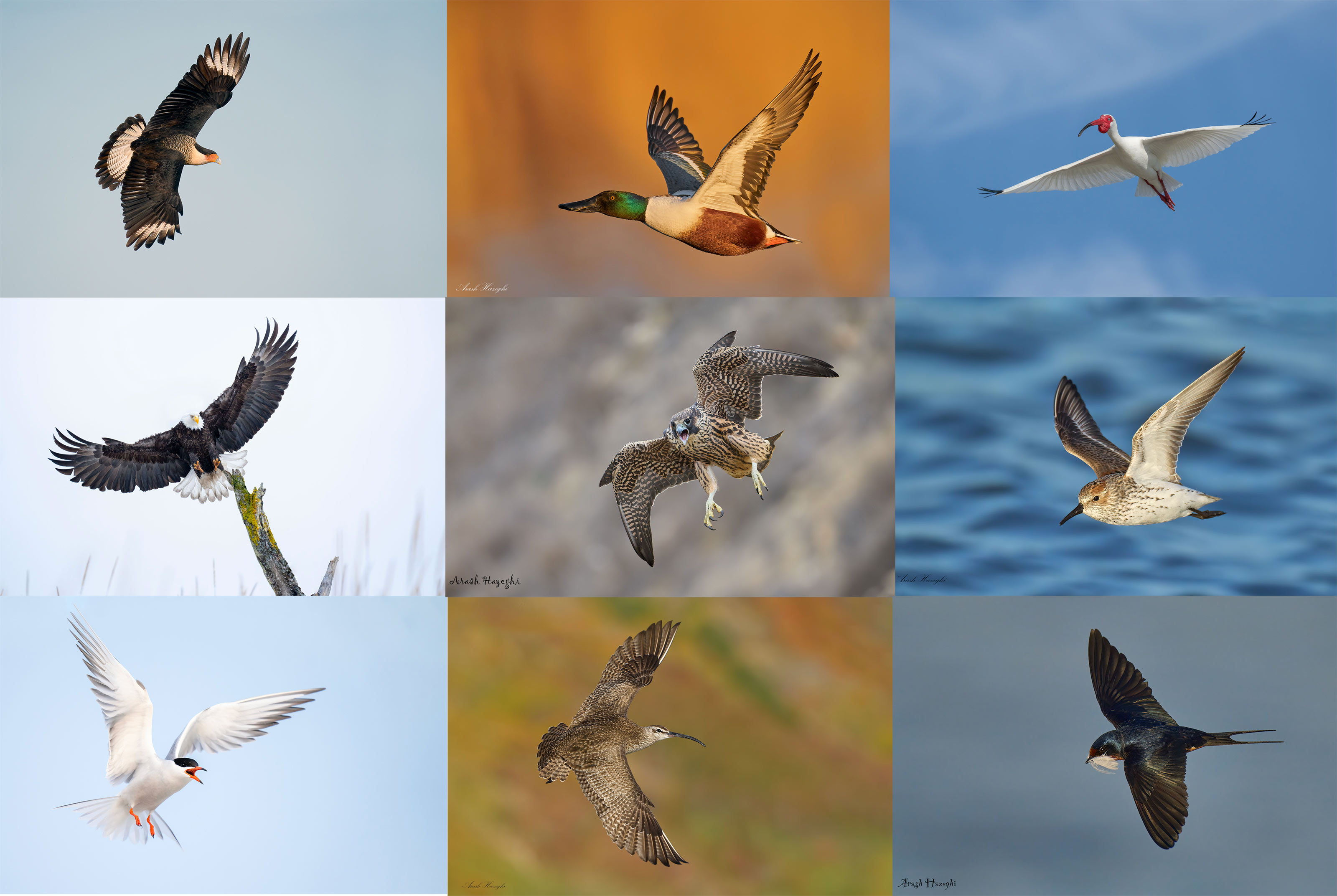
The guide consists of 267 pages and 21,013 words. There are 82 illustrative photos scattered throughout the text, two screen captures, and a 112-image gallery that includes examples created by Canon, Nikon, and mostly Sony gear. As seen above, each of the 194 inspirational photos is labeled with an educational caption.
You can purchase your copy here for $99.00.
Arash Hazeghi
Arash Hazeghi, Ph.D. is a principal electron device engineer. He received his Ph.D. degree in Electrical Engineering in 2011, from Stanford University, Stanford, California. His pioneering research on Carbon Nanotubes has been cited many times. In the past decade, Arash Hazeghi has been a major contributor to the research and the development of some of the most cutting-edge technologies introduced by Silicon Valley’s most reputable names including SanDisk, Intel and Apple.
More relevant here is that he is widely recognized as one of the world’s best birds in flight photographers. He specializes in raptors and the technical aspects of bird photography.
|
|
Flight photography is a skill that can be studied, practiced, and learned. Improve your skills by studying The Complete and Quintessential Guide to Photographing Birds in Flight |
The Complete and Quintessential Guide to Photographing Birds in Flight
By Arash Hazeghi Ph.D., and Arthur Morris/BIRDS AS ART
What you will learn (about):
-
1- Weight and handholding super-telephoto lenses.
2- Weight and handholding intermediate telephoto and telephotos zoom lenses.
3- Choosing the right flight photography lens or lenses for you.
4- The importance of focal length for flight photography.
5- The importance of lens speed (the maximum aperture for flight photography.
6- Choosing between fixed focal lengths and zoom lenses for flight photography.
7- The importance of AF speed and performance for flight photography.
8- Handholding tips and techniques.
9- Shooting flight off a tripod with the Levered-clamp FlexShooter Pro.
10- Flight poses and wing positions.
11- Why artie changed his mind about the 400mm f/2.8 lenses for flight and more.
12- The advantages and disadvantages of using teleconverters for flight photography.
13- Why to stay away from off-brand lenses.
14- Understanding the importance of wind direction and speed for flight photography.
15- The relationship between sky conditions and wind direction and how it affects flight photography.
16- Creating flight silhouettes in wind-against-sun conditions.
17- The importance of being on sun angle for flight photography (and avoiding harsh shadows).
18- Tips on doing flight photography in cloudy, foggy, or overcast conditions.
19- About the direction of light in cloudy, foggy, or overcast conditions and how it affects flight photography.
20- How your understanding of bird behavior can dramatically improve your flight photography.
21- Tips on attracting birds for flight photography.
22- What to do when your camera’s AF system is temporarily blind.
23- The vital importance of pre-focusing.
24- How Direct Manual Focus can help you with flight photography.
25- The importance of shooting aggressively when doing flight photography.
26- Everything that you need to know with regards to rest positions for flight photography.
27- The importance of getting low when doing flight in many situations.
28- Getting the right exposure when doing flight photography.
29_ Why to use Manual mode 95% of the time for flight.
30- Tips on finding the bird in the frame, acquiring focus, and tracking the bird in flight.
31- How to set and best utilize your lens’s image stabilization feature (and why).
32- Setting the focus range limiter switch on your flight lens or lenses.
33- To choose the best shutter speed for photographing birds in flight.
34- The vital importance of pre-focusing. And yes, this is so important that it is on the list twice.
You can see four sample pages in the blog post here. And you can purchase your copy here.
Typos
With all blog posts, feel free to e-mail or to leave a comment regarding any typos or errors.







This post is coming up instead of your latest email link to the backlit Egret images?
While my guitar gently weeps. Here comes the sun little darling.
Thanks, Jeff. Two more from Harrison.
with love, artie
I am all in on the sandhill cranes: #1, #2 and #5. How lucky you are to have these majestic birds in your backyard!
Thanks, Pat. You’ve got that right. The challenge is to try to come up with new and different images on a regular basis.
with love, artie
Hey artie, top three picks:
#5 as I am a fan of well done tight closeups. I love the pink sky and the details on the crane’s head.
#1 as I like the vertical comp, the two cranes looming large seemingly over our heads, and prefer I the juxtaposition of the cranes on #1 compared to #2 (which I like too).
#3 as it is a very interesting behaviour image that kept my attention to it pretty long to study what is happening. Fun!
What bugs you about #6? Perhaps the bill tip “touching” the tail feather, it bugs me a little bit, but I suspect it is where the horizon line intersects the vulture – you’d have likely prefer the vulture higher against that line (line cutting much lower on the body, if at all)
Huge thanks, Dan. Your thoughtful comments are always appreciated and spot on. Interesting thoughts on #1 vs. #2. The crane in #3 was tossing grass to impress its mate.
The bill tip “touching” the tail feather was indeed bugged me the most.
much love, artie
Artie, Love George Harrison
Love the image #2 with her inviting. However the Dance is my favorite with the sunset it happens so fast and you need to be ready. Love the colors.
I suspect in the Vulture is could be her left foot not quite visible
AND the 200-600mm lens really does rock.
Always with love b
Thanks, Bob. See you in San Diego.
with love, artie
I’ll take a stab at what bugs you about #6. I see three things that may make you twitch.
1. You may wish for the right wing to be fully fanned like the left.
2. The tip of the beak just merging with the dark edge of the tail feather.
3. This is my leading contender. I suspect you wish both feet were clear of the body for landing.
Thanks, Pugs. Two out of three ain’t bad (Meat Loaf).
What are your three faves?
with love, artie
Thanks, Pugs. Two out of three ain’t bad (Meat Loaf).
What are your three top picks?
with love, artie
5, 3, 6
Thanks for revisiting Pugs!
with love, artie