
Your Calls?
Which two of today’s five featured Pied-billed Grebe images is your favorite? Why did you choose them?
Which do you prefer — the grebes in the sun or the grebes in the shade?
My Calls
Thanks for all the comments on the 13 images in the last blog post. The consensus pick was the vertical Pied-billed Grebe and its reflection. Here are my top six (sorry) picks in no particular order:
1- The vulture tree sunrise for the sky color and the single bird landing.
2- The bathing Mottled Duck for the action, the spray, and the decent look at both speculums.
3- The perched juvenile Norther Harrier because of the soft light and the beauty of the bird and the bird.
4- The crane dismount because I stuck with the challenging situation and managed to pull out a single decent frame.
5- The Great Egret rain shower sunset for its uniqueness.
6-The caracara on the road kill for the low perspective.
Please note that I loved the other seven images as well.
What’s Up?
Opportunities during my morning photo sessions here at ILE have been pretty good recently yesterday, I had several chances with the perched juvenile harrier and made two very nice passerine images — a Palm Warbler with a juicy insect and a Blue-Gray Gnatcatcher with its tail raised.
Today is Friday 26 December 2025. I will — of course — be heading down to the lake early. The forecast is calling clear and sunny with a slight NW breeze. Whatever you opt to do, I hope that you too choose to have a wonderful and productive day and that you have fun too. Do remember that happiness is a choice — Byron Katie, The Work.Com.
If an item — a Delkin flash card or reader, a Levered-clamp FlexShooter Pro, or a Wimberley lens plate or low foot — for example, that is available from B&H and/or Bedfords, is also available in the BAA Online Store, it would be great, and greatly appreciated, if you would opt to purchase from us. We will match or beat any price. Please remember also to use my B&H affiliate links or to earn 3% cash back at Bedford by using the BIRDSASART discount code at checkout for your major gear purchases. Doing either often earns you free guides and/or discounts. And always earns my great appreciation.
Gear Questions and Advice
Too many folks attending BAA IPTs and dozens of photographers whom I see in the field and on BirdPhotographer’s.Net, are — out of ignorance — using the wrong gear, especially when it comes to tripods and more especially, tripod heads. And the same is true in spades when ordering new camera bodies or lenses. My advice will often save you some serious money and may help you avoid making a seriously bad choice. Please know that I am always glad to answer your gear questions via e-mail. If you are desperate, you can try me on my cell at 863-221-2372. Please leave a message and shoot me a text if I do not pick up.
B&H Simplified
To ensure that I get credit for your B&H purchases, you can always click here. The tracking is invisible but using my affiliate links is greatly appreciated. And, with B&H, you can use your PayBoo card. You must use the website to order. You cannot get your free guides if you make a phone order. Once you have an item in your cart, you must complete the order within two hours. Huge thanks!
B&H
Many folks have written recently stating that they purchased a Sony a1 from B&H and would like their free membership in the Sony 1 Info and Updates Group, a $150.00 value. But when I check my affiliate account, their orders have not been there. When I let them know that they get credit for B&H purchases only if they use one of the many B&H affiliate links on the blog or begin their searches with this link, they are always disappointed. If in doubt, please contact me via e-mail and request a BH link. I am always glad to help and to guide you to the right gear.

Bedfords Simplified
Click here to start your search. Choose standard shipping, and when you get to the payment page, enter BIRDSASART in the discount code box and hit apply. You will be upgraded to free second day air Fed-Ex and receive 3% cash back on your credit card once your stuff ships. Using either my affiliate links is greatly appreciated and will often earn you free guides or discounts. To receive a free guide or free entry into a Sony Set-up and Info Notes e-Mail group, you need to shoot me your receipt via e-mail. The B&H receipts need to include the order number.
Bedfords Amazing BAA Discount Policy
Folks who have fallen in love with Bedfords can always use the BIRDSASART coupon code at checkout to enjoy a post-purchase, 3% off-statement credit (excluding taxes and shipping charges) on orders paid with a credit card. The 3% credit will be refunded to the card you used for your purchase when your product ships. Be sure, also, to check the box for free shipping to enjoy free Second Day Air Fed-Ex. This offer does not apply to purchases of Classes, Gift Cards, or prior purchases.
You can visit the Bedfords website here, shoot Steve Elkins an e-mail, or text him on his cell phone at (479) 381-2592.
|
|
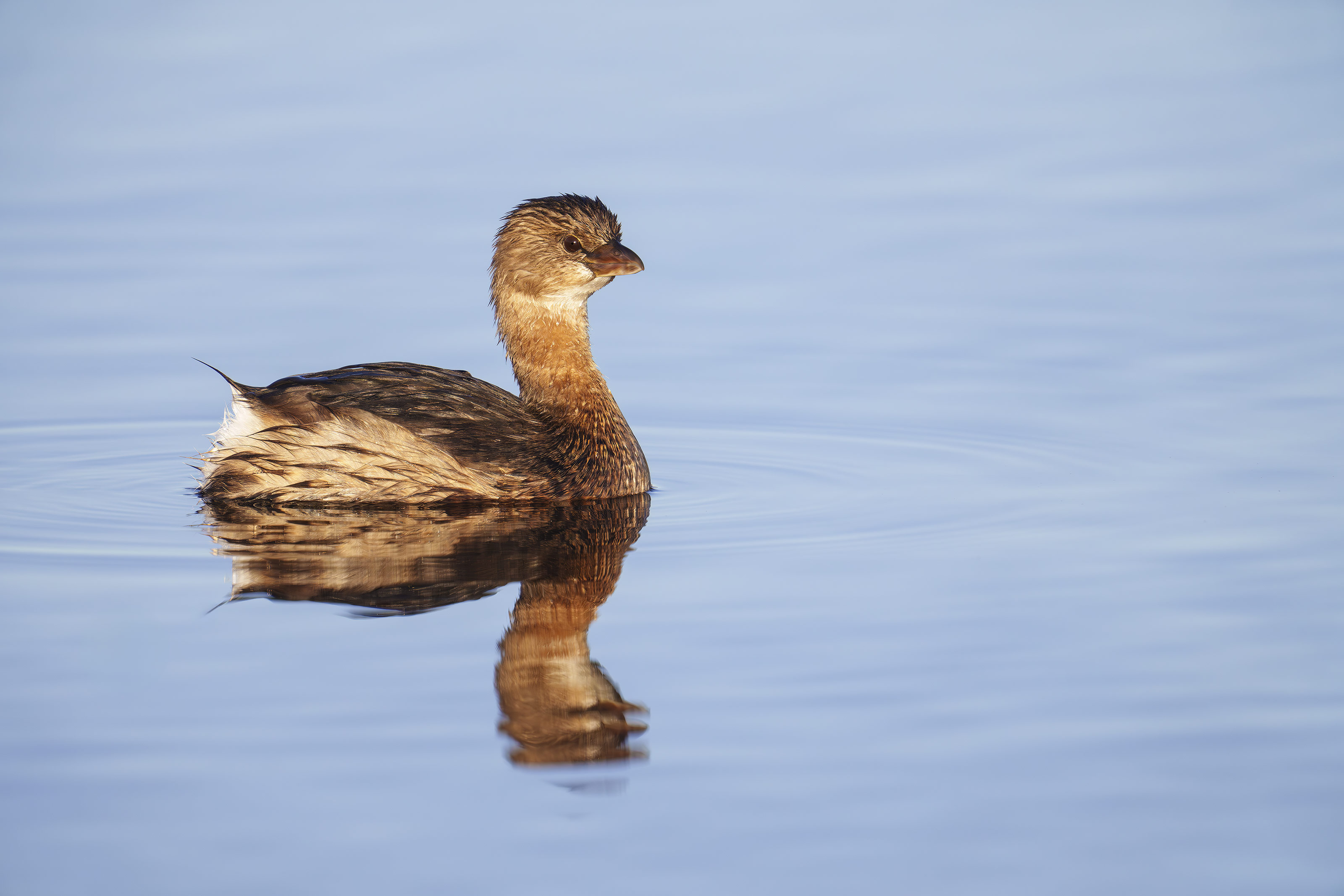
This image was created on 22 December 2025 by yours truly down by the lake near my home at Indian Lake Estates, FL. Seated in the driver’s seat of my SUV, I used the BLUBB-supported Sony FE 600mm f/4 GM OSS lens with the Sony FE 2x Teleconverter and the Sony a-1 (now replaced by The Latest Greatest Sony Flagship Body, the a1 II Mirrorless Camera). The exposure was determined using Zebra technology with ISO on the Thumb Wheel. ISO 1600: 1/1600 second at f/8 (wide open) in Manual mode. AWB at 8:07:47am on a sunny morning. Wide/AF-C with Bird-Eye/Face Detection performed perfectly. Click on the image to enjoy the high-res version. Image #1: Pied-billed Grebe floating in the sun |
Grebes
Grebes are specialized waterbirds which inhabit marshes and reed-fringed lakes. Virtually unable to move on land, they build floating nests and find all their food (arthropods and fish) in the water. Because of their total dependence on wetlands they are sensitive to changes in these ecosystems.
These ancient diving birds appeared suddenly in the fossil record around 23-25 million years ago in the Miocene, likely originating in the Southern Hemisphere. Extinct genera like Thiornis and Pliolymbus showed early diving traits, while modern grebes, with their unique leg placement and diving skills represent a highly specialized, isolated lineage from deep time.
All Grebes, especially the Pied-billed Grebe, are exceptional divers with remarkable buoyancy control, allowing them to sink silently like submarines to hunt prey or evade danger by trapping water in their feathers and expelling air, often disappearing with only their head showing before submerging completely. They propel themselves underwater with their powerful, lobed feet set far back on their bodies, making them agile underwater but clumsy on land. They can stay submerged for about 30 seconds, chasing fish, insects, and crustaceans, using their unique diving to hunt and hide effectively.
|
|
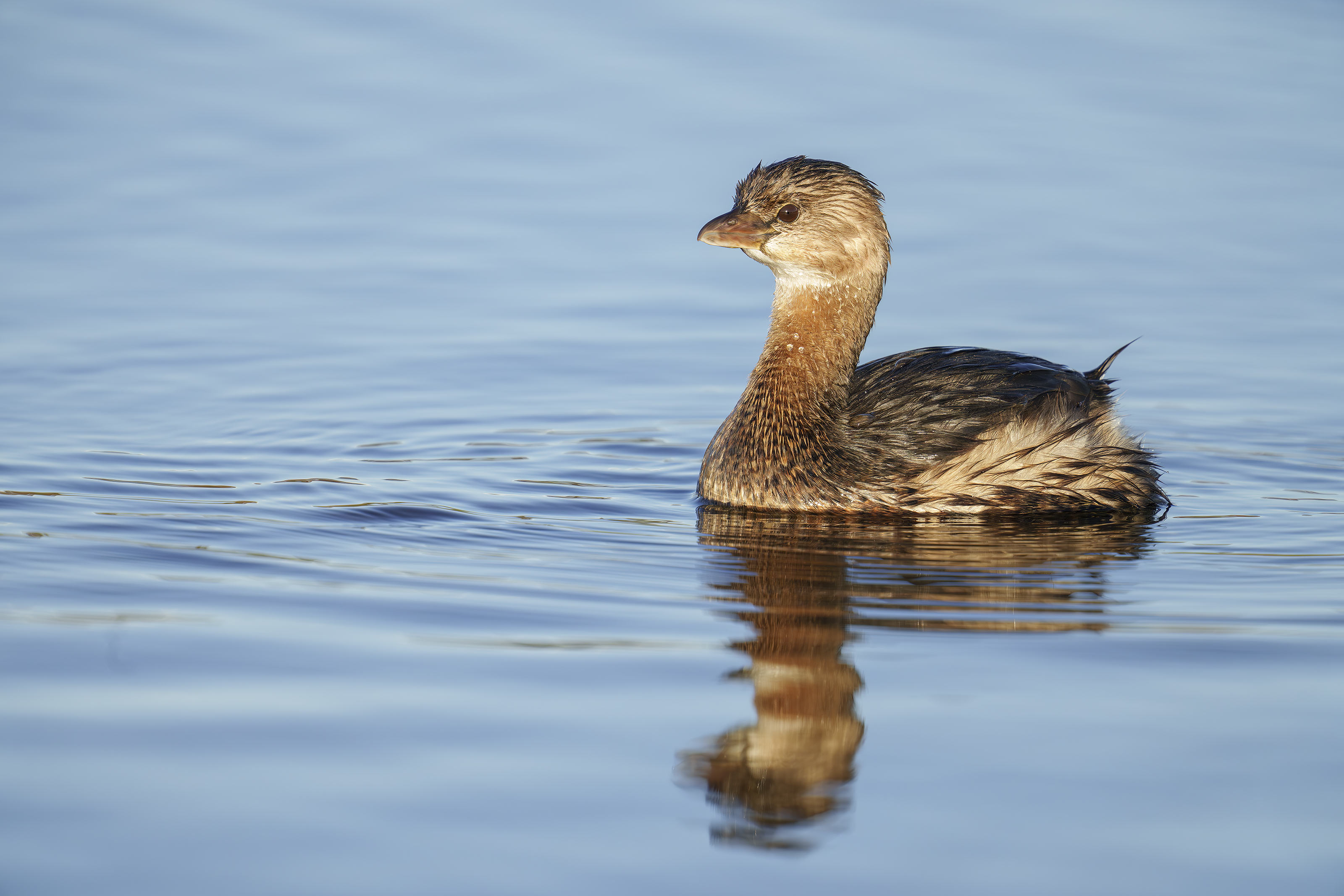
This image was created on 22 December 2025 by yours truly down by the lake near my home at Indian Lake Estates, FL. Seated in the driver’s seat of my SUV, I used the BLUBB-supported Sony FE 600mm f/4 GM OSS lens with the Sony FE 2x Teleconverter and the Sony a-1 (now replaced by The Latest Greatest Sony Flagship Body, the a1 II Mirrorless Camera). The exposure was determined using Zebra technology with ISO on the Thumb Wheel. ISO 1250: 1/1600 second at f/8 (wide open) in Manual mode. AWB at 8:12:16am on a sunny morning. Wide/AF-C with Bird-Eye/Face Detection performed perfectly. Click on the image to enjoy the high-res version. Image #2: Pied-billed Grebe floating in the sun |
Pied-billed Grebe
The Pied-billed Grebe (Podilymbus podiceps) is a species of the grebe family of water birds primarily found in ponds throughout the Americas.
This species was first described by Carl Linnaeus in the 10th edition of his Systema Naturae in 1758 as Colymbus podiceps. Other names include American dabchick, rail, dabchick, Carolina grebe, devil-diver, dive-dapper, hell-diver, pied-billed dabchick, thick-billed grebe, and water witch.
Since the extinction of the Atitlán Grebe (Podilymbus gigas), the pied-billed has become the sole extant member of the genus Podilymbus. Atitlán Grebe was endemic at the Lago de Atitlán in Guatemala at an altitude of 1700 meters!
Outside of its own genus, the closest relatives of the Pied-billed Grebe are the small grebes of the genus Tachybaptus — the widespread Little Grebe (Tachybaptus ruficollis) of Eurasia, Africa, and Australasia, and the Least Grebe (Tachybaptus dominicus) of the Americas.
|
|
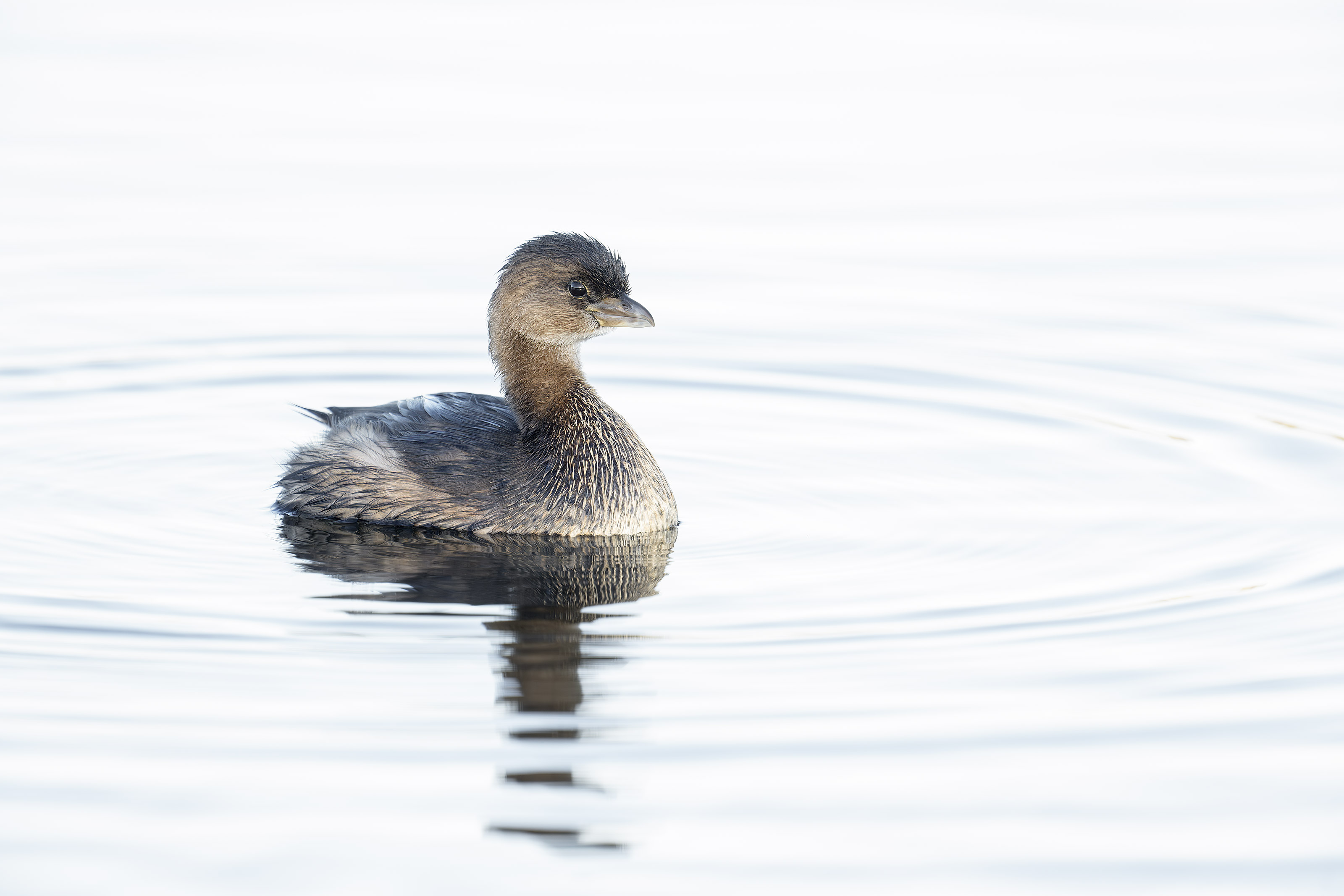
This image was created on 24 December 2025 by yours truly down by the lake near my home at Indian Lake Estates, FL. Seated in the driver’s seat of my SUV, I used the BLUBB-supported Sony FE 600mm f/4 GM OSS lens with the Sony FE 1.4x Teleconverter and the Latest Greatest Sony Flagship Body, the a1 II Mirrorless Camera. The exposure was determined using Zebra technology with ISO on the Thumb Wheel. ISO 1250: 1/400 second at f/5.6 (wide open) in Manual mode. AWB at 8:03:16am in the shade of some large trees on a sunny morning. Wide/AF-C with Bird Eye/Face Detection enabled performed perfectly. Click on the image to enjoy the larger, inexplicably sharper high-res version. Image #3: Pied-billed Grebe floating in the shade |
Shade versus Sun
The pied-billeds in Images #1 & #2 were lit by the sun. Working in Manual (exposure) mode, the analogue scale showed +2/3 of a stop. The color balances were fine and the colors looked quite natural. The birds in Images #3, #4, and #5 were in the shade. The analogue exposure scale showed close to +2 stops. These images showed a distinct blue cast that was largely removed by increasing the color temperature during the raw conversion. ACR masks were used to lighten and further warm up the birds and to remove the remainder of the blue color cast especially from the wings of the bird in the rear of Image #5.
The masking feature in Adobe Camera Raw (in both Photoshop and Lightroom) allows making changes to the subject and or the background alone easy as pie. In Volume III of the Digital Basics IV Video Series. I introduced and detailed the use of a variety of ACR mask selection options including Subject, Background, Sky, Brush, and Linear Gradient. In the last two volumes I will cover creating Radial Gradient, Object (beyond amazing!), and both Color Range and Luminance Range masks. I have selected the six images for Volume IV and will create that video today.
The more I use and experiment with the Masking feature in ACR the more neat tricks I come up with.
Remember: when the sun is shining, your camera’s meter is fairly smart. In the shade, it is as dumb as a skunk. Also, the first step to correct the color of images created in the shade is to increase the color temperature during the raw conversion.

|
|
This image was created on 24 December 2025 by yours truly down by the lake near my home at Indian Lake Estates, FL. Seated in the driver’s seat of my SUV, I used the BLUBB-supported Sony FE 600mm f/4 GM OSS lens with the Sony FE 1.4x Teleconverter and the Latest Greatest Sony Flagship Body, the a1 II Mirrorless Camera. The exposure was determined using Zebra technology with ISO on the Thumb Wheel. ISO 1250: 1/640 second at f/5.6 (wide open) in Manual mode. AWB at 8:03:43am in the shade of some large trees on a sunny morning. Wide/AF-C with Bird Eye/Face Detection enabled performed perfectly. Click on the image to enjoy the larger, inexplicably sharper high-res version. Image #4: Pied-billed Grebe flapping after dive |
Getting Lucky with Shutter Speed!
For the first 8 or ten images in the flapping sequence, I clipped the bird’s head as it rose unexpectedly and quickly from the water. When I finally got the bird centered in the frame without clipping the wings, most of the images showed enough motion blur on the head to ruin the photo. Because my shutter speed was not fast enough for intermediate action, this frame was the only keeper.
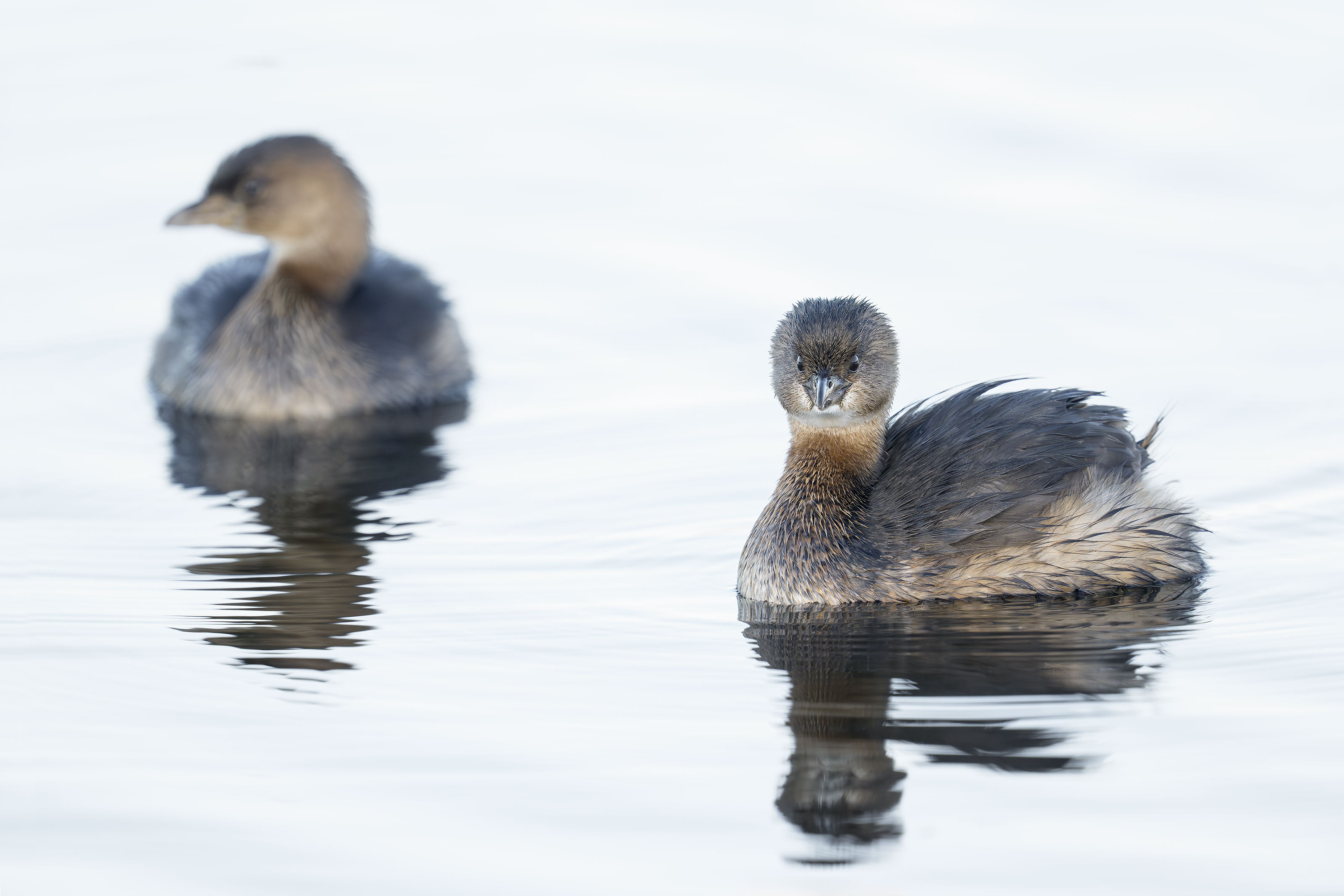
A better plan would have been to increase the ISO to 2000 and correspondingly raise the shutter speed to 1/1000 second. I did just that with Image #5 below but unfortunately, the horse had already left the barn.
Nearly Comprehensive YouTube Video Guide: Shutter Speeds for Bird Photography
View, bookmark, and study this 46-minute video and learn about choosing a suitable shutter speed for all types of bird photography — for static subjects, for flight, and for various types of action. Not to mention for creating the pleasingly blurred images that I love. There is so much info in this 46 minutes video that serious bird photographers will wish to bookmark it for study. Scroll down to see the succinct summary below.
For lots more on shutter speeds, see the blog post here.
|
|
This image was created on 24 December 2025 by yours truly down by the lake near my home at Indian Lake Estates, FL. Seated in the driver’s seat of my SUV, I used the BLUBB-supported Sony FE 600mm f/4 GM OSS lens with the Sony FE 1.4x Teleconverter and the Latest Greatest Sony Flagship Body, the a1 II Mirrorless Camera. The exposure was determined using Zebra technology with ISO on the Thumb Wheel. ISO 2000: 1/1000 second at f/5.6 (wide open) in Manual mode. AWB at 8:05:05am in the shade of some large trees on a sunny morning. Wide/AF-C with Bird Eye/Face Detection enabled performed perfectly. Click on the image to enjoy the larger, inexplicably sharper high-res version. Image #5: Two Pied-billed Grebes floating in the shade |
Two Bird Juxtapositions
When working with two birds in the frame, look for situations where the subjects are arranged pleasingly. Most times it is best to avoid merges. And unless the birds are virtually on the same plane, do not strive to render both birds sharp. That ain’t gonna happen with a telephoto lens if the birds are more than an inch apart. That the rear bird is out of focus adds a sense of depth to the image.
Typos
With all blog posts, feel free to e-mail or to leave a comment regarding any typos or errors.









Ah, somebody else likes the shade, like me 🙂
much love, a
These are all very good images. I like the juxtaposition of the birds, with the primary subject keeping an eye on you in image 5, and the action of image 4. I also really like the colors of the sun images and feel that the shade images are just a bit too blue.
Thanks, Dane. You should have seen the shady raw files.
much love, artie
I’m with Patricia on this one, Image 5 being my favourite, but second favourite is Image 2. Perfect capture and I love the bird’s expression… dare I say “cute”!
Thanks Maggi. I should have included “cute” in the title.
with love, artie
I like the colors with the sun and the action in the shade.
Thanks, J Marr. I am the odd man out; I like the colors in the images made in the shade best.
with love, artie
My first choice is #5, the two grebes in the shade — I like the face on the nearest bird. My second choice is #4, the grebe flapping it’s wings. The images in the shade make the birds “pop” more.