
Your Call
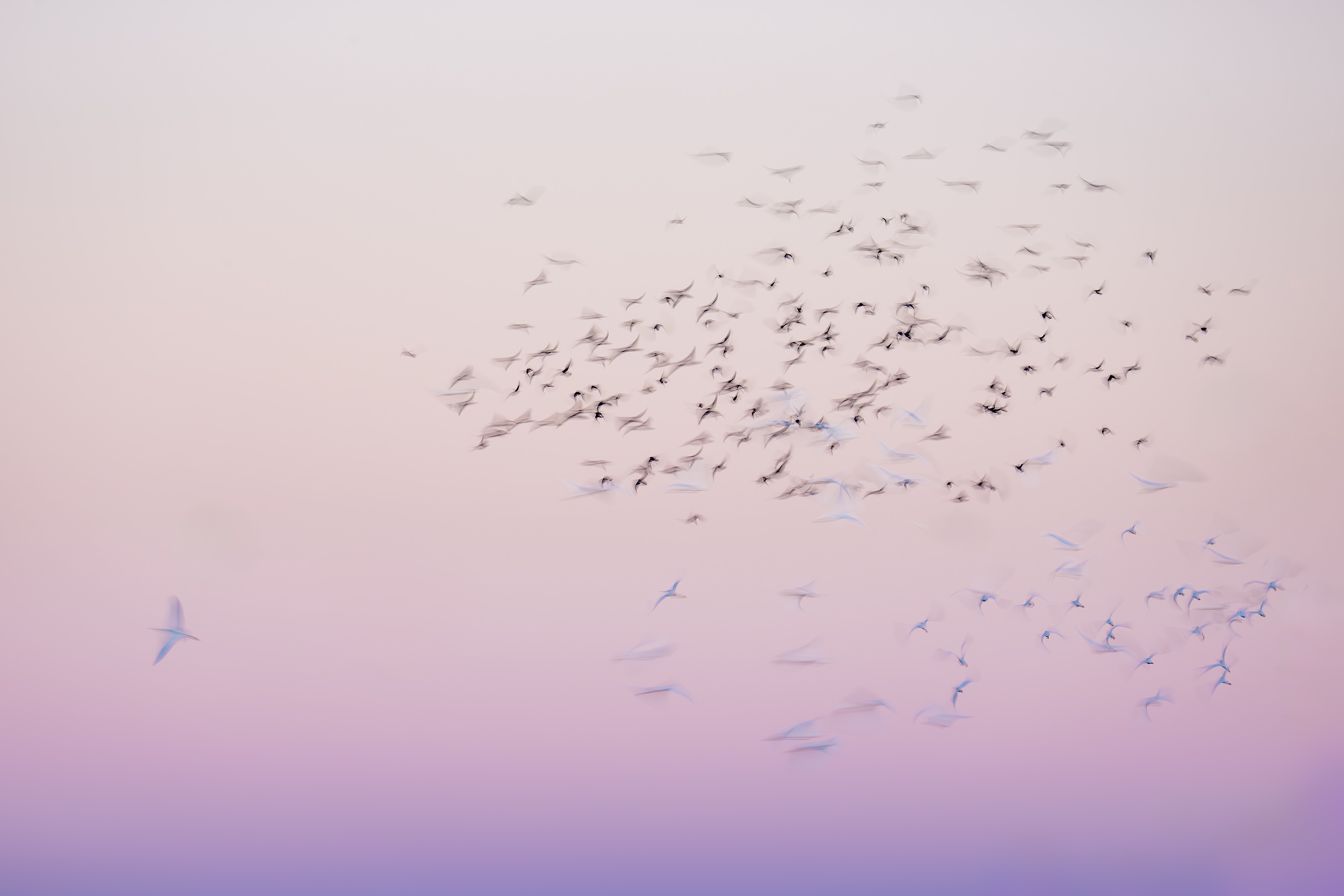
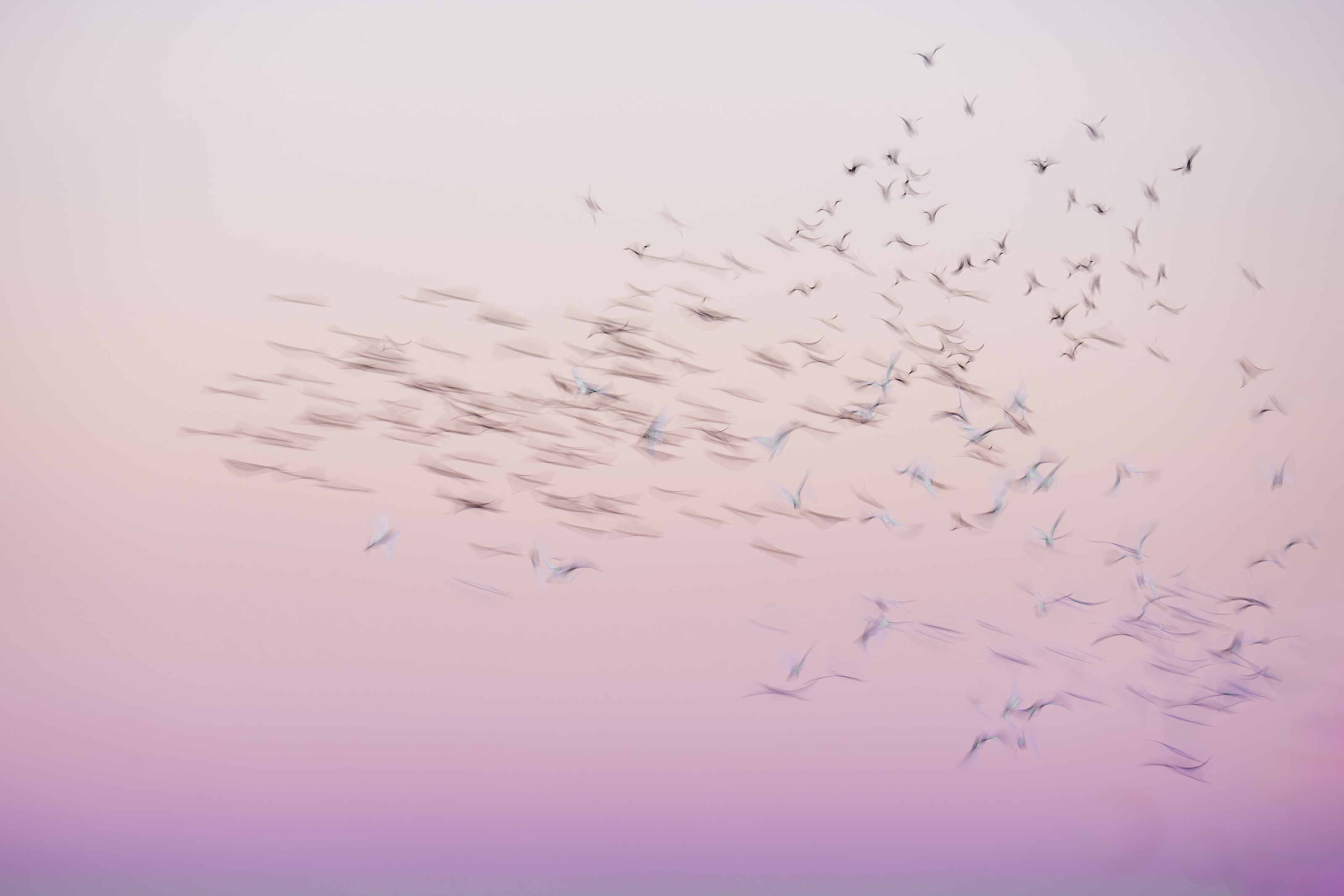
Today’s two featured images are quite similar — each was created in the same second. They were the two keepers from a short series of about a dozen. If you like blurs and prefer one over the other, please leave a comment and let us know your reasons. If you hate all blurs, have a happy 2026!
In the Last Post
Huge thanks for all the comments in the last blog post and all the 2026 best wishes. Though I absolutely loved the Anhinga flight shot and was proud of myself for getting on that bird so quickly, the dancing crane fire-in-the-mist shot was my favorite by a small margin. In addition to the action and behavior I love the silhouetted vegetation (especially the spent flowers on the left side of the frame).
Sony 12-24mm f/2.8 GM Ultra-Wide Angle Zoom Lens
Your truly is offering a (barely) used Sony FE 12-24mm f/2.8 GM Lens in near mint to like-new condition for the silly low price of $1,998.00. The sale includes the original box, the lens shade, the front cover, and insured ground shipping via Fed-Ex to lower 48 addresses. (Others please inquire.)
Please contact artie via e-mail or on his cell at 863-221-2372.
Ultra-Wide, Ultra Versatile
Comprising a range of ultra-wide fields of view, the Sony FE 12-24mm f/2.8 GM is an E-mount zoom characterized by an impressively bright and versatile design. Ideal for landscape, nature, architecture, and interior applications, the lens’s constant f/2.8 maximum aperture and advanced optical design make it a perfect choice for working in difficult shooting conditions while still offering well-corrected imagery. As part of Sony’s esteemed G Master series, this lens is designed to achieve notably high resolution and sharpness through the correction of a wide variety of spherical and chromatic aberrations. Bright f/2.8 constant maximum aperture benefits working in difficult lighting conditions and also affords increased control over depth of field.
Nano AR Coating II has been applied to reduce surface reflections, flare, and ghosting for increased contrast and color rendering in strong lighting conditions. This updated coating is better suited for larger, curved elements and is especially adept at minimizing internal reflections.
Rounded nine-blade diaphragm contributes to a pleasing bokeh quality when employing shallow depth of field techniques. Sony & B&H
I am selling this lens because I rarely use it; I am a telephoto kind of guy. It is selling new for $3,248.00. There are used copies in lesser condition (9 – Minor surface marks) like this one for $2,585.95 and one in the same condition (10 — Good as new) here for $2,824.95. Get in touch with me today and save a handsome $1250.00 for my pretty much new lens. artie
What’s Up?
Three of the four College Football Playoff (CFP) games were heart-stoppingly exciting with the Ole Miss victory over Georgia taking the cake. And there are some great NFL games with playoff implications on the schedule both today and tomorrow.
Conditions were perfect on Friday morning — clear skies with a rare breeze from the southeast. The session began very slowly as my walk on the pier was totally unproductive. I almost gave up early but decided to check the boat ramp. I spent a wonderful hour photographing an American Kestrel in flight working from my vehicle at 840mm/f/5.6 with the 600 on the BLUBB! The bird was perching on a utility wire and then diving into the grass for bugs and spiders. I have tried this before but whenever I would stop anywhere near the perched raptor they would leave the scene. For unknown reasons, this female was quite accommodating. I wound up with several that I really liked — my best kestrel photos in nearly 43 years.
Today is Saturday 3 January. After heading down to the lake I need to start packing for San Diego. The second IPT is wide open and I have room for you at the AirBnB. We can do airport pick-up and ride with the leader so you would not need to rent a car. Scroll down to the bottom for details. As is usual when I am home, heading down to the lake well before sunrise to see what’s going on is at the top of the day’s agenda. I hope that you too choose to have a wonderful and productive day and that you have fun too. Please remember that happiness is a choice — Byron Katie, The Work.Com (and as discussed in yesterday’s blog post).
If an item — a Delkin flash card or reader, a Levered-clamp FlexShooter Pro, or a Wimberley lens plate or low foot — for example, that is available from B&H and/or Bedfords, is also available in the BAA Online Store, it would be great, and greatly appreciated, if you would opt to purchase from us. We will match or beat any price. Please remember also to use my B&H affiliate links or to earn 3% cash back at Bedford by using the BIRDSASART discount code at checkout for your major gear purchases. Doing either often earns you free guides and/or discounts. And always earns my great appreciation.
|
|
This image was created on 31 December 2026 down by the lake near my home at Indian Lake Estates, FL. Standing on the pier, I used the handheld Sony FE 200-600mm f/5.6-6.3 G OSS lens (at 264mm) and the The Latest Greatest Sony Flagship Body, the a1 II Mirrorless Camera. The exposure was determined by Zebras with Exposure Compensation (EC) on the thumb wheel. Multi Metering +1.7 stops. AUTO ISO set ISO 125: 1/15 second at f/6.3 (wide open) in Shutter Priority mode. AWB at 7:18:00am before the sun rose over the woods on a clear morning. Wide/AF-C with Bird-Eye/Face Detection performed perfectly. Click on the image to enjoy the larger, inexplicably sharper high-res version. Image #1: Boat-tailed Grackle/Cattle Egret pre-dawn blur
|
On Being Prepared
When you head out into nature to do some bird or wildlife photography, you must be ready to react almost instantly so that if something good, great, or amazing happens right in front of you you are good to go. Here are some simple suggestions that you should incorporate into your fieldcraft. Religiously.
1- Turn the camera on and leave it on until your session is done. I am amazed at how many folks turn their cameras off when they are not actively photographing “to save battery power.” I explain that if they turn off their camera every time that they are not shooting that in one decade they might save two cents worth of electricity while missing dozens of great chances while waiting the half second or so for their camera to boot up.
2- Be aware of what mode you are in, Manual or Shutter Priority. As the BIRDS AS ART Blog posts have shown for years (and most especially recently) that I will often work in Shutter Priority mode at sunrise and sunset and then switch to Manual (exposure) mode once the sun comes out or it brightens up considerably.
3- Before you head out, you also want to be aware and certain of your settings, most especially the chosen shutter speed, always step one in the process. If you are in Shutter Priority mode, make sure that you are in AUTO ISO and that you have chosen an appropriate shutter speed — slow for blurs, medium for static photography, of high for flight and action. Lastly in this mode you must be aware of the Exposure Compensation that you have set.
Once things brighten up and you switch to Manual (exposure) mode, adjust your settings for possible action by setting a fast shutter speed. For example, if I am walking the pier once the sun is out and their are Cattle Egrets on the railings, I will set 1/4000 sec. at wide open aperture with the ISO set for a bright white bird. If a darker subject flies by I will adjust for the tonality of the subject by raising the ISO or lowering the shutter speeds as needed.
With those three bases covered; you are ready to hit a home run when something special happens.
|
|
This image was created on 31 December 2026 (in the same second and four frames after Image #1, above) down by the lake near my home at Indian Lake Estates, FL. Standing on the pier, I used the handheld Sony FE 200-600mm f/5.6-6.3 G OSS lens (at 264mm) and the The Latest Greatest Sony Flagship Body, the a1 II Mirrorless Camera. The exposure was determined by Zebras with Exposure Compensation (EC) on the thumb wheel. Multi Metering +1.7 stops. AUTO ISO set ISO 125: 1/15 second at f/6.3 (wide open) in Shutter Priority mode. AWB at 7:18:00am before the sun rose over the woods on a clear morning. Wide/AF-C with Bird-Eye/Face Detection performed perfectly. Click on the image to enjoy the larger, inexplicably sharper high-res version. Image #2: Boat-tailed Grackle/Cattle Egret pre-dawn blur
|
Sometimes the Plan Works Perfectly
I generally peek out the door to my pool deck about 30 minutes before the time of sunrise. It is easy to tell if the sky is dead clear. If it is, I try to get down to the lake at least ten minutes before the time of sunrise as I know that the low sky opposite a clear sunrise — anywhere from northwest in the fall and winter and the southwest in the warmer months, will show a lovely palette of pink/purple/blue. This is the result of the low sky being in the earth’s shadow just before sunrise.
As I am driving down to the lake early every morning that I am home, I put a fresh battery in my a-1 ii and a Delkin 960GB Black CF Express Memory Card into card slot 1, view a few images to make sure I have downloaded the card and seen the photos on my laptop (and backed them up), and then format the card. Next I lower the ISO until it gets to AUTO, move the mode dial from M to S to get into Shutter Priority, set a slow shutter speed, and dial in +1.7 or +2 stops. If a nice flock flies through the pink, I not only know where I am but am confident that I am ready to create some nice pleasing blurs. I’ve done the exact same thing day after day after day, most days since I got back from Sebastian. Until the last day of the year, I had not been rewarded for my diligent efforts. I cannot say that any more :-).
|
|
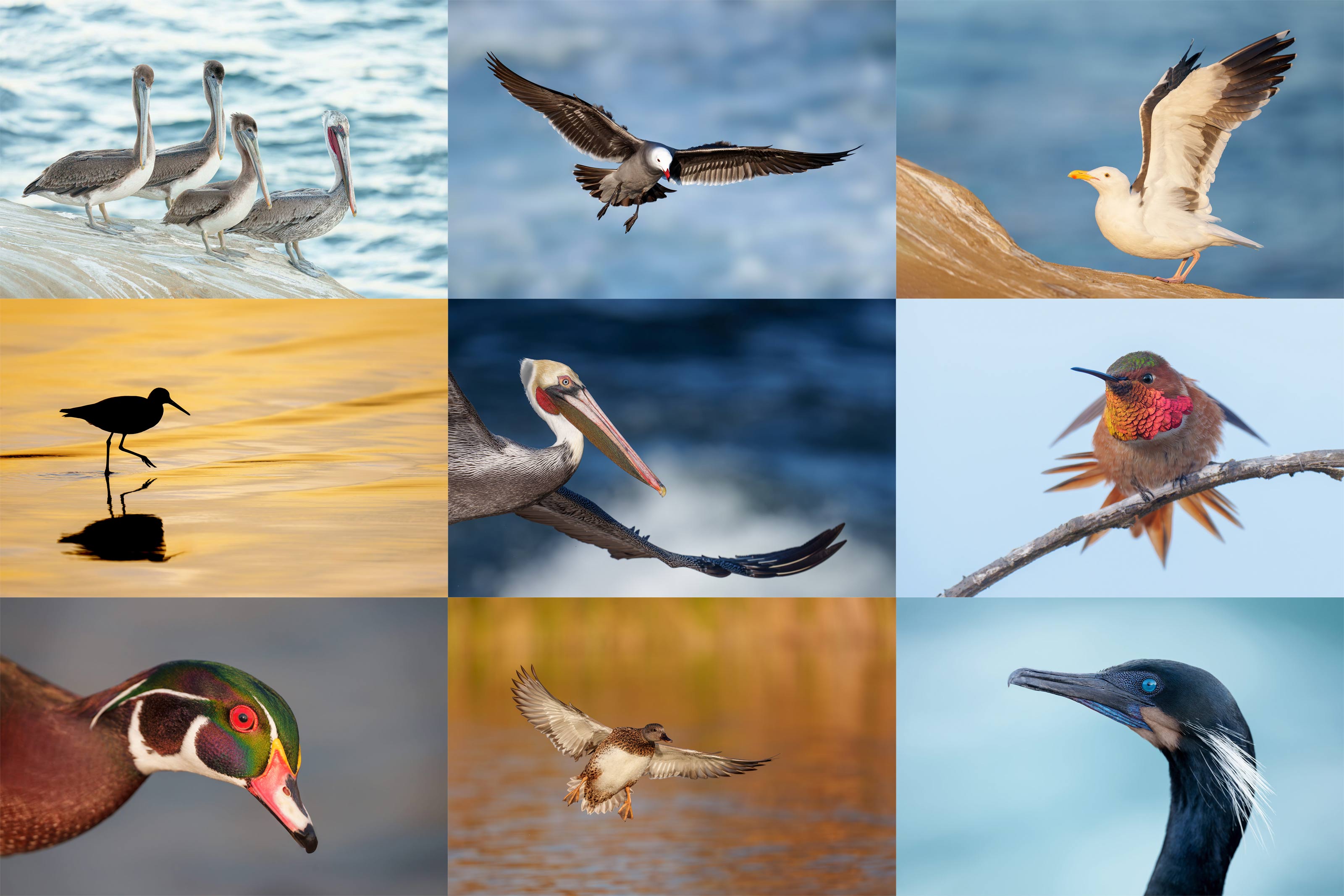
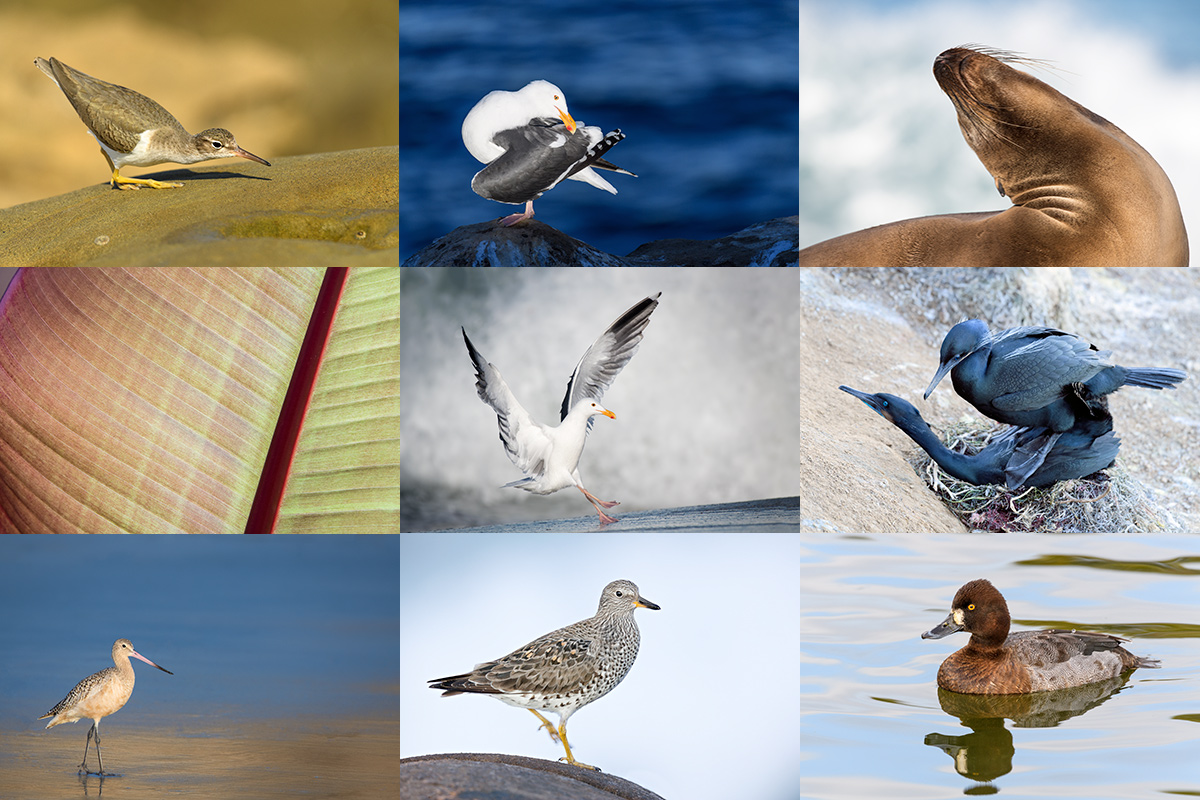
San Diego offers an incredible variety of attractive avian subjects, including and especially the Pacific race of Brown Pelican. Clockwise from top left back to center: juvenile and sub-adult Brown Pelicans; Heermann’s Gull; Western Gull; Allen’s Hummingbird; Brandt’s Cormorant; Gadwall hen; Wood Duck drake; Willet; Brown Pelican tight flight. Click on the composite to enjoy a larger version. |
The 2026 San Diego Brown Pelicans (and more!) IPTs
San Diego IPT #1: 4 1/2 DAYS: THURS 8 JAN thru the morning session on MON 12 JAN 2026: $2599.00. Deposit: $699.00. Limit: 6 photographers/4 openings. (AirBnB Sold Out)
San Diego IPT #2: 4 1/2 DAYS: FRI 16 JAN thru the morning session on TUES 20 JAN 2026: $2599.00. Limit: 6 photographers.
Please get in touch with questions or to register with an e-mail to samandmayasgrandpa@att.net and please shoot me a text to 863-221-2372.
AirBnB accommodations and ground transport with the leader are available for the second IPT. Please e-mail for details and/or to register.
Join me in San Diego to photograph the spectacular breeding plumage Brown Pelicans with their fire-engine red and olive green bill pouches; Brandt’s (nesting) and Double-crested Cormorants; breeding plumage Wood and Ring-necked Ducks; other duck species possible including Lesser Scaup, Redhead, Northern Shoveler and Surf Scoter; a variety of gulls including Western, California, and the gorgeous Heermann’s, all in full breeding plumage; shorebirds including Marbled Godwit, Willet, Sanderling and Black-bellied Plover; many others are possible including Least, Western, and Spotted Sandpiper, Whimbrel, Black and Ruddy Turnstone, Semipalmated Plover, and Surfbird; Harbor Seals and California Sea Lions (both depending on the current regulations and restrictions). And as you can see by studying the IPT cards, there are some nice bird-scape and landscape opportunities as well. Not to mention a ton of excellent flight photography opportunities and instruction.
Please note: where permitted and on occasion, ducks and gulls may be attracted (or re-located) with offerings of grains or bread.
|
|
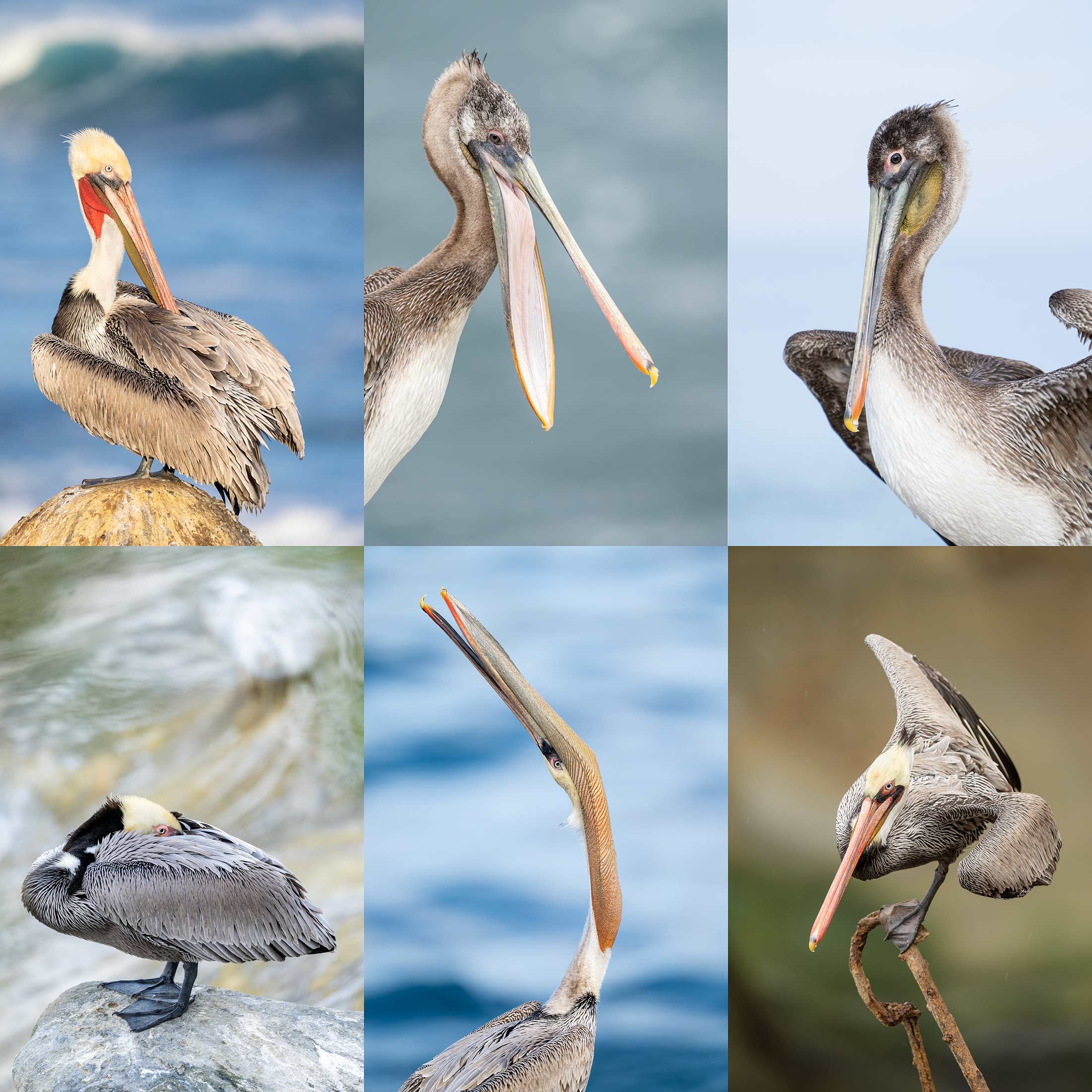
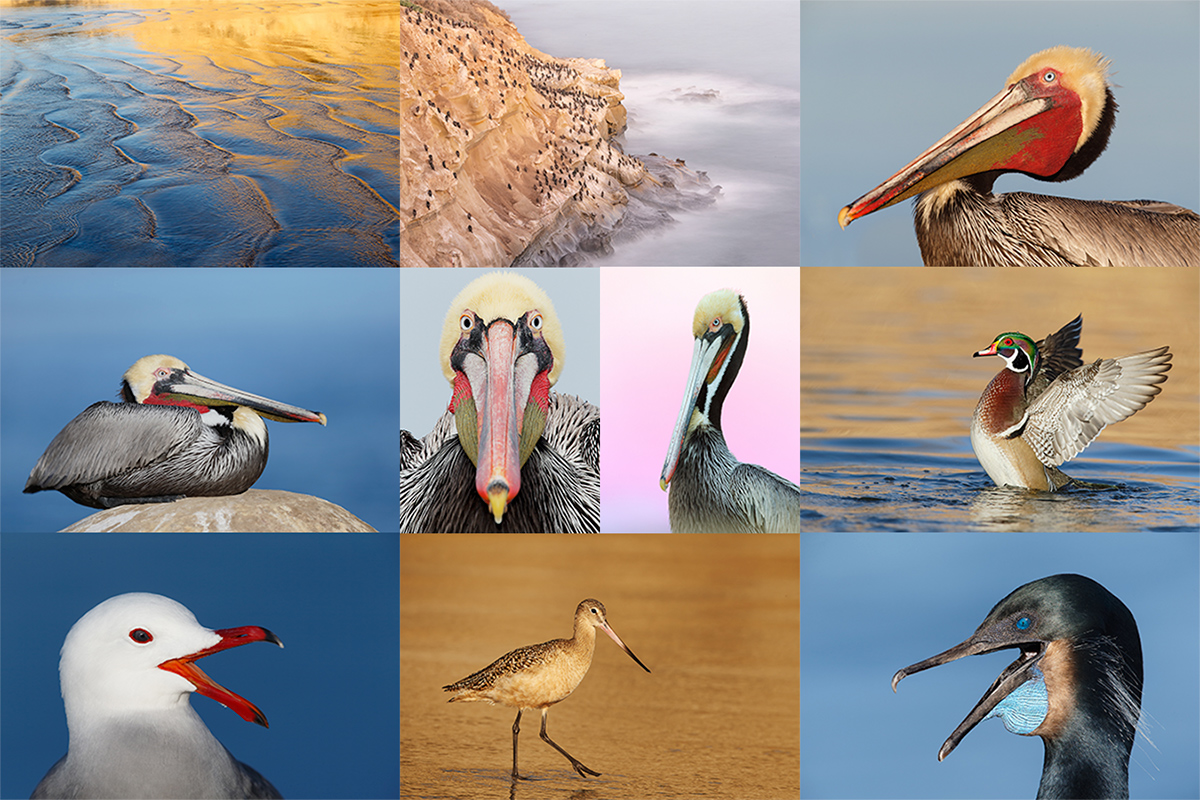
San Diego offers a wealth of very attractive natural history subjects, including and especially the Pacific race of California Brown Pelican. With annual visits spanning more than four decades, I have lots of photographic experience there … Click on the composite to enjoy a larger version. |
Learning Exposure, Whether You Like It Or Not
Whether you like it or not, we will be beating the subject of exposure like a dead horse. In every new situation, you will hear my thoughts on exposure along with my thoughts on both Nikon and Canon histograms and SONY Zebras. Whether you like it or not, you will learn to work in manual mode so that you can get the right exposure every time (as long as a bird gives you ten seconds with the light constant). Or two seconds with SONY zebras … And you will learn what to do when the light is changing constantly. What you learn about exposure will be one of the great takeaways on every IPT.
|
|
Though the pelicans will be the stars of the show on this IPT, there will be many other handsome and captivating subjects in wonderful settings. Click on the composite to enjoy a larger version. |
It Ain’t Just Pelicans
With gorgeous subjects just sitting there waiting to have their pictures taken, photographing the pelicans on the cliffs is about as easy as nature photography gets. With the winds from the east almost every morning, there is usually some excellent flight photography, at times with 70-200mm lenses! And the pelicans are almost always doing something interesting: preening, scratching, bill pouch cleaning, or squabbling. And then there are those crazy head throws that are thought to be a form of intra-flock communication. You will be guided as to how to make the best of those opportunities. Depending on the weather, the local conditions, and the tides, there are a variety of other fabulous photo chances available in and around San Diego. Each IPT will include one or two duck sessions.
|
|
|
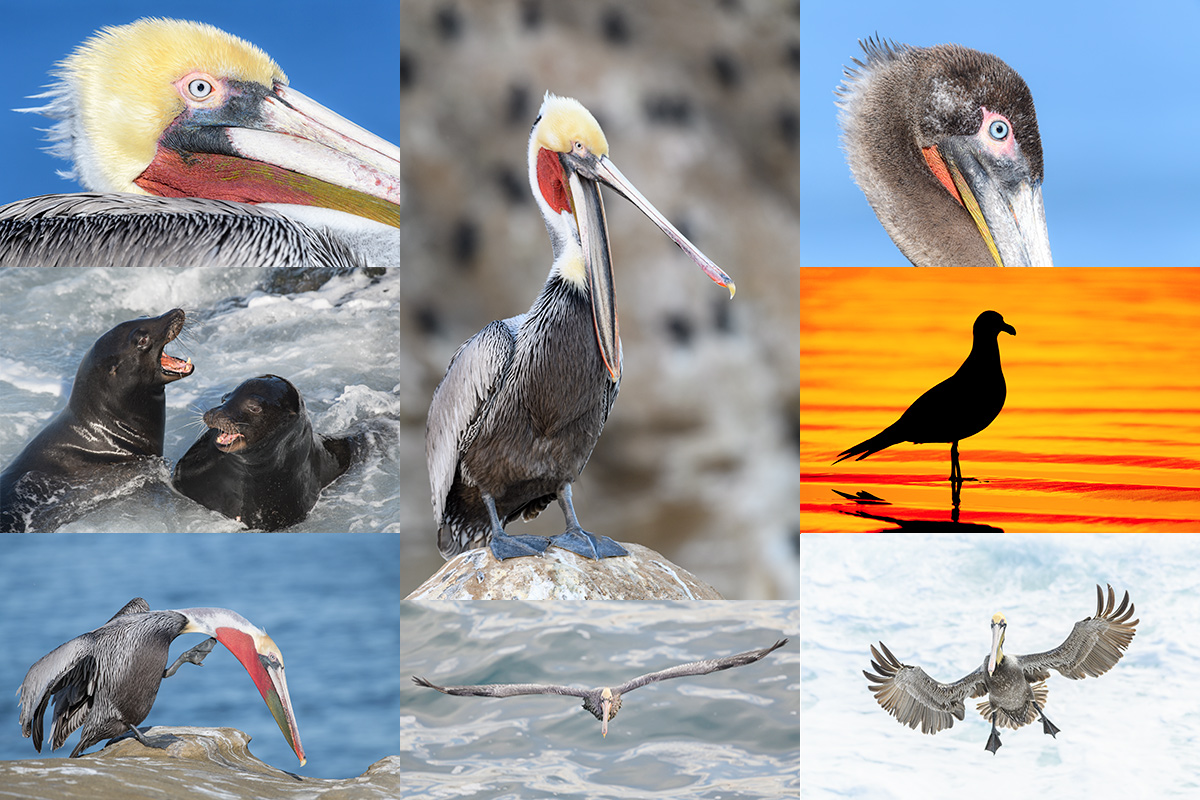
Did I mention that there are lots of great birds and natural history subjects in San Diego in winter? Click on the composite to enjoy a larger version. |
The San Diego Details
These IPTs will include five 3-hour morning photo sessions, four 1 1/2-hour afternoon photo sessions, and four working brunches (included) that will include image review and Photoshop sessions. On rare cloudy days, we may — at the leader’s discretion, stay out in the morning for a long session and skip that afternoon shoot. To ensure early starts, breakfasts will be your responsibility. And so that we can get some sleep, dinners will be on your own as well. In the extremely unlikely event that Goldfish Point is closed due to local ordinance (or whimsy) — that has never happened in the past fifty years, I will of course do my very best to maximize our photographic opportunities.
AirBnB Details
I have reservations for a wonderful AirBnB. I am able to cancel for free no later than 5 December 2025. Staying at an IPT AirBnB maximizes learning and allows for more time in the field. The cost of your private room in a lovely home will be $150/night. Explore the possibility of arriving early and/or staying on for additional photography sessions by getting in touch via e-mail. Brunch is on me. Dinners are provided for $25/day. I am an excellent chef and the food is both healthy and of high quality.
|
|
San Diego offers a wealth of very attractive natural history subjects, including and especially the Pacific race of California Brown Pelican. With annual visits spanning more than four decades, I have lots of photographic experience there. Click on the composite to enjoy a larger version. |
Deposit Info
A $699 deposit (plus half the cost of your lodging and meals) is required to hold your slot for one of the 2026 San Diego IPTs. You can send a check (made out to “BIRDS AS ART”) to us here: BIRDS AS ART, PO Box 7245, Indian Lake Estates, FL, 33855, or call Jim or Jennifer at the office with a credit card at 863-692-0906. Your balance, payable only by check, is due two months before the trip.
|
|
|
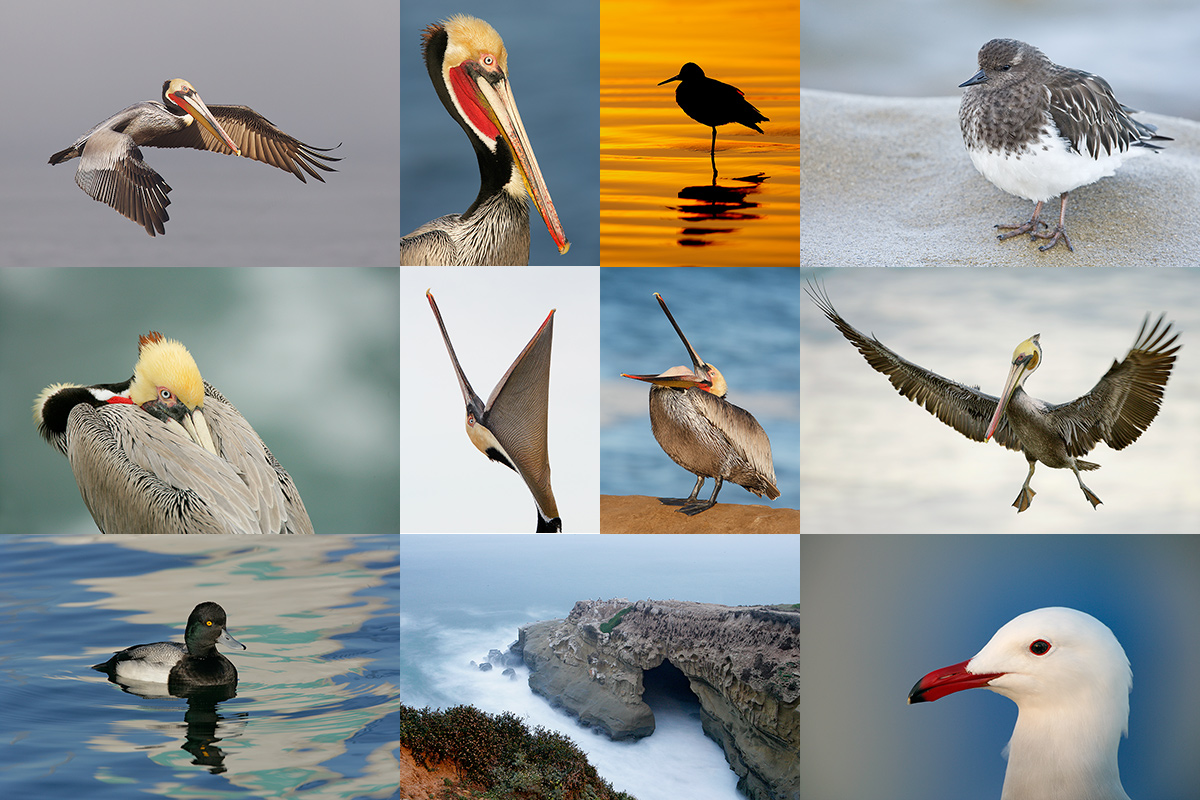
Variety is surely the spice of life in San Diego. Click on the composite to enjoy a larger version. |
Getting Up Early and Staying Out Late
On all BIRDS AS ART IPTS including and especially the San Diego IPT, we get into the field early to take advantage of unique and often spectacular lighting conditions and we stay out late to maximize the chances of killer light and glorious sunset silhouette situations. We often arrive at the cliffs a full hour before anyone else shows up to check out the landscape and seascape opportunities.
Typos
With all blog posts, feel free to e-mail or to leave a comment regarding any typos or errors.









In #1 the single bird on the left makes the photo. Love the pink light.
In #2 the stronger diagonal lines make that one for me.
Thanks, Elinor. I agree that it is a toss-up and that pink light is magical.
with love, artie