
Your Call
Which of today’s eight featured images do you like best? Please leave a comment and let us know why you made your choices. Only two folks left a comment at the last blog post; I responded to them individually.
Incredible
For the past few days, Kevin Hice borrowed some of my Sony lenses and used them with my back-up a-1 ii body. Impressed by the light weight of the Sony gear and the incredible Bird/Face-Eye tracking autofocus system of the a- ii, he is, after using Canon gear 15 years, switching to Sony.
What’s Up?
With low surf conditions, i.e., no big waves to force the birds up on the cliffs, pelican photography at the main cliff has been relatively poor but for our (Bob and me) first session. We have done well with pelican flight at the Bridge Club; on Monday morning, Nora Kane did it again coming up with the image of the day — a beautiful breeding plumage Brown Pelican riding the spray of a breaking wave. See more on Nora’s amazing progress below. We’ve continued to do well with the ducks (as seen in today’s blog post) and with the nesting Brandt’s Cormorants.
We spent several hours on Monday reviewing photos and creating image optimization videos. In addition, we all sat around the dining room table with our laptops on and open as I created a video and guided everyone in setting up my personalized keyboard shortcuts.
Today is Tuesday 13 January 2026. We will likely be heading to the beach at Coronado for a change of pace. Nora’s husband Doug, and Kevin and Colleen are heading to the San Diego Zoo this afternoon. Anyhoo, I hope that you too choose to have a wonderful and productive day and that you have fun too. Please remember that happiness is a choice — Byron Katie, The Work.Com (and as discussed in the previous blog post).
If an item — a Delkin flash card or reader, a Levered-clamp FlexShooter Pro, or a Wimberley lens plate or low foot — for example, that is available from B&H and/or Bedfords, is also available in the BAA Online Store, it would be great, and greatly appreciated, if you would opt to purchase from us. We will match or beat any price. Please remember also to use my B&H affiliate links or to earn 3% cash back at Bedford by using the BIRDSASART discount code at checkout for your major gear purchases. Doing either often earns you free guides and/or discounts. And always earns my great appreciation.
Gear Questions and Advice
Too many folks attending BAA IPTs and dozens of photographers whom I see in the field and on BirdPhotographer’s.Net, are — out of ignorance — using the wrong gear, especially when it comes to tripods and more especially, tripod heads. And the same is true in spades when ordering new camera bodies or lenses. My advice will often save you some serious money and may help you avoid making a seriously bad choice. Please know that I am always glad to answer your gear questions via e-mail.. If you are desperate, you can try me on my cell at 863-221-2372. Please leave a message and shoot me a text if I do not pick up.
B&H Simplified
To ensure that I get credit for your B&H purchases, you can always click here. The tracking is invisible but using my affiliate links is greatly appreciated. And, with B&H, you can use your PayBoo card. You must use the website to order. You cannot get your free guides if you make a phone order. Once you have an item in your cart, you must complete the order within two hours. Huge thanks!
B&H
Many folks have written recently stating that they purchased a Sony a1 from B&H and would like their free membership in the Sony 1 Info and Updates Group, a $150.00 value. But when I check my affiliate account, their orders have not been there. When I let them know that they get credit for B&H purchases only if they use one of the many B&H affiliate links on the blog or begin their searches with this link, they are always disappointed. If in doubt, please contact me via e-mail and request a BH link. I am always glad to help and to guide you to the right gear.

Bedfords Simplified
Click here to start your search. Choose standard shipping, and when you get to the payment page, enter BIRDSASART in the discount code box and hit apply. You will be upgraded to free second day air Fed-Ex and receive 3% cash back on your credit card once your stuff ships. Using either my affiliate links is greatly appreciated and will often earn you free guides or discounts. To receive a free guide or free entry into a Sony Set-up and Info Notes e-Mail group, you need to shoot me your receipt via e-mail. The B&H receipts need to include the order number.
Bedfords Amazing BAA Discount Policy
Folks who have fallen in love with Bedfords can always use the BIRDSASART coupon code at checkout to enjoy a post-purchase, 3% off-statement credit (excluding taxes and shipping charges) on orders paid with a credit card. The 3% credit will be refunded to the card you used for your purchase when your product ships. Be sure, also, to check the box for free shipping to enjoy free Second Day Air Fed-Ex. This offer does not apply to purchases of Classes, Gift Cards, or prior purchases.
You can visit the Bedfords website here, shoot Steve Elkins an e-mail, or text him on his cell phone at (479) 381-2592.
|
|
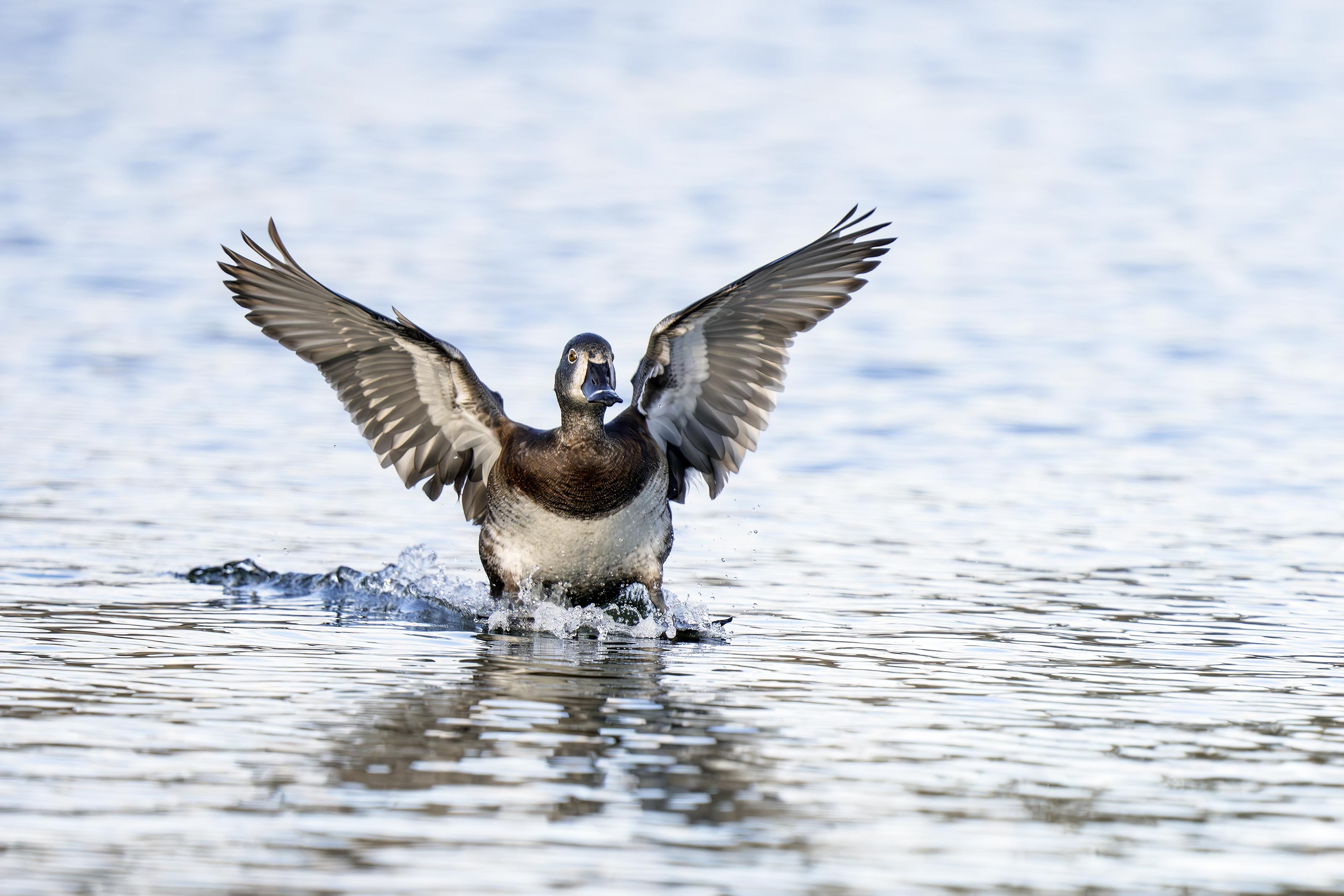
This image was created on 8 January 2026 by IPT student Nora Kane at Santee Lakes Regional Park, CA. Seated on a sidewalk adjacent to Lake 5, she used the handheld Sony FE 200-600mm f/5.6-6.3 G OSS lens (at 600mm) and the The Latest Greatest Sony Flagship Body, the a1 II Mirrorless Camera. The exposure was determined by Zebras with Exposure Compensation (EC) on the thumb wheel. Multi Metering +1 stop. AUTO ISO set ISO 2000: 1/3200 second at f/6.3 (wide open) in Shutter Priority mode. AWB at 3:46:23pm on a variably sunny afternoon. Tracking: Zone/AF-C with Bird-Eye/Face Detection performed perfectly. Click on the image to enjoy the larger, inexplicably sharper high-res version. Image #1: Ring-necked Duck hen landing
|
Nora’s First Afternoon With the Sony a- ii
When Nora signed up at the urging of multiple IPT veteran and good friend Kevin Hice, she owned the 200-600, the 400-800, and the a7RV. When I ‘splained to her that her camera would not cut it for birds; especially for birds in flight, she trusted me and purchased a new a-1 ii (kindly using my link of course). On Thursday afternoon, I got my settings on her camera and taught her to operate the camera sitting on the couch in our AirBnB. After three days of shooting, me thinks that she has learned more in less time than anyone who has ever attended an IPT, even Red Stevens who had never photographed a bird when he showed up at Sebastian Inlet. Nora learned her camera quickly. She learned tripod handling. Se learned Photo Mechanic from scratch. She now confidently picks here keepers from 3,000 to 7,000 images in short order. She arrived enamored with Adobe LightRoom Classic but I begged her to learn Photoshop. She is now optimizing her best images quickly and efficiently. What more could a teacher ask for?
Anyhoo, on our first flying duck session, Nora made the single best image. She credits her teacher.
|
|
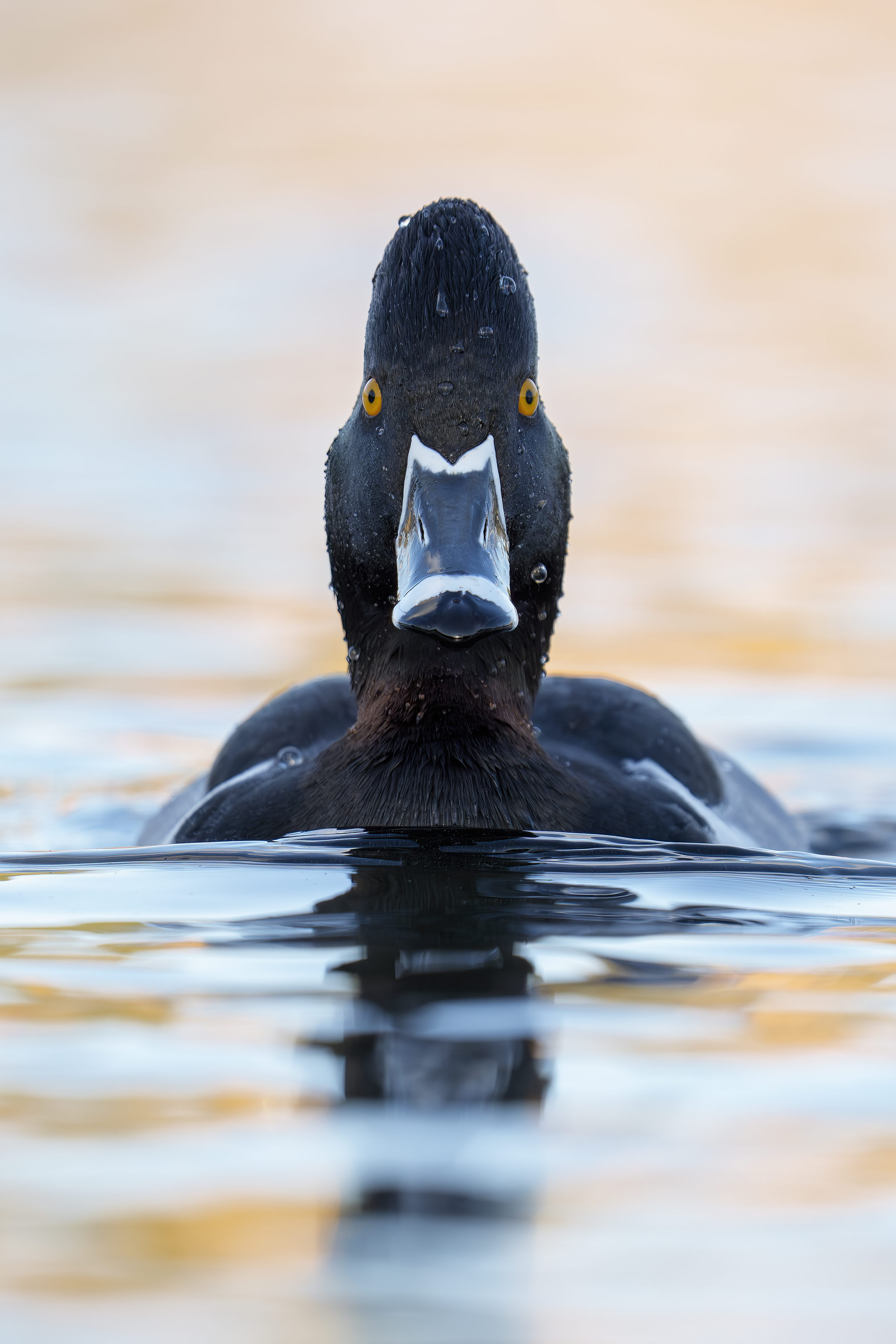
This image was created on 8 January 2026 at Santee Lakes Regional Park, CA. Seated on a tarmac road, I used the handheld Sony FE 200-600mm f/5.6-6.3 G OSS lens (at 541mm) and the The Latest Greatest Sony Flagship Body, the a1 II Mirrorless Camera. The exposure was determined by Zebras with Exposure Compensation (EC) on the thumb wheel. Multi Metering +2.0 stops. AUTO ISO set ISO 1600: 1/1000 second at f/6.3 (wide open) in Shutter Priority mode. AWB at 4:14:25pm on a sunny afternoon in the shade of a hill to the west. Wide/AF-C with Bird-Eye/Face Detection performed perfectly. Click on the image to enjoy the larger, inexplicably sharper high-res version. Image #2: Ring-necked Duck drake staring down the lens barrel
|
Shutter Priority With AUTO ISO and Exposure Compensation (EC) on a Convenient Dial
Though I have used Shutter Priority with AUTO ISO and EC on the Thumb Wheel for ducks in flight, on this trip I have begun using it for all of my waterfowl shooting at Santee Lakes. It is by far the fastest, easiest, and most efficient way to come up with good exposures as the ducks are swimming from sunlight into shadows. Some of the hens are all earth tones, and require a bit of plus Exposure Compensation when basked by sunshine. The male woodies and ring-necked have small patches of brilliant white; in the sun, they might need as much a -1 full stop of EC. Once the birds are in the shade, you need to as high as +1.7 or even +2 full stops to properly light the darker subjects. How much brighter? Zebra technology makes that far easier to do as compared to other systems.
|
|
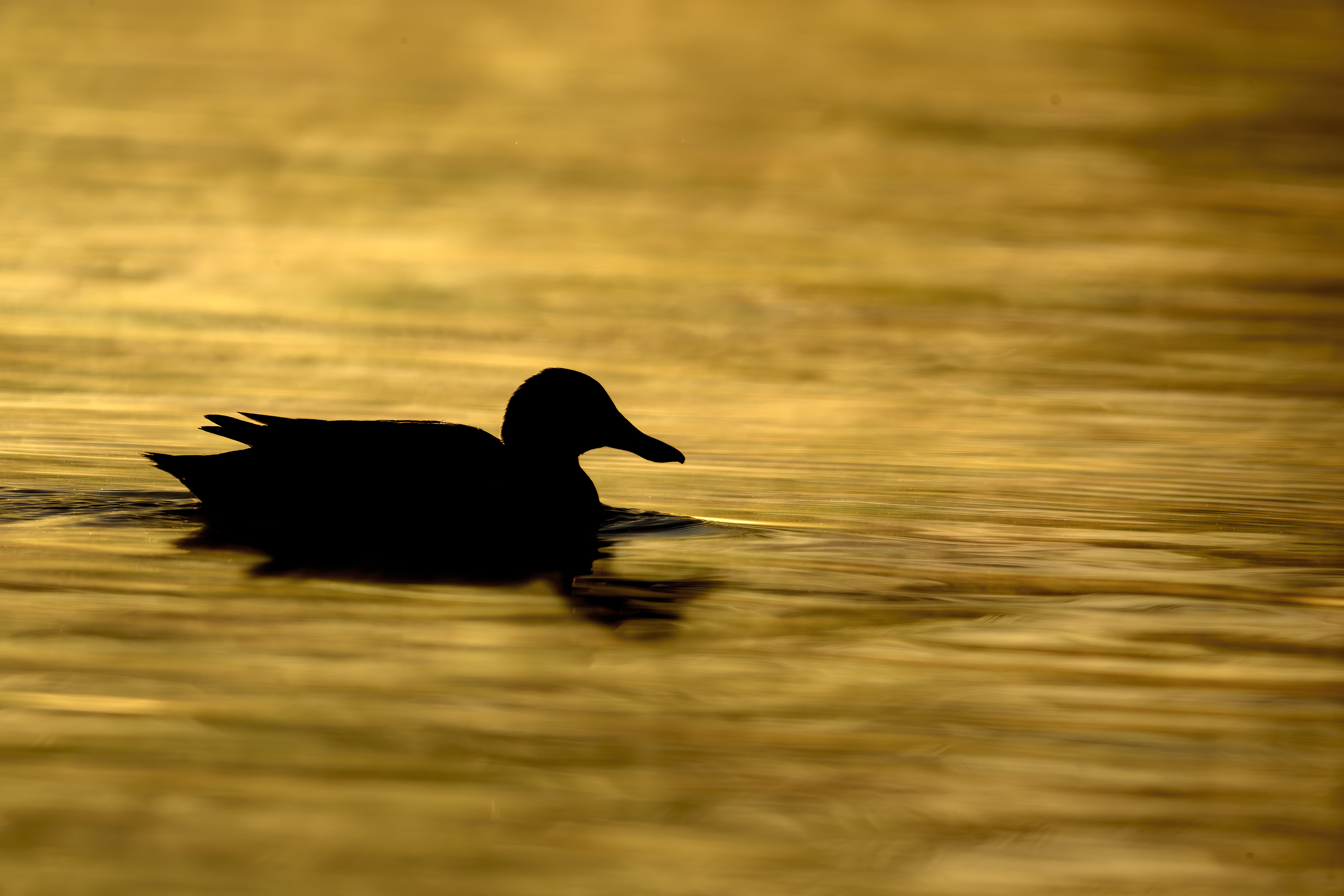
This image was created on 11 January 2026 at Santee Lakes Regional Park, CA. Seated on the edge of Lake 5, I used the handheld Sony FE 400-800mm f/6.3-8 G OSS lens (Sony E) with the Sony FE 1.4x Teleconverter (at 1071mm) and The Latest Greatest Sony Flagship Body, the a1 II Mirrorless Camera. The exposure was determined by Zebras with Exposure Compensation (EC) on the thumb wheel. Multi Metering at zero. AUTO ISO set ISO 500: 1/3200 second at f/11 (wide open) in Shutter Priority mode. AWB at 7:17:28am early on a sunny morning. Tracking Spot S/AF-C with Bird-Eye/Face Detection performed perfectly. Click on the image to enjoy the larger, inexplicably sharper high-res version. Image #3: Mallard drake swimming — dawn silhouette |
We Froze Our Butts Off!
It has been a bit chilly in the mornings at La Jolla, high 40s° to low 50s°. But it is much colder inland. On Sunday morning it was 35°at Santee! Fortunately, there was barely a breeze. Though we did have some steam on the lake as the sun rose, we did not do well making any fire-in-the-mist type images as the ducks were swimming in the wrong places. We did, however, have some good silhouettes chances. One we moved to the sunny side of the lake we had some great chances with the usual suspects. Everyone created from four to eight thousand photos. And everyone got a few good ones.
|
|
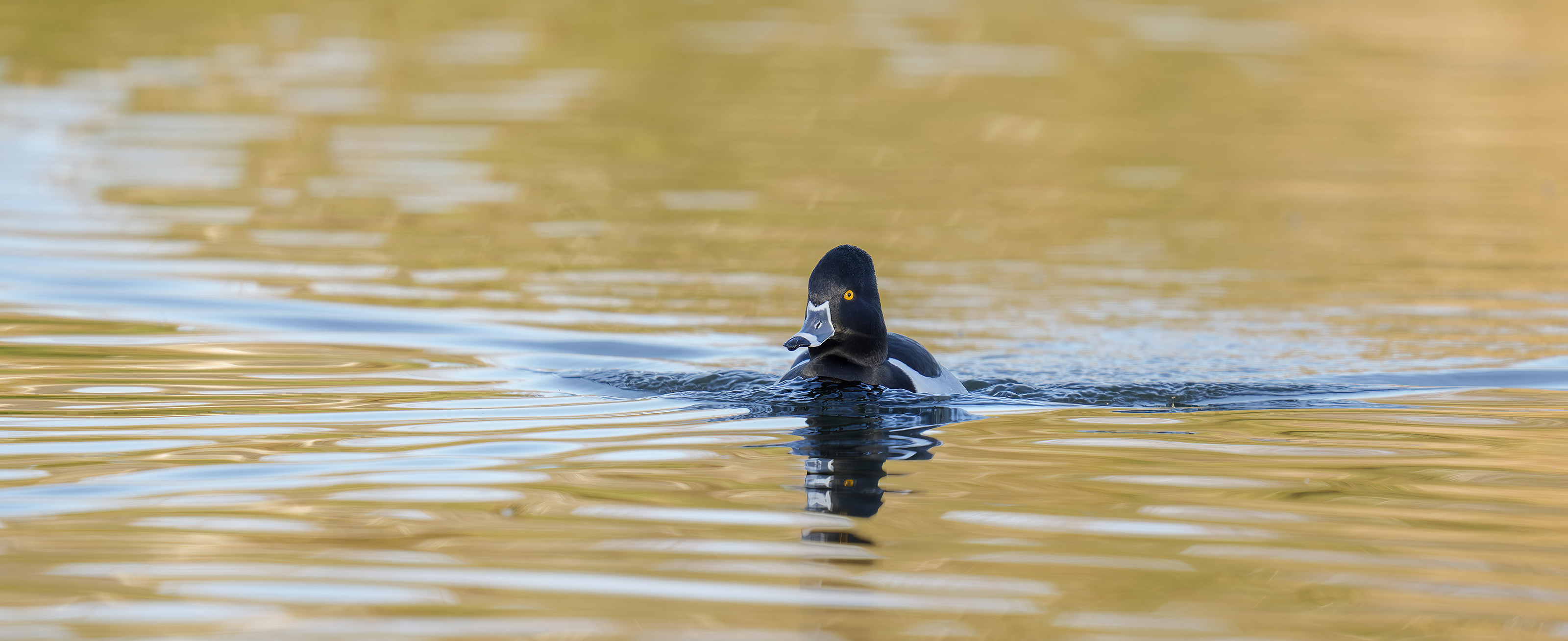
This image was created on 11 January 2026 at Santee Lakes Regional Park, CA. Seated on a sidewalk adjacent to Lake 5, I used the handheld Sony FE 200-600mm f/5.6-6.3 G OSS lens (at 600mm) and the The Latest Greatest Sony Flagship Body, the a1 II Mirrorless Camera. The exposure was determined by Zebras with Exposure Compensation (EC) on the thumb wheel. Multi Metering +1.7 stops. AUTO ISO set ISO 1600: 1/1250 second at f/6.3 (wide open) in Shutter Priority mode. AWB at 7:57:25am on a sunny morning. Wide/AF-C with Bird-Eye/Face Detection performed perfectly. Click on the image to enjoy the larger, inexplicably sharper high-res version. Image #3: Ring-necked Duck drake swimming pano crop
|
A Pano Crop
With this image, I went to a pano crop to emphasize the colorful reflections and the wake created by the swimming bird.
|
|
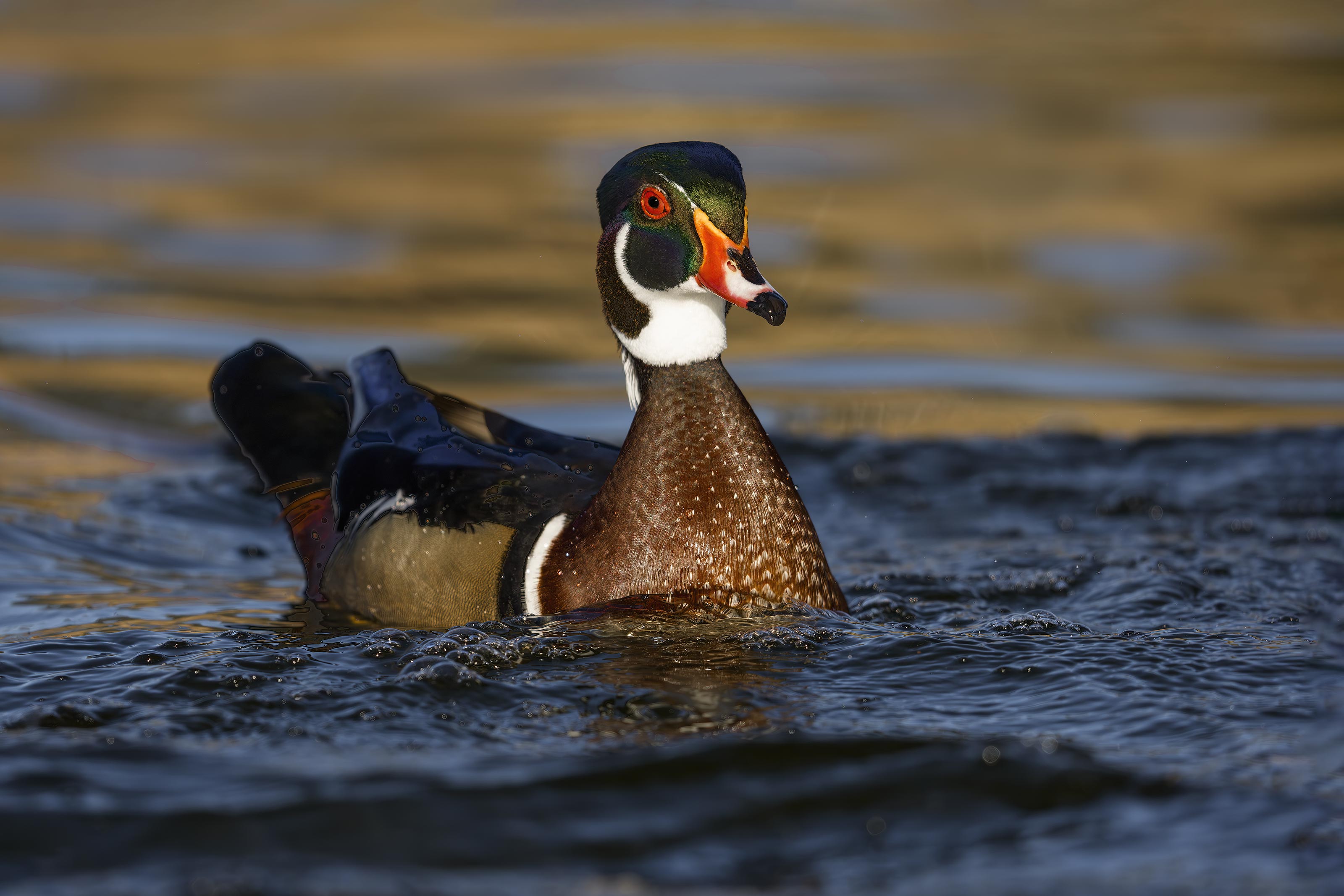
This image was created on 11 January 2026 at Santee Lakes Regional Park, CA. Seated on the edge of Lake 5, I used the flattened Wide/AF-C with Bird-Eye/Face Detection performed perfectly. Click on the image to enjoy the larger, inexplicably sharper high-res version. Image #5: Wood Duck drake looking alert |
Minus 0.7 Stops Exposure Compensation
The -0.7 EC was needed to prevent over-exposing the super-bright cheek patch. As noted above, with some birds in the sun and others in the shade, Shutter Priority with AUTO ISO and Exposure Compensation on a convenient dial is fast and efficient as the camera sets the ISO automatically in response to the EC that you dial in (with help from Sony Zebras).
|
|
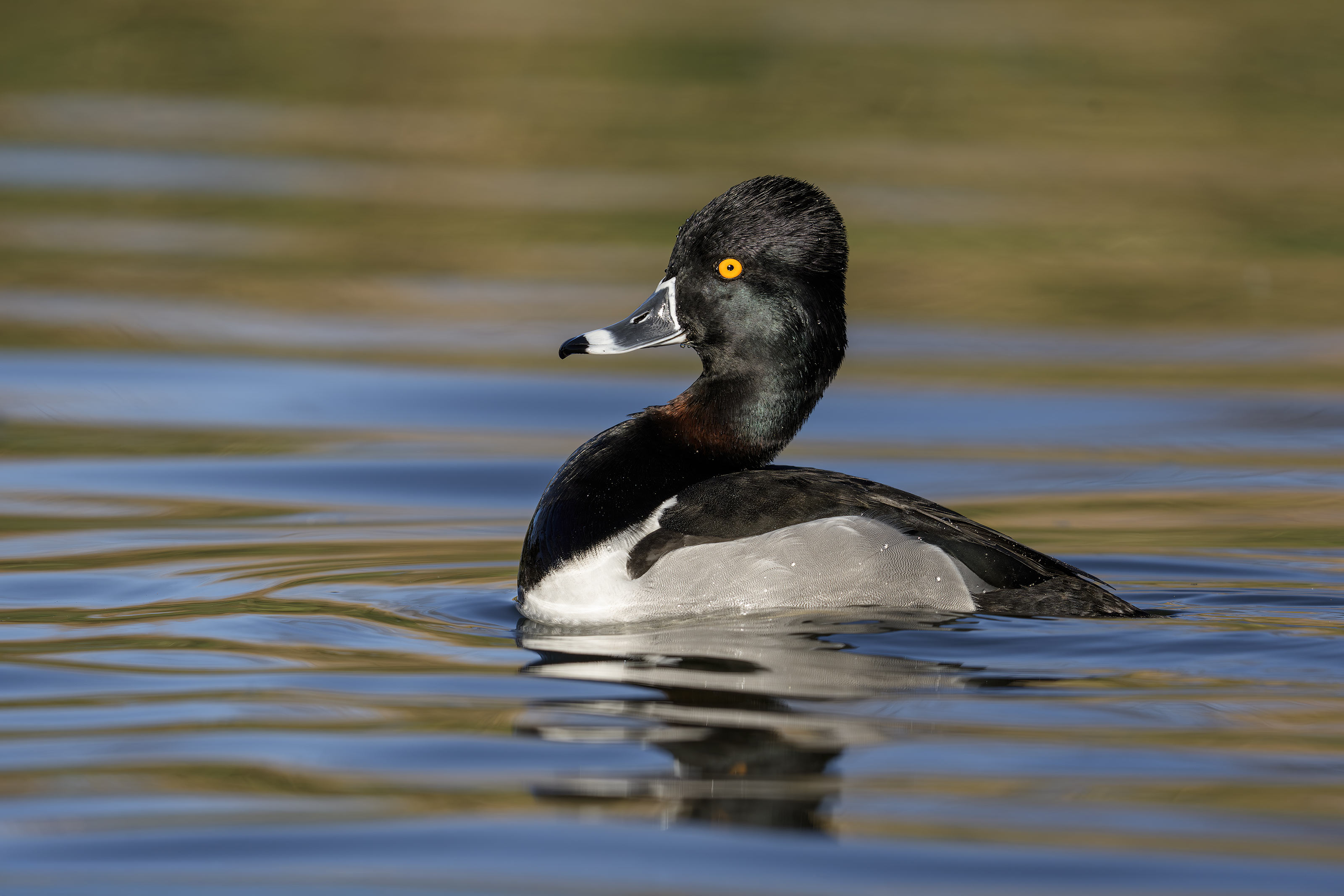
This image was created on 11 January 2026 at Santee Lakes Regional Park, CA. Seated on the edge of Lake 5, I used the Wide/AF-C with Bird-Eye/Face Detection performed perfectly. Click on the image to enjoy the larger, inexplicably sharper high-res version. Image #6: Ring-necked Duck drake heads up posture |
Not Sure …
I am not sure exactly what this bird was doing at the moment of exposure. The ducks will often extend their necks and pull their heads back a bit prior to flapping after a bath or a part of a courtship display. This bird did neither, but I sure to its posture and the look of the image. The -0.3 EC was needed to prevent over-exposing the triangle of bright white feathers on the sides of its breast.
|
|
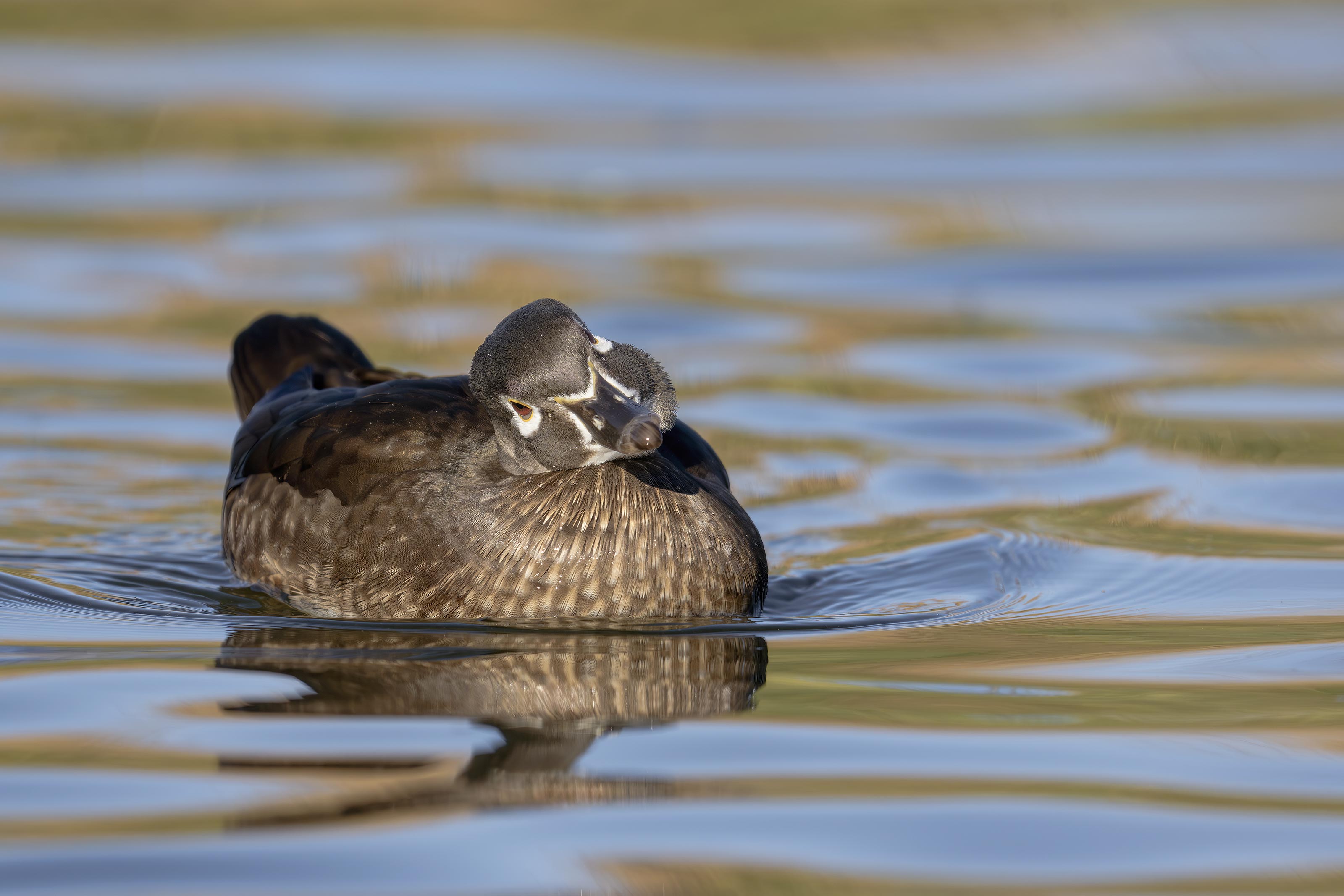
This image was created on 11 January 2026 at Santee Lakes Regional Park, CA. Seated on the edge of Lake 5, I used the Wide/AF-C with Bird-Eye/Face Detection performed perfectly. Click on the image to enjoy the larger, inexplicably sharper high-res version. Image #6: Wood Duck hen looking for acorns |
Jumping for Acorns
Santee’s Wood Duck are often seen looking up into a single big oak tree that hangs over Lake 5. At times, the burst from the pond to pull one off a branch. Years ago, an IPT participant — I do not remember who, made a great image of a male Wood Duck swimming with an acorn in its mouth and a garland of oak leaves around its neck. This bird never jumped up. One of the problems when trying to get the shot of a woodie leaping out of the water is that the area under the tree is mixed sun and shade.
|
|
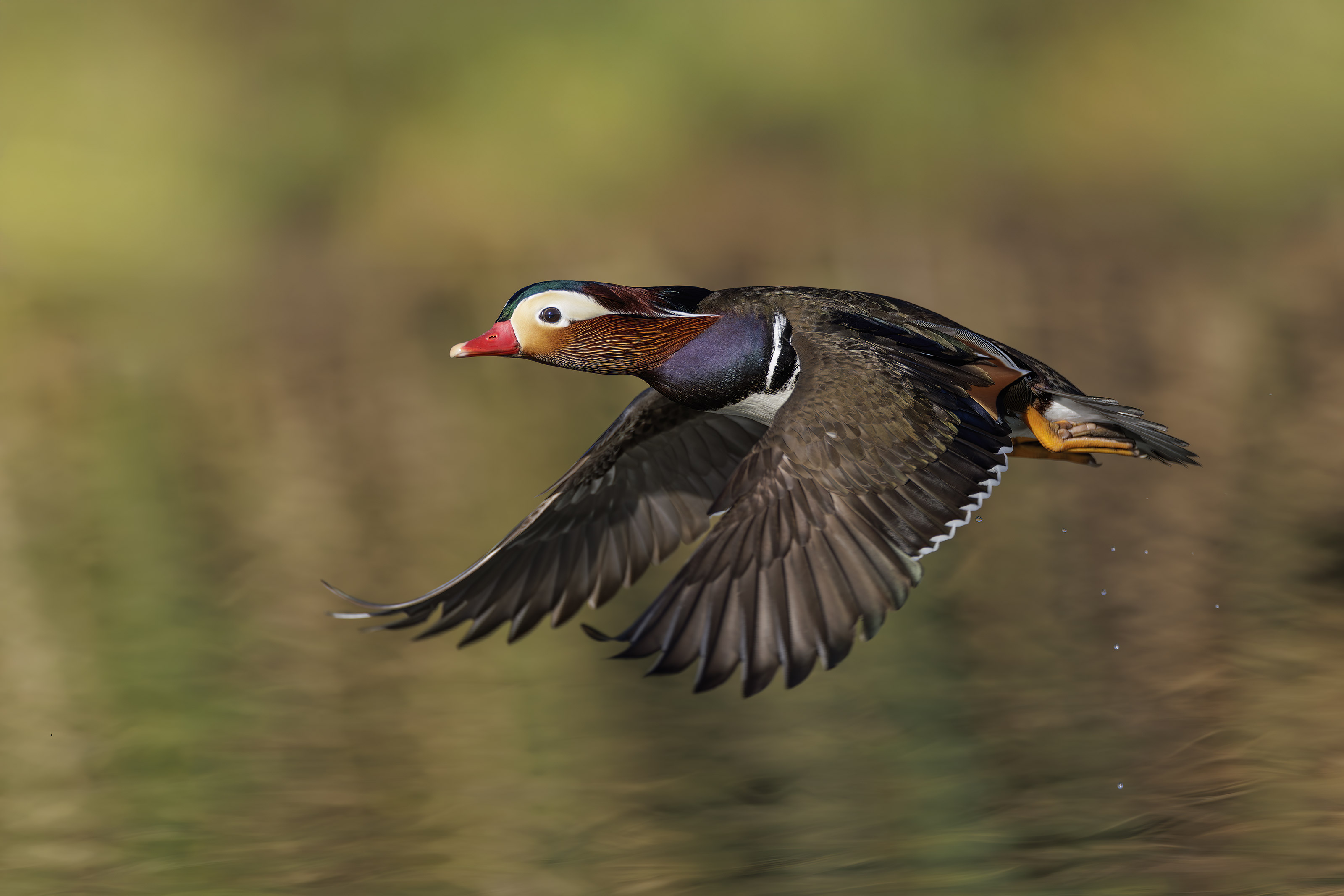
This image was created on 1 January 2026 by good friend and multiple IPT veteran Kevin Hice at Santee Lakes. Standing at the north end of Lake 5, he used the Wimberley Head V-II-mounted Canon RF 400mm f/2.8 L IS USM lens with the Canon Extender RF 1.4x and the Canon EOS R5 Mark II Mirrorless Camera. ISO 200: 1/2500 sec. at f/4in Manual mode. AWB at 9:06:41am on a sunny morning. Be sure to click on the image to see a larger and sharper high res version. Image #7: Mandarin Duck drake taking flight |
Mandarin Ducks in North America
There are zero records of free and wild Mandarin Duck anywhere in North America, even in the westernmost Aleutian Islands. This species is native to East Asia. Escapees from waterfowl collections in the US have led to the establishment of feral (non-native) populations especially in Oregon, California, and Florida. Anyone who gets a good look at a drake Mandarin will be impressed by its vibrant color and rather ornate feathering. Once a pinioned exotic duck escapes it will molt and be able to fly (and to breed if it encounters a female of its species). This individual has been at Santee Lakes for quite some time.
Kevin Hice
Kevin is a long time friend and a multiple IPT veteran. He will be doing his second Homer Bald Eagle trip with me in less than a month. In April of 2024 Kevin guided Anita North and I around North and South Dakota for Greater Prairie Chickens and Sharp-tailed Grouse. We had a great time and made some great images (see here and here).
Kevin and Bob went exploring at Santee and found the Mandarin hiding in the reeds. When Bob headed back towards Nora and me to see if I needed a hand with anything, Kevin stuck around. When the handsome duck blasted into flight, Kevin — with his strength and fast reflexes, created a long series of sharp images. There was one image that I liked better than this one but I was out-voted.
As noted here previously, Kevin is a very skilled photographer. You can see lots more of his work with birds (and mammals) here and here.
|
|
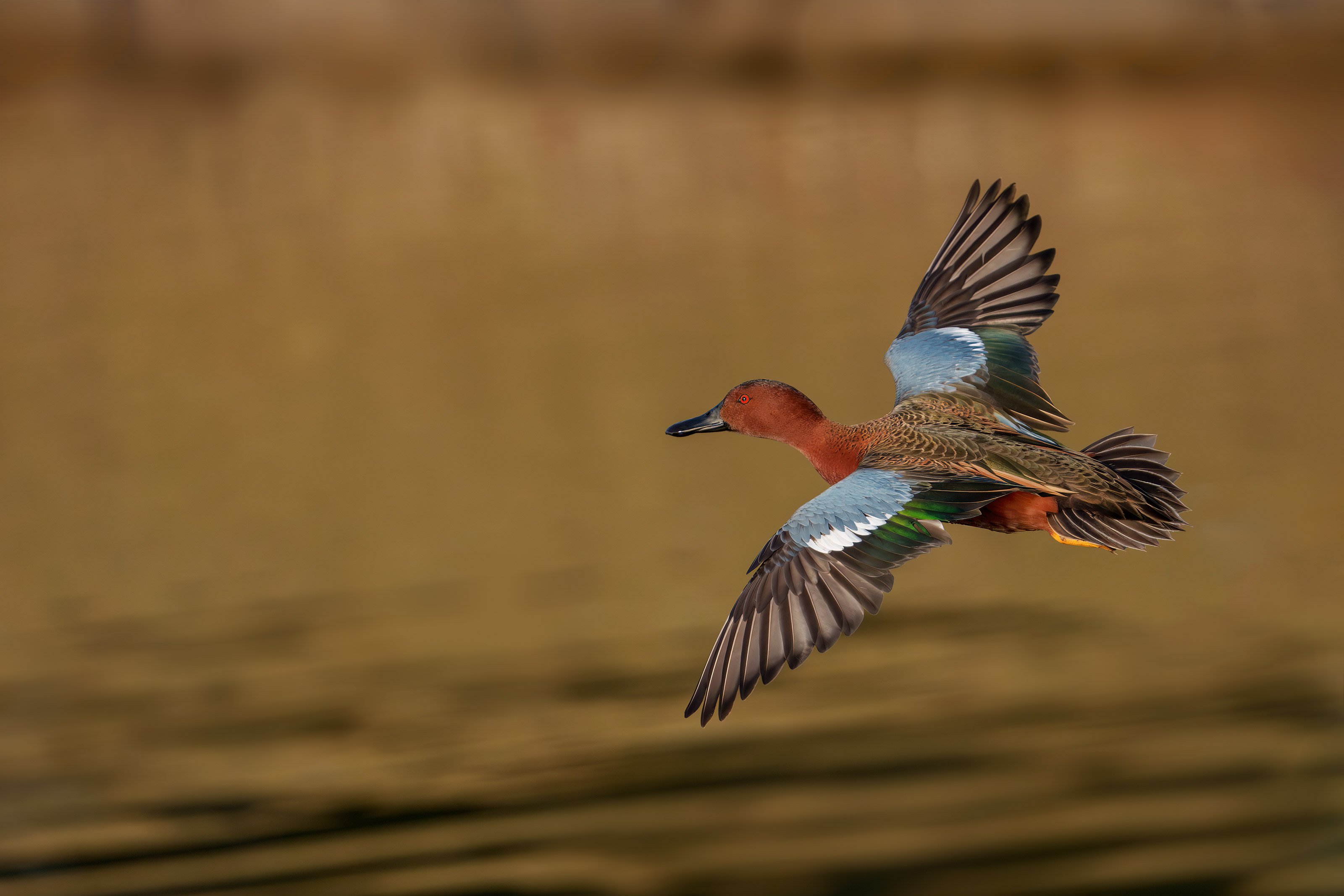
This image was created on 31 January 2025 at La Jolla, CA by my good friend Bob Eastman. Standing at full height, he used the hand held Sony FE 200-600mm f/5.6-6.3 G OSS lens (at 600mm) and The One, the Sony Alpha 1 Mirrorless digital camera. ) The exposure was determined using Zebra technology with ISO on the Thumb Dial. ISO 1600. 1/3200 second at f/6.3 (wide-open) in Manual Mode. AWB at 3:54:22pm on a sunny afternoon. RawDigger showed the exposure to be within 1/2 stop of dead solid perfect. Tracking: Spot (XS) AF-C with Bird Face/Eye Detection performed perfectly. Be sure to click on the image to enjoy a high-res version. Image #8: Cinnamon Teal drake — dorsal view, flying away
|
Bob’s Eastman’s Trusty Sony 200-600 G Lens with the Sony a-1
It has become a standing joke. As I am deciding on which lens to use for a photo session, Bob will always chime in with, “I think I’ll take my two to six.” It is his only long telephoto lens and he has consistently created some fabulous images with it. More than ten years my junior, Mr. Bob is stronger, has faster reflexes, and better hand-eye coordination than I. Thus, he is better able to get on the smallest, fastest flying ducks like Cinnamon Teal. His top shot of this drake Cinnamon teal showing the sky blue greater coverts and the green feathers of the speculum is both spectacular and worth revisiting.
If you do not know Bob’s life story you need to read Hapless But Happy and Loving It! The Life of Bob Eastman. Be sure to check out his Short-eared Owl photos here. Even more amazing is his Thieving Pelican series of images in the blog post here.
In Closing
Bob Eastman comment/November 8, 2024 at 6:59pm (at the Thieving Pelican blog post)
I want to thank all for the amazing comments!!
When it comes down to life I keep on keeping on and do what I can and that is to be happy and explore and love life being able to be out doors and do what I love, Photography is amazing and one needs to keep on trying and have some luck. Today I was able to get a dolphin throwing a snook into the air that was so cool, knowing what to do is key. That is where my great friend artie has been amazing in helping me along in my journey with his amazing teachings on photography. I have been thru lots and life is just beginning as I say. PS…. I’m single….lol
“May the Sunshine keep you smiling and the wind set you free.”
Typos
With all blog posts, feel free to e-mail or to leave a comment regarding any typos or errors.








#2 for me – Down the barrel shots always appeal to me. Perhaps a bit looser would be beneficial?
Thanks, Pugs. I considered cropping a bit wider, but stuck with the in-your-face look. That one was from a vertical original. ‘
with love, artie
Image #7 of the Mandarin duck in flight is my favorite with #8 very close behind. #1 is my third choice. Hope your group has better luck with the Pelicans on the cliffs in the coming days.
Thanks Jim. You nailed my first two choices but in the opposite order. Nora appreciates your mentioning her landing ring-necked hen shot.
with love, artie
Kevin Hice’s Mandarin drake (#7) is my choice. Some on my own favorite images are of Mandarin drakes that I took on your phototours — but I never got one in flight, or even saw one in flight. I like the wing position on this image and the sharp, colorful head of the bird (that “pops” against the background).
I agree. Kevin’s flight shot is stunning in all respects.
with love, artie
Like them all but will pick the ring-necked duck #2. It immediately grabs your attention…and maybe turn and run. Beautiful detail in the dark tones and fore and aft blur!
Thanks Dr. Dick. Focus on the eyes and let her rip!
with love, artie
Image 2 is my favorite because that’s what cameras can do so well: show you things in a way that you don’t see them without a camera.
I agree. I was just trying for the down the lens barrel stare but never saw the crazy head shape.
much love, artie
2 due to the unusual perspective, 5 activity and colors, 7 my favorite, because of the pose and flight.
Thanks so much for leaving a comment and explaining your choices.
with love, artie
I’m going with #2 and #7. #2, while not flattering to the duck, is unusual and interesting. #7, while far more pedestrian, is a nice photo of a flying duck.
#8 doesn’t really work for me because the duck is flying away and looking away, two attributes that are generally frowned upon in bird photography. (It certainly does show the bird’s plumage nicely.)
Hi Steve,
Thanks for commenting. For me, #7, is far more than a “nice photo of a flying duck;” it is downright spectacular.
As for Bob’s spectacular teal image, you cannot show the fabulous colors on the dorsal wing surfaces without having the bird angling away at least a bit. With the slight head turn toward us and a great look at that red eye and spread tail, this one is my very favorite.
And yes, #2 is goofy 🙂
much love, artie