
Your Call/My Call
Improve your own photography by ranking today’s four featured backlit images in order of preference with the strongest photo first and the weakest last. And please let us know what you liked best about your first two picks. This will be a tough chore as all three images are quite good (he said modestly).
Thanks for all the comments at the recent More Flight Photography Tips: Back Shots, a-1 ii AF, Surfing Pelican, Lenses for Flight, Tight Flight, and Exposure Tips blog post here. The consensus top pick was my square cormorant with nesting material. While I thought that that was a very strong image, I actually liked the other Brandt’s image just a tad more. My top pick was Nora Kane’s pelican in the spray of a breaking wave image. My second choice by a slim margin was the back flight shot of the Western Gull for the soft light, the symmetry, and the spread tail.
Kudos to Don Poulton who correctly answered the perspective question that accompanied Image #7 when he wrote:
If you set your tripod a bit lower, there would have been more space between the bird and the horizon …
Repeated Warnings
#1: Always use a flash card large enough so that you never have to change cards in the field. If you are using small cards and need to change cards in the field you are astronomically increasing the chances of losing a card. In a quarter of a century, I have never lost a single image due to a Delkin card failure so I do not buy the “don’t put all your eggs in one basket theory.”
#2: With a 960 GB card in each body, I never have to change cards. I never take a card out of a camera at the shooting location. If you do so, you again increase the chance of losing a card by leaps and bounds. When I get back to my home or AirBnB, I remove the card or cards from my camera bodies, hold them in my hand, walk inside, and start to download them. The chance of losing a card between your parking spot or garage and you computer are as close to zero as you can get.
Proof of the Pudding
The huge danger of putting a card into a pants pocket is that you will accidentally pull the card out when you take your cell phone out. The card gets snagged by the rim of the phone protector and falls to the ground unbeknownst to you. That is exactly what happened to Bob Eastman last night. I stayed in to watch the Rams/Bears game and Bob headed out to photograph the Burrowing Owl at the San Diego River. When he got back to the AirBnB, he could not find his card. I told him exactly what had happened. Patrick and Robin Sparkman had stopped by for dinner and the NFL game. Robin suggested that they head back to Old Sea World Road in the pitch dark to search for the card. They did. It was Patrick who spotted the card on the road. And Bob was a very happy man.
For folks using Sony, I use and recommend only Delkin Devices 960GB BLACK CFexpress Type A 4.0 Memory Cards. All Delkin Black cards are backed by their no questions asked 48HR Replacement Guarantee. For Canon shooters we recommend either the Delkin Devices 1TB BLACK CFexpress Type B Memory Card or the Delkin Devices 2TB BLACK CFexpress Type B Memory Card . The new Delkin Black Type B cards are designed for professional photographers and videographers. They are well-suited for raw and continuous-burst photography as well as raw 8K, 6K, and 4K video at high bitrates and frame rates. Thanks to a PCIe 4.0 interface, you’ll be able to achieve maximum read speeds of up to 3700 MB/s and maximum write speeds of up to 3220 MB/s. In addition, this card features sustained write speeds of 2040 MB/s and, thanks to the VPG-400 standard, write speeds are guaranteed not to drop below 400 MB/s. Please note that prices of digital media have risen dramatically in recent months because of the vastly increased demand for memory to support data centers for the AI industry.
What’s Up?
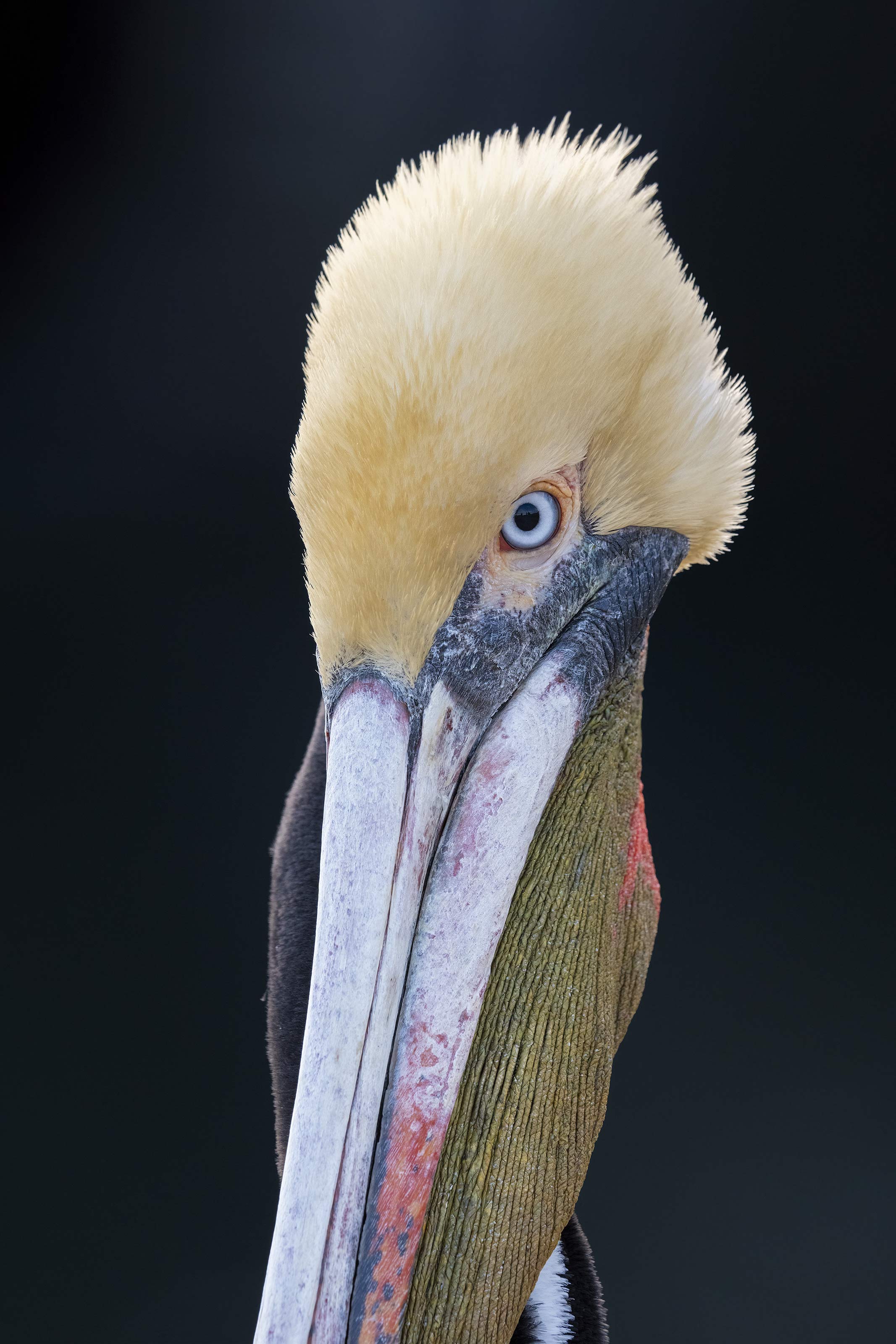
The pelican photography has been getting better every day. On Sunday morning I had the pleasure of photographing with three great friends: Patrick Sparkman, Bob Eastman, and Ed Dow. It was a beautiful morning and the big birds were absolutely copacetic. We began well before the sun came over the ridge on the way into La Jolla. There were two lovely, very tame birds up on the cliff that were gently backlit. Ed first mentioned the possibility of using the shaded cliff and tall, slim caves as black backgrounds and I was the first to move into position. By lowering my tripod so that my Levered-Clamp FlexShooter Pro was about a foot off the ground, I was able to maximize the black background when using relatively long focal lengths with the 400-800. In today’s post, I share three of my favorite backlit head portraits.
All in all I created more than 8.500 images and kept 183. Sixty-nine of those were created during the 48 minutes I spend with my lens pointed to the east. That works out to less than 2% but I kept way too many similars. I will probably get rid of a hundred or more after the second edit. Ed Dow was particularly thrilled as though he lives along the central California coast, he has never been so close to so many tame Pacific race Brown Pelicans. It’s great to see Patrick Sparkman (AKA “Sparky Patman”) getting back into serious bird photography after several years of really serious astro-photography. How serious? His camera and telescope were in an observatory in New Mexico while he stayed up nights making images from his computer in his home office in San Diego! I hope to share some of Patrick’s images with you here soon.
Today is Monday 19 January 2026. The four photographers will be headed back to the cliffs early. I hope that you too choose to have a wonderful and productive day and that you have fun too. Please remember that happiness is a choice — Byron Katie, The Work.Com (and as discussed in the previous blog post).
If an item — a Delkin flash card or reader, a Levered-clamp FlexShooter Pro, or a Wimberley lens plate or low foot — for example, that is available from B&H and/or Bedfords, is also available in the BAA Online Store, it would be great, and greatly appreciated, if you would opt to purchase from us. We will match or beat any price. Please remember also to use my B&H affiliate links or to earn 3% cash back at Bedford by using the BIRDSASART discount code at checkout for your major gear purchases. Doing either often earns you free guides and/or discounts. And always earns my great appreciation.
Gear Questions and Advice
Too many folks attending BAA IPTs and dozens of photographers whom I see in the field and on BirdPhotographer’s.Net, are — out of ignorance — using the wrong gear, especially when it comes to tripods and more especially, tripod heads. And the same is true in spades when ordering new camera bodies or lenses. My advice will often save you some serious money and may help you avoid making a seriously bad choice. Please know that I am always glad to answer your gear questions via e-mail.. If you are desperate, you can try me on my cell at 863-221-2372. Please leave a message and shoot me a text if I do not pick up.
B&H Simplified
To ensure that I get credit for your B&H purchases, you can always click here. The tracking is invisible but using my affiliate links is greatly appreciated. And, with B&H, you can use your PayBoo card. You must use the website to order. You cannot get your free guides if you make a phone order. Once you have an item in your cart, you must complete the order within two hours. Huge thanks!
B&H
Many folks have written recently stating that they purchased a Sony a1 from B&H and would like their free membership in the Sony 1 Info and Updates Group, a $150.00 value. But when I check my affiliate account, their orders have not been there. When I let them know that they get credit for B&H purchases only if they use one of the many B&H affiliate links on the blog or begin their searches with this link, they are always disappointed. If in doubt, please contact me via e-mail and request a BH link. I am always glad to help and to guide you to the right gear.

Bedfords Simplified
Click here to start your search. Choose standard shipping, and when you get to the payment page, enter BIRDSASART in the discount code box and hit apply. You will be upgraded to free second day air Fed-Ex and receive 3% cash back on your credit card once your stuff ships. Using either my affiliate links is greatly appreciated and will often earn you free guides or discounts. To receive a free guide or free entry into a Sony Set-up and Info Notes e-Mail group, you need to shoot me your receipt via e-mail. The B&H receipts need to include the order number.
Bedfords Amazing BAA Discount Policy
Folks who have fallen in love with Bedfords can always use the BIRDSASART coupon code at checkout to enjoy a post-purchase, 3% off-statement credit (excluding taxes and shipping charges) on orders paid with a credit card. The 3% credit will be refunded to the card you used for your purchase when your product ships. Be sure, also, to check the box for free shipping to enjoy free Second Day Air Fed-Ex. This offer does not apply to purchases of Classes, Gift Cards, or prior purchases.
You can visit the Bedfords website here, shoot Steve Elkins an e-mail, or text him on his cell phone at (479) 381-2592.
|
|
This image was created on 18 January 2026 by yours truly at La Jolla, CA. Seated on a sandstone cliff I used the lowered Tracking: Zone/AF-C with Bird-Eye/Face Detection performed perfectly. Click on the image to enjoy the larger, inexplicably sharper high-res version. Image #1: Brown Pelican Pacific race breeding plumage |
Perspective, Perspective, Perspective
Getting a completely black background was a matter of moving my tripod from side to side a matter of a few inches at a time while raising or lowering it to eliminate any light toned areas on the cliff or any white water from a breaking wave. Before the sun came up, Sony Zebra technology allowed for perfect exposures by setting the ISO for faint Zebras on the gently rimlit feathers. As I was so close to the subject, I went with one stop of extra depth of field.
|
|
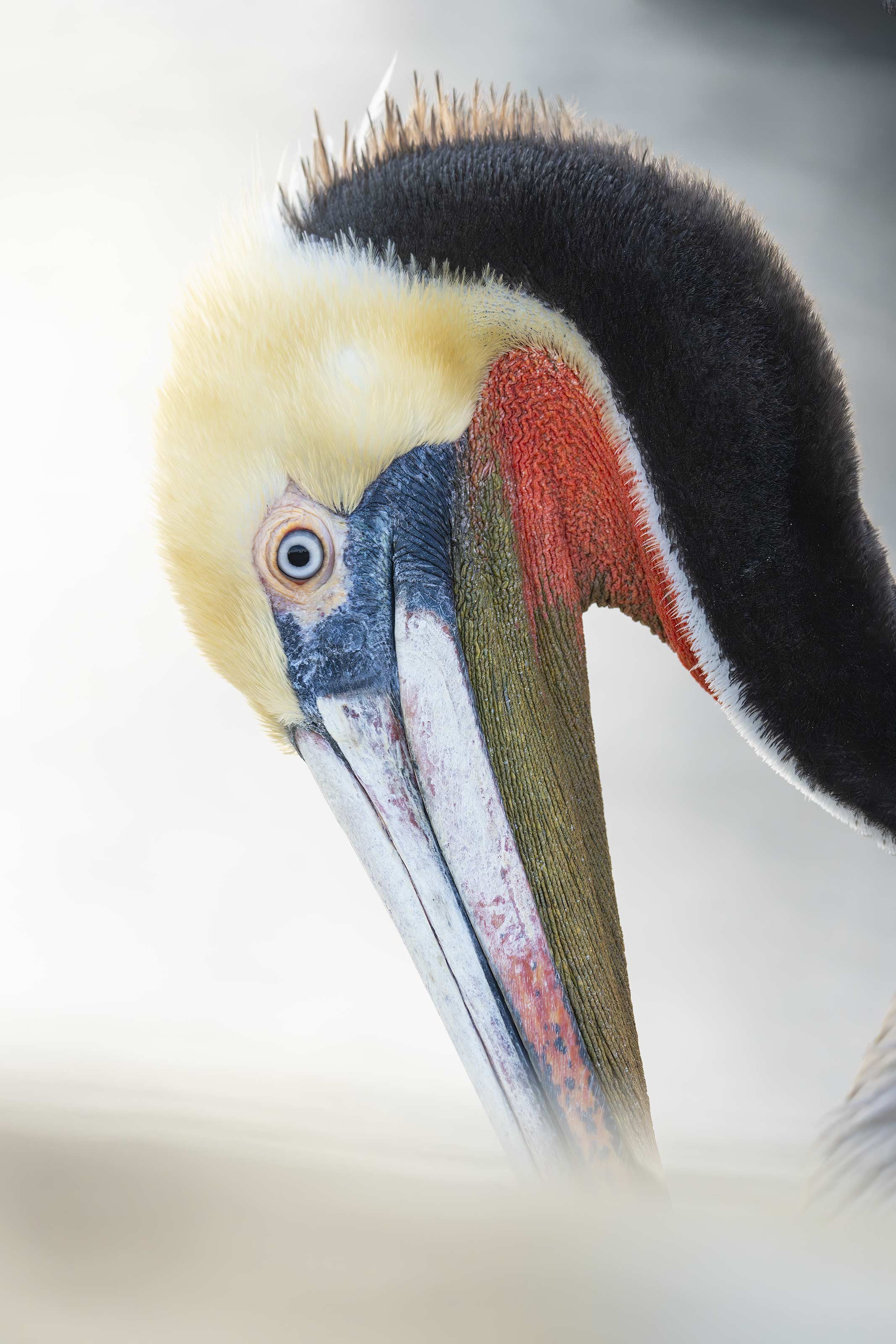
This image was also created on 18 January 2026 by yours truly at La Jolla, CA. Seated on a sandstone cliff I used the lowered Tracking: Zone/AF-C with Bird-Eye/Face Detection performed perfectly. Click on the image to enjoy the larger, inexplicably sharper high-res version. Image #2: Brown Pelican Pacific race breeding plumage |
The Ocean Background
As I mentioned previously, we all wound up working two very tame birds. As I moved about on the cliff, I noticed that the handsome bird on my left had a light Pacific Ocean background so I created a few images just to change the pace. Still with only gentle backlight, I went with lots of Zebras on the nearly white water to ensure a perfect exposure for the gently backlit subject. As the bird was preening, I raised my shutter speed and went to the wide open aperture to avoid any motion blur.
|
|
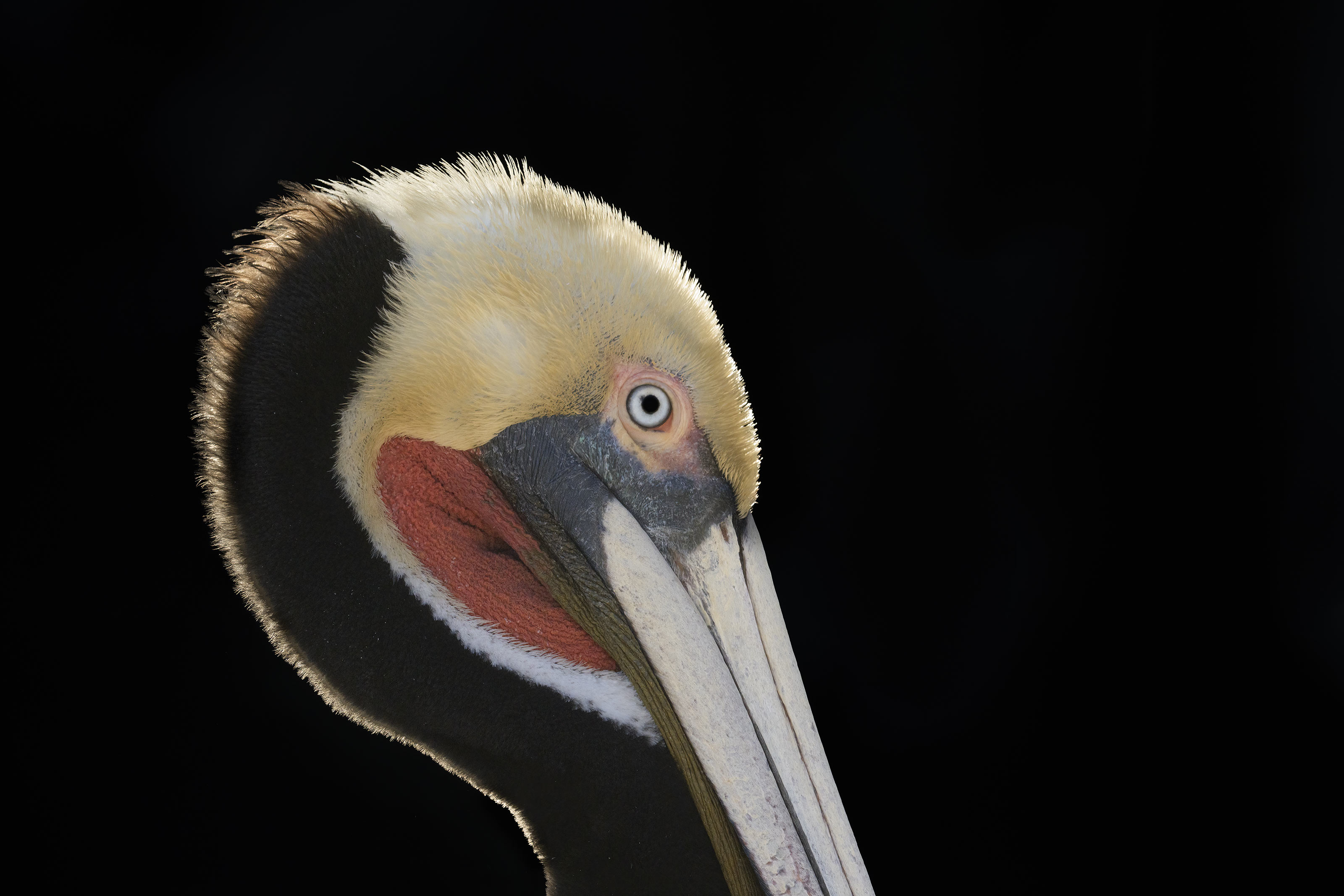
This image was created on 18 January 2026 by yours truly at La Jolla, CA. Seated on a sandstone cliff I used the lowered Tracking: Zone/AF-C with Bird-Eye/Face Detection performed perfectly. Click on the image to enjoy the larger, inexplicably sharper high-res version. Image #3: Brown Pelican Pacific race breeding plumage |
Strong Backlight
Once the sun came over the hill, we were working with strong backlight as the sun hit the birds. I went to a faster shutter speed, a smaller aperture, and a lower ISO so that I had some Zebras on the brightly rimlit feathers. Then I used several Adobe Camera Raw masks to lighten the shaded side of the pelican. As detailed in the Digital Basics IV Video Series. I keep coming up with new masking tricks almost every day.
|
|
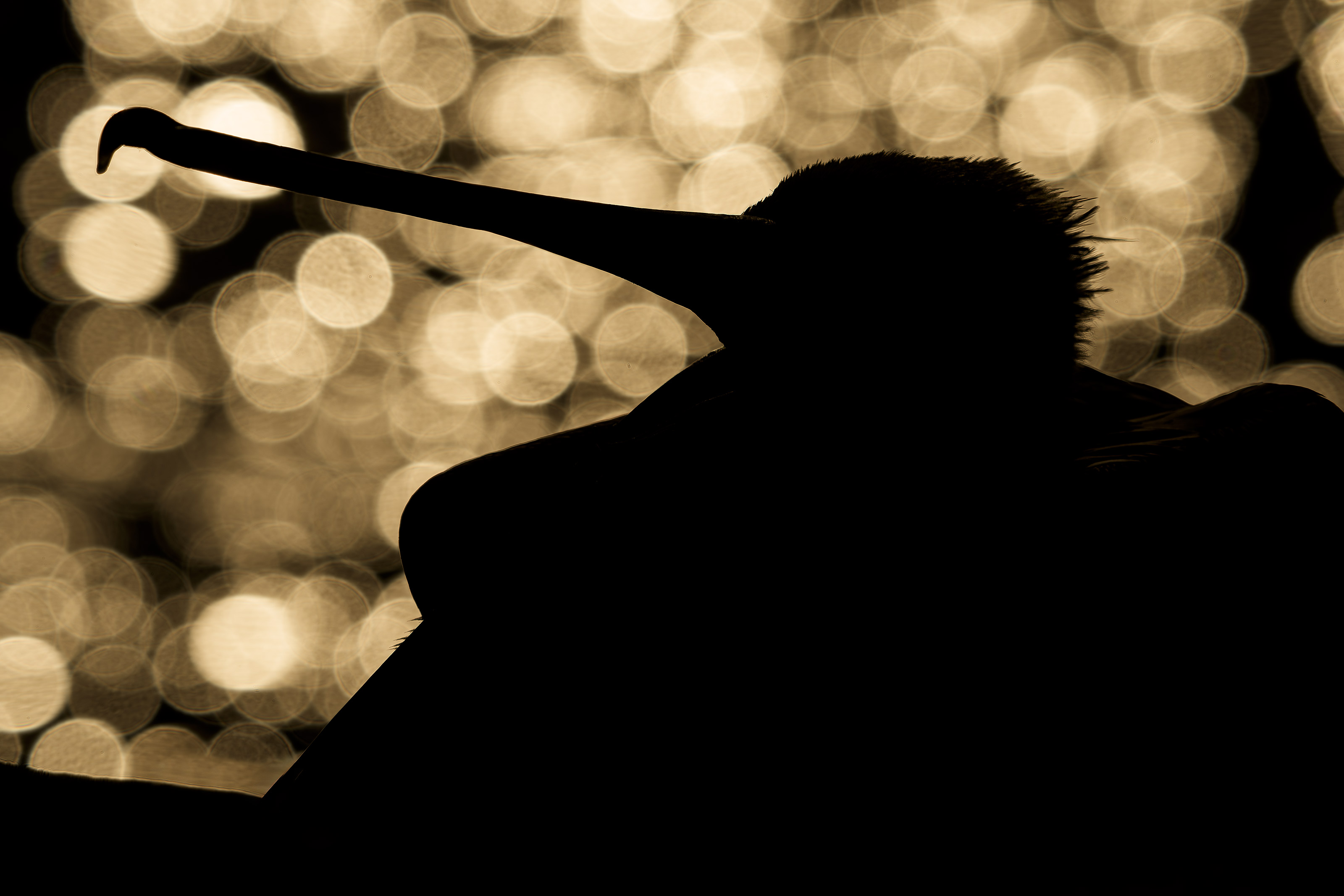
This image was also created on 18 January 2026 by yours truly at La Jolla, CA. Still seated on a sandstone cliff I used the lowered Tracking: Zone/AF-C with Bird-Eye/Face Detection performed perfectly. Click on the image to enjoy the larger, inexplicably sharper high-res version. Image #4: ??? |
What Bird is This?
Did a lost frigatebird land next to the pelicans I was photographing? Or is this a pelican? If the latter, what was going on?
Blasting Backlight Highlights
Photographing birds against the blasting highlights of the bright sun reflected off water is very tricky challenge. First, you need to get the right exposure. Check out the EXIF for Image #3 to get an idea. Again, Zebra technology greatly simplifies this task. I aim for just a few Zebras on the round specular highlights off the water.
Secondly, many AF systems fail completely when confronted with the huge contrast present in these situations. I moved to my left to line the bird up perfectly with the swatch of blinding light. Most times I need to turn off AF and focus manually using Focus Peaking so I was surprised when the autofocus system tracked perfectly.
Lastly, solidly black areas in the background often merge with and or obscure parts or most of the subject.
The BIRDS AS ART SONY 400-800mm f/6.3-9 G Super-telephoto Zoom Lens Guide
When I borrowed this lens from Sony, I assumed that at 5.45 pounds it was too heavy to handhold for long and that at f/8 at the long end (800mm,) it was too slow for most bird photography applications. In short, I did not want to like the lens. After a month of using it, I cannot live without it. After returning the loaner, I was miraculously able to get my own from Bedfords on 16 April 2025. In this guide I share everything that I have learned about using the 400-800. For best results, you need to know exactly what you are doing to get the most out of this zoom lens. It would be best, therefore, to consider and study the material in the guide so that you can begin making great images with your new lens.
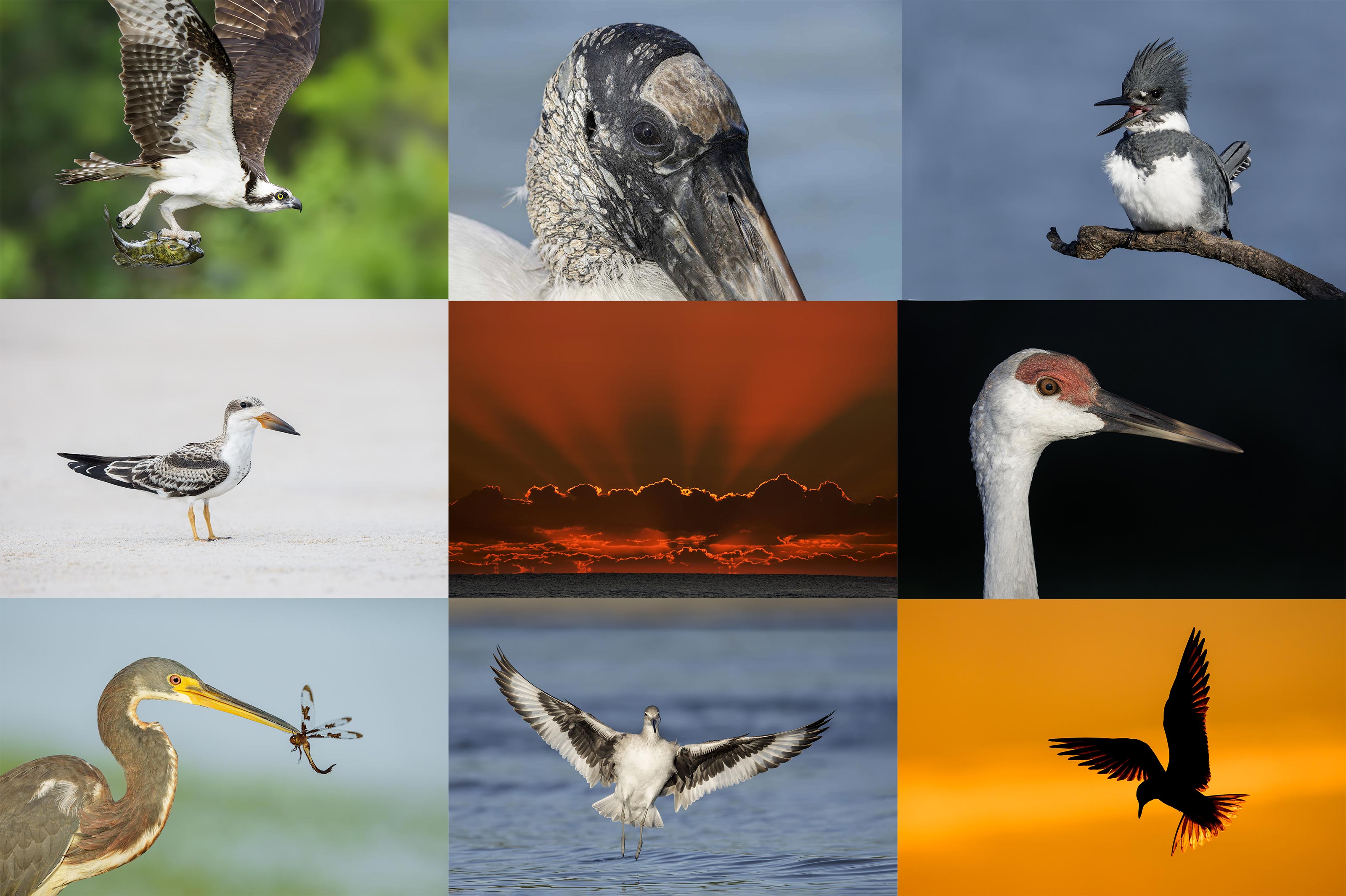
What You Will Learn
You will learn how to deal with the relatively show apertures: f/6.3, f/7.1, and f/8 when working in Manual mode.
You will learn how to ensure that you are working at the widest aperture by working in Shutter Priority mode with AUTO ISO.
If you are able to hand hold the lens, you will learn proper hand holding techniques.
If you can’t, you will learn when, why, and how to employ other options. Those include:
1- The knee-pod, heel-pod, and toe-pod techniques
2- Using the lens on a monopod.
3- The best lens plate and low foot for your 4-8.
4- The best tripod and head for the 4-8 and how best to utilize them.
5- How to use the lens from your vehicle while supporting it on a BLUBB (or not and why not).
6- Detailed instructions on how to set and use the lens controls and buttons:
a- AF/MF
b- DMF Switch
c- Limit Range Switch
d- OSS (Optical Steady Shot) Switch
e- OSS Mode Switch
f- Focus Hold Buttons
The guide also includes a Hand Holding Shutter Speed Primer and an illustrative, educational, and inspiring 67-image gallery.
Free to folks who use one of my two affiliate links to purchase their Sony 400-800 G lens. Otherwise, please send a PayPal for $115.43 to birdsasart@verizon.net and include the words “400-800 Lens Guide” in your e-mail.
|
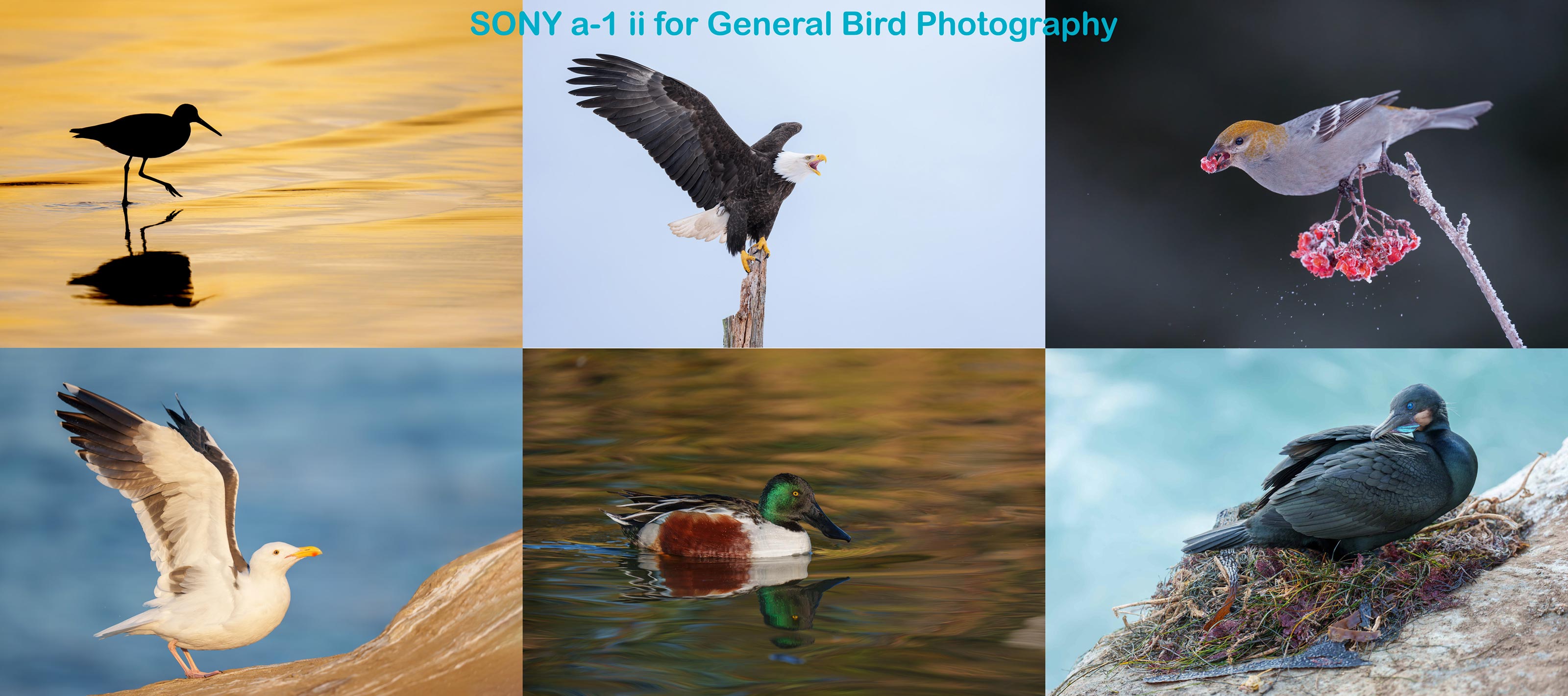
Composite #1: All with the a-1 ii Mirrorless Camera body.
|
The a-1 ii for General Bird Photography
I have found that eye-tracking for general bird photography with the a-1 ii is far, far better than with the original Sony a-1. It grabs the eye and tracks it faster and far more consistently and focus is rarely lost, even with backgrounds other than sky.
|
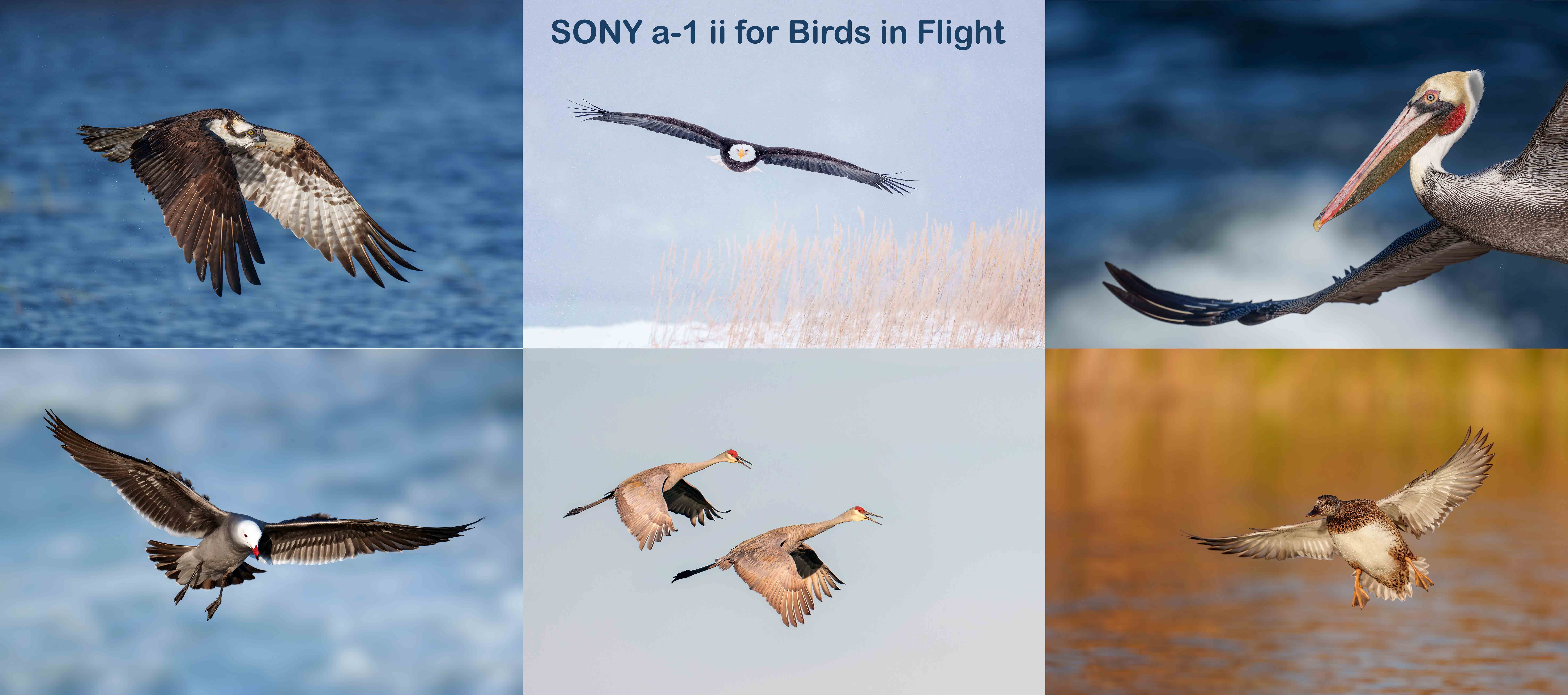
Composite #2: All with the a-1 ii Mirrorless Camera body.
|
The a-1 ii for Birds in Flight
For birds in flight, the a-1 ii Mirrorless Camera body has no equal. As Arash Hazeghi says, “It is better than the a-1.” When I am late getting on a bird in flight, I have consistently been amazed at how often the AF system of the a-1 ii finds and tracks the bird’s eye.
|
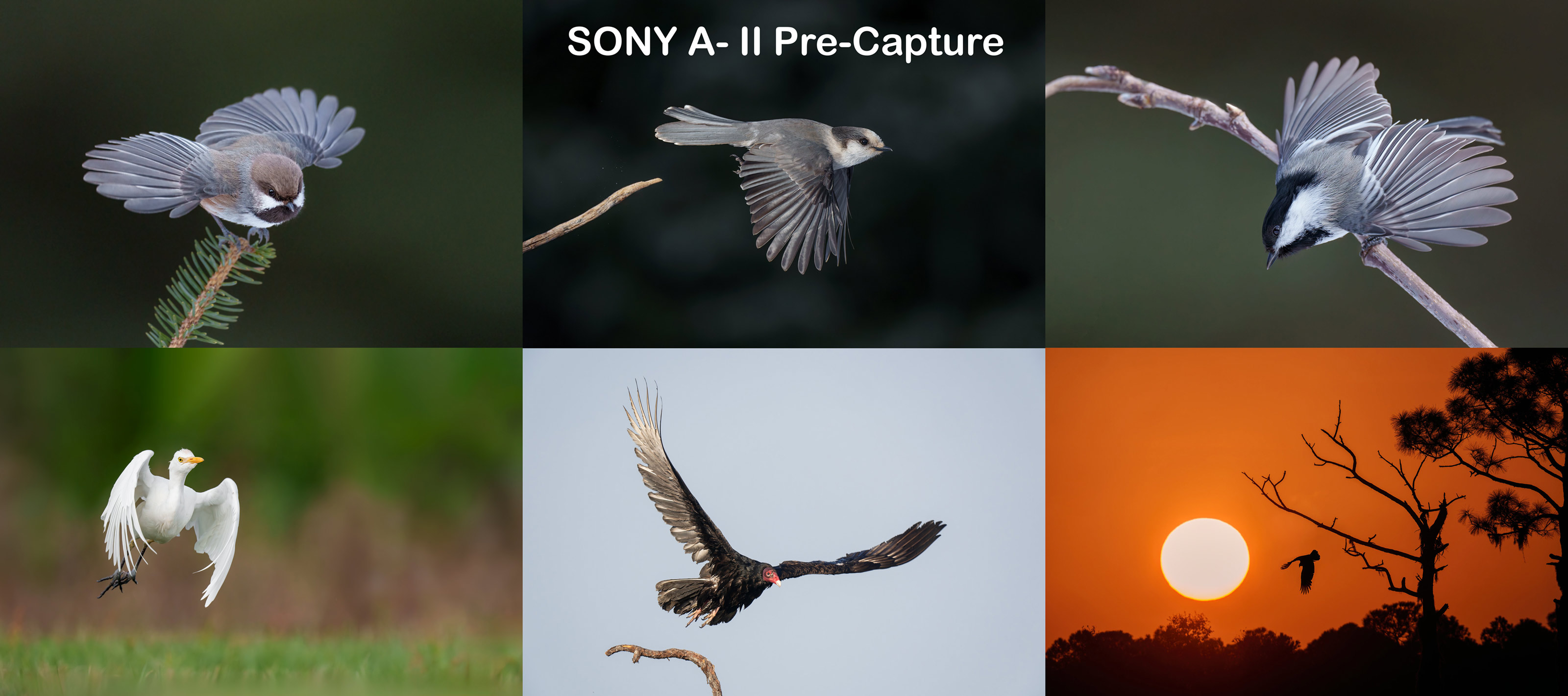
Composite #3: All the result of using Pre-Capture with the a-1 ii Mirrorless Camera body.
|
Pre-Capture with the Sony a-1 ii
When it comes to Pre-Capture with the a-1 ii Mirrorless Camera body, Arash and I agree 100%. And with my slower reflexes, Pre-Capture is more important for me than it is for Arash. Understand that in each of the images in Composite #3, I did not push the shutter button until after the bird took flight!
|
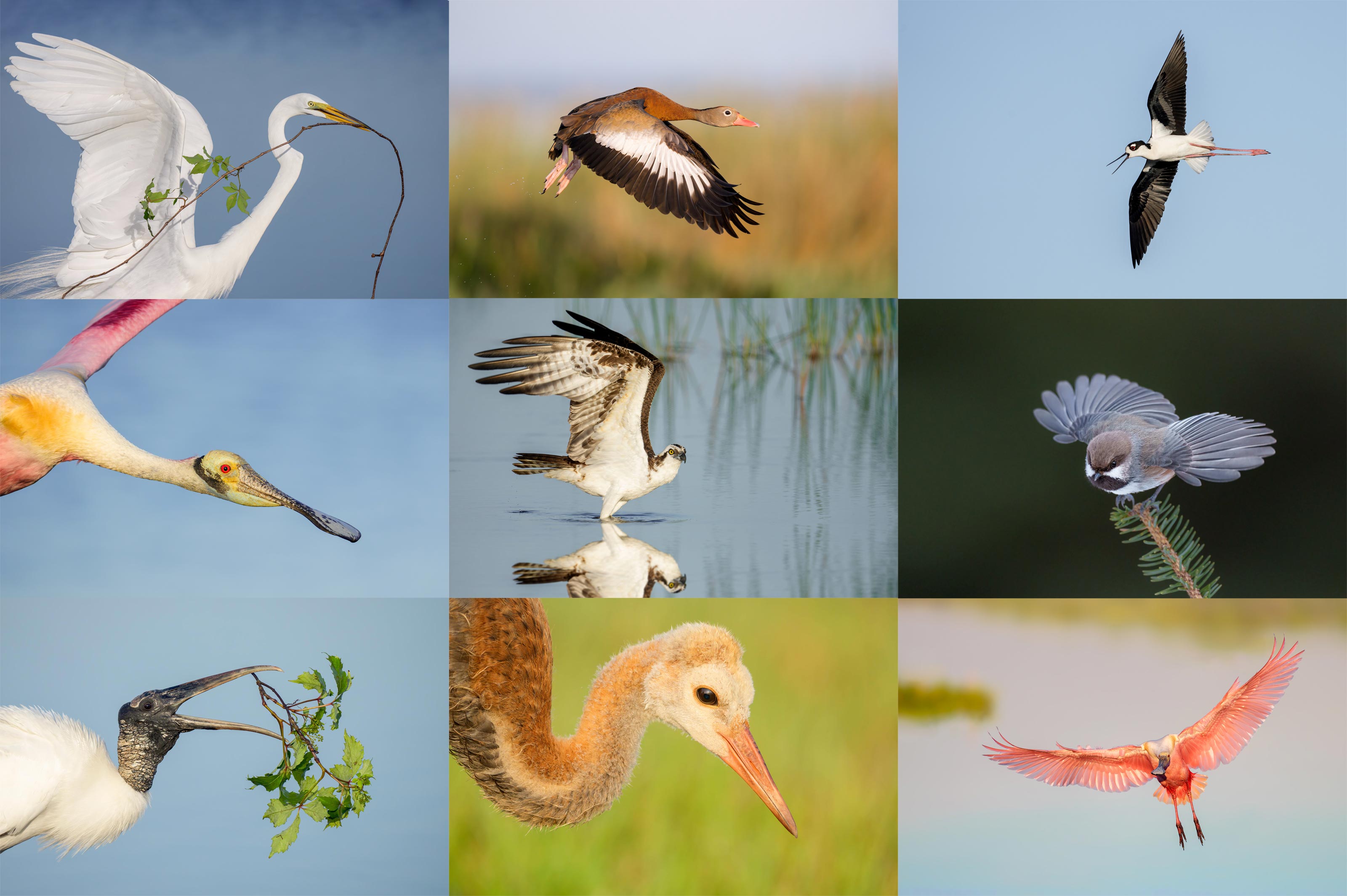
All with the a-1 ii Mirrorless Camera body.
|
Purchasing or Upgrading to a Sony a-1 ii
The Sony a-1 ii e-Mail Set-up and Info Guide
I now own and use two Sony a-1 ii bodies. Every day that I use them, the more I am amazed by speed and accuracy of the Bird Face-Eye tracking in AF-C and the overall performance of the camera.
Aside from the improved ergonomics as compared to the a-1, other nice features include the fact that the rear screen tilts both ways — the lack of a tilting rear screen on the original a-1 always ticked me off. Pre-capture has proven to be a huge plus almost exclusively for take-off flight images. In my opinion, the Speed Boost feature is a total waste for bird photography because you should always be utilizing the maximum frame rate. In addition, the resolution on the rear monitor has been improved dramatically. I must mention again that Bird Face-Eye tracking on the a-1 ii is vastly improved as compared to both the a-1 and the a9 iii and that the 51MP files are to die for.
So, the big question is, is the a-1 ii “worth” a gear upgrade. Remembering that I can never know whether or not something is worth it to you, I can say that I was not floored when first using my a-1 ii. The differences between the a-1 ii and the original a-1, seemed to be neither huge nor eye-opening. But over time, I have come to realize that I was 100% wrong. The huge difference between the new camera body and the a9 iii is, of course, the 51MP a-1 raw files (as compared to the 24MP files rendered by the a9 iii).
The price of a new a-1 is $5,898.00. The price of a new a-1 ii is $1,100.00 more: $6,998.00. As the a-1 ii is clearly far superior for bird photography to the original a-1, the choice for folks new to Sony or for those upgrading from lesser Sony camera bodies is an easy one. Prices for used a-1 bodies has not dropped drastically as I anticipated. At this point, a-1 folks who like showing flight and action and can afford an a-1 ii, are advised to purchase an a-1 ii. Please remember that life is short; we only get one ride on the merry-go-round.
If you do purchase an a-1 ii, be sure to use one of my two affiliate links so that you will receive my a-1 ii settings (in the form of a CAMSEa1ii.DAT file), the Buttons and Dials Guide, and an Info Sheet for free. Using my links will never cost you one penny and may actually save you some money. Folks who do not purchase their new a-i using my B&H link or from Bedfords here and entering the BIRDSASART discount code at checkout will be able to purchase the a-1 ii guide for $244.93. If you are at all confused and do not want to screw up your order, please get in touch via e-mail. If you would like to chat about upgrading, shoot me a text to 863-221-2372 and LMK a good time to call you.
Typos
With all blog posts, feel free to e-mail or to leave a comment regarding any typos or errors.







Love # 3 subject isolation with OLED type blacks
Thanks, Anthony. Them’s kind words!
with love, artie
Image #3, 1, 4, 2. In #3, I like the fact that more of the red of the pouch is visible in #3 than in #1. I prefer dark backgrounds, which accentuate the rimlight more than light backgrounds, which is why #3 and #1 are the top two. If #2 had a darker background, I would have rated it higher. The specular highlights of #4 make that image. As for what #4 is, I would vote pelican and say that it is cleaning its pouch. If I recall correctly, I learned that’s what it’s doing from someone with the initials of A.M., based on a very helpful site guide I purchased.
Hey Tom,
Methinks you are correct. Thanks for leaving a comment and explaining your choices.
much love, artie
Here is my order: #1,3,2,4. #1 has a very clean background and that eye contact just draws me into the image. #3 is a very close second with the rim lighting around the head and once again very nice eye contact. #2 is nice but the white at the bottom of the image is distracting and pulling my eye away from the bird. #4 has too much OOF bokeh in the background for me. Thanks for sharing.
Thanks for commenting and explaining why you liked your picks!
with love, artie
Hi, Artie. I like image 1 best because of the bird’s eye and pose. As for the lost frigate bird, that was my first thought too, but the back of the head screams pelican, and you were at La Jolla, so I’m going with brown pelican. I’d have to guess it was yawning. Nice capture.
David, Good guess. The bird was cleaning its throat pouch, and action that is quite similar to a yawn.
with love, artie
Typo: I hope to share some of Patrick’s images with you hear soon.
Thanks, Paul. What did you say???
artie
I like #3 best, but would have preferred a vertical showing full bill. Nice backlighting!
Thanks for commenting!
with love, artie