
Paradise Written and Recorded by John Prine
“The world’s largest shovel” as Prine describes it in the song, the Bucyrus Erie 3850-B power shovel was used for excavation at Paradise and ultimately buried there. “Paradise” is about the devastating impact of surface mining for coal, whereby the top layers of soil are blasted off with dynamite or dug away with steam shovels to reach a coal seam below, in Muhlenberg County, Kentucky, the home county of Prine’s parents. The song references coal mining corporation Peabody Energy and the former coal mining town of Paradise in Muhlenberg County, where the Tennessee Valley Authority operated the coal-fired Paradise Fossil Plant. In late 1967, Paradise was abandoned and demolished to accommodate an expansion of the power plant. (Wikipedia)
John Prine
Several folks on the first Stick Marsh IPT arrived having never heard of John Prine and left as huge fans, marveling at his late-in-life gravelly voice and his songwriting skills. Widely cited as one of the most influential songwriters of his generation, Prine was known for his signature blend of humorous lyrics about love, life, and current events, often with elements of social commentary and satire, as well as sweet songs and melancholy ballads. He was active as a composer, recording artist, live performer, and occasional actor from the early 1970s until his death in 2020. (Wikipedia)
Your Call?
Which of today’s ten featured images are your favorites? Please be so kind as to leave a comment letting all know why you made your choices. I will share my two top picks in the next blog post.
Ten Other Reasons to Join a San Diego 2027 IPT
Though the Pacific race Brown Pelicans with their fire-engine red and green bill pouches are the stars of the show, there is lots more to photograph in San Diego. I realized recently is that the #1 reason for attending an IPT is not to head home with lots of great images, but to learn to improve as a bird photographer both in the field and at your computer.
What’s Up?
After three spectacular mornings of spoonbill photography, we enjoyed two pretty good but not great am sessions. We did two sunset sessions at Sebastian Inlet where the group learned to mine gold from seemingly drab water. Sunday afternoon at Stick Marsh was pretty dead but for a male Snail Kite and a cooperative juvenile Little Blue Heron. We ended the day with head shots of a very friendly Great Blue Heron. I was glad to learn recently of the sale of my Sony 12-24mm f/2.8 GM Ultra-Wide Angle Zoom Lens on the BAA Used Gear page.
If you would like pre-announcement info on the 2027 Stick Marsh AirBnB IPTs, please get in touch via e-mail or shoot me a text at 863-221-2372.
Today is Monday 9 March 2026. Mike De Rosa and Alvin “Red” Stevens departed for home on Sunday afternoon. Newbie Drew Salmon, Bob Eastman, and I are headed back to Stick Marsh early for a final session with the spoonies. Drew is coming to ILE for two more days of bird photography and image optimization sessions. Whatever you opt to do I hope that you too choose to have fun and enjoy life. Please remember that happiness is a choice — Byron Katie, The Work.Com
If an item — a Delkin flash card or reader, a Levered-clamp FlexShooter Pro, or a Wimberley lens plate or low foot — for example, that is available from B&H and/or Bedfords, is also available in the BAA Online Store, it would be great, and greatly appreciated, if you would opt to purchase from us. We will match or beat any price. Please remember also to use my B&H affiliate links or to earn 3% cash back at Bedford by using the BIRDSASART discount code at checkout for your major gear purchases. Doing either often earns you free guides and/or discounts. And always earns my great appreciation.
Gear Questions and Advice
Too many folks attending BAA IPTs and dozens of photographers whom I see in the field and on BirdPhotographer’s.Net, are — out of ignorance — using the wrong gear, especially when it comes to tripods and more especially, tripod heads. And the same is true in spades when ordering new camera bodies or lenses. My advice will often save you some serious money and may help you avoid making a seriously bad choice. Please know that I am always glad to answer your gear questions via e-mail.. If you are desperate, you can try me on my cell at 863-221-2372. Please leave a message and shoot me a text if I do not pick up.
|
|
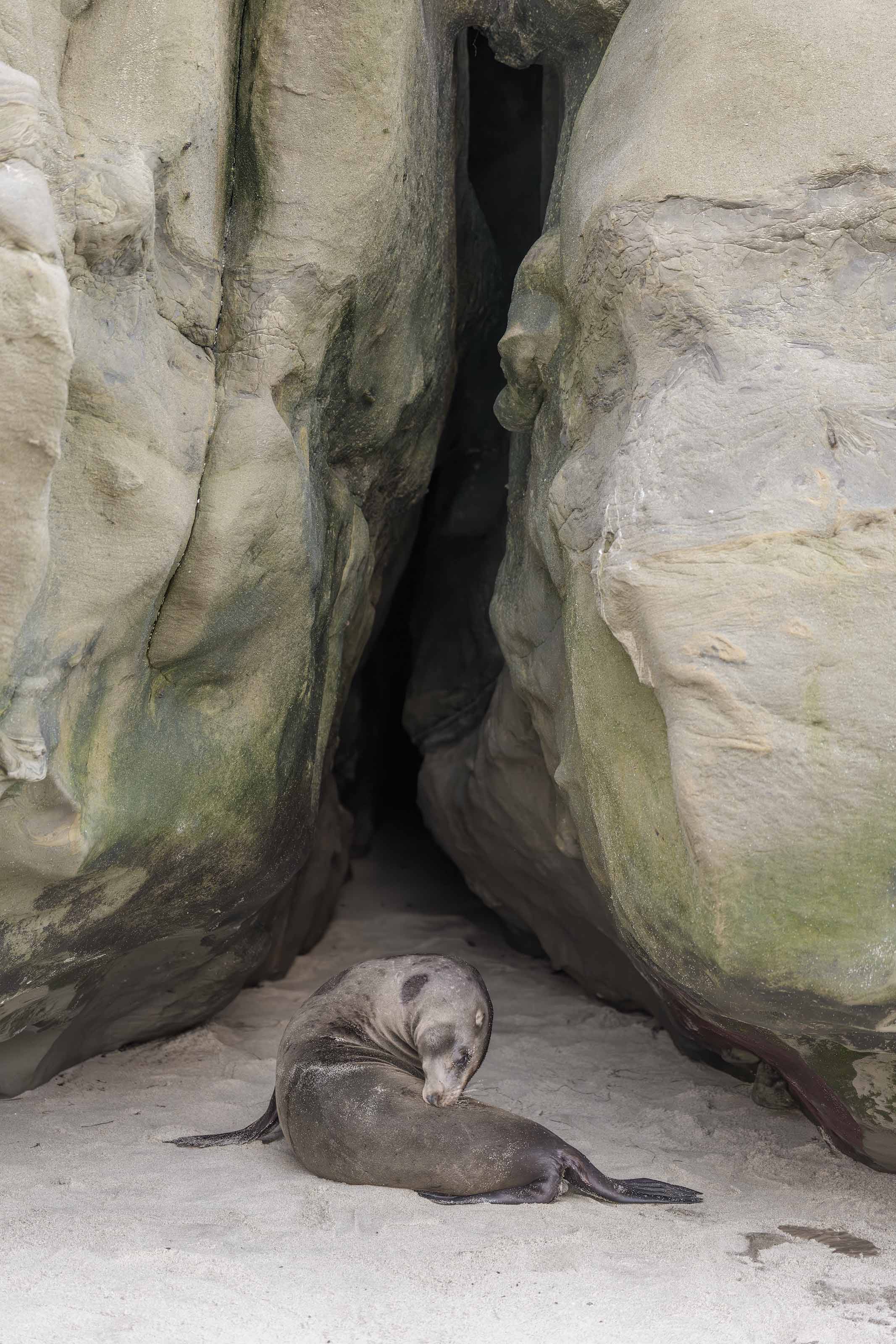
This image was created by yours truly on 8 January 2026 at La Jolla, CA on a 2026 San Diego Extended AirBnB Instructional Photo-Tour. Standing on the beach below the cormorant nesting shelf I used the handheld Sony FE 70-200mm f/2.8 GM OSS II Lens (at 70mm) and The Latest Greatest Sony Flagship Body, the a1 II Mirrorless Camera. The exposure was determined by Zebras with ISO on the rear wheel — ISO 1250: 1/125 second at f/2.8 (wide open) in Manual mode. AWB at 7:13:19am in the shade. Tracking: Spot XS/AF-C with Bird-Eye/Face Detection performed perfectly. Click on the image to enjoy the larger, inexplicably sharper high-res version. Image #1: California Sea Lion grooming itself |
On Being Flexible and Adaptable
On our first morning we grabbed our 70-200s and walked down the hill to the cormorants. There had been hundreds on the lower shelves when we had scouted on the previous day. It was low tide but the beach had not yet been despoiled by human footprints. As there were dozens of sea lions on the beach and in the shallow waters, we walked down the steps to the beach at the swimming cove and went to work.
I went vertical for this one, zoomed out to 70mm, and backed up into the shallow Pacific so that I could fit the top of the vertical slit in the cliff wall in the frame. I moved the AF point to the bottom of the viewfinder and created an image that made me happy. Note that because of the distance to the subject and the cliff everything was sharp even at f/2.8. Note also that with a static subject that working at 1/125 sec. did not present any problems in terms of sharpness.
|
|
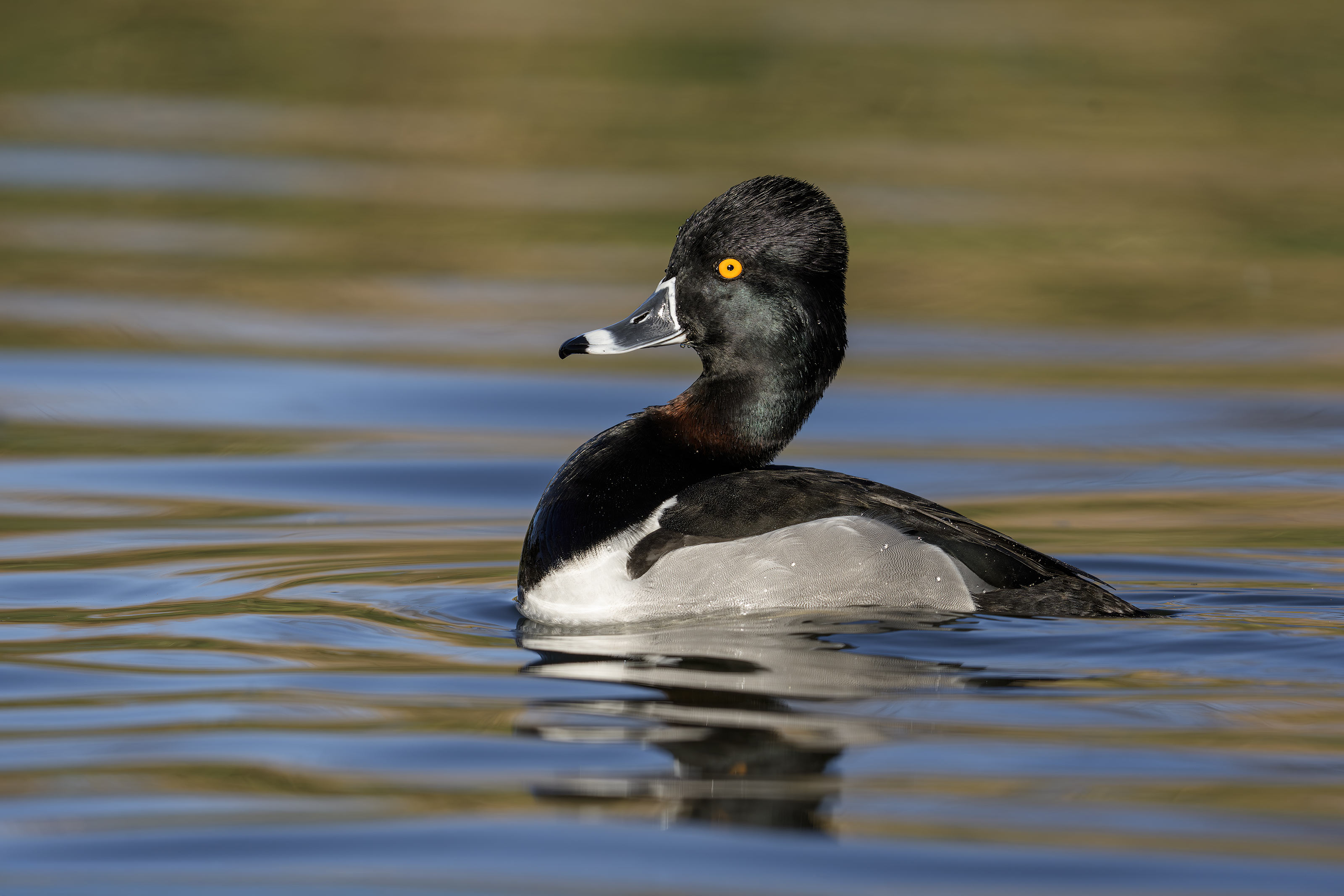
This image was created by yours truly on 11 January 2026 at Santee Lakes on a 2026 San Diego Extended AirBnB IPT. Seated on the grass I used the flattened Wide/AF-C with Bird-Eye/Face Detection performed perfectly. Click on the image to enjoy the larger, inexplicably sharper high-res version. Image #2: Ring-necked Duck display posture |
Toe-Poddiing
Using the toe-pod technique makes it difficult to follow swimming ducks and pretty much impossible to track flight and action. So what’s the big attraction? Working at a low perspective yields images that are far more intimate and pleasing than those made standing or even when using the knee-pod technique. With the road two feet level of the lake it was not possible to get right down to the subject’s eye level.
|
|
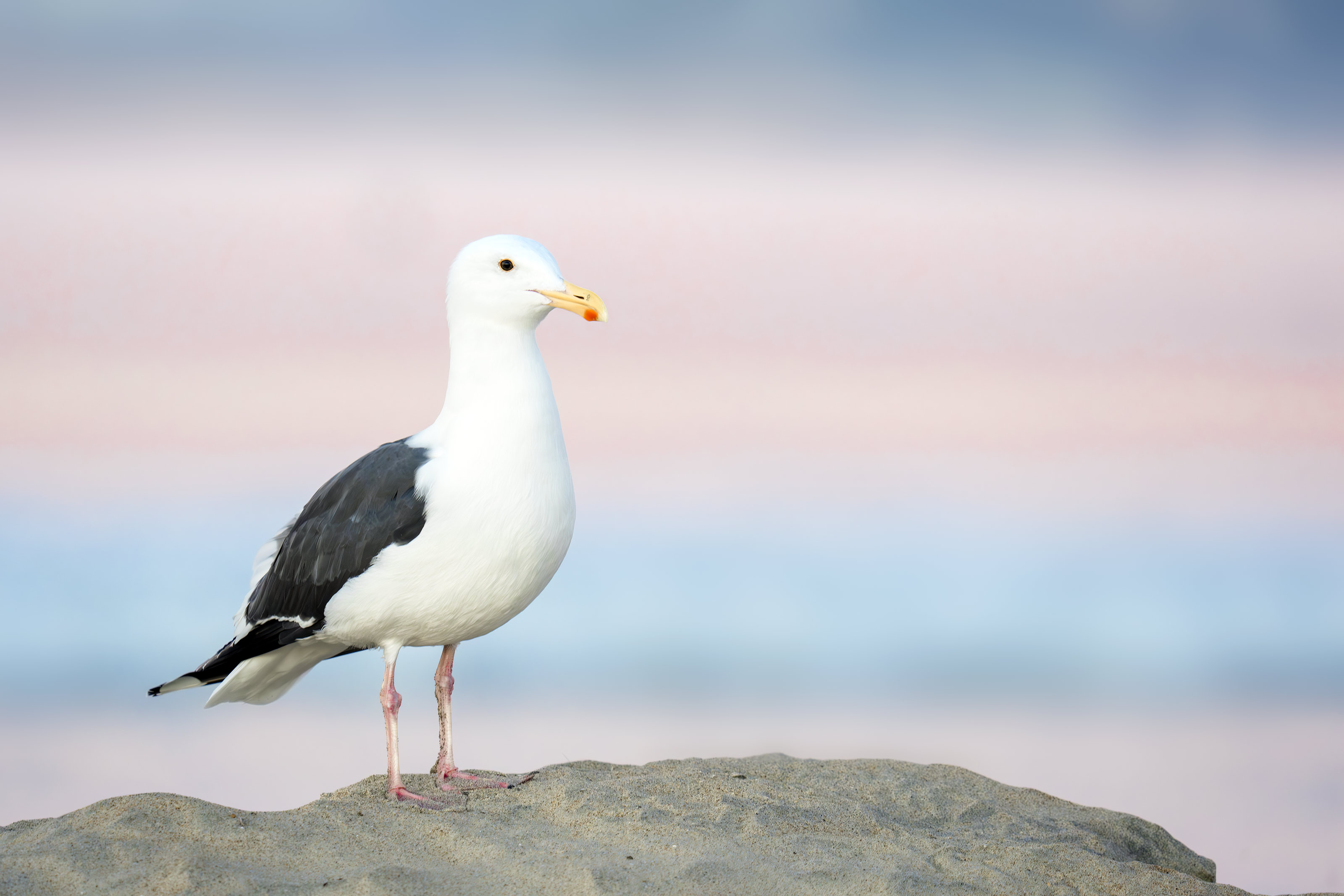
This image was created on 13 January 2026 by yours truly at Coronado Beach, CA on a 2026 San Diego Extended AirBnB IPT. Crouching a bit, I used the handheld Sony FE 200-600mm f/5.6-6.3 G OSS lens (at 481mm) and The Latest Greatest Sony Flagship Body, the a1 II Mirrorless Camera. The exposure was determined using Zebra technology with Exposure Compensation (EC) on the Thumb Dial. Multi-metering +1.3 stops. AUTO ISO set ISO 3200: 1/250 sec, at f/6.3 (wide open) in Shutter Priority mode. AWB at 6:48:23am in the shade well before the sun appeared. Wide/AF-C with Bird-Eye/Face Detection performed perfectly. Click on the image to enjoy the larger, inexplicably sharper high-res version. Image #3: Western Gull in pink and blue
|
On Getting Up Early
From where I sit there are countless advantages to being afield well before sunrise. Right at the top of that list is being able to work with the blue/pink/purple tones in the sky opposite a clear sunrise (and their reflections in the water). With this one I crouched to place the bird’s head and breast squarely in the pink surrounded above and below by layers of soft blue.
|
|
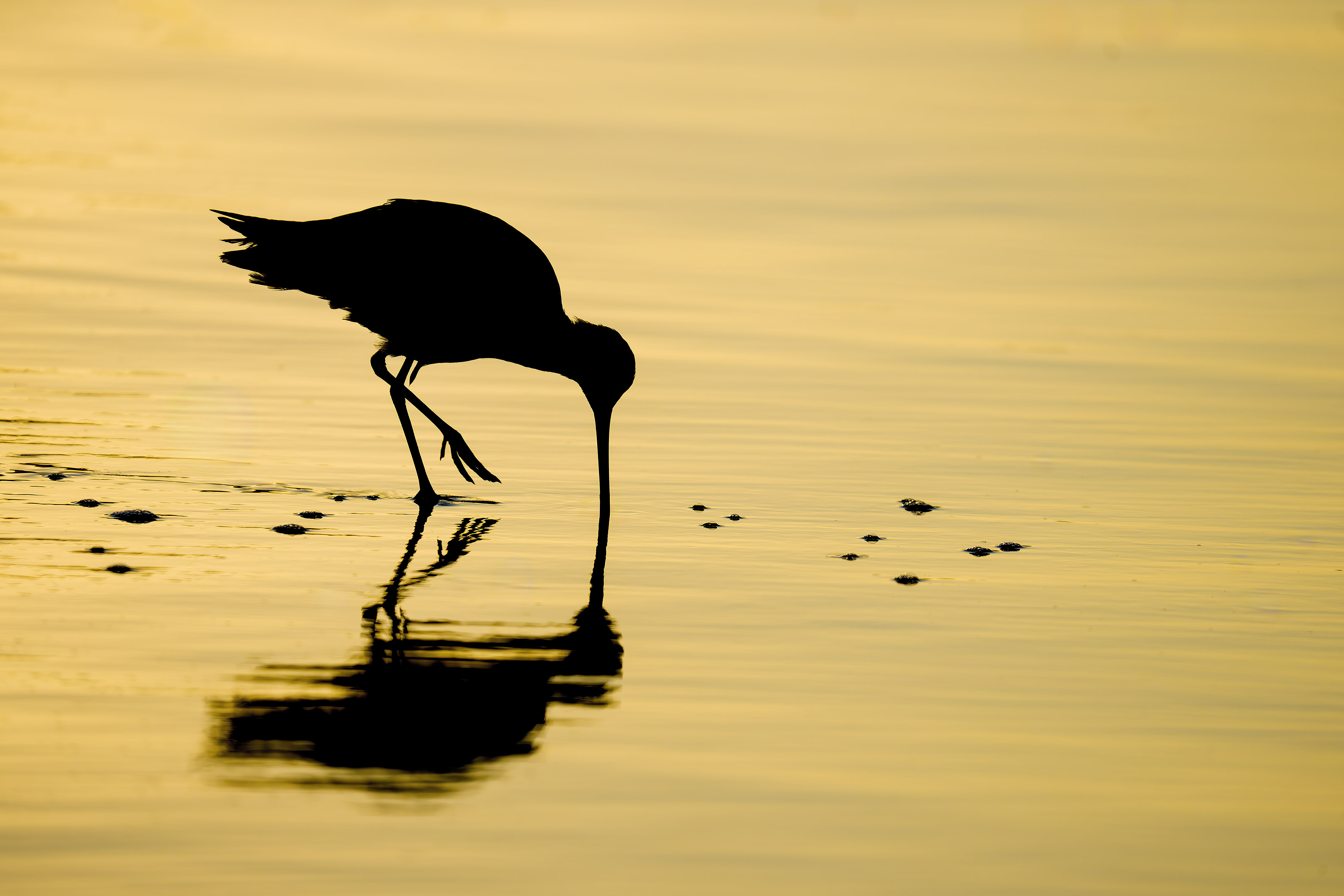
This image was created on 13 January 2026 by yours truly at Coronado Beach, CA on a 2026 San Diego Extended AirBnB IPT. Crouching just a bit, I used the handheld Sony FE 200-600mm f/5.6-6.3 G OSS lens (at 481mm) and The Latest Greatest Sony Flagship Body, the a1 II Mirrorless Camera. The exposure was determined using Zebra technology with Exposure Compensation (EC) on the Thumb Dial. Multi-metering +1.0 stop. AUTO ISO set ISO 250: 1/1000 sec, at f/6.3 (wide open) in Shutter Priority mode. AWB at 7:16:25am just as the sun broke through the fog. Wide/AF-C with Bird-Eye/Face Detection performed perfectly. Click on the image to enjoy the larger, inexplicably sharper high-res version. Image #4: Marbled Godwit foraging — silhouette
|
Turning Around and Facing East
In winter, the Hotel Del Coronado blocks the sun on the horizon a bit depending on how close you are to the buildings. With a bit of fog, we had some very nice color on the wet sand. To maximize the gold, the trick is to put the sun, the wet sand, and the bird on the same line. The raised foot here adds.
|
|
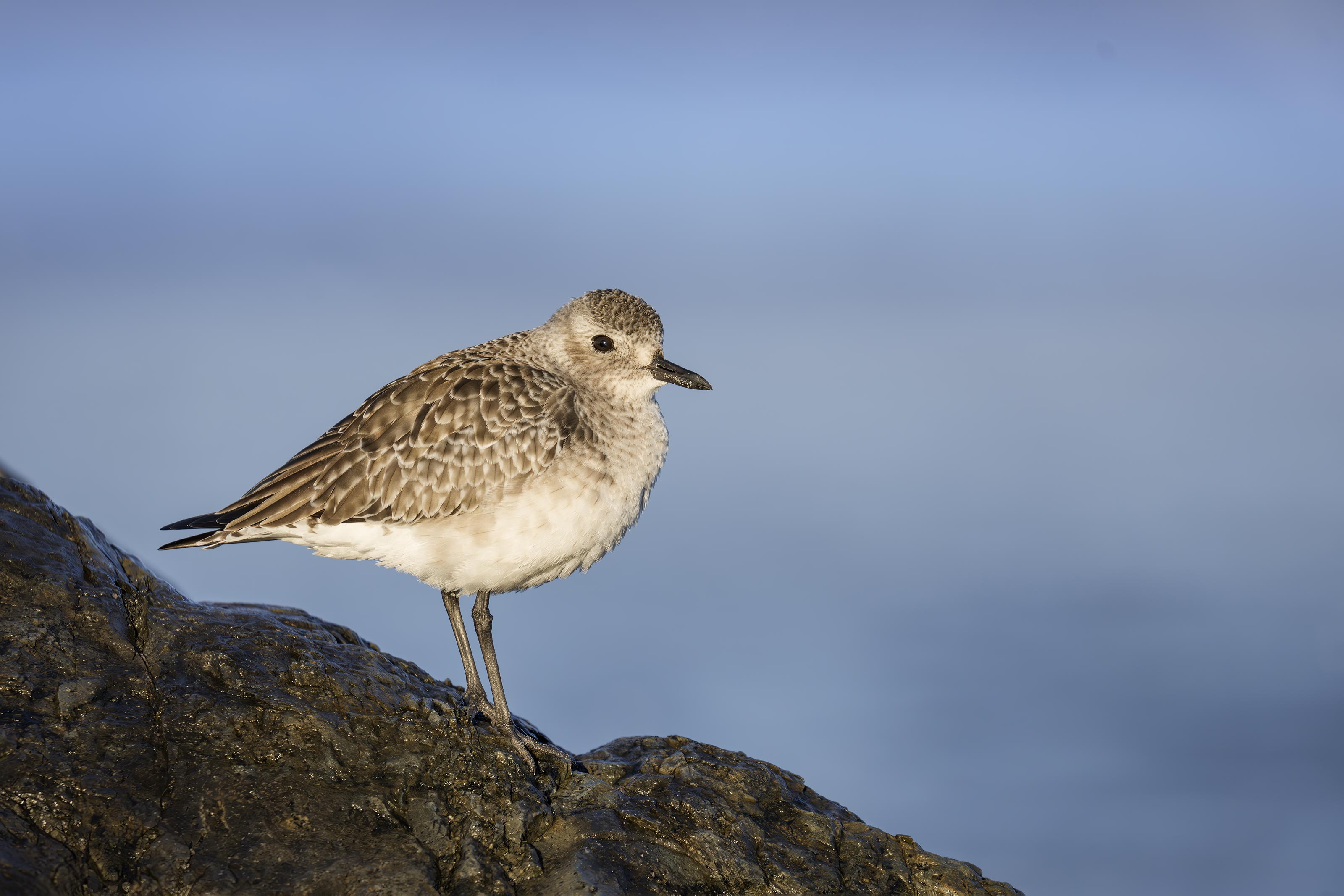
This image was created on 13 January 2026 by yours truly at Coronado Beach, CA on a 2026 San Diego Extended AirBnB IPT. Standing at full height close to a rock jetty, I used the handheld Sony FE 200-600mm f/5.6-6.3 G OSS lens (at 600mm) and The Latest Greatest Sony Flagship Body, the a1 II Mirrorless Camera. The exposure was determined using Zebra technology with Exposure Compensation (EC) on the Thumb Dial. Multi-metering +0.3 stops. AUTO ISO set ISO 500: 1/1250 sec, at f/6.3 (wide open) in Shutter Priority mode. AWB at 7:31:55am on a mostly sunny morning. Wide/AF-C with Bird-Eye/Face Detection performed perfectly. Click on the image to enjoy the larger, inexplicably sharper high-res version. Image #5: Black-bellied Plover winter plumage
|
Working the Jetty
There is a short jetty near the hotel. As the sun rose, we the sun was filtered by some light cloud and a bit of fog. To get close to sun angle for this one, I needed to pick my way through some tidal pools and a collection of rocks. Many of the clients worked on the Black Turnstones on the large boulders but I passed on all of them as I could not see the bird’s feet.
|
|
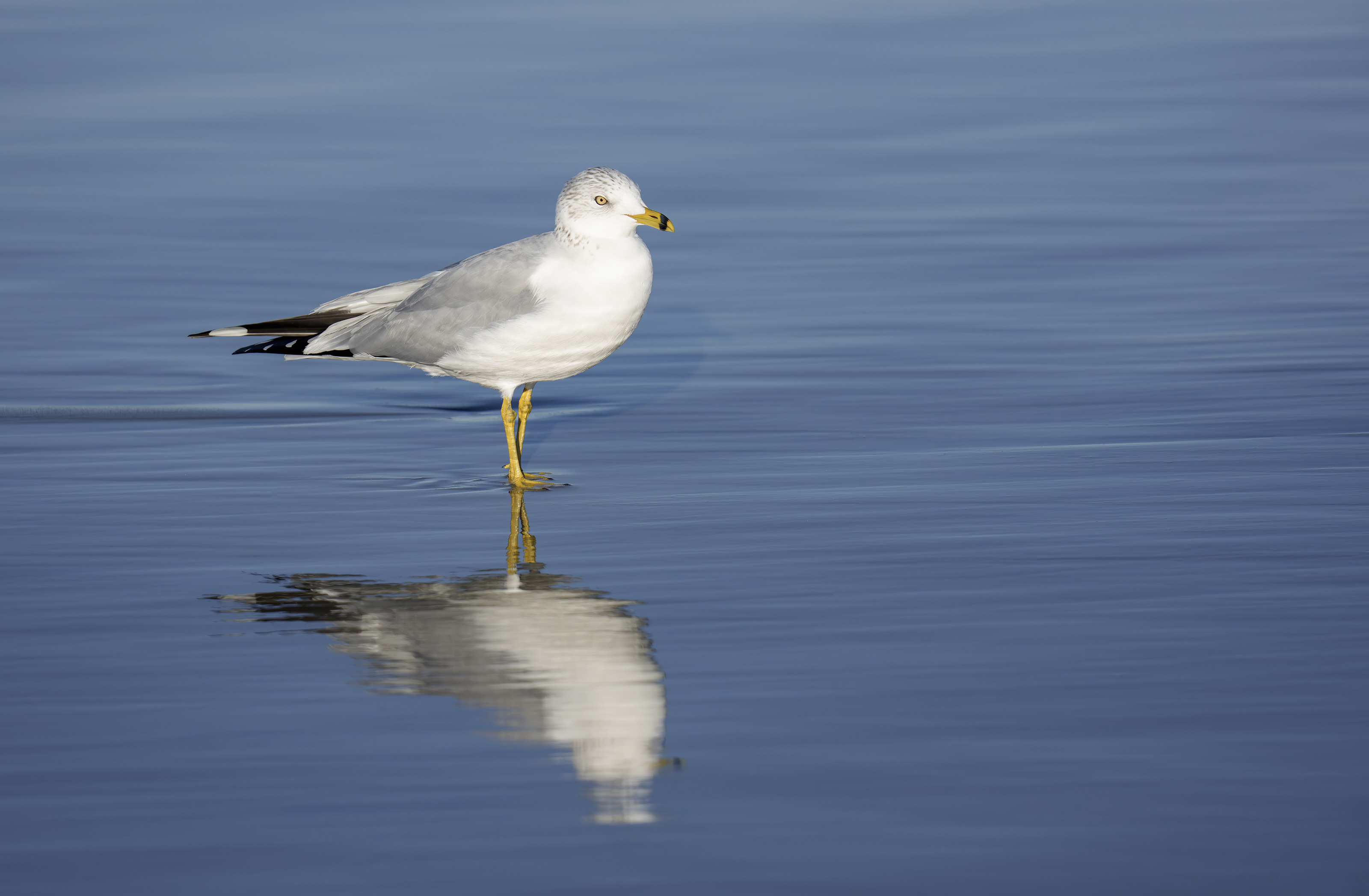
This image was created on 13 January 2026 by yours truly at Coronado Beach, CA on a 2026 San Diego Extended AirBnB IPT. Standing at full height on the beach I used the handheld Sony FE 200-600mm f/5.6-6.3 G OSS lens (at 324mm) and The Latest Greatest Sony Flagship Body, the a1 II Mirrorless Camera. The exposure was determined using Zebra technology with ISO on the Thumb Dial. ISO 640: 1/4000 sec. at f/8 (stopped down 2/3 stop) in Manual mode. AWB at 8:11:32am on a sunny morning. Wide/AF-C with Bird-Eye/Face Detection performed perfectly. Click on the image to enjoy the larger, inexplicably sharper high-res version. Image #6: Ring-billed Gull on wet, wave-washed sand
|
The Clean Wet Sand
Turning around again and facing west we continued to work the patches of wet sand. I made this image just as a wave was receding. I had zoomed out to include the bird’s complete but less than perfect reflection.
|
|
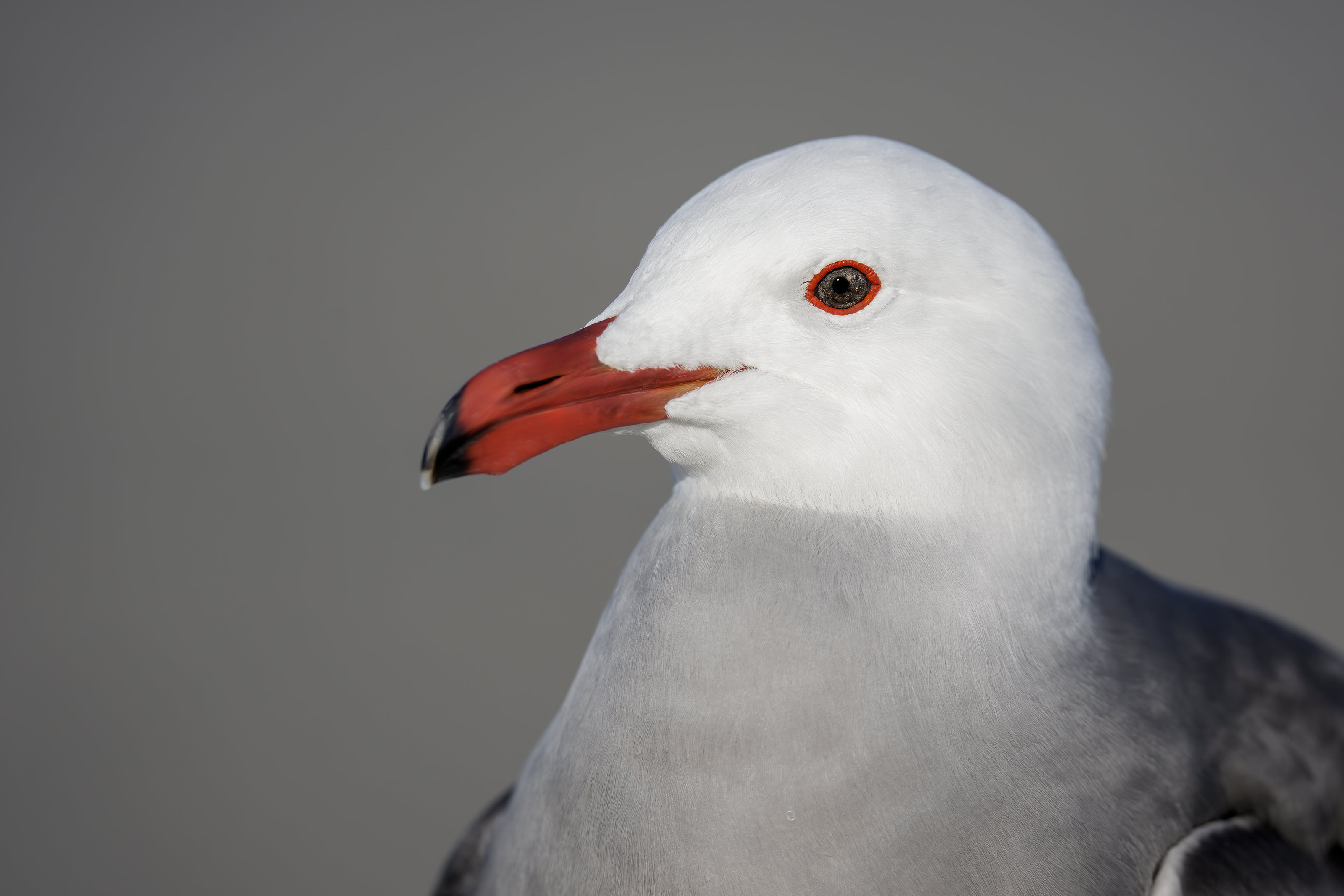
This image was created on 13 January 2026 by yours truly at Coronado Beach, CA on a 2026 San Diego Extended AirBnB IPT. Seated on damp sand, I used the knee-pod technique with the handheld Sony FE 200-600mm f/5.6-6.3 G OSS lens (at 600mm) and The Latest Greatest Sony Flagship Body, the a1 II Mirrorless Camera. The exposure was determined using Zebra technology with ISO on the Thumb Dial. ISO 640: 1/4000 sec. at f/6.3 (wide open) in Manual mode. AWB at 8:23:53am on a sunny morning. Wide/AF-C with Bird-Eye/Face Detection performed perfectly. Click on the image to enjoy the larger, inexplicably sharper high-res version. Image #7: Heermann’s Gull head portrait
|
The Gray Mat Background
There are some fairly large expanses of dark gray sand at Coronado Beach. By getting low and moving slowly, it is possible to utilize this sand as a sort of studio background. Heermann’s Gull are among the handsomest of North American Gulls eclipsed for me only by Sabine’s Gull in full breeding plumage. I have never had the privilege and doubt that I will.
|
|
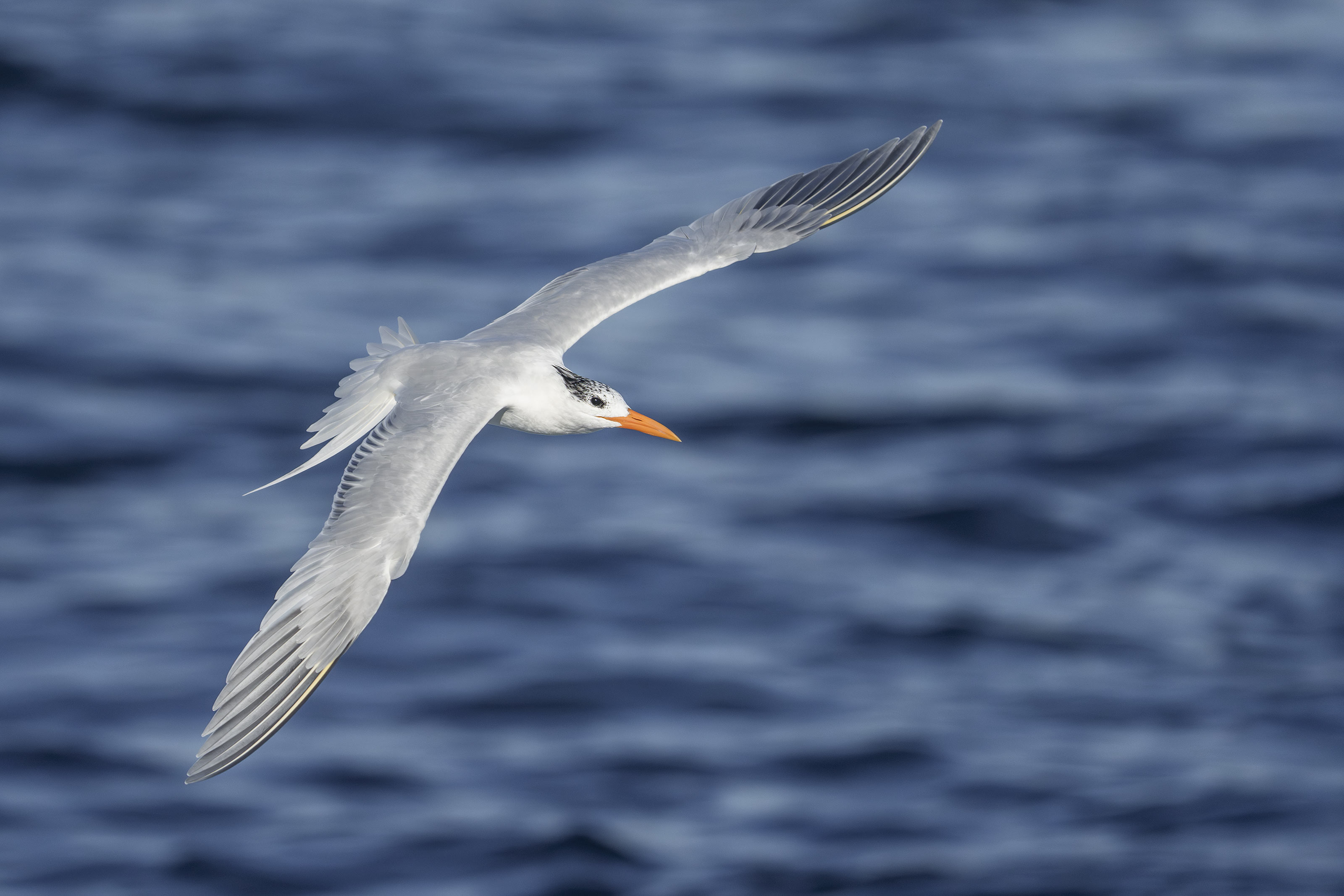
This image was created by yours truly on 15 January 2026 at La Jolla, CA on a 2026 San Diego Extended AirBnB IPT. Standing in front of the Bridge Club, I used the Wide/AF-C with Bird-Eye/Face Detection performed perfectly. Click on the image to enjoy the larger, inexplicably sharper high-res version. Image #8: Royal Tern winter plumage in flight — dorsal view |
Working the Wind and the Backgrounds
Photographing Royal Terns at the Bridge Club will teach you everything you need to know to be a successful flight photographer as long as you have a wind somewhere from the east, the prevailing wind direction in La Jolla in winter. We teach you to set up in a spot that will yield a variety of pleasing backgrounds.
|
|
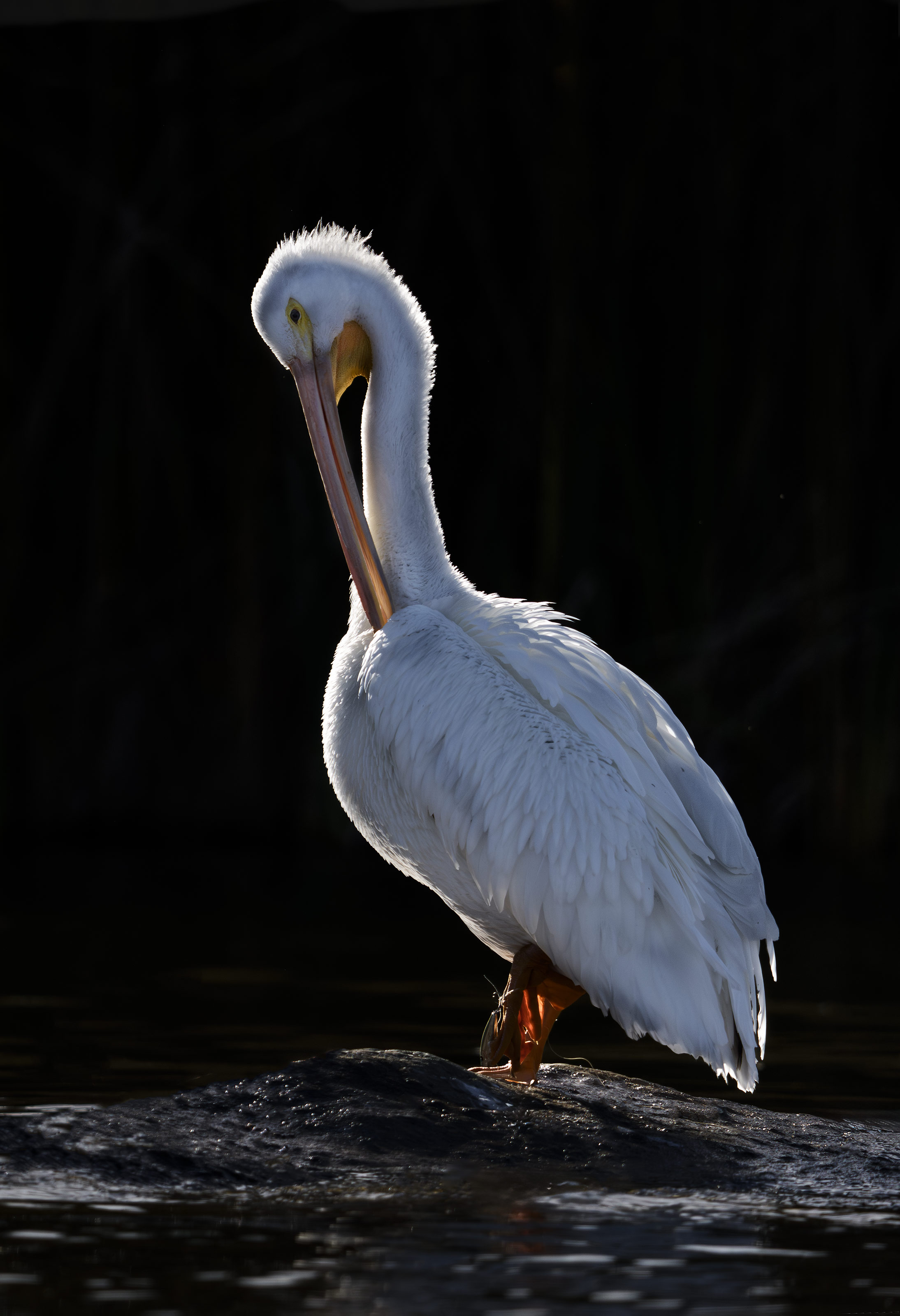
This image was created by yours truly on 17 January 2026 at La Jolla, CA on a 2026 San Diego Extended AirBnB IPT. Standing on the road at Santee Lakes, I used the handheld Sony FE 400-800mm f/6.3-8 G OSS lens (Sony E) (at 689mm) and The Latest Greatest Sony Flagship Body, the a1 II Mirrorless Camera. The exposure was determined using Zebra technology with Exposure Compensation (EC) on the Thumb Dial. Multi-metering -3.0 stops! AUTO ISO set ISO 640: 1/4000 sec, at f/8 (wide open) in Shutter Priority mode. AWB at 8:48:54am on a sunny morning. Wide/AF-C with Bird-Eye/Face Detection performed perfectly. Click on the image to enjoy the larger, inexplicably sharper high-res version. Image #9: American White Pelican backlit |
Drive By Shooting
We were headed from our pre-dawn location on the west side of Lake 5 to our morning session on the east side of that same lake when I spotted this dramatically backlit American White Pelican. We all jumped out and made a few images. ACR masks as detailed in the Digital Basics IV Video Series helped bring this image to life.
|
|
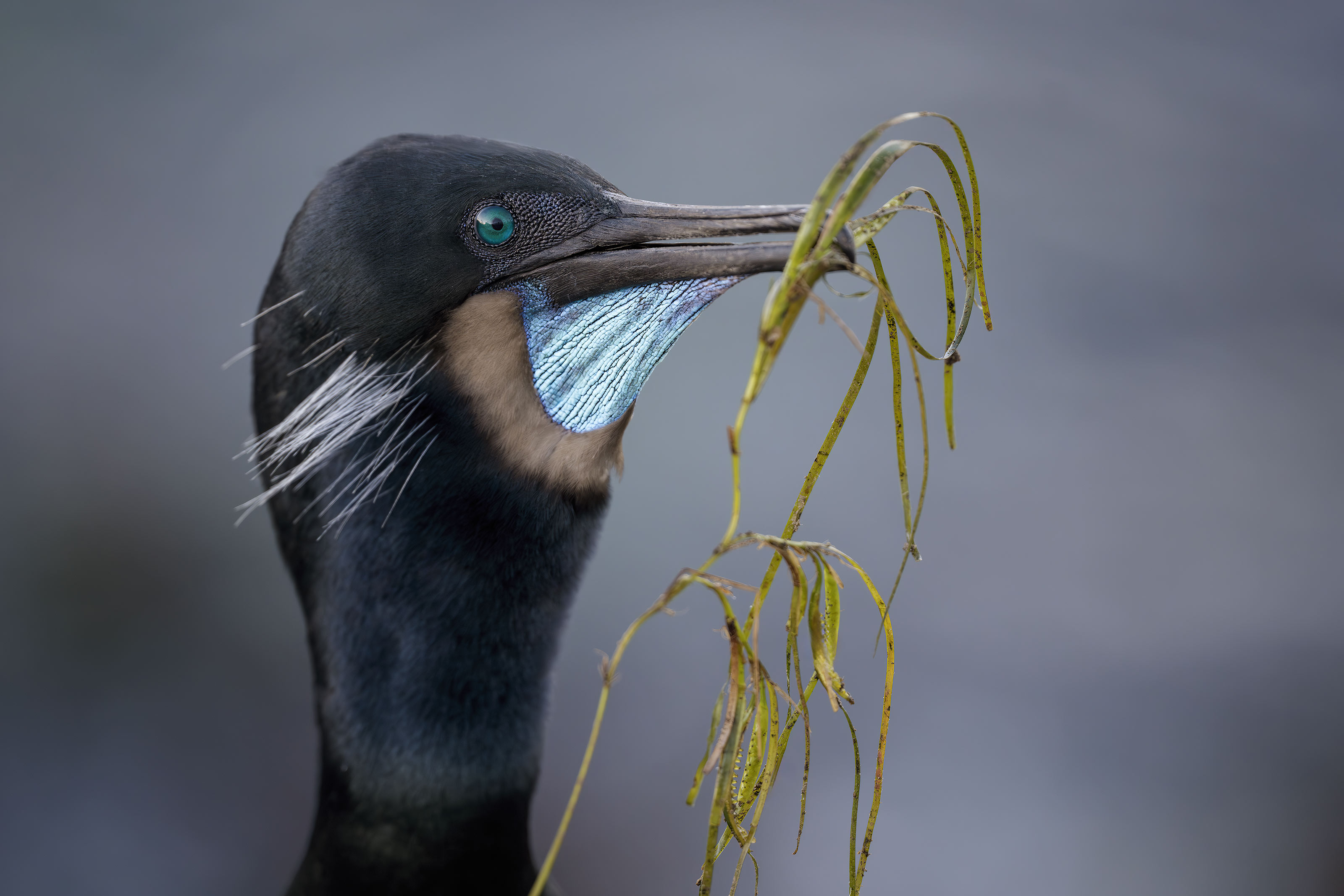
This image was created by yours truly on 19 January 2026 at La Jolla, CA on a 2026 San Diego Extended AirBnB IPT. Standing on the sidewalk above the cormorant nesting shelf, I used the handheld Sony FE 300mm f/2.8 GM OSS Lens (Sony E) with the Sony FE 1.4x Teleconverter (at 420mm) with the Latest Greatest Sony Flagship Body, the a1 II Mirrorless Camera. The exposure determined via Zebras with ISO on the Thumb Wheel. ISO 1600: 1/640 sec. at f/4 (wide open) in Manual mode. AWB at 4:27:42pm in the shade. Wide/AF-C with Bird Eye/Face Detection enabled performed perfectly. Click on the image to enjoy the larger, inexplicably sharper high-res version. Image #10: Brandt’s Cormorant with nesting material |
420mm
Not only is the 300mm f/2.8 GM lens deadly for flight, it can be great in low light situations. Though a bit more depth of field might have been nice to sharpen up the grasses, there was no time to do anything. I was walking uphill when this bird picked up some wet seagrasses. Working quickly I was able to make a very few images before the cormorant dropped the nesting material and went on to something else.
|
|
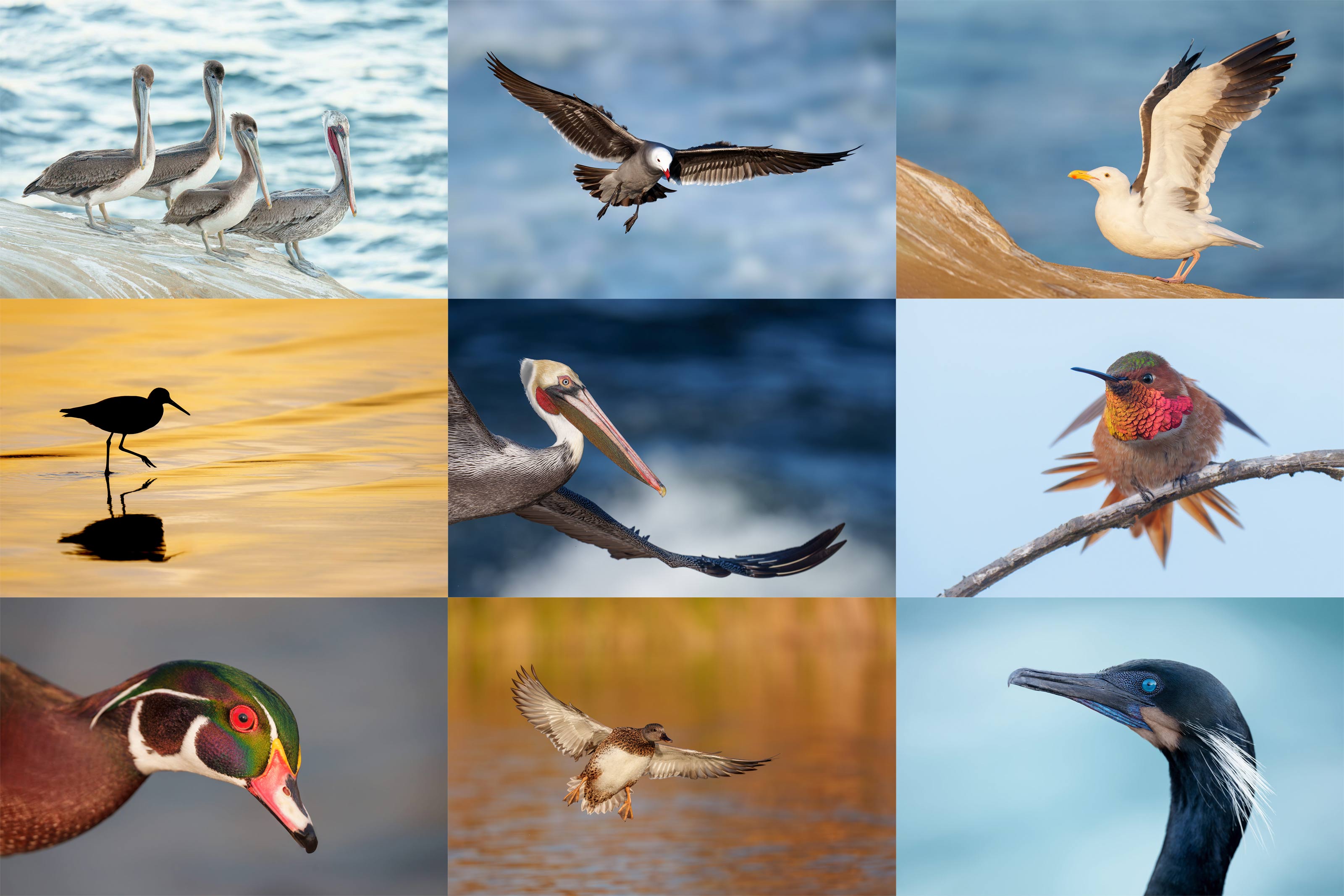
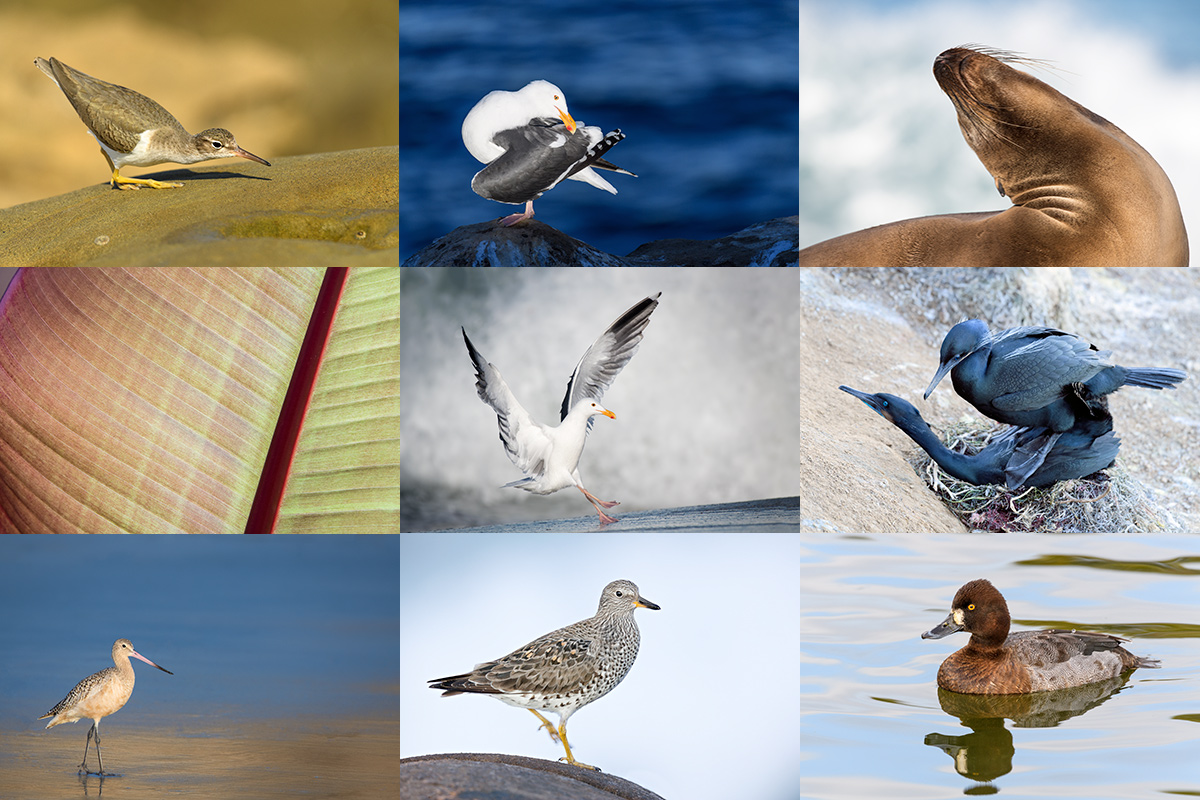
San Diego offers an incredible variety of attractive avian subjects, including and especially the Pacific race of Brown Pelican. Clockwise from top left back to center: juvenile and sub-adult Brown Pelicans; Heermann’s Gull; Western Gull; Allen’s Hummingbird; Brandt’s Cormorant; Gadwall hen; Wood Duck drake; Willet; Brown Pelican tight flight. Click on the composite to enjoy a larger version. |
The 2027 San Diego Brown Pelicans (and more!) IPTs
San Diego IPT #1: 4 1/2 DAYS: WED 6 JAN thru the morning session on SUN 10 JAN 2027: $2699.00. Deposit: $699.00. Limit: 6 photographers.
San Diego IPT #2: 4 1/2 DAYS: TEUS 19 JAN thru the morning session on SAT 23 JAN 2027: $2699.00. Limit: 6 photographers.
AirBnB accommodations and ground transport with the leader are available for both IPTs and for the In-the-Field Instructional Sessions on a first come, first served basis. Please e-mail for details and information on personalized pre- and post-IPT morning sessions. Staying in the group AirBnB allows for increased learning and less travel for all.
Morning BAA In-the-Field Instructional Sessions (ITFIS) followed by brunch and an Image Review & Photoshop session: $499.00/per session
Available dates: JAN 11-20 2027. AirBnB accommodations possibly available for multiple sessions. Please get in touch with questions or to register with an e-mail to samandmayasgrandpa@att.net and please shoot me a text to 863-221-2372.
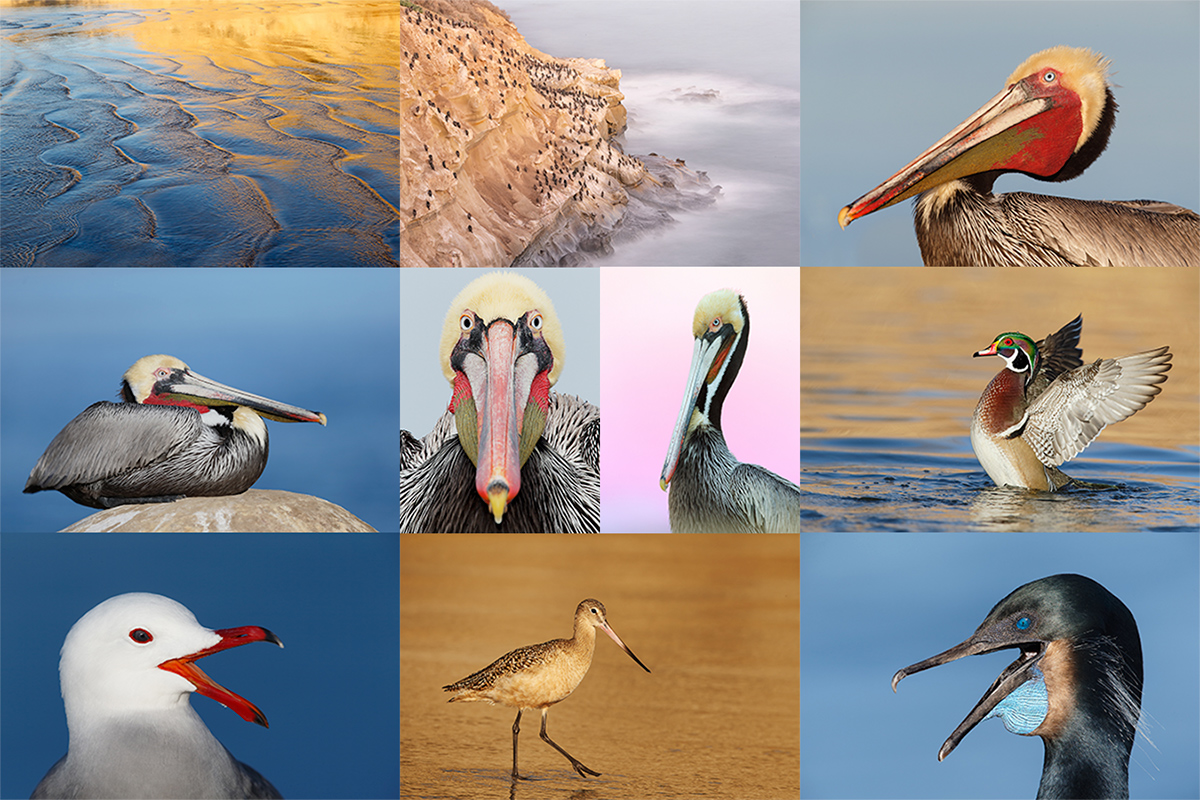
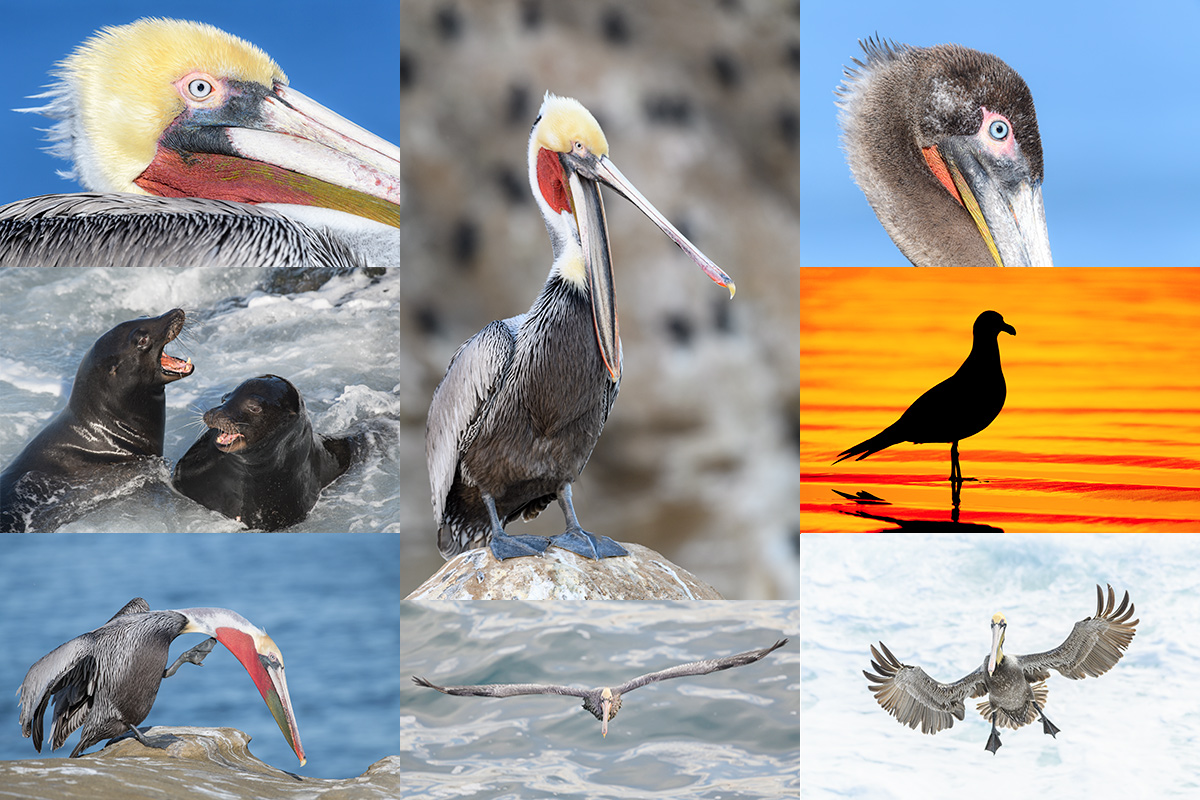
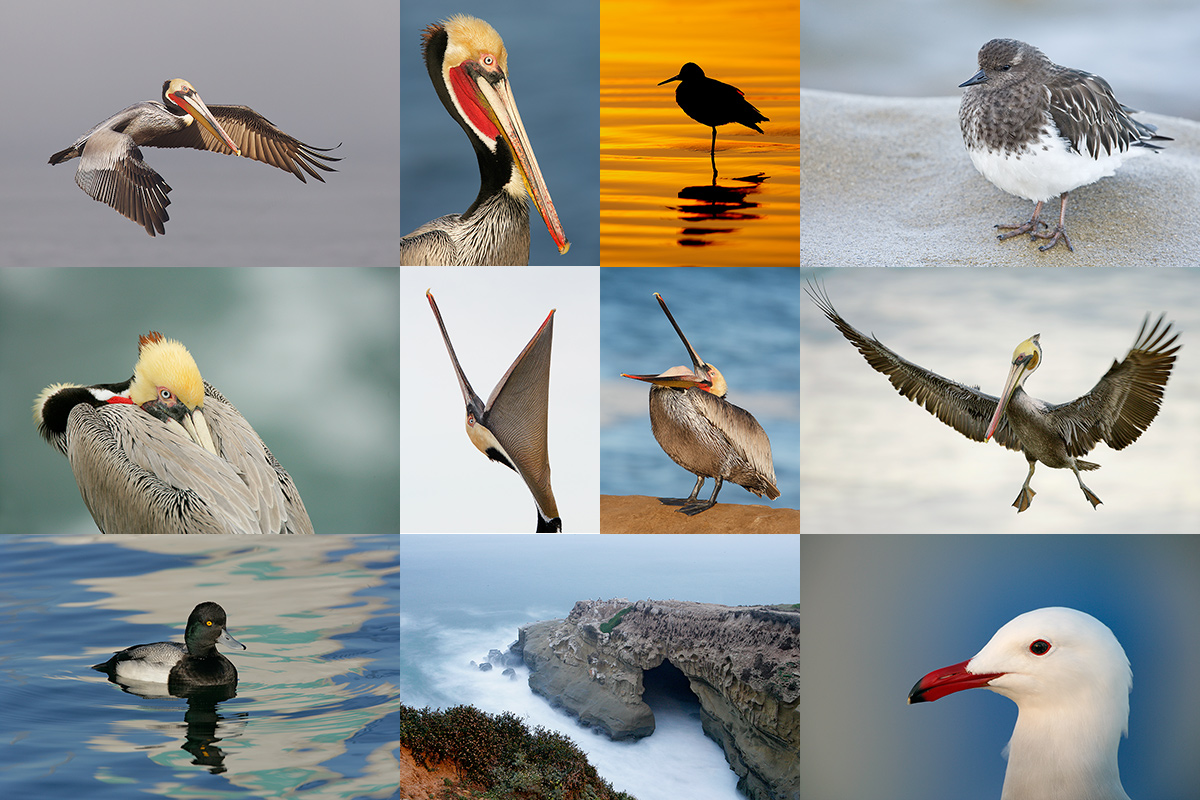
Join me in San Diego to photograph the spectacular breeding plumage Brown Pelicans with their fire-engine red and olive green bill pouches; Brandt’s (nesting) and Double-crested Cormorants; breeding plumage Wood and Ring-necked Ducks; other duck species possible including Lesser Scaup, Redhead, Northern Shoveler and Surf Scoter; a variety of gulls including Western, California, and the gorgeous Heermann’s, all in full breeding plumage; shorebirds including Marbled Godwit, Willet, Sanderling and Black-bellied Plover; many others are possible including Least, Western, and Spotted Sandpiper, Whimbrel, Black and Ruddy Turnstone, Semipalmated Plover, and Surfbird; Harbor Seals and California Sea Lions (both depending on the current regulations and restrictions). And as you can see by studying the IPT cards, there are some nice bird-scape and landscape opportunities as well. Not to mention a ton of excellent flight photography opportunities and instruction.
Please note: where permitted and on occasion, ducks and gulls may be attracted (or re-located) with offerings of grains or bread.
|
|
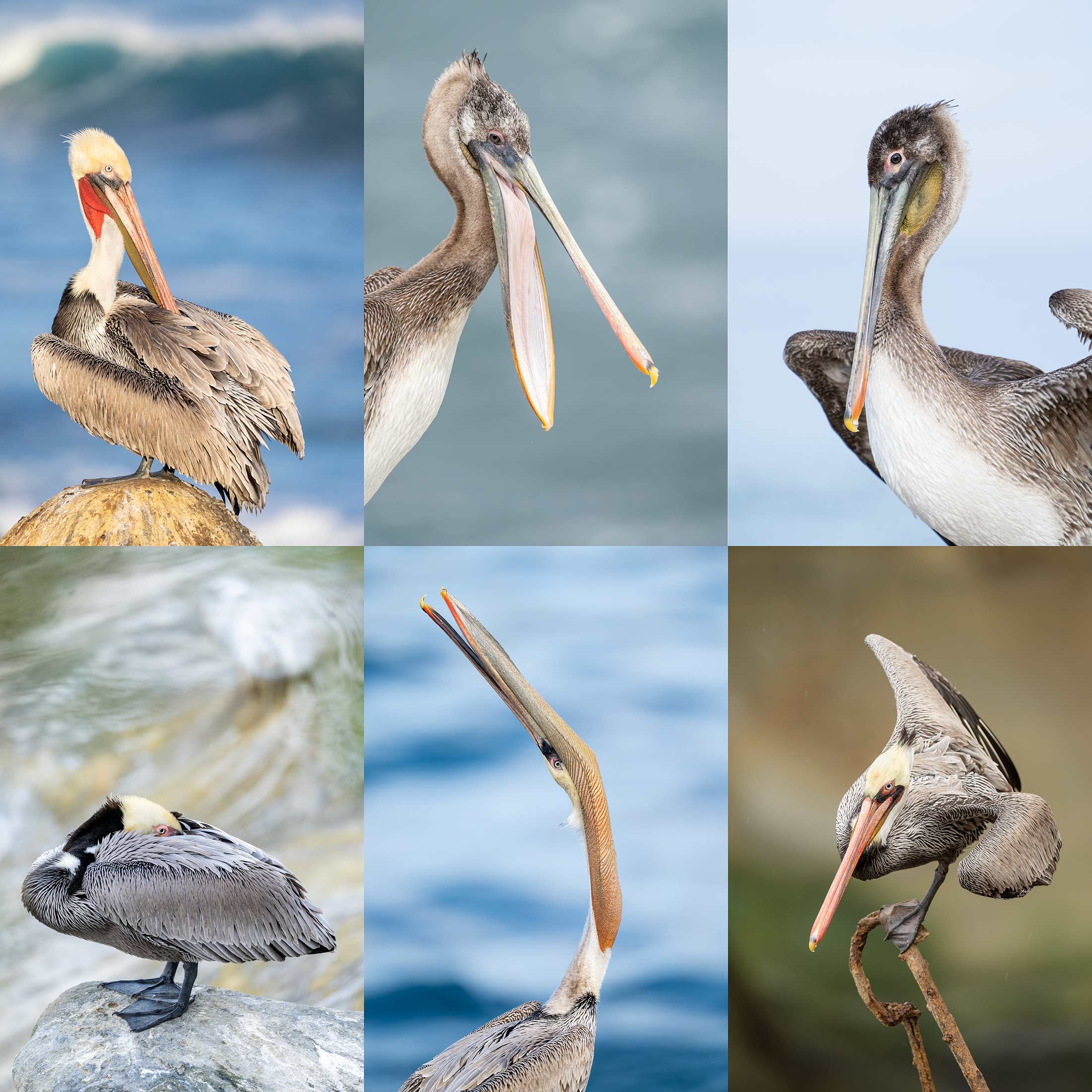
San Diego offers a wealth of very attractive natural history subjects, including and especially the Pacific race of California Brown Pelican. With annual visits spanning more than four decades, I have lots of photographic experience there … Click on the composite to enjoy a larger version. |
Learning Exposure, Whether You Like It Or Not
Whether you like it or not, we will be beating the subject of exposure like a dead horse. In every new situation, you will hear my thoughts on exposure along with my thoughts on both Nikon and Canon histograms and SONY Zebras. Whether you like it or not, you will learn to work in manual mode so that you can get the right exposure every time (as long as a bird gives you ten seconds with the light constant). Or two seconds with SONY zebras … And you will learn what to do when the light is changing constantly. What you learn about exposure will be one of the great takeaways on every IPT.
|
|
Though the pelicans will be the stars of the show on this IPT, there will be many other handsome and captivating subjects in wonderful settings. Click on the composite to enjoy a larger version. |
It Ain’t Just Pelicans
With gorgeous subjects just sitting there waiting to have their pictures taken, photographing the pelicans on the cliffs is about as easy as nature photography gets. With the winds from the east almost every morning, there is usually some excellent flight photography, at times with 70-200mm lenses! And the pelicans are almost always doing something interesting: preening, scratching, bill pouch cleaning, or squabbling. And then there are those crazy head throws that are thought to be a form of intra-flock communication. You will be guided as to how to make the best of those opportunities. Depending on the weather, the local conditions, and the tides, there are a variety of other fabulous photo chances available in and around San Diego. Each IPT will include one or two duck sessions.
|
|
|
Did I mention that there are lots of great birds and natural history subjects in San Diego in winter? Click on the composite to enjoy a larger version. |
The San Diego Details
These IPTs will include five 3-hour morning photo sessions, four 1 1/2-hour afternoon photo sessions, and four working brunches (included) that will include image review and Photoshop sessions. On rare cloudy days, we may — at the leader’s discretion, stay out in the morning for a long session and skip that afternoon shoot. To ensure early starts, breakfasts will be your responsibility. And so that we can get some sleep, dinners will be on your own as well. In the extremely unlikely event that Goldfish Point is closed due to local ordinance (or whimsy) — that has never happened in the past fifty years, I will of course do my very best to maximize our photographic opportunities.
|
|
San Diego offers a wealth of very attractive natural history subjects, including and especially the Pacific race of California Brown Pelican. With annual visits spanning more than four decades, I have lots of photographic experience there. Click on the composite to enjoy a larger version. |
Deposit Info
A $699 deposit is required to hold your slot for one of the 2027 San Diego IPTs. You can send a check (made out to “BIRDS AS ART”) to us here: BIRDS AS ART, PO Box 7245, Indian Lake Estates, FL, 33855, or call Jim or Jennifer at the office with a credit card at 863-692-0906. Your balance, payable only by check, is due three months before the trip.
|
|
|
Variety is surely the spice of life in San Diego. Click on the composite to enjoy a larger version. |
Getting Up Early and Staying Out Late
On all BIRDS AS ART IPTS including and especially the San Diego IPT, we get into the field early to take advantage of unique and often spectacular lighting conditions and we stay out late to maximize the chances of killer light and glorious sunset silhouette situations. We often arrive at the cliffs a full hour before anyone else shows up to check out the landscape and seascape opportunities.
Typos
With all blog posts, feel free to e-mail or to leave a comment regarding any typos or errors.









My favorite is #7. For me, the thing that makes this picture is the beautiful gray background — perfect for this gray, black and white bird with the riveting red bill and eye ring.