
Your Call?
Which version of today’s featured image do you like best? Why?
My Realization
In the I Was On The Fence About This One. What Do You Think? blog post here, I was somewhat surprised that so many folks realized right off the bat that it was the owl’s eyes needed to be level. I created Image #1 first after rotating the image so that the nearest fence post was perfectly vertical. Looking at it, I realized that I needed instead to level the bird’s eyes to create a more natural looking image that had the front fence post leaning toward the road to my right.
Thanks a stack to dear friend Muhammed Arif for appreciating that the title of this post was intended to be a humorous pun. And thanks to everyone who left a comment.
What’s Up?
Conditions were perfect on Saturday morning with clear sunny skies and a good breeze from the northeast. As there was not much to shoot, both Bob Eastman and I came away pretty much empty. The excellent conditions prevailed again on Sunday, the only change being a wind from the south. Bob and I had an amazing few minutes with a Barred Owl that landed on Bob’s North Perch that had been erected only three days before. After the bird flew right at us, we got out of the car giddy and celebrated with high fives and huge smiles all around. Photos and the complete story here soon.
Today is Monday 16 March. The forecast this morning is quite similar to yesterday’s: clouds clearing early with more sun and a breeze from the south. We will be headed down to the lake at 7:30am to see what’s up. Whatever you opt to do I hope that you too choose to have fun and enjoy life. Please remember that happiness is a choice — Byron Katie, The Work.Com After our morning session, I will continue to work hard on my slide program for PhotoCon KC (details below).
If an item — a Delkin flash card or reader, a Levered-clamp FlexShooter Pro, or a Wimberley lens plate or low foot — for example, that is available from B&H and/or Bedfords, is also available in the BAA Online Store, it would be great, and greatly appreciated, if you would opt to purchase from us. We will match or beat any price. Please remember also to use my B&H affiliate links or to earn 3% cash back at Bedford by using the BIRDSASART discount code at checkout for your major gear purchases. Doing either often earns you free guides and/or discounts. And always earns my great appreciation.
Gear Questions and Advice
Too many folks attending BAA IPTs and dozens of photographers whom I see in the field and on BirdPhotographer’s.Net, are — out of ignorance — using the wrong gear, especially when it comes to tripods and more especially, tripod heads. And the same is true in spades when ordering new camera bodies or lenses. My advice will often save you some serious money and may help you avoid making a seriously bad choice. Please know that I am always glad to answer your gear questions via e-mail.. If you are desperate, you can try me on my cell at 863-221-2372. Please leave a message and shoot me a text if I do not pick up.
IPT Updates
I was thrilled to learn that multiple Homer IPT veteran Chris Loffredo will be joining the second 2027 San Diego IPT and that long-ago IPT veteran Jon Sostarich and multiple IPT veteran Mike De Rosa will be attending the first 2027 Homer IPT and both songbird days. See the complete details here.
San Diego IPT #1: 4 1/2 DAYS: WED 6 JAN thru the morning session on SUN 10 JAN 2027: $2699.00. Deposit: $699.00. Limit: 5 photographers.
San Diego IPT #2: 4 1/2 DAYS: TUES 19 JAN thru the morning session on SAT 23 JAN 2027: $2699.00. Limit: 5 photographers/Openings: 4.
Anchor Point Songbird Days: WED 10 FEB & TUES 11 FEB 2027. Full day: $500/day.
Homer IPT #1: FRI 12 FEB 2027 through the full day on TUES 16 FEB 2027. Five days/20 hours on the boat: $5900.00. Limit 5 photographers/Openings: 2
Homer IPT #2: WED 17 FEB 2027 through the full day on SUN 21 FEB 2027. Five days/20 hours on the boat: $5900.00. Limit 5 photographers/Openings: 2
Dates for the three 2027 Stick Marsh IPTs will be announced here soon.
PhotoCon KC
PhotoCon is coming to Kansas City for the very first time. And bringing the Midwest’s biggest photography and imaging event with us. The Overland Park Convention Center will transform into a massive interactive trade show floor, buzzing with creativity, education, and community. This isn’t just another conference. It’s a hands-on experience designed to fuel photographers, filmmakers, and content creators of every level. Whether you’re here to test-drive the newest gear, sharpen your skills, or connect with people who share your passion, PhotoCon KC is your place.
Free Event Passes!
If you live in or near Kansas City, KS and would like a free pass to this great event, simply shoot me an e-mail with PhotoCon KC as the Subject Line and I will be glad to have a pass sent to the first ten folks who get in touch. I am really looking forward to seeing Steve Sanders’ Saturday Keynote A Day In The Life! NFL Photographer (4:00 PM – 6:00 PM in Courtyards 4 – 7).
Steve Sanders is the Director of Photography for the Kansas City Chiefs Football Club. With over 30 years of covering the Chiefs, and the last 16 in a full-time roll, he has continued to evolve and excel with the changes in the photography industry. Before landing the full-time role with the team, his diverse portfolio included weddings, portraits, events, commercial advertising, architecture, and food photography. This experience enabled him to bring a wealth of knowledge to every Chiefs project. By fostering strong relationships with the team and players, Steve has earned trust both on and off the field, which allows him to capture exceptional images and achieve career milestones.
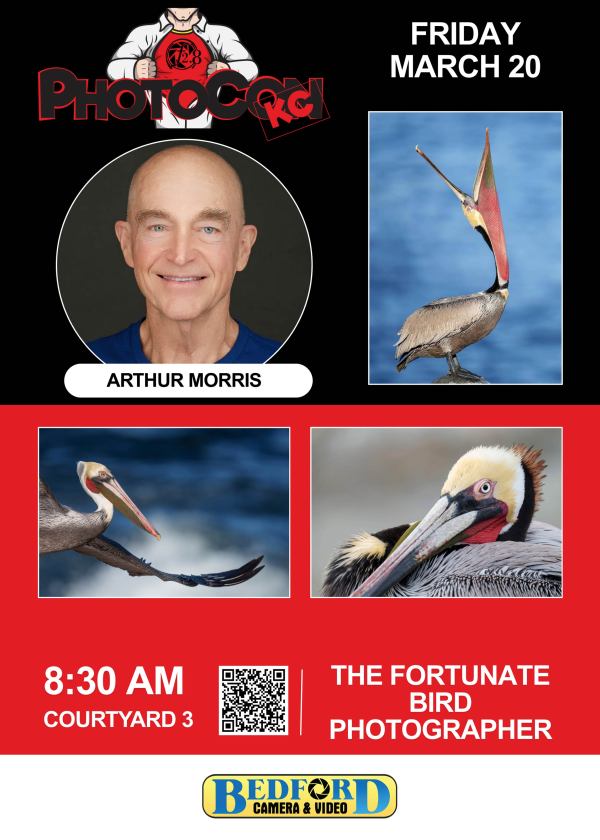
The Fortunate Bird Photographer
8:30 AM – 10:00 AM in Courtyard 3
After 42 years of bird photography — heck, I started late, I am, thanks to mirrorless autofocus technology, photographing more and enjoying it more than ever before as I approach age 80. Join me as I share the illustrated story of a life filled with countless incredible blessings. All bird photographers have benefited from the amazing technological advances made over the past decade — none more so than I!
|
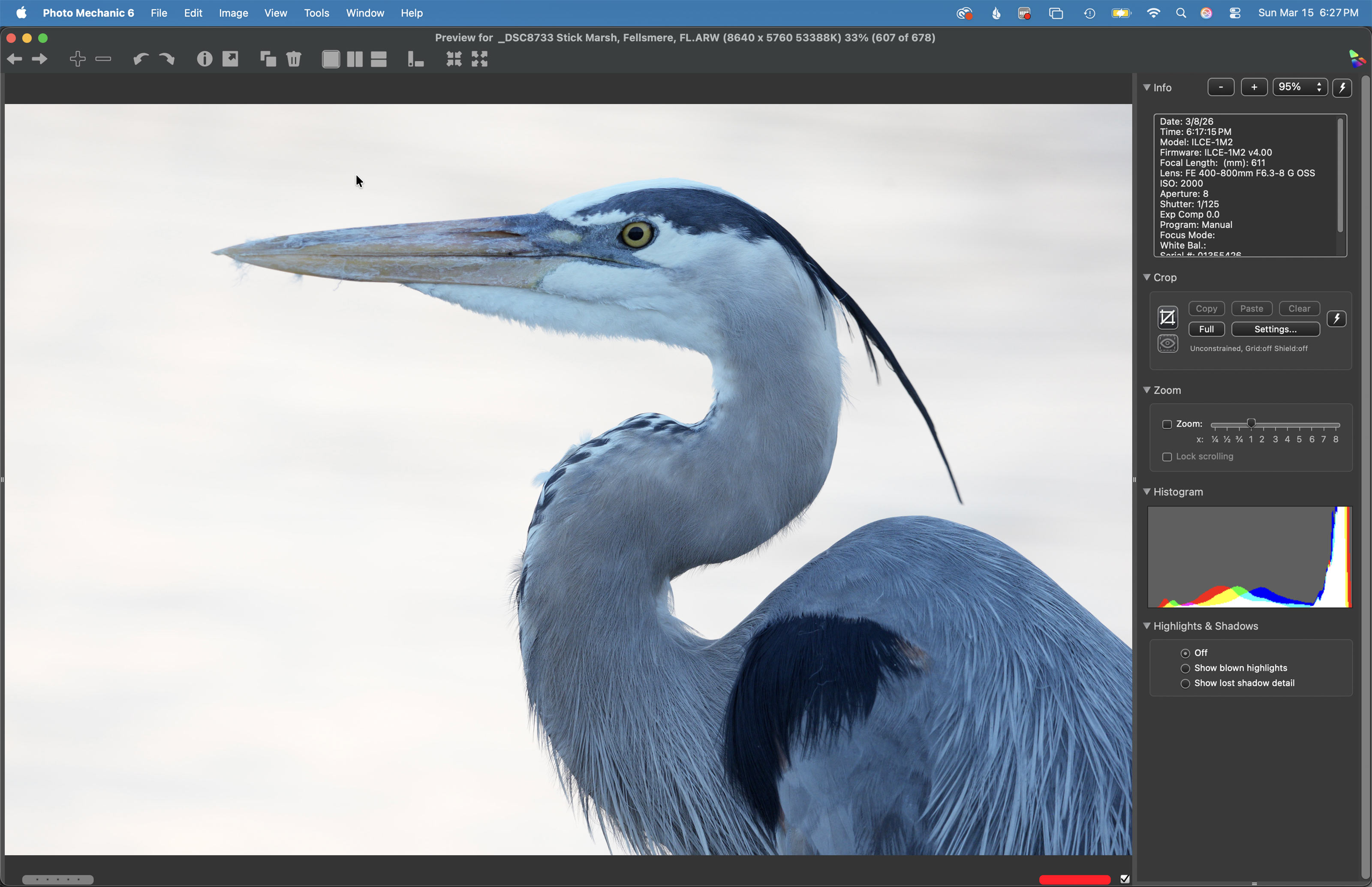
The Photo Mechanic Screen Capture for the Great Blue Heron in low light image (the original capture that represents the raw file) |
The 100% Inviolate Principle of Bird Photography
The five of us were indecisive about heading to Stick Marsh for a late afternoon session on March 8th. As the western skies brightened a bit and the east wind prevailed, it seemed that we might be able to make some nice silhouette of birds returning to the two rookery islands. Then I reminded the group of the 100% inviolate principle of bird photography: If you are sitting on your couch watching TV, you will never get any good images. If in doubt, get off your ass and get out in nature. At least then, you have a chance.
By the time we arrived at our location, there was a huge dark cloud covering the sky to the west; it was obvious that there was not going to be much of a sunset. There were no birds by the airboat ramp so we headed south to look for subjects on either side of the dike road. We found a breeding plumage Glossy Ibis, a Purple Gallinule, and several of the introduced Purple Swamphens. The backgrounds were ugly and cluttered so I stuck to observing and coaching. Though things looked dire, we decided to cross the bridge to check things out. As we headed down the hill toward the two rookery islands I was glad to see an adult Great Blue Heron standing in his usual spot. We talked about moving slowly without raising our lenses and about getting in position square to the pretty much stationary bird’s head. We talked about choosing a safe shutter speed for a static subject and about exposing to the right. lastly, we talked about lining up the head shot with the bit of reflected color in the water. Lastly, I mentioned that there would be two ways to go when processing the raw files.
Everyone came away with some nice images. Had we given up either before we started or when things looked bleak, we would all have come away with nothing.
Photo Mechanic Screen Capture
Note that exposing to the right with an f/8 lens meant using a relatively slow shutter speed and a relatively high ISO. Being properly on the tripod however, meant that folks using handheld lenses like the 200-600 would need even higher ISO as they would need to use a shutter speed of at least 1/500 second to make a sharp image at the long end. Note that when photographing completely still subjects, I far prefer a tripod to a monopod. And recently, as I did in San Diego, I have been using the 4-8 on the tripod for flight and action.
Note also that I had zoomed out from 800mm so as to include the heron’s black shoulder patch with a border around it. Lastly, note the blue color cast on the bird’s gray feathers. Such color shifts are expected when shooting in cloudy conditions.
|
|
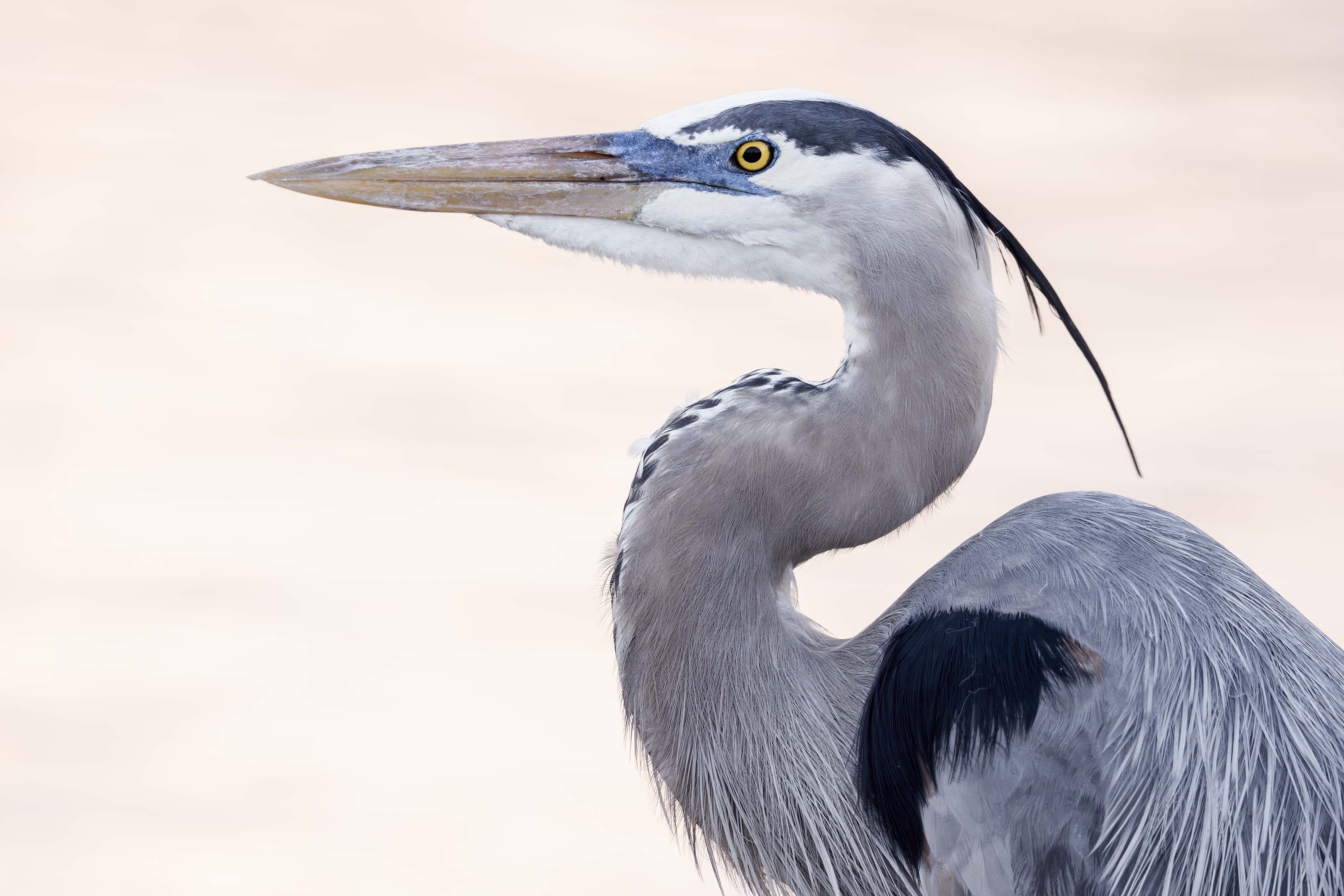
This image was created by yours truly on 8 March 2026 on a Stick Marsh AirBnB IPT. Crouching a bit, I used the slightly lowered Wide/AF-C with Bird-Eye/Face Detection performed perfectly. Click on the image to enjoy the larger, inexplicably sharper high-res version. Image #1: Great Blue Heron in low light — processed naturally |
Processing the Raw File Straight Up
The first step in the image optimization was to warm up the image using the Color Temperature slider. After adjusting the sliders on the Light and the Effects tabs in Adobe Camera Raw and running Denoise, I created a Select Subject Mask, lightened the bird, and added a touch of Dehaze to bring up the feather detail. Then I painted a mask of the skin around the bird’s eyes to juice up the blue lores. Once the image was brought into Photoshop, I did just a bit of bill cleanup before saving my master file as a .TIF and then created a 3200px wide JPEG for the blog.
The result was a very natural portrait that very much reflected what we saw in the field. I love the perfect head angle, the soft light, the bit of almost pinkish tones in the water, and most of all, that the breeding plume was raised by the wind.
|
|
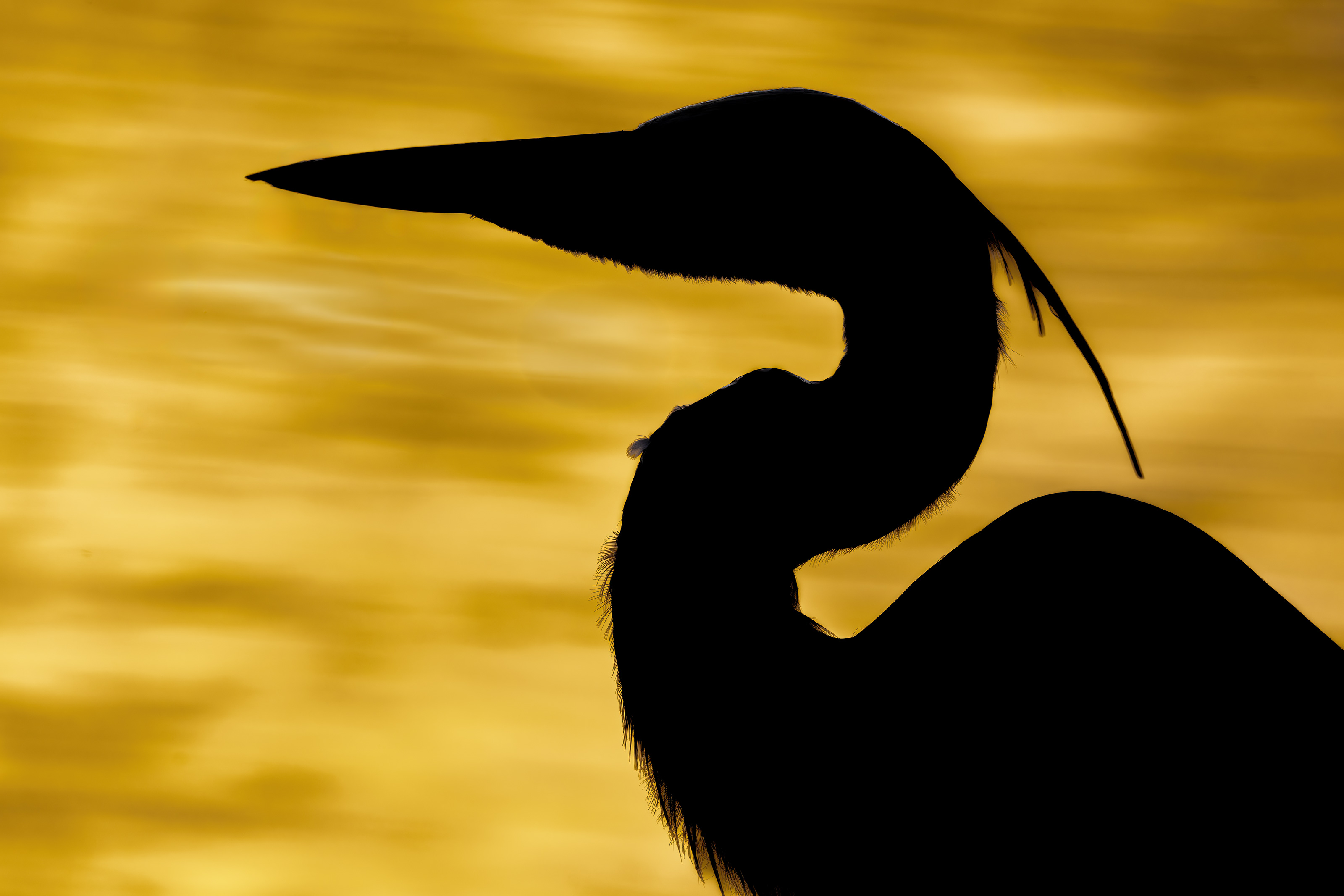
This image was created by yours truly on 8 March 2026 on a Stick Marsh AirBnB IPT from the same raw file as Image #1. Image #1A: Great Blue Heron in low light — processed as a silhouette |
Going for the Gold
We had visited Sebastian Inlet twice in the afternoon before trying Stick Marsh near the end of the first IPT. Each time the sun was fighting to break through the clouds and the wind was from the east, perfect conditions for creating silhouettes. Though the color in the water was faint, I urged the group members to position themselves with their subject lined up just to the left or right of the well-muted sun — there were lots of birds on our first afternoon. When I explained that the properly exposed washed out raw files could be processed to create richly colored black and gold silhouettes, they looked at me as if I were from another planet. The next afternoon, we created a screen capture video detailing the processing a single image from each participant in which I spun gold as I turned their drab images into colorful silhouettes. You will see some of those golden creations soon in a new YouTube Before and After video.
All of the Camtasia videos created on an IPT are shared with the group as .MP4 files before they depart for home. And everyone gets a copy of the master .TIF files that I created from their raw files during our Image Review/Photoshop sessions.
For Image #2, I created an ACR mask of the background to boost the golden tones. Working on the same mask, I used the Dehaze slider to bring up some swirly details in the water.
Great News
When the YouTube Before and After video is published, we will be offering a money-saving package deal combining the DB II PDF with both the DB III and the DB IV Video Series.
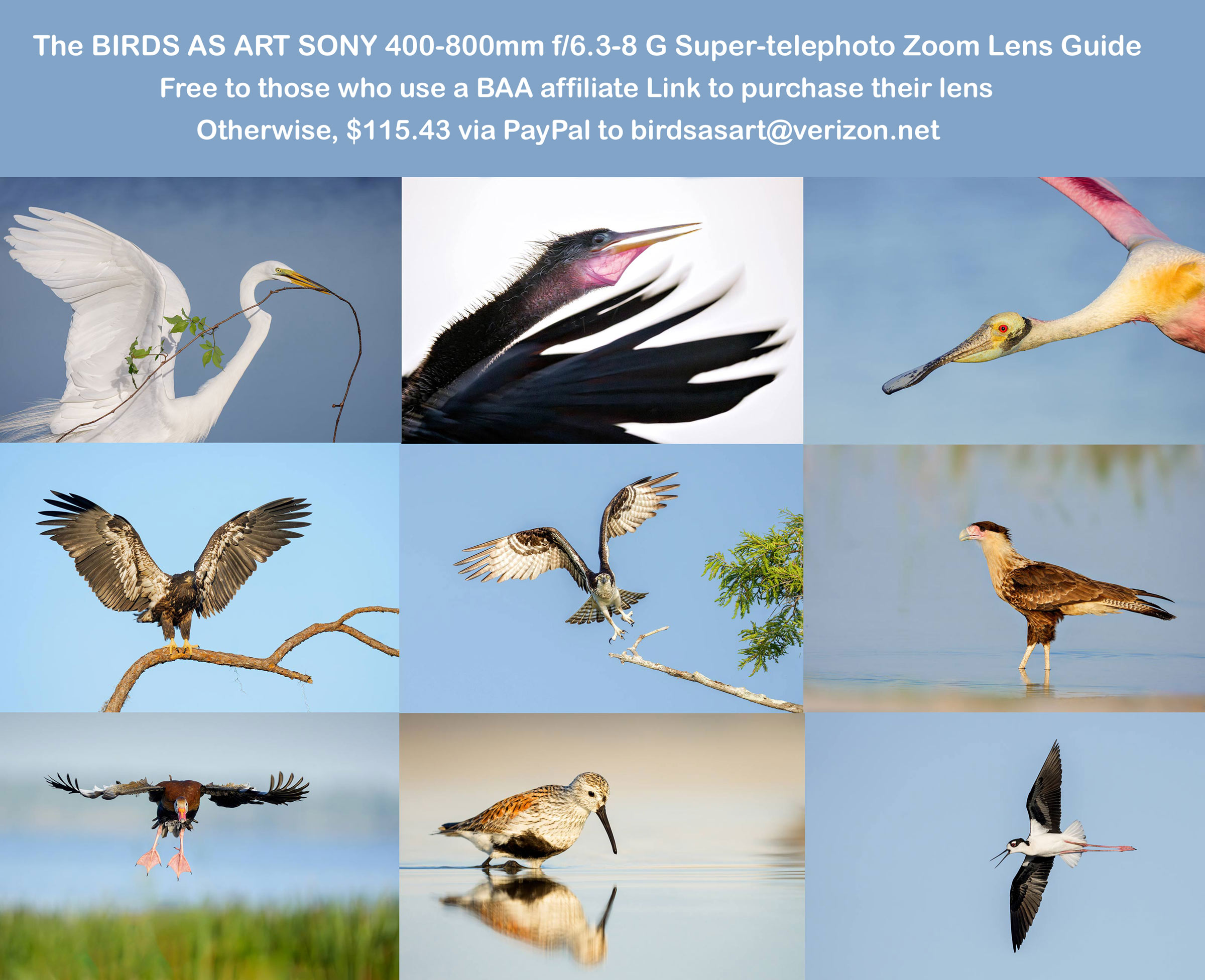
The BIRDS AS ART SONY 400-800mm f/6.3-8 G Super-telephoto Zoom Lens Guide
When I borrowed this lens from Sony, I assumed that at 5.45 pounds it was too heavy to handhold for long and that at f/8 at the long end (800mm,) it was too slow for most bird photography applications. In short, I did not want to like the lens. After a month of using it, I cannot live without it. After returning the loaner, I was miraculously able to get my own from Bedfords on 16 April 2025. In this guide I share everything that I have learned about using the 400-800. For best results, you need to know exactly what you are doing to get the most out of this zoom lens. It would be best, therefore, to consider and study the material in the guide so that you can begin making great images with your new lens.
You will learn how to deal with the relatively show apertures: f/6.3, f/7.1, and f/8 when working in Manual mode.
You will learn how to ensure that you are working at the widest aperture by working in Shutter Priority mode with AUTO ISO.
If you are able to hand hold the lens, you will learn proper hand holding techniques.
If you can’t, you will learn when, why, and how to employ other options. Those include:
1- The knee-pod, heel-pod, and toe-pod techniques
2- Using the lens on a monopod.
3- The best lens plate and low foot for your 4-8.
4- The best tripod and head for the 4-8 and how best to utilize them.
5- How to use the lens from your vehicle while supporting it on a BLUBB (or not and why not).
6- Detailed instructions on how to set and use the lens controls and buttons:
a- AF/MF
b- DMF Switch
c- Limit Range Switch
d- OSS (Optical Steady Shot) Switch
e- OSS Mode Switch
f- Focus Hold Buttons
The guide also includes a Hand Holding Shutter Speed Primer and an illustrative, educational, and inspiring 67-image gallery.
This guide is free to folks who use one of my two affiliate links to purchase their Sony 400-800 G lens. Otherwise, please send a PayPal for $115.43 to birdsasart@verizon.net and include the words “400-800 Lens Guide” in your e-mail.
Typos
With all blog posts, feel free to e-mail or to leave a comment regarding any typos or errors.






Leave a Reply