
Your Call
Which two of today’s six featured images most impress you? Please be so kind to let us know why you made your choices.
In the last blog post, Bob Eastman’s cropped shot of the caracara on top of the vulture was the pick of the litter. Rightly so. And I concur.
Summary
Florida is supposed to be the Sunshine State, but you would not come to that conclusion based on the rainy weather that has predominated for well over a month. As a result, I have not been using the small, featherweight Sony FE 600mm f/6.3 GM OSS Lens (Sony E) as much as I would have had the skies been clear and blue.
There are many myths about this great new lens online. In today’s blog post, I offer real-world examples to dispel them.
Though hundreds of folks used one of my affiliate links to purchase their Sony a9, a9 II, and a9 III bodies — along with 153 who purchased their a-1s and 53 who purchased their a-1 II mirrorless cameras — only six folks have purchased the totally amazing 600mm f/6.3. Hard to believe.
Anyhoo, the new 600mm GM (G Master) lens is an amazing game-changer. Keep reading to learn why. And if today’s post has you thinking, it would behoove you to check out the images (some made with the 1.4x TC) in The Extraordinary Featherweight Sony Super-Telephoto Lens blog post here.
If you decide to purchase a copy, please use one of my two affiliate links to earn a free copy of the BAA 600mm f/6.3 Lens Guide. My tips on dealing with temporary AF blindness with this lens are easily worth the price of admission. If you are at all confused about using a BAA affiliate link, please shoot me an e-mail. I can often help you save some money.
Gemini
General information, copy editing, re-crafting, technical refinement, and formatting for segments of this blog post were assisted by Gemini AI.
What’s Up?
Bob and I saw the sun for an hour late on Sunday afternoon, but alas, there was no sunset color — at least none that did us any good. Other than that, it has been dark and overcast with winds out of the WNW. 🙁 Not to mention that, aside from the South Peninsula, the fields are far too soft and wet to even think about driving on them. Still, we get out every morning and have been enjoying a steady diet of vultures, cranes, and Great Egrets, along with small servings of Black-bellied Whistling-Ducks. The ducks have included a good number of juveniles, feeding by the dozen on the lawns of houses facing the lake.
Today is Tuesday 24 November 2026. The forecast is calling for mostly cloudy early with a breeze from the north switching to the NE before 9:00am. We will of course be headed down to the lake early in part to keep my morning photography streak going –I have photographed every am since returning from Nickerson Beach on 13 September of this year. Whatever you opt to do today, we hope you choose to have fun and enjoy life. Please remember that happiness is a choice — Byron Katie – The Work.Com
If an item — a Delkin flash card or reader, a Levered-clamp FlexShooter Pro, or a Wimberley lens plate or low foot — for example, that is available from B&H and/or Bedfords, is also available in the BAA Online Store, it would be great, and greatly appreciated, if you would opt to purchase from us. We will match or beat any price. Please remember also to use my B&H affiliate links or to earn 3% cash back at Bedford by using the BIRDSASART discount code at checkout for your major gear purchases. Doing either often earns you free guides and/or discounts. And always earns my great appreciation.
Gear Questions and Advice
Too many folks attending BAA IPTs and dozens of photographers whom I see in the field and on BirdPhotographer’s.Net, are — out of ignorance — using the wrong gear, especially when it comes to tripods and more especially, tripod heads. And the same is true in spades when ordering new camera bodies or lenses. My advice will often save you some serious money and may help you avoid making a seriously bad choice. Please know that I am always glad to answer your gear questions via e-mail. If you are desperate, you can try me on my cell at 863-221-2372. Please leave a message and shoot me a text if I do not pick up.
|
|
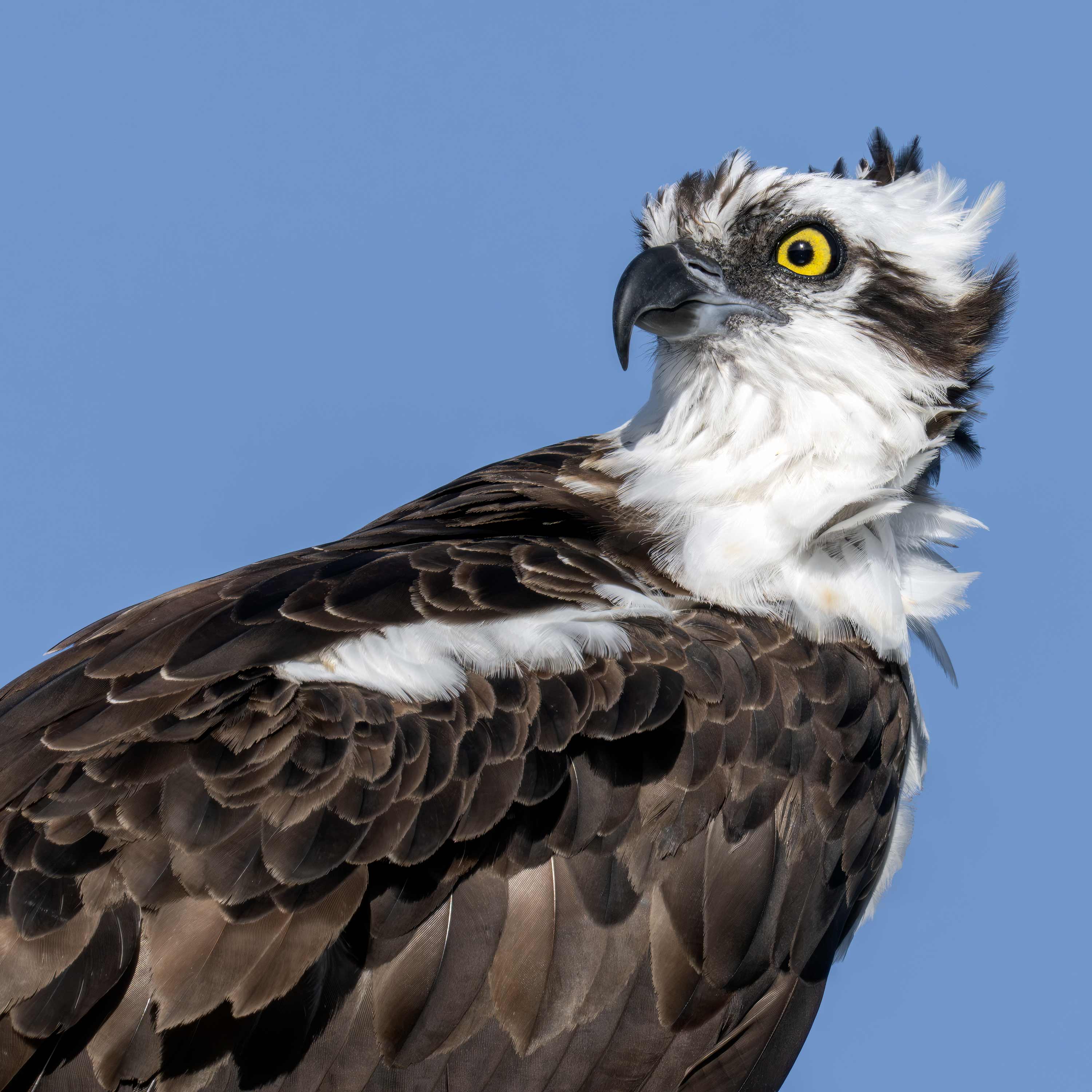
This image was created on 24 October 2026 down by the lake near my home at Indian Lake Estates, FL. Seated in the driver’s seat of my SUV (!), I used the handheld Sony FE 600mm f/6.3 GM OSS Lens (Sony E) with the Sony FE 2x Teleconverter and the alleged poor man’s a-1 ii, the Sony a7R VI Mirrorless Camera (in APS-C crop mode — effective focal length = 1800mm!). The exposure was determined by Zebras with ISO on the rear wheel. ISO 1600: 1/800 sec. at f/18 (stopped down one-stop) in Manual mode. AWB at 7:59:42am on a partly sunny morning. Wide/AF-C with Bird-Eye/Face Detection performed perfectly. Click on the image to enjoy the larger high-res version. Image #1: Osprey head portrait |
The Not-Feasible 2X TC Myth
Pretty much anybody with a reasonable knowledge of bird photography would tell you that adding a 2X teleconverter to a relatively slow lens is just plain stupid and that the resulting images would never be sharp at the pixel level. Fortunately, I was dumb enough to try it.
RAW File Offer
If you would like to examine the RAW files, click here, and I will shoot you a link.
The Perspective
Believe it or not, this bird was sitting atop a telephone pole about 30 feet up, and I was sitting in my X5 pointing the lens up at about 35°, resulting in a relatively steep angle of inclination. I have no idea why it looks almost as if I had been at the bird’s eye level.
Curious
Loving clean, tight, and graphic images, one of the first things I did after getting the featherweight 600 was slap a 2X TC in place and see what was possible — just because. I was as astounded by the quality of the images made at 1200mm as I was by the ridiculously light weight and small size of the Sony FE 600mm f/6.3 GM lens.
The North Wind Helped
The wind has been blowing from somewhere out of the north almost every day for more than a month. Being past the fall equinox, with the sun rising south of east, a north wind is less than ideal on clear mornings. For this image, however, it proved to be a blessing: when the Osprey looked toward the south, the north wind ruffled the feathers on the raptor’s head.
|
|
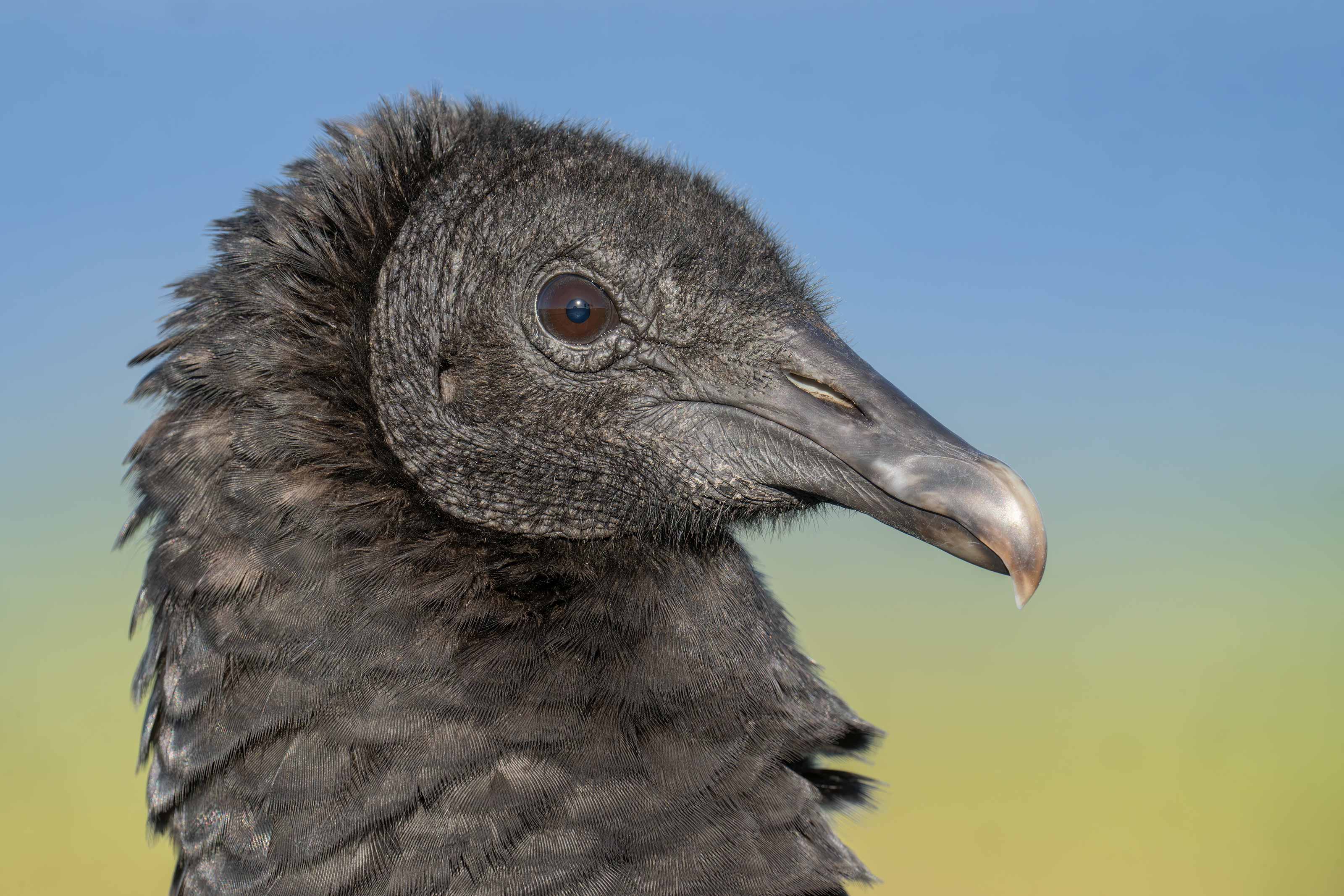
This image was created on 26 October 2026 down by the lake near my home at Indian Lake Estates, FL. Crouching a bit on the pier to move the background farther from the subject, I used the handheld Sony FE 600mm f/6.3 GM OSS Lens (Sony E) with the Sony FE 2x Teleconverter and The Latest Greatest Sony Flagship Body, the a-1 II Mirrorless Camera. The exposure was determined by Zebras with ISO on the rear wheel. ISO 2500: 1/500 sec. at f/16 (stopped down 2/3-stop) in Manual mode. AWB at 7:59:42am on a partly sunny morning. Wide/AF-C with Bird-Eye/Face Detection performed perfectly. Click on the image to enjoy the larger high-res version. Image #2: Black Vulture head portrait |
The Featherweight 600 for Pier Walks
Tipping the scales at just a shade over two pounds, the 600mm f/6.3 weighs about 1 1/4 pounds less than the 300mm f/2.8 GM and is two pounds lighter than the 100-400mm f/4.5 GM. Astoundingly, it weighs nearly 3 3/4 pounds less than my favorite pier-walking lens, the 400-800 G. Heading out on the pier with the 600mm f/6.3 makes it feel as if I am walking empty-handed.
The Bokeh Myth
Many folks believe — and espouse, that with its relatively small maximum aperture of f/6.3, unwanted background detail will usually be a problem when compared to images made at f/2.8 or f/4. As I have been saying for decades, the distance from the subject to the background is of far greater importance. How else could you explain the butter-smooth background of Image #2, made at f/16? Note also that at a given focal length, the closer you get to the subject, the smoother and more out-of-focus your backgrounds will be. For this image, both of those principles applied — I was point-blank to the bird, and the distance to the background was nearly 50 yards.
|
|
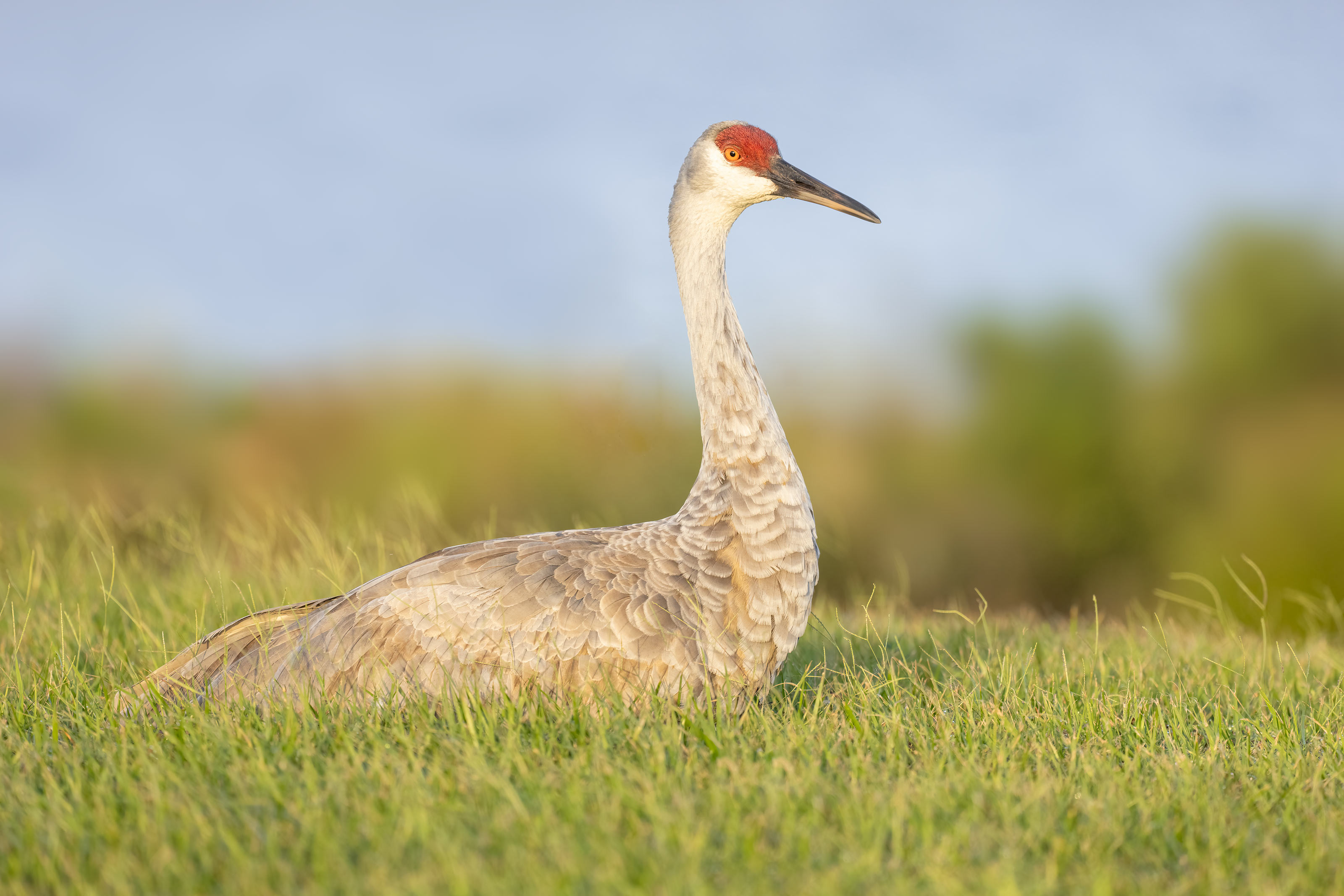
This image was created on 26 October 2026 down by the lake near my home at Indian Lake Estates, FL. Seated on the hill north of the parking circle, I used the handheld BLUBB-supported Sony FE 600mm f/6.3 GM OSS Lens (Sony E) and the alleged poor man’s a-1 ii, the Sony a7R VI Mirrorless Camera. The exposure was determined by Zebras with ISO on the rear wheel. ISO 1000: 1/500 sec. at f/6.3 (wide open) in Manual mode. AWB at 7:57:17am on a mostly sunny morning. Wide/AF-C with Bird-Eye/Face Detection performed perfectly. Click on the image to enjoy the larger high-res version. Image #3: Sandhill Crane adult (“Stumpy”) resting |
Ease of Mobility, Maneuverability, and Handling
It is 100% obvious that working with the featherweight 600mm f/6.3 lens allows you to be extremely mobile — heck, the lens is tiny and barely weighs anything. And you are far more maneuverable with a compact handheld lens than you are with a tripod-mounted behemoth like a 600mm f/4. The ease of handling the 600mm f/6.3 is unmatched — bringing the lens to your eye, fine-tuning your framing, and panning while tracking action or a bird in flight are all effortless.
Positioned on the side of the small hill — and trying to frame Stumpy’s head against the blue water of the lake while balancing the taller vegetation on the right side of the frame — working with the featherweight 600mm f/6.3 made a difficult task relatively easy. Even for an old man.
|
|
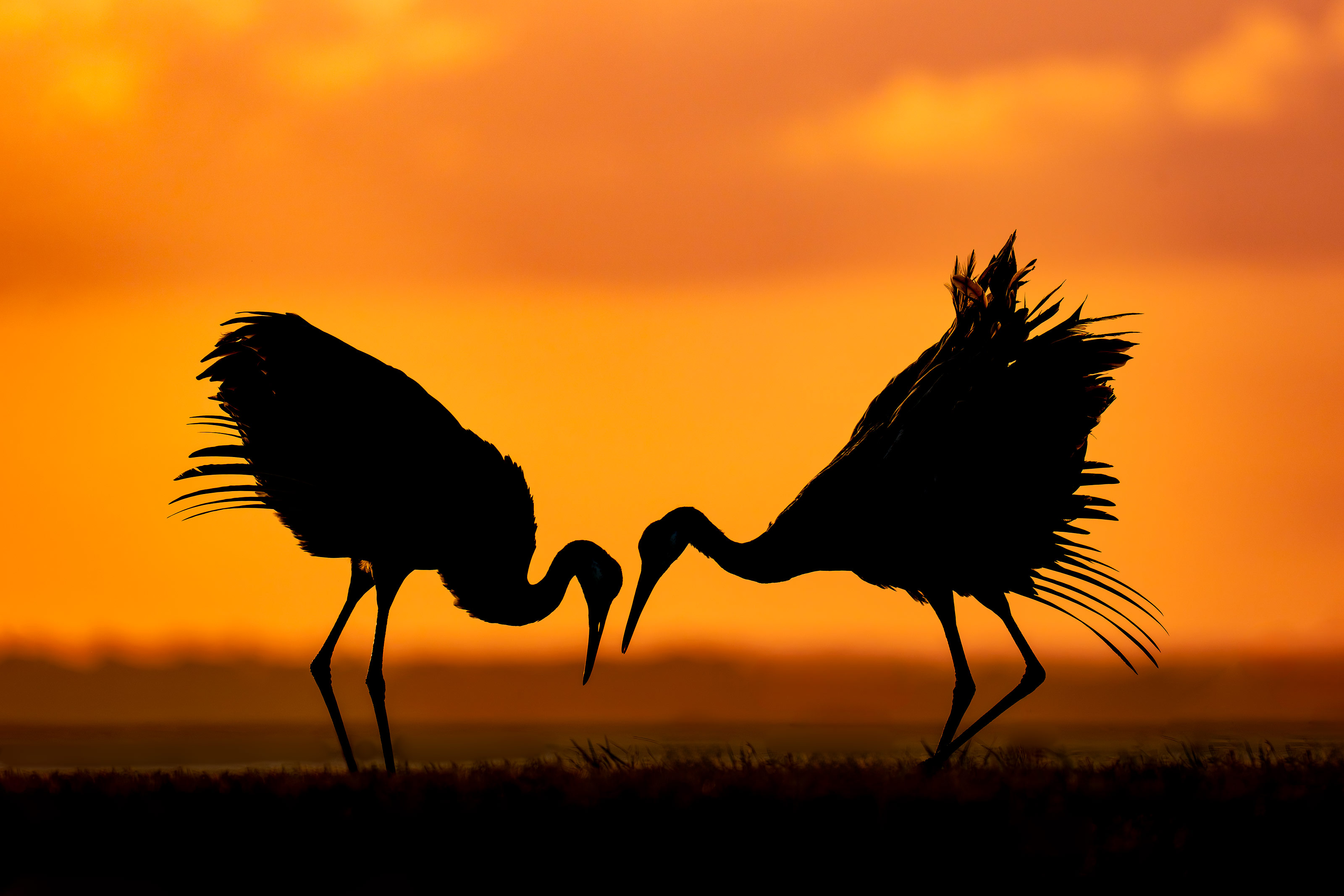
This image was also created on 29 October 2026 down by the lake near my home at Indian Lake Estates, FL. Standing at the base of the hill north of the parking circle, I used the handheld BLUBB-supported Sony FE 600mm f/6.3 GM OSS Lens (Sony E) and The Latest Greatest Sony Flagship Body, the a-1 II Mirrorless Camera. The exposure was determined by Zebras with ISO on the rear wheel. ISO 1250: 1/3200 sec. at f/6.3 (wide open) in Manual mode. AWB at 6:27:47pm right at sunset. Wide/AF-C with Bird-Eye/Face Detection performed perfectly. Click on the image to enjoy the larger high-res version. Image #4: Sandhill Crane sunset courtship dance |
Human Zooming Part I
When I first heard the phrase “human zoomin’,” I didn’t get it. But when you are working with a fixed-focal-length lens (rather than a zoom lens), you control the size of the bird in the frame by either moving closer to the subject or backing farther away. For Image #4, I stayed well back at the bottom of the hill. Even so, I still wound up clipping a few wings.
Sony Lens Choice
Which of these three lenses might be best for you — the Sony 400mm f/4.5 GM, the 600mm f/6.3, or the 100-400mm f/4.5 GM? The first consideration is whether you want the small size and light weight of one of the two new featherweight primes or the versatility of the heavier, constant-aperture zoom. Choosing between the 400mm f/4.5 and the 600mm f/6.3 depends a lot on where you live and what you are photographing. For decades, I have been saying and writing that given the choice, it is almost always best to choose a longer, slower lens like the 600mm f/6.3 over a shorter, faster one like the 400mm f/4.5. Thus, I never considered the 400mm f/4.5.
I am blessed to own both the 100-400mm f/4.5 and the 600mm f/6.3, at times choosing between the two depending on wind direction and sky conditions.

|
|
This image was created on 29 October 2026 down by the lake near my home at Indian Lake Estates, FL. Crouching on the hill north of the parking circle, I used the handheld BLUBB-supported Sony FE 600mm f/6.3 GM OSS Lens (Sony E) and The Latest Greatest Sony Flagship Body, the a-1 II Mirrorless Camera. The exposure was determined by Zebras with Exposure Compensation (EC) on the Thumb Dial. Multi Metering -0.3 stops. AUTO ISO set ISO 800: 1/3200 second at f/6.3 (wide open) in Shutter Priority mode. AWB at 6:36:21pm right at sunset. Wide/AF-C with Bird-Eye/Face Detection performed perfectly. Click on the image to enjoy the larger high-res version. Image #5: Sandhill Crane preening at sunset |
Human Zooming Part II
Same hill. Same situation. Same sunset. And one of the two birds in Image #5. Only this time I approached the bird to within ten feet or so and — working in vertical format off the tilted rear monitor, held my rig low enough to include a dark strip at the bottom of the frame.
600mm f/6.3 Close Focus. And More …
With its amazing Minimum Focusing Distance (MFD) of only 8.2 feet, the featherweight 600mm f/6.3 — weighing just a bit more than two pounds and costing $3,698.00 — slays the Sony 600mm f/4 GM lens, which focuses down only to 14.8 feet and weighs 6.7 pounds (yours for $14,098.00!). Both are incredibly sharp lenses — much sharper than most photographers. Please do not get me wrong — I hope to be using my 600mm f/4 successfully at least until age 95.
Comparing the Sony 600mm f/6.3 lens with the NIKKOR Z 600mm f/6.3 VR S lens reveals that the Nikon version weighs about one pound more, focuses only to an embarrassing 13.1 feet, and lists for $5,196.95. And don’t forget that the vaunted Nikon Z9 weighs a colossal three pounds — more than twice as much as the Sony a1 II. Speaking of Nikon, here are my thoughts: Ridiculously heavy. Pre-capture only with JPEGs. No Zebra technology, but for an unsupported hack. I don’t understand anyone using Nikon gear for bird photography.
Note: Canon currently does not offer any small, lightweight, fixed-focal-length super-telephoto lenses at all. And their telephoto zooms are all horrific for one reason or another.
|
|
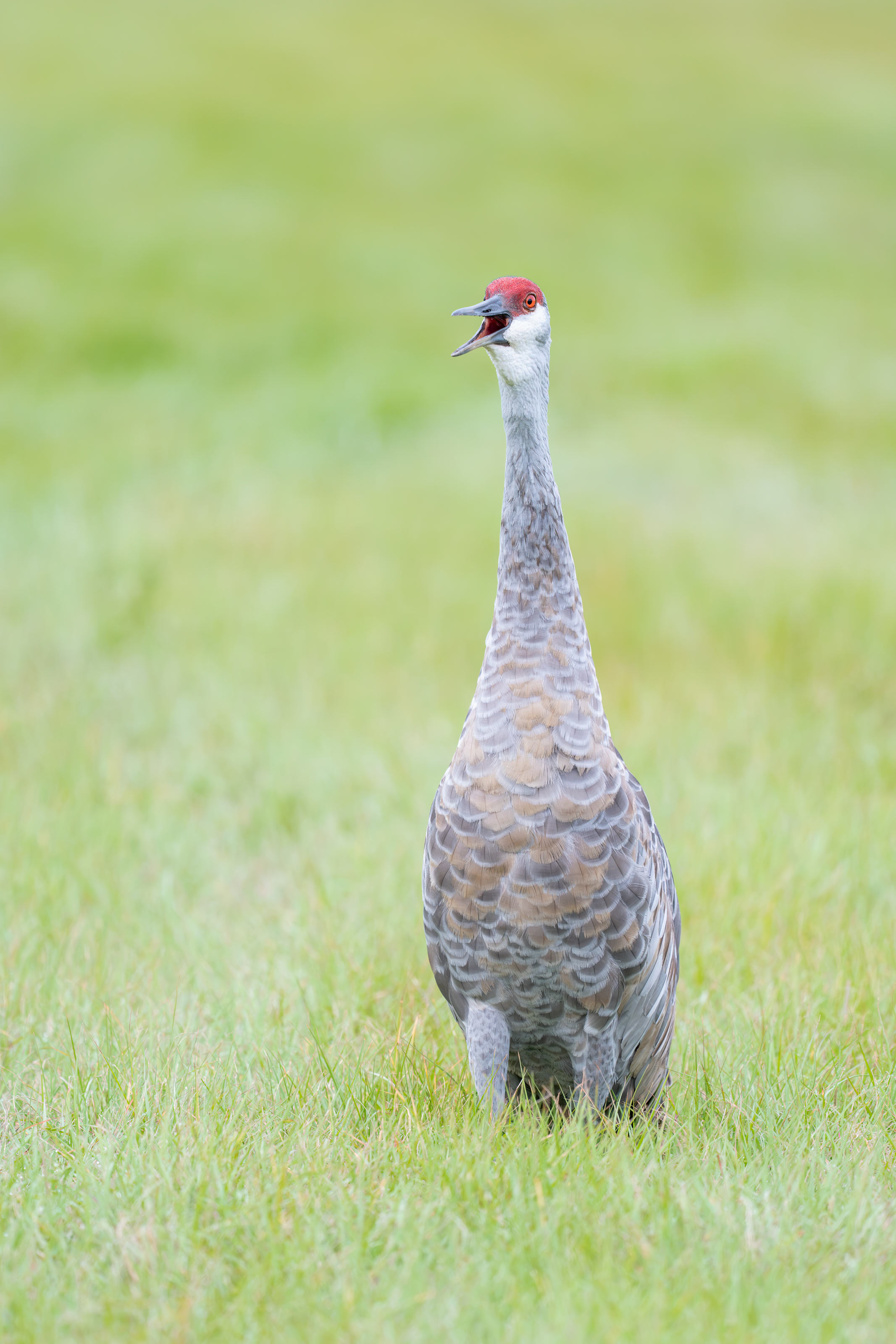
This image was created on 1 November 2026 down by the lake near my home at Indian Lake Estates, FL. Working from the driver’s seat of my SUV I used the BLUBB-supported Sony FE 600mm f/6.3 GM OSS Lens (Sony E) and The Latest Greatest Sony Flagship Body, the a-1 II Mirrorless Camera. The exposure was determined by Zebras with ISO on the rear wheel. ISO 2500: 1/250 sec. at f/6.3 (wide open) in Manual mode. AWB at 8:37:33 am on a cloudy morning. Wide/AF-C with Bird-Eye/Face Detection performed perfectly. Click on the image to enjoy the larger high-res version. Image #6: Sandhill Crane adult resting on haunches |
Another Myth Busted
The word on the street is that relatively slow lenses are worthless in low-light conditions such as those encountered on cloudy days. With its superb Optical SteadyShot (OSS) and in-body image stabilization (IBIS), handholding at relatively slow shutter speeds in low light is eminently doable. And the better your sharpness techniques, the more you can avoid crazy-high ISOs. My preference is to stay at or below ISO 2500 except when I need to go higher —even much higher, to create a sharp image; it is much easier to deal with high-ISO noise than it is to deal with unsharp RAW files.
World’s Greatest Frying Pan
I purchased an Our Place 8.5″ Nonstick Titanium Frying Pan about six months ago and use it pretty much every day when I am home. It is great for bacon and eggs (the perfect keto breakfast), salmon croquettes, sautéing onions, and searing thin slices of beef liver, and it is large enough for three burgers. The coating-free titanium surface stays nonstick for years and can safely be used with metal utensils — no scratches or peeling to worry about. Order yours by clicking here or on the logo link above. To support the blog you can click on the link and then scroll down to check out related products including pots and pans sets.
Typos
With all blog posts, feel free to e-mail or to leave a comment regarding any typos or errors.










Image #4 of the courtship at sunset is a stunner and my favorite by far! I love the feather separation in the silhouette and the gradations of orange colors in the image. Excellent.
I’m impressed that the osprey image #1 has the feather detail that it does with the wind, slower shutter speed (at1800mm effective focal length) while handheld. Well done!