
Your Call?
Which two of today’s seven (not eight) featured images are the strongest? Why did you make your choices?
What’s Up?
On our Wednesday morning scouting session at La Jolla, Bob Eastman and I were blessed early on with cloudy bright skies followed by sun. And lots and lots of photogenic and photographable Brown Pelicans. Bob and I picked up Kevin Hice and Colleen at the airport just before noon. And Nora Kane and Doug got to the AirBnb at about 1:00pm. The new arrivals spent the rest of their day setting up their rooms. I helped Nora set up her brand new a-1 ii and taught her to use it in the usual five minutes. Then the six of us headed to Beaumont for a great dinner.
Early on Thursday the group headed back to La Jolla. The weather was far different from the previous day: cold with a brisk wind from the northwest as a cold front passed. Again it was cloudy early, so we worked the cormorants on the shelf and created some photos similar to Image #1 below. Next we walked
down the steps to the beach at the swim cove and worked the California Sealions. I introduced the group to the nesting Brandt’s Cormorants and then Kevin alerted us to a male Allen’s Hummingbird so we walked up the hill and stayed with that bird for a good half hour before heading back to the AirBnB for brunch and image review. We ended our day with a short duck session at Santee Lakes where there were dozens of drake ring-necks and more than a few Cinnamon Teal (among others). Dinner at the AirBnB was a huge salad and platters full of lightly fried flounder. Junior’s Fish Market in Lake Wales closed last year when Mike sold the building. He continues, however, to meet us at Walmart in Lake Wales and deliver us fresh fish to order. Before the trip, I froze three pounds of flounder and put it in one of my two checked bags. As the cargo holds are unheated the fish arrived in San Diego still frozen solid! And was enjoyed by all.
We were back at La Jolla on Friday and did much better with the pelicans with a nice wind from the NE. With a strong east wind in the afternoon, duck flight photography was impossible but we all made some nice images of the ring-neckeds and a molting Rudy Ducks with a bright blue bill. And there were some American Wigeons around as well.
Today is Saturday 10 January 2026. The photographers in the group will be heading back early to La Jolla. Nora Kane’s photography has improved by leaps and bounds in just two days. We have set her up with Photo Mechanic and she has been confidently picking her keepers and deleting the Untagged! She arrived with a brand new a-1 ii and has been making great images during each session. On Thursday morning she made a wonderful image of a male Allen’s Hummingbird. That afternoon she made the best flight shot of a duck; her hen Ring-necked Duck image was created with the 200-600. And on Saturday morning, she created the single best pelican flight image with her 400-800 on a tripod. She had never done birds in flight before. She is a quick study! But, she has a great teacher (he said modestly).
We will have another long day filled with photography, learning, image review, Photoshop and Lightroom, and fine food. I hope that you too choose to have a wonderful and productive day and that you have fun too. Please remember that happiness is a choice — Byron Katie, The Work.Com (and as discussed in yesterday’s blog post).
If an item — a Delkin flash card or reader, a Levered-clamp FlexShooter Pro, or a Wimberley lens plate or low foot — for example, that is available from B&H and/or Bedfords, is also available in the BAA Online Store, it would be great, and greatly appreciated, if you would opt to purchase from us. We will match or beat any price. Please remember also to use my B&H affiliate links or to earn 3% cash back at Bedford by using the BIRDSASART discount code at checkout for your major gear purchases. Doing either often earns you free guides and/or discounts. And always earns my great appreciation.
Gear Questions and Advice
Too many folks attending BAA IPTs and dozens of photographers whom I see in the field and on BirdPhotographer’s.Net, are — out of ignorance — using the wrong gear, especially when it comes to tripods and more especially, tripod heads. And the same is true in spades when ordering new camera bodies or lenses. My advice will often save you some serious money and may help you avoid making a seriously bad choice. Please know that I am always glad to answer your gear questions via e-mail.. If you are desperate, you can try me on my cell at 863-221-2372. Please leave a message and shoot me a text if I do not pick up.
B&H Simplified
To ensure that I get credit for your B&H purchases, you can always click here. The tracking is invisible but using my affiliate links is greatly appreciated. And, with B&H, you can use your PayBoo card. You must use the website to order. You cannot get your free guides if you make a phone order. Once you have an item in your cart, you must complete the order within two hours. Huge thanks!
B&H
Many folks have written recently stating that they purchased a Sony a1 from B&H and would like their free membership in the Sony 1 Info and Updates Group, a $150.00 value. But when I check my affiliate account, their orders have not been there. When I let them know that they get credit for B&H purchases only if they use one of the many B&H affiliate links on the blog or begin their searches with this link, they are always disappointed. If in doubt, please contact me via e-mail and request a BH link. I am always glad to help and to guide you to the right gear.

Bedfords Simplified
Click here to start your search. Choose standard shipping, and when you get to the payment page, enter BIRDSASART in the discount code box and hit apply. You will be upgraded to free second day air Fed-Ex and receive 3% cash back on your credit card once your stuff ships. Using either my affiliate links is greatly appreciated and will often earn you free guides or discounts. To receive a free guide or free entry into a Sony Set-up and Info Notes e-Mail group, you need to shoot me your receipt via e-mail. The B&H receipts need to include the order number.
Bedfords Amazing BAA Discount Policy
Folks who have fallen in love with Bedfords can always use the BIRDSASART coupon code at checkout to enjoy a post-purchase, 3% off-statement credit (excluding taxes and shipping charges) on orders paid with a credit card. The 3% credit will be refunded to the card you used for your purchase when your product ships. Be sure, also, to check the box for free shipping to enjoy free Second Day Air Fed-Ex. This offer does not apply to purchases of Classes, Gift Cards, or prior purchases.
You can visit the Bedfords website here, shoot Steve Elkins an e-mail, or text him on his cell phone at (479) 381-2592.
|
|
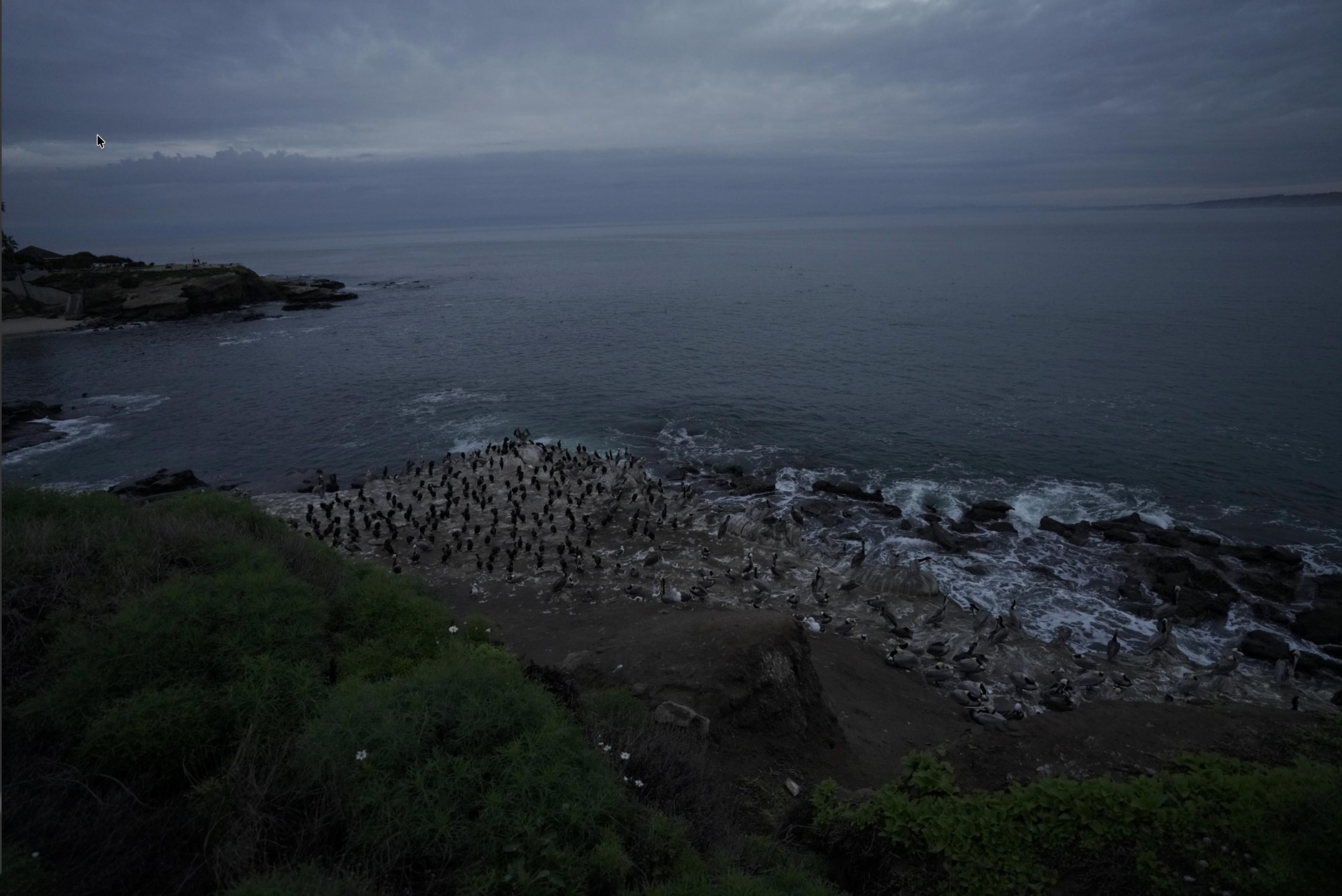
This image was created on 7 January 2026 by my dear friend, Robert Eastman at La Jolla, CA. Standing at full height, He used the hand held Sony FE 16-35mm f/2.8 GM II Lens (Sony E) at 18mm and the Sony A7 R IV, now replaced by the Sony a7R IVA Mirrorless Camera. The exposure was set to avoid burning out the sky (but was overdone). ISO 2500: 1/500 second at f/2.8 (wide open) in Manual mode. AWB at 6:45:54am in the pre-dawn on what began as a cloudy morning. Click on the image to enjoy the larger, inexplicably sharper high-res version. Image #1: the lower cliffs — the original |
Keep or Delete?
After a quick look at this under-exposed raw file and before scrolling down, would you have kept this image or deleted it? Why? Bob’s plan was to underexpose to hold back the sky. RawDigger tells me that he could have added at least a stop more of light without getting in any trouble. Anyhoo, I looked carefully at the raw file and liked the image design so I took a crack at it.
|
|
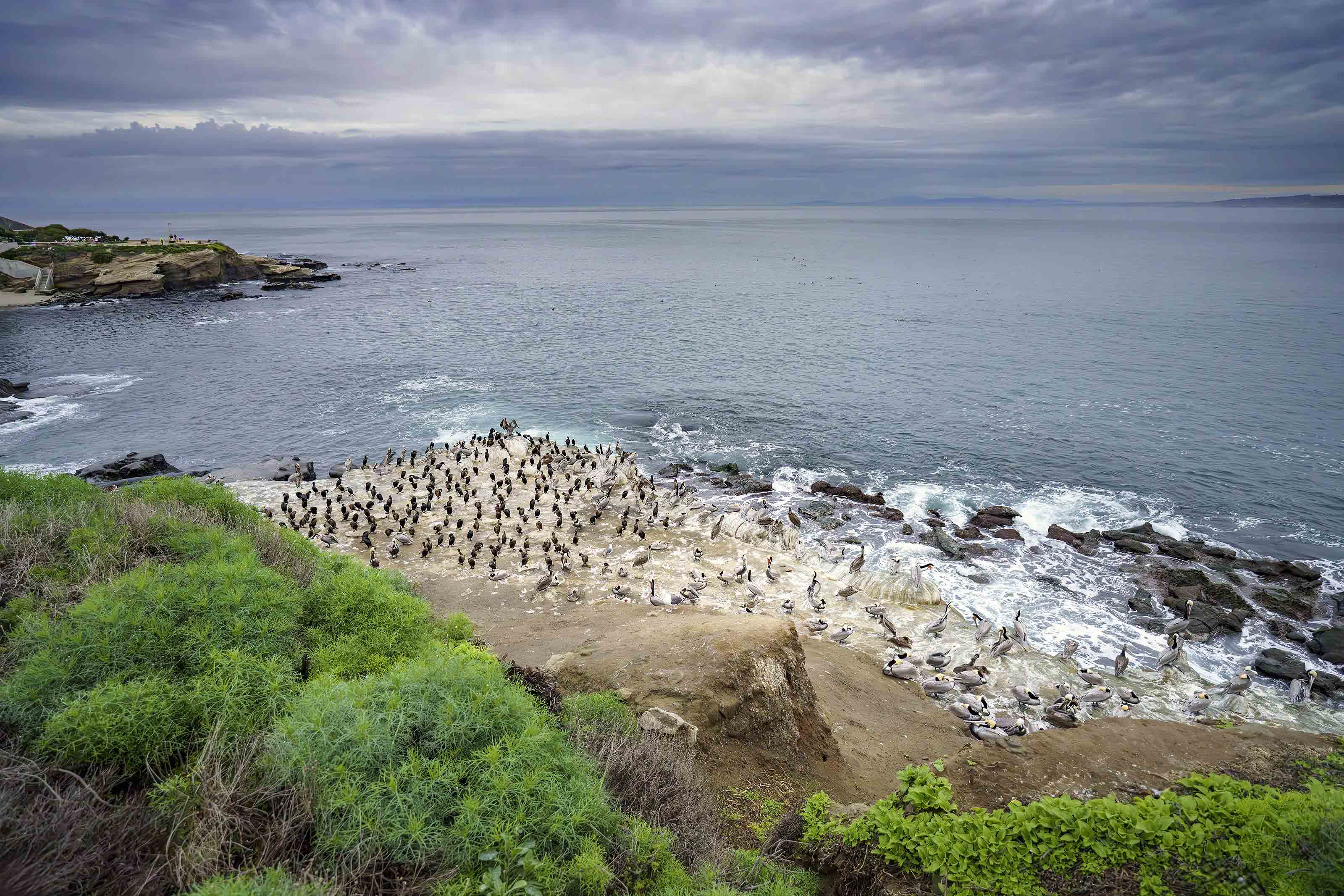
This image was created on 7 January 2026 by my dear friend, Robert Eastman at La Jolla, CA. Standing at full height, He used the hand held Sony FE 16-35mm f/2.8 GM II Lens (Sony E) at 18mm and the Sony A7 R IV, now replaced by the Sony a7R IVA Mirrorless Camera. The exposure was set to avoid burning out the sky (but was overdone). ISO 2500: 1/500 second at f/2.8 (wide open) in Manual mode. AWB at 6:45:54am in the pre-dawn on what began as a cloudy morning. Click on the image to enjoy the larger, inexplicably sharper high-res version. Image #1A: the lower cliffs/optimized |
Bob Loves His 16-35mm Wide Angle
Bob often takes a walk in the pre-dawn with his 16-35 lens and I often wonder what he is doing. The widest lens I have in San Diego is a 70-200mm. After the image was processed, I realized that a wide angle can produce some stunning images.
More ACR Masking Magic!
I used several masks to bring this image to life including both linear and radial gradients. I was so thrilled with the results that when I shared the master file with the group I got goose pimples. Learn to use Adobe Camera Raw masks in the Digital Basics IV Video Series. The complete optimization of this image will be featured in Volume V (coming soon to a theater near you).
|
|
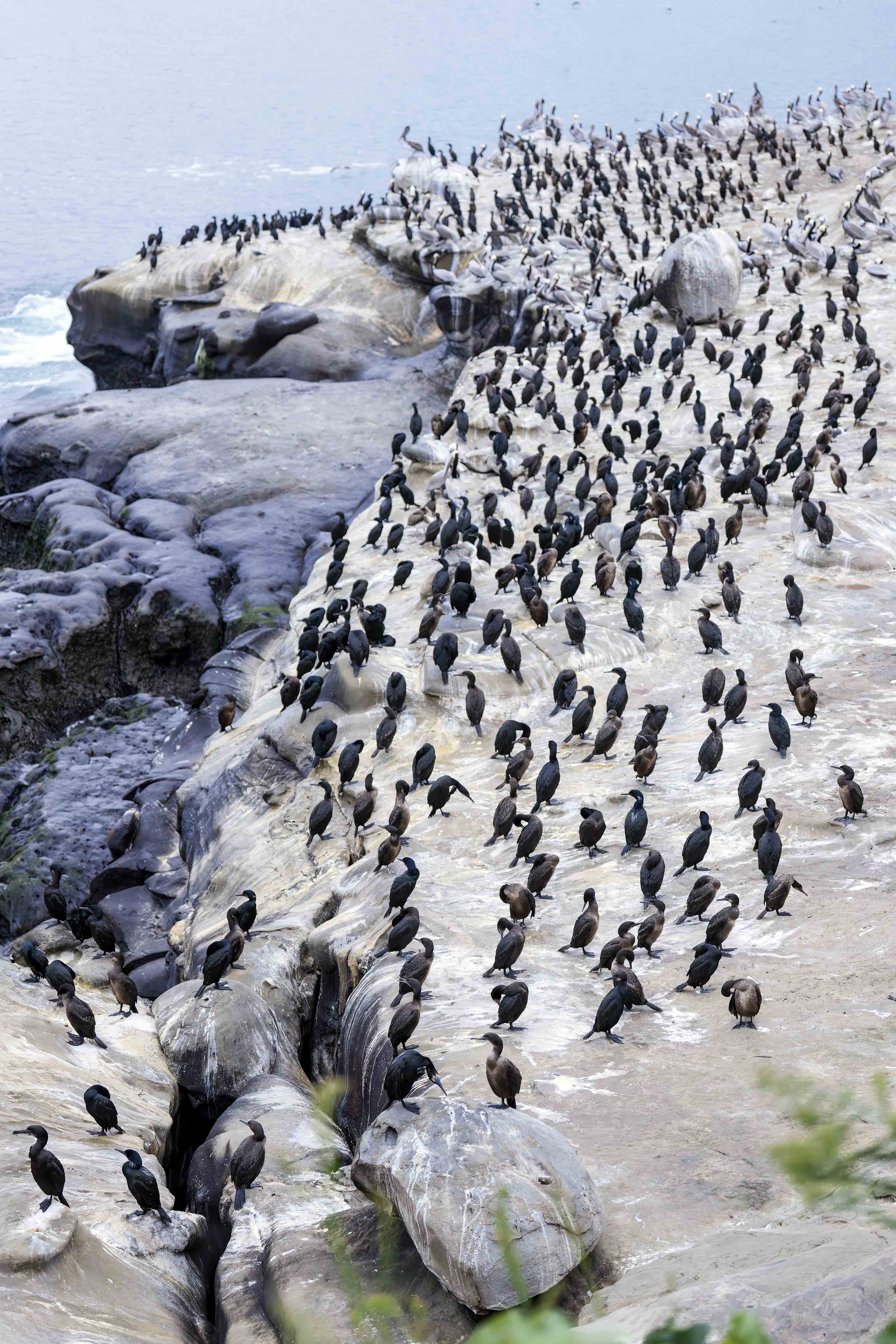
This image was created on 7 January 2026 by yours truly at La Jolla, CA. Standing at full height, I used the hand held Sony FE 70-200mm f/2.8 GM OSS II Lens (at 70mm) and The Latest Greatest Sony Flagship Body, the a1 II Mirrorless Camera. The exposure was determined by Zebras with ISO on the rear wheel — ISO 3200: 1/200 second at f/2.8 (wide open) in Manual mode. AWB at 6:55:00am on a cloudy morning. Tracking: Spot XS/AF-C with Bird-Eye/Face Detection performed perfectly. Click on the image to enjoy the larger, inexplicably sharper high-res version. Image #2: Brandt’s Cormorants (predominantly) and pelicans on rock shelf |
More Brandt’s Than Ever Before
Bob and I got to La Jolla typically early on our first San Diego morning, We grabbed a lens and decided to explore the area past the downhill sidewalk. The flat shelves there held many hundreds of birds, mostly Brandt’s Cormorants, more than I ever remember seeing there before. Along with dozens of pelicans and a smattering of gulls. I moved around a lot looking for a good angle and a great perspective. Going vertical was the obvious choice. This was my favorite image design. I love the way the swirly pattern of the birds moves the viewer’s eye from the bottom of the frame to the top.
Bird Scape Tip
When photographing a group of birds on the ground or in the water, it is pretty much mandatory to focus on the closest bird. This is generally done best by moving a single AF point to the lower part of the frame.
|
|
This image was also created on 7 January 2026 by yours truly at La Jolla, CA. Standing at full height, I used the Wide/AF-C with Bird-Eye/Face Detection performed perfectly. Click on the image to enjoy the larger, inexplicably sharper high-res version. Image #3: Brown Pelican, Pacific race adult in breeding plumage looking back |
A Big Change for BIRDS AS ART
When I flew to San Diego on Monday past it was the first time in many decades that I did not have a 600mm or 500mm f/4 super-telephoto lens in my Think Tank roller. I sent both of my big Sony lenses to be cleaned and checked. My plan is to sell the 400mm f/2.8 GM lens when I get it back. As folks saw in the recent Think Tank Packing for Air Travel YouTube video, I went with the 70-200, the 300mm f/2.8, the 200-600, and the 400-800 lenses. Though Wednesday started off cloudy, I opted for the relatively slow (f/8 at the long end) 400-800 on the tripod. Early on, as with Image #2, I went with a marginal shutter speed to get a good exposure at ISO 3200. When choosing a marginal shutter speed, you will not be able to create a sharp image if the bird moves anything more than slowly — can you say head throw? With the 4-8 on a tripod I am comfortable making sharp images at shutter speeds as slow as 1/60 second. With the larger, heavier 600mm f/4, I could have been at 1/1000 second f/4 and made sharp images of a head throw (for example). Though slower, the great focal length range and versatility of the 400-800 turned out to be perfect once things brightened up. And even in relatively low light, it can be effective on a tripod.
|
|
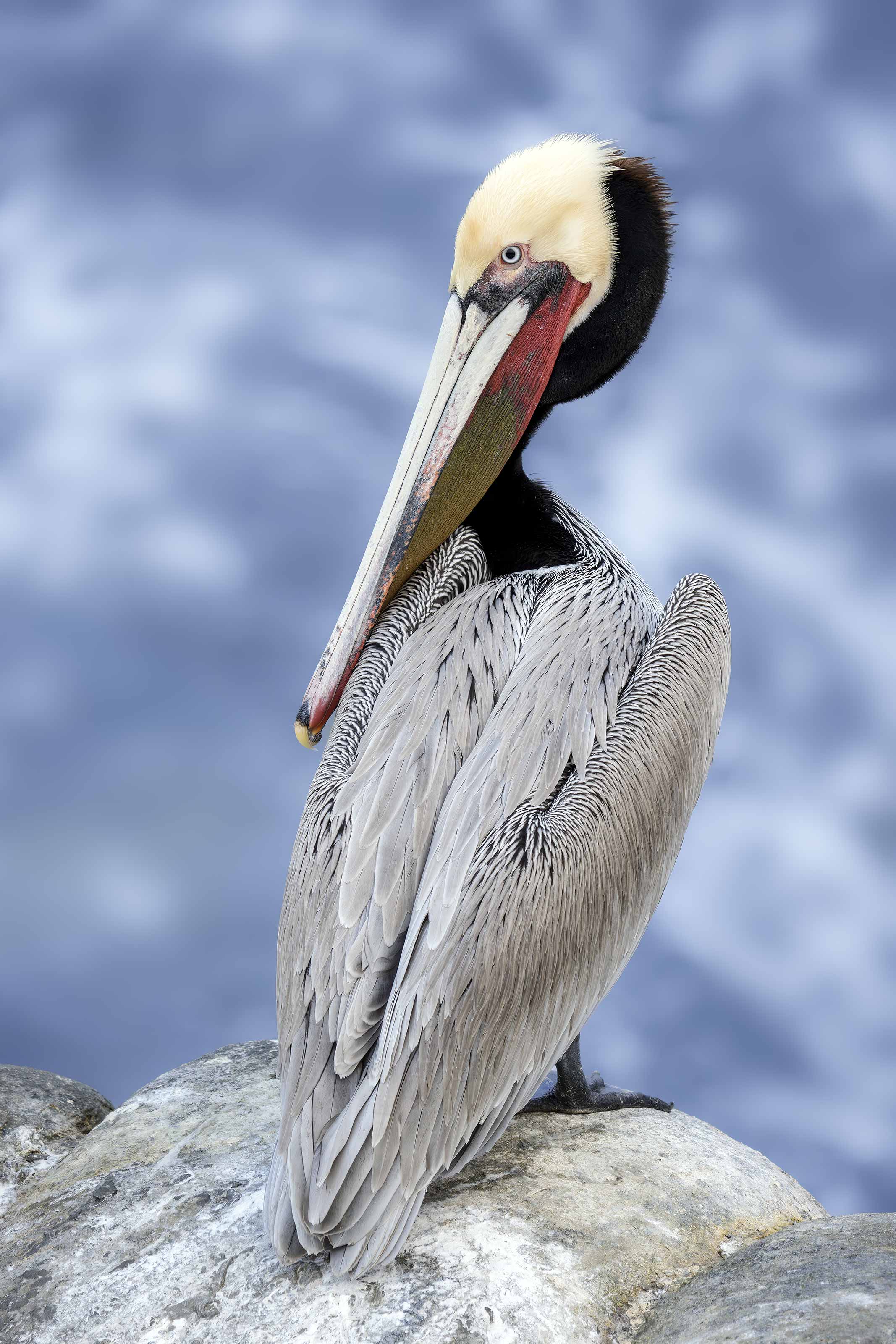
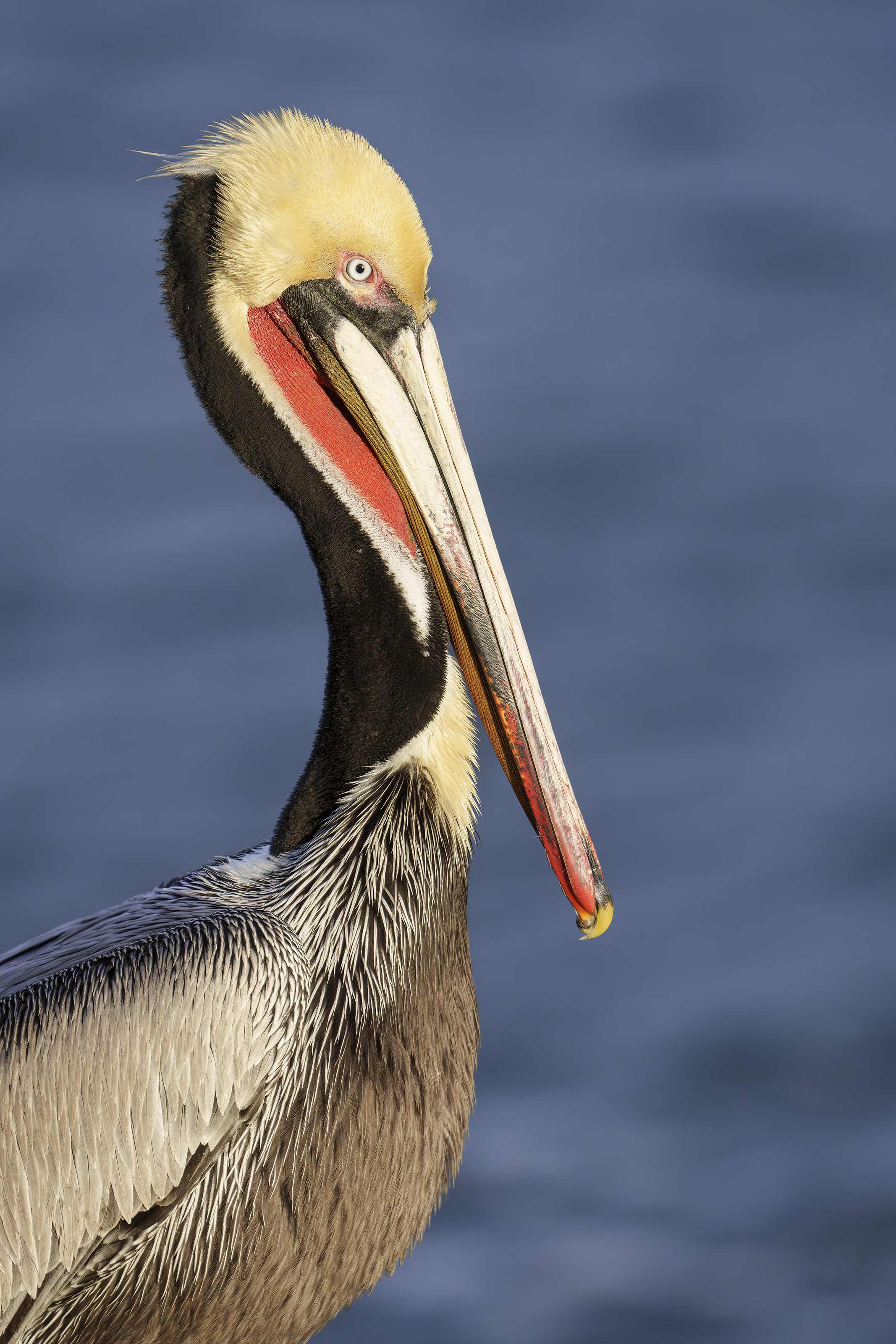
This image was created on 7 January 2026 by my dear friend, Robert Eastman at La Jolla, CA. Seated on a sandstone cliff, he used the Sony FE 200-600mm f/5.6-6.3 G OSS lens (at 600mm) and This Sony a-1 (now replaced by the Latest Greatest Sony Flagship Body, the a1 II Mirrorless Camera). The exposure was determined by Zebras with ISO on the rear wheel. ISO 800: 1/3200 second at f/6.3 (wide open) in Manual mode. AWB at 7:48:35am on a then sunny morning. Tracking: Zone AF-C with Bird-Eye/Face Detection performed perfectly. Click on the image to enjoy the larger, inexplicably sharper high-res version. Image #4: Brown Pelican Pacific race — breeding plumage — classic head, neck, and breast portrait |
Bob nailed this one: a beautiful bird, right down sun angle, a distant blue Pacific background, and sharp as a tack. Though I find the breeding plumage pelicans to be strikingly gorgeous, most of the local photographers ignore them. There seem to be far fewer bird photographers on the cliffs as compared to years ago when the site attracted large numbers of telephoto-toting folks.
|
|
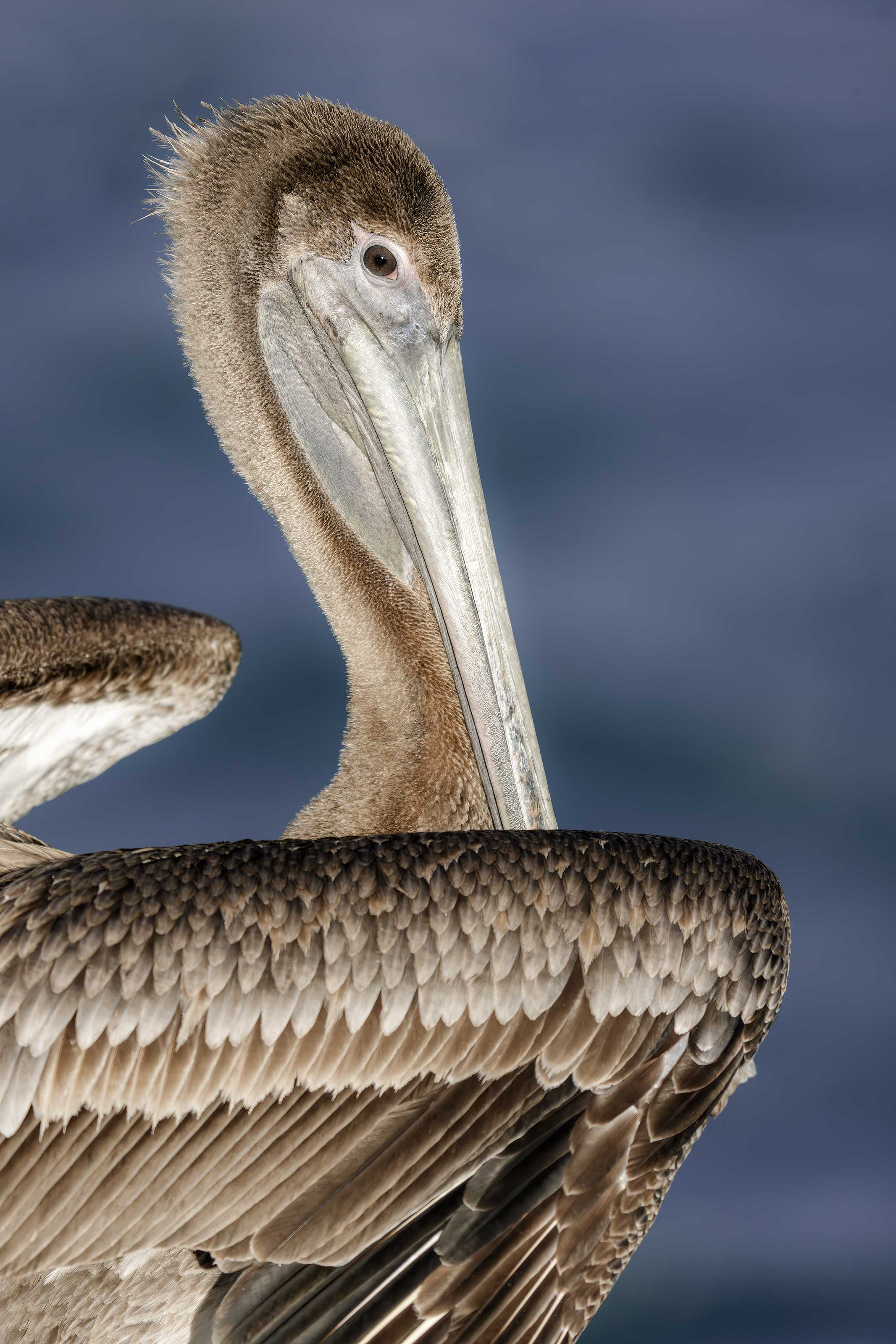
This image was also created on 7 January 2026 by yours truly at La Jolla, CA. Again, standing at full height, I used the Wide/AF-C with Bird-Eye/Face Detection performed perfectly. Click on the image to enjoy the larger, inexplicably sharper high-res version. Image #5: Brown Pelican, Pacific race juvenile with wings drooped |
Head Angle, Head Angle, Head Angle
I loved the pattern formed by the young pelican’s drooped wings but the darned bird refused to turn its head toward me. Until the very end. Sometimes even I can be patient.
|
|
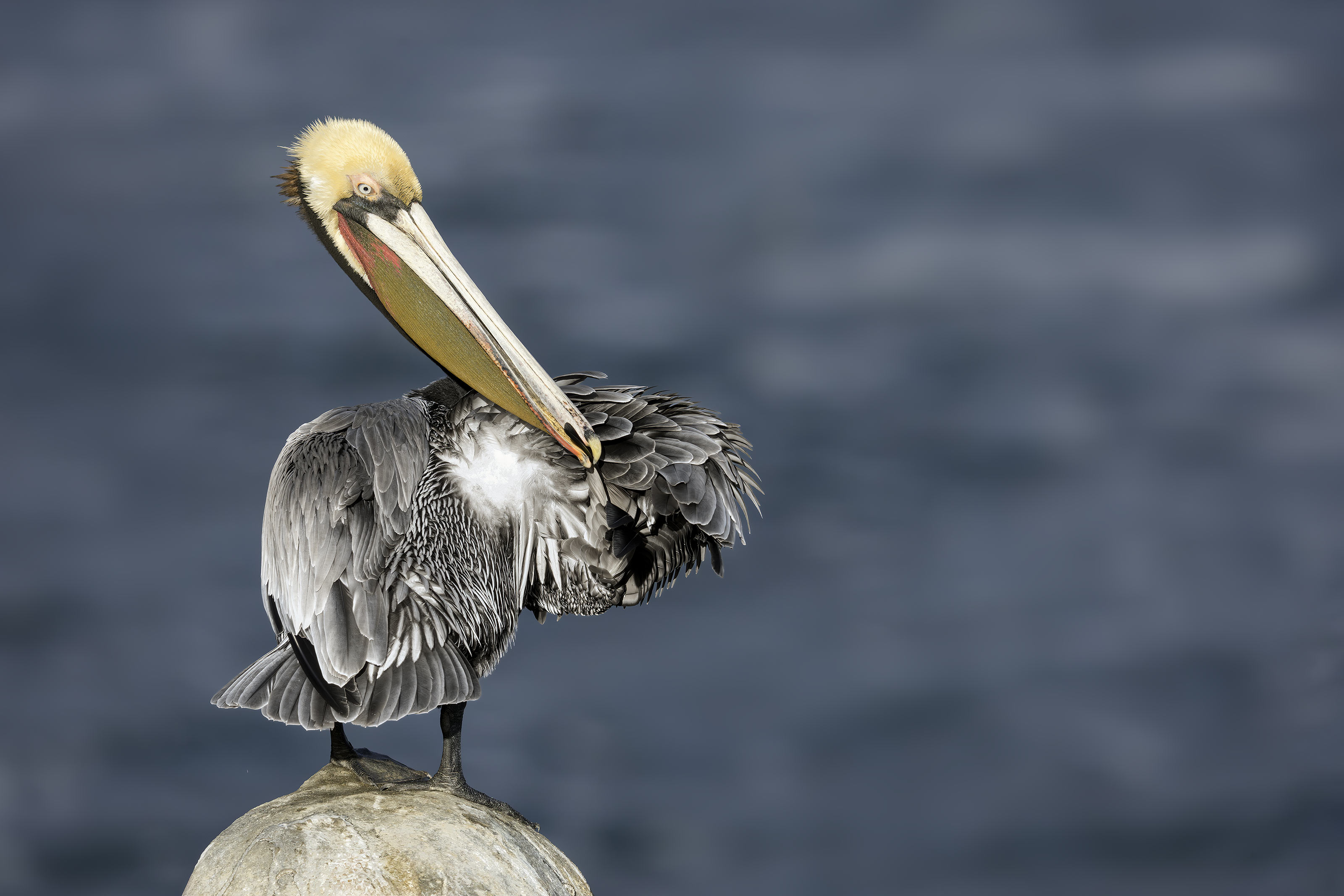
This image was also created on 7 January 2026 by yours truly at La Jolla, CA. Again, standing at full height, I used the Wide/AF-C with Bird-Eye/Face Detection performed perfectly. Click on the image to enjoy the larger, inexplicably sharper high-res version. Image #6: Brown Pelican, Pacific race adult preening |
Sun Angle, Sun Angle, Sun Angle
I was doing some head and full frame vertical stuff on some fairly close pelicans. When this handsome bird began preening on one of my favorites perches in La Jolla, I move to my left about 5 yards to get on sun angle and created many dozens of horizontals. This one, with the bird grasping the tip of a single feather in its bill tip, was my favorite.
|
|
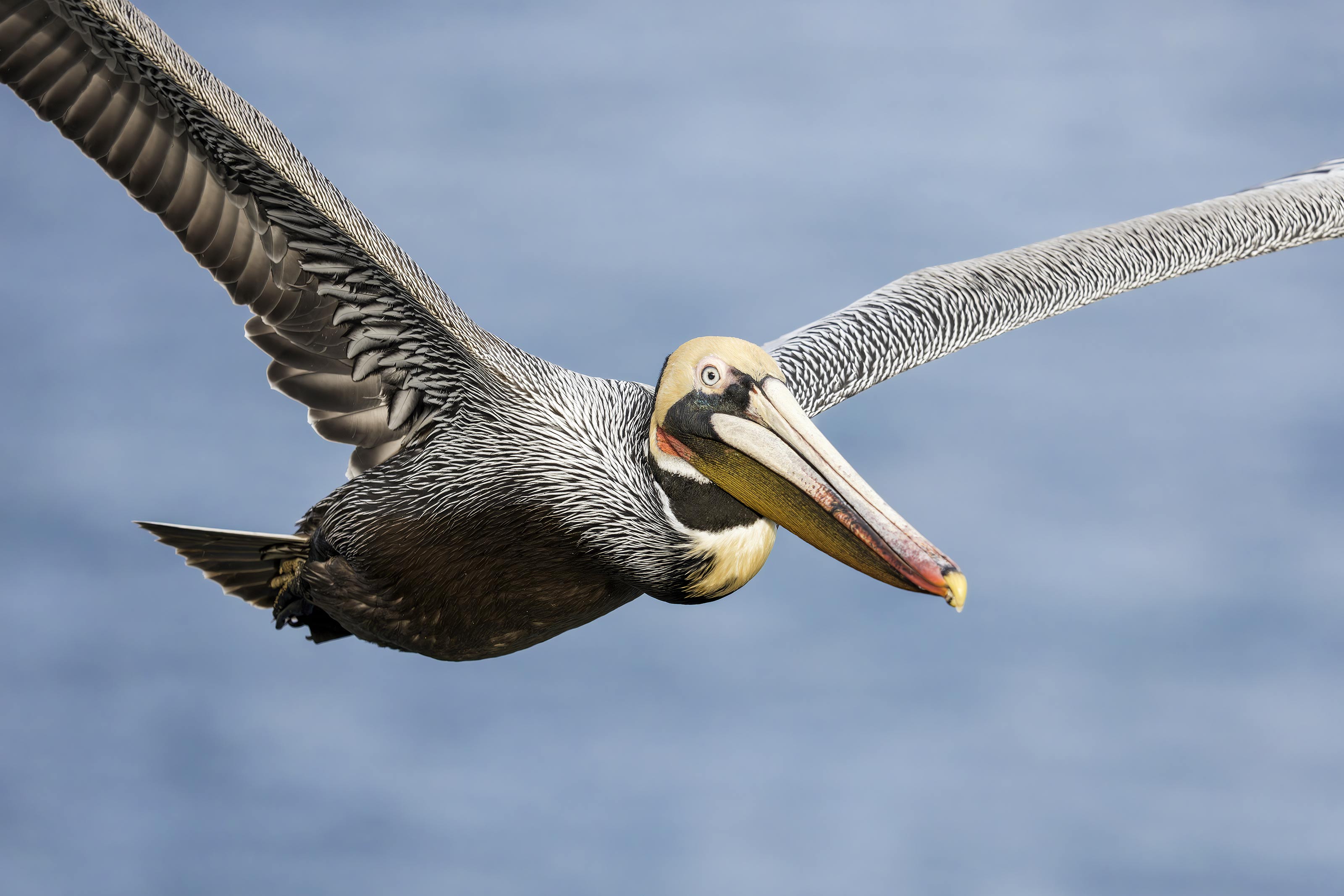
This image was also created on 7 January 2026 by yours truly at La Jolla, CA. Again, standing at full height, I used the Wide/AF-C with Bird-Eye/Face Detection performed perfectly. Click on the image to enjoy the larger, inexplicably sharper high-res version. Image #7: Brown Pelican, Pacific race adult Tight/Flight |
Another Mirrorless Flight Photography Tip
The autofocus systems on today’s high end mirrorless camera bodies are so good that I advise folks nots9 to quit shooting when they begin clipping wings. Stay on the subject and strive to keep the bird’s eye somewhere near the center of the frame. There are times when, with a small crop, you just might be able to create a Tight/Flight shot.
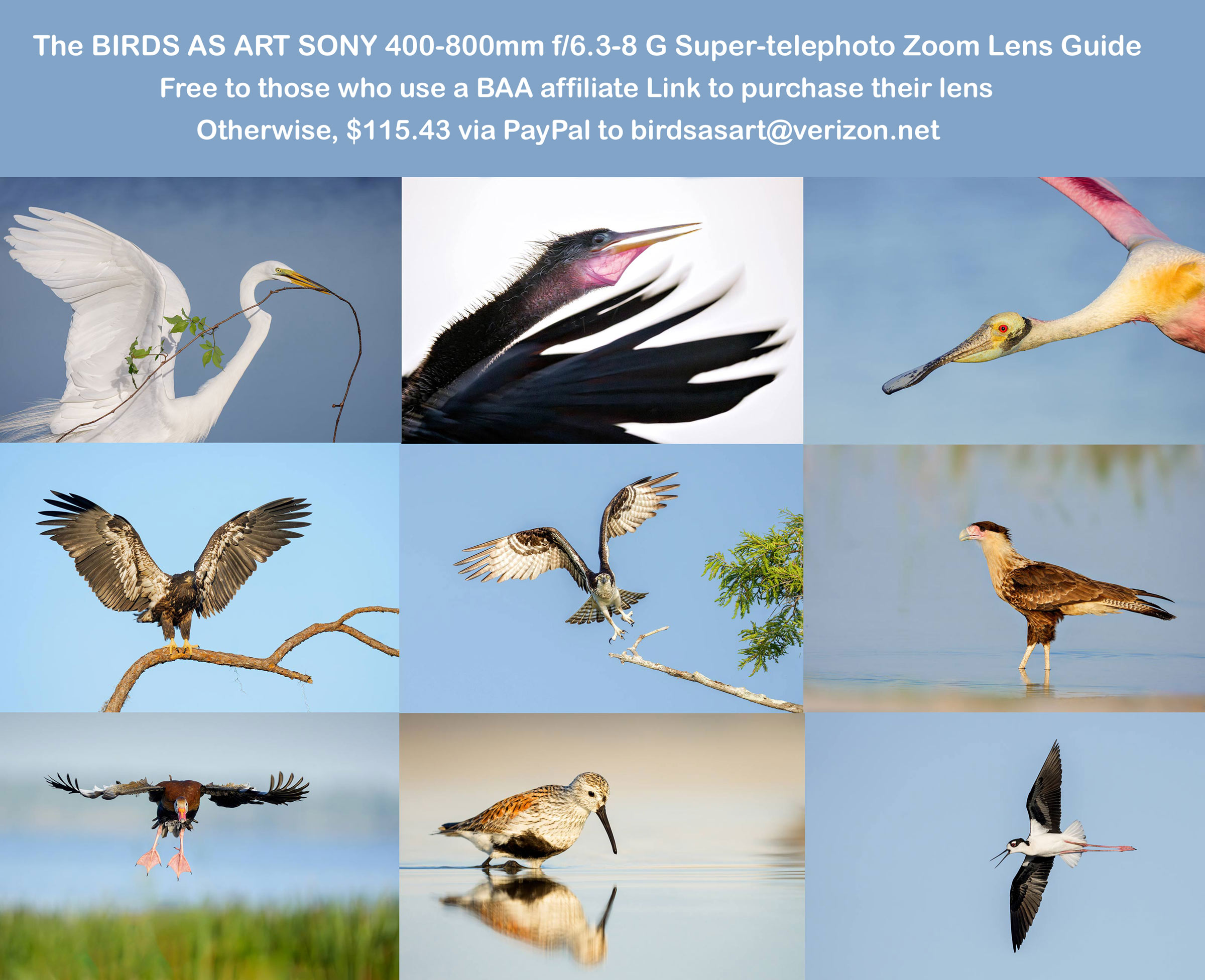
The BIRDS AS ART SONY 400-800mm f/6.3-9 G Super-telephoto Zoom Lens Guide
When I borrowed this lens from Sony, I assumed that at 5.45 pounds it was too heavy to handhold for long and that at f/8 at the long end (800mm,) it was too slow for most bird photography applications. In short, I did not want to like the lens. After a month of using it, I cannot live without it. After returning the loaner, I was miraculously able to get my own from Bedfords on 16 April 2025. In this guide I share everything that I have learned about using the 400-800. For best results, you need to know exactly what you are doing to get the most out of this zoom lens. It would be best, therefore, to consider and study the material in the guide so that you can begin making great images with your new lens.
What You Will Learn
You will learn how to deal with the relatively show apertures: f/6.3, f/7.1, and f/8 when working in Manual mode.
You will learn how to ensure that you are working at the widest aperture by working in Shutter Priority mode with AUTO ISO.
If you are able to hand hold the lens, you will learn proper hand holding techniques.
If you can’t, you will learn when, why, and how to employ other options. Those include:
1- The knee-pod, heel-pod, and toe-pod techniques
2- Using the lens on a monopod.
3- The best lens plate and low foot for your 4-8.
4- The best tripod and head for the 4-8 and how best to utilize them.
5- How to use the lens from your vehicle while supporting it on a BLUBB (or not and why not).
6- Detailed instructions on how to set and use the lens controls and buttons:
a- AF/MF
b- DMF Switch
c- Limit Range Switch
d- OSS (Optical Steady Shot) Switch
e- OSS Mode Switch
f- Focus Hold Buttons
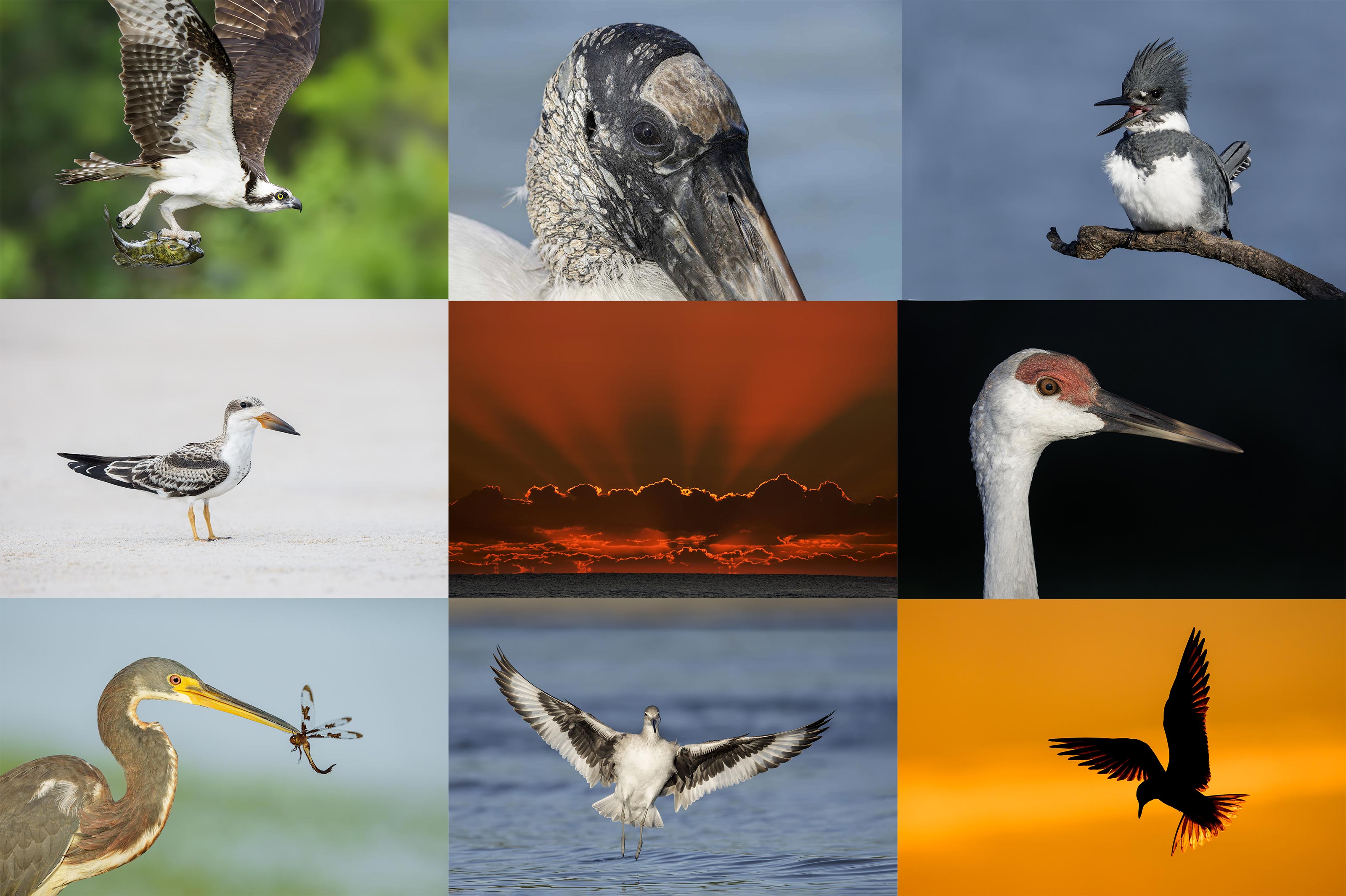
The guide also includes a Hand Holding Shutter Speed Primer and an illustrative, educational, and inspiring 67-image gallery.
Free to folks who use one of my two affiliate links to purchase their Sony 400-800 G lens. Otherwise, please send a PayPal for $115.43 to birdsasart@verizon.net and include the words “400-800 Lens Guide” in your e-mail.
Typos
With all blog posts, feel free to e-mail or to leave a comment regarding any typos or errors.







#6 for me. I like the image design with the bird off center and some of its enviornment shown to the right. The pose of the bird with ruffled feathers is a plus as is the muted color of the ocean in the background. Thanks for sharing.
Thanks, James. But for Bob’s bird-scape, that is my pick.
much love, artie
Those pictures bring back so many wonderful memories of phototours that Stokes and I took with you years ago. I sure wish I could have been there this year! My favorite is #4 — because of the tack sharp image of a beautifully posed brown pelican against the blue sky. My second is #5, the juvenile brown pelican portrait with the unusual wing placement.
Thanks, Pat. Yes, lots of great memories. I seems that you like the Pacfic race pelicans!
with love, artie