
What’s Up?
My morning photo sessions have been tough with temps in the low 30°s, clear skies, and winds from the north. With the sun rising south of east and continuing to move to the south, bird photography is extremely difficult.
Today is Friday 30 January 2026. It is supposed to warm up today (with a few clouds!) but another even more vicious cold front is supposed to arrive on Saturday. Temperatures in the high 20°s are forecast for Saturday and Sunday morning. I will of course be heading down to the lake as soon as I hit Publish. Whatever you opt to do today, I hope that you choose to be have fun. And please remember that happiness is a choice — Byron Katie, The Work.Com.
If an item — a Delkin flash card or reader, a Levered-clamp FlexShooter Pro, or a Wimberley lens plate or low foot — for example, that is available from B&H and/or Bedfords, is also available in the BAA Online Store, it would be great, and greatly appreciated, if you would opt to purchase from us. We will match or beat any price. Please remember also to use my B&H affiliate links or to earn 3% cash back at Bedford by using the BIRDSASART discount code at checkout for your major gear purchases. Doing either often earns you free guides and/or discounts. And always earns my great appreciation.
Gear Questions and Advice
Too many folks attending BAA IPTs and dozens of photographers whom I see in the field and on BirdPhotographer’s.Net, are — out of ignorance — using the wrong gear, especially when it comes to tripods and more especially, tripod heads. And the same is true in spades when ordering new camera bodies or lenses. My advice will often save you some serious money and may help you avoid making a seriously bad choice. Please know that I am always glad to answer your gear questions via e-mail.. If you are desperate, you can try me on my cell at 863-221-2372. Please leave a message and shoot me a text if I do not pick up.
Nora Kane on the First San Diego Extended IPT
I first met Nora Kane at a dinner hosted by Lugene Gerber in Bismarck, ND in the spring of 2022. Anita North and I had been invited to photograph Greater Prairie Chicken and Sharp-tailed Grouse by good friend and multiple IPT veteran Kevin Hice. Kevin had been telling Nora for years that if she wanted to improve her bird photography she should sign up for a BIRDS AS ART Instructional Photo-Tour (IPT). Last December she signed up for the first San Diego IPT and added three extra days. We spoke several times. It was fairly easy to convince Nora that getting an a-1 ii would be the best course of action. When Jeanette LaPorte canceled at the last minute when she tested positive for COVID, Nora wound up with a private IPT.
Nora stuck with me every step of the way, asking lots of questions and following my advice to a “T.” She was a quick learner and it was obvious that she wanted to improve. She did that in spades. (FYI: The idiom “in spades,” meaning to do something in great abundance, to an extreme degree, or with high intensity, originates from the card game of Contract Bridge popular in the 1920s. In bridge, spades is the highest-ranking suit, so having “spades” meant holding the winning, superior cards.)
Nora, 76, does not look a day over 65. She rode and showed horses for many years. When her last horse died in 2020, photography filled the void. Three years ago she began photographing birds with a friend; she had great fun and enjoyed the challenge. She met husband Doug in college at a sorority/fraternity exchange; they have been married for 55 years! She taught school until they started a family. After that she was a stay-at-home mom; but, in her own words, was never idle. She had many different jobs over the years. The last was a “small” business; she made and sold miniature dollhouses to specialty shops throughout the country.
She easily got down to the lower cliffs at La Jolla with her gear. She was a natural at making sharp images. She learned to get the right exposure using Zebra technology in two minutes. She has a good eye and learned to use three different AF methods to design pleasing images. And, somewhat amazingly, she learned to shoot flight both handheld (with the 70-200 and the 200-600) and on the tripod (with the 400-800). She began making some excellent images in our very first session and then improved greatly during the nine days we spent together.
Nora On the IPT Via e-Mail
I used to photograph with a Canon point and shoot — never took it off Auto. I had no idea what ISO, aperture and shutter speed were. I couldn’t even set the menu. Five years ago I purchased a Sony a6000 and a Sony 100-400 lens. Then I bought a Sony a7riii. Two years ago I got the Sony a7rv along with a few good zoom lenses for birds photography And before the IPT, artie suggested that I purchase an a-1 ii. I love that camera!
After some encouragement from a friend,I attended artie’s BIRDS AS ART IPT in San Diego. It was hands down the best investment and experience I have ever had at a photo workshop! The in-the-field instruction was superb. Artie was always by my side and always encouraging. The photo opportunities were beyond belief! Photo Mechanic and Photoshop were new programs for me and again artie said, “trust me”. I did and will not go back to my old ways.
As above, I purchased the Sony a1-ii (using one of Artie’s affiliate links) and started using Photo Mechanic and Photoshop! I learned a tremendous amount about bird photography! “hen I came to the IPT I was in kindergarten and now I am a college graduate”. The learning curve was steep but artie stuck with me and we both made lots of progress! I have signed up for the second Stick Marsh 2026 IPT in March to photograph the Roseate Spoonbills. I highly recommend an IPT with artie to anyone who wants to improve their photography skills. If you’re struggling with your bird photography you should sign up for a trip with artie ASAP. You can’t continue to do the same wrong thing and expect different results.
Kudos to Nora Kane
I have never had a student work as hard or put as much effort into improving as Nora did in San Diego. She and the images she has produced on this IPT have made me incredibly proud. Though she has been photographing birds for several years, she was brand-new to the a-1 ii, brand new to Photo Mechanic, brand new to Photoshop (!), and brand new to flight photography (on a tripod no less!) when she showed up at the AirBnb in early January.

|
|
This image was created by IPT participant Nora Kane on 12 January 2026 at La Jolla, CA on the first San Diego Extended IPT. Standing at full height near the Bridge Club, she used the Wide/AF-C with Bird-Eye/Face Detection performed perfectly. Click on the image to enjoy the larger, inexplicably sharper high-res version. Image #1: Brown Pelican riding breaking wave |
I Can’t Believe I Forgot Nora’s Best Image!
When I ran this image in the recent More Flight Photography Tips: Back Shots, a-1 ii AF, Surfing Pelican, Lenses for Flight, Tight Flight, and Exposure Tips here, several folks picked it as their favorite. Skilled UK photographer Mike Poole wrote:
As much as you’ve produced the goods again Artie, it’s Nora’s shot that gets my gold medal; it is simply a superb environmental image.
For years I have been saying the beginning and intermediate photographers can — with their camera bodies set up properly and a bit of good instruction, create images as good as or better than those made by a professional with 40+ years of experience. Nora proved that time and time again.
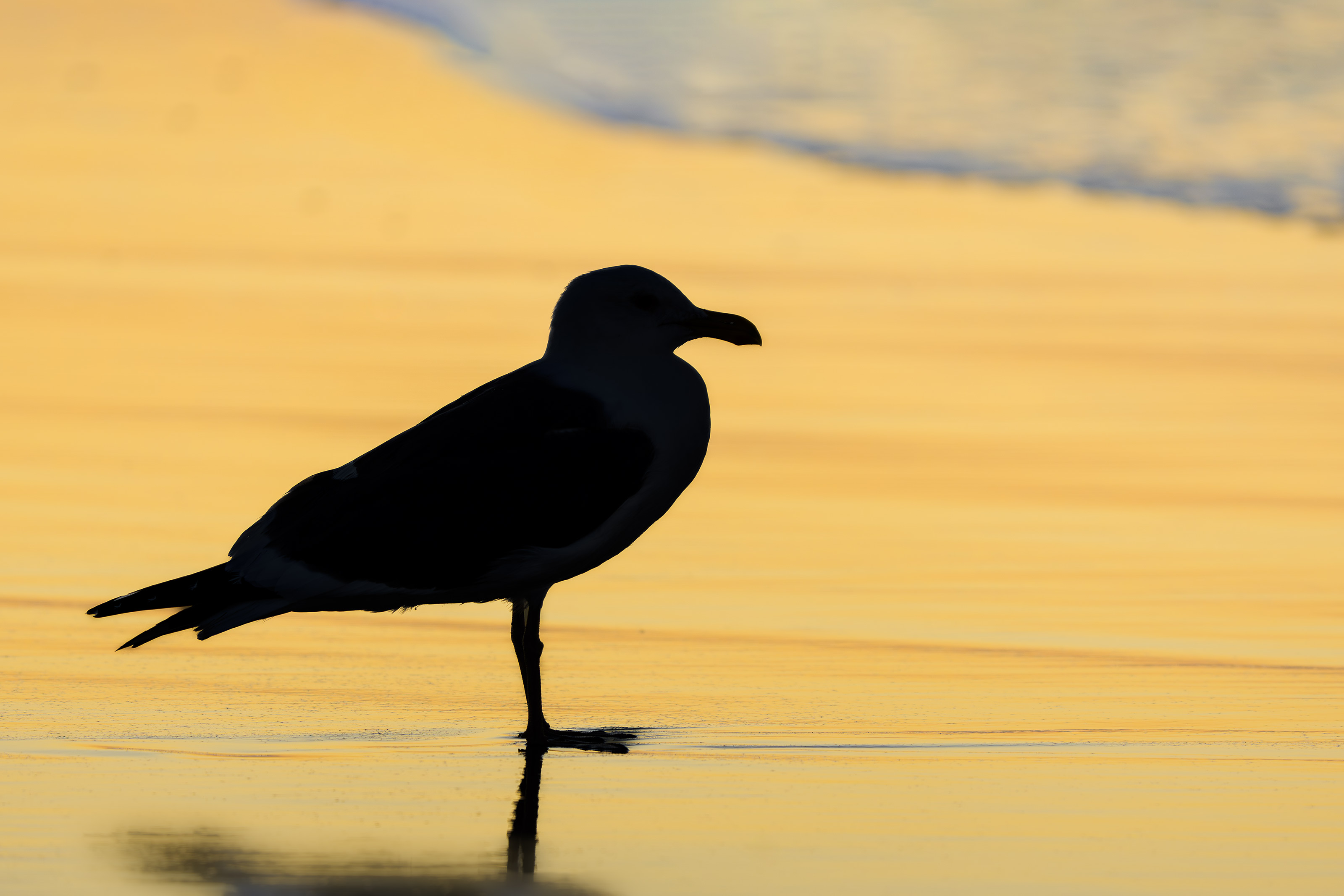
|
|
This image was created by IPT participant Nora Kane on 13 January 2026 at Coronado Beach, CA on the first San Diego Extended IPT. Standing at full height she used the handheld Sony FE 200-600mm f/5.6-6.3 G OSS lens (at 459mm) and The Latest Greatest Sony Flagship Body, the a1 II Mirrorless Camera. The exposure was determined by Zebras with Exposure Compensation (EC) on the thumb wheel. Multi Metering+1.3 stops. AUTO ISO set ISO 640: 1/400 second at f/6.3 (wide open) in Shutter Priority mode. AWB at 6:58:50 am on a mostly sunny morning. Tracking: Zone/AF-C with Bird-Eye/Face Detection performed perfectly. Click on the image to enjoy the larger, inexplicably sharper high-res version. Image #2: Western Gull dawn silhouette |
Listen to the Instructor!
It seems very obvious that if you are paying for instruction that it would be best to pay close attention to what the teacher is saying. Not everyone does that. I remember calling Nora over and inviting her to get her feet wet so I could show her how the wet sand reflected the sunrise colors. Ever the trouper, that is exactly what she did. I forgot to mention above that she quickly learned when and how to work in Shutter Priority mode with AUTO ISO and Exposure Compensation (EC) on the thumb wheel.
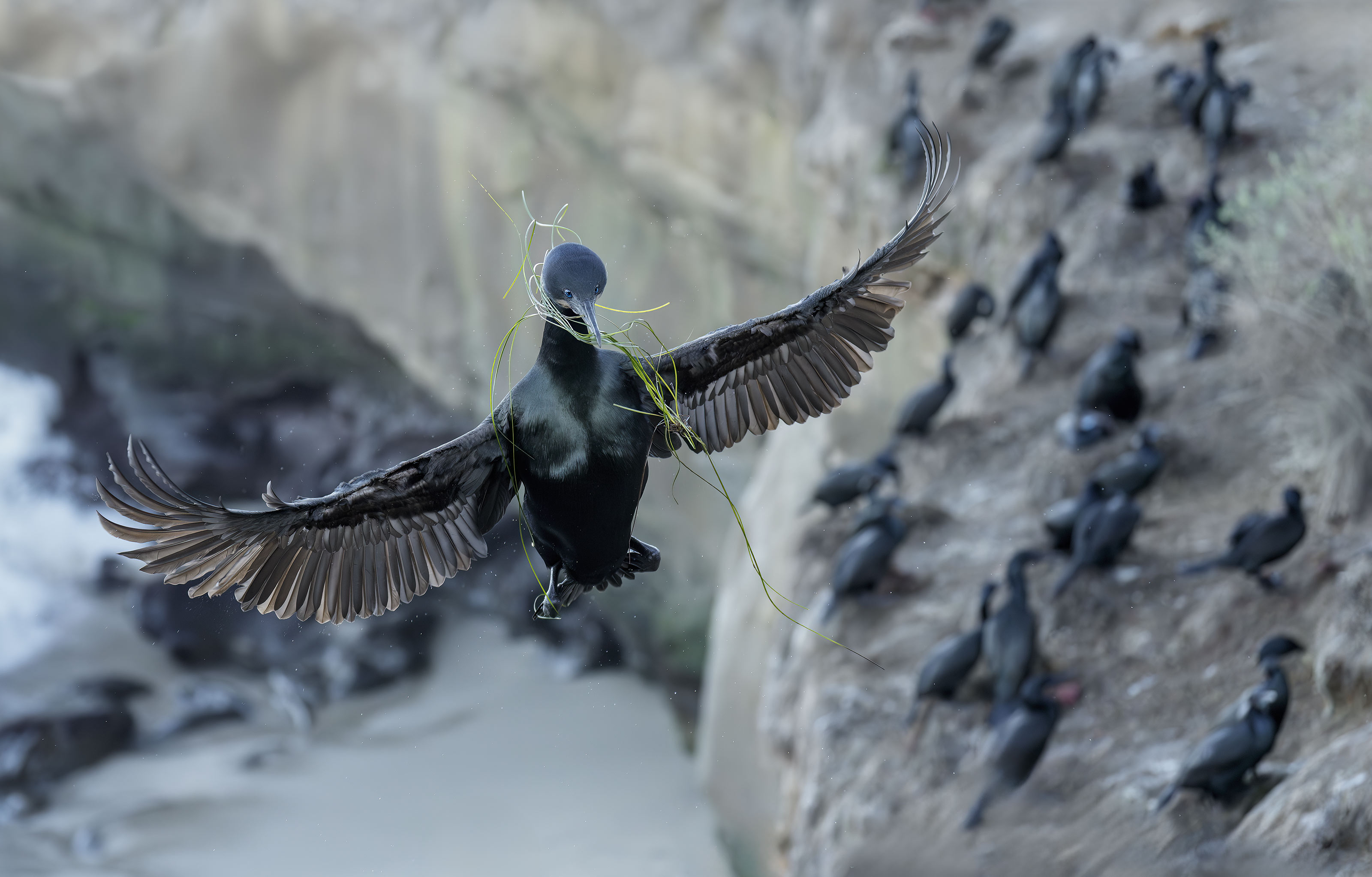
|
|
This image was created by IPT participant Nora Kane on 13 January 2026 at Coronado Beach, CA on the first San Diego Extended IPT. Standing at full height she used the hand held Sony FE 70-200mm f/2.8 GM OSS II Lens (at 70mm) and The Latest Greatest Sony Flagship Body, the a1 II Mirrorless Camera. The exposure was determined via Zebras with ISO on the Thumb Wheel. ISO 2500: 1/3200 sec. at f/2.8 (wide open) in Manual mode. AWB at 3:23:40 pm in the shade on a sunny afternoon. Wide/AF-C with Bird-Eye/Face Detection performed perfectly. Click on the image to enjoy the larger, inexplicably sharper high-res version. Image #3: Brandt’s Cormorant incoming flight-scape |
Zooming Out to the Max!
To create this wonderful image that included an incoming cormorant with nesting material and a portion of the nesting shelf as background, Nora zoomed out to 70mm and produced a unique photograph. Again, it came down to listening to the instructor: First turn off Zebras so that you can see the bird in the sun. Then zoom in to 200mm and pre-focus on the surface of the ocean about 50 yards out. When you see a returning bird acquire focus and follow it in. As it gets closer, zoom out.
|
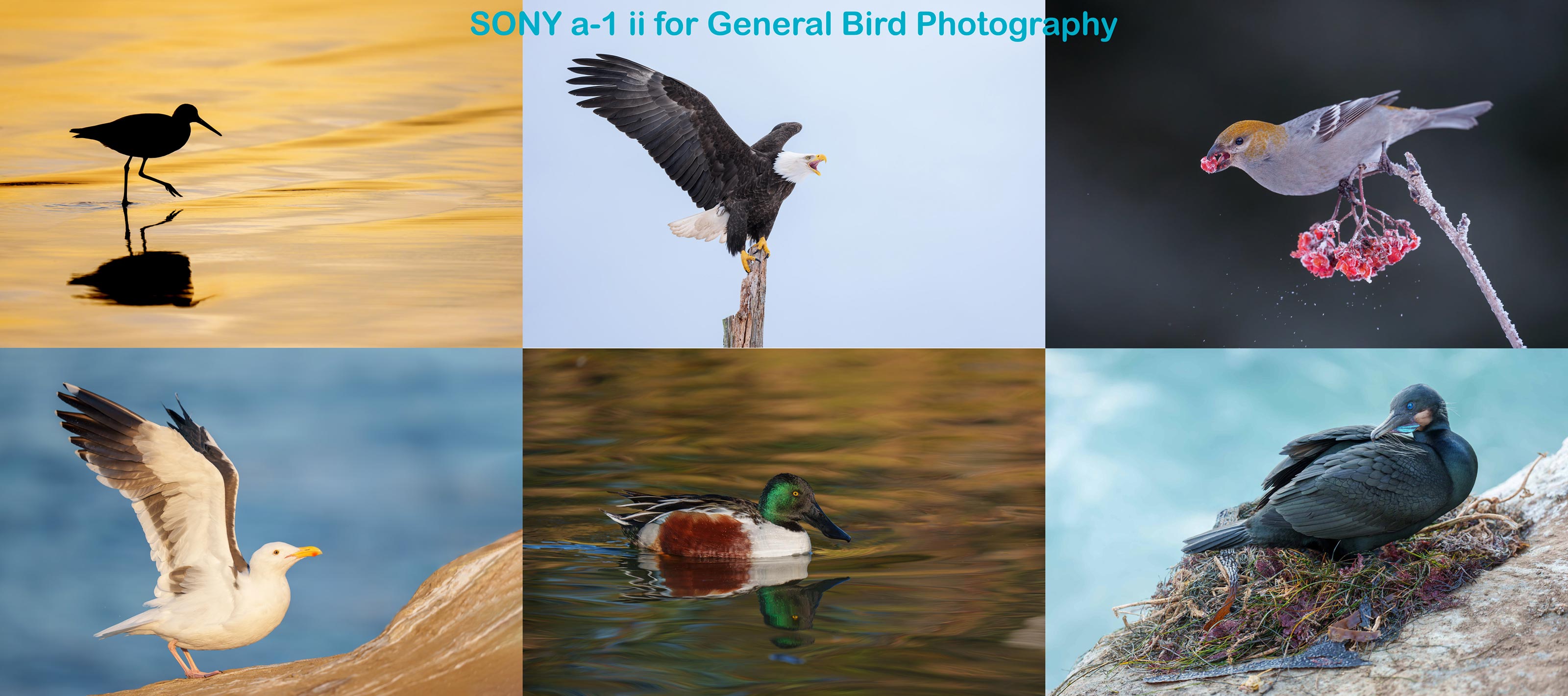
Composite #1: All with the a-1 ii Mirrorless Camera body.
|
The a-1 ii for General Bird Photography
I have found that eye-tracking for general bird photography with the a-1 ii is far, far better than with the original Sony a-1. It grabs the eye and tracks it faster and far more consistently and focus is rarely lost, even with backgrounds other than sky.
|
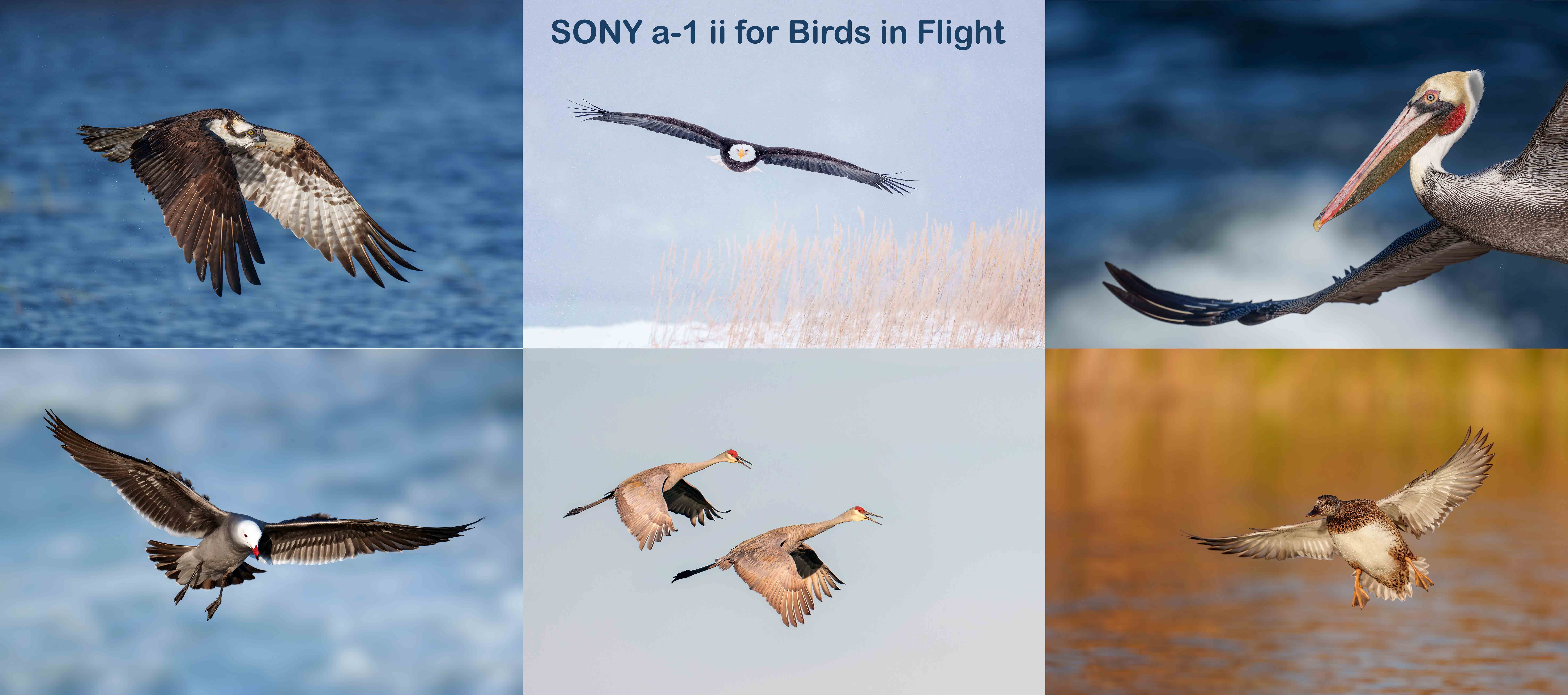
Composite #2: All with the a-1 ii Mirrorless Camera body.
|
The a-1 ii for Birds in Flight
For birds in flight, the a-1 ii Mirrorless Camera body has no equal. As Arash Hazeghi says, “It is better than the a-1.” When I am late getting on a bird in flight, I have consistently been amazed at how often the AF system of the a-1 ii finds and tracks the bird’s eye.
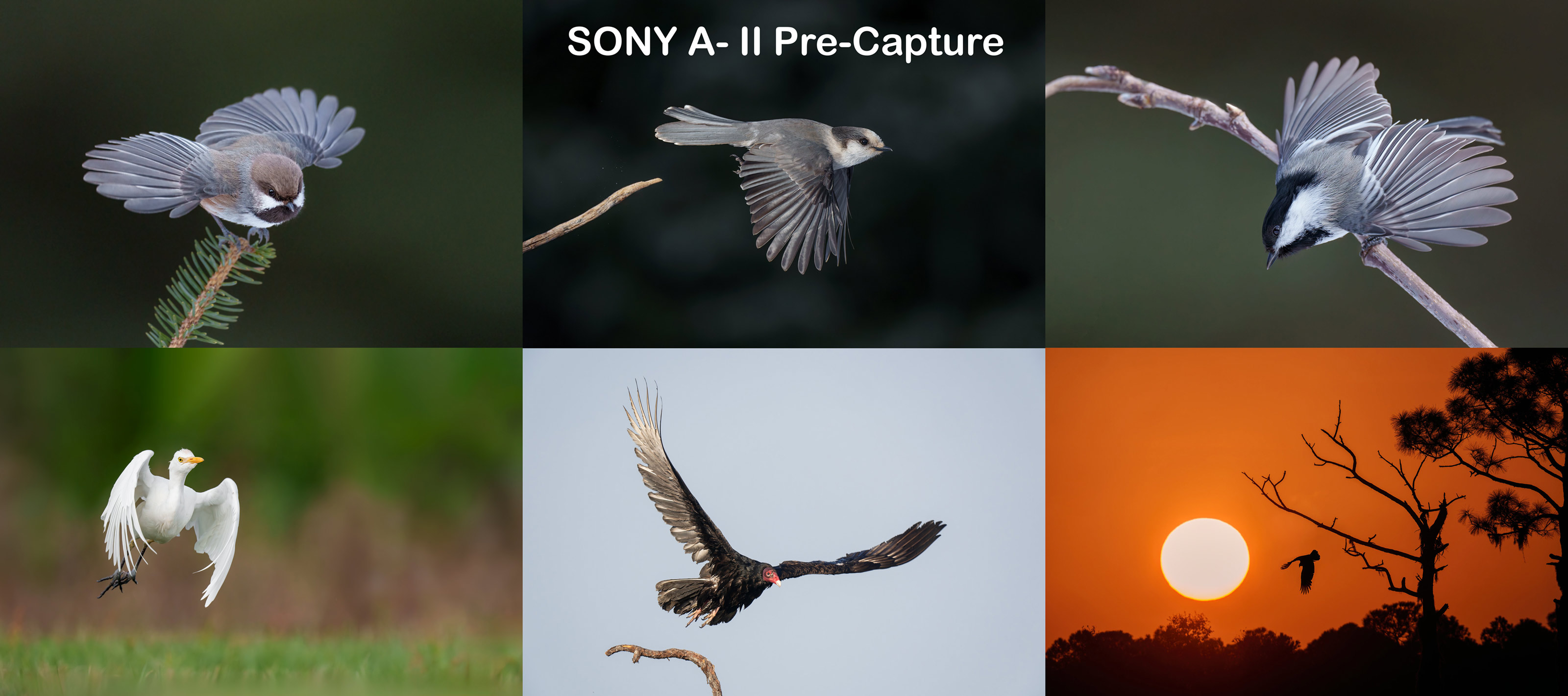
|
Composite #3: All the result of using Pre-Capture with the a-1 ii Mirrorless Camera body.
|
Pre-Capture with the Sony a-1 ii
When it comes to Pre-Capture with the a-1 ii Mirrorless Camera body, Arash and I agree 100%. And with my slower reflexes, Pre-Capture is more important for me than it is for Arash. Understand that in each of the images in Composite #3, I did not push the shutter button until after the bird took flight!
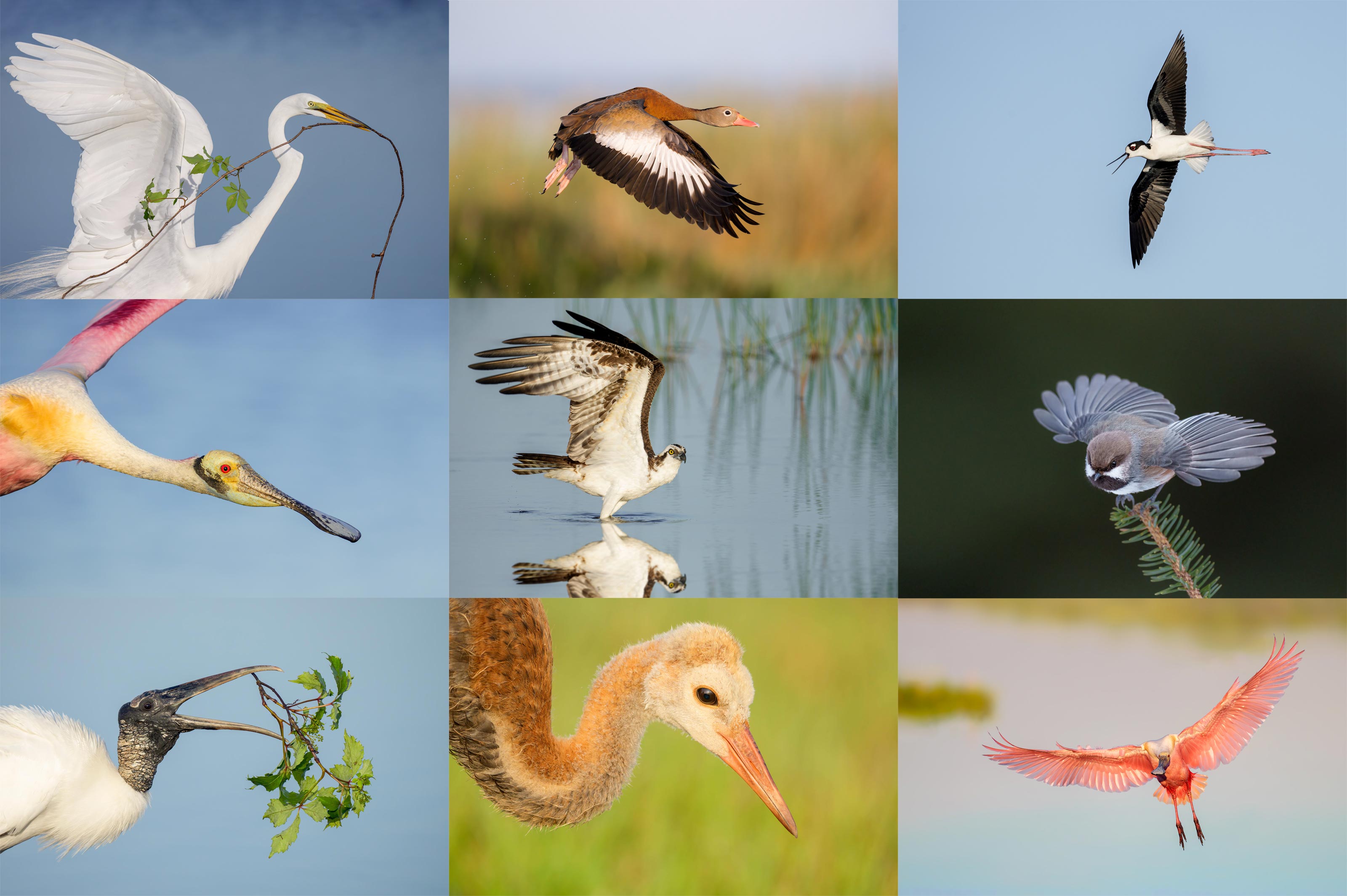
|
All with the a-1 ii Mirrorless Camera body.
|
Purchasing or Upgrading to a Sony a-1 ii
The Sony a-1 ii e-Mail Set-up and Info Guide
I now own and use two Sony a-1 ii bodies. Every day that I use them, the more I am amazed by speed and accuracy of the Bird Face-Eye tracking in AF-C and the overall performance of the camera.
Aside from the improved ergonomics as compared to the a-1, other nice features include the fact that the rear screen tilts both ways — the lack of a tilting rear screen on the original a-1 always ticked me off. Pre-capture has proven to be a huge plus almost exclusively for take-off flight images. In my opinion, the Speed Boost feature is a total waste for bird photography because you should always be utilizing the maximum frame rate. In addition, the resolution on the rear monitor has been improved dramatically. I must mention again that Bird Face-Eye tracking on the a-1 ii is vastly improved as compared to both the a-1 and the a9 iii and that the 51MP files are to die for.
So, the big question is, is the a-1 ii “worth” a gear upgrade. Remembering that I can never know whether or not something is worth it to you, I can say that I was not floored when first using my a-1 ii. The differences between the a-1 ii and the original a-1, seemed to be neither huge nor eye-opening. But over time, I have come to realize that I was 100% wrong. The huge difference between the new camera body and the a9 iii is, of course, the 51MP a-1 raw files (as compared to the 24MP files rendered by the a9 iii).
The price of a new a-1 is $5,898.00. The price of a new a-1 ii is $1,100.00 more: $6,998.00. As the a-1 ii is clearly far superior for bird photography to the original a-1, the choice for folks new to Sony or for those upgrading from lesser Sony camera bodies is an easy one. Prices for used a-1 bodies has not dropped drastically as I anticipated. At this point, a-1 folks who like showing flight and action and can afford an a-1 ii, are advised to purchase an a-1 ii. Please remember that life is short; we only get one ride on the merry-go-round.
If you do purchase an a-1 ii, be sure to use one of my two affiliate links so that you will receive my a-1 ii settings (in the form of a CAMSEa1ii.DAT file), the Buttons and Dials Guide, and an Info Sheet for free. Using my links will never cost you one penny and may actually save you some money. Folks who do not purchase their new a-i using my B&H link or from Bedfords here and entering the BIRDSASART discount code at checkout will be able to purchase the a-1 ii guide for $244.93. If you are at all confused and do not want to screw up your order, please get in touch via e-mail. If you would like to chat about upgrading, shoot me a text to 863-221-2372 and LMK a good time to call you.
Typos
With all blog posts, feel free to e-mail or to leave a comment regarding any typos or errors.








Hundreds? You have a short memory East Bobman. She was doing seven or eight thousand every morning near the end.
Love you much,
artie
Ahhh I meant she Kept Hundreds Mr. Artie 🙂 yup
Always with love b
Great times!! Just look what I started with a little ranch dressing and some chicken!! HAHA
Good to hear from you Lugene. As I remember, that was some pretty darned good chicken not to mention everything else as well!
with love, artie
Excellent images by Nora. And a great testament to Artie as an instructor. For those contemplating an IPT, change direction and make a commitment. Well worth while.
Thanks for your kind words, Dane. It’ s been too long!
with love, artie
Great to see a student do so well. Three fantastic images!
Agree!
with love, a
Artie
It was more than a pleasure to have worked with Nora for 9 days each day in the morning and mid day seeing her at the computer picking her favorites as there were hundreds. I am beyond amazed by how quick she became a gooder 🙂 photographer. I love the Brown Pelican riding the wave, I heard Nora GO WOW when she saw this photo. Amazing Fun.
Always with love b
Mr. Bob,
It was great having you along to help everyone in San Diego, especially me!
much love, artie