
This Just In
This was originally published on 13 February. For reasons unknown to me, but probably involving operator error, post notifications failed to send. Anyhoo, today is Thursday 19 February. The first Homer IPT was about as perfect as possible and the four folks who did only the first IPT are all safely home or well on their way. The first day of the second IPT was record-breaking as we stayed on the boat all day and photographed for 8 1/2 hours. Today is a much needed weather day off. The next three days are looking excellent. As each Homer IPT includes 20 hours on the boat, we are aha of schedule. The first group went 1 3/4 hours over. Have a good one. I’d be especially be interested in folks sharing their experience with grief at the loss of a loved one.
Netflix Recommendation
I’ve been watching The Closer on Netflix every day when I do my Body Mechanics practice. I just finished watching Season 4, Episode 7, “Sudden Death.” While I have enjoyed every one I have watched, this one was over the top emotionally. This is what AI Overview had to say:
“Sudden Death” (Season 4, Episode 7) of The Closer is widely recognized by fans as an emotionally intense, standout episode focusing on Detective Julio Sanchez, with many praising the stellar, heart-wrenching performances. The episode, which deals with the shooting of Sanchez’s brother, is described as an emotional roller-coaster with realistic portrayals of street gang violence and grief.
There are dozens of rave reviews all over the internet. I am guessing that I took it very personally as I recalled the death of my late wife, Elaine Belsky Morris more, than 31 years ago.
On Grief
I recall reading an excellent account of grief more than a quarter century ago in a book on grieving given to me by a friend. As I do not remember the name of the book, or the author, I am paraphrasing here:
Grief is like ocean waves. When the loss is fresh, you feel as if you are in the surf being hit by huge waves. You get smashed to the bottom, tumbled upside down, and wind up with sand in your bathing suit. As soon as you break the surface, you are hit by another even larger wave. A month later, some large waves come along but they are not quite as big as they were. Over times, the time between waves gets long and the waves get smaller. As the years go by, most of the waves are just small ripples on the surface. But even 31 years later you may get hit by a fairly large wave. For me, the resulting tears are tears of joy at knowing how lucky I was to have Elaine as a best friend and a wife.
What’s Up?
The first songbird day was fabulous. Between the four of us, we created more than 54,000 images. Not really amazingly, I had a single image that was clearly my best. I share two versions of it with you in today’s post. We did an image review session early on Thursday morning. The group found it extremely helpful. With eight inches of fresh snow in Anchor Point the second songbird day was even better than the first one! The photography was non-stop. I was low hook with 17,228 images. Chris Lofferdo chipped in with 18,293 photos. Brian “The Mailman” Bower added 18,293 pix, and Kevin Hice just about lost his mind by creating 29,146 Sony a-1 ii raw files. The total for a single session is a record by far: 83,736. I am hoping the everybody got a few great ones.
Robert “Bear Bob” Sabin arrived on Wednesday morning and Jim Dolgin, his morning flight cancelled, wound up taking the bus and got to Homer at 7:00pm.
Today is Friday 13 February 2026. We will be meeting Captain Gabe at 8:30 and heading across Kachemak Bay for our first session with the eagles. Everyone is excited. Whatever you opt to do today, I hope that you choose to be have fun. And please remember that happiness is a choice — Byron Katie, The Work.Com.
If an item — a Delkin flash card or reader, a Levered-clamp FlexShooter Pro, or a Wimberley lens plate or low foot — for example, that is available from B&H and/or Bedfords, is also available in the BAA Online Store, it would be great, and greatly appreciated, if you would opt to purchase from us. We will match or beat any price. Please remember also to use my B&H affiliate links or to earn 3% cash back at Bedford by using the BIRDSASART discount code at checkout for your major gear purchases. Doing either often earns you free guides and/or discounts. And always earns my great appreciation.
Gear Questions and Advice
Too many folks attending BAA IPTs and dozens of photographers whom I see in the field and on BirdPhotographer’s.Net, are — out of ignorance — using the wrong gear, especially when it comes to tripods and more especially, tripod heads. And the same is true in spades when ordering new camera bodies or lenses. My advice will often save you some serious money and may help you avoid making a seriously bad choice. Please know that I am always glad to answer your gear questions via e-mail. If you are desperate, you can try me on my cell at 863-221-2372. Please leave a message and shoot me a text if I do not pick up.
|
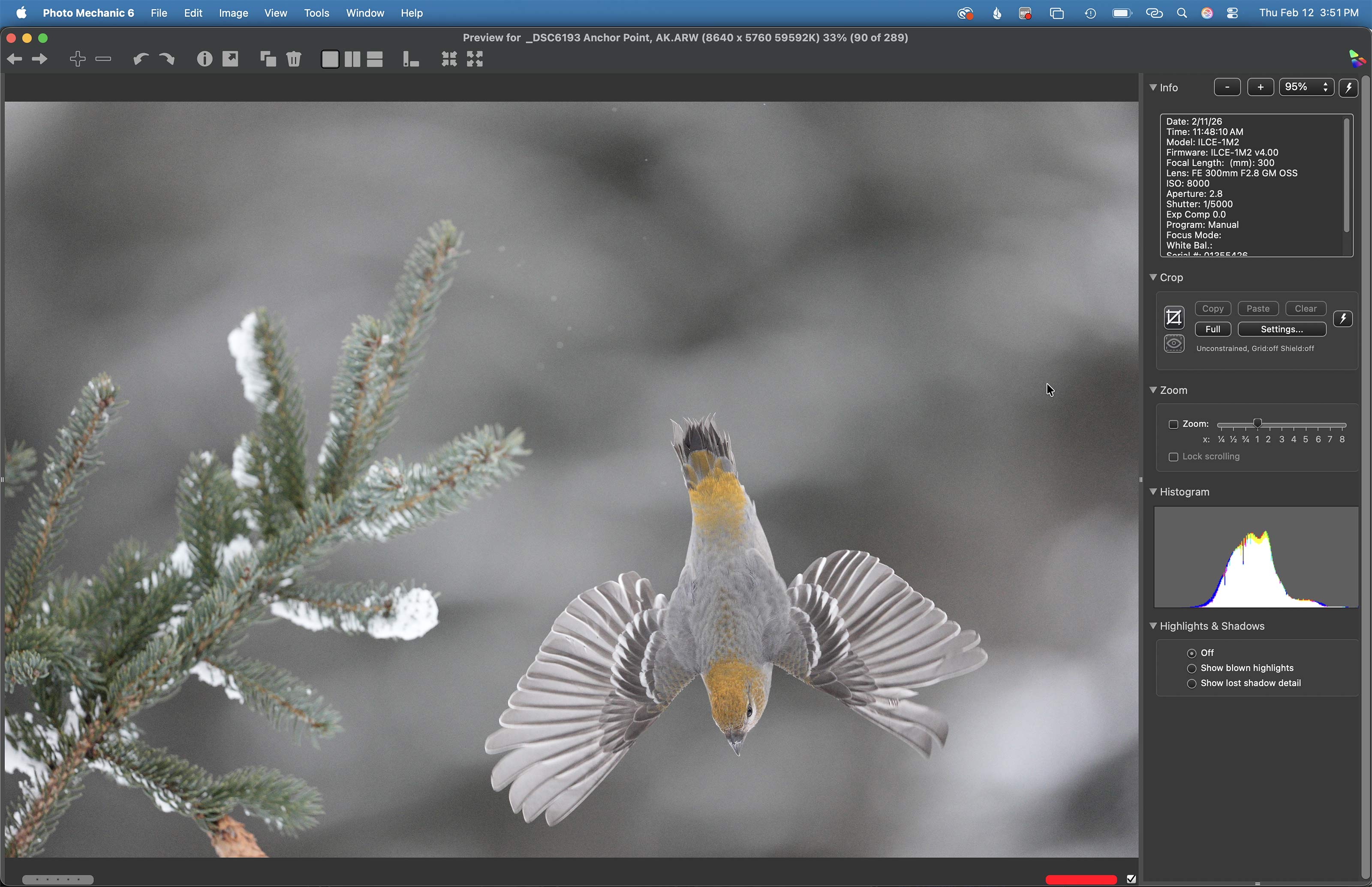
Image #1: The Photo Mechanic screen capture for the original Pine Grosbeak diving off perch imgae |
The Original Frame
Before you scroll down, consider your image optimization options. How would you crop this? Would you need to add any canvas? What would you do with the light and dark area in the lower left corner of the frame?
|
|
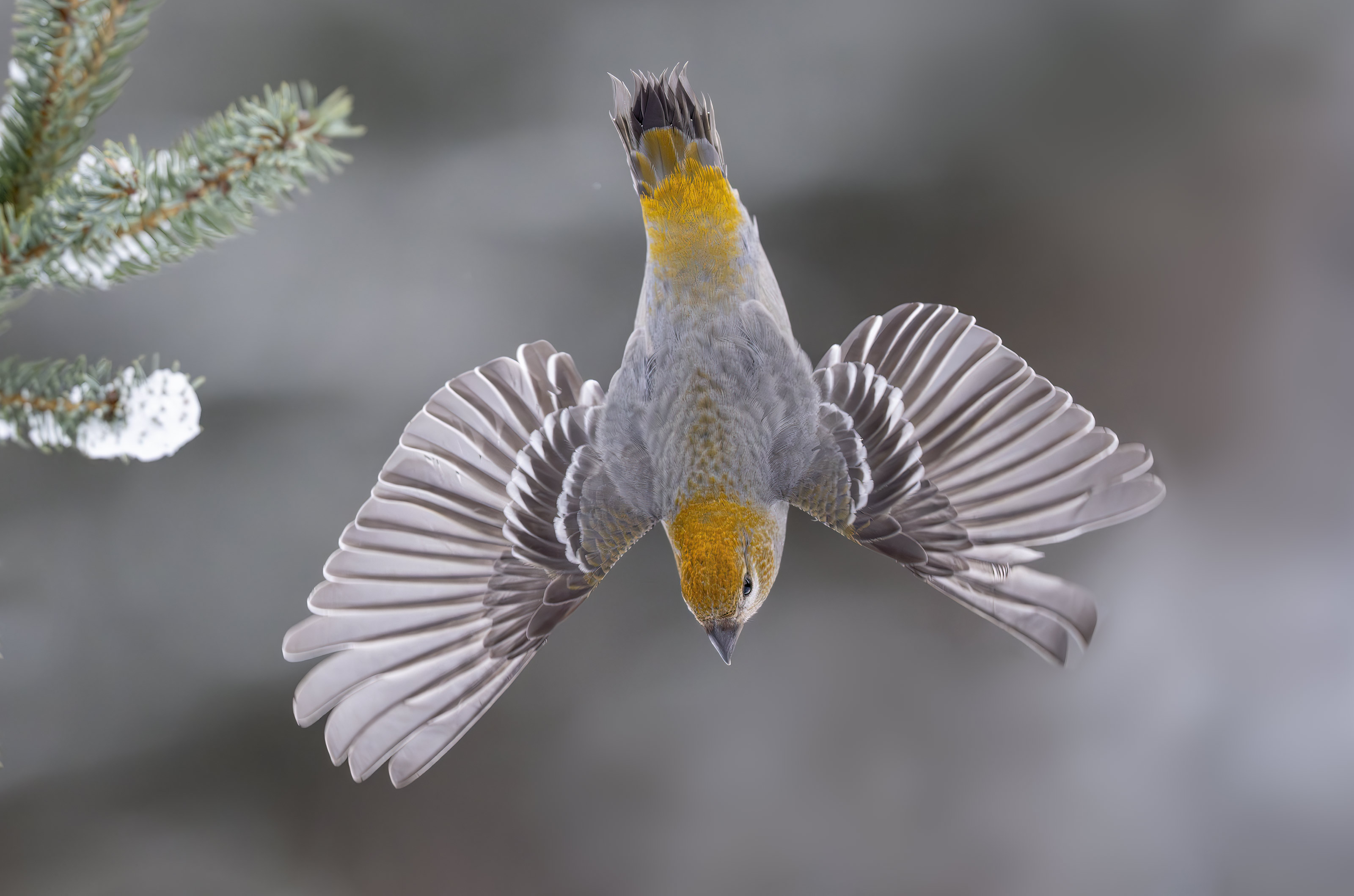
This image was created by yours truly on 11 February 2026 on the first songbird day before the Homer IPTs. Standing on snow and ice behind my she used the Tracking: Zone/AF-C with Bird Eye/Face Detection enabled performed perfectly. Click on the image to enjoy the larger, inexplicably sharper high-res version. Image #1A: Pine Grosbeak diving off perch. Version I: tight |
My First Version
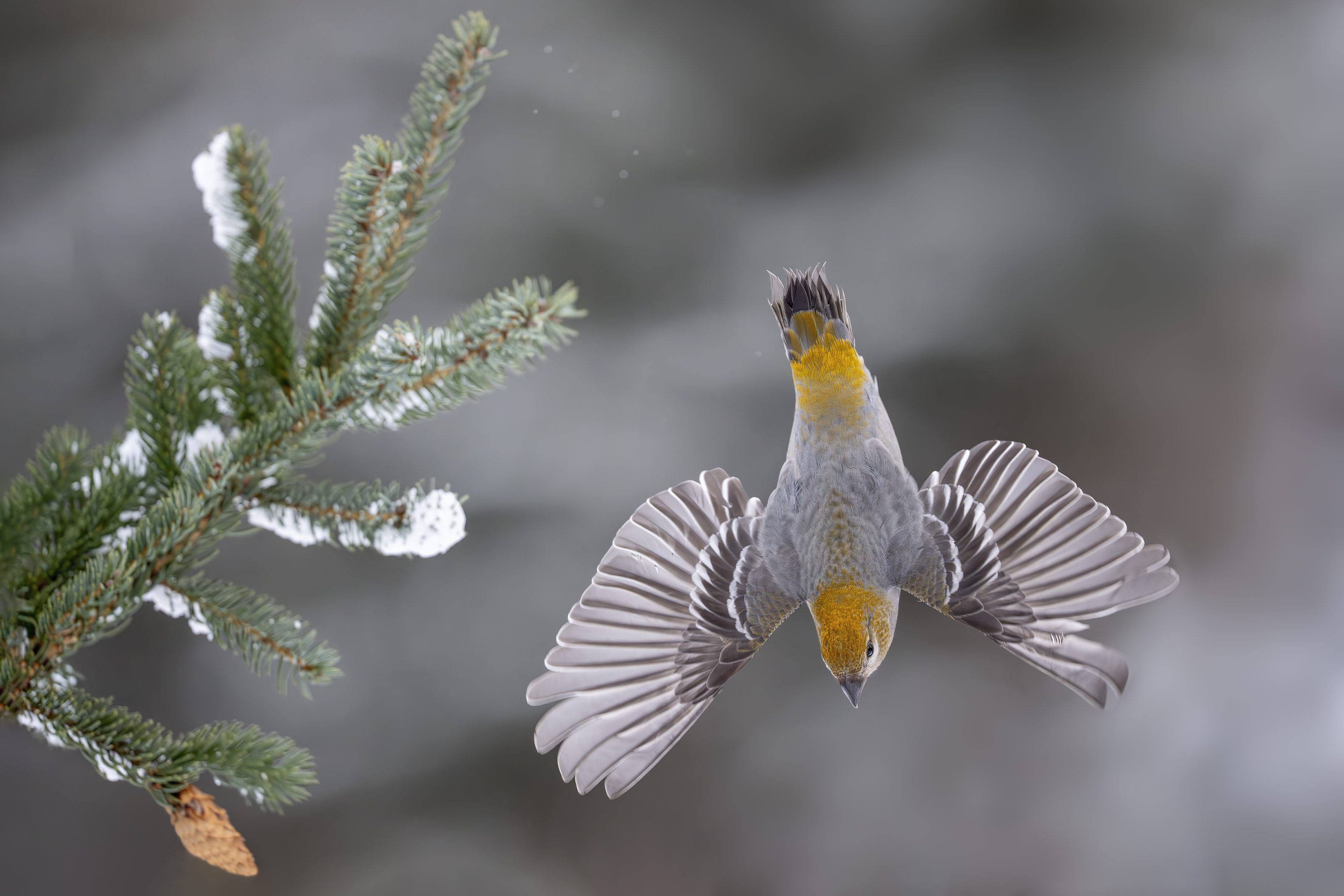
I was lucky to have gotten the whole bird in the frame (just barely) without clipping anything. The autofocus system of the a-1 ii performed superbly by nailing the bird’s eye. My first thought was to go tight with a fairly large crop and add a bit of canvas below. When I shared the image with the group at dinner, Chris Loffredo suggested that I create a wider version that showed more of spruce tree setup. So, I did.
|
|
This image was created by yours truly on 11 February 2026 on the first songbird day before the Homer IPTs. Standing on snow and ice behind my she used the Tracking: Zone/AF-C with Bird Eye/Face Detection enabled performed perfectly. Click on the image to enjoy the larger, inexplicably sharper high-res version. Image #1B: Pine Grosbeak diving off perch. Version II: wide |
Your Call?
Which do you feel is the stronger image? The tight version, Image 1A, or the wider version, Image 1B? Why did you make your choice?
|
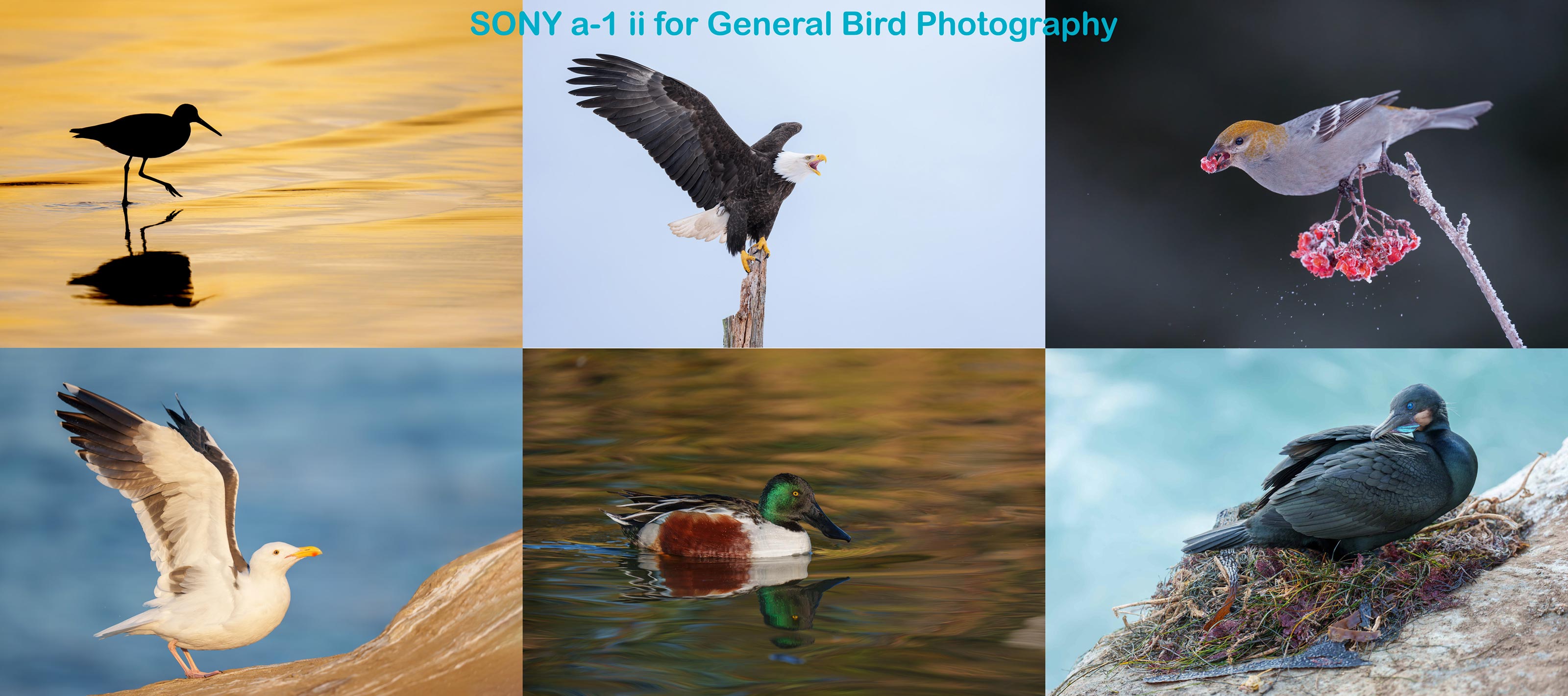
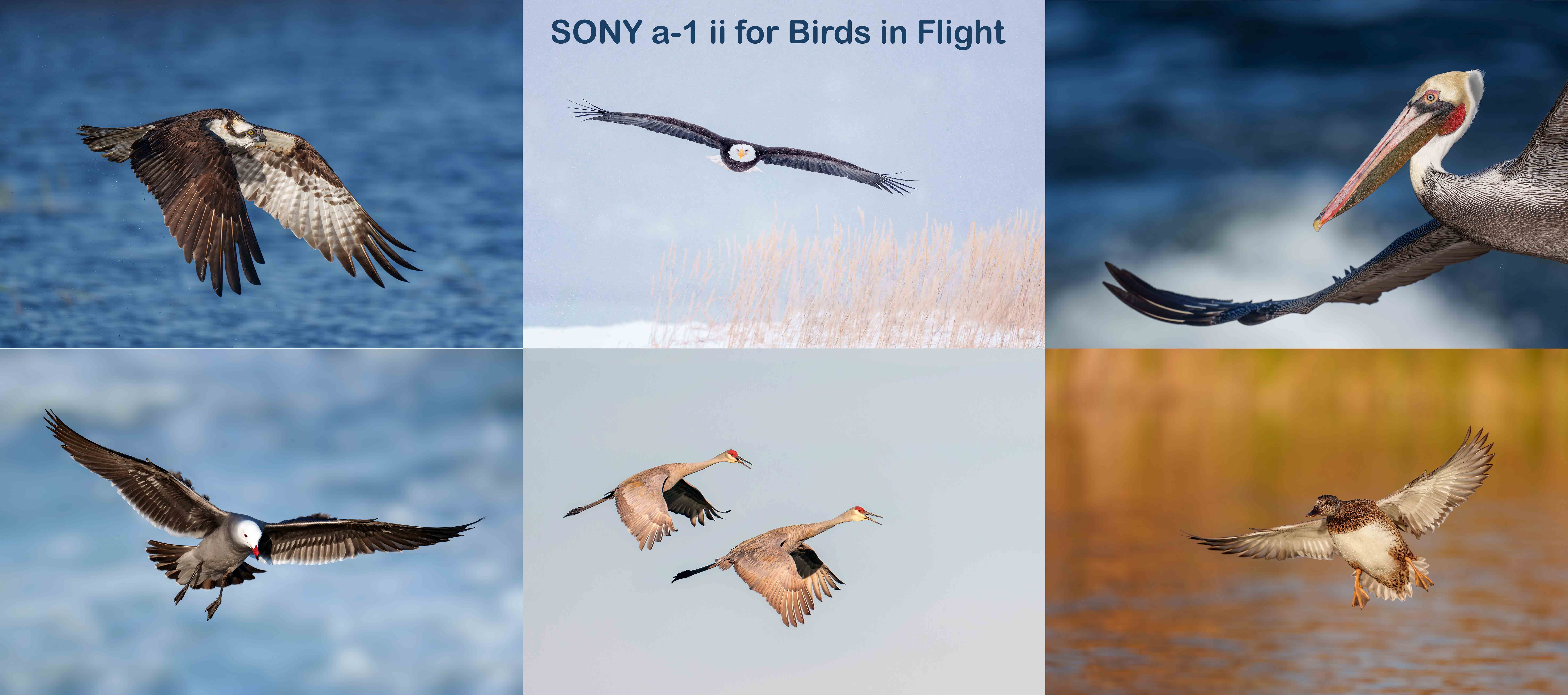
Composite #1: All with the a-1 ii Mirrorless Camera body.
|
The a-1 ii for General Bird Photography
I have found that eye-tracking for general bird photography with the a-1 ii is far, far better than with the original Sony a-1. It grabs the eye and tracks it faster and far more consistently and focus is rarely lost, even with backgrounds other than sky.
|
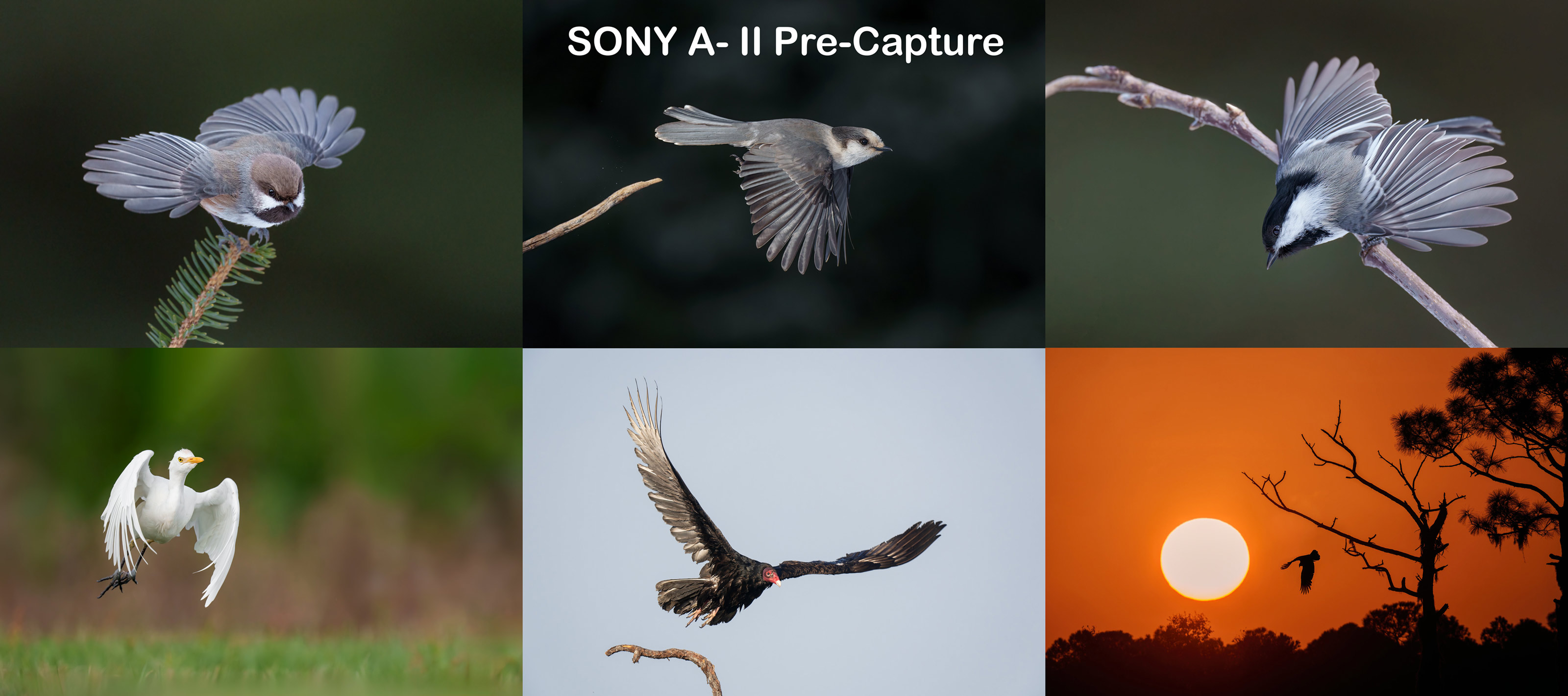
Composite #2: All with the a-1 ii Mirrorless Camera body.
|
The a-1 ii for Birds in Flight
For birds in flight, the a-1 ii Mirrorless Camera body has no equal. As Arash Hazeghi says, “It is better than the a-1.” When I am late getting on a bird in flight, I have consistently been amazed at how often the AF system of the a-1 ii finds and tracks the bird’s eye.
|
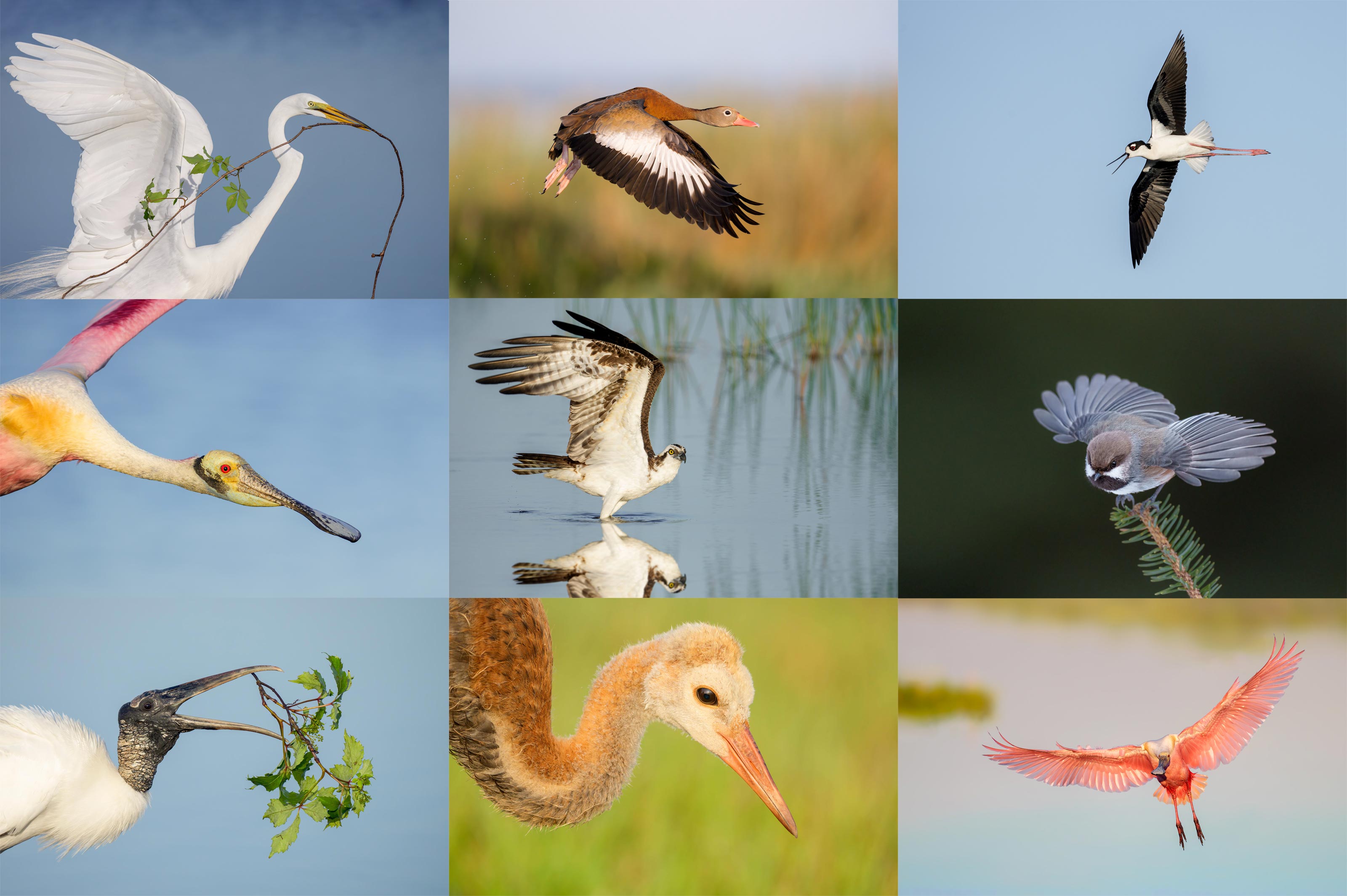
Composite #3: All the result of using Pre-Capture with the a-1 ii Mirrorless Camera body.
|
Pre-Capture with the Sony a-1 ii
When it comes to Pre-Capture with the a-1 ii Mirrorless Camera body, Arash and I agree 100%. And with my slower reflexes, Pre-Capture is more important for me than it is for Arash. Understand that in each of the images in Composite #3, I did not push the shutter button until after the bird took flight!
|
All with the a-1 ii Mirrorless Camera body.
|
Purchasing or Upgrading to a Sony a-1 ii
The Sony a-1 ii e-Mail Set-up and Info Guide
I now own and use two Sony a-1 ii bodies. Every day that I use them, the more I am amazed by speed and accuracy of the Bird Face-Eye tracking in AF-C and the overall performance of the camera.
Aside from the improved ergonomics as compared to the a-1, other nice features include the fact that the rear screen tilts both ways — the lack of a tilting rear screen on the original a-1 always ticked me off. Pre-capture has proven to be a huge plus almost exclusively for take-off flight images. In my opinion, the Speed Boost feature is a total waste for bird photography because you should always be utilizing the maximum frame rate. In addition, the resolution on the rear monitor has been improved dramatically. I must mention again that Bird Face-Eye tracking on the a-1 ii is vastly improved as compared to both the a-1 and the a9 iii and that the 51MP files are to die for.
So, the big question is, is the a-1 ii “worth” a gear upgrade. Remembering that I can never know whether or not something is worth it to you, I can say that I was not floored when first using my a-1 ii. The differences between the a-1 ii and the original a-1, seemed to be neither huge nor eye-opening. But over time, I have come to realize that I was 100% wrong. The huge difference between the new camera body and the a9 iii is, of course, the 51MP a-1 raw files (as compared to the 24MP files rendered by the a9 iii).
The price of a new a-1 is $5,898.00. The price of a new a-1 ii is $1,100.00 more: $6,998.00. As the a-1 ii is clearly far superior for bird photography to the original a-1, the choice for folks new to Sony or for those upgrading from lesser Sony camera bodies is an easy one. Prices for used a-1 bodies has not dropped drastically as I anticipated. At this point, a-1 folks who like showing flight and action and can afford an a-1 ii, are advised to purchase an a-1 ii. Please remember that life is short; we only get one ride on the merry-go-round.
If you do purchase an a-1 ii, be sure to use one of my two affiliate links so that you will receive my a-1 ii settings (in the form of a CAMSEa1ii.DAT file), the Buttons and Dials Guide, and an Info Sheet for free. Using my links will never cost you one penny and may actually save you some money. Folks who do not purchase their new a-i using my B&H link or from Bedfords here and entering the BIRDSASART discount code at checkout will be able to purchase the a-1 ii guide for $244.93. If you are at all confused and do not want to screw up your order, please get in touch via e-mail. If you would like to chat about upgrading, shoot me a text to 863-221-2372 and LMK a good time to call you.
Typos
With all blog posts, feel free to e-mail or to leave a comment regarding any typos or errors.











My pick is 1B
Love the expanded negative space and the more green branch
One gift grief has given me is an enhanced appreciation for those around me now. It does not make grief any better but allows for a positive off-ramp.
1A because the tight crop gives a lot more detail of the bird.
On death and dieing… I lost my husband 26 yeas ago in April. Life has not been the same since. Finding that special someone is a once in a lifetime chance. I miss him everyday and wonder how my life would have been different with him still in it. Mike loved me with everything he had and he showed it every day. As time went on the heart break has gotten easier but never to be forgotten. i have come to the conclusion that I will see him again some day soon!!
I like 1A. love tight images..up in your face!
>> The first songbird day was fabulous. Between the four of us, we created more than 54,000 images. <<
Imagine if you were still shooting film?
My grief at losing Stokes three years ago was somewhat assuaged by the fact that we had talked about death and dying many times over our 66 years together and I knew he didn’t want to live a diminished life. Quality of life was more important to both of us than length of life. The other thing that helped me deal with his loss was the “gift” he gave us: Three days before he died, his face rapturous and his arms in the air, he said, “The families are coming, the families are coming.” Then, despite the fact that neither of us were religious, he said, “Lord, Stokes Fishburne” — as if introducing himself to the Lord. Then, he said, “I think I am going to stay a little longer.” About an hour later, he said, “Lord, It’s my life, I get to decide! I want to stay with Pat.” Then, he shrugged his shoulders and said, “Okay.” This “gift” made all of us more accepting of his death since it was clear that he was going someplace and was at peace with it.
That’s a beautiful story, thanks for sharing
This is a beautiful recounting of your last hours together and his transition. I am imagining how this gift could be treasured as your life continues without him … but after 66 years together … no words! Thank you very much for sharing this with us.
Hi Artie, it’s image 1A for me too. I think that the fir branch and background are still featured in 1A and nothing is gained for including a bit more, for me anyway. The lovely feather detail is improved by making it larger in the frame. It’s that detail which we don’t see with our naked eyes that always wows me.
love to you Artie. Clive.
Artie,
It’s been years since I’ve been to Ding Darling or Bosque or did any bird photography, for that matter. The weight of the camera gear + old age took its toll. Nonetheless, are those spots still viable for bird photography? Last time I was there it wasn’t as good as in the glory years. Still miss K-Bobs!
Hi Dick,
Both have gotten worse over time 🙁
with love, artie
My pick is image 1A. The branch is just a distraction of the main subject which is the bird.