
Seeking Used Sony a-1 Camera Bodies
After selling both of my remaining a-1 bodies along with my Sony 12-28 and my 400m f/2.8 GM lens on the Used Gear page, I have several buyers interested in purchasing a used a-1 in excellent or better condition for a fair price, well more than you would get from B&H or any of the other companies that regularly purchase used gear. If you have an a-1 body that is sitting on a shelf gathering dust and would like to sell it, please get in touch via e-mail.
Your Call?
Which of today’s six featured images is your favorite? Why did you like it best?
My Call
In the recent blog Two New Chick Photos with the Sony 300mm f/2.8 GM Lens (and a Spectacular Mockingbird Mobbing Barred Owl Image) post here, only two folks bothered to comment. Each liked the crane chick best especially because of the raised foot. My favorite by far was the mockingbird harassing the Barred Owl for several reasons:
1- The fact that both birds were on the exact same plane.
2- The wings down attacking pose of the much smaller songbird.
Thanks to David Policansky for asking this excellent question:
One typically thinks of babies as having big heads, but this one has huge feet. What can you tell us about the biology of that?
That prompted some research along with this reply:
Adapted from AI Overview:
Young cranes have disproportionately large feet and long legs to provide stability and support for fast growth. These oversized limbs help them walk, run, and forage within 24 hours of hatching, while also helping them navigate marshy, uneven terrain. They eventually “grow into” their feet as they mature.
From artie: I’ve seen tiny chicks walking around in the marsh outside the nest less than an hour after hatching.
What’s Up?
The second 2026 Roseate Spoonbill Stick Marsh IPT has been going great guns. We did the baby cranes at ILE on the first morning and had a fabulous session on Wednesday. We lucked out late on Thursday morning when two spoonies flew in to bathe right after I had given up and headed back to my SUV to start packing up. Anyhoo, I made a quick u-turn and got in on the action. we stayed late again on Friday morning and were rewarded when a Wood Stork flew in to play with nesting material. We enjoyed two decent afternoon sessions at Sebastian Inlet State Park. I took the group to the fabulous Oar Restaurant on Friday evening for the thank you dinner. As always, the dining was fine and everyone loved their meal. After sharing two orders of their amazingly delicious Cornmeal-Fried Green Tomatoes with bacon jam, goat cheese, sundried tomatoes, and balsamic glaze. Five of the seven folks had and raved about their signature dish: Pan Seared Pork Chop – sweet potato purée, grilled asparagus, pear-rosemary chutney, and toasted almonds. Bob Eastman had the short ribs (“beyond amazing”) and Steve Shore went for the seafood pot pie.
Today is Saturday 28 March 2026. The forecast is for a negligible breeze from the NW so we have our fingers crossed. I hope that you too choose to have a happy and productive day.
If an item — a Delkin flash card or reader, a Levered-clamp FlexShooter Pro, or a Wimberley lens plate or low foot — for example, that is available from B&H and/or Bedfords, is also available in the BAA Online Store, it would be great, and greatly appreciated, if you would opt to purchase from us. We will match or beat any price. Please remember also to use my B&H affiliate links or to earn 3% cash back at Bedford by using the BIRDSASART discount code at checkout for your major gear purchases. Doing either often earns you free guides and/or discounts. And always earns my great appreciation.
Gear Questions and Advice
Too many folks attending BAA IPTs and dozens of photographers whom I see in the field and on BirdPhotographer’s.Net, are — out of ignorance — using the wrong gear, especially when it comes to tripods and more especially, tripod heads. And the same is true in spades when ordering new camera bodies or lenses. My advice will often save you some serious money and may help you avoid making a seriously bad choice. Please know that I am always glad to answer your gear questions via e-mail. If you are in a hurry, you can try me on my cell at 863-221-2372. Please leave a message and shoot me a text if I do not pick up.
IPT Updates
I was thrilled to learn that multiple Homer IPT veteran Chris Loffredo will be joining the second 2027 San Diego IPT and that long-ago IPT veteran Jon Sostarich and multiple IPT veteran Mike De Rosa will be attending the first 2027 Homer IPT and both songbird days. See the complete details here.
San Diego IPT #1: 4 1/2 DAYS: WED 6 JAN thru the morning session on SUN 10 JAN 2027: $2699.00. Deposit: $699.00. Limit: 5 photographers.
San Diego IPT #2: 4 1/2 DAYS: TEUS 19 JAN thru the morning session on SAT 23 JAN 2027: $2699.00. Limit: 5 photographers/Openings: 4.
Anchor Point Songbird Days: WED 10 FEB & TUES 11 FEB 2027. Full day: $500/day.
Homer IPT #1: FRI 12 FEB 2027 through the full day on TUES 16 FEB 2027. Five days/20 hours on the boat: $5900.00. Limit 5 photographers/Openings: 1
Homer IPT #2: WED 17 FEB 2027 through the full day on SUN 21 FEB 2027. Five days/20 hours on the boat: $5900.00. Limit 5 photographers/Openings: 2
Dates for the three 2027 Stick Marsh IPTs will be announced here soon.

B&H Simplified
To ensure that I get credit for your B&H purchases, you can always click here. The tracking is invisible. Using my affiliate links is greatly appreciated. And, with B&H, you can use your PayBoo card. You must use the website to order. You cannot get your free guides if you make a phone order. Once you have an item in your cart, you must complete the order within two hours. Huge thanks!
B&H
Many folks have written recently stating that they purchased a Sony a1 from B&H and would like their free membership in the Sony 1 Info and Updates Group, a $150.00 value. But when I check my affiliate account, their orders have not been there. When I let them know that they get credit for B&H purchases only if they use one of the many B&H affiliate links on the blog or begin their searches with this link, they are always disappointed. If in doubt, please contact me via e-mail and request a BH link. I am always glad to help and to guide you to the right gear.

Bedfords Simplified
Click here to start your search. Choose standard shipping, and when you get to the payment page, enter BIRDSASART in the discount code box and hit apply. You will be upgraded to free second day air Fed-Ex and receive 3% cash back on your credit card once your stuff ships. Using either my affiliate links is greatly appreciated and will often earn you free guides or discounts. To receive a free guide or free entry into a Sony Set-up and Info Notes e-Mail group, you need to shoot me your receipt via e-mail. The B&H receipts need to include the order number.
Bedfords Amazing BAA Discount Policy
Folks who have fallen in love with Bedfords can always use the BIRDSASART coupon code at checkout to enjoy a post-purchase, 3% off-statement credit (excluding taxes and shipping charges) on orders paid with a credit card. The 3% credit will be refunded to the card you used for your purchase when your product ships. Be sure, also, to check the box for free shipping to enjoy free Second Day Air Fed-Ex. This offer does not apply to purchases of Classes, Gift Cards, or prior purchases.
You can visit the Bedfords website here, shoot Steve Elkins an e-mail, or text him on his cell phone at (479) 381-2592.
|
|
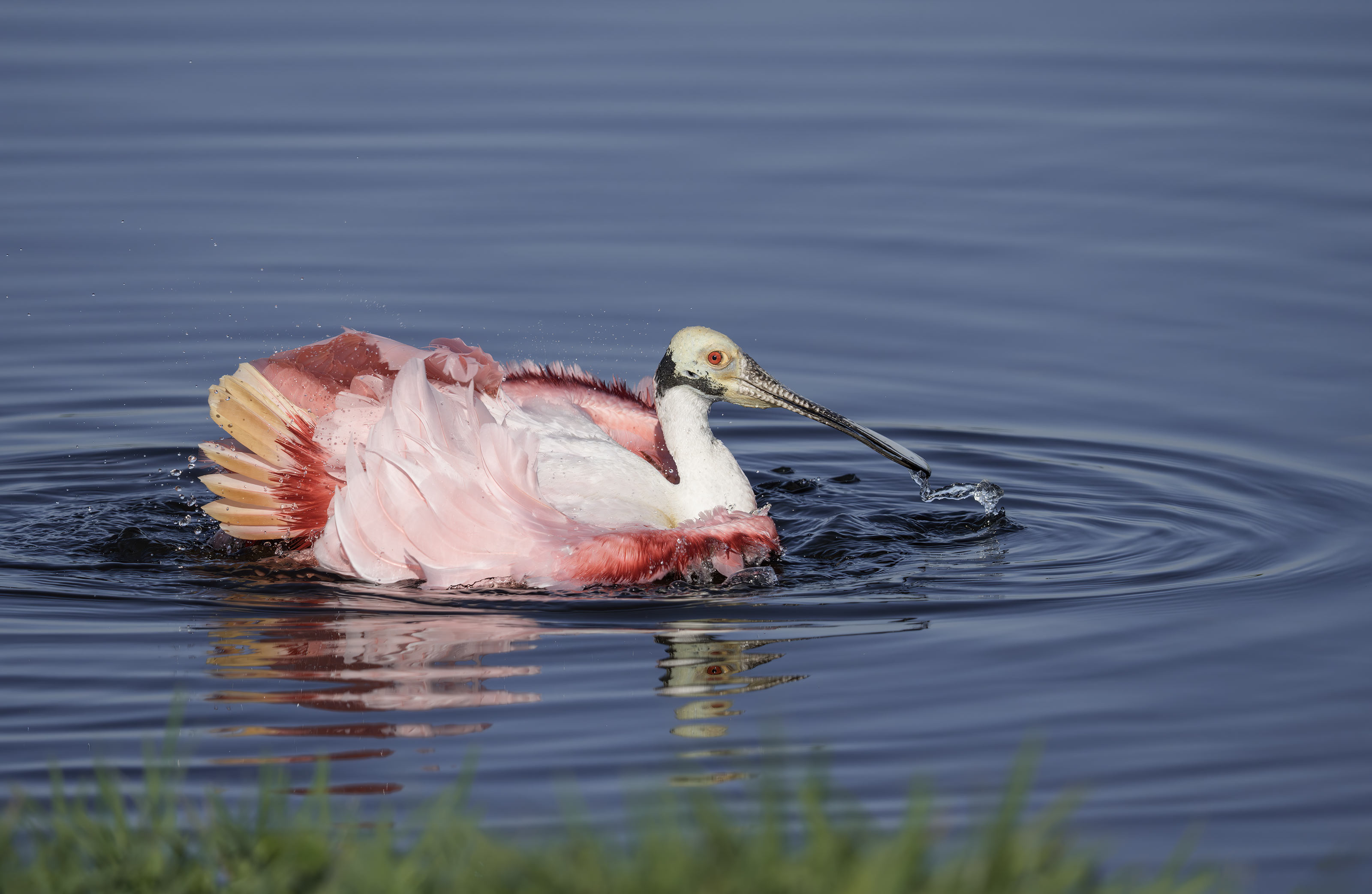
This image was created on 26 March 2026 at Fellsmere Grade Recreation Area, FL on the second Stick Marsh IPT. Seated on a the grass, I used the handheld Sony FE 400-800mm f/6.3-8 G OSS lens (Sony E) (at 619mm) and The Latest Greatest Sony Flagship Body, the a1 II Mirrorless Camera. The exposure was determined by Zebras with ISO on the rear wheel — ISO 1000: 1/4000 second at f/8 (wide open) in Manual mode. RawDigger showed that the exposure was perfect. AWB at 9:27:14am on then bright sunny morning. Wide/AF-C with Bird-Eye/Face Detection performed perfectly. Click on the image to enjoy the larger, inexplicably sharper high-res version. Image #1: Roseate Spoonbill adult starting to bathe |
The Late Morning Bathing Spoonbills Miracle
Our second morning at Stick Marsh has been a bit on the slow side. I kept hoping that we might end with something spectacular. There were some neat images to be made after the foggy sunrise but fewer spoonies flew in than had on our fabulous first morning. The sun was out fully just after eight. Bored by 9:25am, I started bringing my stuff up to the car. The folks in the group were hanging on and hanging out. Everyone but Mark Smith and his son had left by 8:30. I had just taken my a-1 ii off the 400-800 when four spoonbills flew in and landed in the still water. It was hot by then and I thought, “Conditions are prefect for bathing.” Before I finished my thought, two of the birds began bathing so I shouted to the group as they had been milling around. Everyone got on the ground and got to work. Things were intense; everyone created between three and five thousand images of the bathing and then preening birds. After the bathing stopped we scooched closer to the bird on our butts for head shots. At breakfast, I asked everyone to estimate how long we had with the four birds. All agreed on at least a half hour or 40 minutes at the least. The photos showed 17 minutes from the first image to the last — 14 minutes for me as I had been late to the party.
It just shows to go ya’: you cannot make any good images if you are sitting at home, or in your hotel or AirBnb on a couch.
|
|
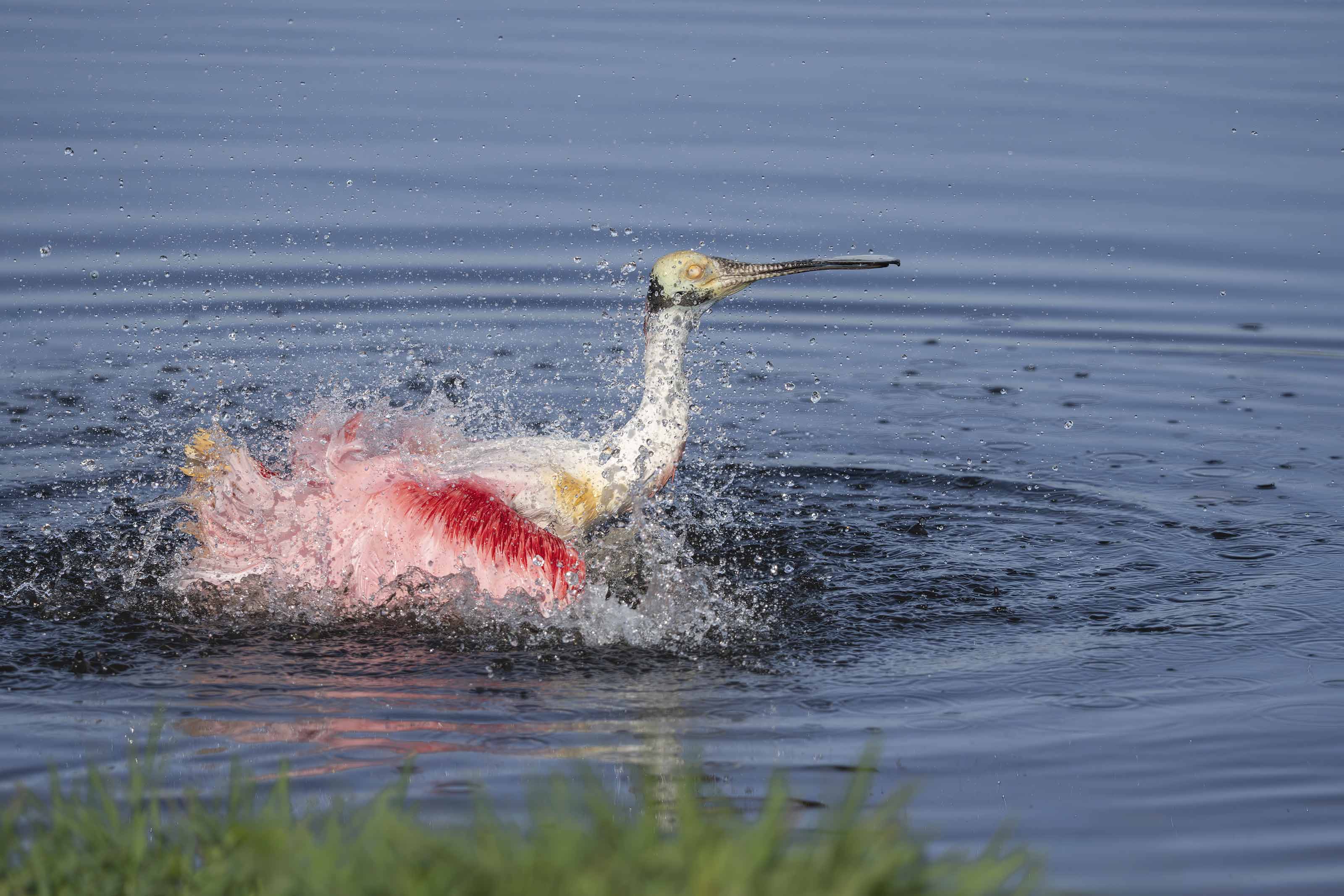
This image was created on 26 March 2026 at Fellsmere Grade Recreation Area, FL on the second Stick Marsh IPT. Seated on a the grass, I used the handheld Sony FE 400-800mm f/6.3-8 G OSS lens (Sony E) (at 559mm) and The Latest Greatest Sony Flagship Body, the a1 II Mirrorless Camera. The exposure was determined by Zebras with ISO on the rear wheel — ISO 1000: 1/4000 second at f/8 (wide open) in Manual mode. RawDigger showed that the exposure was perfect. AWB at 9:27:42am on then bright sunny morning. Wide/AF-C with Bird-Eye/Face Detection performed perfectly. Click on the image to enjoy the larger, inexplicably sharper high-res version. Image #2: Roseate Spoonbill adult bathing — maximum splashing |
Maximum Splashing
Though I could have replaced the closed eye, I did not mind that the nictitating membrane was over the bird’s eye in this image as it was splashing furiously.
Adapted and Improved from Wikipedia
The nictitating membrane is a transparent or translucent “third eyelid” found in many birds (and reptiles, fish, and some mammals). It moves horizontally across the eye to protect it from debris, another bird’s beak, or to moisten it, acting like “nature’s goggles,” used for protection while diving, flying, hunting, bathing, squabbling, or feeding young.
|
|
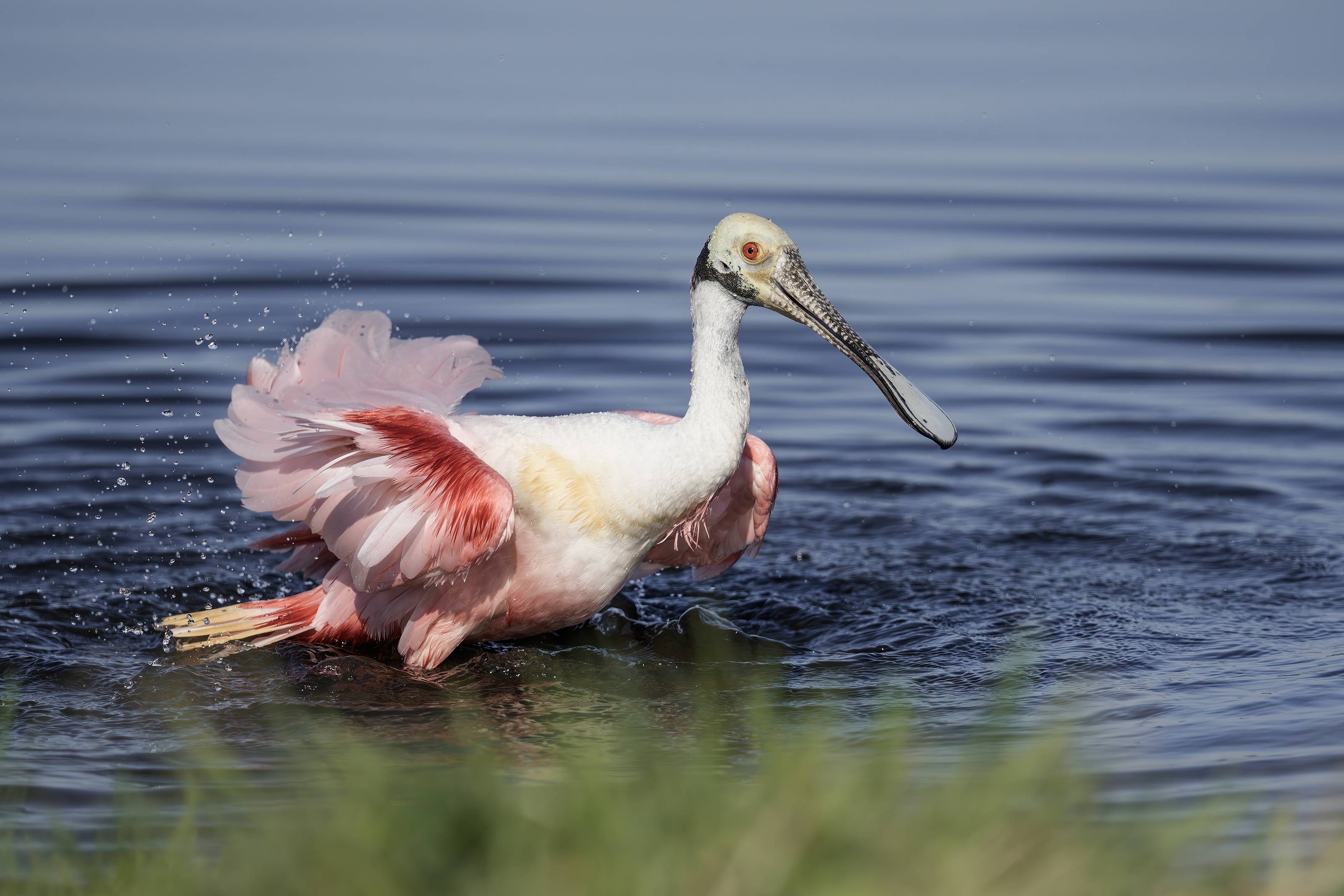
This image was created on 26 March 2026 at Fellsmere Grade Recreation Area, FL on the second Stick Marsh IPT. Seated on a the grass, I used the knee-pod technique with the handheld Sony FE 400-800mm f/6.3-8 G OSS lens (Sony E) (at 619mm) and The Latest Greatest Sony Flagship Body, the a1 II Mirrorless Camera. The exposure was determined by Zebras with ISO on the rear wheel — ISO 1000: 1/4000 second at f/8 (wide open) in Manual mode. RawDigger showed that the exposure was perfect. AWB at 9:29:13am on then bright sunny morning. Wide/AF-C with Bird-Eye/Face Detection performed perfectly. Click on the image to enjoy the larger, inexplicably sharper high-res version. Image #3: Roseate Spoonbill adult bathing |
It Was a Very Good Day
On Thursday past I created 8021 images. I kept 421. In just four minutes, I created more than 2,000 photos of the two bathing spoonies. In the next ten minutes, I made more than 3000 more images of the same birds preening. It was quite a good day.
Though I was using the knee-pod technique, I needed to lift the left up to get over the foreground grass in this image. Both of my shoulders were feeling the weight of the 400-800. I mentioned that I wish I had brought my monopod down from the car … I opted to suffer a bit rather than risk missing anything great.
|
|
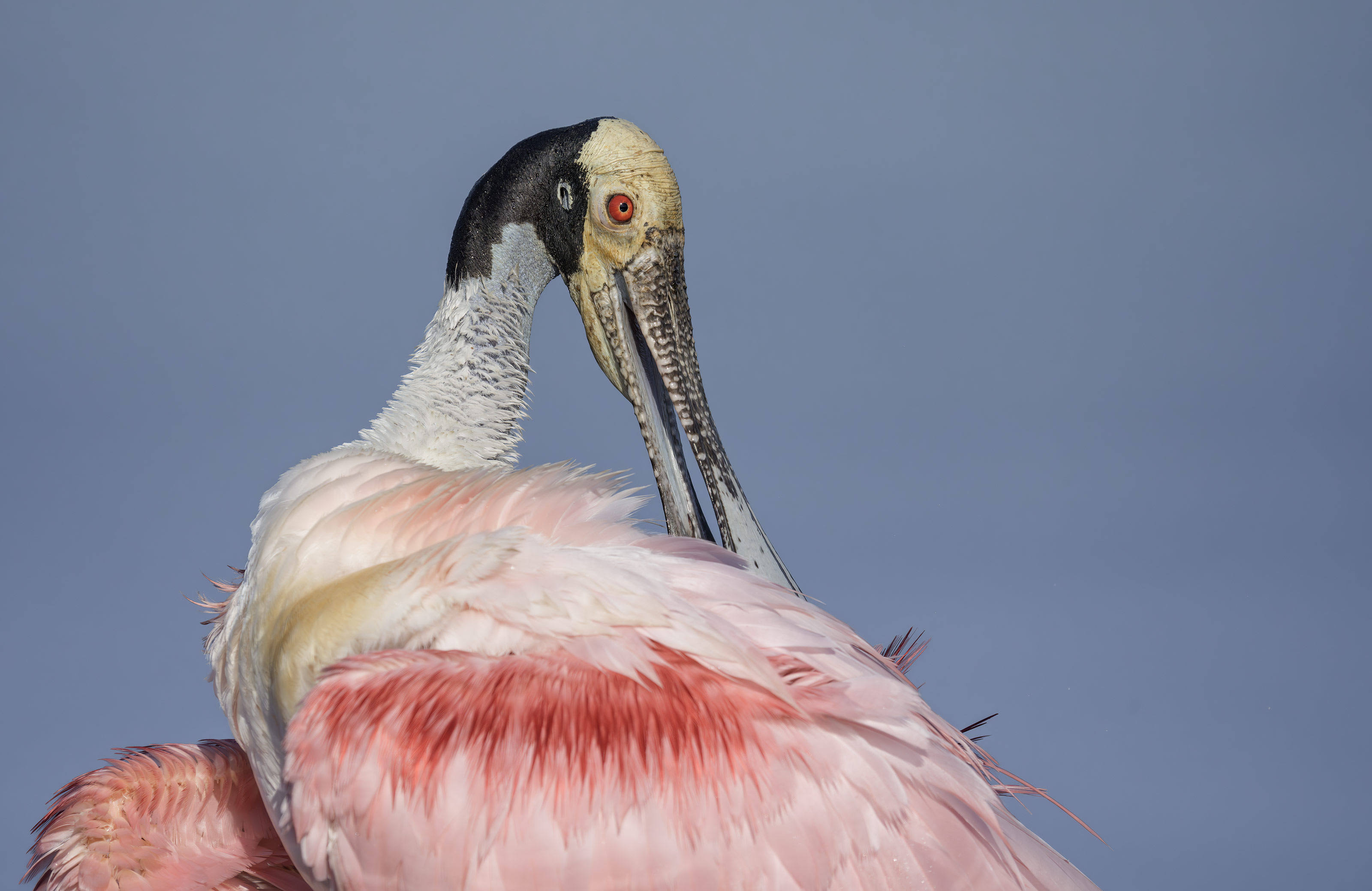
This image was created on 26 March 2026 at Fellsmere Grade Recreation Area, FL on the second Stick Marsh IPT. Seated on a the grass, I used the Robus RCM-439 4-Section Carbon Fiber Monopod, 65/Wimberley MonoGimbal Head-supported Sony FE 400-800mm f/6.3-8 G OSS lens (Sony E) (at 800mm) and The Latest Greatest Sony Flagship Body, the a1 II Mirrorless Camera. The exposure was determined by Zebras with ISO on the rear wheel — ISO 1000: 1/4000 second at f/8 (wide open) in Manual mode. RawDigger showed that the exposure was perfect. AWB at 9:30:30am on then bright sunny morning. Wide/AF-C with Bird-Eye/Face Detection performed perfectly. Click on the image to enjoy the larger, inexplicably sharper high-res version. Image #4: Roseate Spoonbill tight preening |
Bobby Boo to the Rescue
The next thing that I know, Bob Eastman tapped me on the shoulder and handed me my monopod. What a great friend to have as an assistant!
To learn more about monopodding see the Robus MonoPodding With the Sony 400-800 G Lens blog post here.
|
|
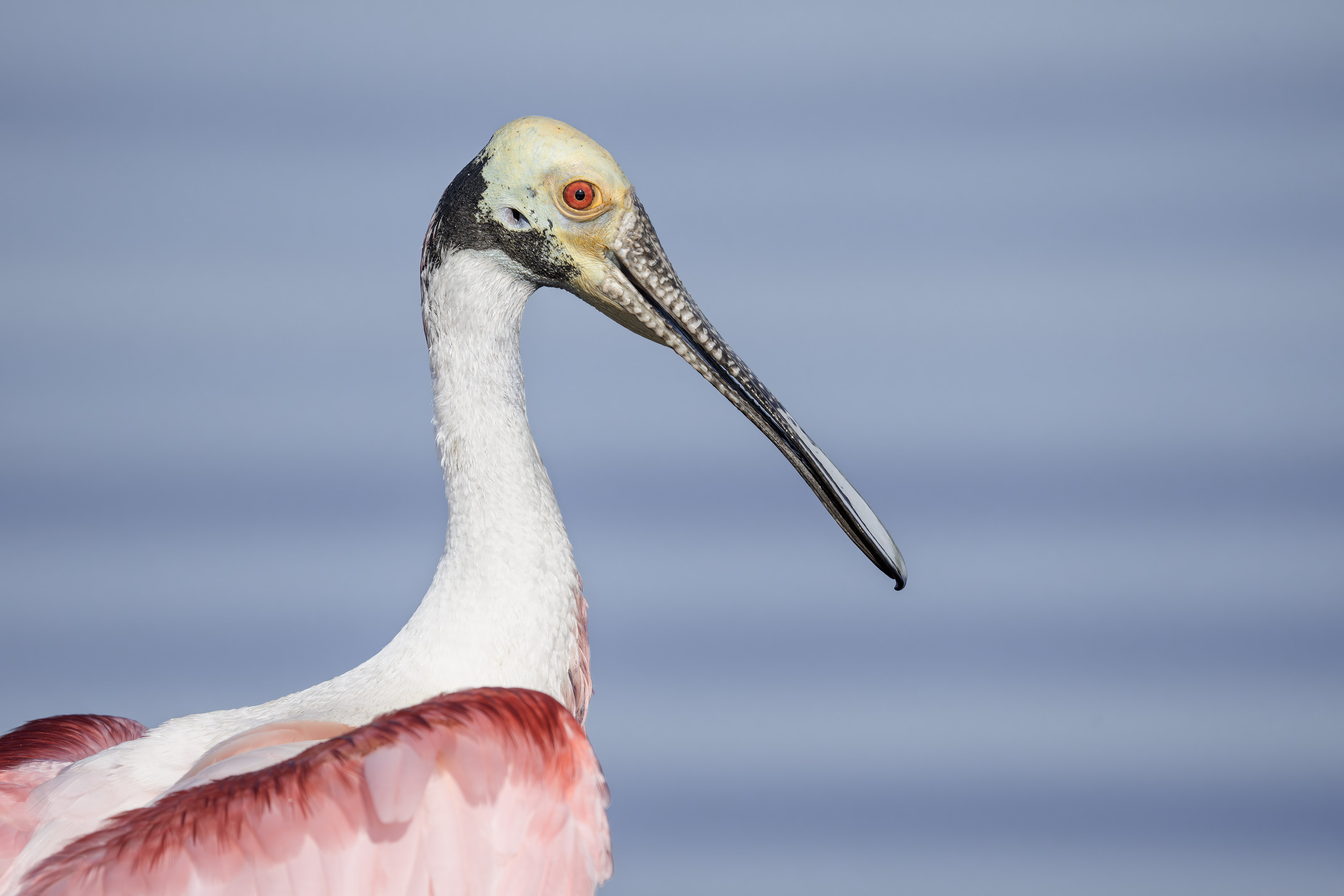
This image was created on 26 March 2026 at Fellsmere Grade Recreation Area, FL on the second Stick Marsh IPT. Seated on a the grass, I used the Robus RCM-439 4-Section Carbon Fiber Monopod, 65/Wimberley MonoGimbal Head-supported Sony FE 400-800mm f/6.3-8 G OSS lens (Sony E) (at 800mm) and The Latest Greatest Sony Flagship Body, the a1 II Mirrorless Camera. The exposure was determined by Zebras with ISO on the rear wheel — ISO 1000: 1/3200 second at f/8 (wide open) in Manual mode. RawDigger showed that the exposure was perfect. AWB at 9:31:56am on then bright sunny morning. Wide/AF-C with Bird-Eye/Face Detection performed perfectly. Click on the image to enjoy the larger, inexplicably sharper high-res version. Image #5: Roseate Spoonbill head portrait |
The Patriotic Motif
With this image, I love the combination of red and white with the soft blue tones. Note that as we are exposing for the whites, the middle-toned blue water is rendered one stop too dark. I used the Luminance slider in Color Mixer in Adobe Camera Raw to pleasingly lighten the water.
Once the Sun Comes Out …
Once the sun comes out at full strength at Stick Marsh, I reach for my Sony 400-800. I first tried the 4-8 there on the spoonbills (and lots of others species as well) and was quickly amazed by the variety of new and different images that I made despite its slow speed (f/8 at the long end) and its considerable weight. I use it often with the 1.4X TC and the results at 1120mm at f/11 are nothing short of astounding. For me it has been a game-changer in part because it is much easier to travel with than the 600mm f/4 because of its smaller size.
|
|
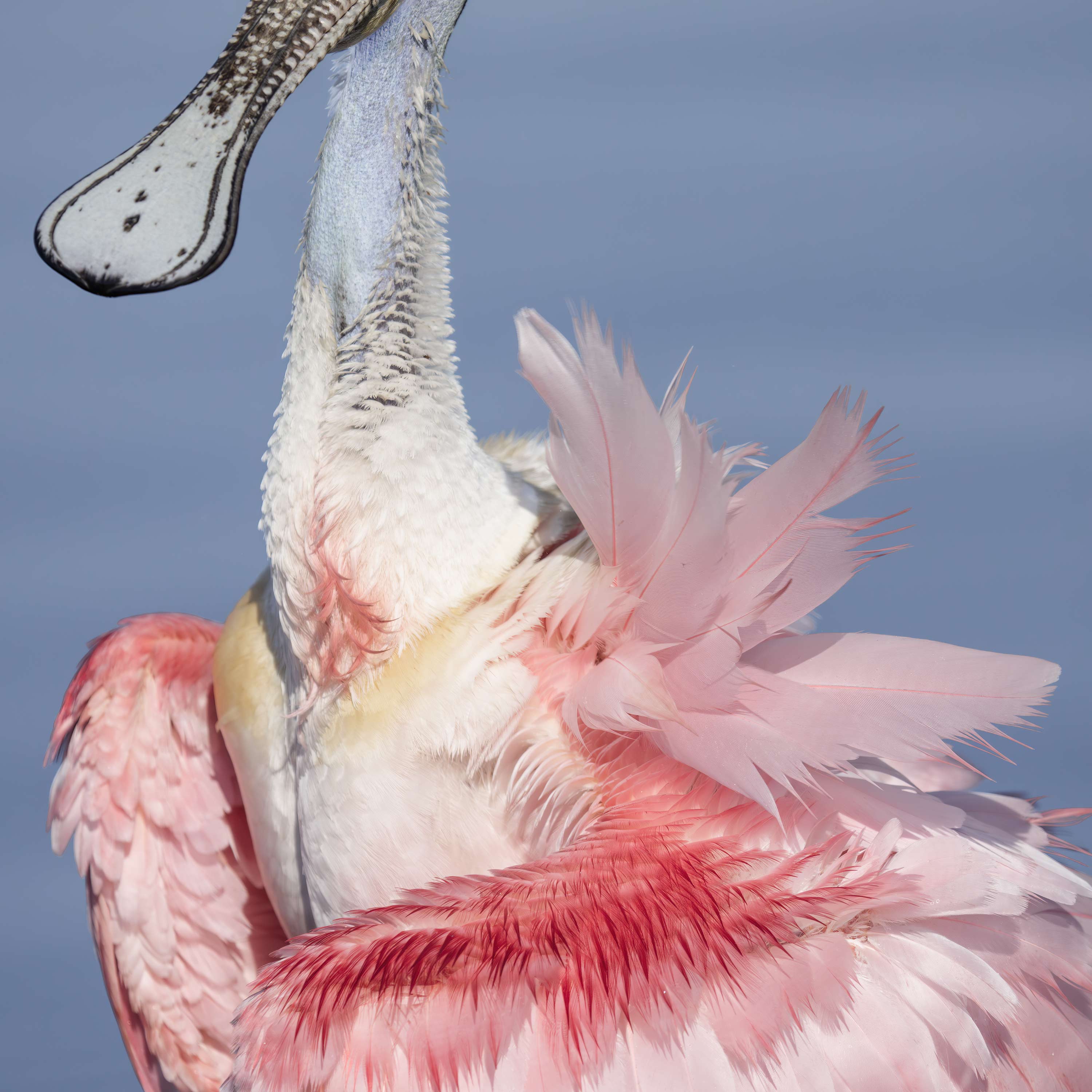
This image was created on 26 March 2026 at Fellsmere Grade Recreation Area, FL on the second Stick Marsh IPT. Seated on a the grass, I used the Robus RCM-439 4-Section Carbon Fiber Monopod, 65/Wimberley MonoGimbal Head-supported Sony FE 400-800mm f/6.3-8 G OSS lens (Sony E) (at 800mm) and The Latest Greatest Sony Flagship Body, the a1 II Mirrorless Camera. The exposure was determined by Zebras with ISO on the rear wheel — ISO 1000: 1/3200 second at f/8 (wide open) in Manual mode. RawDigger showed that the exposure was perfect. AWB at 9:32:45am on then bright sunny morning. Wide/AF-C with Bird-Eye/Face Detection performed perfectly. Click on the image to enjoy the larger, inexplicably sharper high-res version. Image #6 Roseate Spoonbill splayed feathers |
Like it or Hate It?
I clipped the top of the spoonbill’s head but I loved the splayed feathers and the bare blue skin on the bird’s neck so I went with a square crop to emphasize both. Please be honest: do you like the headless image and the unorthodox crop or do you hate it? Why?
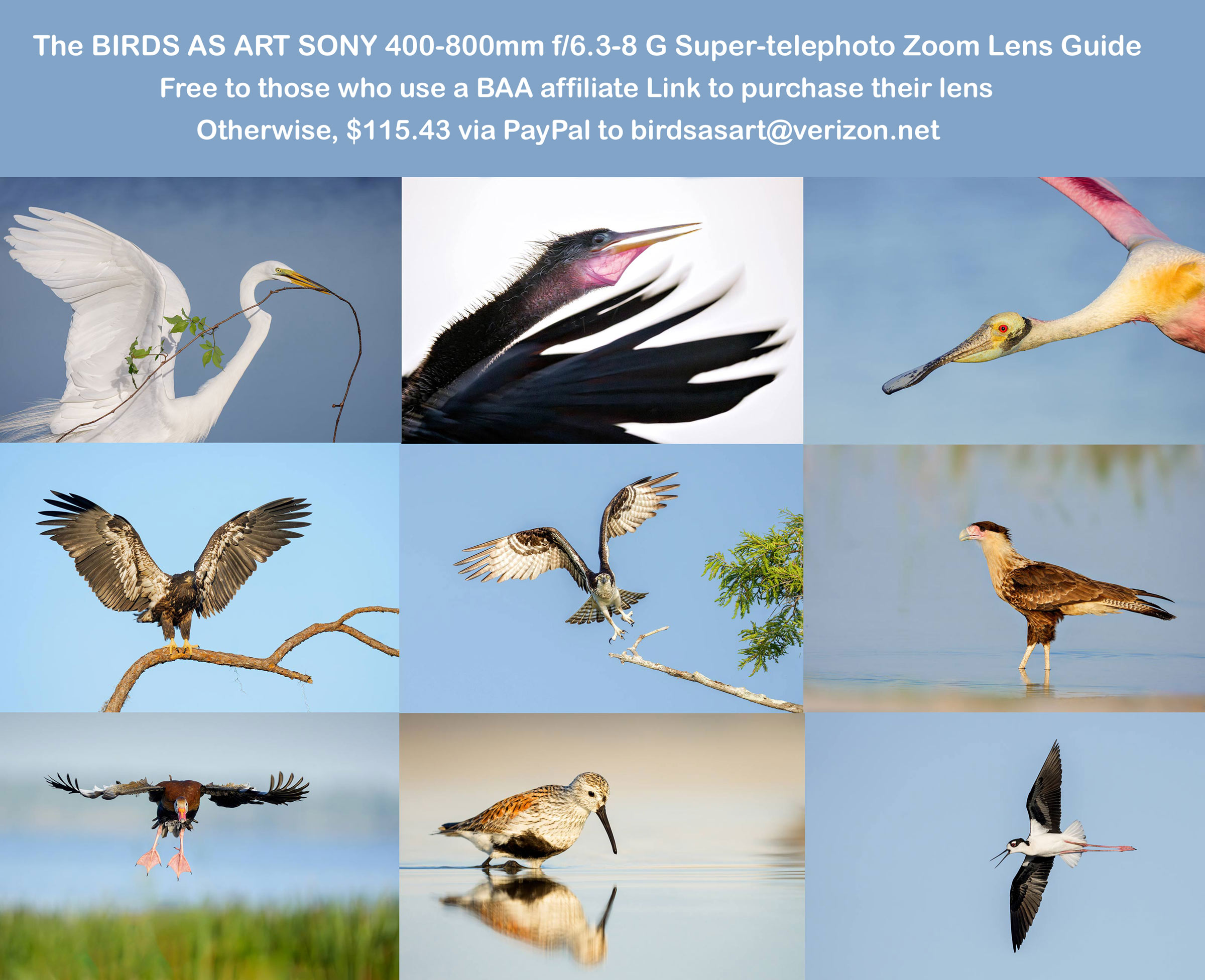
The BIRDS AS ART SONY 400-800mm f/6.3-9 G Super-telephoto Zoom Lens Guide
When I borrowed this lens from Sony, I assumed that at 5.45 pounds it was too heavy to handhold for long and that at f/8 at the long end (800mm,) it was too slow for most bird photography applications. In short, I did not want to like the lens. After a month of using it, I cannot live without it. After returning the loaner, I was miraculously able to get my own from Bedfords on 16 April 2025. In this guide I share everything that I have learned about using the 400-800. For best results, you need to know exactly what you are doing to get the most out of this zoom lens. It would be best, therefore, to consider and study the material in the guide so that you can begin making great images with your new lens.
You will learn how to deal with the relatively show apertures: f/6.3, f/7.1, and f/8 when working in Manual mode.
You will learn how to ensure that you are working at the widest aperture by working in Shutter Priority mode with AUTO ISO.
If you are able to hand hold the lens, you will learn proper hand holding techniques.
If you can’t, you will learn when, why, and how to employ other options. Those include:
1- The knee-pod, heel-pod, and toe-pod techniques
2- Using the lens on a monopod.
3- The best lens plate and low foot for your 4-8.
4- The best tripod and head for the 4-8 and how best to utilize them.
5- How to use the lens from your vehicle while supporting it on a BLUBB (or not and why not).
6- Detailed instructions on how to set and use the lens controls and buttons:
a- AF/MF
b- DMF Switch
c- Limit Range Switch
d- OSS (Optical Steady Shot) Switch
e- OSS Mode Switch
f- Focus Hold Buttons
The guide also includes a Hand Holding Shutter Speed Primer and an illustrative, educational, and inspiring 67-image gallery.
Free to folks who use one of my two affiliate links to purchase their Sony 400-800 G lens. Otherwise, please send a PayPal for $115.43 to birdsasart@verizon.net and include the words “400-800 Lens Guide” in your e-mail.
Typos
With all blog posts, feel free to e-mail or to leave a comment regarding any typos or errors.








#3 is my favorite. Sharpness and colors, tail feathers all make a great looking picture to me.
#2 For me. Love the water splashing and the closed eye.
Thanks, Jim,
That bird was surely enjoying itself.
a
I like #3. The bird is giving us the “side-eye” for intruding on a private moment when it unfurled it’s soft pink feathers over it’s back.
Thank, Pat. The one is my favorite.
a
Best line of the day, “It just shows to go ya’: you cannot make any good images if you are sitting at home, or in your hotel or AirBnb on a couch.”
A Yogi-ism at its finest! Glad to hear you’re enjoying your time at FP and making great captures. I must say that I’m a bit surprised you like the longer and slower FL lenses in that setting. As you are well aware, much of the action at FP is rather close to the gaggle of assembled photographers and the window to photograph is usually short (from shortly before sunrise for 1-2 hours before the light becomes really harsh).
If you have seen these images and those I created here previously with the 400-800 you would not be at all surprised that I love it at Stick Marsh (and elsewhere). Why? As mentioned above, it allows me to create new and different images after getting bored of creating sharp, gorgeous flight shots of the incoming spoonies braking to land 🙂
a
What is FP?
a
For some strange reason my autocorrect changed “SM” (Stick Marsh) to the mystery “FP”, revealing my failure as a human to catch the error before hitting “post comment”. Your points regarding the utility and creative application of the zoom range are appreciated.
I like #2 (mislabeled #1) for the intensity of the action.
Thanks and fixed. a
artie