
Your Call
Which two of today’s each featured migrant songbird photos do you like best? Please be so kind as the share the reasons for your choices.
The Sony 300mm f/2.8 Lens for Migrant Songbirds!
As you will unequivocally see below, the Sony 300mm f/2.8 GM lens with either TC has proven to be deadly for those striving to photograph migrant shorebirds. It’s small size and light weight allow for great mobility and allow me to get into position very quickly without being encumbered by a heavy tripod and a long, fast telephoto lens. Adding APS-C/Super 35mm Mode to the mix further increases AF accuracy in cluttered situations and increases the versatility of this unparalleled lens.
|
|
For those who did not use my link to purchase their Sony 300mm f/2.8 GM lens, you can order your a copy here for $209.93. Click on the image to enlarge and to be able to read the fine print. |
The BAA Sony 300mm f/2.8 Lens Guide
Impressed by my (or Pat’s) Sony FE 300mm f/2.8 GM OSS Lens (Sony E) images? Use either my Bedfords or B&H affiliate link to purchase your Sony 300mm f/2.8 GM lens and shoot me your receipt via e-mail and request a copy of the first-ever BAA Lens Guide. I thought that it would take only minutes to create this guide, but I was dead wrong. In the process of creating it, I learned a ton about the lens. And even better, I discovered a simple yet potentially fatal flaw that was resulting in sporadically unsharp flight images. The set-up fix is simple. Just be sure to use one of my affiliate links and get the guide for free.
If not, you can purchase a copy here for $209.93. Yes, it never hurts to use my links and it never costs you one penny more. And if you contact me via e-mail before you make a major purchase, I can often save you some money.
What’s Up?
After leaving the Ramierez Ranch north and west of Roma, TX we drove 3 /12 hours straight to the Convention Center on South Padre Island and came upon a fabulous fallout. The rain on Sunday had knocked hundreds if not thousands of migrating songbirds out of the sky after they crossed the Gulf of Mexico.
There were dozens of thrushes, Painted and Indigo Buntings, and several species of warblers feeding on the ground. The bushes and trees were alive with warblers, tanagers, orioles, flycatchers, and vireos. And hundreds of Ruby-throated Hummingbirds swarmed the sugar water feeders. Keep reading for details and photos.
On Sunday we did well with a tame Greater Roadrunner on the road into Laguna Atascosa NWR and with two species of hummingbirds at a sugar water feeder at the Laguna Vista Nature Trail. Monday, however, was our least productive day photographically; we re-visited the same two places that we had spent time at the previous day and pretty much came up empty.
Our Monday highlight was dinner on the deck at Henrietta’s Bayfront. Our very excellent server Alex suggested the Grilled Beef Short Rib Bourguignon with Yogurt and Chive Potato mash and Haricot Vert and the Broiled Chilean Sea Bass with Coconut Velouté Sauce served with Ratatouille Rice Pilaf. We sampled and enjoyed each dish. After dinner, we ran into the owners of Henrietta’s Bayfront Restaurant on South Padre Island, Rhonda and John Ferrone. I wanted to meet John to tell him about my late friend Dominick Ferrone, teammate of mine on the Brooklyn College golf Team. When we were seniors, Dom, a huge underdog to scholarship players from Pace and Princeton, won the Met Intercollegiate Tournament. Dom went on to a great career was the head teaching pro at the Callaway Resort & Gardens in Pine Mountain, Georgia. He died far too young.
Today is Tuesday 28 April 2026. In the days after the fallout, the songbird photo action had slowed considerably each day. Though there are still a few songbirds around, they have all been too high up in the trees to photograph. I will probably try going back to the bay to see if there are some gulls, terns, wading birds, and shorebird to shoot. There is supposed to be a strong cold front this coming Saturday so we are considering staying an additional week. Nature being nature there are of course, no guarantees. Whatever you opt to do, I hope that you too choose to have fun and enjoy life. Please remember that happiness is a choice — Byron Katie, The Work.Com
If an item — a Delkin flash card or reader, a Levered-clamp FlexShooter Pro, or a Wimberley lens plate or low foot — for example, that is available from B&H and/or Bedfords, is also available in the BAA Online Store, it would be great, and greatly appreciated, if you would opt to purchase from us. We will match or beat any price. Please remember also to use my B&H affiliate links or to earn 3% cash back at Bedford by using the BIRDSASART discount code at checkout for your major gear purchases. Doing either often earns you free guides and/or discounts. And always earns my great appreciation.
Gear Questions and Advice
Too many folks attending BAA IPTs and dozens of photographers whom I see in the field and on BirdPhotographer’s.Net, are — out of ignorance — using the wrong gear, especially when it comes to tripods and more especially, tripod heads. And the same is true in spades when ordering new camera bodies or lenses. My advice will often save you some serious money and may help you avoid making a seriously bad choice. Please know that I am always glad to answer your gear questions via e-mail. If you are desperate, you can try me on my cell at 863-221-2372. Please leave a message and shoot me a text if I do not pick up.

B&H Simplified
To ensure that I get credit for your B&H purchases, you can always click here. The tracking is invisible. Using my affiliate links is greatly appreciated. And, with B&H, you can use your PayBoo card. You must use the website to order. You cannot get your free guides if you make a phone order. Once you have an item in your cart, you must complete the order within two hours. Huge thanks!
B&H
Many folks have written recently stating that they purchased a Sony a1 from B&H and would like their free membership in the Sony 1 Info and Updates Group, a $150.00 value. But when I check my affiliate account, their orders have not been there. When I let them know that they get credit for B&H purchases only if they use one of the many B&H affiliate links on the blog or begin their searches with this link, they are always disappointed. If in doubt, please contact me via e-mail and request a BH link. I am always glad to help and to guide you to the right gear.

Bedfords Simplified
Click here to start your search. Choose standard shipping, and when you get to the payment page, enter BIRDSASART in the discount code box and hit apply. You will be upgraded to free second day air Fed-Ex and receive 3% cash back on your credit card once your stuff ships. Using either my affiliate links is greatly appreciated and will often earn you free guides or discounts. To receive a free guide or free entry into a Sony Set-up and Info Notes e-Mail group, you need to shoot me your receipt via e-mail. The B&H receipts need to include the order number.
Bedfords Amazing BAA Discount Policy
Folks who have fallen in love with Bedfords can always use the BIRDSASART coupon code at checkout to enjoy a post-purchase, 3% off-statement credit (excluding taxes and shipping charges) on orders paid with a credit card. The 3% credit will be refunded to the card you used for your purchase when your product ships. Be sure, also, to check the box for free shipping to enjoy free Second Day Air Fed-Ex. This offer does not apply to purchases of Classes, Gift Cards, or prior purchases.
You can visit the Bedfords website here, shoot Steve Elkins an e-mail, or text him on his cell phone at (479) 381-2592.
|
|
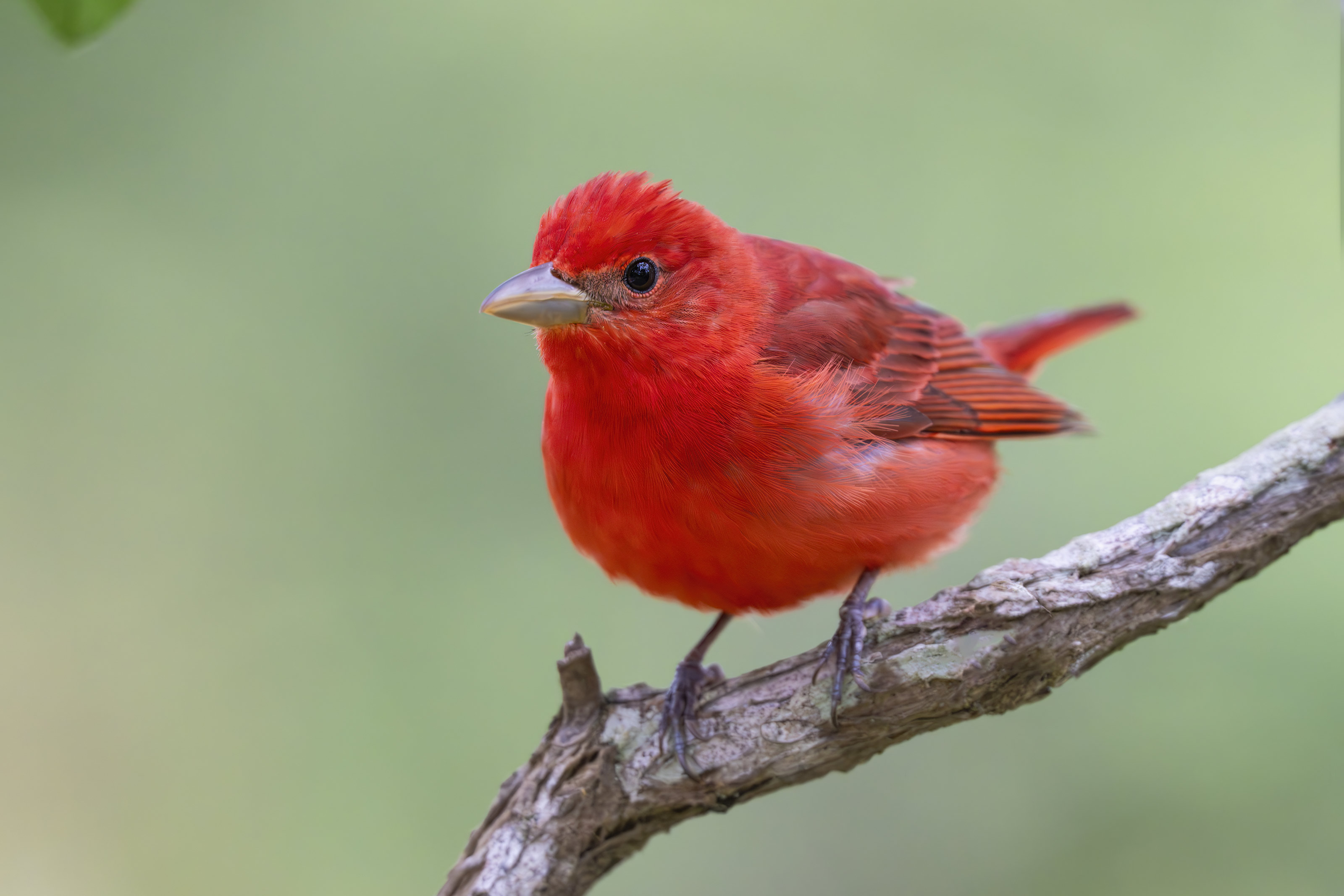
This image was created on 20 April by yours truly at the South Padre Island Convention Center. Standing at full height, I used the handheld Sony FE 300mm f/2.8 GM OSS Lens (Sony E) with the Sony FE 2x Teleconverter (at 600mm) and the Latest Greatest Sony Flagship Body, the a1 II Mirrorless Camera. Exposure determined via Zebras with ISO on the Thumb Wheel. ISO 3200: 1/320 sec. at f/5.6 (wide open) in Manual mode. AWB at 6:04:07pm in the shade. Tracking: Zone/AF-C with Bird Eye/Face Detection enabled performed perfectly. Image #1: Summer Tanager male |
Photographing Migrant Songbirds Ain’t Easy!
Unless you are photographing at a set-up with a water drip and/or you are using audio playback, photographing migrant songbirds is about as difficult as bird photography can get. Those using playback often come up empty. First off, even if you are at one of the premier migrant traps in North America, the birds might not arrive. I once spent 13 days at Point Pelee National Park in Leamington, Ontario, Canada. With strong winds from the south every day, we did not see a single songbird for nearly two weeks.
And, if by chance, you find yourself in the middle of a fallout with birds everywhere, photographing them well is usually extremely difficult of impossible. Why? Warblers are relatively tiny. Most migrant songbirds are very active and are almost always flitting about, feeding on tiny bugs, or flying from bush to bush or tree to tree. They are often so high in the trees that making an attractive image is not possible. And when they are low in a tree or in a bush, there are almost always in extremely cluttered situations, blocked by leaves or branches and twigs. Thrushes and several species of warblers like Kentucky, hooded, worm-eating, Swainson’s Ovenbird, and others spend most of their time on the ground where making a pretty photo is pretty much difficult or impossible. Getting a bird on a relatively clean perch with a defocused twig-free background is a challenge.
Not to mention that when it is sunny, your problems are compounded by harsh shadows and very high contrast. So, you still wanna be a migrant songbird photographer?
|
|
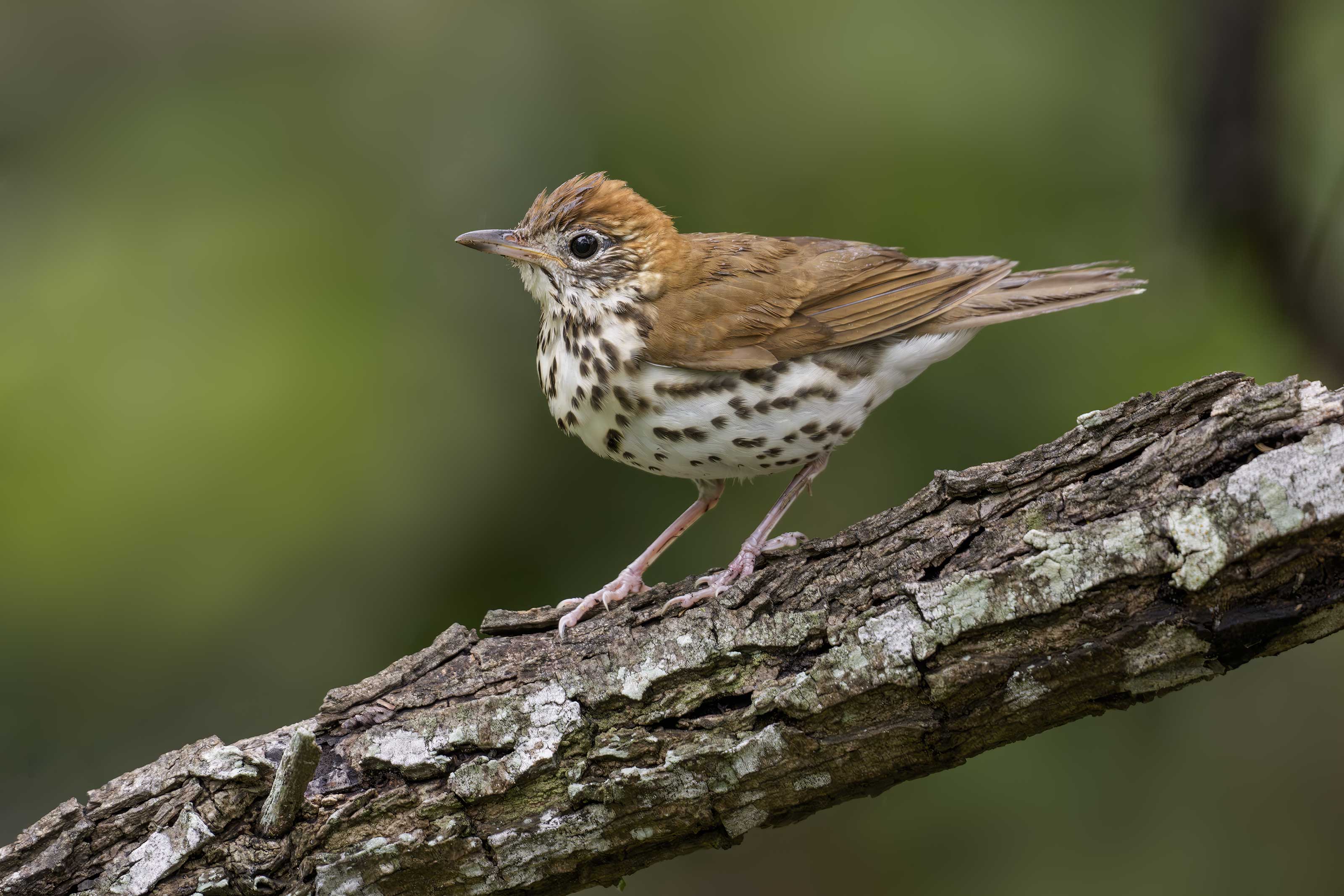
This image was also created on 20 April by yours truly at the South Padre Island Convention Center. Crouching a bit to move the background a bit farther from the bird, I used the handheld Sony FE 300mm f/2.8 GM OSS Lens (Sony E) with the Sony FE 2x Teleconverter (at 600mm) and the Latest Greatest Sony Flagship Body, the a1 II Mirrorless Camera. Exposure determined via Zebras with ISO on the Thumb Wheel. ISO 2500: 1/500 sec. at f/5.6 (wide open) in Manual mode. AWB at 6:16:21pm in the shade. Tracking: Zone/AF-C with Bird Eye/Face Detection enabled performed perfectly. Image #2: Wood Thrush on fallen branch |
The Trick to Thrush Photography
On migration, thrushes spend the great majority of their time on the ground. When we approached the south side of the convention center from the west, there were dozens of thrushes on the ground. The two most numerous were wood and Swainson’s along with a few grey-cheeked and a Veery or two. I saw more thrushes in two minutes that I had seen in the past 49 years of birding and photography.
Photographing thrushes on the ground is extremely difficult as you are shooting down at the birds and the backgrounds are usually pretty ugly (unless you get flat down on the ground). The trick is to find them on a clean perch, most always, a fallen branch. Though the wings and tail of this individual Wood Thrush make it look like the bird had a rough crossing of the Gulf of Mexico, I was thrilled with the bird up on the perch, a good look at the tail, and the pleasingly defocused background.
|
|
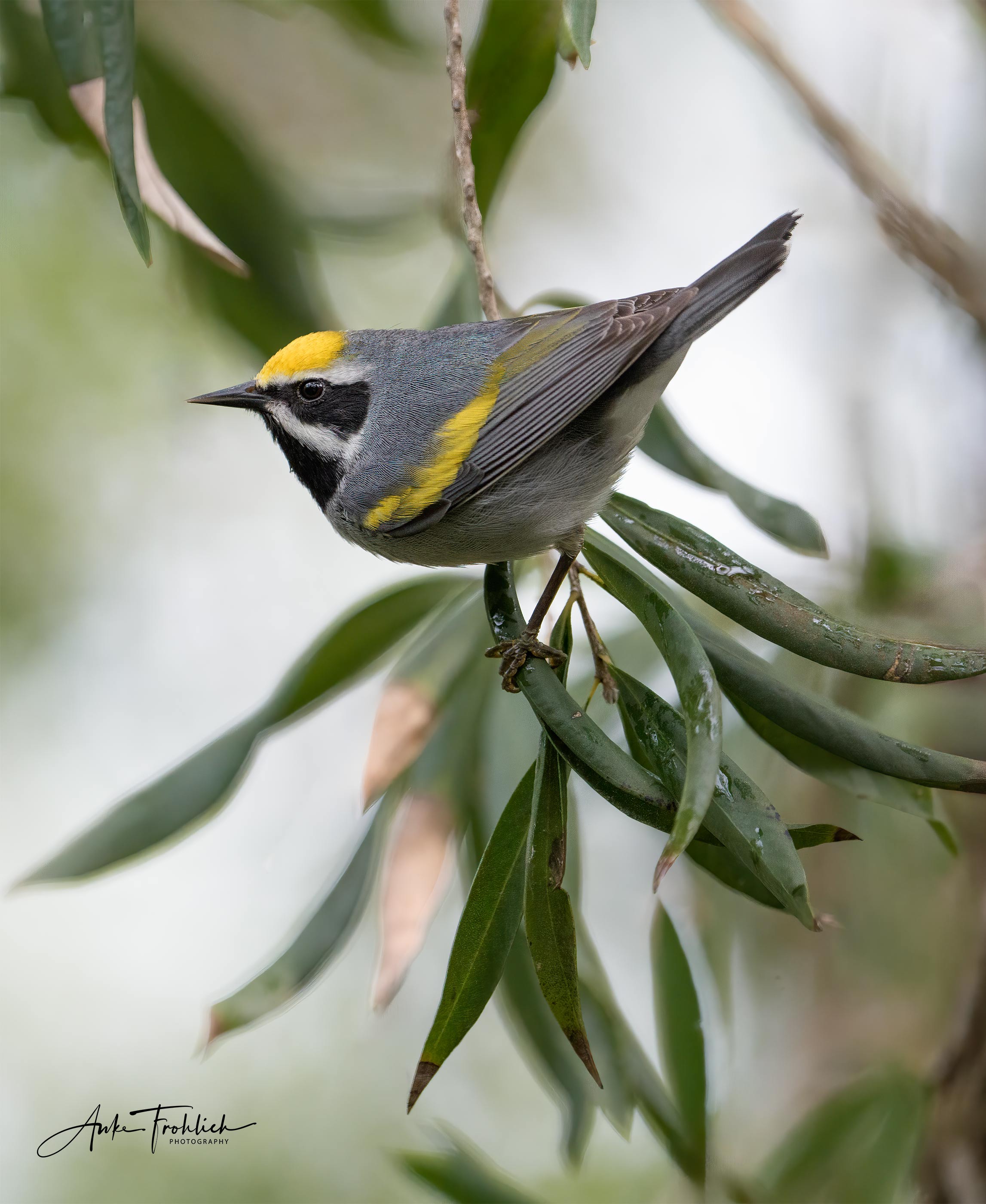
This image was created on 20 April by Anke Froelich at the South Padre Island Convention Center. Standing at full height, she used the handheld Sony FE 200-600mm f/5.6-6.3 G OSS lens (at 600mm) and the The Latest Greatest Sony Flagship Body, the a1 II Mirrorless Camera. The exposure was determined by Zebras with ISO on the thumb wheel. ISO 3200: 1/640 second at f/6.3 (wide open) in Manual mode. AWB at 7:10:31pm in the shade. Tracking: Zone/AF-C with Bird-Eye/Face Detection performed perfectly. Click on the image to enjoy the larger, inexplicably sharper high-res version. Image #3: Golden-winged Warbler male
|
The Sony 200-600 for Migrant Songbirds
Anke Frohlich owns the Sony 600mm f/4 OSS GM lens but far prefers her 2-6 as its lighter weight and smaller size allow her to handhold it for hours. And she needs to do that as she is quite persistent; she never gives up when chasing warblers. The slower speed of the 200-600 — f/6.3 wide open as compared to f/4 with the 600mm or the 300mm f/2.8 GM with the 1.4X TC, is somewhat of a handicap. She does very well with it by using the higher ISO settings. That she is highly skilled when it comes to making sharp images at relatively slow shutter speeds is a great plus with the 200-600.
This bird was incredibly fast and rarely stayed in the same spot for more than one second. I stayed with it for more than 20 minutes and managed only a very few decent frames, none nearly as good as this one. Now is a good time to note that if you are working on a tripod with migrant songbirds your opportunities will be few and far between. You need to be fast and mobile when working with these little speedsters. Handholding is the way to go.
You can see more of Anke’s fine work on her website at https://ankefrohlich.com and on Instagram at https://www.instagram.com/anke.frohlich.photography/
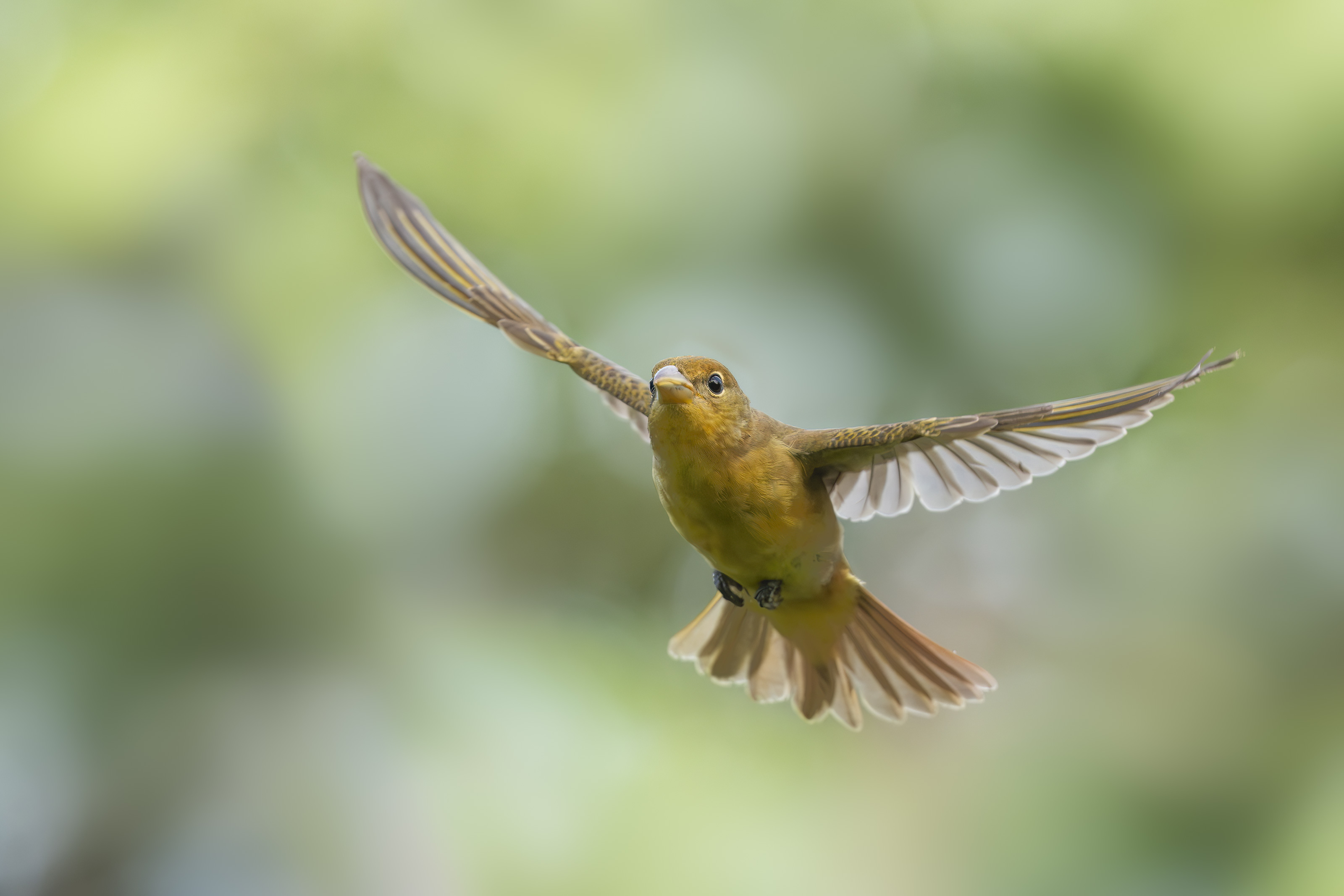
|
|
This image was created on 22 April by yours truly at the South Padre Island Convention Center. Standing at full height, I used the handheld Sony FE 300mm f/2.8 GM OSS Lens (Sony E) and the Sony FE 1.4x Teleconverter (at 420mm) and the Latest Greatest Sony Flagship Body, the a1 II Mirrorless Camera. Exposure determined via Zebras with ISO on the Thumb Wheel. ISO 2500: 1/3200 sec. at f/4 (wide open) in Manual mode. AWB at 6:10:38pm on a hazy, cloudy bright afternoon. Wide/AF-C with Bird Eye/Face Detection enabled performed perfectly. Image #4: Summer Tanager female in flight |
Songbird Flight Photography!
While many folks attempt to photograph songbirds in flight with either a handheld or tripods-mounted 600mm f/4 lens or a slower telephoto zoom lens, the Sony 300mm f/2.8 GM is superb for this purpose, almost always with the 1.4X TC. You are able to succeed even in low light situations. See more on Pre-Capture below.
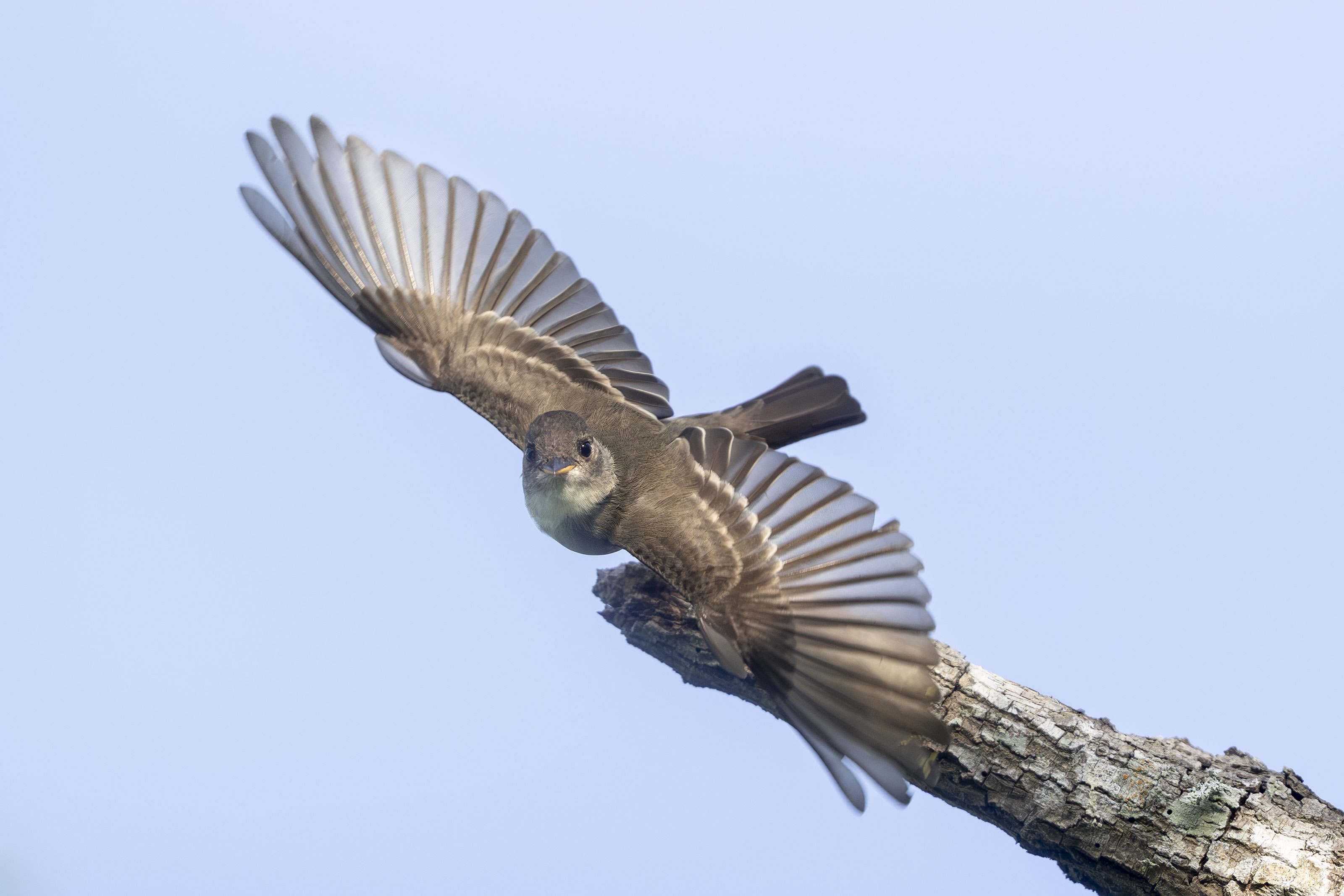
|
|
This image was created on 23 April by yours truly at the South Padre Island Convention Center. Standing at full height, I used the handheld Sony FE 300mm f/2.8 GM OSS Lens (Sony E) and the Sony FE 1.4x Teleconverter (at 420mm) and the Latest Greatest Sony Flagship Body, the a1 II Mirrorless Camera. Exposure determined via Zebras with ISO on the Thumb Wheel. ISO 1250: 1/4000: 1/400 sec. at f/4 (wide open) in Manual mode. AWB at 6:27:33pm on a sunny but hazy afternoon. Wide/AF-C with Bird Eye/Face Detection enabled performed perfectly. Image 5: Eastern Wood Pewee taking flight |
Pre-Capture
Imagine. I did not press the shutter button until after this bird took flight. When trying for take-offs and doing flight photography, I raise the Pre-Capture time from 0.2 to 1 full second. Working at 30fps as I always do with the latter setting, this saves the 30 images recorded before I fully depress the shutter button. The key to using Pre-Capture successfully is that you must keep the shutter button half-pressed so that the camera is actively focusing before the bird takes flight.
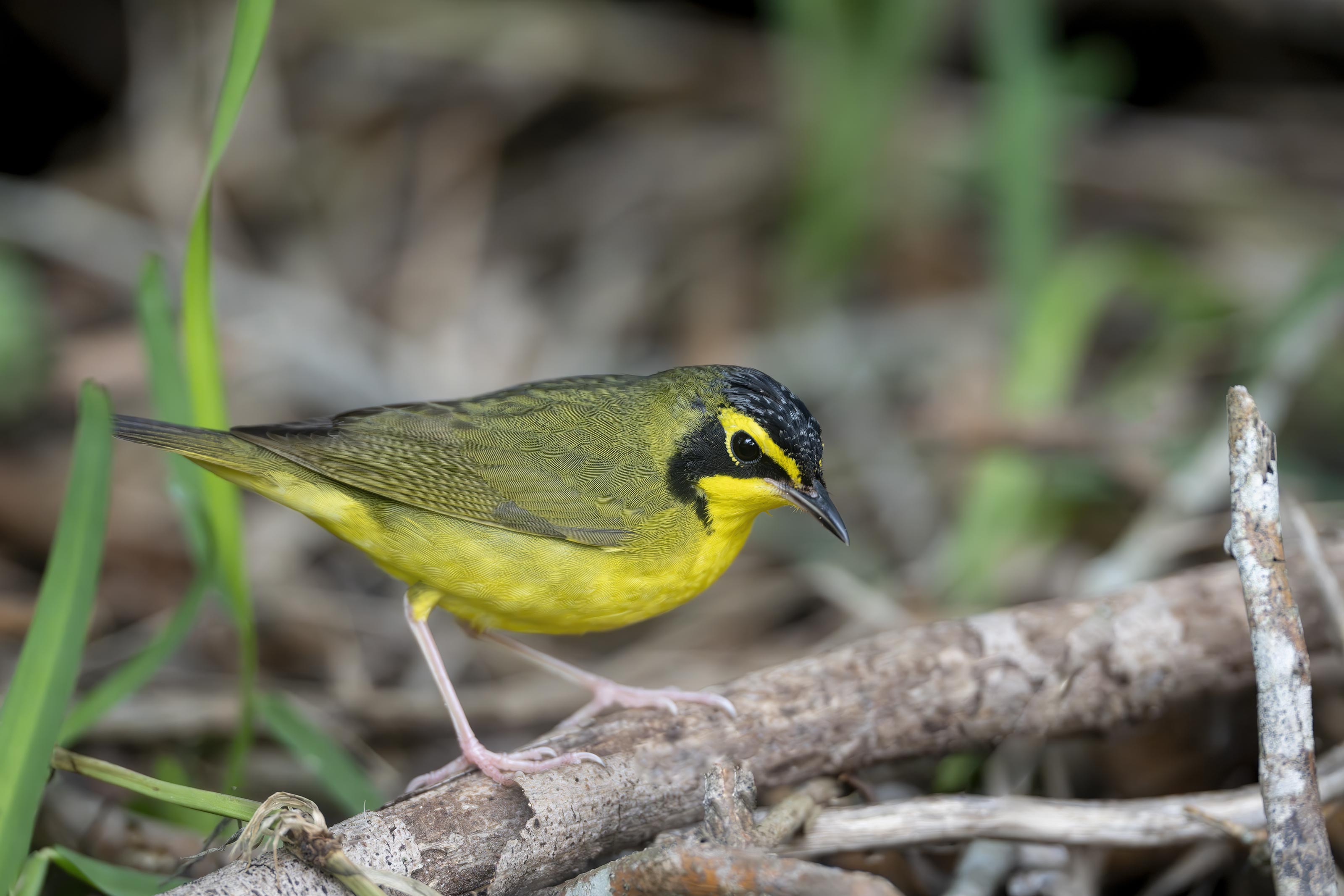
|
|
This image was created on 23 April by yours truly at the South Padre Island Convention Center. Seated on grass and dirt, I used the handheld Sony FE 300mm f/2.8 GM OSS Lens (Sony E) the Sony FE 1.4x Teleconverter (at 420mm) and the Latest Greatest Sony Flagship Body, the a1 II Mirrorless Camera. Exposure determined via Zebras with ISO on the Thumb Wheel. ISO 4000: 1/400 sec. at f/4 (wide open) in Manual mode. AWB at 8:28:19am in the shade on a cloudy morning. Tracking Zone/AF-C with Bird Eye/Face Detection enabled performed perfectly. Image #6: Kentucky Warbler adult male |
The Kentucky Miracle
Kentucky Warbler is a real skulker that spends most of its time on the ground in dark places. We spotted a Kentucky, an Ovenbird, and a Worm-eating Warbler foraging in a bare area with very little light. I sat for ten minutes but the birds left. Ten minutes after that the Kentucky re-appeared flitting about on the ground catching tiny bugs. Again, I got down on the ground. Two other photographers joined me and sat to my right. The bird moved left out of sight and then circled around and landed on a bare branch eight feet to my left. Praying all the while for the bird to stay put of two more seconds, I hit the button that I had assigned to APS-C to get back to full frame — see more on APS-C/Super 35mm Mode below). In the same instant, I raised my shutter speed two clicks as the bird was somewhat in the open so there was a bit more light.I was able to make four frames and keep two. My quick thinking and actions and the short Minimum Focusing Distance (MFD) of the Sony 300mm f/2.8 saved the day for me.
One of the folks to my right was blocked (by me) and the other was able to get on the bird but could not focus close enough.
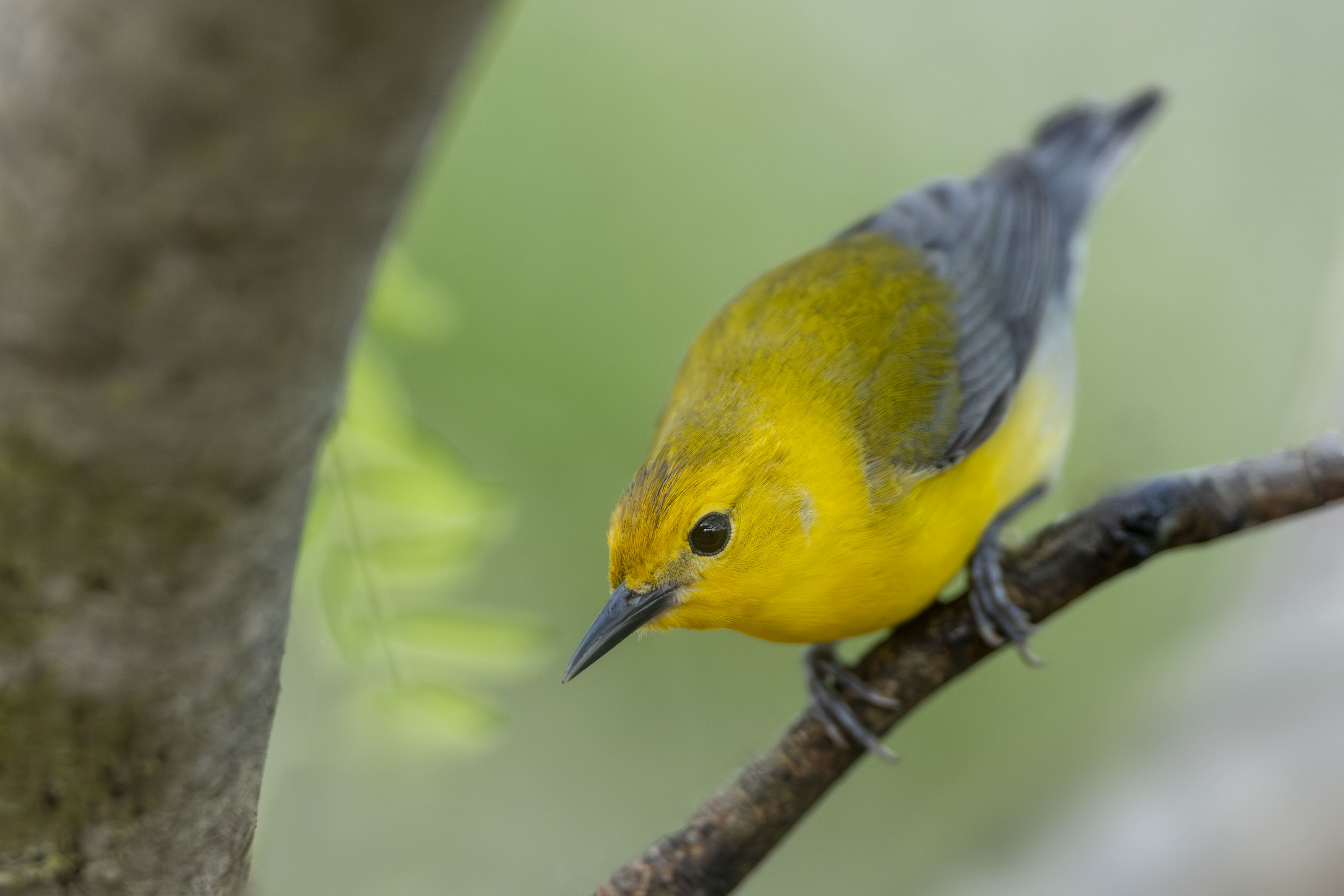
|
|
This image was created on 23 April by yours truly at the Sheepshead Street natural area on South Padre Island. Standing at full hight, I used the handheld Sony FE 300mm f/2.8 GM OSS Lens (Sony E) the Sony FE 1.4x Teleconverter (at 630mm in APS-C Crop Mode) and the Latest Greatest Sony Flagship Body, the a1 II Mirrorless Camera. Exposure determined via Zebras with ISO on the Thumb Wheel. ISO 1600: 1/1000 sec. at f/4 (wide open) in Manual mode. AWB at 8:52:35am on a cloudy-bright morning . Tracking Zone/AF-C with Bird Eye/Face Detection enabled performed perfectly. Image #7: Prothonotary Warbler adult male |
APS-C/Super 35mm Mode
Though I have long scoffed at the reasons for using various crop modes, I recently began trying APS-C/Super 35mm Mode with the warblers to give the AF system a better look at the birds’ eye. This turned out to be effective, especially in dark, cluttered situations.
The Sony a-1 ii offers a APS-C/Super 35mm mode that applies a 1.5x crop to its 50.1MP sensor. The result is a high-quality, ~21MP image that is approximately 5,616 x 3,744 pixels. The raw file for the Prothonotary Warbler image was 54.6 KB. It held up more than nicely to a decent crop. This mode increases the effective focal length (e.g., 420mm becomes 630mm, and 600mm becomes 900mm). In addition, it allows for a faster, more efficient workflow (as you are working with smaller files).
Another advantage of cropping in camera rather than after the fact at the computer is that it allows me to go with the 1.4X TC rather than the 2X. The huge advantage with the 1.4X TC and crop mode is that I can work at f/4 (as compared to f/5.6 with the 2X in place. That saves me one stop of ISO and/or allows me to work with a faster shutter speed in low light situations.
As the songbird action has slowed considerably since the fallout last Sunday and Monday — we caught only the tail-end on Monday afternoon, I have begun experimenting with APS-C/Super 35mm Mode for more traditional bird photography and have found some additional benefits. I will share those with you at some point here on the blog.
|
|
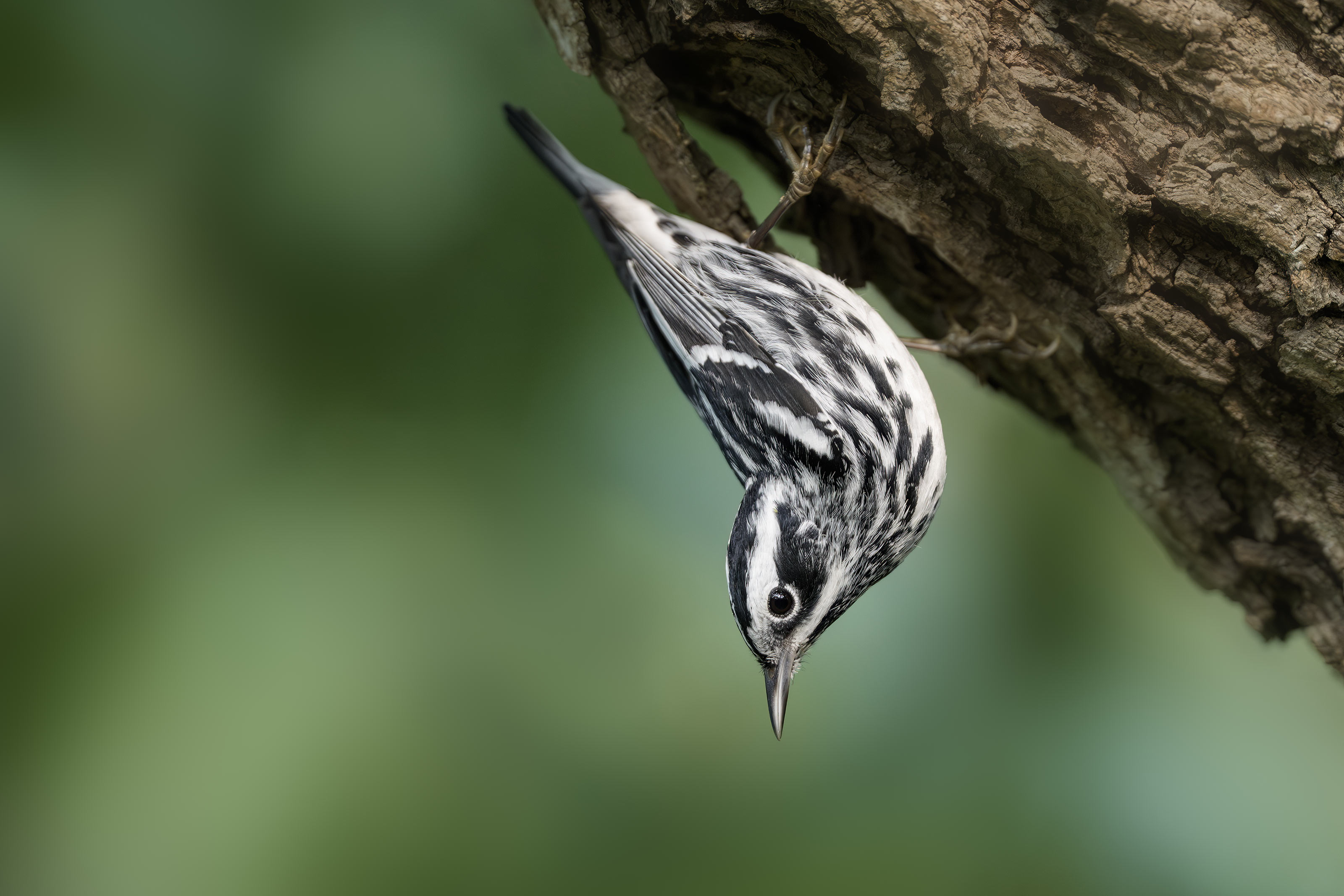
This image was created on 24 April by yours truly at the South Padre Island Convention Center. Standing at full hight, I used the handheld Sony FE 300mm f/2.8 GM OSS Lens (Sony E) the Sony FE 1.4x Teleconverter (at 630mm in APS-C Crop Mode) and the Latest Greatest Sony Flagship Body, the a1 II Mirrorless Camera. Exposure determined via Zebras with ISO on the Thumb Wheel. ISO 1600: 1/1000 sec. at f/4 (wide open) in Manual mode. AWB at 5:58:59pm on a faintly sunny afternoon. Tracking Zone/AF-C with Bird Eye/Face Detection enabled performed perfectly. Image #8: Black and White Warbler adult male |
The Classic B&W Pose
Black and White Warblers spend hours spiraling around tree trunks and thick branches in search of insects, spiders, and the like. The best images feature them on the edge of the tree as that often provides a nicely defocused background — if and only if you can get a good head angle. I created hundreds of photos of this bird with ugly-ass bark backgrounds and kept only two of those. I had two frames with the classic pose — only Image #7 was razor sharp on the bird’s eye.
Note: The Sony a-1 offers APS-C Crop Mode but does not offer Pre-Capture.
|
Composite #1: All with the a-1 ii Mirrorless Camera body.
|
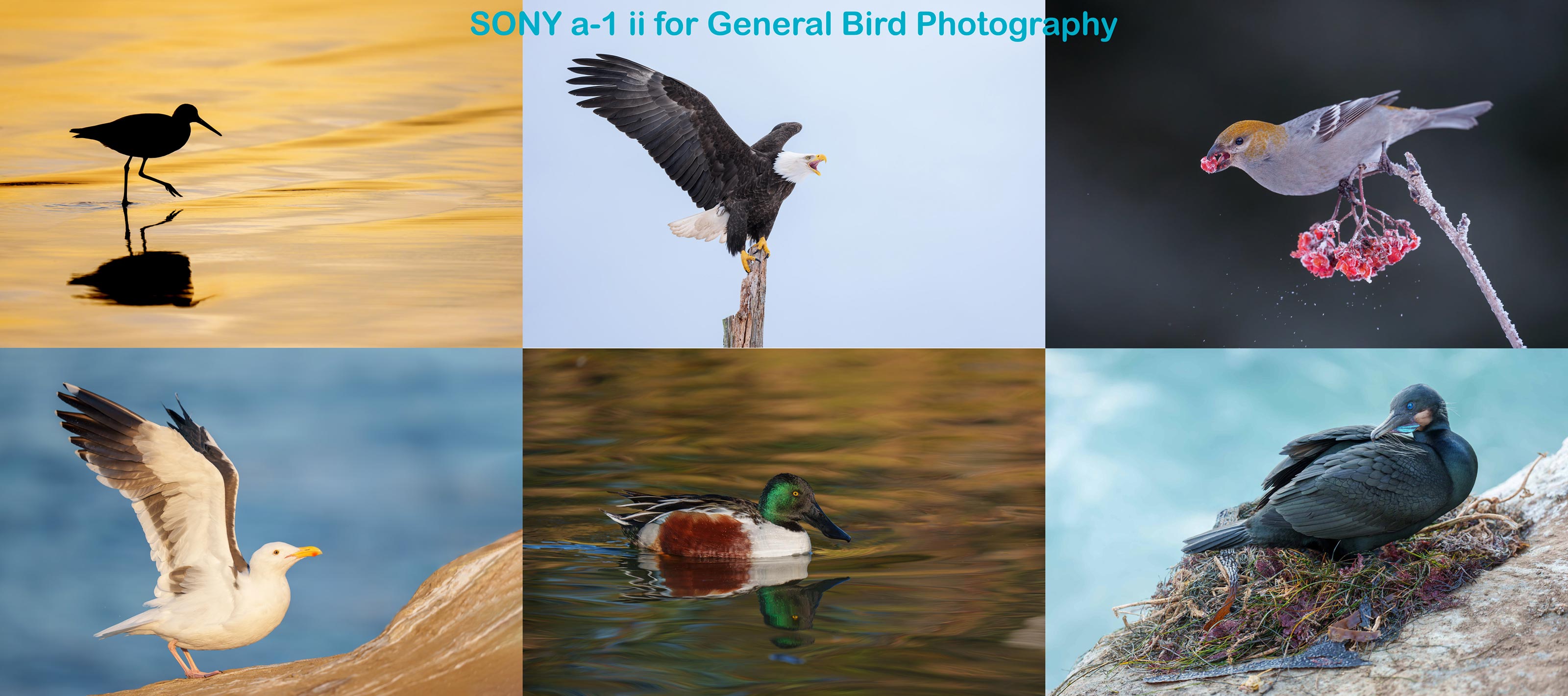
The a-1 ii for General Bird Photography
I have found that eye-tracking for general bird photography with the a-1 ii is far, far better than with the original Sony a-1. It grabs the eye and tracks it faster and far more consistently and focus is rarely lost, even with backgrounds other than sky.
|
Composite #2: All with the a-1 ii Mirrorless Camera body.
|
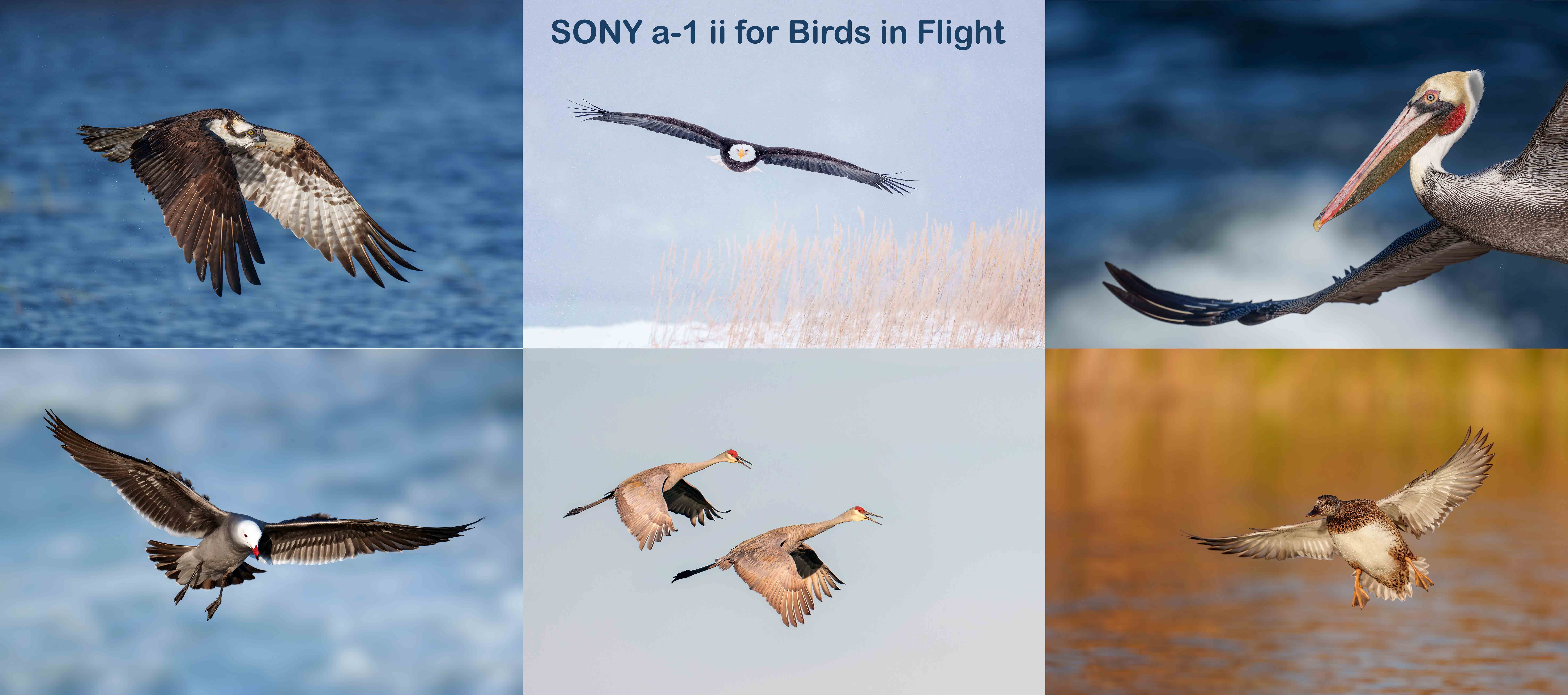
The a-1 ii for Birds in Flight
For birds in flight, the a-1 ii Mirrorless Camera body has no equal. As Arash Hazeghi says, “It is better than the a-1.” When I am late getting on a bird in flight, I have consistently been amazed at how often the AF system of the a-1 ii finds and tracks the bird’s eye.
|
Composite #3: All the result of using Pre-Capture with the a-1 ii Mirrorless Camera body.
|
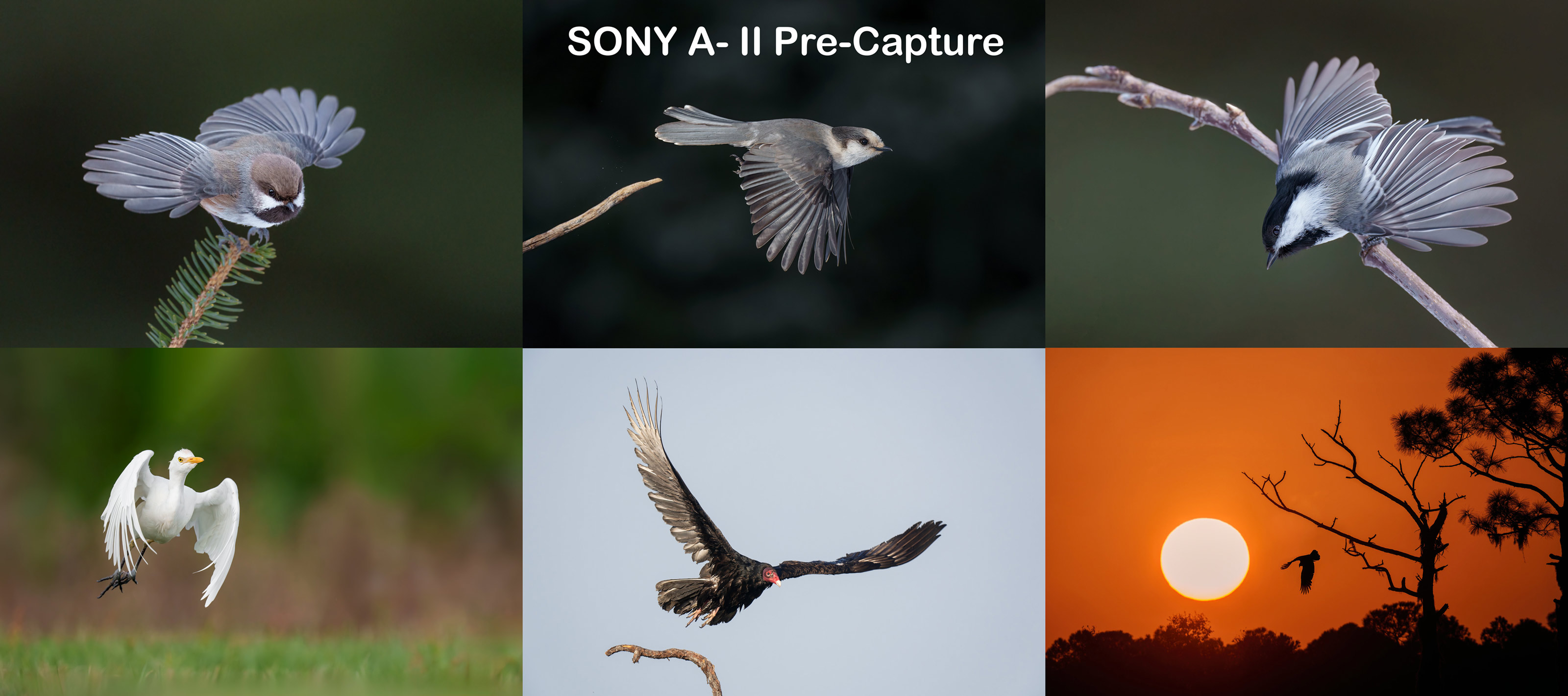
Pre-Capture with the Sony a-1 ii
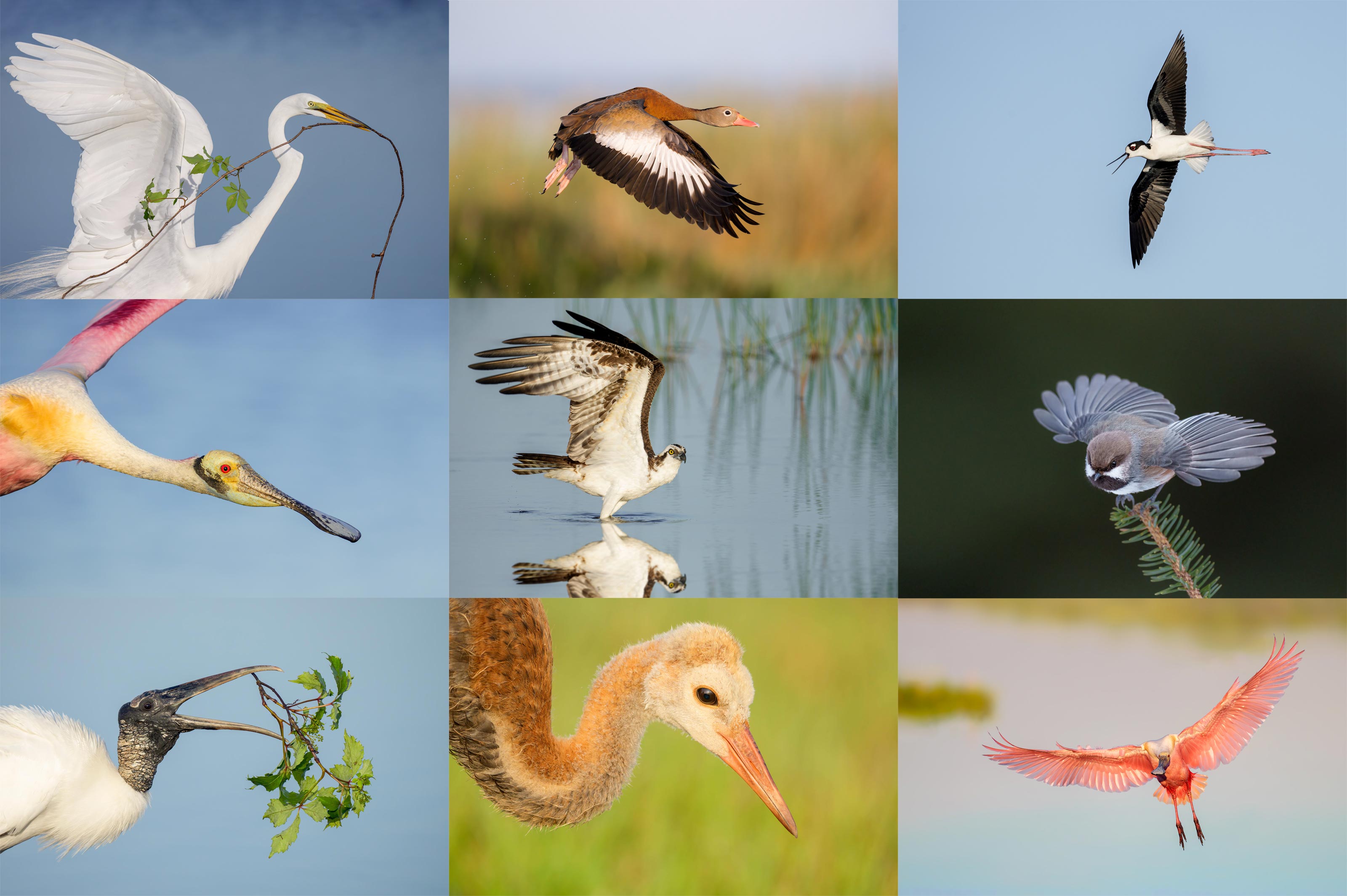
When it comes to Pre-Capture with the a-1 ii Mirrorless Camera body, Arash and I agree 100%. And with my slower reflexes, Pre-Capture is more important for me than it is for Arash. Understand that in each of the images in Composite #3, I did not push the shutter button until after the bird took flight!
|
All with the a-1 ii Mirrorless Camera body.
|
Purchasing or Upgrading to a Sony a-1 ii
The Sony a-1 ii e-Mail Set-up and Info Guide
I now own and use two Sony a-1 ii bodies. Every day that I use them, the more I am amazed by speed and accuracy of the Bird Face-Eye tracking in AF-C and the overall performance of the camera.
Aside from the improved ergonomics as compared to the a-1, other nice features include the fact that the rear screen tilts both ways — the lack of a tilting rear screen on the original a-1 always ticked me off. Pre-capture has proven to be a huge plus almost exclusively for take-off flight images. In my opinion, the Speed Boost feature is a total waste for bird photography because you should always be utilizing the maximum frame rate. In addition, the resolution on the rear monitor has been improved dramatically. I must mention again that Bird Face-Eye tracking on the a-1 ii is vastly improved as compared to both the a-1 and the a9 iii and that the 51MP files are to die for.
So, the big question is, is the a-1 ii “worth” a gear upgrade. Remembering that I can never know whether or not something is worth it to you, I can say that I was not floored when first using my a-1 ii. The differences between the a-1 ii and the original a-1, seemed to be neither huge nor eye-opening. But over time, I have come to realize that I was 100% wrong. The huge difference between the new camera body and the a9 iii is, of course, the 51MP a-1 raw files (as compared to the 24MP files rendered by the a9 iii).
The price of a new a-1 is $5,898.00. The price of a new a-1 ii is $1,100.00 more: $6,998.00. As the a-1 ii is clearly far superior for bird photography to the original a-1, the choice for folks new to Sony or for those upgrading from lesser Sony camera bodies is an easy one. Prices for used a-1 bodies has not dropped drastically as I anticipated. At this point, a-1 folks who like showing flight and action and can afford an a-1 ii, are advised to purchase an a-1 ii. Please remember that life is short; we only get one ride on the merry-go-round.
|
All with the a-1 ii Mirrorless Camera body.
|
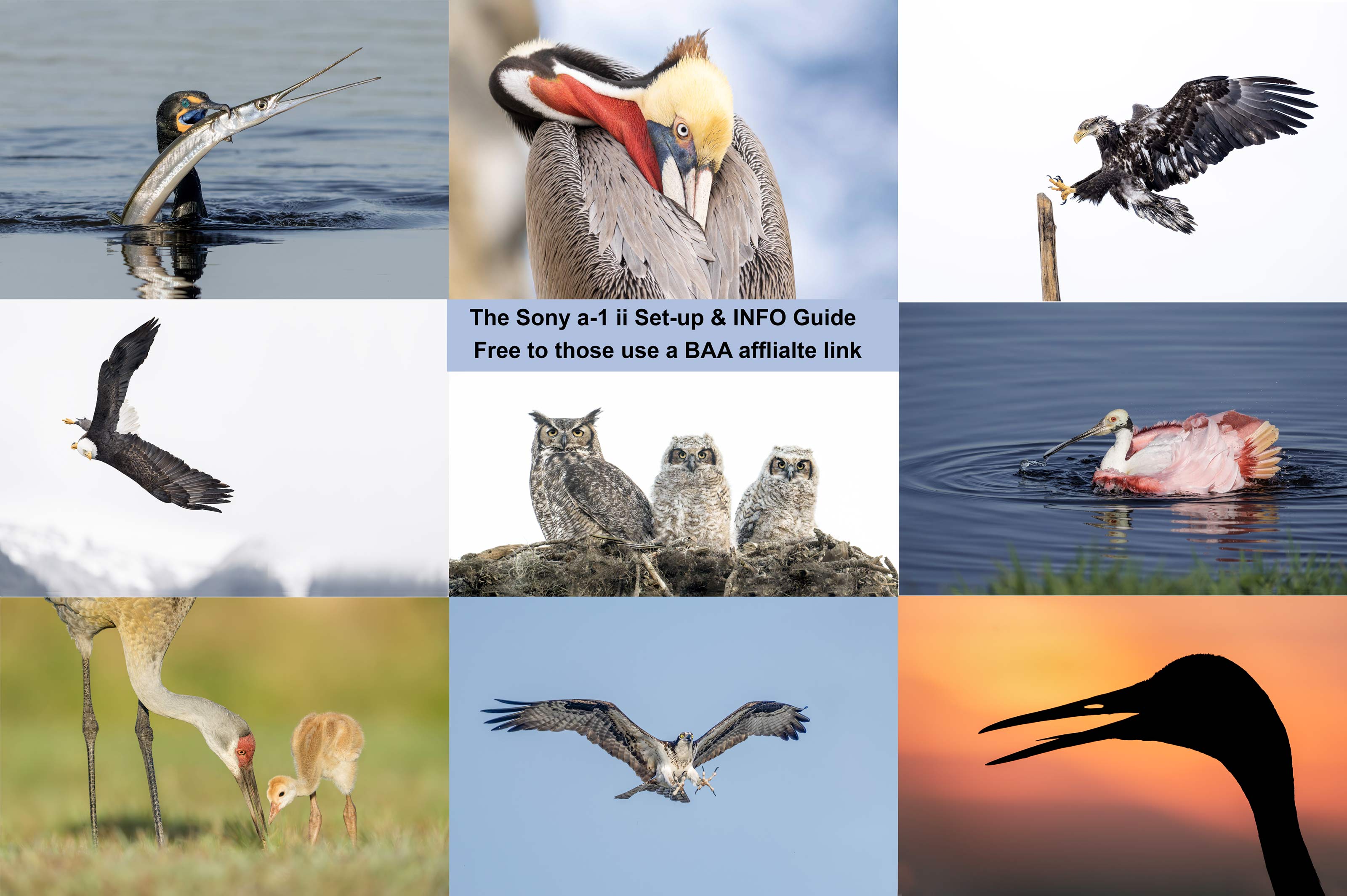
If you do purchase an a-1 ii, be sure to use one of my two affiliate links so that you will receive my a-1 ii settings (in the form of a CAMSEa1ii.DAT file), the Buttons and Dials Guide, and an Info Sheet for free. Using my links will never cost you one penny and may actually save you some money. Folks who do not purchase their new a-i using my B&H link or from Bedfords here and entering the BIRDSASART discount code at checkout will be able to purchase the a-1 ii guide for $244.93. If you are at all confused and do not want to screw up your order, please get in touch via e-mail. If you would like to chat about upgrading, shoot me a text to 863-221-2372 and LMK a good time to call you.
Typos
With all blog posts, feel free to e-mail or to leave a comment regarding any typos or errors.










Yes, the benefits to the birds are obvious — not so the potential detriment to the flowers they would otherwise have pollinated.
Again, during fallouts the benefits — potentially the lives of hundreds of Ruby-throated Hummingbirds, far outweighs the negatives. Not to mention that there are not enough flowers blossoming to feed hundreds of hummingbirds (along with orioles, tanagers, woodpeckers, and several species of warblers).
a
Furthermore, I should have mentioned that there were so many hummers that there were dozens of birds pollinating the blossoms around the Convention Center, most notably the numerous bottlebrush flowers; hummers love red!
artie
#8 due to its pose. You have a good variety of birds. On the upper TX coast we had the fall out at Sabine Woods last Monday. Hoping to get some stragglers after the weekend cold front. Safe travels and thanks for posting.
Thanks on all counts, Jim. Good luck to you too. We decided to stay till 5 May.
with love, artie
Since I have to choose I’ll go with 5 and 8. 5 for the down the barrel takeoff and 8 because as soon as I saw it I thought it perfectly described the B&W’s behavior.
Also, you’ve convinced me to try 1.5x mode when shorebirds are relatively small in the frame. I’ll have to determine the best button for the assignment.
Thanks, Pugs. We’ve been lucky. #5 due to Pre-Capture 🙂
The crop mode with and without TCs offers many options. From 600mm full frame to 1800mm in crop mode!
with love, artie
ps: tanks for sending the DeSoto pix. One of your godwits was in breeding plumage with the orange base to the bill.
The American robin (Turdus migratorius) is a thrush, and if you look at the head and face of your wood thrush in image #2, you can see a distinct family resemblance.
BTW, THRUSH was the name of the evil organization in the TV show “The Man From U.N.C.L.E.”
Are you a member of T.H.R.U.S.H.?
a
>> The Sony a-1 ii offers a APS-C/Super 35mm mode that applies a 1.5x crop to its 50.1MP sensor. The result is a high-quality, ~21MP image <<
This sounds like what I get with my Nikon D500, which I enjoy immensely!
I am glad for you. I like having lots of options with my a-1 ii.
a
>> … two species of hummingbirds at a sugar water feeder at the Laguna Vista Nature Trail <<
I heard something interesting on a wildlife photography podcast this morning regarding feeding hummingbirds in this manner. It wasn't about any potential negative effects on the birds — although there are several — but about the fact that hummingbirds are pollinators of many of the plants they visit, and when they are fed by feeders, this has a negative effect on the plants they would otherwise be pollinating.
I had not considered this possibility before, but it seems there are many more factors we, as wildlife photographers, have to consider than just the most obvious ones regarding how our activities affect our subjects and their ecosystems.
Tanks, Steve,
Your point might be valid where the hummers are breeding but when 100s of hummer arrive weak and starving after their trans-Gulf migration I am 100% sure that the benefits far outweigh the negatives.
a
Yes, the benefits to the birds are obvious — not so the potential detriment to the flowers they would otherwise have pollinated.