
|
|
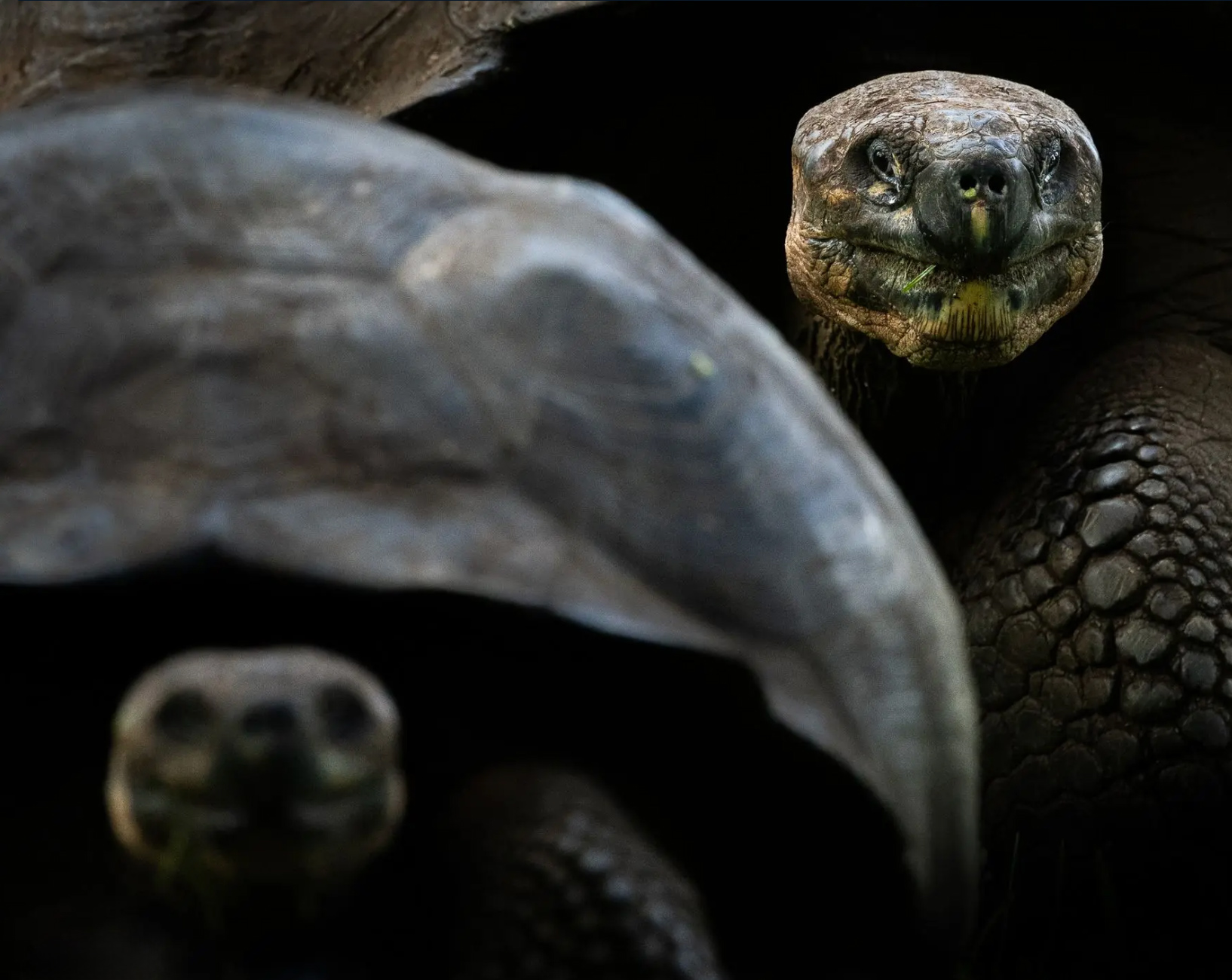
My pro photographer friend — see more below — has a wonderful eye for both composition and light, and is one of the very few leaders (aside from me, he said modestly) who actually teaches on a photo trip. Galapagos Tortoises |
Stellar Galapagos Trip
An award-winning professional photographer friend has three open slots on a summer 2027 photo cruise to the Galapagos Archipelago. This trip is capped at just eleven participants on a fast ship that normally carries fourteen. He is an exceptional photographer and instructor, a master of image design, and works with light as well as anyone in the field. Over the past few years, his work has even inspired me to get off sun angle on occasion.
If you are seriously interested in learning more, please get in touch with me via e-mail.
Summary
I’ve been successfully using the pink/purple/blue light opposite the sun on clear mornings and evenings for years. When I happened to mention that to my good friend Gemini AI, he taught me about the Belt of Venus. I took what I learned, put it in my own words, and share it with you below.
The more I use the handheld Sony FE 100-400mm f/4.5 GM OSS lens, the more I am impressed by its sharpness, its versatility, its speed — a constant f/4.5, its performance with either TC, and its relatively light weight. I am currently working on the BAA lens guide, free to those who use one of my affiliate links to purchase their copy of this amazing lens.
Note: General information, copy editing, re-crafting, technical refinement, and formatting for this blog post were assisted by Gemini AI.
In the Last Blog Post
1- Which image do you most wish was yours? All of them. Oh wait, they are all mine 🙂
2- Which image is the most creative? Hands down, the three eggs image. The sunball shot comes in second.
3- Which image is the most dramatic? For me, the black sky photo.
4- Which image features the most interesting light? This was a tough one. I guess I’d go with the red light district image. They are so, so difficult.
Your Calls
First off, thanks for the wealth of interesting comments on the last blog post. So many old friends showed up — they should consider sharing their thoughts on a regular basis 🙂
Of today’s three featured Belt of Venus images, which is the strongest? Which is the weakest? Why for each?
What’s Up?
With wind-against-sun mornings, things have been tough. Somehow, I have managed to create a family jewel image or two during every session, often surprising myself. Early on Wednesday evening I had the pleasure of taking my long time good friend Tom Pfeiffer to dinner at Wild Ginger in Merrick. After the great meal, we headed to the beach and had some fabulous Common Tern blast-offs and a nice sunset. The large flock of skimmer just sat on the beach doing nothing 🙂
Tomorrow is Friday 28 August 2026. The forecast is for more wing from the SW with partly cloudy skies. I will be hoping for some sunrise color and lots of blast offs. Whatever you opt to do, I hope that you choose to have fun and enjoy life. Please remember that happiness is a choice — Byron Katie – The Work.Com
If an item — a Delkin flash card or reader, a Levered-clamp FlexShooter Pro, or a Wimberley lens plate or low foot — for example, that is available from B&H and/or Bedfords, is also available in the BAA Online Store, it would be great, and greatly appreciated, if you would opt to purchase from us. We will match or beat any price. Please remember also to use my B&H affiliate links or to earn 3% cash back at Bedford by using the BIRDSASART discount code at checkout for your major gear purchases. Doing either often earns you free guides and/or discounts. And always earns my great appreciation.
Gear Questions and Advice
Too many folks attending BAA IPTs and dozens of photographers whom I see in the field and on BirdPhotographer’s.Net, are — out of ignorance — using the wrong gear, especially when it comes to tripods and more especially, tripod heads. And the same is true in spades when ordering new camera bodies or lenses. My advice will often save you some serious money and may help you avoid making a seriously bad choice. Please know that I am always glad to answer your gear questions via e-mail. If you are desperate, you can try me on my cell at 863-221-2372. Please leave a message and shoot me a text if I do not pick up.
|
|
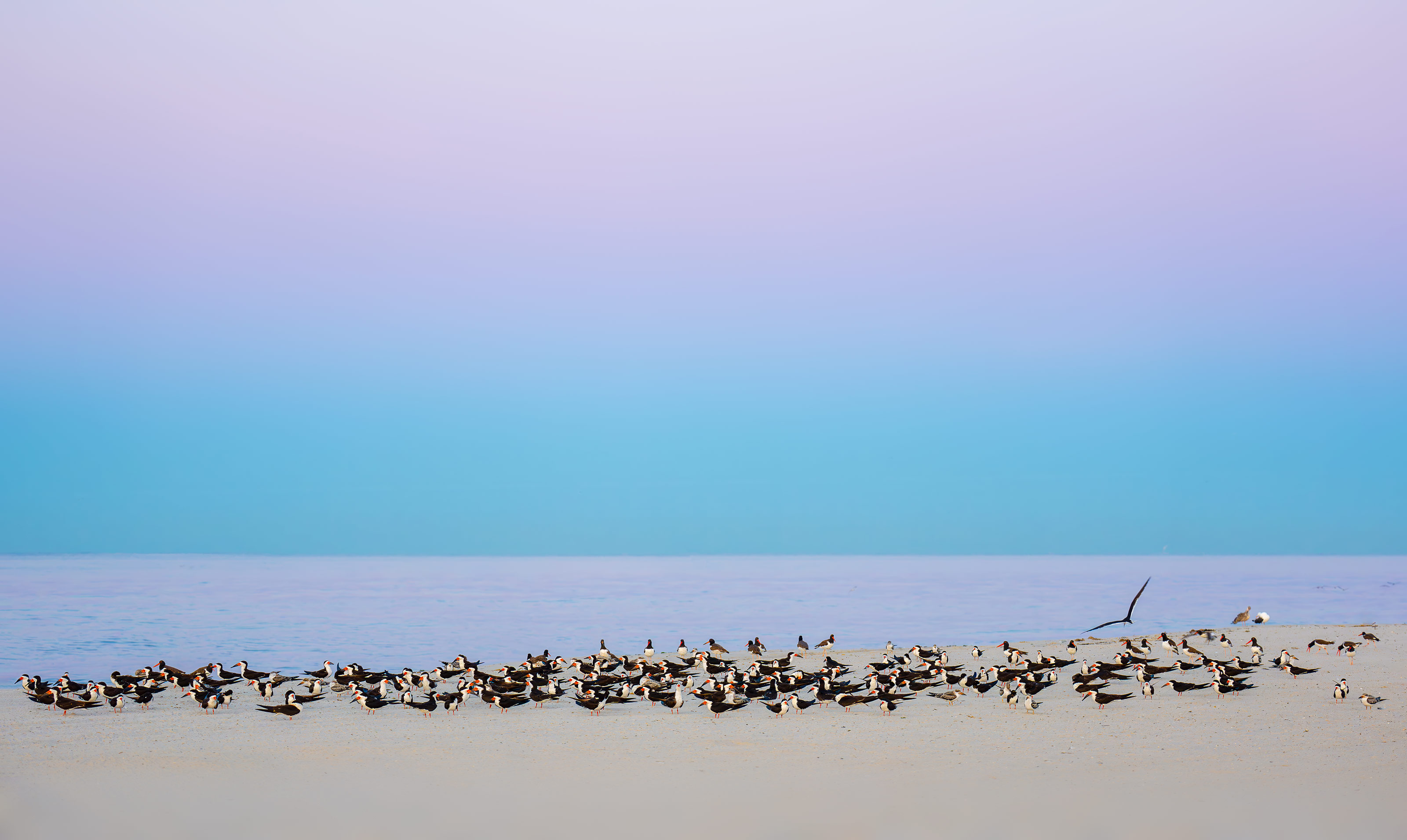
This image was created on the morning of 26 August 2026 at Nickerson Beach Park, Lido Beach, Long Island, NY. Standing on the beach at full height, I used the handheld Sony FE 100-400mm f/4.5 GM OSS lens (at 111mm) and The Latest Greatest Sony Flagship Body, the a-1 II Mirrorless Camera (in full frame mode). The exposure was determined by Zebras with Exposure Compensation (EC) on the Thumb Dial. Multi Metering +1.7 stops. AUTO ISO set ISO 1600: 1/125 second at f/4.5 in Shutter Priority mode. AWB at 6:12:00am on a dead-clear morning Tracking: Spot S (moved to near the bottom f the frame)/AF-C with Bird-Eye/Face Detection performed perfectly. Click on the image to enjoy a larger high-res version. Image #1: Black Skimmer flock on beach with pink/purple/blue |
The Belt of Venus
The Belt of Venus (sometimes called the Venus’s Girdle or the anticrepuscular arch) is an atmospheric phenomenon that appears shortly before and after sunset or just before or after sunrise on clear days. It appears a soft, pinkish or rose-colored band stretching roughly 10° to 20° above the horizon, situated directly opposite the sun (in the anti-solar sky).
How It Works
The Belt of Venus — the soft pink and rose band opposite the sun — is created by the backscattering of reddened sunlight. Near dawn or dusk, when the sun is below the horizon, sunlight travels through a thick column of atmosphere. The shorter blue wavelengths scatter away, leaving long red and pink wavelengths to bounce off particles in the upper atmosphere.
Directly below the pink band along the horizon lies the Earth’s shadow — a dark, slate-blue band cast onto our own atmosphere. As photographers know, shadows naturally produce a cool, blue color cast.
On clear mornings, the pink band fades rapidly as the sun rises, quickly turning light blue. On clear evenings, the Earth’s shadow ascends, eventually swallowing the Belt of Venus as the sky transitions into twilight and night.
Shutter Priority for Sharp
Zoomed out to 111mm, I knew that producing a sharp image with a shutter speed of 1/125 second would not be a problem. By staying in Shutter Priority mode, all I needed to do to get back to creating pleasing blurs is reduce the shutter speed. As in images #1 and #3. Exposure compensation and AUTO ISO take care of everything else.
|
|
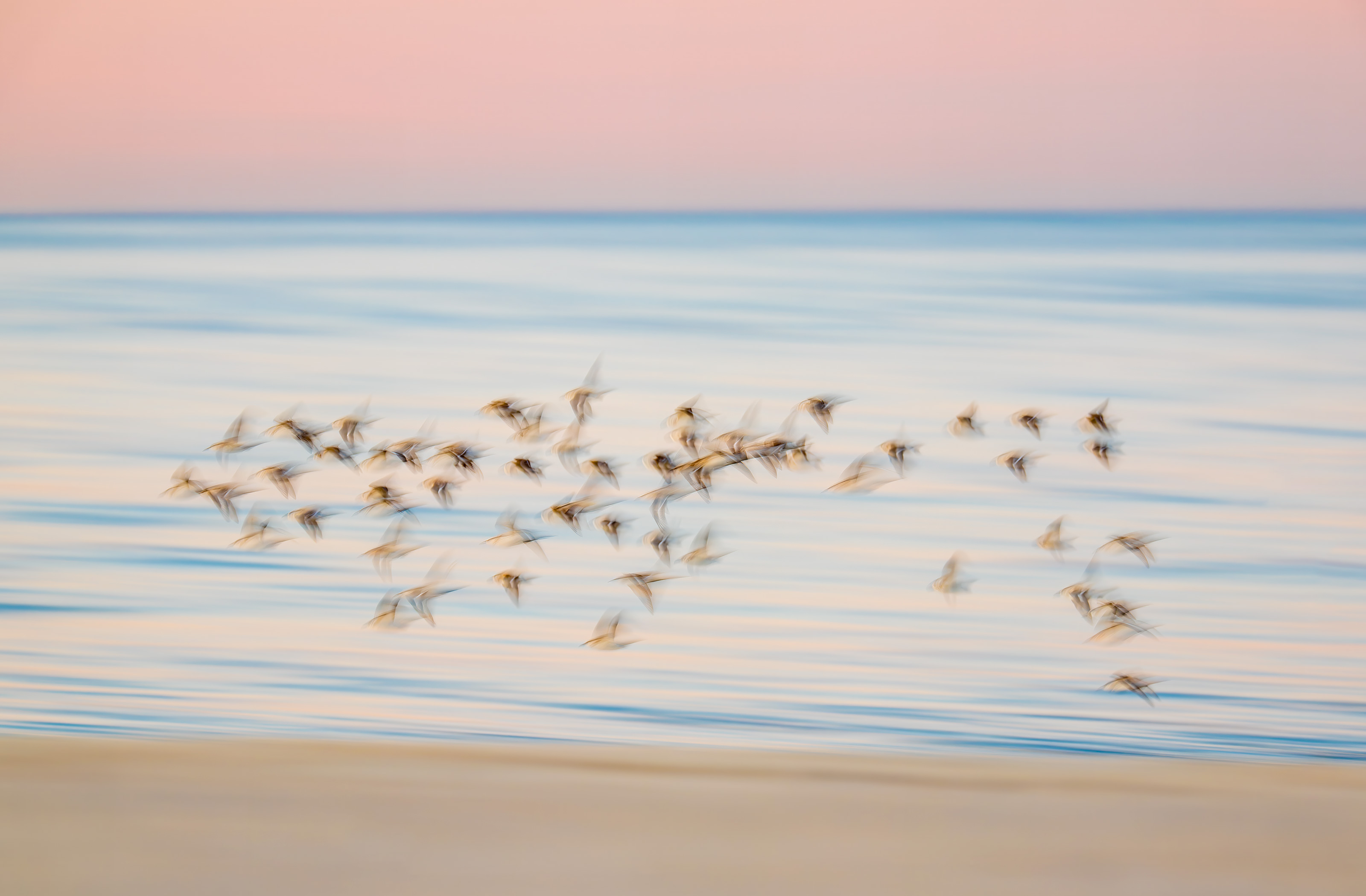
This image also was created on the morning of 26 August 2026 at Nickerson Beach Park, Lido Beach, Long Island, NY. Seated on my life-changing Rubbermaid Roughneck Step-Stool, I used the handheld Sony FE 100-400mm f/4.5 GM OSS lens with the Sony FE 1.4x Teleconverter (at 360mm) and The Latest Greatest Sony Flagship Body, the a-1 II Mirrorless Camera (in full frame mode). The exposure was determined by Zebras with Exposure Compensation (EC) on the Thumb Dial. Multi Metering +1.7 stops. AUTO ISO set ISO 400: 1/20 second in Shutter Priority mode. AWB at 6:16:22am on a dead clear morning Tracking: Spot S (moved to near the bottom of the frame)/AF-C with Bird-Eye/Face Detection performed perfectly. Click on the image to enjoy a larger high-res version. Image #2: Sanderling flock blur |
Shutter Priority for Pleasing Blurs
Shutter Priority with AUTO ISO and Exposure Compensation on a convenient dial is THE way to go when creating pleasing blurs of birds or flocks of birds in flight or in motion. Provided that the backgrounds will be of a relatively consistent tonality as was the case for all three of today’s featured images. If your background might change from dark to light and then back again it is mandatory for you to be in Manual mode and exposure correctly for the subject.
When working with consistently toned backgrounds, shutter priority is the fastest, most convenient, and most efficient mode. Period. You can actually vary the shutter speed during a single blast-off. It is also my go-to mode for shooting against colorful skies at sunrise and sunset; it works perfectly with both fast and slow shutter speeds.
Derivation of The Belt of Venus
100% Gemini AI
The name comes directly from classical Greek and Roman mythology, inspired by the goddess of love, beauty, and fertility (Aphrodite in Greek, Venus in Roman).
1. The Mythological Origin
According to ancient myth, Aphrodite/Venus possessed a famous magical girdle (or belt) — known in Homer’s Iliad as the kestos imas (embroidered girdle).
This magical band was woven with love, desire, and beauty. It was said to be a delicate, glowing sash that could enchant anyone who looked upon it, granting the wearer irresistible charm. When 19th-century atmospheric scientists and observers sought a name for the soft, glowing pink-to-rose band that wraps across the twilight horizon, they turned to classical mythology. The delicate pink sash appearing across the sky just before nightfall was evocative of the goddess’s legendary enchanted belt.
2. A Historical Misnomer
Interestingly, from a strictly astronomical standpoint, the name is a misnomer!
The Astronomical Planet: The planet Venus is an interior planet (closer to the Sun than Earth). Because of this, Venus can never appear in the part of the sky where the Belt of Venus is located.
The Geometry: The Belt of Venus appears opposite the Sun (the anti-solar point — in the east at sunset, or in the west at sunrise). Venus, meanwhile, is always tied closely to the Sun and can only ever be seen low in the sky toward the sunset or sunrise. So, while the planet Venus is never inside the Belt of Venus, the phenomenon keeps its name as a poetic homage to the glowing, rosy sash of the goddess herself.
|
|
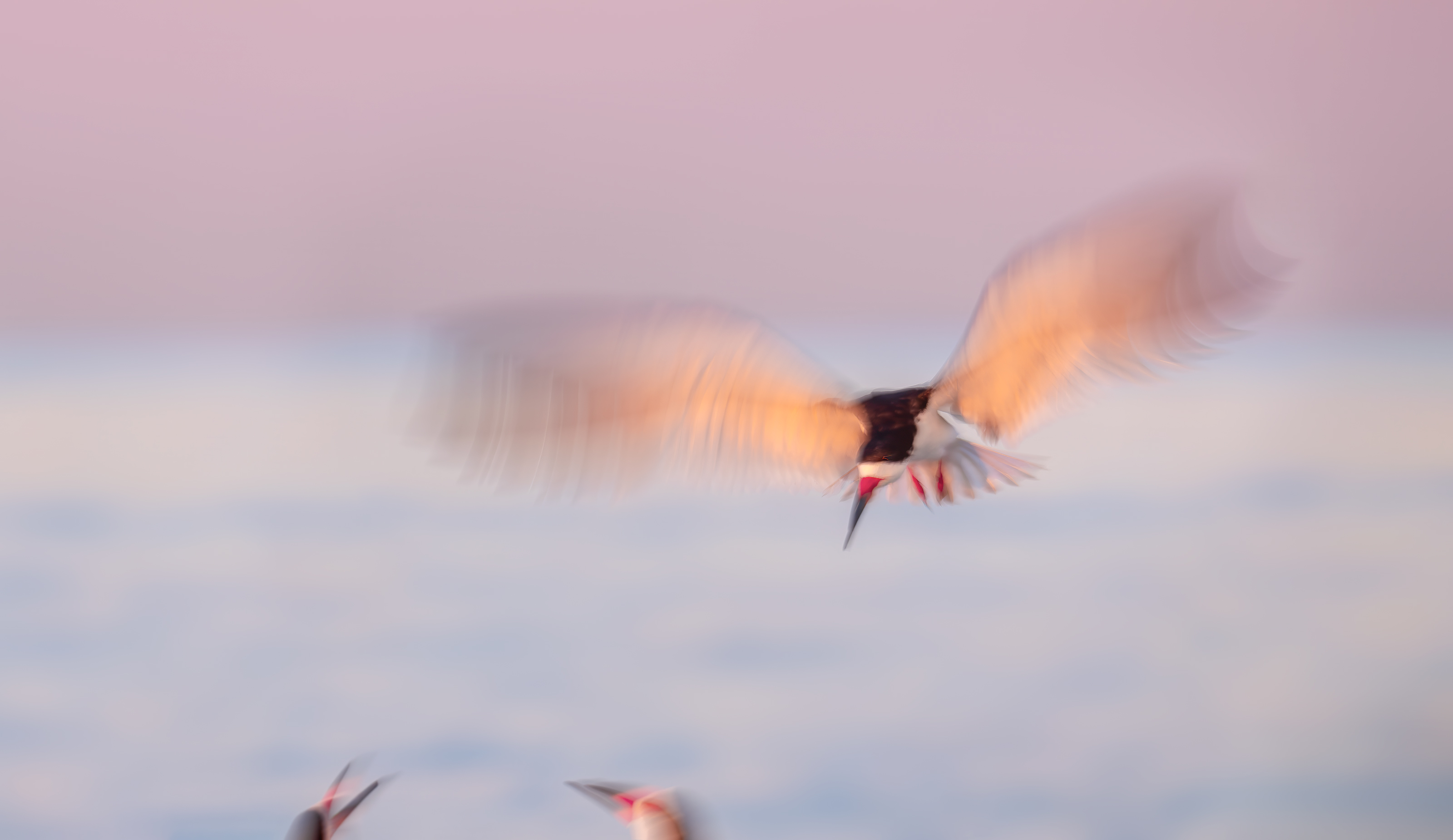
This image also was created on the morning of 26 August 2026 at Nickerson Beach Park, Lido Beach, Long Island, NY. Standing at full height on the beach, I used the handheld Sony FE 100-400mm f/4.5 GM OSS lens with the Sony FE 1.4x Teleconverter (at 420mm) and The Latest Greatest Sony Flagship Body, the a-1 II Mirrorless Camera (in full frame mode). The exposure was determined by Zebras with Exposure Compensation (EC) on the Thumb Dial. Multi Metering +1.3 stops. AUTO ISO set ISO 400: 1/20 second in Shutter Priority mode. AWB at 6:23:12am on a dead clear morning Tracking: Zone/AF-C with Bird-Eye/Face Detection performed perfectly. Click on the image to enjoy a larger high-res version. Image #3: Black Skimmer braking to land blur |
Beating the Dead Horse
Though you will rarely hear about it anywhere else, understanding the relationship between sky conditions and wind direction is a constant theme here on the BAA blog. With clear skies and a north wind I positioned myself with the wind at my back, a flock of skimmers on he beach in front of me, and the pink/purple/blues of the Belt of Venus as background. Exactly that same situation as with Image #1 above.
Would you have left the greeting committee?
Typos
With all blog posts, feel free to e-mail or to leave a comment regarding any typos or errors.










#1 and #2 are both great but the second is a gem! really interesting to see those three warm, complementary horizontal color blocks emerging with the right to left pan. Good info there about the Belt of Venus..sheesh there’s so much to learn about the wonders of nature and not nearly enough time to assimilate it all!!
In a hypothetical “What would Artie do” contest I would sure bet on you eliminating the greeting committee on #3 but I was wrong..interesting. how close is your final to full frame?
Artie image one is sublime. Wish it were mine. Those colors and with the blacks of the skimmer . what a contrast.
Learn something every day on your blog Artie, sure have seen those colors many times if you’re up early. But had no idea called the Belt of Venus.
Thanks, Kevin.
Me neither!
much love, artie
Based on the theme of the post, #1 is the strongest. Lovely colors, comp and the one airborne bird is the icing. My personal favorite is #2 – pure avian art.
Thanks, Pugs. The big flocks of Sanderlings should be arriving any day.
with love, artie
Without a doubt, image #1 is the strongest because it shows the pink, purple and blue of the Belt of Venus to best advantage. Moreover, it adds two additional layers — the blue of the water and the beige of the sand. Just lovely! The weakest is image #3, not only because it shows the Belt of Venus to least advantage but mostly because of the two very distracting birds at the bottom of the frame. Eliminate them and it’s a very nice image (even though it’s a blur which you know I don’t like!).
Thanks, Pat.
I am seeing the water in #1 as purple reflecting the rose.
I actually like the greeting committee in #3 but agree that the image is the weakest.
with love, artie