
Your Call?
Which is the strongest image? Which is the most interesting?
On Loving Life and Counting My Many Blessings
Just recently, I learned of a friend who is hospitalized after a propane explosion. Another dear friend with a long history of bad health luck had a fairly serious setback two months ago. And a third photography friend underwent heart surgery yesterday. To tell the truth, things in my life have been going so well recently that I have been feeling quite lucky. And a bit guilty. So what’s so wonderful? In no particular order:
1- I spent two months at Sebastian Inlet photographing birds every day.
2- I got to spend Thanksgiving my two truly wonderful daughters and their equally wonderful families.
3- While there, I learned that my grandson Idris, a high functioning autistic, was accepted to his first choice college, Pace University, and offered a four year, very generous scholarship.
4- I will be 80 years old this June. My health is pretty darned good. I have been a well controlled (for the most part) diabetic (on insulin) for about three decades. I have less than two pounds to go to get back to my fighting weight — 174. Almost seven months ago, I signed up for Body Magic Method, a course offered by Bruce Scott. It is a movement based practice that I have been following religiously since I signed up, never missing more than two sessions a month. Both shoulders have been problematic for at least twenty years. Eight years ago I slipped on a swim suit puddle in the hallway outside my bedroom and really messed up what had been my good shoulder, the left one, with a torn rotator cuff and more. My left knee (two arthroscopic surgeries thank you very much) has been giving me trouble for well more than five decades. The Body Magic program has helped a lot with both shoulders. Most importantly, it has — over time, become easier and easier for me to get up and down off the ground. This is of huge importance as getting low is an integral part of my photographic style. My left knee? Not so much, but I am keeping the wolf at the door. Recently the bone on bone discomfort and the restricted range of motion has improved (unexpectedly) seemingly as a result of taking Garden of Life Grass Fed Collagen Peptides Powder Unflavored Collagen Powder in hopes of strengthening the thin skin on my arms that rip and tear every time I brush against a wall or a door frame. Or the steering wheel of my BMW! There is lots of great free stuff on Bruce’s Instagram Body Mechanics Institute page here.
5-I have a comfortable home at Indian Lake Estates, FL where there is some decent bird photography pretty much 365 mornings a year (except leap years). The last two mornings here at ILE have been fantastic. And my lap pool is heated in winter and chilled in summer.
6-As noted here recently and often, I am enthralled by the autofocus capabilities of the mirrorless gear that I am using. I enjoy my time in the field immensely and somewhat strangely, I enjoy the heck out of processing my images and bringing them to life.
7-Being able to make a decent living doing what I love most is perhaps #2 on the list (after #4, above). I have, however, been mystified for years as to why so few folks have been signing up for IPTs. Why? Most but not all photography trip leaders do very little if any teaching.
8- Jim Litzenberg, who has worked for me for 22+ years, makes my life easier in more ways than you could imagine.
9- My ability to see the shot: to see a subject, evaluate the light and the wind, and then be able to put myself in position to create the image that I had visualized.
10- A closely related blessing is my ability to design an image instantly and utilize the a-1 ii’s AF system to pull it off.
(Please note: the best way for you to improve #9 and #10 is to join me on a BIRDS AS ART Instructional Photo-Tour.)
For many reasons, I have been particularly bursting with happiness for the past few days.

|
|
This image was created on 30 November 2025 by yours truly at Sebastian Inlet State Park, FL. Standing at full height, I used the Robus RC-5570 Vantage Series 3 Carbon Fiber Tripod/Levered-Clamp FlexShooter Pro-mounted Sony FE 600mm f/4 GM OSS lens with the Sony FE 1.4x Teleconverter and the Latest Greatest Sony Flagship Body, the a1 II Mirrorless Camera. Exposure determined via Zebras with ISO on the Thumb Wheel. ISO 2000: 1/4000 sec. at f/5.6 (wide open) in Manual mode. RawDigger showed that the exposure was perfect. AWB at 9:53:22am on a variably cloudy morning. Wide/AF-C with Bird Eye/Face Detection enabled performed perfectly. Click on the image to enjoy the larger, inexplicably sharper high-res version. Image #1: Osprey in flight with Yellowfin Menhaden in its talons |
Feeding My Osprey Addiction
After getting home from Long Island, there was a seemingly good forecast for Saturday and Sunday so I scooted over to a Sebastian AirBnB fairly late on Friday afternoon. As far as diving Ospreys, Saturday was pretty much of a bust. On Sunday, however, the dam burst as the Ospreys and the Brown Pelicans were diving and catching. Image #1 is one of my favorites from 2510 keepers on a fabulous morning. Being able to scratch my Osprey itch at a moment’s notice is another of my wonderful blessings.

|
|
This image was also created on 30 November 2025 by yours truly at Sebastian Inlet State Park, FL. Standing at full height, I used the Robus RC-5570 Vantage Series 3 Carbon Fiber Tripod/Levered-Clamp FlexShooter Pro-mounted Sony FE 600mm f/4 GM OSS lens with the Sony FE 1.4x Teleconverter and the Latest Greatest Sony Flagship Body, the a1 II Mirrorless Camera. Exposure determined via Zebras with ISO on the Thumb Wheel. ISO 2000: 1/4000 sec. at f/5.6 (wide open) in Manual mode. RawDigger showed that the exposure was perfect. AWB at 8:04:25am on a variably sunny morning. Wide/AF-C with Bird Eye/Face Detection enabled performed perfectly. Click on the image to enjoy the larger, inexplicably sharper high-res version. Image #2: Brown Pelican juvenile flying through bright rainbow |
Creatively Gifted
For several decades I have been blessed by my ability to see the shot, to see a subject and see the light and then be able to put myself in position to make the image that I had visualized (he said modestly). I was on the South Jetty on Sunday morning when a huge deeply colored rainbow broke out above and behind the inlet bridge. I was chatting with a nice guy named Martin from Germany. I said to him, “I am gonna go closer to the bridge and get a pelican in flight with a rainbow background.” I had been watching the pelicans landing on a railing atop one of the stanchions. I knew that if I got to the right spot I could get an incoming pelican below the deck of the bridge and above the railing with the rainbow in the background. My only wish as that this bird had been braking to land. Heck, that was the original plan.
The Image Optimization
Rainbow shots are difficult without a circular polarizer and carrying around, installing, and using one with a 600mm f/4 lens is not at all practical. After exposing to the right, my goal was to bring up the colors of the rainbow without over-saturating the pelican. I used a series of Adobe Camera Raw masks both before and after the raw conversion toward that end. How did I do? Your honest opinion is valued. In Volume III of the Digital Basics IV Video Series I introduced and discussed a variety of ACR mask selection options including Subject, Background, Sky, Brush, and Linear Gradient. I the last two volumes I will cover creating Radial Gradient, Object (beyond amazing!), and both Color Range and Luminance Range masks.
|
|
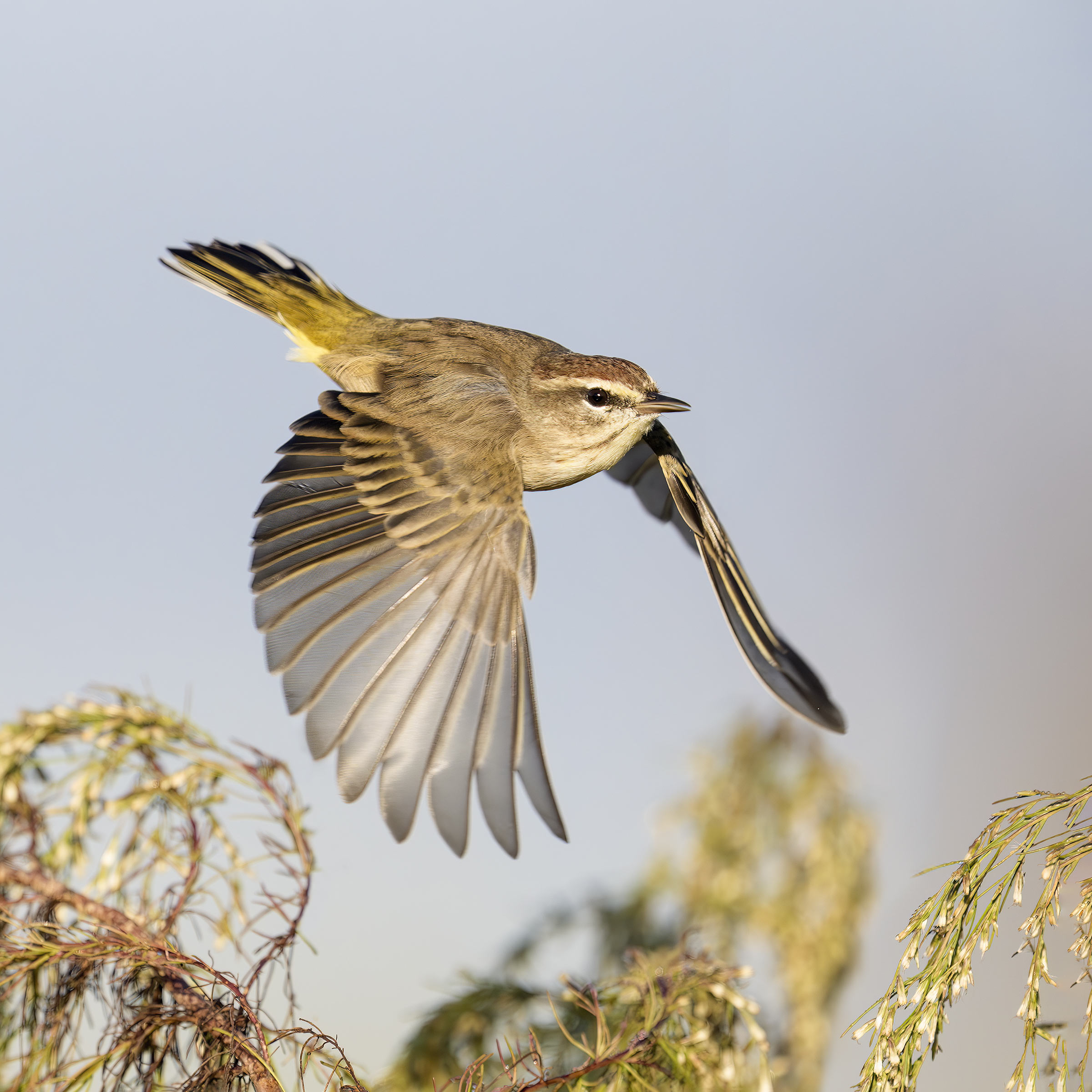
This image was created on 26 November 2025 by yours truly at Indian Lake Estates, FL. Working from the front seat of my SUV I used the BLUBB-supported Sony FE 600mm f/4 GM OSS lens with the Sony FE 1.4x Teleconverter and the Latest Greatest Sony Flagship Body, the a1 II Mirrorless Camera. Exposure determined via Zebras with ISO on the Thumb Wheel. ISO 2000: 1/4000 sec. at f/5.6 (wide open) in Manual mode. RawDigger showed that the exposure was perfect. AWB at 8:42:03am on a then cloudy morning. Wide/AF-C with Bird Eye/Face Detection enabled performed perfectly. Click on the image to enjoy the larger, inexplicably sharper high-res version. Image #3: Palm Warbler taking flight |
Blessed By Sony a-1 II AF and Pre-Capture!
When I was a Canon Explorer of Light (for 19 years, one of the original 55), I remember telling Rudy Winston and the late Chuck Westfall that it would be great if Canon could develop a truly science-fiction-like autofocus system. With today’s high end mirrorless camera bodies, my dreams have pretty much been realized. And I firmly believe that the a-1 ii is the best of the lot. By far. I had never envisioned the possibility of making any type of flight shot of a warbler. Until now. And more amazingly, I actually planned for this image. With my reflexes slowed somewhat by age, I actually planned for this one in advance by setting the Pre-Capture time to the max, 1.0 second.
|
|
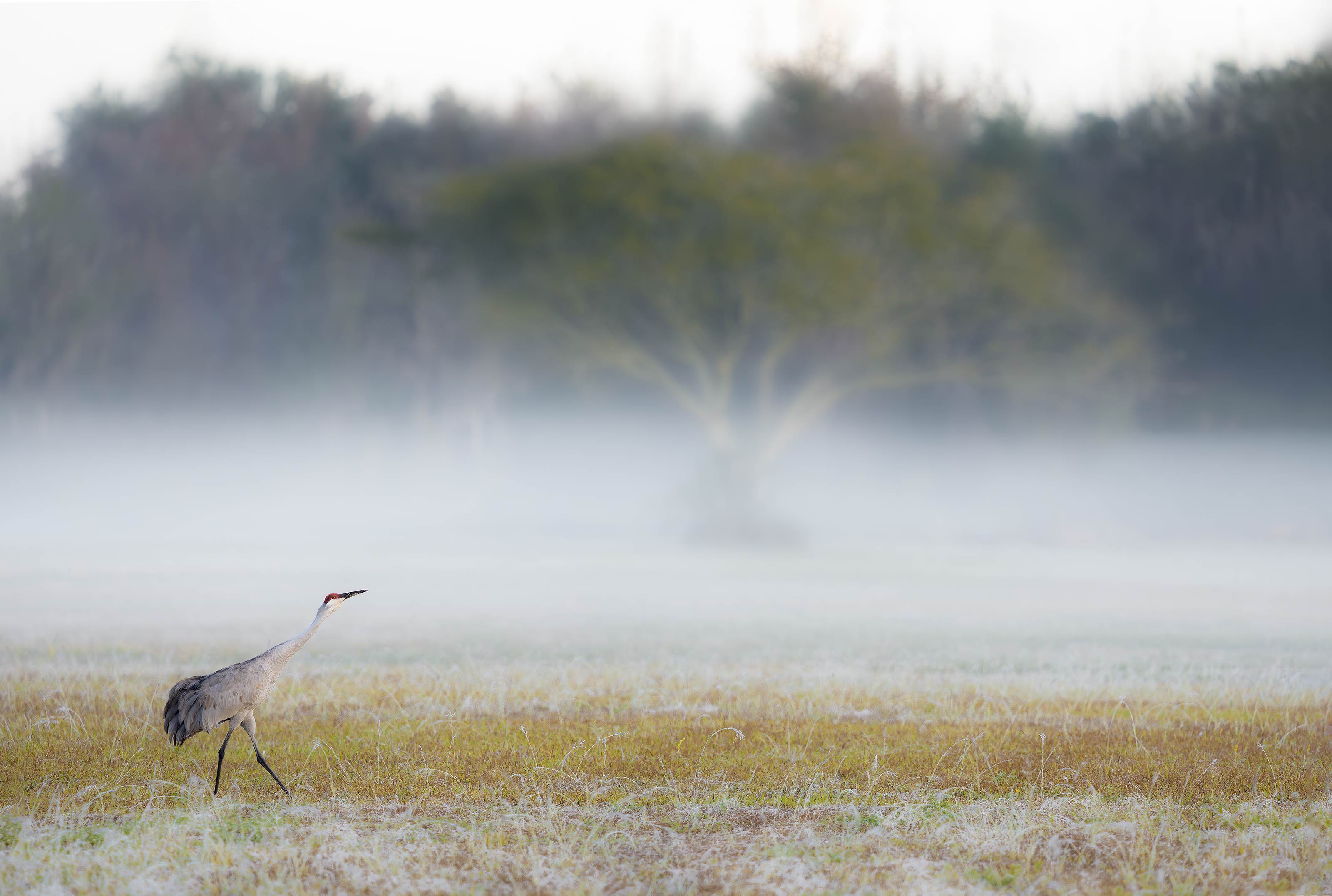
This image was created on 1 December 2025 by yours truly at Indian Lake Estates, FL. Working from the front seat of my SUV I used the BLUBB-supported Sony FE 400-800mm f/6.3-8 G OSS lens (Sony E) (at 522mm) and the Latest Greatest Sony Flagship Body, the a1 II Mirrorless Camera. Exposure determined via Zebras with ISO on the Thumb Wheel. ISO 1600: 1/200 sec. at f/7.1 (wide open at that focal length) in Manual mode. RawDigger showed that the exposure was perfect. AWB at 7:26:16am on a then misty morning with some light clouds on the eastern horizon. Wide/AF-C with Bird Eye/Face Detection enabled performed perfectly. Click on the image to enjoy the larger, inexplicably sharper high-res version. Image #4: Sandhill Crane inviting copulation in foggy field |
One Photo Illustrates Many Blessings
1- My ability to analyze the conditions and then put myself in the right spot. When I saw the mist on the North Field, I hoped that there were some distant cranes that I could not see in the fog. So, I turned right, headed north, and was rewarded.
2- My ability to design pleasing images pretty much instantly.
3- Sony a-1 ii Wide AF-C with Bird Eye/Face Detection enabled allows me to execute nearly all of my compositional plans with ease.
4- The Sony 400-800 offers a wide range of focal lengths from 400mm up to 1600mm and is thus incredibly versatile for bird photography.
5- The Sandhill Cranes at ILE are indeed a great blessing. They are pretty much available for photo sessions every day of the year. There mere presence challenges me to strive to create new and different images every time that I drive down to the lake.
6- The BLUBB provides a solid support when working from my SUV with long focal lengths.
7- My dependable BMW X5.
|
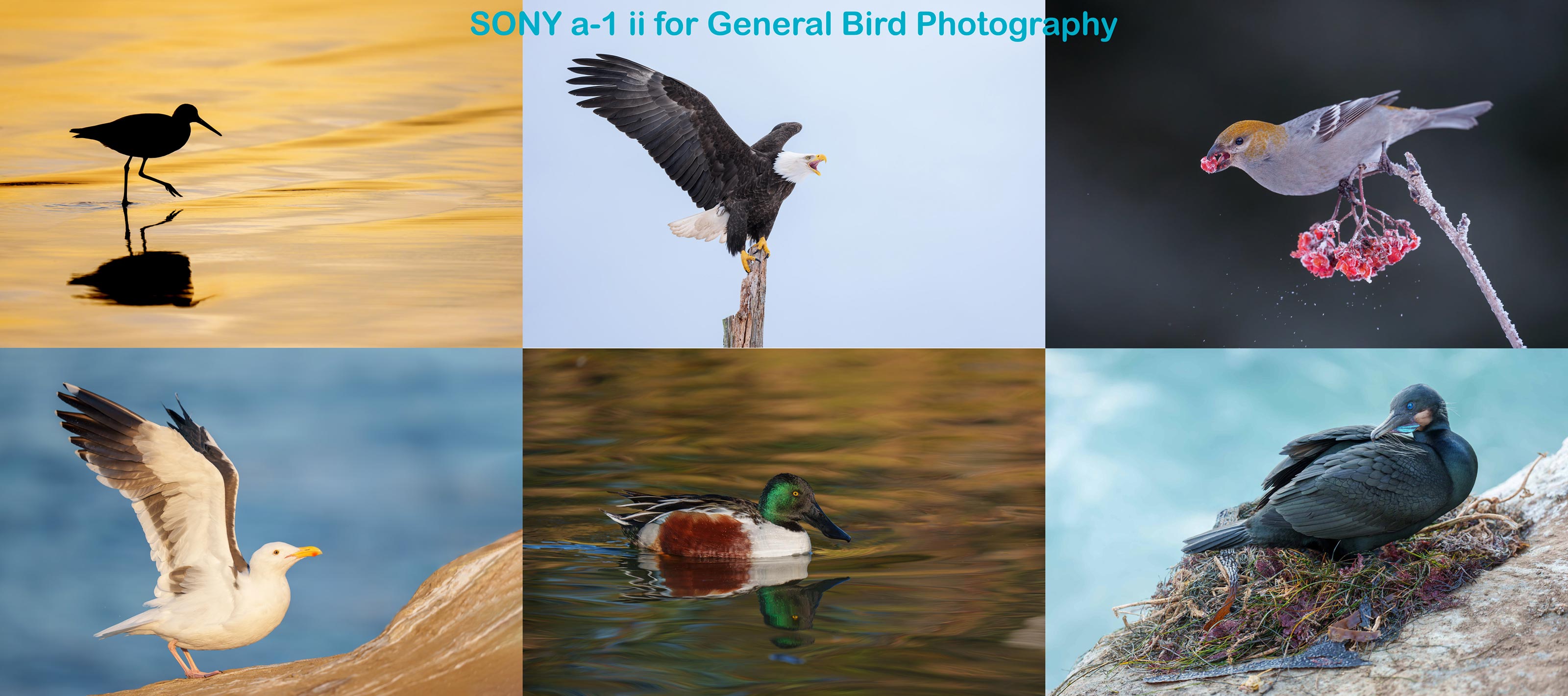
Composite #1: All with the a-1 ii Mirrorless Camera body.
|
The a-1 ii for General Bird Photography
I have found that eye-tracking for general bird photography with the a-1 ii is far, far better than with the original Sony a-1. It grabs the eye and tracks it faster and far more consistently and focus is rarely lost, even with backgrounds other than sky.
|
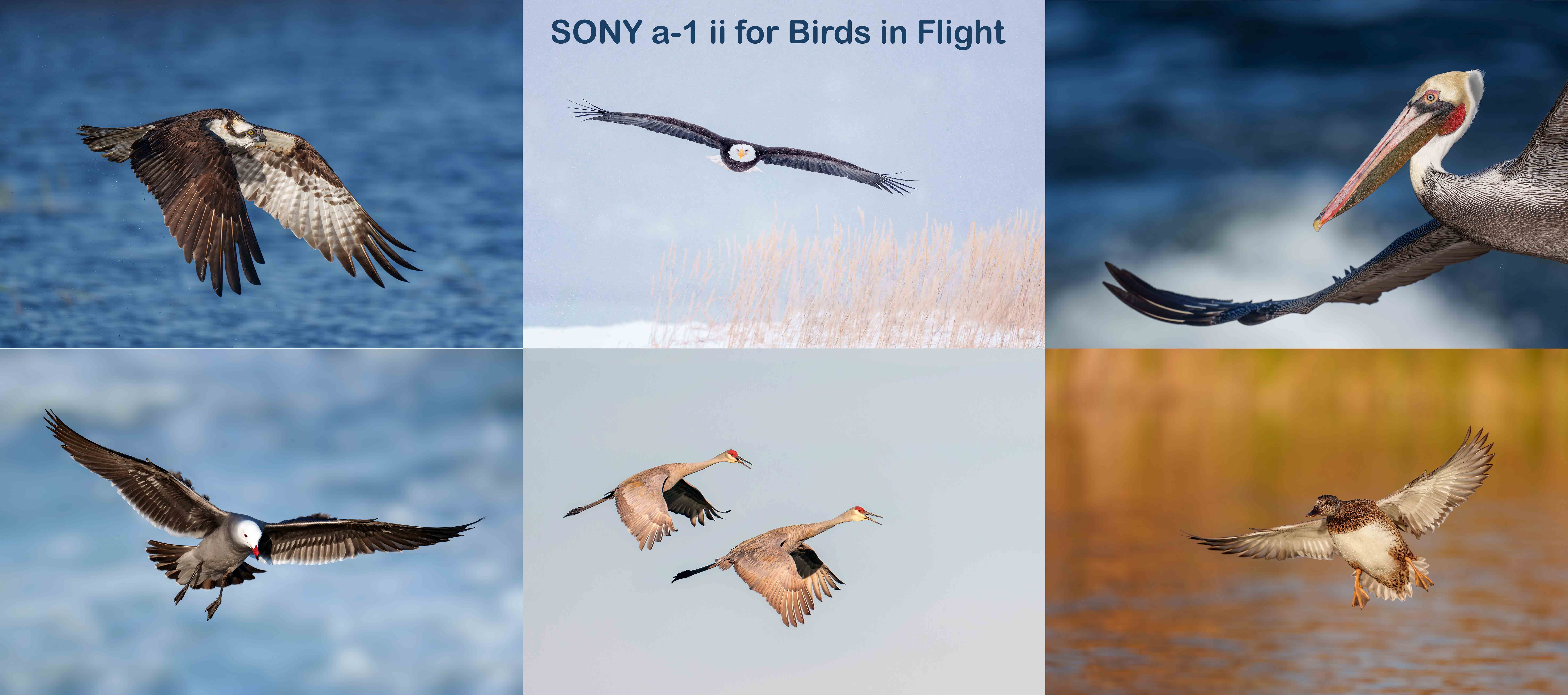
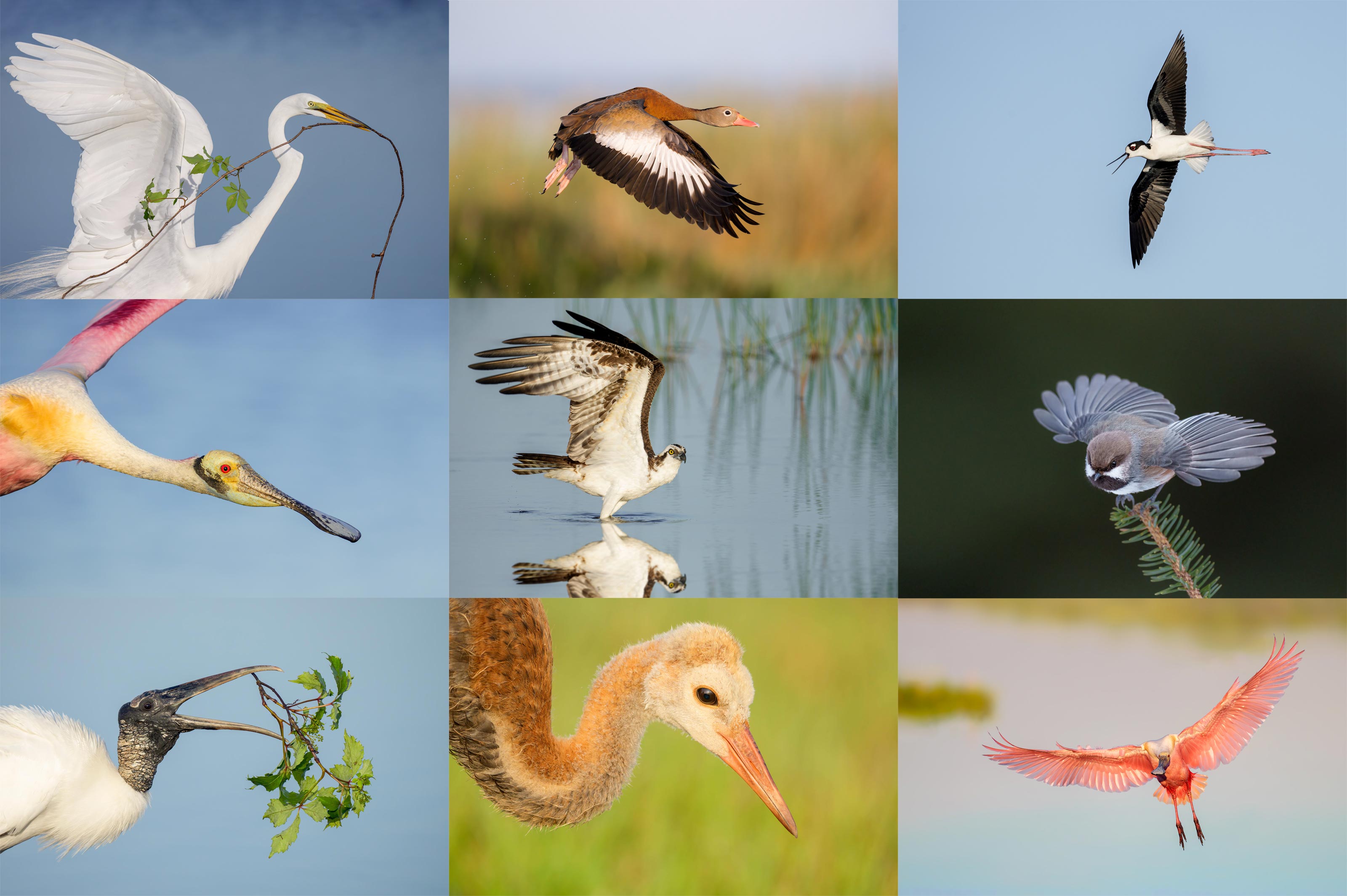
Composite #2: All with the a-1 ii Mirrorless Camera body.
|
The a-1 ii for Birds in Flight
For birds in flight, the a-1 ii Mirrorless Camera body has no equal. As Arash Hazeghi says, “It is better than the a-1.” When I am late getting on a bird in flight, I have consistently been amazed at how often the AF system of the a-1 ii finds and tracks the bird’s eye.
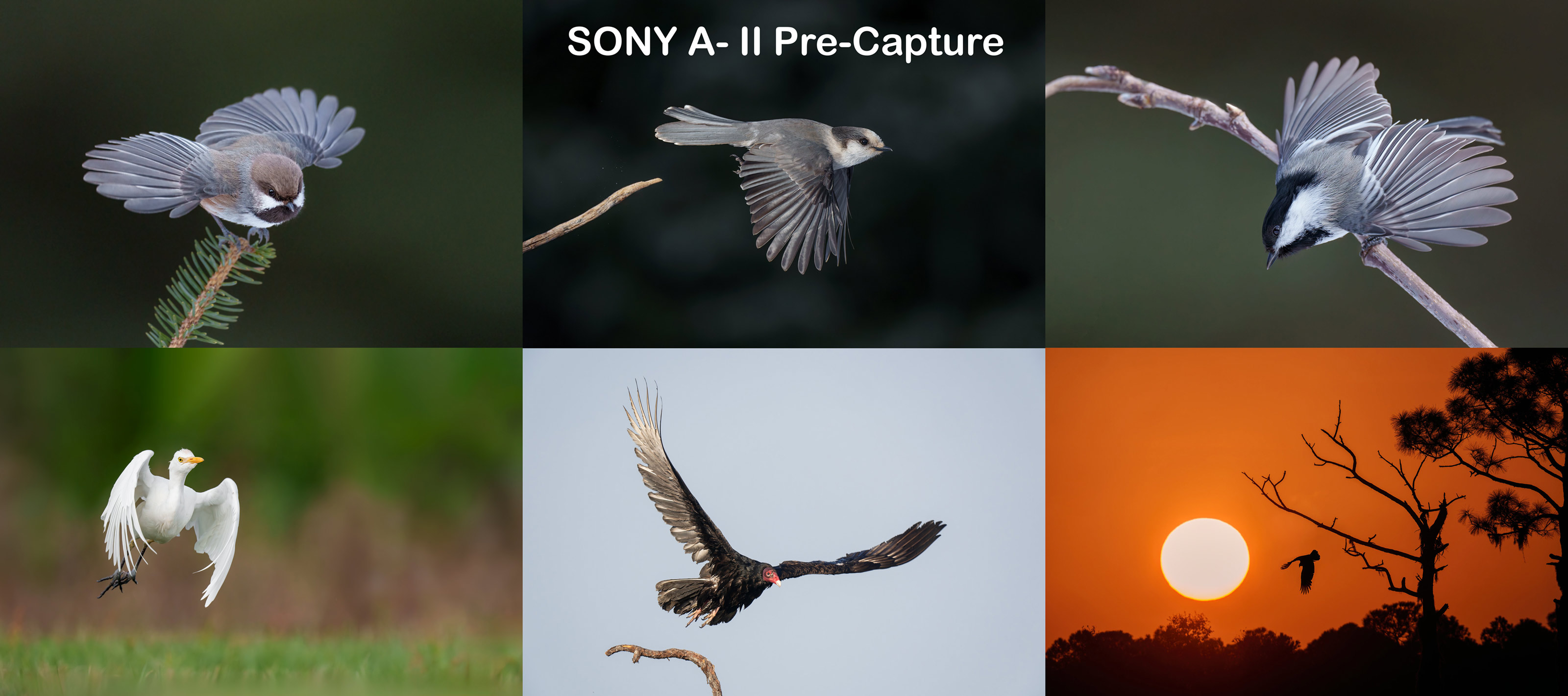
|
Composite #3: All the result of using Pre-Capture with the a-1 ii Mirrorless Camera body.
|
Pre-Capture with the Sony a-1 ii
When it comes to Pre-Capture with the a-1 ii Mirrorless Camera body, Arash and I agree 100%. And with my slower reflexes, Pre-Capture is more important for me than it is for Arash. Understand that in each of the images in Composite #3, I did not push the shutter button until after the bird took flight!
|
All with the a-1 ii Mirrorless Camera body.
|
Purchasing or Upgrading to a Sony a-1 ii
The Sony a-1 ii e-Mail Set-up and Info Guide
I now own and use two Sony a-1 ii bodies. Every day that I use them, the more I am amazed by speed and accuracy of the Bird Face-Eye tracking in AF-C and the overall performance of the camera.
Aside from the improved ergonomics as compared to the a-1, other nice features include the fact that the rear screen tilts both ways — the lack of a tilting rear screen on the original a-1 always ticked me off. Pre-capture has proven to be a huge plus almost exclusively for take-off flight images. In my opinion, the Speed Boost feature is a total waste for bird photography because you should always be utilizing the maximum frame rate. In addition, the resolution on the rear monitor has been improved dramatically. I must mention again that Bird Face-Eye tracking on the a-1 ii is vastly improved as compared to both the a-1 and the a9 iii and that the 51MP files are to die for.
So, the big question is, is the a-1 ii “worth” a gear upgrade. Remembering that I can never know whether or not something is worth it to you, I can say that I was not floored when first using my a-1 ii. The differences between the a-1 ii and the original a-1, seemed to be neither huge nor eye-opening. But over time, I have come to realize that I was 100% wrong. The huge difference between the new camera body and the a9 iii is, of course, the 51MP a-1 raw files (as compared to the 24MP files rendered by the a9 iii).
The price of a new a-1 is $5,898.00. The price of a new a-1 ii is $1,100.00 more: $6,998.00. As the a-1 ii is clearly far superior for bird photography to the original a-1, the choice for folks new to Sony or for those upgrading from lesser Sony camera bodies is an easy one. Prices for used a-1 bodies has not dropped drastically as I anticipated. At this point, a-1 folks who like showing flight and action and can afford an a-1 ii, are advised to purchase an a-1 ii. Please remember that life is short; we only get one ride on the merry-go-round.
If you do purchase an a-1 ii, be sure to use one of my two affiliate links so that you will receive my a-1 ii settings (in the form of a CAMSEa1ii.DAT file), the Buttons and Dials Guide, and an Info Sheet for free. Using my links will never cost you one penny and may actually save you some money. Folks who do not purchase their new a-i using my B&H link or from Bedfords here and entering the BIRDSASART discount code at checkout will be able to purchase the a-1 ii guide for $244.93. If you are at all confused and do not want to screw up your order, please get in touch via e-mail. If you would like to chat about upgrading, shoot me a text to 863-221-2372 and LMK a good time to call you.
Typos
With all blog posts, feel free to e-mail or to leave a comment regarding any typos or errors.







So much to be thankful for! I like what you did with the rainbow. You don’t see that often
My favorite is the Sandhill Crane. The background is very nice/beautiful.
My favorite is the Sandhill Crane. The background is very nice/beautiful.
Also liked your thankfulness. But know that I am thankful for all your help and getting me started correctly. I know I need more instruction but for now need to ingest what you have already tried to teach me. I am also thankful for someone like you who firmly but patiently shares his expertise. Thank you.
Without a doubt, I think #3, the Palm Warbler in flight, is the strongest and the most interesting image in today’s blog.