
|
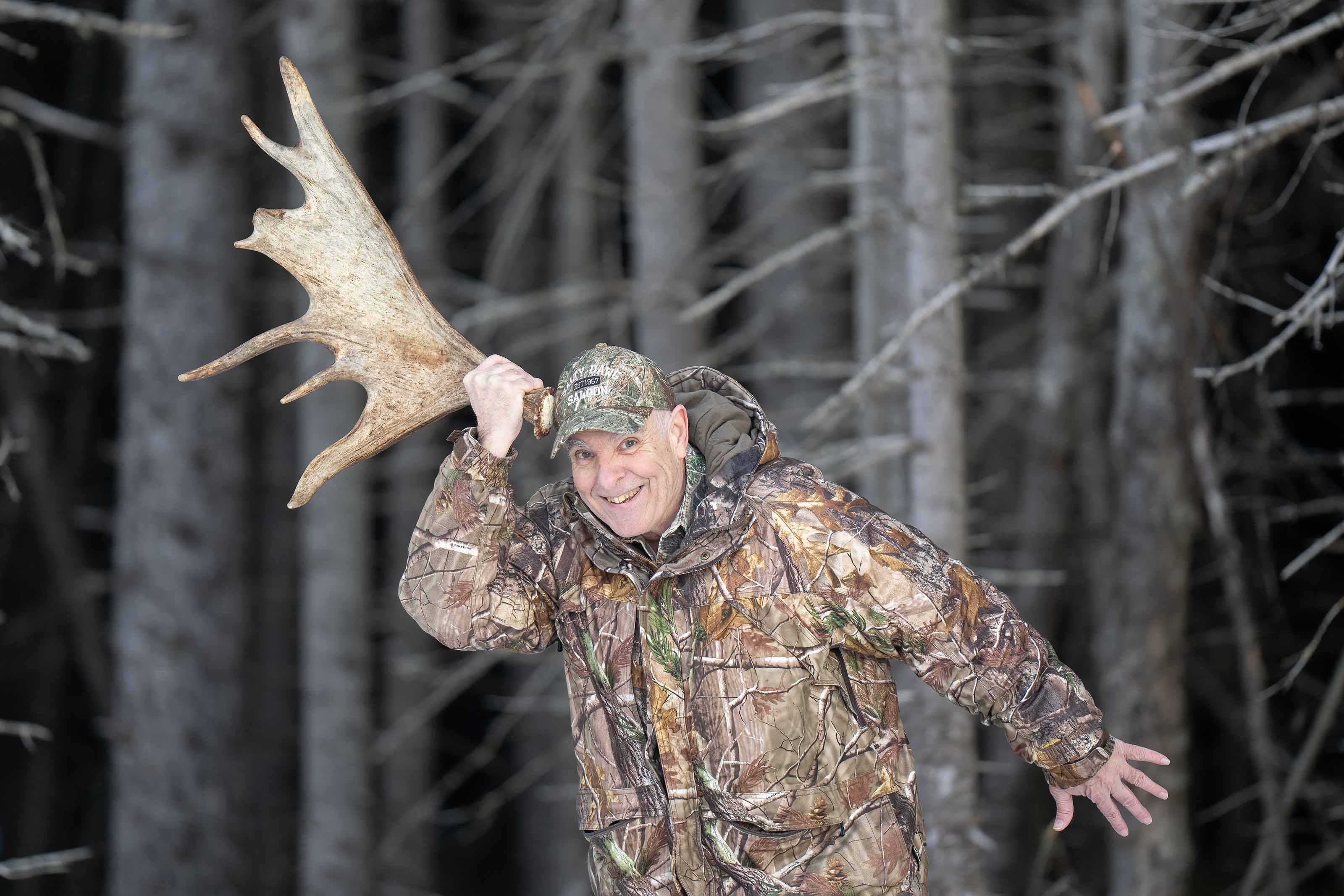
Bob Eastman in Zany Mode disguising himself as a one-antlered Moose |
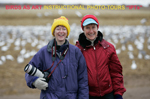
Bob Eastman
Bob Eastman is a great friend, a very good photographer, a bit zany most of the time, and enjoys each and every day despite a run of bad luck that began in 1962 and continued into 2025. A few months back he learned that he had an inoperable cyst below a metal plate in his neck. And when we spoke yesterday on the evening of 15 December, he had just had an infected tooth yanked. All in all, he has had more than his share of bad luck. Learn a ton about Bob in the Hapless But Happy and Loving It! The Life of Bob Eastman blog post here. I just re-read it and I could not believe the story. Through it all he continues to love life and bird photography.
Be sure to visit the Osprey and the Thieving Brown Pelican/A Fabulous Story-telling Photo Sequence by My Friend, Bob Eastman blog post here. And see some more of his excellent work in the How Bob Eastman Severely Kicked My Butt with his Trusty Sony 200-600mm G Lens on the Morning of 12-22-2024 blog post here.
Recently, he learned about some Short-eared Owls 2 1/2 hours from his home in Reedsburg, Wisconsin. He made the five hour-round trip four times. One trip back home took almost five hours with freezing rain, ice, and then snow. He succeeded twice with the owls and came up empty twice. His dedication paid off on December 6 and 11. The temperature on the sixth was 18° F and on the eleventh it was 12° F with windchills both days right around zero. I was thinking about flying to Green Bay until I learned that it was supposed to get much colder.
So what does Hawaiian pizza have to do with all of this? When I call Bob, he answers “Pizza Joe’s.” Then I leave my order, as above in the title of today’s post. I am thrilled that Bob will be joining me again in San Diego this coming January.
What Bob Said
When it comes down to life I keep on keeping on and do what I can and that is to be happy and explore and love life being able to be out doors and do what I love, photography is amazing and one needs to keep on trying and have some luck. Today I was able to get a dolphin throwing a snook into the air that was so cool, knowing what to do is key. That is where my great friend artie has been amazing in helping me along in my journey with his amazing teachings on photography. I have been thru lots and life is just beginning as I say. PS…. I’m single….lol
“May the Sunshine keep you smiling and the wind set you free”
Always with love Bob

|
|
This image was created on 6 December 2025 by my great friend Bob Eastman at Killsnake Wildlife Area, near Chilton, WI. Standing at full height, he used the hand held Sony FE 200-600mm f/5.6-6.3 G OSS lens (at 600mm) and The One, the Sony Alpha 1 Mirrorless digital camera. ) The exposure was determined using Zebra technology with ISO on the Thumb Dial. ISO 1000. 1/1600 second at f/6.3 (wide-open) in Manual Mode. AWB at 2:56:06pm on a cloudy afternoon. RawDigger showed the exposure to be about one stop under. Tracking: Spot (XS) AF-C with Bird Face/Eye Detection performed perfectly. Be sure to click on the image to enjoy a high-res version. Image #1: Short-eared Owl aerial squabble
|
Two Birds in a Flight/Fight Image
Creating successful images of two (or more) birds in flight is a huge challenge that requires a ton of skill and a bit of luck. What’s great about this one?
1- We have a great look at the faces of both owls.
2- The owls are pretty much on the same plane so that the faces and eyes of both birds are sharp.
3- The soft light allowed for wonderful underwing detail.
4- The image design and the juxtaposition of the two owls is pleasing and well balanced.
5- The powerful wing position of the bird on the lower left while looking up at the other bird conveys the message: I’m gonna get you!

|
|
This image was also created on 6 December 2025 by my great friend Bob Eastman at Killsnake Wildlife Area, near Chilton, WI. Standing at full height, he used the hand held Sony FE 200-600mm f/5.6-6.3 G OSS lens (at 600mm) and The One, the Sony Alpha 1 Mirrorless digital camera. ) The exposure was determined using Zebra technology with ISO on the Thumb Dial. ISO 1000. 1/1600 second at f/6.3 (wide-open) in Manual Mode. AWB at 2:56:06pm on a cloudy afternoon. RawDigger showed the exposure to be about one stop under. Tracking: Spot (XS) AF-C with Bird Face/Eye Detection performed perfectly. Be sure to click on the image to enjoy a high-res version. Image #2: Short-eared Owl taking flight
|
Johnny on the Spot
Or Bobby Eastman on the spot.
Bob Eastman is always ready. He rarely lowers his shutter speeds so that he is usually prepared for flight photography. He has fast reflexes. And his subject acquisition and panning and tracking skills are superb as well. Those skills combined allow him to stay on the bird while using Tracking: Spot (XS) AF-C with Bird Face/Eye Detection enabled and produce consistently sharp images.
Using a small single AF point for flight is extremely difficult for most folks especially and including me.
Tracking: Spot Extra Small (XS) along with a variety of new AF patterns were introduced recently with Sony ILCE-1 System Software (Firmware) Update Ver. 4.00. a-1 folks can download the BODYDATA.DAT file here.
|
|
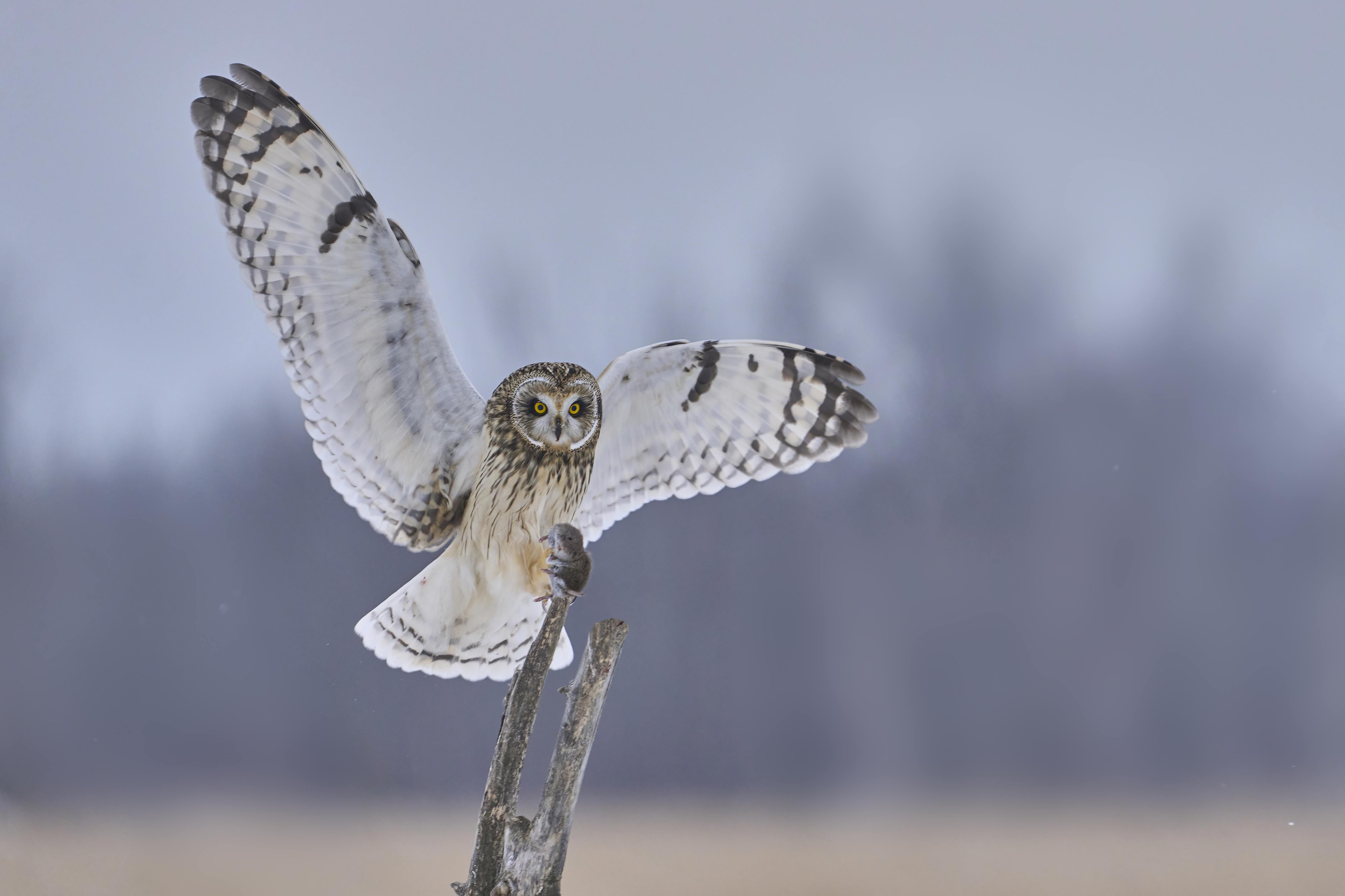
This image was also created on 6 December 2025 by my great friend Bob Eastman at Killsnake Wildlife Area, near Chilton, WI. Standing at full height, he used the hand held Sony FE 200-600mm f/5.6-6.3 G OSS lens (at 600mm) and The One, the Sony Alpha 1 Mirrorless digital camera. ) The exposure was determined using Zebra technology with ISO on the Thumb Dial. ISO 2000. 1/1600 second at f/6.3 (wide-open) in Manual Mode. AWB at 3:39:35pm on a cloudy afternoon. RawDigger showed the exposure to be about one stop under. Tracking: Spot (XS) AF-C with Bird Face/Eye Detection performed perfectly. Be sure to click on the image to enjoy a high-res version. Image #3: Short-eared Owl landing with vole
|
General But Invaluable Advice for Bird Photography
As a general rule, you want to position yourself with the wind behind you when photographing birds. Especially when doing flight photography. This strategy is often most productive on cloudy days.
During my two month visit to Sebastian Inlet this fall I observed hundreds of folks who would have benefited from being aware of and adhering to this principle.
How do we know that Mr. Bob kept the wind behind him for all of his Short-eared Owl photography? All of the birds in his images are facing the camera. That as a result of their landing, facing, and taking off into the wind.

|
|
This image was also created on 6 December 2025 by my great friend Bob Eastman at Killsnake Wildlife Area, near Chilton, WI. Standing at full height, he used the hand held Sony FE 200-600mm f/5.6-6.3 G OSS lens (at 600mm) and The One, the Sony Alpha 1 Mirrorless digital camera. ) The exposure was determined using Zebra technology with ISO on the Thumb Dial. ISO 2000. 1/1600 second at f/6.3 (wide-open) in Manual Mode. AWB at 3:40:50pm on a cloudy afternoon. RawDigger showed the exposure to be about one stop under. Tracking: Spot (XS) AF-C with Bird Face/Eye Detection performed perfectly. Be sure to click on the image to enjoy a high-res version. Image #4: Short-eared Owl on perch with vole
|
Combining for Success
Once the owl landed with the vole, Bob moved closer and to his right. Once I received his large JPEG, I opted to remove the thinner portion of the two-pronged perch that intersected with the owl’s tail.

|
|
This image was created on 11 December 2025 by my great friend Bob Eastman at Killsnake Wildlife Area, near Chilton, WI. Standing at full height, he used the hand held Sony FE 200-600mm f/5.6-6.3 G OSS lens (at 600mm) and The One, the Sony Alpha 1 Mirrorless digital camera. ) The exposure was determined using Zebra technology with ISO on the Thumb Dial. ISO 2000. 1/1600 second at f/6.3 (wide-open) in Manual Mode. AWB at 3:43:47pm on a cloudy afternoon. RawDigger showed the exposure to be about one stop under. Tracking: Spot (XS) AF-C with Bird Face/Eye Detection performed perfectly. Be sure to click on the image to enjoy a high-res version. Image #5: Short-eared Owl in flight — full frame
|
A Tribute
The success of this un-cropped flight shot is a tribute to both the tracking accuracy of the Sony a-1 AF system and Bob’s skills (as noted previously below Image #2).

|
|
This image was also created on 11 December 2025 by my great friend Bob Eastman at Killsnake Wildlife Area, near Chilton, WI. Standing at full height, he used the hand held Sony FE 200-600mm f/5.6-6.3 G OSS lens (at 600mm) and The One, the Sony Alpha 1 Mirrorless digital camera. ) The exposure was determined using Zebra technology with ISO on the Thumb Dial. ISO 2000. 1/1600 second at f/6.3 (wide-open) in Manual Mode. AWB at 3:43:48pm on a cloudy afternoon. RawDigger showed the exposure to be about one stop under. Tracking: Spot (XS) AF-C with Bird Face/Eye Detection performed perfectly. Be sure to click on the image to enjoy a high-res version. Image #6: Short-eared Owl tight flight
|
More of the Same
Tight flight shots revealing the incredible face and feather detail were virtually impossible with dSLR camera bodies. With the high end mirrorless camera bodies and a modicum of skill, they are almost becoming commonplace.
Bob sent me the raw file for this one as requested. I used the Masking feature in Adobe Camera Raw during the raw conversion to soften the detail in the background and turn the bluish snow white. Bob liked it.
The relatively new masking feature in Adobe Camera Raw allows making changes to the background alone easy as pie. Easier, in fact. In Volume III of the Digital Basics IV Video Series I introduced and discussed a variety of ACR mask selection options including Subject, Background, Sky, Brush, and Linear Gradient. I the last two volumes I will cover creating Radial Gradient, Object (beyond amazing!), and both Color Range and Luminance Range masks.
The more I use and experiment with the Masking feature in ACR the more neat tricks I come up with.

|
|
This image was also created on 11 December 2025 by my great friend Bob Eastman at Killsnake Wildlife Area, near Chilton, WI. Standing at full height, he used the hand held Sony FE 200-600mm f/5.6-6.3 G OSS lens (at 600mm) and The One, the Sony Alpha 1 Mirrorless digital camera. ) The exposure was determined using Zebra technology with ISO on the Thumb Dial. ISO 2000. 1/1600 second at f/6.3 (wide-open) in Manual Mode. AWB at 4:02:54pm on a cloudy afternoon. RawDigger showed the exposure to be about one stop under. Tracking: Spot (XS) AF-C with Bird Face/Eye Detection performed perfectly. Be sure to click on the image to enjoy a high-res version. Image #7: Short-eared Owl taking flight
|
Bob’s Recipe for Success
Bob Eastman owns and uses only one super-telephoto lens, the Sony FE 200-600mm f/5.6-6.3 G OSS lens. He does not own The Latest Greatest Sony Flagship Body, the a1 II Mirrorless Camera. He sticks with his original Sony Alpha 1 Mirrorless digital camera.)
For a bird photographer, there are several advantages to owning only a single super-telephoto lens (and a single camera body:
1- You always have your best lens and rig in hand.
2- You rarely need to make any gear decisions.
3- You quickly become intimately familiar with the operation of both your lens and your camera; your rig pretty much becomes an extension of you.
Low Light Flight Advice for Bob
Try to use at least 1/2500 second for flight even in low light. Then raise the ISO to show at least +1 2/3 stops off the sky. This will yield sharper images with less noise. Otherwise, keep on keeping on!
A Lesson for Everyone
Two things determine the success of a nature photographer. The eight inches directly behind the camera and the heart and soul of the person holding the gear. The lens and the camera are just tools — they have zero to do with success or failure.
|
|
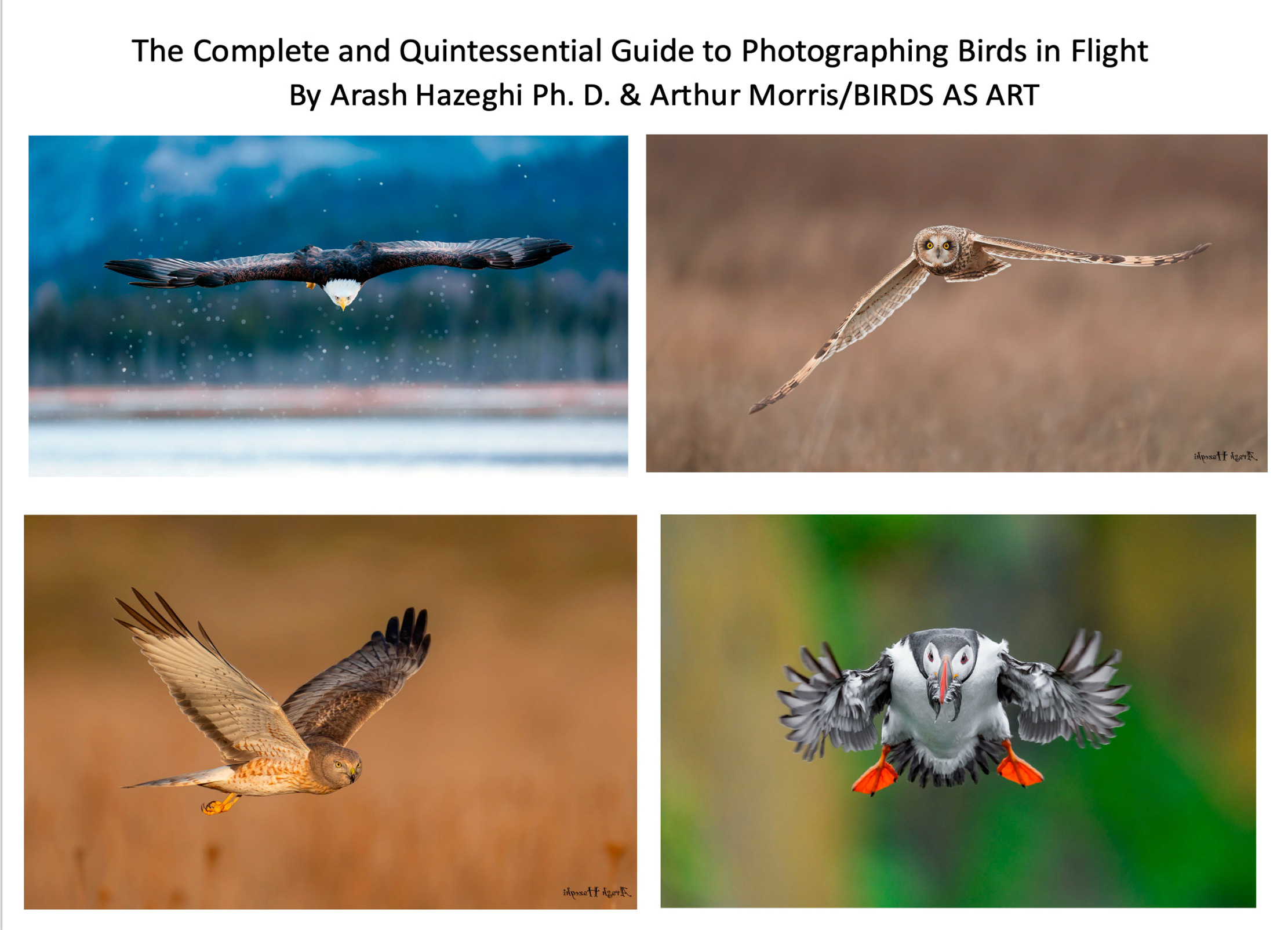
The title says it all. Purchase your copy here. The Complete and Quintessential Guide to Photographing Birds in Flight
|
The Complete and Quintessential Guide to Photographing Birds in Flight: $99.00
I had long dreamed of becoming a great flight photographer. When using dSLR gear, making sharp images was a huge problem. Most of the time, the camera bodies simply were not up to snuff. Things have changed dramatically with mirrorless technology. The high-end mirrorless camera bodies now feature science fiction-like autofocus systems and frame rates of 30, 40, and even 125 fps. Nowadays, getting the eye sharp is no longer a problem. The problem more often involves selecting the strongest image from a long series of sharp images.
The truth, however, is that there is a lot more than owning a Canon EOS R1, a Nikon Z9, or a Sony a-1 ii to consistently creating great photographs of birds in flight. Some of the biggest factors to success include gear choice, shooting strategies, and understanding the importance of sky conditions and wind speed and direction. Once you have the techniques and technical aspects down pat and can routinely create sharp images, learning the importance of flight poses, wing positions, backgrounds, and subject placement and image design enable you to create and then select superb flight images. And you guessed it, each of those topics and tons more are covered in detail in The Complete and Quintessential Guide to Photographing Birds in Flight.
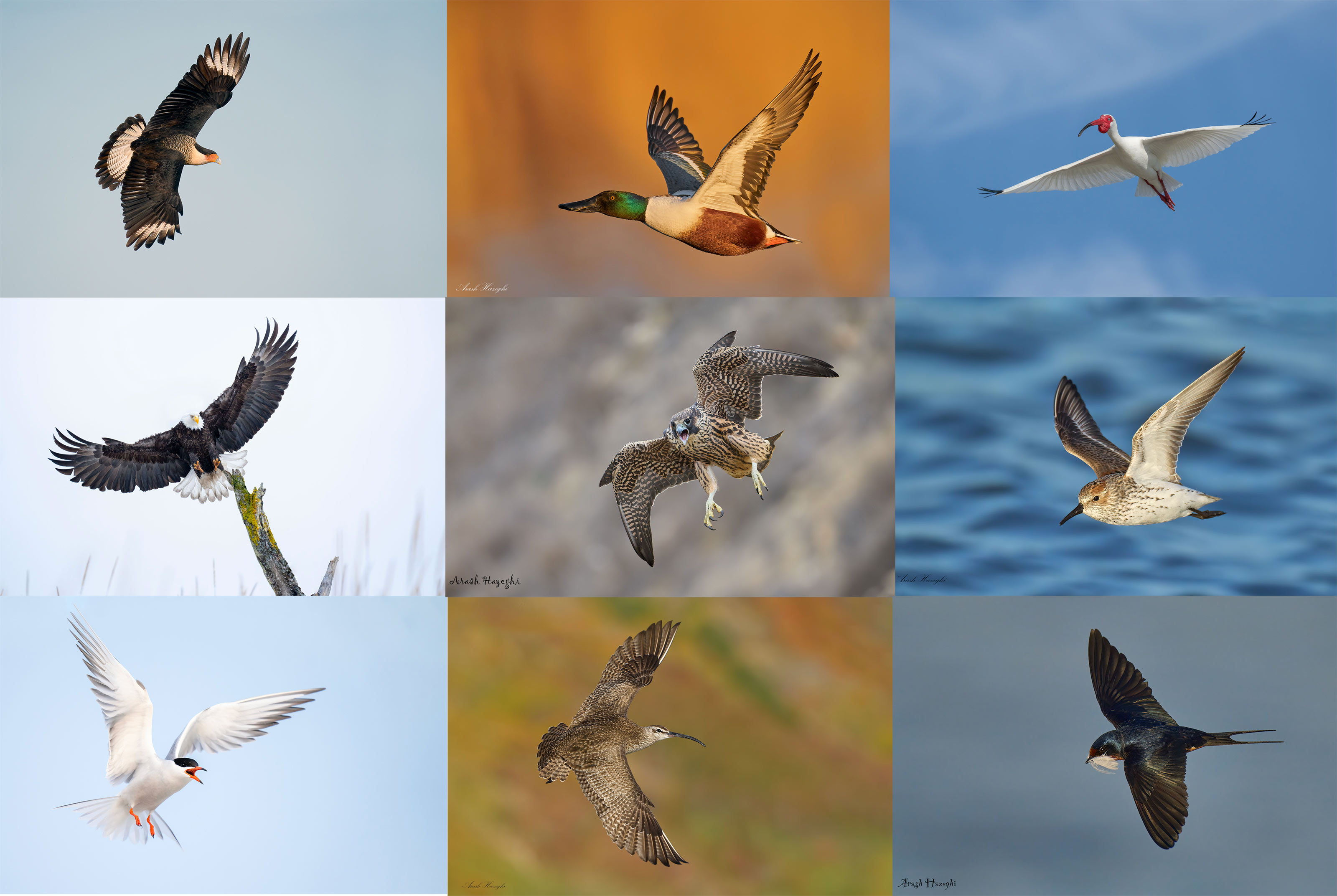
The guide consists of 267 pages and 21,013 words. There are 82 illustrative photos scattered throughout the text, two screen captures, and a 112-image gallery that includes examples created by Canon, Nikon, and mostly Sony gear. As seen above, each of the 194 inspirational photos is labeled with an educational caption.
You can purchase your copy here for $99.00.
Arash Hazeghi
Arash Hazeghi, Ph.D. is a principal electron device engineer. He received his Ph.D. degree in Electrical Engineering in 2011, from Stanford University, Stanford, California. His pioneering research on Carbon Nanotubes has been cited many times. In the past decade, Arash Hazeghi has been a major contributor to the research and the development of some of the most cutting-edge technologies introduced by Silicon Valley’s most reputable names including SanDisk, Intel and Apple.
More relevant here is that he is widely recognized as one of the world’s best birds in flight photographers. He specializes in raptors and the technical aspects of bird photography.
|
|
Flight photography is a skill that can be studied, practiced, and learned. Improve your skills by studying The Complete and Quintessential Guide to Photographing Birds in Flight |
The Complete and Quintessential Guide to Photographing Birds in Flight
By Arash Hazeghi Ph.D., and Arthur Morris/BIRDS AS ART
What you will learn (about):
-
1- Weight and handholding super-telephoto lenses.
2- Weight and handholding intermediate telephoto and telephotos zoom lenses.
3- Choosing the right flight photography lens or lenses for you.
4- The importance of focal length for flight photography.
5- The importance of lens speed (the maximum aperture for flight photography.
6- Choosing between fixed focal lengths and zoom lenses for flight photography.
7- The importance of AF speed and performance for flight photography.
8- Handholding tips and techniques.
9- Shooting flight off a tripod with the Levered-clamp FlexShooter Pro.
10- Flight poses and wing positions.
11- Why artie changed his mind about the 400mm f/2.8 lenses for flight and more.
12- The advantages and disadvantages of using teleconverters for flight photography.
13- Why to stay away from off-brand lenses.
14- Understanding the importance of wind direction and speed for flight photography.
15- The relationship between sky conditions and wind direction and how it affects flight photography.
16- Creating flight silhouettes in wind-against-sun conditions.
17- The importance of being on sun angle for flight photography (and avoiding harsh shadows).
18- Tips on doing flight photography in cloudy, foggy, or overcast conditions.
19- About the direction of light in cloudy, foggy, or overcast conditions and how it affects flight photography.
20- How your understanding of bird behavior can dramatically improve your flight photography.
21- Tips on attracting birds for flight photography.
22- What to do when your camera’s AF system is temporarily blind.
23- The vital importance of pre-focusing.
24- How Direct Manual Focus can help you with flight photography.
25- The importance of shooting aggressively when doing flight photography.
26- Everything that you need to know with regards to rest positions for flight photography.
27- The importance of getting low when doing flight in many situations.
28- Getting the right exposure when doing flight photography.
29_ Why to use Manual mode 95% of the time for flight.
30- Tips on finding the bird in the frame, acquiring focus, and tracking the bird in flight.
31- How to set and best utilize your lens’s image stabilization feature (and why).
32- Setting the focus range limiter switch on your flight lens or lenses.
33- To choose the best shutter speed for photographing birds in flight.
34- The vital importance of pre-focusing. And yes, this is so important that it is on the list twice.
You can see four sample pages in the blog post here. And you can purchase your copy here.
Typos
With all blog posts, feel free to e-mail or to leave a comment regarding any typos or errors.







Bob’s story always amazes me. Yet, he keeps on smiling. These SEO images are fantastic. Using xs focusing shows how skilled he is with tracking and holding that lens. That has been my favorite winter sport here in NJ….finding and shooting SEO’s. Problem is that word gets out to their location and the area becomes saturated with photographers who are clueless about respect for wildlife when trying to get “the” photo. Thanks for sharing Bob’s amazing shots.
Thanks, Sandy. Bob is surely an amazing and happy guy. And his images are first rate as well.
much love, artie
Merry Christmas! You need to watch the movie “What About Bob”with Bill Murray and Richard Dreyfuss. Enjoy.
Thanks, Jeff. I think that you suggested that the last time I wrote about Bob!
with love, artie
Nice images Bob!
#1 is killer – congrats Bob!
With all his bad luck, did he at least make money when he founded Eastman Kodak?
Not this week 🙂
a
Art, thanks so much for this blog about Bob Eastman. It’s hard to believe that anyone could have survived what he has been through. How wonderful that he lived to enjoy photography and make such wonderful images — my favorite is #4.
Thanks, Pat. He is an amazing human bean 🙂
with love, a
Amazing images, I love all Owls. Amazing story too after reading it again…. Amazing man!!
P.S. I’m single too Bob, but a bit too ancient and heat-loving for you!!! Haha… Plus I’m a Brit.