
Your Call?
Which three of today’s 13 featured images do you think are the strongest? Why did you make your picks? Before you head off to Instagram or Facebook, you might want to read the Why Comment item immediately below. Doing so might help you to become a much better photographer.
As you peruse the images, note the great variety of subject sizes, the compositional and framing choices, and artie’s use of the natural light. There is a lot to learn simply by looking at good or great photos. Taking the time to evaluate, consider, and compare them, however, can help you to elevate your bird photography game.
Why Comment?
An e-Mail Conversation with Blog Subscriber Tom Schreffler
am: Hi Tom,
Re:
TS: I know I’ve been unfair to you …
am: Not at all!
TS: because you provide me (now again, after many months) …
am: Again, the blog was published pretty much every third day at the least for forever 🙂
TS: with your very informative blog posts. You are nearly my exclusive source of criteria for choosing one image over a similar image.
am: That is one of the main thrusts of the blog so I am glad that you appreciate it. And your kind words are greatly appreciated.
TS: But I don’t think what I like better than what is information of much value to your readers.
am: First off, what you think matters to me. Secondly, others learn a lot from the comments of others.
This brings up my decades old response to the “I’m not good/smart/talented enough to offer a valid photo critique” refrain:
1- Doing a critique is quite simple:
a- What do you like?
b- What don’t you like?
c- Could the photographer have done anything different in the field to improve the image?
d- Could the photographer have done anything different at the computer to improve the image?
Picking your two or three favorites or ranking images in order with the best first is no more difficult than doing a critique. The only folks who get away with not doing image critiques or picking favorites are those who are blind.
Furthermore — I often learn from the comments left by others. On a recent Turkey Vulture image , for example, David Pugsley’s comment pointed out two additional items that I had missed originally.
Most importantly, there are many benefits for the person writing the comment and evaluating the work of others:
1- It helps you to develop a critical eye: You learn to identify what makes a photo successful (or not) by analyzing elements like composition, focus, and light in someone else’s work, rather than being emotionally attached to your own.
2- Doing so increases awareness: It highlights the strengths and weaknesses in a picture, making you more conscious of those same aspects in your own shots.
3- It provides new perspectives: Seeing how others frame subjects, use color, or create mood introduces new ideas you can adapt.
4- It fosters creativity: Challenging yourself to critique helps you see possibilities you might miss, like new formats or creative angles.
5- Lastly, it builds your style: By understanding different approaches, you can consciously choose elements that align with or help you to develop your own photographic style.
To be most effective you can — as noted above, provide constructive feedback by focusing on what works and what could be improved and by offering suggestions. You can ask questions and inquire about the photographer’s intent or their compositional or technical choices to deepen your analysis. Finally, you can look for patterns and notice common elements in successful images made by various photographers.
TS: I read your blog to learn from you.
am: That is both good and appreciated. But I have a lot to learn from you and others. And so do the others. Fresh eyes and thoughts are often thought provoking.
TS: I understand that if only a few readers respond to one of your blog posts, you might begin to wonder whether people are reading what you write. Let me assure you that I do read, enjoy, and learn from your blog, and I suspect many others do, too. But my online profile is so low, that I very rarely write anything that winds up anywhere it could be read by someone I wouldn’t recognize if I passed them on the street. I understand your blog is a very friendly place to comment, but I guess it just isn’t my style.
am: At times, of course, I do wonder about that. As above, however, try it; you might actually learn a ton.
TS: But understand that I really appreciate what I’ve learned from you, starting with the original The Art of Bird Photography, continuing with a seminar you once gave in Portland, Maine, your book on Shorebirds, a number of magazine articles over the years, and continuing with your blog. And that’s true even if I don’t feel like I have anything to say that would be of interest to the other readers of your blog.
am: Your self-deprecation might be hindering your development as a photographer.
Much love and thanks again for writing,
artie
Sony FE 90mm F2.8 Macro G OSS
Used Gear Page regular, IPT Veteran, and BAA friend Dane Johnson is offering a Sony FE 90mm F2.8 Macro G OSS, in like-new condition for $698.00. There are no dings or dents, or signs of wear on the lens barrel, and the front element is pristine. The sale includes the original product box, the manuals, the USA warranty card, the lens shade, the front and rear lens caps, the lens case, and insured ground shipping via major courier to lower-48 US addresses only. Your item will not ship until your check clears unless other arrangements are made.
Please contact Dane by phone at 559-593-0989 (Pacific Time zone) or via email at danaphoto4@yahoo.com.
This great macro lens sells new at B&H for $1,048.00. Save a handsome $350.00 by grabbing Dane’s pretty much new lens today. artie
G Lens, Macro Versatility
Get up close and personal with the 1:1 magnification ratio of the full-frame compatible Sony FE 90mm f/2.8 Macro G OSS Lens. As a G series lens, it perfectly balances sharpness and bokeh and, as a macro lens, close and controlled focusing performance is prioritized with advanced AF and intuitive handling.
Close-Up Capabilities
True macro design affords a life-size, 1:1 magnification ratio along with an 11″ minimum focusing distance for working with close-up subjects. The focusing distance and magnification scale is printed on top of the lens to aid in more technical applications. The focus range limiter switch allows you constrain the usable focus range between 11-19.7″, 19.7″-infinity, or full. This lens’ focusing ring can be slid forwards and backwards to quickly shift between manual to autofocus modes. The internal focusing design maintains the overall lens length during use, benefitting focus accuracy and ease of use when working distance is a concern.
G Series Optical Design
Two extra-low dispersion elements, including one Super ED element, are featured in the lens design to reduce chromatic aberrations and color fringing for improved clarity and color neutrality.
One aspherical element helps reduce astigmatism, field curvature, coma, and other monochromatic aberrations. The Nano AR Coating has been applied to reduce surface reflections, flare, and ghosting for increased contrast and color rendering in strong lighting conditions. The Rounded nine-blade diaphragm contributes to a pleasing bokeh quality when employing selective focus techniques.
Above by B&H and Sony.
What’s Up?
Every morning that I head down to the lake, I have the same thought: “Today might be the day that I wind up with nothing.” As today’s collection of images shows, that day has not come yet this December. My goal every time I head out is to make one good one. Somewhat surprisingly, I have been doing at least that every day since I got home from Sebastian Inlet.
Today is Wednesday 24 December 2025. I will of course be heading down to the lake soon. Whatever you opt to do, I hope that you too choose to have a wonderful and productive day and that you have fun too. Do remember that happiness is a choice — Byron Katie, The Work.Com.
If an item — a Delkin flash card or reader, a Levered-clamp FlexShooter Pro, or a Wimberley lens plate or low foot — for example, that is available from B&H and/or Bedfords, is also available in the BAA Online Store, it would be great, and greatly appreciated, if you would opt to purchase from us. We will match or beat any price. Please remember also to use my B&H affiliate links or to earn 3% cash back at Bedford by using the BIRDSASART discount code at checkout for your major gear purchases. Doing either often earns you free guides and/or discounts. And always earns my great appreciation.
Gear Questions and Advice
Too many folks attending BAA IPTs and dozens of photographers whom I see in the field and on BirdPhotographer’s.Net, are — out of ignorance — using the wrong gear, especially when it comes to tripods and more especially, tripod heads. And the same is true in spades when ordering new camera bodies or lenses. My advice will often save you some serious money and may help you avoid making a seriously bad choice. Please know that I am always glad to answer your gear questions via e-mail. If you are desperate, you can try me on my cell at 863-221-2372. Please leave a message and shoot me a text if I do not pick up.

|
|
This image was created on 5 December 2025 by yours truly on the South Peninsula down by the lakeshore near my home at Indian Lake Estates, FL. Seated in the driver’s seat of my SUV, I used the BLUBB-supported Sony FE 600mm f/4 GM OSS lens with the Sony FE 2x Teleconverter and the Sony a-1 (now replaced by The Latest Greatest Sony Flagship Body, the a1 II Mirrorless Camera). The exposure was determined by Zebras with Exposure Compensation (EC) on the thumb wheel. Multi Metering +1.3 stops. AUTO ISO set ISO 400: 1/400 second at f/8 (wide open) in Shutter Priority mode. RawDigger showed that the exposure was more than 2 full stops too dark! AWB at 7:07:20am. Center Tracking: Zone/AF-C with Bird-Eye/Face Detection performed perfectly. Click on the image to enjoy the high-res version. Image #1: Turkey Vultures at pre-dawn roost |
First Stop Every Morning
Unless I am late or it is totally cloudy, foggy, or overcast, my first stop every morning is the vulture tree near the south end of the South Field. To shoot it backlit with pre-dawn or sunrise color, I work from the south end of the South Peninsula — the tree is across the canal that separates the South Field from the South Peninsula. IPT veteran and good friend Ed Dow was visiting ILE and worked this scene from right behind the driver’ seat of my vehicle. I’ve photographed this scene many times at 600mm, 840mm, and, as here, at 1200mm. On occasion, I go wider with the 200-600 G lens.

|
|
This image was created on 13 December 2025 by yours truly on the South Peninsula down by the lakeshore near my home at Indian Lake Estates, FL. Seated in the driver’s seat of my SUV, I used the BLUBB-supported Sony FE 600mm f/4 GM OSS lens with the Sony FE 2x Teleconverter and the Sony a-1 (now replaced by The Latest Greatest Sony Flagship Body, the a1 II Mirrorless Camera). The exposure was determined using Zebra technology with ISO on the Thumb Wheel. ISO 800: 1/2000 second at f/8 (wide open) in Manual mode. RawDigger showed that the exposure was 1/6 stop short of perfect. AWB at 8:24:32am on a variably sunny morning. Wide/AF-C with Bird-Eye/Face Detection performed perfectly. Click on the image to enjoy the high-res version. Image #2: Little Blue Heron juvenile scratching (on Bob Eastman’s pine perch) |
Bob’s Pine Perch
Bob erected this perch near the south end of the South Marsh. Of the four main perches, this one is least used by the birds. For several days in mid-December, the same juvie Little Blue Heron visited it fairly regularly. The scratching behavior is a plus. I eliminated the sawed off stub at the bend of the perch using the Clone Stamp Tool and the Remove Tool in Photoshop.

|
|
This image was created on 14 December 2025 by yours truly down by the lake near my home at Indian Lake Estates, FL. Seated in the driver’s seat of my SUV, I used the BLUBB-supported Sony FE 600mm f/4 GM OSS lens and the Sony a-1 (now replaced by The Latest Greatest Sony Flagship Body, the a1 II Mirrorless Camera). The exposure was determined using Zebra technology with ISO on the Thumb Wheel. ISO 2000: 1/500 second at f/4 (wide open) in Manual mode. RawDigger showed that the exposure was dead solid perfect. AWB at 7:33:36am on a cloudy morning. Wide/AF-C with Bird-Eye/Face Detection performed perfectly. Click on the image to enjoy the high-res version. Image #3: Mottled Duck bathing |
Low Light Most Often Means No Teleconverters!
When you wish to make sharp images in low light conditions you will want to use a fast lens and leave your teleconverters in your pocket. Or, in my case, on the car seat. Choosing 1/500 second was a bit risky but I got lucky when the bird flapped. Seeing both brightly colored speculums (or specula — the traditional Latin plural), is a big plus.

|
|
This image was created on 14 December 2025 by yours truly along the lakeshore near my home at Indian Lake Estates, FL. Seated in the driver’s seat of my SUV, I used the BLUBB-supported Sony FE 600mm f/4 GM OSS lens with the Sony FE 2x Teleconverter and The Latest Greatest Sony Flagship Body, the a1 II Mirrorless Camera. The exposure was determined using Zebra technology with ISO on the Thumb Wheel. ISO 2500: 1/1000 second at f/8 (wide open) in Manual mode. RawDigger showed that the exposure was 1 full stop short of perfect. AWB at 8:07:36am on a cloudy morning. Wide/AF-C with Bird-Eye/Face Detection performed perfectly. Click on the image to enjoy the high-res version. Image #4: Northern Harrier juvenile on The Perch II |
Bird Photography at Indian Lake Estates is Not Easy
Notice that six of today’s thirteen featured images was created at 1200mm. Most folks are simply not comfortable using the 2X teleconverter on their 600mm f/4 lenses as a matter of course. I am. Very much so. It’s another one of my many blessings.
A Premonition Realized
When I see a bird on The Perch II and begin to approach, I usually jog left and then turn gently right again so that my car is hidden as I drive closer. At this time, my view of the perch is blocked by some bushes and small trees. I try to figure out how close I should get and then — after placing the big lens on the BLUBB, slow down to make my final approach.
As I headed east and then north to check out the North Field on the 14th, I remembered the one time that I had a Northern Harrier on The Perch II. Though I had approached carefully, it took flight while I was still relatively far away (that after I made a few crummy photos). I thought, “A harrier on that perch again would be nice.” Anyhoo, I spotted a raptor on the perch and assumed that it was “just” a Red-shouldered Hawk so I did not make my usual stealthy approach. Instead, I drove willy-nilly toward the perch. As I got closer I saw the longer tail and realized that the bird on the perch was a Northern Harrier. I slowed down as smoothly as possible, got the big lens on the BLUBB, adjusted the exposure, and made about two dozen portraits. Then I decided to attempt to get a bit closer. The moment I moved the car forward, the bird took flight. Did I mention that harriers are extremely skittish?

|
|
This image was created on 14 December 2025 by yours truly along the lakeshore near my home at Indian Lake Estates, FL. Seated in the driver’s seat of my SUV, I used the BLUBB-supported Sony FE 600mm f/4 GM OSS lens with the Sony FE 2x Teleconverter and The Latest Greatest Sony Flagship Body, the a1 II Mirrorless Camera. The exposure was determined using Zebra technology with ISO on the Thumb Wheel. ISO 2500: 1/500 second at f/8 (wide open) in Manual mode. RawDigger showed that the exposure was 1/2 stop short of perfect. AWB at 8:18:35am on a cloudy morning. Upper center Tracking: Zone/AF-C with Bird-Eye/Face Detection performed perfectly. Click on the image to enjoy the high-res version. Image #5: Pied-billed Grebe |
It’s Been a Pied-billed December
For the first time in my memory, Pied-billed Grebe photography from my SUV has been good in the small bay south of the pier this month. On Monday, there were two pied-billed swimming around within range. I made lots of sweet sunlit images at 1200mm. On Tuesday morning, there were an unprecedented three!
|
|
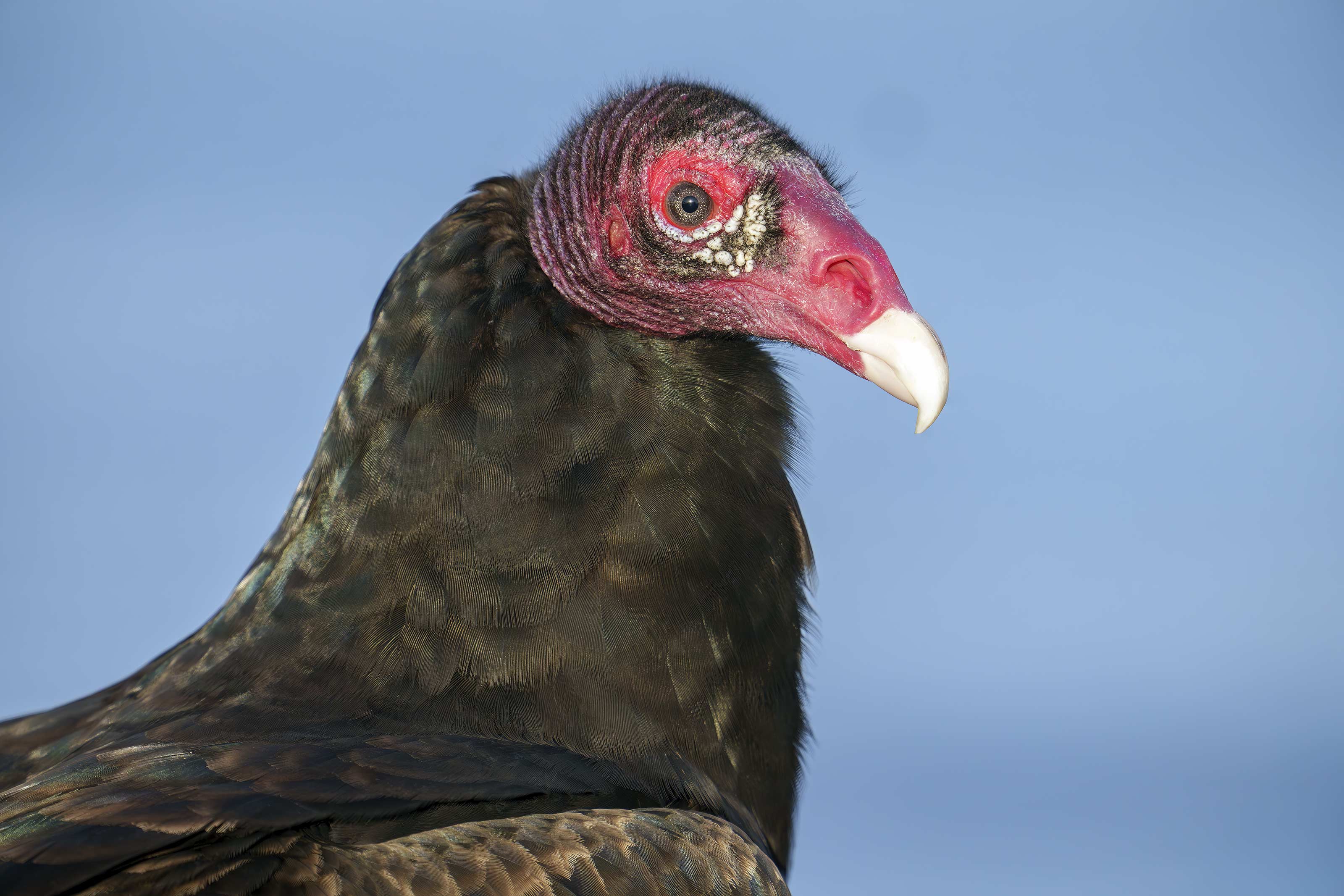
This image was created on 15 December 2025 by yours truly along the lakeshore near my home at Indian Lake Estates, FL. Seated in the driver’s seat of my SUV, I used the BLUBB-supported Sony FE 600mm f/4 GM OSS lens with the Sony FE 2x Teleconverter and the Sony a-1 (now replaced by The Latest Greatest Sony Flagship Body, the a1 II Mirrorless Camera). The exposure was determined using Zebra technology with ISO on the Thumb Wheel. ISO 2000: 1/1600 second at f/8 (wide open) in Manual mode. RawDigger showed that the exposure was dead solid perfect. AWB at 8:15:00 am on a sunny morning. Wide/AF-C with Bird-Eye/Face Detection performed perfectly. Click on the image to enjoy the high-res version. Image #6: Turkey Vulture adult — regal head and neck portrait |
Surprise!
While checking out the distant grebes south of the pier on the morning of the 15th, I happened to glance down at the shoreline and see this handsome vulture standing just 15 feet away with a gorgeous lake-blue background. So, I went to work, again at 1200mm. After picking a suitable shutter speed, I dialed up the ISO until I had faint Zebras on the white bill tip.
|
|
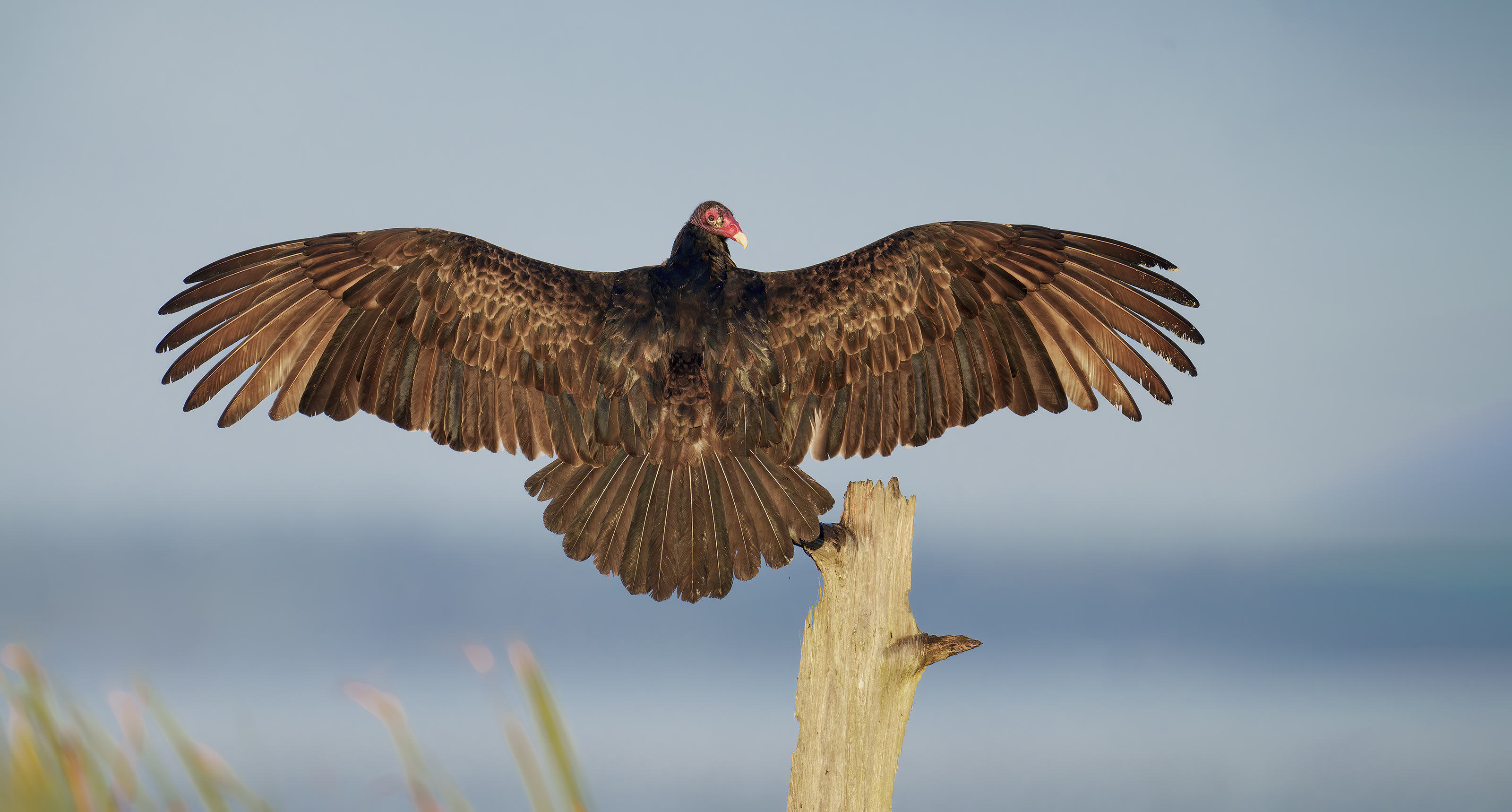
This image was created on 16 December 2025 by yours truly along the lakeshore near my home at Indian Lake Estates, FL. Seated in the driver’s seat of my SUV, I used the BLUBB-supported Sony FE 600mm f/4 GM OSS lens with the and the Sony a-1 (now replaced by The Latest Greatest Sony Flagship Body, the a1 II Mirrorless Camera). The exposure was determined using Zebra technology with ISO on the Thumb Wheel. ISO 1600: 1/640 second at f/8 (wide open) in Manual mode. RawDigger showed that the exposure was less than 1/6 stop short of perfect. AWB at 7:34:13 am on a sunny morning. Wide/AF-C with Bird-Eye/Face Detection performed perfectly. Click on the image to enjoy the high-res version. Image #7: Turkey Vulture full wingspread on The Perch II |
Dream TV Shot
I’ve seen hundreds of Turkey and Black Vultures sunning themselves buy stretching their wings fully to maximize the thermoregulatory benefits. I have photographed many dozens of those birds without ever making one that I really liked. I can no longer say that. So, what do I like about this image?
1- The full and complete wing stretch.
2- That the bird was right down sun angle.
3- That with the weathered gray wood, the perch has character.
4- That the bird was square to the back of the camera.
5- That the bird cooperated with the perfect head turn for the over-this-shoulder image: 90°.
6- That the bird was perfectly positioned on this two-pronged perch.
Note that though I could easily have approached this subject by moving my vehicle closer and switched to a shorter focal length — 840mm, I opted not to. Here’s why?
1- By staying well back, I was on a slight rise that put me close to the bird’s eye level.
2- In a similar vein, going with 1200mm the angle of elevation is reduced.
3- Though the bird would likely have remained on the perch, it might have folded its wings.

|
|
This image was created on 18 December 2025 on the South Peninsula down by the lake near my home at Indian Lake Estates, FL. Seated in the front seat of my SUV I used the handheld Sony FE 200-600mm f/5.6-6.3 G OSS lens (at 318mm) and the Sony a-1 (now replaced by The Latest Greatest Sony Flagship Body, the a1 II Mirrorless Camera). The exposure was determined by Zebras with ISO on the rear wheel — ISO 12800: 1/1600 second at f/6.3 (wide open) in Manual mode. RawDigger showed that the exposure was dead solid perfect. AWB at 7:49:05am on a then sunny morning. Wide/AF-C with Bird-Eye/Face Detection performed perfectly. Click on the image to enjoy the larger, inexplicably sharper high-res version. Image #8: Sandhill Crane male dismounting after copulating
|
ISO 12,800!
Getting down to the lake early sometimes requires going with crazy high ISOs when you need a shutter speed that is high enough to freeze the action. Once I selected the shutter speed I raised the ISO until I had a few Zebra’s on the adult crane’s chins. As the pair copulated, I fired away even while knowing that there was no shot– the birds were blocking each other. The single decent image was made just as the male dismounted. The third bird, the one on our left, is last year’s young.
The alternative to using a ridiculously high ISO is to create an image ruined by motion blur/subject movement. My double noise reduction technique (as first detailed in the DB III Video Series) worked quite well here.
|
|
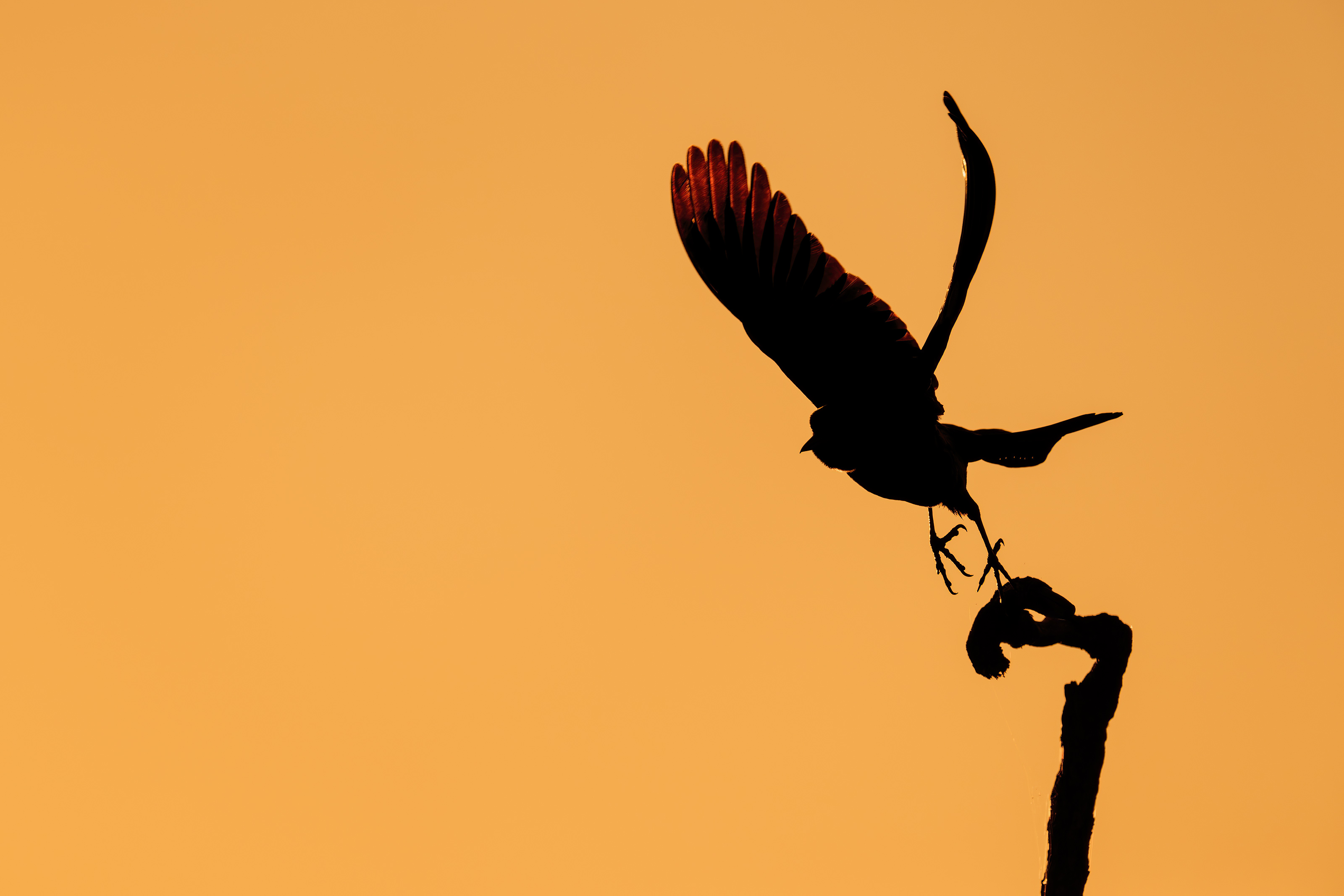
This image was created on 20 December 2025 by yours truly on the South Peninsula down by the lake near my home at Indian Lake Estates, FL. Seated in the front seat of my SUV I used the BLUBB-supported Sony FE 600mm f/4 GM OSS lens with the Sony FE 1.4x Teleconverter and the Latest Greatest Sony Flagship Body, the a1 II Mirrorless Camera. The exposure was determined by Zebras with Exposure Compensation (EC) on the thumb wheel. Multi Metering +1.3 stops. AUTO ISO set ISO 500: 1/5000 second at f/5.6 (wide open) in Shutter Priority mode. RawDigger showed that the exposure was dead solid perfect. AWB at 5:20:36pm on a mostly sunny afternoon. Wide/AF-C with Bird Eye/Face Detection enabled performed perfectly. Click on the image to enjoy the larger, inexplicably sharper high-res version. Image #9: Boat-tailed Grackle male taking flight from Bob Eastman’s skinny perch |
a-1 ii Pre-capture
When I have a bird on a perch that I think might take flight, I take a moment to increase the Pre-capture time from 0.3 sec. to one full second. Then I concentrate on maintaining pressure on the shutter button and depressing it fully the moment I see or even sense any movement. With Image #9, this approach paid off. Last night, the bird flew off as I was changing the Pre-capture setting. Sometimes you win, sometimes you lose.

|
|
This image was created on 20 December 2025 down by the lake near my home at Indian Lake Estates, FL. Seated on the sand beach left of the pier I used the handheld Sony FE 200-600mm f/5.6-6.3 G OSS lens (at 565mm) and The Latest Greatest Sony Flagship Body, the a1 II Mirrorless Camera. The exposure was determined by Zebras with Exposure Compensation (EC) on the thumb wheel. Multi Metering +1.3 stops. AUTO ISO set ISO 500: 1/500 second at f/11 (stopped down 1 2/3 stops) in Aperture Priority mode. RawDigger showed that the exposure was one full stop short of perfect. AWB at 5:33:07pm moments after sunset. Wide/AF-C with Bird-Eye/Face Detection performed perfectly. Click on the image to enjoy the larger, inexplicably sharper high-res version. Image #10: Sandhill Crane sunset silhouette head portrait
|
An Extra Touch
Images like this are relatively easy to make here at ILE simply by walking up to one of the many tame cranes and getting low at sunset. I raised up a bit to get high enough to include the bit of distant, out-of-focus vegetation in the lower left corner of the frame. For me, this extra element makes this one a lot better than images made against backgrounds of 100% sunset color.
|
|
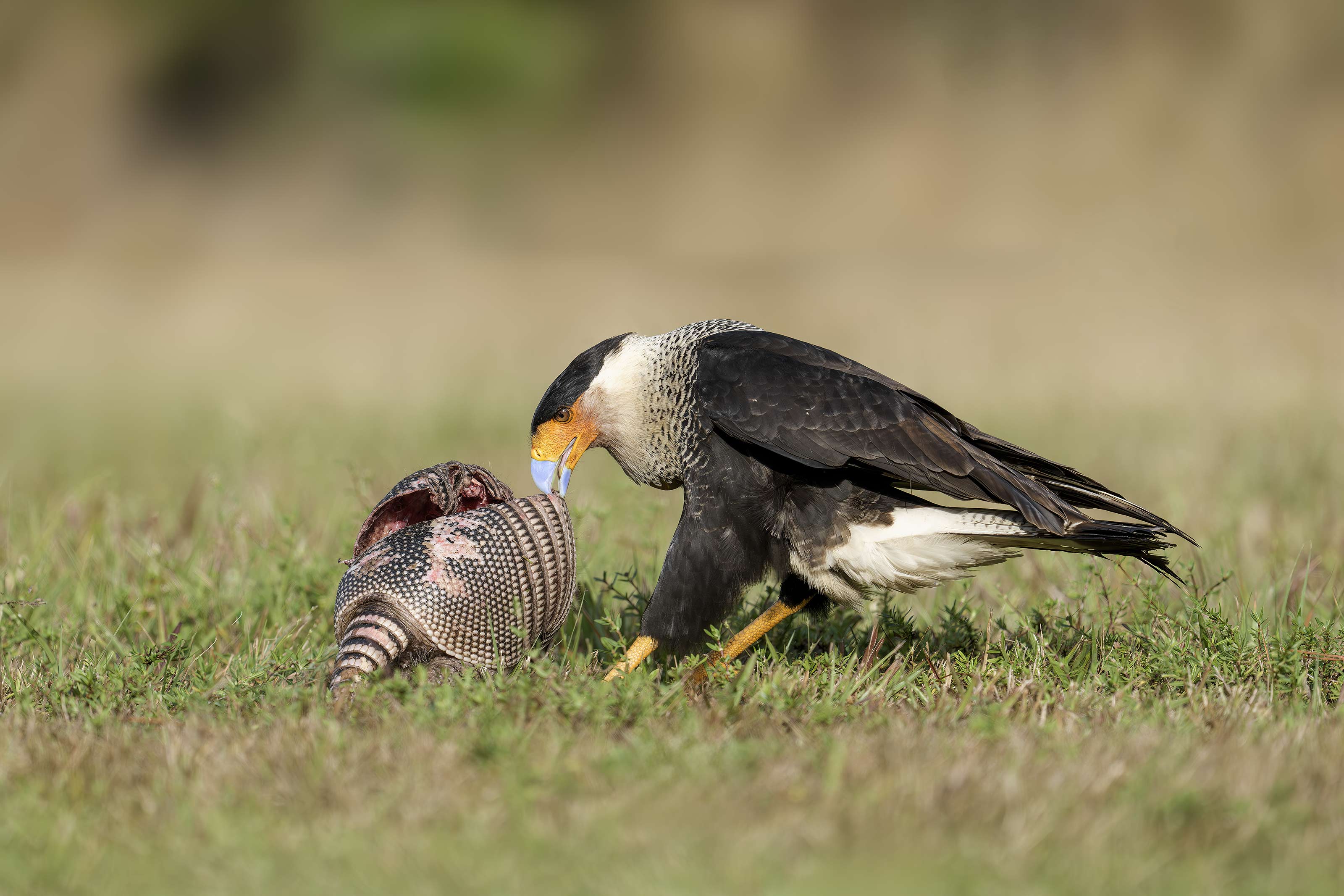
This image was created on 21 December 2025 by yours truly down on Park Blvd. at Indian Lake Estates, FL. Seated on the grass outside of my SUV, I used the toe-pod technique with the handheld Sony FE 600mm f/4 GM OSS lens and The Latest Greatest Sony Flagship Body, the a1 II Mirrorless Camera. The exposure was determined using Zebra technology with ISO on the Thumb Wheel. ISO 640: 1/640 second at f/4 (wide open) in Manual mode. RawDigger showed that the exposure was 1/2 stop short of perfect. AWB at 8:59:40am on a partly cloudy morning. Wide/AF-C with Bird-Eye/Face Detection performed perfectly. Click on the image to enjoy the high-res version. Image #11: Crested Caracara taking apart road-killed armadillo |
Smart Thinking
I saw the road killed armadillo on the south side of Park Boulevard on my way down to the lake in the pre-dawn. I attempted to photograph the caracara partaking of the opportunity but it flew off. Realizing that the road kill was too close to the street and would be in the shade for more of the morning, I grabbed the critter by the tail and moved it to the grass on the north side of Park. The first time that I checked, there was nothing on the carcass. But, on my way home, I saw that it was surrounded by several Turkey Vultures and a single Black Vulture. The smaller Crested Caracara, however, ruled the roost and fed for about a half hour while occasionally having to defend its meal from the approaching vultures. Once the caracara flew off, the Black Vulture was next in line and easily defended the smelly armadillo from the larger Turkey Vultures. This pecking order is 100% normal.
|
|
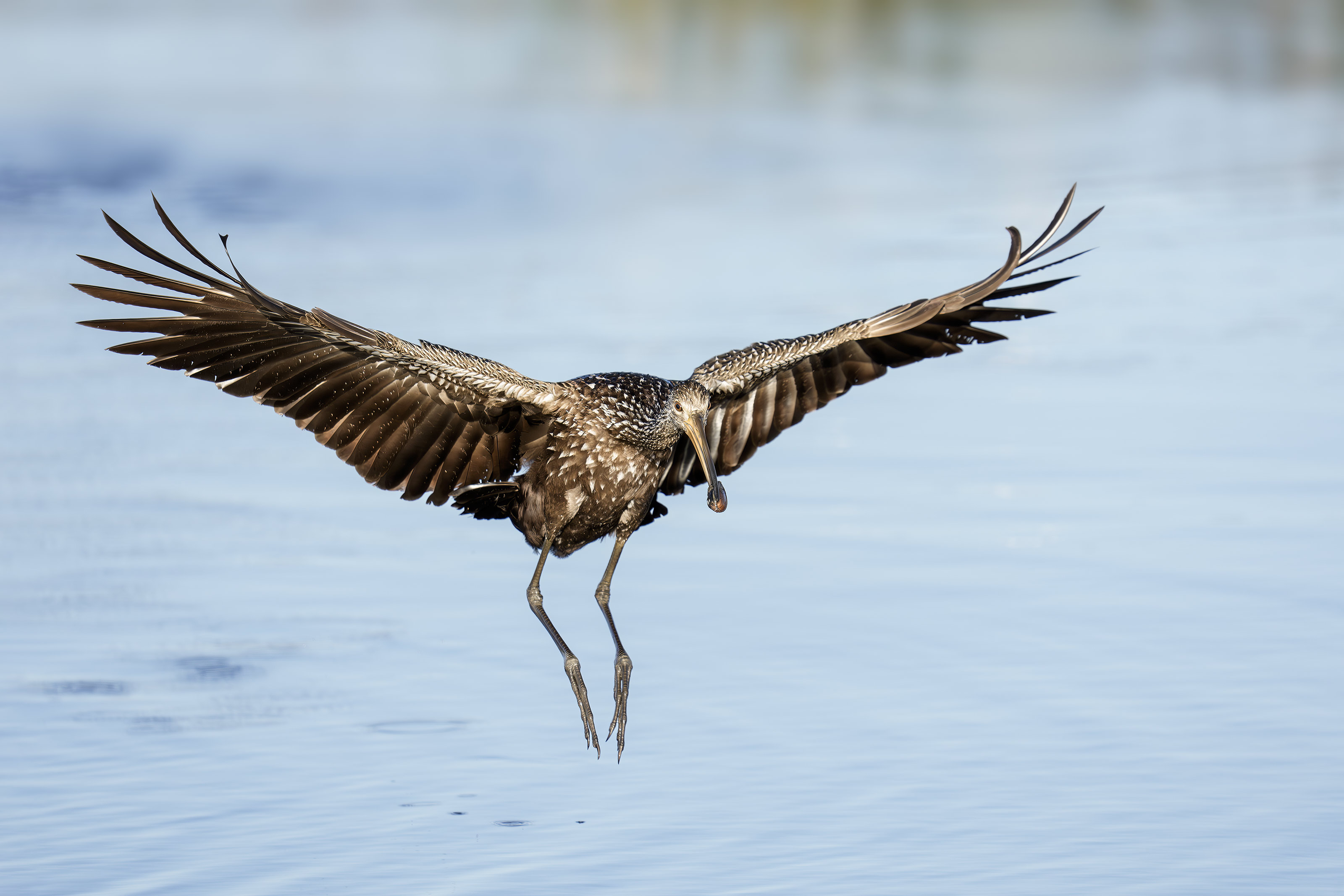
This image was created on 22 December 2025 down by the lake near my home at Indian Lake Estates, FL. Seated in the front seat of my SUV I used the handheld Sony FE 200-600mm f/5.6-6.3 G OSS lens (at 318mm) and the Sony a-1 (now replaced by The Latest Greatest Sony Flagship Body, the a1 II Mirrorless Camera). The exposure was determined by Zebras with ISO on the rear wheel — ISO 1600: 1/3200 second at f/6.3 (wide open) in Manual mode. RawDigger showed that the exposure was dead solid perfect. AWB at 8:25:07am on a sunny morning. Wide/AF-C with Bird-Eye/Face Detection performed perfectly. Click on the image to enjoy the larger, inexplicably sharper high-res version. Image #12: Limpkin flying to the beach with a freshwater mussel in its bill
|
Bird Behavior is Often Repetitive
Two Limpkins were foraging in a small channel between two grassy islands just south of the pier. When they grabbed a mussel, they would either walk to the farther grassy island, walk to the shoreline, or fly to the shoreline. It took a lot longer for them to open and chow down on the mussel than to grab the next mussel. With the wind from the northeast, conditions were perfect for an incoming flight shot. I set up for flight and had lots of chances with the birds walking right at me. And two good chances for flight.
|
|
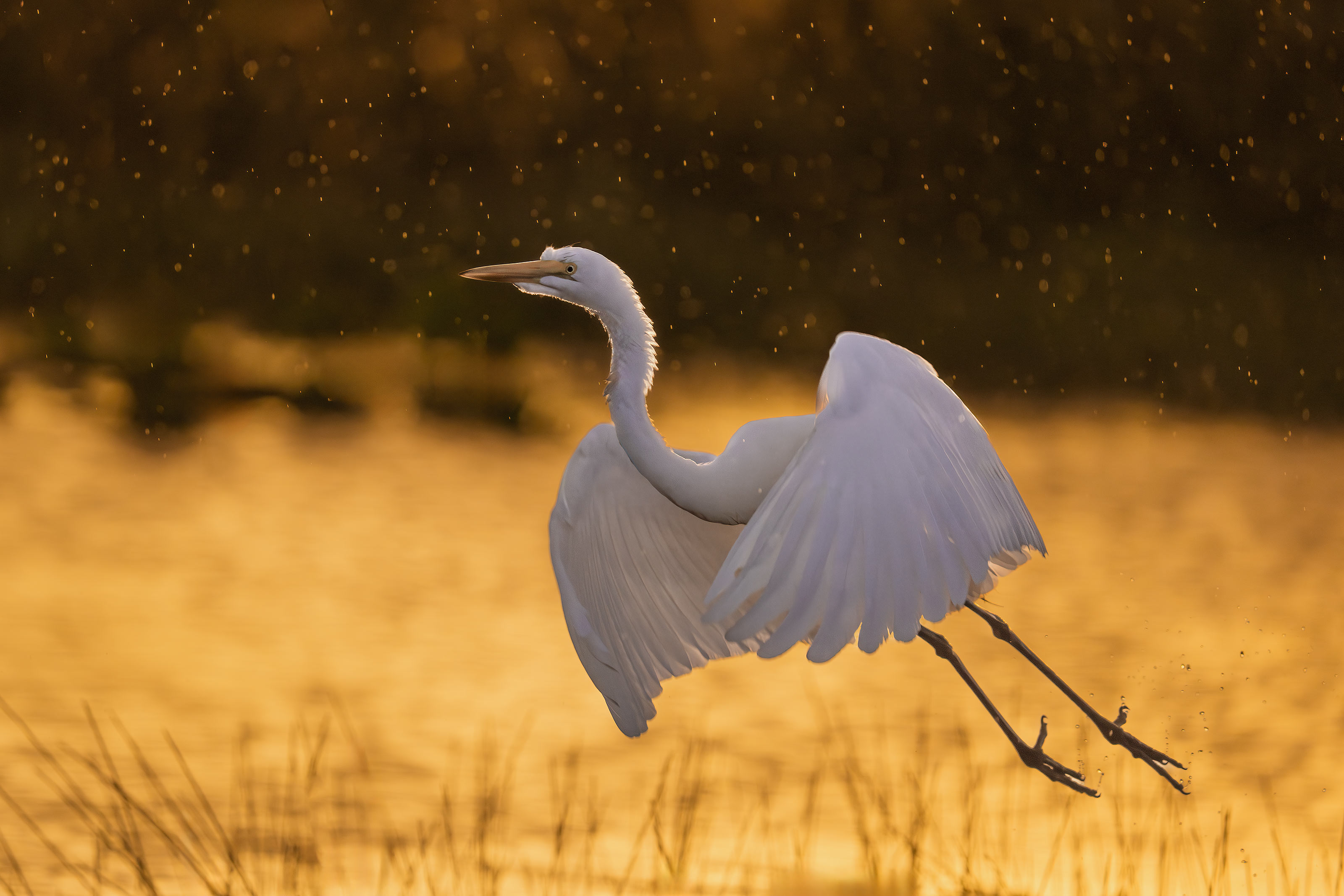
This image was created on 22 December 2025 down by the lake near my home at Indian Lake Estates, FL. Seated in the front seat of my SUV I used the handheld Sony FE 200-600mm f/5.6-6.3 G OSS lens (at 600mm) and the Sony a-1 (now replaced by The Latest Greatest Sony Flagship Body, the a1 II Mirrorless Camera). The exposure was determined by Zebras with Exposure Compensation (EC) on the thumb wheel. Multi Metering +0.3 stops. AUTO ISO set ISO 4000: 1/1600 second at f/6.3 (wide open) in Shutter Priority mode. RawDigger showed that the exposure was 1/3 stop short of perfect. AWB at 5:28:57am moments before sunset. Wide/AF-C with Bird-Eye/Face Detection performed perfectly. Click on the image to enjoy the larger, inexplicably sharper high-res version. Image #13: Great Egret taking flight in rain shower at sunset
|
A Rainy Sunset!
Once again called down to the lake just before sunset, it began to drizzle as I drove west. After photographing a complete rainbow with my cell phone, I headed to the pier. By getting as far north on the beach as possible, I was able to place the sunset color behind the fishing egret. Working at 600mm with the 2-6, I was trying for a pattern shot featuring the bird and the marsh grasses. When the bird unexpectedly took flight, I fired away and severely clipped the wings in 13 of the 14 images that I made. The image above was the only salvageable one. As you might imagine by now, I used several ACR masks to bring this image to life.
The masking feature in Adobe Camera Raw (in both Photoshop and Lightroom) allows making changes to the subject and or the background alone easy as pie. In Volume III of the Digital Basics IV Video Series. I introduced and detailed the use of a variety of ACR mask selection options including Subject, Background, Sky, Brush, and Linear Gradient. In the last two volumes I will cover creating Radial Gradient, Object (beyond amazing!), and both Color Range and Luminance Range masks. I have selected the six images for Volume IV and will create that video this week. The complete optimization of today’s featured image will be detailed in Volume V.
The more I use and experiment with the Masking feature in ACR the more neat tricks I come up with.
Typos
With all blog posts, feel free to e-mail or to leave a comment regarding any typos or errors.








My vote is for #5. Although I’m ordinarily not a fan of vertical-format wildlife shots or of perfectly centered subjects, this one works for me because of the almost quizzical look on the bird’s face as he looks directly at us, and because of the vertical symmetry provided by the reflection.
Thanks, Steve. There is no better spot to put the bird in that frame.
with love, artie
Dear Art:
My favorite today is #1, the beautifully balanced turkey vulture image with five birds lined up on one branch and one in flight. Second, #5, the pied-billed grebe with reflection placed, as it should be, right in the center of the image. Third is #11 the unusual image of a caracara with the armadillo road kill. But, I find the the black in the upper left distracting and would have deleted if if it were my image.
Thanks, Pat. I find that the dark area you mention balances nicely with the dark feathers of the bird. In fact, I moved it from the right side of the frame to the left. Removing it would certainly work as well.
with love, artie
#1- Beautifully constructed silhouette cum flight cum environmental image. This one has it all. Congrats!
#5 – Great face-on-with-reflection capture.
#12 – Rare bird to catch so clearly in flight, especially with prey item.
Thanks Thomas. And have a great holiday.
with love, artie
I like 1 & 7, though all are nice. 1, sets an early morning mood. 7, full wingspan, head angle. Great shots.
Thanks, J Marr. I agree 🙂
with love, artie
#12 Limpkin shot is so sharp!
#4 Northern Harrier same. I’ve not yet seen one perched- usually they’re flying just above ground so this is a good view- I would like to see it tighter though, but still in my top 3.
I’m with Kerry on this…. Love the head-on shot & reflection of the Grebe, and yes, thanks for the share re critiques. Certainly applies to someone like me!
Possibly images 6 & 10 are my next favourites…. Surprising, as I think vultures are such ugly birds normally! When I first glanced at image 12, I thought it was a very odd looking Spoonbill! Haha, then I looked at the text….
Thanks, Maggi. As far as I know, there are no brown spoonbills!
Enjoy the season.
with love, a
Hi Artie, thank you for sharing the conversation about photo critiques. We all benefit from hearing other perspectives and wonderful for you to share that even a master photog like you is still learning.
My favorite is the pied billed grebe. The head on shots are a perspective that I appreciate as they’re not common. Yours is perfection and I love the mirror image in the lake.
Thank you for all you do and Happy Holidays to you, your family and all the blog posters
Thanks, Kerry. I only learn something new every day 🙂 I got some really nice pied-billeds this morning; they are so cute!
Enjoy the holidays.
with love, artie
ps: what are your other two favorites?
Merry Christmas, Artie. Isn’t that an armadillo the caracara is taking apart in image 11? I love the tuvi portrait. I made a similar one that I liked recently (different background).
Thanks, David, And a belated Happy Hannukah to you 🙂
Yes, my brain was on vacation when I typed Opossum rather than armadillo. Jim caught it also.
Speaking or errors, what is a “tuvi?”
with love, artie
ps: what are your other two favorites?
Thanks, Artie. A “tuvi” is a typo for “tuvu,” turkey vulture. I wish it were possible to edit what we write here; I noticed the error but too late. My other two favorites are the little blue heron (#2) and the egret taking flight (#13) and the pied-billed grebe (#5). I know, that’s three. 🙂
Thanks for revisiting David. I don’t think that I would have caught on to tuvu either. Maybe TUVU would have done the trick but I am so used to calling them TV-s that I likely would not have caught on to the four letter code.
As far as four, the more the merrier — perfect for the holiday season.
with love, artie
The more I look at the egret (#13) the more I like it.