
Your Call/My Call
Which two of today’s ten featured images do you feel are the strongest. Please leave a comment and let us know why you made your choices.
Thanks for all the comments at the last blog post. I was surprised at how many folks liked my drake Ring-necked Duck staring down the lens barrel. My favorite image was Bob Eastman’s drake Cinnamon Teal flight shot for the great looks at the dorsal wing surfaces (and colors!). My second choice was Kevin Hice’s spectacular Mandarin Duck flight image for the colors, patterns, sharpness, and the difficulty of getting the shot.
What’s Up?
It has been a pleasure to work with the first group and share the AirBnB with all. The chemistry was spot on. Bob Eastman served as our driver, food shopper, all around helper, and humorist; he always puts a smile on everyone’s face. Nora Kane has worked incredibly hard at improving her photographic skills and succeeded beyond anyone’s dreams. Nora’s husband Doug does not photograph and has been enjoying the San Diego tourist scene often with Kevin’s Colleen. Doug has shared some wonderful stories as well as some fine wines with the group. After trying some of my Sony gear, the easy-going and always pleasant Kevin Hice has decided to go all in on Sony and sell his Canon gear. He has also helped with the dishes and kept us supplied with Tostitos Hint of Lime Flavored Triangles (and salsa). While everyone has pitched in on meal prep, setting the table, and doing the dishes, Colleen has been more than incredibly helpful in all areas. She has even been emptying the two kitchen trash cans!
On Wednesday night I got to thank everyone by treating the group to a fabulously lovely dinner at Kings Fish House in Mission Valley. We even managed to escape with three small loaves of their scrumptious sourdough bread.
The bird photography? It has been great. We headed to Coronado Beach on Wednesday morning for a change of scenery and on Thursday morning we had our best session with the stars of the show, the Pacific race Brown Pelicans in full breeding plumage. And Friday morning was pretty darned good as well. After brunch on Friday Doug and Nora took off to visit the USS Midway Museum. They will be spending the night at an airport hotel and heading back home to Bismarck, ND on an early flight.
Today is Friday 16 January 2026. Kevin and Colleen and Bob and I will be headed early to La Jolla. Then Bob will drop them off at the airport for their flights back to Indiana with a change of planes in Minneapolis. Please remember that happiness is a choice — Byron Katie, The Work.Com.
If an item — a Delkin flash card or reader, a Levered-clamp FlexShooter Pro, or a Wimberley lens plate or low foot — for example, that is available from B&H and/or Bedfords, is also available in the BAA Online Store, it would be great, and greatly appreciated, if you would opt to purchase from us. We will match or beat any price. Please remember also to use my B&H affiliate links or to earn 3% cash back at Bedford by using the BIRDSASART discount code at checkout for your major gear purchases. Doing either often earns you free guides and/or discounts. And always earns my great appreciation.
Gear Questions and Advice
Too many folks attending BAA IPTs and dozens of photographers whom I see in the field and on BirdPhotographer’s.Net, are — out of ignorance — using the wrong gear, especially when it comes to tripods and more especially, tripod heads. And the same is true in spades when ordering new camera bodies or lenses. My advice will often save you some serious money and may help you avoid making a seriously bad choice. Please know that I am always glad to answer your gear questions via e-mail.. If you are desperate, you can try me on my cell at 863-221-2372. Please leave a message and shoot me a text if I do not pick up.
|
|
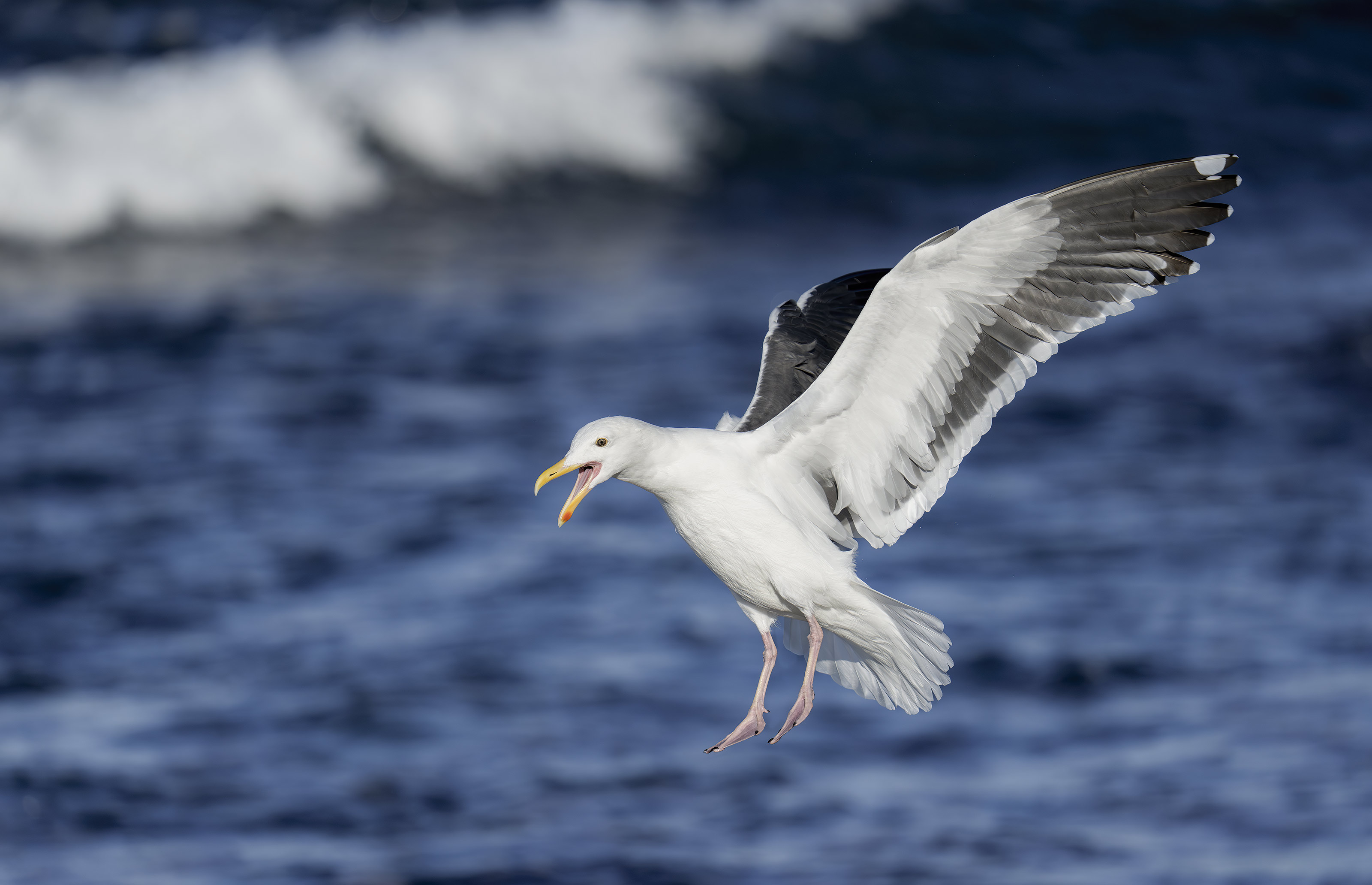
This image was created on 10 January 2026 by yours truly at La Jolla, CA on the first San Diego Extended IPT. Standing on the beach at the low cliffs, I used the handheld Sony FE 200-600mm f/5.6-6.3 G OSS lens (at 478mm) and the The Latest Greatest Sony Flagship Body, the a1 II Mirrorless Camera. The exposure was determined using Zebra technology with ISO on the Thumb Dial. ISO 640. 1/5000 second at f/6.3 (wide-open) in Manual Mode. AWB at 8:46:54am on a sunny morning. Wide/AF-C with Bird-Eye/Face Detection performed perfectly. Click on the image to enjoy the larger, inexplicably sharper high-res version. Image #1: Western Gull fishing
|
Why the 200-600?
I (and Nora Kane) have been using the 400-800 G lens on a Robus tripod topped by a FlexShooter Pro head for nearly all of our pelican photography. When we tried for the Western Gulls in flight, we both went to the 200-600s as they are lighter and easier to handhold. And handholding for flight is always a great option as it is easier to pan with and track the birds in the air (than it is when working on a tripod).
|
|
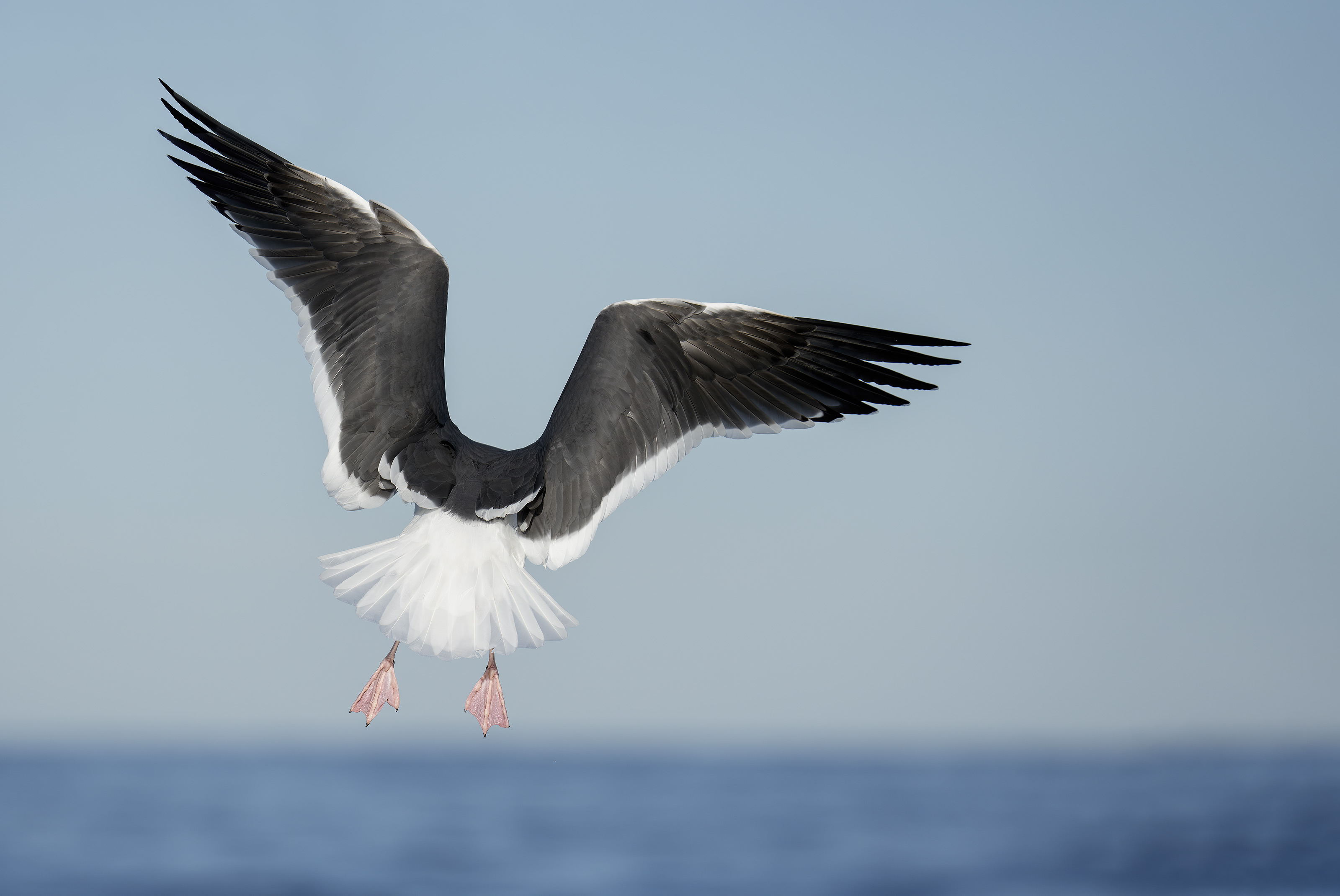
This image was also created on 10 January 2026 by yours truly at La Jolla, CA on the first San Diego Extended IPT. Standing on the beach at the low cliffs, I used the handheld Sony FE 200-600mm f/5.6-6.3 G OSS lens (at 400mm) and the The Latest Greatest Sony Flagship Body, the a1 II Mirrorless Camera. The exposure was determined using Zebra technology with ISO on the Thumb Dial. ISO 640. 1/5000 second at f/6.3 (wide-open) in Manual Mode. AWB at 8:49:59am on a sunny morning. Wide/AF-C with Bird-Eye/Face Detection performed perfectly. Click on the image to enjoy the larger, inexplicably sharper high-res version. Image #2: Western Gull rear flight shot
|
Wind in Your Face?
As you have seen here quite a bit recently, when the wind is blowing right at you, creating a back or rear flight shot just might be your best option. The best of these will usually feature some nearly perfect symmetry and a flared tail.
I clipped the ends of three primary feathers on the bird’s left wing in the raw file and used the feathers on the right wing to make the repairs (after adding the needed canvas above). I used three Regular Layer Masks; each was flipped horizontally and roughly put into position. Then, each mask was re-sized and warped before fine tuning the placement. The Remove Tool was used to both smooth the seams and eliminate any tonality mismatches in the feathering.
|
|
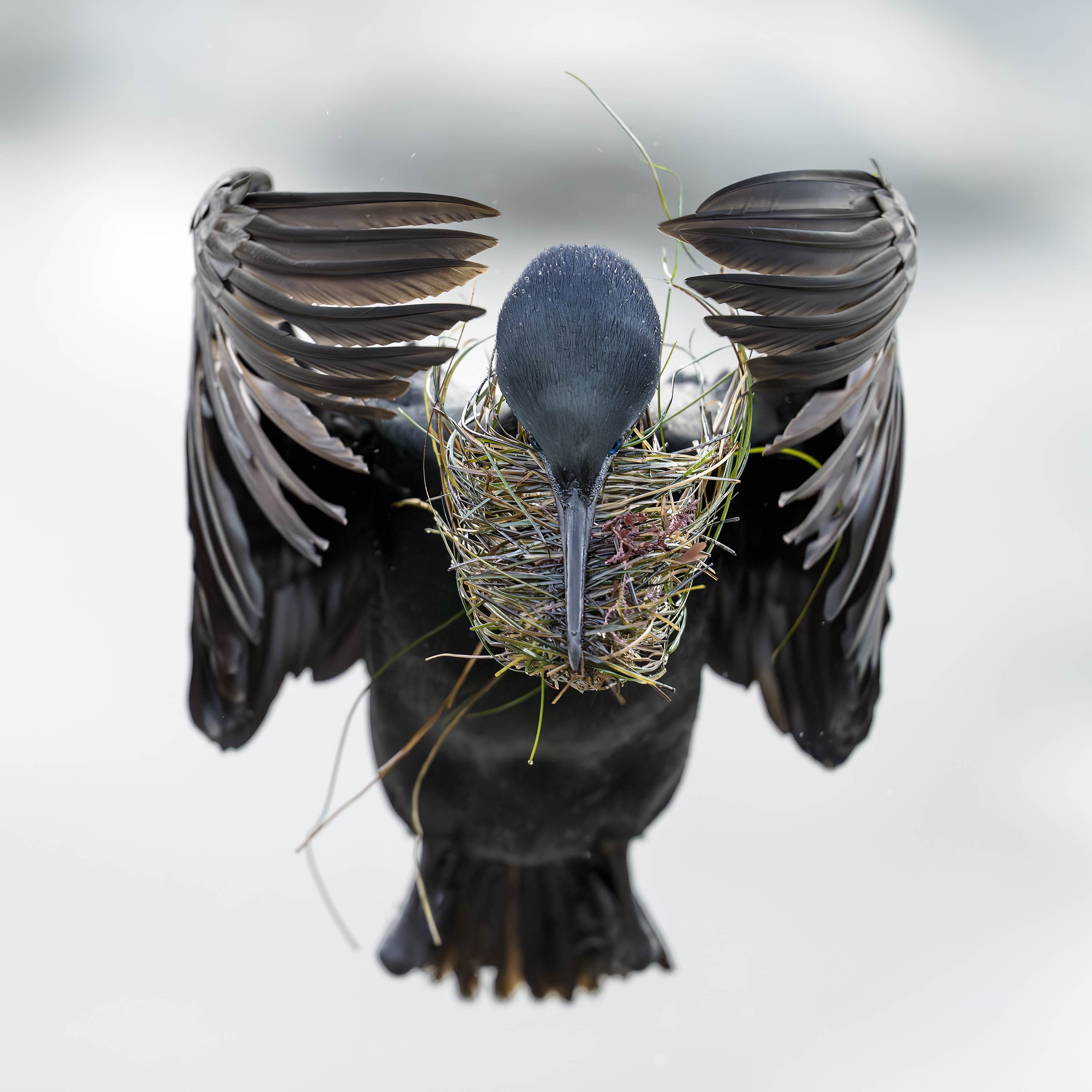
This image was also created by yours truly on 11 January 2026 at La Jolla, CA on the first San Diego Extended IPT. Standing on the sidewalk above the breeding shelf, I used the handheld Sony FE 300mm f/2.8 GM OSS Lens (Sony E) and The Latest Greatest Sony Flagship Body, the a1 II Mirrorless Camera. ISO 3200. The exposure was determined via Zebras with ISO on the Thumb Wheel; 1/3200 sec. at f/2.8 (wide open) in Manual mode. AWB at 3:58:38pm in the shade on a sunny afternoon. Tracking Zone/AF-C with Bird Eye/Face Detection enabled performed perfectly. Image #3: Brandt’s Cormorant incoming with nesting material/square crop |
The Orchestra Leader Flight Pose
The orchestra leader flight pose with the wings pulled in and nearly covering the bird’s face can be quite powerful. Square crops often work quite well with this flight pose.
Sony a-1 ii Face-Eye Tracking
I first began to realize how great the Sony AF systems were when photographing incoming Brandt’s Cormorants at La Jolla in 2018. The a-1 ii currently represents the pinnacle of autofocus technology. I have no idea how the a-1 ii is able to recognize and track the cobalt blue eye of a bird set into black feathers even when the eye or eyes are barely visible.

|
|
This image was created by IPT participant Nora Kane on 12 January 2026 at La Jolla, CA on the first San Diego Extended IPT. Standing at full height near the Bridge Club, she used the Wide/AF-C with Bird-Eye/Face Detection performed perfectly. Click on the image to enjoy the larger, inexplicably sharper high-res version. Image #4: Brown Pelican riding breaking wave |
More Kudos to Nora Kane
I have never had a student work as hard or put as much effort into improving as Nora. She and the images she has produced on this IPT have made me incredibly proud. Though she has been photographing birds for several years, she was brand-new to the a-1 ii, brand new to Photo Mechanic, brand new to Photoshop (!), and brand new to flight photography (on a tripod no less!) when she showed up last Wednesday.
With this image Nora zoomed out just enough (to 663mm) so as to include the base of the breaking wave in the frame. Throw in a gorgeous pelican and the spray from the wave and you have a real winner.

|
|
This image was created on 12 January 2026 by yours truly at Santee Lakes Recreational Preserve on the first San Diego Extended IPT. Seated on the road adjacent to Lake 5, I used the hand held Sony FE 300mm f/2.8 GM OSS Lens (Sony E) with the Sony FE 2x Teleconverter and the Latest Greatest Sony Flagship Body, the a1 II Mirrorless Camera. The exposure was determined by Zebras with Exposure Compensation (EC) on the thumb wheel. Multi Metering at zero. AUTO ISO set ISO 1000: 1/3200 second at f/6.3 (wide open) in Shutter Priority mode. AWB at 4:10:13pm on a sunny afternoon. Tracking: Zone/AF-C with Bird Eye/Face Detection enabled performed perfectly. Image #5: Ring-necked Duck drake braking to land with hen in background |
300mm f/2.8 GM & 2X TC
As noted here previously and often, this combination makes an ideal flight photography rig. Why? It is nearly light as a feather, incredibly small and compact, and, with an a-1 ii, offers super-fast subject acquisition and science-fiction-like eye tracking. With birds flying at closer range this lens can be used effectively either bare (as with Image #6 immediately below) or with the 1.4X TC.
|
|
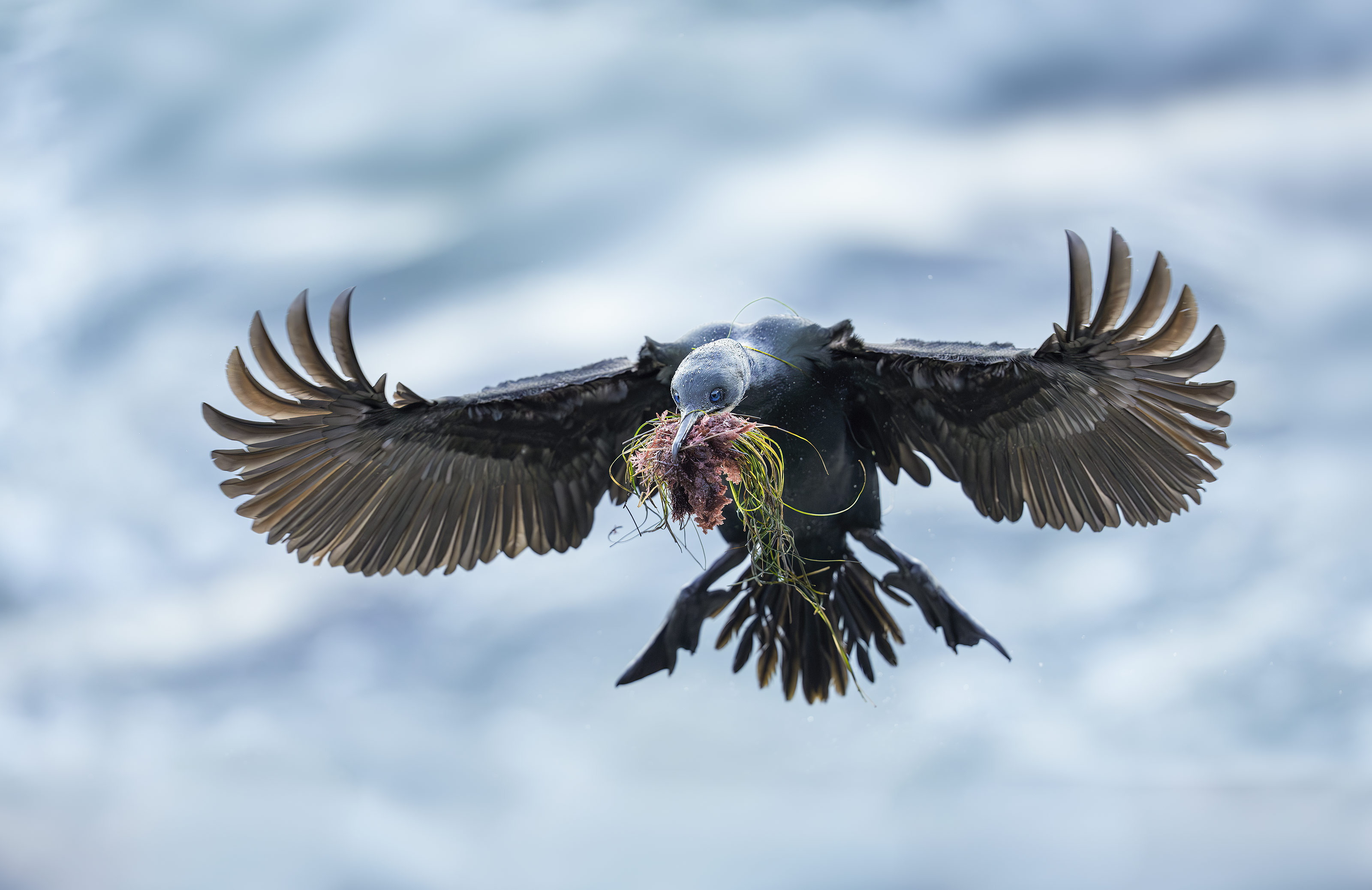
This image was also created by yours truly on 13 January 2026 at La Jolla, CA on the first San Diego Extended IPT. Standing on the sidewalk above the breeding shelf, I used the handheld Sony FE 300mm f/2.8 GM OSS Lens (Sony E) and The Latest Greatest Sony Flagship Body, the a1 II Mirrorless Camera. The exposure was determined via Zebras with ISO on the Thumb Wheel. ISO 3200: 1/3200 sec. at f/2.8 (wide open) in Manual mode. AWB at 3:56:25pm in the shade on a sunny afternoon. Tracking Zone/AF-C with Bird Eye/Face Detection enabled performed perfectly. Image #6: Brandt’s Cormorant braking to land with nesting material |
Quod Erat Demonstrandum
Q.E.D. is the Latin abbreviation for “quod erat demonstrandum,” meaning “that which was to be demonstrated.” I. E., the 300 alone can be a deadly flight lens in the right situations. With the incoming cormorants in the shade of the buildings on the ridge that is Prospect Street, the main drag in La Jolla, it’s f/2.8 speed enables the use of fast shutter speeds without have to go to the very high ISOs, those in the 4000 to 12,500 range.
Tip for Sony Users
In situations where the exposure is correctly set for birds in the shade, proper technique calls for shutting off Zebras so that you can get on the subject when it if flying above the sunlit ocean and track it until it flies into the shade. At which time, of course, you begin fully pressing the shutter button and creating sharp images. With all of my Sony camera set-ups, the same button is programmed to toggle Zebras Off and On.
If you fail to turn the Zebra technology off in these situations, all you will see when the bird is approaching from a distance is flashing black and white stripes — you simply will not be able to see the subject.
|
|
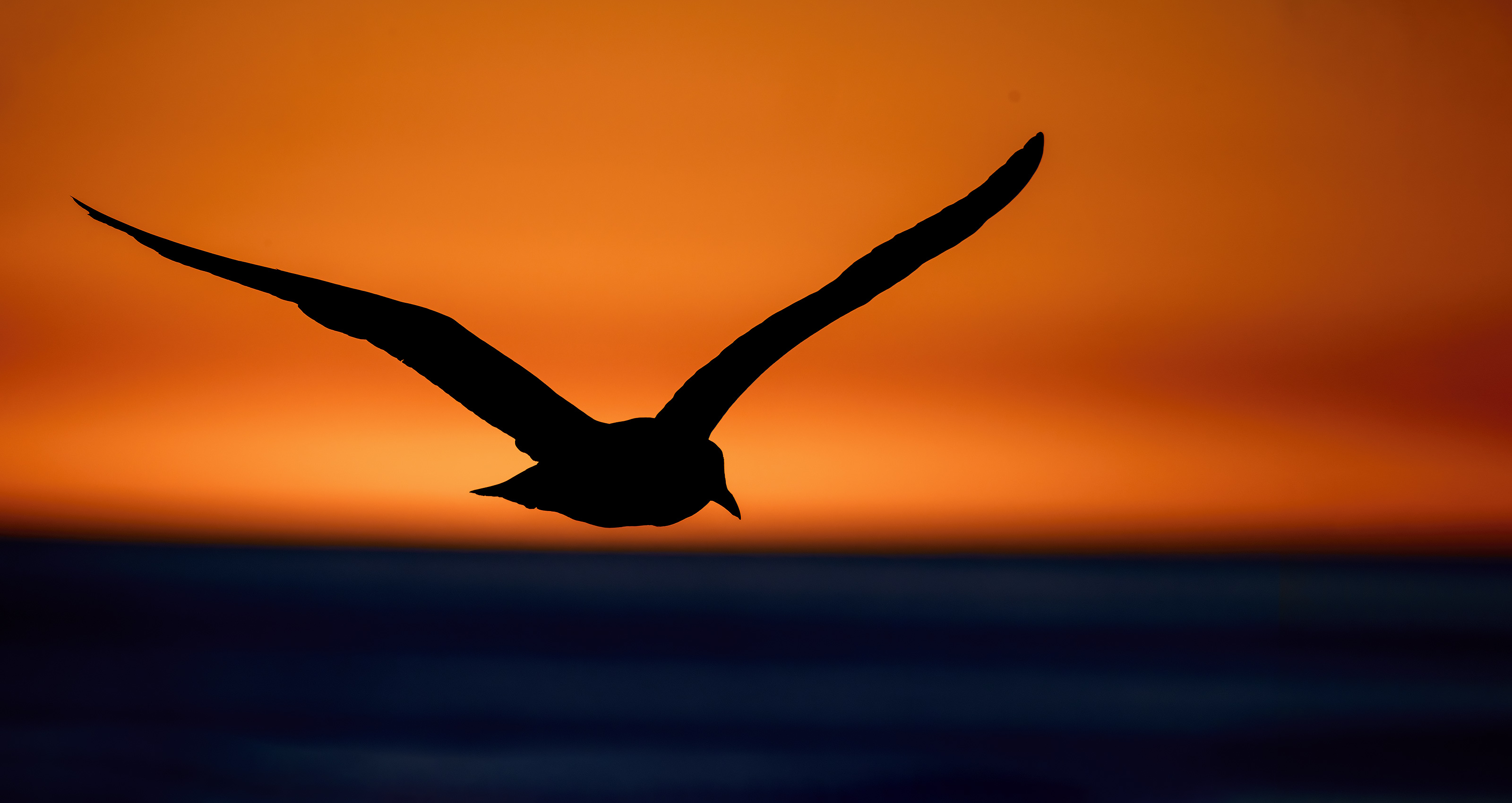
This image was created on 13 January 2026 by yours truly at La Jolla, CA on the first San Diego Extended IPT. Standing on the sidewalk west of the Bridge Club, I used the Tracking: Zone/AF-C with Bird-Eye/Face Detection performed perfectly. Click on the image to enjoy the larger, inexplicably sharper high-res version. Image #7: Western Gull post sunset orange glow silhouette |
Perspective Question
Why would this image have been far stronger had I set up my tripod six inches lower.
Reacting to the Situation
I had gone to the 1.4X TC so that I could make distant subjects larger in the frame. My maximum focal length was 1120mm. When I saw the gull at close race approaching the bright orange glow, I zoomed out as quickly as possible in an effort to fit the bird in the frame. I call this technique esti-zooming as you are just estimating — you could say guessing, how much to zoom out. You never think of a number, you simply need to react instinctually.
|
|
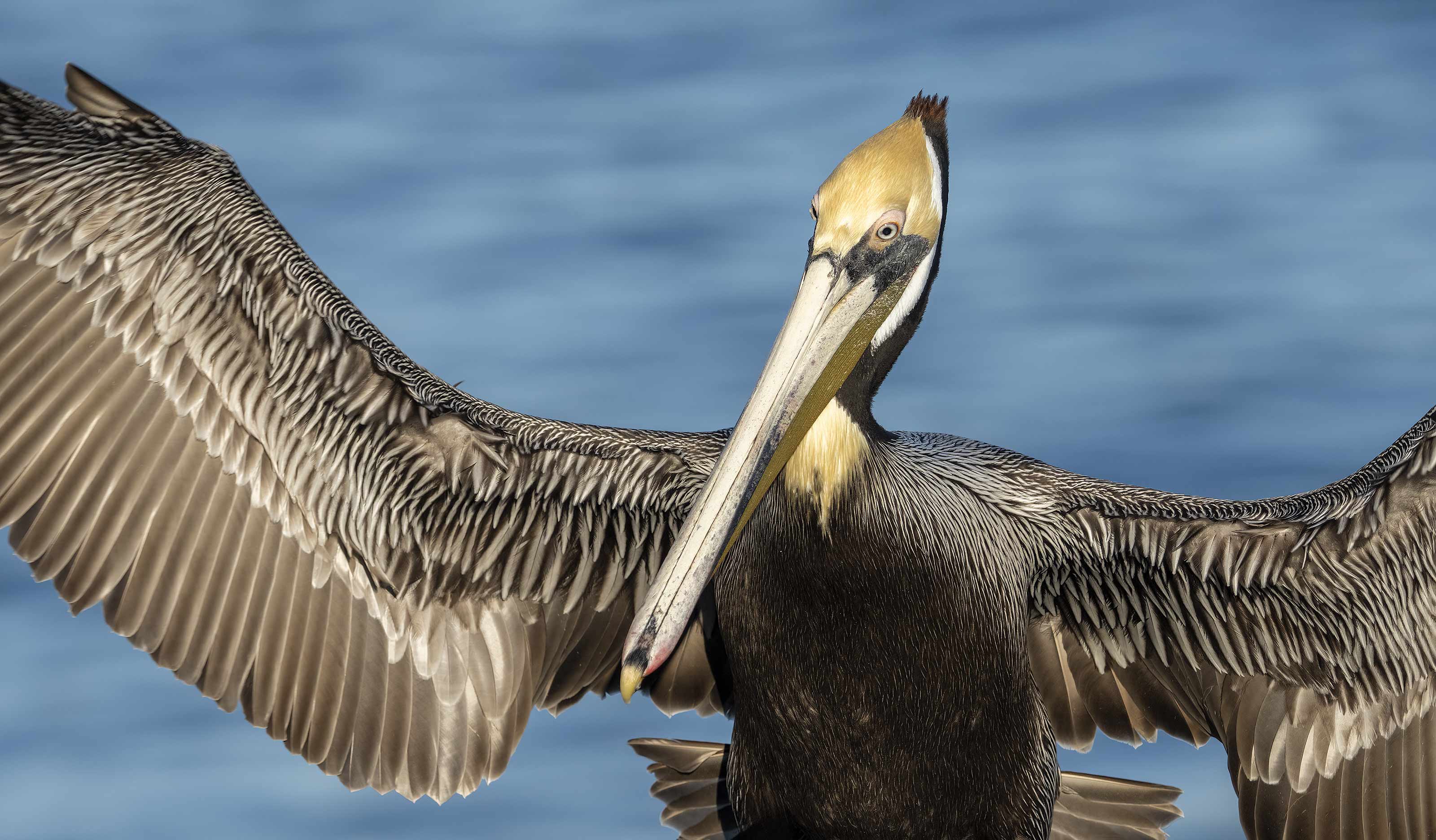
This image was created on 14 January 2026 by yours truly at La Jolla, CA on the first San Diego Extended IPT. Seated on a sandstone cliff, I used the handheld Sony FE 400-800mm f/6.3-8 G OSS lens (Sony E) with the Sony FE 1.4x Teleconverter (at 1071mm) and The Latest Greatest Sony Flagship Body, the a1 II Mirrorless Camera. The exposure was determined via Zebras with ISO on the Thumb Wheel. ISO 1000: 1/2500 sec. at f/8 (wide open) in Manual mode. AWB at 8:14:59am on a sunny morning. Tracking: Zone/AF-C with Bird-Eye/Face Detection performed perfectly. Click on the image to enjoy the larger, inexplicably sharper high-res version. Image #8: Brown Pelican tight flight |
Caught with My Pants Down
An Occasional Disadvantage of the 400-800
Handholding is great for flight. Resting the 4-8 on my left knee provides an ideal rest position. When I saw this pelican coming in, I raised the lens and immediately zoomed out to the max, 400mm. It was not wide enough. I clipped both wings and worse than that, I cut off the bird’s feet. I struggled to come up with a less-than-awkward crop and am not sure if I succeeded.
So why stick with the 400-800? You can’t beat the reach! It is fabulous for tight head shots and zooming out when trying for head throws is relatively easy to do and demonstrates the lens’s great versatility.
|
|
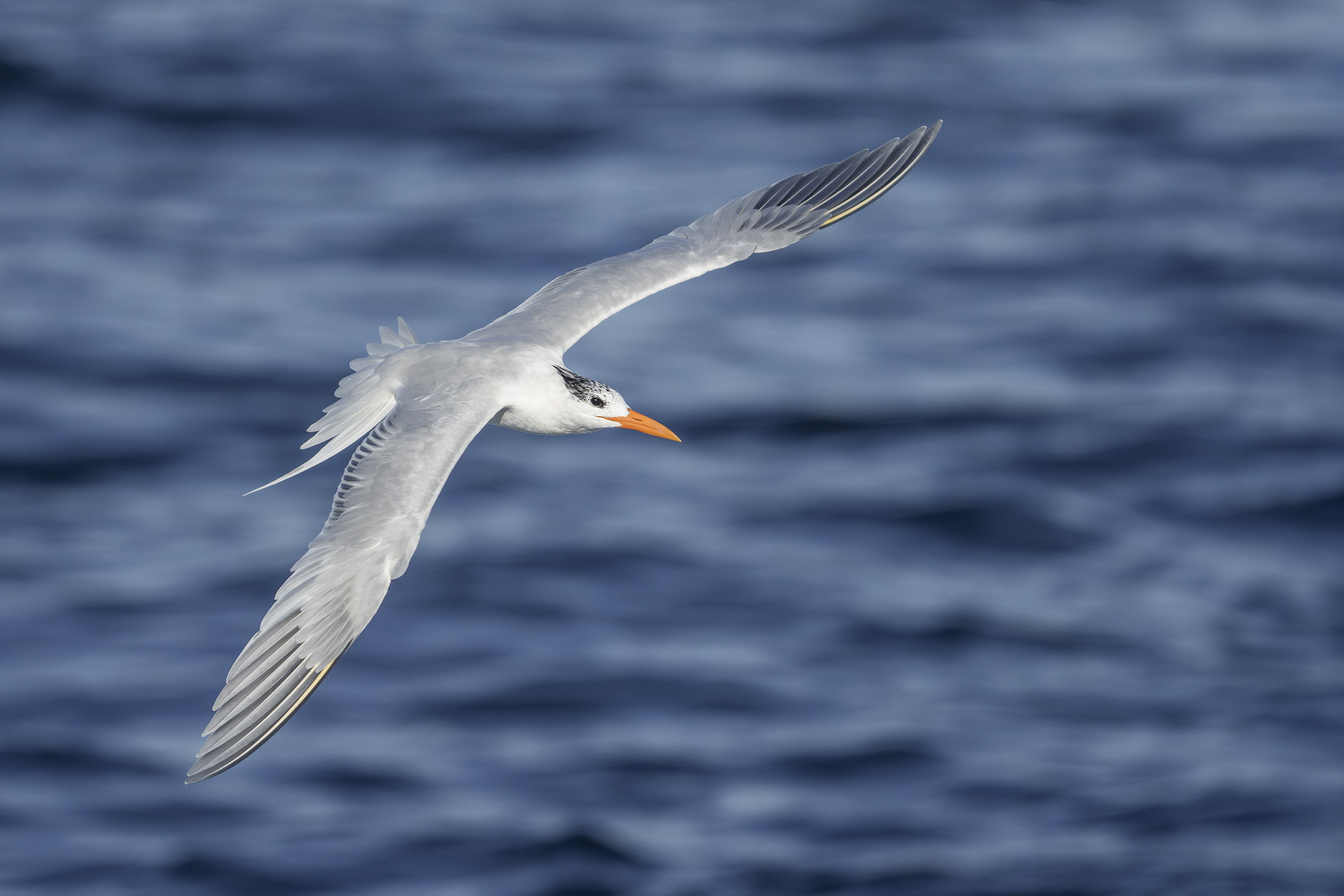
This image was created on 15 January 2026 by yours truly at La Jolla, CA on the first San Diego Extended IPT. Standing at full height by the Bridge Club, I used the Tracking: Zone/AF-C with Bird-Eye/Face Detection performed perfectly. Click on the image to enjoy the larger, inexplicably sharper high-res version. Image #9: Royal Tern dorsal view flight |
Ocean Background Detail Principles
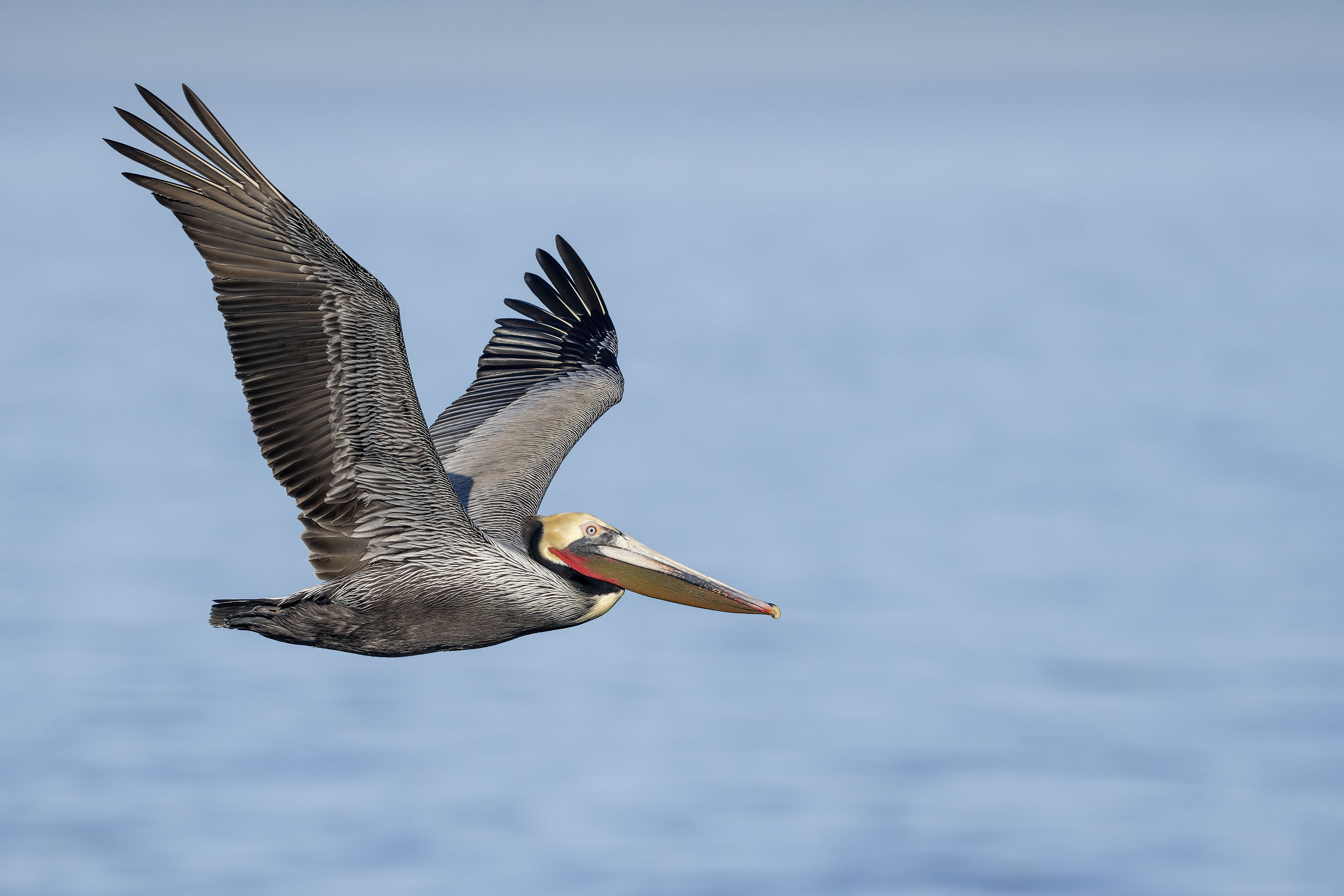
When photographing birds in flight against ocean backgrounds, the closer to the water the subject is flying, the more detail you will see on the surface of the ocean. The higher the bird is flying, but still with an ocean background, the smoother the background will be. Compare Image #7 with Image #8 (below) where the pelican is flying much higher above the ocean but still with a distant ocean as background (along with a small strip of sky at the top of the frame).
|
|
This image was created on 15 January 2026 by yours truly at La Jolla, CA on the first San Diego Extended IPT. Standing at full height by the Bridge Club, I used the Tracking: Zone/AF-C with Bird-Eye/Face Detection performed perfectly. Click on the image to enjoy the larger, inexplicably sharper high-res version. Image #10: Brown Pelican Pacific race breeding plumage in flight — wings up pose |
Flight Exposure Principles
Adjusting for Subject Tonality
Once you have a perfect exposure for a Brown Pelican (Image #10), you need to increase your shutter speed by one click (1/3 stop) for a Royal Tern (Image #9) because the tern has brighter white feathers than the pelican.
If a cormorant flies by, you need to increase your ISO by one full stop — 3 clicks because to properly expose the darker feathers.
It was and is the same at Bosque. The cranes would be the base exposure. You’d need to go one or two clicks darker for the white geese (Snows and Ross’s) two clicks lighter for an immature Blue Goose (dark grayish blue), and add 1 1/3 stops of light for a Common Raven (black).
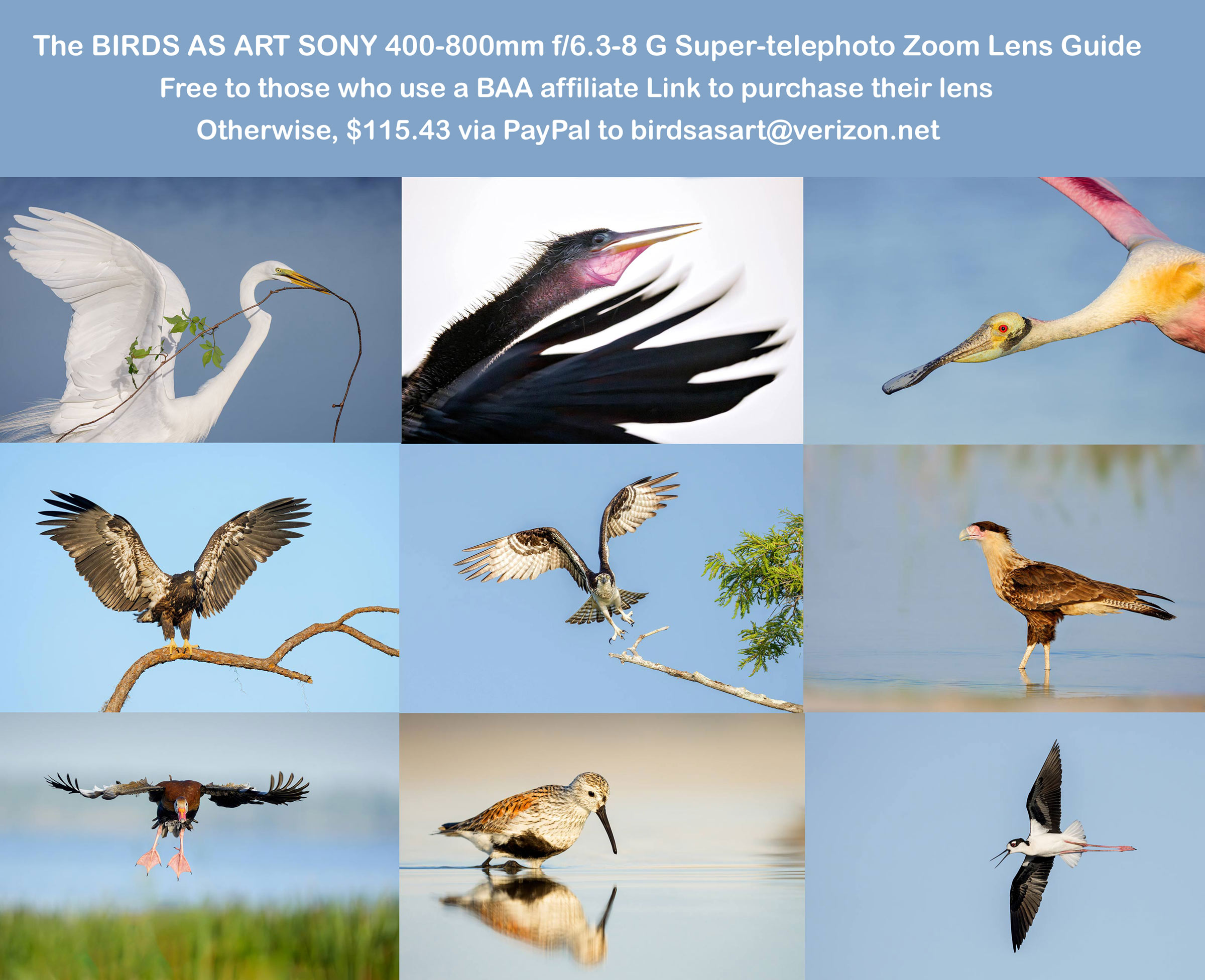
The BIRDS AS ART SONY 400-800mm f/6.3-9 G Super-telephoto Zoom Lens Guide
When I borrowed this lens from Sony, I assumed that at 5.45 pounds it was too heavy to handhold for long and that at f/8 at the long end (800mm,) it was too slow for most bird photography applications. In short, I did not want to like the lens. After a month of using it, I cannot live without it. After returning the loaner, I was miraculously able to get my own from Bedfords on 16 April 2025. In this guide I share everything that I have learned about using the 400-800. For best results, you need to know exactly what you are doing to get the most out of this zoom lens. It would be best, therefore, to consider and study the material in the guide so that you can begin making great images with your new lens.
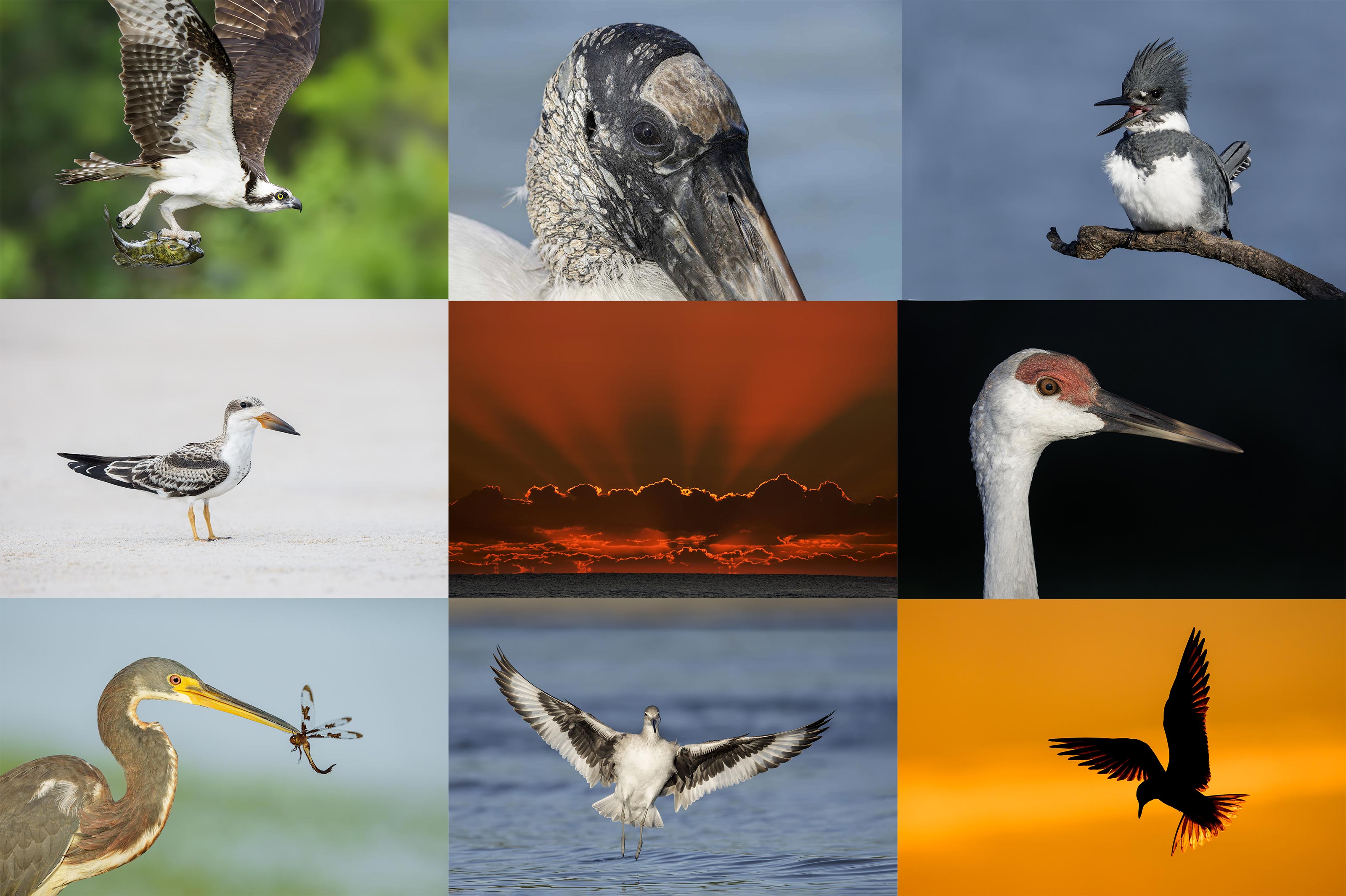
What You Will Learn
You will learn how to deal with the relatively show apertures: f/6.3, f/7.1, and f/8 when working in Manual mode.
You will learn how to ensure that you are working at the widest aperture by working in Shutter Priority mode with AUTO ISO.
If you are able to hand hold the lens, you will learn proper hand holding techniques.
If you can’t, you will learn when, why, and how to employ other options. Those include:
1- The knee-pod, heel-pod, and toe-pod techniques
2- Using the lens on a monopod.
3- The best lens plate and low foot for your 4-8.
4- The best tripod and head for the 4-8 and how best to utilize them.
5- How to use the lens from your vehicle while supporting it on a BLUBB (or not and why not).
6- Detailed instructions on how to set and use the lens controls and buttons:
a- AF/MF
b- DMF Switch
c- Limit Range Switch
d- OSS (Optical Steady Shot) Switch
e- OSS Mode Switch
f- Focus Hold Buttons
The guide also includes a Hand Holding Shutter Speed Primer and an illustrative, educational, and inspiring 67-image gallery.
Free to folks who use one of my two affiliate links to purchase their Sony 400-800 G lens. Otherwise, please send a PayPal for $115.43 to birdsasart@verizon.net and include the words “400-800 Lens Guide” in your e-mail.
|
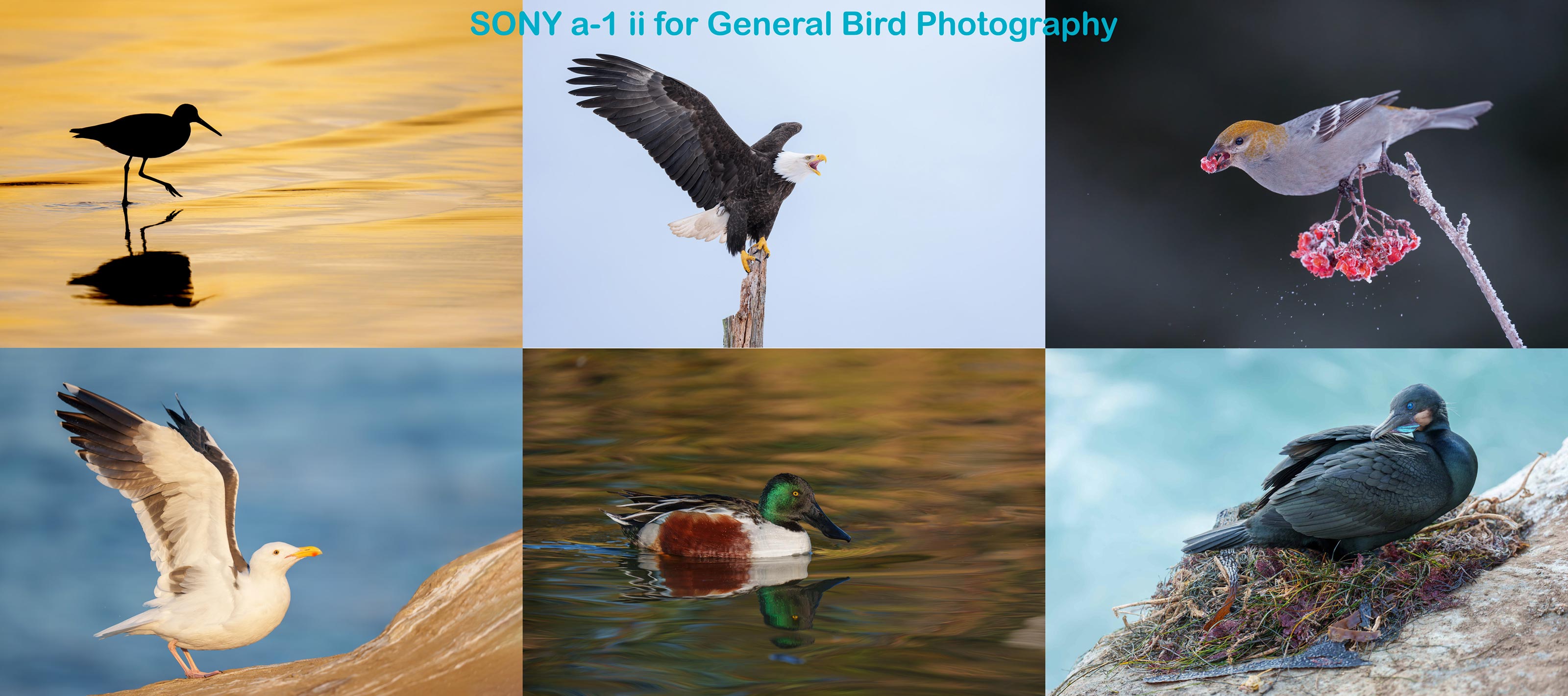
Composite #1: All with the a-1 ii Mirrorless Camera body.
|
The a-1 ii for General Bird Photography
I have found that eye-tracking for general bird photography with the a-1 ii is far, far better than with the original Sony a-1. It grabs the eye and tracks it faster and far more consistently and focus is rarely lost, even with backgrounds other than sky.
|
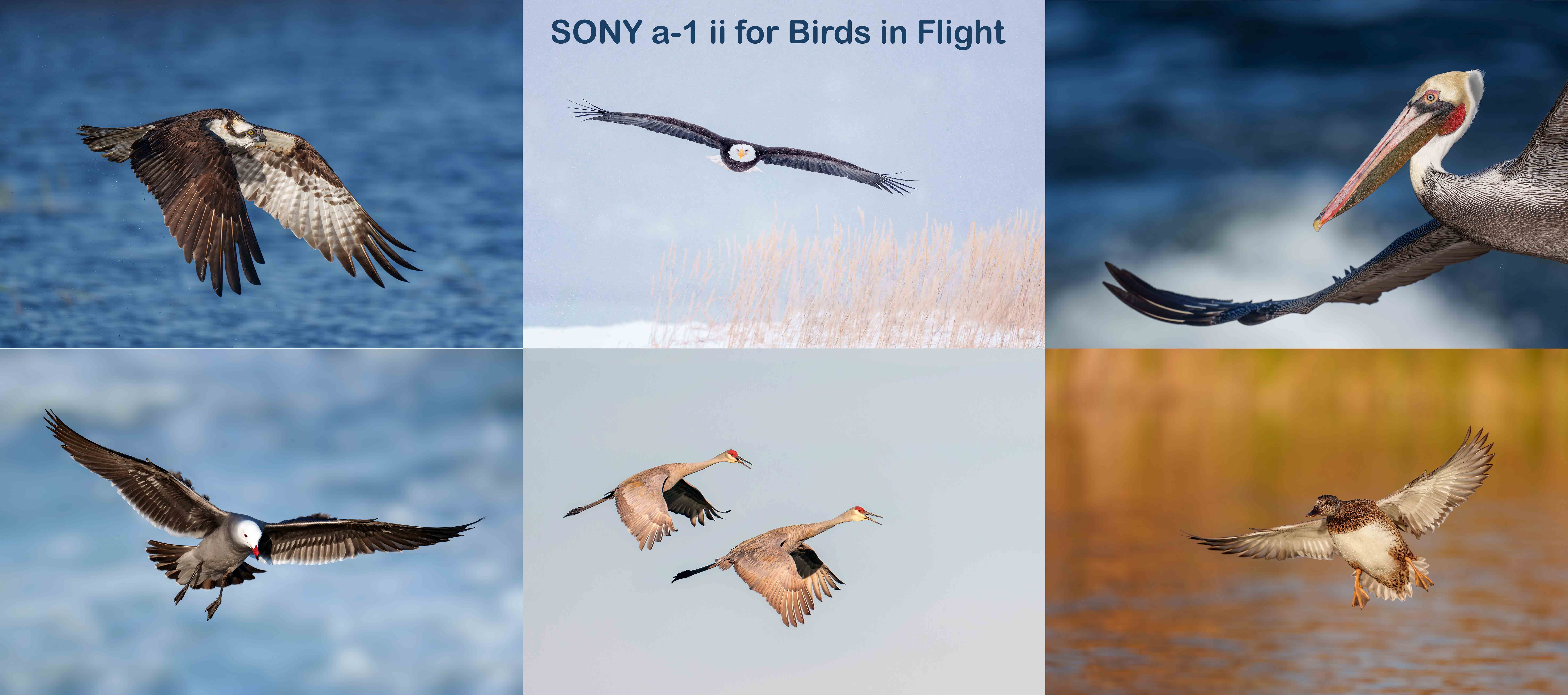
Composite #2: All with the a-1 ii Mirrorless Camera body.
|
The a-1 ii for Birds in Flight
For birds in flight, the a-1 ii Mirrorless Camera body has no equal. As Arash Hazeghi says, “It is better than the a-1.” When I am late getting on a bird in flight, I have consistently been amazed at how often the AF system of the a-1 ii finds and tracks the bird’s eye.
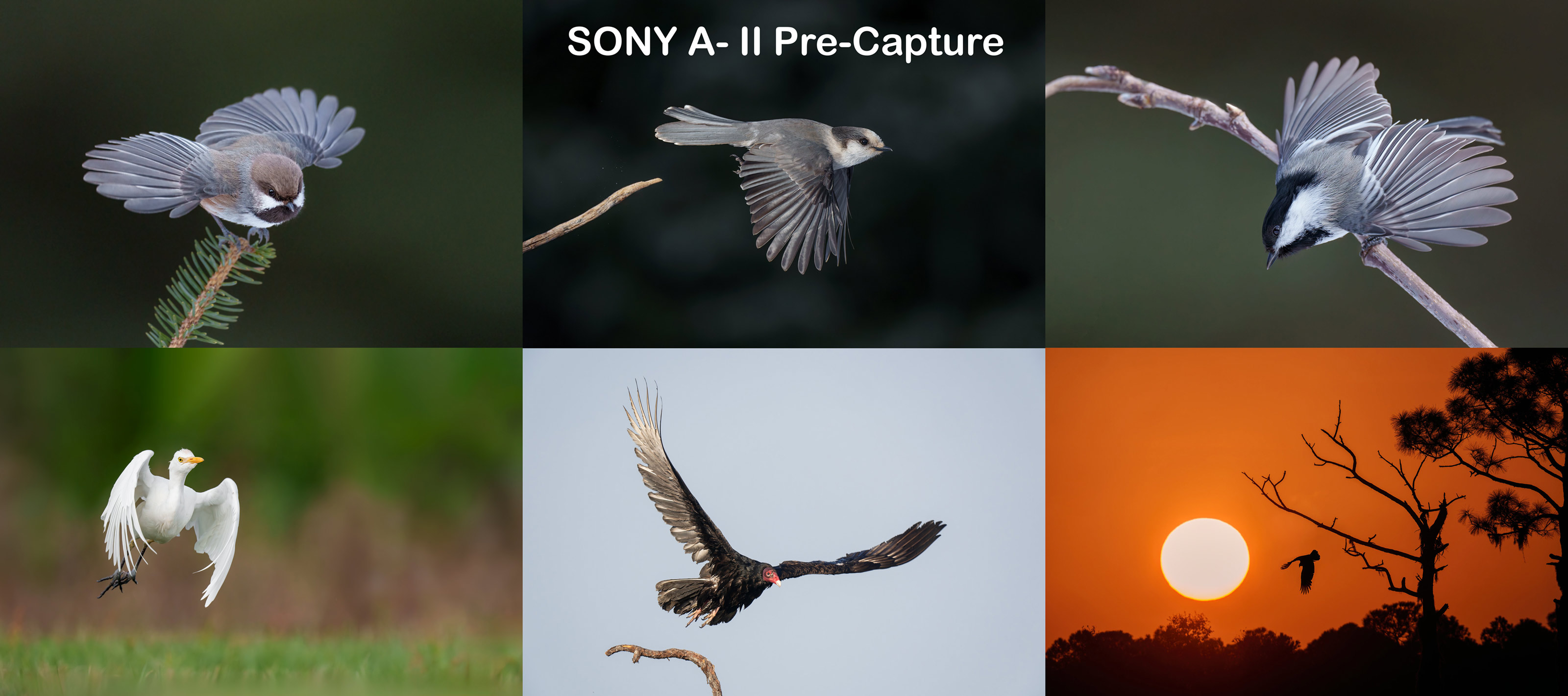
|
Composite #3: All the result of using Pre-Capture with the a-1 ii Mirrorless Camera body.
|
Pre-Capture with the Sony a-1 ii
When it comes to Pre-Capture with the a-1 ii Mirrorless Camera body, Arash and I agree 100%. And with my slower reflexes, Pre-Capture is more important for me than it is for Arash. Understand that in each of the images in Composite #3, I did not push the shutter button until after the bird took flight!
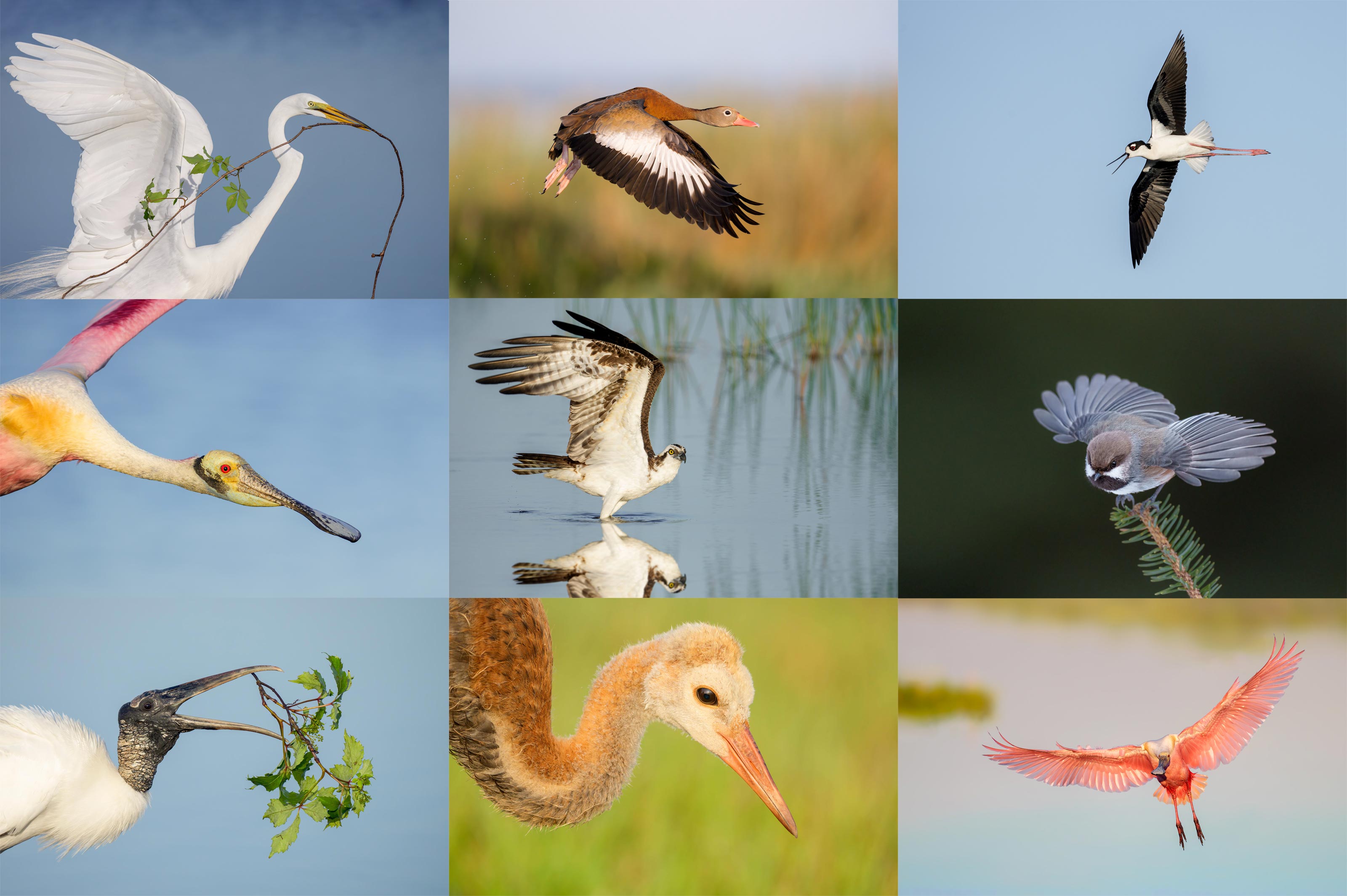
|
All with the a-1 ii Mirrorless Camera body.
|
Purchasing or Upgrading to a Sony a-1 ii
The Sony a-1 ii e-Mail Set-up and Info Guide
I now own and use two Sony a-1 ii bodies. Every day that I use them, the more I am amazed by speed and accuracy of the Bird Face-Eye tracking in AF-C and the overall performance of the camera.
Aside from the improved ergonomics as compared to the a-1, other nice features include the fact that the rear screen tilts both ways — the lack of a tilting rear screen on the original a-1 always ticked me off. Pre-capture has proven to be a huge plus almost exclusively for take-off flight images. In my opinion, the Speed Boost feature is a total waste for bird photography because you should always be utilizing the maximum frame rate. In addition, the resolution on the rear monitor has been improved dramatically. I must mention again that Bird Face-Eye tracking on the a-1 ii is vastly improved as compared to both the a-1 and the a9 iii and that the 51MP files are to die for.
So, the big question is, is the a-1 ii “worth” a gear upgrade. Remembering that I can never know whether or not something is worth it to you, I can say that I was not floored when first using my a-1 ii. The differences between the a-1 ii and the original a-1, seemed to be neither huge nor eye-opening. But over time, I have come to realize that I was 100% wrong. The huge difference between the new camera body and the a9 iii is, of course, the 51MP a-1 raw files (as compared to the 24MP files rendered by the a9 iii).
The price of a new a-1 is $5,898.00. The price of a new a-1 ii is $1,100.00 more: $6,998.00. As the a-1 ii is clearly far superior for bird photography to the original a-1, the choice for folks new to Sony or for those upgrading from lesser Sony camera bodies is an easy one. Prices for used a-1 bodies has not dropped drastically as I anticipated. At this point, a-1 folks who like showing flight and action and can afford an a-1 ii, are advised to purchase an a-1 ii. Please remember that life is short; we only get one ride on the merry-go-round.
If you do purchase an a-1 ii, be sure to use one of my two affiliate links so that you will receive my a-1 ii settings (in the form of a CAMSEa1ii.DAT file), the Buttons and Dials Guide, and an Info Sheet for free. Using my links will never cost you one penny and may actually save you some money. Folks who do not purchase their new a-i using my B&H link or from Bedfords here and entering the BIRDSASART discount code at checkout will be able to purchase the a-1 ii guide for $244.93. If you are at all confused and do not want to screw up your order, please get in touch via e-mail. If you would like to chat about upgrading, shoot me a text to 863-221-2372 and LMK a good time to call you.
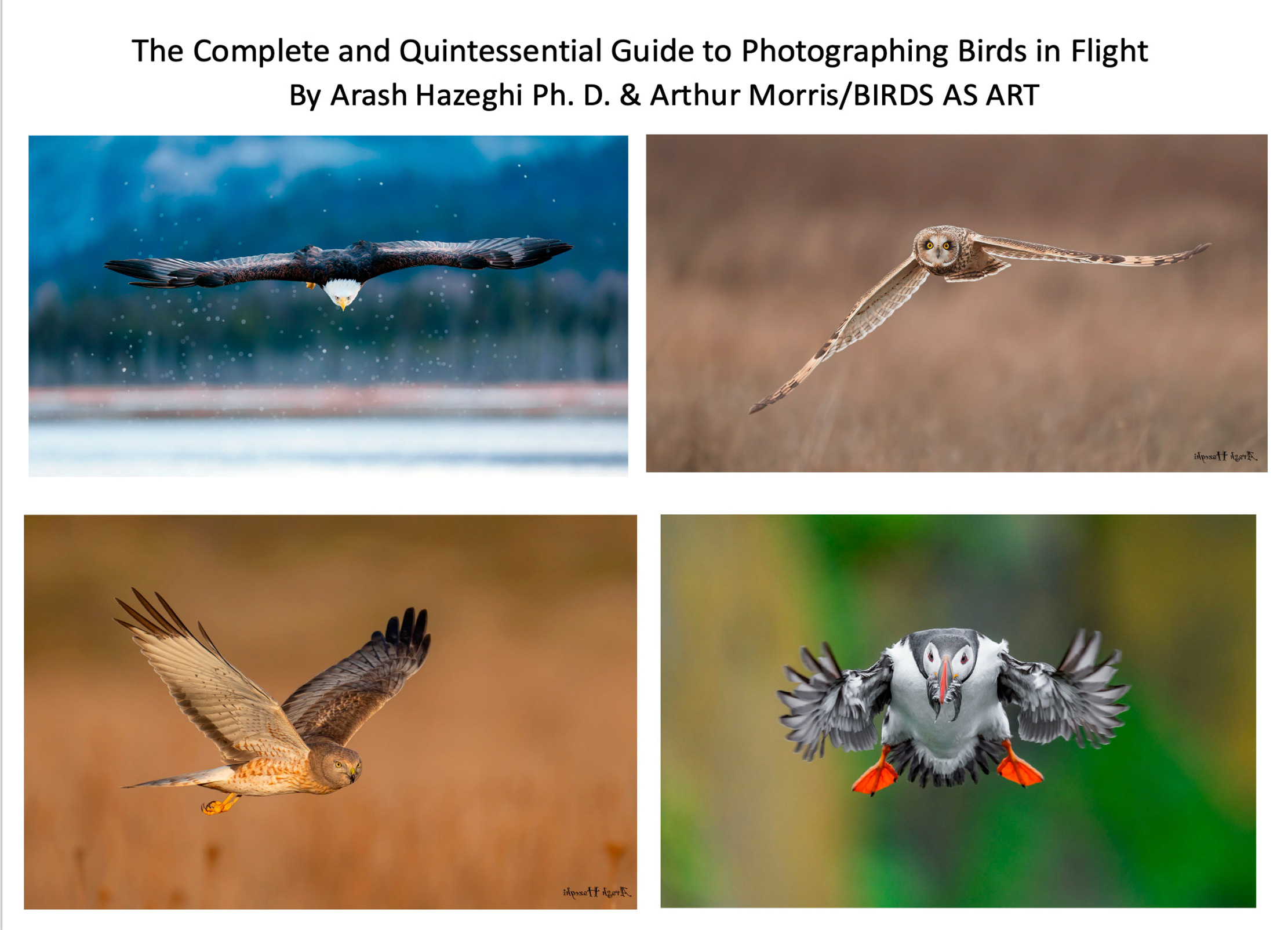
|
|
The title says it all. Purchase your copy here. The Complete and Quintessential Guide to Photographing Birds in Flight
|
The Complete and Quintessential Guide to Photographing Birds in Flight: $99.00
I had long dreamed of becoming a great flight photographer. When using dSLR gear, making sharp images was a huge problem. Most of the time, the camera bodies simply were not up to snuff. Things have changed dramatically with mirrorless technology. The high-end mirrorless camera bodies now feature science fiction-like autofocus systems and frame rates of 30, 40, and even 125 fps. Nowadays, getting the eye sharp is no longer a problem. The problem more often involves selecting the strongest image from a long series of sharp images.
The truth, however, is that there is a lot more than owning a Canon EOS R1, a Nikon Z9, or a Sony a-1 ii to consistently creating great photographs of birds in flight. Some of the biggest factors to success include gear choice, shooting strategies, and understanding the importance of sky conditions and wind speed and direction. Once you have the techniques and technical aspects down pat and can routinely create sharp images, learning the importance of flight poses, wing positions, backgrounds, and subject placement and image design enable you to create and then select superb flight images. And you guessed it, each of those topics and tons more are covered in detail in The Complete and Quintessential Guide to Photographing Birds in Flight.
The guide consists of 267 pages and 21,013 words. There are 82 illustrative photos scattered throughout the text, two screen captures, and a 112-image gallery that includes examples created by Canon, Nikon, and mostly Sony gear. As seen above, each of the 194 inspirational photos is labeled with an educational caption.
You can purchase your copy here for $99.00.
Arash Hazeghi
Arash Hazeghi, Ph.D. is a principal electron device engineer. He received his Ph.D. degree in Electrical Engineering in 2011, from Stanford University, Stanford, California. His pioneering research on Carbon Nanotubes has been cited many times. In the past decade, Arash Hazeghi has been a major contributor to the research and the development of some of the most cutting-edge technologies introduced by Silicon Valley’s most reputable names including SanDisk, Intel and Apple.
More relevant here is that he is widely recognized as one of the world’s best birds in flight photographers. He specializes in raptors and the technical aspects of bird photography.
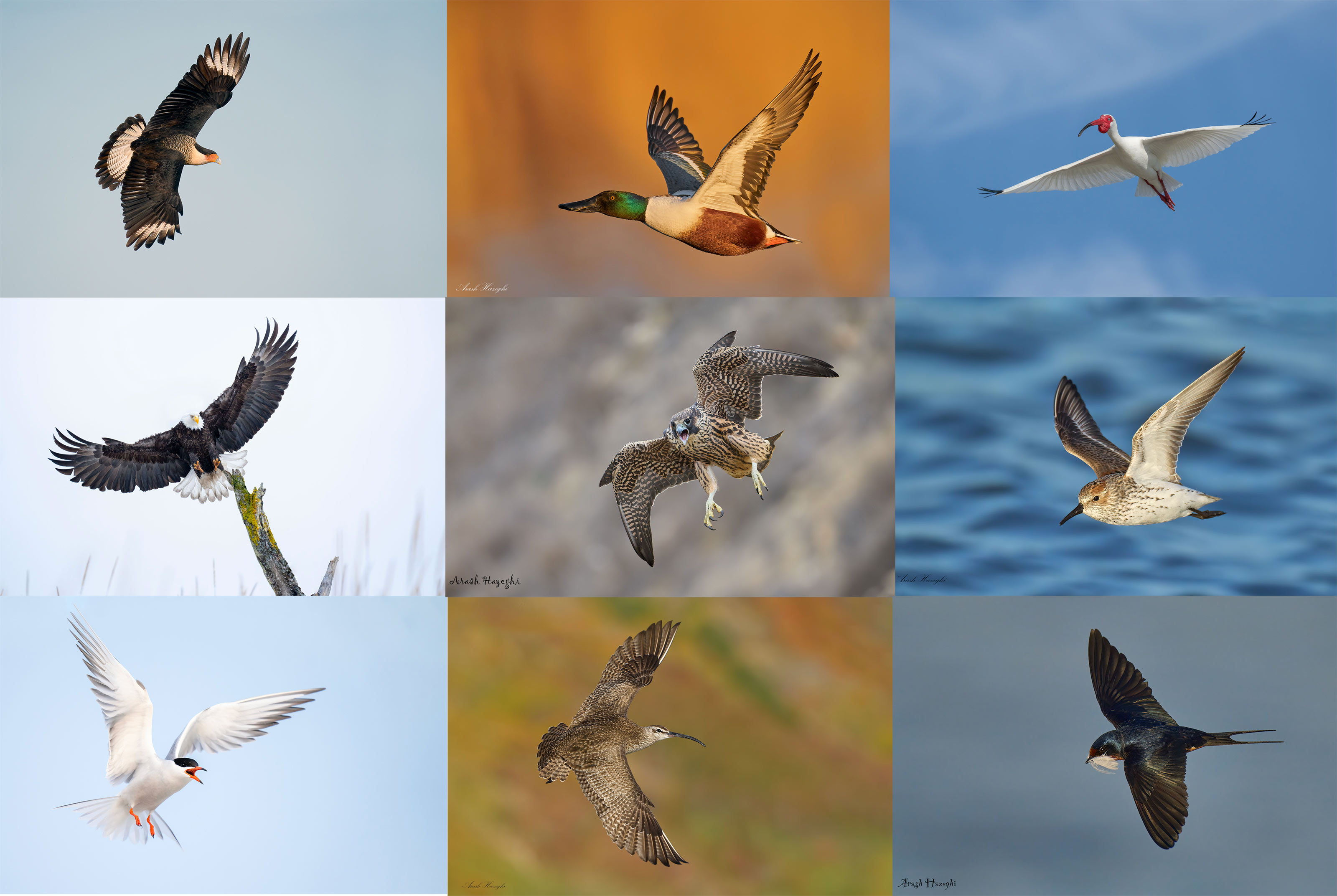
|
|
Flight photography is a skill that can be studied, practiced, and learned. Improve your skills by studying The Complete and Quintessential Guide to Photographing Birds in Flight |
The Complete and Quintessential Guide to Photographing Birds in Flight
By Arash Hazeghi Ph.D., and Arthur Morris/BIRDS AS ART
What you will learn (about):
-
1- Weight and handholding super-telephoto lenses.
2- Weight and handholding intermediate telephoto and telephotos zoom lenses.
3- Choosing the right flight photography lens or lenses for you.
4- The importance of focal length for flight photography.
5- The importance of lens speed (the maximum aperture for flight photography.
6- Choosing between fixed focal lengths and zoom lenses for flight photography.
7- The importance of AF speed and performance for flight photography.
8- Handholding tips and techniques.
9- Shooting flight off a tripod with the Levered-clamp FlexShooter Pro.
10- Flight poses and wing positions.
11- Why artie changed his mind about the 400mm f/2.8 lenses for flight and more.
12- The advantages and disadvantages of using teleconverters for flight photography.
13- Why to stay away from off-brand lenses.
14- Understanding the importance of wind direction and speed for flight photography.
15- The relationship between sky conditions and wind direction and how it affects flight photography.
16- Creating flight silhouettes in wind-against-sun conditions.
17- The importance of being on sun angle for flight photography (and avoiding harsh shadows).
18- Tips on doing flight photography in cloudy, foggy, or overcast conditions.
19- About the direction of light in cloudy, foggy, or overcast conditions and how it affects flight photography.
20- How your understanding of bird behavior can dramatically improve your flight photography.
21- Tips on attracting birds for flight photography.
22- What to do when your camera’s AF system is temporarily blind.
23- The vital importance of pre-focusing.
24- How Direct Manual Focus can help you with flight photography.
25- The importance of shooting aggressively when doing flight photography.
26- Everything that you need to know with regards to rest positions for flight photography.
27- The importance of getting low when doing flight in many situations.
28- Getting the right exposure when doing flight photography.
29_ Why to use Manual mode 95% of the time for flight.
30- Tips on finding the bird in the frame, acquiring focus, and tracking the bird in flight.
31- How to set and best utilize your lens’s image stabilization feature (and why).
32- Setting the focus range limiter switch on your flight lens or lenses.
33- To choose the best shutter speed for photographing birds in flight.
34- The vital importance of pre-focusing. And yes, this is so important that it is on the list twice.
You can see four sample pages in the blog post here. And you can purchase your copy here.
Typos
With all blog posts, feel free to e-mail or to leave a comment regarding any typos or errors.







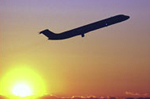
#3 is my favorite due to showing a different perspective of the bird with nesting material coming towards you. My second is #6 because of the composition and wing position.
Thanks, Jim. Another incoming cormorant lover!
best always, artie
My favorites are #3, because of the unusual wing position and the abundance of nesting material and #6, the other Brandt cormorant with nesting material and interesting wing position.
Thanks, Pat. Your 300m f/2.8 would have been great for this cormorants.
with love, artie
Looks like it’s been a really good IPT. Images #6,4, and 3 are all excellent, and that’s the order that I would score them. In image 3, I like the wing pose, the straight-on approach, and the fact that there is no intersection between the head and wings. The hint of the blue eyes (I would have loved more) and the water droplets on the head add to its strength. If the Brandt’s were turned just slightly more to their right and more straight-on, image #3 would have been my first choice. However, Image 6 gets my nod for first place. The excellent wing pose, the spread tail, the better visualization of the blue eyes, and the blue background edge out image 4. The enviroscape of the pelican and wave is well done, and the cresting wave and spray make for a beautiful image deserving of a close second.
BTW, image #9 is simply a beautiful, peaceful image, I always love the color combinations of royal terns and water.
Thanks Tom,
It has been great and the last three days have been even better for the pelicans. It seems that most folks agree on the top 3 but not on the order. Thanks for the mention of #9 and for your sharing your reasons. I actually like all of them but would agree on the top 3.
with love, artie
#3 is pretty dang crazy
Thanks, Anthony. I agree that #3 is pretty special, but I actually like the other incoming cormorant a bit better.
with love, artie
As much as you’ve produced the goods again Artie, it’s Nora’s shot that gets my gold medal, simply a superb environmental image.
Hope you’re all doing well, have a great trip
Thanks, Mike. I pretty much agree. Not bad for an a-1 ii beginner!
with love, artie
Image #3: Brandt’s Cormorant incoming with nesting material/square crop is the one that stands out to me the most. The closeness of the bird and the detail of the nesting material very intimate for a flight shot.
Thanks Jay and welcome to the blog. I agree that that is a very strong image.
with love, artie
#3 rules the roost. Beauty, congrats.
Image 7, if you set your tripod lower, there would be more space between the bird and the horizon, rather than there being almost no space.
You are correct sir!
many thanks, artie
You made it difficult to pick just one image of the set posted today, Artie! Yet in the end I kept coming back to Image #4, of the Brown Pelican flying just above the crest of the waves -wow. One of the better environmental shots over the water I’ve seen. It’s hard to find any fault with the image. Well done, and thank you for sharing. All the best.
Thanks, John. I agree and Nora will be beyond thrilled.
With love, artie