
Huge a-1 ii Thanks
Huge thanks to Nora Kane, Kevin Hice, and Harvey Seargeant for using one of my two affiliate links to purchase a new Sony a-1 ii. And Kevin, who finally saw the Sony light after 15 years of making great images with his Canon gear, went for both the 300mm f/2.8 GM and the 600mm f/4 GM lenses. My 600 is still in the shop :-(. All received my three a-1 ii set-up e-mails that include my current .DAT file along with a Buttons and Dials guide and the a-1 ii INFO file.
Your Call/My Call
Which of today’s featured images do you like best? Why?
In the Tight, Backlit Pelican Faces X Three. +1. Repeated Warnings blog post here, my top pick was Image #2 with the light-toned background as it best showcased the colors. A very close second was Image #1 with the 45° head turn and the dramatic black background. As for #4, kudos to Tom Redd who wrote: I would vote pelican and say that it is cleaning its bill pouch. He was correct on all counts.
What’s Up?
It had rained for several days before Bob Eastman and I showed up in San Diego. Our first day was cloudy and then the sun came out every day for two weeks. On Wednesday, it was cloudy bright and we had yet another fantastic morning. Foolishly, we had considered photographing for a short while on Thursday morning, our getaway day. When I re-did the math, however, I realized that we would be rushed and that we both might miss our flights. Instead, we stayed in, packed, and got to the airport in plenty of time. Bob had picked so many oranges from the AirBnB backyard trees in his checked bag that they wanted to charge him $100.00 for his overweight suitcase. So, he removed seven pounds of oranges and went on his merry way.
Jim picked me up at Orlando Airport just before 7pm on Thursday and we headed home. Bob Eastman landed in Minneapolis while we were on the road. The temperature was -7°F and his truck was stuck in a snowbank. And he had a 6 1/2 hour drive ahead of him to get back to Reedsburg, WI where was -20F without the windchill the next morning. It was a great blessing having him along.
On Friday, I woke early and headed down to the lake to check things out. With no wind, I was blessed by a foggy sunrise and several pairs of Sandhill Cranes in good places. With a touch of sadness, I saw that three-quarters of the first eagle nest tree had toppled to the ground — many wonderful memories (and images) remain. I plan on doing an In Memoriam blog post soon.
Today is Saturday 24 January 2026. I will be heading down to the lake again hoping for some more fog. I hope that you too choose to have a wonderful and productive day and that you have fun too. And please remember that happiness is a choice — Byron Katie, The Work.Com (and as discussed in depth here recently).
If an item — a Delkin flash card or reader, a Levered-clamp FlexShooter Pro, or a Wimberley lens plate or low foot — for example, that is available from B&H and/or Bedfords, is also available in the BAA Online Store, it would be great, and greatly appreciated, if you would opt to purchase from us. We will match or beat any price. Please remember also to use my B&H affiliate links or to earn 3% cash back at Bedford by using the BIRDSASART discount code at checkout for your major gear purchases. Doing either often earns you free guides and/or discounts. And always earns my great appreciation.
Gear Questions and Advice
Too many folks attending BAA IPTs and dozens of photographers whom I see in the field and on BirdPhotographer’s.Net, are — out of ignorance — using the wrong gear, especially when it comes to tripods and more especially, tripod heads. And the same is true in spades when ordering new camera bodies or lenses. My advice will often save you some serious money and may help you avoid making a seriously bad choice. Please know that I am always glad to answer your gear questions via e-mail. If you are desperate, you can try me on my cell at 863-221-2372. Please leave a message and shoot me a text if I do not pick up.
|
|
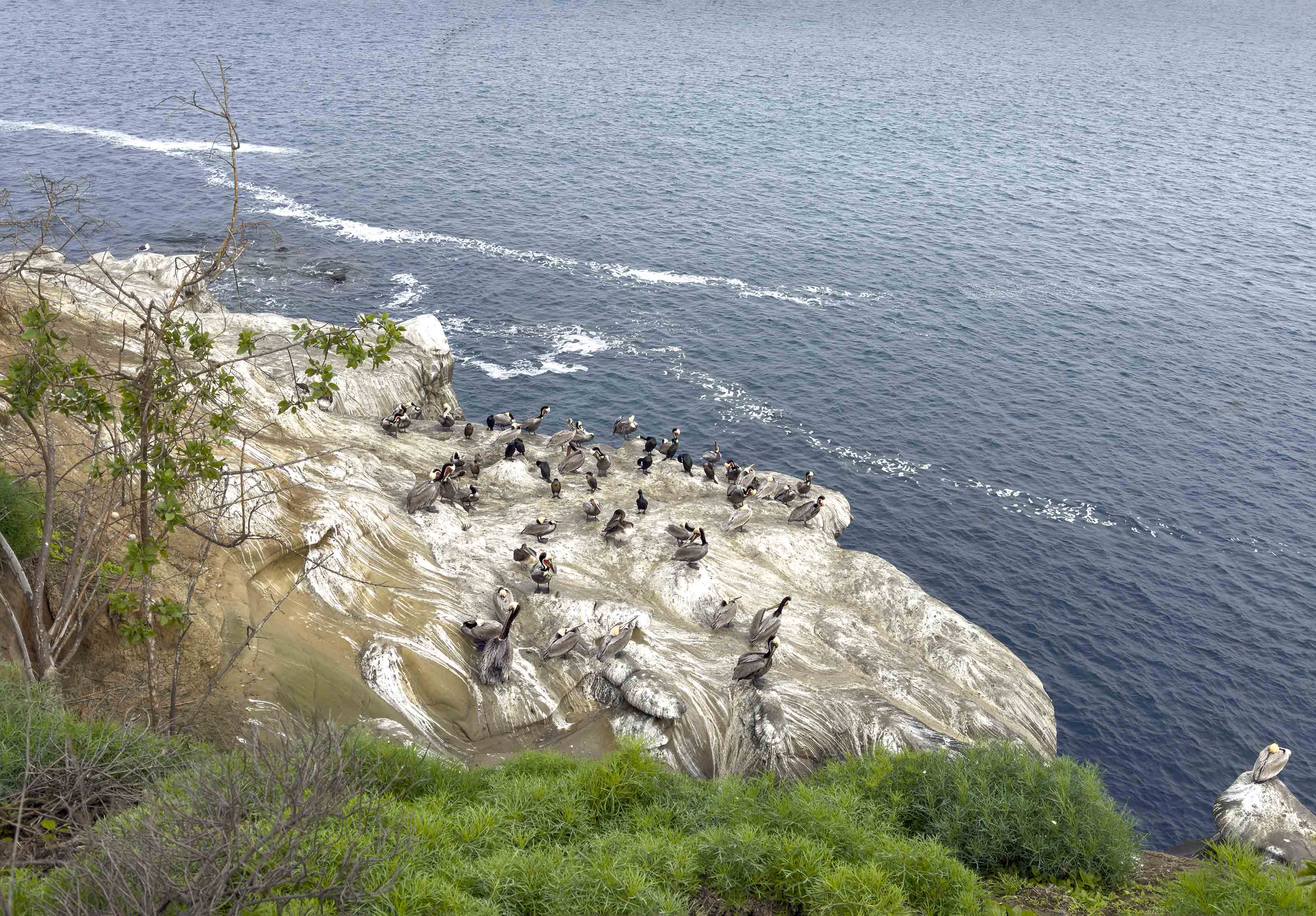
This image was created on 21 January. I used the iPhone 17 Pro Max back triple camera 6.765mm f/1.78. ISO 64: 1/1400 sec. at f/1.8 at 8:50:17am on a cloudy morning. Image #1: Setting the scene on the downhill sidewalk image |
Setting the Scene For Our Great Morning
This spot is just uphill from the observation point cutout. Over the years, the hillside next to the uphill sidewalk has become terribly overgrown. Last January we whacked down some bushes with our tripods and Bob climbed over the railing to break down a few more that we could not reach from the sidewalk. When we arrived two weeks ago, we were glad to see that the viewing window we had opened up in 2025 was still providing good views of the shelf you see in the image (and the one just to the right as well). As the birds are well off sun angle at this spot, you need clouds to achieve success.
Pelicans Dwarfed in La Jolla. Honest!
There is a little person — they were called midgets when I was a kid, who has been photographing the pelicans at La Jolla for years. Note that today the term midget is viewed as derogatory when referring to someone with dwarfism. In any case, he likes to do close range cell phone selfies with pelican backgrounds. He is amazingly agile climbing over the railings (illegally?) and down onto the cliffs where the birds are roosting. In previous seasons he would climb down into the crevice at Goldfish Point and scare every pelican off the upper ridge with impunity. Lots of photographers screamed and cursed at him but he did not care. Nor did he change his behavior. And he would climb over the fences at the lower shelves and scare off every bird within minutes.
I noted this year that his stalking skills have improved considerably. He moves much more slowly and often gets within a few feet of the big birds. He makes both images of the birds and selfies. All with his phone. The end result however is always the same: he scares every single pelican off the cliff he is working. On Thursday morning he actually helped us a lot. He began at the lowest shelf. We knew that he had climbed over the fence, made his way quickly down the steep cliff, and scared all the birds as pelicans began flying by to the east. Some landed on the shelf you see in the photograph. The flight shooting was great.
Many of the pelicans continued to fly east and landed at Goldfish Point. Mr Little Person followed. Then he climbed down to the lower ledge and eventually scared single every pelican off that cliff. Again, many of the birds flew right at us and again, many landed on the shelf you see in Image #1. The breeze from the southeast the birds had the birds braking to land right at us. Had it not been a cloudy morning, we would have been way off sun angle and been unable to create any decent photos.
Anyhoo, multiple events lined up in perfect sequence to produce some very fine bird photography.
|
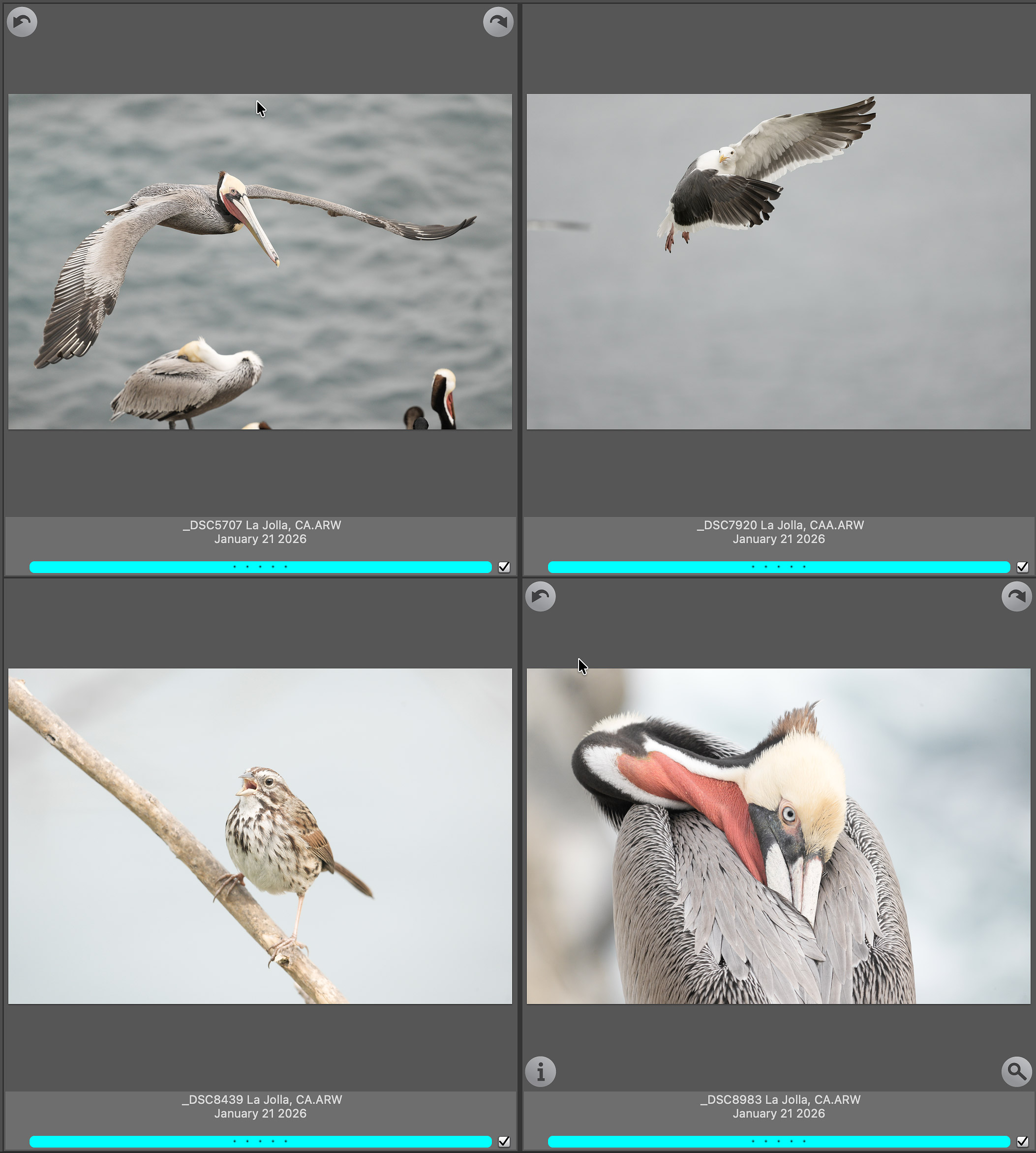
Screen Capture: representing the four raw files for today’s featured avian photographs |
The Four Raw Files
Compare the flat, washed out, properly exposed to the right raw files above with the four optimized versions below. In addition to the vastly improved color and contrast in all four photos, note the cropping, expanded canvas, subject re-positioning, and image cleanup in various images.
All as detailed (plus tons more) in Digital Basics II, the Digital Basics III Video Series, and the Digital Basics IV Video Series.
|
|
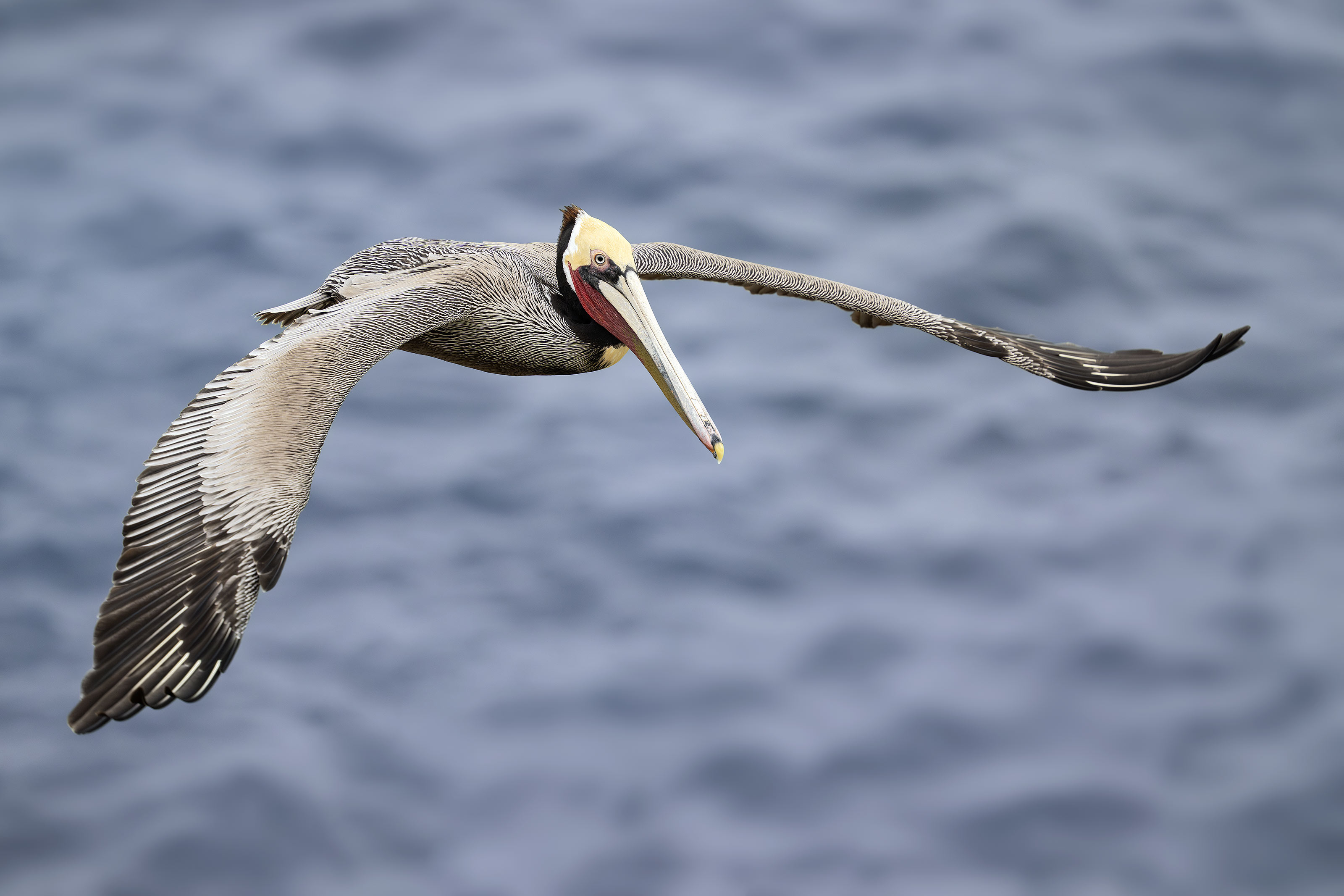
This image was created on 21 January 2026 by yours truly at La Jolla, CA. Standing on the downhill sidewalk, I used the hand held Sony FE 300mm f/2.8 GM OSS Lens (Sony E) with the Sony FE 1.4x Teleconverter with the Latest Greatest Sony Flagship Body, the a1 II Mirrorless Camera. Exposure determined via Zebras with ISO on the Thumb Wheel. ISO 2000: 1/2500 sec. at f/4 (wide open) in Manual mode. AWB at 8:37:12am on a cloudy morning. Tracking: Zone/AF-C with Bird Eye/Face Detection enabled performed perfectly. Click on the image to enjoy the larger, inexplicably sharper high-res version. Image #2: Brown Pelican breeding plumage adult dorsal view flight image |
The Higher the Bird in Flight, the More pleasingly Defocused the Ocean Background
My best flight images on Wednesday were made when I moved left of the small scraggly tree (call it a tall bush if you wish) that you see on the left side of the frame in Image #1. Doing that, I was able to photograph the birds before they descended to land on the shelf. Once the birds continued downward to land, all sorts of distracting elements popped up in the background including white streaks in the water and waves and ripples on the surface of the Pacific.
|
|
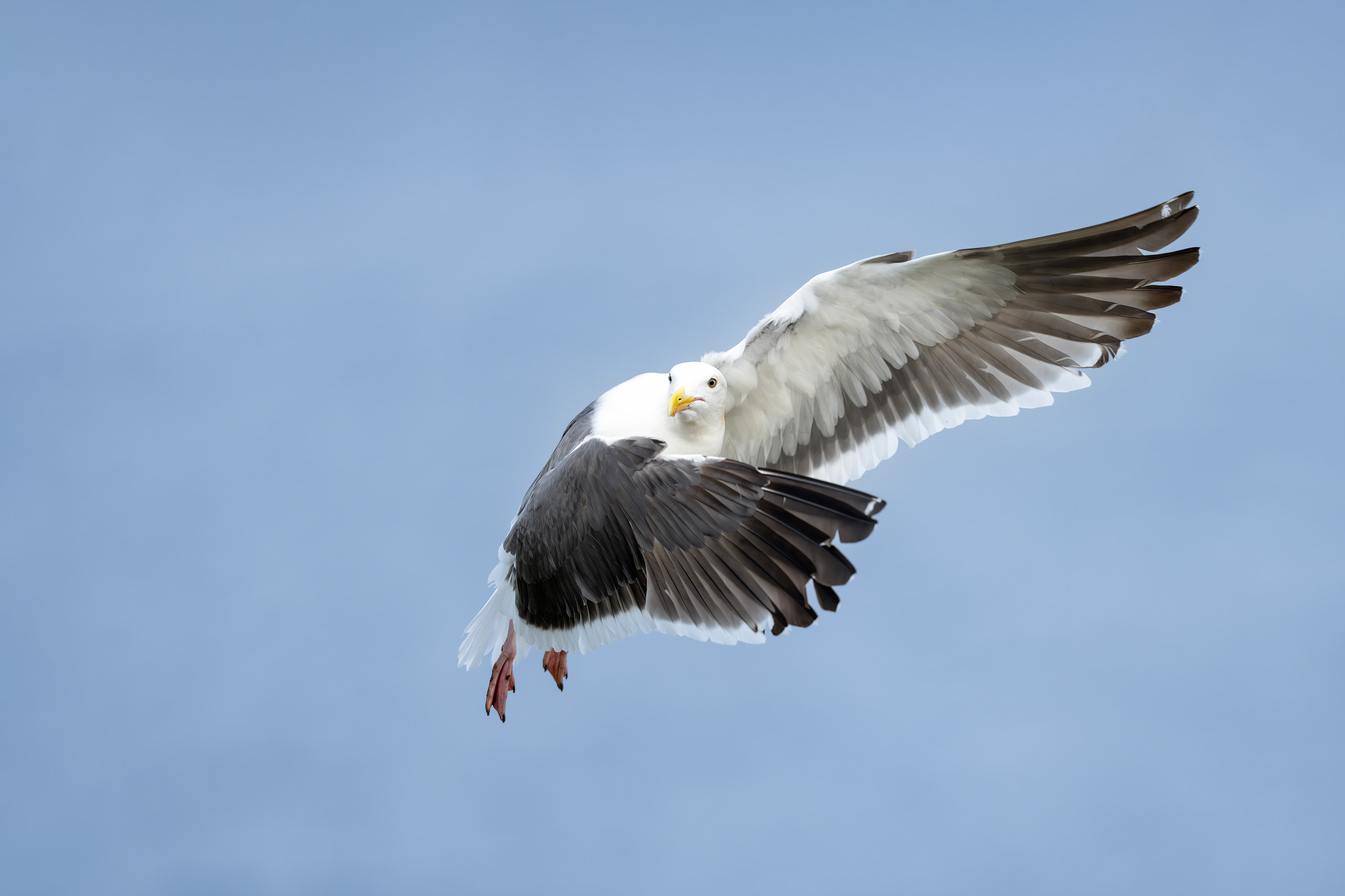
This image was also created by yours truly on 21 January 2026 at La Jolla, CA. Standing on the downhill sidewalk I used the handheld Sony FE 300mm f/2.8 GM OSS Lens (Sony E) and The Latest Greatest Sony Flagship Body, the a1 II Mirrorless Camera. ISO 640. The exposure was determined via Zebras with ISO on the Thumb Wheel; 1/4000 sec. at f/2.8 (wide open) in Manual mode. AWB at 9:15:35am on a cloudy morning. Tracking Zone/AF-C with Bird Eye/Face Detection enabled performed perfectly. Image #3: Western Gull adult turning in flight |
Take Advantage of the Situation
When a cormorant would drop or regurgitate a fish, the Western Gulls would go nuts hovering above them and screaming. The big problem was isolating a single gull. But the light and the wind were perfect and we had lots of great chances.
|
|
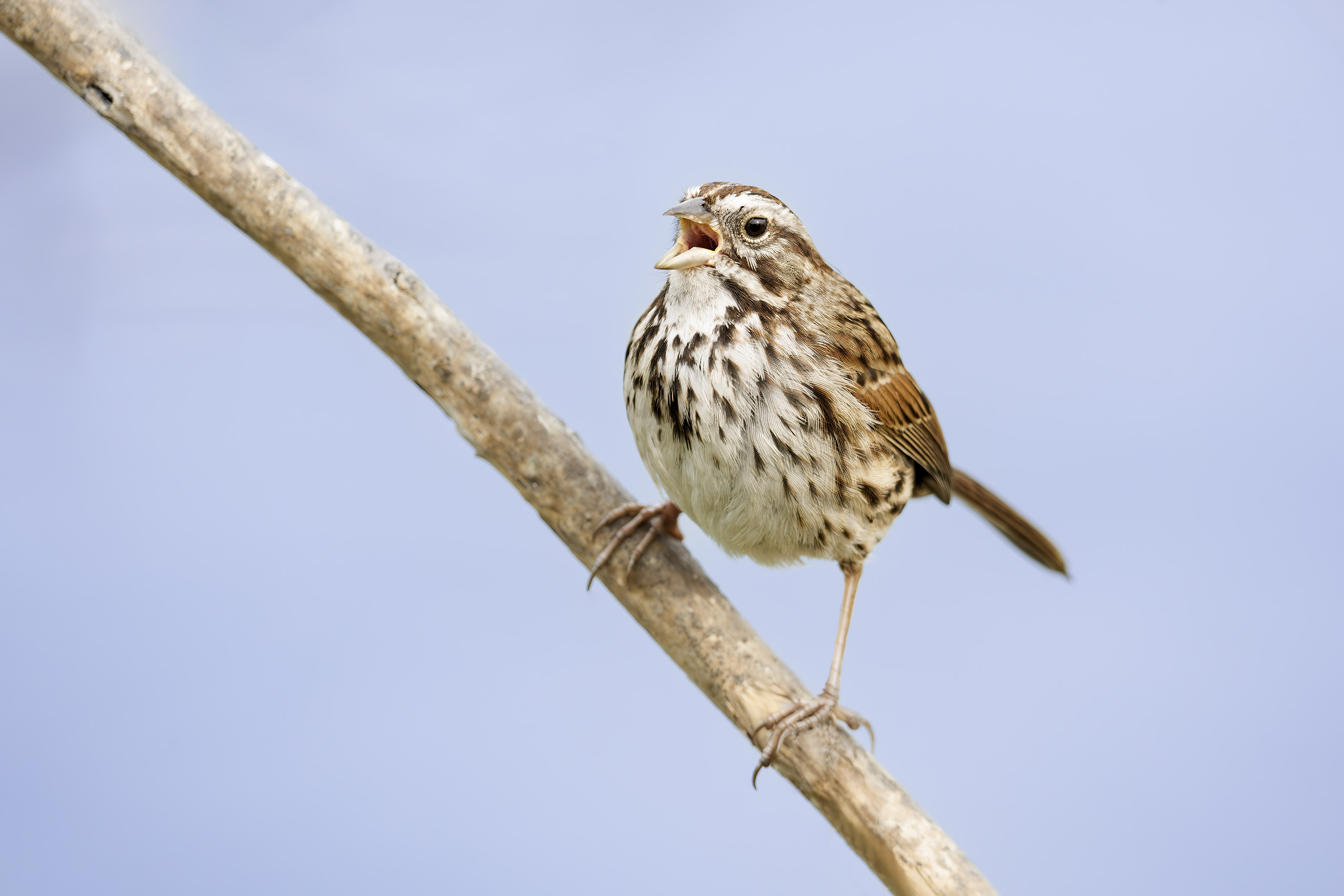
This image was also created on 21 January 2026 by yours truly at La Jolla, CA. Standing at full height on the downhill sidewalk I used the Tracking: Zone/AF-C with Bird-Eye/Face Detection performed perfectly. Click on the image to enjoy the larger, inexplicably sharper high-res version. Image #4: Song Sparrow singing from clean perch |
iPhone Trick
There were several Song Sparrows flitting around in the shrubbery on the hillside. So, I took out my iPhone, opened up iBird Plus, played the species call, placed the phone on the railing, and walked toward my tripod-mounted rig. Before I could even get to my gear, the bird in Image #4 landed on the only clean perch in sight and began to sing. As I found the subject and framed the image, I noted that the previous exposure was perfect so I acquired focus and began firing.
|
|
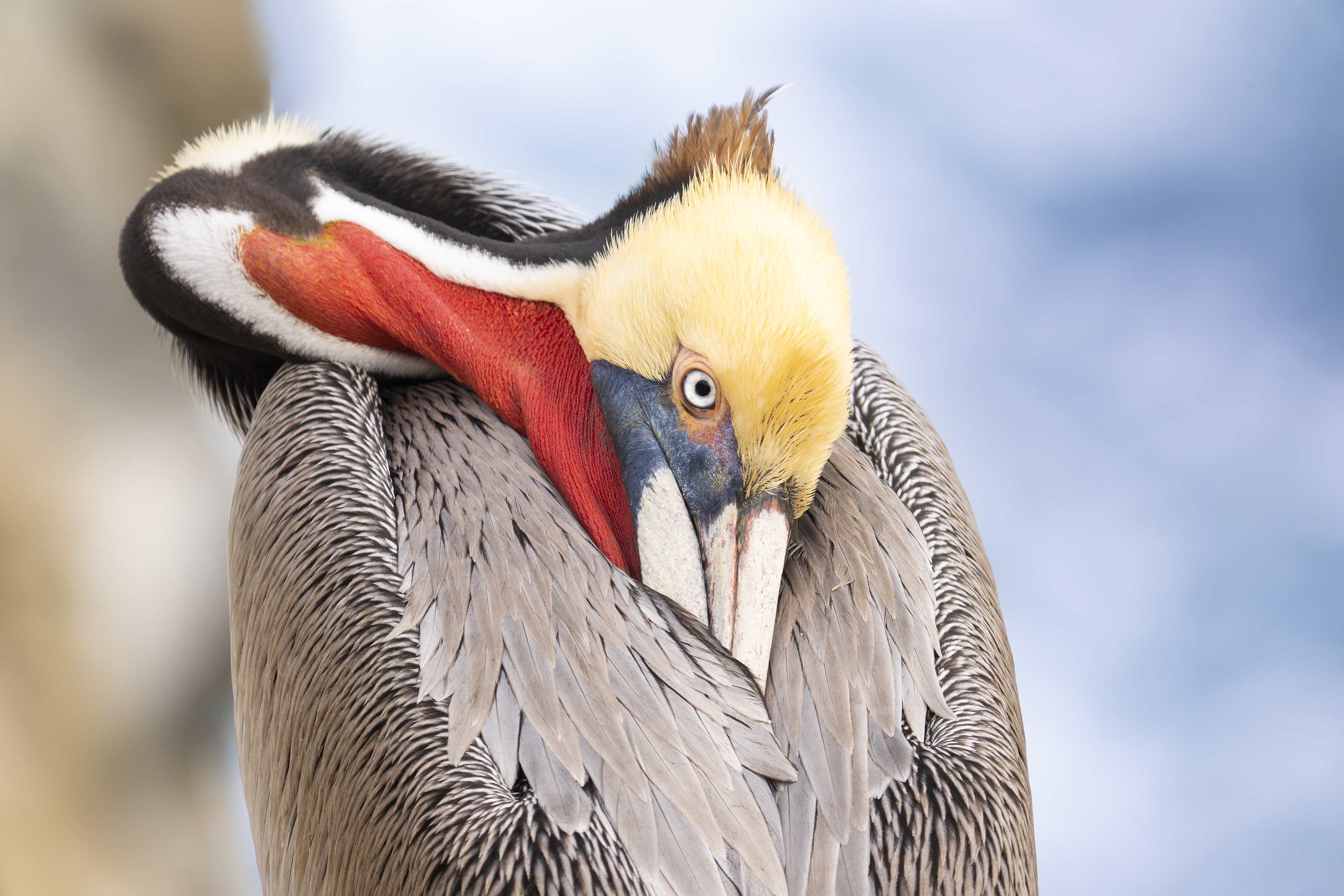
This image was created on 21 January 2026 by yours truly at La Jolla, CA. Standing at full height on the downhill sidewalk I used the Tracking: Zone/AF-C with Bird-Eye/Face Detection performed perfectly. Click on the image to enjoy the larger, inexplicably sharper high-res version. Image #5: Brown Pelican breeding plumage adult resting |
1120mm
Regular visitors to the blog know that I have loved the Sony 400-800 lens ever since I got my hands on one early last spring. When working on a tripod, adding a 1.4X teleconverter gives you an effective focal length of 1120mm (albeit at f/11). The sharpness of the results are nothing short of astounding. Sony shooters who photograph birds need to consider this relatively inexpensive super-telephoto zoom lens even if they already own and use the fabulous 200-600 G lens. The two are totally different animals.
|
|
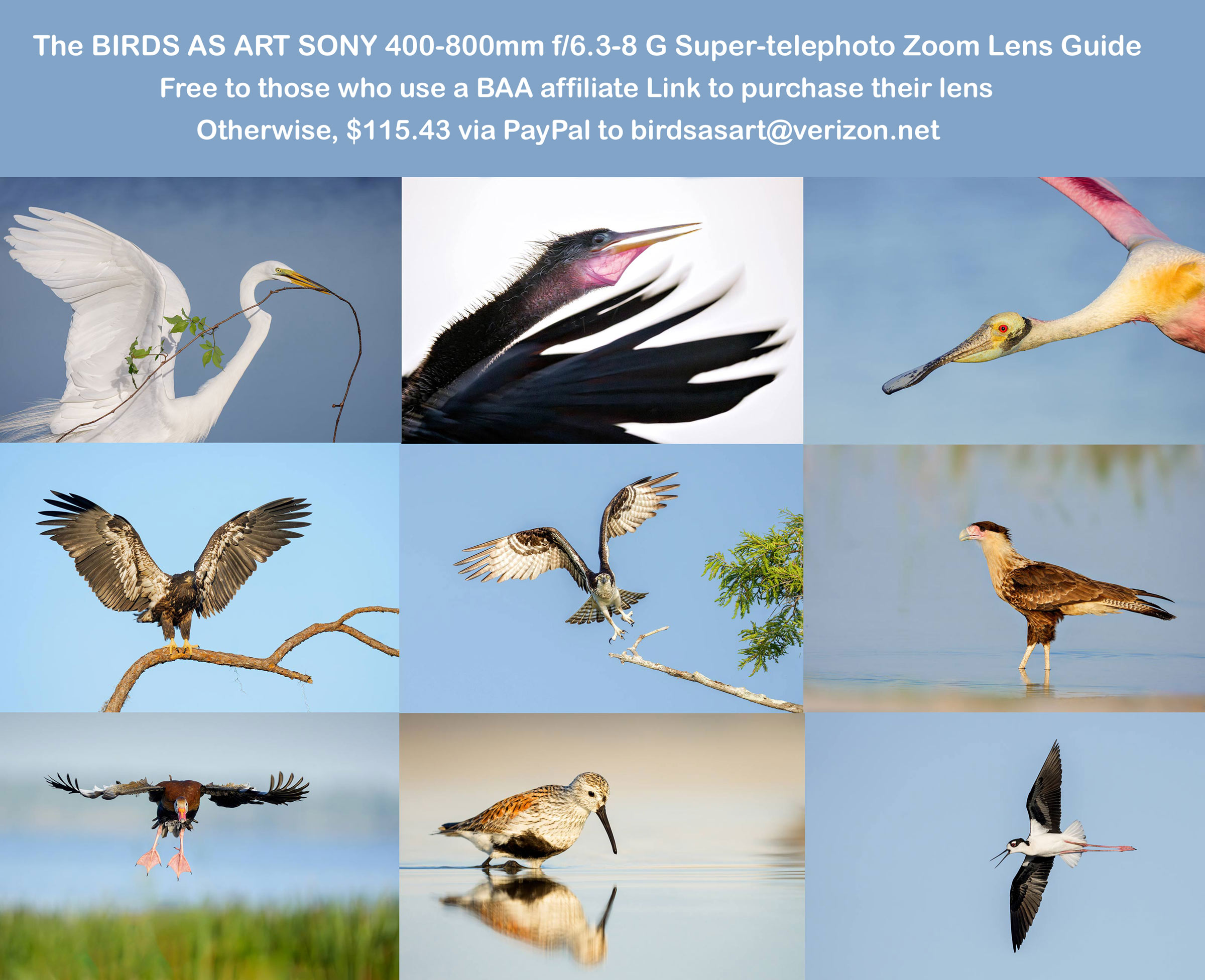
This guide is free to folks who use one of my two affiliate links to purchase their Sony 400-800 G lens. Otherwise, please send a PayPal for $115.43 to birdsasart@verizon.net and include the words “400-800 Lens Guide” in your e-mail. |
The BIRDS AS ART SONY 400-800mm f/6.3-9 G Super-telephoto Zoom Lens Guide
When I borrowed this lens from Sony, I assumed that at 5.45 pounds it was too heavy to handhold for long and that at f/8 at the long end (800mm,) it was too slow for most bird photography applications. In short, I did not want to like the lens. After a month of using it, I cannot live without it. After returning the loaner, I was miraculously able to get my own from Bedfords on 16 April 2025. In this guide I share everything that I have learned about using the 400-800. For best results, you need to know exactly what you are doing to get the most out of this zoom lens. It would be best, therefore, to consider and study the material in the guide so that you can begin making great images with your new lens.
|
|
Free to folks who use one of my two affiliate links to purchase their Sony 400-800 G lens. Otherwise, please send a PayPal for $115.43 to birdsasart@verizon.net and include the words “400-800 Lens Guide” in your e-mail. |
What You Will Learn
You will learn how to deal with the relatively show apertures: f/6.3, f/7.1, and f/8 when working in Manual mode.
You will learn how to ensure that you are working at the widest aperture by working in Shutter Priority mode with AUTO ISO.
If you are able to hand hold the lens, you will learn proper hand holding techniques.
If you can’t, you will learn when, why, and how to employ other options. Those include:
1- The knee-pod, heel-pod, and toe-pod techniques
2- Using the lens on a monopod.
3- The best lens plate and low foot for your 4-8.
4- The best tripod and head for the 4-8 and how best to utilize them.
5- How to use the lens from your vehicle while supporting it on a BLUBB (or not and why not).
6- Detailed instructions on how to set and use the lens controls and buttons:
a- AF/MF
b- DMF Switch
c- Limit Range Switch
d- OSS (Optical Steady Shot) Switch
e- OSS Mode Switch
f- Focus Hold Buttons
The guide also includes a Hand Holding Shutter Speed Primer and an illustrative, educational, and inspiring 67-image gallery.
How to Get This Guide
This guide is free to folks who use one of my two affiliate links to purchase their Sony 400-800 G lens. Otherwise, please send a PayPal for $115.43 to birdsasart@verizon.net and include the words “400-800 Lens Guide” in your e-mail.
|
|
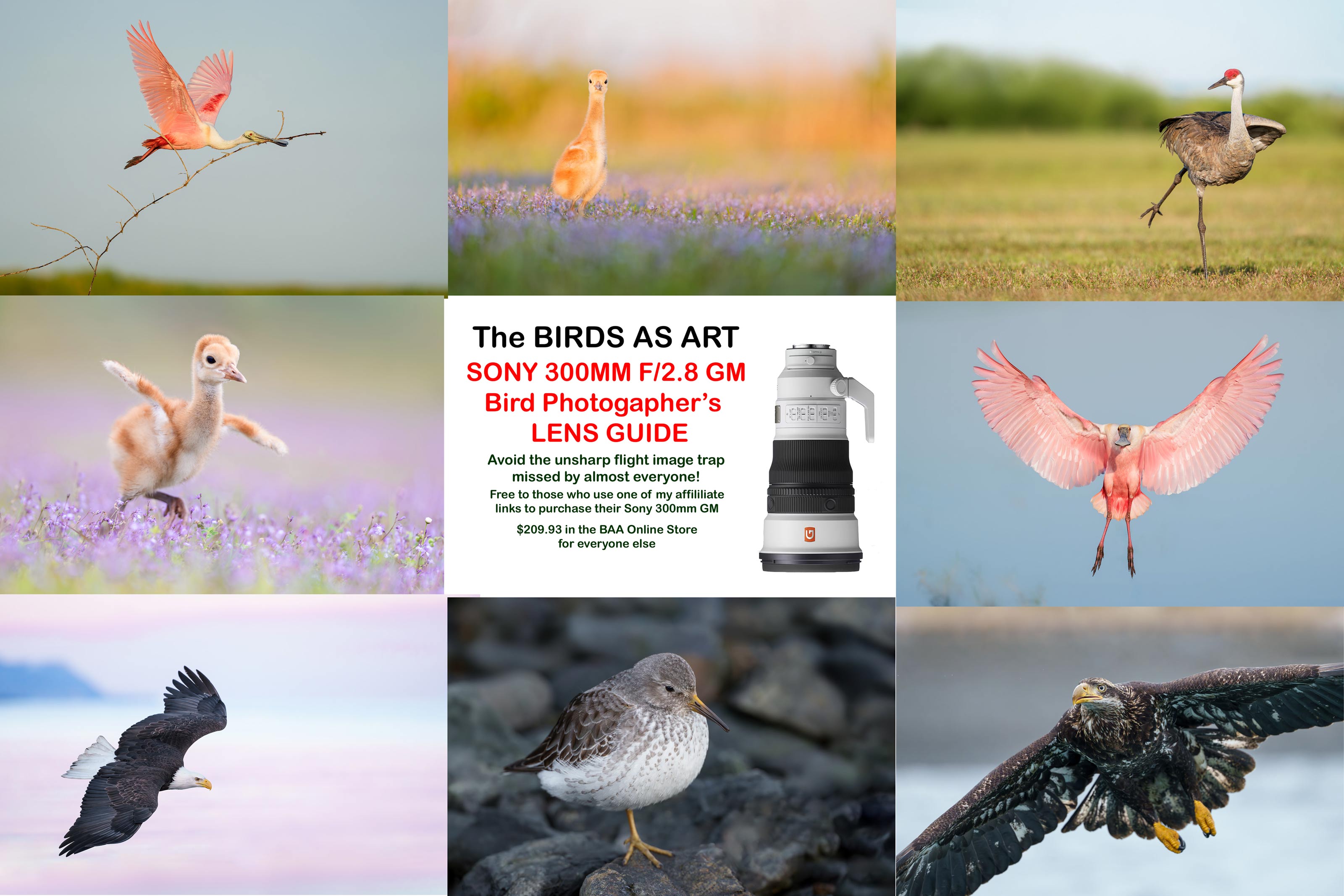
For those who did not use my link to purchase their Sony 300mm f/2.8 GM lens, you can order your a copy here for $209.93. Click on the image to enlarge and to be able to read the fine print. |
The BAA Sony 300mm f/2.8 Lens Guide
The handheld 300mm f/2.8 GM lens is one of my very favorite flight photography lenses bare or with either TC. It is incredibly light and the images are incredibly sharp. If you have been impressed by my Sony FE 300mm f/2.8 GM OSS Lens (Sony E) images, you can use either my Bedfords or B&H affiliate link to purchase your Sony 300mm f/2.8 GM lens and shoot me your receipt via e-mail and request a copy of the first-ever BAA Lens Guide. I thought that it would take only minutes to create this guide, but I was dead wrong. In the process of creating it, I learned a ton about the lens. And even better, I discovered a simple yet potentially fatal flaw that was resulting in sporadically unsharp flight images. The set-up fix is simple. Just be sure to use one of my affiliate links and get the guide for free.
If not, you can purchase a copy here for $209.93. Yes, it never hurts to use my links and it never costs you one penny more. And if you contact me via e-mail before you make a major purchase, I can often help save you some money.
Typos
With all blog posts, feel free to e-mail or to leave a comment regarding any typos or errors.







#3 for me. I like the head turn which brings my eyes back into the image. The wing position and head turn make the bird appear to be braking. Thanks for sharing.
Thanks, Jim. And yes, when birds turn in flight they must put on the brakes before doing so.
with love, artie
My favorite is image 5 for the color, pose, composition, and sharpness. Second-favorite is image 3, the turning western gull. I find framing a challenge with such images; do you frame for the bird’s head, as you did, or for its overall pose? I always try it both ways and sometimes go to a square frame, but it’s often a difficult call.
All of your questions are quite valid; I often deal with the same considerations!
with love, artie
#4 the song sparrow. It is so hard to get these small, flighty birds!
Thanks, Pat. Those little birds are tough!
with love, artie
Good morning from Texas… like the Brown Pelican breeding plumage adult dorsal view flight image because of the clean and sharp focus on the eye and head… great job…
Thanks, Joe. I love that one too.
artie
“Pelicans Dwarfed in La Jolla.”
Ha! I see what you did there!
Clever, no?
a
Image 5 showcasing the colors, textures and patterns of the pelican is my favorite. Image 3 is a close second with the turning pose revealing both the dorsal and ventral views of its wings to go with the nice look back with the head.
Thanks, Tom. I too really love the 1120mm pelican image.
with love, artie