
Homer 2027
I will be returning to Homer in 2027 for my last-ever Bald Eagle Instructional Photo-Tours. Four of the ten slots are already filled. If you are seriously interested in joining me, please get in touch via e-mail or shoot me a text at 863-221-2372.
Your Call
A tough assignment: from today’s eleven featured images, rank your three favorites with the strongest first. Kindly let us know why you made your three picks.
My Call
In the Homer Being Homer. Eagles Being Eagles! blog post here, my two favorite images were #7: Bald Eagle adult with wings raised, and #8: Bald Eagle 3-year old landing/touchdown. All the rest were tied for third.
What’s Up?
The first day of the second Homer IPT was gloriously cloudy. With 10-foot seas forecast for the next day, we enjoyed 8 1/2 hours of great Bald Eagle photography. After our day off the weather has been cold, clear, and sunny yet we have had one great session after another.
Today is Sunday 22 February 2026. Here is the marine forecast: Variable winds averaging 10 knots. Seas 2 ft. Right now it is a balmy 18° F with a gentle breeze from the NE. The skies are clear with some increasing clouds coming for our last session. Whatever you opt to do today, I hope that you choose to have fun. And please remember that happiness is a choice — Byron Katie, The Work.Com.
I will be doing the drive back to Homer by myself for the first time ever tomorrow. My flight to Seattle is at 5:00pm on Monday evening. After my red-eye flight, I am scheduled to arrive in Orlando at 7:40am on Tuesday morning where Jim will pick me up. Bob Eastman should be getting to my home on Tuesday evening. He is driving down from Wisconsin to give me a hand with the two sold out Stick Marsh Roseate Spoonbill IPTs.
If an item — a Delkin flash card or reader, a Levered-clamp FlexShooter Pro, or a Wimberley lens plate or low foot — for example, that is available from B&H and/or Bedfords, is also available in the BAA Online Store, it would be great, and greatly appreciated, if you would opt to purchase from us. We will match or beat any price. Please remember also to use my B&H affiliate links or to earn 3% cash back at Bedford by using the BIRDSASART discount code at checkout for your major gear purchases. Doing either often earns you free guides and/or discounts. And always earns my great appreciation.
Gear Questions and Advice
Too many folks attending BAA IPTs and dozens of photographers whom I see in the field and on BirdPhotographer’s.Net, are — out of ignorance — using the wrong gear, especially when it comes to tripods and more especially, tripod heads. And the same is true in spades when ordering new camera bodies or lenses. My advice will often save you some serious money and may help you avoid making a seriously bad choice. Please know that I am always glad to answer your gear questions via e-mail.. If you are desperate, you can try me on my cell at 863-221-2372. Please leave a message and shoot me a text if I do not pick up.
|
|
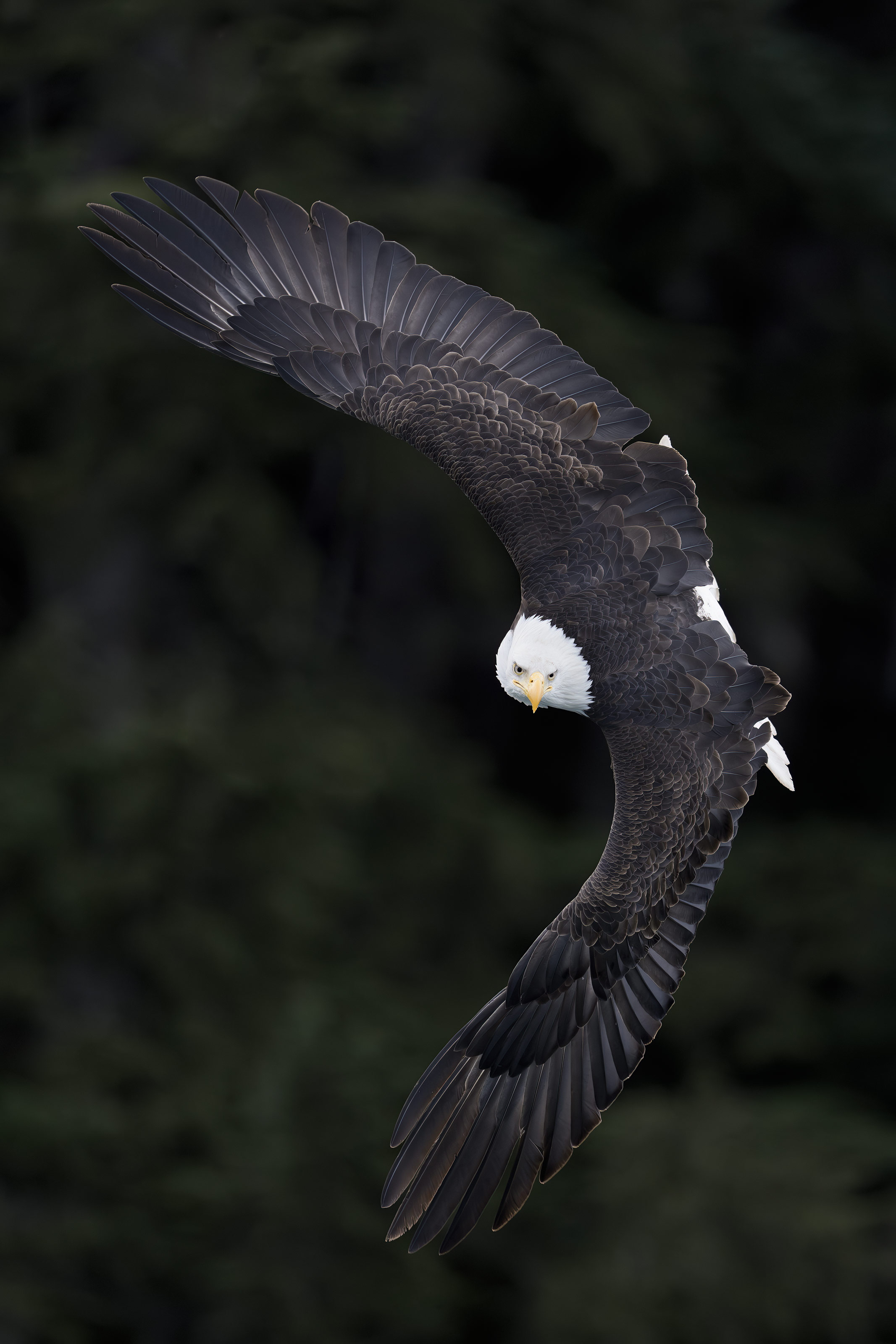
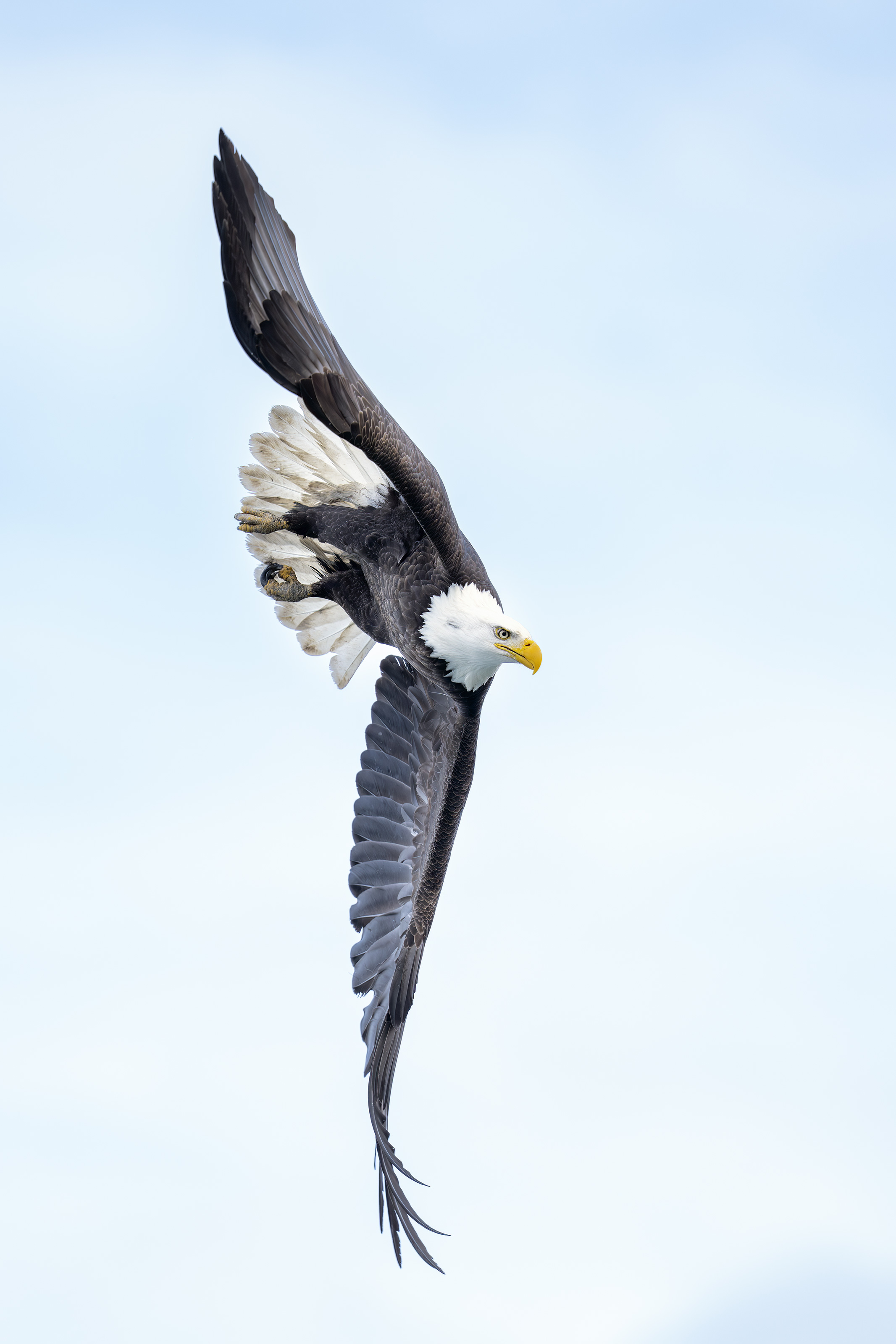
This image was created on 16 February 2026 by multiple IPT veteran Jim Dolgin at Kachemak Bay, Homer, AK. Standing on the deck of our work (eagle) boat, he used the handheld Sony FE 300mm f/2.8 GM OSS Lens (Sony E) and The Latest Greatest Sony Flagship Body, the a1 II Mirrorless Camera. ISO 1600. The exposure was determined via Zebras with ISO on the Thumb Wheel; 1/4000 sec. at f/2.8 (wide open) in Manual mode. AWB at 2:04:55 pm on a cloudy afternoon. Wide/AF-C with Bird Eye/Face Detection enabled performed perfectly. Image #1: Bald Eagle vertical bank with dark background |
Cropped From a Horizontal Original
Most but not all vertical banking flight shots are created from horizontal originals. Jim fit this one into the frame perfectly. We added a bit of canvas top and bottom before executing the obvious vertical crop. With wind against sun conditions on a sunny afternoon Captain Gabe came up with the idea photographing the birds in the shade of a tall hill/small mountain ridge with the wind behind us. I had him position the boat so that we could shoot against a dark conifer background.
|
|
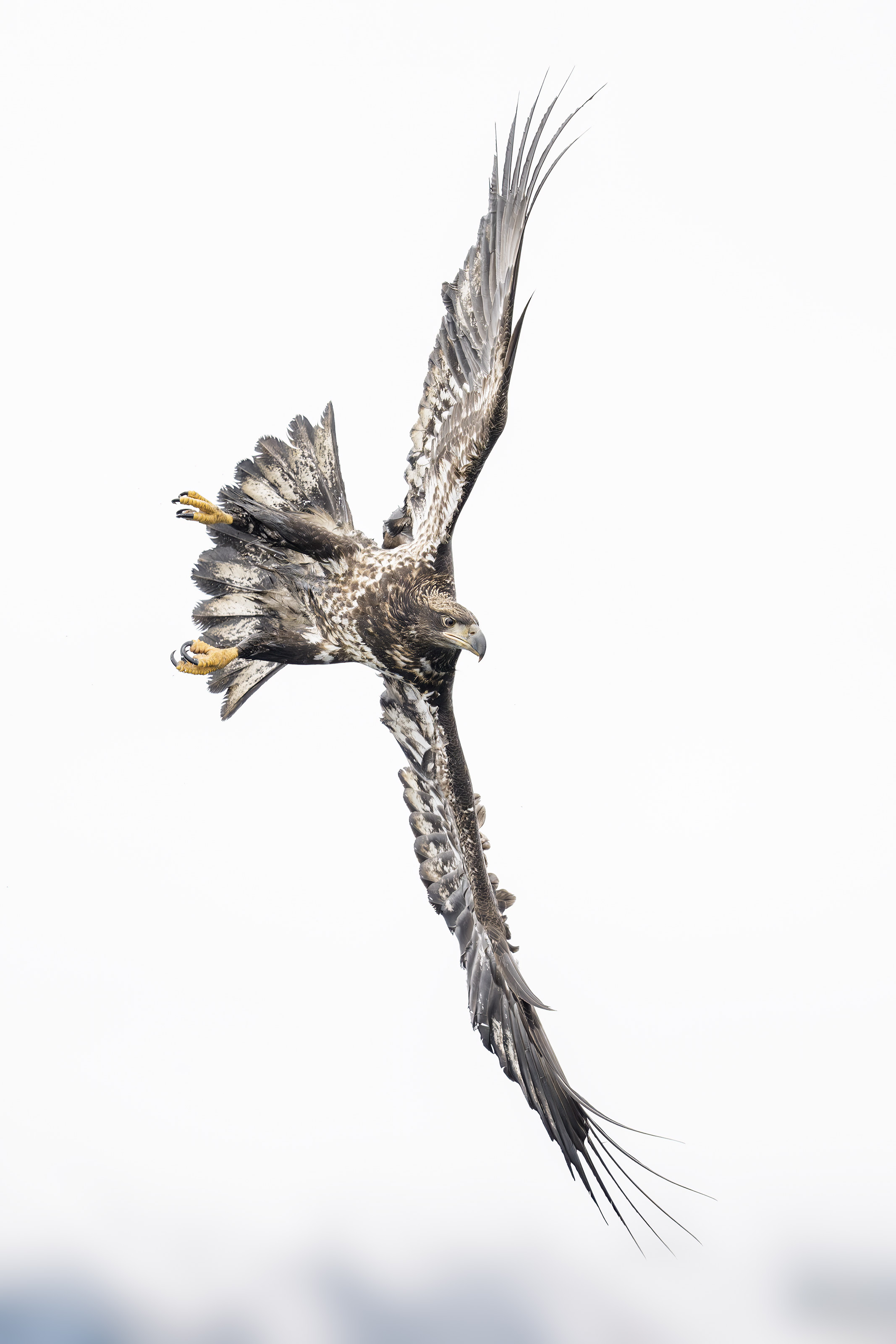
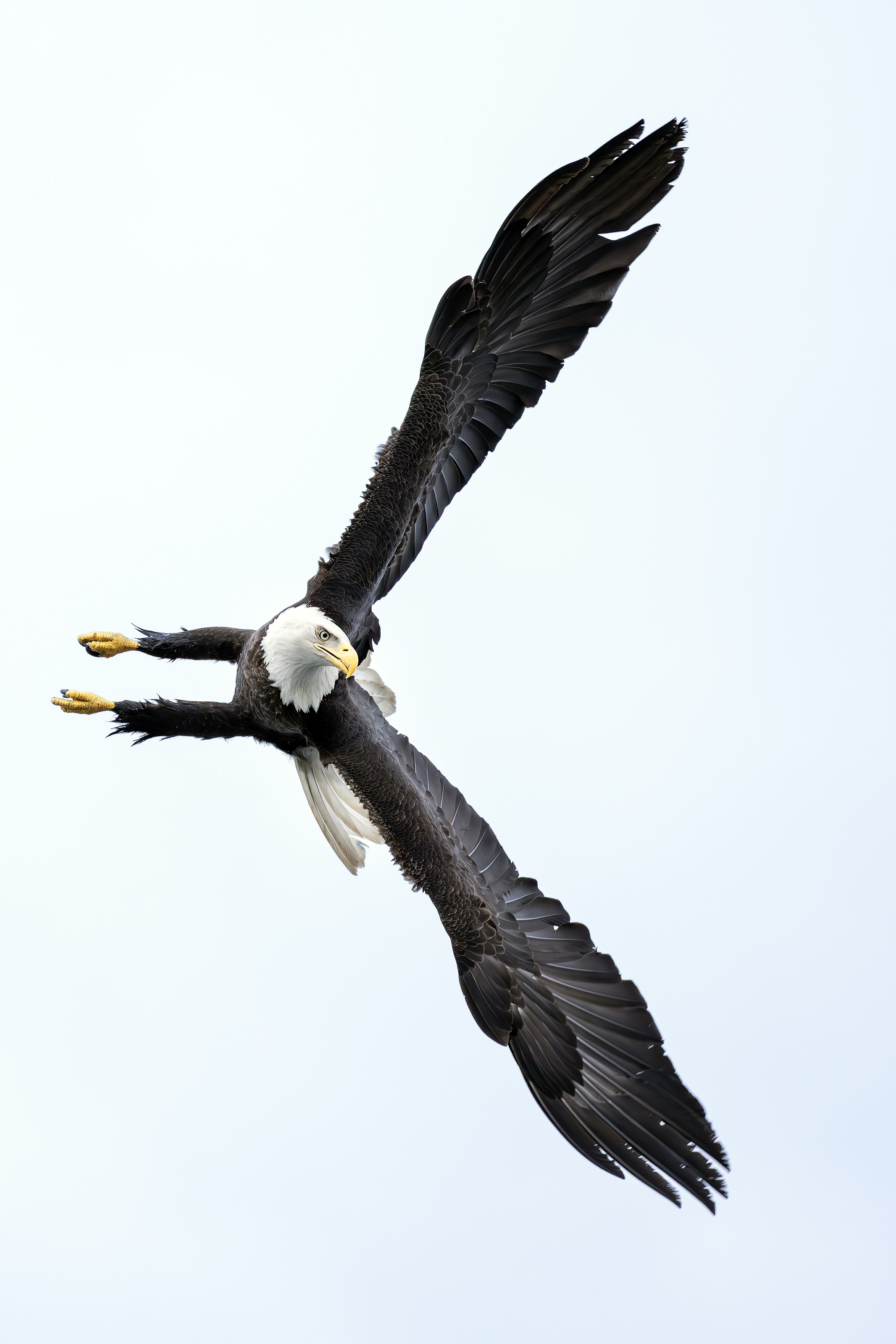
This image was created on 18 February 2026 by yours truly at Kachemak Bay, Homer, AK on the second 2026 Homer IPT. Standing on the deck of our work (eagle) boat, I used the handheld Sony FE 300mm f/2.8 GM OSS Lens (Sony E) and The Latest Greatest Sony Flagship Body, the a1 II Mirrorless Camera. ISO 3200. The exposure was determined via Zebras with ISO on the Thumb Wheel; 1/2500 sec. at f/2.8 (wide open) in Manual mode. AWB at 3:36:54pm on a cloudy afternoon. Wide/AF-C with Bird Eye/Face Detection enabled performed perfectly. Image #2: Bald Eagle juvenile banking flight |
Adjusting the Exposure for the Tonality of the Subject
When a juvenile eagle approaches, I yell out, “Add 1/3-stop of light.” Why? Though the younger eagles have some white feathers admixed in their plumage they do not have the gleaming white heads of the adults. Thus, they need a bit more light to be properly exposed. This is also a crop from a horizontal original. It is much easier to hold the camera horizontally when shooting flight than it is to rotate the camera to vertical.
|
|
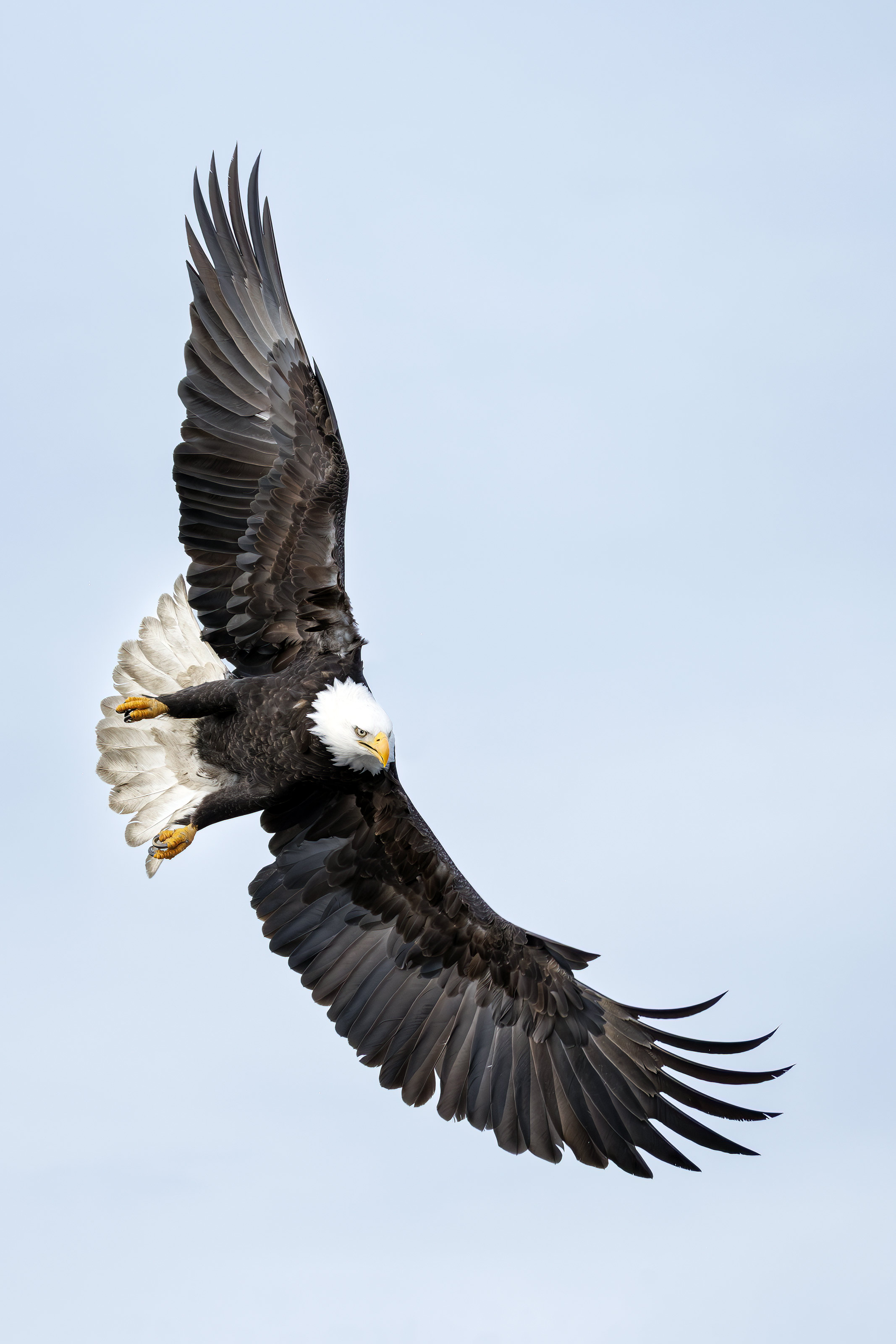
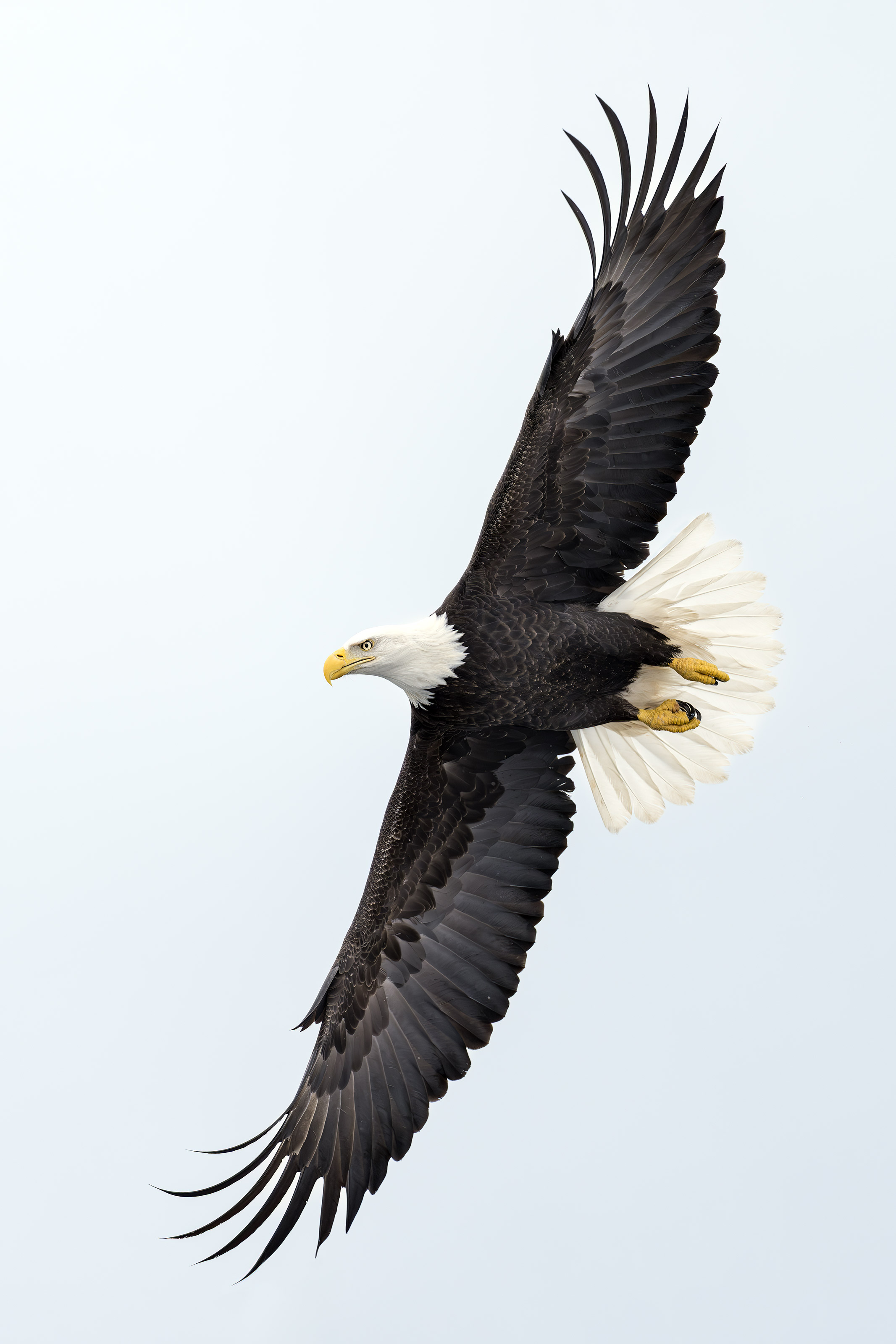
This image was also created on 18 February 2026. This one by multiple IPT participant and good friend Mishael Voisin on the first day of the second 2026 Homer IPT. Standing on the deck of our work (eagle) boat, he used the handheld Canon RF 200-800mm f/6.3-9 IS USM Lens (Canon RF) and the Canon EOS R1 Mirrorless Camera. ISO 3200. 1/2000 sec. at f/9 (wide open!) in Manual mode. AWB at 3:36:54pm on a cloudy afternoon. Wide/AF-C with Bird Eye/Face Detection enabled performed perfectly. Image #3: Bald Eagle adult banking flight |
The Lens I Love to Hate
Though light in weight and relatively inexpensive, I am not a fan of the Canon RF 200-800. Why? The zoom mechanism is poor at best. The lens changes length as you zoom, the zooming in or out is quite stiff, and getting from 200 to 800 requires several twists of the wrist. Compared to the Sony 400-800mm, I can only describe the 200-800 as an abomination, As Mishael is both young and totally in love with bird photography I am on him often about selling his boatload of Canon lenses and bodies and going all in on Sony. He is almost there and the deciding factor might be the all around smaller and lighter Sony stuff. He knows full well that using Sony and getting the right exposure is simpler and easier than with Canon.
That said, he has produced a very fine image here. He was happy to do so with a lens that I love to hate.
|
|
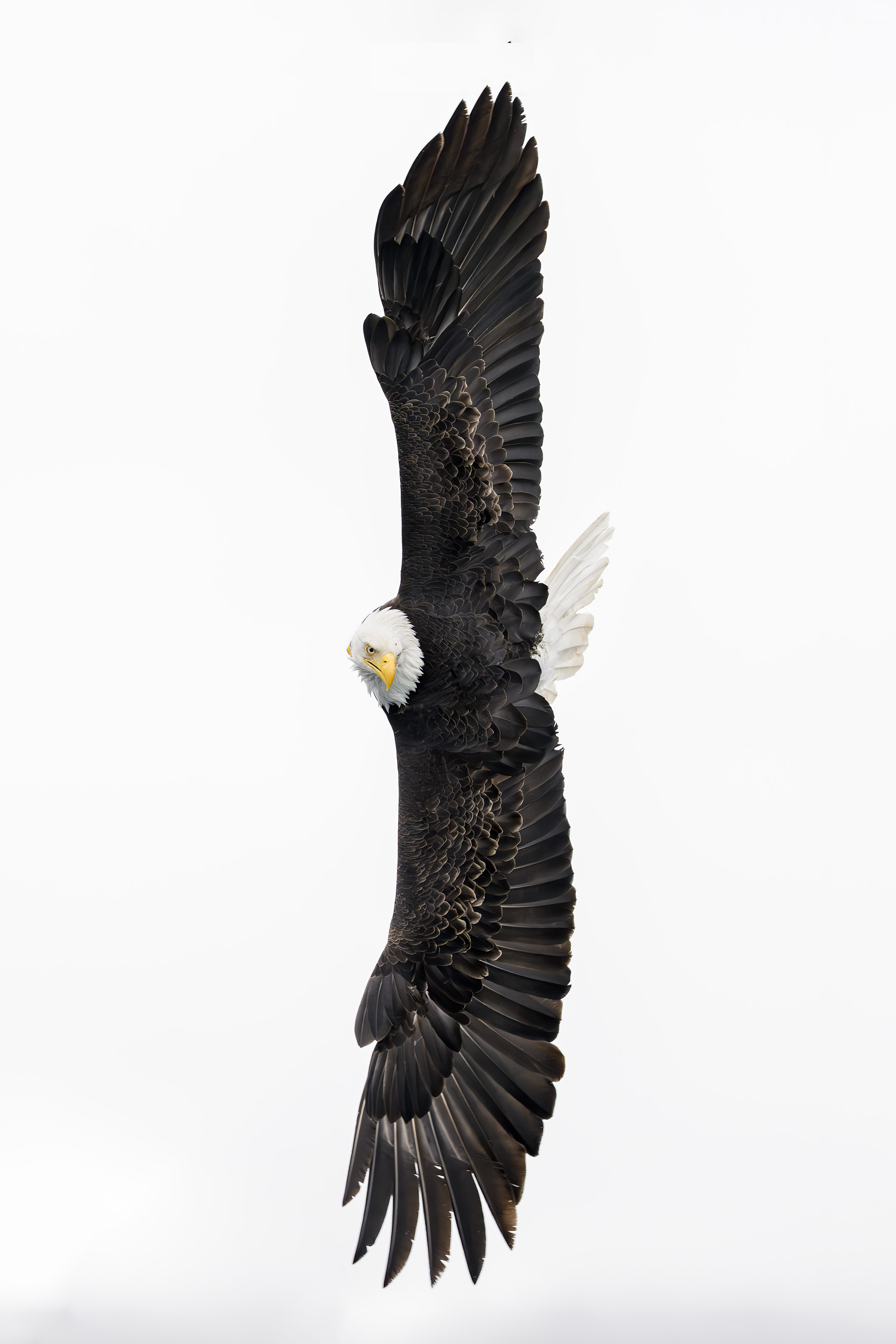
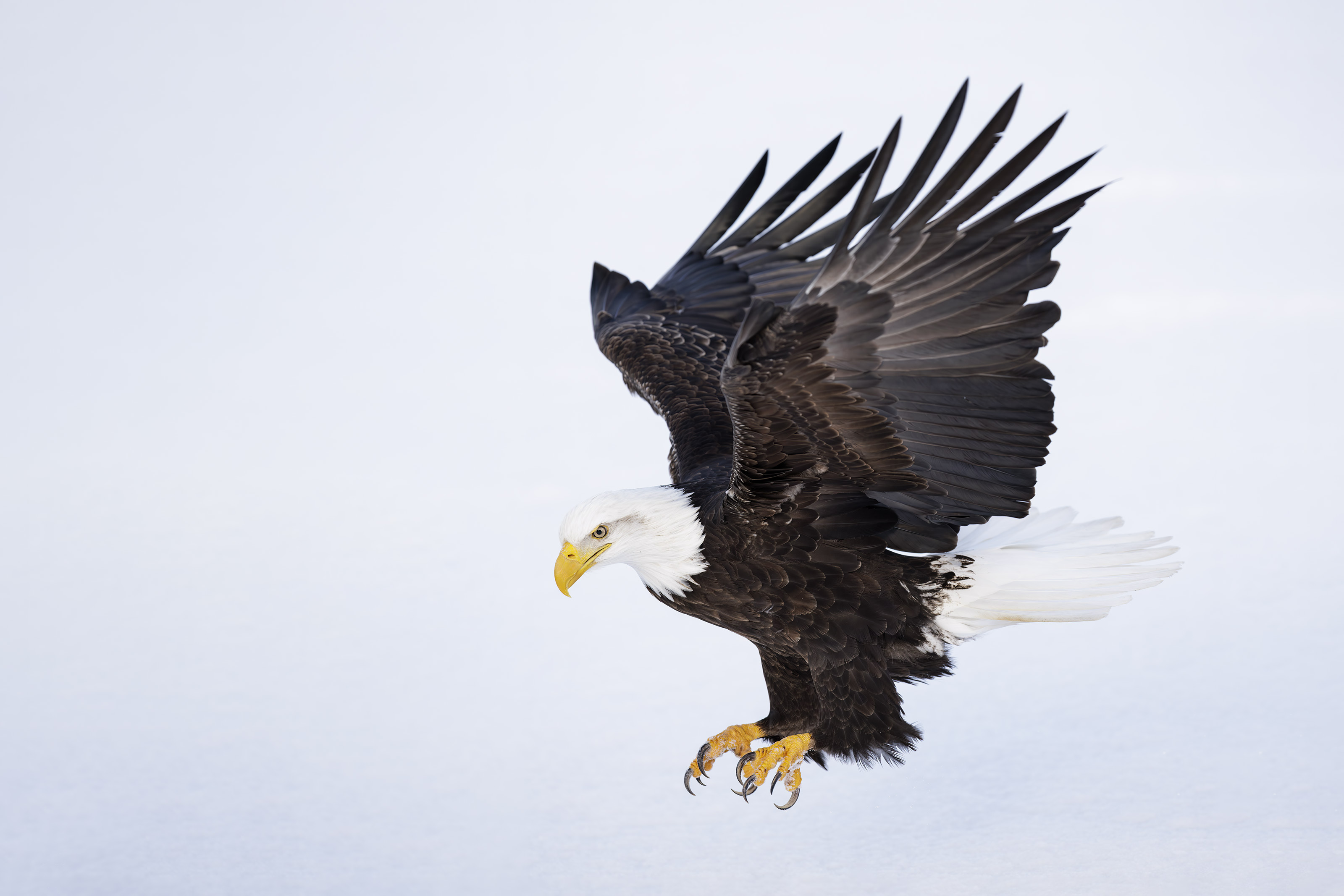
This image was created on 18 February 2026 by yours truly at Kachemak Bay, Homer, AK on the second 2026 Homer IPT. Standing on the deck of our work (eagle) boat, I used the handheld Sony FE 300mm f/2.8 GM OSS Lens (Sony E) and The Latest Greatest Sony Flagship Body, the a1 II Mirrorless Camera. ISO 3200. The exposure was determined via Zebras with ISO on the Thumb Wheel; 1/3200 sec. at f/2.8 (wide open) in Manual mode. AWB at 3:35:51pm on a cloudy afternoon. Wide/AF-C with Bird Eye/Face Detection enabled performed perfectly. Image #4: Bald Eagle vertical bank |
Two Primary Tips Added
I almost fit this handsome eagle into the frame but clipped the tips of the two longest primary feathers in this otherwise spectacular horizontal image. I painted a Quick Mask of the third longest primary feather and used it to repair both clipped feathers. When you start clipping wingtips while working horizontally the birds are telling you that it is time to begun holding the camera on end and trying to create some vertical originals. So when the banking birds are too close, that is exactly what I try to do.
|
|
This image was also created on 18 February 2026 by yours truly at Kachemak Bay, Homer, AK on the second 2026 Homer IPT. Standing on the deck of our work (eagle) boat, I used the handheld Sony FE 300mm f/2.8 GM OSS Lens (Sony E) and The Latest Greatest Sony Flagship Body, the a1 II Mirrorless Camera. ISO 1250. The exposure was determined via Zebras with ISO on the Thumb Wheel; 1/4000 sec. at f/2.8 (wide open) in Manual mode. AWB at 1:56:13pm on a cloudy afternoon. Center Tracking: Zone/AF-C with Bird Eye/Face Detection enabled performed perfectly. Image #5: Bald Eagle vertical banking flight |
A Rare Vertical Original
When the birds are banking too close to the boat, usually on days with high winds, I will try to create some vertical originals. The first thing that I do is turn the camera on end by rotating it 90° so that my right hand is on top. This is a lot easier to do when you are using a vertical grip but I quit using them years ago to save weight. Next, I switch from Wide AF to center Tracking: Zone and get to work. It is a challenging endeavor but with far more pixels on the subject it is well worth the effort.
Thanks to George Foo
During our long image review/Photoshop session on Thursday when the wind and waves prevented us from getting out, first timer George Foo asked a question about white skies. That led to my coming up with a new ACR masking technique that enabled me to slightly darken and add a touch of blue to a white sky without making it either obvious or overdone (i.e., somewhat nauseating).
|
|
This image was created on 14 February by multiple Homer IPT veteran Chris Loffredo on the first 2026 Homer IPT. Standing on a snow-covered beach in China Poot, he used the handheld Sony FE 70-200mm f/2.8 GM OSS II Lens (at 200mm) and the Latest Greatest Sony Flagship Body, the a1 II Mirrorless Camera. The exposure determined via Zebras with ISO on the Thumb Wheel. ISO 3200: 1/4000 sec. at f/2.8 (wide open) in Manual mode. AWB at 11:04:05am on a cloudy morning. Wide/AF-C with Bird Eye/Face Detection enabled worked just fine. Click on the image to enjoy the larger, inexplicably sharper high-res version. Image #6: Bald Eagle vertical bank from a horizontal original |
The Case for the Sony 70-200 II in Homer
The fact is that you could actually do an entire Homer IPT with the latest version of the 70-200 and both teleconverters. In fact, Adrian Whitchelo-Scott is doing just that. For those who own the 300mm f/2.8, the smaller, lighter 70-200 is much easier to handhold and thus, getting and staying on banking, turning, twisting, diving eagles is that much easier as well. And with the long, non-stop flight action, sessions, your shoulder and back muscles will appreciate the time that you spend with the 70-200.
|
|
This image was created on 14 February by multiple IPT veteran and great friend Kevin Hice on the first 2026 Homer IPT. Standing on a snow-covered beach in China Poot, he used the handheld Sony FE 300mm f/2.8 GM OSS Lens (Sony E) and The Latest Greatest Sony Flagship Body, the a1 II Mirrorless Camera. ISO 2000. The exposure was determined via Zebras with ISO on the Thumb Wheel; 1/3200 sec. at f/2.8 (wide open) in Manual mode. AWB at 2:17:01pm on a cloudy afternoon. Wide/AF-C with Bird Eye/Face Detection enabled performed perfectly. Image #7: Bald Eagle juvenile banking flight |
Yet Another Canon Defector
defector — [dih-fek-ter]/dɪˈfɛk tər. NOUN: a person who defects from a cause, country, alliance, camera system, etc.
The list of folks whom I know about who switched from Canon or Nikon to Sony for bird photography is a long one. And there are dozens or more like 100s more photographers who were influenced my me to jump ship. Kevin Hice is a skilled bird photographer who had been using Canon gear for 15 years. In San Diego, I loaned him my 300mm f/2.8 GM lens and an a-1 ii. After tracking a few pelicans in flight for probably less than a minute, he said, “This is better. I am switching to Sony.” In short order he sold all of his Canon gear including the RF 600mm f/4 and the RF RF 400mm f/2.8 and arrived in Alaska two weeks later with the Sony 600mm f/4 GM, the 300mm f/2.8 GM, both TCs, and an a- ii. He began making great images on 0.3 seconds.
In addition to having the best AF system in the world for birds in flight, the Sony gear is smaller and lighter than the comparable Canon or Nikon gear. And Zebra technology makes it easy for even beginning photographers to get the right exposure every time as long as their camera bodies are set up properly. With pre-capture, improved ergonomics as compared to the original a-1, and an articulating rear screen that allows me to work vertically, the a-1 ii is the best camera in the world for serious bird photographers. Period.
|
|
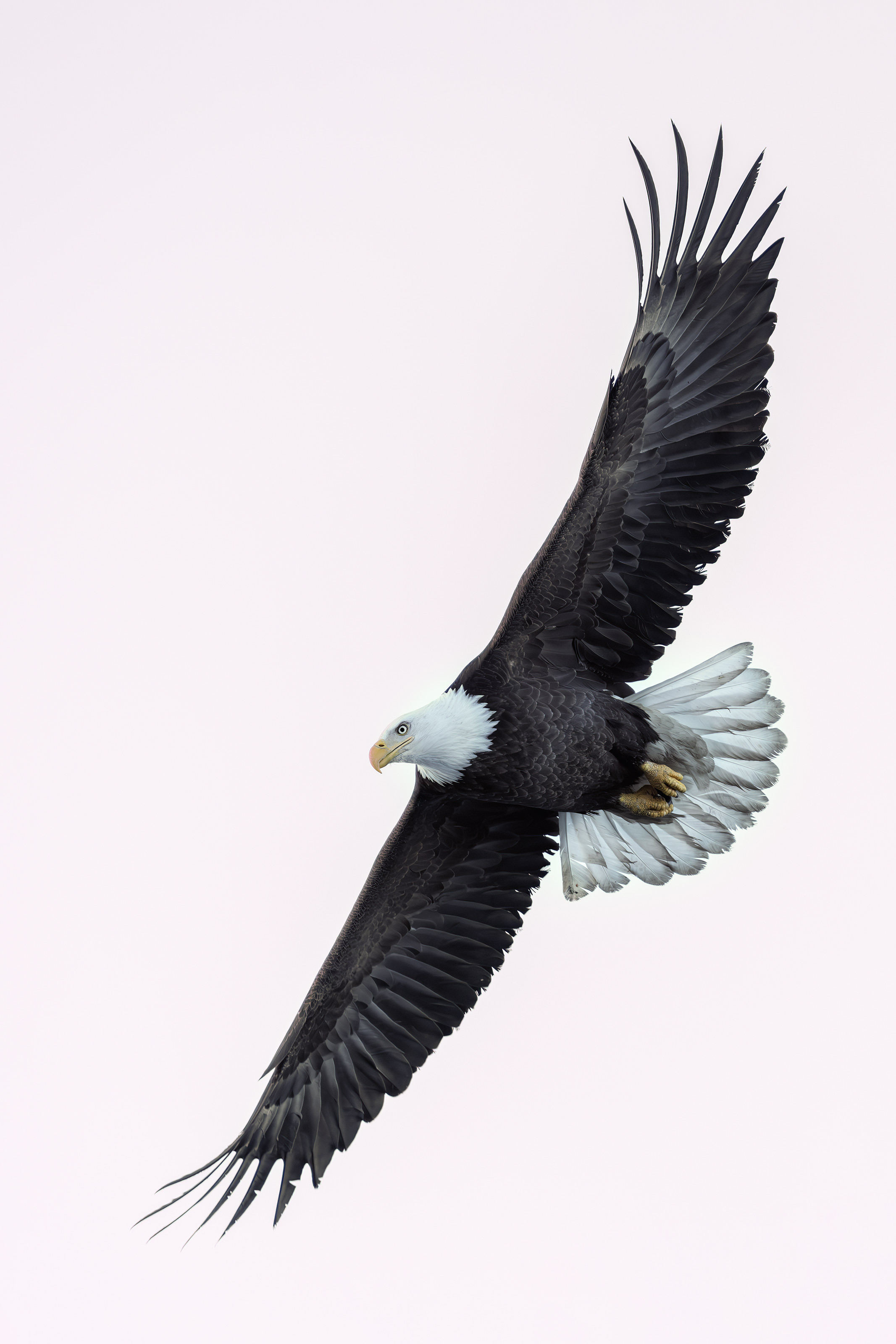
This image was created on 13 February by multiple IPT veteran and great friend Brian (“The Mailman”) Bower on the first 2026 Homer IPT. Standing on a snow-covered beach in China Poot, he used the handheld Canon EF300mm f/2.8L IS II USM lens (no longer in production) and the Canon EOS R5 Mark II Mirrorless Camera (with the Canon Mount Adapter EF-EOS R). ISO 3200. The exposure was determined via Zebras with ISO on the Thumb Wheel; 1/3200 sec. at f/4 (stopped down one stop in error)) in Manual mode. AWB at 11:31:10am on a cloudy morning. Image #8: Bald Eagle adult on the hunt from a vertical original! |
A Rare Occasion!
Creating a stunning horizontal image from a vertical is something that I have never done before. Brian was shooting verticals when he made this image and barely fit the bird in the frame with a half inch to spare both front and back. Cropping to a horizontal and adding canvas took all of five seconds. The Canon EF300mm f/2.8L IS II USM lens weighs a preverbal ton in comparison to the Sony 300mm f/2.8 GM lens but Brian is big and strong and can handle the weight.
|
|
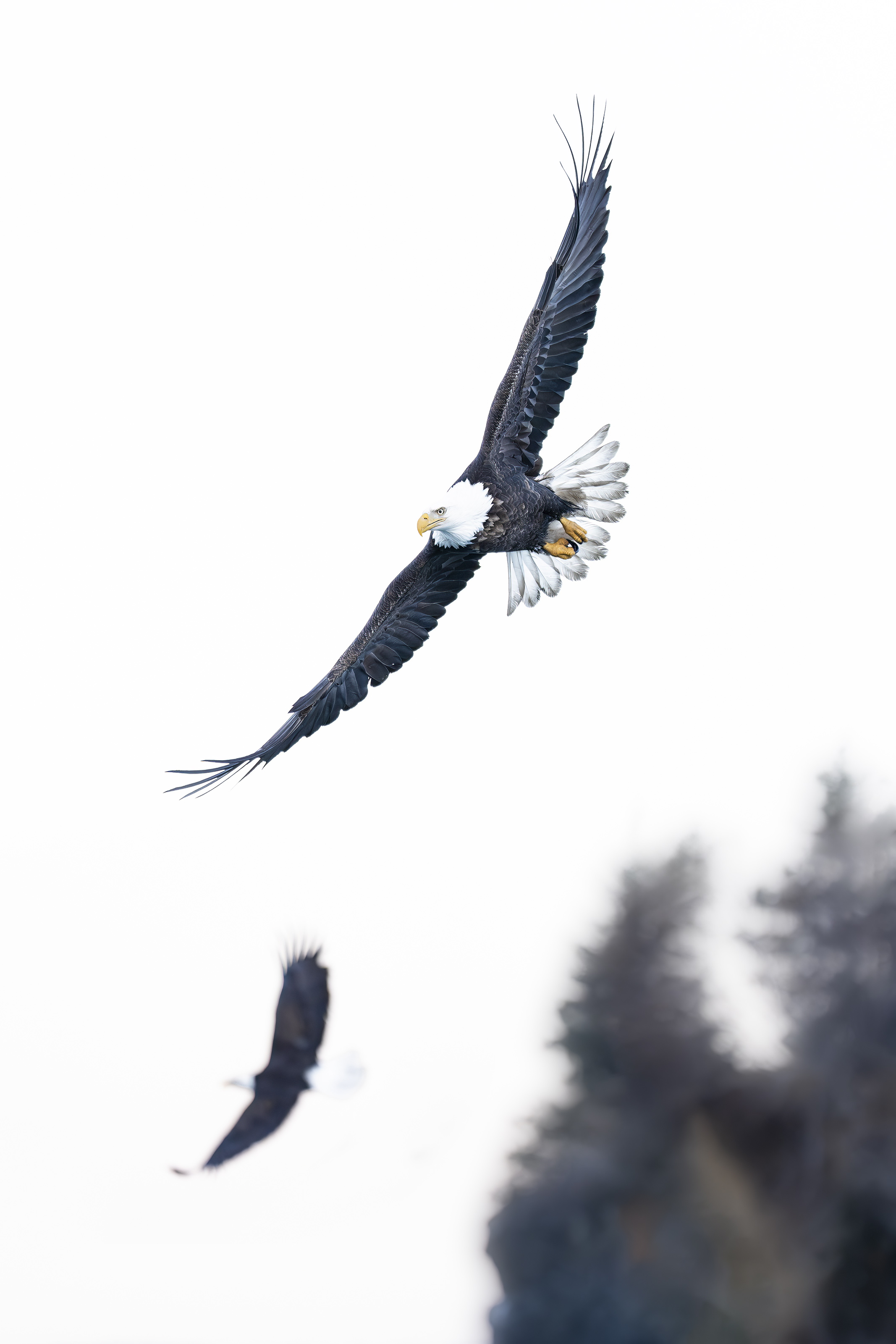
This image was created on 19 February by multiple IPT veteran and great friend Robert (“Bear Bob”) Sabin on the second 2026 Homer IPT — Bob always does both trips). Standing on the deck of our work (eagle) boat, he used the handheld EF 70-200mm f/4L IS USM lens (also no longer in production) at 192mm and the Canon EOS R5 Mark II Mirrorless Camera (with the Canon Mount Adapter EF-EOS R). ISO 2500: 1/2000 sec. at f/4 (wide open) in Manual mode. AWB at 8:13:10am in the shade on a clear morning. Image #8A: Bald Eagle adult banking flight from a horizontal original |
First Boat Out on Clear Mornings
On clear mornings it is imperative to get out very early so that you can work the birds in the shade of the low mountains to the east and in addition, enjoy a bit of pink sky photography.
Bear Bob on His Own Planet
I have know Bob for about 30 years. He has always been on his own planet. He is a brilliant man who has dozens of medical patents. He is a dear, sweet man with an endearing smile. He grows roses and makes award-winning images of them with his cell phone. His computer and post processing skills are nil. Despite my efforts over the years, he is barely able to find and view his images on a laptop computer. He keeps all of his images on memory cards.
He has attended both Homer IPT for several years running. His main lens before this year has been the 100-500 in spite of the fact that much of our eagle photography is done at point blank range in low light. Until this year, he has stubbornly insisted on using Aperture Priority with AUTO ISO. With the dark and light backgrounds that we encounter regularly that makes it virtually impossible to come up with consistently acceptable exposures. When he gets the occasional right exposure in Aperture Priority, it is strictly a matter of luck.
This year he showed up with the an Canon EF 70-200mm f/4L IS USM lens. A lifetime ago, I owned, used, and loved that lens. Anyhoo, for the past few days he has — at my urging — begun using the 70-200 and working in Manual (exposure) mode. Hooray for Bob!
|
|
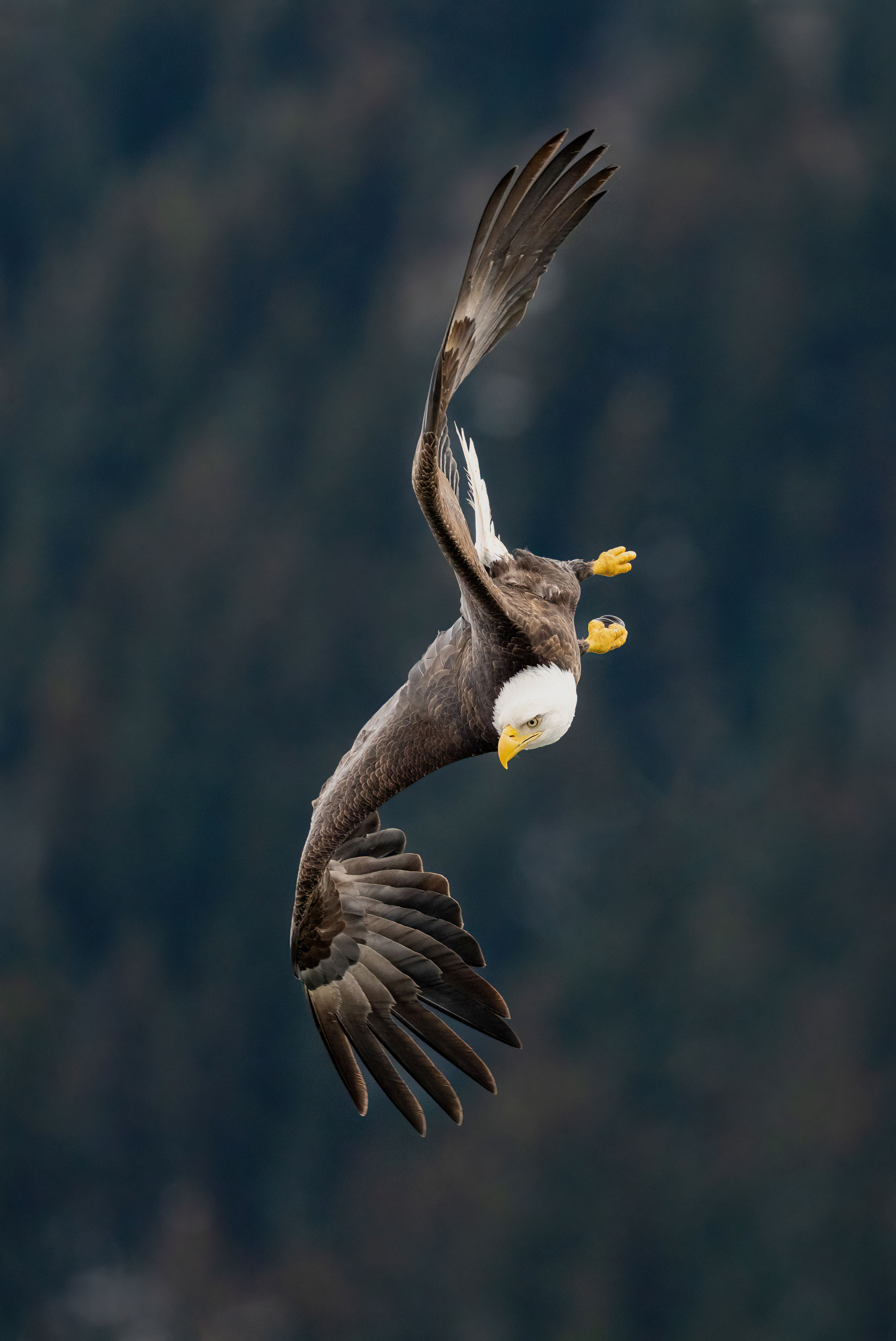
This image was created on 20 February by 2025 San Diego IPT veteran and good friend Adrian Whitchelo-Scott on the second 2026 Homer IPT. Standing on the deck of our work (eagle) boat, he used the handheld Sony FE 70-200mm f/2.8 GM OSS II Lens (at 167mm) and the Latest Greatest Sony Flagship Body, the a1 II Mirrorless Camera. The exposure determined via Zebras with ISO on the Thumb Wheel. ISO 5000: 1/2500 sec. at f/2.8 (wide open) in Manual mode. AWB at 8:49:37am in the shade on what would become a bright sunny morning. Wide/AF-C with Bird Eye/Face Detection enabled worked just fine. Click on the image to enjoy the larger, inexplicably sharper high-res version. Image #9: Dual Bald Eagle-scape |
Going Wide for Bird-scapes
With only the 70-200 II and a 1.4X TC, Adrian often creates some lovely bird-scapes that are not available to those of us using a 300mm f/2.8 lens. He is currently saving for one of those. Adrian is another dear, sweet, pleasant, soft-spoken man. He is a Brit and has been fighting leukemia for many years. Before the Homer trip he received a double-dose of immune system-boosting medication and has been doing great. Twenty years ago he lost his wife and son to a preventable tragedy. He makes a living as a psychologist and a board certified therapist. He writes, “Thankfully, I have a wonderful daughter who has given me a granddaughter and a grandson.”
|
|
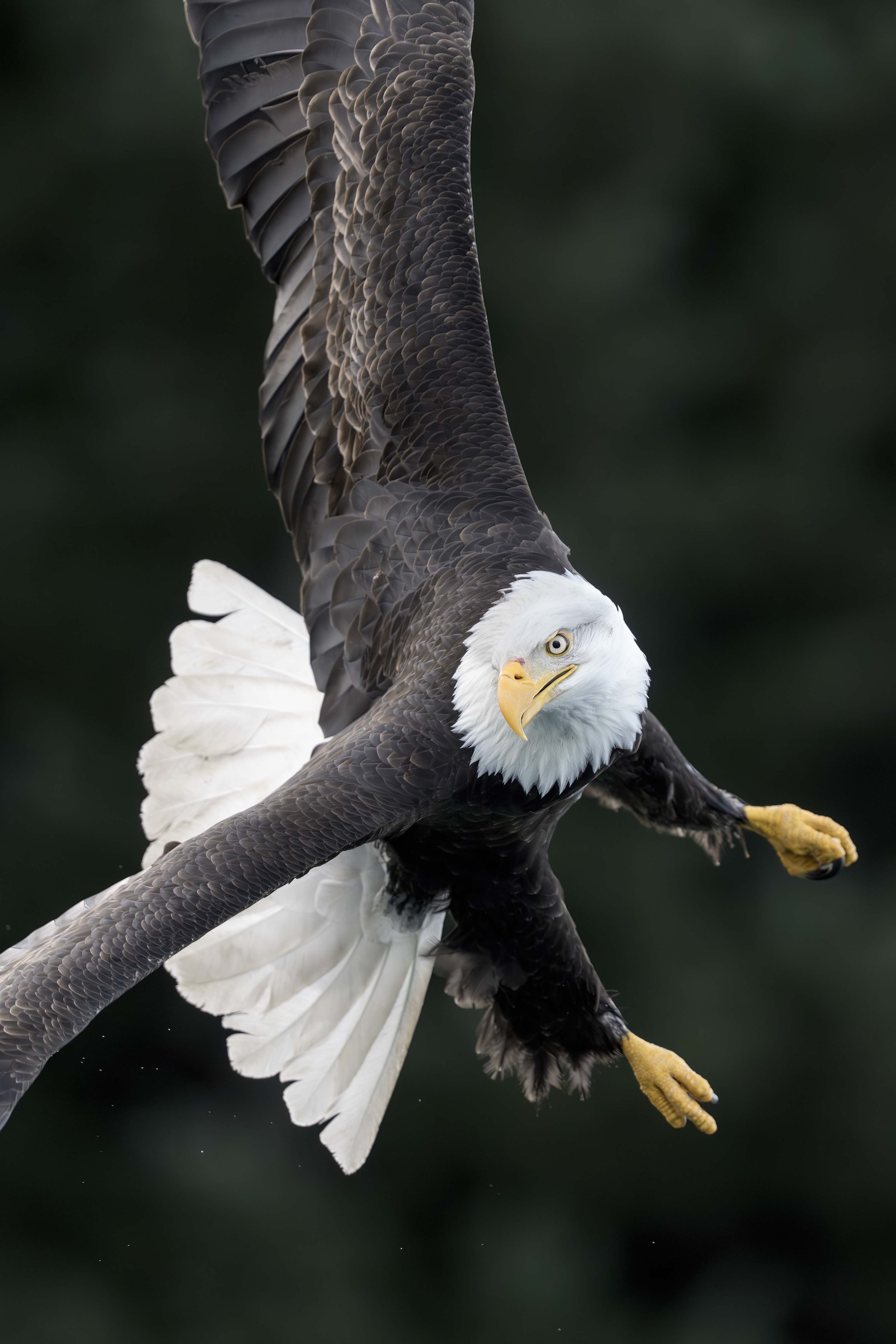
This image was created on 18 February by first timer George Foo on the second 2026 Homer IPT. Standing on the deck of our work (eagle) boat, he used the handheld Sony FE 300mm f/2.8 GM OSS Lens (Sony E) and The Latest Greatest Sony Flagship Body, the a1 II Mirrorless Camera. ISO 800. The exposure was determined via Zebras with ISO on the Thumb Wheel: 1/4000 sec. at f/2.8 (wide open) in Manual mode. AWB at 4:21:00pm on a cloudy afternoon. Wide/AF-C with Bird Eye/Face Detection enabled performed perfectly. Image #10: Bald Eagle juvenile banking flight |
Not a Terminally Intermdiate Photographer!
It first met George the night before the second Homer IPT began. It is his first IPT. He told me that he has taken many photographic trips and described himself as a “terminally intermediate photographer.” I told him that if he paid attention that he could easily become a highly skilled bird photographer. Image #7 shows that he has listened and is fully capable of making superb images. Though his post processing skills are excellent, he has picked up quite a few tips during our image optimization sessions.
|
|
This image was created on 16 February 2026 by yours truly at Kachemak Bay, Homer, AK on the first 2026 Homer IPT. Standing on the deck of our work (eagle) boat, I used the handheld Sony FE 300mm f/2.8 GM OSS Lens (Sony E) with the Sony FE 1.4x Teleconverter (at 420mm) with the Latest Greatest Sony Flagship Body, the a1 II Mirrorless Camera. The exposure determined via Zebras with ISO on the Thumb Wheel. ISO 3200: 1/3200 sec. at f/4 (wide open) in Manual mode. AWB at 3:14:05pm in the shade of a tall cliff on a sunny afternoon. Wide/AF-C with Bird Eye/Face Detection enabled performed perfectly. Click on the image to enjoy the larger, inexplicably sharper high-res version. Image #11: Bald Eagle adult high banking flight |
Going for the Gusto
In search of something different (as always), I added the 1.4X TC to the 300m f/2.8 GM lens to get to 420mm and try for some tight flight head portraits. I did not quite get all the way there but was thrilled with this one that was cropped from the sides from a horizontal original. As you will learn below, most but not all vertical banking flight shots are created from horizontally formatted raw files.
|
|
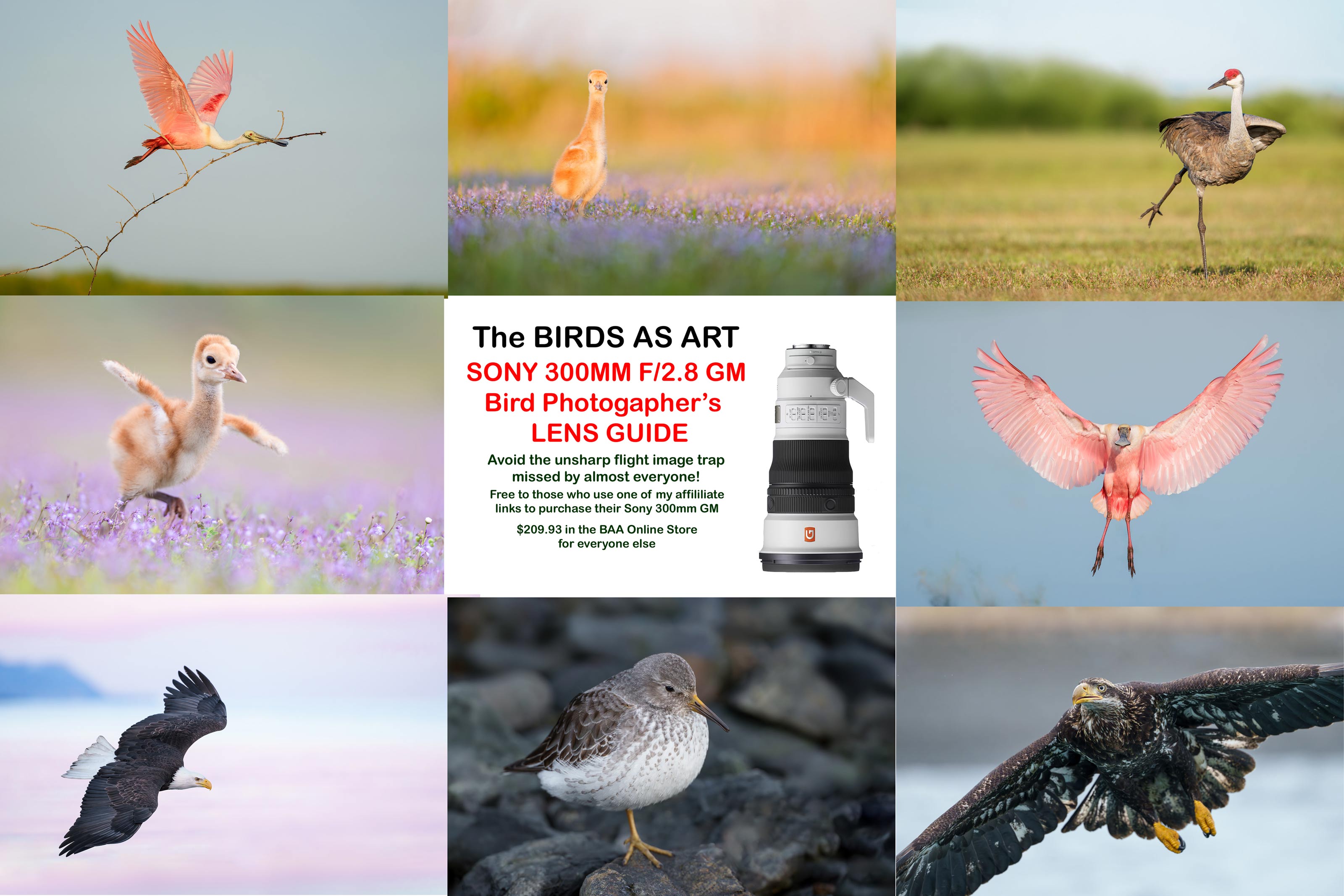
For those who did not use my link to purchase their Sony 300mm f/2.8 GM lens, you can order your a copy here for $209.93. Click on the image to enlarge and to be able to read the fine print. |
The BAA Sony 300mm f/2.8 Lens Guide
Impressed by my Sony FE 300mm f/2.8 GM OSS Lens (Sony E) images? Use either my Bedfords or B&H affiliate link to purchase your Sony 300mm f/2.8 GM lens and shoot me your receipt via e-mail and request a copy of the first-ever BAA Lens Guide. I thought that it would take only minutes to create this guide, but I was dead wrong. In the process of creating it, I learned a ton about the lens. And even better, I discovered a simple yet potentially fatal flaw that was resulting in sporadically unsharp flight images. The set-up fix is simple. Just be sure to use one of my affiliate links and get the guide for free.
If not, you can purchase a copy here for $209.93. Yes, it never hurts to use my links and it never costs you one penny more. And if you contact me via e-mail before you make a major purchase, I can often save you some money.
|
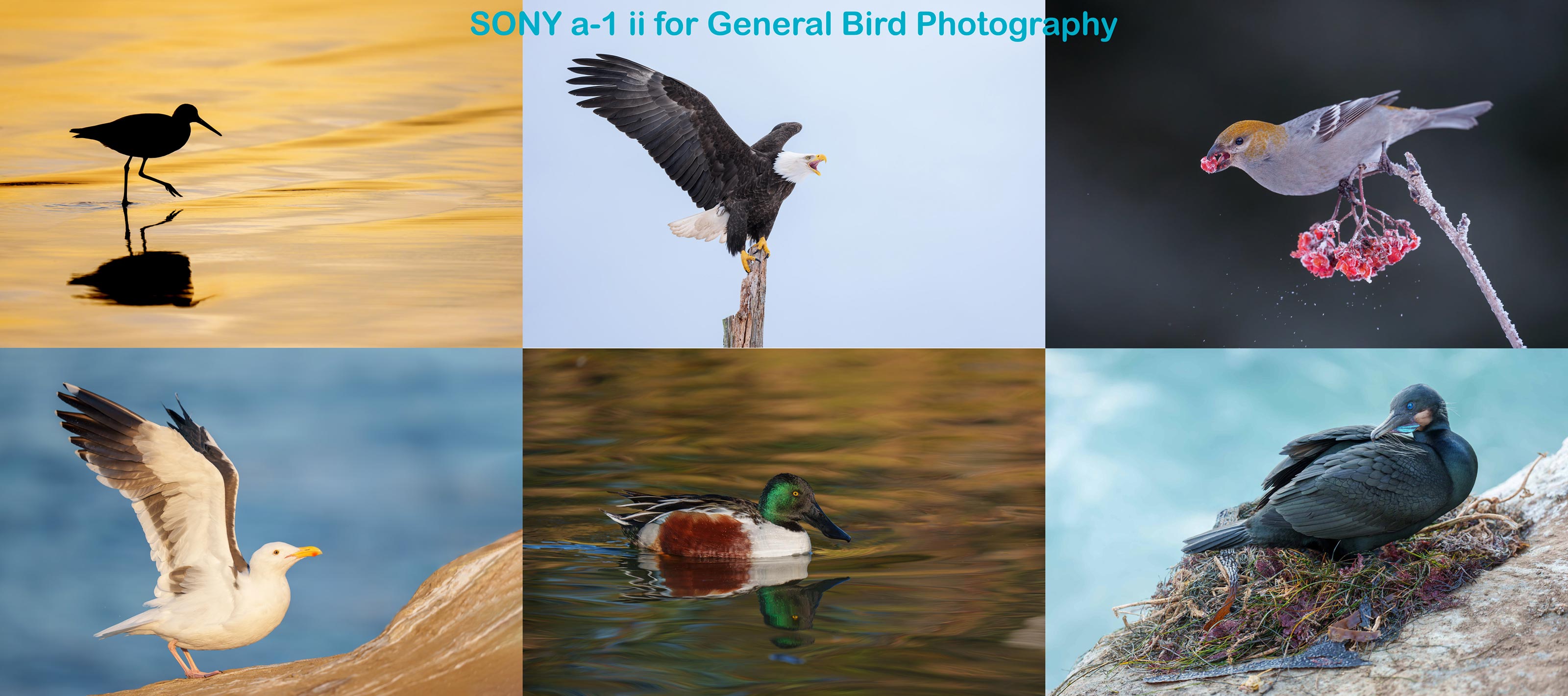
Composite #1: All with the a-1 ii Mirrorless Camera body.
|
The a-1 ii for General Bird Photography
I have found that eye-tracking for general bird photography with the a-1 ii is far, far better than with the original Sony a-1. It grabs the eye and tracks it faster and far more consistently and focus is rarely lost, even with backgrounds other than sky.
|
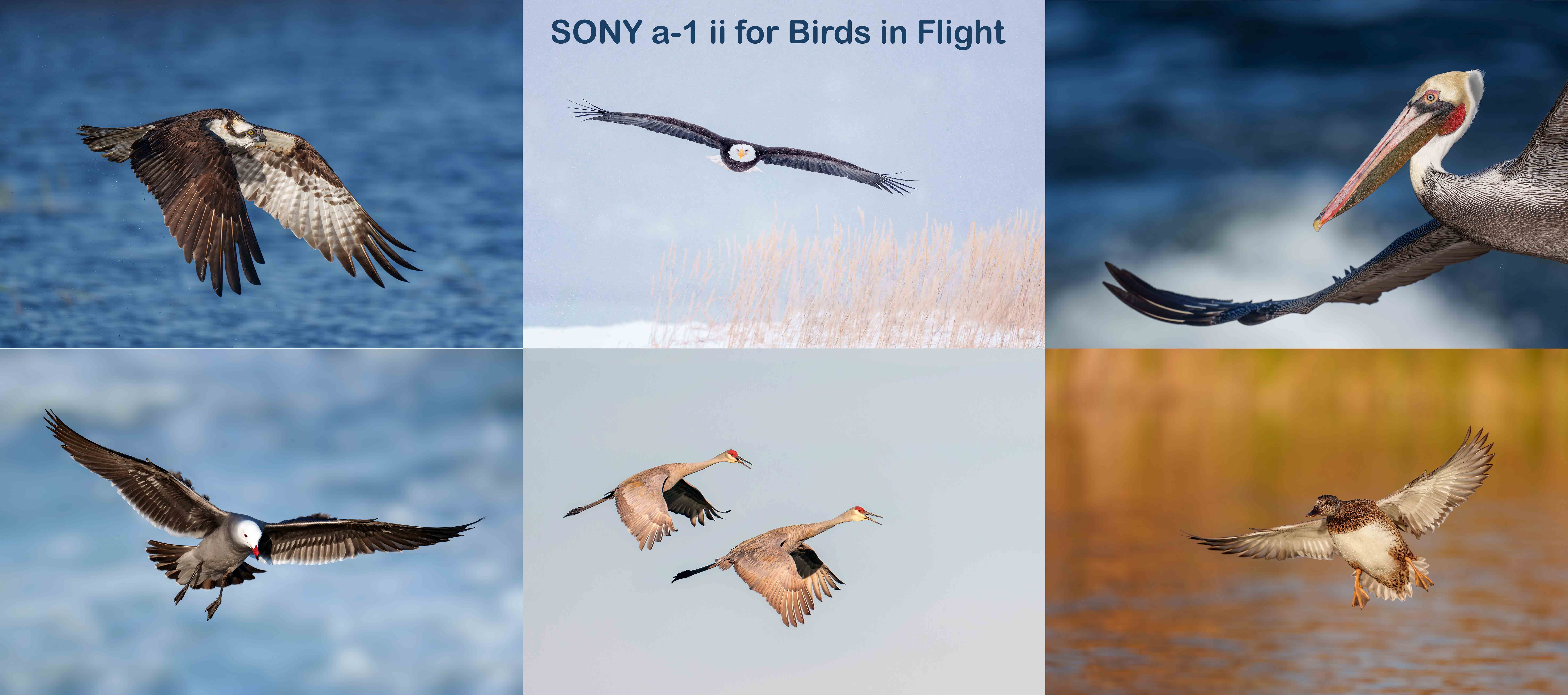
Composite #2: All with the a-1 ii Mirrorless Camera body.
|
The a-1 ii for Birds in Flight
For birds in flight, the a-1 ii Mirrorless Camera body has no equal. As Arash Hazeghi says, “It is better than the a-1.” When I am late getting on a bird in flight, I have consistently been amazed at how often the AF system of the a-1 ii finds and tracks the bird’s eye.
|
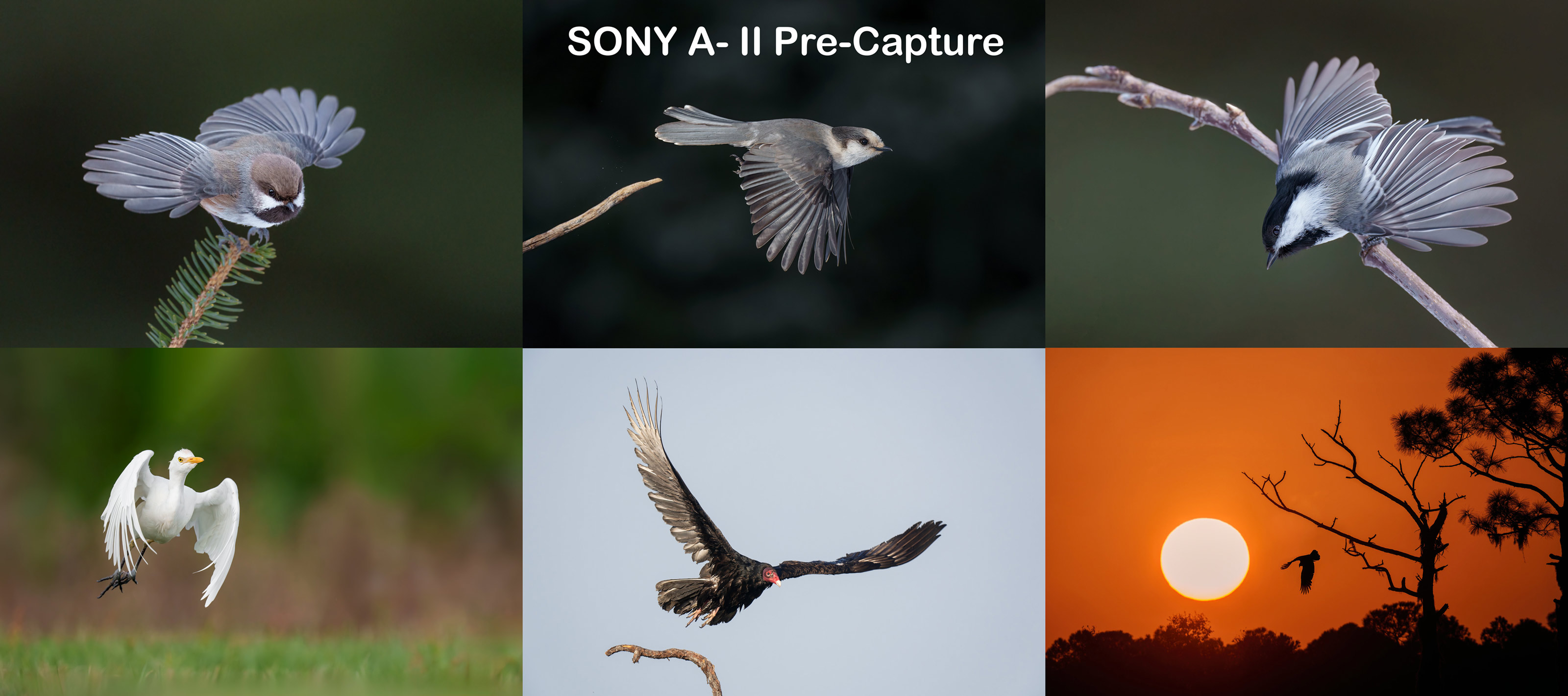
Composite #3: All the result of using Pre-Capture with the a-1 ii Mirrorless Camera body.
|
Pre-Capture with the Sony a-1 ii
When it comes to Pre-Capture with the a-1 ii Mirrorless Camera body, Arash and I agree 100%. And with my slower reflexes, Pre-Capture is more important for me than it is for Arash. Understand that in each of the images in Composite #3, I did not push the shutter button until after the bird took flight!
|
All with the a-1 ii Mirrorless Camera body.
|
Purchasing or Upgrading to a Sony a-1 ii
The Sony a-1 ii e-Mail Set-up and Info Guide
I now own and use two Sony a-1 ii bodies. Every day that I use them, the more I am amazed by speed and accuracy of the Bird Face-Eye tracking in AF-C and the overall performance of the camera.
Aside from the improved ergonomics as compared to the a-1, other nice features include the fact that the rear screen tilts both ways — the lack of a tilting rear screen on the original a-1 always ticked me off. Pre-capture has proven to be a huge plus almost exclusively for take-off flight images. In my opinion, the Speed Boost feature is a total waste for bird photography because you should always be utilizing the maximum frame rate. In addition, the resolution on the rear monitor has been improved dramatically. I must mention again that Bird Face-Eye tracking on the a-1 ii is vastly improved as compared to both the a-1 and the a9 iii and that the 51MP files are to die for.
So, the big question is, is the a-1 ii “worth” a gear upgrade. Remembering that I can never know whether or not something is worth it to you, I can say that I was not floored when first using my a-1 ii. The differences between the a-1 ii and the original a-1, seemed to be neither huge nor eye-opening. But over time, I have come to realize that I was 100% wrong. The huge difference between the new camera body and the a9 iii is, of course, the 51MP a-1 raw files (as compared to the 24MP files rendered by the a9 iii).
The price of a new a-1 is $5,898.00. The price of a new a-1 ii is $1,100.00 more: $6,998.00. As the a-1 ii is clearly far superior for bird photography to the original a-1, the choice for folks new to Sony or for those upgrading from lesser Sony camera bodies is an easy one. Prices for used a-1 bodies has not dropped drastically as I anticipated. At this point, a-1 folks who like showing flight and action and can afford an a-1 ii, are advised to purchase an a-1 ii. Please remember that life is short; we only get one ride on the merry-go-round.
If you do purchase an a-1 ii, be sure to use one of my two affiliate links so that you will receive my a-1 ii settings (in the form of a CAMSEa1ii.DAT file), the Buttons and Dials Guide, and an Info Sheet for free. Using my links will never cost you one penny and may actually save you some money. Folks who do not purchase their new a-i using my B&H link or from Bedfords here and entering the BIRDSASART discount code at checkout will be able to purchase the a-1 ii guide for $244.93. If you are at all confused and do not want to screw up your order, please get in touch via e-mail. If you would like to chat about upgrading, shoot me a text to 863-221-2372 and LMK a good time to call you.
Typos
With all blog posts, feel free to e-mail or to leave a comment regarding any typos or errors.







Awesome shots one and all. Love that so many are repeat IPTers and all are great friends with Artie. I’m jealous, but I certainly enjoy seeing all the terrific shots! Be safe one and all. Thanks for sharing.
You are welcome, Jeff. And thanks for your kind words. I agree –they are all pretty special.
with love, artie
#2 like the contrast against the white sky is my favorite. #5 like the composition and the way the white head and tail feathers help move my eye. #6 like the “v” shape of the wings and the head turn. You could also rotate 90 degrees counter clockwise and create a pano. Safe travels home.
Hey Jim,
Glad that you liked #2.I should have mentioned that one of the tricks to making good flight shots of the young eagle is that the head not merge with the body. Or else it gets lost in the brown feathers… I am quite proud of #5. And I love Chris’s image as well.
with love, artie
Man great blog! # 5 blue sky! and #11 in your face!
Thanks, Anthony. You should finally sign up for an IPT — this one is very special. ]
with love, artie
I prefer the more traditional images: $7, #8 and #3 which give a beautiful, detailed view of the whole bird.
Thanks, Pat. Though I checked, I wound up with two Image #8s 🙁 So I renamed the second one 8A.
with love, artie
I agree with Robert T.
#11is my favorite as well 🙂
with love, a
First choice is #11 – I like the tight headshot
Second choice is #10 – I think this picture has the best lighting of all of them, and the wing positioning is interesting
Third choice is #1 – I like the wing position with the view of the top f the wings
And I realize all my choices had a dark background
Thanks, Robert. The funny thing is that all three were made in the same location with the dark hemlock tree backgrounds.
with love, artie