
Canon EF 400mm f4 DO IS II USM Lens
William Dummitt is offering a Canon EF 400mm f4 DO IS II USM lens in excellent condition (pristine glass, minor cosmetic wear on the body) for a BIRDS AS ART record low by far $2499.00. The sale includes the lens, front and rear lens covers, the lens trunk (with key), and insured ground shipping via major courier to lower-48 US addresses only. Photos available upon request.
Please contact Bill via e-mail.
Featuring a unique optical design and paired with advanced image stabilization technologies, the Canon EF 400mm f/4 DO IS II USM is a super telephoto lens characterized by its relative light weight and compact form factor. Housed within a weather-resistant barrel, this lens features fluorine coatings on the front and rear elements for protection against fingerprints and other elements that might affect image quality. Canon
I owned, used, and loved this lens for many years when I was a Canon Explorer of Light (one of the original 55!). At 4.63 pounds and with its relatively small size (as mentioned above,) this lens is easily hand holdable for most folks. It performs superbly with a 1.4X TC. I made many memorable images with mine. Folks using Canon mirrorless gear can add one of the EF-R Adapters and expect superbly sharp results even with a 2X TC. A quick internet search for used copies of the 400 DO II found prices ranging from $3,698.35 to $3999.00! Get in touch with Bill and save a slew of dollars. artie
What’s Up?
It continues to amaze me that nearly every time I head down to the lake I find something magical to photograph. There was some beautiful sunset color on Sunday evening but there were no birds on any of the perches. I was sitting in my X5 near Bob’s V-perch talking to Kevin Hice on my cell phone. I glanced to my left just before the sun set and noticed that a Turkey Vulture had landed. An instant later, it was displaced by another. For three minutes it was sunset mayhem as more vultures flew in, fought over the perch, landed with raised wings, and jumped off the perch to take flight or drop down into the marsh (for some of the rotten fish I had put out that morning).
On Monday morning I had a few good chances with the flickers and with two small crane colts. It was looking good for sunset silhouettes on Monday evening when I headed down at 7:15pm. But a big cloud materialized on the western horizon and put the kibosh on that. On Sunday morning I found a Killdeer nest with three eggs in the North Field and David Pugsley and I roped it off with small stakes and yellow flags. So, I went to check out the nest only to learn that the eggs that were there the morning before were gone. I assumed that the nest had been predated when I heard the adult Killdeers yapping. I circled back a ways and quickly spotted both adults. Then I saw and photographed the three day-old chicks!
On Tuesday morning I had a few good chances with the male flicker at the nest stump and then worked a Red-shouldered Hawk on The Perch II. I headed north and was happy to see a pair of cranes with two very small but muddy chicks about 2-3 days old. The whole family was very accepting even after I got out of my SUV and onto the ground while handholding the bare 600. I butt crawled south to stay on sun angle as they foraged and eventually wound up inside the lens’s minimum focusing distance (MFD).
On Tuesday afternoon I headed down for sunset and never made a single image.
Even my shirtless vitamin D walk, however, have been interesting. On Monday afternoon, there was a Royal Tern — very rare inland, on the pier railing with the dozen or so Forster’s Terns. The next day as I headed out on the pier, I thought about pelicans. For no reason at all. I remembered have seen several young Brown Pelicans patrolling the lakeshore over the years — usually in the fall. I racked my brain trying to remember if I had ever seen any white pelicans over the lake. I thought that I had, but was not sure. Anyhoo, I looked up and what did I see right above me? Eight American White Pelicans riding a thermal and then disappearing into the puffy white clouds. I had never had a pelican premonition before.
I am flying to Houston Hobby on Friday morning for a spur of the moment 12-days-of bird photography trip to Texas. I will be visiting Corpus Christi, South Padre Island, the Ramirez Ranch in Roma, and then hooking up with Dennis Moncla who recently purchased my 400mm f/2.8 GM lens. We will be exploring the High Island Area. If you know anything about bird photography hotspots in Corpus Christi or have any other great tips please get in touch via e-mail or try me on my cell at 863-221-2372. Please leave a message and shoot me a text if I do not pick up.
Huge thanks to the many who responded to yesterday’s e-mail request for Texas bird photography help.
Today is Wednesday 15 April and I will be headed down to the lake early for a short session as I need to start packing for my Friday flight. Whatever you opt to do I hope that you too choose to have fun and enjoy life. Please remember that happiness is a choice — Byron Katie, The Work.Com
If an item — a Delkin flash card or reader, a Levered-clamp FlexShooter Pro, or a Wimberley lens plate or low foot — for example, that is available from B&H and/or Bedfords, is also available in the BAA Online Store, it would be great, and greatly appreciated, if you would opt to purchase from us. We will match or beat any price. Please remember also to use my B&H affiliate links or to earn 3% cash back at Bedford by using the BIRDSASART discount code at checkout for your major gear purchases. Doing either often earns you free guides and/or discounts. And always earns my great appreciation.
Gear Questions and Advice
Too many folks attending BAA IPTs and dozens of photographers whom I see in the field and on BirdPhotographer’s.Net, are — out of ignorance — using the wrong gear, especially when it comes to tripods and more especially, tripod heads. And the same is true in spades when ordering new camera bodies or lenses. My advice will often save you some serious money and may help you avoid making a seriously bad choice. Please know that I am always glad to answer your gear questions via e-mail. If you are desperate, you can try me on my cell at 863-221-2372. Please leave a message and shoot me a text if I do not pick up.

B&H Simplified
To ensure that I get credit for your B&H purchases, you can always click here. The tracking is invisible. Using my affiliate links is greatly appreciated. And, with B&H, you can use your PayBoo card. You must use the website to order. You cannot get your free guides if you make a phone order. Once you have an item in your cart, you must complete the order within two hours. Huge thanks!
B&H
Many folks have written recently stating that they purchased a Sony a1 from B&H and would like their free membership in the Sony 1 Info and Updates Group, a $150.00 value. But when I check my affiliate account, their orders have not been there. When I let them know that they get credit for B&H purchases only if they use one of the many B&H affiliate links on the blog or begin their searches with this link, they are always disappointed. If in doubt, please contact me via e-mail and request a BH link. I am always glad to help and to guide you to the right gear.

Bedfords Simplified
Click here to start your search. Choose standard shipping, and when you get to the payment page, enter BIRDSASART in the discount code box and hit apply. You will be upgraded to free second day air Fed-Ex and receive 3% cash back on your credit card once your stuff ships. Using either my affiliate links is greatly appreciated and will often earn you free guides or discounts. To receive a free guide or free entry into a Sony Set-up and Info Notes e-Mail group, you need to shoot me your receipt via e-mail. The B&H receipts need to include the order number.
Bedfords Amazing BAA Discount Policy
Folks who have fallen in love with Bedfords can always use the BIRDSASART coupon code at checkout to enjoy a post-purchase, 3% off-statement credit (excluding taxes and shipping charges) on orders paid with a credit card. The 3% credit will be refunded to the card you used for your purchase when your product ships. Be sure, also, to check the box for free shipping to enjoy free Second Day Air Fed-Ex. This offer does not apply to purchases of Classes, Gift Cards, or prior purchases.
You can visit the Bedfords website here, shoot Steve Elkins an e-mail, or text him on his cell phone at (479) 381-2592.
|
|
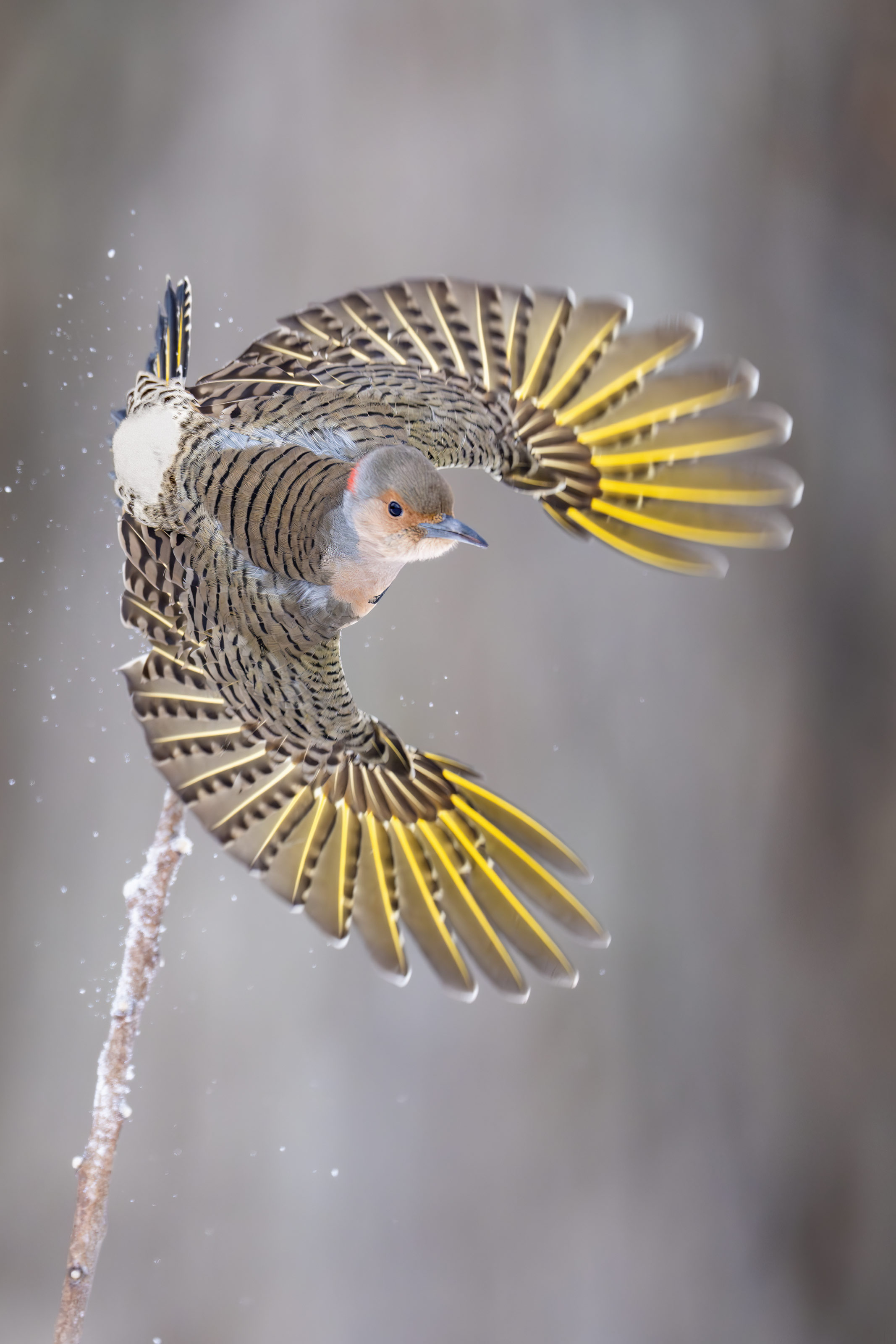
This image was created on 8 February 2026 by great friend and multiple IPT veteran Kevin Hice on his property at his new home in Indiana. FL. Seated in a homemade (heated !) blind, he used the Robus RC-5570 Vantage Series 3 Carbon Fiber Tripod/Levered-Clamp FlexShooter Pro-mounted Sony FE 600mm f/4 GM OSS lens and The Latest Greatest Sony Flagship Body, the a1 II Mirrorless Camera). The exposure was determined using Zebra technology with ISO on the Thumb Wheel. ISO 4000: 1/3200 second at f/4 (wide open) in Manual mode. RawDigger showed that the white uppertail coverts for this one were over-exposed. I did my best to tame them. AWB at 9:08:11am on a cloudy morning with snow on the ground. Wide/AF-C with Bird-Eye/Face Detection performed perfectly. Click on the image to enjoy the high-res version. Image #1: Northern Flicker leaping off perch |
Killer Image!
The first time that Kevin shared this image with me, I was blown away by the spectacular arced flight pose. It reminded me that Northern Flicker is indeed one of North America’s most beautiful birds. On the San Diego AirBnB Extended IPT this past January, I loaned my 300mm f/2.8 GM and an a- ii to Kevin. After raising the lens once and acquiring focus on a fly-by pelican, he said, “This is way better.” Within a week of getting home he sold all of his Canon gear and purchased the 300, the 600mm f/4GM, and an a-1 ii. He recently added the 200-600 and the 70-200mm f/2.8 GM II. He is now good to go.
|
|
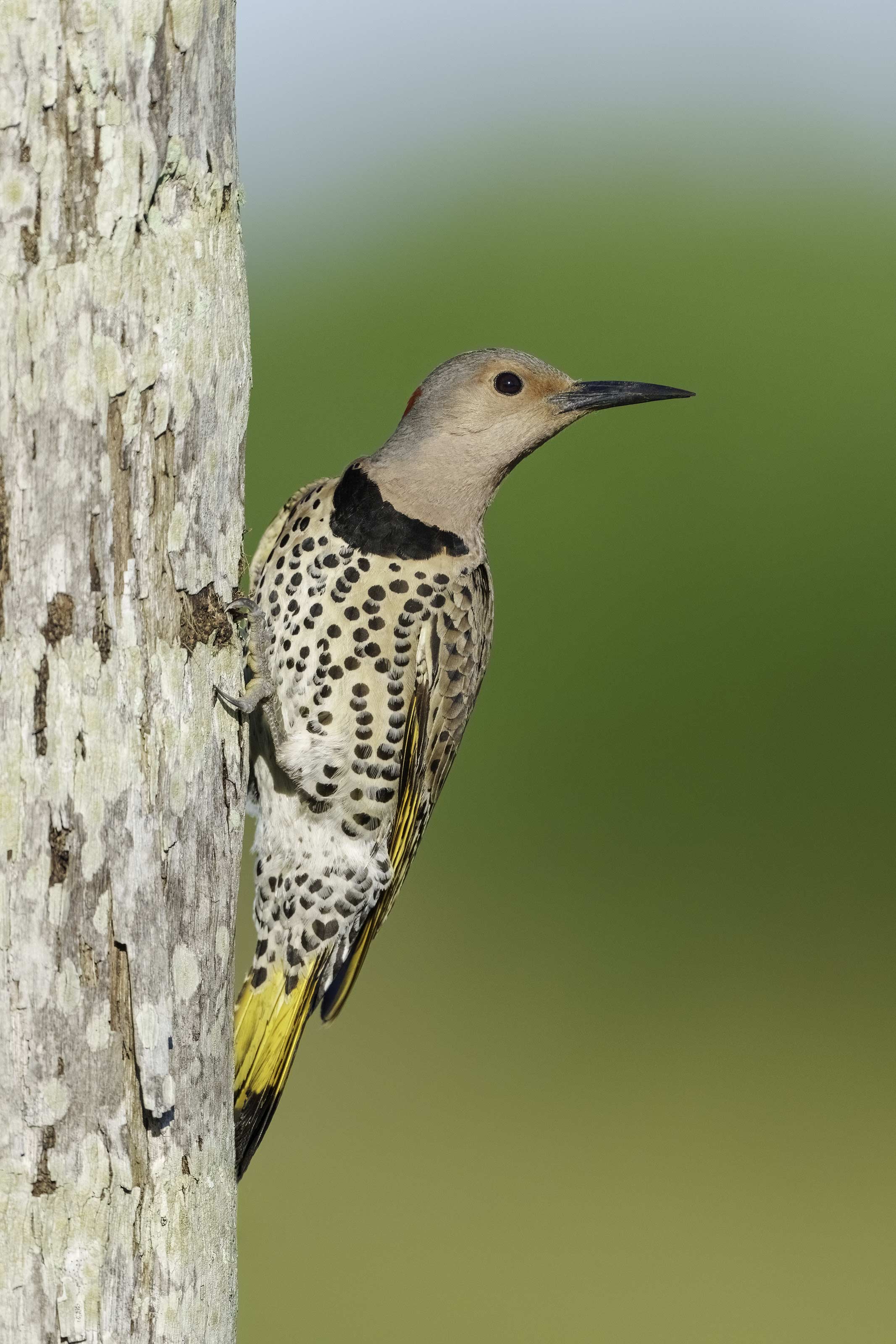
This image was created on 11 April 2026 by good friend David Pugsley at Indian Lake Estates, FL. Seated behind me in my SUV he used the BLUBB-supported Sony FE 600mm f/4 GM OSS lens with the Sony FE 1.4x Teleconverter, and the venerable Sony a-1 (now replaced by the Latest Greatest Sony Flagship Body, the a1 II Mirrorless Camera). The exposure was determined via Zebras with ISO on the rear dial. ISO 1000: 1/2500 sec. at f/5.6 (wide open). AWB at 8:29:45am on a sunny morning. Tracking: upper center Zone AF-C with Bird-Eye/Face Detection performed perfectly. Click on the image to enjoy the larger, inexplicably sharper and warmer high-res version. Image #2: Northern Flicker — female at nest tree |
Refurbished Housing
Regular readers know that I was excited in March when a pair of Red-bellied Woodpeckers were investigating two eye-level nest-holes in a six foot tall Cabbage Palm stump just a few feet from the road and right down morning sun angle!. That never panned out as the birds eventually selected another nest site. Last week I noticed that the lower of the two cavities had being enlarged. So, paying a bit more attention, I noticed a pair of flickers hanging around. With David in the backseat on Friday morning, we had our first good chances and paid them off with several nice images.
|
|
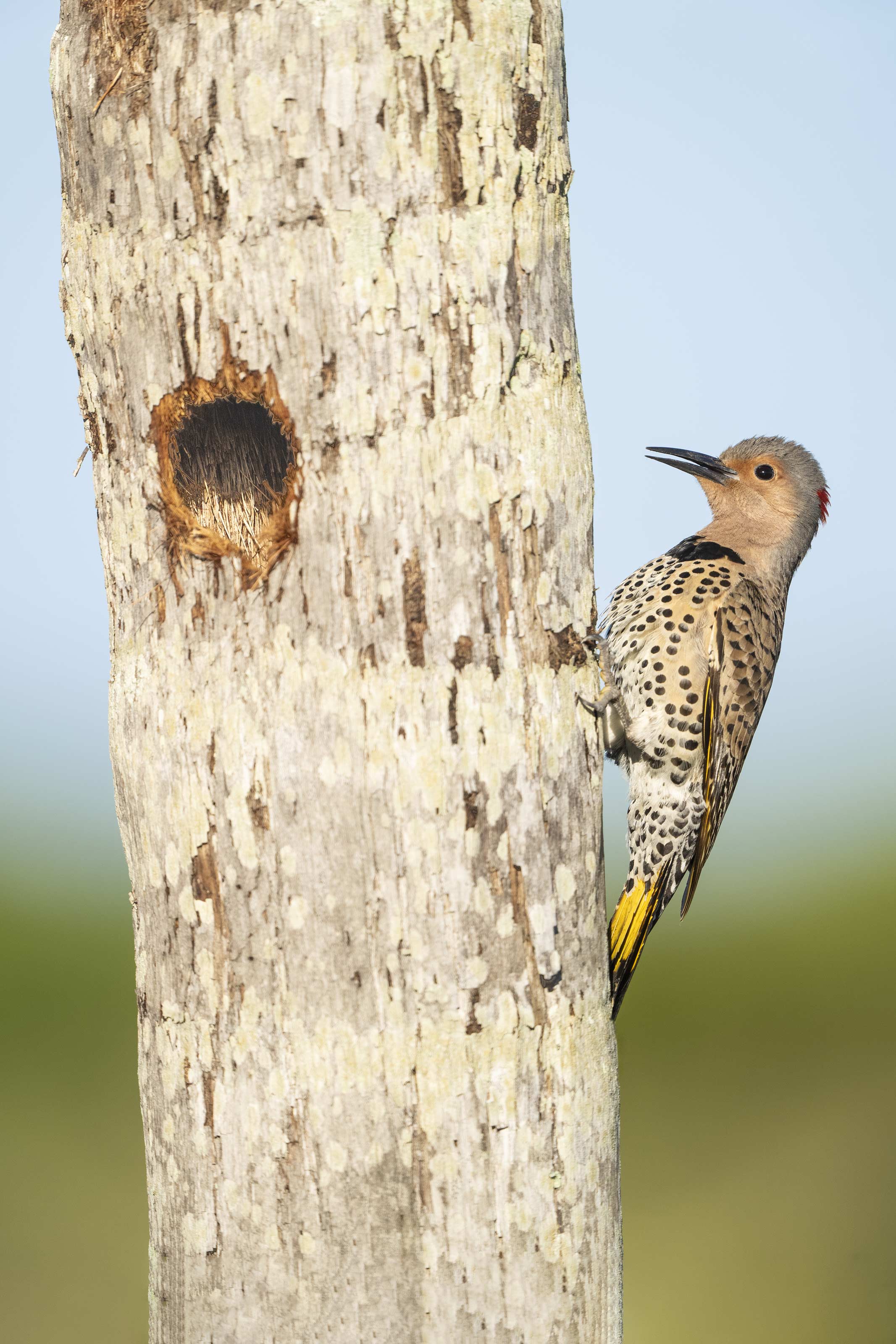
This image was created on 11 April 2026 by yours truly at Indian Lake Estates, FL. Seated in my SUV, I used the BLUBB-supported Sony FE 600mm f/4 GM OSS lens with the Sony FE 1.4x Teleconverter, and the Latest Greatest Sony Flagship Body, the a1 II Mirrorless Camera. The exposure was determined via Zebras with ISO on the rear dial. ISO 640: 1/1600 sec. at f/5.6 (wide open). AWB at 8:30:01am on a sunny morning. Tracking: upper center Zone AF-C with Bird-Eye/Face Detection performed perfectly. Click on the image to enjoy the larger, inexplicably sharper and warmer high-res version. Image #3: Northern Flicker — female at nest tree |
Thrilled!
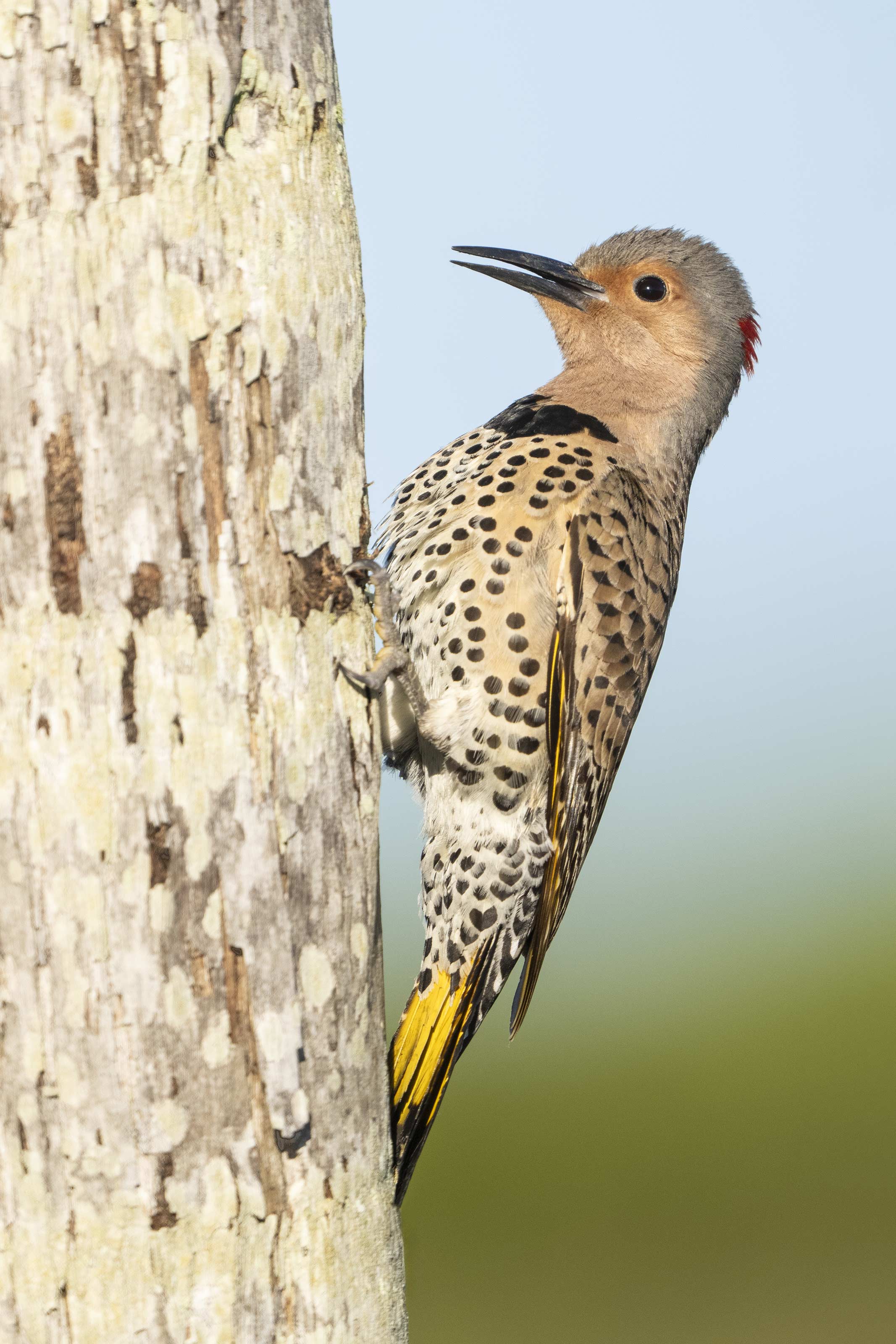
I was thrilled when the female flicker first accepted us by perching on the side of the nest tree for a minute or two before entering the nesting cavity. Wanting to include the refurbished flicker cavity in the image, I framed the original with only a tiny border behind the bird’s head. I used Content-Aware Crop to add canvas along the right frame-edge.
|
|
This image is a crop of Image #2 above and thus, was created by yours truly at Indian Lake Estates, FL. Seated in my SUV, I used the BLUBB-supported Sony FE 600mm f/4 GM OSS lens with the Sony FE 1.4x Teleconverter, and the Latest Greatest Sony Flagship Body, the a1 II Mirrorless Camera. The exposure was determined via Zebras with ISO on the rear dial. ISO 640: 1/1600 sec. at f/5.6 (wide open). AWB at 8:30:01am on a sunny morning. Tracking: upper center Zone AF-C with Bird-Eye/Face Detection performed perfectly. Click on the image to enjoy the larger, inexplicably sharper and warmer high-res version. Image #3A: Northern Flicker — female at nest tree |
Northern Flicker
There are two races of this species — Yellow-Shafted (Eastern/Taiga), and Red-Shafted (Western). They live year round in virtually all of the lower 48 states and breed there as well. Migratory flickers head north in spring and breed in a huge area across all of the mid-latitude and southern Canadian provinces and southeastern Alaska as well.
AI Overview
Northern Flickers are unique woodpeckers that primarily eat insects, especially ants and beetles, which they forage for on the ground rather than in trees. They use their long, sticky tongues to consume thousands of ants daily. Their diet also includes fruits, berries, seeds, and nuts, particularly in winter
|
|
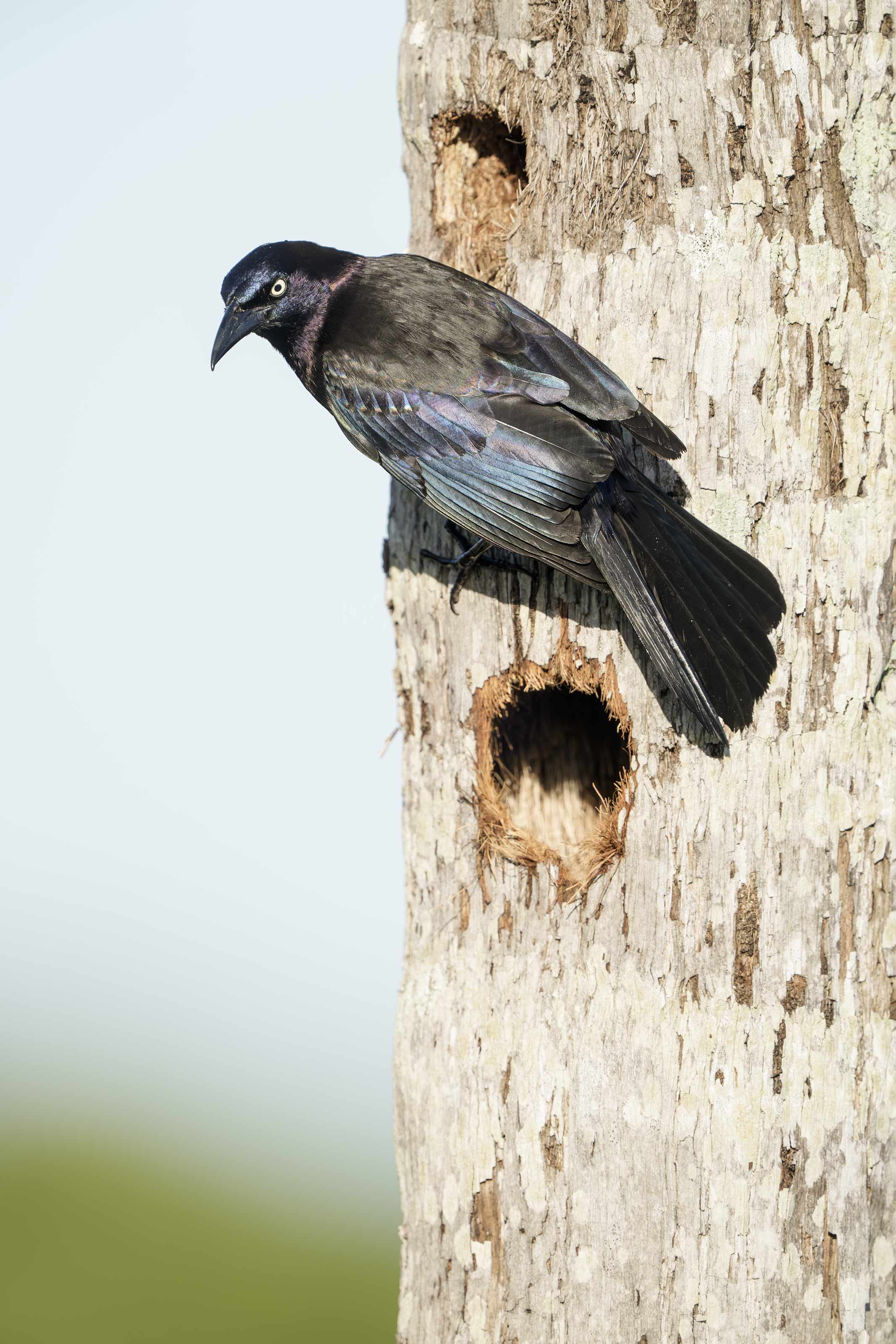
This image was created on 11 April 2026 by yours truly at Indian Lake Estates, FL. Seated in my SUV, I used the BLUBB-supported Sony FE 600mm f/4 GM OSS lens with the Sony FE 1.4x Teleconverter, and the Latest Greatest Sony Flagship Body, the a1 II Mirrorless Camera. The exposure was determined via Zebras with ISO on the rear dial. ISO 800: 1/1600 sec. at f/5.6 (wide open). AWB at 8:34:45am on a sunny morning. Tracking: upper center Zone AF-C with Bird-Eye/Face Detection performed perfectly. Click on the image to enjoy the larger, inexplicably sharper and warmer high-res version. Image #4: Common Grackle at woodpecker nest cavities |
Nest Predators!
Common Grackles routinely raid the nest of many species of birds breaking and eating the eggs and killing and devouring the chicks. The grackle in this image stuck its head into the nest cavity but left quite soon after being attacked by one of the adult flickers. I am pretty sure that the more numerous Boat-tailed Grackles are too large to fit into a flicker nest hole.
Note the larger size of the bottom nest hole, the one that was enlarged by the flickers.
|
|
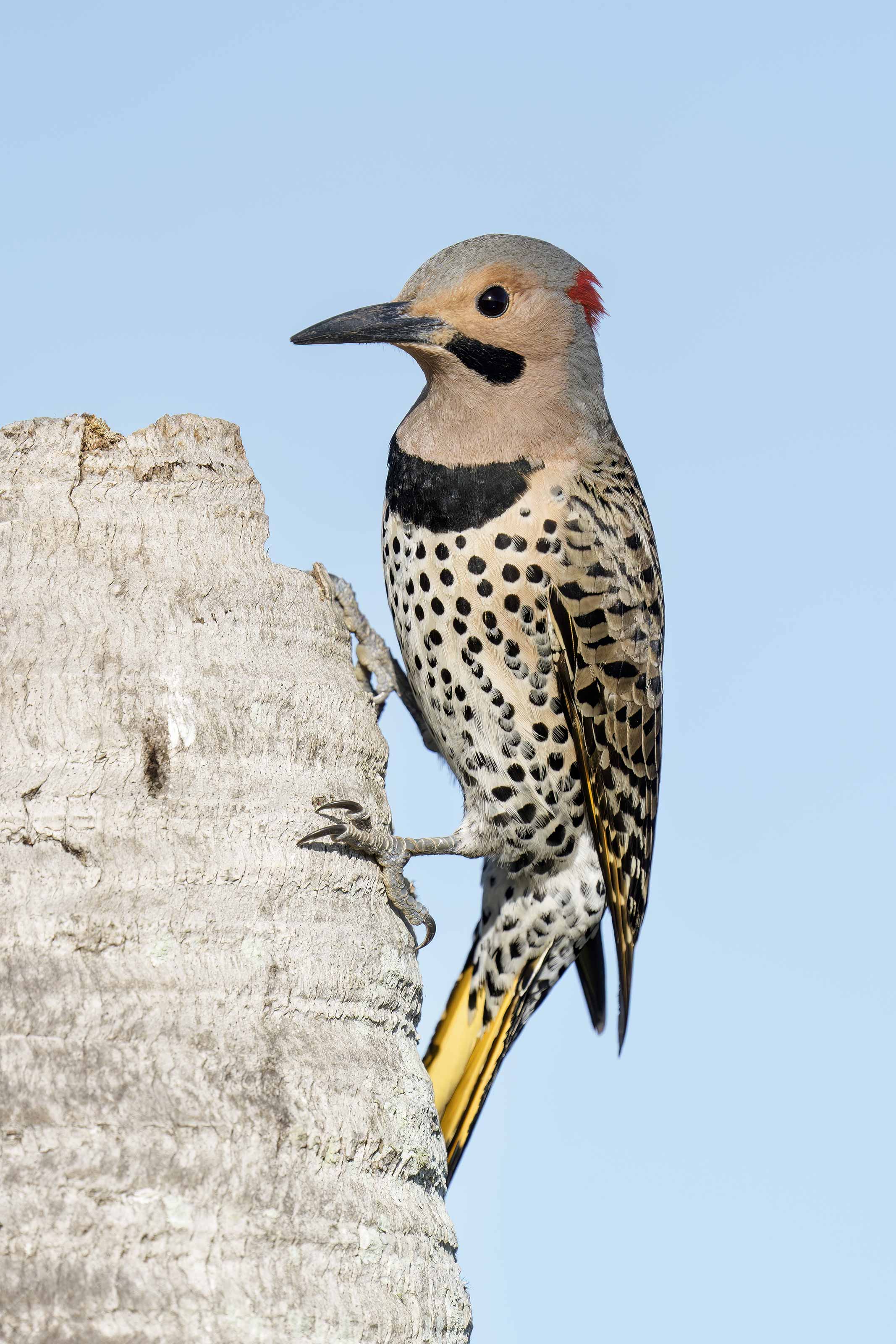
This image was created on 12 April 2026 by yours truly at Indian Lake Estates, FL. Seated in my SUV, I used the BLUBB-supported Sony FE 600mm f/4 GM OSS lens and the Latest Greatest Sony Flagship Body, the a1 II Mirrorless Camera. The exposure was determined via Zebras with ISO on the rear dial. ISO 640: 1/3200 sec. at f/4 (wide open). AWB at 8:43:14am on a sunny morning. Tracking: upper center Zone AF-C with Bird-Eye/Face Detection performed perfectly. Click on the image to enjoy the larger, inexplicably sharper and warmer high-res version. Image #5: Northern Flicker near top of nest tree |
The Male Northern Flicker
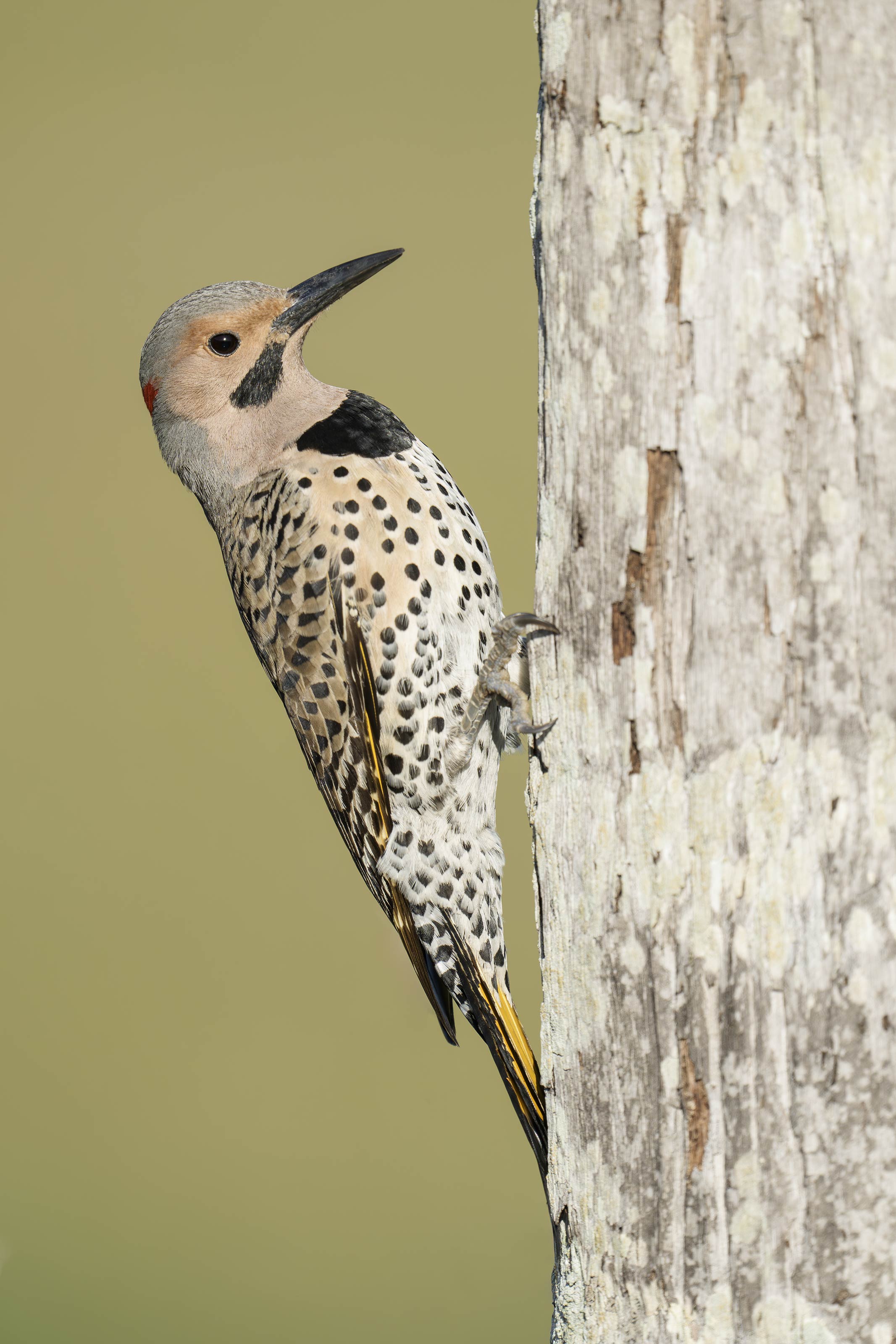
Not the black molar streak, a sort of mustache, that distinguishes the male flicker from the females.
|
|
This image was created on 13 April 2026 by yours truly at Indian Lake Estates, FL. Seated in my SUV, I used the BLUBB-supported Sony FE 600mm f/4 GM OSS lens with the Sony FE 1.4x Teleconverter, and the Latest Greatest Sony Flagship Body, the a1 II Mirrorless Camera. The exposure was determined via Zebras with ISO on the rear dial. ISO 640: 1/1600 sec. at f/5.6 (wide open). AWB at 8:31:03am on a sunny morning. Tracking: upper center Zone AF-C with Bird-Eye/Face Detection performed perfectly. Click on the image to enjoy the larger, inexplicably sharper and warmer high-res version. Image #6: Northern Flicker male at nest tree |
The Traditional Vertical Woodpecker Image Design
The traditional vertical image design calls for 1/3 tree, 1/3 bird, and 1/3 background. Image # 6 has a bit more tree and a bit less background.
In a Perfect World
In a perfect world, the flickers will be feeding their young at the nest hole when I get back from Texas :-).
Typos
With all blog posts, feel free to e-mail or to leave a comment regarding any typos or errors.









Yes, Flickers are indeed very interesting woodpeckers and one of their calls is quite distinctive. You’re fortunate to have a nest nearby and accessible. Safe travels to Texas!
Thanks. And at eye level no less. Headed to the airport now.’
a