
Wanted to Buy
I have a friend looking for a used Canon EF Extender (teleconverter) 1.4X III in excellent or better condition. If you have one sitting on a shelf gathering dust, please get in touch via e-mail.
My Calls
In the last blog post, I loved all eight images. If forced to pick one, I’d go with the Kentucky Warbler for the sharpness, the difficulty, and the beauty of this rarely seen species.
What’s Up?
We decided to extend the Texas trip by six days hoping that Saturday’s predicted cold front will materialize and that the storm will bring some migrant passerines to South Padre Island. Most mornings we have been visiting the bay north of the Convention Center and working the small group of spoonbills, several white morph Reddish Egrets, and a variety of other wading birds, terns, gulls, and shorebirds.
Today is Thursday 30 April 2026. We will be headed to the bay soon. Whatever you opt to do, I hope that you too choose to have fun and enjoy life. Please remember that happiness is a choice — Byron Katie, The Work.Com
If an item — a Delkin flash card or reader, a Levered-clamp FlexShooter Pro, or a Wimberley lens plate or low foot — for example, that is available from B&H and/or Bedfords, is also available in the BAA Online Store, it would be great, and greatly appreciated, if you would opt to purchase from us. We will match or beat any price. Please remember also to use my B&H affiliate links or to earn 3% cash back at Bedford by using the BIRDSASART discount code at checkout for your major gear purchases. Doing either often earns you free guides and/or discounts. And always earns my great appreciation.
Gear Questions and Advice
Too many folks attending BAA IPTs and dozens of photographers whom I see in the field and on BirdPhotographer’s.Net, are — out of ignorance — using the wrong gear, especially when it comes to tripods and more especially, tripod heads. And the same is true in spades when ordering new camera bodies or lenses. My advice will often save you some serious money and may help you avoid making a seriously bad choice. Please know that I am always glad to answer your gear questions via e-mail. If you are desperate, you can try me on my cell at 863-221-2372. Please leave a message and shoot me a text if I do not pick up.
|
|
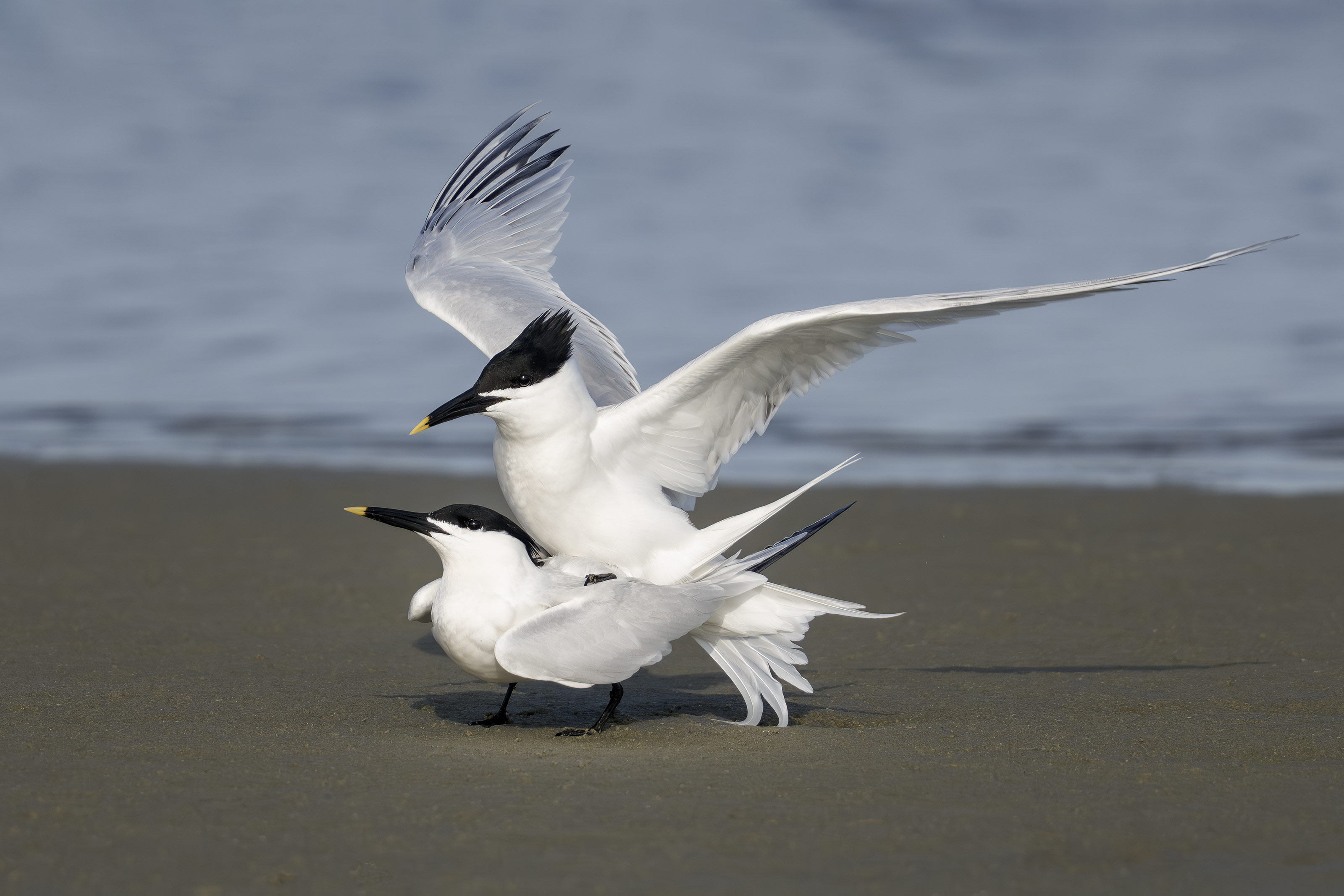
This image was created by yours truly on 22 April 2026 down by the bay just north of the Convention Center on South Padre Island, TX. Standing at full height on damp mud, I used the hand held Sony FE 300mm f/2.8 GM OSS Lens (Sony E) with the Sony FE 2x Teleconverter (at 900mm in APS-C Crop Mode!) and the Latest Greatest Sony Flagship Body, the a1 II Mirrorless Camera. The exposure was determined via Zebras with ISO on the Thumb Wheel. ISO 800: 1/4000 sec. at f/5.6 (wide open) in Manual mode. RawDigger showed that the exposure was dead solid perfect: AWB at 9:42:22am on a hazy, sunny morning. Tracking: Zone/AF-C with Bird Eye/Face Detection enabled performed perfectly. Image #1: Sandwich Terns copulating |
The Lightweight Hand-holdable 900mm f/5.6 Lens!
I was feeling a bit lazy on a hazy, hot, and humid morning and did not want to lug around the 600mm f/4 GM OSS lens and a tripod so I grabbed the 300 and the a-1 ii, made sure to turn the camera off to close the shutter, and added the 2X TC. What fun. By assigning APS-C Crop Mode to the Trash button, I am easily able to switch from full frame to crop mode in an instant. That decision is based on how close I am able to get to the subject(s). In this case, I would have had to risk walking through a foot deep pond of mud to get closer so I opted for crop mode. Whenever you go to APS-C Mode, autofocus performance will increase.
Gorgeous Breeding Plumage
With their complete and rich black caps, and the black bills with bright yellow bill tips, this pair of Sandwich Terns was as spiffy as any I had ever seen before. Think of the bill tips as mayonnaise and remember their name: “sandwich”.
|
|
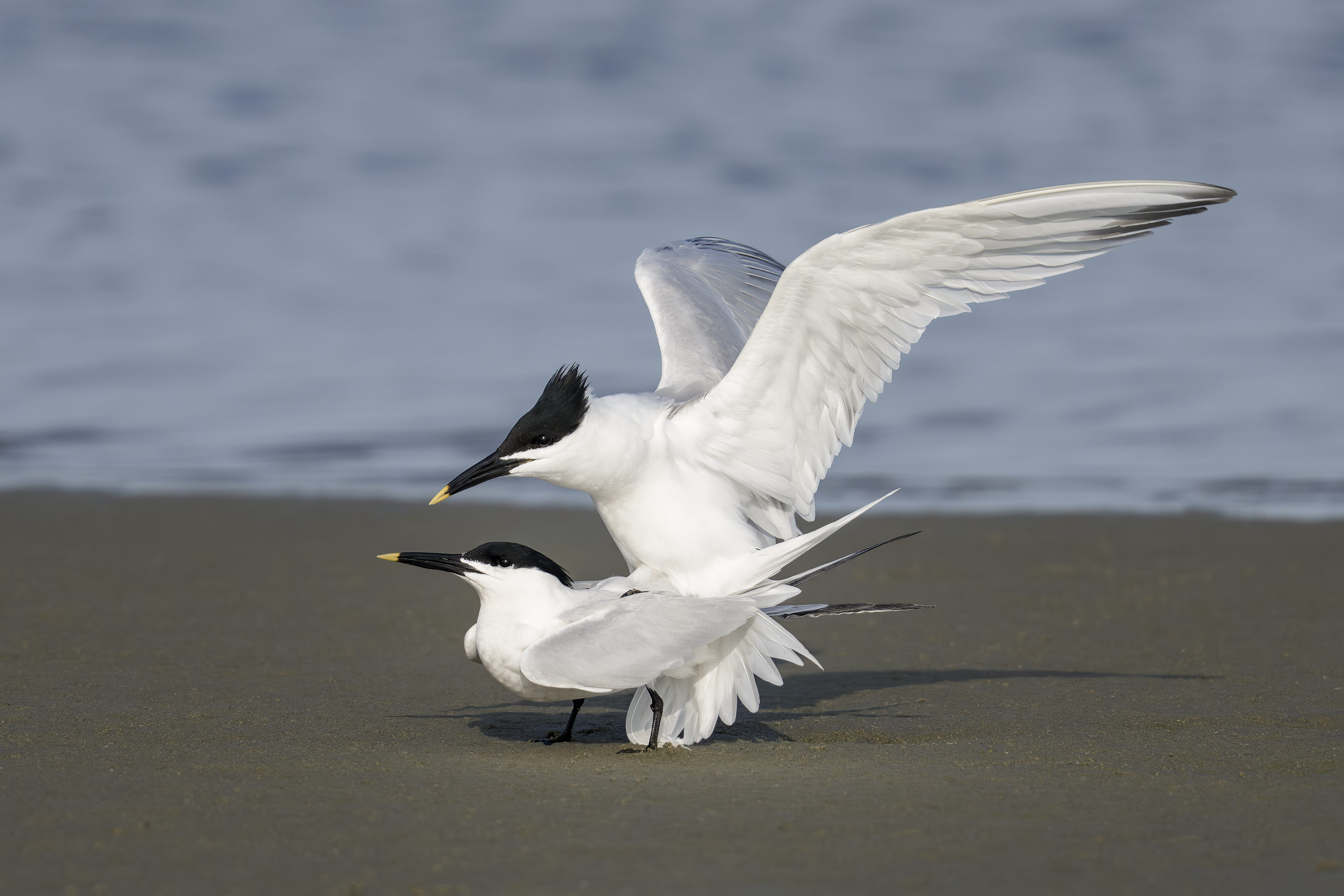
This slightly different version of Image #1 was created about one second after the previous photo by yours truly on 22 April 2026 down by the bay just north of the Convention Center on South Padre Island, TX. Standing at full height on damp mud, I used the hand held Sony FE 300mm f/2.8 GM OSS Lens (Sony E) with the Sony FE 2x Teleconverter and the Latest Greatest Sony Flagship Body, the a1 II Mirrorless Camera. The exposure was determined via Zebras with ISO on the Thumb Wheel. ISO 800: 1/4000 sec. at f/5.6 (wide open) in Manual mode. RawDigger showed that the exposure was dead solid perfect: AWB at 9:42:21am on a hazy, sunny morning. Tracking: Zone/AF-C with Bird Eye/Face Detection enabled performed perfectly. Image #2: Sandwich Terns copulating |
Comparing the Two Images
When I was on the beach, it seemed that the male was atop the female for an eternity — perhaps ten minutes before dismounting. In fact, the whole episode was over in less than 2 minutes, 15 seconds. In that short time, I created 771 photos. After the first edit, I kept only 42. Today’s featured images were my two favorites. Though the elapsed time from Image #1 to image #2 was in the vicinity of a single second, 41 other frames were created between those two.
In what way or ways is the first image stronger than the second image? In what way or ways is the second image stronger than the first image?
What is the fatal flaw common to both photos? And how could I have eliminated the problem. I will share my thoughts in the next blog post.
|
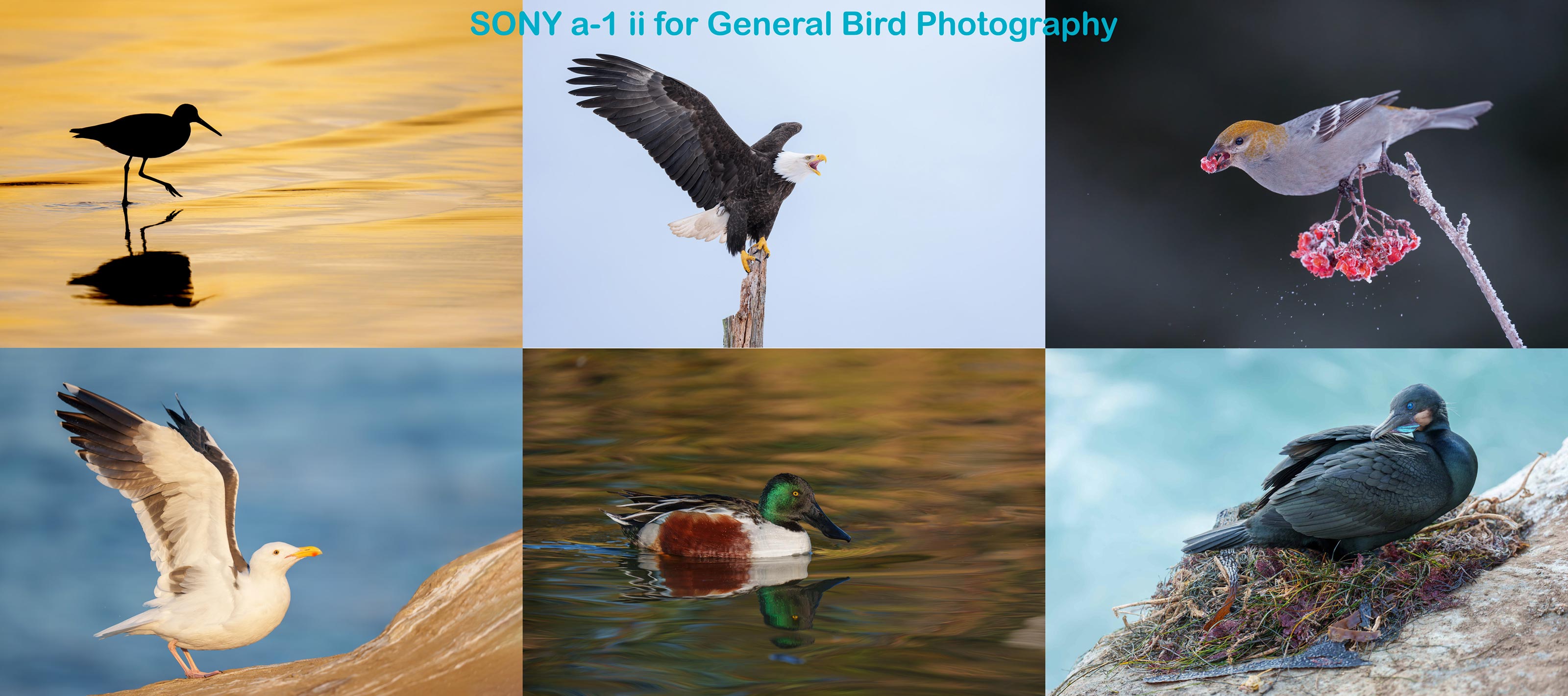
Composite #1: All with the a-1 ii Mirrorless Camera body.
|
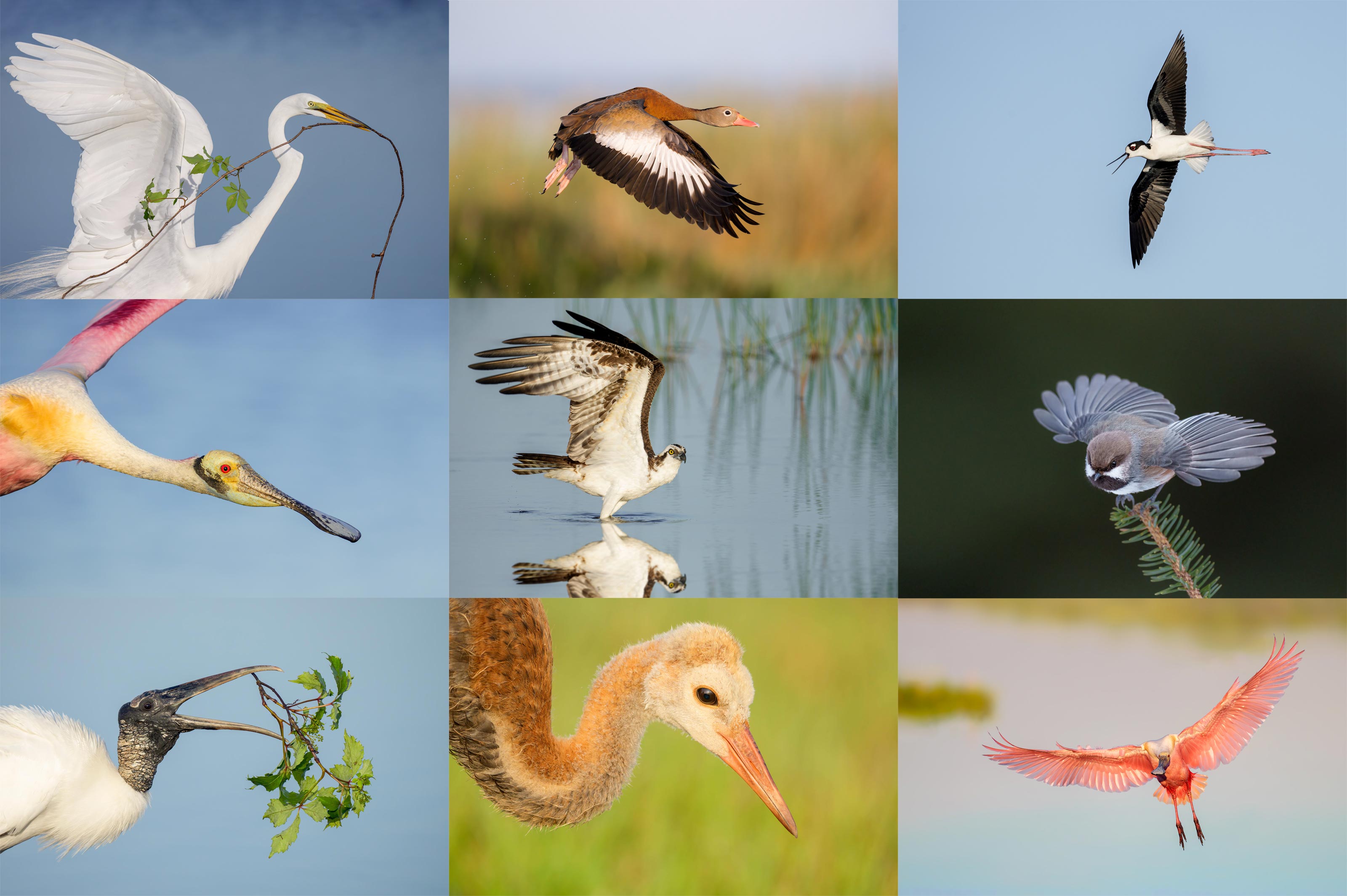
The a-1 ii for General Bird Photography
I have found that eye-tracking for general bird photography with the a-1 ii is far, far better than with the original Sony a-1. It grabs the eye and tracks it faster and far more consistently and focus is rarely lost, even with backgrounds other than sky.
|
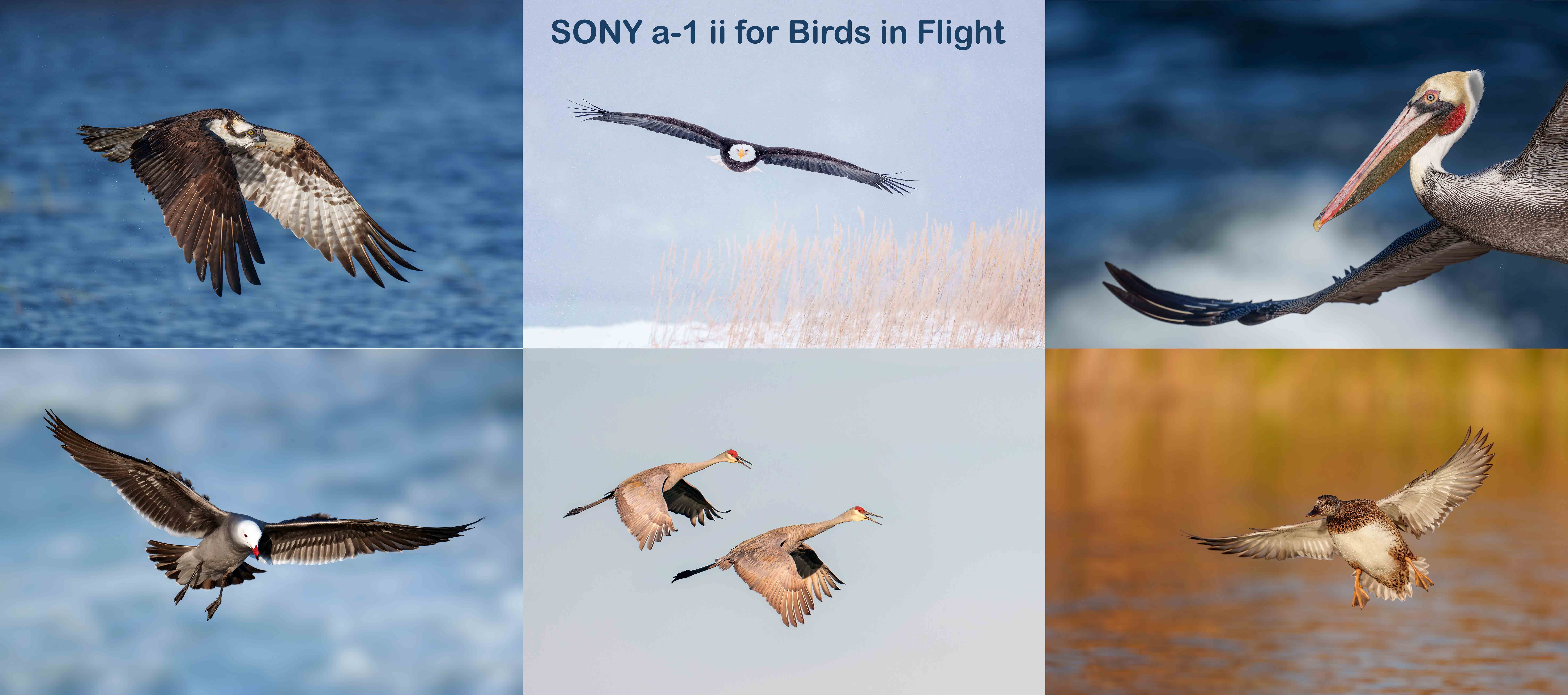
Composite #2: All with the a-1 ii Mirrorless Camera body.
|
The a-1 ii for Birds in Flight
For birds in flight, the a-1 ii Mirrorless Camera body has no equal. As Arash Hazeghi says, “It is better than the a-1.” When I am late getting on a bird in flight, I have consistently been amazed at how often the AF system of the a-1 ii finds and tracks the bird’s eye.
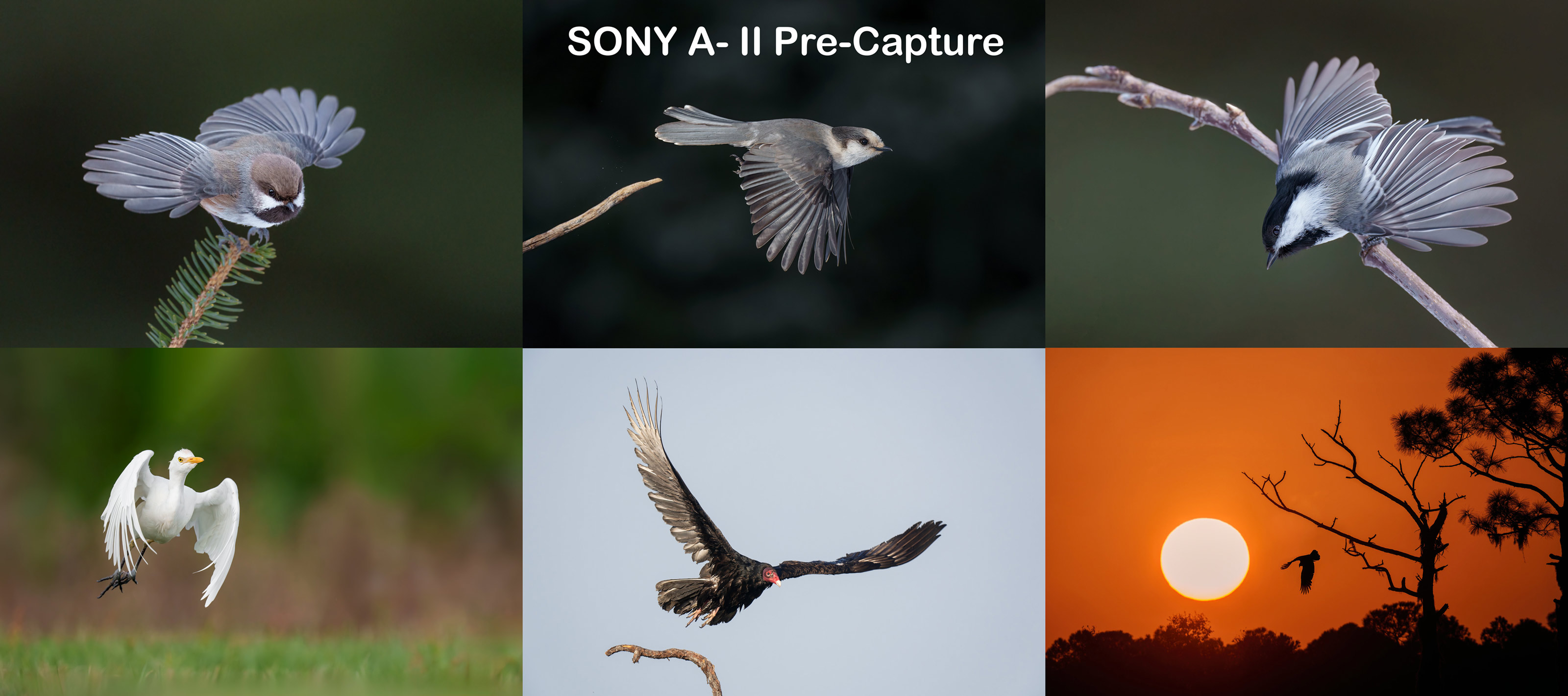
|
Composite #3: All the result of using Pre-Capture with the a-1 ii Mirrorless Camera body.
|
Pre-Capture with the Sony a-1 ii
When it comes to Pre-Capture with the a-1 ii Mirrorless Camera body, Arash and I agree 100%. And with my slower reflexes, Pre-Capture is more important for me than it is for Arash. Understand that in each of the images in Composite #3, I did not push the shutter button until after the bird took flight!
|
All with the a-1 ii Mirrorless Camera body.
|
Purchasing or Upgrading to a Sony a-1 ii
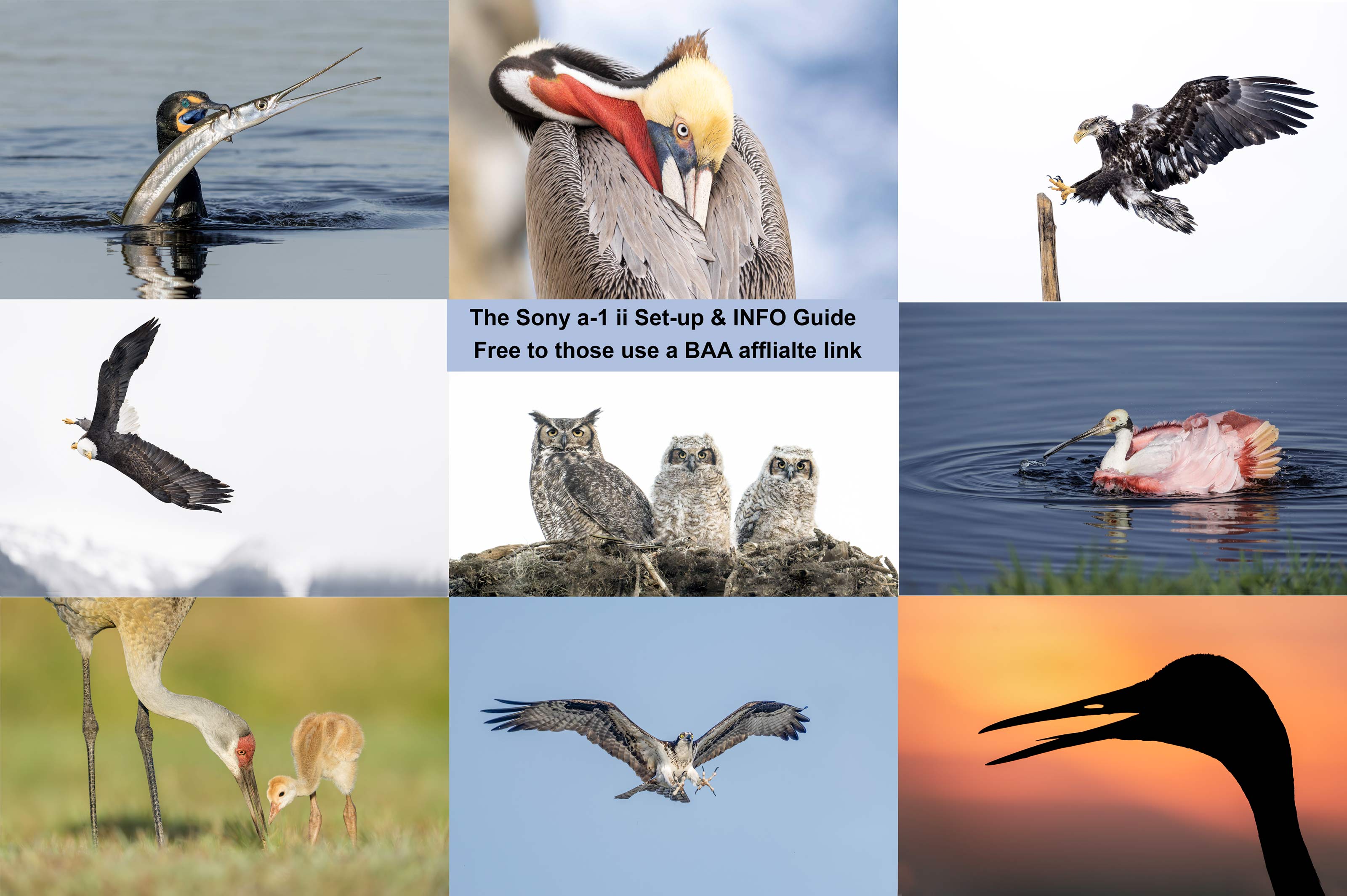
The Sony a-1 ii e-Mail Set-up and Info Guide
I now own and use two Sony a-1 ii bodies. Every day that I use them, the more I am amazed by speed and accuracy of the Bird Face-Eye tracking in AF-C and the overall performance of the camera.
Aside from the improved ergonomics as compared to the a-1, other nice features include the fact that the rear screen tilts both ways — the lack of a tilting rear screen on the original a-1 always ticked me off. Pre-capture has proven to be a huge plus almost exclusively for take-off flight images. In my opinion, the Speed Boost feature is a total waste for bird photography because you should always be utilizing the maximum frame rate. In addition, the resolution on the rear monitor has been improved dramatically. I must mention again that Bird Face-Eye tracking on the a-1 ii is vastly improved as compared to both the a-1 and the a9 iii and that the 51MP files are to die for.
So, the big question is, is the a-1 ii “worth” a gear upgrade. Remembering that I can never know whether or not something is worth it to you, I can say that I was not floored when first using my a-1 ii. The differences between the a-1 ii and the original a-1, seemed to be neither huge nor eye-opening. But over time, I have come to realize that I was 100% wrong. The huge difference between the new camera body and the a9 iii is, of course, the 51MP a-1 raw files (as compared to the 24MP files rendered by the a9 iii).
The price of a new a-1 is $5,898.00. The price of a new a-1 ii is $1,100.00 more: $6,998.00. As the a-1 ii is clearly far superior for bird photography to the original a-1, the choice for folks new to Sony or for those upgrading from lesser Sony camera bodies is an easy one. Prices for used a-1 bodies has not dropped drastically as I anticipated. At this point, a-1 folks who like showing flight and action and can afford an a-1 ii, are advised to purchase an a-1 ii. Please remember that life is short; we only get one ride on the merry-go-round.
|
All with the a-1 ii Mirrorless Camera body.
|
If you do purchase an a-1 ii, be sure to use one of my two affiliate links so that you will receive my a-1 ii settings (in the form of a CAMSEa1ii.DAT file), the Buttons and Dials Guide, and an Info Sheet for free. Using my links will never cost you one penny and may actually save you some money. Folks who do not purchase their new a-i using my B&H link or from Bedfords here and entering the BIRDSASART discount code at checkout will be able to purchase the a-1 ii guide for $244.93. If you are at all confused and do not want to screw up your order, please get in touch via e-mail. If you would like to chat about upgrading, shoot me a text to 863-221-2372 and LMK a good time to call you.
Typos
With all blog posts, feel free to e-mail or to leave a comment regarding any typos or errors.











The demarcation line has already been mentioned so that’s covered. As for comparing, I’ll make a number of subjective observations. These are all things I prefer:
1. The slightly raised head of the female in #1.
2. The far wing of the male in #1 and the near wing of the male in #2.
3. The male’s body position in #2 is, shall we say, more engaged?!
Hi Artie,
The fatal flaw in both Sandwich Tern photos is the background which is divided between sand and water. Getting lower to include only the water would have made the images stronger.
Thanks for sharing your images.
Tilo
Good job, Tilo. Now compare the two 🙂
with love, artie
Is your “fatal flaw” is having the demarcation line between water and sand pass behind the birds? You could have eliminated it by making your own position either higher or lower.
Yes. And good job, Steve. Now compare the two :-). BTW, lower was the correct move for greater intimacy.
with love, artie