
Miracle of Miracles?
After a 13-day hiatus, the server for the BIRDS AS ART Blog came back on line on Tuesday morning. As I never received the promised e-mail from Bluehost, I found out accidentally. I was not shocked that Bluehost dropped the ball once again. But I was thrilled to get my life’s work back.
Your Call?
After reading the material and clicking on each image to enlarge it, consider this question: overall, Which of today’s two featured images is the strongest?
What’s Up?
Photography here at Indian Lake Estates continues to be very good to excellent. It seems that one or two of the crane colts may have perished this past week. Young crane survival rates are still well above average. Most of the numerous Osprey nests have two or three chicks and a low platform nest on Lantana has three very large chicks ready to fledge in about a week or so. The parent birds at all the nests are catching Bluegills nonstop.
Today is Wednesday 13 May 2026. Jim and I ventured into the mud south of the pier yesterday afternoon to pull some dead, scraggly weeds from the lake. So, I will of course be headed down to the lake early to work the whistling ducks again. I fly to Islip next Monday for trigger finger surgery on my right ring finger. It will be done by the amazing Dr. Steven Puopolo. Whatever you opt to do, I hope that you too choose to have fun and enjoy life. Please remember that happiness is a choice — Byron Katie, The Work.Com
If an item — a Delkin flash card or reader, a Levered-clamp FlexShooter Pro, or a Wimberley lens plate or low foot — for example, that is available from B&H and/or Bedfords, is also available in the BAA Online Store, it would be great, and greatly appreciated, if you would opt to purchase from us. We will match or beat any price. Please remember also to use my B&H affiliate links or to earn 3% cash back at Bedford by using the BIRDSASART discount code at checkout for your major gear purchases. Doing either often earns you free guides and/or discounts. And always earns my great appreciation.
Gear Questions and Advice
Too many folks attending BAA IPTs and dozens of photographers whom I see in the field and on BirdPhotographer’s.Net, are — out of ignorance — using the wrong gear, especially when it comes to tripods and more especially, tripod heads. And the same is true in spades when ordering new camera bodies or lenses. My advice will often save you some serious money and may help you avoid making a seriously bad choice. Please know that I am always glad to answer your gear questions via e-mail. If you are desperate, you can try me on my cell at 863-221-2372. Please leave a message and shoot me a text if I do not pick up.

B&H Simplified
To ensure that I get credit for your B&H purchases, you can always click here. The tracking is invisible. Using my affiliate links is greatly appreciated. And, with B&H, you can use your PayBoo card. You must use the website to order. You cannot get your free guides if you make a phone order. Once you have an item in your cart, you must complete the order within two hours. Huge thanks!
B&H
Many folks have written recently stating that they purchased a Sony a1 from B&H and would like their free membership in the Sony 1 Info and Updates Group, a $150.00 value. But when I check my affiliate account, their orders have not been there. When I let them know that they get credit for B&H purchases only if they use one of the many B&H affiliate links on the blog or begin their searches with this link, they are always disappointed. If in doubt, please contact me via e-mail and request a BH link. I am always glad to help and to guide you to the right gear.

Bedfords Simplified
Click here to start your search. Choose standard shipping, and when you get to the payment page, enter BIRDSASART in the discount code box and hit apply. You will be upgraded to free second day air Fed-Ex and receive 3% cash back on your credit card once your stuff ships. Using either my affiliate links is greatly appreciated and will often earn you free guides or discounts. To receive a free guide or free entry into a Sony Set-up and Info Notes e-Mail group, you need to shoot me your receipt via e-mail. The B&H receipts need to include the order number.
Bedfords Amazing BAA Discount Policy
Folks who have fallen in love with Bedfords can always use the BIRDSASART coupon code at checkout to enjoy a post-purchase, 3% off-statement credit (excluding taxes and shipping charges) on orders paid with a credit card. The 3% credit will be refunded to the card you used for your purchase when your product ships. Be sure, also, to check the box for free shipping to enjoy free Second Day Air Fed-Ex. This offer does not apply to purchases of Classes, Gift Cards, or prior purchases.
You can visit the Bedfords website here, shoot Steve Elkins an e-mail, or text him on his cell phone at (479) 381-2592.
|
|
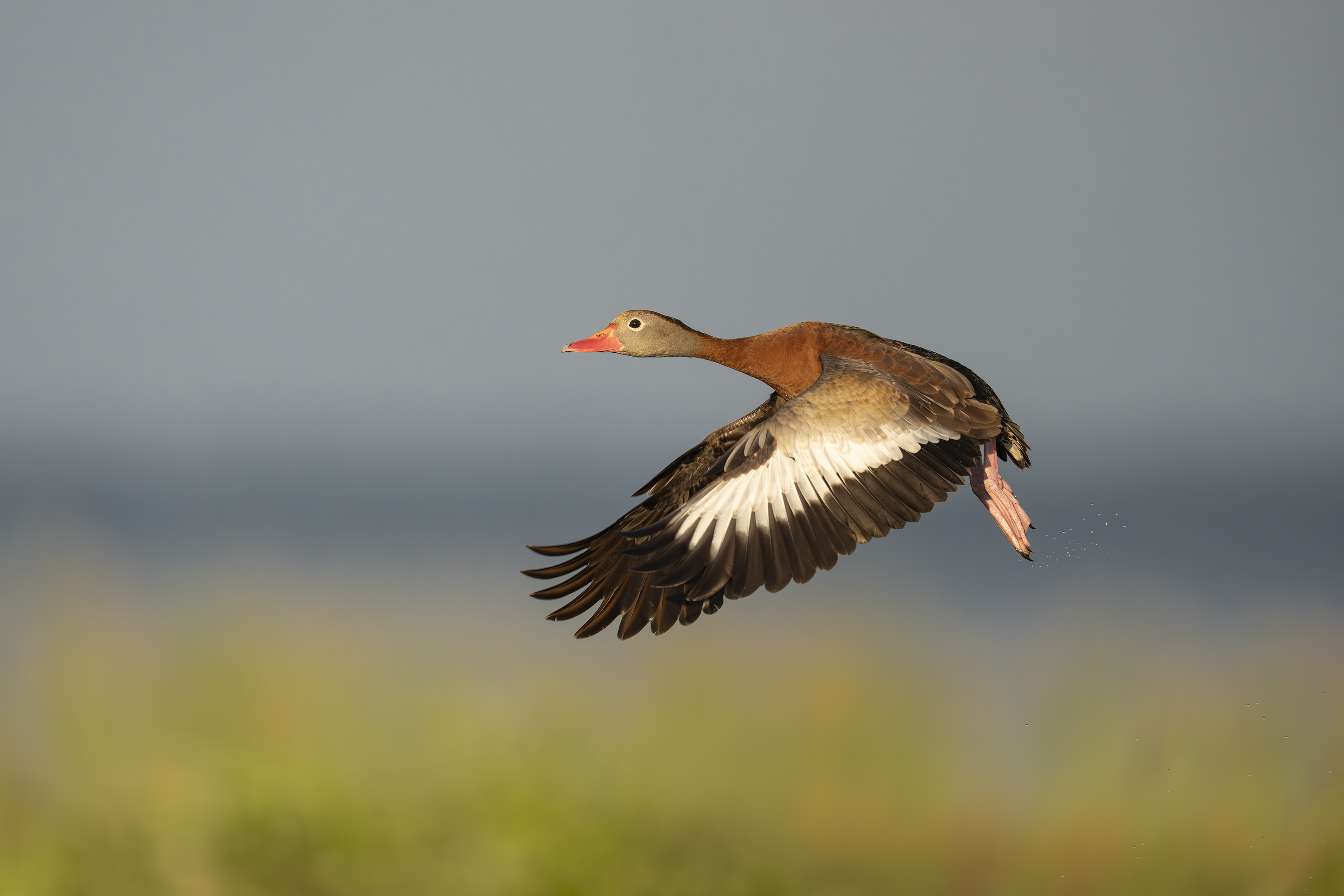
This image was created on 12 May 2026 by yours truly down by the lake at ILE. Standing at full height near his SUV, he used the Robus RC-5570 Vantage Series 3 Carbon Fiber Tripod/Levered-Clamp FlexShooter Pro-mounted Sony FE 600mm f/4 GM OSS lens and The Latest Greatest Sony Flagship Body, the a1 II Mirrorless Camera. The exposure was determined by Zebras with ISO on the rear wheel: ISO 1000: 1/3200 sec. at f/4 (wide open) in Manual mode. RawDigger showed that the exposure was dead solid perfect. AWB at 7:21:24am on a briefly sunny morning. Wide/AF-C with Bird-Eye/Face Detection performed perfectly. Click on the image to enjoy the larger, inexplicably sharper high-res version. Image #1: Black-bellied Whistling Duck in flight — full downstroke wing position |
The Goal
Every time I head out to photograph, my goal is to make at least one image that makes me happy. On rare occasions, I create a perfect image. On ridiculously rare occasions, I create two perfect images. When those two perfect images depict birds in flight or in action, it’s party time.
As mentioned previously, the whistling ducks began flying into the bay south of the pier several days ago. Since photographing flight from the front seat of my SUV is quite challenging, I tried a new strategy to avoid scaring the birds. There were about twenty ducks in the bay south of the pier when I arrived at 7:10am yesterday. With the historically low water levels (due to the continuing drought), I parked with my SUV facing south as close to the lake as I dared. I exited on the driver’s side so that I was mostly hidden behind my vehicle. I opened the rear hatch. The birds stayed. I made my way to the back of the vehicle and grabbed the tripod. I set it up behind the front hood to break up my form. The birds were copasetic. I grabbed the 600 alone, mounted it on the Levered-Clamp FlexShooter Pro, leveled the black ball, and went to work.
Understanding Bird Behavior
At times, groups of Black-bellied Whistling Duck burst into flight seemingly for no reason at all. Most of the time, any remaining ducks will take flight in a few moments. So, when about ten birds blasted off, I got on two of the remaining birds and readied myself for take-off. Since they were relatively close to my position, I tapped the Trash Can button to switch from APS-C Crop mode to full frame to avoid clipping wings and more. Handholding for flight is always better if and only if you can handhold a given lens comfortably for extended shooting sessions. As I cannot handhold the 600mm f/4 for more than a few moments at best and because I needed the 600mm reach and the f/4 aperture, going to the tripod was the only option. That said, when the bird took flight, I did clip a few wings. But, I got back on the bird nicely and created a long series before the bird turned away. Today’s two featured images were clearly the picks of the litter.
Note: I have been doing lots of experimenting with APS-C Crop mode and will be sharing my findings with you here soon (and with the a-1 and a-1 ii groups as well).
|
|
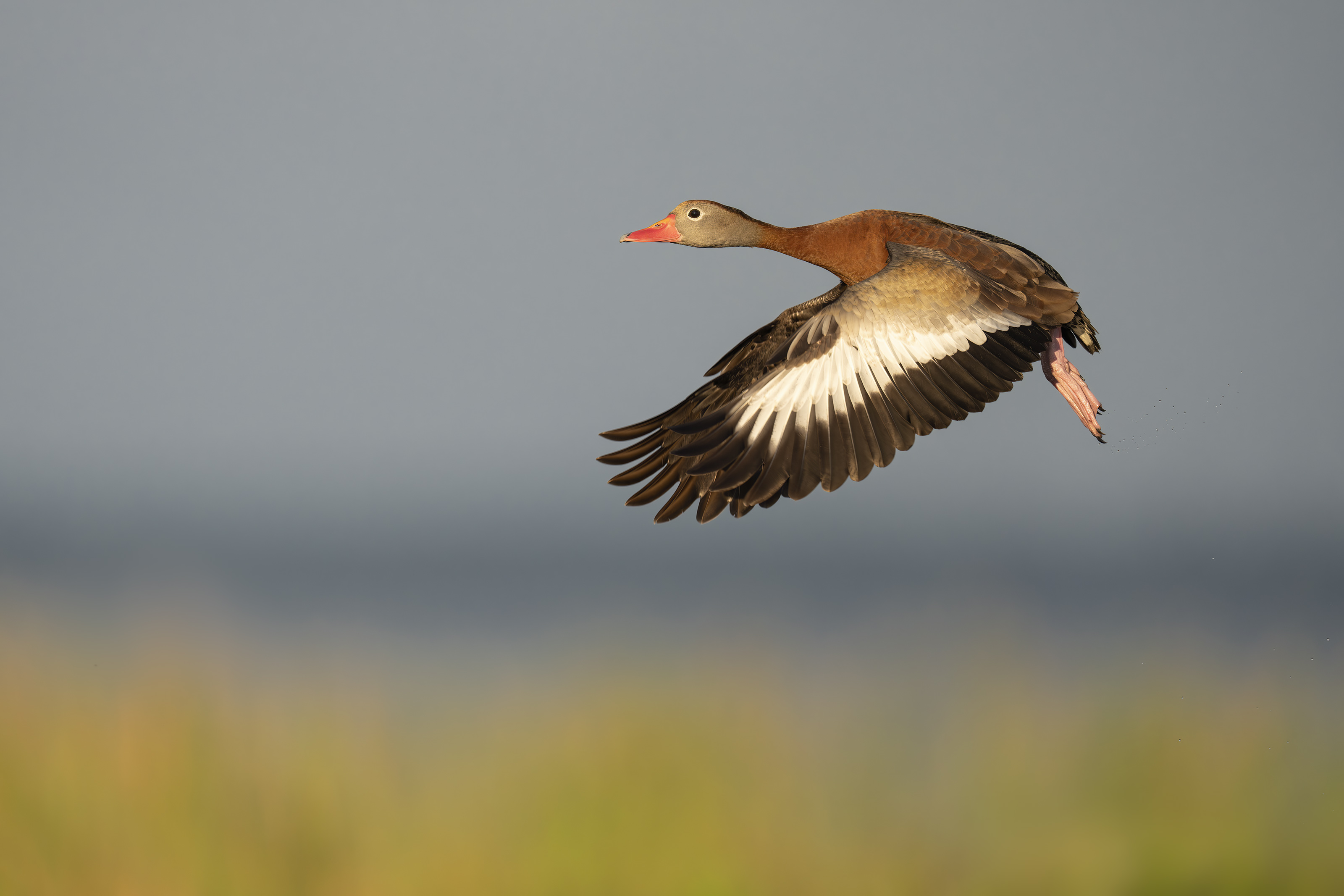
This image of the same bird was created on 12 May 2026 by yours truly down by the lake at ILE — five frames after but in the same second as Image #1. Standing at full height near his SUV, he used the Robus RC-5570 Vantage Series 3 Carbon Fiber Tripod/Levered-Clamp FlexShooter Pro-mounted Sony FE 600mm f/4 GM OSS lens and The Latest Greatest Sony Flagship Body, the a1 II Mirrorless Camera. The exposure was determined by Zebras with ISO on the rear wheel: ISO 1000: 1/3200 sec. at f/4 (wide open) in Manual mode. RawDigger showed that the exposure was dead solid perfect. AWB at 7:21:24am on a briefly sunny morning. Wide/AF-C with Bird-Eye/Face Detection performed perfectly. Click on the image to enjoy the larger, inexplicably sharper high-res version. Image #2: Black-bellied Whistling Duck in flight — full downstroke wing position |
So, What’s So Good About Both?
First, I should note that both photos are un-cropped, that is, 100% full frame.
1- The almost identical, 100% fabulous full downstroke wing positions.
2- The two perfect head angles.
3- The incredible sharpness.
4- The lovely out-of-focus marsh background.
5- The sweet, early morning light, the result of the sun breaking through the clouds just a minute before the birds took flight.
5- The storm cloud background.
6- The strip of lead blue lake water.
Differences?
In Image #1, the water droplets flying off the ducks webbed feet are perfectly set against the lead blue water of the lake.
In Image #2, the composition is a bit stronger as the bird is above the marsh grasses in the rule of thirds position.
|
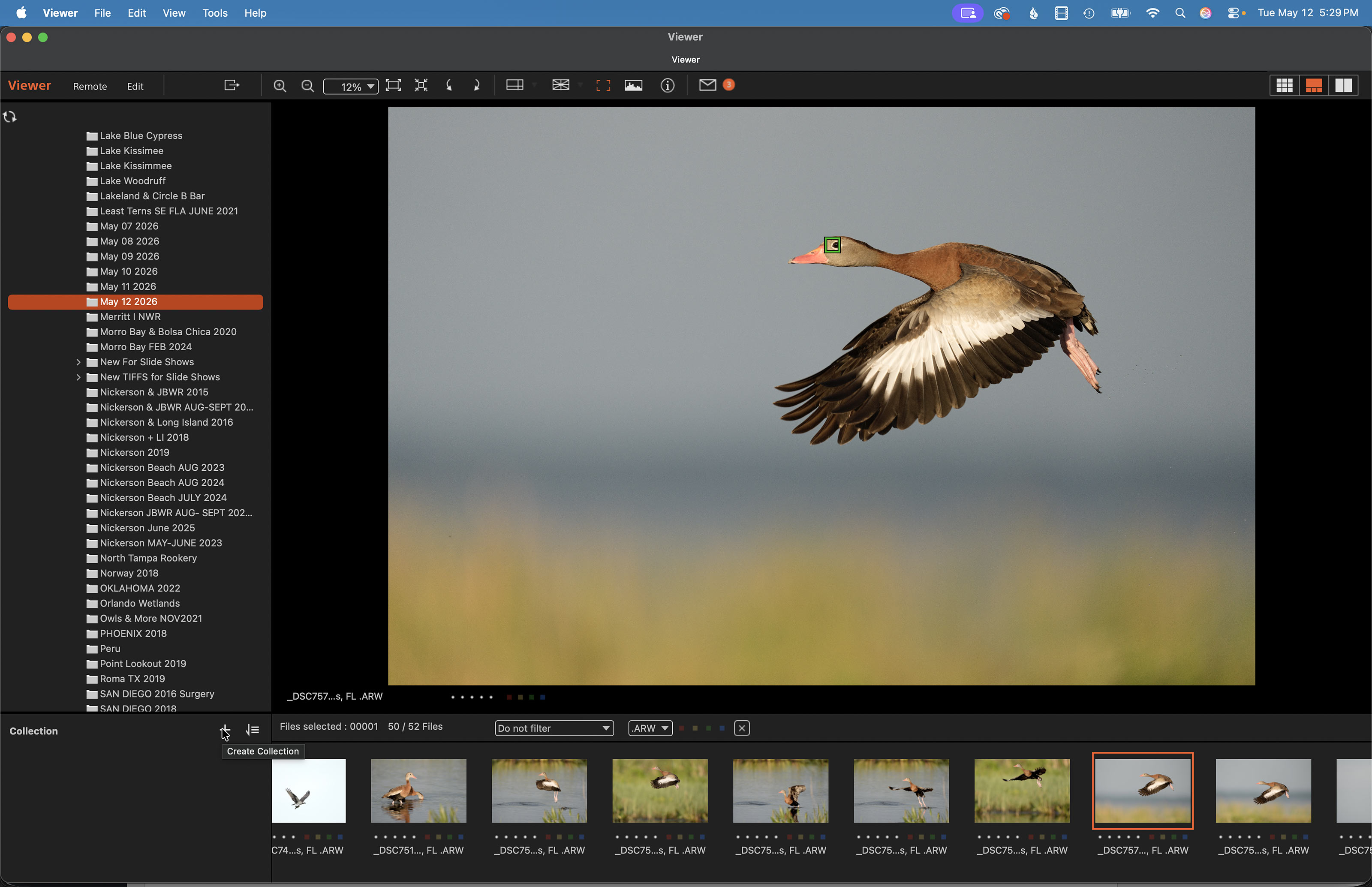
The IEDT Viewer Screen Capture for Image #2: Black-bellied Whistling Duck in flight — full downstroke wing position |
The IEDT Viewer Screen Capture
Click on the screen capture to see the tiny green AF box squarely on the eye of the flying duck. If you think that the AF system on your camera will nail the eye of a bird in flight, you are smoking dope. Though I think that the a href=”https://www.bhphotovideo.com/c/product/1861705-REG/sony_a1_ii_mirrorless_camera.html/BI/6633/KBID/7226/kw/SOA12/DFF/d10-v2-t1-xSOA12″ target=”_blank” rel=”noopener”>a1 II Mirrorless Camera has the best AF system in the world by far for bird photography, I would never tell you to expect results like this with every frame in a flight sequence. When, however, you combine today’s amazing technology two minutes of sweet light, a knowledge of bird behavior, and a modicum of flight photography skill, the results can be exceptional.
|
|
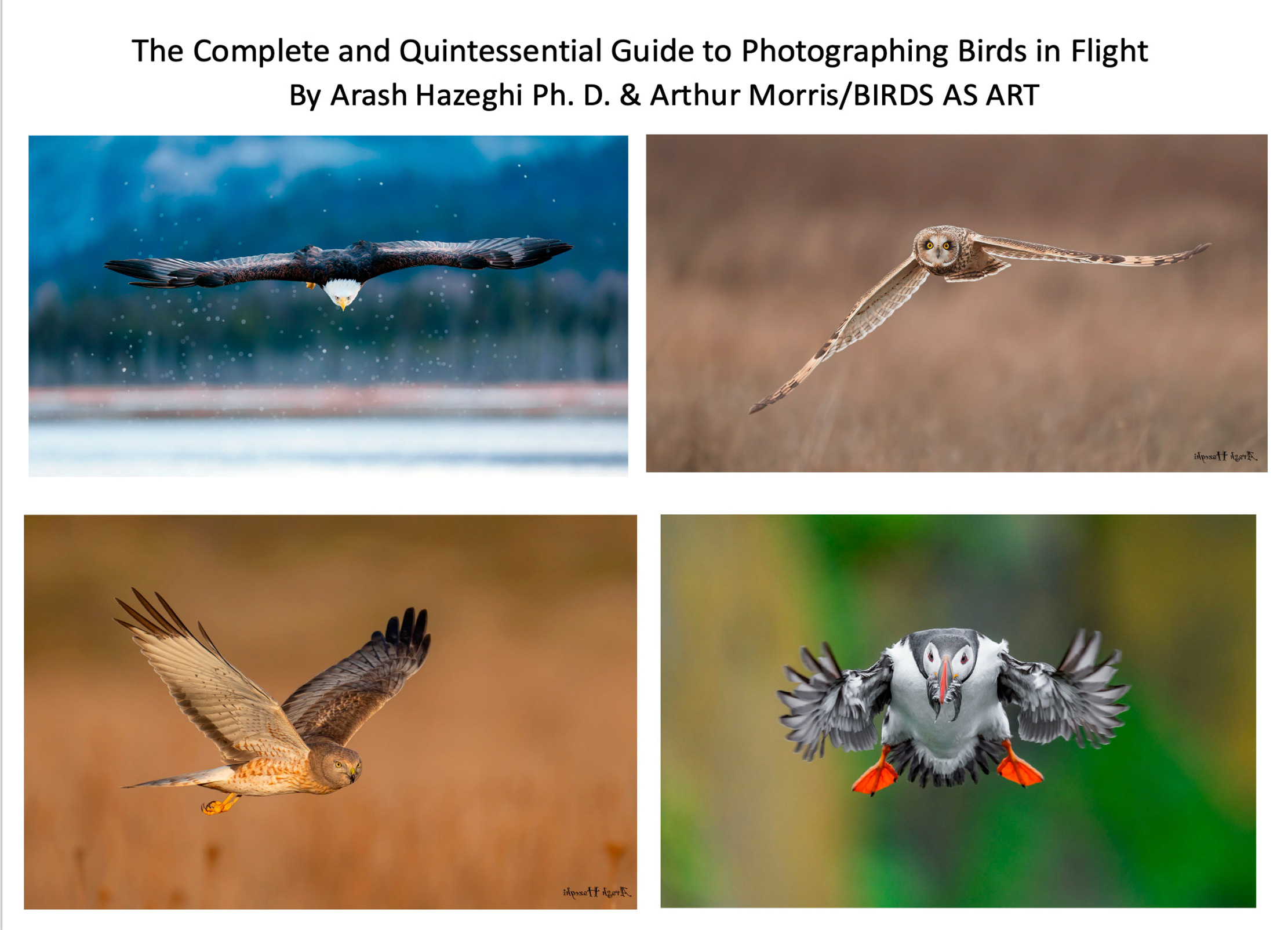
The title says it all. Purchase your copy here. The Complete and Quintessential Guide to Photographing Birds in Flight
|
The Complete and Quintessential Guide to Photographing Birds in Flight: $99.00
I had long dreamed of becoming a great flight photographer. When using dSLR gear, making sharp images was a huge problem. Most of the time, the camera bodies simply were not up to snuff. Things have changed dramatically with mirrorless technology. The high-end mirrorless camera bodies now feature science fiction-like autofocus systems and frame rates of 30, 40, and even 125 fps. Nowadays, getting the eye sharp is no longer a problem. The problem more often involves selecting the strongest image from a long series of sharp images.
The truth, however, is that there is a lot more than owning a Canon EOS R1, a Nikon Z9, or a Sony a-1 ii to consistently creating great photographs of birds in flight. Some of the biggest factors to success include gear choice, shooting strategies, and understanding the importance of sky conditions and wind speed and direction. Once you have the techniques and technical aspects down pat and can routinely create sharp images, learning the importance of flight poses, wing positions, backgrounds, and subject placement and image design enable you to create and then select superb flight images. And you guessed it, each of those topics and tons more are covered in detail in The Complete and Quintessential Guide to Photographing Birds in Flight.
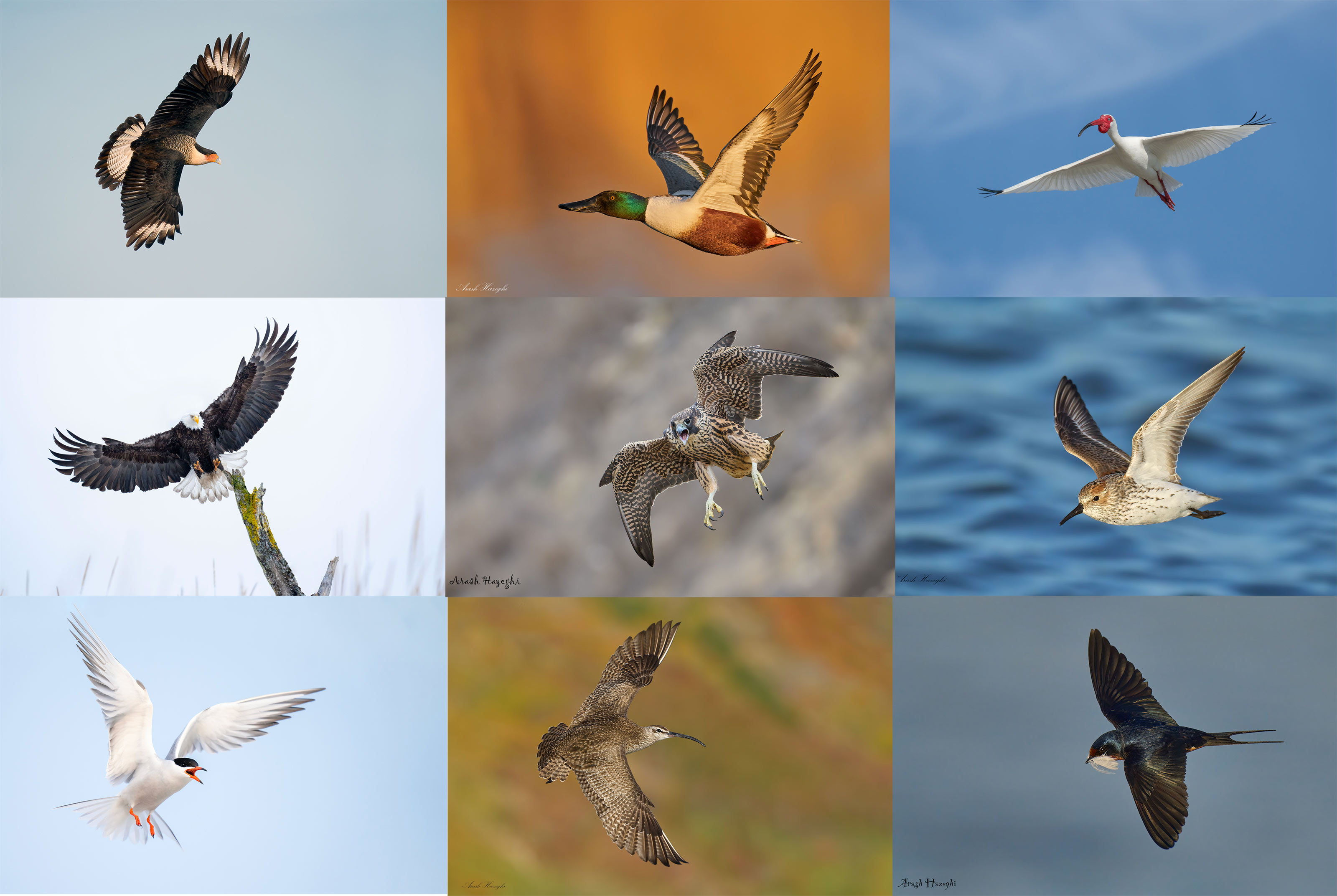
The guide consists of 267 pages and 21,013 words. There are 82 illustrative photos scattered throughout the text, two screen captures, and a 112-image gallery that includes examples created by Canon, Nikon, and mostly Sony gear. As seen above, each of the 194 inspirational photos is labeled with an educational caption.
You can purchase your copy here for $99.00.
Arash Hazeghi
Arash Hazeghi, Ph.D. is a principal electron device engineer. He received his Ph.D. degree in Electrical Engineering in 2011, from Stanford University, Stanford, California. His pioneering research on Carbon Nanotubes has been cited many times. In the past decade, Arash Hazeghi has been a major contributor to the research and the development of some of the most cutting-edge technologies introduced by Silicon Valley’s most reputable names including SanDisk, Intel and Apple.
More relevant here is that he is widely recognized as one of the world’s best birds in flight photographers. He specializes in raptors and the technical aspects of bird photography.
|
|
Flight photography is a skill that can be studied, practiced, and learned. Learn to get better in The Complete and Quintessential Guide to Photographing Birds in Flight |
The Complete and Quintessential Guide to Photographing Birds in Flight
By Arash Hazeghi Ph.D., and Arthur Morris/BIRDS AS ART
What you will learn (about):
-
1- Weight and handholding super-telephoto lenses.
2- Weight and handholding intermediate telephoto and telephotos zoom lenses.
3- Choosing the right flight photography lens or lenses for you.
4- The importance of focal length for flight photography.
5- The importance of lens speed (the maximum aperture for flight photography.
6- Choosing between fixed focal lengths and zoom lenses for flight photography.
7- The importance of AF speed and performance for flight photography.
8- Handholding tips and techniques.
9- Shooting flight off a tripod with the Levered-clamp FlexShooter Pro.
10- Flight poses and wing positions.
11- Why artie changed his mind about the 400mm f/2.8 lenses for flight and more.
12- The advantages and disadvantages of using teleconverters for flight photography.
13- Why to stay away from off-brand lenses.
14- Understanding the importance of wind direction and speed for flight photography.
15- The relationship between sky conditions and wind direction and how it affects flight photography.
16- Creating flight silhouettes in wind-against-sun conditions.
17- The importance of being on sun angle for flight photography (and avoiding harsh shadows).
18- Tips on doing flight photography in cloudy, foggy, or overcast conditions.
19- About the direction of light in cloudy, foggy, or overcast conditions and how it affects flight photography.
20- How your understanding of bird behavior can dramatically improve your flight photography.
21- Tips on attracting birds for flight photography.
22- What to do when your camera’s AF system is temporarily blind.
23- The vital importance of pre-focusing.
24- How Direct Manual Focus can help you with flight photography.
25- The importance of shooting aggressively when doing flight photography.
26- Everything that you need to know with regards to rest positions for flight photography.
27- The importance of getting low when doing flight in many situations.
28- Getting the right exposure when doing flight photography.
29_ Why to use Manual mode 95% of the time for flight.
30- Tips on finding the bird in the frame, acquiring focus, and tracking the bird in flight.
31- How to set and best utilize your lens’s image stabilization feature (and why).
32- Setting the focus range limiter switch on your flight lens or lenses.
33- To choose the best shutter speed for photographing birds in flight.
34- The vital importance of pre-focusing. And yes, this is so important that it is on the list twice.
You can purchase your copy here.
|
|
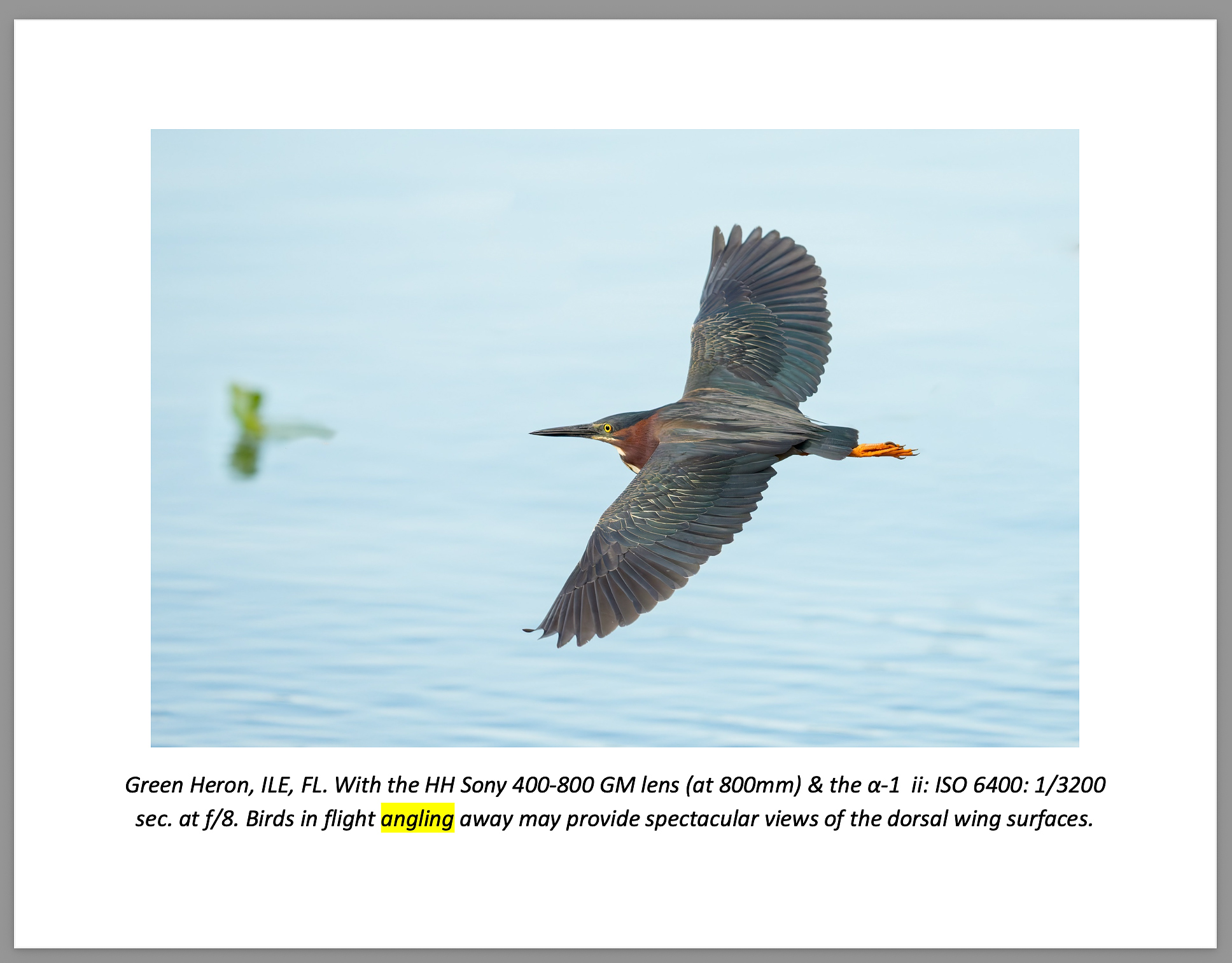
Sample Page #1. Copyright 2024: Arthur Morris/BIRDS AS ART, the senior author. Page 254 of The Complete and Quintessential Guide to Photographing Birds in Flight |
Sample Page #1
Birds in flight that are flying away from you may at times provide spectacular views of the dorsal wing surfaces.
|
|
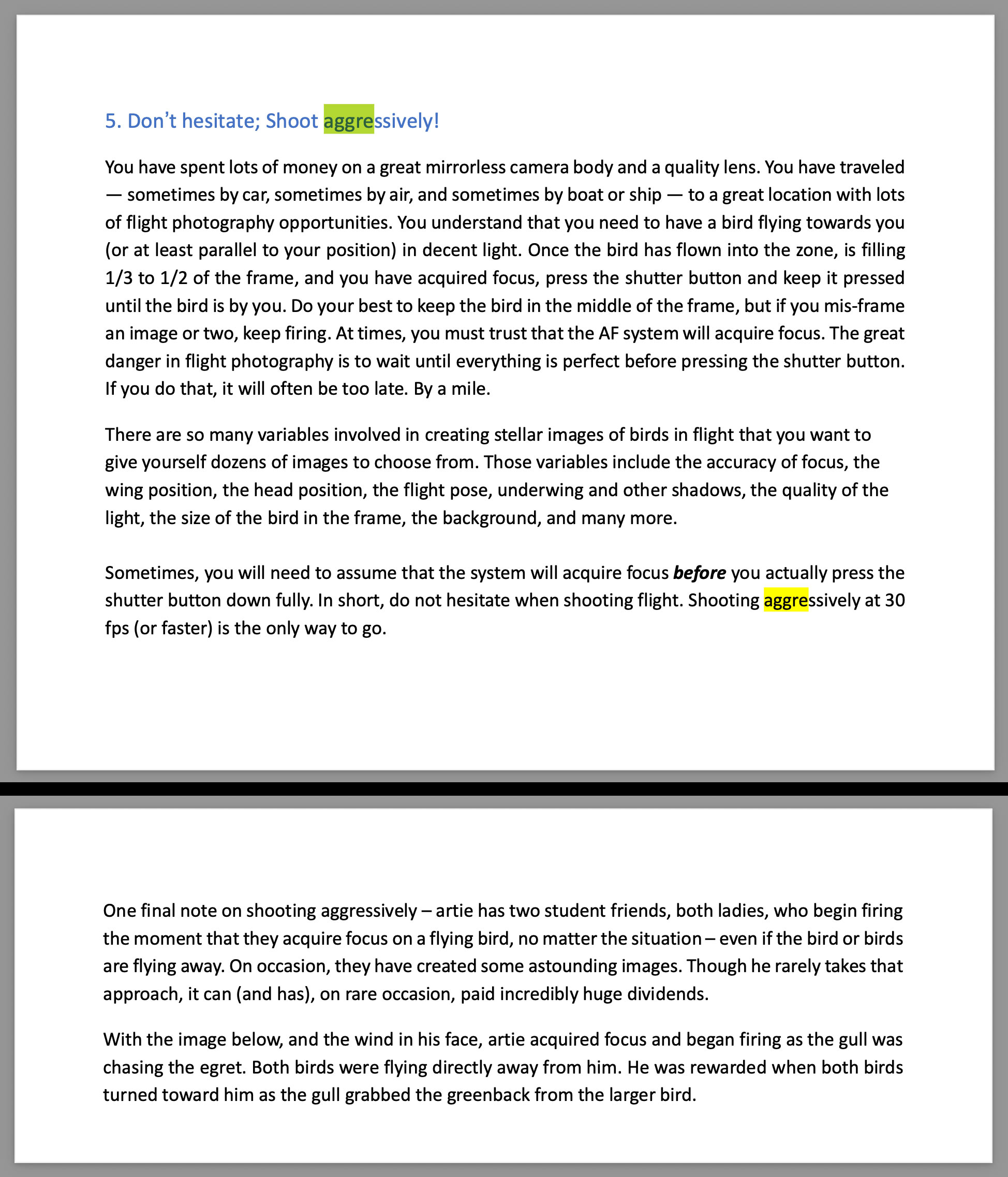
Screen capture and text copyright 2024:: Arthur Morris/BIRDS AS ART, the senior author. Pages 106 & 107 of The Complete and Quintessential Guide to Photographing Birds in Flight |
Sample pages #2 & 3
It is — for many reasons, imperative that you shoot aggressively when doing flight photography. If you wait for it to be perfect, you will usually wind up with nothing. That said, most of my flight sequences rarely consist or more than seven or eight frames; I do not blast away at specks and once the bird is past the light and flying away from me I quit shooting.
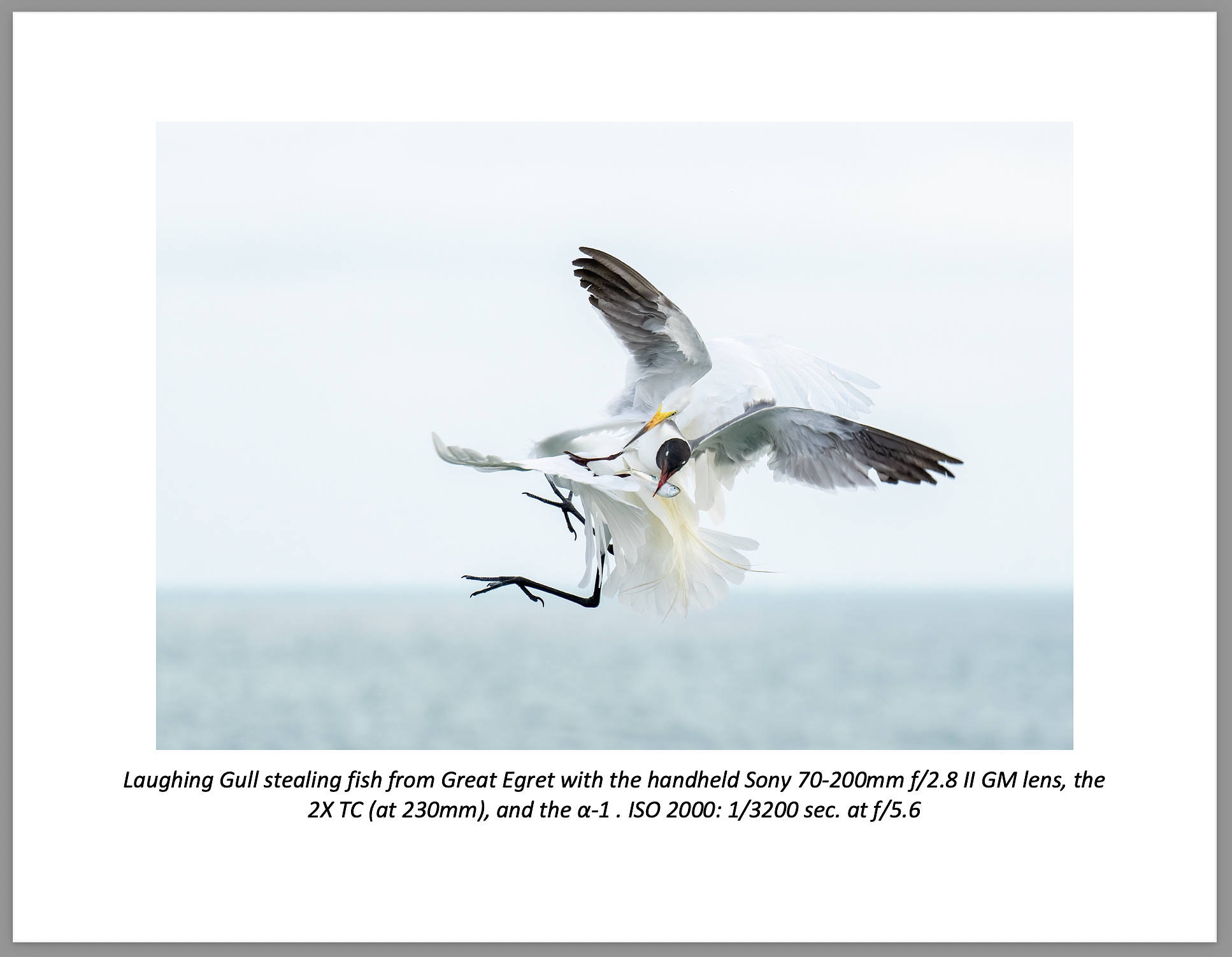
Scroll down to see what happens when you shoot flight and action aggressively. The two birds were flying away from me into a NW wind and when the gull attacked they turned towards me; the result was two spectacular frames.
|
|
Image copyright 2024: Arthur Morris/BIRDS AS ART, the senior author. Page 108 of The Complete and Quintessential Guide to Photographing Birds in Flight |
Sample page #4
Sometimes you need to press the shutter button just in case the bird or birds turn back to look at you. The Great Egret above was flying directly away from me but turned abruptly when the gull grabbed the fish.
Shooting flight aggressively can enable you to make images that on the surface, would seem impossible.
Typos
With all blog posts, feel free to e-mail or to leave a comment regarding any typos or errors.







I actually prefer #1 because the bird is more immersed in the environment.
Glad to see the blog back. Hope you didn’t lose any of your past content. Much love.
Agree with Elinor. We must be crossing paths as I was down in FL earlier in the week. I must say that the light in your images was lovely and my whistling duck images were not nearly as nice. One has to nail the exposure as they feature the blacks and whites along with the lovely colors as you beautifully demonstrated. They are really quixotic and lovely ducks and I especially appreciate it when they go arboreal. There is nothing funnier that seeing a pair of whistling ducks hanging out on a couple of tree limbs.
Thanks, Adam. That makes it two to two. With Sony Zebras set up properly, getting the right exposure on this and any other species either in sun or on cloudy days is quite simple and easy. Yet many folks resist using them … I have made some nice silhouettes of these guys in trees on Lake Blue Cypress.
with love, artie
Hello Artie,
I am glad your blog is back!
Nice post. Both great shots and I prefer image #2 because of the composition.
Did you think about cropping image #1 in order to evaluate if it would be better than image #2.
Cheers,
Alessio
I prefer the placement of the bird in the frame in image #1 over #2. I have a minor quibble that applies to both: the horizon “line” in each image seems a little bit tilted to me and I’d prefer them to be level.
Thanks for your comment. You may very well be right about the distant shoreline that I am 99% sure that my Levered-clamp FlexShooter Pro was perfectly level so what we are seeing may be an illusion.
with love, artie
Artie, good to see the blog back (was concerned you’d had a health or other problem in Texas until I saw your Facebook post). I actually prefer the placement of the bird in Image 1, centered, yes, but tying the other elements together. Water drops are a bonus.
Thanks, Cliff. Where were you in TX? I spend almost three weeks on the coast, most in South Padre.
with love, artie
Haven’t been to Texas in 19 years (!). But I knew you were there, and then the blog disappeared, so I feared a mishap. Glad you got some fallouts and that the convention center still seems good.
Thanks! I misread your comment. All is well.
with love, artie
I like the composition of #2 better because the bird is above center and also above the blue water and vegetation. It’s also just a hair farther to the right side giving it plenty of space to fly into. Would have been nice to have the water droplets in #2 as well. But timing didn’t work for that.
Thanks. Others disagree. I will share my thoughts in the next post.
with love, artie