
Your Call?
Which of today’s ten featured images is the strongest? Why did you make your choice. My #1 pick here is not as definitive as it was in the last blog post. But I will share my thoughts soon.
My Call
Thanks to the many who commented at the last blog post. As many surmised, my favorite by a mile from the Early Season Nickerson Beach Expectations Realized blog post here was Image #4, Common Tern midair squabble. My alternate title is “Red, White, and Blue Upside Down Cake.” I love the color scheme, the interaction, the graceful action, and the image design.
Image #1, the oystercatcher in the lovely grass setting, was a popular choice as well.
Nickerson Beach Early Season Guide
If you would like to receive an e-mail guide describing where to be in what weather during May and June at Nickerson Beach and what to expect, please send a PayPal for $26.00 to birdsasart@verizon.net. It will include a primer on wind direction and gear suggestions. There will be an update sent in June before I head home no later than mid-month. This short, informal guide will include specific directions to the three oystercatcher families/nests discussed below and a recommendation on parking on mornings with winds with an easterly component. Please include the words Nickerson Beach Early Season Guide with your Paypal order. As is usually the case, it is likely that I will put a lot more work into this than I am planning.
The Used Gear Page
Bart Deamer sold a Sony a-1 in excellent plus to near mint condition for $3098.00 in late May before it was even listed on the Used Gear Page. And Larry Master also sold a Sony a-1 in excellent plus to near mint condition for $3098.00 in late May. Both before either was listed! (I had interested buyers and found a camera for them)
Sony FE 90mm F2.8 Macro G OSS
Used Gear Page regular, IPT Veteran, and BAA friend Larry Master is offering a Sony FE 90mm F2.8 Macro G OSS in like-new condition for $598.00. There are no dings or dents, or signs of wear on the lens barrel, and the front element is pristine. The sale includes the original product box, the manuals, the USA warranty card, the lens shade, the front and rear lens caps, the lens case, and insured ground shipping via major courier to lower-48 US addresses only. Your item will not ship until your check clears unless other arrangements are made.
Please contact by Larry by e-mail.
This great macro lens sells new at B&H for $948.00. Save a handsome $350.00 by grabbing Larry’s pretty much new lens today. artie
G Lens, Macro Versatility
Get up close and personal with the 1:1 magnification ratio of the full-frame compatible Sony FE 90mm f/2.8 Macro G OSS Lens. As a G series lens, it perfectly balances sharpness and bokeh and, as a macro lens, close and controlled focusing performance is prioritized with advanced AF and intuitive handling.
Close-Up Capabilities
True macro design affords a life-size, 1:1 magnification ratio along with an 11″ minimum focusing distance for working with close-up subjects. The focusing distance and magnification scale is printed on top of the lens to aid in more technical applications. The focus range limiter switch allows you constrain the usable focus range between 11-19.7″, 19.7″-infinity, or full. This lens’ focusing ring can be slid forwards and backwards to quickly shift between manual to autofocus modes. The internal focusing design maintains the overall lens length during use, benefitting focus accuracy and ease of use when working distance is a concern.
G Series Optical Design
Two extra-low dispersion elements, including one Super ED element, are featured in the lens design to reduce chromatic aberrations and color fringing for improved clarity and color neutrality. Tne aspherical element helps reduce astigmatism, field curvature, coma, and other monochromatic aberrations. The Nano AR Coating has been applied to reduce surface reflections, flare, and ghosting for increased contrast and color rendering in strong lighting conditions. The Rounded nine-blade diaphragm contributes to a pleasing bokeh quality when employing selective focus techniques.
Above by B&H and Sony.
What’s Up?
On Sunday it poured all day on Long Island as predicted. Monday morning was pretty grungy too. With brightening skies in the afternoon and a southwest wind, I headed back to Nickerson in hopes of photographing the three small American Oystercatcher chicks that I had seen on Saturday. I did. The skimmers are setting up on scrapes, there are seemingly a zillion Common Terns on scrapes everywhere including all over the open beach to the west of the East Colony. They are so scattered that there is no way they will be roping off the whole beach. And I discovered several more oystercatcher nests with eggs. I created 3087 as yet unedited images.
Today is Tuesday 26 May 2026. It dawned sunny and bright but with the forecast northwest wind I opted to sleep in to rest up for my surgery tomorrow. I will be catching up on old e-mails, culling yesterday’s images, and continuing to due third and forth edits on old image folders to clear additional room on my new laptop. Whatever you opt to do, I hope that you too choose to have fun and enjoy life. Please remember that happiness is a choice — Byron Katie, The Work.Com
If an item — a Delkin flash card or reader, a Levered-clamp FlexShooter Pro, or a Wimberley lens plate or low foot — for example, that is available from B&H and/or Bedfords, is also available in the BAA Online Store, it would be great, and greatly appreciated, if you would opt to purchase from us. We will match or beat any price. Please remember also to use my B&H affiliate links or to earn 3% cash back at Bedford by using the BIRDSASART discount code at checkout for your major gear purchases. Doing either often earns you free guides and/or discounts. And always earns my great appreciation.
Gear Questions and Advice
Too many folks attending BAA IPTs and dozens of photographers whom I see in the field and on BirdPhotographer’s.Net, are — out of ignorance — using the wrong gear, especially when it comes to tripods and more especially, tripod heads. And the same is true in spades when ordering new camera bodies or lenses. My advice will often save you some serious money and may help you avoid making a seriously bad choice. Please know that I am always glad to answer your gear questions via e-mail. If you are desperate, you can try me on my cell at 863-221-2372. Please leave a message and shoot me a text if I do not pick up.

|
|
This image was created on 23 May 2026 by yours truly at Nickerson Beach Park, Lido Beach, Long Island, NY. Seated on dry sand, I used the toe-pod technique with the used the hand held Sony FE 300mm f/2.8 GM OSS Lens (Sony E) with the Sony FE 1.4x Teleconverter with the Latest Greatest Sony Flagship Body, the a1 II Mirrorless Camera. Exposure determined via Zebras with ISO on the Thumb Wheel. ISO 800: 1/125 sec. at f/4 (wide open) in Manual mode. RawDigger showed that the exposure was perfect. AWB at 6:17:47am on a cloudy morning. Tracking: Center Zone AF-C with Bird Eye/Face Detection enabled performed perfectly. Click on the image to enjoy the larger, inexplicably sharper high-res version. Image #1: Common Tern on scrape in pure sand with one egg |
A Wayward Soul
On Friday afternoon, the researchers correctly moved the ropes at the southeast corner of the East Colony out as there were several scrapes and new nests (some with one or two eggs) outside the boundaries of the colony. On Saturday morning, I photographed the bird in Image #1 on a fresh scrape about 50 feet from the nearest colony rope. Unusual was the fact that the scrape was on pure flat sand with not a trace of vegetation. Compare that with the much more typical Image #5 in the previous blog post.

|
|
This image was also created on 23 May 2026 by yours truly at Nickerson Beach Park, Lido Beach, Long Island, NY. Seated on dry sand, I used the toe-pod technique with the used the hand held Sony FE 300mm f/2.8 GM OSS Lens (Sony E) and the Latest Greatest Sony Flagship Body, the a1 II Mirrorless Camera. Exposure determined via Zebras with ISO on the Thumb Wheel. ISO 2500: 1/1600 sec. at f/2.8 (wide open) in Manual mode. RawDigger showed that the exposure was perfect. AWB at 6:29:23am on a cloudy morning. Tracking: Center Zone AF-C with Bird Eye/Face Detection enabled performed perfectly. Click on the image to enjoy the larger, inexplicably sharper high-res version. Image #2: Common Tern in habitat looking up |
Who’s Got a Fish For Me?
This bird was looking up in hopes of seeing its mate flying in with a courtship fish in its beak. Not this time.
|
|
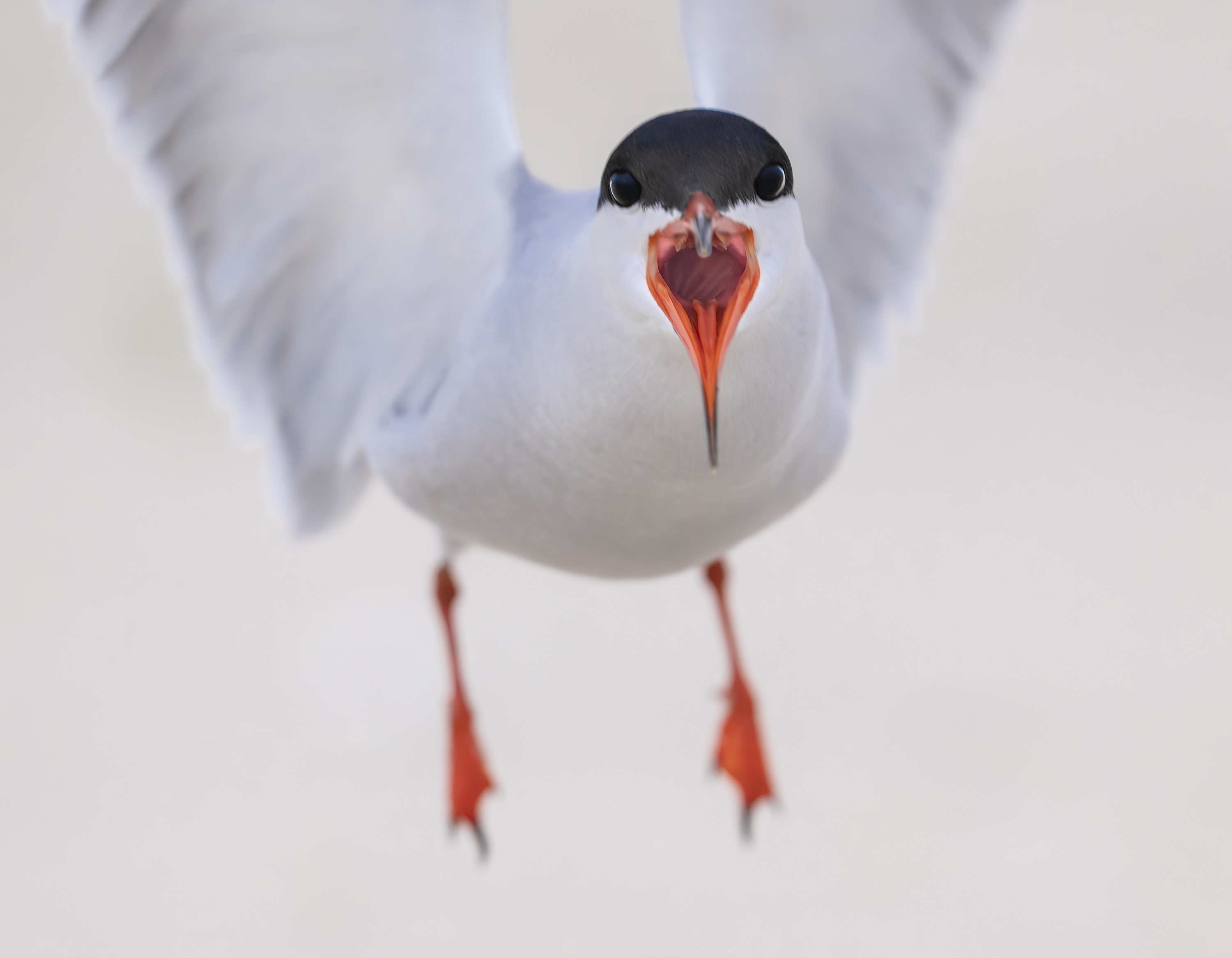
This image was also created on 23 May 2026 by yours truly at Nickerson Beach Park, Lido Beach, Long Island, NY. Seated on dry sand, I used the hand held Sony FE 300mm f/2.8 GM OSS Lens (Sony E) with the Sony FE 1.4x Teleconverter with the Latest Greatest Sony Flagship Body, the a1 II Mirrorless Camera. Exposure determined via Zebras with ISO on the Thumb Wheel. ISO 2000: 1/1000 (!) sec. at f/4 (wide open) in Manual mode. RawDigger showed that the exposure was perfect. AWB at 6:36:44am on a cloudy morning. Tracking: upper center Zone AF/C with Bird Eye/Face Detection enabled performed perfectly. Click on the image to enjoy the larger, inexplicably sharper high-res version. Image #3: Common Tern screaming/tight flight |
Barely …
As the terns are small, fast erratic flyers at times I was lucky to get enough of this bird into the top of the frame to create a tight screaming boxy crop.
|
|
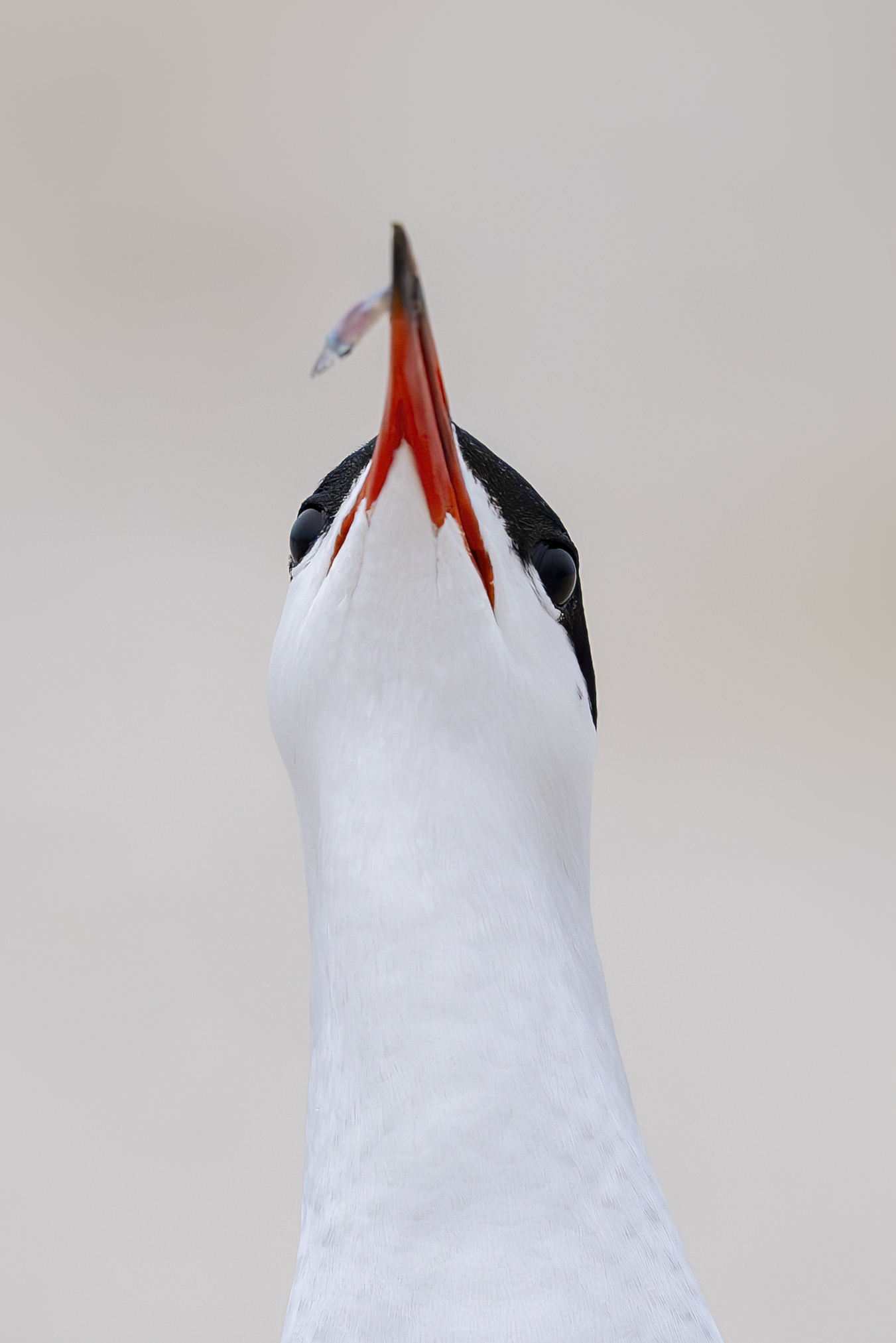
This is a huge crop of an image also created on 23 May 2026 by yours truly at Nickerson Beach Park, Lido Beach, Long Island, NY. Seated on dry sand, I used the hand held Sony FE 300mm f/2.8 GM OSS Lens (Sony E) with the Sony FE 1.4x Teleconverter with the Latest Greatest Sony Flagship Body, the a1 II Mirrorless Camera. Exposure determined via Zebras with ISO on the Thumb Wheel. ISO 2500: 1/2500 sec. at f/4 (wide open) in Manual mode. RawDigger showed that the exposure was perfect. AWB at 6:51:34am on a cloudy morning. Wide AF-C with Bird Eye/Face Detection enabled performed perfectly. Click on the image to enjoy the larger, inexplicably sharper high-res version. Image #4: Common Tern courtship display — offering tiny fish |
Incredible Sharpness — Zero Depth of Field
The original horizontal frame included the subject bird in the center of the frame. It would have worked nicely as a full bird vertical but another tern photo-bombed the image by covering the lower left part of the bird with an out of focus blob. I tried several tight crops and eventually went with the mega-crop above. The sharpness and detail in an image that is using just slightly more than 4% of the original pixels is quite remarkable. The depth of field on the other hand is razor thin; the eyes of the tern are 100% sharp while the bill tip and the tiny fish are not even close. Why? The wide open aperture of f/2.8 and the fact that I was relatively close to the subject.
|
|
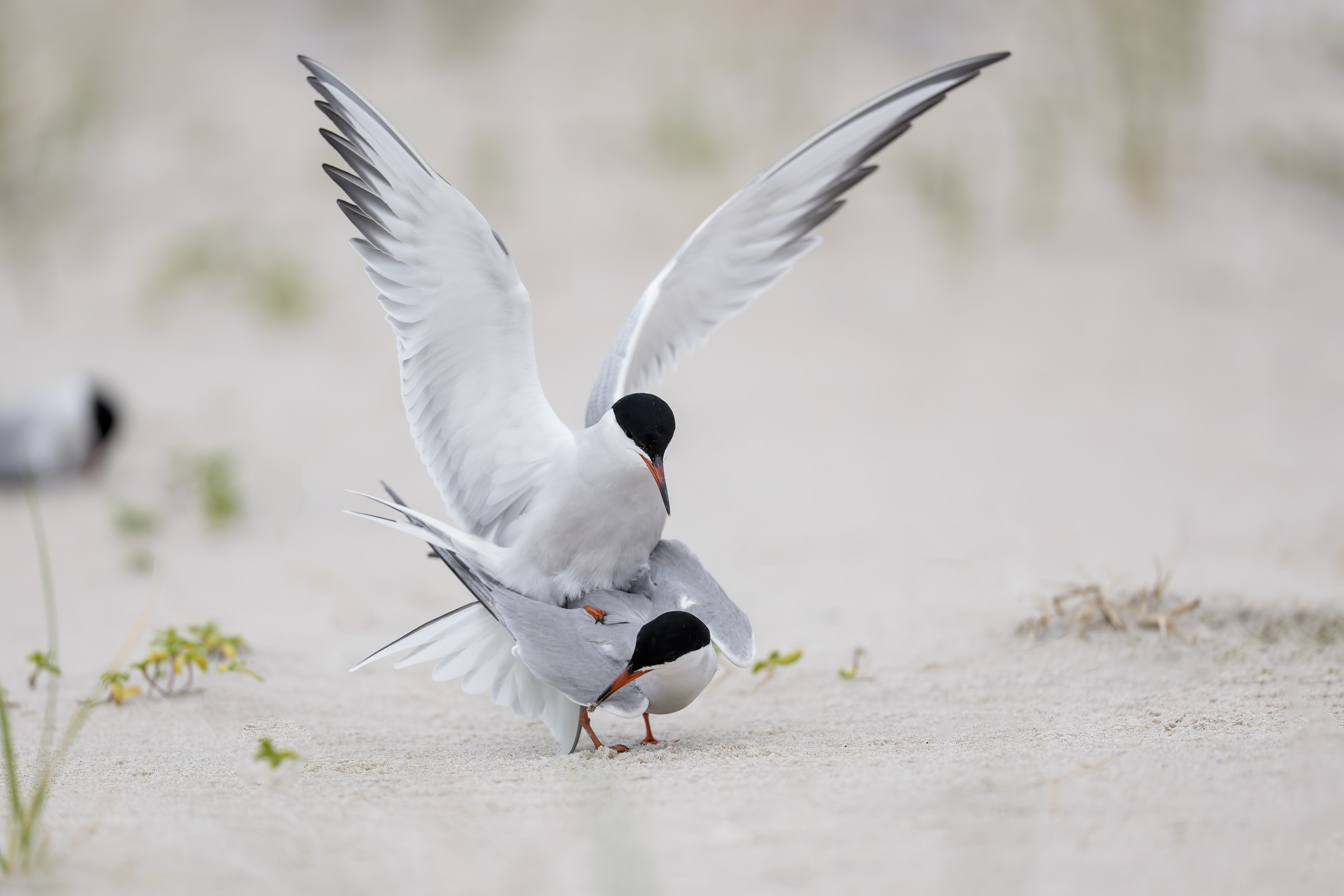
This image was also created on 23 May 2026 by yours truly at Nickerson Beach Park, Lido Beach, Long Island, NY. Seated on dry sand, I used the hand held Sony FE 300mm f/2.8 GM OSS Lens (Sony E) and the Latest Greatest Sony Flagship Body, the a1 II Mirrorless Camera. Exposure determined via Zebras with ISO on the Thumb Wheel. ISO 2500: 1/5000 sec. at f/2.8 (wide open) in Manual mode. RawDigger showed that the exposure was perfect. AWB at 6:56:42am on a cloudy morning. Tracking: Center Zone AF-C with Bird Eye/Face Detection enabled performed perfectly. Click on the image to enjoy the larger, inexplicably sharper high-res version. Image #5: Common Tern pair copulating |
Taking Their Time
I noticed on my two visits that the early season pre-copulatory stands were lasting for at least several minutes during which there would be multiple copulations. I was shooting verticals at 420mm knowing that I would be clipping the wings in most every frame. It took me at most 33 seconds (6:56:07 till 6:56:42) to remove the 1.4X TC and re-mount the lens onto the a-1 ii.
|
|
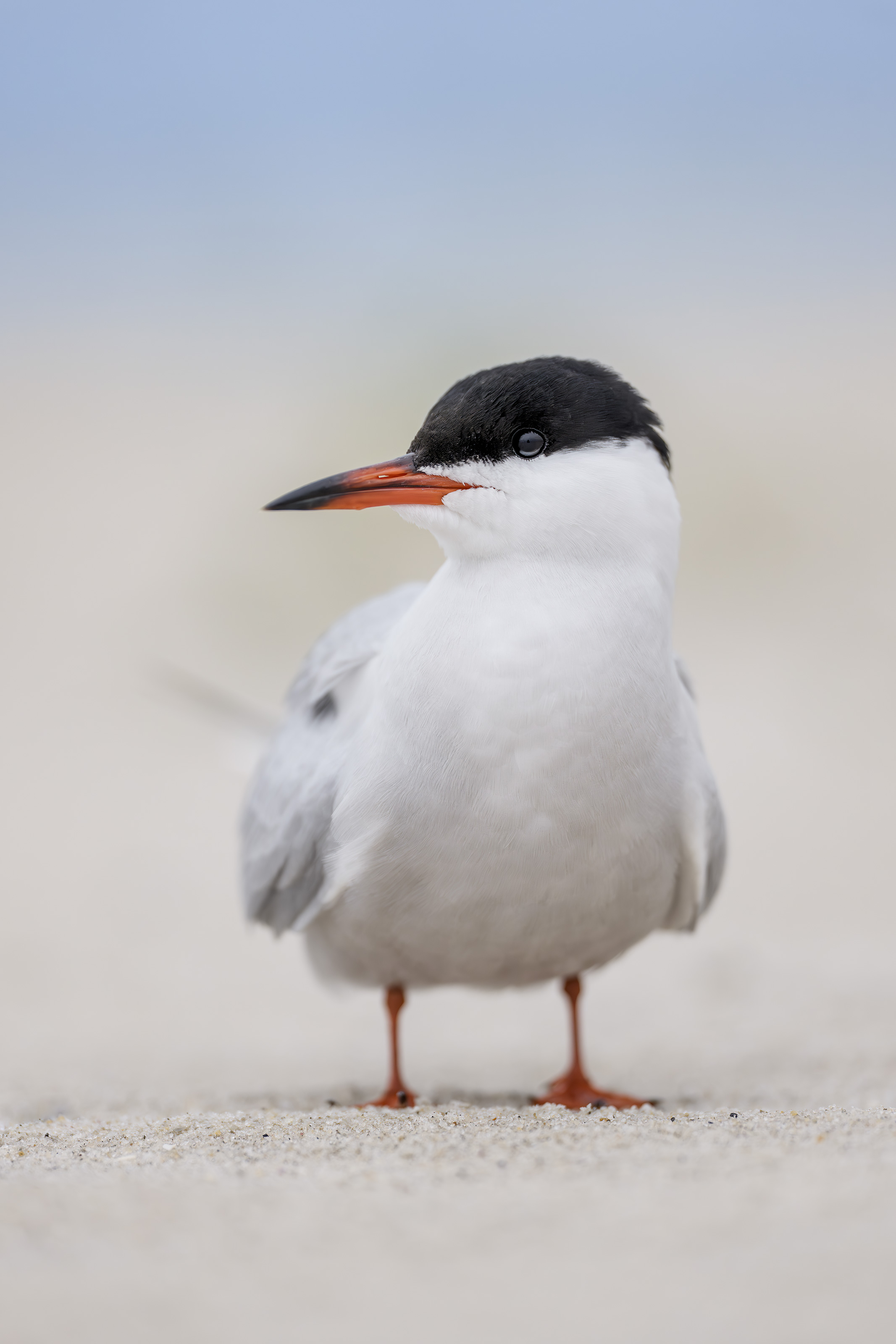
This image was also created on 23 May 2026 by yours truly at Nickerson Beach Park, Lido Beach, Long Island, NY. Seated on dry sand and working off the tilted rear monitor, I used the hand held Sony FE 300mm f/2.8 GM OSS Lens (Sony E) and the Latest Greatest Sony Flagship Body, the a1 II Mirrorless Camera. Exposure determined via Zebras with ISO on the Thumb Wheel. ISO 2000: 1/4000 sec. at f/2.8 (wide open) in Manual mode. RawDigger showed that the exposure was perfect. AWB at 6:57:54am on a cloudy morning. Tracking: Upper Center Zone AF-C with Bird Eye/Face Detection enabled performed perfectly. Click on the image to enjoy the larger, inexplicably sharper high-res version. Image #6: Common Tern vertical portrait |
Using the Rear Monitor Hanging in Space
The handsome bird in Image #6 landed very close to me on my left. As it was facing right at me, I knew it would make a lovely vertical at 300mm. I did not want to scare the bird into flight, so rather than trying to turn my body while seated, I flipped down the vertical rear screen, rotated my upper torso slowly to the left, framed the image, trusted the AF system, and fired off a short burst. Mission accomplished.
One of the Great Challenges of Bird Photography
Bird photography often requires you to make many decisions quickly: What shutter speed? What aperture? Sit or stand (or lie down)? Zoom in or out? What ISO? Get closer or stay where you are? TC or not? If yes, which one? What AF pattern? And most recently, full frame or APS-C? The success of a given image often depends on making the correct decision or a series of decisions in a matter of seconds at most. If you get even one of them wrong, you will be trashing the resulting images.
|
|
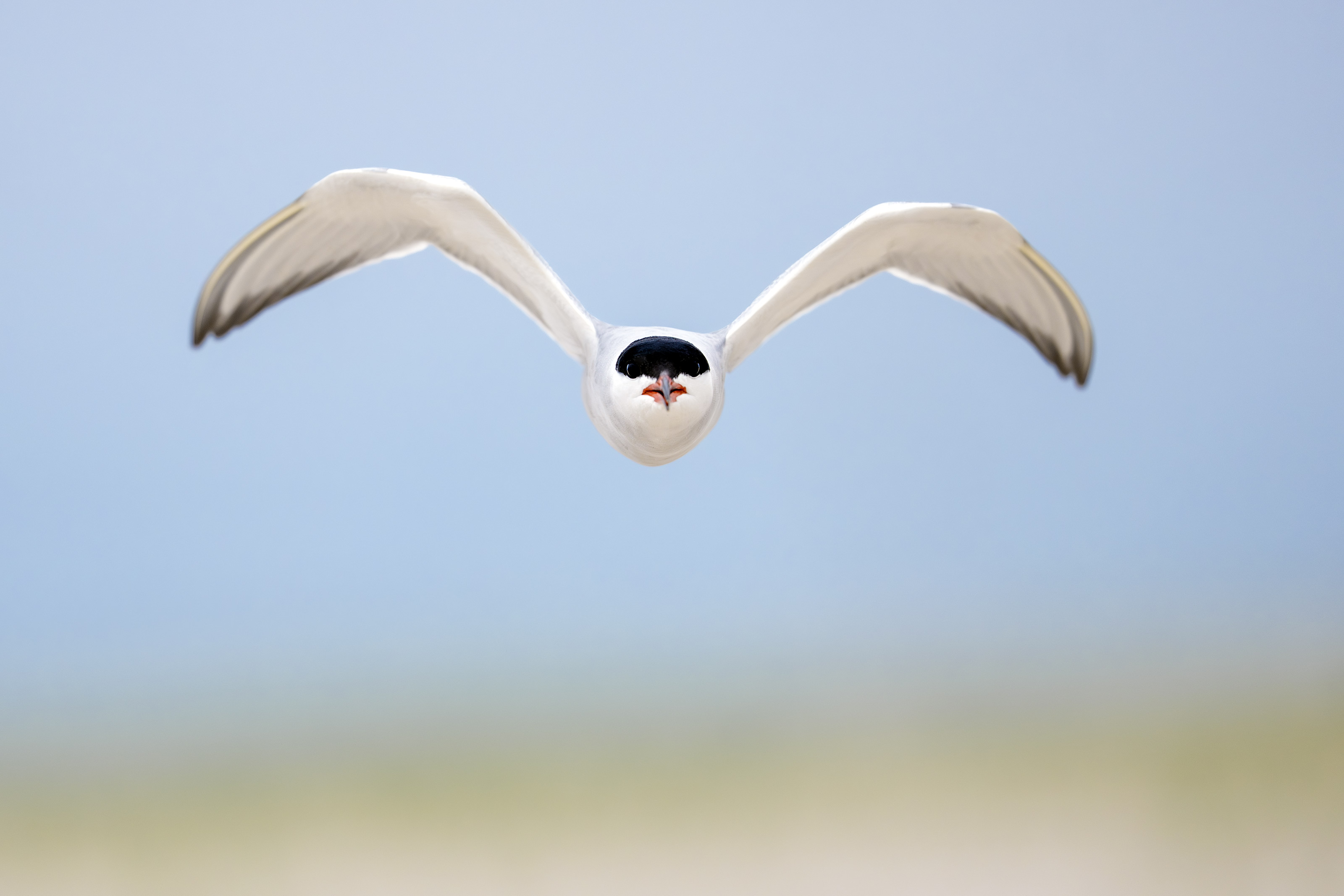
This image was also created on 23 May 2026 by yours truly at Nickerson Beach Park, Lido Beach, Long Island, NY. Seated on dry sand I used the hand held Sony FE 300mm f/2.8 GM OSS Lens (Sony E) and the Latest Greatest Sony Flagship Body, the a1 II Mirrorless Camera. Exposure determined via Zebras with ISO on the Thumb Wheel. ISO 2000: 1/4000 sec. at f/2.8 (wide open) in Manual mode. RawDigger showed that the exposure was perfect. AWB at 7:15:37am on a cloudy morning. Wide AF-C with Bird Eye/Face Detection enabled performed perfectly. Click on the image to enjoy the larger, inexplicably sharper high-res version. Image #7: Common Tern in flight/attack mode |
Why the 300mm f/2.8GM on Saturday?
In the previous blog post, I explained that I went with the 400-800 on Friday because of the brightening skies and for its exceptional reach. So why the change on Saturday? The forecast was for 100% cloud cover all morning and when I arrived at 5:30am it was in fact 100% cloudy. With not a hint of a patch of blue anywhere and the low light conditions, I knew that I needed my super-fast lens to do some flight photography. With a stiff wind from the northeast, the 300mm f/2.8 GM was the obvious choice. As things turned out, it was the perfect choice.

|
|
This image was also created on 23 May 2026 by yours truly at Nickerson Beach Park, Lido Beach, Long Island, NY. Seated on dry sand I used the hand held Sony FE 300mm f/2.8 GM OSS Lens (Sony E) with the Sony FE 2x Teleconverter and the Latest Greatest Sony Flagship Body, the a1 II Mirrorless Camera. ISO 1600. Exposure determined via Zebras with ISO on the Thumb Wheel; 1/800 sec. at f/5.6 (wide open) in Manual mode. RawDigger showed that the exposure was dead solid perfect: AWB at 7:50:01am on a cloudy morning. Tracking: Spot S (small)/AF-C with Bird Eye/Face Detection enabled performed perfectly. Image #8: American Oystercatcher family with one chick struggling to climb out of the tire track |
Dangerous Choice?
Adult oystercatchers along with tern and skimmer chicks of various sizes often choose to rest in the tire track ruts left by the far-too-numerous beach vehicles. Those include town and state police, garbage trucks, safety officers, and conservation agency and researcher vehicles. On chilly or very windy days, roosting in a deep rut can provide some shelter from hard conditions. And those same ruts might provide a bit of shade on hot sunny days.
The adult oystercatcher here was peacefully brooding her three chicks in a tire track, almost surely to get out of the wind. When momma bird returned from the surf with a tidbit for one of the chicks, the young ones woke up and headed for their female parent. As you can see in the images, chick in the middle had a hard time climbing up to the level beach.
On occasion, a chick or two is squished by a variety of beach vehicles. Especially those exceeding the posted 5mph signs.
On Changing Teleconverters
Many beginning photographers are reluctant to add or subtract a teleconverter to the mix in the field, especially at the beach on a windy day. That is something that I do often and with impunity no matter the conditions. If your camera closes the shutter with power off, be sure to turn your camera off and wait the 8 seconds or so until you hear the click. Removing the caps when adding a TC makes things easier. If you are standing in shallow water, exit before you make the change. Then, simply put your back to the wind, take care not to drop anything in the sand, and go about your business with confidence. Teleconverters are hugely valuable as they enable you to get “closer” without any additional risk of scaring off the subject allowing for more pixels on the subject.
|
|
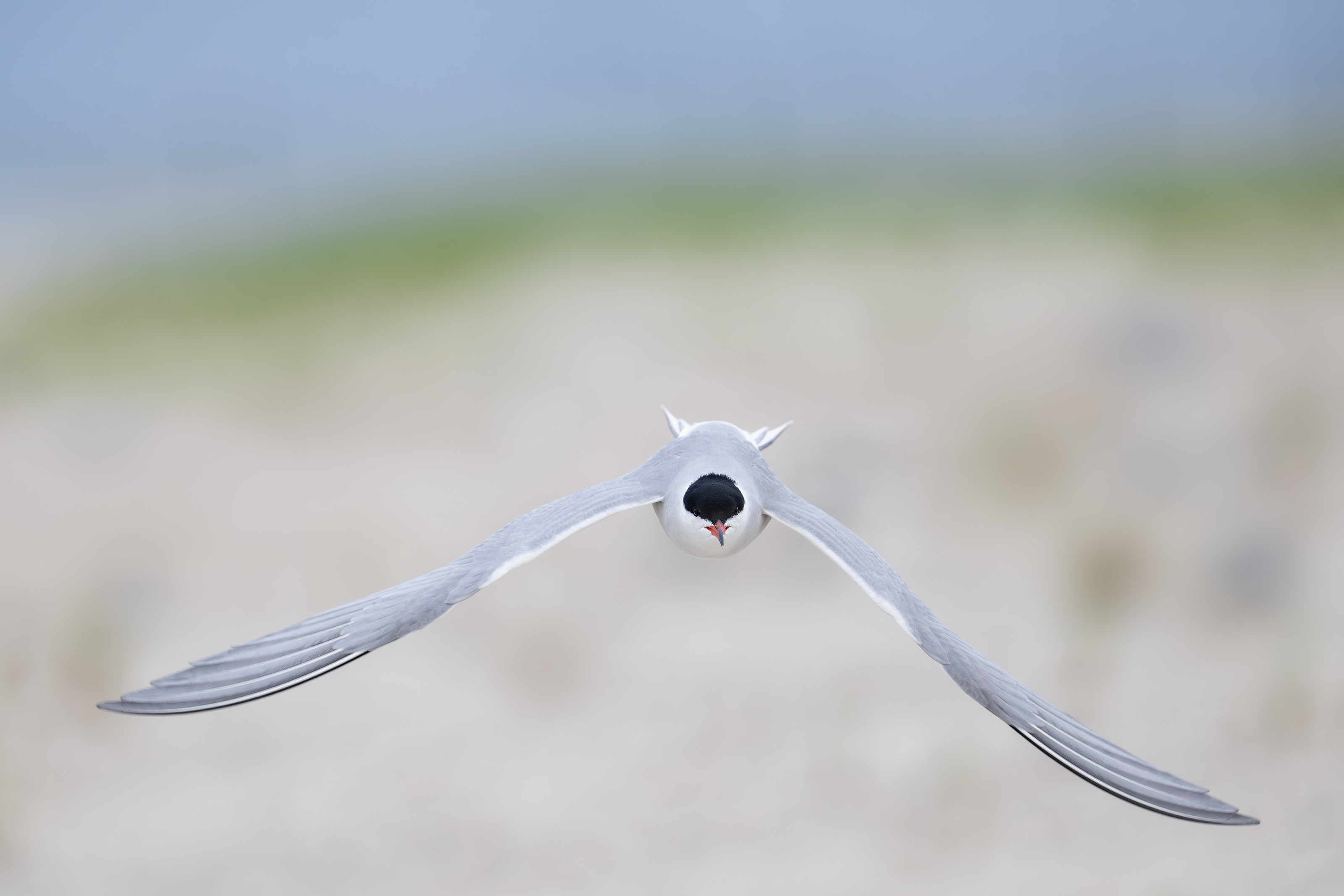
This image was also created on 23 May 2026 by yours truly at Nickerson Beach Park, Lido Beach, Long Island, NY. Standing at full height, I used the hand held Sony FE 300mm f/2.8 GM OSS Lens (Sony E) with the Sony FE 1.4x Teleconverter with the Latest Greatest Sony Flagship Body, the a1 II Mirrorless Camera. Exposure determined via Zebras with ISO on the Thumb Wheel. ISO 2000: 1/3200 sec. at f/4 (wide open) in Manual mode. RawDigger showed that the exposure was perfect. AWB at 8:09:39am on a cloudy morning. Wide AF-C with Bird Eye/Face Detection enabled performed perfectly. Click on the image to enjoy the larger, inexplicably sharper high-res version. Image #9: Common Tern on final approach |
Visualizing the Background and Executing the Plan
Terns flying back to the colony will often hover above their scrape nest and then descend. My goal was to create some images that included a dorsal view of those terns, bit of sky, a strip of green beach vegetation, and a beach background with a smattering of an out of focus terns. Bingo!
|
|
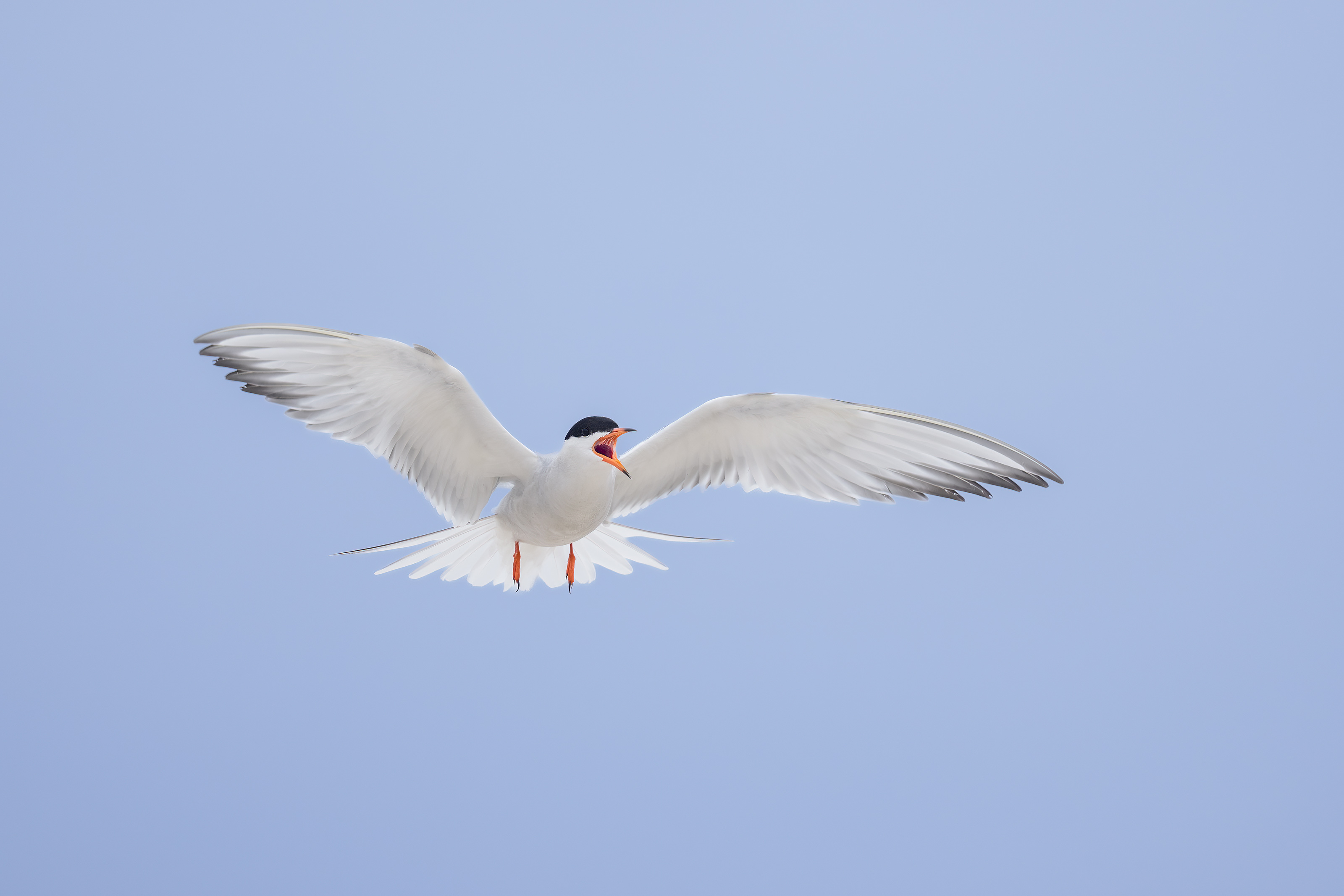
This image was also created on 23 May 2026 by yours truly at Nickerson Beach Park, Lido Beach, Long Island, NY. Again, standing at full height, I used the hand held Sony FE 300mm f/2.8 GM OSS Lens (Sony E) with the Sony FE 1.4x Teleconverter with the Latest Greatest Sony Flagship Body, the a1 II Mirrorless Camera. Exposure determined via Zebras with ISO on the Thumb Wheel. ISO 2000: 1/3200 sec. at f/4 (wide open) in Manual mode. RawDigger showed that the exposure was perfect. AWB at 8:09:39am on a cloudy morning. Wide AF-C with Bird Eye/Face Detection enabled performed perfectly. Click on the image to enjoy the larger, inexplicably sharper high-res version. Image #10: Common Tern hovering and calling before landing |
Won’t You Make My White Sky Blue
The blue skies in Images #1, 6, 7, 9 & 10 and the pinkish almost violet sky in Image #2 were created by masking the white skies in Adobe Camera Raw (using a variety of selection techniques) and then pulling down the Exposure, decreasing the Color Temperature, and playing with the Hue slider. All as detailed (plus tons more) in the Digital Basics IV Video Series.

|
|
For those who did not use my link to purchase their Sony 300mm f/2.8 GM lens, you can order your a copy here for $209.93. Click on the image to enlarge and to be able to read the fine print. |
The BAA Sony 300mm f/2.8 Lens Guide
Impressed by my (or Pat’s) Sony FE 300mm f/2.8 GM OSS Lens (Sony E) images? Use either my Bedfords or B&H affiliate link to purchase your Sony 300mm f/2.8 GM lens and shoot me your receipt via e-mail and request a copy of the first-ever BAA Lens Guide. I thought that it would take only minutes to create this guide, but I was dead wrong. In the process of creating it, I learned a ton about the lens. And even better, I discovered a simple yet potentially fatal flaw that was resulting in sporadically unsharp flight images. The set-up fix is simple. Just be sure to use one of my affiliate links and get the guide for free.
If not, you can purchase a copy here for $209.93. Yes, it never hurts to use my links and it never costs you one penny more. And if you contact me via e-mail before you make a major purchase, I can often save you some money.
Typos
With all blog posts, feel free to e-mail or to leave a comment regarding any typos or errors.












#5, good image design and an activity you don’t get to photograph much.
Thanks. Lots of copulations right now at Nickerson — isolating the birds is the trick!
with love, a
I’ll likely be going against the grain, but my favorite is #1. My reasons:
1. The beautiful OOF foreground and background leading to a spectacularly clean image.
2. The entire bird below the horizon line.
3. The low POV.
4. The intimacy of the image that is created by points 1-3.
Thanks, Pugs. Funny, when I was in the field I loved #1. In retrospect? Not so much.
with love, artie
Artie #4 is my favorite, like the head position, the fish near the tip of the beak and the clean sand background.
Thanks, Monte. Always good to see you leaving a comment. I love that one too.
with love, artie
I love #7 best. Simple design, lovely OOF background. Thanks!
Thanks, J Marr. That bird was a bit pissed 🙂
with love, artie
#5 is my choice — the black wing tips and black heads of the birds make a nice design. But, were it my image, I would have cropped out the distracting bird on the left. The resulting image would also have had the advantage of putting the copulating couple more off-center, which I think would have improved the overall look.
Thanks. Some folks distracting bird is a scene-setter for others 🙂
a