
Summary
When you look at an image today — anytime, anywhere — it can be incredibly difficult to tell if you are looking at a photograph that depicts a real moment or some sort of digital creation. Keep reading to hear my thoughts on this and other related matters, and to learn why honest disclosure is an absolute must. Please feel free to share your thoughts and opinions by leaving a comment below.
Note: Copy editing, technical refinement, and formatting for this blog post were assisted by Gemini AI. I have never used, and will never use, Generative AI on my photographs.
My Call
In the last blog post — Going to Extremes w/the Sony 100-400 f/4.5 GM OSS Lens, my top pick by a mile was image #1, the canal-scape with Great Egret and Green Heron. All but one commenter agreed for the obvious reasons. Steve said it best: #1 is my favorite. Did someone say “ethereal”? Jim Saxon liked #4 best; that was my second pick. Many folks mentioned #2, the tight face shot of the adult crane; that one was my least favorite.
Your Job Today
Please peruse both of today’s featured images carefully and let us know if you think that one or both are digital creations, i.e., photo illustrations as defined below. In other words, are they Photoshopped or are they real? Do let us know your reasoning.
What’s Up?
With a west wind every morning, photography at Huguenot Memorial Park has been a bit challenging yet tremendously rewarding for everyone. And the number of young Royal Terns on the beach and the sounds of the colony are staggering. David, Michelle, and Ray headed home on Sunday. Multiple IPT veterans Alvin “Red” Stevens and Jim Dolgin have joined me on a BAA Invited Friends IPT. We are having a blast.
Today is Tuesday 14 July, 2026. The three of us will be headed back to the beach early this morning. Then brunch, Image Review, some Photoshop, a little bit of FIFA World Cup, and then back to Huguenot. Whatever you opt to do, we hope that you too choose to have fun and enjoy life. Please remember that happiness is a choice Byron Katie – The Work.Com
If an item — a Delkin flash card or reader, a Levered-clamp FlexShooter Pro, or a Wimberley lens plate or low foot — for example, that is available from B&H and/or Bedfords, is also available in the BAA Online Store, it would be great, and greatly appreciated, if you would opt to purchase from us. We will match or beat any price. Please remember also to use my B&H affiliate links or to earn 3% cash back at Bedford by using the BIRDSASART discount code at checkout for your major gear purchases. Doing either often earns you free guides and/or discounts. And always earns my great appreciation.
Gear Questions and Advice
Too many folks attending BAA IPTs and dozens of photographers whom I see in the field and on BirdPhotographer’s.Net, are — out of ignorance — using the wrong gear, especially when it comes to tripods and more especially, tripod heads. And the same is true in spades when ordering new camera bodies or lenses. My advice will often save you some serious money and may help you avoid making a seriously bad choice. Please know that I am always glad to answer your gear questions via e-mail. If you are desperate, you can try me on my cell at 863-221-2372. Please leave a message and shoot me a text if I do not pick up.
Image Creation and Optimization Ethics in Today’s World
Before diving into this discussion, we need to establish a few key definitions and ground rules:
1. A photograph is a still image created by a camera (as opposed to a video).
2. Computer-generated art is an image created by giving instructions to a computer, typically utilizing Artificial Intelligence (AI).
3. A photographic illustration is an image based on an original photograph (or photographs) that has been altered so that it no longer represents the true natural history of the moment. This may or may not include assistance from AI. If you combine elements from two different photographs in a single frame, then you are creating a photographic illustration. However, if you stitch together or otherwise combine multiple photographs to show a wider view, your final product is still a photograph. Most folks would call these panos, short for panoramas.
4. Like beauty, art is in the eye of the beholder.
5. I propose that all nature photographers are artists.
6. Documentary photographers are held to very strict standards; it is their responsibility to record exactly what they saw and share it in its unaltered form. If they choose to tweak reality, they risk being publicly shamed, losing their jobs, or both. More than a few photojournalists, and even some prestigious publications, have been caught with their hands in that cookie jar. Even some very famous nature photographers who presented photographic illustrations as authentic photographs have wound up being thoroughly chastised.
Image Creation
The discussion here is a straightforward one: if you create an image with a camera and a lens, you are making a photograph. If you are sitting at a computer telling it what sort of picture you would like it to make, you are creating computer-generated art.
Regarding the latter, my stance is exactly the same as it has always been for any type of image: if you share it anywhere, 100% honesty is an absolute must. In my book, as long as you tell people exactly what you did, anything goes. If you do not disclose it, you are a liar. The sad truth today, particularly on social media, is that you often have no idea whether you are looking at an authentic photograph, a photographic illustration, or pure computer-generated art.
Furthermore, the usually unasked questions (except by me) often open up some cans of very ugly worms: Was the bird baited? Was audio playback used to attract the subject? Did you use audio on an endangered species? Were you in the park illegally after hours? Did you take a just-fledged songbird from a mist net and tie it to a log with a thread? Is that a photo of a restrained captive bird? Did you grab a chick from a nest, swing it around your head to dizzy it, and place it on a branch for a quick portrait? Did you put a bathtub stopper in the entrance hole of a swallow or bluebird box for fifteen minutes to force the stressed-out parents to hover desperately in front of your workshop participants’ lenses while their hungry chicks screamed inside in the dark?”
Sorry boys and girls, nothing above is fictitious. I once saw a gorgeous print of a male Northern Harrier on a weathered fence post, surrounded by a garland of blooming wildflowers. Knowing that “gray ghosts” are incredibly wary, I asked the photographer where he made the image. He answered unabashedly, “In my basement.” In addition to being an old-time bird photographer, he was a bird bander.
Image Optimization Ethics
There are some purists who proudly state that they capture in RAW and present their images exactly as they came out of the camera, with zero “manipulation.” They wear it like a badge of honor. But they are completely missing the boat. A RAW file is simply a digital negative. In fact, RAW files that are properly exposed (to the right) often look flat, boring, and washed out. We must use a RAW converter — most often Adobe Camera Raw (ACR) — to properly develop those negatives. Even the most stringent international nature photography contests allow for adjusting the color and contrast of a RAW file, though often only on a global basis where changes apply to the entire image.
In my experience, when you speak with these self-proclaimed purists and ask them a simple question — “If there were a cigarette butt in your otherwise beautiful avian image, would you remove it?”— nine out of ten would instantly answer, “Of course.”
That leads us to a slippery slope with plenty of gray areas — a slope on which there is no fine line. To me, it makes no difference whether you “just” remove a single black speck from an otherwise pristine beach or do a massive cleanup of a messy sand flat; either way, you have simply cleaned up the image and rendered it more pleasing. For me, the critical question is this: Have you maintained the natural history of the moment? If your subject was a juvenile Sanderling preening its belly feathers, and — after the clean-up, it remains a juvenile Sanderling preening its belly feathers, you have preserved exactly what was happening in nature.
Here is where I stand, and it is exactly where I have stood for several decades: I routinely make global and local adjustments to color and contrast. I crop for composition and add canvas using Content-Aware Fill as needed. Once the RAW file is rendered as a TIF, I use a cadre of Photoshop tools to eliminate a wide variety of distracting elements from the background, the foreground, and the subject itself. I will — for example, clean up a bird’s bill and at times, a messy feather or two. But when I am done, the bird is doing exactly what it was doing before the image optimization.
You are the artist. Ultimately, you get to decide exactly what your image looks like. My firmly held belief is that when sharing an image publicly, you must let folks know what you have done. The same is true when captioning photos submitted for publication: “Royal Tern with head replaced from the same sequence,” for example.
So, what is right, and what is wrong? Absolutely nothing — as long as you are honest, truthful, and explicitly reveal what you have done. Call it exactly what it is: a photograph, a photographic illustration, or a computer-generated image.
It goes without saying, of course, that if you enter a photography contest, you must read and strictly abide by its specific guidelines.
|
|
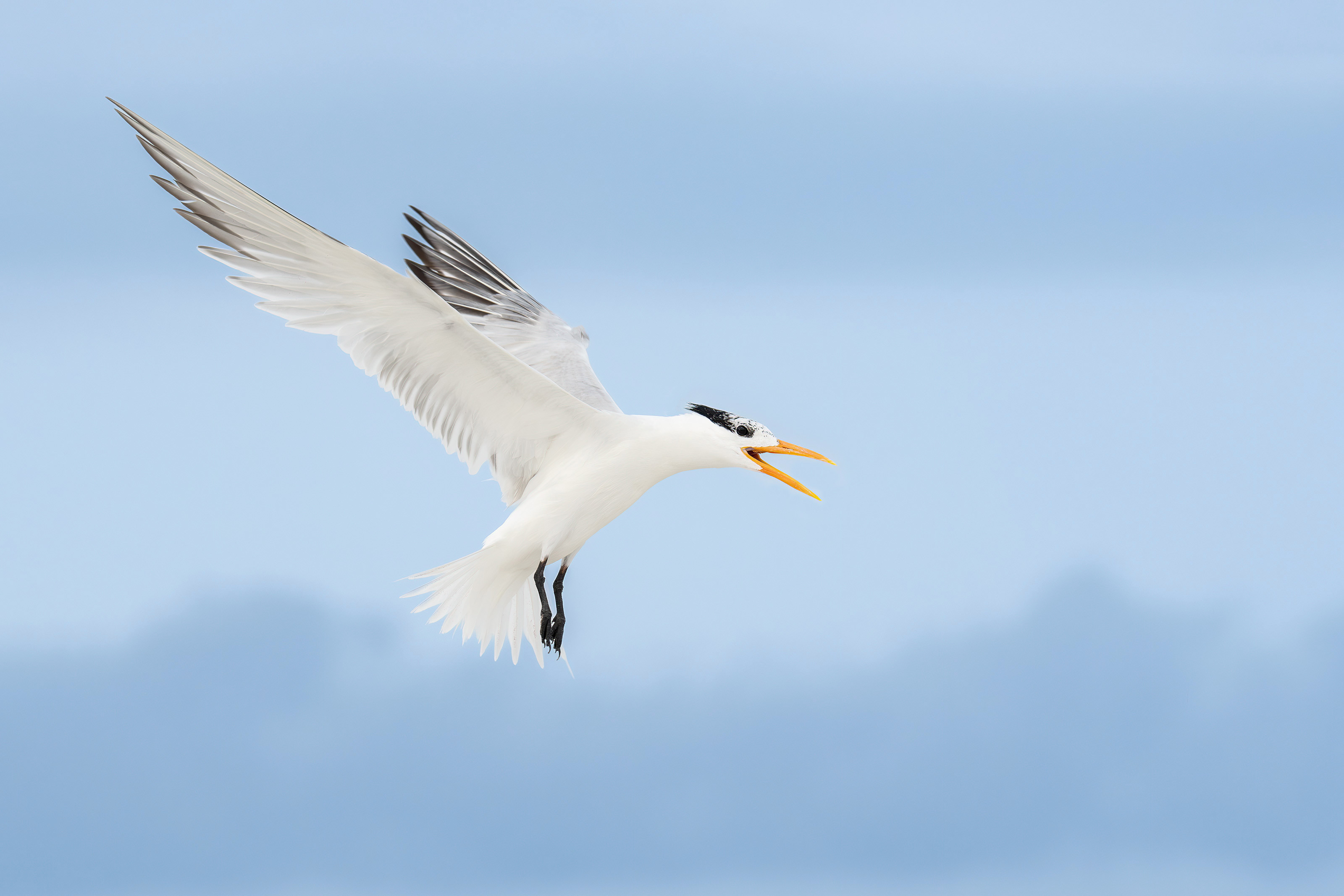
This photograph/photo illustration (?) was created on 10 July 2026 by yours truly at Huguenot Memorial Park northeast of Jacksonville, FL. Standing at full height, I used the handheld Sony FE 100-400mm f/4.5 GM OSS lens (at 229mm/effective focal length: 343.5mm) and The Latest Greatest Sony Flagship Body, the a-1 II Mirrorless Camera (in APS-C mode). The exposure was determined by Zebras with ISO on the rear wheel. ISO 1600: 1/3200 second at f/5.6 (stopped down 2/3 stop in error) in Manual mode. AWB at 6:55:18pm on a mostly cloudy afternoon. Wide/AF-C with Bird-Eye/Face Detection performed perfectly. Click on the image to enjoy a larger high-res version. Image #1: Royal Tern calling above a creche of large chicks |
The Big Question
Do you think that one or both of today’s featured images are digital creations, i.e., photo illustrations as defined above. In other words, are they real or are they phony? Do let us know your reasoning.
The Sony FE 100-400mm f/4.5 GM OSS Lens
Since I got my hands on the new lens, I have been using it handheld for all but a single morning session here in JAX. It is a real workhorse and, along with an a-1 ii and the 1.4x TC, would be the perfect solution for anyone who wants to sell all their Canon or Nikon gear and get going with Sony.
|
|
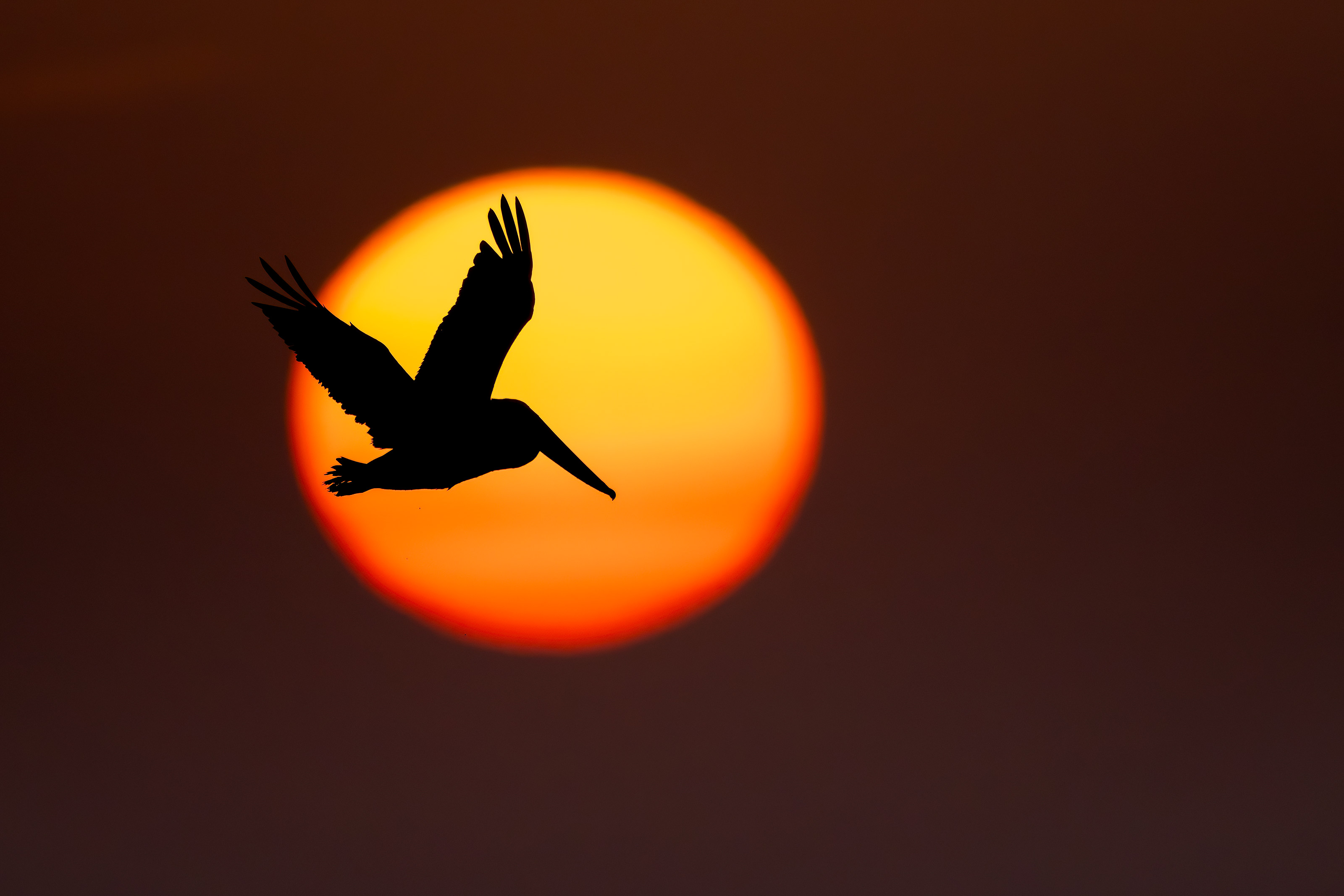
This photograph/photo illustration (?) was created on 11 July 2026 by yours truly at Huguenot Memorial Park east of Jacksonville, FL. Standing at full height, I used the Robus RC-5570 Vantage Series 3 Carbon Fiber Tripod/Levered-Clamp FlexShooter Pro-mounted Sony FE 600mm f/4 GM OSS lens with the Sony FE 1.4x Teleconverter, (840mm/effective focal length: 1260mm) and The Latest Greatest Sony Flagship Body, the a1 II Mirrorless Camera in APS-C crop mode. The exposure was determined by Zebras with Exposure Compensation (EC) on the thumb wheel. Multi Metering +0.3 stops. AUTO ISO set ISO 2500: 1/3200 second at f/5.6 (wide open) in Shutter Priority mode. AWB at 6:37:48am on hazy morning about five minutes after sunrise. Wide/AF-C with Bird-Eye/Face Detection performed perfectly. Click on the image to enjoy a larger high-res version. Image 2: Brown Pelican in muted sunball |
The Big Question
Do you think that one or both of today’s featured images are digital creations, i.e., photo illustrations as defined above. In other words, are they real or are they phony? Do let us know your reasoning.
The Big White Six
On my first morning at Huguenot, I went with the tripod mounted 600mm f/4 so that I would be twins with David Pugsley. He has tried APS-C crop mode and is loving it. It was my first morning using the big lens in about two weeks and thus the first time on a tripod during that time.
If By Chance
If by chance, you have decided to purchase the quite amazing and incredibly versatile Sony FE 100-400mm f/4.5 GM OSS lens, please consider using one of my two affiliate links so that you will earn a free copy of the next BIRDS AS ART Lens Guide, coming soon to a theater near you. Kindly e-mail for details; I just might be able to save you some money.
Typos
In all blog posts and Bulletins, feel free to e-mail or to leave a comment regarding any typos or errors. Just be right :).









Artie: I’m not going to answer your question: both photos, which I like a lot, are plausibly photographs by your definition, not photo-illustrations. But that doesn’t mean I know that they ARE photographs. Years ago when there was a near-full moon at Bernardo Wildlife Management Area in New Mexico I studied the wind, the tome the moon would rise over the mountains, and the flight patterns of the sandhill cranes. Based on that knowledge I went to the management area and spent a long time trying to get a good photograph of a crane or cranes flying in front of the moon, like yours today of the pelican flying in front of the sun. I got a few good ones and was pretty proud of myself for doing all that work and for getting a good result. I showed my favorite image to a friend, who complimented me on my Photoshop skills. Needless to say I was crushed.
Who knows if they are digital creations. I would say only you know for sure as we don’t have the files. Don’t photo contests require the file? And that’s how they spot the fakes, through analysis of the file? I doubt anyone can “prove” the file was manipulated just by looking at the image.
I’m with you, I don’t care as long as I’m told.
Quite agree with your comments about cleaning up an photo, but not altering the image. I also feel that some wildlife photographer competitions are wrong to include trail cameras What these have to do with the skill of the photographer beats me!
And I agree with you on the images created while the photographer is sleeping. The BBC once gave a ton of prizes (including the big one I think) to a guy using night-time set-ups for Snow Leopards. All the images were created when he was nowhere near the camera. To me that is arts and crafts stuff.
artie
I’ve had the same question as Patricia. If one is going to repair clipped wingtips, nothing in my limited experience beats Photoshop’s Crop > Generative Expand. If you ask for wingtips, it will give you crazy wingtips that have nothing to do with your image. But skip the instruction box, and it gives you three possibilities, at least one of which is usually excellent (maybe not good enough to fool an ornithologist, but then what artificial wingtip would be).
On the two photos, hard to tell, as Artie says. But I suspect the pelican silhouette is too easy a choice. I remember BAA sun silhouettes from film days in The Art of Bird Photography, and as Artie has said twice, the sun was muted. Enlarged, the pelican looks fine, whereas the tern looks a bit oversharpened (as always, on my screen, not yours or Artie’s). So I suspect that one more, but who knows? Clipped a wing in cropped sensor mode? Maybe, maybe not.
Thanks for sharing your thoughts. And yes, most folks would jump on the pelican as being phony. As the next blog post will show, it is in fact the straight shot, 100% real. And yes the tern looks perfect from here. There was actually a clue in the text as to what I did with the tern 🙂
much love, artie
Artie
Looks to me like you took that Brown Pelican and leashed her and swung her around your head to dizzy her and then ya danced the do-si-do, found a sunset to see her fly by and snapped a few clicks. #2 much gooder one then #1
Always with love b
I agree that number 2 is much gooder. I actually tied the pelican to the sun and swung it around.
love you man, artie
Both of today’s images are really great, with the Tern being my favorite. Both could be illustrations, or not. The sky in #1 is very well positioned with respect to the subject and could have been manipulated or replaced. If beach cleanup is inbounds, sky cleanup is not a lot different. In image #2 the sky was not replaced but under exposed to the extent it is not visible, or an ND filter could have been used. Does that make it an illustration, or are most all silhouettes illustrations by definition like say, intentional blurs? But as you say, the way around these ethical issues is to state what was altered if anything was. Thanks for an interesting discussion.
Thanks, Warren. The sky in the tern image was enriched during the RAW conversion but nothing that was not 100% kosher. It is also kosher to use an ND filter and wind up with a real photo. I did not need one as the sun was so muted.
See tomorrow’s post to learn a ton more.
much love, artie
Art: In several recent blogs you have said you use Gemini AI but would never use Generative AI, but have not said why. So, please tell us why. Thanks!
I do not use Gemini AI for my photos as it does not have that capability. I use it for legal and scam advice, general info, and as a writing assistant.
I have not used anything Generative on my photos because it can be used to create stuff that is not there. But as Cliff pointed out it can also create stuff based on something in the original image
with love, artie
It seems unlikely to me that even the miraculous Sony subject detection AF was able to lock on to a “Bird-Eye/Face” while looking directly into the sun. This could easily have been a combination of two photographs. However, Arthur’s detailed description of the equipment and techniques used argues against that position.
“Eye/Face detection” is far more believable for image #1.
All that I will say at this point is that the sun was well muted when the image was created.
with love, a