
Your Call
Which is your favorite flight image in my Sony α Universe article? If you must list more than one, that is fine. Please let us know why you made your choice (or choices). I will share my three favorites with you in the next blog post.
Note: If you have any questions about flight photography please ask them by leaving a comment below.
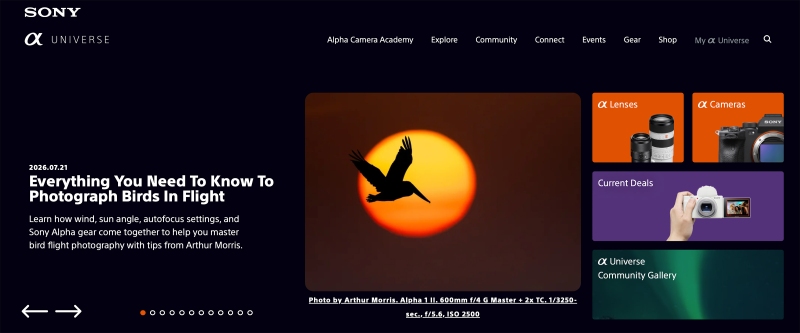
Wow! So I Am Famous — On Sony Alpha
I was thrilled and honored on Tuesday to see my flight photography article as the lead item on the Sony α UNIVERSE homepage. Thanks to Kishore Sawh of PixelShift Studio for putting me in touch with Sony α UNIVERSE editor Ali Fulks. Ali did a fabulous job of selecting the images and on the layout and design of the article.
Photographing birds in flight is one of the most unforgiving disciplines in wildlife photography. A fraction of a second is the difference between a masterpiece and a missed opportunity. In Mastering Avian Flight Photography with Sony Alpha Gear, we dive deep into everything that matters for flight photography: wind direction, light, shutter speeds, lenses, tripod or handheld, AF patterns, focusing tips, and more. Stop leaving your hit rate to chance!
Read, enjoy, and learn from one of my proudest achievements here.
Note: for those who are new to the blog, the pelican in the sunball photo is a real image, not a composite or an AI creation.
Note also: Copy editing, re-crafting, technical refinement, and formatting for this blog post and the article were assisted by Gemini AI. I have never used, and will never use, Generative AI on my photographs.
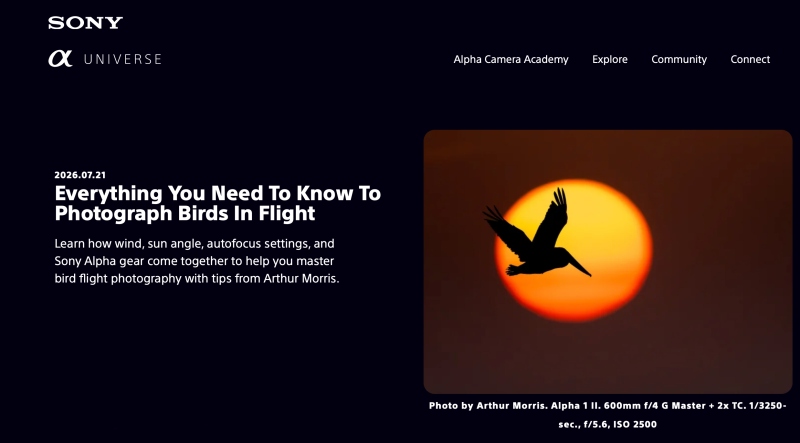
Mastering Avian Flight Photography with Sony Alpha Gear
You can click on the logo link immediately above to access the profusely illustrated article.
Few subjects test a shooter’s skill quite like birds in flight. Nailing the shot requires fast reflexes, impeccable technique, and an absolute mastery of wind and light. Few know this better than 80-year-old Arthur Morris. With 43 years in the field, the creator of BIRDS AS ART has built a world-renowned career capturing nature’s most dynamic moments. In his article here, Artie breaks down the essential skills – from reading the sky conditions and light to choosing and dialing in your Sony gear – to help you land crisp, keeper-quality flight shots.
I sent 21 photos with captions to Ali Fulks. She used an amazing 18 images with the article. The three that did not make the final cut are featured in today’s blog post so that you do not miss a single thing.
|
|
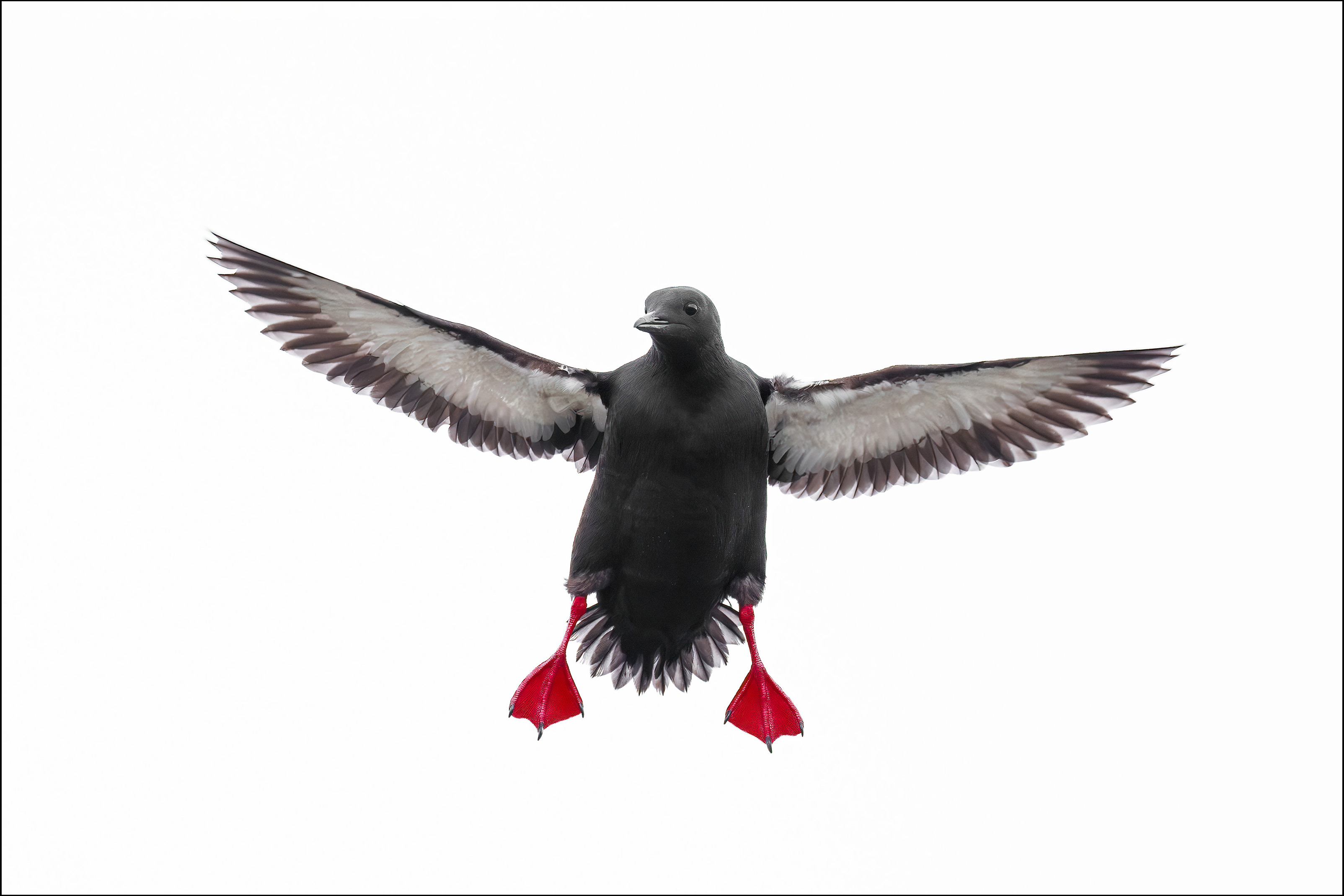
Frustrated by the erratic flight patterns of the incoming guillemots, I took my rig off the tripod and handheld Sony FE 600mm f/4 GM OSS lens and the A-1 (now replaced by The Latest Greatest Sony Flagship Body, the a1 II Mirrorless Camera.) Image #1: Pigeon Guillemot braking to land in the fog, Grimsey Island, Iceland |
Pigeon Guillemot braking to land in the fog, Grimsey Island, Iceland
Captured with the handheld Sony FE 600mm f/4 GM OSS lens and the Alpha 1. Even though the Sony 600mm f/4 is the lightest in its class, I cannot handhold it for more than a few minutes at most. The trick to photographing in the fog is to add a ton of light to the exposure suggested by the camera. In this case, with a dark subject, working in Manual mode, I added more than three full stops to the exposure reading off the sky.
|
|
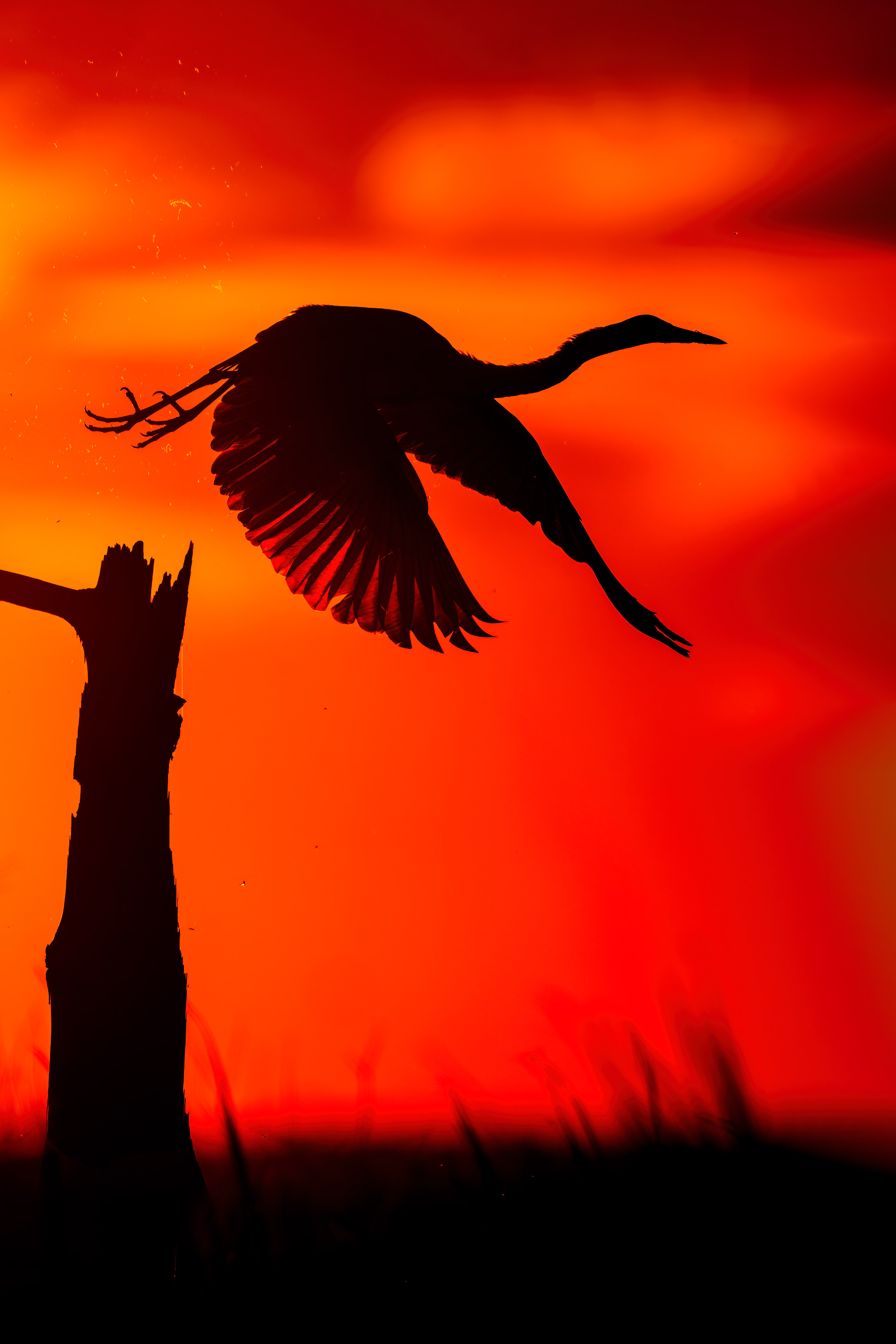
From my SUV, I used the BLUBB-supported Sony FE 600mm f/4 GM OSS lens with the Sony FE 1.4x Teleconverter, and Sony a-1 (now replaced by The Latest Greatest Sony Flagship Body, the a1 II Mirrorless Camera). Image #2: Great Egret taking flight at sunset, Indian Lake Estates, Florida |
Great Egret taking flight at sunset, Indian Lake Estates, Florida
From the driver’s seat of my SUV with the BLUBB (Big Lens Ultimate BeanBag) — supported Sony FE 600mm f/4 GM OSS lens, the 1.4X TC, and the Alpha 1. Tracking: Zone AF-C with bird face-eye enabled. When working with colorful skies at sunrise and sunset, I usually work in Shutter Priority Mode with AUTO ISO and exposure compensation (EC) on the Thumb Dial. I choose a fast shutter speed and dial in some positive EC. The wings fully down flight pose is very powerful.
|
|
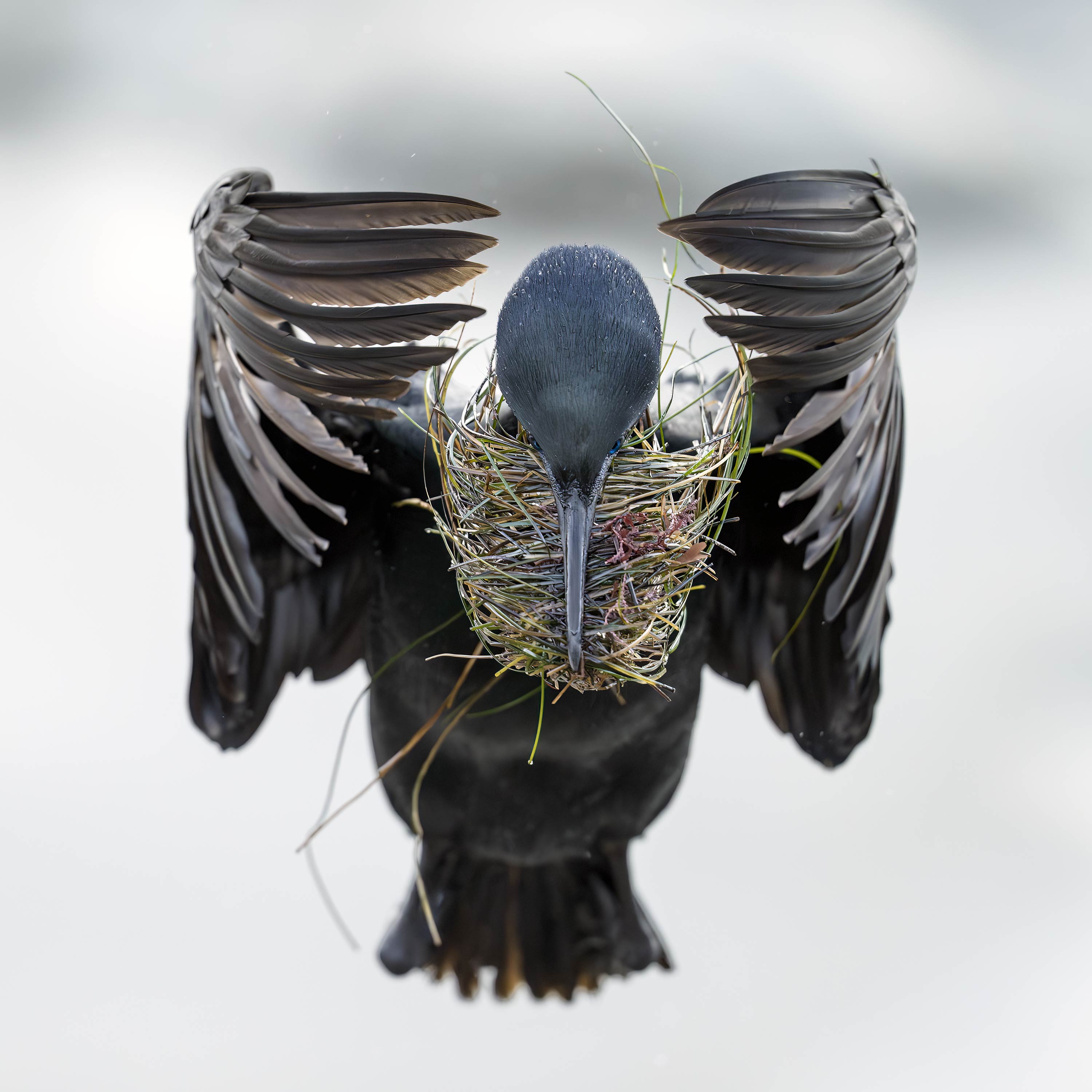
This image was created with the hand held Sony FE 300mm f/2.8 GM OSS Lens (Sony E) and The Latest Greatest Sony Flagship Body, the a1 II Mirrorless Camera Image #3: Brandt’s Cormorant with nesting material, La Jolla, CA. |
Brandt’s Cormorant with nesting material, La Jolla, CA.
Standing at full height, I used the handheld Sony FE 300mm f/2.8 GM OSS lens and the Alpha 1 ii. Wide/AF-C with Bird Face/Eye AF enabled. The eye-tracking AF on this image was incredible—it grabbed a barely visible eye and maintained razor-sharp focus. With its super-fast f/2.8 aperture, this lens is ideal for low-light flight photography. Its small size and light weight make it handholdable by just about anyone. ISO 3200: 1/3200 sec at f/2.8.
|
|
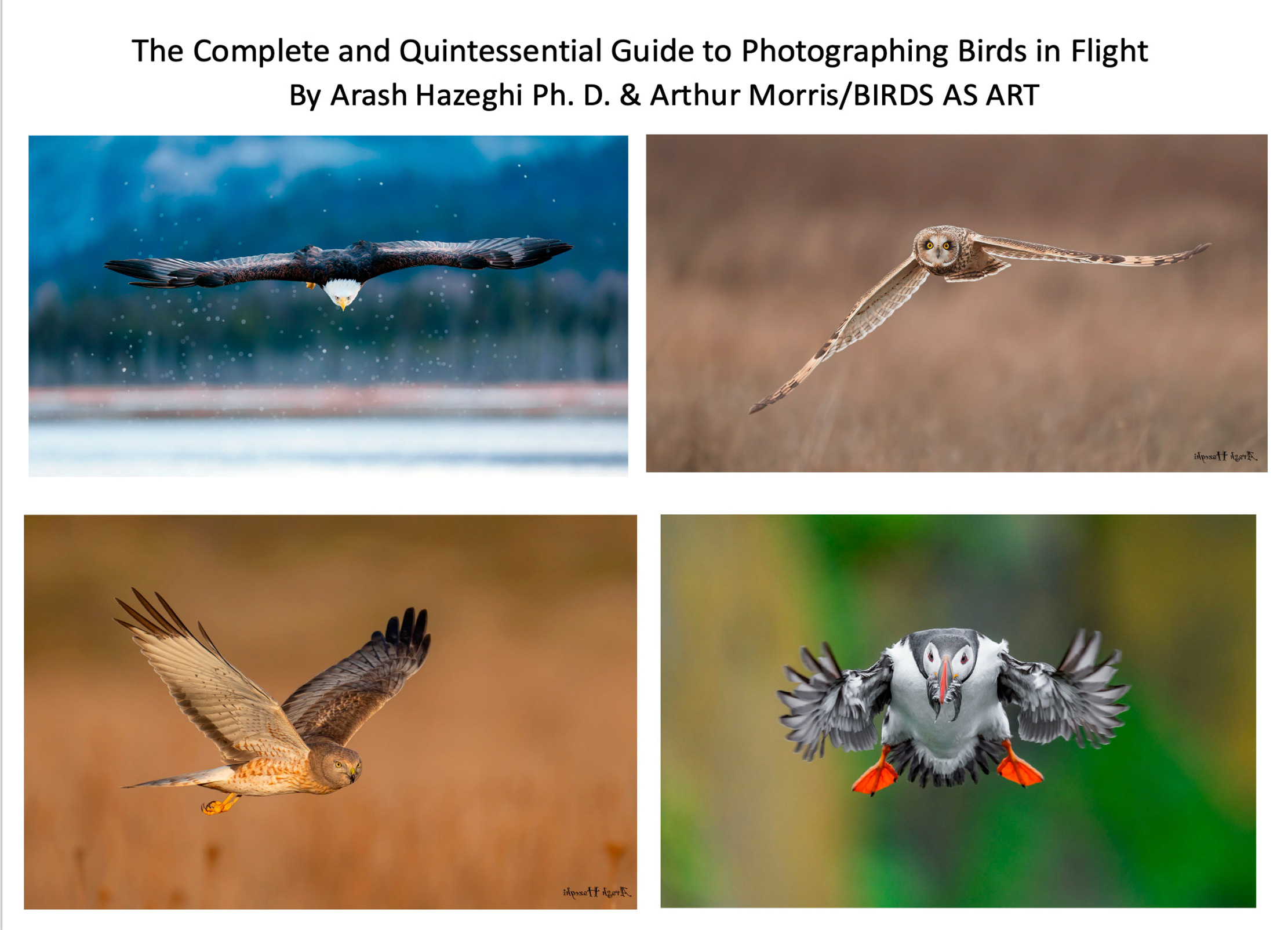
The title says it all. Purchase your copy here. The Complete and Quintessential Guide to Photographing Birds in Flight
|
The Complete and Quintessential Guide to Photographing Birds in Flight: $99.00
I had long dreamed of becoming a great flight photographer. When using dSLR gear, making sharp images was a huge problem. Most of the time, the camera bodies simply were not up to snuff. Things have changed dramatically with mirrorless technology. The high-end mirrorless camera bodies now feature science fiction-like autofocus systems and frame rates of 30, 40, and even 125 fps. Nowadays, getting the eye sharp is no longer a problem. The problem more often involves selecting the strongest image from a long series of sharp images.
The truth, however, is that there is a lot more than owning a Canon EOS R1, a Nikon Z9, or a Sony a-1 ii to consistently creating great photographs of birds in flight. Some of the biggest factors to success include gear choice, shooting strategies, and understanding the importance of sky conditions and wind speed and direction. Once you have the techniques and technical aspects down pat and can routinely create sharp images, learning the importance of flight poses, wing positions, backgrounds, and subject placement and image design enable you to create and then select superb flight images. And you guessed it, each of those topics and tons more are covered in detail in The Complete and Quintessential Guide to Photographing Birds in Flight.
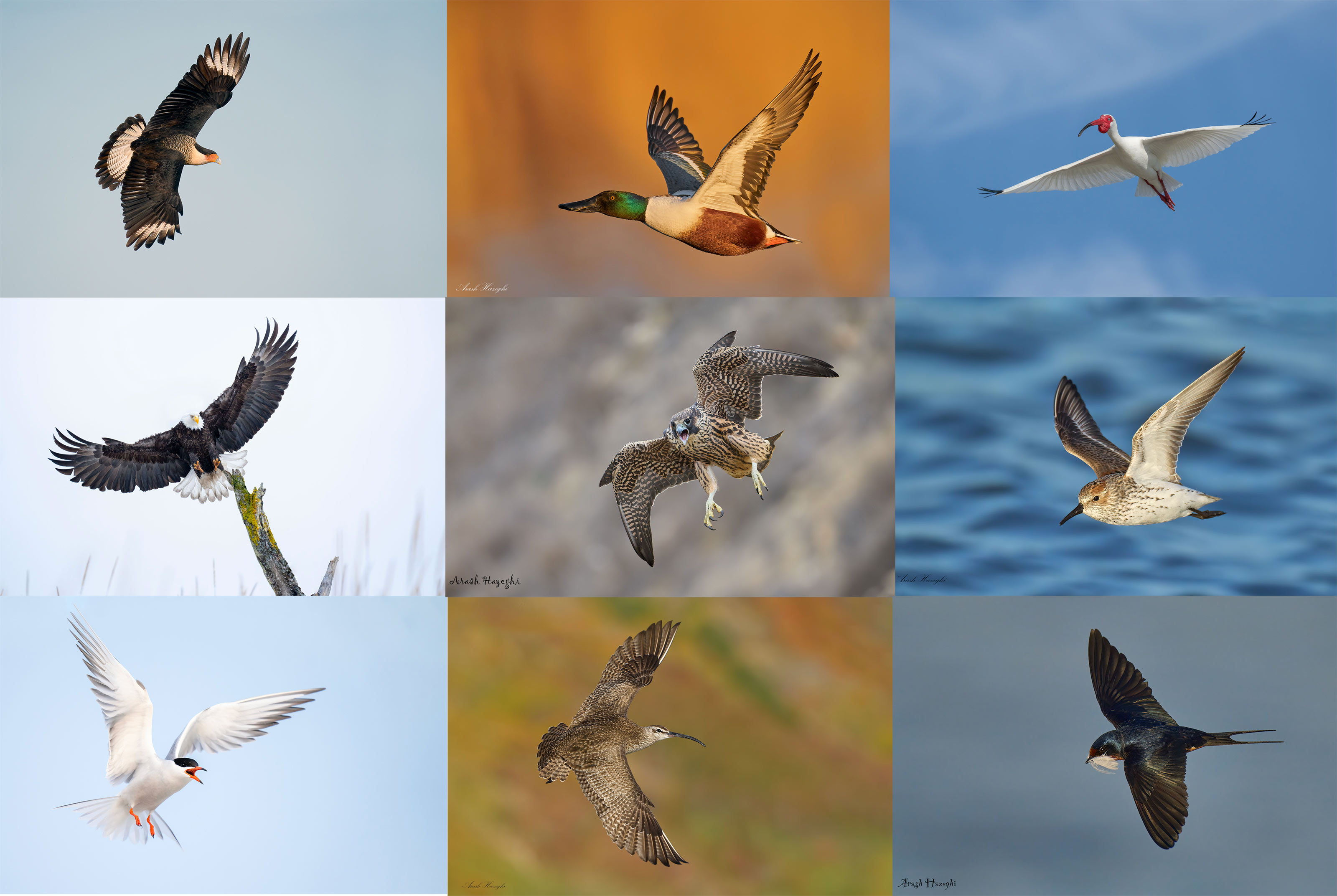
The guide consists of 267 pages and 21,013 words. There are 82 illustrative photos scattered throughout the text, two screen captures, and a 112-image gallery that includes examples created by Canon, Nikon, and mostly Sony gear. As seen above, each of the 194 inspirational photos is labeled with an educational caption.
You can purchase your copy here for $99.00.
Arash Hazeghi
Arash Hazeghi, Ph.D. is a principal electron device engineer. He received his Ph.D. degree in Electrical Engineering in 2011, from Stanford University, Stanford, California. His pioneering research on Carbon Nanotubes has been cited many times. In the past decade, Arash Hazeghi has been a major contributor to the research and the development of some of the most cutting-edge technologies introduced by Silicon Valley’s most reputable names including SanDisk, Intel and Apple.
More relevant here is that he is widely recognized as one of the world’s best birds in flight photographers. He specializes in raptors and the technical aspects of bird photography.
|
|
Flight photography is a skill that can be studied, practiced, and learned. Learn to get better in The Complete and Quintessential Guide to Photographing Birds in Flight |
The Complete and Quintessential Guide to Photographing Birds in Flight
By Arash Hazeghi Ph.D., and Arthur Morris/BIRDS AS ART
What you will learn (about):
-
1- Weight and handholding super-telephoto lenses.
2- Weight and handholding intermediate telephoto and telephotos zoom lenses.
3- Choosing the right flight photography lens or lenses for you.
4- The importance of focal length for flight photography.
5- The importance of lens speed (the maximum aperture for flight photography.
6- Choosing between fixed focal lengths and zoom lenses for flight photography.
7- The importance of AF speed and performance for flight photography.
8- Handholding tips and techniques.
9- Shooting flight off a tripod with the Levered-clamp FlexShooter Pro.
10- Flight poses and wing positions.
11- Why artie changed his mind about the 400mm f/2.8 lenses for flight and more.
12- The advantages and disadvantages of using teleconverters for flight photography.
13- Why to stay away from off-brand lenses.
14- Understanding the importance of wind direction and speed for flight photography.
15- The relationship between sky conditions and wind direction and how it affects flight photography.
16- Creating flight silhouettes in wind-against-sun conditions.
17- The importance of being on sun angle for flight photography (and avoiding harsh shadows).
18- Tips on doing flight photography in cloudy, foggy, or overcast conditions.
19- About the direction of light in cloudy, foggy, or overcast conditions and how it affects flight photography.
20- How your understanding of bird behavior can dramatically improve your flight photography.
21- Tips on attracting birds for flight photography.
22- What to do when your camera’s AF system is temporarily blind.
23- The vital importance of pre-focusing.
24- How Direct Manual Focus can help you with flight photography.
25- The importance of shooting aggressively when doing flight photography.
26- Everything that you need to know with regards to rest positions for flight photography.
27- The importance of getting low when doing flight in many situations.
28- Getting the right exposure when doing flight photography.
29_ Why to use Manual mode 95% of the time for flight.
30- Tips on finding the bird in the frame, acquiring focus, and tracking the bird in flight.
31- How to set and best utilize your lens’s image stabilization feature (and why).
32- Setting the focus range limiter switch on your flight lens or lenses.
33- To choose the best shutter speed for photographing birds in flight.
34- The vital importance of pre-focusing. And yes, this is so important that it is on the list twice.
You can purchase your copy here.
|
|
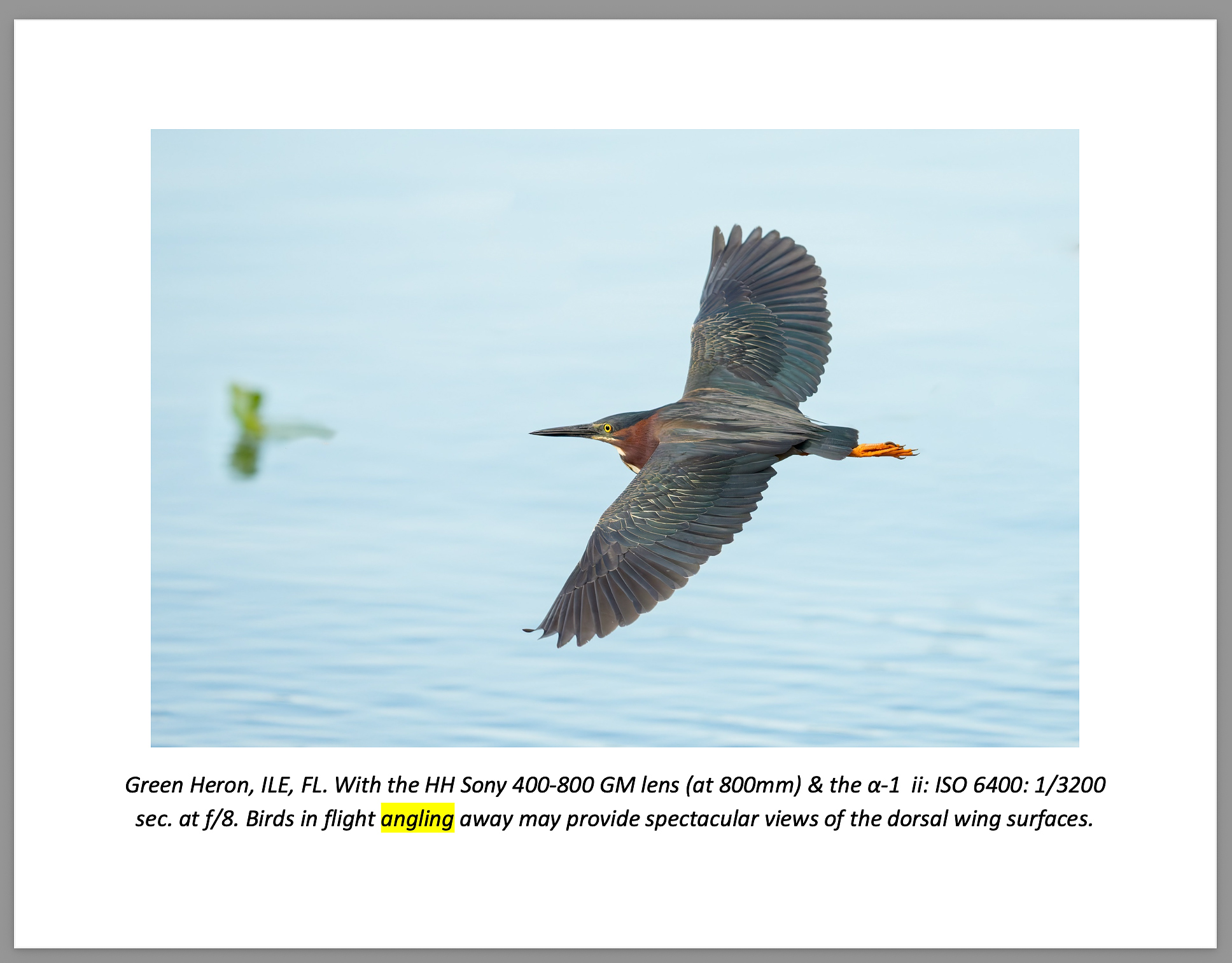
Sample Page #1. Image copyright 2024: Arthur Morris/BIRDS AS ART, the senior author. Page 254 of The Complete and Quintessential Guide to Photographing Birds in Flight |
Sample Page #1
Birds in flight that are flying away from you may at times provide spectacular views of the dorsal wing surfaces.
|
|
Image copyright 2024: Arthur Morris/BIRDS AS ART, the senior author. Sample pages #2 & 3. Pages 106 & 107 of The Complete and Quintessential Guide to Photographing Birds in Flight |
Sample pages #2 & 3
It is — for many reasons, imperative that you shoot aggressively when doing flight photography. If you wait for it to be perfect, you will usually wind up with nothing. That said, most of my flight sequences rarely consist or more than seven or eight frames; I do not blast away at specks and once the bird is past the light and flying away from me I quit shooting.
|
|
Image copyright 2024: Arthur Morris/BIRDS AS ART, the senior author. Sample page #4 Page 108 of The Complete and Quintessential Guide to Photographing Birds in Flight |
Sample page #4
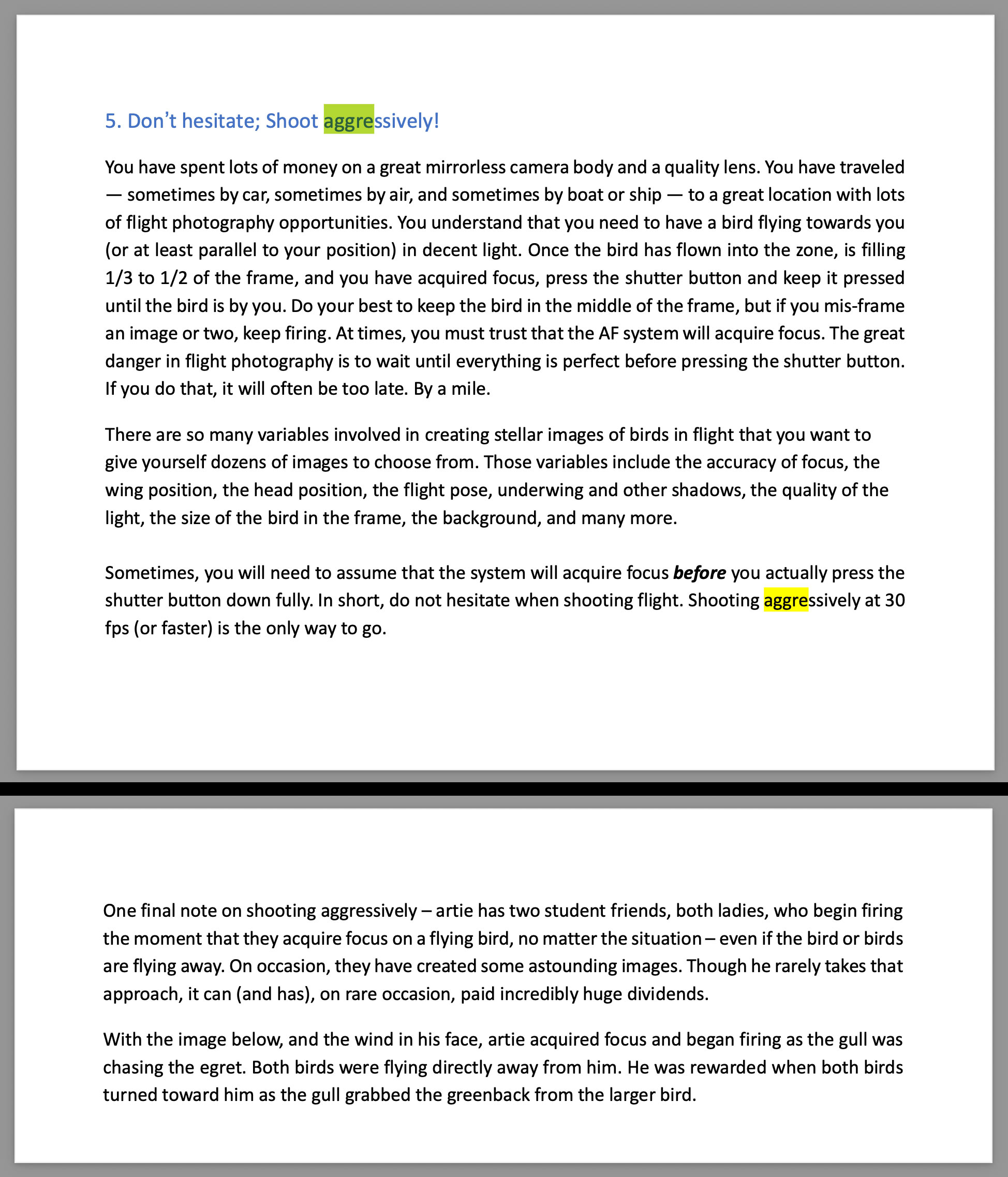
Sometimes you need to press the shutter button and hold it down just in case the bird or birds turn back to look at you. The Great Egret above was flying directly away from me but turned abruptly when the gull grabbed the fish. Having learned from two lady photographer friends, I was right on this one!
Shooting flight aggressively can enable you to make images that on the surface, would seem impossible.
Typos
With all blog posts, feel free to e-mail or to leave a comment regarding any typos or errors.







Congrats, nice honor for a nice guy. Honor to have found your blog and before that your books and features in Outdoor Photographer.
Thanks, Jeff. Do you remember my kingfish/sunball cover on OP? Taken with the Canon 600mm f/4 and stacked teleconverters? On film!
with love, artie
Yes, I remember. It’s one of my favorite all time pictures of yours. Always wondered if you’d go blind from those types of shots. You my friend have always been one of the best in my books.
Congratulations Artie! Not only are you “The” world class bird photographer you have blessed thousands by willingly sharing your knowledge with them. Really like images 2 & 3; the Brant’s Cormorant is great. Congratulations again.
Thanks, Monte. Give me a call this weekend when you are by your camera and we can get the updating figured out.
with love, artie
Congratulations, Artie — excellent article which is concise and informative. The photos are top-notch, too.
Just for fun, I added up the prices of the camera and lenses (not any support equipment such as tripods) used to take the photos in the article. At Bedford, the equipment comes to $39,184. If we throw in the other lenses mentioned in the article, we are at $54,280.
Thanks, Steve, Did you include two a-1 ii bodies??? And my $8K MacBook Pro?
All part of my many blessings 🙂
with love, artie
This is fantastic, Artie. I love it for you!
Thanks, Pugs! JAX blog post coming soon with some of yours 🙂
with love, artie
Congratulations, Artie. It wasn’t that long ago that you used to say you were not good at photographing birds in flight.
Thanks, David. And you are correct. For me, it all began when I switched to Sony 🙂
with love, artie
Bravo Artie…excellent post by Sony that will help other wildlife photogs learn from your deep well of knowledge.
Thanks, Marc. Hope that our paths cross again this August.
with love, artie
Lots of great images, but the Osprey on the surfboard stands out to me for the parallel position of both subjects and the size of the seafood. Second favorite is one of the ones they didn’t use, the Brandt’s Cormorant with nesting material, for the closeness, behavior, and unusual position.
Thanks, Cliff. Good point on the Osprey as surfboard!
with love, a
Congratulations Artie! Well deserved recognition. BTHS Hall of Fame worthy.
Thanks, John. I am sure that Ms. “Granny” Graesser, my Math teacher at Brooklyn Technical High School 62 years ago would be very proud of me. She is, however, long dead 🙁
with love, a