
Summary
When there are no fisherman or walkers, there are usually a least a half dozen Anhingas on the pier most mornings. Some are skittish, while some — usually the juvenile birds, are very tame. The ticket to success when working the same subject over and over again, is to strive to create new and different images. This is done by using a variety of lenses and by depending on Sony’s amazing Bird Face-Eye autofocus technology. The latter makes it easy to come up with innovative compositions. In addition, Sony Zebra technology makes it easy to come up with perfect exposures of these handsome black and silver subjects whether the sun is shining or it is cloudy and overcast.
Your Calls
Which of today’s five featured images do you like best? Why? Would you have left the sliver of board in Image #2? Did I use too much Gaussian Blur on the board? Would you have left the “T” of the pier in that last photo?
In the Last Blog Post
Thanks to the many folks who left comments at the recent Right Lens. Wrong Lens. Turkey Vulture Flight Sky Colors blog post here. As presented, my ranking was #3, the sunny morning flight image, #1, the white-sky image, and finally, #2, with the light-blue sky that was created after the fact.
I will be sharing my additional (strong) thoughts in detail in the next blog post along with a new version of each image. Reading between the lines above, you might surmise that I do not like phony blue skies created from white sky raw files … You would be 100% correct. Learn why in the next post (or read Cliff Beittel’s comment at the Turkey Vulture Flight Sky Colors post.
What’s Up?
Sunday morning was excellent with no fisherman or pier-walkers, clear skies, and a nice breeze from the East. I created 2300+ images and kept 54 after the first edit.
Today is Monday 5 October and the forecast is for partly cloudy with a gentle SE breeze. I will be headed down to the lake as soon as the blog post notifications are sent. Whatever you opt to do, I hope that you choose to have fun and enjoy life. Please remember that happiness is a choice — Byron Katie – The Work.Com
If an item — a Delkin flash card or reader, a Levered-clamp FlexShooter Pro, or a Wimberley lens plate or low foot — for example, that is available from B&H and/or Bedfords, is also available in the BAA Online Store, it would be great, and greatly appreciated, if you would opt to purchase from us. We will match or beat any price. Please remember also to use my B&H affiliate links or to earn 3% cash back at Bedford by using the BIRDSASART discount code at checkout for your major gear purchases. Doing either often earns you free guides and/or discounts. And always earns my great appreciation.
Gear Questions and Advice
Too many folks attending BAA IPTs and dozens of photographers whom I see in the field and on BirdPhotographer’s.Net, are — out of ignorance — using the wrong gear, especially when it comes to tripods and more especially, tripod heads. And the same is true in spades when ordering new camera bodies or lenses. My advice will often save you some serious money and may help you avoid making a seriously bad choice. Please know that I am always glad to answer your gear questions via e-mail. If you are desperate, you can try me on my cell at 863-221-2372. Please leave a message and shoot me a text if I do not pick up.
|
|
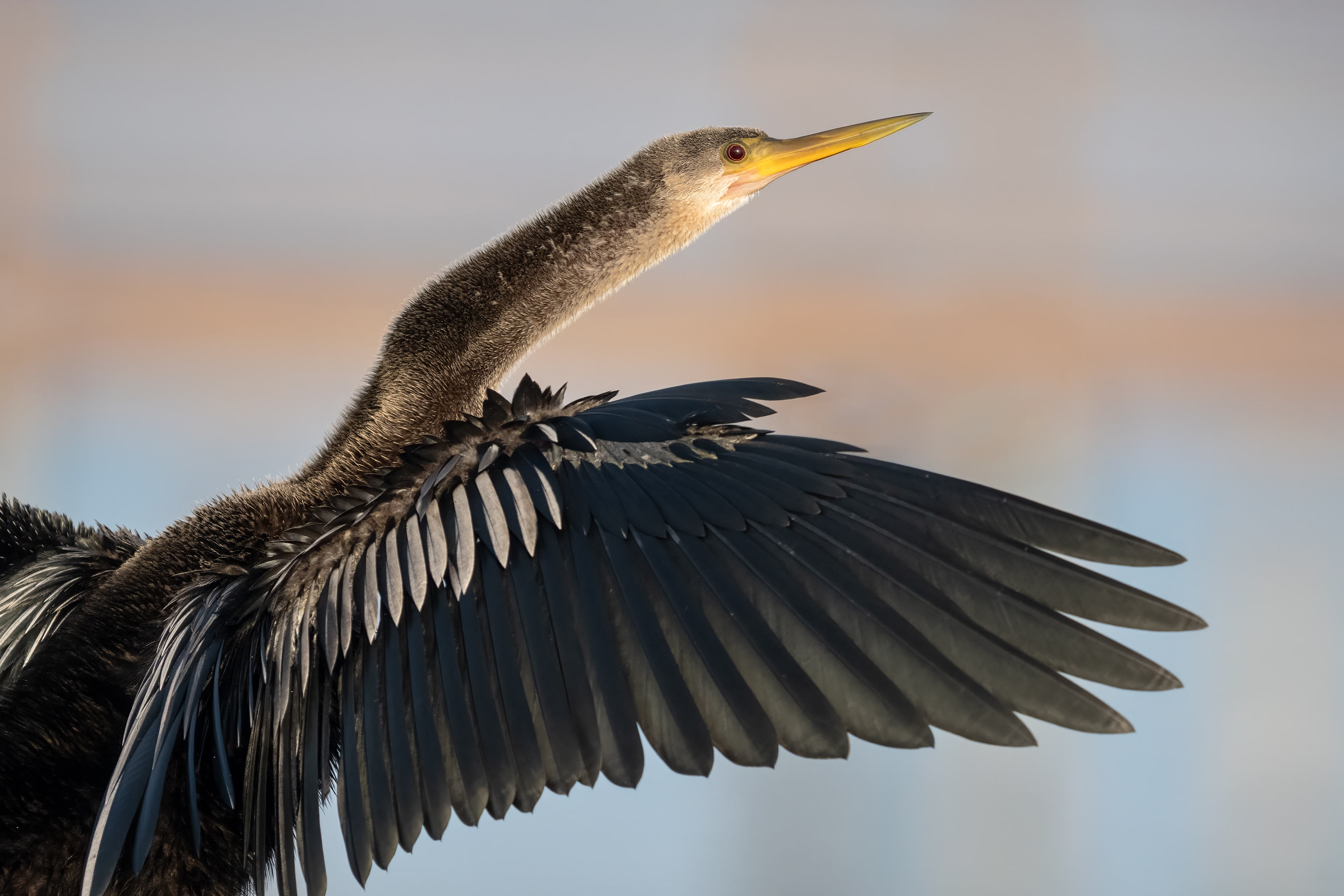
This image was created by yours truly on 21 September 2026 down by the lake near my home. Standing tall on the pier, I used the handheld Sony FE 400-800mm f/6.3-8 G OSS lens (Sony E) (at 800mm) and The Latest Greatest Sony Flagship Body, the a1 II Mirrorless Camera (in APS-C crop mode — effective focal length = 1200mm). The exposure was determined by Zebras with ISO on the rear wheel. ISO 2500: 1/2500 second at f/8 (wide open) in Manual mode. AWB at 8:11:24am on a partly sunny morning. Wide/AF-C with Bird-Eye/Face Detection performed perfectly. Click on the image to enjoy the larger high-res version. Image #1: Anhinga tight portrait with view of near wing |
Amazing Bird Face-Eye Tracking AF
Eye tracking with Wide AF is so good that it tracks an Anhinga’s eye even if comes close to disappearing behind the stretched wing. And if the eye is blocked by the wing, the system will pick it up instantly the moment the bird’s head re-appears.
|
|
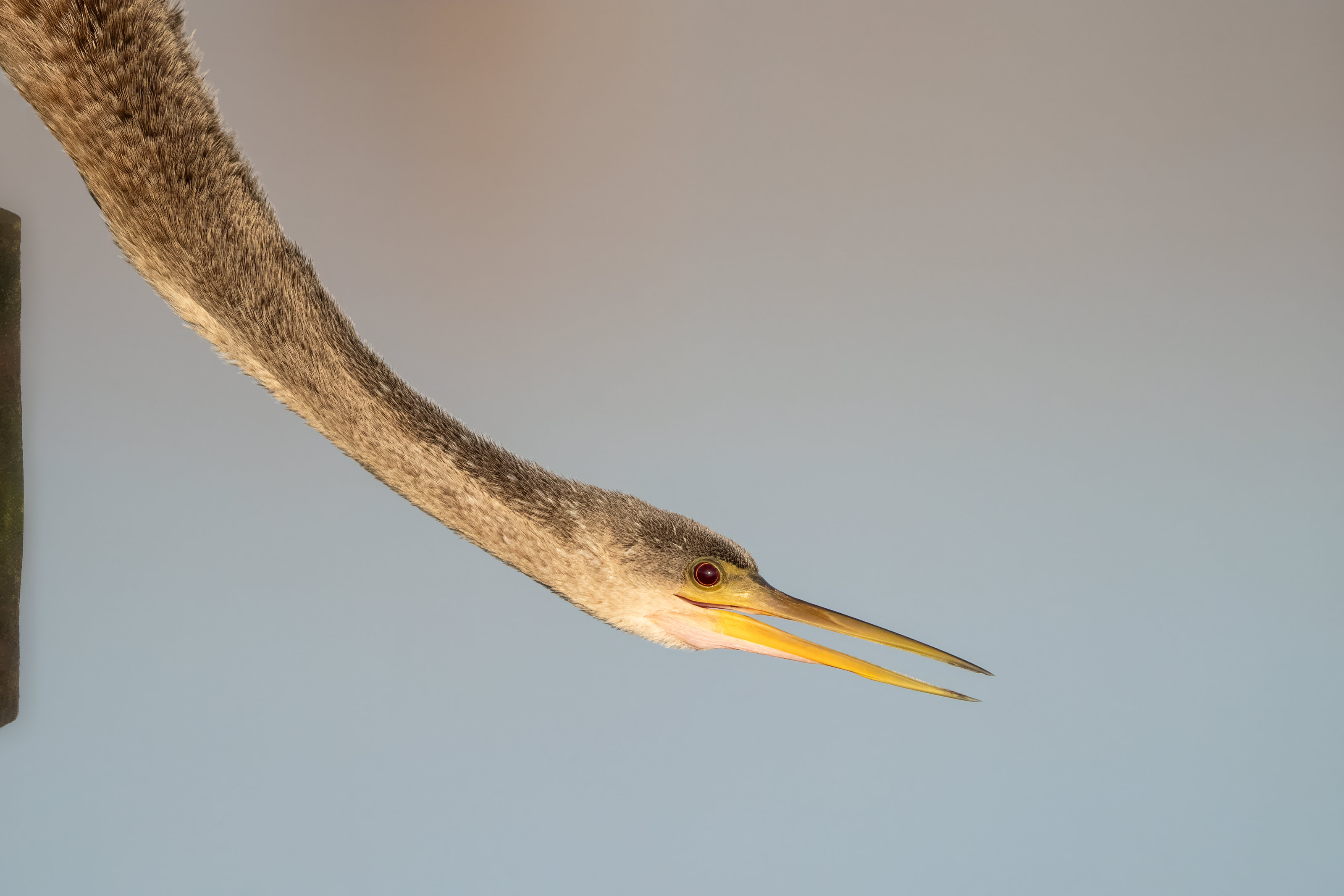
This image was created by yours truly on 22 September 2026 down by the lake near my home. Again, standing tall on the pier, I used the handheld Sony FE 400-800mm f/6.3-8 G OSS lens (Sony E) (at 800mm) and The Latest Greatest Sony Flagship Body, the a1 II Mirrorless Camera (in APS-C crop mode — effective focal length = 1200mm). The exposure was determined by Zebras with ISO on the rear wheel. ISO 2500: 1/2500 second at f/8 (wide open) in Manual mode. AWB at 7:57:40am on a partly sunny morning. Wide/AF-C with Bird-Eye/Face Detection performed perfectly. Click on the image to enjoy the larger high-res version. Image #2: Anhinga extending neck toward the water |
Snake Bird
It is easy to see from this image why Anhinga earned its “snake bird” nickname. When they swim at the surface with their heads held above the water, they look every bit like a swimming snake.
The Board or Not the Board
I removed part of the pier that intersected with the bird’s head, but opted to leave a single board on the left frame edge to avoid any confusion as to whether or not the bird was perched.
Your thoughts?
|
|
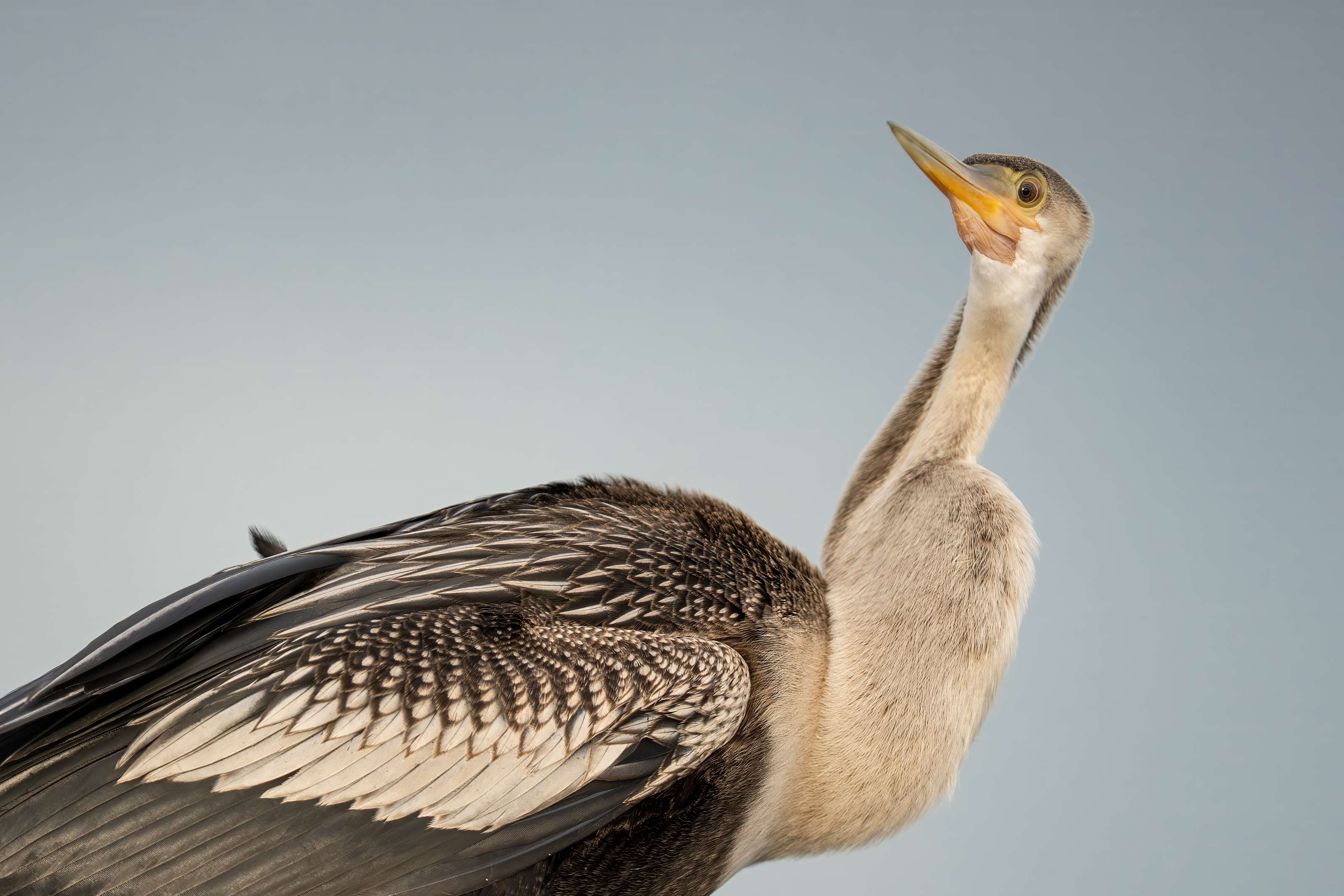
This image was created on 30 September 2026 by yours truly on the pier at Indian Lake Estates, FL. Standing at full height I used the handheld Sony FE 100-400mm f/4.5 GM OSS lens (at 400mm) and The Latest Greatest Sony Flagship Body, the a-1 II Mirrorless Camera (in APS-C crop mode — effective focal length 600mm). The exposure was determined by Zebras with ISO on the Thumb Dial. ISO 2000: 1/2000 second at f/4.5 (wide open) in Manual mode. AWB at 8:26:32am on a very cloudy morning. Tracking: Zone/AF-C with Bird-Eye/Face Detection performed perfectly. Click on the image to enjoy a larger high-res version. Image #3: Anhinga looking back
|
Tracking: Zone Versus Wide
With the high-end Sony mirrorless camera bodies, there are nine bracket positions when you are using Tracking: Zone. The reason you would use Tracking: Zone rather than Zone (Non-tracking) is that once you acquire focus, the system will continue to track even when the bird’s head winds up outside the brackets. With the Image #3 design, both center zone and upper right zone would have worked just fine.
That said, I used Wide (full frame Non-tracking AF) for this image and probably use it more than 90% of the time for my general bird photography. Why? With the a-1 ii, the Bird Face-eye tracking in Wide is science-fiction-like — it tracks the bird’s eye anywhere in the frame. Not to mention that it is my go-to AF pattern for flight and action photography (for the very same reason).
I scratch my head when I hear of Canon folks having to use multiple back buttons for flight and action. With Sony, I simply use the shutter button 100% of the time.
Note: “Sony’s choice of the term “Non-tracking” to describe one of the two AF methods is confusing at best because the AF system tracks the birds face, head, or eye perfectly anywhere in the frame.
|
|
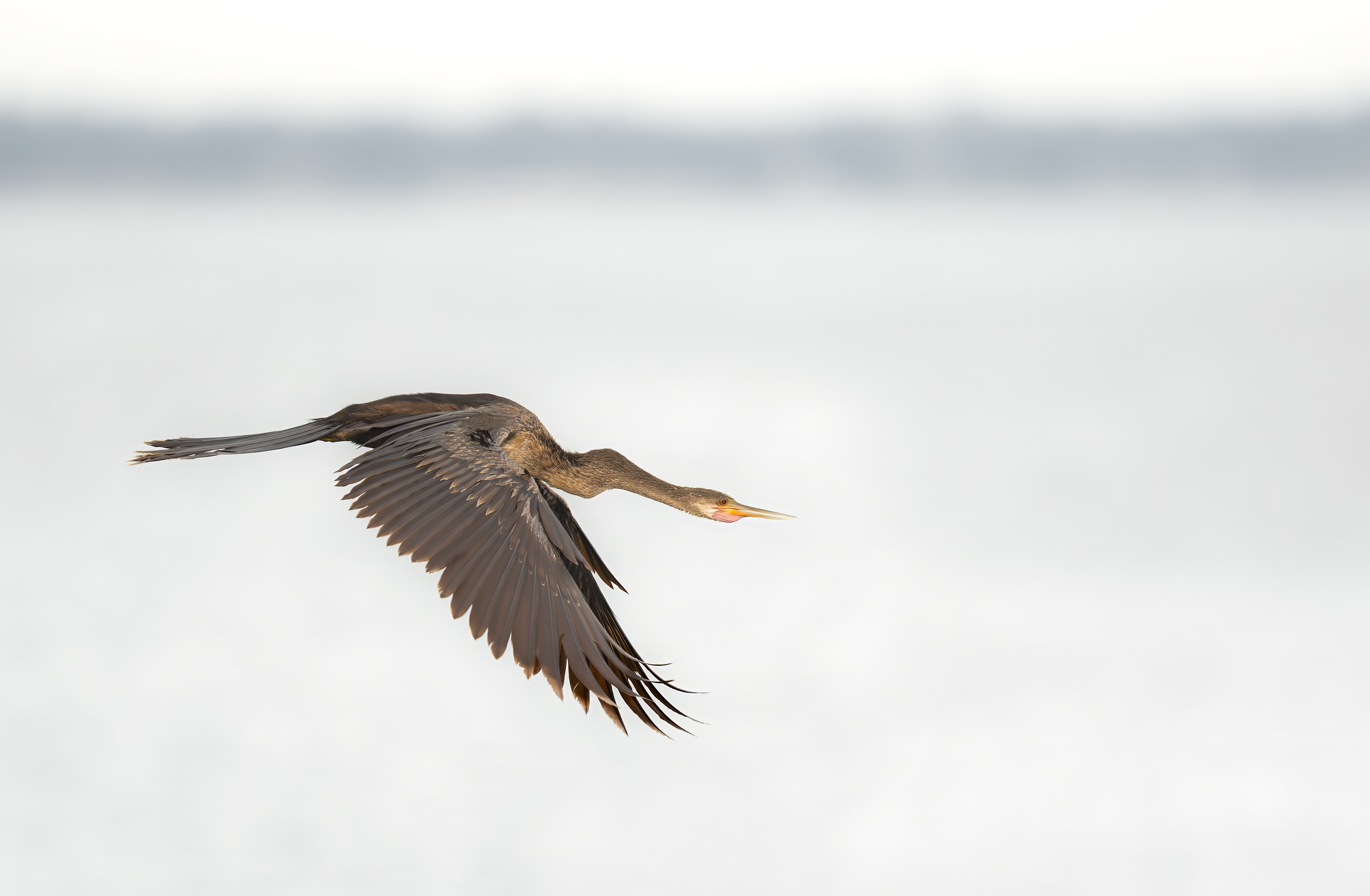
This image was also created on 30 September 2026 by yours truly on the pier at Indian Lake Estates, FL. Standing at full height I used the handheld Sony FE 100-400mm f/4.5 GM OSS lens (at 400mm) and The Latest Greatest Sony Flagship Body, the a-1 II Mirrorless Camera (in full frame mode). The exposure was determined by Zebras with ISO on the Thumb Dial. ISO 2500: 1/2500 second at f/4.5 (wide open) in Manual mode. AWB at 8:31:16am on a very cloudy morning. Tracking: Zone/AF-C with Bird-Eye/Face Detection performed perfectly. Click on the image to enjoy a larger high-res version. Image #4: Anhinga sharp — low light flight
|
The Anhinga on the Pier Flight Photography Challenge
No matter the wind direction, 99% of the Anhingas that take flight from the pier railings or lampposts angle away from you. I have made a zillion sharp flight shots with decent flight poses where the bird is headed away from me. I delete more than 99% of those.
With a northeast breeze on a cloudy morning, I had a decent chance on the bird featured in Image #4. And paid it off. The bird is angling ever-so-slightly towards me. The green strip in the background is the far shore of Lake Walk-in-Water.
Note: Image quality with this healthy crop of a full frame original held up nicely.
|
|
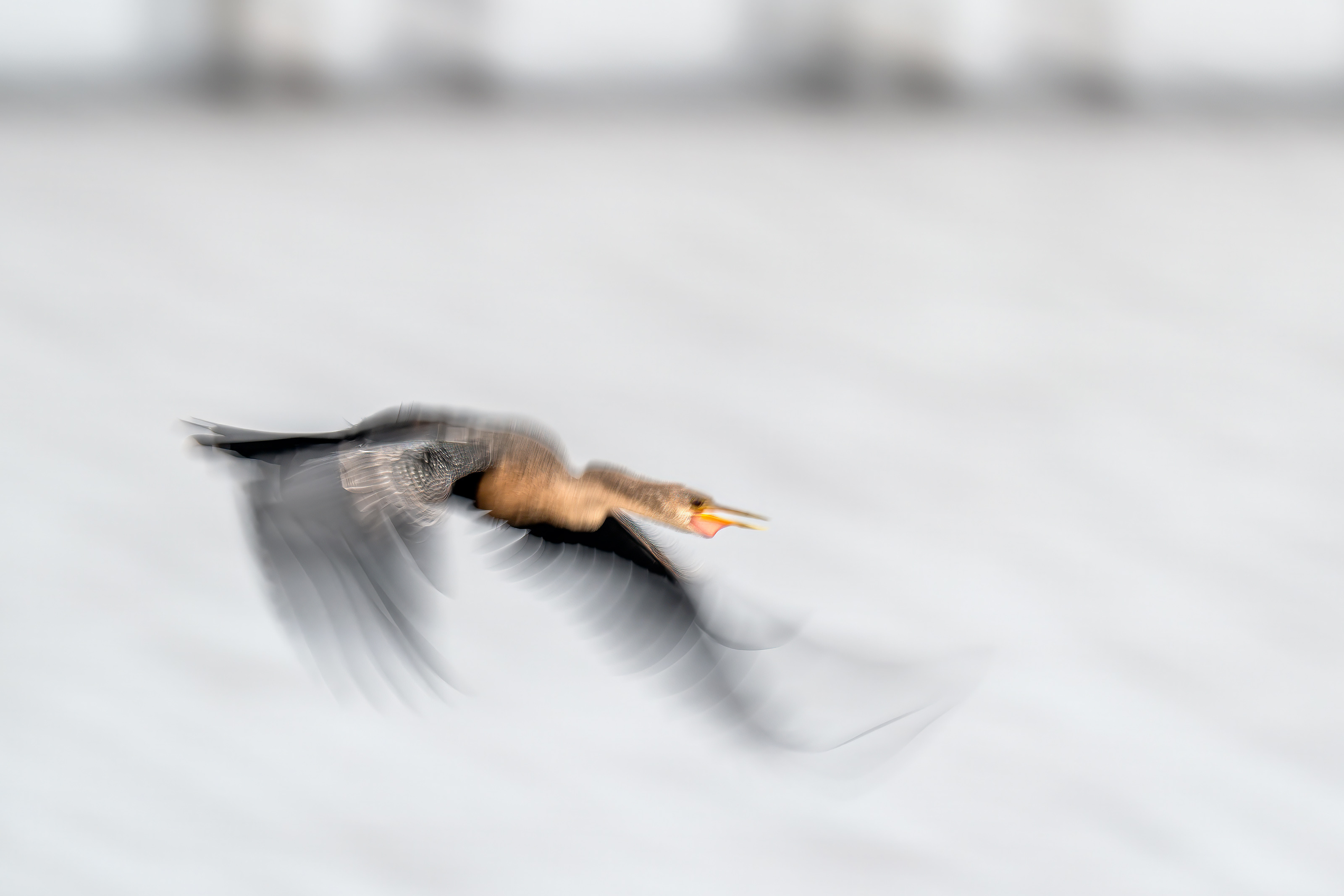
This image was created on 2 October 2026 by yours truly on the pier at Indian Lake Estates, FL. Standing at full height I used the handheld Sony FE 100-400mm f/4.5 GM OSS lens with the Sony FE 1.4x Teleconverter (at 560mm) and The Latest Greatest Sony Flagship Body, the a-1 II Mirrorless Camera (in full frame mode). The exposure was determined by Zebras with ISO on the Thumb Dial. ISO 400: 1/40 second at f/8 (stopped down 2/3-stop) in Manual mode. AWB at 7:52:02am on a cloudy-dark morning. Tracking: Zone/AF-C with Bird-Eye/Face Detection performed perfectly. Click on the image to enjoy a larger high-res version. Image #5: Anhinga flight blur |
Necessity, the Mother of Invention
Light levels on the morning of 2 October were so low that I set up for blurs before I even set out on the pier hoping that something might fly by in just the right spot. Creating a sharp flight image would have required a ridiculously high ISO. If I skimped a bit on the shutter speed and went with 1/2000 second, I would have needed ISO 12,800. And that is not a neighborhood I want to live in 🙂
This Anhinga cooperated nicely as it flew by at fairly close range while heading to the northwest. The background at the top of this image is the “T” of the pier.
Typos
With all blog posts, feel free to e-mail or to leave a comment regarding any typos or errors.








Leave a Reply