
Support BIRDS AS ART with your Everyday Online Shopping
Using the BAA Tip Jar Costs You Nothing
This You Tube video blog post took more than three hours to create not including the time spent photographing, picking my keepers, and optimizing the images. Consider using the BAA Tip Jar — it never costs you a single penny to help me out.
If you are like me, you enjoy the convenience of shopping online at Amazon without having to drive into town. The prices are competitive, and you can return anything you purchase for any reason (as long as you have not wrecked it).
If you enjoy learning from the blog posts, the YouTube videos, and the Instagram posts, or simply love being inspired by the images, the simplest and easiest way to support my efforts at BIRDS AS ART at no cost to you, is to use my generic Amazon link:
Whenever you make your routine household purchases — from groceries and coffee to backup batteries, household supplies, or electronics, making it a habit to click on our link first helps keep things running smoothly here. And again, it never costs you one penny to help me out.
Click here or on the Great (Photographic Accessory) Stuff tab on the lower, orange-yellow menu bar at the top of each blog post to learn about my favorite photo accessories. And more.

Trader Joe’s Everything But the Bagel Seasoning
I sprinkle this stuff on salads, veggies, and fish. With zero carbs, it is perfect for my current keto approach to eating. It is so tasty without being overbearing that I bring some along whenever I travel. Click here to order the two-pack. Once you try it, you will be ordering them by the dozen like I do. When you do re-order, please start your purchase by clicking below. And remember, it never costs you anything by helping to support BAA. And it is greatly appreciated.
Important Note
As an Amazon Associate I earn a small percentage from qualifying purchases whenever you use my Amazon links. Please make it a habit. 🙂
What’s Up?
Yes, I am posting more often as I have much to share: more on the 600mm f/6.3 (including a great Arash Hazeghi kestrel flight shot at 840mm handheld!), more rainbow images (with more on working the subject, Will’s great images from DeSoto, my best photos from Thursday and Friday at DeSoto, and my thoughts and the basic info on the Sony a7R VI Mirrorless Camera.
Conditions were very good here at ILE on Sunday morning: a brisk north wind with sunny skies. It was the coldest morning of the season. The cold front brought the season’s first American Kestrels. I tested the amazing new Sony FE 600mm f/6.3 GM OSS Lens (Sony E) on a cooperative Sandhill Crane family of four. With full sun, I went with the 1.4X TC most of the time.
Monday morning was cold and dark early on. I started working the cranes again with the bare lens, intrigued by its small size and ridiculously light weight. I wanted to see if using this relatively slow (f/6.3) lens was a viable choice on a dark morning. It was. As the north wind picked up, I switched the f/6.3 GM lens for the 300mm f/2.8 GM and did some vulture flight at 1/3200 second or thereabouts. As it began raining a bit harder the south of the pier crane family walked onto the beach begging to have their photos taken. I obliged and did not get back for breakfast until just before 10:00am.
Today is Tuesday 20 October 2026. The forecast is calling for clear and cool (63° F) with an 8mph breeze from the north. With the sun now rising south of east the birds will be angling slightly away right at sunrise with the wind against sun conditions getting worse with each passing minute as the sun heads south. That’s why I will be heading down to the lake very early. I have not been getting anything on the pier railings lately as there have been too many fisherman and walkers 🙁 So, with the most of the fields still too wet to drive on, photography has been on the tough side.
Whatever you opt to do today, I hope you choose to have fun and enjoy life. Please remember that happiness is a choice — Byron Katie – The Work.Com
If an item — a Delkin flash card or reader, a Levered-clamp FlexShooter Pro, or a Wimberley lens plate or low foot — for example, that is available from B&H and/or Bedfords, is also available in the BAA Online Store, it would be great, and greatly appreciated, if you would opt to purchase from us. We will match or beat any price. Please remember also to use my B&H affiliate links or to earn 3% cash back at Bedford by using the BIRDSASART discount code at checkout for your major gear purchases. Doing either often earns you free guides and/or discounts. And always earns my great appreciation.
Gear Questions and Advice
Too many folks attending BAA IPTs and dozens of photographers whom I see in the field and on BirdPhotographer’s.Net, are — out of ignorance — using the wrong gear, especially when it comes to tripods and more especially, tripod heads. And the same is true in spades when ordering new camera bodies or lenses. My advice will often save you some serious money and may help you avoid making a seriously bad choice. Please know that I am always glad to answer your gear questions via e-mail. If you are desperate, you can try me on my cell at 863-221-2372. Please leave a message and shoot me a text if I do not pick up.
Gemini
General information, copy editing, re-crafting, technical refinement, and formatting for this blog post were assisted by Gemini AI.
|
|
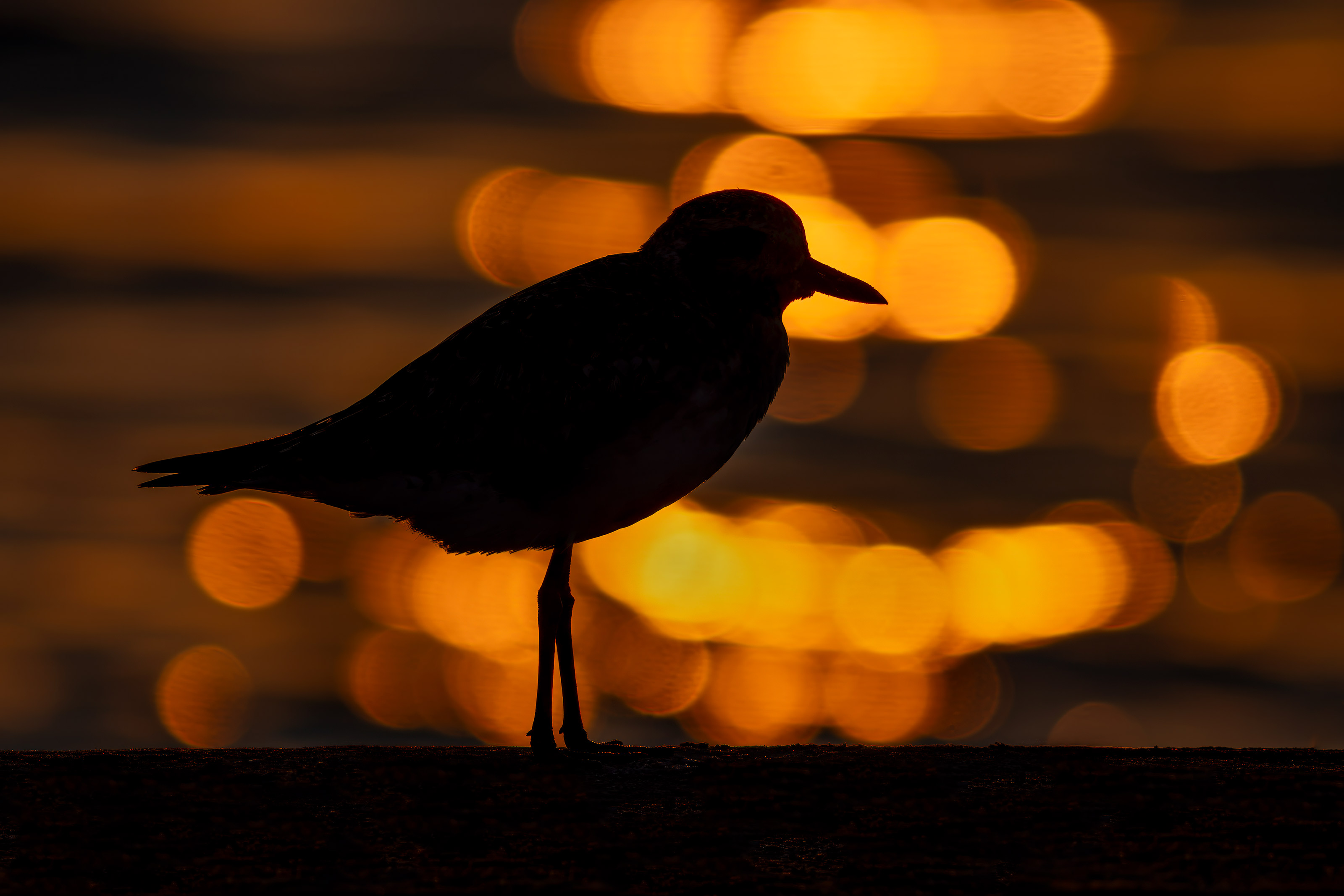
This image was created by yours truly on 15 October 2026 at my secret sunset spot near Fort DeSoto Park, FL. Sitting on hard limestone dirt with a few scattered rocks, I used the toe-pod technique with the Sony FE 400-800mm f/6.3-8 G OSS lens (Sony E) (at 464mm) and The Latest Greatest Sony Flagship Body, the a1 II Mirrorless Camera in APS-C crop mode. The effective focal length is 696mm.) The exposure was determined by Zebras with Exposure Compensation (EC) on the Thumb Dial. Multi Metering -1.3 stops. AUTO ISO set ISO 125: 1/2000 second at f/6.3 (wide open at the given focal length) in Shutter Priority mode. AWB at 6:58:06pm a very few minutes before sunset. Wide/AF-C with Bird-Eye/Face Detection performed perfectly. Click on the image to enjoy the larger high-res version. Image #1: Black-bellied Plover on seawall |
My Major Mistake?
Take a close look at the EXIF data in the caption for this image, see if you can figure out what I did wrong, and then leave a comment letting folks know what rookie mistake I made.
The Situation
I got to my sunset spot a bit early. In general, I hope for a few fishermen, as their bait tends to attract the birds. On what was a lovely evening, there was only one lady fishing. While I was setting up, a Great Blue Heron and a Great Egret were standing perfectly still on the seawall. With a north breeze, both were square to the setting sun. I was beginning to get excited.
Ready, I turned to see both birds flying away to the north; the lady fisherman had walked right by them. As my late Mom would often say, “Oh well.” Because the western sky was showing some color, I decided to stick around. In a few minutes, a Black-bellied Plover landed on the seawall, also facing north and thus square to the back of my camera as I got on the ground with the setting sun right behind the bird.
Shooting into the blasting highlights is tricky as there is a ton of light. In these instances, I always switch to Shutter Priority mode; doing so makes my life easy. Note the EC of -1.3 stops. When the highlights had been brighter, I was working as dark as -3 stops.
I gotta say that while most camera bodies — including the original Sony a-1 — have a ton of trouble acquiring and maintaining focus in super-bright situations, the Sony Alpha-1 ii handles these conditions pretty much flawlessly.
The parking lot sloped a bit down toward the bird. Sitting on my butt as the sun got lower and lower in the sky, I was hoping to get close enough (and low enough) for a sunball shot with the plover set against the well-muted setting sun just above the horizon. I was perhaps 12 feet from the bird when the oblivious lady fisherman walked between me and the bird. The outcome was predictable. I never said a word.
When fishermen or beachgoers scare away a bird, I never get upset, because if it were not for them, the birds at the fishing spots would not be nearly as tame as they are. If, however, I see them coming, I will always ask politely if they might walk around me. Most do.
The Blasting Highlights Image Key to Success
I kept only six of the hundreds of images I made with the bird set against the bright reflections of the setting sun in the bay. This frame was my top pick because the bird’s head and bill were set against the orange water. In most of the photos, the head and bill vanished against the dark or black water.
Bird Photography Tips and Field Accessories
A Deep Dive BAA Follow-up YouTube Video
In two recent blog posts, I shared my two, actually three, favorite field accessories, along with 15 fairly recent images. Each photo is accompanied by a legendary BIRDS AS ART educational caption.
In this 11-minute video, I take you through both blog posts while commenting on more than a few before-and-after sequences where we compare the raw file with the optimized version. Stay tuned until the end and learn why Manual mode is a must when dealing with changing background tonalities.
Check out “Outfitted for Success: My Go-To Field Hat & Fanny Pack” by clicking here.
Visit “Fort DeSoto Field Notes: A Masterclass in Mixed Techniques” by clicking here.
Learn about Adobe Camera Raw masking in the Digital Basics IV Video Series by clicking here.
New to Photoshop? Save $186.00 by purchasing the entire Digital Basics Collection here.
|
|
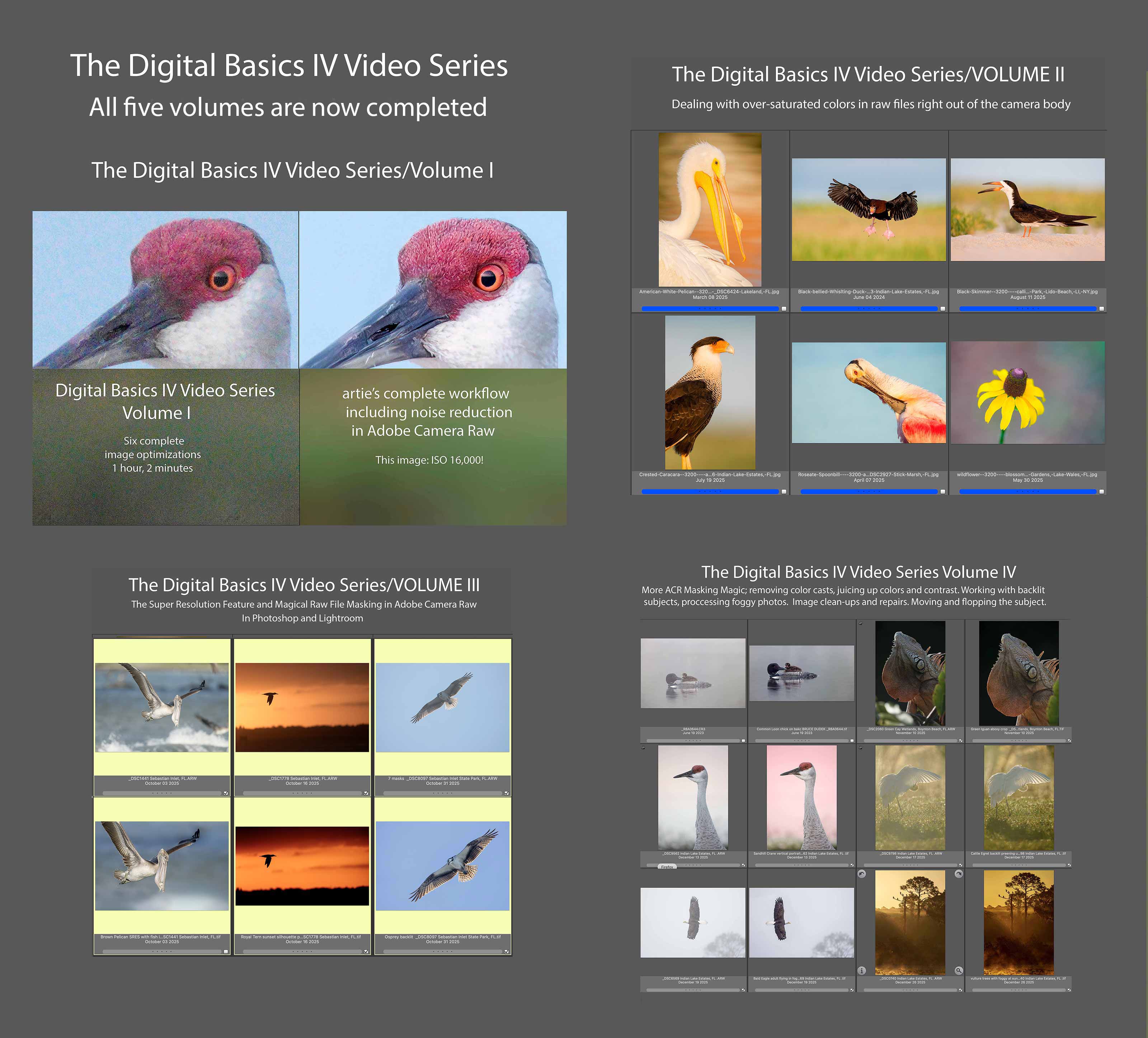
Click to enlarge. The Digital Basics IV Video Series by Arthur Morris/BIRDS AS ARTYou can save $50.00 by purchasing the entire 5-Volume Series by clicking here. |
Digital Basics IV Video Series: $146.00 for all five videos/save $50.00
I have some fabulous new image optimization tips, techniques, and tricks to share. As the Digital Basics III Video Series proved to be so popular, I decided last fall to run it back in the form of Digital Basics IV. Digital Basics V is on the horizon.
My new workflow includes the use of the masking feature in Adobe Camera Raw (thanks to Anita North), the use of the Point Color eye dropper to tame super-saturated colors during raw conversions (discovered in tandem with Anita), a fabulous new Remove Tool trick that makes my favorite Photoshop Tool even more powerful than before -— that one discovered by me. In addition, I have recently begun doing some Curves work during my ACR raw conversions.
My basic workflow remains much the same as is detailed in both the Digital Basics II PDF and in the Digital Basics III Video Series:
1- Setting the Color Temperature (when and if needed).
2- Setting the White and Black Points and adjusting the Highlights and Shadows sliders.
3- Setting the Clarity and Dehaze sliders.
4- Fine-tuning color using the Hue/Saturation/Luminance Targeted Adjustment Tool, a huge step up from the Color Mixer Tool.
5- My 2-step noise reduction technique (with most images).
Once I have the .TIF file in Photoshop, I use my usual cadre of clean-up tools and techniques including the Remove Tool, the Clone Stamp (only rarely), Divide and Conquer, Quick Masking, Layer Masking, Gaussian Blurs, an expanded array of personalized keyboard shortcuts, and tons of other image optimization strategies and methods adapted from previous versions of Digital Basics. I also demonstrate the selective use of Topaz Sharpen AI utilizing the masking feature. And last but not least, I share my JPEG creation methodology.
I am quite proud of the Digital Basics IV Video Series.

|
The BIRDS AS ART Digital Basics Collection: $199.00. |
The BIRDS AS ART Digital Basics Collection
The best news is that learning to use the tools and techniques that I use to improve my images is made fairly simple for those who purchase, use and study the Digital Basics offerings from BIRDS AS ART. One of the great skills that I have been blessed with is writing coherent how-to instructions that can be followed easily by a third grader. Learn to unlock the potential in your images by purchasing the Digital Basics Collection here. The collection includes the Digital Basics II PDF, and all the videos in the Digital Basics III and the Digital Basics IV Video Series.
The original Digital Basics file was created in the mid-aughts when I saw countless numbers of folks creating sharp, nicely designed, well exposed images and then ruining them in Photoshop. I sold enough copies at $20.00 a pop to pay for my $68,000 lap pool! As my workflow changed and improved, various versions of Digital Basics were created to help folks learn to improve their images at the computer during post processing. Save an incredible $86.00 by purchasing the Digital Basics Collection here. Folks who own one or two of the three afore-mentioned products are invited to contact me via e-maill for personalized discount information.
Typos
With all blog posts, feel free to e-mail or to leave a comment regarding any typos or errors.









Leave a Reply