
Dark Skies, Bright Sun, Bad Wind, the Wrong Lens, and Few Ospreys, All in One Day – With Tough Conditions the Key to Success is Thinking Fast and Adapting
As detailed in today’s blog post, Tuesday, November 10, 2026, was a challenging day to be a bird photographer. With the sun coming and going every 30 seconds or so and the wind blowing from the west in the morning, you needed to be at your creative best and really needed to be on top of your exposure game. As you keep reading, be sure to note exactly how I used the light in each image.
Today, when it comes to understanding exposure theory, most nature photographers today have no clue. That is why we are now offering the softcover edition of The Art of Bird Photography at half price. Yes, 50% off the classic bible of modern-day bird photography! Was $40.00, now $20.00 plus shipping. Order yours in the next two weeks, and I will be glad to sign and personalize it just for you. Studying and mastering the principles covered in the Exposure chapter will change your life—and improve your images.
Gemini
General information, copy editing, re-crafting, technical refinement, and formatting for this blog post were assisted by Gemini AI.
What’s Up?
On Wednesday morning we had as many as 56 Osprey diving for fish in the inlet. Several came up with a Yellowfin Menhaden in each talon! The forecast had been for partly cloudy with a SW wind. Had it been accurate, we would have been famous. Instead, it was mostly sunny and the wind was straight out of the west — nearly every single bird hit the water, took off to the west (away from he light), and turned tail to the north. When the Osprey action subsided the pelicans went nut, twisting and turning and diving alongside the South Jetty. As I had brought the 600 with the tripod for the Ospreys, I was a bit tight for the diving pelicans but managed a few very special diving pelican images. Bob Eastman with his trusty 200-600 and his a-1 and Steve Baglione with his new Sony 100-400mm f/4.5 GM were both better equipped than I was for the diving pelicans at close range. They each created some stunners.
Thursday morning was totally cloudy with a nice breeze from the WNW. We were ready for a repeat performance by the Ospreys. And by the pelicans. While there were a few fish hawks patrolling the inlet, they were not diving and therefore, they were not catching any fish. And with the total lack of bait, the pelicans were also on hiatus 🙁
We worked the Royal Terns in flight from the base of the closed North Jetty and then got on our butts on the beach and worked the roosting tern flock along with some Sanderlings and a single handsome Willet.
Today is Friday 13 November. Conditions are looking the same as they were on Thursday morning so we will be headed back to the North Jetty early to see if the bait returns to the inlet. Whatever you opt to do today, we hope that you choose to have fun and enjoy life. Please remember that happiness is a choice — Byron Katie – The Work.Com
The forecast for the weekend mornings are death on bird photography: a NW wind with clear skies. Our plan is to wake early on Saturday and drive over to Indian Lake Estates for two mornings of Sandhill Crane and vulture photography. We will head back to Steve’s place in Sebastian, photograph on Monday morning — Steve’s last instruction session. The Bob and I will head back to ILE.
If an item — a Delkin flash card or reader, a Levered-clamp FlexShooter Pro, or a Wimberley lens plate or low foot — for example, that is available from B&H and/or Bedfords, is also available in the BAA Online Store, it would be great, and greatly appreciated, if you would opt to purchase from us. We will match or beat any price. Please remember also to use my B&H affiliate links or to earn 3% cash back at Bedford by using the BIRDSASART discount code at checkout for your major gear purchases. Doing either often earns you free guides and/or discounts. And always earns my great appreciation.
Gear Questions and Advice
Too many folks attending BAA IPTs and dozens of photographers whom I see in the field and on BirdPhotographer’s.Net, are — out of ignorance — using the wrong gear, especially when it comes to tripods and more especially, tripod heads. And the same is true in spades when ordering new camera bodies or lenses. My advice will often save you some serious money and may help you avoid making a seriously bad choice. Please know that I am always glad to answer your gear questions via e-mail. If you are desperate, you can try me on my cell at 863-221-2372. Please leave a message and shoot me a text if I do not pick up.

B&H Simplified
To ensure that BAA gets credit for your B&H purchases, you can always click here. The tracking is invisible. Using my affiliate links is greatly appreciated. And, with B&H, you can use your PayBoo card. You must use the website to order. You cannot get your free guides if you make a phone order. Once you have an item in your cart, you must complete the order within two hours. Huge thanks!
B&H
Many folks have written recently stating that they purchased this or that from B&H and would like their free copy of the matching guide. But when I check my affiliate account, their orders are not there. When I let them know that I get credit for their B&H purchases only if they use one of the many B&H affiliate links on the blog or begin their searches with this link, they are always disappointed. If in doubt, please contact me via e-mail and request a BH link. I am always glad to help and to guide you to the right gear.

Bedfords Simplified
Click here to start your search. Choose standard shipping, and when you get to the payment page, enter BIRDSASART in the discount code box and hit apply. You will be upgraded to free second day air Fed-Ex and receive 3% cash back on your credit card once your stuff ships. Using either my affiliate links is greatly appreciated and will often earn you free guides or discounts. To receive a free guide or free entry into a Sony Set-up and Info Notes e-Mail group, you need to shoot me your receipt via e-mail. The B&H receipts need to include the order number.
Bedfords Amazing BAA Discount Policy
Folks who have fallen in love with Bedfords can always use the BIRDSASART coupon code at checkout to enjoy a post-purchase, 3% off-statement credit (excluding taxes and shipping charges) on orders paid with a credit card. The 3% credit will be refunded to the card you used for your purchase when your product ships. Be sure, also, to check the box for free shipping to enjoy free Second Day Air Fed-Ex. This offer does not apply to purchases of Classes, Gift Cards, or prior purchases.
You can visit the Bedfords website here, shoot Steve Elkins an e-mail, or text him on his cell phone at (479) 381-2592.
|
|
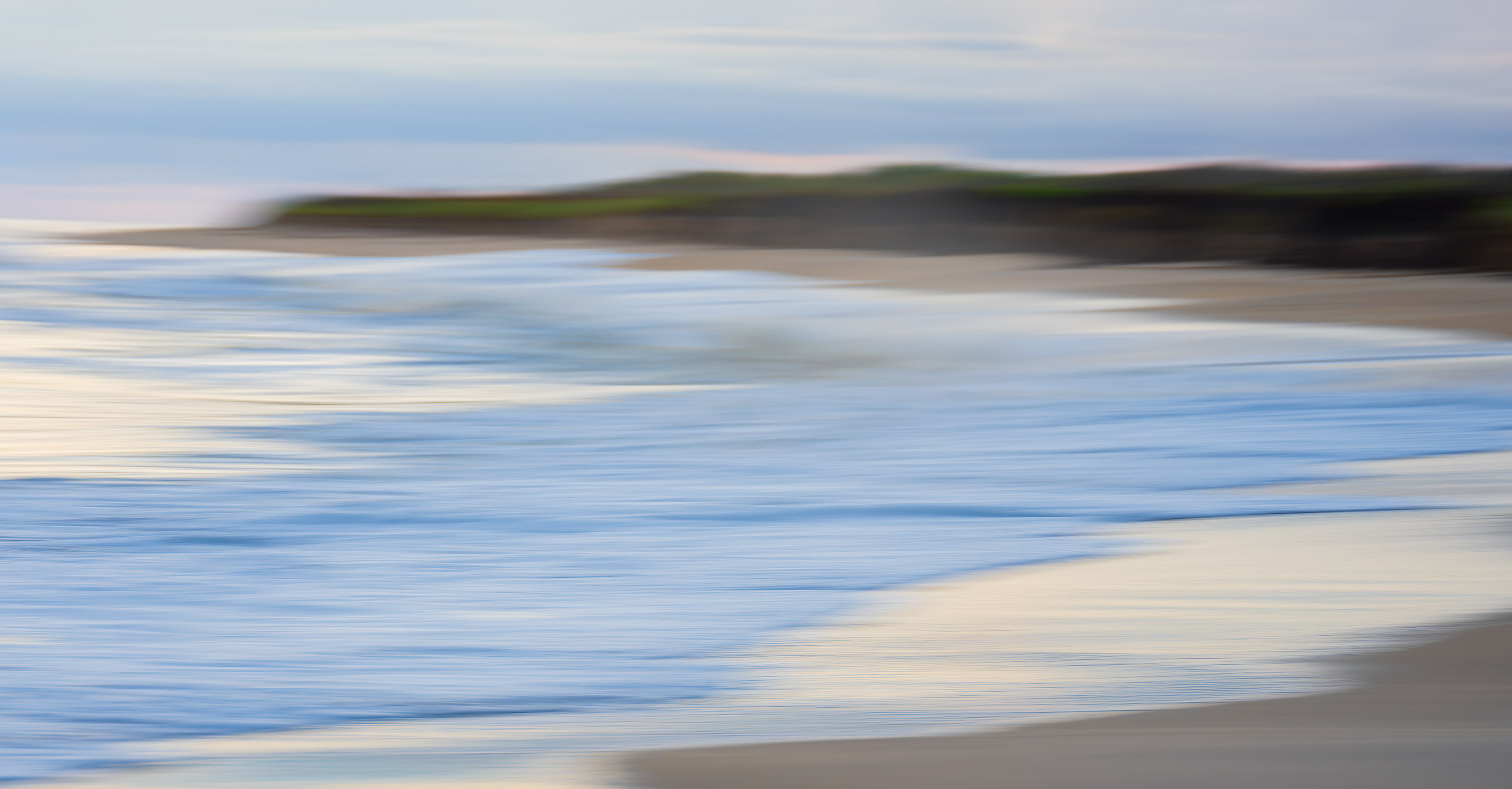
This image was created by yours truly on 10 November 2026 at Sebastian Inlet State Park with Steve Baglione. Bags flew down from Maine for two weeks of private In-the-Field Instructional sessions. Standing at full height, I used the handheld Sony FE 100-400mm f/4.5 GM OSS Lens (Sony E) (at 160mm) and the alleged poor man’s a-1 ii, the Sony a7R VI Mirrorless Camera. The exposure was determined by Zebras with Exposure Compensation (EC) on the Thumb Dial. Multi Metering +1.7 stops. AUTO ISO set ISO 160: 1/8 second at f/4.5 (wide open) in Shutter Priority mode. AWB at 6:03:50am on a then mostly cloudy morning. Wide/AF-C with Bird-Eye/Face Detection performed more than adequately. Click on the image to enjoy the larger, inexplicably sharper high-res version. Image #1: Deserted Atlantic Ocean beach blur |
Avoiding Fisherman
Your chances of finding the beach south of the South Jetty at Sebastian Inlet totally deserted are far greater if you arrive ridiculously early on a weekday rather than later in the morning on a weekend. Even then, you need to be a bit lucky. This image was created while standing just south of the base of the jetty — fortunately, no fishermen had arrived behind us yet. Note that the walk from the A1A parking lot to the South Jetty is a bit more than a half-mile.
Thanks, Bags!
As I had grabbed the wrong lens (the Sony 400–800mm) when we left the car — and wanted to show Steve Baglione a few wide ocean blurs — I borrowed his Sony FE 100-400mm f/4.5 GM OSS lens to create Image #1 above. Thanks, Steve!
|
|
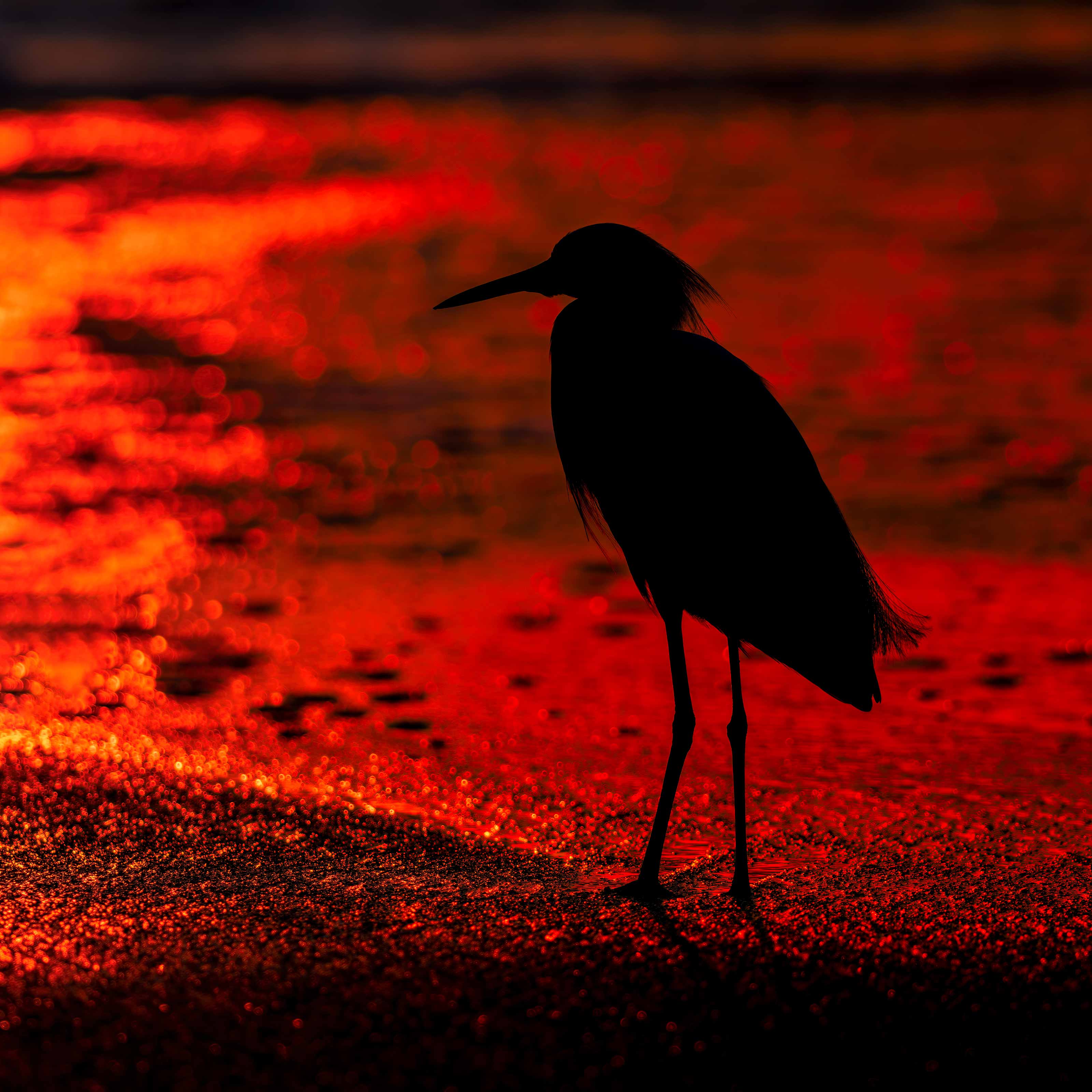
This image was also created by yours truly on 10 November 2026 at Sebastian Inlet State Park with Steve Baglione. Bags flew down from Maine for two weeks of private In-the-Field Instructional sessions. Standing at full height, I used the handheld Sony FE 400-800mm f/6.3-8 G OSS Lens (Sony E) (at 474mm) and the alleged poor man’s a-1 ii, the Sony a7R VI Mirrorless Camera The exposure was determined by Zebras with Exposure Compensation (EC) on the Thumb Dial. Multi Metering -0.7 stops. AUTO ISO set ISO 250: 1/500 second at f/6.3 (wide open at the given focal length) in Shutter Priority mode. AWB at 6:44:12am just minutes after sunrise (with a few clouds on the eastern horizon providing the color and muting the sun just a wee bit). Wide/AF-C with Bird-Eye/Face Detection performed perfectly. Click on the image to enjoy the larger, inexplicably sharper high-res version. Image #2: Snowy Egret sunrise silhouette |
Getting to the Beach Early
Most bird photographers simply do not get up early enough to create images like this. That holds true at La Jolla, Nickerson Beach, Fort De Soto, Huguenot Memorial Park, and a thousand other bird photography hotspots. No matter where we plan to photograph at Sebastian Inlet State Park — a decision always guided by wind direction and sky conditions — we have been arriving around 6:00 AM. Sunrise on the 12th was at 6:40 AM, and as we approach the Winter Solstice (December 21), the days are still shortening, pushing sunrise back by about 45 to 50 seconds each day.
Shutter Priority with AUTO ISO and Exposure Compensation on a Convenient Dial
Many self-proclaimed internet geniuses state that “real” photographers work in Manual mode 100% of the time. By taking a look at and comparing the EXIF info for Images #1 and #2, you will quickly see that such advice is 100% ridiculous.
Two things are needed to make this approach work for you:
1- A thorough understanding of exposure theory. This vitally important topic is covered completely and in detail in the Exposure chapter of the original The Art of Bird Photography — now on sale at half price here at 50% off (was $40.00, now $20.00 plus shipping). Amphoto (New York) had sold more than 35,000 copies by the early aughts when they decided not to do a third reprint. At one point, the hardcover edition was selling for as much as $675.00 online! That is when BIRDS AS ART bought the rights to the book for $1,700.00. We had 10,000 copies printed overseas and delivered to my home in Indian Lake Estates.
2: A consistently toned background that does not change while you are photographing.
While these two images were created roughly a half-hour apart, going from 1/8 sec. at +1.7 stops to 1/500 sec. at -0.7 stops took roughly two seconds. Using Shutter Priority mode as detailed above, the camera automatically determines the correct ISO. Whether you are working in Shutter Priority mode or Manual mode, you are dead in the water if you have not mastered exposure theory. Note: Making those same adjustments in Manual mode would have taken quite a bit longer.
Sony Zebra technology with stills of course makes things a lot easier for Sony shooters who know how to set them up and use them properly. There are more than a few pros who recommend against using Zebras. And one of them, a fabulous photographer, advises using triple back-button focus with Sony high end mirrorless camera bodies. To me, both of the above are an insane way of making things that should be completely simple far too complex.
|
|
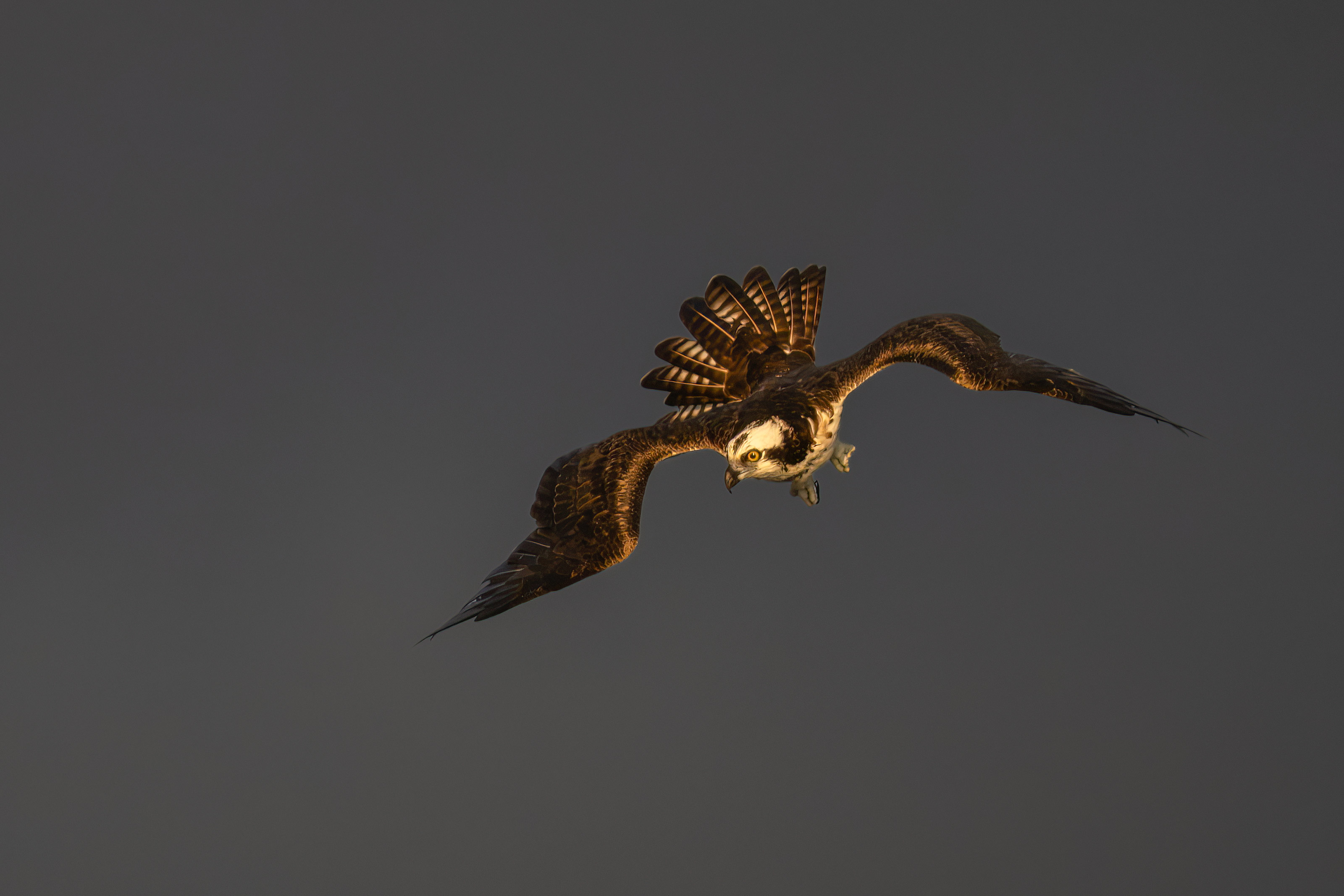
This image was also created by yours truly on 10 November 2026 at Sebastian Inlet State Park with Steve Baglione. Bags flew down from Maine for two weeks of private In-the-Field Instructional sessions. Standing at full height, I used the handheld Sony FE 400-800mm f/6.3-8 G OSS Lens (Sony E) (at 800mm) and the alleged poor man’s a-1 ii, the Sony a7R VI Mirrorless Camera (inn APS-C crop mode — effective focal length = 1200mm). The exposure was determined via Zebras with ISO on the Thumb Wheel: ISO 2500: 1/2500 sec. at f/8 (wide open) in Manual mode. AWB at 7:09:15am when the sun came out for ten minutes on an otherwise cloudy morning. Wide/AF-C with Bird-Eye/Face Detection performed perfectly. Click on the image to enjoy the larger, inexplicably sharper high-res version. Image #3: Osprey starting dive/dark storm cloud backround |
Trying to Make Hay While the Sun Shined
When we left the parking lot to begin the “death march,” there were not many clouds in the eastern sky. I grabbed what I thought was the Sony FE 100-400mm f/4.5 GM lens. Halfway down the path to the beach, I realized I had actually packed the heavier Sony FE 400-800mm f/6.3-8 G lens. “What the hay,” I thought, “it’s gonna be sunny anyway,” and pressed on with the long walk to the South Jetty carrying the 4-8, figuring I would be fine as soon as the sun came up. The sun finally broke over the horizon clouds at 6:54 AM, only to disappear behind heavy cloud cover that materialized just 25 minutes later. With that warm early light and the spectacular storm-cloud background, we were desperate to find anything in the air coming toward us to photograph. This distant Osprey just beginning to dive was my best chance. It is an absolutely huge crop from the original Sony a7R VI RAW file, which was created in crop mode to begin with — leaving slightly less than 11% what the full frame raw file would have been!
|
|
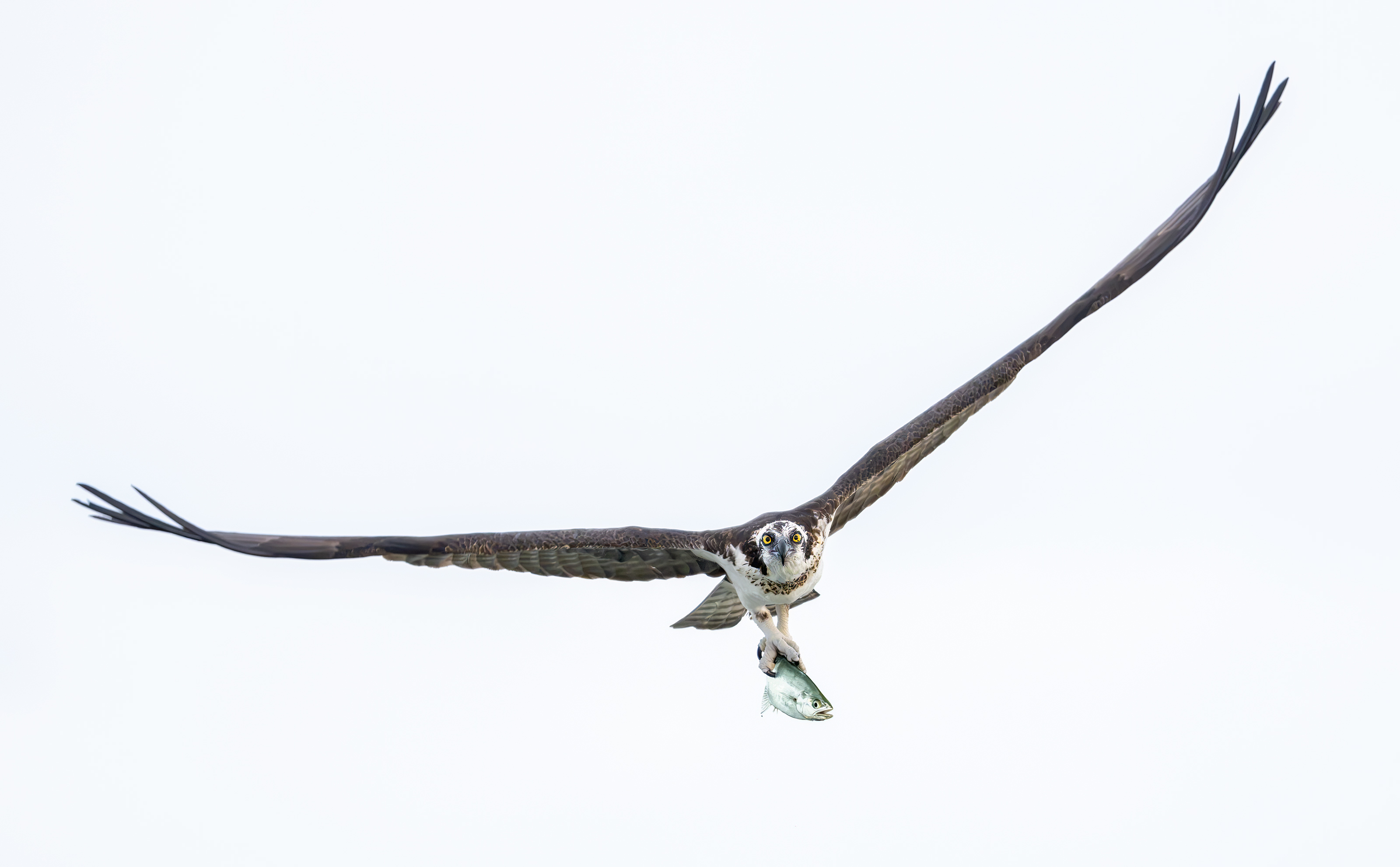
This image was also created by yours truly on 10 November 2026 at Sebastian Inlet State Park with Steve Baglione. Bags flew down from Maine for two weeks of private In-the-Field Instructional sessions. Standing at full height, I used the handheld Sony FE 400-800mm f/6.3-8 G OSS Lens (Sony E) (at 800mm) and the alleged poor man’s a-1 ii, the Sony a7R VI Mirrorless Camera The exposure was determined via Zebras with ISO on the Thumb Wheel: ISO 6400 (!): 1/1600 sec. (!) at f/8 (wide open) in Manual mode. AWB at 7:28:29am (!) on a then cloudy dark morning. Wide/AF-C with Bird-Eye/Face Detection performed perfectly. Click on the image to enjoy the larger, inexplicably sharper high-res version. Image #4: Osprey with Yellowfin Menhaden |
Now, I Got the Wrong Lens — What to Do?
Why All the Exclamation Points?
Now it is cloudy dark and I have an f/8 lens — far less than ideal for birds in flight.
So, the first thing that I do is compromise on the shutter speed for flight. While 1/3200 or 1/4000 second is ideal, I drop down to 1/1600 second. Thus, the first exclamation point.
Next, I raise the ISO to 6400 knowing that I am still under-exposed, but reluctant to work at an even higher ISO. When evaluated in RawDigger, the raw file brightness was shown to be one stop too dark. Under-exposed at ISO 6400 — that is the second exclamation point.
The one after the time — 7:28:29am, was to note that the sun had been shining brightly just minutes prior.
|
|
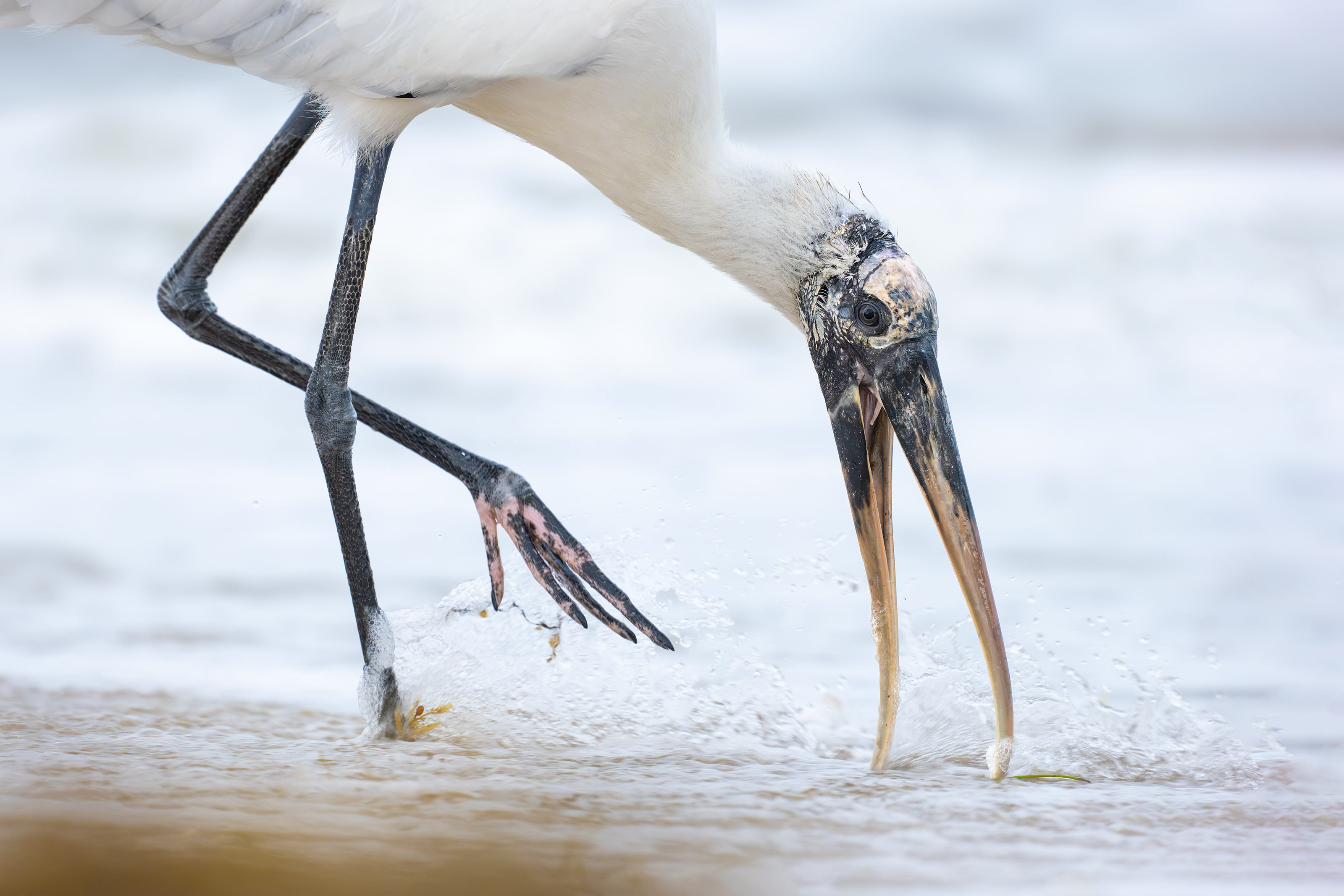
This image was also created by yours truly on 10 November 2026 at Sebastian Inlet State Park with Steve Baglione. Bags flew down from Maine for two weeks of private In-the-Field Instructional sessions. Seated on a concrete slab below the base of the North Jetty, I used the handheld Sony FE 600mm f/6.3 GM OSS Lens (Sony E) and the alleged poor man’s a-1 ii, the Sony a7R VI Mirrorless Camera The exposure was determined via Zebras with ISO on the Thumb Wheel: ISO 2000: 1/500 sec. at f/6.3 (wide open) in Manual mode. AWB at 4:52:38pm on a cloudy afternoon. Wide/AF-C with Bird-Eye/Face Detection performed perfectly. Click on the image to enjoy the larger, inexplicably sharper high-res version. Image #5: Wood Stork feeding along the edge of the surf |
Why the 600mm f/6.3 Featherweight Lens?
With dark, cloudy skies and a high tide, prospects were not looking great, so I grabbed my new, relatively slow (at f/6.3) but amazingly small and light lens just for the heck of it. I was working at about two stops brighter than the exposure suggested by the camera’s meter to ensure bringing out the dark tones on the stork’s face (without toasting the whites). As I was holding the lens just above the sand and working off the rear monitor, I mis-framed the original and clipped the image just above the top of the bird’s legs. So, I first expanded the canvas and then used a Quick Mask to add the back of the same bird from the previous frame. It was moved roughly into place and then refined with the addition of a Regular Layer Mask.
|
|
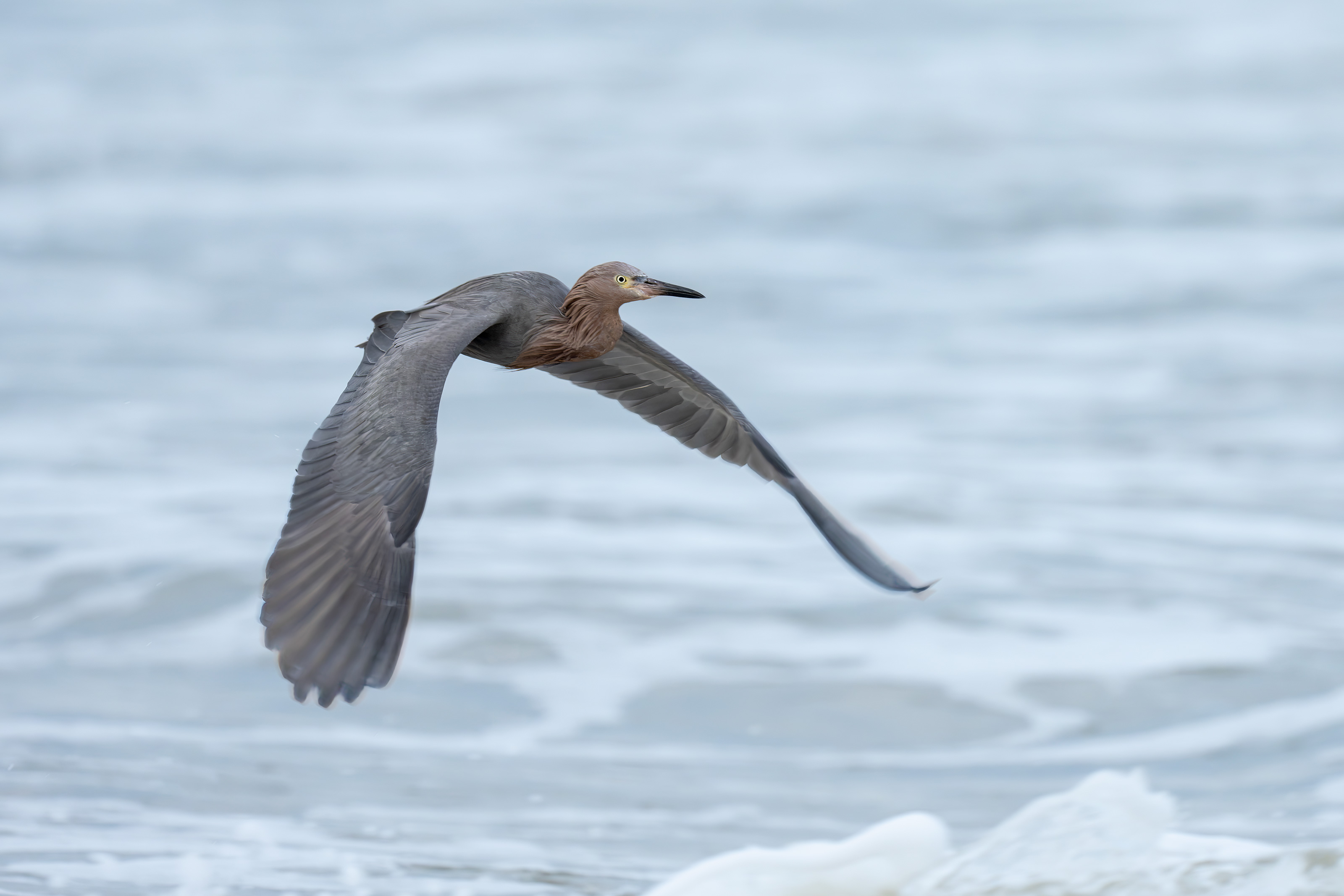
This image was also created by yours truly on 10 November 2026 at Sebastian Inlet State Park with Steve Baglione. Bags flew down from Maine for two weeks of private In-the-Field Instructional sessions. Seated on a concrete slab below the base of the North Jetty, I used the handheld Sony FE 600mm f/6.3 GM OSS Lens (Sony E) and the alleged poor man’s a-1 ii, the Sony a7R VI Mirrorless Camera The exposure was determined via Zebras with ISO on the Thumb Wheel: ISO 2000: 1/500 sec. (!) at f/6.3 (wide open) in Manual mode. AWB at 4:57:23pm on a cloudy afternoon. Wide/AF-C with Bird-Eye/Face Detection performed perfectly. Click on the image to enjoy the larger, inexplicably sharper high-res version. Image #6: Reddish Egret in flight |
A Pretty Sharp Flight Series at 1/500 Second!
A Pretty Sharp Flight Series at 1/500 Second!
I’d been photographing a very nice dark morph adult Reddish Egret standing on the berm with an ocean background in very low light. I was 100% sure that I was exposed right to the right, and I knew that 1/500 sec. was too slow for most flight photography.
I was seated with my “too-slow-for-flight” lens in low light when the bird suddenly took flight right toward me. What’s a guy to do? I raised the lens and fired off about 20 images. At the back of my mind, I thought, “1/500 of a second was just about as fast as we could get in the old days with ISO 50 Velvia pushed one stop. And heck, we made a few sharp flight images at 1/500 sec. back then.”
When I got the photos onto my MacBook Pro, I was surprised — but not entirely shocked, to see that each one was sharply focused on the eye and that half of the photos were acceptably sharp, featuring just a hint of motion blur when examined at 100%. For this one — featuring my favorite wing position, I used Topaz Photo > Sharpen > Motion Blur at 80% and was quite pleased with the optimized result.
|
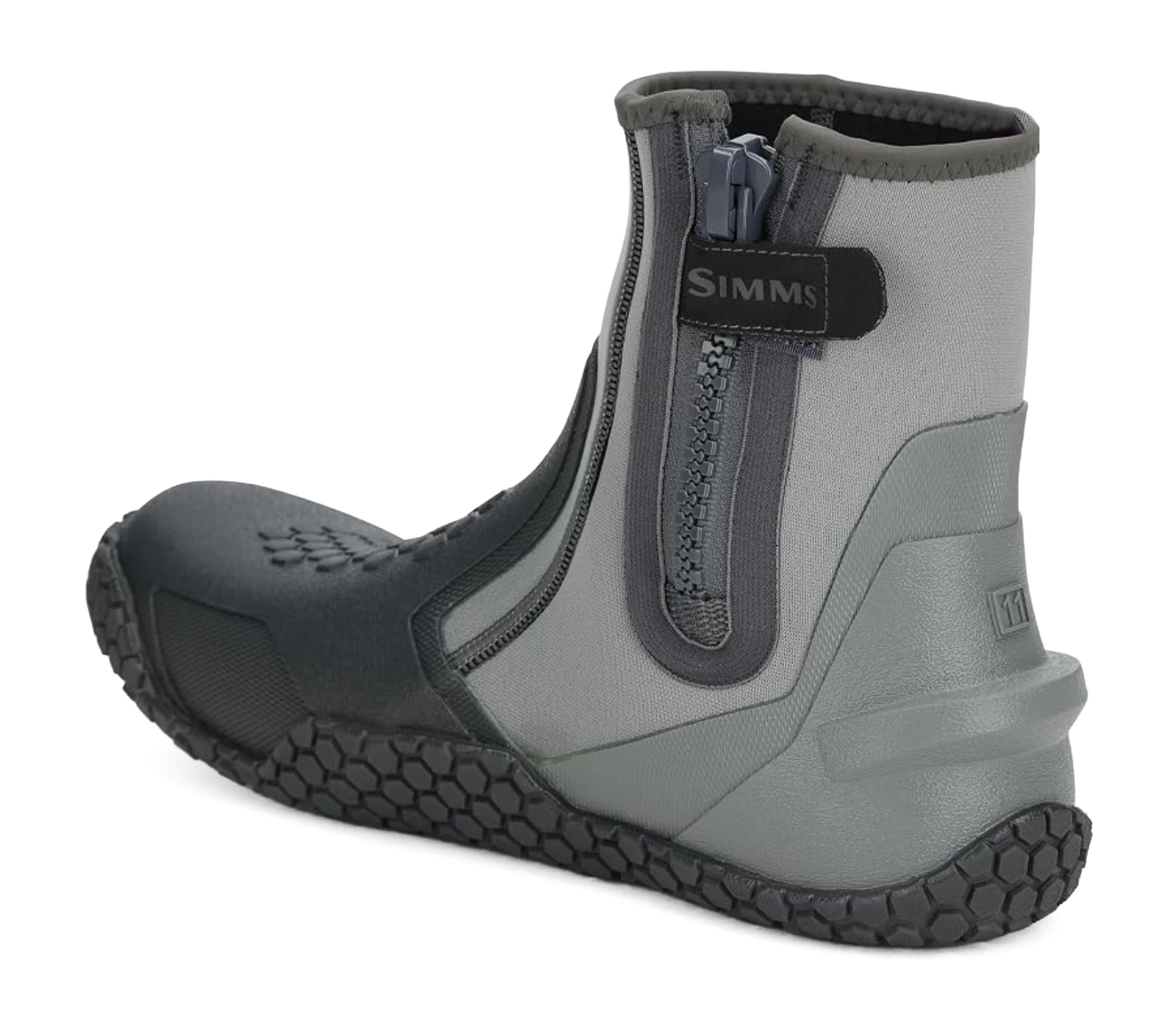
Simms Surf Booties
When I might need to be walking in the water be it at ILE, Fort DeSoto, La Jolla Shores Beach, Nickerson Beach, Sebastian Inlet, or anywhere else, I always have a pair of Simms Surf Booties on. The are comfortable but rugged, add a bit of warmth on cold days, keep your feet cool on hot days, prevent cuts from shells, broken glass, and the like, and give some degree of protection against sting rays. And the lugged soles prevent slipping on wet mud or muck. For years I used a pair of Neo-Sport Booties. But I wore them out in six months and had to replace them. I tried a pair of more expensive Simms Surf Booties and found the top of the heap brand.
Use a forceful hose to spray the zipper after each beach use to keep the sand out and follow that with a good spray of WD 40 and the zipper will operate smoothly pretty much forever.
You can order a pair of Simms Surf booties by clicking here. They tend to run a very small. I wear a size 10 1/2 or 11 wide sneaker and needed a size 13. I wish they carried half sizes — 12 1/2 would have been perfect for me. That said, I wear them comfortably with socks and they are a huge improvement over the Neo-Sport Booties that I wore out constantly. The bottoms were so slick on those that I once slipped and fell on smooth muck at Fort DeSoto while carrying my Sony 400mm f/2.8 GM lens!
Support BIRDS AS ART with your Everyday Online Shopping
Using the BAA Tip Jar Costs You Nothing
This You Tube video blog post took three hours to prepare not including the time spent photographing, picking my keepers, and optimizing the images. Consider using the BAA Tip Jar — it never costs you a single penny to help me out.
If you are like me, you enjoy the convenience of shopping online at Amazon without having to drive into town. The prices are competitive, and you can return anything you purchase for any reason (as long as you have not wrecked it).
If you enjoy learning from the blog posts, the YouTube videos, and the Instagram posts, or simply love being inspired by the images, the simplest and easiest way to support my efforts at BIRDS AS ART at no cost to you, is to use my generic Amazon link:
Whenever you make your routine household purchases — from groceries and coffee to backup batteries, household supplies, or electronics, making it a habit to click on our link first helps keep things running smoothly here. And again, it never costs you one penny to help me out.
Click here or on the Great (Photographic Accessory) Stuff tab on the lower, orange-yellow menu bar at the top of each blog post to learn about my favorite photo accessories. And more.
Typos
With all blog posts, feel free to e-mail or to leave a comment regarding any typos or errors.








Leave a Reply