
An Old Man’s Take on the Vastly Under-appreciated Sony 400-800mm G Lens
The word on the street is that this lens is to too slow for bird photography and too heavy and poorly balanced to handhold. I, and the images I have made with this lens, beg to differ. Arash Hazeghi, my good friend, world class bird photographer, and co-creator of The Complete and Quintessential Guide to Photographing Birds in Flight, does not like the 4-8 one bit. He thinks that it is not a sharp lens and that there is too much weight at the front of the lens. He handholds the heavier 600mm f/4 GM lens easily for long flight and action sessions. I am 100% sure that the lens is incredibly sharp with the RAW files comparable to those created with my other Sony super-telephotos including the 600mm f/4 GM. And, I can barely lift the 600mm f/4 even though it is less than a pound heavier than the 400-800. Different strokes. There is a very small chance that Arash has a bad copy … When he first got his 200-600 he told me that it was junk. I told him that he must have a defective lens. He had it replaced and used it with great success for years.
On sunny days at the beach, the 400-800 is my go-to lens. Watch the video and see for yourself.
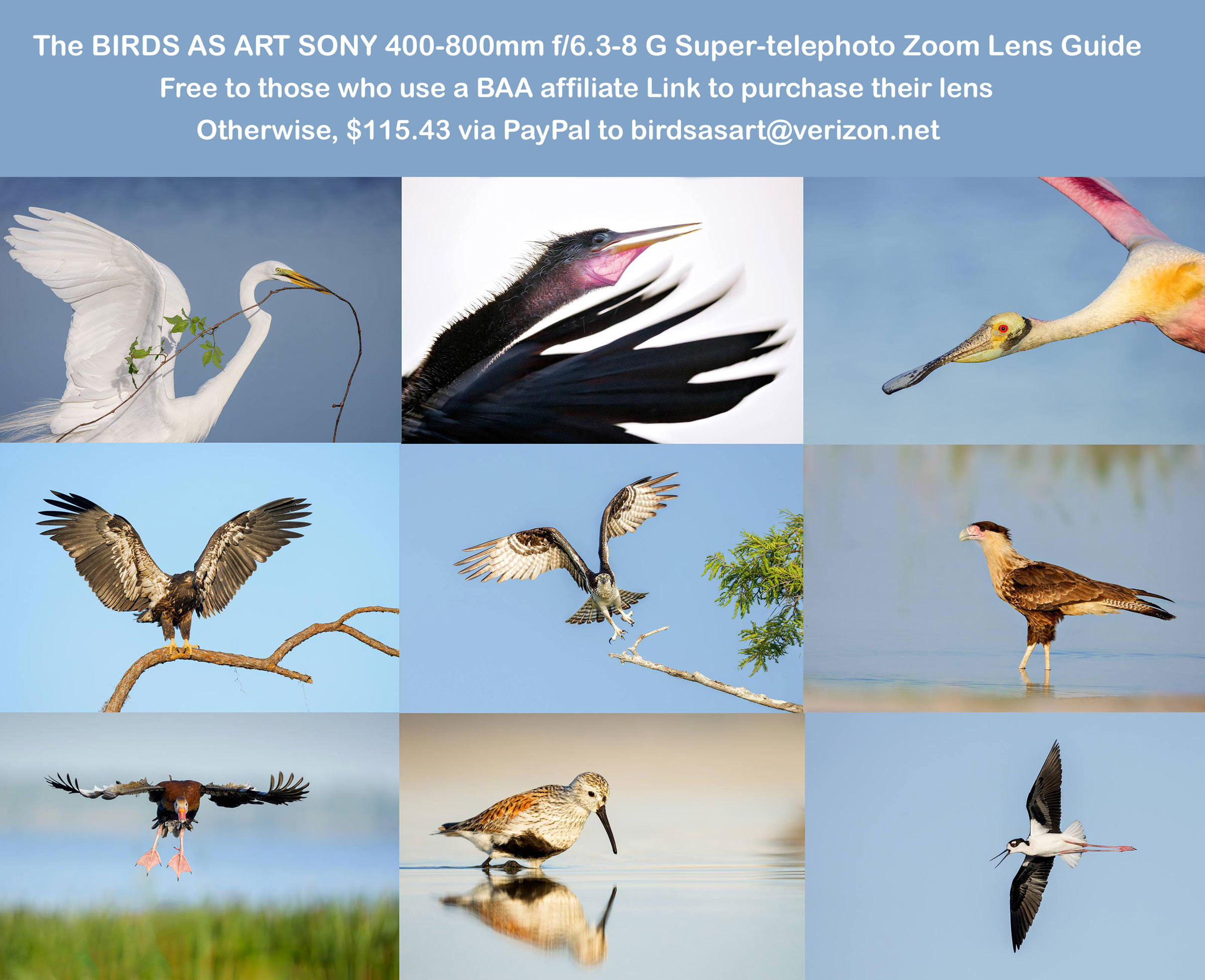
The BIRDS AS ART SONY 400-800mm f/6.3-9 G Super-telephoto Zoom Lens Guide
If you decide to purchase this lens, please be sure to use one of my affiliate links so that I can send you the guide as a thank you gift.
When I borrowed this lens from Sony, I assumed that at 5.45 pounds it was too heavy to handhold for long and that at f/8 at the long end (800mm,) it was too slow for most bird photography applications. In short, I did not want to like the lens. After a month of using it, I could not live without it. After returning the loaner, I was miraculously able to get my own from Bedfords on 16 April 2025. In this guide I share everything that I have learned about using the 400-800. For best results, you need to know exactly what you are doing to get the most out of this zoom lens. It would be best, therefore, to consider and study the material in the guide so that you can begin making great images with your new lens.
You will learn how to deal with the relatively show apertures: f/6.3, f/7.1, and f/8 when working in Manual mode.
You will learn how to ensure that you are working at the widest aperture by working in Shutter Priority mode with AUTO ISO.
If you are able to hand hold the lens, you will learn proper hand holding techniques.
If you can’t, you will learn when, why, and how to employ other options. Those include:
1- The knee-pod, heel-pod, and toe-pod techniques
2- Using the lens on a monopod.
3- The best lens plate and low foot for your 4-8.
4- The best tripod and head for the 4-8 and how best to utilize them.
5- How to use the lens from your vehicle while supporting it on a BLUBB (or not and why not).
6- Detailed instructions on how to set and use the lens controls and buttons:
a- AF/MF
b- DMF Switch
c- Limit Range Switch
d- OSS (Optical Steady Shot) Switch
e- OSS Mode Switch
f- Focus Hold Buttons
The guide also includes a Hand Holding Shutter Speed Primer and an illustrative, educational, and inspiring 67-image gallery.
This guide is free to folks who use one of my two affiliate links to purchase their Sony 400-800 G lens. Otherwise, please send a PayPal for $115.43 to birdsasart@verizon.net. and include the words “400-800 Lens Guide” in your e-mail.
In the Last Blog Post
In the last blog post, five of the six images got some love — only the pretty-darned-good preening backlit crane went un-mentioned. The dancing crane pair on the hill was the big favorite along with the incredibly detailed Black Vulture head portrait. They were my #1 and #2 as well.
Your Calls?
Which is your single favorite image from the video? Which is your favorite of today’s four featured photos? Why did you make your choices?
What’s Up?
On Tuesday morning — cloudy with a NE wind, Bob Eastman and I had several really good chances with a hunting, fly-by juvenile Northern Harrier. And we paid them off quite nicely. Conditions were the same on Wednesday but for the fact that it was pouring when we left the house at 8:00am. We did OK for a while shooting from the car keeping the wind at our backs. As the rain let up just a bit, we had some great chances with the soaking wet Crested Caracara pair that is nesting in a big Cabbage Palm in the front yard of a house on Palmetto Drive.
Today is Thursday 26 2026. Happy bird day! I hope that you enjoy a wondrous day filled with friends and football (if the latter is your gig). A for counting my blessings, regular readers know that I am and have been one of the luckiest guys on the planet, getting to do what I love pretty much every day of the year. The forecast is for brighter skies (good) with the wind from the NW (bad). We will of course be heading down to the lake early. Whatever you opt to do today, we hope you choose to have fun and enjoy life. Please remember that happiness is a choice — Byron Katie – The Work.Com
We will be headed over to DeSoto on Friday afternoon and getting back to ILE midday on Sunday in time for the NFL games.
If an item — a Delkin flash card or reader, a Levered-clamp FlexShooter Pro, or a Wimberley lens plate or low foot — for example, that is available from B&H and/or Bedfords, is also available in the BAA Online Store, it would be great, and greatly appreciated, if you would opt to purchase from us. We will match or beat any price. Please remember also to use my B&H affiliate links or to earn 3% cash back at Bedford by using the BIRDSASART discount code at checkout for your major gear purchases. Doing either often earns you free guides and/or discounts. And always earns my great appreciation.
Gear Questions and Advice
Too many folks attending BAA IPTs and dozens of photographers whom I see in the field and on BirdPhotographer’s.Net, are — out of ignorance — using the wrong gear, especially when it comes to tripods and more especially, tripod heads. And the same is true in spades when ordering new camera bodies or lenses. My advice will often save you some serious money and may help you avoid making a seriously bad choice. Please know that I am always glad to answer your gear questions via e-mail. If you are desperate, you can try me on my cell at 863-221-2372. Please leave a message and shoot me a text if I do not pick up.
|
|
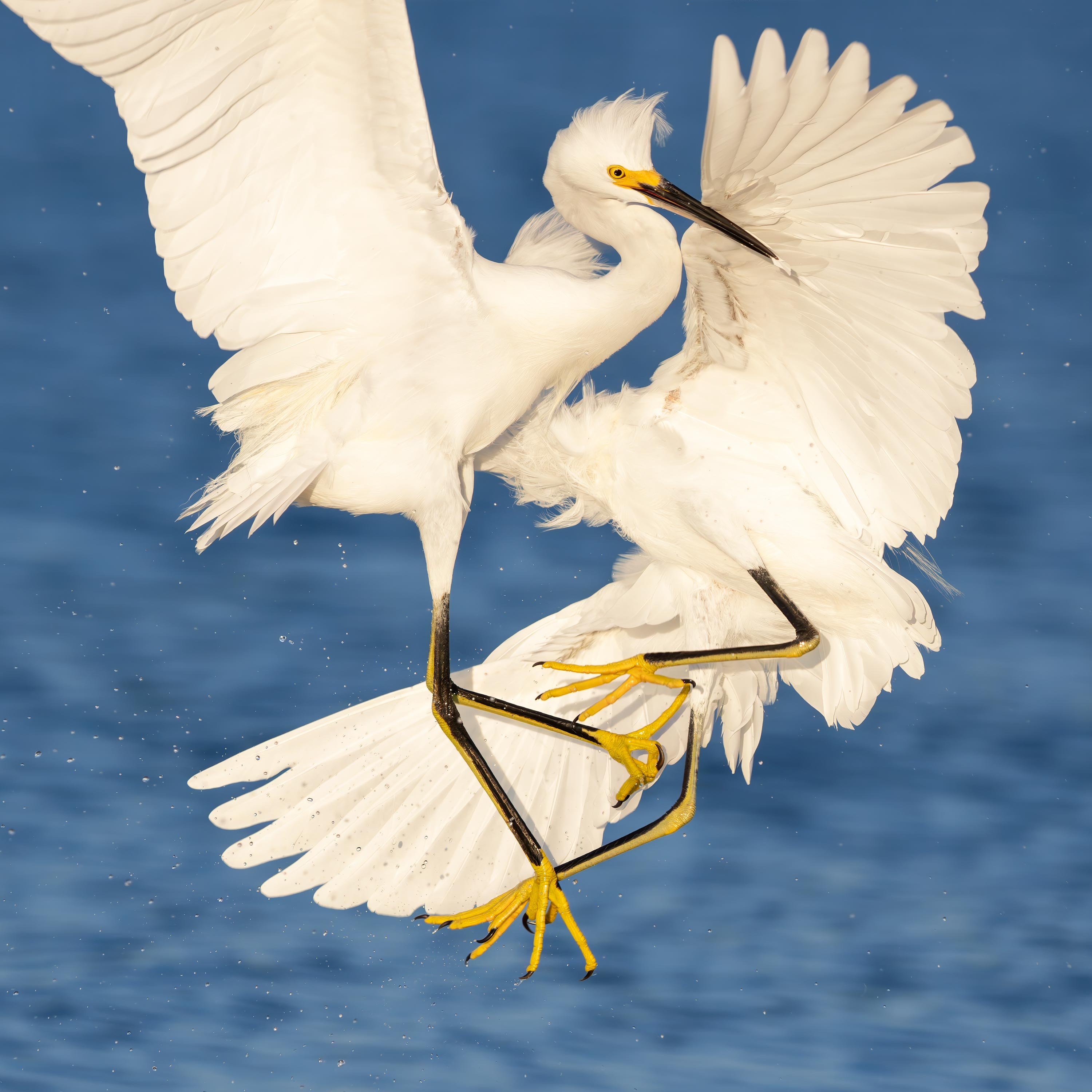
This image was created on 15 October 2026 at Fort DeSoto Park, FL. Standing at full height Sony FE 400-800mm f/6.3-8 G OSS lens (Sony E) (at 400mm) and The Latest Greatest Sony Flagship Body, the a1 II Mirrorless Camera. The exposure was determined by Zebras with ISO on the rear wheel — ISO 1600: 1/2500 second at f/8 (stopped down 2/3 stop at the given focal length) in Manual mode. AWB at 7:58:42am on partly sunny morning. Tracking: Zone/AF-C with Bird-Eye/Face Detection performed perfectly. Click on the image to enjoy the larger, inexplicably sharper high-res version. Image #1: Snowy Egret midair fight |
Lens Too Long
I had two great mornings at DeSoto handholding the 400-800 in mid-October — my very favorite image was the Sandwich Tern with a fish (as seen in the YouTube video above at the 29:26 mark. But, when these Snowy Egrets began squabbling in midair, even zooming out all the way to 400mm left me clipping wings. Strangely enough, even with the clipped wings and only one of the combatants face visible, I love the image for the intensity of the action. And for the early morning light white on blue color scheme. Oh, and those feet!
|
|
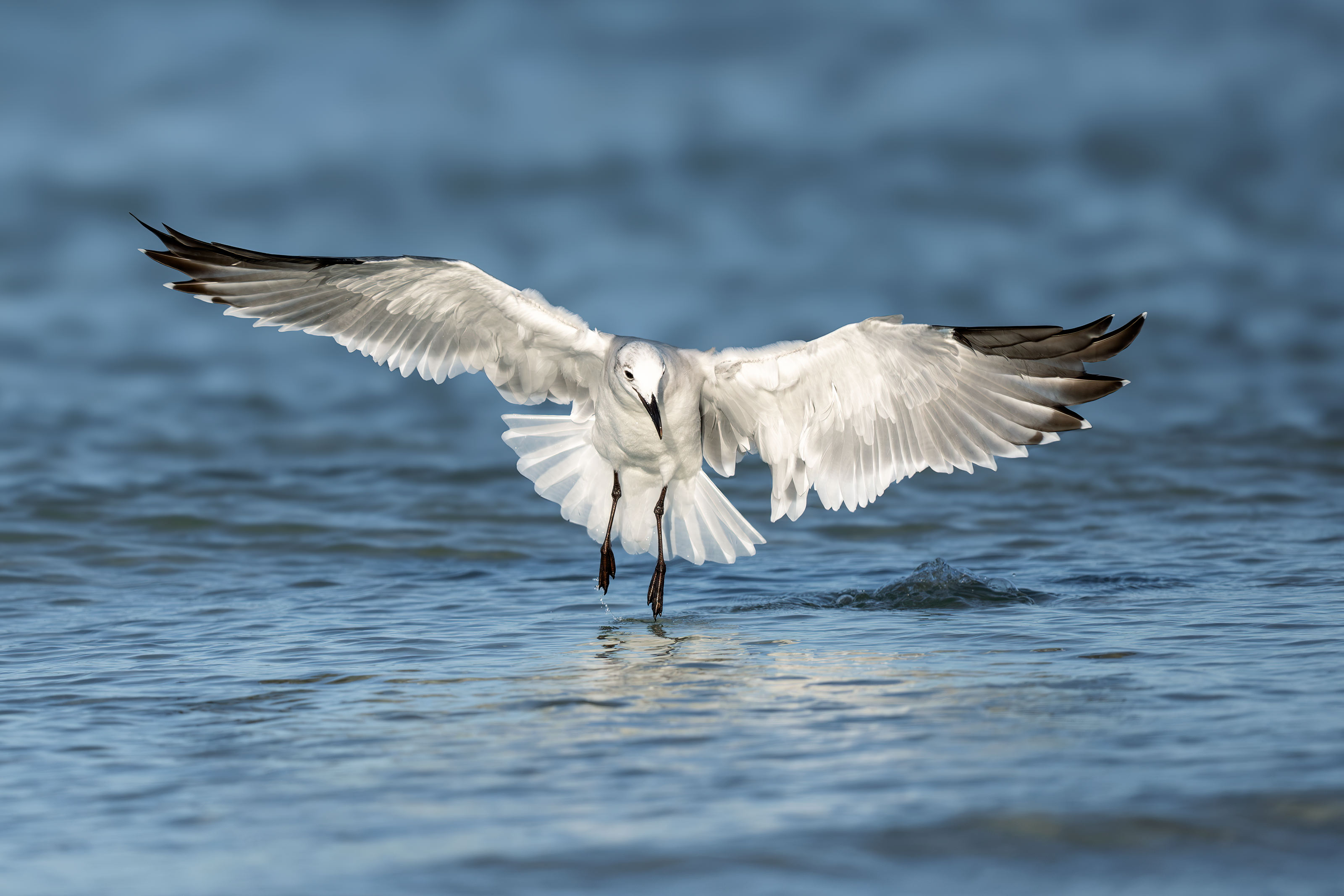
This image was also created on 15 October 2026 at Fort DeSoto Park, FL. Seated on a Rubbermaid Roughneck Step-Stool, I used the handheld Sony FE 400-800mm f/6.3-8 G OSS lens (Sony E) (at 800mm) and The Latest Greatest Sony Flagship Body, the a1 II Mirrorless Camera. The exposure was determined by Zebras with ISO on the rear wheel — ISO 1000: 1/3200 second at f/8 (wide open) in Manual mode. AWB at 8:33:04am on partly sunny morning. Tracking: Zone/AF-C with Bird-Eye/Face Detection performed perfectly. Click on the image to enjoy the larger, inexplicably sharper high-res version. Image #2: Laughing Gull non-breeding fishing |
Getting Low For Flight at the Beach
Getting low when doing flight photography at the beach is often the best plan as it effectively moves the background farther from the subjects. That effect was lessened to some degree as I was sitting on a rather high berm when the terns and gulls found a school of baitfish.
|
|
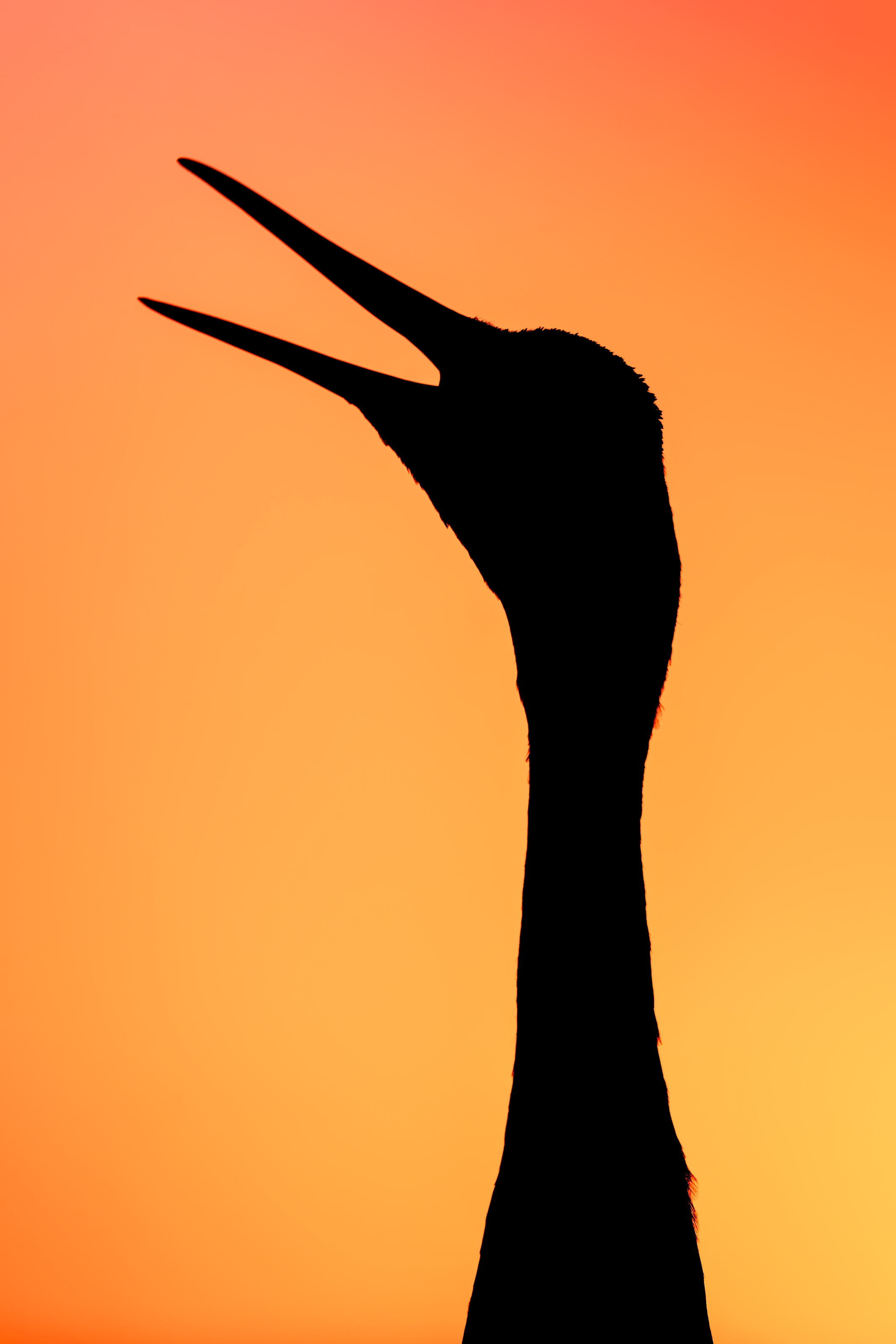
This image was created on 23 October at Indian Lake Estates, FL. Standing at full height I used the handheld Sony FE 400-800mm f/6.3-8 G OSS lens (Sony E) (at 800mm) and the alleged poor man’s a-1 ii, the Sony a7R VI Mirrorless Camera. The exposure was determined by Zebras with Exposure Compensation (EC) on the Thumb Dial. Multi Metering +1.3 stops. AUTO ISO set ISO 500: 1/1000 second at f/8 (wide open) in Shutter Priority mode. AWB at 6:42:12pm right at sunset. Wide AF-C with Bird-Eye/Face Detection performed perfectly. Click on the image to enjoy the larger, inexplicably sharper high-res version. Image #3: Sandhill Crane calling — sunset silhouette |
A Rare Sunset
With huge low pressure systems hanging over Florida for the last six weeks bringing clouds and rain, sunset color has been extremely rare. When I saw a chance on October 23rd, I quickly ran down to the lake and found some cooperative cranes on the South Peninsula.
|
|
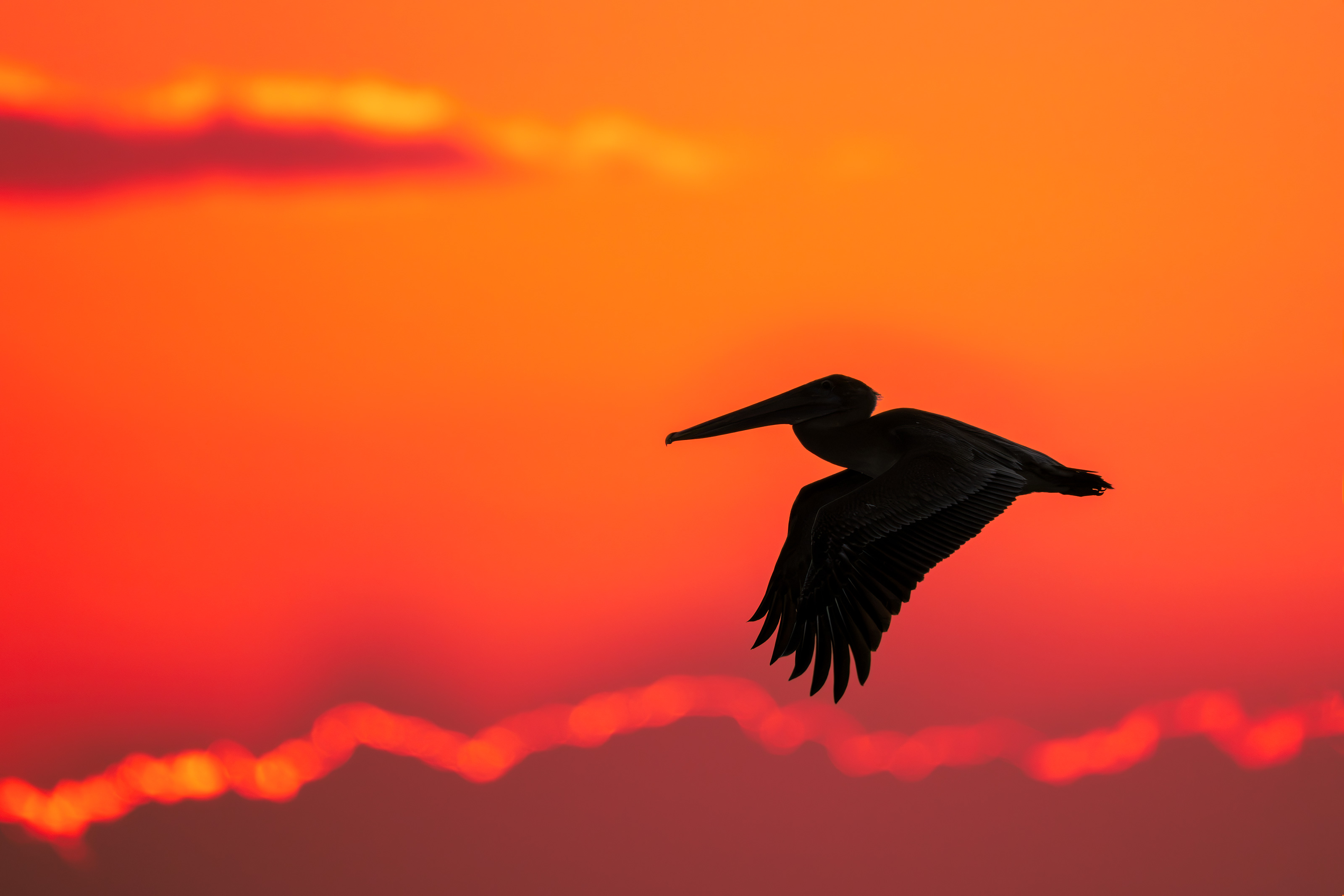
This image was created on 6 November 2026 at Sebastian Inlet State Park, FL. Standing at full height I used the handheld Sony FE 400-800mm f/6.3-8 G OSS lens (Sony E) (at 800mm) and the alleged poor man’s a-1 ii, the Sony a7R VI Mirrorless Camera. The exposure was determined by Zebras with Exposure Compensation (EC) on the Thumb Dial. Multi Metering +1 stop. AUTO ISO set ISO 6400: 1/3200 second at f/8 (wide open) in Shutter Priority mode.AWB at 6:31:00pm a few minutes before sunset. Wide AF-C with Bird-Eye/Face Detection performed perfectly. Click on the image to enjoy the larger, inexplicably sharper high-res version. Image #4: Brown Pelican downstroke flight — sunset silhouette |
The Bench
For years, I have been shooting sunset color at Sebastian from a spot that we have nicknamed The Bench. It is near the fishing pier and usually offers some good chances at sunset. Though it was not particularly productive this year, we — Bob, Steve Baglione, and I, had some great chances on November 6th.
Typos
With all blog posts, feel free to e-mail or to leave a comment regarding any typos or errors.







Absolutely fabulous video — thanks! But, I wish I knew when I was watching it that you would ask us for a favorite shot. Too late now. Happy Thanksgiving!
#2 for me. I like the position of the bird and the spread wings. Have a safe and Happy Thanksgiving. Thanks for all you do to help educate us to become better photographers and people.
Happy Thanksgiving! I’m grateful for the time you take to create your posts and share your thoughts and expertise.
Of today’s four images, I like image 4 of the pelican sunset because it holds my interest the longest and the beautiful colors. Image 1 of the fighting egrets would have taken 1st but I need to see the second bird’s head, or at least the majority of it.
I’ll have to watch the video sometime today to pick a favorite.
Thanks, Tom.
Don’t eat too much!
with love, artie