
Your Call
Which of today’s featured images do you like best? Why did you make your choice?
In the Last Blog Post
Thanks for all the encouraging comments on Steve Baglione’s work in the last blog post here.. My three top picks in no particular order were the Royal Tern in the wash, the single Brown Pelican diving during feeding frenzy, and the Crested Caracara taking flight. I picked the first and the third because I missed both of those shots and the pelican for its fabulous diving pose. Thanks again to Steve for allowing me to share his fine images with you here on the BIRDS AS ART blog.
Summary
When a Crested Caracara attacked a Turkey Vulture on the North Field last week, I was proud that I got the big lens on the action and happy to come away with several sharp, dramatic images. Then I saw Bob Eastman’s amazing frame from the same sequence showing the caracara with its talons extended right on the vulture’s back. With only one super-telephoto lens—the remarkably versatile Sony 200-600 G, Bob is always ready, and he is quick on the draw as well. Oftentimes having the newest camera and the most expensive lens is not the key to success.
Keep reading to learn how Bird Face-Eye tracking autofocus, perspective, reaction time, exposure, handholding, depth of field, ACR Lens Blur, Layer Masks, and focal length shaped today’s featured images.
|
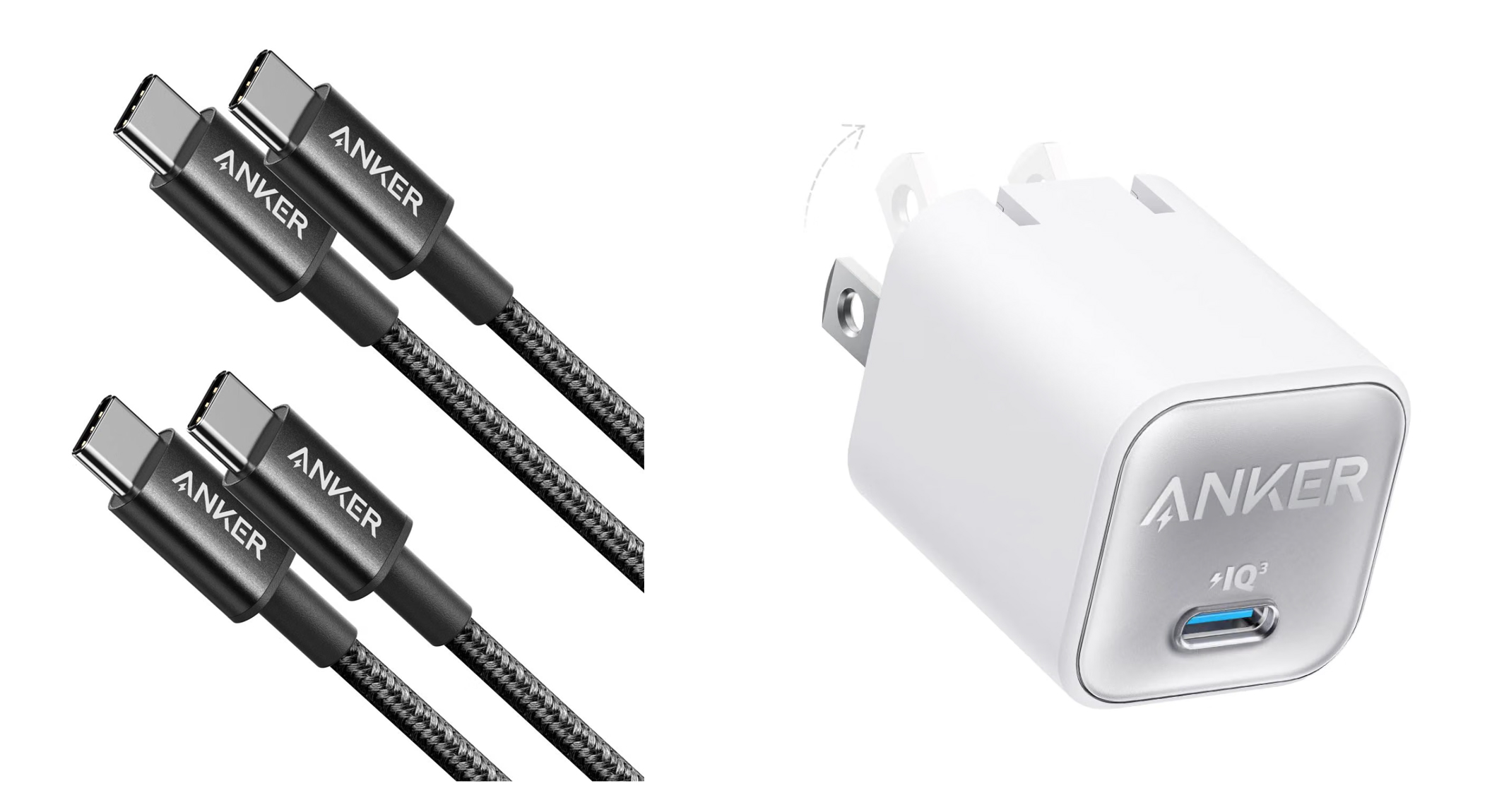
Anker Nano 30W Chargers and 60W USB C to USB C Cables
I was floored when I opened the box containing my first Sony a-1 ii body and found the battery charger without either a wall charger or a cable — both are needed to charge a battery. And the same thing happened with my A7R VI. If you look hard enough you can find this from Sony:
The battery charger requires a commercially available USB Type-C cable (USB-C® – USB-C) that is capable of delivering an electric current of 3 amps and a commercially available USB PD (USB Power Delivery) power supply that is capable of outputting 30 W or more.
When I called Sony Pro Support I was told that any old iPhone charging wall charger and cord would work. I tried several but none worked. So I did some searching and came up with these two items:
Anker Nano (Phone) Charger, 30W Portble and Foldable USB C GaN Charger
I was thrilled to learn that the wall block charger combined with one of the cables below is designed for a wide variety of devices. It works perfectly with both of my new Sony battery chargers, charges my iPhone, and several alternative medicine devices that I use daily to help with knee pain and thumb arthritis. It can also be used to charge earbuds, iPads, tablets, and even a MacBook Air. I now own six of these small, versatile, lightweight, powerful wall chargers.
Click here to order yours.
Anker USB C to USB C Cable, 60W Fast Charging Cable (2-Pack, 3.3 ft, Black)
This cord pairs perfectly with the Anker wall block charger above. Click here to order a 2-pack.
Important Note
As an Amazon Associate I earn a small percentage from qualifying purchases whenever you use my Amazon links. Please make it a habit. 🙂
Support BIRDS AS ART with your Everyday Online Shopping
Using the BAA Tip Jar Costs You Nothing
The previous Steve Baglione blog post took about eight hours to prepare. This one took well more than two hours. Both not including the time spent photographing, picking the keepers, and optimizing the best of those images. Please consider using the BAA Tip Jar — it never costs you a single penny to help me out. If you are like me, you enjoy the convenience of shopping online at Amazon without having to drive into town. The prices are competitive, and you can return anything you purchase for any reason (as long as you have not wrecked it).
If you enjoy learning from the blog posts, the YouTube videos, and the Instagram posts, or simply love being inspired by the images, the simplest and easiest way to support my efforts at BIRDS AS ART at no cost to you, is to use my generic Amazon link:
Whenever you make your routine household purchases — from groceries and coffee to backup batteries, household supplies, or electronics, making it a habit to click on our link first helps keep things running smoothly here. And again, it never costs you one penny to help me out.
Click here or on the Great (Photographic Accessory) Stuff tab on the lower, orange-yellow menu bar at the top of each blog post to learn about my favorite photo accessories. And more.
What’s Up?
Things have been tough since Bob and I got back from Sebastian. Wednesday and Thursday mornings were cloudy and dark with a NE breeze and intermittent rain and drizzle. Friday was the same with a W/NW wind. We’ve been working the cranes and vultures pretty hard, and on Thursday morning we had a good chance on the male Bald Eagle taking flight with talons full of nesting material. We’ve done OK considering that it was supposed to be pouring rain every day all day. Florida’s Atlantic coastal counties from Miami to Jacksonville got slammed last week by the heavy rains and flooding with rain totals as high as 24 inches at the Space Coast. We left Sebastian on Tuesday — more than 14 inches of rain fell in the next two days!
Today is Saturday 21 November 2026. The forecast is slightly improved: cloudy with a a S/SW breeze. Bob and I will be heading down to the lake as soon as I hit publish. I will be working hard on my Instagram account and my B&H Storefront. More details soon. Whatever you opt to do today, we hope that you choose to have fun and enjoy life. Please remember that happiness is a choice — Byron Katie – The Work.Com
If an item — a Delkin flash card or reader, a Levered-clamp FlexShooter Pro, or a Wimberley lens plate or low foot — for example, that is available from B&H and/or Bedfords, is also available in the BAA Online Store, it would be great, and greatly appreciated, if you would opt to purchase from us. We will match or beat any price. Please remember also to use my B&H affiliate links or to earn 3% cash back at Bedford by using the BIRDSASART discount code at checkout for your major gear purchases. Doing either often earns you free guides and/or discounts. And always earns my great appreciation.
Gear Questions and Advice
Too many folks attending BAA IPTs and dozens of photographers whom I see in the field and on BirdPhotographer’s.Net, are — out of ignorance — using the wrong gear, especially when it comes to tripods and more especially, tripod heads. And the same is true in spades when ordering new camera bodies or lenses. My advice will often save you some serious money and may help you avoid making a seriously bad choice. Please know that I am always glad to answer your gear questions via e-mail. If you are desperate, you can try me on my cell at 863-221-2372. Please leave a message and shoot me a text if I do not pick up.
Google Gemini AI
As usual, Gemini AI assisted with general information, copy editing, re-crafting, technical refinement, and formatting for this blog post
|
|
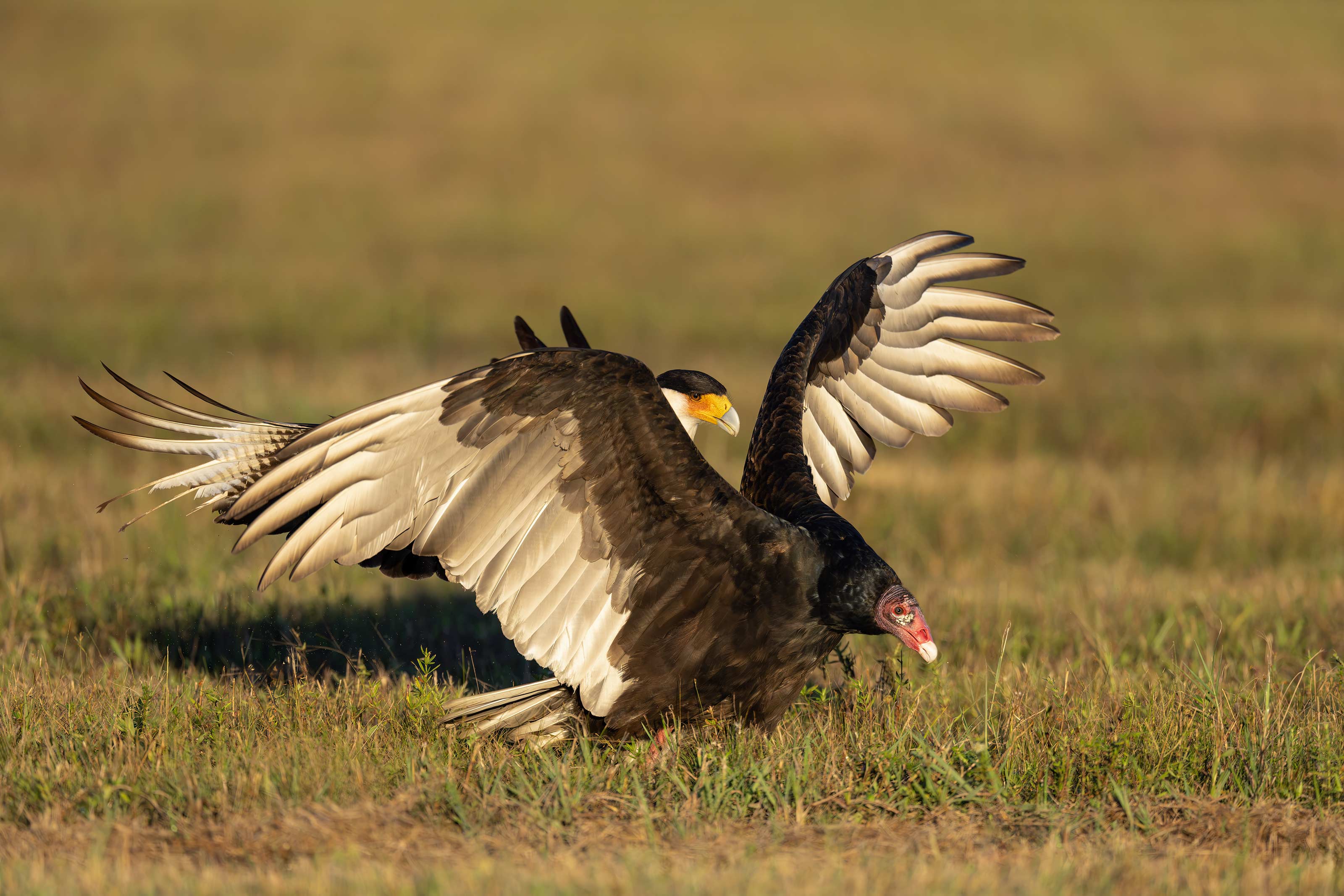
This image was created on 14 November 2026 by yours truly at Indian Lake Estates, FL with Steve Baglione in the back seat. Bags flew down from Maine for nearly two weeks of private In-the-Field Instructional sessions. Seated in the driver’s seat of my X5, I used the BLUBB-supported Sony FE 600mm f/4 GM OSS Lens with the Sony FE 1.4x Teleconverter (at 840mm) and the alleged poor man’s a-1 ii, the Sony a7R VI Mirrorless Camera. The exposure determined via Zebras with ISO on the Thumb Wheel: ISO 1250: 1/3200 sec. at f/5.6 (wide open) in Manual mode. AWB at 7:17:40am on a sunny morning. Wide/AF-C with Bird-Eye/Face Detection performed perfectly. Click on the image to enjoy the larger, inexplicably sharper high-res version. Image #1: Crested Caracara adult attacking Turkey Vulture that landed near fish head |
The Situation
It was sunny with a NE breeze. Steve Baglione was in the left rear seat of my SUV so that we could both shoot out of the left side of the vehicle, with a BLUBB on each window frame. Bob had pulled in right behind us and was standing outside his truck as I relocated the 2+ pound head of a largemouth bass that had been resting in a plastic bag in my laundry room fridge for two weeks. An adult Crested Caracara (four-letter banding/alpha code: CRCA) left its rooftop perch and landed just beyond breakfast in the North Field.
I had just gotten back into the driver’s seat when the handsome raptor began picking at the fish head. A Turkey Vulture landed behind the caracara, but the smaller, slimmer bird had no intention of sharing. It took flight into the wind, circled around, and seemed to land right on the vulture’s back. I was proud of myself for getting on the bird so quickly and firing off a burst of the squabble. With just a few Zebras on the caracara’s off white head, I knew I had a darned good exposure, and I marveled watching the AF point track the caracara’s eye as it attacked the larger scavenger. Steve couldn’t get his big lens onto the action in time, but he managed to lift his lens off the BLUBB and capture a single excellent flight shot when the bird took off a second time — Image #17 in the last blog post.
|
|
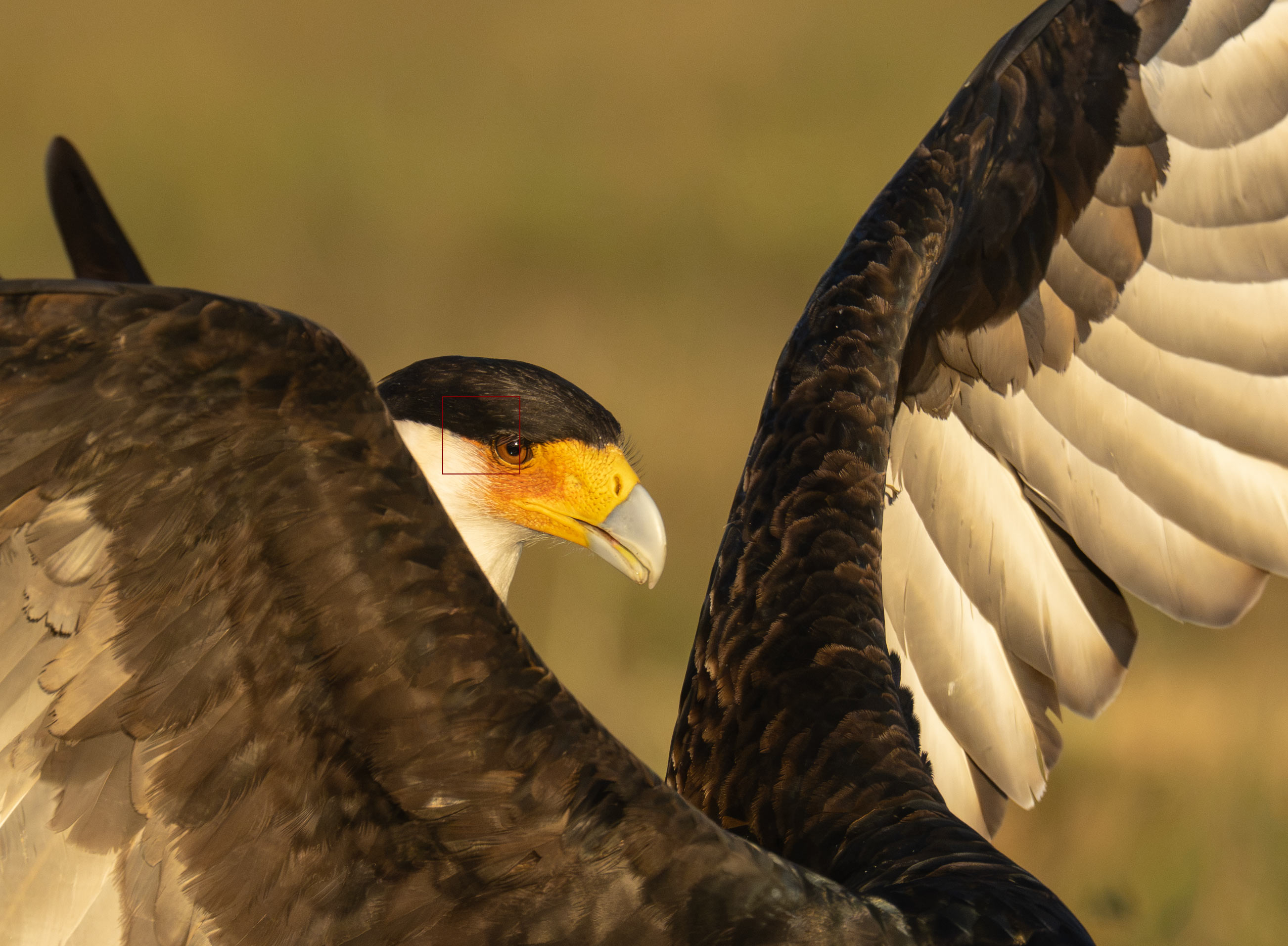
The A7R VI Bird Face-Eye tracking AF point from an Adobe Camera Raw (ACR) screen capture. Image #1A: Crested Caracara adult attacking Turkey Vulture that landed near fish head |
A7R VI Bird Face-Eye Tracking
Note the small red square indicating the active AF point that tracked the Crested Caracara’s eye even after it was briefly blocked by the vulture’s near wing. Most Sony shooters using the new 67MP body for bird photography feel that its Bird Face/Eye tracking is even stronger than with the more expensive a-1 ii. See the recent A Real World Bird Photography Look at the Sony a7R VI blog post here for a detailed look at the a7R VI, including the body’s potential shortcomings.
|
|
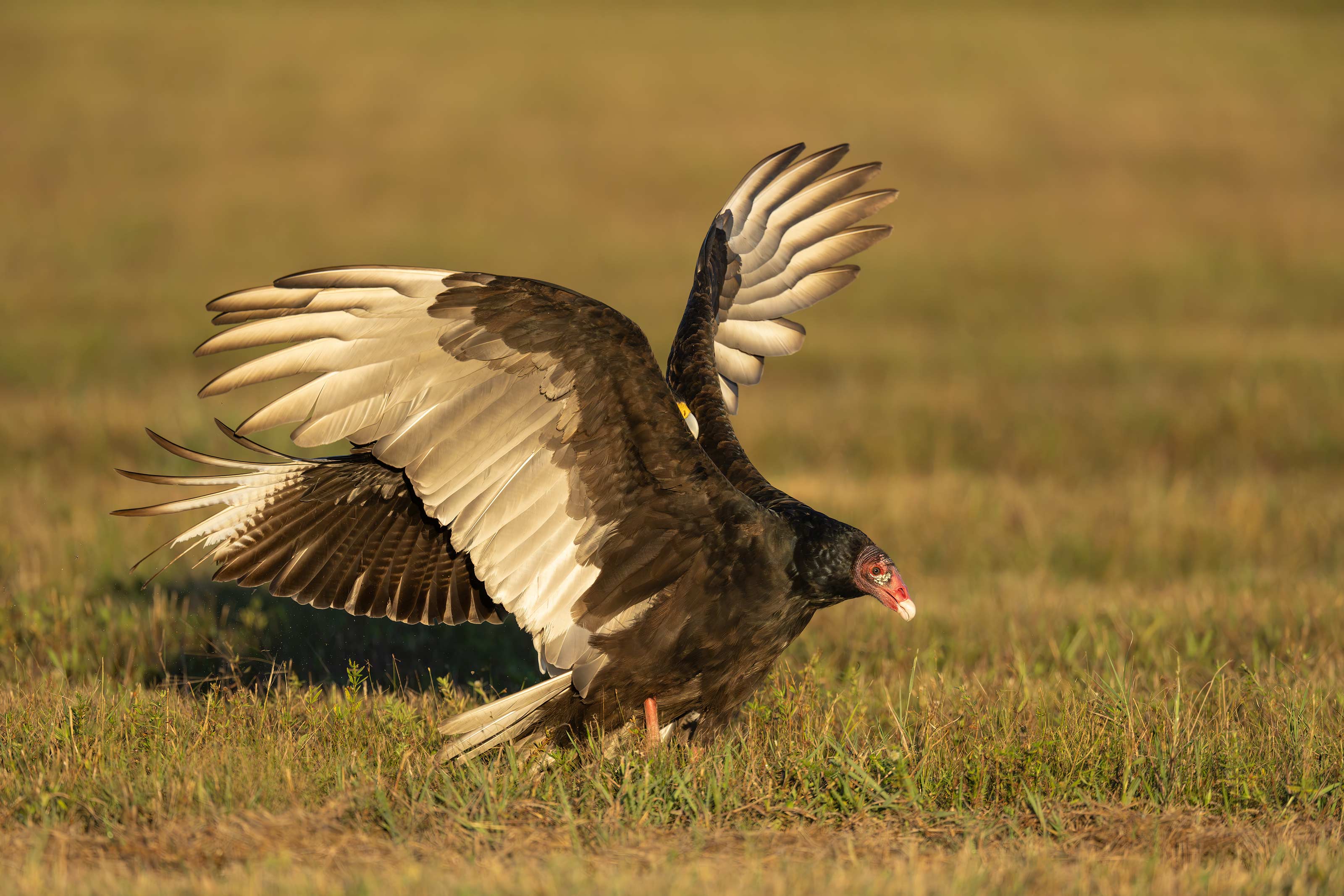
This image was created on 14 November 2026 by yours truly at Indian Lake Estates, FL with Steve Baglione in the back seat. Bags flew down from Maine for nearly two weeks of private In-the-Field Instructional sessions. Seated in the driver’s seat of my X5, I used the BLUBB-supported Sony FE 600mm f/4 GM OSS Lens with the Sony FE 1.4x Teleconverter (at 840mm) and the alleged poor man’s a-1 ii, the Sony a7R VI Mirrorless Camera. The exposure determined via Zebras with ISO on the Thumb Wheel: ISO 1250: 1/3200 sec. at f/5.6 (wide open) in Manual mode. AWB at 7:17:40am on a sunny morning. Wide/AF-C with Bird-Eye/Face Detection performed perfectly. Click on the image to enjoy the larger, inexplicably sharper high-res version. Image #2: Crested Caracara adult attacking Turkey Vulture that landed near fish head |
The Next Frame
In the next frame in the sequence, the CRCA’s head — except for part of its bill, was totally hidden behind the vulture’s near wing. But I loved the great look at the raised and perfectly illuminated near wing, so I kept it. Would you have deleted Image #2? Why or why not?
|
|
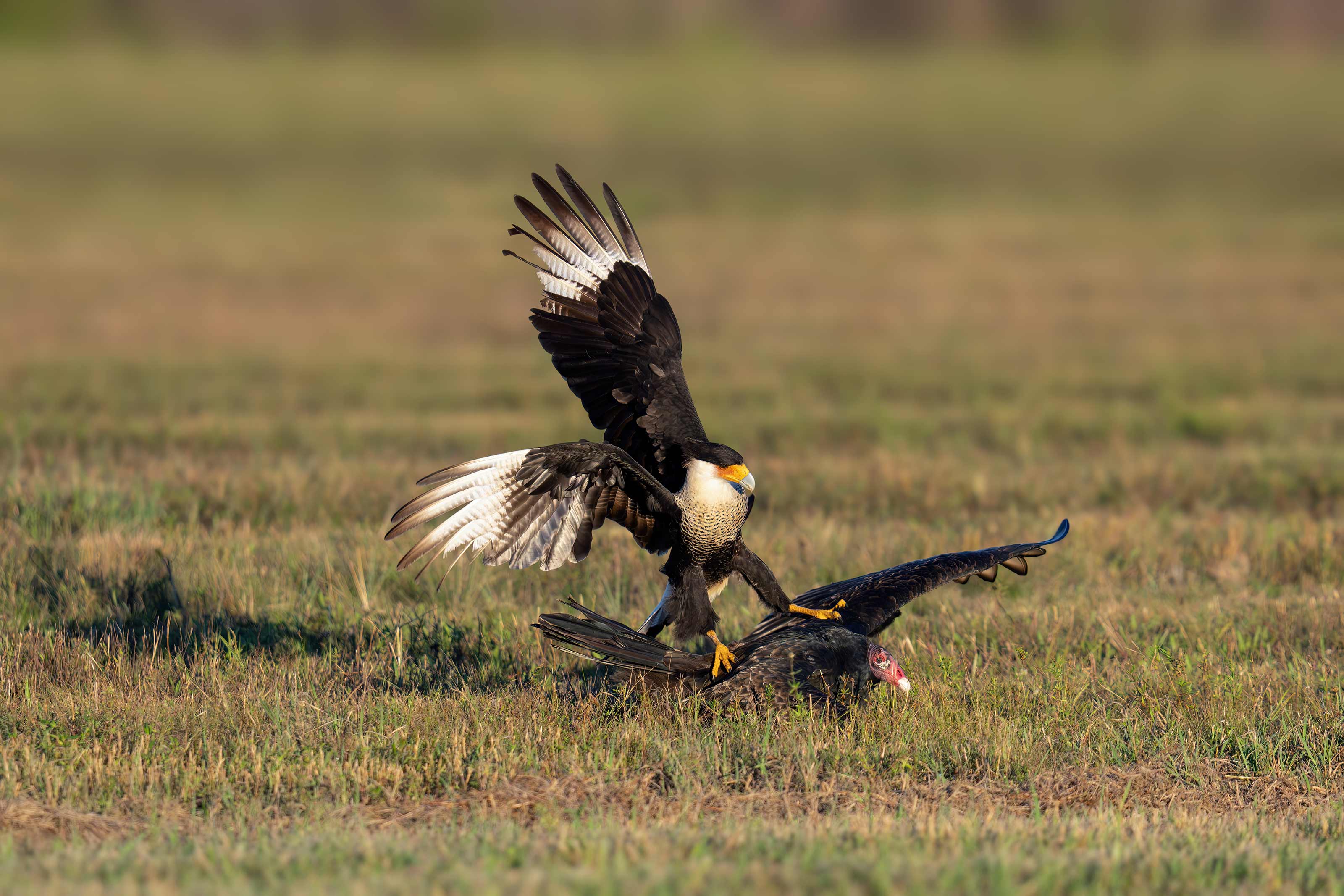
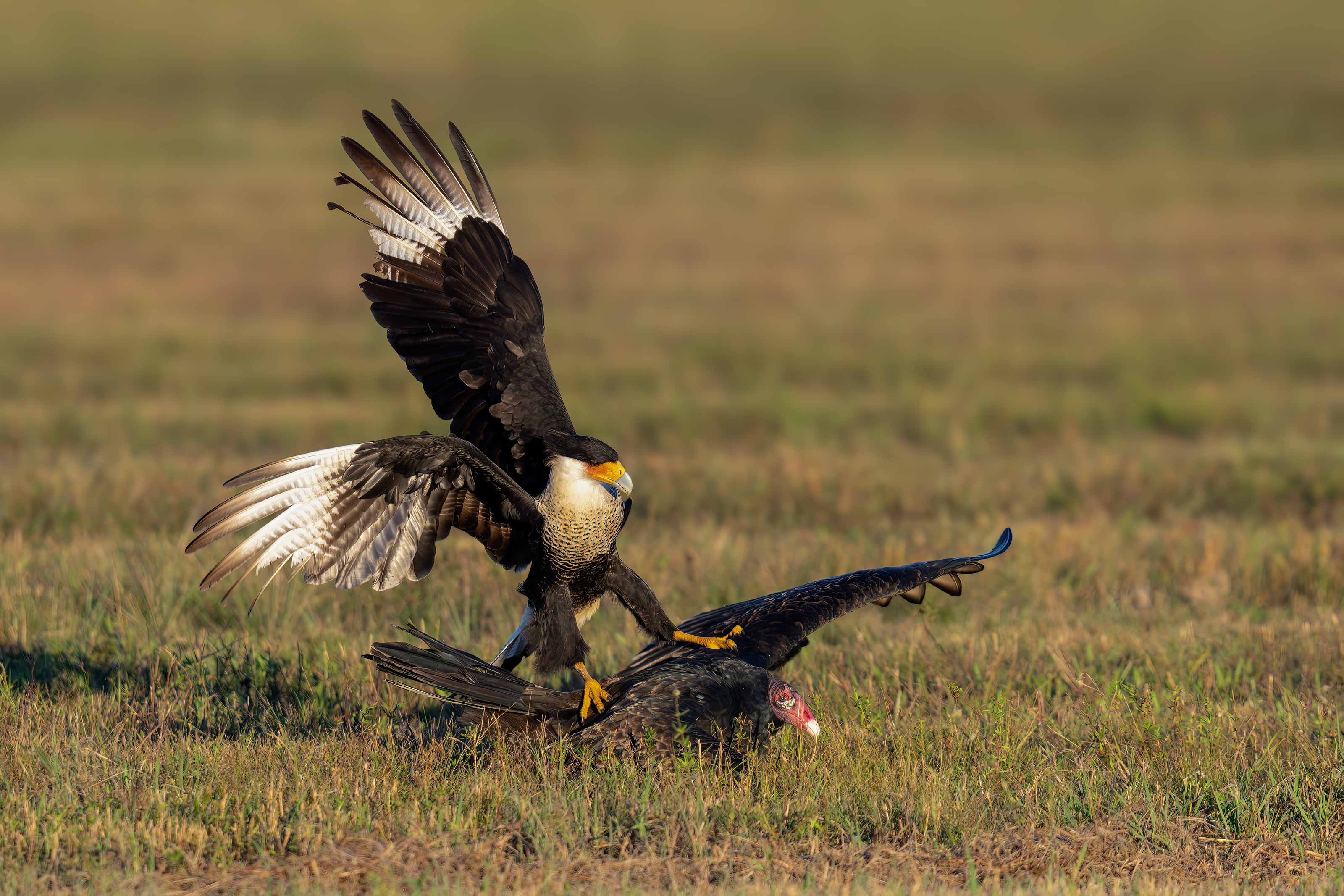
This image was created on 14 November 2026 by Bob Eastman at Indian Lake Estates, FL. Standing at full height outside of the Toyota Tacoma that he drove down from Wisconsin recently he use the handheld Sony FE 200-600mm f/5.6-6.3 G OSS lens (at 496mm) and The One, the Sony Alpha 1 Mirrorless digital camera. ) ISO 800. 1/3200 second at f/6.3 (wide-open) in Manual Mode. AWB at 7:17:23am on sunny morning. Tracking: Spot (XS) AF-C with Bird Face/Eye Detection performed quite well. Be sure to click on the image to enjoy a high-res version. Image #3: Crested Caracara adult flying in to attack Turkey Vulture that landed near fish head
|
Bobby Boo on the Spot
I did not realize that Bob Eastman had gotten out of his truck and nailed the incoming caracara as it landed on the vulture’s back. Image #3 is a small crop of the original (that you can see in the screen capture that ends the educational portion of this blog post). For this version, I opted to include the complete shadow of the attacking bird.
|
|
This image was created on 14 November 2026 by Bob Eastman at Indian Lake Estates, FL. Standing at full height outside of the Toyota Tacoma that he drove down from Wisconsin recently he use the handheld Sony FE 200-600mm f/5.6-6.3 G OSS lens (at 496mm) and The One, the Sony Alpha 1 Mirrorless digital camera. ) ISO 800. 1/3200 second at f/6.3 (wide-open) in Manual Mode. AWB at 7:17:23am on sunny morning. Tracking: Spot (XS) AF-C with Bird Face/Eye Detection performed quite well. Be sure to click on the image to enjoy a high-res version. Image #3A: A tighter crop of the Crested Caracara adult flying in to attack Turkey Vulture that landed near fish head image
|
A Tighter Crop
For this tighter, more dramatic version I cropped away most of the shadow so as to offer a better view of the attacking bird actually landing on the vulture’s back.
Bob’s Eastman’s Trusty Sony 200-600 G Lens with the Sony a-1
It has become a standing joke. As I am deciding which of my many Sony lenses to use for a photo session, I ask Bob what lens he’ll be using. He usually scratches his chin as if in deep thought and says, “I’m thinking of taking my two to six.” It is his only long telephoto lens, and as you have seen above, he consistently creates some fabulous images with it. More than ten years my junior, Mr. Bob is stronger and has faster reflexes and better hand-eye coordination than I do. And owning just a single, very versatile lens, he is always ready.
On Exposure
While I espouse exposing well to the right, Bob’s personal choice is almost always to shoot considerably darker than I do, and that was the case with the Crested Caracara attack. I was at ISO 1250, 1/3200 sec. at f/5.6. Bob was at ISO 800, 1/3200 second at f/6.3. He was working one full stop darker than I was — two clicks of ISO and one click of aperture.
On Handholding
Photographing flight and action will always be easier when you are comfortably handholding a lens rather than working with a heavier lens on a tripod (or, as here, with a heavier lens resting on a large beanbag like the BLUBB.
|
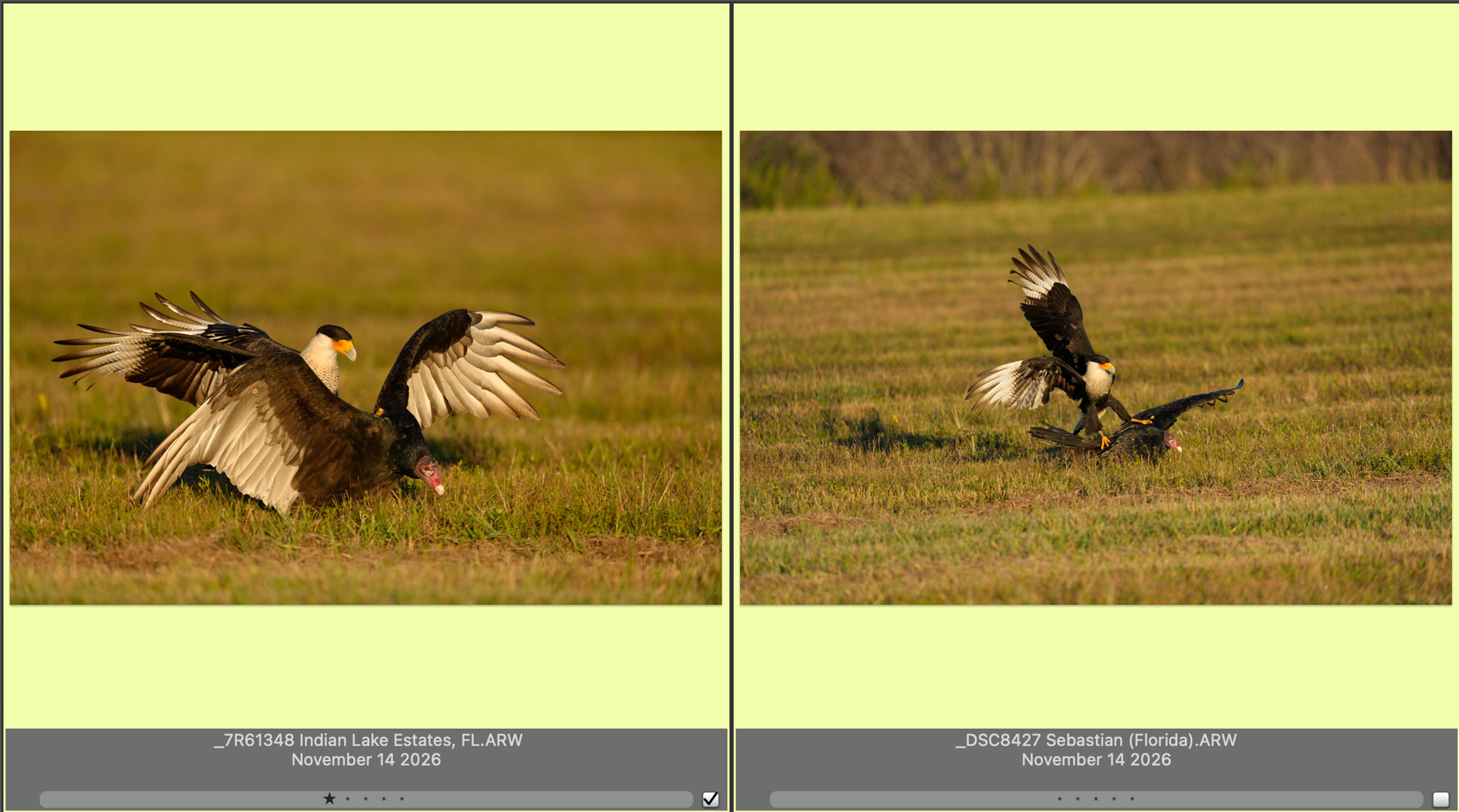
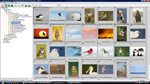
A Photo Mechanic Screen Capture of the RAW files for Image #1 and Image #3 |
Depth of Field Differences
Because Bob was a bit farther from the birds and zoomed out to 496mm while I was at 840mm, his images showed much more detail on the field in the background – mostly the furrows caused by the ILE folks botching the mowing the too-soft, flooded grassy tract. The greater the effective distance to the subject, the deeper the depth of field. Long focal lengths, on the other hand, put you effectively closer to the subject, compress the scene, and greatly reduce depth of field.
Though the furrows were simply part of what was there, they are somewhat distracting. Compare his RAW file with the two optimized versions and you will see that I softened the background in Photoshop. I used a new ACR Lens Blur technique taught to me by Steve Baglione during our image optimization sessions, along with a layer of Gaussian Blur refined using a Black (Hide-All or Inverted) Layer Mask.
Perspective Differences
The second factor that brought out additional unwanted background detail in Bob’s images was that he was standing while I was seated in the driver’s seat of my vehicle. He was shooting from roughly two and a half feet higher than I was. Getting lower always moves the proximal background farther behind the subject thus rendering it more out of focus. With birds flying relatively close to the ground, getting low can have hugely beneficial effects on the background — provided, of course, that you do not get so low as to introduce distracting elements in the distance. There are plenty of times when I opt to sit while doing flight photography.
Typos
With all blog posts, feel free to e-mail or to leave a comment regarding any typos or errors.








Amazing work Bob! My favorite is #3A. I like it better, compositionally, than #3. The crop emphasizes the wing position of the cara-cara as it descends — violently — in it’s attack on the vulture.
I personally like the action in 3, and the crop in 3A. Great work Bob.
My favorite is 3A. The action and composition are perfect!
Bob always sees things no one else sees
Artie’s image optimization made it even more perfect.
I certainly love Bob’s image, and prefer your second crop to give more detail. It is also compositionally more attractive with the birds on the left of the frame instead of the middle.
As for #2, it wouldn’t be an instant delete but it wouldn’t be a favorite either.
Is there a reason that you chose #1 over the image in the PM screen capture? To my eye, your image on the left is stronger than #1 and I like seeing more of the CRCA and a little of yellow talon.