
Your Call
Which two of today’s eight featured images do you think are the strongest? Why did you make your choices?
My Call
In the last blog post here, only a single person left a comment. Robert Tucker wrote, “My pick is image 1A. The branch is just a distraction. The subject is the bird.” Thanks, Robert. I agree 🙂
This Just In
It seems that the post notification for the last blog post was never sent most likely due to operator error 🙁 I will send it soon along with a note … At least that explains the single comment and no mention of the piece on grief and grieving.
What’s Up?
The first Homer IPT has been as close to perfect as possible. After two ideal weather days with long shooting sessions, we did not shoot on Sunday with high winds and 10 foot seas in Kachemak Bay. The weather for the last two days of Homer #1 is looking quite good with Tuesday looking the better of the two days. The weather for the second IPT was looking quite problematic but the forecast has already changed for the better. We spent several hours on Sunday doing image review and image optimizations. And I created Camtasia videos for many of the latter.
Today is Monday 16 February. The crossing should be on the rough side but we will be OK once we get into the bays. Whatever you opt to do today, I hope that you choose to be have fun. And please remember that happiness is a choice — Byron Katie, The Work.Com.
If an item — a Delkin flash card or reader, a Levered-clamp FlexShooter Pro, or a Wimberley lens plate or low foot — for example, that is available from B&H and/or Bedfords, is also available in the BAA Online Store, it would be great, and greatly appreciated, if you would opt to purchase from us. We will match or beat any price. Please remember also to use my B&H affiliate links or to earn 3% cash back at Bedford by using the BIRDSASART discount code at checkout for your major gear purchases. Doing either often earns you free guides and/or discounts. And always earns my great appreciation.
Gear Questions and Advice
Too many folks attending BAA IPTs and dozens of photographers whom I see in the field and on BirdPhotographer’s.Net, are — out of ignorance — using the wrong gear, especially when it comes to tripods and more especially, tripod heads. And the same is true in spades when ordering new camera bodies or lenses. My advice will often save you some serious money and may help you avoid making a seriously bad choice. Please know that I am always glad to answer your gear questions via e-mail.. If you are desperate, you can try me on my cell at 863-221-2372. Please leave a message and shoot me a text if I do not pick up.
|
|
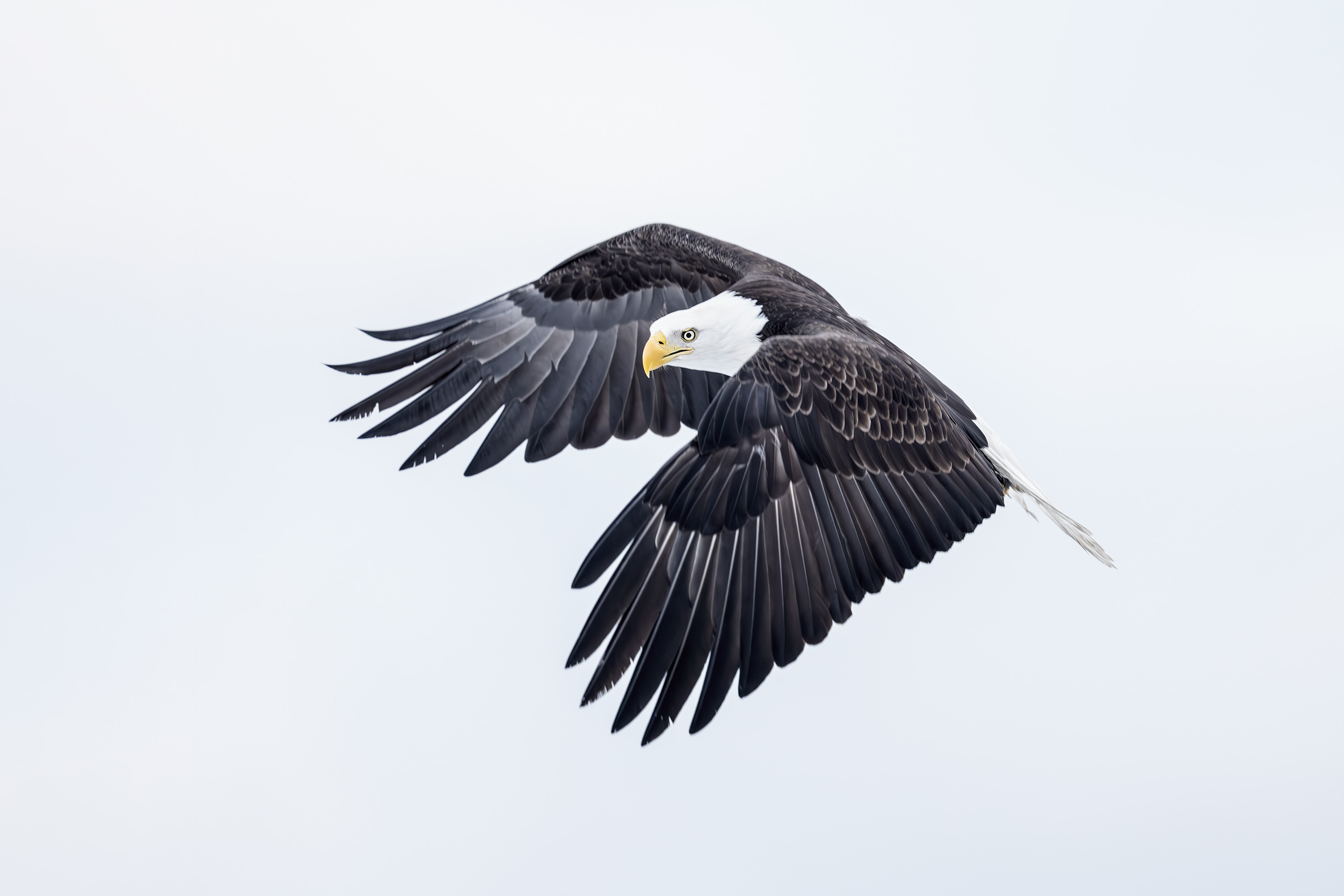
This image was created on 13 February 2026 by yours truly at Kachemak Bay, Homer, AK. Standing on an inch of snow, I used the handheld Sony FE 300mm f/2.8 GM OSS Lens (Sony E) and The Latest Greatest Sony Flagship Body, the a1 II Mirrorless Camera. ISO 4000. The exposure was determined via Zebras with ISO on the Thumb Wheel; 1/2000 sec. at f/2.8 (wide open) in Manual mode. AWB at 9:33:43 am on a cloudy morning. Wide/AF-C with Bird Eye/Face Detection enabled performed perfectly. Image #1: Bald Eagle adult wings down flight pose |
A New Flight Pose
Many of the Bald Eagle flight poses are repeated and repeated and repeated. This sort of boxy one with the eagle’s head set against the underside of the far wing is a new one for me. If you can come up with a clever name for this flight pose, please leave a comment.
|
|
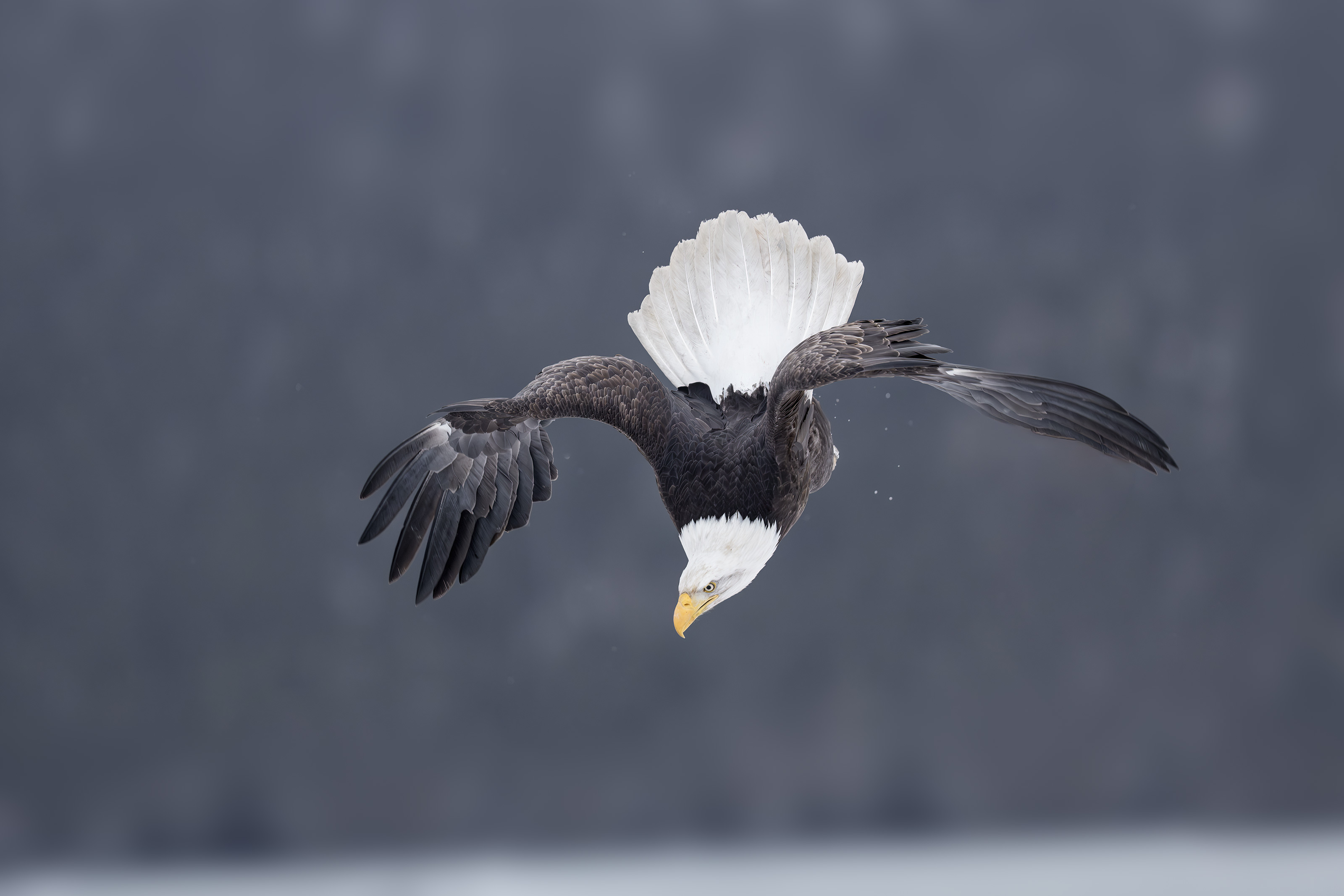
Sony FE 300mm f/2.8 GM OSS Lens (Sony E) and The Latest Greatest Sony Flagship Body, the a1 II Mirrorless Camera. ISO 3200. The exposure was determined via Zebras with ISO on the Thumb Wheel; 1/3200 sec. at f/2.8 (wide open) in Manual mode. AWB at 10:04:19 am on a cloudy morning. Wide/AF-C with Bird Eye/Face Detection enabled performed perfectly. Image 2: Bald Eagle adult diving on another eagle |
Image Clean-up
There were three extraneous eagles in the original frame — the two heads on the lower left frame edge were dealt with easily. It took quite a bit of work to get rid of the bird in the air just below and merging with the eagle’s left wing but taking the time to eliminate it without a trace was well worth the effort.
|
|
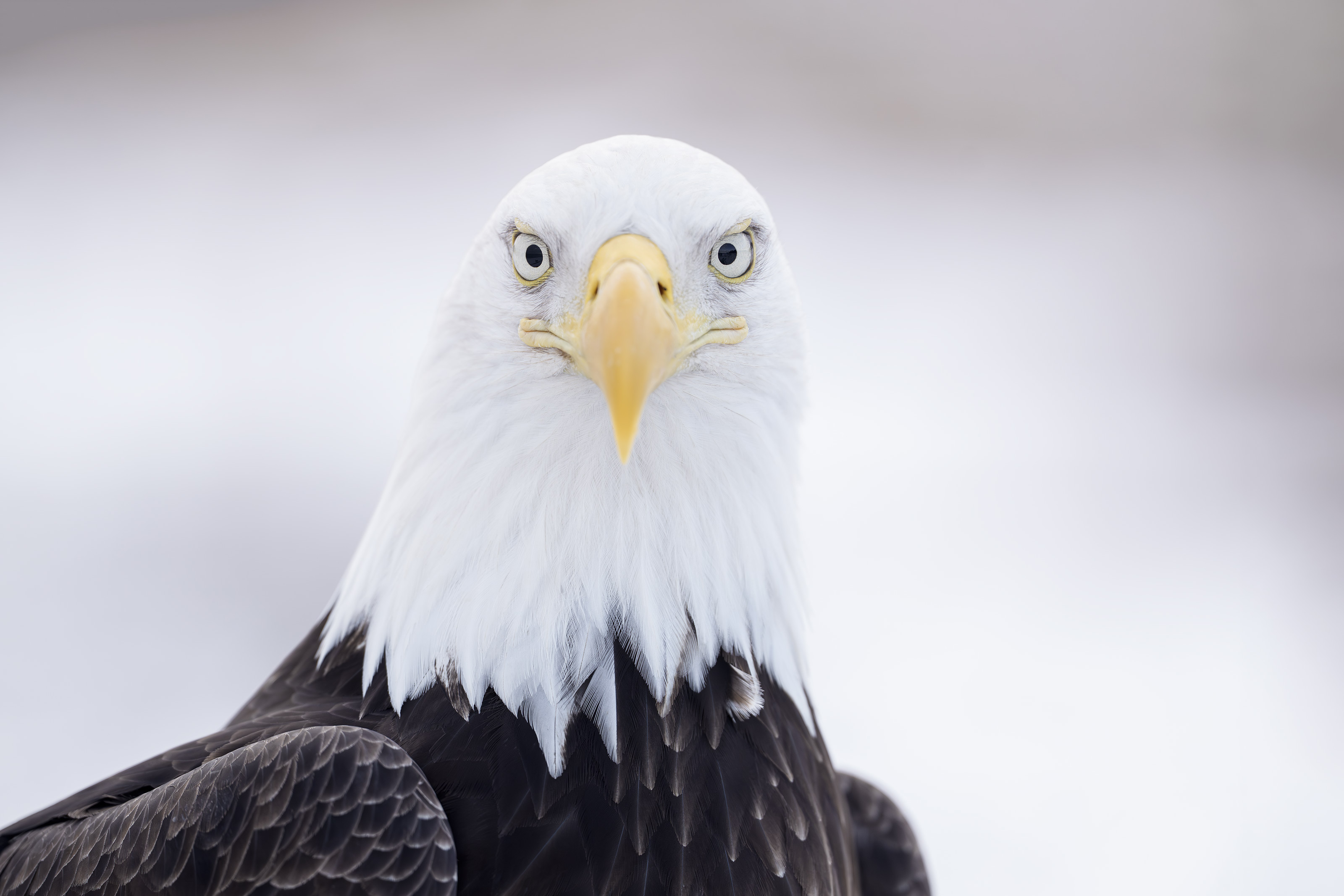
This image was also created on 13 February 2026 by yours truly at Kachemak Bay, Homer, AK. Standing on an inch of snow, Holding the lens at knee level and working off the rear monitor with my reading glasses on, I used the handheld Sony FE 300mm f/2.8 GM OSS Lens (Sony E) with the Sony FE 1.4x Teleconverter (at 420mm) with the Latest Greatest Sony Flagship Body, the a1 II Mirrorless Camera. The exposure determined via Zebras with ISO on the Thumb Wheel. ISO 1250: 1/2500 sec. at f/4 (wide open) in Manual mode. AWB at 10:45:31am on a cloudy morning. Wide/AF-C with Bird Eye/Face Detection enabled performed perfectly. Click on the image to enjoy the larger, inexplicably sharper high-res version. Image #3: Bald Eagle adult staring head portrait |
Adding the 1.4X TC for Head Portraits
While head portraits of eagles in Homer are eminently do-able at only 200mm with a careful approach — especially if you sit down on the ground, adding the 1.4X TC to get to 420mm makes things much easier. I held the lens down and worked off the rear monitor with my reading glasses on in order to move the background farther away and produce a soft, pleasingly defocused background.
|
|
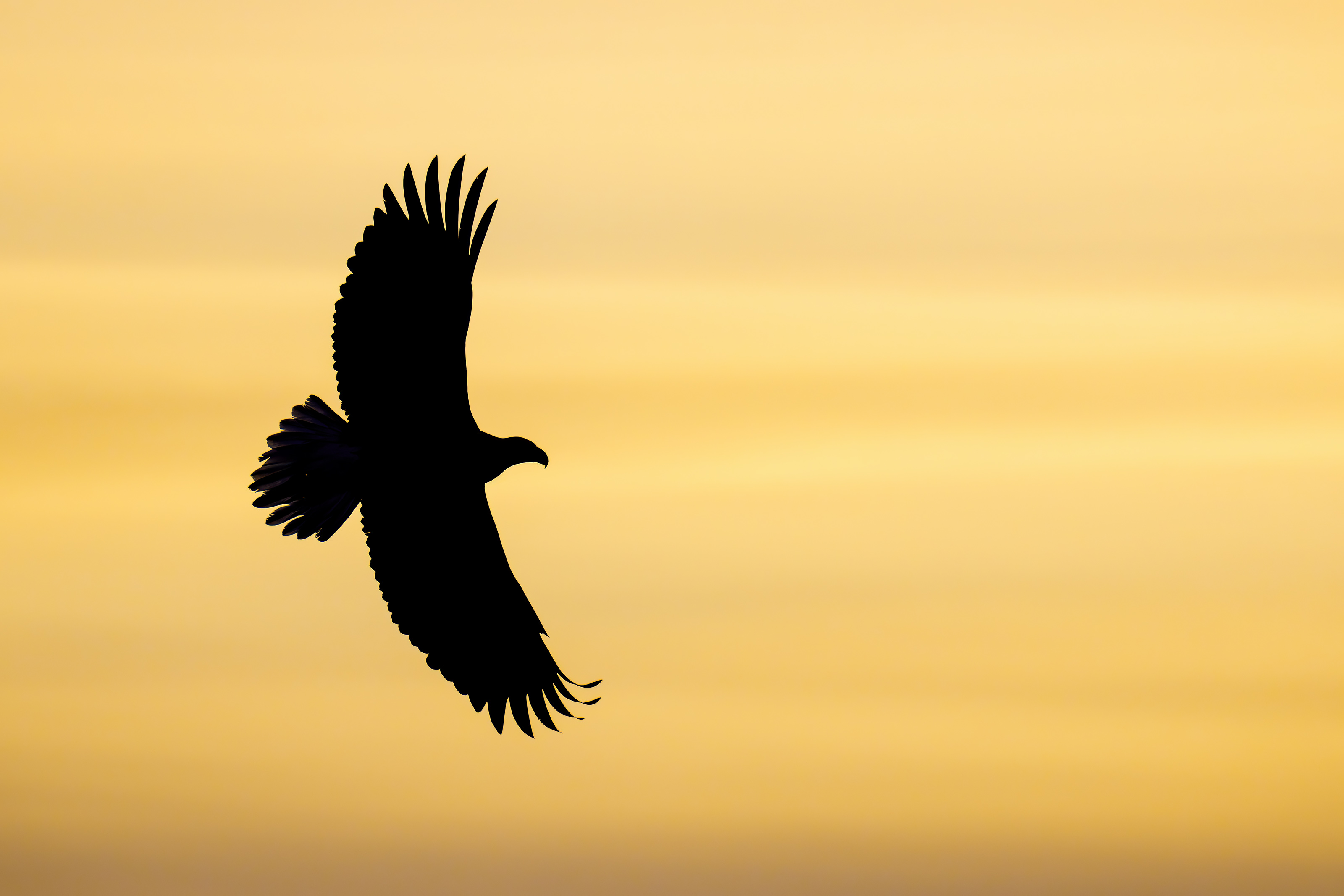
This image was also created on 13 February 2026 by yours truly at Kachemak Bay, Homer, AK. Standing on the deck of our watercraft, I used the handheld Sony FE 70-200mm f/2.8 GM OSS II Lens with the Sony FE 2x Teleconverter (at 400mm) and the Latest Greatest Sony Flagship Body, the a1 II Mirrorless Camera. The exposure was determined by Zebras with Exposure Compensation (EC) on the thumb wheel. Multi Metering +1.3 stops. AUTO ISO set ISO 1250: 1/3200 second at f/5. (6wide open) in Shutter Priority mode. AWB at 5:21:48pm on a partly sunny afternoon. Wide/AF-C with Bird Eye/Face Detection enabled performed perfectly. Click on the image to enjoy the larger, inexplicably sharper high-res version. Image #4: Bald Eagle sunset flight silhouette |
Sunsets in Homer
After lunch at Fat Olives, the skies were relatively clear so we got back on the boat and headed across the bay to Sadie Cove. Front-lit flight photography was challenging and thus the conditions for shooting silhouettes were quite good. A light fog bank on the western horizon added some nice color. As always with sunrise and sunset color, I find working in Shutter Priority with AUTO ISO and Exposure Compensation (EC) on a convenient dial is the best way to go. I instructed the Sony folks on how to do that easily; some of them listened.
|
|
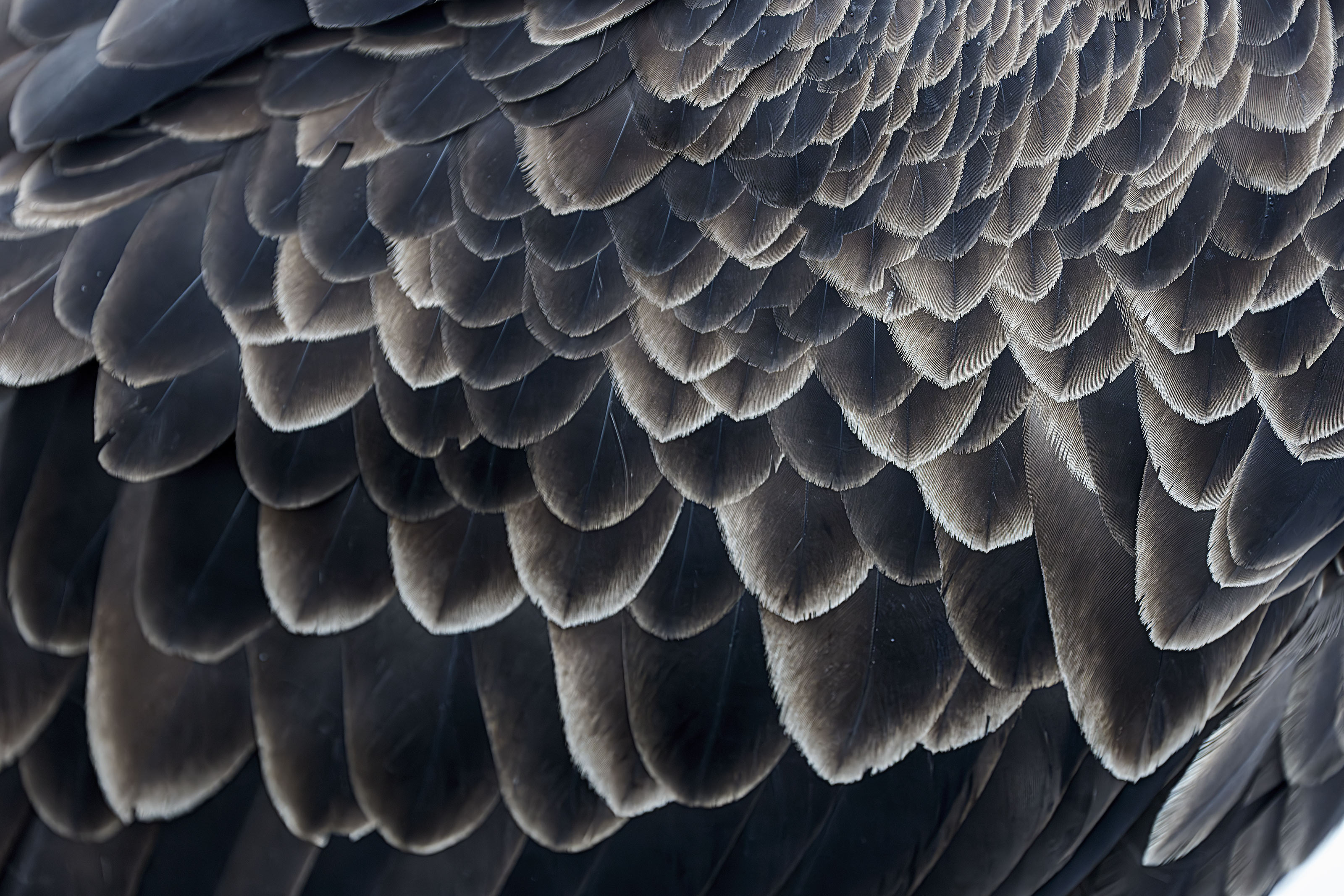
This image was created on 14 February 2026 by yours truly at Kachemak Bay, Homer, AK. Crouching down on the snow-covered beach and again working off the rear monitor with my reading glasses on, I used the handheld Sony FE 70-200mm f/2.8 GM OSS II Lens and the Latest Greatest Sony Flagship Body, the a1 II Mirrorless Camera. The exposure determined via Zebras with ISO on the Thumb Wheel. ISO 4000: 1/250 sec. at f/3.5 (stopped down 2/3-stop) in Manual mode. AWB at 9:45:31am on a cloudy morning. Wide/AF-C with Bird Eye/Face Detection enabled worked just fine. Click on the image to enjoy the larger, inexplicably sharper high-res version. Image #5: Bald Eagle covert feathers of adult female |
Big Lady
This huge female Bald Eagle was especially fearless so I decided to try for a full frame body shot that showed only the feathers of the wing coverts. I stopped down 2/3rds of a stop for a bit of extra depth of field but it did not help much as I was quite close to the incredibly short Minimum Focusing Distance (MFD) of the 70-200 lens.
|
|
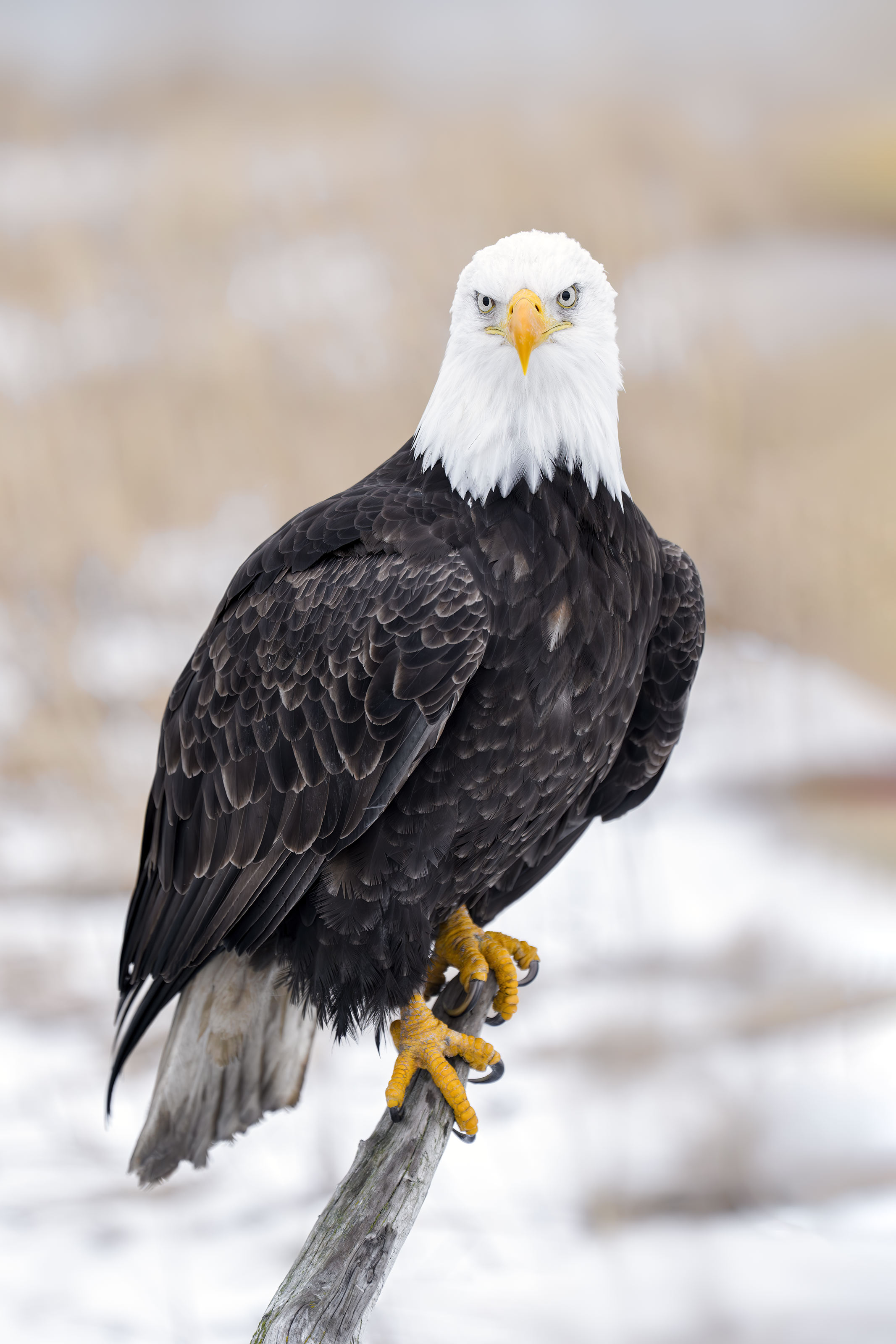
This image was also created on 14 February 2026 by yours truly at Kachemak Bay, Homer, AK. Standing as tall as possible on the snow, I used the handheld Sony FE 70-200mm f/2.8 GM OSS II Lens and the Latest Greatest Sony Flagship Body, the a1 II Mirrorless Camera. The exposure determined via Zebras with ISO on the Thumb Wheel. ISO 1600: 1/800 sec. at f/2.8 (wide open) in Manual mode. AWB at 9:51:18am on a cloudy morning. Wide/AF-C with Bird Eye/Face Detection enabled performed perfectly. Click on the image to enjoy the larger, inexplicably sharper high-res version. Image #6: Bald Eagle adult perched on driftwood |
Why Get as Tall As Possible?
I approached the bird very slowly and got as tall as possible to eliminate the dark spruce tree horizon line from the top of the frame. I love the great look at this bird’s talons.
|
|
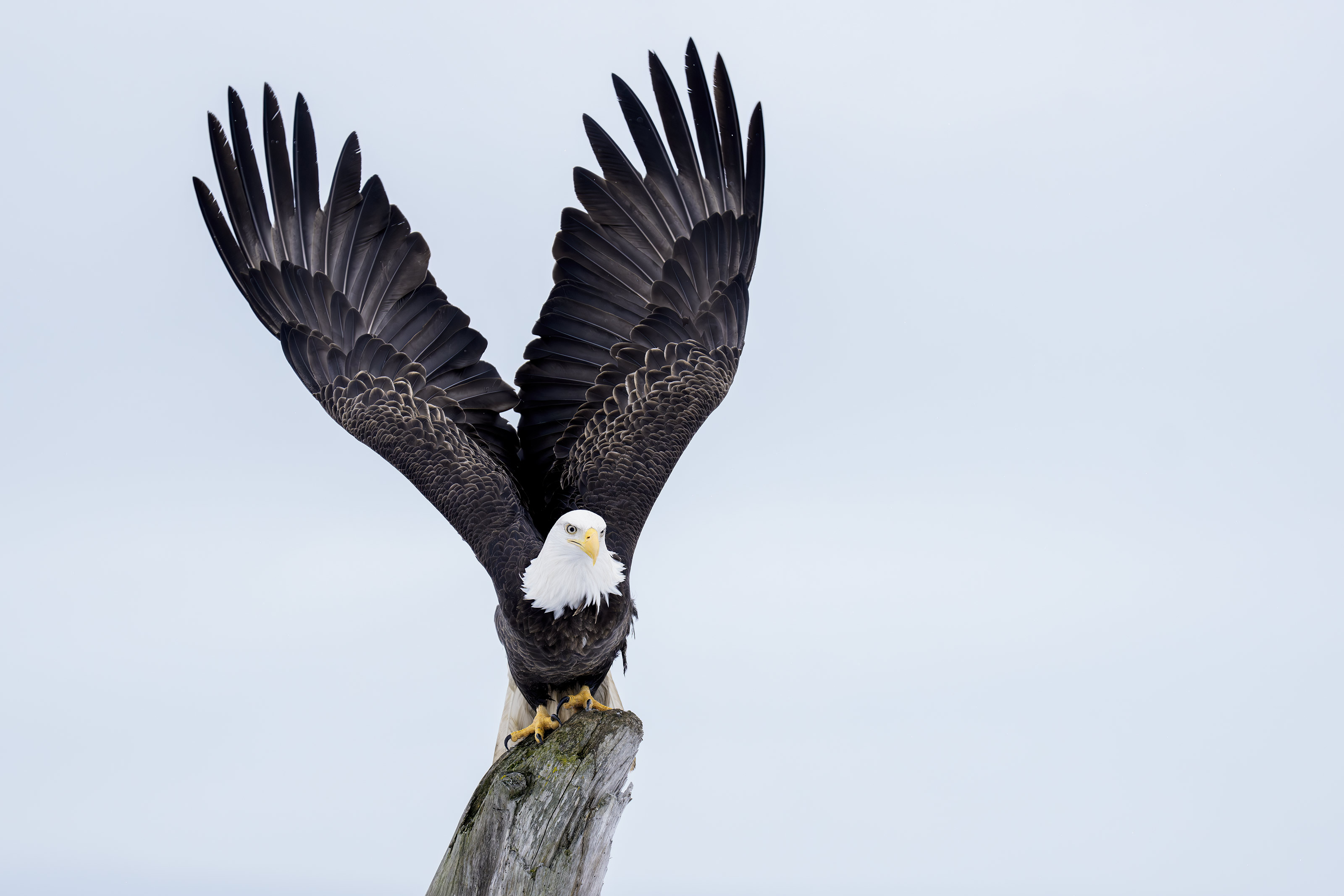
This image was also created on 14 February 2026 by yours truly at Kachemak Bay, Homer, AK. Standing on a gravel spit, I used the handheld Sony FE 70-200mm f/2.8 GM OSS II Lens with the Sony FE 2x Teleconverter (at 200mm) and the Latest Greatest Sony Flagship Body, the a1 II Mirrorless Camera. The exposure determined via Zebras with ISO on the Thumb Wheel. ISO 2000: 1/4000 sec. at f/2.8 (wide open) in Manual mode. AWB at 12:41:13pm on a cloudy afternoon. Wide/AF-C with Bird Eye/Face Detection enabled performed perfectly. Click on the image to enjoy the larger, inexplicably sharper high-res version. Image #7: Bald Eagle adult with wings raised |
Taking Flight
When most raptors are ready to take off the first thing that they do is raise their wings directly overhead. Clipping the wingtips is a common occurrence that was avoided here by using a short focal length. The “V” wing position is quite attractive.
|
|
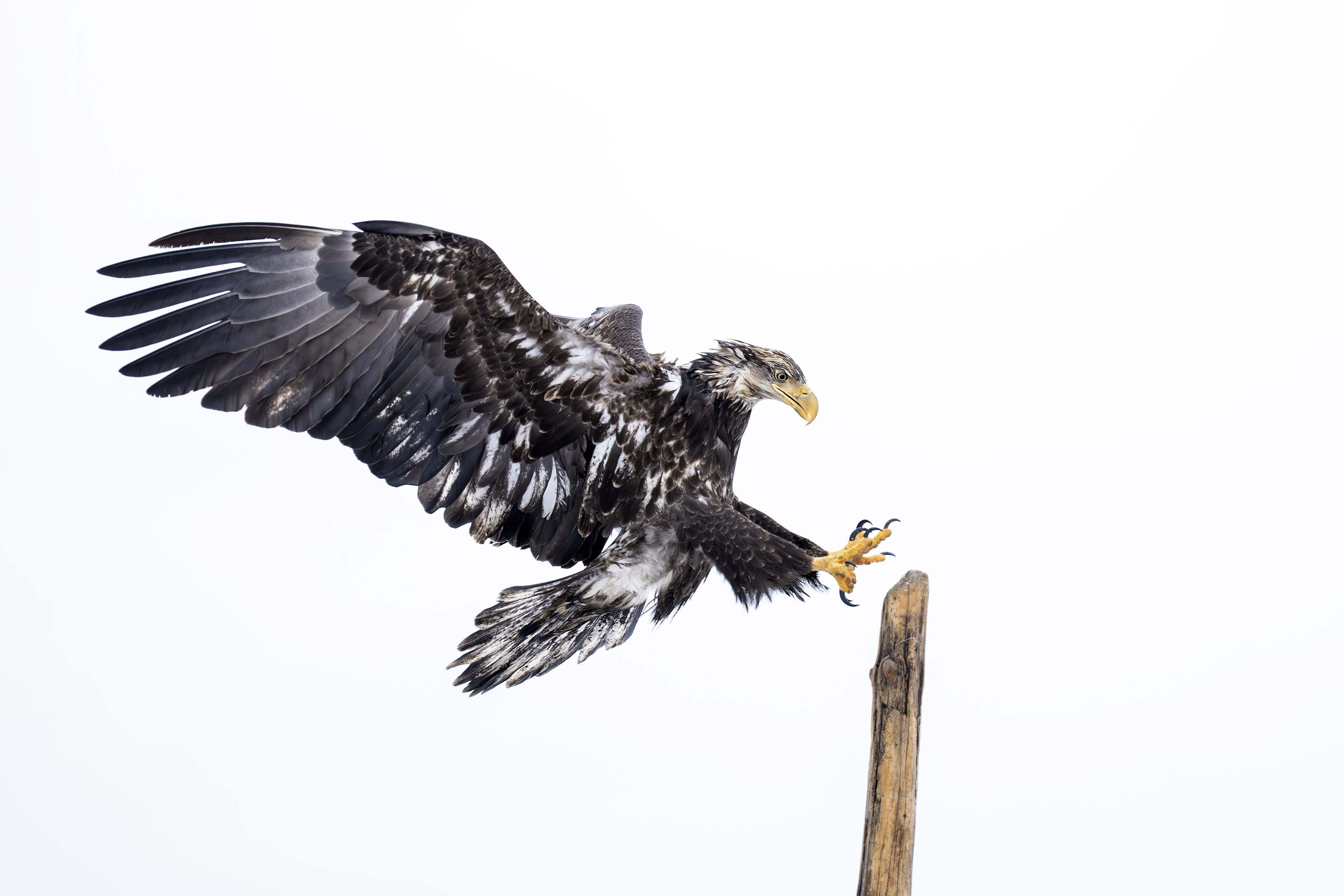
This image was also created on 14 February 2026 by yours truly at Kachemak Bay, Homer, AK. Standing on a gravel spit, I used the handheld Sony FE 70-200mm f/2.8 GM OSS II Lens with the Sony FE 2x Teleconverter (at 200mm) and the Latest Greatest Sony Flagship Body, the a1 II Mirrorless Camera. The exposure determined via Zebras with ISO on the Thumb Wheel. ISO 2000: 1/3200 sec. at f/2.8 (wide open) in Manual mode. AWB at 12:57:25pm on a cloudy afternoon. Wide/AF-C with Bird Eye/Face Detection enabled performed perfectly. Click on the image to enjoy the larger, inexplicably sharper high-res version. Image #8: Bald Eagle 3-year old landing/touchdown |
Thanks Kevin!
Working with Captain Gabe, Kevin found and erected this perch for the group. It paid huge dividends. Note that this 3-year old eagle is just beginning to get some white feathers on its head.
Typos
With all blog posts, feel free to e-mail or to leave a comment regarding any typos or errors.







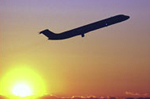
Kevin has had lots of practice creating spots for shooting!!! Good job buddy!
Artie
The dive in #2 is sweet but could it be that it’s not level, I base my thought on the snowy white bottom? I am a great fan of the sunset silhouette in #4 and I love the take off V in #7
They all are pretty nice just to say….YUP!
PS my journey south starts Monday 🙂
Always with love b
2, 3, 4, and 5 for me Artie. 2. I really like the shapes; it’s an unusual pose, which draws me in and hints to the power of the bird in the air. 3. beauty in the drape of the white collar and those eyes. 4. I’m a sucker for a silhouette; the colour tells us about the moment. 5. again – the beauty of the feathers; the details we don’t see normally. fur, feathers, claws, teeth, bills and eyes always draw my attention.
Hopefully one day I might get to Alaska. For now, the woodlands, beaches, moorlands, and rivers of Britain are within my reach. Love to see the photos from your travels Artie!
love to you and yours, Clive
I’m partial to 1&2, especially #2, the dorsal view and gray background. Great job!
My first choice was easy: #1 — I like the bird’s white head against the dark wing, it really makes it “pop.” Choosing a second one was harder, but I finally decided on #4, the silhouette. I like the well defined wings and tail against the golden background
Hi, Artie. Looks like a good winter to be in Homer, earlier than when I was there with you. I love image #5, in part because it’s so different from most photos I see (and made) there and obviously for the great composition and detail.