
Cloudy Morning Tripod Flight Second Edit
Educational YouTube Video
This 17-minute video contains an absolute ton of great bird photography tips. With today’s high frame-rate (30, 40, and even 120 fps) mirrorless camera bodies, selecting the best images from several thousand is a hugely important skill. Sit beside me at my laptop as I do a second edit of the folder of images created on the morning of 13 May. I discuss and compare photos made in the same second. And learn about (and see) a new technique I developed recently for using my car as a blind to break up the human form.
You can learn about how and why I use a tripod and a Levered-clamp FlexShooter Pro for flight photography with my 600mm f/4 in the last blog post (“Miracle of Miracles. And 600mm/a-1 ii Flight on the Tripod”) blog post here.
My three favorites are optimized below.
Your Call?
Which of today’s three featured photos below do you like best? Why?
What’s Up?
At times, predicting general bird behavior can be a frustrating endeavor. On May 11-13, the were many dozens of Black-bellied Whistling Ducks in the bay south of the pier. For the last three mornings, two to four was the high count. On 14 May, there were 80 White Ibises in the same spot. and yesterday morning there were more than 200. On the morning of the 16th, there was one. There was little going on south of the pier but I did manage one very fine landing whistling duck image. After that, nada. So, I headed for the Osprey nest on Lantana that I had photographed on Friday afternoon. Two of the three large chicks have fledged. The remaining bird was exercising its wings every five minutes of so. I kept seven out of several hundred.
Today is Sunday 17 May 2026. The forecast is for sunny with a Southeast breeze so I will be headed down to the lake early. I fly to Islip early on Monday morning for trigger finger surgery on my right ring finger. It will be done by the amazing Dr. Steven Puopolo. Whatever you opt to do, I hope that you too choose to have fun and enjoy life. Please remember that happiness is a choice — Byron Katie, The Work.Com
If an item — a Delkin flash card or reader, a Levered-clamp FlexShooter Pro, or a Wimberley lens plate or low foot — for example, that is available from B&H and/or Bedfords, is also available in the BAA Online Store, it would be great, and greatly appreciated, if you would opt to purchase from us. We will match or beat any price. Please remember also to use my B&H affiliate links or to earn 3% cash back at Bedford by using the BIRDSASART discount code at checkout for your major gear purchases. Doing either often earns you free guides and/or discounts. And always earns my great appreciation.
Gear Questions and Advice
Too many folks attending BAA IPTs and dozens of photographers whom I see in the field and on BirdPhotographer’s.Net, are — out of ignorance — using the wrong gear, especially when it comes to tripods and more especially, tripod heads. And the same is true in spades when ordering new camera bodies or lenses. My advice will often save you some serious money and may help you avoid making a seriously bad choice. Please know that I am always glad to answer your gear questions via e-mail. If you are desperate, you can try me on my cell at 863-221-2372. Please leave a message and shoot me a text if I do not pick up.
|
|
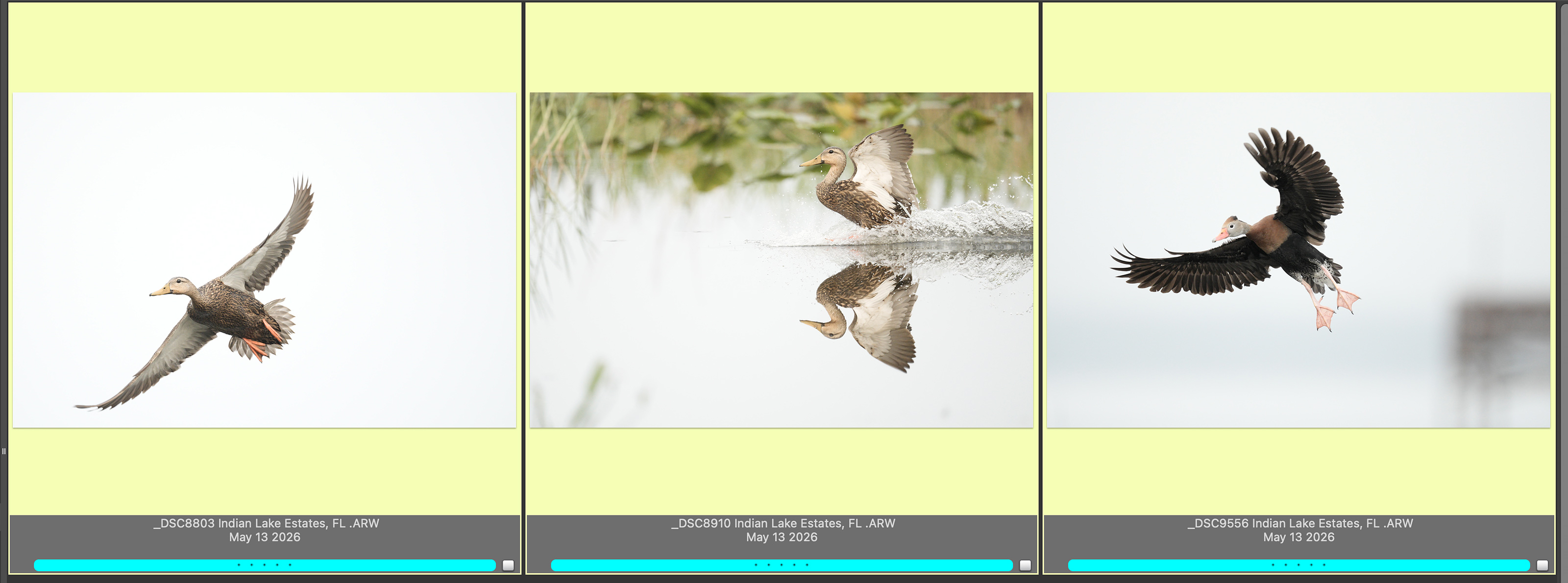
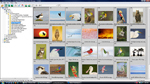
Click to enlarge. Photo Mechanic Screen Capture: the three original frames for today’s featured images |
Exposing to the Right
When properly exposing to the right in foggy/cloudy conditions both the sky and the water will be rendered a very light grey. I call these “white sky conditions”. While we will almost always want to juice up the subject by boosting the colors and contrast on the subject, the sky color is up to the photographer/artist. Be sure to compare each original with the optimized version below paying close attention to both the crop and the sky color.
APS-C/Super 35mm Mode
For simplicity’s sake, I refer to APS-C/Super 35mm Mode as APS-C Crop Mode. All three of the raw files were created using APS-C Crop Mode. In addition to making it easier for the AF system to find and track a bird’s eye, going with Crop Mode rather than the 1.4X TC allows for the use of a one-stop wider (faster) aperture thus saving you one full stop of ISO. ISO 3200 is a far cry better than ISO 6400.
Though I have long scoffed at the reasons for using various crop modes, I recently began trying APS-C/Super 35mm Mode with the warblers to give the AF system a better look at the birds’ eye. This turned out to be effective, especially in dark, cluttered situations. As noted previously, the Sony a-1 ii (and the venerable Sony a-1), offer a APS-C/Super 35mm mode that applies a 1.5x crop to its 50.1MP sensor. The result is a high-quality, ~21MP image that is approximately 5,616 x 3,744 pixels. Sharp APS-C images can still stand a bit of cropping. This mode increases the effective focal length of your rig: 420mm becomes 630mm, 600mm becomes 900mm, 840mm becomes 1260mm, and 1200mm becomes 1800mm! In addition, it allows for a faster, more efficient workflow (as you are working with smaller files).
Another advantage of cropping in camera rather than after the fact (at the computer) is that it allows me to go with the 1.4X TC rather than the 2X. Again, the huge advantage here with the 1.4X TC and crop mode is that I can save one stop of ISO and/or go with a faster shutter speed in low light situations. I am still experimenting and still learning and will continue to share my findings with you here on the blog.
|
|
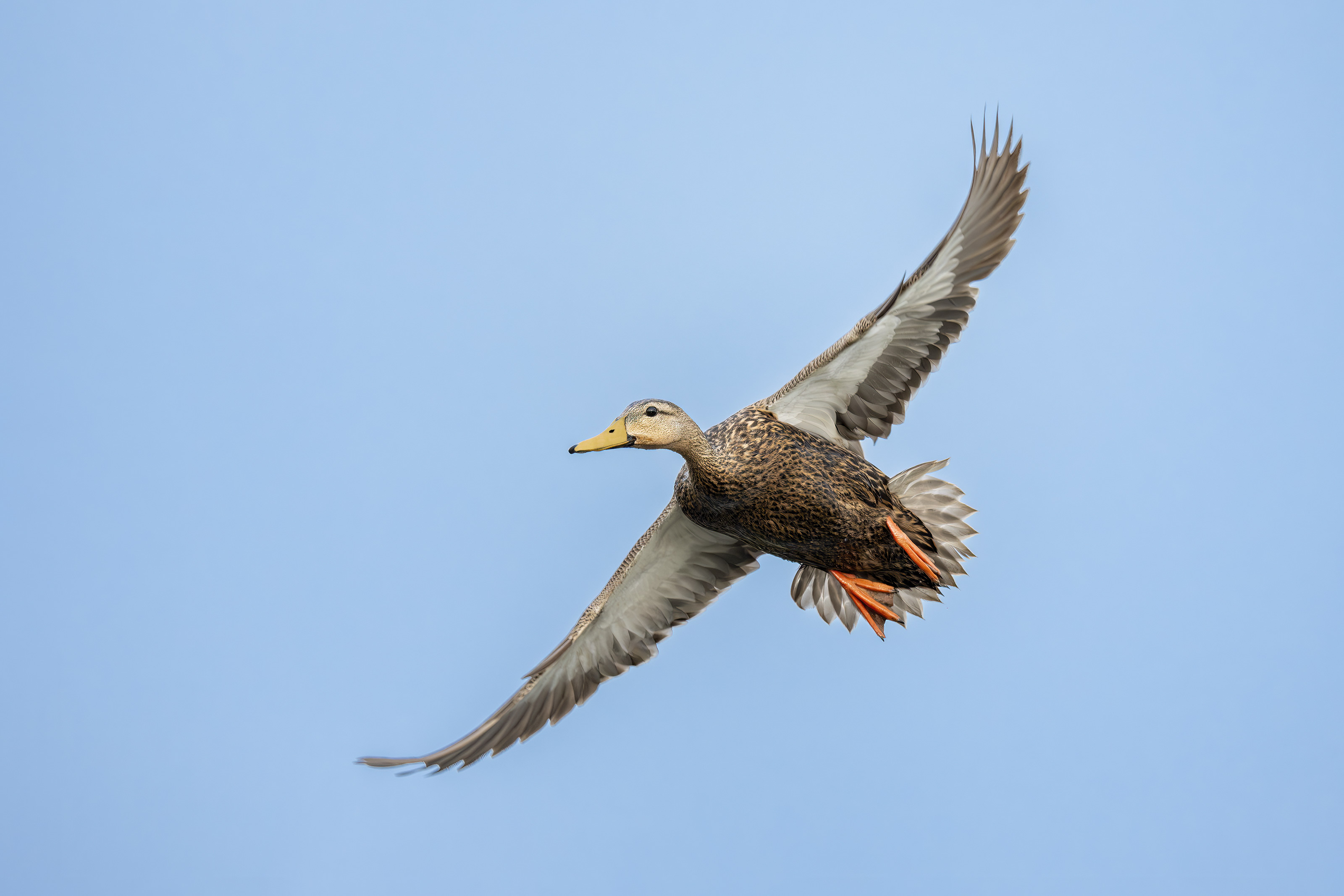
This image was created on 13 May 2026 by yours truly down by the lake at ILE. Standing at full height near my SUV, I used the Robus RC-5570 Vantage Series 3 Carbon Fiber Tripod/Levered-Clamp FlexShooter Pro-mounted Sony FE 600mm f/4 GM OSS lens and The Latest Greatest Sony Flagship Body, the a1 II Mirrorless Camera (in APS-C Crop mode). The exposure was determined by Zebras with ISO on the rear wheel: ISO 3200: 1/2500 sec. at f/4 (wide open) in Manual mode. RawDigger showed that the exposure was dead solid perfect. AWB at 7:48:32am on a cloudy/foggy morning. Wide/AF-C with Bird-Eye/Face Detection performed perfectly. Click on the image to enjoy the larger, inexplicably sharper high-res version. Image #1: Mottled Duck drake in flight |
White Sky Blue
There are several ways to make an accurate ACR selection of the sky during the raw conversion. Each (plus tons more) is detailed in the Digital Basics IV Video Series. Once you have selected the sky you have lots of options to control the look of the sky:
1- Decrease (usually) or increase the exposure.
2- Reduce the Color Temperature
3- Increase (usually) or decrease the Saturation.
Once the image is opened in Photoshop I usually use Color Mixer to increase or decrease the Luminance of the sky to taste, and, with blue skies, (usually) use the Hue slider to add a tad of MAGENTA to the BLUES.
|
|
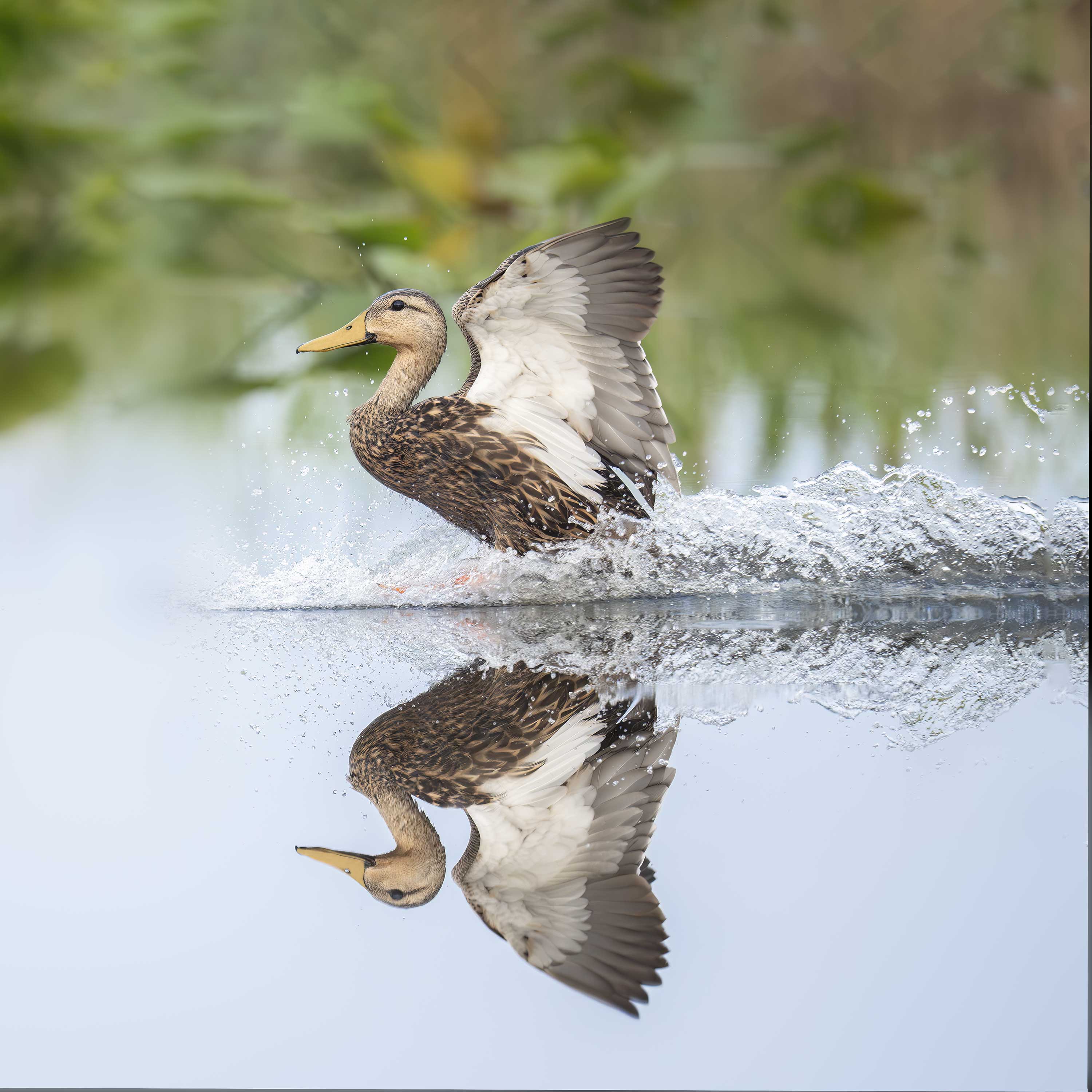
This image was also created on 13 May 2026 by yours truly down by the lake at ILE. Again, standing at full height near my SUV, I used the Robus RC-5570 Vantage Series 3 Carbon Fiber Tripod/Levered-Clamp FlexShooter Pro-mounted Sony FE 600mm f/4 GM OSS lens and The Latest Greatest Sony Flagship Body, the a1 II Mirrorless Camera (in APS-C Crop mode). The exposure was determined by Zebras with ISO on the rear wheel: ISO 3200: 1/2500 sec. at f/4 (wide open) in Manual mode. RawDigger showed that the exposure was dead solid perfect. AWB at 7:48:48am on a cloudy/foggy morning. Wide/AF-C with Bird-Eye/Face Detection performed perfectly. Click on the image to enjoy the larger, inexplicably sharper high-res version. Image #2: Mottled Duck drake skidding to a landing |
Square Crop
For me, going to a square crop for this photo was an obvious choice so as to better emphasize the splash. In retrospect, I think that I could have increased the contrast a bit and made the water a lot bluer.
|
|
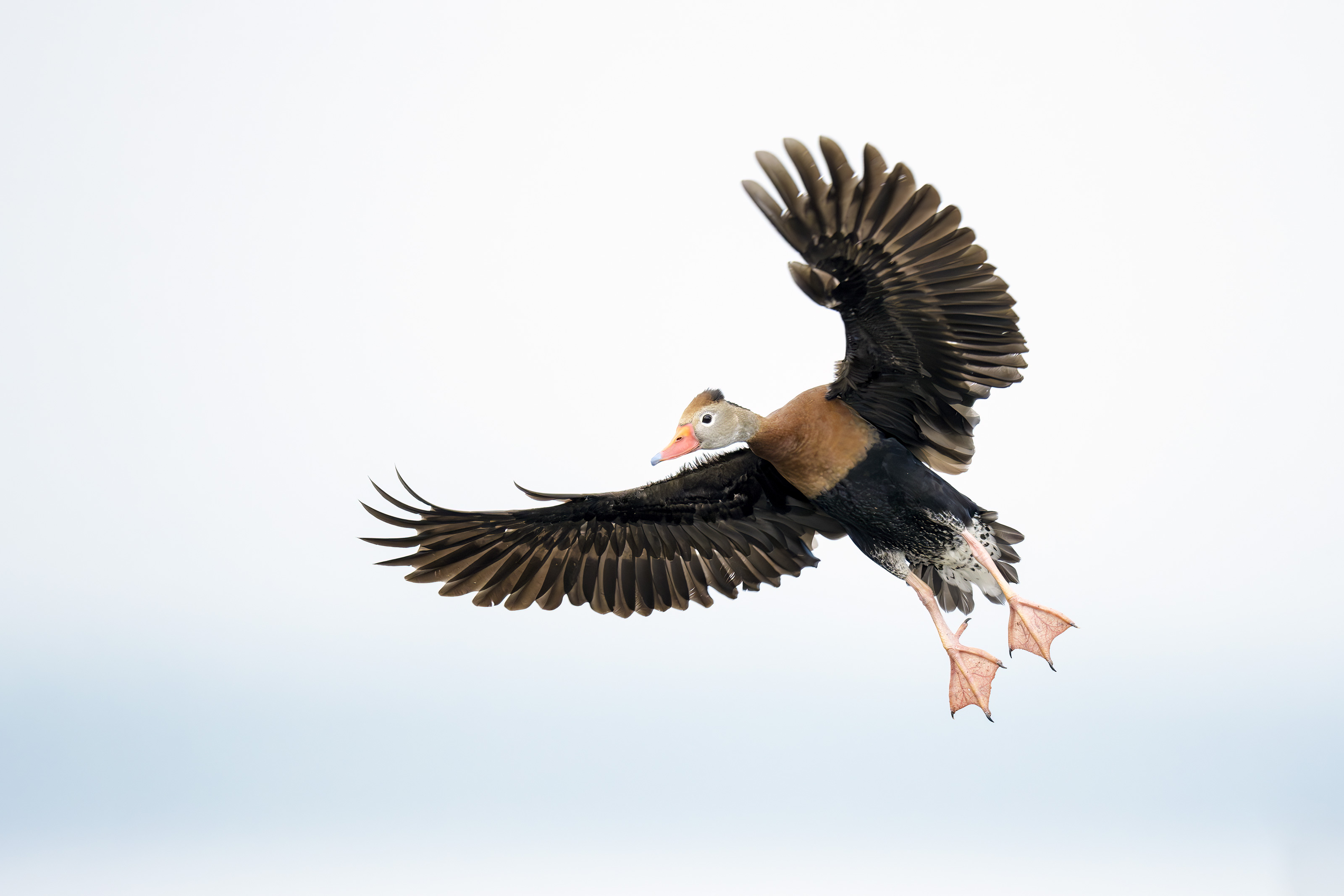
This image was also created on 13 May 2026 by yours truly down by the lake at ILE. Again, standing at full height near my SUV, I used the Robus RC-5570 Vantage Series 3 Carbon Fiber Tripod/Levered-Clamp FlexShooter Pro-mounted Sony FE 600mm f/4 GM OSS lens and The Latest Greatest Sony Flagship Body, the a1 II Mirrorless Camera (in APS-C Crop mode). The exposure was determined by Zebras with ISO on the rear wheel: ISO 3200: 1/3200 sec. at f/4 (wide open) in Manual mode. RawDigger showed that the exposure was dead solid perfect. AWB at 8:12:55am on a cloudy/foggy morning. Wide/AF-C with Bird-Eye/Face Detection performed perfectly. Click on the image to enjoy the larger, inexplicably sharper high-res version. Image #3: Black-bellied Whistling Duck braking to land |
My Top Pick
Of all the images in the video, this one was my top pick. I love the dropped landing gear, the braking pose, the strip of distant shoreline, the fabulous underwing detail, the speckled undertail coverts, and the fact that the head is clear of the wings.

|
The BIRDS AS ART Digital Basics Collection: $199.00. |
The BIRDS AS ART Digital Basics Collection
The best news is that learning to use the tools and techniques that I use to improve my images is made fairly simple for those who purchase, use and study the Digital Basics offerings from BIRDS AS ART. One of the great skills that I have been blessed with is writing coherent how-to instructions that can be followed easily by a third grader. Learn to unlock the potential in your images by purchasing the Digital Basics Collection here. The collection includes the Digital Basics II PDF, and all the videos in the Digital Basics III and the Digital Basics IV Video Series.
The original Digital Basics file was created in the mid-aughts when I saw countless numbers of folks creating sharp, nicely designed, well exposed images and then ruining them in Photoshop. I sold enough copies at $20.00 a pop to pay for my $68,000 lap pool! As my workflow changed and improved, various versions of Digital Basics were created to help folks learn to improve their images at the computer during post processing. Save an incredible $86.00 by purchasing the Digital Basics Collection here. Folks who own one or two of the three afore-mentioned products are invited to contact me via e-maill for personalized discount information.
Typos
With all blog posts, feel free to e-mail or to leave a comment regarding any typos or errors.








Thanks Monte and David. I cannot disagree with your tops picks.
with love, a
All three are great images, I like the action in #2 and the position of the duck in the frame in #1.
#3 is my favorite, I like full display of the wings and the head angle.
#3 is my favorite for the fully displayed wings, the dangling feet and the all-too-cute mohawk.
An action packed blog post to be sure. One facet of the video I appreciated was your inclusion of a flight image where the focus was less than optimal. I think it’s important to include these occasional “misses” which illustrate that no camera is perfect in its tracking and it helps to reassure those who are endeavoring to improve their technique. Regarding your use of the car as a “blind”, I was surprised that you were shooting over the hood. Even without the car engine running, I suspect the hood could generate atmospherics. Including the trick to make gray skies blue was a bonus and is a frequent hack I employ.
I hope everything goes well next week and best wishes for a speedy recovery!
Thanks for your kind words, Adam. My drive to the lake takes less than three minutes so my SUV is barely warmed up.
with love, artie
I was listening to a wildlife photography podcast and one of the participants talked about the first photography book he ever read. He said it was “The Art of Bird Photography,” by a guy named Arthur Morris, who he called “the grandfather of bird photography.” He loved the book and said it was his “bible” when he first started shooting.
Here’s a link to the podcast:
https://podcasts.apple.com/us/podcast/episode-11-social-media-and-photography/id1640992487?i=1000617452686
Artie’s mention starts at time index 53:12.
Thanks Steve and thanks Josh Galicki. I enjoyed the podcast and hopefully it will have an effect on me. I knew the name Josh Galicki but was not familiar with his work. If you would like to see some excellent small-in-the-frame and moody bird photography, check him out on Instagram:
https://www.instagram.com/galicki_photography/
“Grandfather” seems dated (and speaking in Woke, ageist). Forgive them, Godfather.
I agree with Pat on Image #1, but might choose #2 or #3 with added saturation, especially on the birds. I understand overcast light, but the mind adjusts to see expected colors, and so can ACR. 😉
As soon as I looked at #1 I was fascinated by the splayed out tail and orange feet. I checked out the other two images but kept coming back to look at #1.
Thanks, Pat. Good to see that you are able to comment again 🙂
with love, a