
Your Call?
Which of today’s six featured images is the strongest? Why did you make your choice. My #1 pick stands well above the other five. I will share my thoughts on that one with you in the next blog post.
Nickerson Beach Early Season Guide
If you would like to receive an e-mail guide describing where to be in what weather during May and June at Nickerson Beach and what to expect, please send a PayPal for $26.00 to birdsasart@verizon.net. It will include a primer on wind direction and gear suggestions. There will be an update sent in June before I head home no later than mid-month. This short, informal guide will include specific directions to the three oystercatcher families/nests discussed below and a recommendation on parking on mornings with winds with an easterly component. Please include the words Nickerson Beach Early Season Guide with your Paypal order. As is usually the case, it is likely that I will put a lot more work into this than I am planning.
What’s Up?
I nailed the wind and sky conditions and enjoyed two excellent mornings of bird photography at Nickerson Beach on Friday and Saturday. With cloudy-bright plus conditions on Friday I went with the hand held 400-800 and did well. On Saturday the cloud cover was 100% with the wind again from the northeast. I did well. It is supposed to rain for two straight days so I will likely not get out again until Monday morning. My trigger finger surgery is scheduled for Wednesday.
When I went to download my images on Friday afternoon I discovered that I had apparently left my card reader on my desk back in Florida. Another first. So, I used the USB-C to USB-C cable from my SanDisk 4TB Extreme PRO Portable SSD V2 external hard drives to connect the camera to my laptop and the images downloaded easily and quickly. Any port in a storm.
Today is Sunday 24 May 2026. I will be working on a small claims court suit against the landlord of the place I stayed in last August on Long Island. And then continuing to clear space on my new laptop by doing third edits of old files. Whatever you opt to do, I hope that you too choose to have fun and enjoy life. Please remember that happiness is a choice — Byron Katie, The Work.Com
If an item — a Delkin flash card or reader, a Levered-clamp FlexShooter Pro, or a Wimberley lens plate or low foot — for example, that is available from B&H and/or Bedfords, is also available in the BAA Online Store, it would be great, and greatly appreciated, if you would opt to purchase from us. We will match or beat any price. Please remember also to use my B&H affiliate links or to earn 3% cash back at Bedford by using the BIRDSASART discount code at checkout for your major gear purchases. Doing either often earns you free guides and/or discounts. And always earns my great appreciation.
Gear Questions and Advice
Too many folks attending BAA IPTs and dozens of photographers whom I see in the field and on BirdPhotographer’s.Net, are — out of ignorance — using the wrong gear, especially when it comes to tripods and more especially, tripod heads. And the same is true in spades when ordering new camera bodies or lenses. My advice will often save you some serious money and may help you avoid making a seriously bad choice. Please know that I am always glad to answer your gear questions via e-mail. If you are desperate, you can try me on my cell at 863-221-2372. Please leave a message and shoot me a text if I do not pick up.

B&H Simplified
To ensure that I get credit for your B&H purchases, you can always click here. The tracking is invisible. Using my affiliate links is greatly appreciated. And, with B&H, you can use your PayBoo card. You must use the website to order. You cannot get your free guides if you make a phone order. Once you have an item in your cart, you must complete the order within two hours. Huge thanks!
B&H
Many folks have written recently stating that they purchased a Sony a1 from B&H and would like their free membership in the Sony 1 Info and Updates Group, a $150.00 value. But when I check my affiliate account, their orders have not been there. When I let them know that they get credit for B&H purchases only if they use one of the many B&H affiliate links on the blog or begin their searches with this link, they are always disappointed. If in doubt, please contact me via e-mail and request a BH link. I am always glad to help and to guide you to the right gear.

Bedfords Simplified
Click here to start your search. Choose standard shipping, and when you get to the payment page, enter BIRDSASART in the discount code box and hit apply. You will be upgraded to free second day air Fed-Ex and receive 3% cash back on your credit card once your stuff ships. Using either my affiliate links is greatly appreciated and will often earn you free guides or discounts. To receive a free guide or free entry into a Sony Set-up and Info Notes e-Mail group, you need to shoot me your receipt via e-mail. The B&H receipts need to include the order number.
Bedfords Amazing BAA Discount Policy
Folks who have fallen in love with Bedfords can always use the BIRDSASART coupon code at checkout to enjoy a post-purchase, 3% off-statement credit (excluding taxes and shipping charges) on orders paid with a credit card. The 3% credit will be refunded to the card you used for your purchase when your product ships. Be sure, also, to check the box for free shipping to enjoy free Second Day Air Fed-Ex. This offer does not apply to purchases of Classes, Gift Cards, or prior purchases.
You can visit the Bedfords website here, shoot Steve Elkins an e-mail, or text him on his cell phone at (479) 381-2592.
|
|
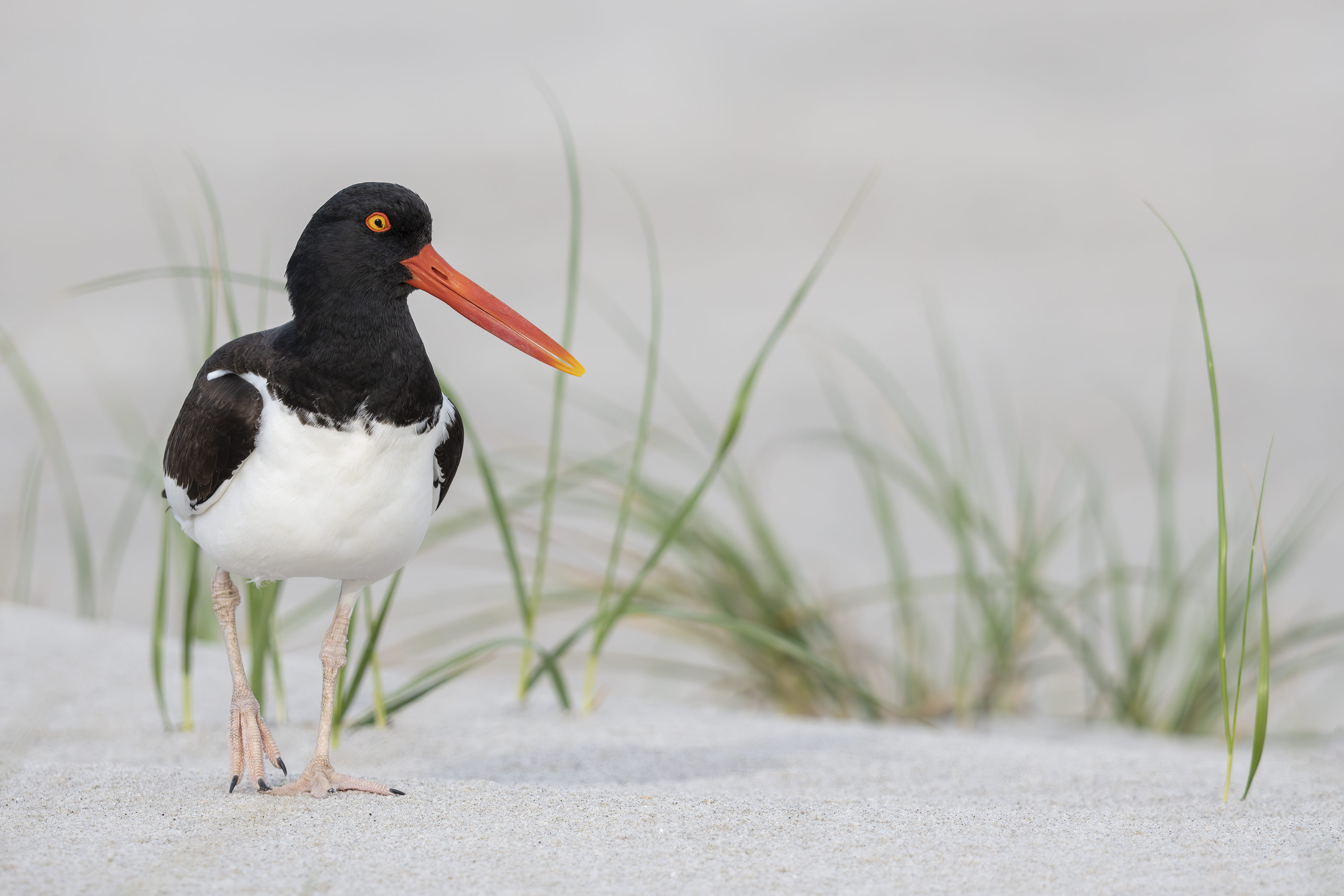
This image was created on 22 May 2026 at Nickerson Beach Park, Lido Beach, Long Island, NY. Standing at full height (the bird was on a rise), I used the hand held Sony FE 400-800mm f/6.3-8 G OSS lens (Sony E) (at 556mm) and The Latest Greatest Sony Flagship Body, the a1 II Mirrorless Camera (in APS-C crop mode!). The exposure was determined by Zebras with ISO on the rear wheel — ISO 2000: 1/800 second at f/8 (wide open) in Manual mode. RawDigger showed that the exposure was perfect. AWB at 7:05:32am on a variably cloudy morning. Tracking: Zone/AF-C with Bird-Eye/Face Detection performed perfectly. Click on the image to enjoy the larger, inexplicably sharper high-res version. Image #1: American Oystercatcher female in beach grass near nest |
My Nickerson Beach Hand Surgery Gear Bag
As I knew I would be traveling fairly light to Long Island, I used the smaller of my two Think Tank rollers, the Airport InternationalTM V3.0 rolling bag. I left my brand new 600mm f/4 GM lens at home and opted for the 300mm f/2.8 GM, the 200-600 G, and the 400-800 G lens (that is built and acts like a GM lens!). All of the lenses were packed and protected by sewn up hockey socks. May two Sony a-1-ii bodies, two 1.4X TCs, and one 2X TC, were all packed and protected by Carhartt watch caps. And a few extra camera batteries were placed in some old whites socks. The three lens hoods along with my Robus RC-5570 Vantage Series 3 Carbon Fiber Tripod and the Levered-Clamp FlexShooter Pro got to Islip in one of my two checked bags.
That the weather forecast was for and extended period of cold and rain, that I knew I would not be doing a ton of photography before the surgery, and likely very little if any after the surgery influenced my lens choices.
|
|
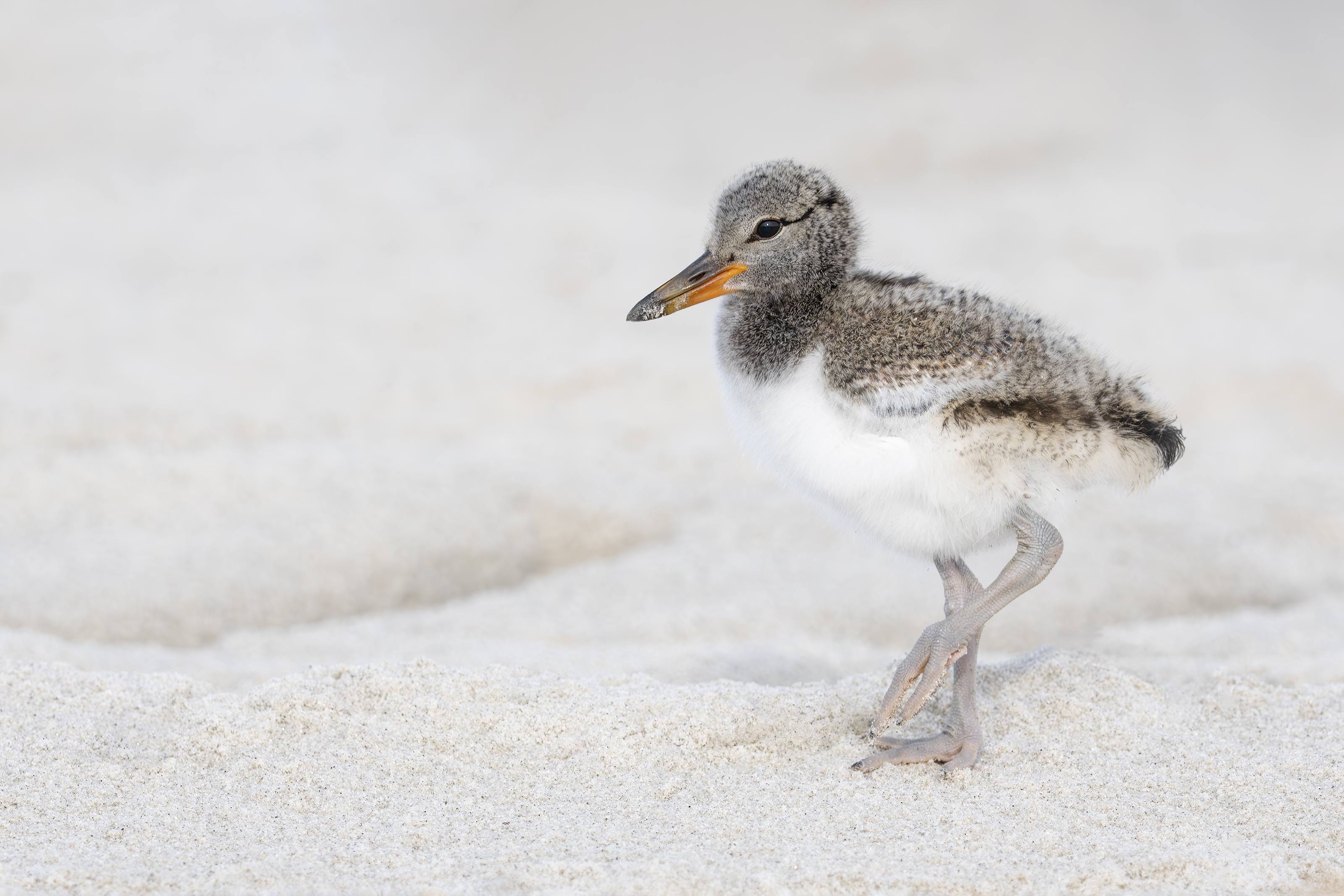
This image was also created on 22 May 2026 at Nickerson Beach Park, Lido Beach, Long Island, NY. Seated on dry sand using the knee pod technique, I used the hand held Sony FE 400-800mm f/6.3-8 G OSS lens (Sony E) (at 519mm) and The Latest Greatest Sony Flagship Body, the a1 II Mirrorless Camera (in APS-C crop mode!). The exposure was determined by Zebras with ISO on the rear wheel — ISO 2500: 1/1000 second at f/8 (wide open) in Manual mode. RawDigger showed that the exposure was perfect. AWB at 7:28:39am on a variably cloudy morning. Tracking: Zone/AF-C with Bird-Eye/Face Detection performed perfectly. Click on the image to enjoy the larger, inexplicably sharper high-res version. Image #2: American Oystercatcher chick |
Why the 400-800?
I got to the beach a bit late on Friday morning and found conditions better than expected. There was a good deal of cloud cover as predicted but the clouds to the east were looking as if they would be breaking up fairly soon. With the promise of at least cloudy bright or even sun, the choice of the slow 400-800 for its reach was an obvious one. I figured that if there was some good flight photography I could do that while seated as it is much easier to hand hold the 4-8 when you do not need to lift it very far from the rest position than it is when standing. Next up was the tripod decision. I opted to go hand held all the way as it was getting brighter by the minute.
A Big Reach Surprise
I grabbed my more used a-1 ii, mounted it on the 4-8, and headed out to the beach with just my car keys and one extra battery along for the ride. Right off the bat I found an oystercatcher nest with three eggs and another pair just beyond that. The second pair had a single chick probably about two weeks old — the bird in Image #2. As it had been quite some time since I used the 400-800, I was quite shocked by its incredible reach — the birds were looking really big in the frame and quite often, as in Image #2, I was surprised to find myself zooming out.
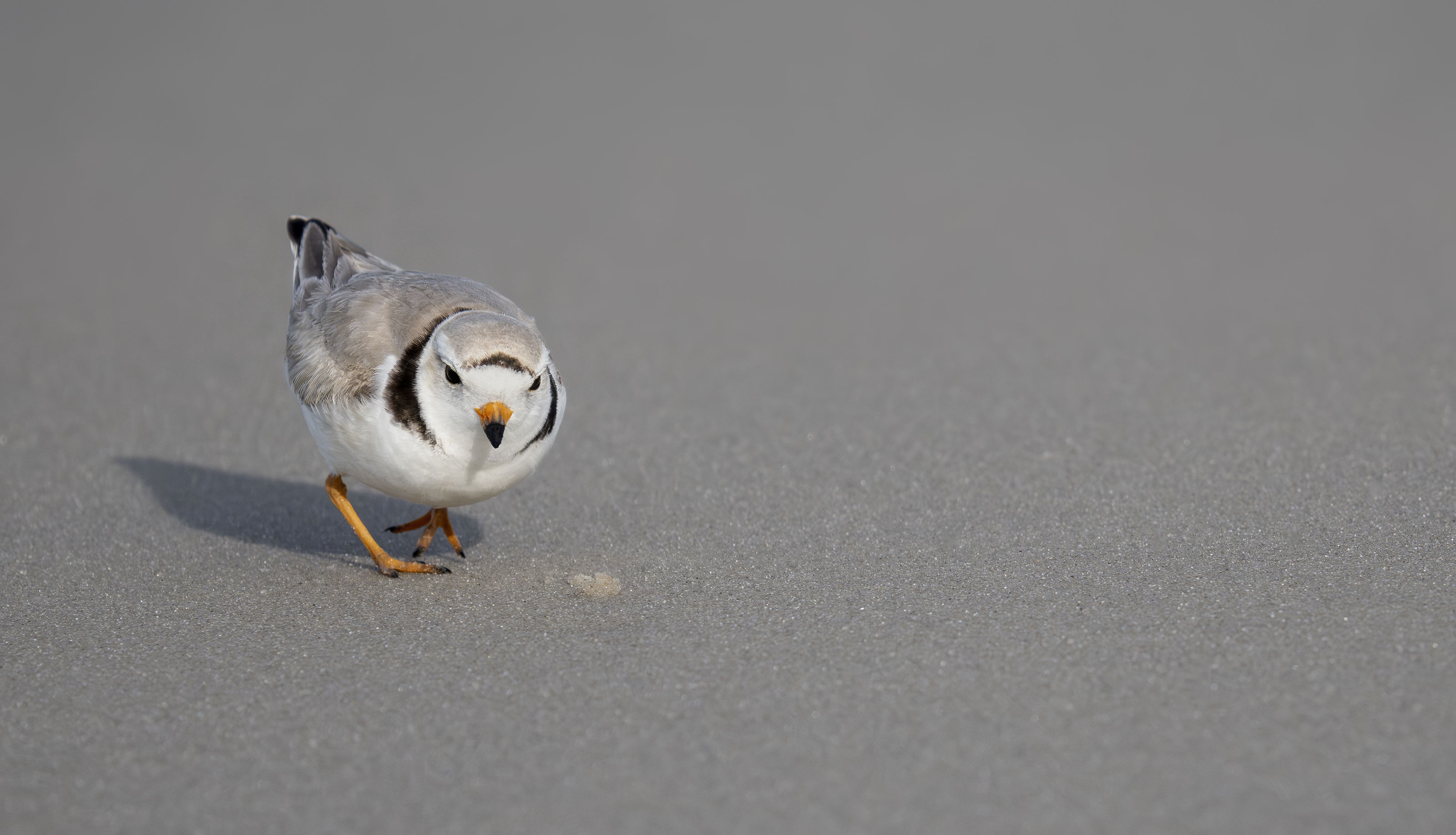
Why? I had totally forgotten about APS-C crop mode. As I approached the Piping Plover in the next image I went toggle crop mode on when I discovered that it had been on all morning. Yikes. That explained things.
An Un-realized Advantage of Screwing Up with Crop Mode
On the surface, it would seem that using crop mode and having to zoom out would be a very poor and counterproductive way to go. I had, however, been concerned about a minimum shutter speed when working at 800mm. The next day I realized that by being at 519mm in crop mode rather than at 800mm in full frame mode allowed me to make sharper images at a given shutter speed. Why? unsharpness due to gear shake is a factor of the square of the focal length.
Here is another way to look at this: getting more pixels on the subject in full frame mode will not help if the image is not sharp.
|
|
This image was also created on 22 May 2026 at Nickerson Beach Park, Lido Beach, Long Island, NY. Crouching a bit, I used the hand held Sony FE 400-800mm f/6.3-8 G OSS lens (Sony E) (at 800mm) and The Latest Greatest Sony Flagship Body, the a1 II Mirrorless Camera (in APS-C crop mode!). The exposure was determined by Zebras with ISO on the rear wheel — ISO 1600: 1/2500 second at f/8 (wide open) in Manual mode. RawDigger showed that the exposure was perfect. AWB at 7:36:07am on a variably cloudy morning. Tracking: Zone/AF-C with Bird-Eye/Face Detection performed perfectly. Click on the image to enjoy the larger, inexplicably sharper high-res version. Image #3: Piping Plover adult male foraging |
Expectations Met
On a May visit to Nickerson Beach Park you would expect to see American Oystercatcher, Common Tern, Black Skimmer, Sanderling, Ruddy Turnstone, Willet, Piping Plover, and several species of gulls, mostly Herring Gull. In addition to the single oystercatcher chick mentioned above, I saw three very small ones this morning on the open beach being brooded by a parent. And there are more than a few pairs on eggs. The terns are off to an early start with dozens (if not hundreds) of birds on scrapes, many with one or two eggs. The skimmers are also on the early side; there are probably about 1000 birds already at the East Colony. They should be setting up to nest and making scrapes in the next few weeks.
There have been a smattering of Sanderling on the beach but no appreciable flocks. I’ve seen a half dozen endangered Piping Plover on every beach walk and there are numerous predator exclosures in the dunes. Researcher James believes that at least one chick has hatched. I had two fly-by Willets this morning. The gulls have been quite skittish — lots of herrings, very few Great Black-backed Gulls, and surprisingly, only a single Laughing Gull. Ah, there have been a few Common Grackles and Barn Swallows on the beach as well. Regular photographer Brian Doherty pointed out an interesting behavior on Friday morning — several Barn Swallows were flying behind a huge beach raking machine feeding on the bugs that it displaced from the surface. Brian is an excellent and dedicated photographer. You can see his work here on IG. He has some great bird stuff and his Humpback Whale images from Long Island border on the amazing.
|
|
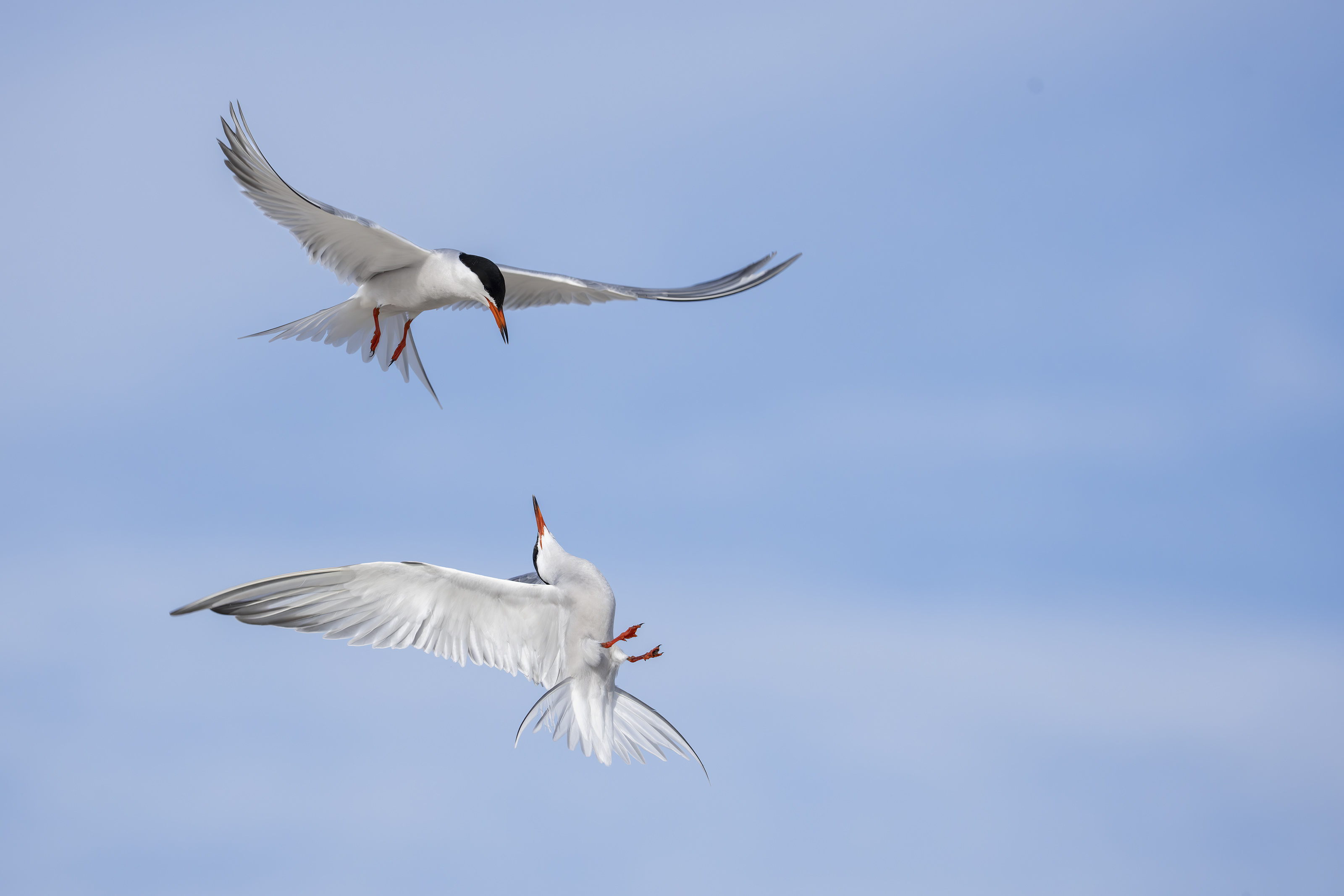
This image was also created on 22 May 2026 at Nickerson Beach Park, Lido Beach, Long Island, NY. Seated on dry sand, I used the hand held Sony FE 400-800mm f/6.3-8 G OSS lens (Sony E) (at 569mm) and The Latest Greatest Sony Flagship Body, the a1 II Mirrorless Camera (in full frame mode). The exposure was determined by Zebras with ISO on the rear wheel — ISO 1600: 1/4000 second at f/8 (wide open) in Manual mode. RawDigger showed that the exposure was perfect. AWB at 7:54:19am on a then variably sunny morning. Wide/AF-C with Bird-Eye/Face Detection performed perfectly. Click on the image to enjoy the larger, inexplicably sharper high-res version. Image #4: Common Tern midair squabble |
Understanding the Wind
In the last blog post I noted that conditions at Nickerson would likely be excellent on Friday and Saturday. Why: the forecast was for basically overcast with a good wind from the northeast. Had anyone opted to join me and wound up in the right place, they would have made some good images. Understanding the wind, sky, and weather conditions can help you maximize your bird photography opportunities.
Common Terns often squabble above the colony from the beginning of the breeding season to the end. The fights often start close to the ground and most will usually progress with the birds gaining altitude.
|
|
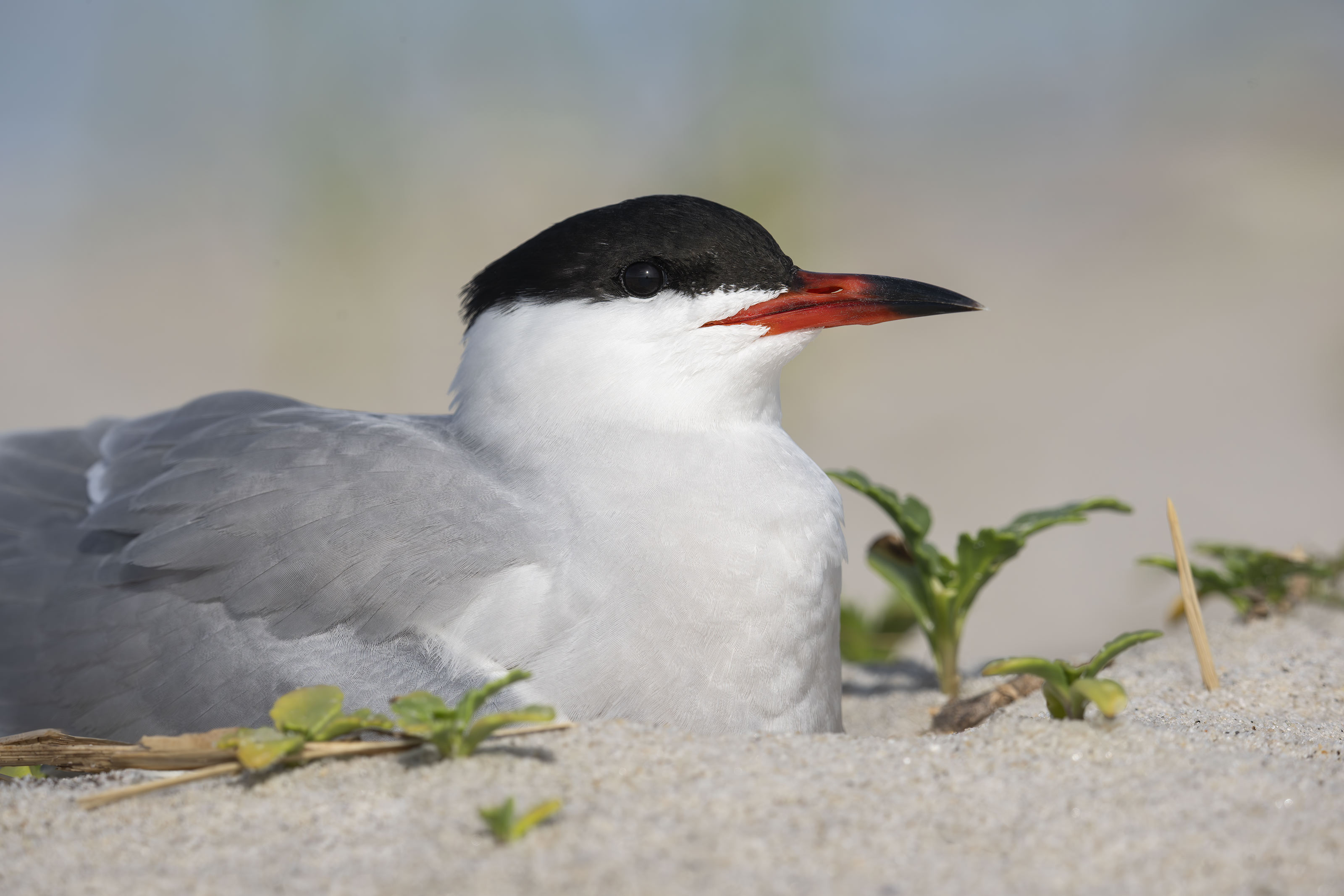
This image was also created on 22 May 2026 at Nickerson Beach Park, Lido Beach, Long Island, NY. Seated on dry sand, I used the toe-pod technique with the hand held Sony FE 400-800mm f/6.3-8 G OSS lens (Sony E) (at 659mm) and The Latest Greatest Sony Flagship Body, the a1 II Mirrorless Camera (in full frame mode). The exposure was determined by Zebras with ISO on the rear wheel — ISO 800: 1/1600 second at f/11 (wide open) in Manual mode. RawDigger showed that the exposure was perfect. AWB at 8:00:48am on a then variably sunny morning. Upper right Tracking; Zone/AF-C with Bird-Eye/Face Detection performed perfectly. Click on the image to enjoy the larger, inexplicably sharper high-res version. Image #5: Common Tern on nest scrape with two eggs |
Colony Strategy
Check out the birds from afar. Look for some areas of relatively clean sand. Wear some sort of protective hat. Approach the colony rope low and slow and get down on the ground. After you get pecked on the head a few times, the birds will calm down completely, land, and return to their nest scrapes. If you stay relatively still, the birds will get back to their lives in short order. Getting low via the toe-pod technique allows for the creation of intimate portraits.
|
|
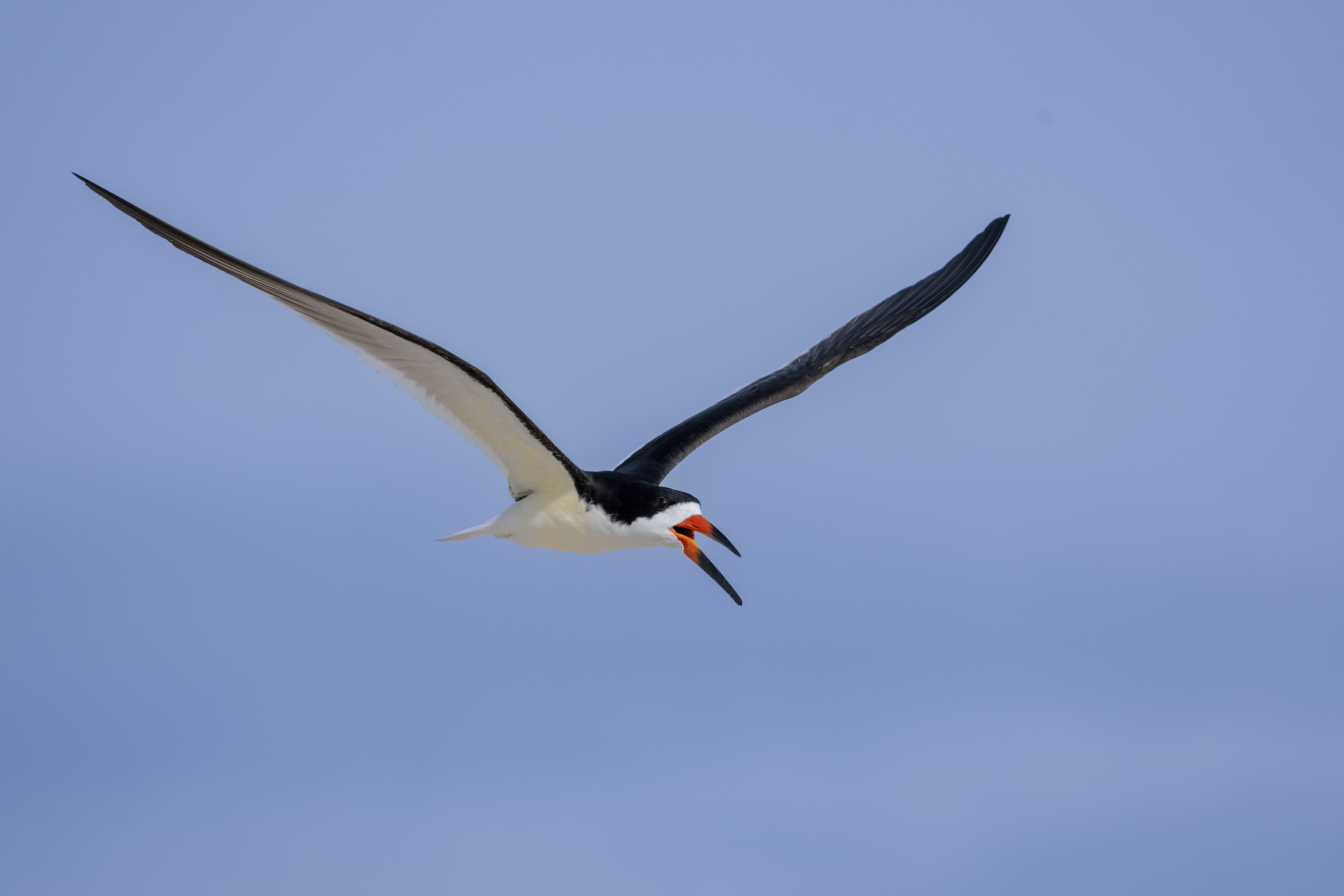
This image was also created on 22 May 2026 at Nickerson Beach Park, Lido Beach, Long Island, NY. Seated on dry sand, I used the hand held Sony FE 400-800mm f/6.3-8 G OSS lens (Sony E) (at 588mm) and The Latest Greatest Sony Flagship Body, the a1 II Mirrorless Camera (in full frame mode). The exposure was determined by Zebras with ISO on the rear wheel — ISO 1250: 1/3200 second at f/8 (wide open) in Manual mode. RawDigger showed that the exposure was perfect. AWB at 8:16:24am on a then variably sunny morning. Wide/AF-C with Bird-Eye/Face Detection performed perfectly. Click on the image to enjoy the larger, inexplicably sharper high-res version. Image #6: Black Skimmer breeding plumage adult calling in flight |
Early Season Skimmer Flight
Before they set up on territory, skimmer flight photography is pretty much random. Anywhere that the wind and the light is behind you, you have a chance. Just stay alert. In general, I will shoot the skimmers in flight 1/3 stop lighter than the adult terns as the whites are not as bright. Getting one calling in flight requires a bit of luck.
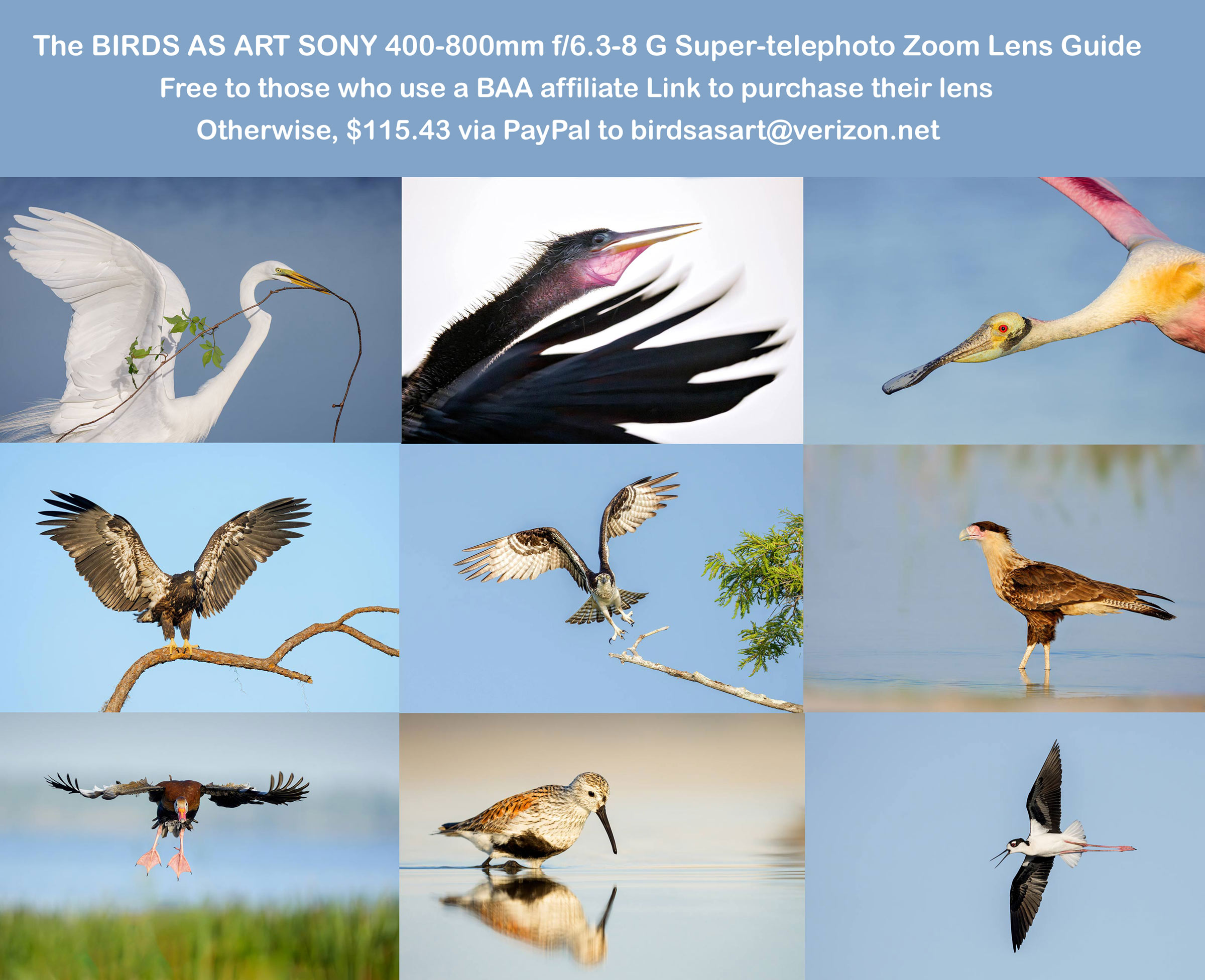
The BIRDS AS ART SONY 400-800mm f/6.3-9 G Super-telephoto Zoom Lens Guide
When I borrowed this lens from Sony, I assumed that at 5.45 pounds it was too heavy to handhold for long and that at f/8 at the long end (800mm,) it was too slow for most bird photography applications. In short, I did not want to like the lens. After a month of using it, I cannot live without it. After returning the loaner, I was miraculously able to get my own from Bedfords on 16 April 2025. In this guide I share everything that I have learned about using the 400-800. For best results, you need to know exactly what you are doing to get the most out of this zoom lens. It would be best, therefore, to consider and study the material in the guide so that you can begin making great images with your new lens.
You will learn how to deal with the relatively show apertures: f/6.3, f/7.1, and f/8 when working in Manual mode.
You will learn how to ensure that you are working at the widest aperture by working in Shutter Priority mode with AUTO ISO.
If you are able to hand hold the lens, you will learn proper hand holding techniques.
If you can’t, you will learn when, why, and how to employ other options. Those include:
1- The knee-pod, heel-pod, and toe-pod techniques
2- Using the lens on a monopod.
3- The best lens plate and low foot for your 4-8.
4- The best tripod and head for the 4-8 and how best to utilize them.
5- How to use the lens from your vehicle while supporting it on a BLUBB (or not and why not).
6- Detailed instructions on how to set and use the lens controls and buttons:
a- AF/MF
b- DMF Switch
c- Limit Range Switch
d- OSS (Optical Steady Shot) Switch
e- OSS Mode Switch
f- Focus Hold Buttons
The guide also includes a Hand Holding Shutter Speed Primer and an illustrative, educational, and inspiring 67-image gallery.
This guide is free to folks who use one of my two affiliate links to purchase their Sony 400-800 G lens. Otherwise, please send a PayPal for $115.43 to birdsasart@verizon.net. and include the words “400-800 Lens Guide” in your e-mail.
Typos
With all blog posts, feel free to e-mail or to leave a comment regarding any typos or errors.








I’m late to the party but #4 and #1 are two of my favorites although #4 wins for sheer art-istry!
Thanks. The consensus.
a
#4 for me. Love the action in the air.
Thank you sir. Me too!
with love, a
#4 for me. Interest, sharpness, beautiful background. Hope all goes well with the hand surgery and best wishes for a rapid recovery!!
Thanks Doc! I hope to be back out on the beach as soon as possible after Wednesday 🙂
with love, artie
#1 is my favorite: colors, composition, exposure — all exquisite.
As for Artie’s favorite, I predict #4: he likes the “science fiction-like” autofocus of the Sony α1 series, and this image shows it off.
Thank you kindly. I agree 100% about Image #1. As for my fave, you might be right.
with love, artie
#1 is my favorite. Classic, beautiful portrait of an oystercatcher with gorgeous greenery. Good luck with your surgery. Didn’t you have similar surgery previously?
Another vote for the habitat shot. And yes, this is not my first trigger finger surgery rodeo. I’ve had at least three previously, possibly four 🙂
with love, artie
#4 is my favorite…. I just like the graceful action. Both birds have really nice positioning.
Thanks, Steve. I cannot argue with that.
with love, artie
#4 immediately caught my attention. But also the more I looked I also like #1 too as the grasses give sense of the environment.
You like the two most popular. Great to hear from you. See you in San Diego in not sooner.
with love, artie
Artie
How ya doing my good friend? Great luck with the up coming surgery but if all else fails just tell him to cut it off and leave a stub so ya can attach a stick to it to use. 🙂
So as far as the favorite I believe it is the perfect head angle and body pose in #1 as you’re down low and she’s looking sweet. However my 2nd choice is #5 as you’re up tight and low and really shows her well as she sits on her nest. While #4 is nice I would like the lower bird to have a gooder head angle. Yup
Always with love b
I always love to see you commenting East Bobman. Yeah, the ring finger doesn’t do much.
With #1 and #5 the birds were up on a rise. With #1 you could call it a small hill.
I think that number four is pretty gooder 🙂
much love my friend, a
I agree with Pat that image #4 is probably your pick ! But my favorite is the oystercatcher chick in the soft light.
Thanks, Sandy. I worked hard for #4. There will be lots of oystercatcher chicks in the first half of August so I hope that you make it to Nickerson this summer.
with love, a
I agree with Pat, #4 is my top pick.
Smart man!
with love, a
If #4, the mid-air squabble of the common terns isn’t your #1 pick I’ll be very surprised. Such a great shot! I particularly love the unusual position of the tern on the bottom.
Hey Pat,
No need to be surprised 🙂
with love, artie