
Summary
With the all fields at ILE flooded and much too soft to drive on, the pier at ILE has been where all the action has been. In today’s post, I share ten recent pier favorites with you, each accompanied by light angle, depth of field, and compositional lessons. Eight of the photos were created with the 400-800, two with the new 100-400 and the 1.4X TC. And seven of the ten were perched on sun angle on the right hand (north) railing.
Note: General information, copy editing, re-crafting, technical refinement, and formatting for this blog post were assisted by Gemini AI.
Your Call
Which three of today’s featured images do you feel are the strongest? Why did you like each one.
In the Last Blog Post
I was pleased and almost shocked at the large number of comments at the last blog post, the one that featured the Barn Swallow flight photos. So thanks a stack for those, and consider keeping up the great work by commenting on each and every post.
Most folks went with #3 as the strongest while #2 also got lots of mentions. Cliff Beittel noted that the lake background in Image #1 also deserved some love. Most recently, David Pugsley went with #1, the juvie, as his first pick.
My original pick of the litter was #2, but over the course of a few days I realized that #3, the consensus pick, was even stronger. That said, they are all quite good.
What’s Up?
The last two mornings have been foggy or cloudy (or both) early on. Thursday BIRDS AS ART 100-400mm f/4.5 GM Lens guide is finished and the PDF has been created. I will be sending a link this afternoon to the many who used one of my two affiliate links to purchase their copy of this amazingly versatile super-telephoto zoom lens.
Today is Friday 25 September 2026 and the forecast is the same so I will head down to the lake just after 7:30am. I need to get back to work on my 2025 tax return so that I can get it to my accountant before the end of the month. Whatever you opt to do, I hope that you choose to have fun and enjoy life. Please remember that happiness is a choice — Byron Katie – The Work.Com
If an item — a Delkin flash card or reader, a Levered-clamp FlexShooter Pro, or a Wimberley lens plate or low foot — for example, that is available from B&H and/or Bedfords, is also available in the BAA Online Store, it would be great, and greatly appreciated, if you would opt to purchase from us. We will match or beat any price. Please remember also to use my B&H affiliate links or to earn 3% cash back at Bedford by using the BIRDSASART discount code at checkout for your major gear purchases. Doing either often earns you free guides and/or discounts. And always earns my great appreciation.
Gear Questions and Advice
Too many folks attending BAA IPTs and dozens of photographers whom I see in the field and on BirdPhotographer’s.Net, are — out of ignorance — using the wrong gear, especially when it comes to tripods and more especially, tripod heads. And the same is true in spades when ordering new camera bodies or lenses. My advice will often save you some serious money and may help you avoid making a seriously bad choice. Please know that I am always glad to answer your gear questions via e-mail. If you are desperate, you can try me on my cell at 863-221-2372. Please leave a message and shoot me a text if I do not pick up.
Price Drops!
|
BIRDS AS ART SONY A9 iii Images |
Sony a-9 iii Mirrorless Camera Body
Price reduced $500.00 on 4 September 2026
Multiple IPT veteran, Used Gear Page regular, and dear student and friend Pat Fishburne is offering a Sony a9 iii Mirrorless camera in like-new condition for a ridiculously low $3,798.00. The sale includes the original product box, the body cap, the battery charger, one battery, the strap, and insured ground shipping via major courier to lower-48 US addresses only.
Your item will not ship until your check clears unless other arrangements are made.
Your purchase will also include my two a9 iii Set-up e-mails.
Please contact Pat via e-mail.
At one point I loved my a9 iii so much for flight and action that I sold two a-1 bodies and purchased a second a9 iii. Working at 120fps gives you four times as many wing positions and flight poses as any other mirrorless camera body. Most every single image will be sharp on the eye. The raw files can stand up to decent crops and in addition, Topaz Gigapixel does a fabulous job of upsizing a9 iii TIF files. A new a9 iii sells at B&H for $$6,398.00. B&H has a used one in stock in 9 condition for $$4,911.95. If you have been dreaming of 120 fps with global shutter for flight and action, grab Pat’s pretty much brand new one right now and save an absolute ton of dollars. artie artie
Sony FE 90mm F2.8 Macro G OSS
Price reduced $150.00 on 23 SEPT 2026
Used Gear Page regular, IPT Veteran, and BAA friend Larry Master is offering a Sony FE 90mm F2.8 Macro G OSS in like-new condition for $458.00 (was $598.00). There are no dings or dents, or signs of wear on the lens barrel, and the front element is pristine. The sale includes the product box, the front and rear lens caps, the lens hood, and insured ground shipping via major courier to lower-48 US addresses only. Please note — these items are not included: the manuals, the long-expired USA warranty card, and the lens pouch. Your item will not ship until your check clears unless other arrangements are made.
Please contact by Larry by e-mail.
This great macro lens sells new at B&H for $1048.00. Save a handsome $500.00 by grabbing Larry’s pretty much new lens today. artie
G Lens, Macro Versatility
Get up close and personal with the 1:1 magnification ratio of the full-frame compatible Sony FE 90mm f/2.8 Macro G OSS Lens. As a G series lens, it perfectly balances sharpness and bokeh and, as a macro lens, close and controlled focusing performance is prioritized with advanced AF and intuitive handling.
Close-Up Capabilities
True macro design affords a life-size, 1:1 magnification ratio along with an 11″ minimum focusing distance for working with close-up subjects. The focusing distance and magnification scale is printed on top of the lens to aid in more technical applications. The focus range limiter switch allows you constrain the usable focus range between 11-19.7″, 19.7″-infinity, or full. This lens’ focusing ring can be slid forwards and backwards to quickly shift between manual to autofocus modes. The internal focusing design maintains the overall lens length during use, benefitting focus accuracy and ease of use when working distance is a concern.
G Series Optical Design
Two extra-low dispersion elements, including one Super ED element, are featured in the lens design to reduce chromatic aberrations and color fringing for improved clarity and color neutrality. Tne aspherical element helps reduce astigmatism, field curvature, coma, and other monochromatic aberrations. The Nano AR Coating has been applied to reduce surface reflections, flare, and ghosting for increased contrast and color rendering in strong lighting conditions. The Rounded nine-blade diaphragm contributes to a pleasing bokeh quality when employing selective focus techniques.
Above by B&H and Sony.
Robus RCM-439 4-Section Carbon Fiber Monopod, 65
Yours truly is offering a Robus RCM-439 4-Section Carbon Fiber Monopod, 65 in like-new plus condition for $74.95 plus the shipping, an even $25.00 less than B&H. In the box with everything that came with it. Never used.
If interested, get in touch with artie via e-mail.
|
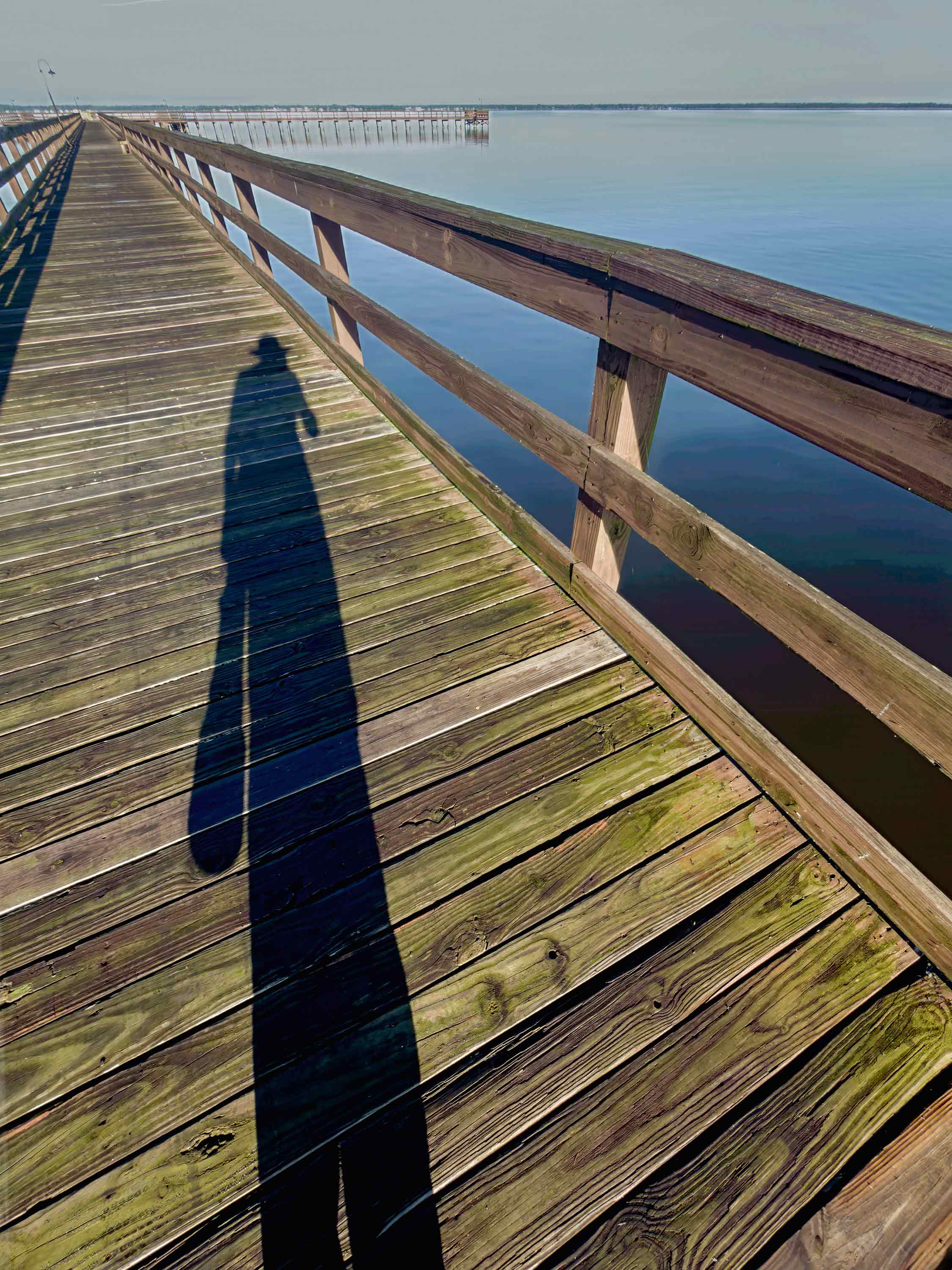
Post Autumn Equinox Morning Pier Sun Angle |
The Autumnal (Fall) Equinox
In the northern hemisphere, the Autumnal (fall) equinox occurs around September 22 — it marks the start of fall. The sunrise rises due east and sets due west. Both day and night have nearly equal length. The word comes from Latin words meaning “equal night.”
The Fall Equinox and the ILE Pier
If you stood on the pier for several days on either side of the autumnal equinox while looking east on clear days at sunrise, the sun would rise pretty much right over Park Boulevard and your shadow (behind you) would run right down the center of the pier that points a very few degrees north of due west. As the sun gets higher in the sky, it moves to the south. The opening image above shows the sun angle at 8:33am on 22 September. It should be obvious why birds sitting on the north railing, the one on our right, make ideal subjects in late September and for the next few months as well — birds on the right hand railing will be on sun angle.
|
|
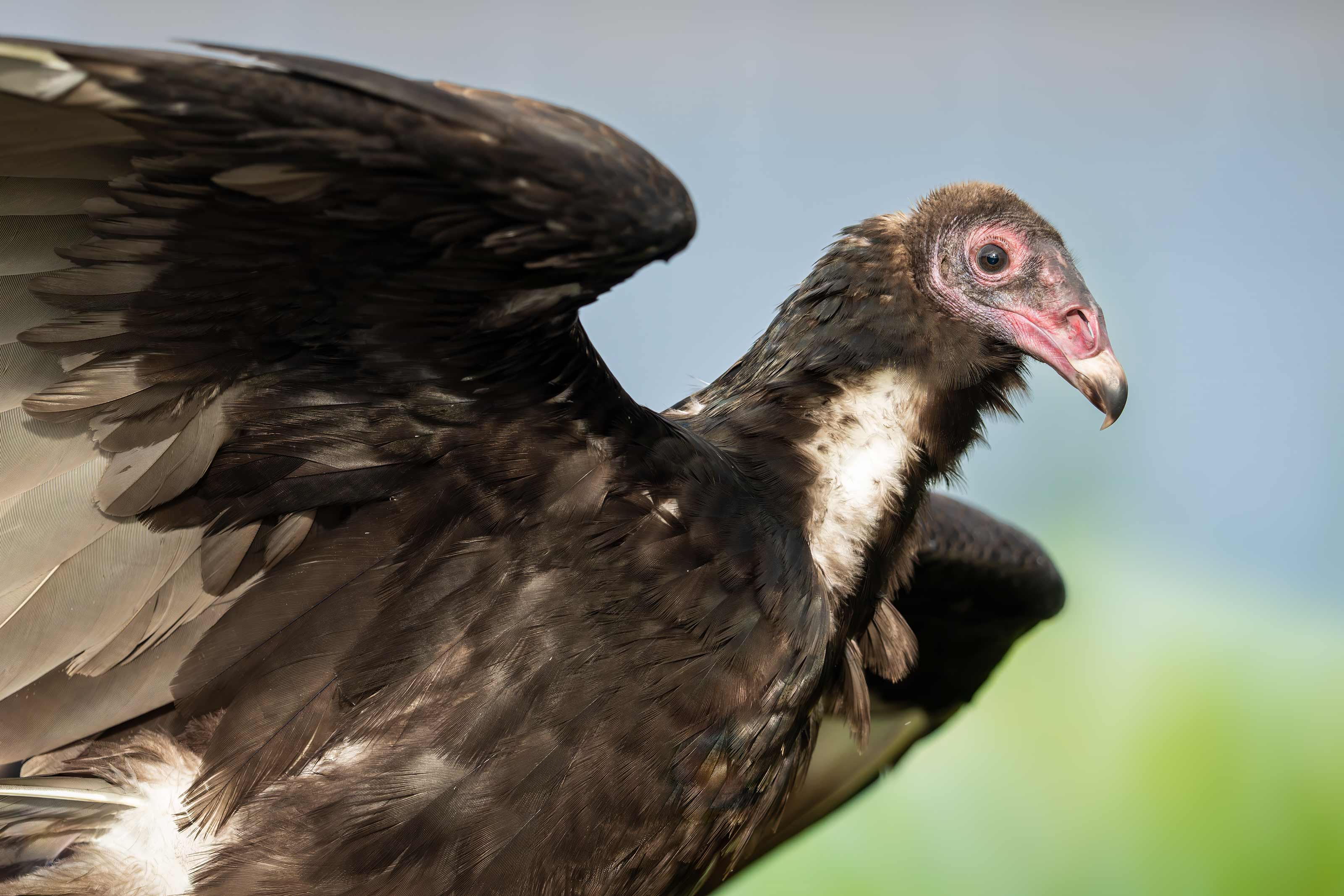
This image was created by yours truly on 16 September 2026 on the pier at Indian Lake Estates. I used the handheld Sony FE 400-800mm f/6.3-8 G OSS lens (Sony E) (at 600mm) and The Latest Greatest Sony Flagship Body, the a1 II Mirrorless Camera (in full frame mode). The exposure was determined by Zebras with ISO on the rear wheel. ISO 2500: 1/1250 second at f/8 (wide open) in Manual mode. AWB at 8:46:00am on a partly sunny morning. Tracking: Zone/AF-C with Bird-Eye/Face Detection performed perfectly. Click on the image to enjoy the larger high-res version. Image #1: Turkey Vulture with wings raised on pier railing |
Add Green Whenever Possible
Yes, I have been saying it for decades — adding green to your bird photographs can bring them to life. To add green when working on the ILE pier I need to find and get close to some birds near the base of the pier so that I can — by getting as high as possible, point the lens down and get some of the marsh vegetation as background. This bird was photographed on the right-hand pier railing.
|
|
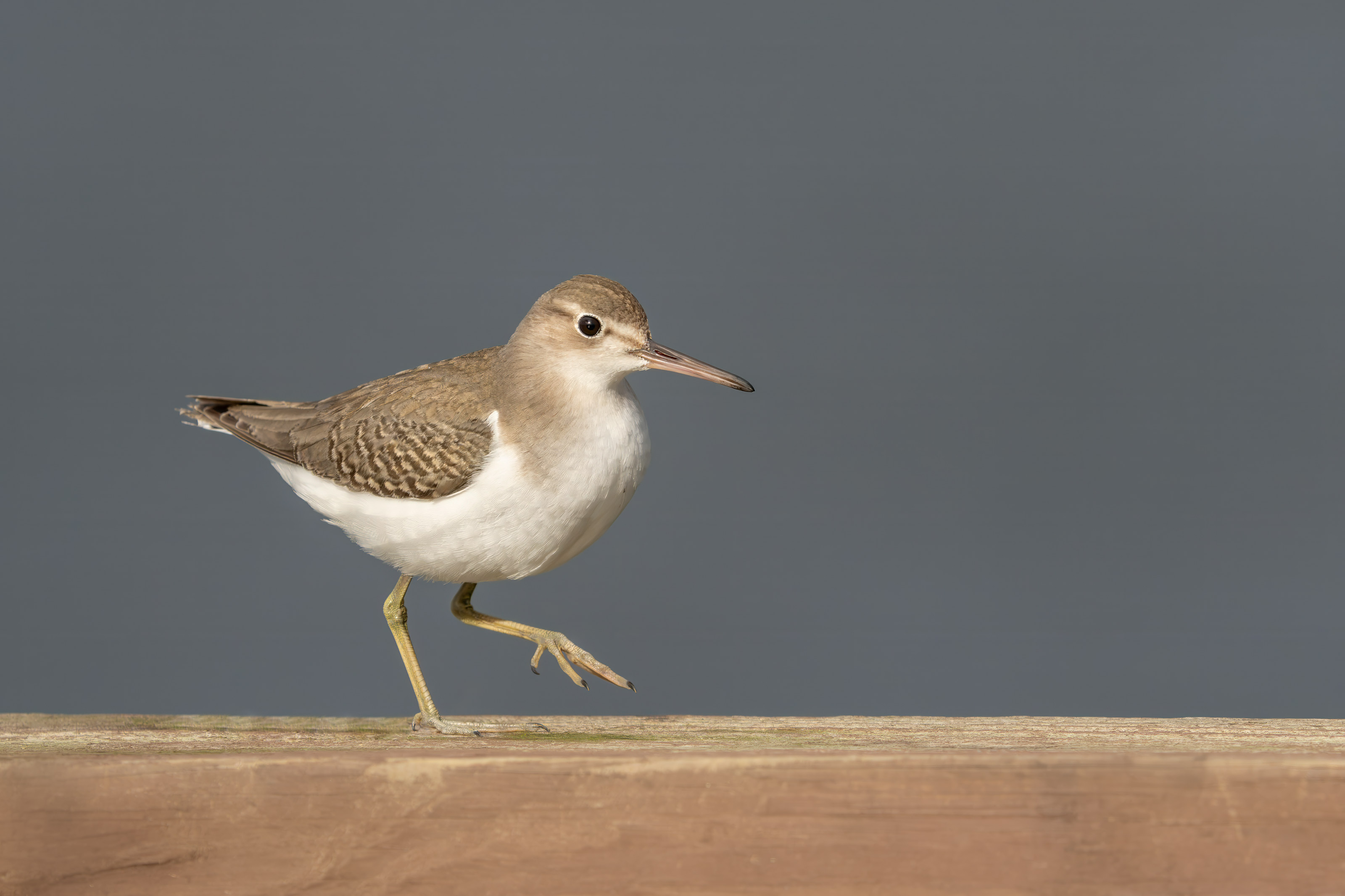
This image was also created by yours truly on 16 September 2026 on the pier at Indian Lake Estates. I used the handheld Sony FE 400-800mm f/6.3-8 G OSS lens (Sony E) (at 800mm) and The Latest Greatest Sony Flagship Body, the a1 II Mirrorless Camera (in APS-C crop mode). The exposure was determined by Zebras with ISO on the rear wheel. ISO 1600: 1/4000 second at f/8 (wide open) in Manual mode. AWB at 9:02:36am on a sunny morning. Tracking: Zone/AF-C with Bird-Eye/Face Detection performed perfectly. Click on the image to enjoy the larger high-res version. Image #2: Spotted Sandpiper juvenile on pier railing |
Matte Grey Backgrounds
When working on the sun angle — as I always do on clear mornings — there is only one situation I know of that will yield a matte grey background: when a dark storm cloud fills the western sky.
That was the case here when I had a rare good chance on a young spotty in fresh juvenal plumage.
This bird was on the west pier railing at the top of the “T.”
|
|
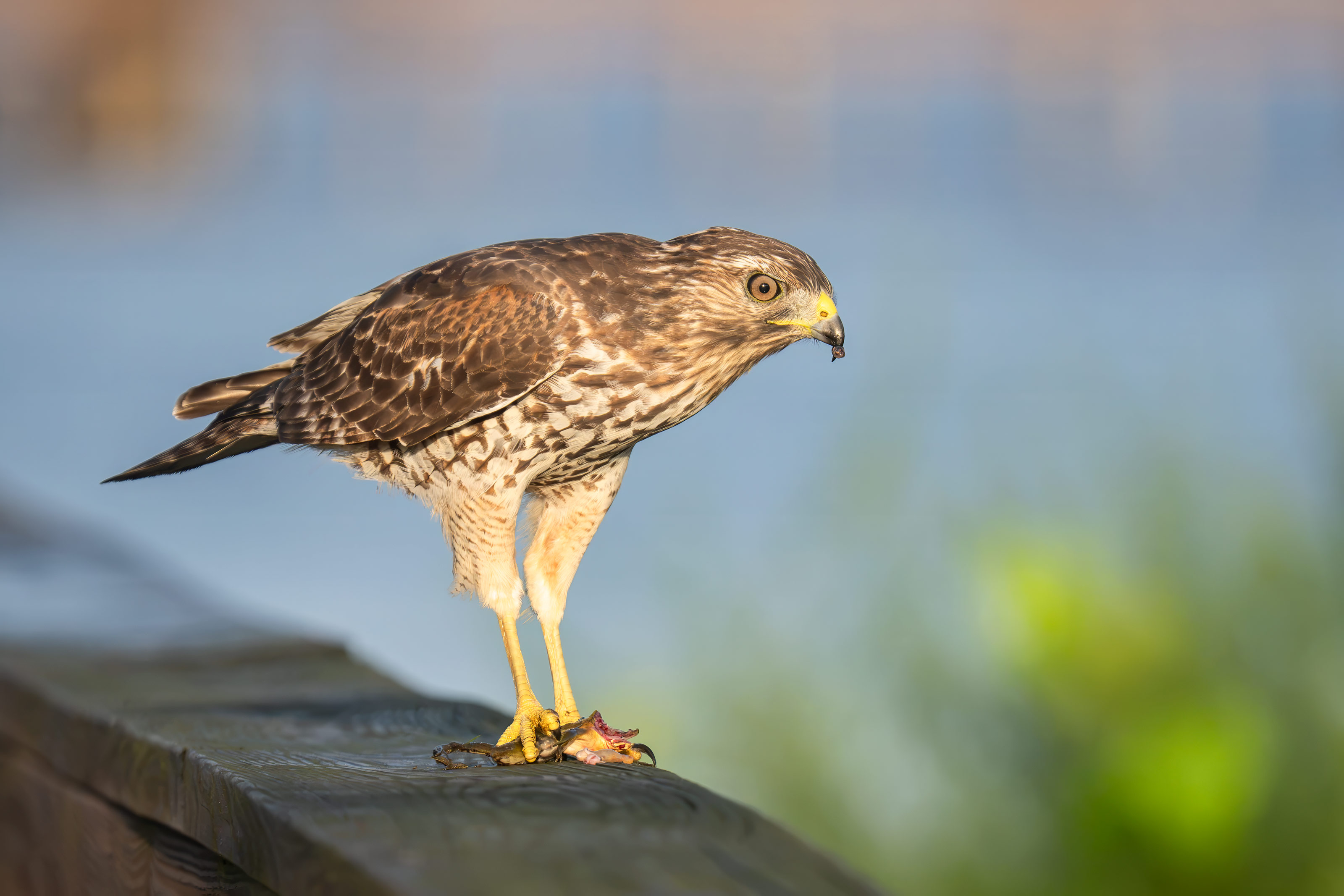
This image was also created on 17 September 2026 by yours truly on the pier at Indian Lake Estates, FL. Standing at full height I used the handheld Sony FE 100-400mm f/4.5 GM OSS lens with the Sony FE 1.4x Teleconverter (at 560mm) and The Latest Greatest Sony Flagship Body, the a-1 II Mirrorless Camera (in APS-C crop mode). The exposure was determined by Zebras with ISO on the Thumb Dial. ISO 2500: 1/3200 second at f/6.3 (wide open) in Manual mode. AWB at 7:54:46am on a mostly sunny morning. Tracking: Zone/AF-C with Bird-Eye/Face Detection performed perfectly. Click on the image to enjoy a larger high-res version. Image #3: “Red-shouldered Hawk worn juvenile with amphibian prey on pier railing |
Crop Mode for Skittish Birds
Spotting the young hawk grab prey in the grass just north of the pier, I watched it fly to a railing at the near-end and begin consuming its prey. I used the small utility shed as cover to get on sun angle. Luckily, the bird had chosen the north railing — on the south side, the lighting would have been problematic. Holding my breath, I crept out into the open at a snail’s pace. Since ILE raptors are notoriously skittish, I knew I couldn’t get tight to the subject, so I toggled to crop mode while still at a respectable distance.
Bingo! The effective focal length of 840mm was perfect for the task at hand.
|
|
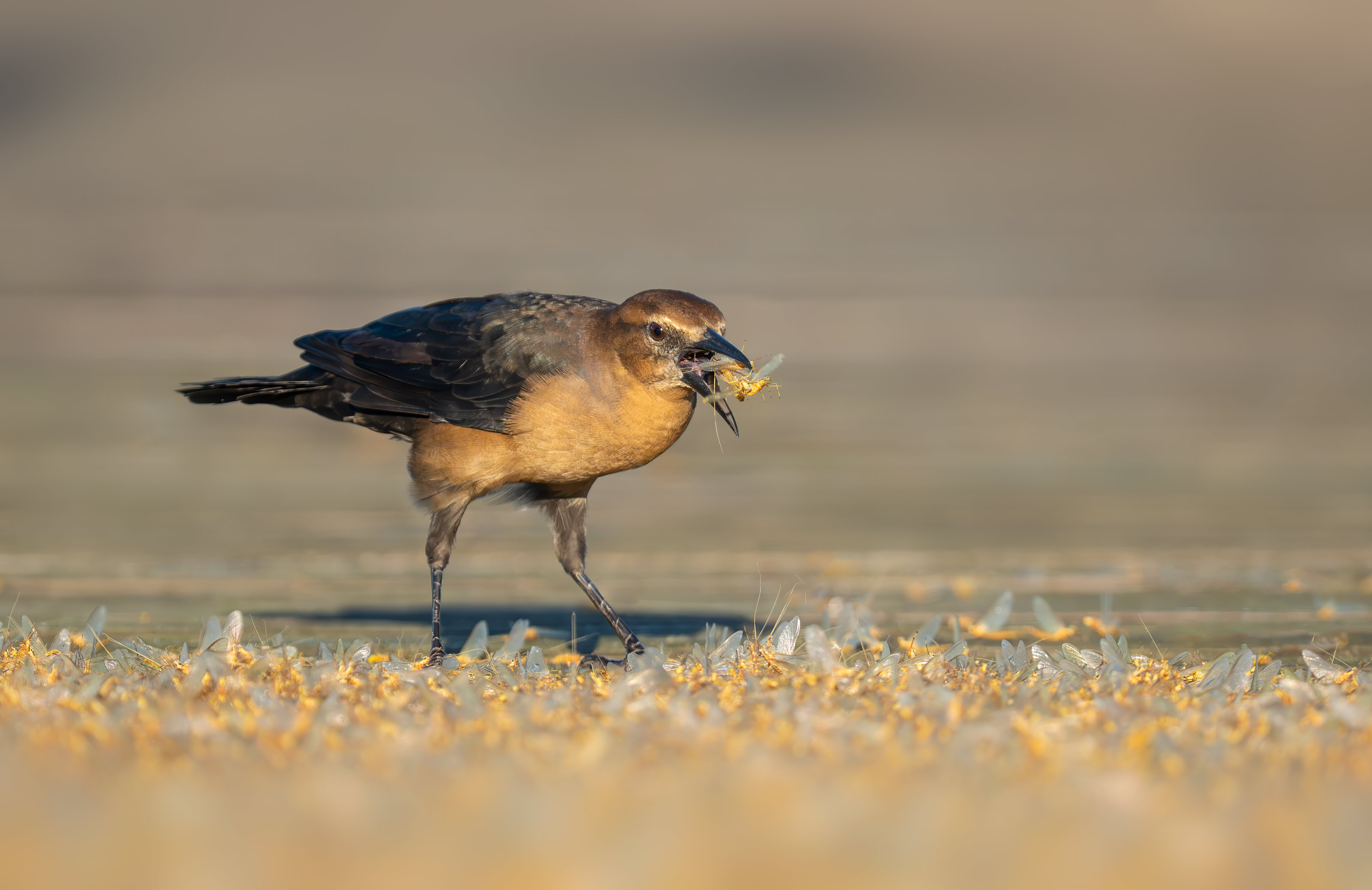
This image was also created on 17 September 2026 by yours truly on the pier at Indian Lake Estates, FL. Standing at full height I used the handheld Sony FE 100-400mm f/4.5 GM OSS lens with the Sony FE 1.4x Teleconverter (at 560mm) and The Latest Greatest Sony Flagship Body, the a-1 II Mirrorless Camera (in APS-C crop mode). The exposure was determined by Zebras with ISO on the Thumb Dial. ISO 1600: 1/2000 second at f/6.3 (wide open) in Manual mode. AWB at 8:11:17am on a mostly sunny morning. Tracking: Zone/AF-C with Bird-Eye/Face Detection performed perfectly. Click on the image to enjoy a larger high-res version. Image #4: Boat-tailed Grackle chowing down on mayflies on pier deck |
Mayfly Life Stages
Nymph (Underwater): Spends most of its life — from a few months up to two years — as aquatic larva in rivers, streams, and lakes.
Adult (Flying): Emerges with wings solely to mate and reproduce. For most species, adults survive for only 12 to 48 hours; some live for just a few minutes.
Feeding: Adult mayflies lack functional mouthparts and do not eat at all during their brief airborne phase.
Breakfast Time and Menu
Huge mayfly hatches can occur at ILE during any of the warmer months. On many mornings throughout late spring, summer, and early fall, piles containing thousands of dead and dying adult mayflies accumulate under the lampposts on the pier.
A wide variety of bird species — most notably Cattle Egret and Boat-tailed Grackle — regularly feast on this seasonal bounty. I’ve even seen Sandhill Crane families near the base of the pier gorging on the adults, which measure over three inches long including their extended tail filaments.
|
|
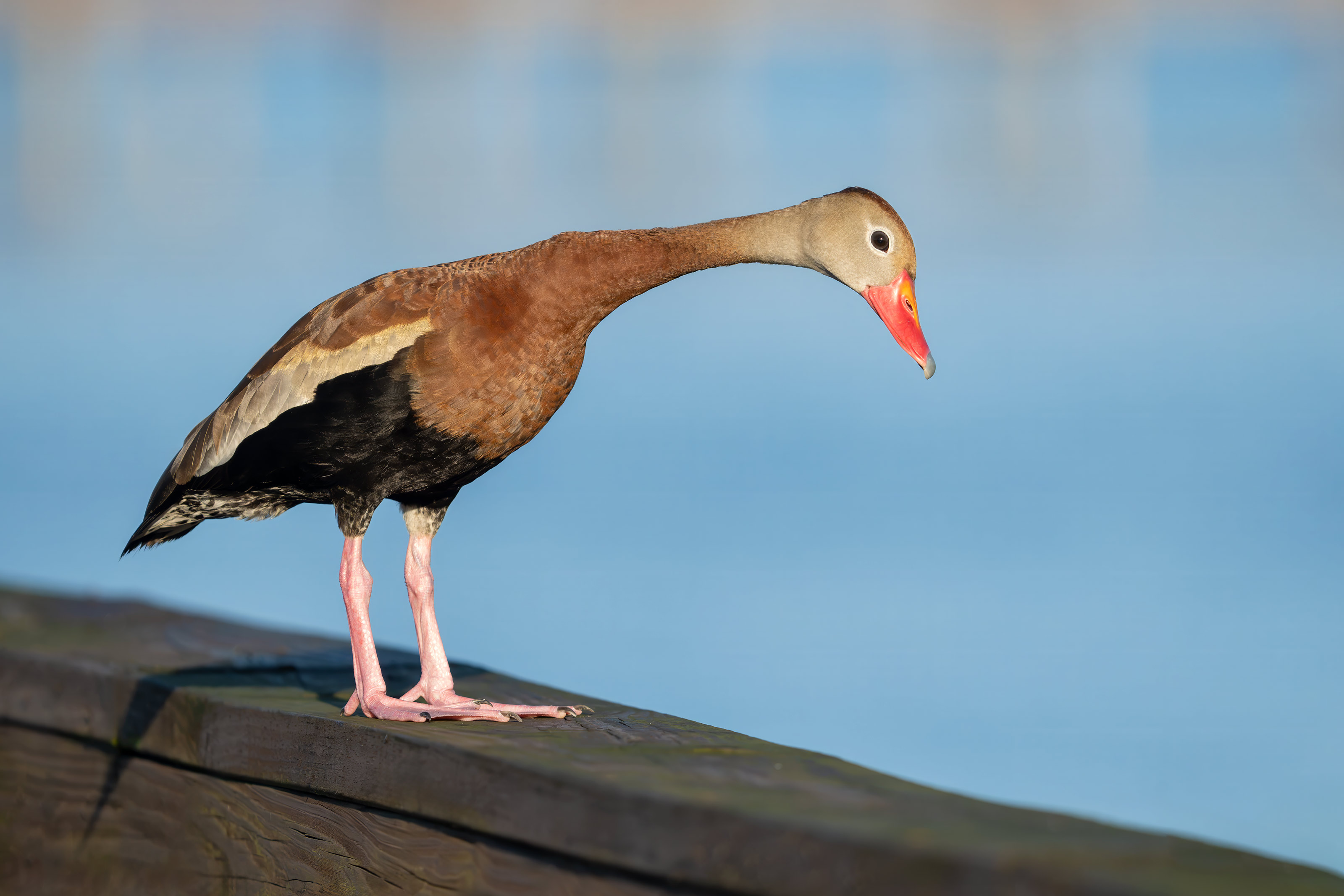
This image was created by yours truly on 20 September 2026 on the pier at Indian Lake Estates. I used the handheld Sony FE 400-800mm f/6.3-8 G OSS lens (Sony E) (at 775mm) and The Latest Greatest Sony Flagship Body, the a1 II Mirrorless Camera (in full frame mode). The exposure was determined by Zebras with ISO on the rear wheel. ISO 2500: 1/3200 second at f/8 (wide open) in Manual mode. AWB at 8:13:01am on a sunny morning. Tracking: Zone/AF-C with Bird-Eye/Face Detection performed perfectly. Click on the image to enjoy the larger high-res version. Image #5: Black-bellied Whistling Duck on pier railing |
Subject Posture Can Add Interest
Though I have no idea why this handsome duck was peering down into the lake, its odd posture makes for a truly interesting image with a nice bit of tension.
This bird was photographed on the right pier railing. Getting relatively close and as tall as possible left only an out-of-focus hint of the “T” of the pier in the upper background.
|
|
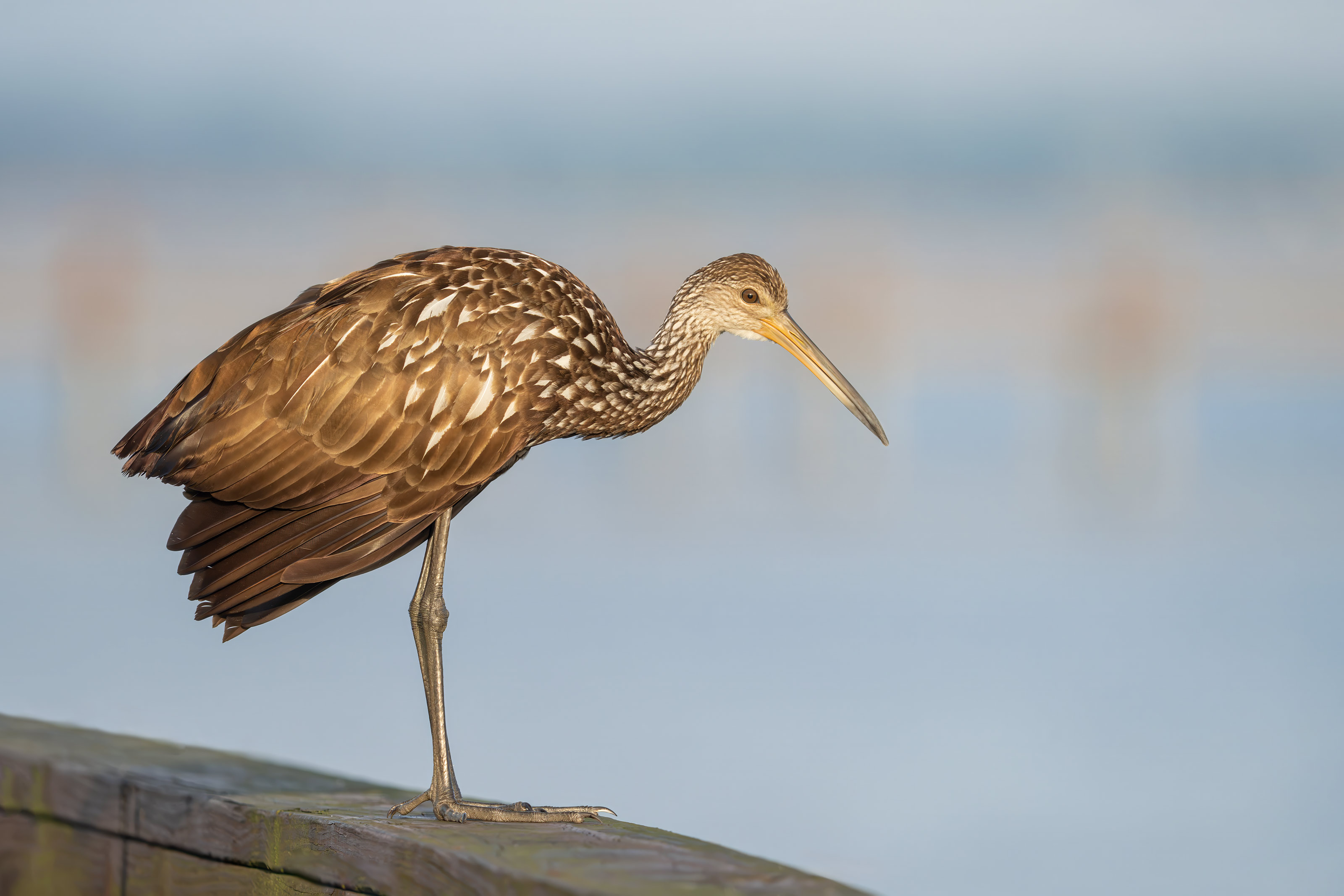
This image was created by yours truly on 21 September 2026 on the pier at Indian Lake Estates. I used the handheld Sony FE 400-800mm f/6.3-8 G OSS lens (Sony E) (at 705mm) and The Latest Greatest Sony Flagship Body, the a1 II Mirrorless Camera(in full frame mode). The exposure was determined by Zebras with ISO on the rear wheel. ISO 2000: 1/1600 second at f/8 (wide open) in Manual mode. AWB at 8:03:22am on a sunny morning. Tracking: Zone/AF-C with Bird-Eye/Face Detection performed perfectly. Click on the image to enjoy the larger high-res version. Image #6: Limpkin on pier railing |
Soft Pier “T” Background
Here is yet another species perched on the right-hand railing directly on sun angle. Shooting wide open rendered the relatively distant “T” of the pier pleasingly out of focus.
|
|
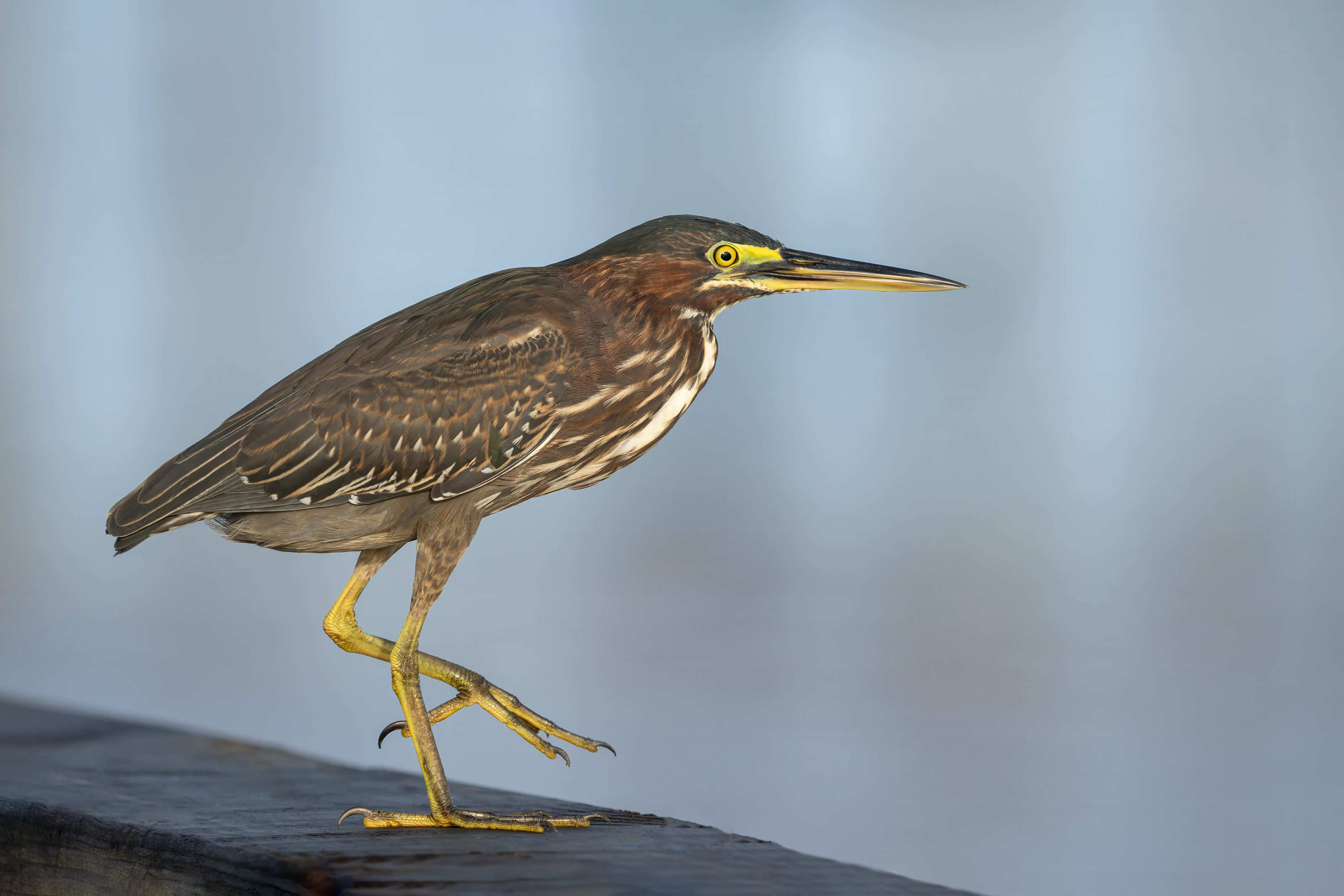
This image was also created by yours truly on 21 September 2026 on the pier at Indian Lake Estates. I used the handheld Sony FE 400-800mm f/6.3-8 G OSS lens (Sony E) (at 800mm) and The Latest Greatest Sony Flagship Body, the a1 II Mirrorless Camera (in full frame mode). The exposure was determined by Zebras with ISO on the rear wheel. ISO 2000: 1/2000 second at f/8 (wide open) in Manual mode. AWB at 8:16:54am on a sunny morning. Tracking: Zone/AF-C with Bird-Eye/Face Detection performed perfectly. Click on the image to enjoy the larger high-res version. Image #7: Green Heron juvenile on pier railing |
Soft Pier Pilings Background
I was thrilled when a young Green Heron in fresh juvenal plumage landed on the right-hand railing toward the end of the pier. By moving in close and elevating my lens, I framed the bird so that only the distant, out-of-focus pilings supporting the “T” and their soft reflections were present in the background.
|
|
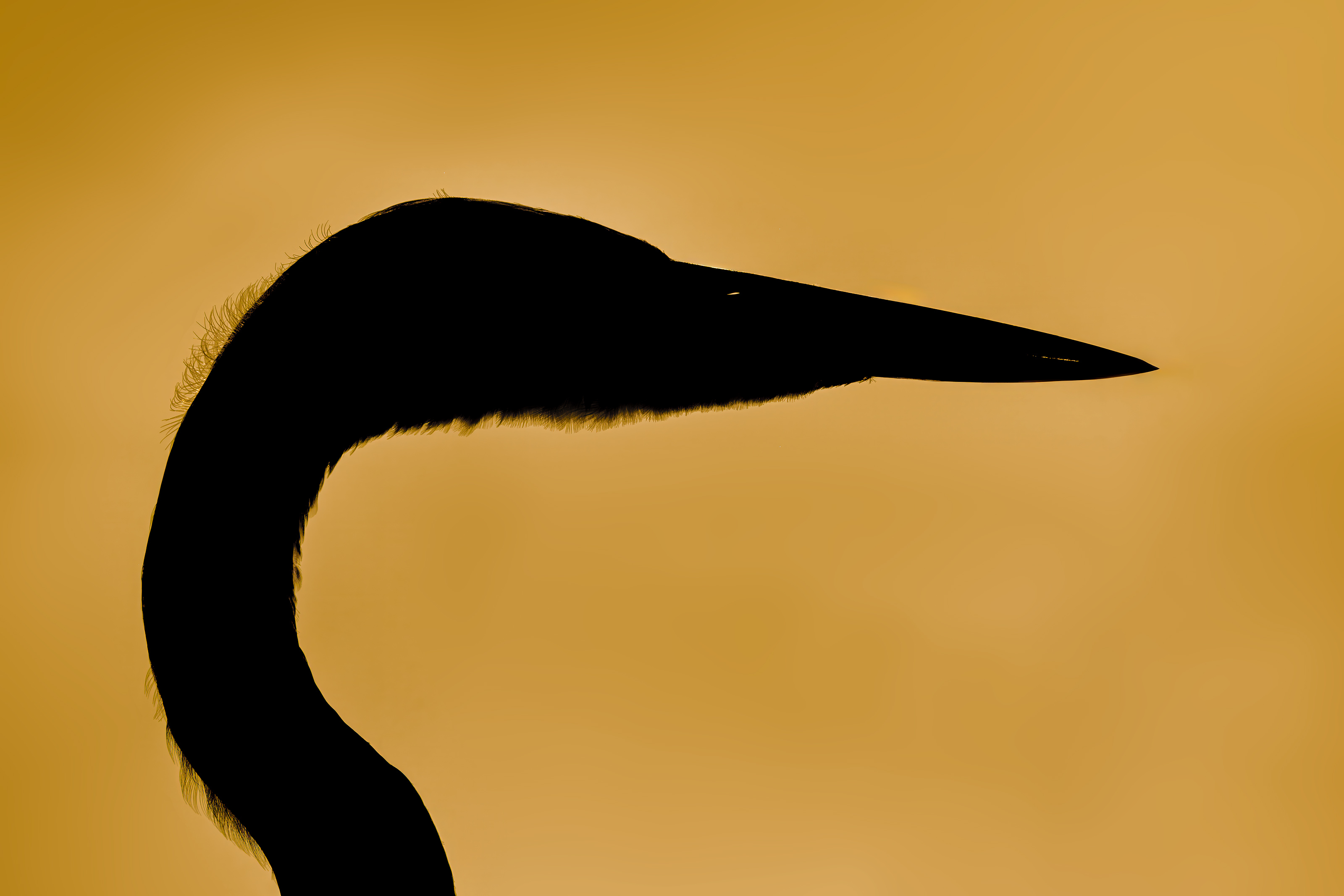
This image was also created by yours truly on 21 September 2026 on the pier at Indian Lake Estates. I used the handheld Sony FE 400-800mm f/6.3-8 G OSS lens (Sony E) (at 800mm) and The Latest Greatest Sony Flagship Body, the a1 II Mirrorless Camera (in full frame mode). The exposure was determined by Zebras with ISO on the rear wheel. ISO 1250: 1/6400 second at f/9 (stopped down 1/3 stop) in Manual mode. AWB at 8:8:32:54am on a cloudy-bright morning. Tracking: Zone/AF-C with Bird-Eye/Face Detection performed perfectly. Click on the image to enjoy the larger high-res version. Image #8: Great Blue Heron silhouette/head portrait |
White Sky Silhouettes
Exposed well to the right, this image started as a white-sky original. I had first photographed this bird front-lit on my way to the end of the pier. On the way back, I noted that the bird had relocated and saw the chance to create a silhouette.
So, where did the golden sky come from? The secret is positioning yourself so that the brighter sky near the muted sun forms the background — without actually including the sun itself in the frame.
Though a properly exposed sky may look washed out or white in the original raw file, there’s gold in “them thar hills.” By creating a mask of the sky in Adobe Camera Raw (ACR), lowering the exposure, and boosting both the Color Temperature and Saturation, you can pull out the rich sky colors that were hiding there all along.
|
|
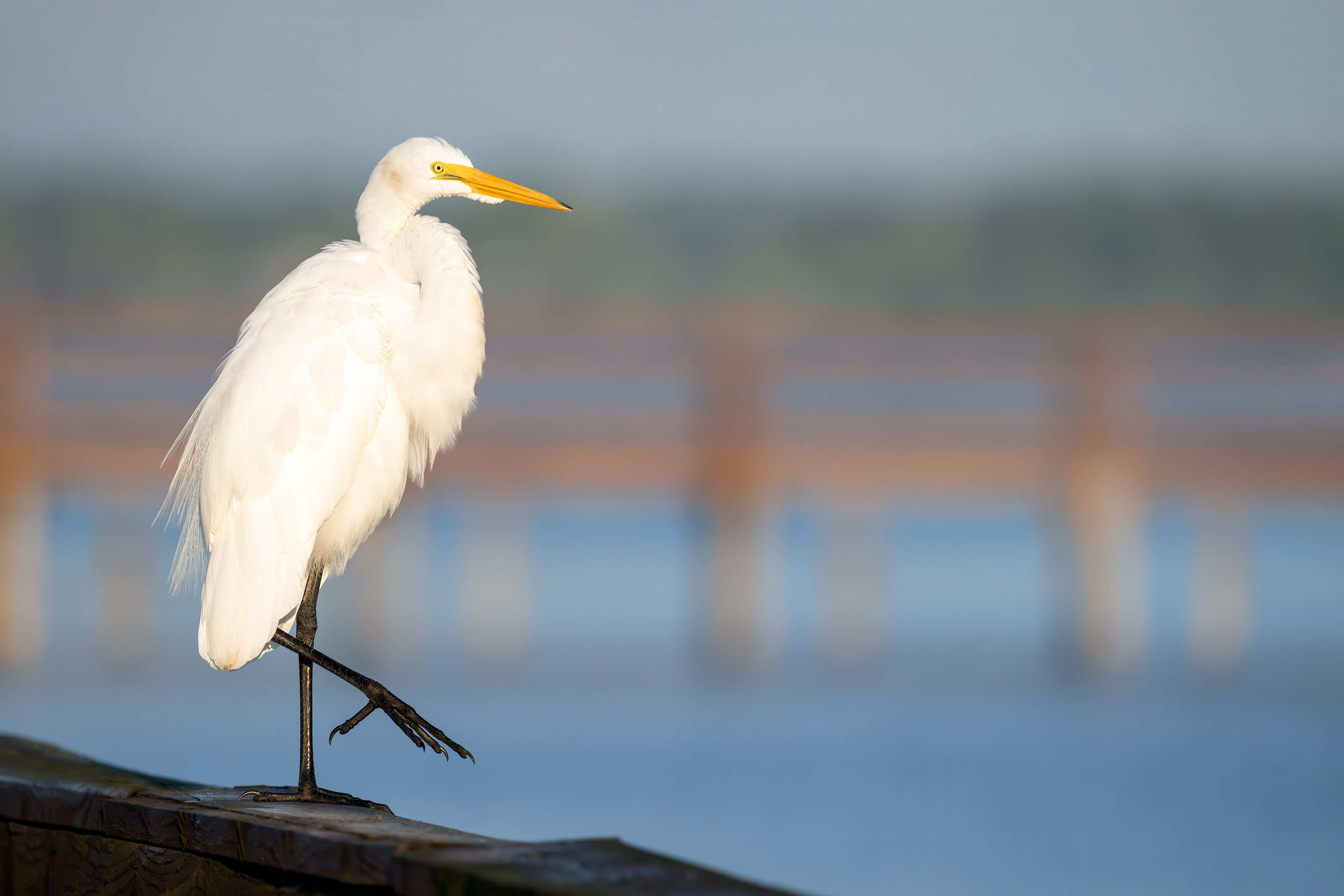
This image was created by yours truly on 22 September 2026 on the pier at Indian Lake Estates. I used the handheld Sony FE 400-800mm f/6.3-8 G OSS lens (Sony E) (at 800mm) and The Latest Greatest Sony Flagship Body, the a1 II Mirrorless Camera (in full frame mode). The exposure was determined by Zebras with ISO on the rear wheel. ISO 2000: 1/2500 second at f/9 (stopped down 1/3 stop) in Manual mode. AWB at 7:48:47am on a sunny morning. Tracking: Zone/AF-C with Bird-Eye/Face Detection performed perfectly. Click on the image to enjoy the larger high-res version. Image #9: Great Egret juvenile on pier railing |
More Defined Pier “T” Backgrounds
In this image, the “T” of the pier is far more defined than in any of the similar shots here. Why? Because the Great Egret is a relatively large bird, I was quite far from it while working at 800mm. The greater your distance from the subject, the greater the depth of field — thus rendering the background structure of the pier much sharper.
As with many of the images here, this bird was perched on the right-hand railing. Working farther from the subject also allowed me to incorporate the lake’s distant shoreline along with a slice of sky.
|
|
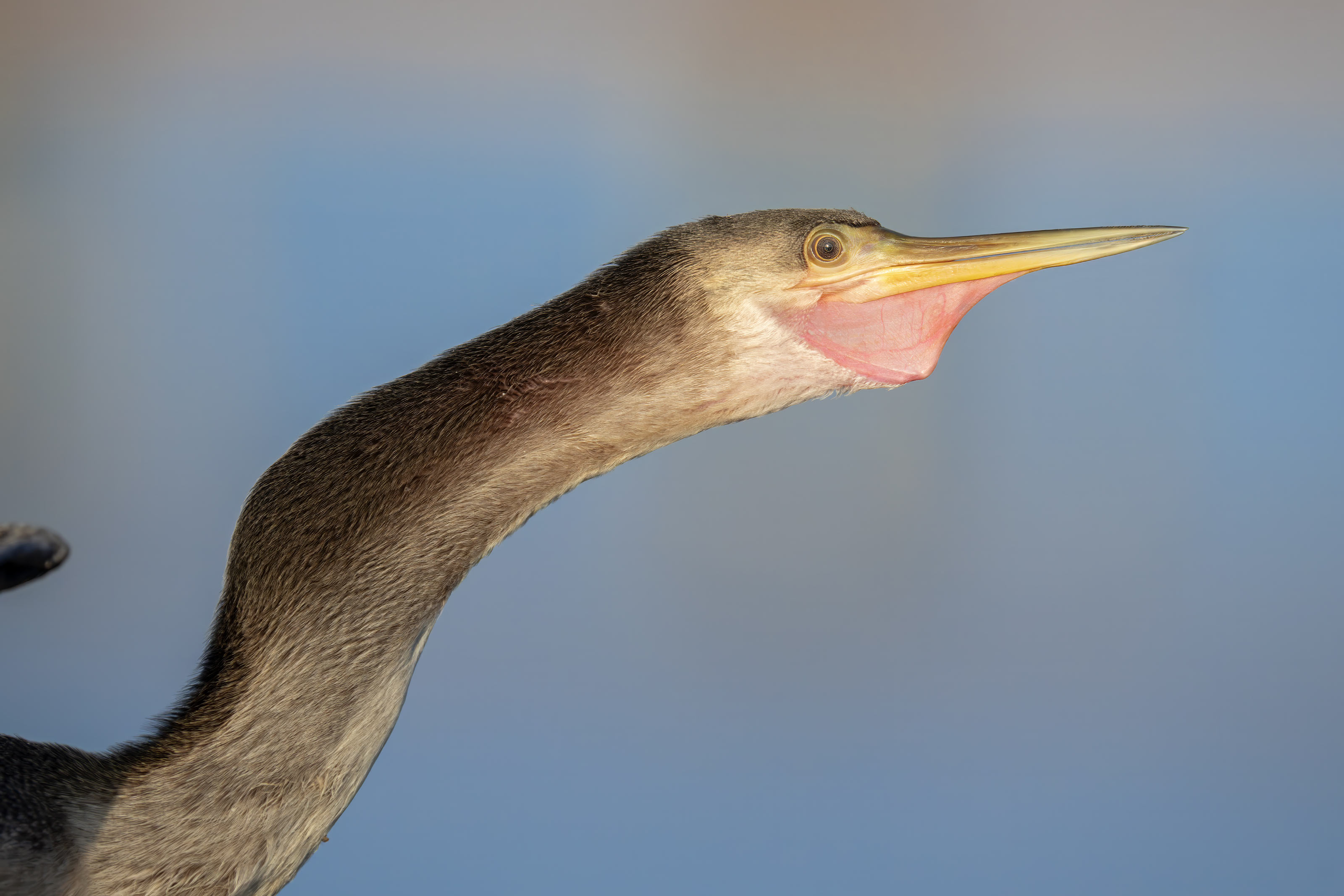
This image was created by yours truly on 23 September 2026 on the pier at Indian Lake Estates. I used the handheld Sony FE 400-800mm f/6.3-8 G OSS lens (Sony E) (at 800mm) and The Latest Greatest Sony Flagship Body, the a1 II Mirrorless Camera (in APS-C crop mode). The exposure was determined by Zebras with ISO on the rear wheel. ISO 2000: 1/2000 second at f/8 (wide open) in Manual mode. AWB at 8:00:38am on a sunny morning. Tracking: Zone/AF-C with Bird-Eye/Face Detection performed perfectly. Click on the image to enjoy the larger high-res version. Image #10: Anhinga on pier railing |
Super-Soft Pier “T” Backgrounds
For this image, I was relatively close to the subject, making the distance to the background proportionately large. As a result, the “T” of the pier was rendered as a pleasing, soft blur of tans and light browns.
Typos
With all blog posts, feel free to e-mail or to leave a comment regarding any typos or errors.









#4 the Grackle with the Mayflies in its beak.
#3 the Red Shouldered Hawk due to the separation of the bird and the background and the railing on the tail.
#8 Great Blue Heron Silhouette due to the fine hair detail on the back of the neck.
Thanks for sharing.
#4 the Grackle for the low perspective, action, as well as the environment of a bed of mayflies
Good morning Artie,
In order of my preference:
Image #3 (red-shouldered hawk with prey) for the early light; the green, as you mentioned; the action of holding its prey; the blue water background, while the pier T, railing, and the vegetation all form a triangular frame; and lastly, the fact that I have an affinity for birds of prey all make this one for me. Much to like in this one.
Image #9 (Great Egret) for the early light making the railing less illuminated (less distracting) and making the egret pop. The pier being a bit more in focus works for this image by giving additional interest/context. In a perfect world, the horizon would not have intersected its head, but it’s enough OOF, that it isn’t a deal breaker for me.
Image #4 for the low perspective, and the OOF mayflies transitioning into focus, leading you to the action of the dining grackle.
Thank you for always making us think.