BIRDS AS ART Instructional Photo Tours (IPTs)
Click here for BIRDS AS ART Instructional Photo-Tour (IPT) General Information.
Click here for BIRDS AS ART Instructional Photo-Tour (IPT) Deposit and Cancellation Policies.
Click here for BIRDS AS ART Instructional Photo-Tour (IPT) Registration and Release Forms.
San Diego IPT #1: 4 1/2 DAYS: WED 6 JAN thru the morning session on SUN 10 JAN 2027: $2699.00. Deposit: $699.00. Limit: 5 photographers.
San Diego IPT #2: 4 1/2 DAYS: TEUS 19 JAN thru the morning session on SAT 23 JAN 2027: $2699.00. Limit: 5 photographers/Openings: 4.
Anchor Point Songbird Days: WED 10 FEB & TUES 11 FEB 2027. Full day: $500/day.
Homer IPT #1: FRI 12 FEB 2027 through the full day on TUES 16 FEB 2027. Five days/20 hours on the boat: $5900.00. Limit 5 photographers/Solod out
Homer IPT #2: WED 17 FEB 2027 through the full day on SUN 21 FEB 2027. Five days/20 hours on the boat: $5900.00. Limit 5 photographers/Openings: 1
More time on the boat with the eagles and even better, you actually learn a ton.
The 2027 Stick Marsh Roseate Spoonbills and More AirBnB IPTs
Stick Marsh IPT: #1: (ARR: MON 8 MAR. IPT #1: TUES 9 MAR thru the morning session on SUN 14 MAR 2027: 5 1/2 DAYS: $2,999.00**. (Limit 4 photographers)
Stick Marsh IPT: #2: (ARR: MON 15 MAR. IPT: TUES 16 MAR thru the morning session on SUN 21 MAR 2027: 5 1/2 DAYS: $2,999.00**. (Limit 4 photographers)
Stick Marsh IPT: #3: (ARR: MON 22 MAR. IPT: TUES 23 MAR thru the morning session on SUN 28 MAR 2027: 5 1/2 DAYS: $2,999.00.** (Limit 4 photographers)
Photograph Roseate Spoonbills in breeding plumage at point blank range with short telephoto lenses!
Travel Insurance
Travel insurance for both big international trips and US-based IPTs is generally recommended only if losing your investment in a given trip is would seriously impact your overall financial position. In the long run, you will make most or all of your trips and you will wind up far ahead by not purchasing trip insurance. However, as we never know what life has in store for us; it might be a good idea for you. If you do purchase travel insurance, note that many plans require that you purchase your insurance within 14 days of our cashing your deposit check or running your credit card. If you do a search for “Complaints about XYZ Travel Insurance Company,” I can guarantee that you will find many complaints no matter the company — it is the nature of the beast. Therefore, and most importantly, whenever purchasing travel insurance, be sure to read the fine print carefully.
What They are Saying …
Unsolicited via e-mail from Pete Myers
I just spent 4 days in the field in a graduate course in bird photography taught by Artie Morris at Fort DeSoto. After almost 50 years of experience pointing cameras at birds from the Arctic to Tierra del Fuego, New Zealand and beyond, I thought I was good enough. But what I learned from Artie in just four days has taken me to a whole new level. As he aptly puts it, it’s “birds as art,” not simply bird photography. One of those 4 days was the most satisfying I’d ever experienced, anywhere. The IPT left me euphoric about what I’d learned, and frighteningly committed to recreating my portfolio with the techniques and insights he taught me.
Via e-mail from multiple IPT participant David Hollander
Primarily, what distinguished the San Diego IPT other photographic classes that I have attended was the “granularity” and specificity of the information you shared. By that I mean the level of specific, technical information that was covered. This was helped by the fact that you often gave an explanation as to why you made your choices. For example, when we first arrived at the location, you told people to shoot at 1600, F 5.6, and various shutter speeds. As the light got better, you progressively moved to lower ISOs, and gave us rules of thumb on what ISO to use in different lighting conditions.
You further explained in one of the review sessions that with modern cameras and good software, the noise isn’t really a problem and that you could get rid of the noise from a 1600 ISO a lot easier than fixing a blurred image. Similarly, you gave precise instruction on what aperture to use in various circumstances. In general, before your class, my “default” mode was to shoot in aperture priority, usually at about F 9 or 8.1. The reason wasn’t that I was trying to capture background, but instead to increase my chances of getting the bird’s head in focus if I got the focus point in the wrong place. I will revisit that approach now.
During and image review session, you showed a picture that had the bird’s eye in focus, but the tip of the beak was slightly off. When I asked you whether you would have used a higher f/stop in that case, you went to a website showing the impact on the depth of field at the given distance of moving up a stop, which was less than an inch. That demonstrated why increasing the f/stop would not have worked in that case. From a teaching perspective, hearing the same information in multiple channels makes it more likely for people to absorb it and remember it, so the technical explanations help the main message sink in. The instruction on use of the back button focus was also very helpful. I had read about that on your blog before, but I had not taken the time to actually try it, and now I have a new tool in my kit. Overall, I found the advice and instruction to be “actionable”. It was all there for those who were listening.
The comparison of slightly different images of the same bird was also very helpful. It showed what you were looking for head angles and placements. However, I should note that differences in many of the pictures that were acute to you were pretty subtle to me, and all of the pictures were ones that most photographers would have been proud to have taken, even the ones that you were rejecting.
A Comment left by Elisabeth L Shore
Thank you, Artie! I had a wonderful time and very much appreciate the time you spent with me to help me get these images of which I am very proud to be able to add to my portfolio! I am definitely looking forward to another workshop with you in the near future. Thank you for pushing me to step out of my comfort zone, for challenging me, and for being there with patience and advice to improve my photography. It means a lot that you did.
Unsolicited via e-mail from IPT veteran Judy Stepenaskie
Hi Artie: I can’t believe it – Dave was looking at some of my pics and he said: “You never made pictures like this before”!!!
Unsolicited via e-mail from IPT veteran Eugen Dolan
Arthur, Thank you very much for your overwhelming infectious enthusiasm that helped get me up on some mornings. Also, your ability to express yourself- and explain in great detail why you like or may not like an image – was very helpful in allowing me to better analyze my images. Eugen
Via e-mail from Dianne Heggie
I had SUCH a great time today! It’s always inspiring to spend time learning from you. Your generosity in sharing knowledge and insights is really exceptional. I shouldn’t let another 8 years pass before joining you for another workshop!
Via e-mail from Jim Miller
I can’t stop thinking about how much fun the DeSoto Fall IPT was, and how much I learned. There were so many things that suddenly made perfect sense after I had been confused for so long. Thank you very much for the wonderful trip, and for being a great teacher. As I worked through the raw files last week, I realized what a fantastic lens the 600 IS is. Thanks for the rental! Maybe someday I will be able to afford one. Some images for critique are attached.
By the way, the plant we were looking at along the sidewalk in Gulfport is Blue Porterweed. It is worth a few minutes on the internet to read about it: a native of Florida and the Caribbean, it is used for medicine in The Bahamas, etc. We have it in a large pot in the front yard and it takes a lot of water. It blooms Spring through Fall. Thank you again, Artie. It was really wonderful to be with you and learn from you.
Via e-mail from Lee Sommie
I want to thank you for making the Fall 2017 Ft. DeSoto IPT such a fun and educational experience for me. I truly did not want the adventure to end. I now look through the viewfinder with an artist’s mindset. And the real bonus was making new friends with fellow students. Thank you for sharing your knowledge and enthusiasm for wildlife photography. I had a great time with you and look forward to more adventures on future IPTs.
Followed by this one
BTW. I downloaded Photo Mechanic and started using it in my workflow. Since I like using Lightroom for my adjustments, I found a way to incorporate Photo Mechanic and Lightroom together. Lightroom was driving me crazy with how slow it is to import and preview photos. I was impressed with how fast you could preview photos and start editing your photos on the DeSoto Fall IPT. Life is too short to wait for applications to import and preview photos and Photo Mechanic solves that problem.
Thanks again for everything Artie. Your knowledge keeps on giving well after the IPT!
Via e-mail from Muhammad Arif
I had a great time at Fort De Soto. Thank you for all the instruction, for your help and pointers; my photography has already improved tremendously and I’ve never made such good bird photos before. I wish I could’ve joined you on Monday and Tuesday morning as well but work got in the way. It was also nice meeting the folks on the IPT. Thanks again for everything and I hope to join you at a future IPT sometime again.
Via e-mail from Morris Herstein
I never thought that I could make in-flight photos of birds successfully. That goal was accomplished during the recent workshop at Stick Marsh only because I listened to your advice and instructions. For the first time I realized how important sun angle was, teachings that you had been communicated for a long time. The result of two days shooting produced the most satisfying images of Roseate Spoonbills I ever could have imagined.
Stay well and safe. Thank you. Morris
Via e-mail from Joe Usewicz
Wow. So many photos to go through. Stick Marsh was a great learning experience. Positioning. Wind impact. Landing zones. Working on backgrounds. I clipped too many incredible reflections. Great fun. Just amazing opportunities.
Warmest Regards, Joe
From BPN-friend Kevin Hice via unsolicited e-mail
Again artie, that was a great trip. I was more than pleased. For me, I could see right away that you knew how to get us and the boat in great position for the best eagle photography. You took into consideration all the factors including the sky conditions, and wind and sun angles. It was a real pleasure to meet the captain. His knowledge of the wind and the currents helped to put us in great position all the time and he did his very best to help on all fronts.
One of the most important factors for me is timeliness. We never had to wait on the captain or on you, artie, and that made the trip a huge success. We got after it every day and had countless great photography opportunities. The other eagle photography tours never got out as early as we did, nor did they pursue the birds as relentlessly as we did.
One can never say that Arthur Morris doesn’t have the passion to get after the Bald Eagles. I have never shot as many photos as I did on this trip even with my poor hand eye coordination. I got plenty of keepers and enjoyed meeting the others in the group and learned a few things from them as well.
Thanks again, Kevin
Unsolicited via e-mail from IPT veteran Eugen Dolan
Arthur, Thank you very much for your overwhelming infectious enthusiasm that helped get me up on some mornings. Also, your ability to express yourself- and explain in great detail why you like or may not like an image – was very helpful in allowing me to better analyze my images. Eugen
Via e-mail from Jim Miller
I can’t stop thinking about how much fun the DeSoto IPT was, and how much I learned. There were so many things that suddenly made perfect sense after I had been confused for so long. Thank you very much for the wonderful trip, and for being a great teacher. As I worked through the raw files last week, I realized what a fantastic lens the 600 IS is. Thanks for the rental! Maybe someday I will be able to afford one. Some images for critique are attached. Thank you again, Artie. It was really wonderful to be with you and learn from you.
Via e-mail from Lee Sommie
I want to thank you for making the Fort DeSoto IPT; it was a fun and educational experience for me. I truly did not want the adventure to end. I now look through the viewfinder with an artist’s mindset. And the real bonus was making new friends with fellow students. Thank you for sharing your knowledge and enthusiasm for wildlife photography. I had a great time with you and look forward to more adventures on future IPTs.
Via e-mail from Muhammad Arif
I had a great time at Fort De Soto. Thank you for all the instruction, for your help and pointers; my photography has already improved tremendously, and I’ve never made such good bird photos before. I wish I could’ve joined you on Monday and Tuesday morning as well, but work got in the way. It was also nice meeting the folks on the IPT. Thanks again for everything and I hope to join you at a future IPT sometime again.
|
|
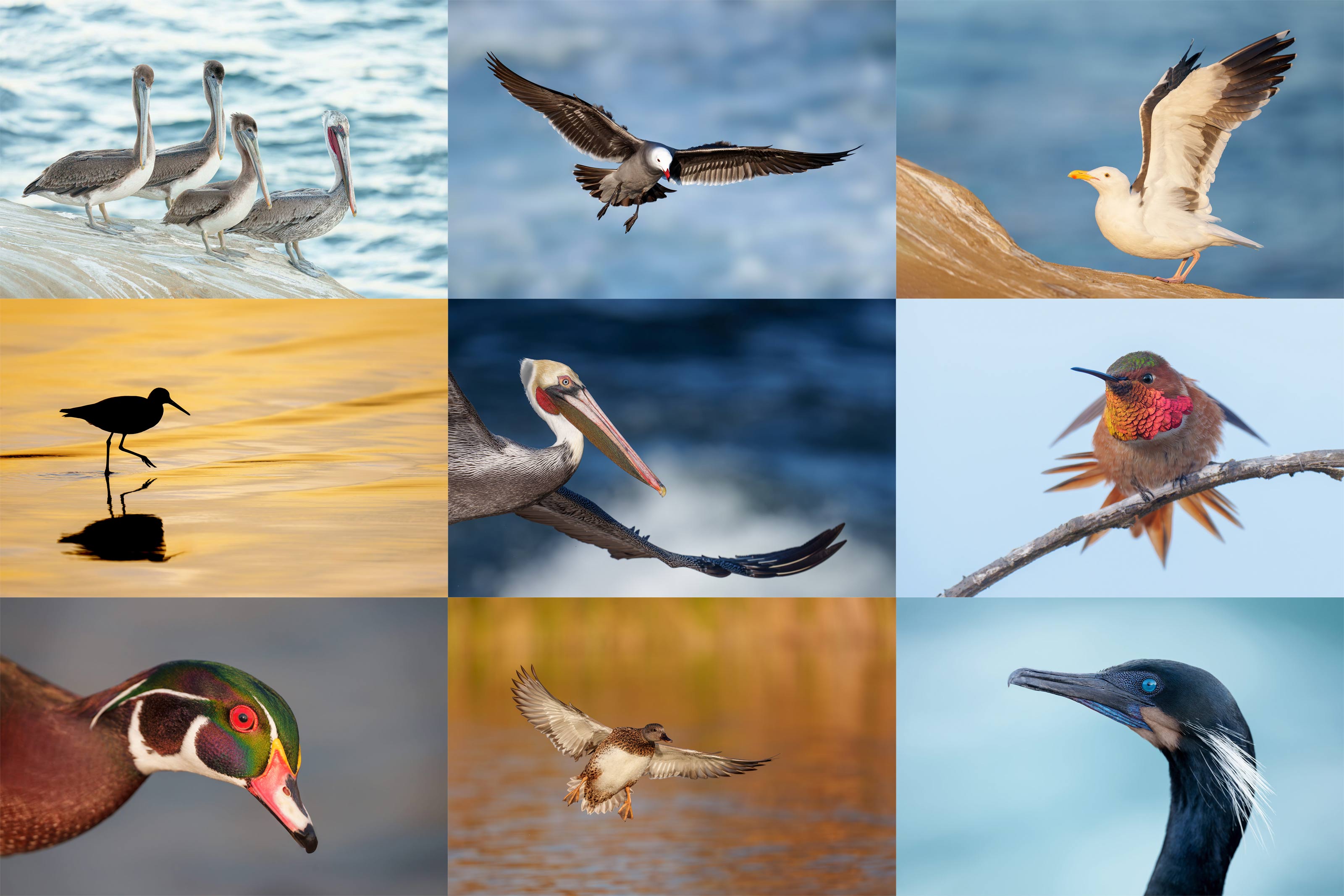
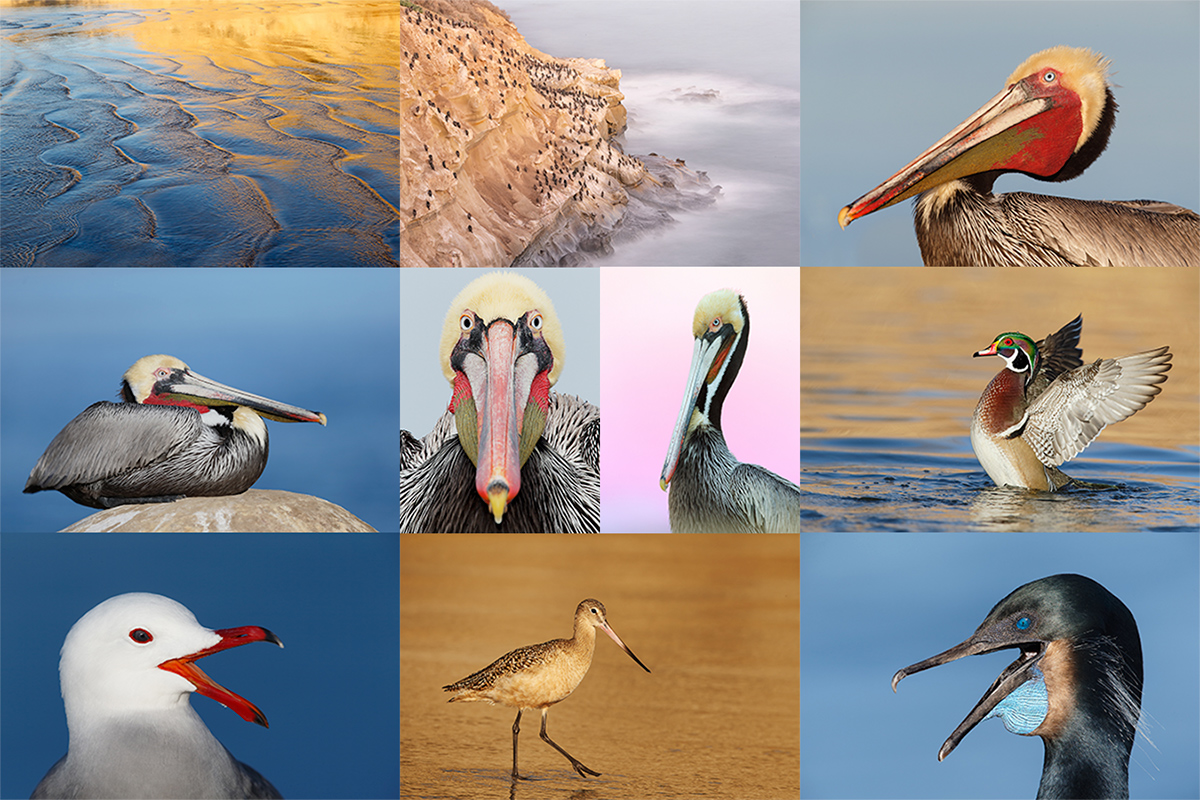
San Diego offers an incredible variety of attractive avian subjects, including and especially the Pacific race of Brown Pelican. Clockwise from top left back to center: juvenile and sub-adult Brown Pelicans; Heermann’s Gull; Western Gull; Allen’s Hummingbird; Brandt’s Cormorant; Gadwall hen; Wood Duck drake; Willet; Brown Pelican tight flight. Click on the composite to enjoy a larger version. |
The 2026 San Diego Brown Pelicans (and more!) IPTs
San Diego IPT #1: 4 1/2 DAYS: WED 6 JAN thru the morning session on SUN 10 JAN 2027: $2699.00. Deposit: $699.00. Limit: 5 photographers.
San Diego IPT #2: 4 1/2 DAYS: TEUS 19 JAN thru the morning session on SAT 23 JAN 2027: $2699.00. Limit: 5 photographers/Openings: 4.
AirBnB accommodations and ground transport with the leader are available for both IPTs and for the In-the-Field Instructional Sessions on a first come, first served basis. Please e-mail for details and information on personalized pre- and post-IPT morning sessions. Staying in the group AirBnB allows for increased learning and less travel for all.
Morning BAA In-the-Field Instructional Sessions (ITFIS) followed by brunch and an Image Review & Photoshop session: $499.00/per session
Available dates: JAN 11-20 2027. AirBnB accommodations possibly available for multiple sessions. Please get in touch with questions or to register with an e-mail to samandmayasgrandpa@att.net and please shoot me a text to 863-221-2372.
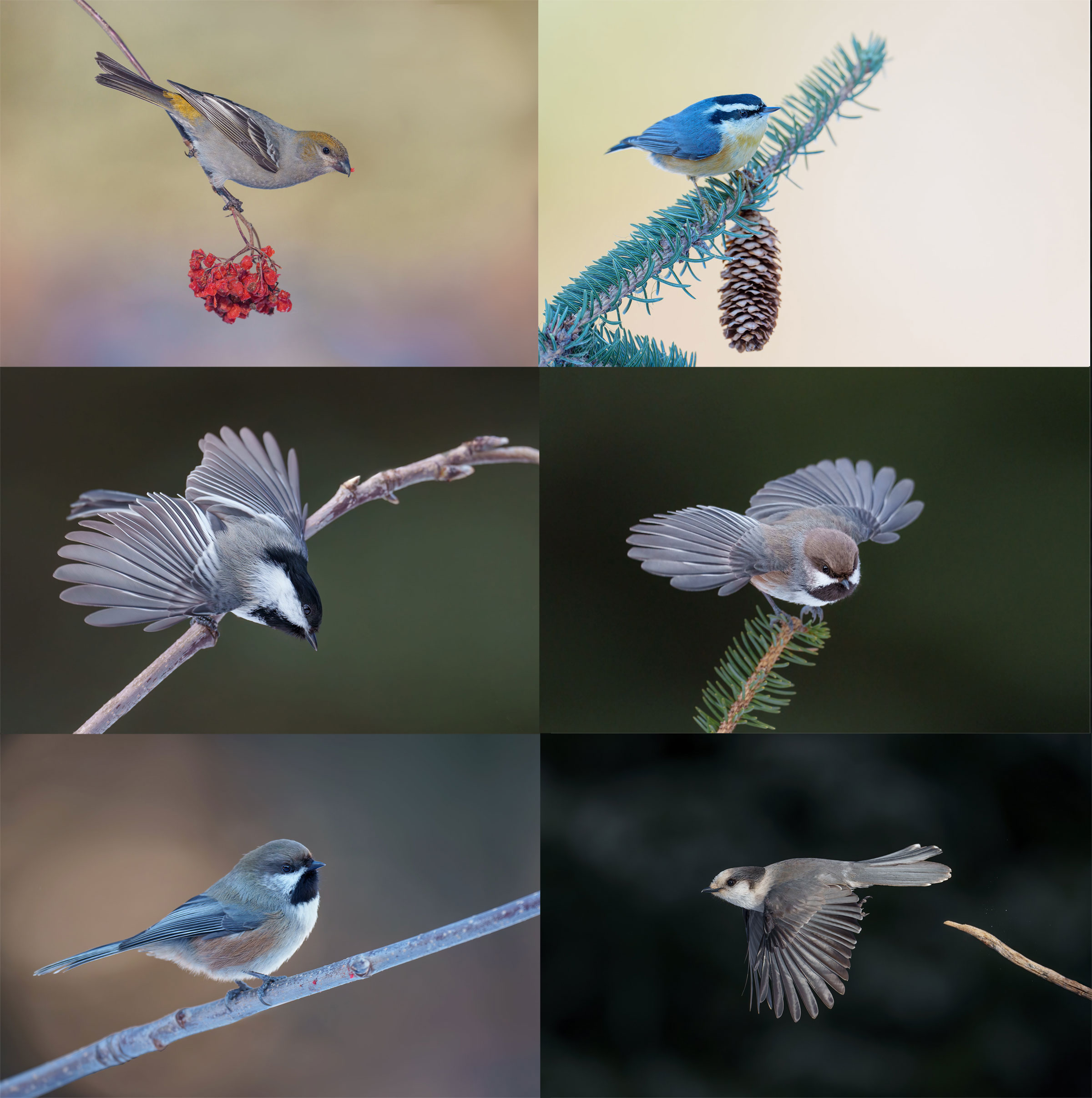
Join me in San Diego to photograph the spectacular breeding plumage Brown Pelicans with their fire-engine red and olive green bill pouches; Brandt’s (nesting) and Double-crested Cormorants; breeding plumage Wood and Ring-necked Ducks; other duck species possible including Lesser Scaup, Redhead, Northern Shoveler and Surf Scoter; a variety of gulls including Western, California, and the gorgeous Heermann’s, all in full breeding plumage; shorebirds including Marbled Godwit, Willet, Sanderling and Black-bellied Plover; many others are possible including Least, Western, and Spotted Sandpiper, Whimbrel, Black and Ruddy Turnstone, Semipalmated Plover, and Surfbird; Harbor Seals and California Sea Lions (both depending on the current regulations and restrictions). And as you can see by studying the IPT cards, there are some nice bird-scape and landscape opportunities as well. Not to mention a ton of excellent flight photography opportunities and instruction.
Please note: where permitted and on occasion, ducks and gulls may be attracted (or re-located) with offerings of grains or bread.
|
|
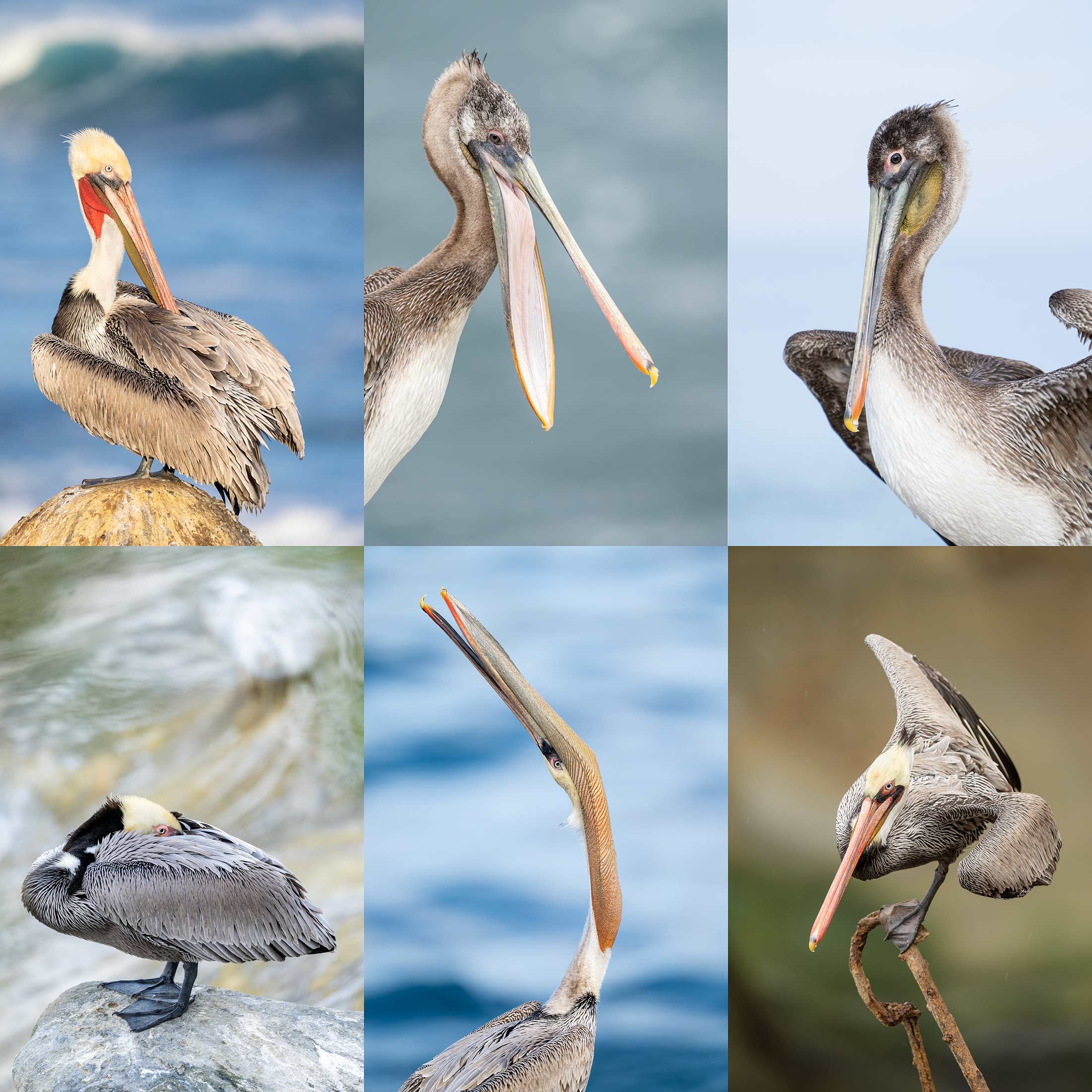
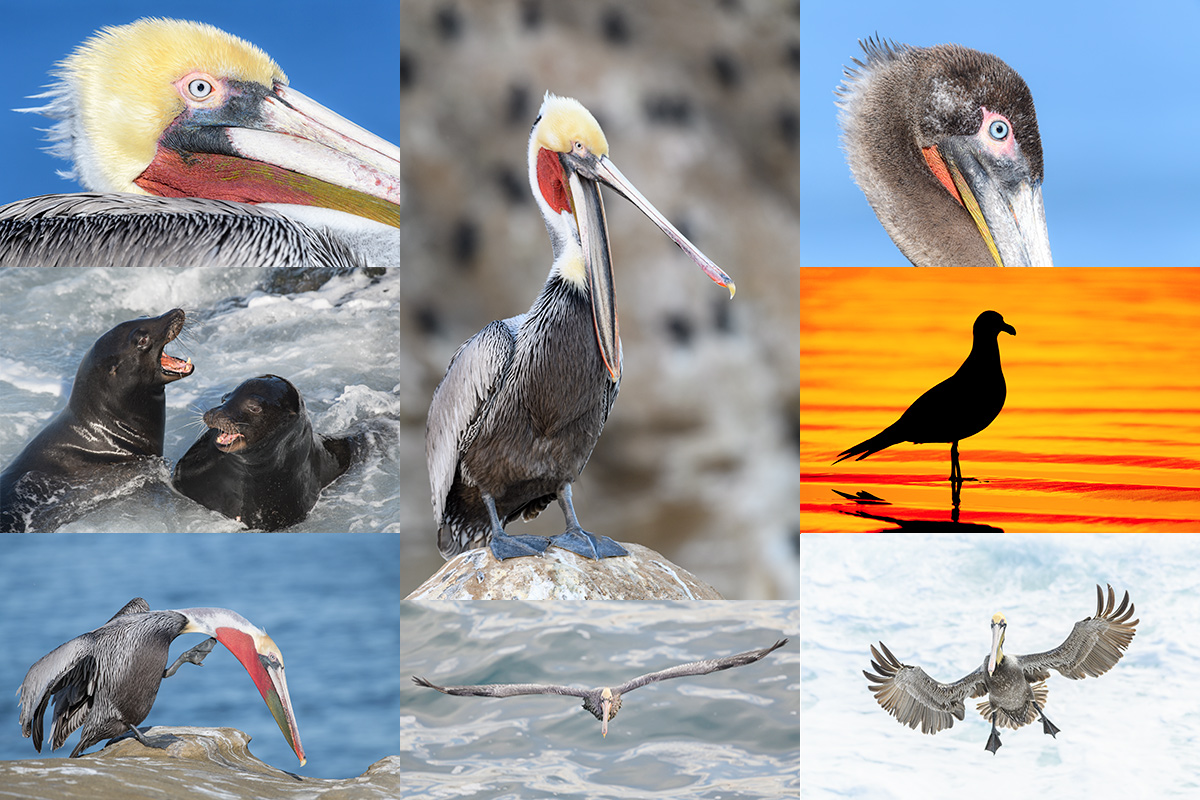
San Diego offers a wealth of very attractive natural history subjects, including and especially the Pacific race of California Brown Pelican. With annual visits spanning more than four decades, I have lots of photographic experience there … Click on the composite to enjoy a larger version. |
Learning Exposure, Whether You Like It Or Not
Whether you like it or not, we will be beating the subject of exposure like a dead horse. In every new situation, you will hear my thoughts on exposure along with my thoughts on both Nikon and Canon histograms and SONY Zebras. Whether you like it or not, you will learn to work in manual mode so that you can get the right exposure every time (as long as a bird gives you ten seconds with the light constant). Or two seconds with SONY zebras … And you will learn what to do when the light is changing constantly. What you learn about exposure will be one of the great takeaways on every IPT.
|
|
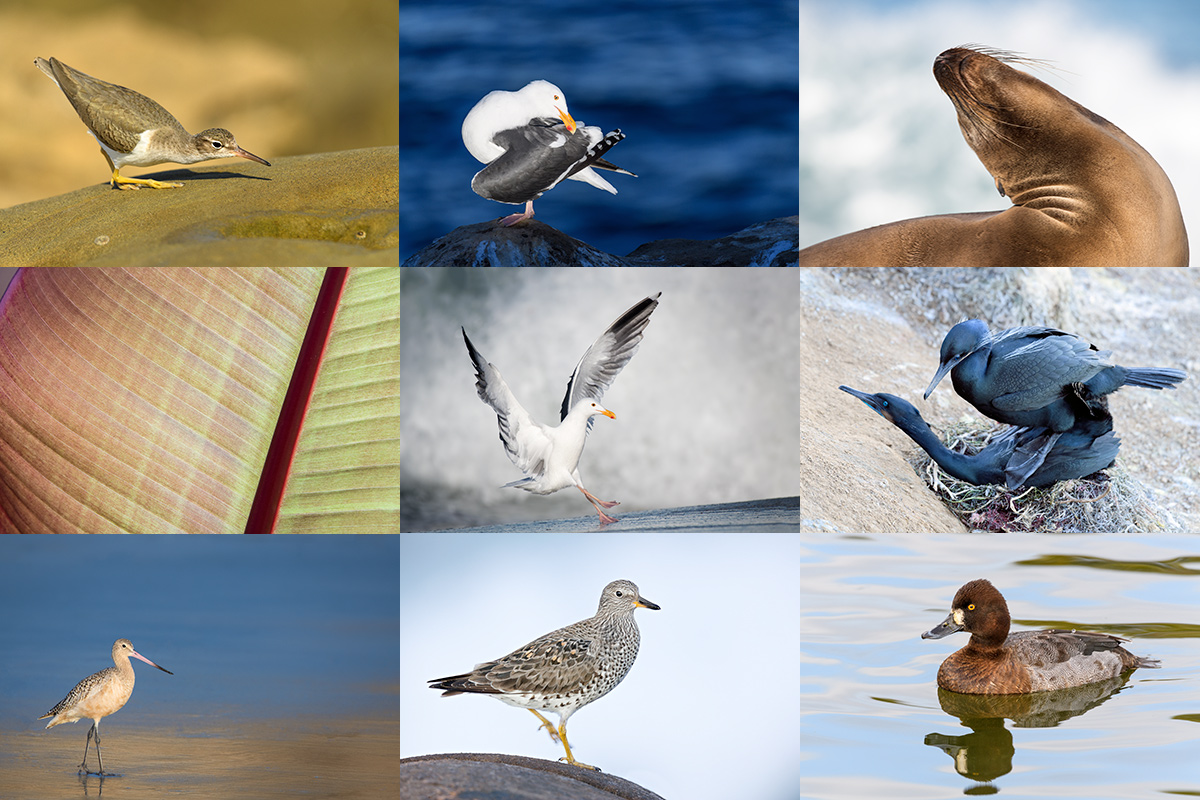
Though the pelicans will be the stars of the show on this IPT, there will be many other handsome and captivating subjects in wonderful settings. Click on the composite to enjoy a larger version. |
It Ain’t Just Pelicans
With gorgeous subjects just sitting there waiting to have their pictures taken, photographing the pelicans on the cliffs is about as easy as nature photography gets. With the winds from the east almost every morning, there is usually some excellent flight photography, at times with 70-200mm lenses! And the pelicans are almost always doing something interesting: preening, scratching, bill pouch cleaning, or squabbling. And then there are those crazy head throws that are thought to be a form of intra-flock communication. You will be guided as to how to make the best of those opportunities. Depending on the weather, the local conditions, and the tides, there are a variety of other fabulous photo chances available in and around San Diego. Each IPT will include one or two duck sessions.
|
|
|
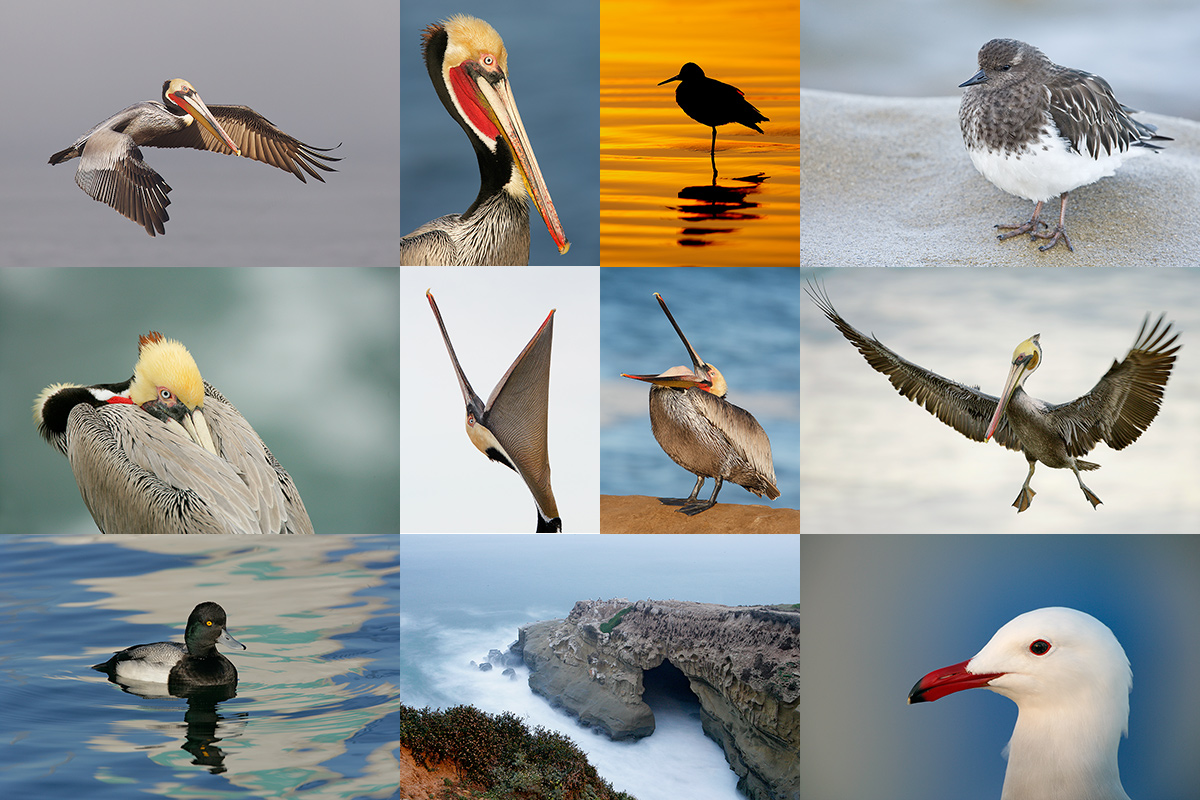
Did I mention that there are lots of great birds and natural history subjects in San Diego in winter? Click on the composite to enjoy a larger version. |
The San Diego Details
These IPTs will include five 3-hour morning photo sessions, four 1 1/2-hour afternoon photo sessions, and four working brunches (included) that will include image review and Photoshop sessions. On rare cloudy days, we may — at the leader’s discretion, stay out in the morning for a long session and skip that afternoon shoot. To ensure early starts, breakfasts will be your responsibility. And so that we can get some sleep, dinners will be on your own as well. In the extremely unlikely event that Goldfish Point is closed due to local ordinance (or whimsy) — that has never happened in the past fifty years, I will of course do my very best to maximize our photographic opportunities.
|
|
San Diego offers a wealth of very attractive natural history subjects, including and especially the Pacific race of California Brown Pelican. With annual visits spanning more than four decades, I have lots of photographic experience there. Click on the composite to enjoy a larger version. |
Deposit Info
A $699 deposit plus half the cost of your AirBnB lodging is required to hold your slot for one of the 2024 San Diego IPT. You can send a check (made out to “BIRDS AS ART”) to us here: BIRDS AS ART, PO Box 7245, Indian Lake Estates, FL, 33855, or call Jim or Jennifer at the office with a credit card at 863-692-0906. Your balance, payable only by check, is due three months before the trip.
|
|
|
Variety is surely the spice of life in San Diego. Click on the composite to enjoy a larger version. |
Getting Up Early and Staying Out Late
On all BIRDS AS ART IPTS including and especially the San Diego IPT, we get into the field early to take advantage of unique and often spectacular lighting conditions and we stay out late to maximize the chances of killer light and glorious sunset silhouette situations. We often arrive at the cliffs a full hour before anyone else shows up to check out the landscape and seascape opportunities.
|
|
Click on the composite to view a larger, high res version.
|
2027 Homer/Kachemak Bay Bald Eagle IPTs
Anchor Point Songbird Days: WED 10 FEB & TUES 11 FEB 2027. Full day: $500/day.
Homer IPT #1: FRI 12 FEB 2027 through the full day on TUES 16 FEB 2027. Five days/20 hours on the boat: $5900.00. Limit 5 photographers/Sold out.
Homer IPT #2: WED 17 FEB 2027 through the full day on SUN 21 FEB 2027. Five days/20 hours on the boat: $5900.00. Limit 5 photographers/Openings: 1
Homer IPT #2: WED 17 FEB 2027 through the full day on SUN 21 FEB 2027. Five days/20 hours on the boat: $5900.00. Limit 5 photographers/Openings: 1
Register for the first trip and do both songbird days and I will be glad to apply a $500.00 discount to your IPT. In addition, you might want to consider riding down to Homer with me in a large SUV thus avoiding the flight from ANC to HOM. And taking a convenient bus back to Anchorage. Register for both trips and the two songbird days and apply an additional $500 discount — $1,000.00 off in total. And ride down and back with me in a large SUV.
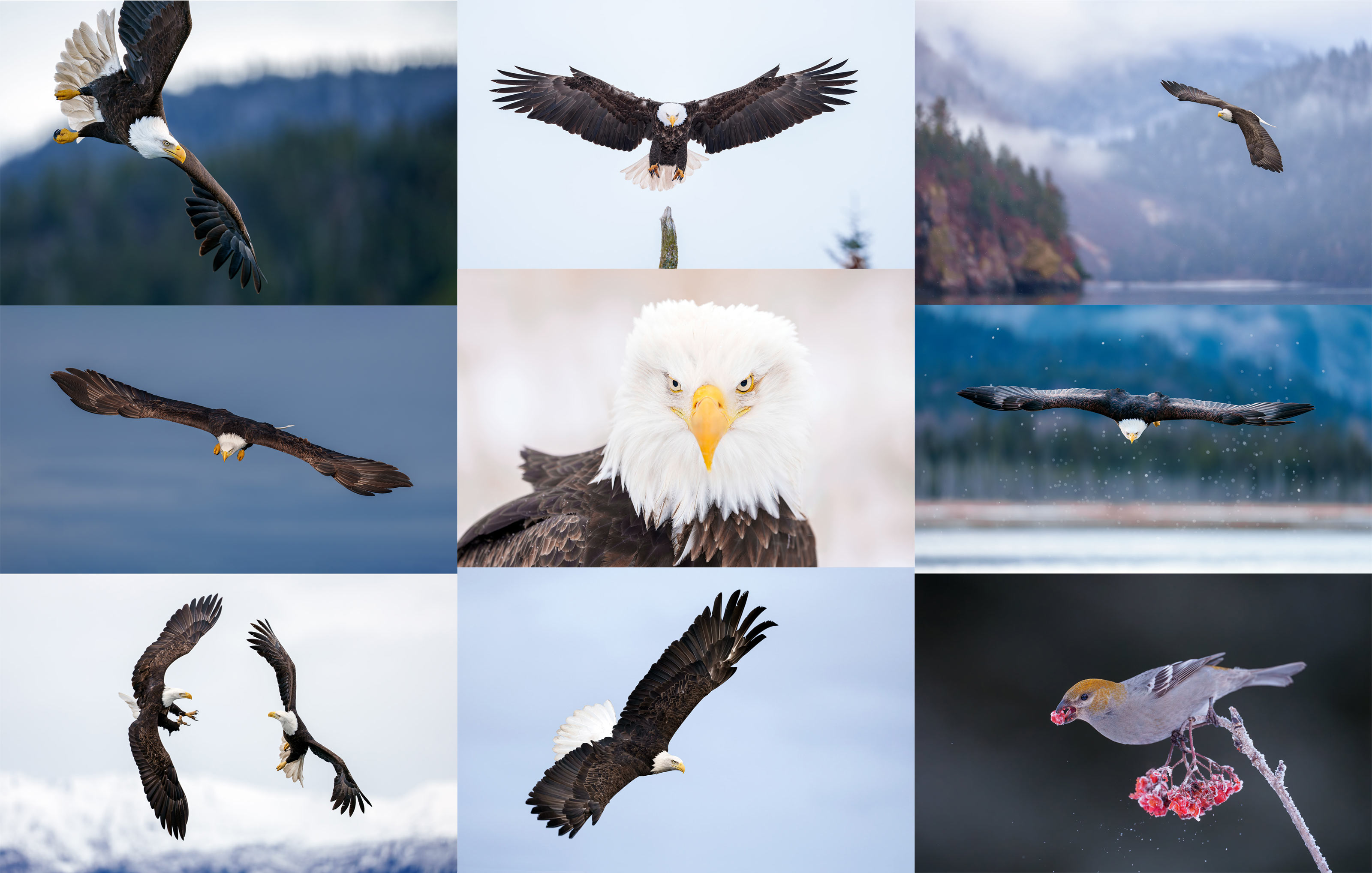
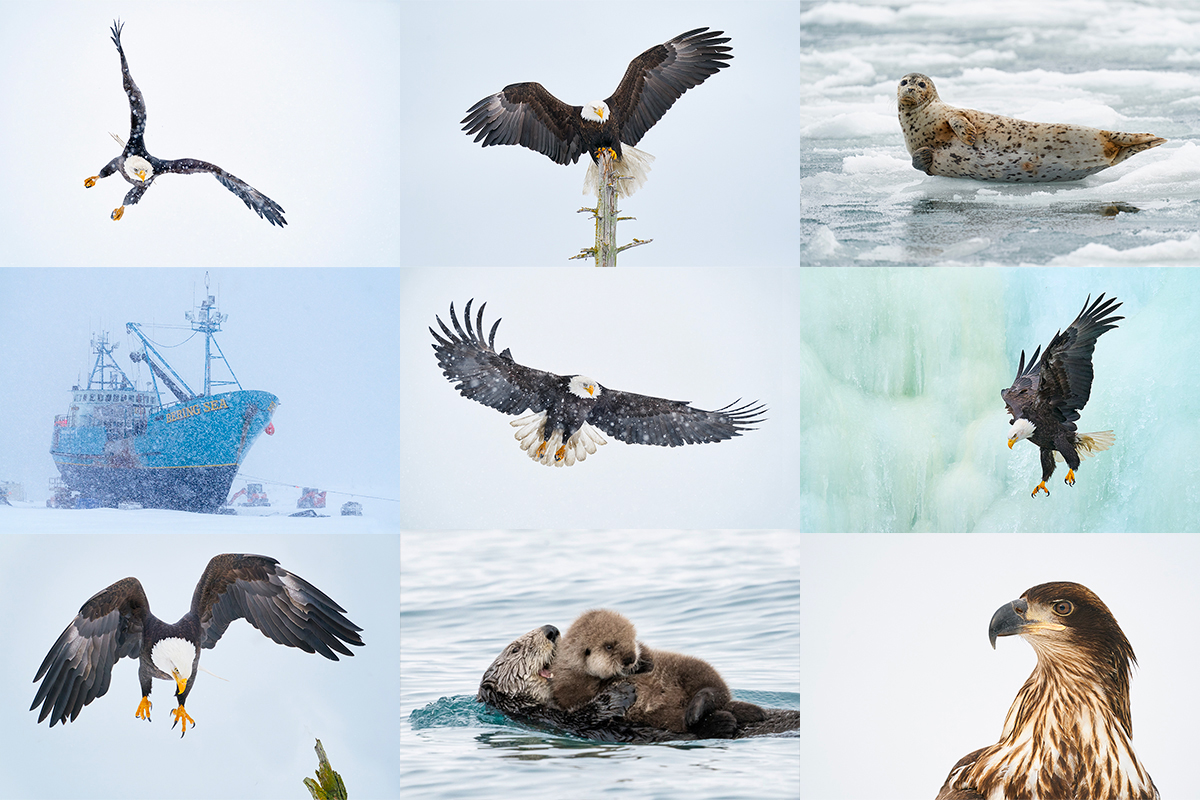
This trip features non-stop flight photography as well as many opportunities to create both environmental and point-blank portraits of one of North America’s most sought-after avian subjects: Bald Eagle (Haliaeetus leucocephalus). Other reliable subjects will include Sea Otter, and Glaucous-winged and Short-billed (formerly Mew) Gulls.
In addition, we should see Common Murre, Black Guillemot, Pelagic Cormorant, two species of loons, and a smattering of ducks including two species of merganser, all three scoters, Common and Barrow’s Goldeneyes, Bufflehead, Harlequin, and Long-tailed Ducks. Close-range photographic chances for these species will require some good luck. Some of these species, especially when in flocks, can, however, often be used effectively when pleasing creating bird-scapes.
If we need to be out early, we will be the first boat out. If the conditions are great, we will stay out. And when there is a chance for sunset silhouettes, we will be in the right spot.
We will be traveling through gorgeous wilderness country; landscape and scenic opportunities abound.
Also featured is a professional leader, often referred to as the father of modern bird photography and the world’s most knowledgeable bird photography trip leader and instructor. He is conversant in Canon, Nikon, and Sony.
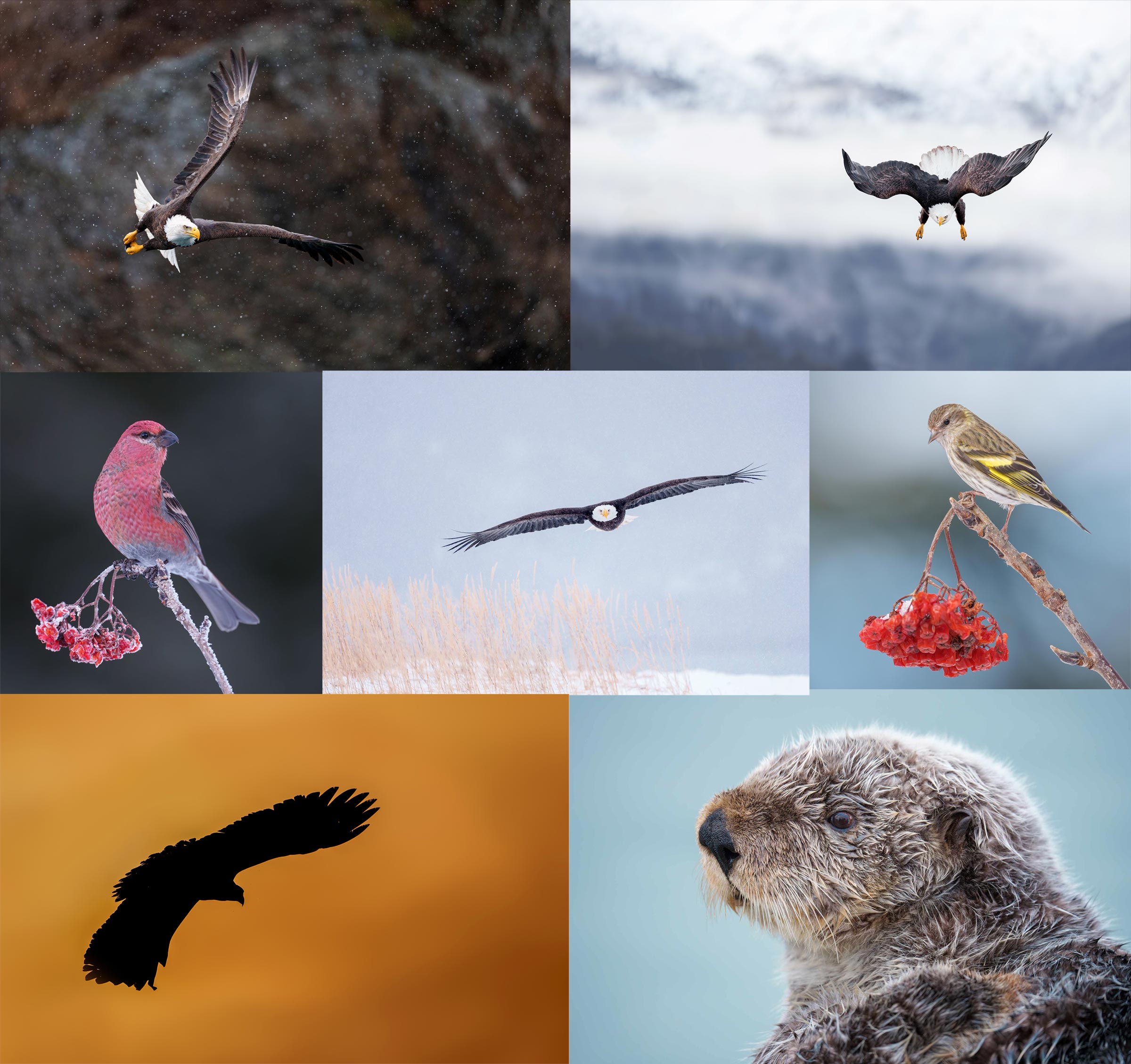
|
|
Click on the composite to view a larger, high res version. All images from the 2025 Homer/Kachemak Bay IPT. |
What You Will Learn
You will learn practical and creative solutions to everyday photographic problems. You will learn to see the shot, to create dynamic images by fine-tuning your compositions, to best utilize your camera’s AF system, and how to analyze the wind, the sky conditions, and the direction and quality of the light. This is one of the very few trips Homer trips where you will not be simply put on the birds and told to have fun and take photos. You will learn to be a better photographer.
You will learn to get the right exposure when it is sunny, when it cloudy-bright, when it is cloudy, when it is cloudy-dark, or when it is foggy. Not to mention getting the right exposure when creating silhouettes. You will learn to make pleasing blurs working in manual mode and to create silhouettes working in Shutter Priority mode. Most importantly, you will learn to pick your best flight photographs from tens of thousands of images.
You will enjoy working with the best and most creative boat captain on his sturdy, photography-spacious, seaworthy, open-deck watercraft.
There will be only five photographers (not the usual six), plus the leader.
Small group Photoshop, Image Review and Critiquing sessions are an integral part of the IPT experience.
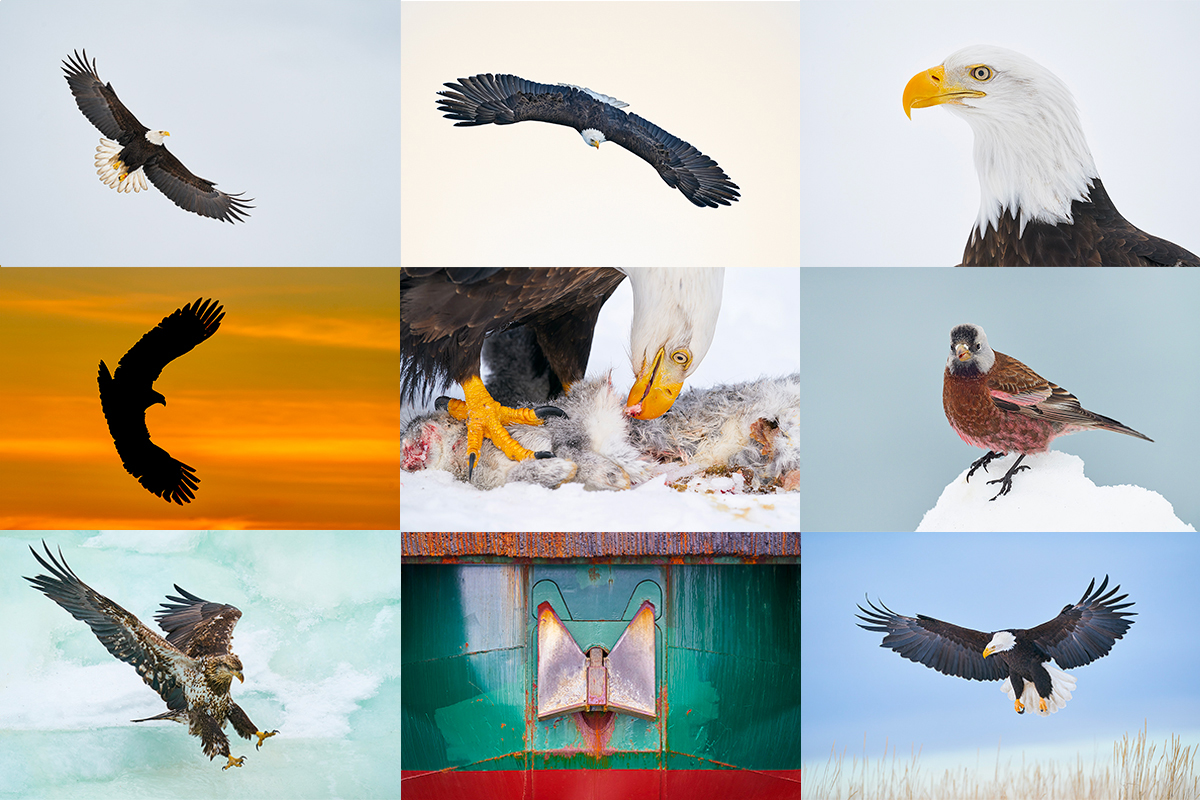
|
|
Click on the composite to view a larger, high res version. All images from Homer or Kachemak Bay, AK |
What’s Included
One four hour or two two-hour boat trips (session length variable depending on the weather) every day (weather permitting), all boat fees and boat-related expenses (excluding tips), ground transportation to and from the dock and back to the hotel each day, in-the-field instruction and guidance, pre-trip gear advice, and small group post-processing and image review sessions.
What’s Not Included
Your airfare to and from Homer, AK (via Anchorage), the cost of your room at Land’s End Resort, all personal items, all meals and beverages, and tips for the boat captain and the first mate ($50-$100 each per IPT is recommended).
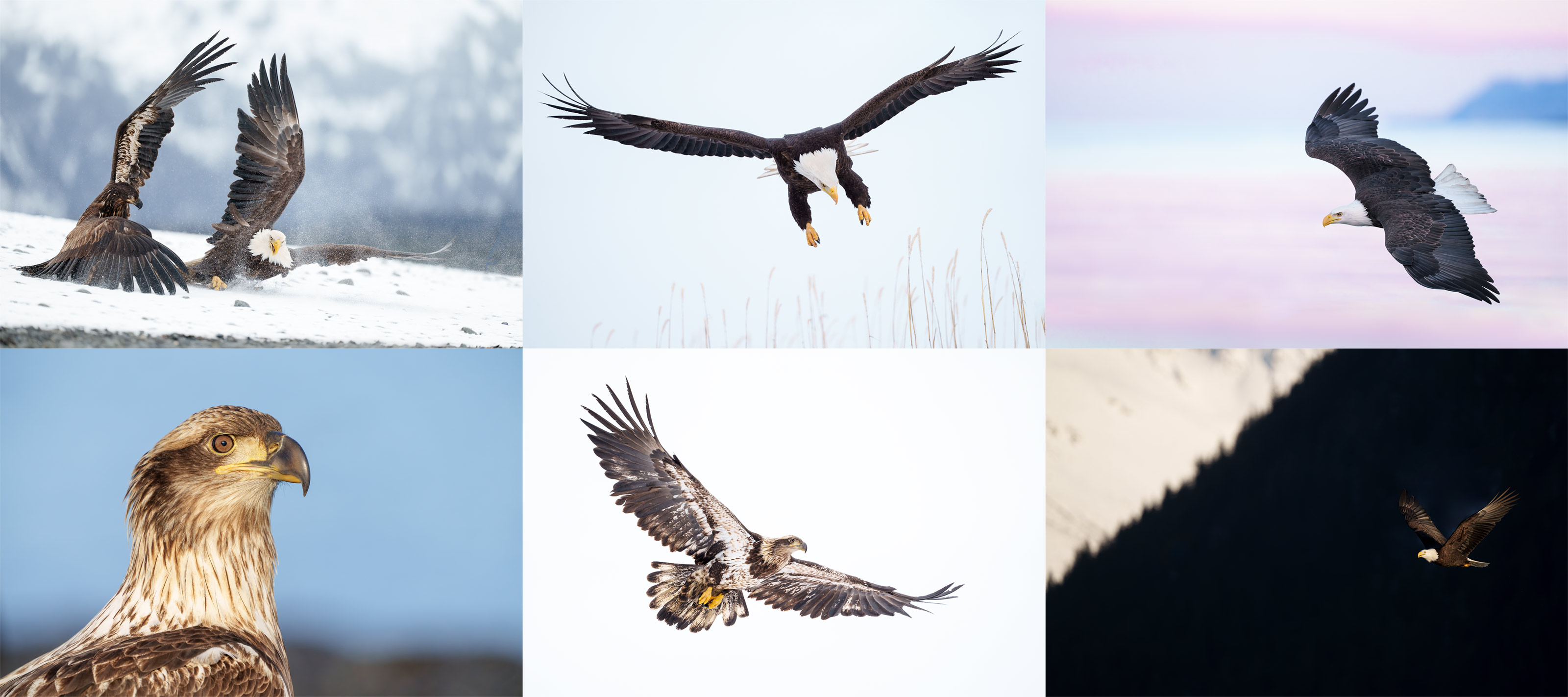
|
|
Click on the composite to view a larger, high res version. All images from the 2024 Homer/Kachemak Bay IPT |
Important Note
On great days, the group may wish to photograph for more than four hours. If the total time on the boat exceeds 20 hours for the five-day trips the group will share the additional expense at a rate of $300.00/hour. The leader will pay for the bait.
Some folks may wish to rent their own vehicle to take advantage of local photographic opportunities around Homer. In prior years those included Moose, Sea Otter, a variety of sea ducks in the harbor, and Great Grey and Short-eared Owl.
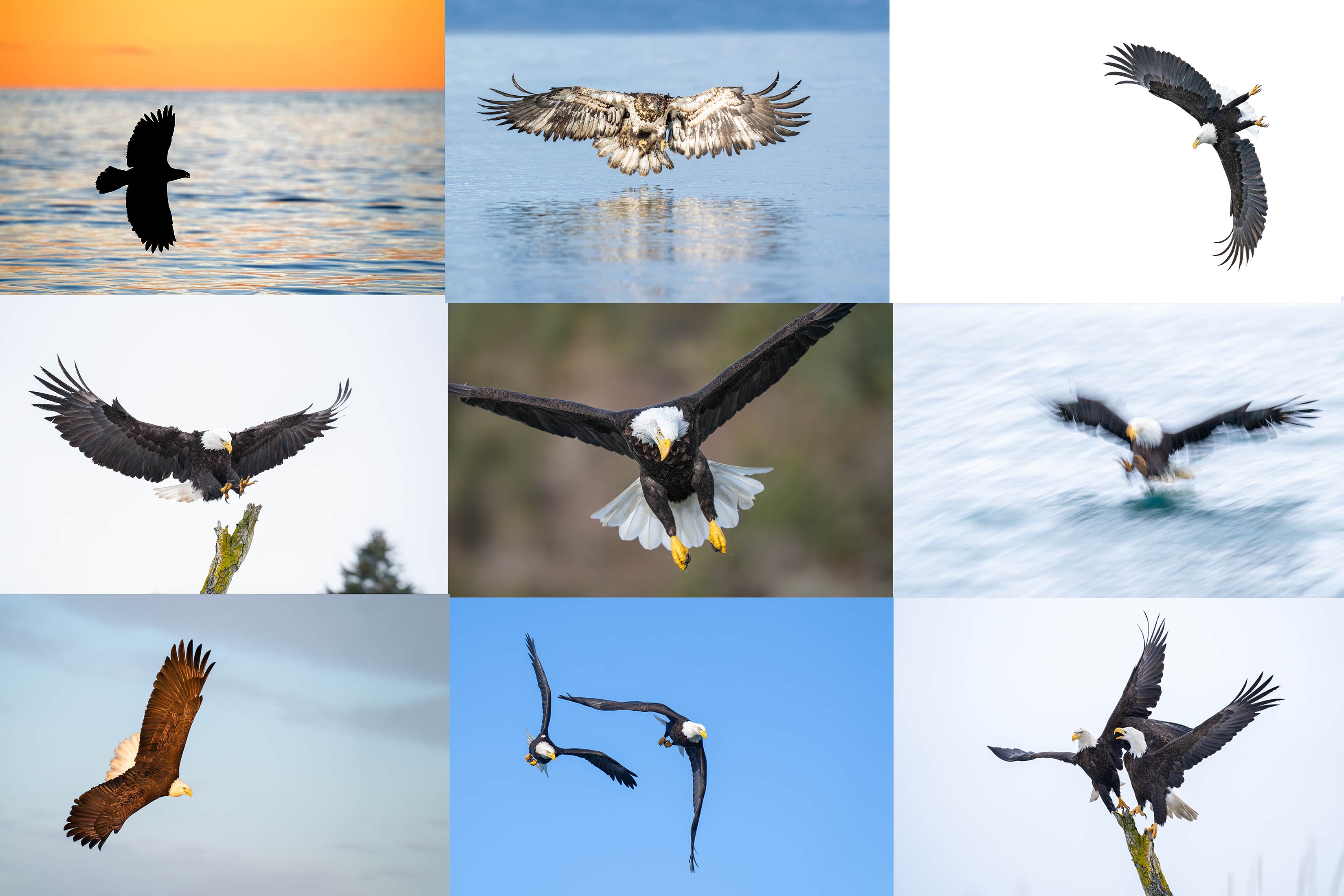
|
|
Click on the composite to view a larger, high res version. All images from the 2024 Homer/Kachemak Bay IPT. |
Deposit Information
A $3000 non-refundable deposit per IPT is required. You may pay your deposit with credit card or by personal check (the latter made out to BIRDS AS ART) and sent via US mail to Arthur Morris. PO Box 7245. Indian Lake Estates, FL 33855. Your balance, due 90 days before the date of departure, is payable only by check.
|
|
Click on the composite to view a larger, high res version.
|
In Closing
I have been going to Homer off and on for well more than two decades. Every trip has been nothing short of fantastic. Many folks go in mid-March. The earlier you go, the better the chances for snow. The only way to assure that you are on the best of these two trips is to sign up for both of them. If you have any questions, or are good to go for one or both of these great trips, please let me know via e-mail or give me a call on my cell phone at 863-221-2372.
|
|
Click on the composite to view a larger, high res version.
|
|
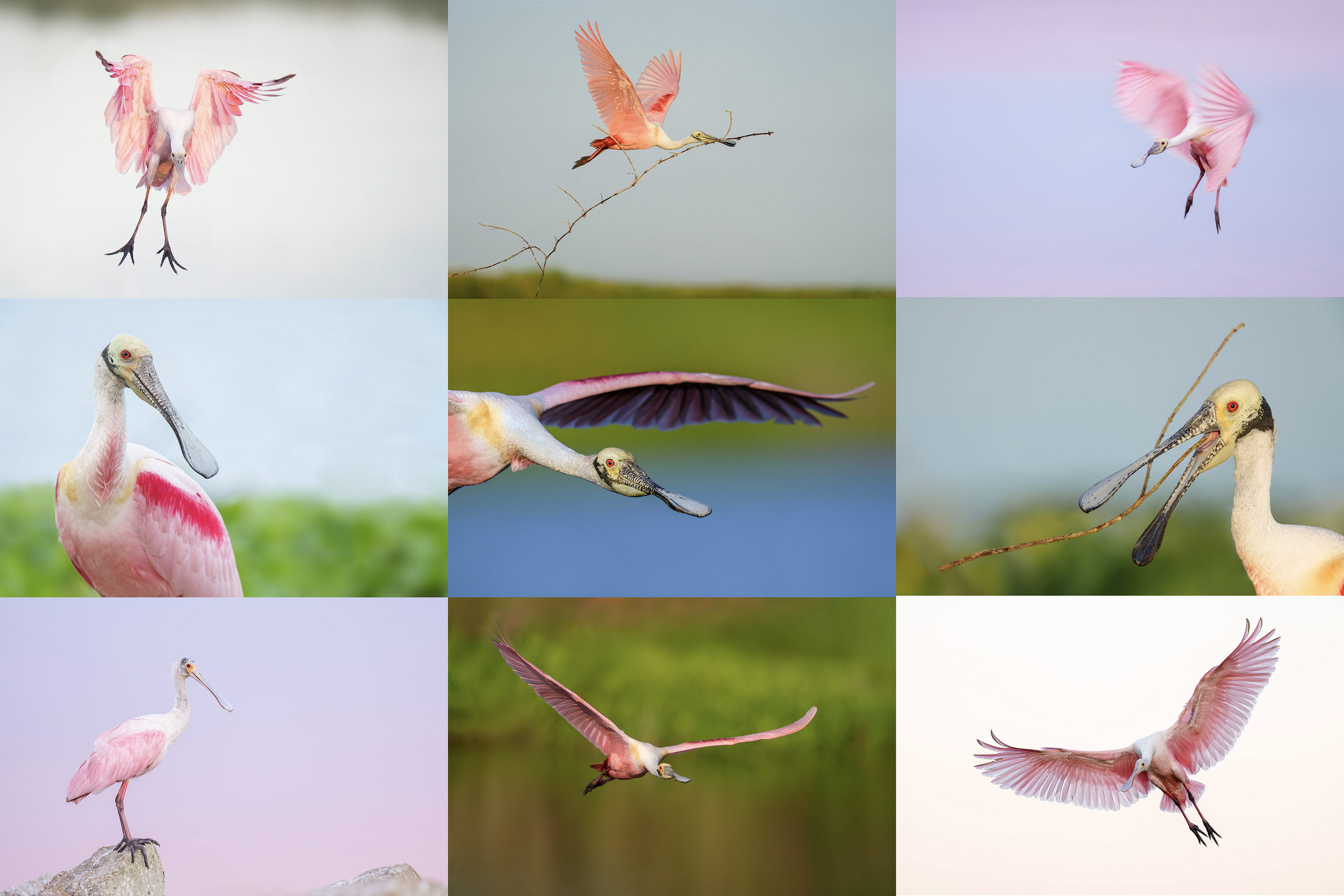
Stick Marsh Card One. Click on the composite to enjoy a larger version.Clockwise from upper left back around to the center: 1-year old spoonbill braking to land (400mm); spoonbill with nesting material; spoonbill braking to land blur (300mm) (300mm); spoonbill grabbing stick 840mm); 1-year spoonbill while sky flight (300mm); spoonbill with green background (300mm with 2X TC = 600mm); sub-adult spoonbill on rock in pink pre-dawn light; adult spoonbill looking back pose (840mm); and spoonbill tight flight (840mm) |
The 2027 Stick Marsh Roseate Spoonbills and More AirBnB IPTs
Stick Marsh IPT: #1: (ARR: MON 8 MAR. IPT #1: TUES 9 MAR thru the morning session on SUN 14 MAR 2027: 5 1/2 DAYS: $2,999.00**. (Limit 4 photographers)
Stick Marsh IPT: #2: (ARR: MON 15 MAR. IPT: TUES 16 MAR thru the morning session on SUN 21 MAR 2027: 5 1/2 DAYS: $2,999.00**. (Limit 4 photographers)
Stick Marsh IPT: #3: (ARR: MON 22 MAR. IPT: TUES 23 MAR thru the morning session on SUN 28 MAR 2027: 5 1/2 DAYS: $2,999.00.** (Limit 4 photographers)
Photograph Roseate Spoonbills in breeding plumage at point blank range with short telephoto lenses!
On each trip there is a possibility of doing a morning session at Indian Lake Estates to photograph Sandhill Crane chicks and colts.
Sign up for back to back trips and enjoy a free morning session in between and a $500 discount. Do all three IPTs and enjoy two morning sessions and a $1,000 discount. Sign up for one IPT and add a single morning session at the end of your trip for only $500.00.
** For folks opting not to stay at the AirBnB the cost of the workshop will be $3499.00.
Questions? Please get in touch via e-mail and I will be glad to share the additional details with you.
AirBnB Details
We will be staying at the same great AirBnb that I used for Stick Marsh in 2025 & 2026, and Sebastian Inlet for a month in 2025 and two months in 2026. The modern, well equipped 5-bedroom AirBnB is located in Vero Lake Estates. It is 26 minutes from Stick Marsh, 26 minutes from Sebastian Inlet State Park (where we spend an afternoon or two) and 26 minutes from the Oar Restaurant where we hold the Thank You Dinner. The cost of the regular bedrooms (with a shared bath) is $150/night. The cost of the Presidential Suite — ideal for couples and/or those desiring a private bathroom, is $180/night.
Check out is at your leisure on all three IPTs only.
Stick Marsh, Where the Photography is Easy
Stick Marsh, where the living and the photography is easy. Photograph incoming Roseate Spoonbills in flight at point blank range with short and intermediate telephoto and telephoto zoom lenses. In 2026, folks used 70-200mm f/2.8 lenses (often with the 1.4X TC), 300mm f/2.8 lenses, and the Sony 400-800 G lenses. I used the Sony 300mm f/2.8 GM Lens, and the 400-800 G Lens. Longer lenses either on a tripod or hand held are ideal for the green background stuff and or when we make the short walk over the bridge. There will be endless flight photography opportunities with a variety of species. In addition to the spoonbills, we should have some excellent chances on Limpkin, Great Egret, Cattle Egret, Great Blue Heron, Little Blue Heron, Double-created Cormorant, Anhinga, Black and Turkey Vultures, and more. Folks with 500 and 600mm f/4 lenses will have lots of opportunities to hone their skills working on a tripod or hand holding.
BIRDS AS ART IPTs are quite different from most bird photography workshops offered today: I am teaching constantly. We do not simply take you to a good location and say, “There are the birds,” or “Incoming spoonbill low right.” We talk wind direction, exposure, light, sky conditions, flight paths, wind positions and flight paths, autofocus, image design, the available options, and tons more. Scroll down to see what you will learn.
There will be six morning photo sessions averaging three hours each. We start in the pre-dawn. The first five morning sessions will be followed by brunch (the cost is included). There will be four after brunch/after Instructor Nap Time image review/Photoshop sessions. There will be at least two in-the-field evening photo sessions. The deposit is $899.00 plus half the cost of your AirBnB lodging. Call Jim at the office any weekday at 863-692-0906 to pay by credit card. Balances must be paid by check. Dinners are $25/night. I am an excellent chef and the food is both healthy and of high quality. Rides with me may be available on a first come/first served basis may be available for $25/day. Ride with me and take an Uber from and to the airport and save the cost of a rental car.

|
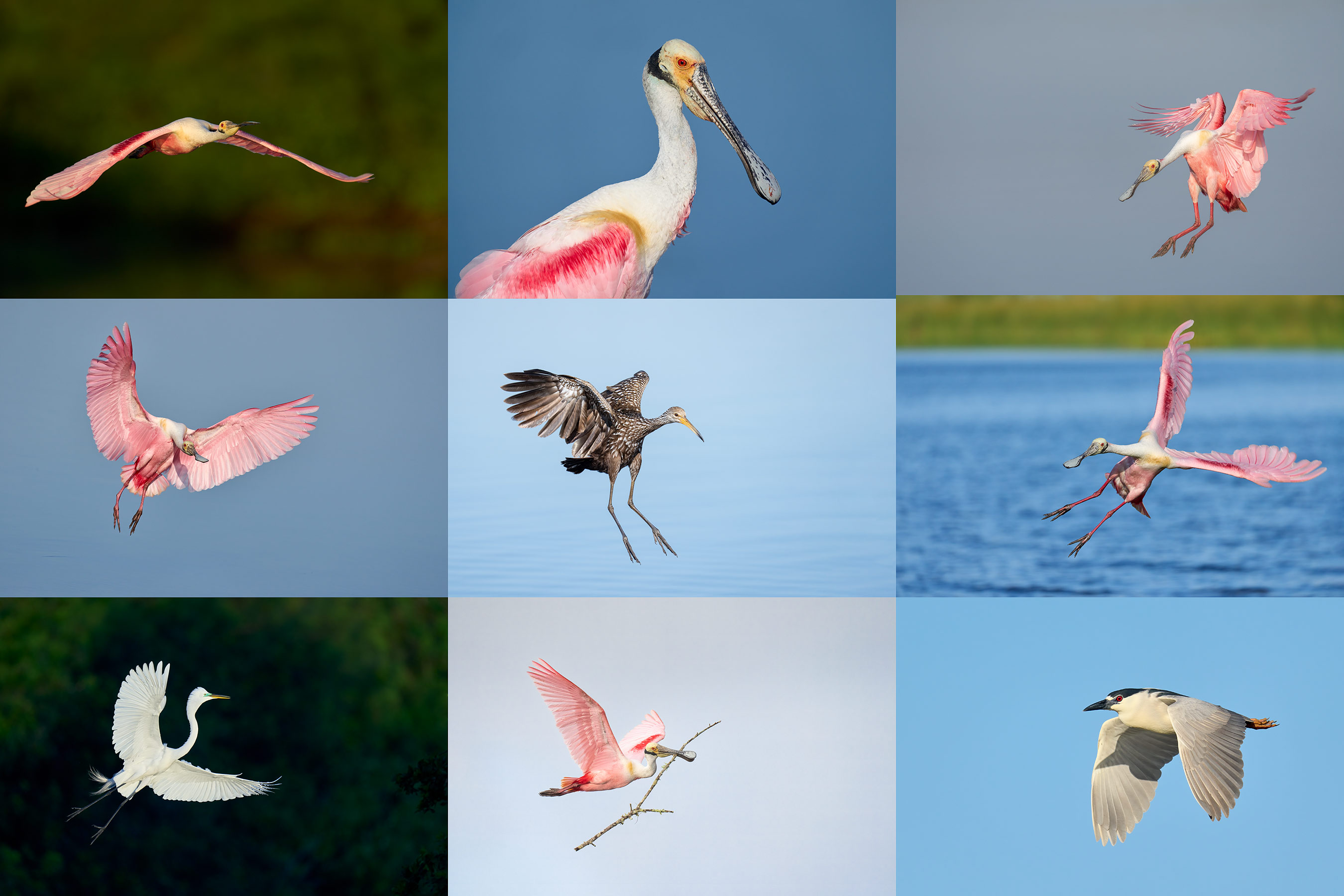
Stick Marsh Card Two. Click on the composite to enjoy a larger version.Clockwise from upper left back around to the center: Great Egret landing sunset silhouette; spoonbill in flowers: spoonbill preening upper tail coverts; Anhinga calling; spoonbill stepping in soft light; Great Egret with nesting material; Wood Stork with nesting material; Anhinga with speared largemouth bass; and spoonbill flight head portrait. |
What You Will Learn on a Stick Marsh IPT
- 1- You will learn the basics and fine points of digital exposure. Nikon and Canon folks will learn to get the right exposure every time after making a single test exposure, and SONY folks will learn to use Zebras so that they can be sure of making excellent exposures before pressing the shutter button..
- 2- You will learn to work in Manual exposure mode even if you are scared of it.
- 3- You will surely learn to evaluate wind and sky conditions and understand how they affect bird photography.
- 4- You will learn the pro secrets that will help you to become a better flight photographer.
- 5- You will learn to zoom out in advance (because the birds are so close!) 🙂
- 6- You will learn how to approach free and wild birds without disturbing them.
- 7- You will learn to spot the good and the great situations.
- 8- You will learn to understand and predict bird behavior.
- 9- You will learn to design pleasing images by mastering your camera’s AF system.
- 10- You will learn to choose the best perspective.
- 11- You will learn to see and control your backgrounds.
- 12- You will learn to see and understand the light.
- 12- You will learn to see and create pleasing blurs in pre-dawn situations.
- 12- You will learn to be ready for the most likely event at all times.
And the best news is that you will be able to take everything you learn home with you so that you will be a better photographer wherever you are and whenever you photograph.
|
Stick Marsh Card Three. Click on the composite to enjoy a larger version.Clockwise from upper left back around to the center: spoonbill with mangrove background; spoonbill head and shoulders portrait; spoonbill braking to land; spoonbill dramatic landing pose; adult Black-crowned Night-Heron; spoonbill with nesting material; Great Egret returning to nest; incoming spoonbill; and Limpkin landing. |
Getting There
You can fly to Orlando International Airport (MCO) and rent a car or fly to Melbourne International Airport (MEL) and explore the possibility of airport pick-up and drop-off or a taxi or uber ride to and from the AirBnB for those who opt to ride with me. As above, rides with me are available for $25/day/person on an extremely limited space available basis. To avoid the cost of a rental car, be sure to book early.
Deposit Information
A non-refundable deposit by check is required to hold your spot. The amount will be $899.00 plus half the cost of the AirBnB lodging. Please contact me by e-mail to check on availability and then make the check out to:
BIRDS AS ART
And send it via US Mail to
BIRDS AS ART
PO Box 7245
Indian Lake Estates, FL 33855