November 9th, 2011
|
|
|
This image was created with the tripod-mounted Canon 800mm f/5.6L IS lens, the 1.4X III TC, and the EOS-1D Mark IV. ISO 800. Evaluative metering +2/3 stop: 1/60 sec. at f/8 in Av mode.
Central Sensor (by necessity) Rear Focus/AI Servo AF on the cub’s face and recompose. Click here if you missed the Rear Focus Tutorial.
For a greater appreciation of the image, click on the photo. Then click on the enlarged version to close it.
|
For Your Critique: Image #16
The image above of a Coastal Brown Bear cub kissing mom was created at Katmai National Park, AK on a Bear Boat IPT. It is presented for your critique; feel free to praise it or rip it to shreds. Would you keep it or delete it? Let us know why either way, what you like or what you hate. What would you have done differently?
Over the course of the next few weeks I will present four additional images in this series for a total of twenty in all. The last will be followed by several revelations including two major ones.
One of the very best ways to grow as a photographer is to look at as many good images as possible. I do that often in books, by checking out contest result web sites, by critiquing images on Bird Photographers.Net (BPN), by visiting the web sites of the world’s best photographers, and during image critiques and by encouraging image sharing on our BAA Instructional Photo-Tours (IPTs).
|
|
|
For a greater appreciation of this composite image, simply click on the image. Then click on the image or hit the X to close the larger version.
|
The KATMAI BEAR BOAT IPT: July 24-31, 2012 from Kodiak, AK: $6499. Limit 8/Openings 5. Coastal Brown Bears (Grizzlies) Galore!
Do consider joining me next summer for a surreal experience: creating intimate photographs of these incredible bears. Coastal Brown Bears at point blank range foraging & clamming with a good chance of copulations; cubs nursing and playing. Likely additional subjects include Horned and Tufted Puffins, nesting Bald Eagle and Black-legged Kittiwake, Steller’s Sea Lion, rafts of Sea Otters and more. Halibut fishing optional.
Click here for complete details on this amazing trip.
Earn Free Contest Entries and Support both the Bulletins and the Blog by making all your B & H purchases here.
More and more folks are earning multiple contest entries with their B & H purchases. See here for details on that. Eleven great categories, 34 winning and honored images, and prize pools valued in excess of $20,000. Click here to visit the competition home page.
Shopper’s Guide
Below is a list of the gear used to create the images in today’s blog post. Thanks a stack to all who have used the Shopper’s Guide links to purchase their gear as a thank you for all the free information that we bring you on the Blog and in the Bulletins. Before you purchase anything be sure to check out the advice in our Shopper’s Guide.
Canon 800mm f/5.L IS lens. Right now this is my all time favorite super-telephoto lens.
Canon 1.4X III Teleconverter. Designed to work best with the new Series II super-telephoto lenses.
Canon EOS-1D Mark IV professional digital camera body. My two Mark IVs are my workhorse digital camera bodies.
And from the BAA On-line Store:
LensCoats. I have a LensCoat on each of my big lenses to protect them from nicks and thus increase their re-sales value. All my big lens LensCoat stuff is in Hardwood Snow pattern.
LegCoat Tripod Leg Covers. I have four tripods active and each has a Hardwood Snow LegCoat on it to help prevent further damage to my tender shoulders 🙂
Gitzo GT3530LS Tripod. This one will last you a lifetime.
Mongoose M3.6 Tripod Head. Right now this is the best tripod head around for use with lenses that weigh less than 9 pounds. For heavier lenses, check out the Wimberley V2 head.
CR-80 Replacement Foot for Canon 800. When using the 800 on a Mongoose as I do, replacing the lens foot with this accessory lets the lens sit like a dog whether pointed up or down and prevents wind-blown spinning of your lens on breezy days by centering the lens directly over the tripod.
Double Bubble Level. You will find one in my camera’s hot shoe whenever I am not using flash.
Be sure to check out our camera body User’s Guides here.
The Lens Align Mark II. I use the Lens Align Mark II pretty much religiously to micro-adjust all of my gear an average of once a month and always before a major trip. Enjoy our free comprehensive tutorial here.
Canon EOS-1D Mark IV User’s Guide. Learn to use your Mark IV the way that I use mine. Also available for the 7D and the Mark III here.
November 7th, 2011
|
|
|
This image of a screaming, winter plumage adult Glaucous-winged Gull was created on the recently concluded Homer Bald Eagle IPT during a snow squall. (What can I say? I love gulls and I love snow.) I used the tripod-mounted Canon 800mm f/5.6L IS lens and the EOS-1D Mark IV. ISO 800. Evaluative metering +3 stops off the snow: 1/320 sec. at f/8. Central Sensor/AI Servo Rear Focus and recompose. In this mega low contrast situation it was necessary to focus on the legs and then re-compose. Click here if you missed the Rear Focus Tutorial. Lens/camera body Micro-adjustment: +2.
For a greater appreciation of the image, click on the photo. Then click on the enlarged version to close it.
|
Image Optimization Magic Part I
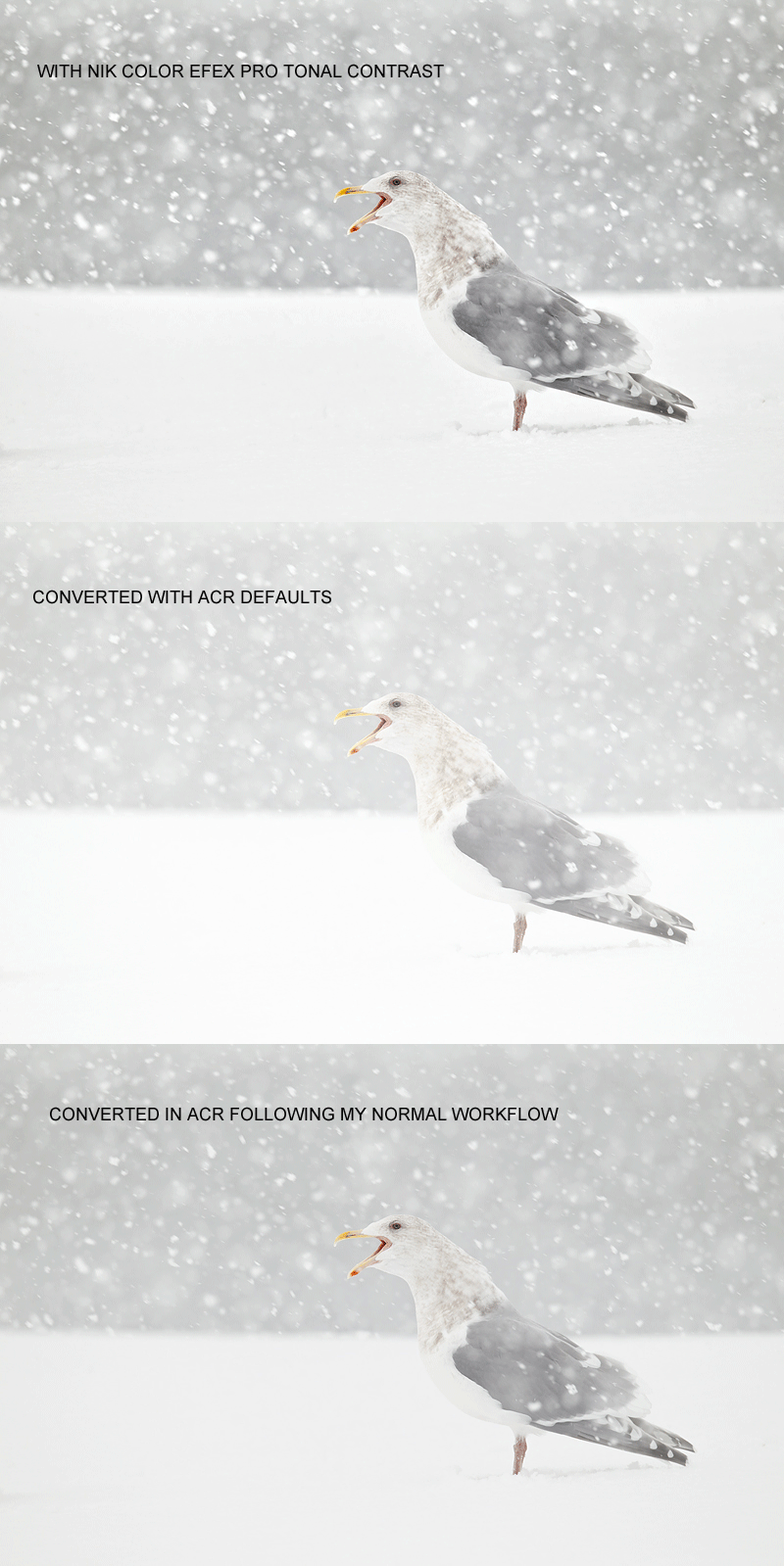
The image above represents my optimized master file. Note that it has been cropped just a bit from the original (see below). The image was sharpened after only being sized for web presentation. Note that you should not be sharpening your optimized master files; no image should be sharpened until it is sized for final use. Take a minute to study the animated GIF below. One frame, the one labeled CONVERTED WITH ACR DEFAULTS, shows exactly what the RAW file looked like. Note that the exposure was correctly pushed all the way to the right, so much so that the image looked washed out on both the back of the camera and on my laptop computer. (Many folks cannot deal with exposing to the right but doing so ensures the very best files.) The next frame is labeled CONVERTED IN ACR FOLLOWING MY NORMAL WORKFLOW. This represents the RAW file after I have adjusted the Exposure, Recovery, Black, and Brightness sliders. The final frame in the animated GIF shows the image after applying Tonal Contrast in NIK’s Color Efex Pro 4. See more on that below.
|
Denise Ippolito had been telling me for two years that Nik’s Tonal Contrast (in Color Efex Pro 4) was fantastic. I finally got around to trying it in Homer and was astounded. With the converted image open in Photoshop, open the plug-in, select Tonal Contrast, and hit OK. A Color Efex 4 layer will appear on your layers palette. Once the Color Efex layer opened I added a regular Layer Mask, hit BDX, and painted away the effect on the top of the bird’s head and the chin (to keep the RGB values in those areas no greater than 230). Next I reduced the Opacity to about 80%. (You may wish to tweak the sliders in Color Efex before hitting OK.) While I could have done pretty gotten the same look in Photoshop it would have required a good bit of time and effort; here a single filter replaced work that would have required making Selective Color, Curves, and Hue Saturation adjustments.
You can save 15% on all NIK products by clicking here and entering BAA in the Promo Code box at check-out. Then hit Apply to see your savings. If you doubt me (could that be possible :)?), you can download a trial copy that will work for 30 days and allow you to create full sized images. Bet you can’t eat just one!
If you are confused by Regular and Hide-all Layer Masks (as I was for about eight years), check out Layer Masking for Dummies in the latest (free) update of Digital Basics, an e-mailable PDF that includes my complete Digital Workflow and dozens of great Photoshop tips, all written in my clear, easy to read, easy to follow style.
|
|
|
This is a screen capture of the NIK Color Efex window. The split screen slider allows you to see the effect before and after. If you have any questions on the controls or sliders or anything else, please leave them in a comment. Note that there are lots of other filter presets aside from Tonal Contrast. I have been experimenting with others and will let you know what I find.
|
I will be sharing lots more examples of what Color Efex can do here over the next few months at least.
Support both the Bulletins and the Blog by making all your B & H purchases here.
B&H On-Line ordering is available six days a week (Sunday through late Friday afternoons) as usual. More and more folks are earning multiple contest entries with their B & H purchases. See here for details on that. Eleven great categories, 34 winning and honored images, and prize pools valued in excess of $20,000. Click here to visit the competition home page.
Shopper’s Guide
Below is a list of the gear used to create the image in today’s blog post. Thanks a stack to all who have used the Shopper’s Guide links to purchase their gear as a thank you for all the free information that we bring you on the Blog and in the Bulletins. Before you purchase anything be sure to check out the advice in our Shopper’s Guide.
Canon 800mm f/5.L IS lens. Right now this is my all time favorite super-telephoto lens.
Canon EOS-1D Mark IV professional digital camera body. My two Mark IVs are my workhorse digital camera bodies.
And from the BAA On-line Store:
LensCoats. I have a LensCoat on each of my big lenses to protect them from nicks and thus increase their re-sales value. All my big lens LensCoat stuff is in Hardwood Snow pattern.
LegCoat Tripod Leg Covers. I have four tripods active and each has a Hardwood Snow LegCoat on it to help prevent further damage to my tender shoulders 🙂
Gitzo GT3530LS Tripod. This one will last you a lifetime.
Mongoose M3.6 Tripod Head. Right now this is the best tripod head around for use with lenses that weigh less than 9 pounds. For heavier lenses, check out the Wimberley V2 head.
CR-80 Replacement Foot for Canon 800. When using the 800 on a Mongoose as I do, replacing the lens foot with this accessory lets the lens sit like a dog whether pointed up or down and prevents wind-blown spinning of your lens on breezy days by centering the lens directly over the tripod.
Double Bubble Level. You will find one in my camera’s hot shoe whenever I am not using flash.
November 5th, 2011
|
|
|
The recently announced Canon EOS-1D X
|
Canon’s Top Tech Rep on the EOS-1D X
A while back I ran Doug Brown’s insightful review of Canon’s newly announced professional digital camera body, the EOS-1D X. Click here if you missed “EOS-1D X Revelations” Doug followed that up with an interview with Canon’s top technical representative, Chuck Wesftall. Chuck’s formal title is: Advisor, Technical Information, ITC Group Professional Engineering & Solutions I Division, Canon U.S.A., Inc. I share that interview with you below. Tanks a stack to both Doug and Chuck.
Doug Brown is one of the new-school 600mm/1.4X/Mark IV hand holding flight photographers. (Count me out of that club.) Doug is quite skilled at it; he garnered his first BBC Veolia Wildlife Photographer of the Year Competition-honored image in last year’s contest. (You can see Doug’s honored photo here.) And be sure to visit Doug’s web site here. Be sure to check out the various galleries; there is tons of amazing stuff in them. Reprinted below, with his permission, is Doug Brown’s take on the new EOS-1D X.
Below, in its entirety, is the interview.
Yesterday morning I had the pleasure of speaking about the Canon EOS-1D x with Chuck Westfall, Canon USA’s Technical Advisor in the Professional Engineering and Solutions Division. In my questioning I tried to focus on the design decisions relevant to nature and wildlife photographers. A big thank you to Chuck for taking the time out from his busy schedule to answer my questions!
DB: Everyone is very excited about the new AF system in the EOS-1 Dx. Among wildlife photographers, the big concern is the loss of f/8 autofocus. Why did Canon choose to eliminate that feature?
CW: Canon felt that while it would have been nice to preserve AF at f/8, the overall improvement in AF achieved with the 1D x took precedence. The new AF system is faster, more controllable, and more intelligent. The improved algorithm means that AF won’t jump to the background as quickly, won’t be tripped up as easily by obstacles in front of the subject, and will handle subjects that are small in the frame much better. As you mention, AF is unavailable on the EOS-1D X if the maximum aperture reported to the camera through the electronic lens mount is smaller than f/5.6. This is a lower specification than previous EOS-1 series DSLRs. There are a lot of trade-offs in life, and this is one of them. Essentially, Canon Inc. decided that the overall improvement of the new 61-point AF system compared to the older 45-point system took precedence over the need for that particular feature. Taking your f/4 lenses as an example, with the new 1D X you now have 41 cross-type AF points (or 21 cross-types with the f/5.6 lenses) plus color and face detection tracking when using those lenses whereas there were none of those features with previous 1D/1Ds cameras. The AI Servo system on the new camera is vastly better than earlier cameras as well, in terms of sensitivity and performance as well as controlability.
DB: Does that mean that it’s not possible to AF at f/8, or that it’s not reliable but could be implemented? Could f/8 AF be enabled as a custom function?
CW: I have no further comment at this time, because Canon Inc. has not published answers to those questions.
DB: I’ve read that the new AF sensor covers a larger area than in previous Canon bodies; could you elaborate?
CW: The AF sensor is larger than in any earlier 1D/1Ds body, measuring 19mm from side to side. This compares to a 15mm-wide AF sensor in both the 1D Mark IV and the 1Ds Mark III.
DB: As a follow-up question, why hasn’t Canon placed AF points at the compositional power points dictated by the rule of thirds?
CW: In a phase detect AF system, it is impossible to spread the AF points out any further. If you were to place AF points at the compositional power points, they wouldn’t receive enough light to do their job properly. You would need an entirely new AF technology to make that possible.
DB: Could you tell us about the improvements that have been made in low-light and low-contrast autofocus?
CW: Low-light autofocus has been improved by a full stop compared to the 1D Mark IV. AF can be achieved at EV -2, the equivalent of locking focus under the light of a full moon. Low-contrast AF has also been significantly enhanced. Each AF point now has a double line of sensors in each direction (horizontal and vertical), and the lines are offset from one another. The result is that the AF sensor is much more sensitive to small changes in contrast than ever before. Lenses that can take advantage of the central f/2.8 sensors will see even better results. In our older systems, we used single lines of sensors, so no offset was possible.
DB: With the 1D x Canon has introduced a feature called EOS intelligent Tracking and Recognition AF (EOS iTR AF). What can you tell us about it?
CW: The AE system of the 1D x is able to detect the color of the subject, and can pass on this information to the AF system to improve subject tracking. To quote the Canon website “By using the colour of the subject that was initially focused, the AF system can track the movement of that subject, both by contrast and colour across the frame, and automatically select the most appropriate focus point given the position of the subject within the frame. This frees you up to concentrate on composing your images rather than selecting the best AF point for focus.”
DB: I’ve read that the AE and AF systems also incorporate face detection. Some wildlife photographers are concerned that face detection may confuse the AF system when photographing animals. Is there any way to disable the feature?
CW: The default AF mode is phase detect AF. Color and face detection is optional, but you can’t choose one or the other. It’s PDAF plus Color and Face Detection or PDAF only.
DB: What information do you have on the size of the 1D x buffer?
CW: At this point, no specs have been released on buffer size.
DB: How did Canon decide upon an 18 megapixel sensor for the 1D x?
CW: The Canon engineers felt that 18 megapixels struck the best balance between image quality and speed. Also they wanted the body to achieve 12 fps shooting, and that helped guide the decision on megapixels.
DB: Moving forward, has Canon dropped the APS-H sensor from its future plans?
CW: The 1.3 crop sensor is not being killed off. Canon is keeping all options open for future products.
DB: One of the advantages of moving to a full-frame sensor with a relatively low megapixel count is an improvement in high ISO noise levels. Canon is claiming a two stop gain in high ISO performance when compared to the 1D Mark IV. Will we see the full two stops when shooting RAW files, or is this limited to JPEG files only?
CW: To get the full two stops of improved performance you’ll need to shoot in the JPEG format. That’s not to say that high ISO performance isn’t significantly better when shooting in RAW, because it absolutely is.
DB: Will the new electronic first curtain replace mirror lock-up?
CW: The electronic first curtain only works in Live View, so it does not replace MLU. It does however offer a significant reduction in camera vibration when used in conjunction with Live View. The performance gains are most noticeable at very long focal lengths (800mm and longer).
DB: Is there a way to easily access the mirror lock-up function in the 1D x?
CW: The 1D x brings custom shooting modes (C1, C2, and C3) to the 1-series EOS bodies. These modes allow you to store regularly used settings for quick recall. Mirror lock-up can be programmed to any one of these custom shooting modes. You can also place mirror lock-up in My Menu. And don’t forget that Live View effectively provides one-touch mirror lock.
DB: Why the new battery, and what are its performance specs?
CW: The new battery was designed to meet some new safety requirements from the Japanese government. The new battery has slightly more capacity than the 1D Mark IV/ 1Ds Mark III battery, and there is complete forward-and-backward compatibility for LP-E4 and LP-E4N battery packs with the 1D x and 1D/1Ds Mark III as well as 1D Mark IV cameras. Canon has not released performance specs yet on the new battery.
DB: Some nature and wildlife photographers feel like Canon is ignoring their input in the design of new camera bodies. How do you address these concerns?
CW: Canon is very cognizant of the importance of the nature and wildlife segment when designing new camera gear.
DB: Canon’s Digital Photo Professional software does an excellent job handling high ISO noise, where products such as Adobe’s Lightroom seem to struggle. Why doesn’t Canon license their RAW processing engine to other software makers?
CW: Canon has an SDK that includes its RAW processing engine that is freely available to other software vendors. To my knowledge no other software maker has chosen to utilize our NR algorithm.
DB: What about the bounding box around the histogram?!?!
CW: Canon is aware that this feature has been requested. It was found in the original EOS-1D, but vanished in subsequent generations. You can enable a live histogram that stands out very clearly from the background in Live View.
|
|
|
Northern Harrier female in flight. Image copyright 2011 and courtesy of Doug Brown Photography. Canon EOS-1D Mark IV, 600mm f/4L IS + 1.4x. Manual exposure, hand held.
|
Thanks again to both Doug Brown and Chuck Westfall. I am posting this from the Orlando Airport. I will be home in two hours :).
November 4th, 2011
|
|
|
This juvenile Bald Eagle flash blur was created with the Canon 70-200mm f/2.8L IS II lens, the 1.4X III TC (handheld at 230mm) with the Canon EOS-1D Mark IV. ISO 200. Evaluative metering +3 2/3 stops off the dreary, dreary white sky: 1/30 sec. at f/5 set manually. Fill flash at -1 stop with the Canon 580Ex II Flash mounted on the camera. Rear Curtain Synch was set on the flash to put the blur behind the bird. I use the Canon CP-E4 Compact Battery Pack to power the flash and reduce recycling times. Note that you still need batteries in the flash head to power the LCD.
Lens/TC/camera body Micro-adjustment: -8.
Central Sensor/Rear Focus/AI Servo AF active at the moment of exposure. To enjoy viewing a larger sized image, click on the photo. Then click on the enlarged version to close it.
Purple flash pupil caused by the flash was eliminated by creating a Quick Mask of the pupil, placing it on its own layer, and desaturating and darkening the pupil using the Digital Eye Doctor techniques described in detail in Digital Basics (along with my complete Digital Workflow and dozens of other great Photoshop tips). DB is an easy to read, easy to follow PDF sent via e-mail.
Learn to use flash as fill and flash as main light in the Flash Simplified section of ABP II (916 pages on CD only). Learn to create flash blurs on page 80 of “A Guide to Pleasing Blurs” by Denise Ippolito and your truly (or by studying the information in the caption above). I would have needed to go to ISO 1600 at least in order to create a sharp image; in my judgement, trying to create pleasing blurs was the best option for those conditions. Adding some flash brought the image to life.
|
Confusion…
During the past few days Jim received e-mails from two folks who made B&H purchases in excess of $5,000. Each was requesting their three free contest entries. One (see the e-mail below) started his search with the BAA main B&H link and then placed his order by phone. The other sent a scan of his receipt for purchases made in the B&H super-store in Manhattan. Unfortunately neither qualified for the three free contest entries….
Here is the relevant information from the Payment Options page:
Optionally, if you make a B&H PHOTO VIDEO purchase of $1000.00 or more using this link only you can e-mail your B&H receipt to us at staffbaa@att.net. Please remember, you must use this link for your B&H purchases to qualify for a free competition entry. And you must order online. Phone orders and purchases made in the store do not qualify. Purchases of $3,000 or more will be good for two contest entries, of $5,000 or more for three entries, and of $10,000 or more for five competition entries.
Once we have received your payment or your B&H receipt you will receive instructions for uploading your images from us via e-mail.
Below, FYI, is the e-mail conversation referred to above:
AM: Howdy, Thanks for your interest in earning free entries into the BAA 1st International Bird Photography Competition. re:
VD: For the life of me, I don’t quite understand how clicking on the “link” gets you into the deal to qualify for additional entries.
AM: It is actually very simple. Once you either begin a search using our BAA link or use one of our product-specific B&H links (like those in Bulletins and blog posts for specific cameras and lenses) the B&H on-line system invisibly tracks your purchase to BIRDS AS ART.
VD: No where in the link after you bring it up it says anything about the contest.
AM: If you place your cursor over a B&H link and check the lower corner of your computer screen, you will see that the active link ends in /7226. Once you click on the link your purchases will be credited to BIRDS AS ART. We earn a small commission (as thanks in part for the free information shared in each and every BAA on-line publication). For example, yesterday morning’s seemingly simple and straightforward blog post “So It’s Bald Eagles You Wanted” took me about three hours to prepare; I sat down at my laptop at 3:30 am Alaska time and hit “Publish” just after 6:30am.
VD: So, I brought up the B&H website using your link, found lenses, clicked on Sigma, chose the lens I needed, and ordered by phone. Where did I go wrong?
AM: You went wrong by placing your order by phone. Believe me, I wish that we could get credit for all B&H phone orders placed by BAA folks and for all B&H purchases made in the store by BAA folks. I have discussed that possibility with my B&H affiliate rep and he has assured me that it is not possible to do so.
To sum up: if you start your search with our B&H link (or with one of our product-specific links) your purchase(s) will be credited to BAA. Once you forward us the receipt that you receive from B&H via e-mail you will receive your free contest entries (via e-mail from staffbaa@att.net). Folks planning on ordering more than one item must start their search using our main B&H link. As it says on the web site and the blog, “Earn Free Contest Entries and Support both the Bulletins and the Blog by making all your B & H purchases “here.” It is this hidden link: http://www.bhphotovideo.com/?BI=6633&KBID=7226 that is tracked invisibly to ensure that BAA is credited. Best and later and love, artie
The BIRDS AS ART 1st International Bird Photography Competition
New folks can learn about the BIRDS AS ART 1st International Bird Photography Competition here or visit the contest home page here.
Earn Free Contest Entries and Support both the Bulletins and the Blog by making all your B & H purchases here.
More and more folks are earning multiple contest entries with their B & H purchases. See here for details on that. Eleven great categories, 34 winning and honored images, and prize pools valued in excess of $20,000. Click here to visit the competition home page.
Shopper’s Guide
Below is a list of the gear used to create the images in today’s blog post. Thanks a stack to all who have used the Shopper’s Guide links to purchase their gear as a thank you for all the free information that we bring you on the Blog and in the Bulletins. Before you purchase anything be sure to check out the advice in our Shopper’s Guide.
Canon 70-200mm f/2.8L IS II lens. Man, I am loving this lens on my shoulder with the 2X III teleconverter. I also use it a lot with the 1.4X III TC.
Canon 1.4X III Teleconverter. Designed to work best with the new Series II super-telephoto lenses.
Canon EOS-1D Mark IV professional digital camera body. My two Mark IVs are my workhorse digital camera bodies.
Canon 580Ex II Flash. This is Canon’s most powerful feature-packed professional flash.
Canon CP-E4 Compact Battery Pack This lightweight accessory powers your flash and reduces recycling times; I never use my flash without having the CP-E4 attached. Note that you still need batteries in the flash head to power the LCD.
And from the BAA On-line Store:
Be sure to check out our camera body User’s Guides here.
The Lens Align Mark II. I use the Lens Align Mark II pretty much religiously to micro-adjust all of my gear an average of once a month and always before a major trip. Enjoy our free comprehensive tutorial here.
Canon EOS-1D Mark IV User’s Guide. Learn to use your Mark IV the way that I use mine. Also available for the 7D and the Mark III here.
November 3rd, 2011
|
|
|
Bald Eagle, adult on snow. Near Homer, AK. This image was created with the tripod-mounted Canon 800mm f/5.6L IS lens and the EOS-1D Mark IV. ISO 400. Evaluative metering at zero: 1/125 sec. at f/5.6 set manually was well underexposed. Lightened and ran noise reduction in ACR.
Central Sensor/Rear Focus/AI Servo AF and recompose. Click here if you missed the Rear Focus Tutorial. Lens/camera body Micro-adjustment: +2.
For a greater appreciation of the image, click on the photo. Then click on the enlarged version to close it.
|
So It’s Bald Eagles You Wanted…
Homer has been great. The second group has two days left. Lots more on the two IPTs in the next BAA Bulletin. I leave Homer on Friday night for my red-eye flights. I am scheduled to arrive in Orlando just after 5pm on Saturday and should be back in ILE in time for dinner and LSU/Alabama.
I am using NIK Color Efexx Pro 4.1 on almost every image now; it is changing my workflow. I will share more on this amazing plug-in here soon. For the image above I did two Color Efex layers, one for tonal contrast at 70% and to improve the look and the apparent sharpness of the bird only (using a hide-all mask) and another with Detail Extractor at 20% to bring up the detail in the head only again using a Hide-All mask (and then painting away the head only). If you are totally confused by Layer Masks (as I was for ten years) see “Layer Masking for Dummies” in the last free update of Digital Basics. DB is a PDF sent via e-mail (only $20) that contains my complete digital workflow and dozens and dozens of great Photoshop techniques.
You can save 15% on all NIK products by clicking here and entering BAA in the Promo Code box at check-out. Then hit Apply to see your savings. I have been using and learning and loving COLOR EFEX and Viveza and SILVER EFEX also. We will be bringing you lots especially on those first two soon.
|
|
|
Bald Eagle taking flight in snow, Near Homer, AK. This image was created with the tripod-mounted Canon 800mm f/5.6L IS lens, the 1.4X III TC, and the EOS-1D Mark IV. ISO 400. Evaluative metering +2/3 stop: 1/100 sec. at f/8 set manually.
Central Sensor (by necessity) Rear Focus/AI Servo AF. See below for additional details. Click here if you missed the Rear Focus Tutorial. Lens/TC/camera body Micro-adjustment: +4.
For a greater appreciation of the image, click on the photo. Then click on the enlarged version to close it.
|
It got a bit brighter so I added the 1.4X TC to photograph this bird. I was doing portraits when it started to take flight. In such a low contrast situation I knew that pressing the rear focus button in an attempt to focus track the bird would be futile so I simply framed the bird as it took off as best I could and made a few images. I knew that at only 1/100 sec. I had at least a decent chance to create a pleasingly blurred image. Added canvas top and right, filled in with several Quick Masks, and did a bit of Eye Doctor work all as described in detail in Digital Basics. DB is a PDF sent via e-mail (only $20) that contains my complete digital workflow and dozens and dozens of great Photoshop techniques. As with the two images above, Nik Color Efex made this one sing for me.
I actually prefer cloudy bright (as in the image above) to full sun for most bald eagle photography. This one qualifies as a dime a dozen image as we are tossing pollack (sold as bait to fishermen) to attract the birds to the boat. Due to my travel schedule I will not be returning to Homer until March 2013. If you are seriously interested in joining me then please shoot me an e-mail with the words Homer March 2013 cut and pasted into the Subject line.
As you can see in the BreezeBrowser screen capture below, I cropped this image from the right and from below to improve the composition and then juiced up the sunset colors. If you missed the silhouette lessons click here and here.
|
|
|
As always you can learn a ton by studying this BreezerBroswer Main View screen capture.
|
Which is Your Favorite?
Take a moment to leave a comment and let us know which of the four eagle images is your favorite, and why. It’s OK if you love all four of them equally :).
Earn Free Contest Entries and Support both the Bulletins and the Blog by making all your B & H purchases here.
More and more folks are earning multiple contest entries with their B & H purchases. See here for details on that. Eleven great categories, 34 winning and honored images, and prize pools valued in excess of $20,000. Click here to visit the competition home page.
Shopper’s Guide
Below is a list of the gear used to create the images in today’s blog post. Thanks a stack to all who have used the Shopper’s Guide links to purchase their gear as a thank you for all the free information that we bring you on the Blog and in the Bulletins. Before you purchase anything be sure to check out the advice in our Shopper’s Guide.
Canon 800mm f/5.L IS lens. Right now this is my all time favorite super-telephoto lens.
Canon 70-200mm f/2.8L IS II lens. Man, I am loving this lens on my shoulder with the 2X III teleconverter. I also use it a lot with the 1.4X III TC.
Canon 1.4X III Teleconverter. Designed to work best with the new Series II super-telephoto lenses.
Canon EOS-1D Mark IV professional digital camera body. My two Mark IVs are my workhorse digital camera bodies.
And from the BAA On-line Store:
LensCoats. I have a LensCoat on each of my big lenses to protect them from nicks and thus increase their re-sales value. All my big lens LensCoat stuff is in Hardwood Snow pattern.
LegCoat Tripod Leg Covers. I have four tripods active and each has a Hardwood Snow LegCoat on it to help prevent further damage to my tender shoulders 🙂
Gitzo GT3530LS Tripod. This one will last you a lifetime.
Mongoose M3.6 Tripod Head. Right now this is the best tripod head around for use with lenses that weigh less than 9 pounds. For heavier lenses, check out the Wimberley V2 head.
CR-80 Replacement Foot for Canon 800. When using the 800 on a Mongoose as I do, replacing the lens foot with this accessory lets the lens sit like a dog whether pointed up or down and prevents wind-blown spinning of your lens on breezy days by centering the lens directly over the tripod.
Double Bubble Level. You will find one in my camera’s hot shoe whenever I am not using flash.
Be sure to check out our camera body User’s Guides here.
The Lens Align Mark II. I use the Lens Align Mark II pretty much religiously to micro-adjust all of my gear an average of once a month and always before a major trip. Enjoy our free comprehensive tutorial here.
Canon EOS-1D Mark IV User’s Guide. Learn to use your Mark IV the way that I use mine. Also available for the 7D and the Mark III here.
November 1st, 2011
|
|
|
This image was created with the Canon 70-200mm f/2.8L IS II lens and the Canon EOS-1D Mark IV). ISO 50. Evaluative metering +1/3 stop; 1/4 sec. at f/29.
For a greater appreciation of this image, click on the photo. Then click on the enlarged version to close it.
|
For Your Critique: Image #15
The image above was created at LeHardy Rapids, Yellowstone National Park. It was converted to black and white using NIK SIlver EFEX Pro. It is presented for your critique; feel free to praise it or rip it to shreds. Would you keep it or delete it? Let us know why either way, what you like or what you hate. What would you have done differently?
Over the course of the next few weeks I will present five additional images in this series for a total of twenty in all. The last will be followed by several revelations including two major ones.
One of the very best ways to grow as a photographer is to look at as many good images as possible. I do that often in books, by checking out contest result web sites, by critiquing images on Bird Photographers.Net (BPN), by visiting the web sites of the world’s best photographers, and by encouraging image sharing during Instructional Photo-Tours (IPTs).
If you would like to learn a variety of techniques that you can use to create pleasing blurs–they are very rarely serendipitous accidents–get yourself a copy of “A Guide to Pleasing Blurs” by Denise Ippolito and yours truly. Like em or not, pleasing blurs do well in the major international nature photography competitions.
You can save 15% on all NIK products by clicking here and entering BAA in the Promo Code box at check-out. Then hit Apply to see your savings. I have been using and learning and loving COLOR EFEX, Viveza, and SILVER EFEX. We will be bringing you lots especially on those first two soon.
Support both the Bulletins and the Blog by making all your B & H purchases here.
B&H On-Line ordering is available six days a week (Sunday through late Friday afternoons) as usual. More and more folks are earning multiple contest entries with their B & H purchases. See here for details on that. Eleven great categories, 34 winning and honored images, and prize pools valued in excess of $20,000. Click here to visit the competition home page.
Earn Free Contest Entries and Support both the Bulletins and the Blog by making all your B & H purchases here.
More and more folks are earning multiple contest entries with their B & H purchases. See here for details on that. Eleven great categories, 34 winning and honored images, and prize pools valued in excess of $20,000. Click here to visit the competition home page.
Shopper’s Guide
Below is a list of the gear used to create the images in today’s blog post. Thanks a stack to all who have used the Shopper’s Guide links to purchase their gear as a thank you for all the free information that we bring you on the Blog and in the Bulletins. Before you purchase anything be sure to check out the advice in our Shopper’s Guide.
Canon 70-200mm f/2.8L IS II lens. Man, I am loving this lens on my shoulder with the 2X III teleconverter. I also use it a lot with the 1.4X III TC as I did here.
Canon 1.4X III Teleconverter. Designed to work best with the new Series II super-telephoto lenses.
Canon EOS-1D Mark IV professional digital camera body. My two Mark IVs are my workhorse digital camera bodies.
And from the BAA On-line Store:
The Lens Align Mark II. I use the Lens Align Mark II pretty much religiously to micro-adjust all of my gear an average of once a month and always before a major trip. Enjoy our free comprehensive tutorial here.
Canon EOS-1D Mark IV User’s Guide. Learn to use your Mark IV the way that I use mine. Also available for the 7D and the Mark III here.
October 31st, 2011
Snowbound!
On the afternoon of October 28 we encountered some brief but heavy snow squalls while baiting eagles from a boat with frozen pollack near Homer, AK. I was fortunate to have this bird fly right toward us while I had the cliff face as a background. On my first attempt the image did not look too good at all (other than the snow). So I did two layers of NIK Color EFEX Pro 4.1, one for tonal contrast at 50% and to improve the look and the apparent sharpness of the whole image and another on a layer with of Detail Extractor to bring up the detail in the head. On the latter I used a Hide-All mask and then painted away the head only. If you are totally confused by Layer Masks (as I was for ten years) see “Layer Masking for Dummies” in the last free update of Digital Basics. DB is a PDF sent via e-mail that contains my complete digital workflow and dozens and dozens of great Photoshop techniques.
You can save 15% on all NIK products by clicking here and entering BAA in the Promo Code box at check-out. Then hit Apply to see your savings. I have been using and learning and loving COLOR EFEX and Viveza and SILVER EFEX also. We will be bringing you lots especially on those first two soon.
Gotta run as it is noon and we leave in 25 minutes for five hours of Bald Eagle photography with the second group after an inch of snow last night. It should be great fun.
Earn Free Contest Entries and Support both the Bulletins and the Blog by making all your B & H purchases here.
More and more folks are earning multiple contest entries with their B & H purchases. See here for details on that. Eleven great categories, 34 winning and honored images, and prize pools valued in excess of $20,000. Click here to visit the competition home page.
Shopper’s Guide
Below is a list of the gear used to create the images in today’s blog post. Thanks a stack to all who have used the Shopper’s Guide links to purchase their gear as a thank you for all the free information that we bring you on the Blog and in the Bulletins. Before you purchase anything be sure to check out the advice in our Shopper’s Guide.
Canon 70-200mm f/2.8L IS II lens. Man, I am loving this lens on my shoulder with the 2X III teleconverter. I also use it a lot with the 1.4X III TC as I did here.
Canon 1.4X III Teleconverter. Designed to work best with the new Series II super-telephoto lenses.
Canon EOS-1D Mark IV professional digital camera body. My two Mark IVs are my workhorse digital camera bodies.
And from the BAA On-line Store:
The Lens Align Mark II. I use the Lens Align Mark II pretty much religiously to micro-adjust all of my gear an average of once a month and always before a major trip. Enjoy our free comprehensive tutorial here.
Canon EOS-1D Mark IV User’s Guide. Learn to use your Mark IV the way that I use mine. Also available for the 7D and the Mark III here.
October 29th, 2011
|
|
|
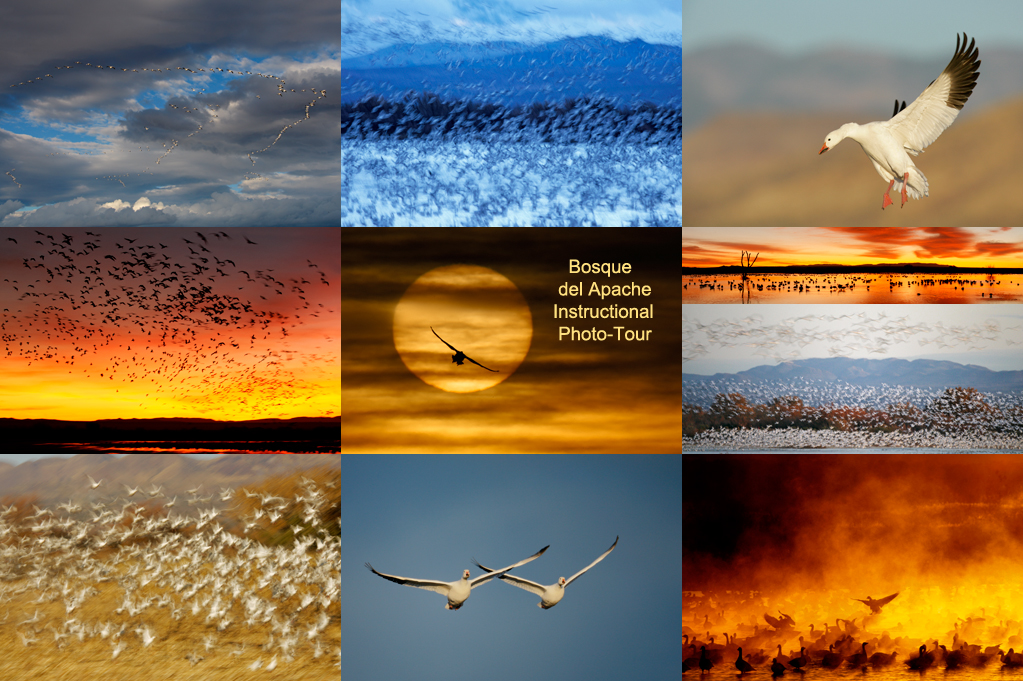
For a greater appreciation of this composite image, click on the photo. Click on the enlarged version to close it.
|
BOSQUE 2011-2012 CONDITIONS & NEWS
Below is an e-mail conversation that I had recently with Bosque del Apache NWR biologist John Vradenburg (JV). His letter detailing the current conditions a the refuge was sent to me by refuge manager Tom Melanson and is reprinted here with his permission.
AM: Hi John, re:
JV: Hope all is well.
AM: Is thanks and ditto. How is the family? Didn’t you have a new addition not too long ago???
JV: Things are looking fair at this time but is has been a rough year for Bosque. I will try and discuss each of the areas where your workshops focus and give you the good and the bad as well as things that have been done to help the Refuge visitors.
AM: Thank you much.
JV: As you have likely heard this is predicted to be one of the biggest fall flights of waterfowl in recorded history. In any year this would translate into high numbers at Bosque however this year this will likely be compounded by drought conditions throughout much of the southwest and Playa Lakes area pushing large numbers of those birds west towards the Middle Rio Grande Valley. We are planning for record populations this fall and winter and are hoping they arrive. Cranes are moving along the river as I write this now.
AM: All good I assume.
JV: The drought that has persisted over the past 2 years compromised our water availability this spring and summer. By mid-June the Refuge was receiving little water and this hit the farmers pretty hard. Early corn growth was stunted so crop height is lower than most years. This places us in a pinch when we try and manage where the birds feed. Compounding this problem one of our cooperative farmers experienced an almost complete failure of corn. We disked in all failed fields and had milo planted which did well in some areas and not good in others. This crop should help us reduce the food deficit due to the corn failure but how the birds will use it is up in the air.
One of the more difficult issues with the corn failure is that these are the fields on the tour loop so at this time there is little food on the loop. We have taken a few measures that we hope will help provide a quality experience but I will go into that later. Our second cooperative farmer did much better but did suffer high loss/damage from elk and trespass cattle. This is likely going to be a long term problem so were are looking into management alternatives to address it. At this time I suspect the corn yield will be around 500,000 lbs (a little more than ½ what we need), milo should add another 2 – 300,000 lbs so there will be enough food for the birds but we need to get creative in how we provide Refuge visitors an opportunity to get around the birds. We have developed a couple ideas that will help visitors have a quality experience during this tough year without causing increased stress to the wildlife. 1. We are developing a temporary alternate tour route which will take the visitor further north of the existing farm loop where crops did better.
AM: I was once in that area as a guest.
JV: We will provide this alternate route for short periods (2-3 weeks) throughout the winter. The first opportunity will likely occur the week after Festival.
AM: That may work out well for me as IPT is scheduled for SAT 19 NOV through FRI 25 NOV. I would love it if you could confirm that the alternate route would be open from MON NOV 21 through at least FRI 25 NOV. Would that be possible? In addition if you could come up with a firm schedule I could publish it in a variety of spots so that folks could plan their trips from out of state to coincide with the times that the alternate route is open.
JV: 2. We will flood the corn/milo fields that have been mowed. We anticipate that this will create another feeding opportunity for the birds which should in turn create a unique visitor opportunity.
AM: Good for the birds and the visitors.
JV: Outside of the Refuge this was one of the biggest corn production years in a long time with over 1,500 acres in corn.
AM: That does seem to give credence to the theory that since the big fiasco several years ago when the excellent farmers who had been working with the refuge for many, many years were betrayed by a regional higher-up from the FW&S that they chose to stop working with the refuge. My understanding is that that now only the worst area farmers are willing to work with the refuge because the excellent farmers lost trust with the refuge folks. In the good old days of Bosque (mid-1990s to the early 2000s) there was tons of corn by the road no matter drought or blight or elk or cattle….
JV: Most has been cut for silage but there will be some late harvest. Waste grain will be great for the birds so I am hopeful we still get the numbers of birds roosting in the traditional ponds which make for a great morning lift off and evening fly in but may reduce bird numbers during the day.
AM: Me too. Bosque without pre-dawn blast offs would not really be Bosque…. And yes, two years ago things were dismal after the cranes left the crane ponds as there was pretty much nothing to photograph. The situation is even worse for visiting photo groups like mine because it is impossible for a group to photograph hard to approach subjects from a vehicle. This is a great strategy for folks visiting on their own.
JV: The wetlands did really well this year despite the drought. We had one of the highest food production years on record which will translate into great duck use. The downside is due to drought our mowing/irrigation for non-desirable plants was not effective which means more fall mowing. The positive side to this, for the visitor, is more open wetlands than in the past. The downside is we must flood these mowed units slower so the up close experience that visitors enjoy may be delayed by as much as 2 weeks to allow the birds to maximize their feeding on the seeds. I know you will be excited to hear that the flight deck pond has been opened up and very little standing vegetation is out there. Again, the downside will be slower flooding but we started flooding today so the wetland should be at full pool by Festival.
AM: That will be great assuming that there are birds .
JV: As in most years we have had a slew of projects that needed to get accomplished so we had to prioritize and do less in other areas. One noticeable area is the mowing of ditch banks. We are starting to catch up but we will likely still be behind in November. To offset this we are trying to make sure popular viewing sites are done now and we will go back later and catch up with those we have had to skip earlier. We have a good amount of the windows completed, I would say more than in the past in some locations but we are still trying to catch up. We never heard from the volunteer windows crew so Refuge staff has been trying to get this accomplished.
AM: My bad; I forgot completely about the Open Windows Volunteer Program this year and I think that they expected to hear from you. If you get in touch with me next summer we I am pretty sure that I can get a crew together.
JV: We have a new wetland that you might be excited about. On the south end of the Marsh Loop the new John Taylor Trail leads to an overlook that gives a good view of the south farm and some of the restored habitat. To the south of that we have been working on a small wetland. I do not imagine it will be a great bird area this year but anticipate in the next few years this will be a location that will provide great birding and photography.
AM: I will take a look at it this year. It is important to realize that for the most part locations where viewing only to the south is possible are generally very poor for photography on clear days as when you are looking south you are pretty much looking into the sun. I would be glad to let you know my thoughts.
One final thought: if there is any way to have the alternate route open full time after MON 21 NOV at least until the corn is all knocked down it would likely go a long way to ease the disappointment and frustration felt by folks who bought their plane tickets far in advance and find few if any birds along the tour route during daylight hours. For me those 9am blast offs from the corn are the epitome of the Bosque experience.
May I have your permission to publish your letter?
Thanks and later and love, artie
cc: Tom Melanson, Phil Norton, Gary Ruoleau
Though I never heard from John Vradenburg I did receive the following e-mail from refuge manager Tom Melanson:
Artie, The extended alternate tour route will be open November 21 – December 11, 2011 and then again January 14 through February 20 2012. We will not be opening this extended route in future years. You may forward/reprint John’s habitat summary. Tom Melanson
It remains to be seen how productive the alternate route will be. Great, I hope. Folks choosing to visit refuge this year will likely be best trying to time their visits with the periods that the extended alternate tour route will be open. I am unsure as to why opening the extended route has been ruled out in future years especially in view of the fact that the 2010-2011 season will be the second year in the past three with no corn by the tour route. Assuming that there will be large numbers of geese roosting in the refuge ponds there will be many great opportunities for pre-dawn blast-offs and fly-outs and many great opportunities at the crane pools in both early morning and very late afternoon.
Whatever the conditions you can maximize your Bosque experience by purchasing a copy of our Bosque del Apache Site Guide.
|
|
|
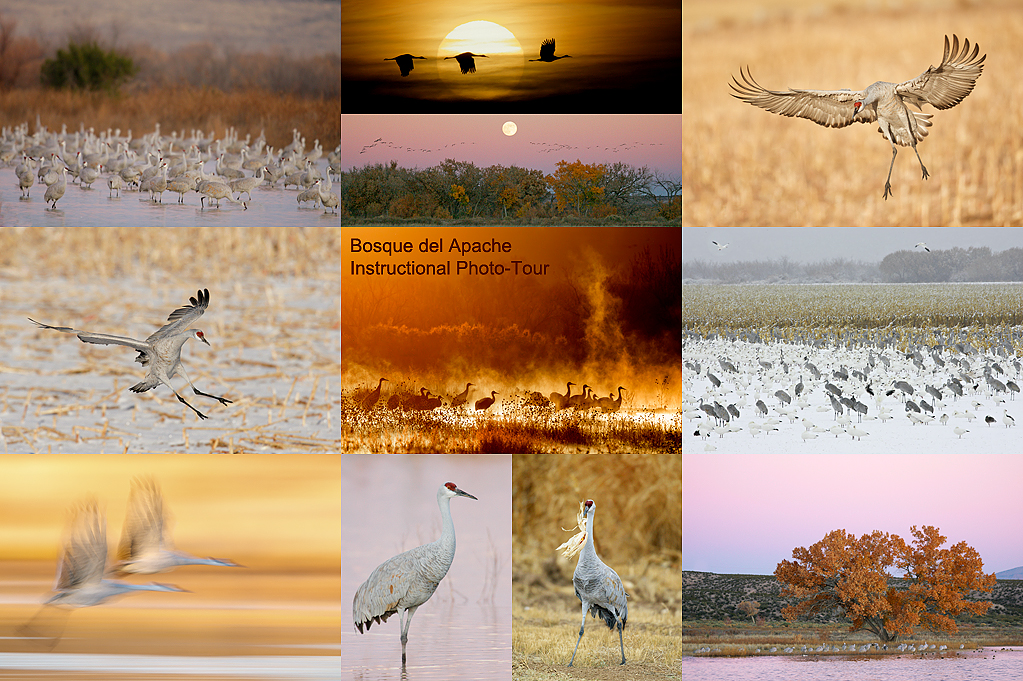
For a greater appreciation of this composite image, click on the photo. Click on the enlarged version to close it.
|
BOSQUE THANKSGIVING BUFFET INVITE
For the past ten years or so I have hosted a Thanksgiving Day midday meal, in part to honor the memory of my late-wife, Elaine Belsky Morris, and in part because I love meeting others who love Bosque as I do. At first it was held at the wonderful and relatively elegant Val Verde Steak House in Socorro, now defunct. Then it was held at the lovely and historic Luna Mansion. Luna Mansion closed a few years ago and recently re-opened but will no longer serves Thanksgiving Day. In 2009 we had fun and a fine meal at the Stage Door Grill but that wonderful little joint recently bit the dust also. Socorro is a tough place for businesses to survive. In 2010 we went a bit upscale and dined in the New Mexico Ballroom at the Hilton Albuquerque hotel. There was tons of food and it was all delicious.
The Hilton is now a Crowne Plaza and the good news is that they are having the buffet again this year. I will be picking up the tab for the IPT group, but as always, all visiting birders and photographers are invited to join us. If you would like to take part in the fun and camaraderie this year please send a check for $40.00 per person made out to ”Arthur Morris” to cover the cost of the buffet that will include all the traditional items plus lots more as well as tax and tip. Drinks are on you. Please mark “Thanksgiving Buffet” on your check and mail it to; BIRDS AS ART, PO Box 4041, Indian Lake Estates, FL 33855. Be sure to include your e-mail address on your check and in a short note. Sorry, no PayPals or credit cards. I do hope that you can join us.
I have group reservations for Thanksgiving Day (of course). Those joining us will need to be at the hotel at 11:30 am sharp. It is located at 1901 University Blvd NE, Albuquerque, NM 87102, about an hour up I-25 from the Super 8 Motel in Socorro where I have stayed happily with my groups for well more than a decade. I do hope that you can join us.
October 28th, 2011
|
|
|
After seeing an Andy Rouse image of a Sally Lightfoot crab on black lava rock surrounded by a blurred wave (in his book, Concepts of Nature, I was determined to try something similar (and perhaps better) on my next Galapagos visit. This image was created with the tripod-mounted Canon 800mm f/5.6L IS lens and the EOS-1D Mark IV. ISO 50. Evaluative metering -2 stops off the crab on the black rock alone: 1/30 sec. at f/9. (I knew that I would need to underexpose quite a bit to avoid losing detail in the white water of the breaking waves; I needed to check the histogram a few times to get it right.)
For a greater appreciation of the image, click on the photo. Then click on the enlarged version to close it.
|
For Your Critique: Image #14
The image above is presented for your critique; feel free to praise it or rip it to shreds. Would you keep it or delete it? Let us know why either way, what you like or what you hate. What would you have done differently?
Over the course of the next few weeks I will present six additional images in this series for a total of twenty in all. The last will be followed by several revelations including two major ones.
An important point here: I have written often that one of the very best ways to grow as a photographer is to look at as many good images as possible. I do that often in books, by checking out contest web sites, by critiquing images on Bird Photographers.Net (BPN), by visiting the web sites of the world’s best photographers, and by encouraging image sharing during Instructional Photo-Tours (IPTs).
Second important point here: if you would like to learn a variety of techniques that you can use to create pleasing blurs–they are very rarely serendipitous accidents–get yourself a copy of “A Guide to Pleasing Blurs” by Denise Ippolito and yours truly. Like em or not, pleasing blurs do well in the major international nature photography competitions.
Support both the Bulletins and the Blog by making all your B & H purchases here.
B&H On-Line ordering is available six days a week (Sunday through late Friday afternoons) as usual. More and more folks are earning multiple contest entries with their B & H purchases. See here for details on that. Eleven great categories, 34 winning and honored images, and prize pools valued in excess of $20,000. Click here to visit the competition home page.
Shopper’s Guide
Below is a list of the gear used to create the image in today’s blog post. Thanks a stack to all who have used the Shopper’s Guide links to purchase their gear as a thank you for all the free information that we bring you on the Blog and in the Bulletins. Before you purchase anything be sure to check out the advice in our Shopper’s Guide.
Canon 800mm f/5.L IS lens. Right now this is my all time favorite super-telephoto lens.
Canon EOS-1D Mark IV professional digital camera body. My two Mark IVs are my workhorse digital camera bodies.
And from the BAA On-line Store:
LensCoats. I have a LensCoat on each of my big lenses to protect them from nicks and thus increase their re-sales value. All my big lens LensCoat stuff is in Hardwood Snow pattern.
LegCoat Tripod Leg Covers. I have four tripods active and each has a Hardwood Snow LegCoat on it to help prevent further damage to my tender shoulders 🙂
Gitzo GT3530LS Tripod. This one will last you a lifetime.
Mongoose M3.6 Tripod Head. Right now this is the best tripod head around for use with lenses that weigh less than 9 pounds. For heavier lenses, check out the Wimberley V2 head.
CR-80 Replacement Foot for Canon 800. When using the 800 on a Mongoose as I do, replacing the lens foot with this accessory lets the lens sit like a dog whether pointed up or down and prevents wind-blown spinning of your lens on breezy days by centering the lens directly over the tripod.
Double Bubble Level. You will find one in my camera’s hot shoe whenever I am not using flash.
Be sure to check out our camera body User’s Guides here.
The Lens Align Mark II. I use the Lens Align Mark II pretty much religiously to micro-adjust all of my gear an average of once a month and always before a major trip. Enjoy our free comprehensive tutorial here.
Canon EOS-1D Mark IV User’s Guide. Learn to use your Mark IV the way that I use mine. User’s Guides are available for the 7D and the Mark III here. And for most Nikon dSLRs here.
October 26th, 2011
Dreary Day, White Sky Exposure Lesson
I arrived safely in Homer, AK at 10:30pm on Monday evening pat after an uneventful but long (23 hours door to door) trip from Orlando to the Land’s End Resort. The first morning of the IPT dawned to pouring rain and high winds so the group holed up and enjoyed two long, educational slide programs by Robert O’Toole and yours truly. The rain and wind eventually let up a bit so we boarded our two boats and headed across the bay to three some fish. Conditions were less than ideal :).
Exposure for me was simple and I shared the following with the group: work in Manual mode. Dial in the widest aperture. Set ISO 1600–I told you it was dreary. Point your lens at the white sky and adjust the shutter speed until the analog scale in the viewfinder shows exactly +3 stops. Now photograph an eagle and check for blinkies on the bird. (A few blinkies on the sky are fine.) Keep firing until the light changes. By simply pointing your lens at the sky you will see when you lose light. At that point you can choose to set a slower shutter speed, set a higher ISO, or switch tracks all together and begin creating pleasing blurs.
|
|
|
Here is a screen capture of the BreezeBrowser main view for this image.
|
Note the perfect histogram. By exposing to the right I ensure getting maximum detail in the blacks while reducing noise as well. Note also that the bird was too centered in the original capture. I moved the bird to our right in the frame quickly and easily using one of the great tutorials in Robert O’Toole’s APTATS II.
Earn Free Contest Entries and Support both the Bulletins and the Blog by making all your B & H purchases here.
More and more folks are earning multiple contest entries with their B & H purchases. See here for details on that. Eleven great categories, 34 winning and honored images, and prize pools valued in excess of $20,000. Click here to visit the competition home page.
Shopper’s Guide
Below is a list of the gear used to create the images in today’s blog post. Thanks a stack to all who have used the Shopper’s Guide links to purchase their gear as a thank you for all the free information that we bring you on the Blog and in the Bulletins. Before you purchase anything be sure to check out the advice in our Shopper’s Guide.
Canon 70-200mm f/2.8L IS II lens. Man, I am loving this lens on my shoulder with the 2X III teleconverter. I also use it a lot with the 1.4X III TC as I did here.
Canon 1.4X III Teleconverter. Designed to work best with the new Series II super-telephoto lenses.
Canon EOS-1D Mark IV professional digital camera body. My two Mark IVs are my workhorse digital camera bodies.
And from the BAA On-line Store:
The Lens Align Mark II. I use the Lens Align Mark II pretty much religiously to micro-adjust all of my gear an average of once a month and always before a major trip. Enjoy our free comprehensive tutorial here.
Canon EOS-1D Mark IV User’s Guide. Learn to use your Mark IV the way that I use mine. Also available for the 7D and the Mark III here.
|