
If …
If you are new to the BIRDS AS ART Blog and liked what you saw and what you learned, you can subscribe by clicking here.
Your Call?
So, which do you think is the stronger image, the large-in-the-frame Image #1, or Image #2, the bird/perch-scape? Why did you make your choice. I have a clear choice that I will share with you here in the next post.
Out of Technology Hell!
Huge thanks to the incredibly talented and creative Tony Sweet for suggesting that I switch to ConstantContact for sending out blog post notifications. You can check out Tony’s great landscapes (and more) on his Instagram page here.
After two years of problems and false hope, I was able to get things up and running with ConstantContact in less than a day. I am pretty confident that things will continue to go well.
What’s Up?
After missing two mornings of bird photography when I visited Long Island briefly for Thanksgiving, I say with certainty that since October 7 of last year I have missed exactly 15 morning photo sessions. Fourteen of those were due to air travel and one more was spent driving down to Homer, AK. That makes me 415 of the last 430 mornings, a pretty good batting average of .965!
It has been cloudy, foggy, and/or overcast here at ILE for the past few days. I have been out every morning making a few good ones. Today is Wednesday 10 December 2025; the sun is supposed to come out later today. I headed down to the lake at 7:15am for my morning photography fix; as usual, I had a few good chances with the regular suspects. I hope that you choose to have a wonderful day.
If an item — a Delkin flash card or reader, a Levered-clamp FlexShooter Pro, or a Wimberley lens plate or low foot — for example, that is available from B&H and/or Bedfords, is also available in the BAA Online Store, it would be great, and greatly appreciated, if you would opt to purchase from us. We will match or beat any price. Please remember also to use my B&H affiliate links or to earn 3% cash back at Bedford by using the BIRDSASART discount code at checkout for your major gear purchases. Doing either often earns you free guides and/or discounts. And always earns my great appreciation.
Supporting My Efforts Here
If you enjoy and learn from the blog, are all set for gear, or live overseas, consider leaving a BAA Blog Thank You Gift here. If you enjoy and learn from the blog, please consider using one of my affiliate links when purchasing new gear. It will never cost you a single penny. To support my effort here, please order from B&H by beginning your search here. Or, click here, to order from Bedfords and enter the discount code BIRDSASART at checkout to receive 3% cash back to your credit card and enjoy free Second-Day Air Fed-Ex shipping. It is always best to write for advice via e-mail.
In many cases, I can help you save some serious dollars. And/or prevent you from purchasing the wrong gear from the wrong shop.
B&H Simplified
To ensure that I get credit for your B&H purchases, you can always click here. The tracking is invisible but using my affiliate links is greatly appreciated. And, with B&H, you can use your PayBoo card. You must use the website to order. You cannot get your free guides if you make a phone order. Once you have an item in your cart, you must complete the order within two hours. Huge thanks!
B&H
Many folks have written recently stating that they purchased a Sony a1 from B&H and would like their free membership in the Sony 1 Info and Updates Group, a $150.00 value. But when I check my affiliate account, their orders have not been there. When I let them know that they get credit for B&H purchases only if they use one of the many B&H affiliate links on the blog or begin their searches with this link, they are always disappointed. If in doubt, please contact me via e-mail and request a BH link. I am always glad to help and to guide you to the right gear.

Bedfords Simplified
Click here to start your search. Choose standard shipping, and when you get to the payment page, enter BIRDSASART in the discount code box and hit apply. You will be upgraded to free second day air Fed-Ex and receive 3% cash back on your credit card once your stuff ships. Using either my affiliate links is greatly appreciated and will often earn you free guides or discounts. To receive a free guide or free entry into a Sony Set-up and Info Notes e-Mail group, you need to shoot me your receipt via e-mail. The B&H receipts need to include the order number.
Bedfords Amazing BAA Discount Policy
Folks who have fallen in love with Bedfords can always use the BIRDSASART coupon code at checkout to enjoy a post-purchase, 3% off-statement credit (excluding taxes and shipping charges) on orders paid with a credit card. The 3% credit will be refunded to the card you used for your purchase when your product ships. Be sure, also, to check the box for free shipping to enjoy free Second Day Air Fed-Ex. This offer does not apply to purchases of Classes, Gift Cards, or prior purchases.
You can visit the Bedfords website here, shoot Steve Elkins an e-mail, or text him on his cell phone at (479) 381-2592.
|
|
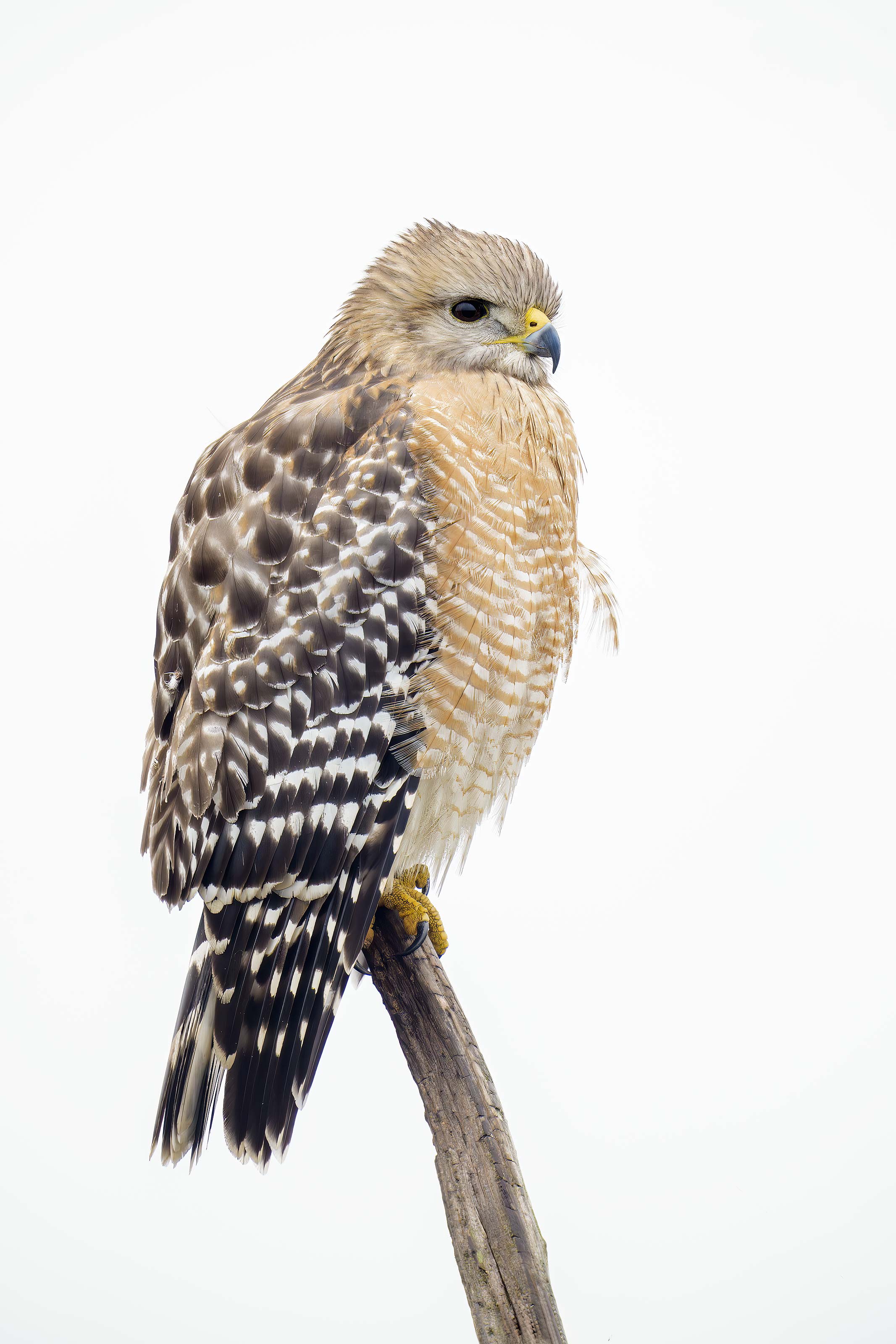
This image was created on 8 December 2025 by yours truly down by the lake near my home at Indian Lake Estates. Seated in the driver’s seat of my SUV, I used the BLUBB-supported Sony FE 600mm f/4 GM OSS lens with the Sony FE 2x Teleconverter and The Latest Greatest Sony Flagship Body, the a1 II Mirrorless Camera. The exposure was determined using Zebra technology with ISO on the Thumb Wheel. ISO 1600: 1/400 second at f/8 (wide open) in Manual mode. RawDigger showed that the exposure was dead solid perfect. AWB at 9:32:04am on a cloudy, overcast morning. Wide/AF-C with Bird-Eye/Face Detection performed perfectly. Click on the image to enjoy the high-res version. Image #1: Red-shouldered Hawk adult on Bob Eastman’s V-perch |
Clean and Tight and Large in the Frame
As far back as the days of film — prehistoric times, I loved working at 1200mm with the 2x TC on a 600mm f/4 lens. A first — 42+ years ago, I assumed that the larger the bird in the frame the better. With digital, I assumed that more pixels on the subject was best. Overtime, I realized that stuffing the bird in the frame was not the way to go. Birds need room in the frame, room to live, room to be. Today, I will often choose a frame where the subject is slightly smaller in the frame as opposed to slightly larger in the frame.
I am 100% happy with the size of the bird in the frame in Image #1.
Loving Overcast, Clouds, and Fog
I absolutely the love soft light on overcast, cloudy, or foggy days. For many reasons:
1- Zero shadows ever.
2- Superb underwing detail with flying birds
3- When there are no shadows, you are not restricted by having to work on or close to sun angle. You can pretty much point your lens anywhere without paying a penalty.
4- While properly exposed to the right raw files made in these conditions often looks flat and washed out, a few simple adjustments in Photoshop, Lightroom, or Capture One, bring the images to life. Easily.
|
|
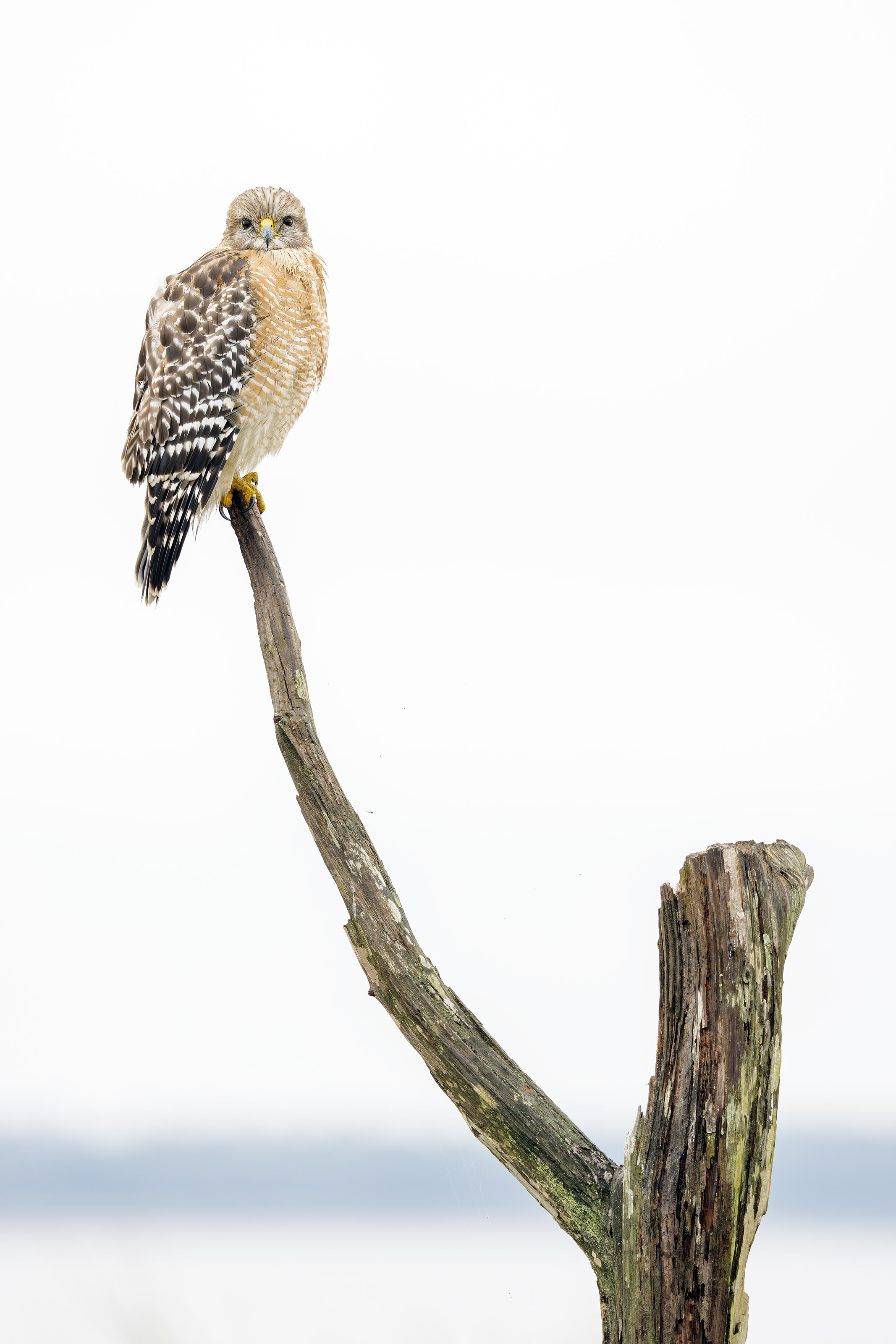
This image was also created on 25 November 2025 by yours truly down by the lake near my home at Indian Lake Estates. Still seated in the driver’s seat of my SUV, for this one I used the BLUBB-supported Sony FE 400-800mm f/6.3-8 G OSS lens (Sony E) (at 615mm) and The Latest Greatest Sony Flagship Body, the a1 II Mirrorless Camera. The exposure was determined via Zebras with ISO on the Thumb Wheel. ISO 1600: 1/160 sec. at f/8 (wide open) in Manual mode. RawDigger showed that the exposure was dead-solid perfect. AWB at 8:57:14 am on a cloudy overcast morning. Wide/AF-C with Bird-Eye/Face Detection performed perfectly. Click on the image to enjoy the larger, inexplicably sharper high-res version. Image #2: Red-shouldered Hawk adult on Bob Eastman’s V-perch |
400-800 Focal Length Versatility
This past week I have had four or five lenses on the passenger seat every morning. My first inclination is always to work tight, thus the 1200mm image above, Image #1. Being sure to first turn the camera off (to close the shutter and minimize the chances of getting any dust on the sensor — as long as your camera is set up as it should be), I switched the a-1 ii to the 400-800. Using the 4-8 on a BLUBB is a bit tricky. Several methods for getting the best results are detailed in the BIRDS AS ART SONY 400-800mm f/6.3-9 G Super-telephoto Zoom Lens Guide. Anyhoo, zooming out allowed me to include the bottom of the-perch as well as the distant shoreline. The latter serves as a base for the image. Exposing well to the right allowed me to bring up the earth tones on the perch during the raw conversion. And Wide AF enabled me to tuck the bird in the upper left corner of the frame for the desired and attractive image design.
The BIRDS AS ART SONY 400-800mm f/6.3-9 G Super-telephoto Zoom Lens Guide
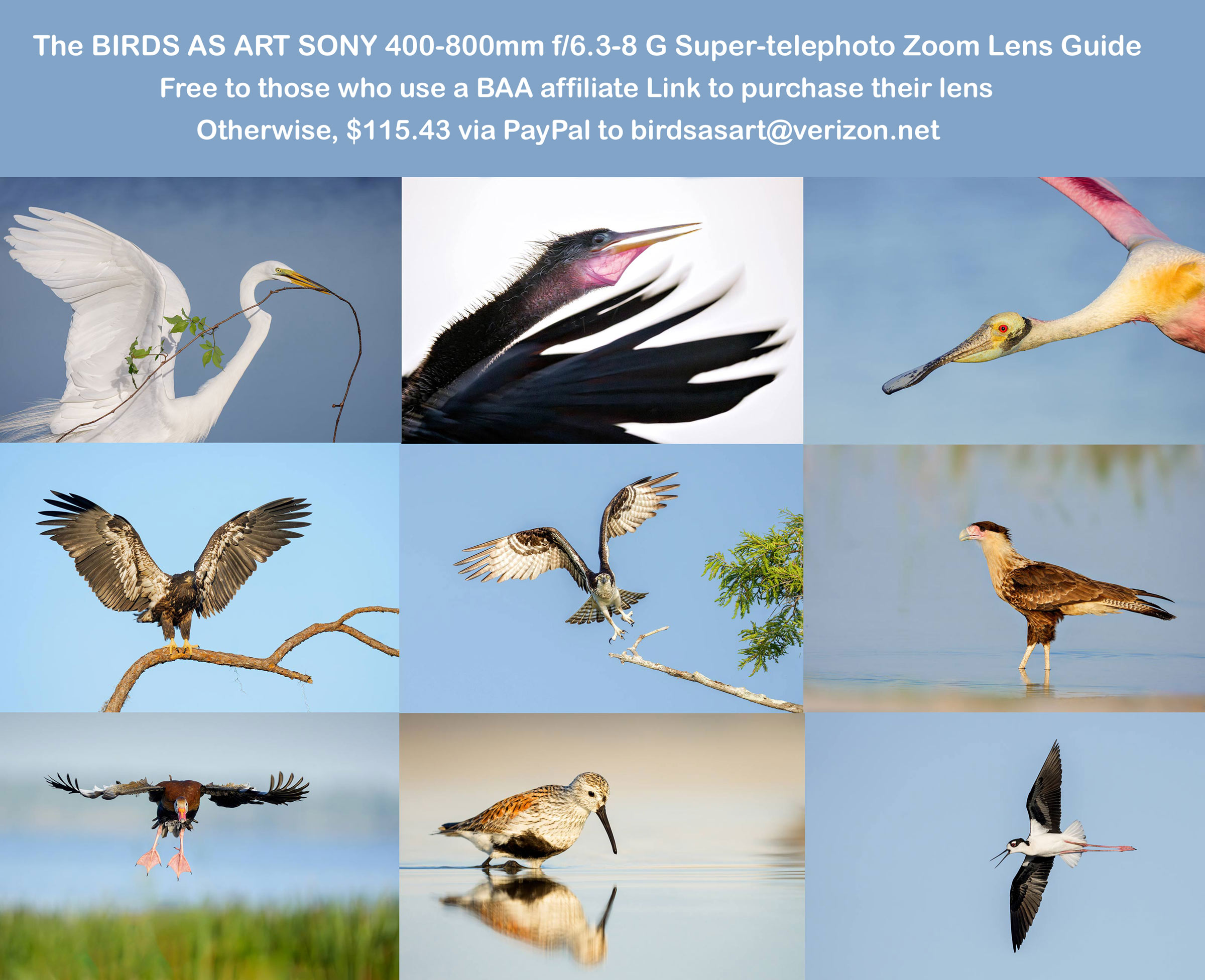
When I borrowed this lens from Sony, I assumed that at 5.45 pounds it was too heavy to handhold for long and that at f/8 at the long end (800mm,) it was too slow for most bird photography applications. In short, I did not want to like the lens. After a month of using it, I cannot live without it. After returning the loaner, I was miraculously able to get my own from Bedfords on 16 April 2025. In this guide I share everything that I have learned about using the 400-800. For best results, you need to know exactly what you are doing to get the most out of this zoom lens. It would be best, therefore, to consider and study the material in the guide so that you can begin making great images with your new lens.
You will learn how to deal with the relatively show apertures: f/6.3, f/7.1, and f/8 when working in Manual mode.
You will learn how to ensure that you are working at the widest aperture by working in Shutter Priority mode with AUTO ISO.
If you are able to hand hold the lens, you will learn proper hand holding techniques.
If you can’t, you will learn when, why, and how to employ other options. Those include:
1- The knee-pod, heel-pod, and toe-pod techniques
2- Using the lens on a monopod.
3- The best lens plate and low foot for your 4-8.
4- The best tripod and head for the 4-8 and how best to utilize them.
5- How to use the lens from your vehicle while supporting it on a BLUBB (or not and why not).
6- Detailed instructions on how to set and use the lens controls and buttons:
a- AF/MF
b- DMF Switch
c- Limit Range Switch
d- OSS (Optical Steady Shot) Switch
e- OSS Mode Switch
f- Focus Hold Buttons
The guide also includes a Hand Holding Shutter Speed Primer and an illustrative, educational, and inspiring 67-image gallery.
Free to folks who use one of my two affiliate links to purchase their Sony 400-800 G lens. Otherwise, please send a PayPal for $115.43 to birdsasart@verizon.net and include the words “400-800 Lens Guide” in your e-mail.
|
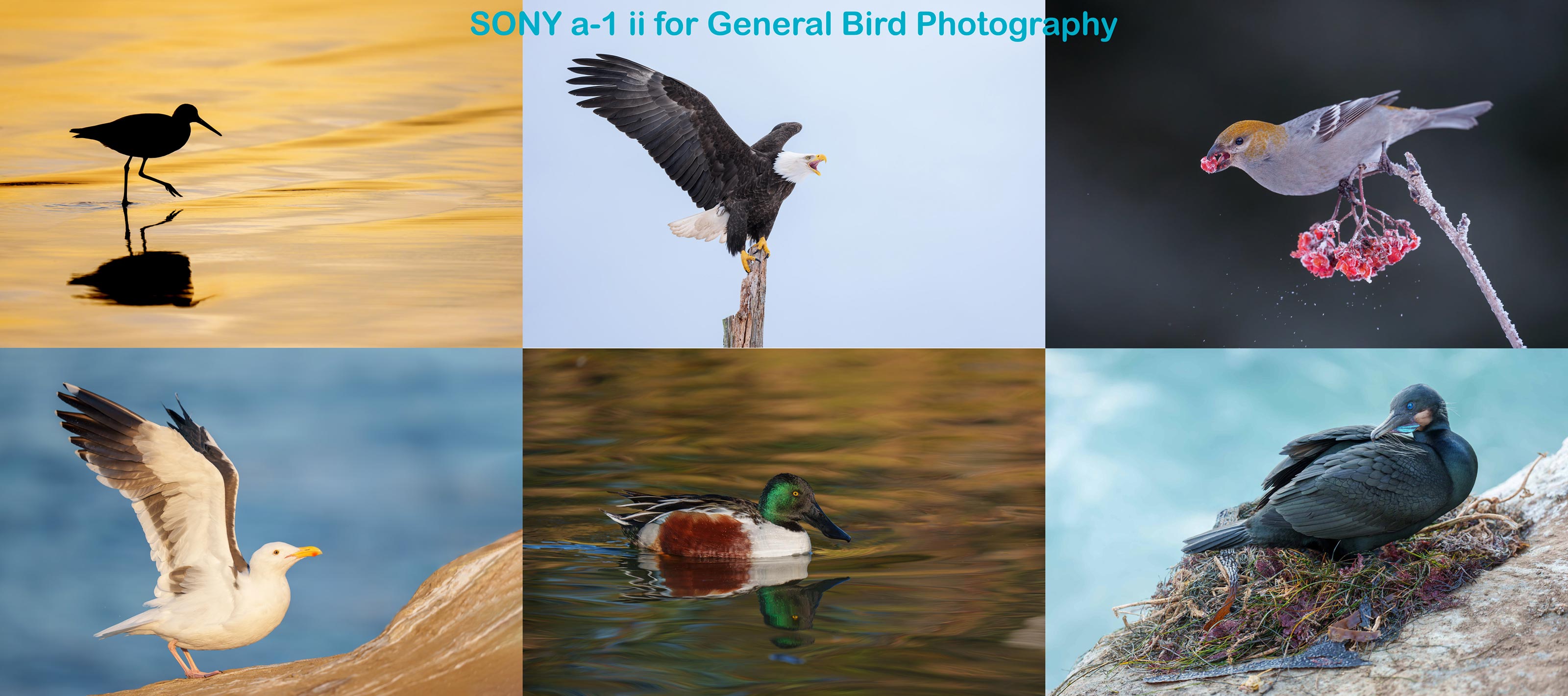
Composite #1: All with the a-1 ii Mirrorless Camera body.
|
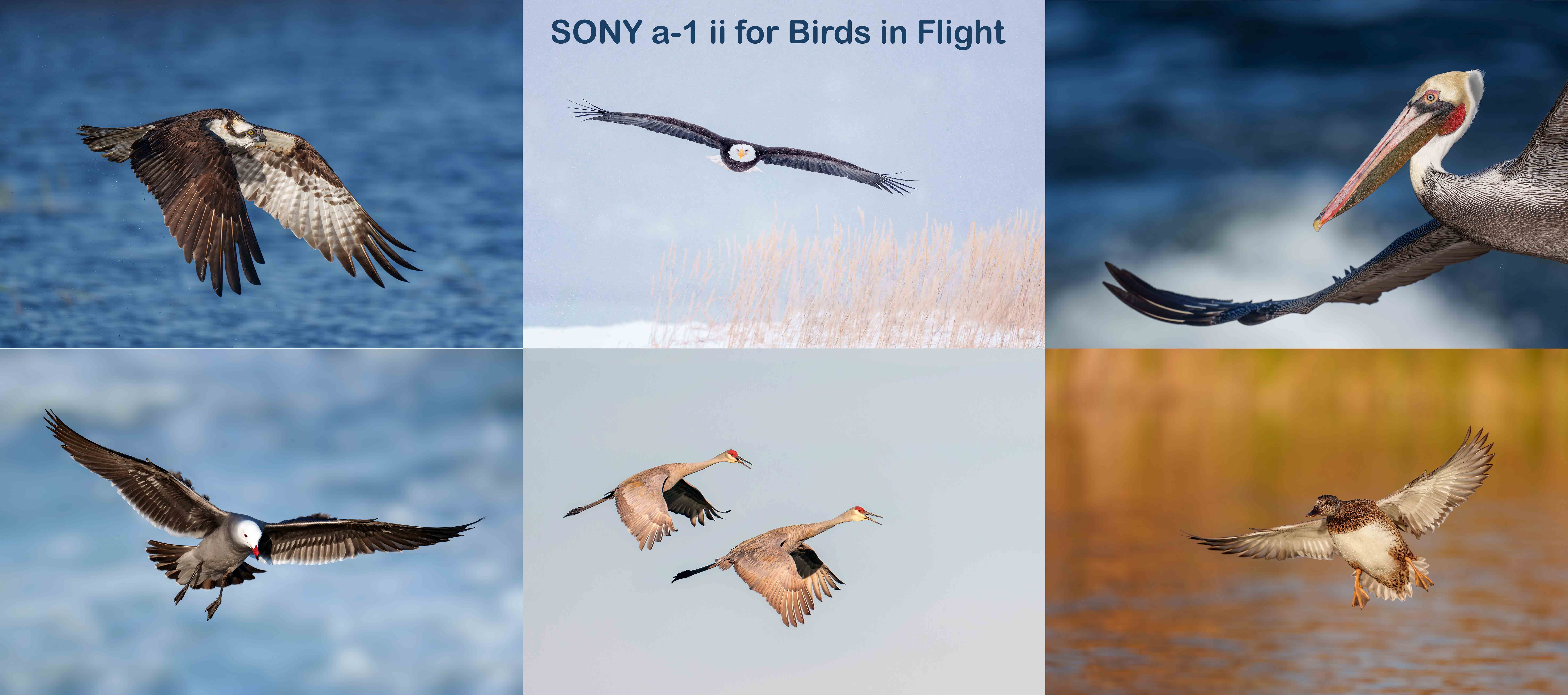
The a-1 ii for General Bird Photography
I have found that eye-tracking for general bird photography with the a-1 ii is far, far better than with the original Sony a-1. It grabs the eye and tracks it faster and far more consistently and focus is rarely lost, even with backgrounds other than sky.
|
Composite #2: All with the a-1 ii Mirrorless Camera body.
|
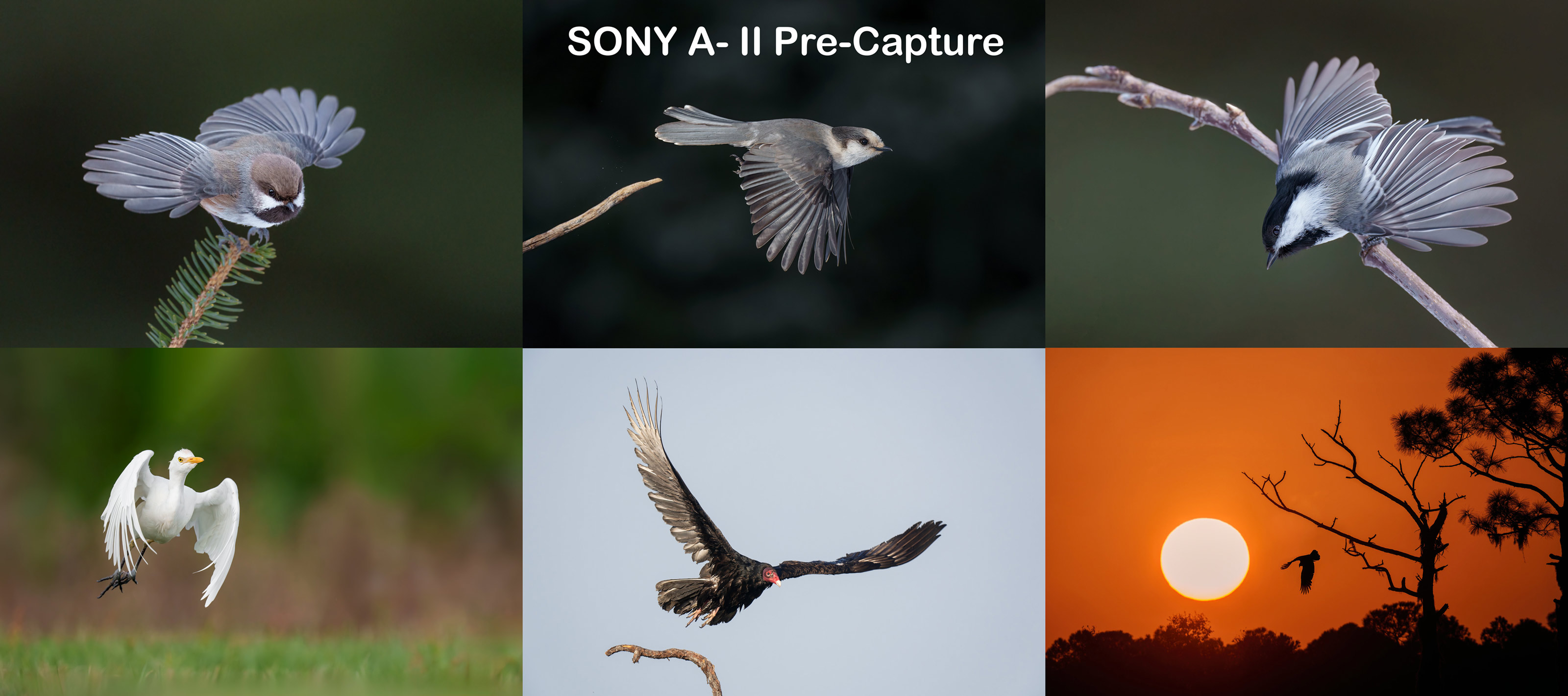
The a-1 ii for Birds in Flight
For birds in flight, the a-1 ii Mirrorless Camera body has no equal. As Arash Hazeghi says, “It is better than the a-1.” When I am late getting on a bird in flight, I have consistently been amazed at how often the AF system of the a-1 ii finds and tracks the bird’s eye.
|
Composite #3: All the result of using Pre-Capture with the a-1 ii Mirrorless Camera body.
|
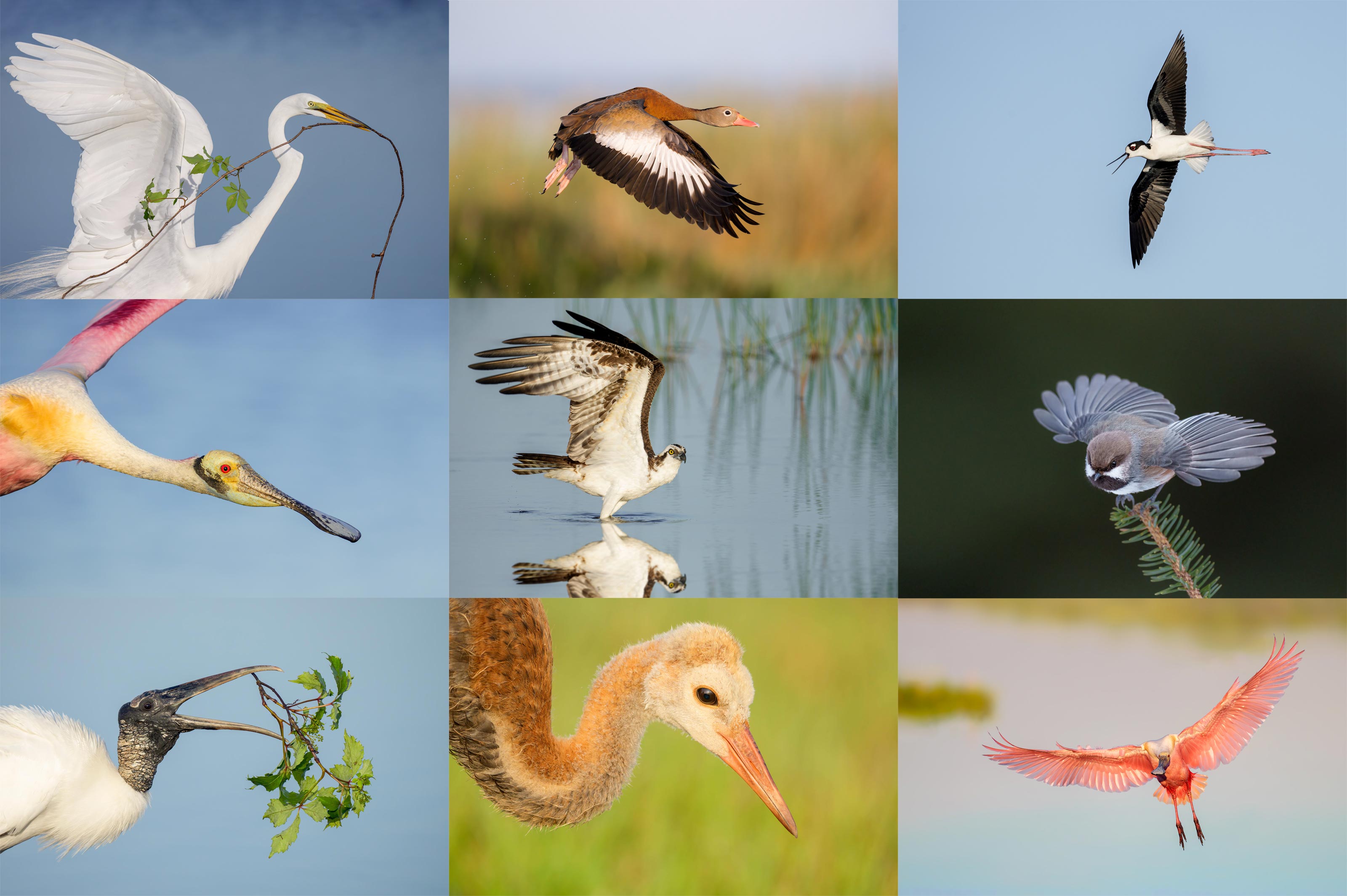
Pre-Capture with the Sony a-1 ii
When it comes to Pre-Capture with the a-1 ii Mirrorless Camera body, Arash and I agree 100%. And with my slower reflexes, Pre-Capture is more important for me than it is for Arash. Understand that in each of the images in Composite #3, I did not push the shutter button until after the bird took flight!
|
All with the a-1 ii Mirrorless Camera body.
|
Purchasing or Upgrading to a Sony a-1 ii
The Sony a-1 ii e-Mail Set-up and Info Guide
I now own and use two Sony a-1 ii bodies. Every day that I use them, the more I am amazed by speed and accuracy of the Bird Face-Eye tracking in AF-C and the overall performance of the camera.
Aside from the improved ergonomics as compared to the a-1, other nice features include the fact that the rear screen tilts both ways — the lack of a tilting rear screen on the original a-1 always ticked me off. Pre-capture has proven to be a huge plus almost exclusively for take-off flight images. In my opinion, the Speed Boost feature is a total waste for bird photography because you should always be utilizing the maximum frame rate. In addition, the resolution on the rear monitor has been improved dramatically. I must mention again that Bird Face-Eye tracking on the a-1 ii is vastly improved as compared to both the a-1 and the a9 iii and that the 51MP files are to die for.
So, the big question is, is the a-1 ii “worth” a gear upgrade. Remembering that I can never know whether or not something is worth it to you, I can say that I was not floored when first using my a-1 ii. The differences between the a-1 ii and the original a-1, seemed to be neither huge nor eye-opening. But over time, I have come to realize that I was 100% wrong. The huge difference between the new camera body and the a9 iii is, of course, the 51MP a-1 raw files (as compared to the 24MP files rendered by the a9 iii).
The price of a new a-1 is $5,898.00. The price of a new a-1 ii is $1,100.00 more: $6,998.00. As the a-1 ii is clearly far superior for bird photography to the original a-1, the choice for folks new to Sony or for those upgrading from lesser Sony camera bodies is an easy one. Prices for used a-1 bodies has not dropped drastically as I anticipated. At this point, a-1 folks who like showing flight and action and can afford an a-1 ii, are advised to purchase an a-1 ii. Please remember that life is short; we only get one ride on the merry-go-round.
If you do purchase an a-1 ii, be sure to use one of my two affiliate links so that you will receive my a-1 ii settings (in the form of a CAMSEa1ii.DAT file), the Buttons and Dials Guide, and an Info Sheet for free. Using my links will never cost you one penny and may actually save you some money. Folks who do not purchase their new a-i using my B&H link or from Bedfords here and entering the BIRDSASART discount code at checkout will be able to purchase the a-1 ii guide for $244.93. If you are at all confused and do not want to screw up your order, please get in touch via e-mail. If you would like to chat about upgrading, shoot me a text to 863-221-2372 and LMK a good time to call you.
Typos
With all blog posts, feel free to e-mail or to leave a comment regarding any typos or errors.







I prefer #2. The first image is a good illustration of a red-shouldered hawk for a birdwatching field guide, but the second places the bird in its environment, and qualifies more as a “bird as art,” rather than mere documentation.
Thank you kindly.
with love, artie
Artie for me#1 if the v perch was a foot shorter on the side of the bird would have been better. Both are great images just a different perspective. I like the second image because of the detail on the main part of the perch or stumpy side. The side of the hawk is quite some distance from the attractive side of the perch with all the detail. Which IMO lends to some isolation from the hawk and the good side of the perch. Artie just used Bedfords for the 70-200 2.8 Z lens Thanks
Thanks Kevin. Especially for using the link! From where I sit I think that the larger and more interesting part of the perch helps moves the viewer’s eye around the frame while balancing the composition nicely. I am looking forward to seeing you and Colleen in San Diego and you in Homer!
Much love, artie
ps: you can see some of Kevin’s great images on the blog here and here.
Tom Redd, J Marr Miller, Maggi Fuller, Steven Pumilia, Anthony Ardito, and David + Policansky: the big question is, what would the verdict have been if the bird had been looking right down the lens barrel at 1200mm?.
Thanks all for leaving a comment.
with love, artie
I would still pick image 2.
I agree 🙂
with love, artie
Well then I’d personally pick #1. But I feel#2 would almost be equally appealing because of the captured setting, putting the subject in context.
Good analysis!
with love, artie
I agree with David Pugsley and James Saxon.
I say #2, and I usually will always go for bigger in the frame, but #2 is just more interesting. Not just the personal touch between you and the bird looking straight at you, but also the details in the perch. Who knows, with a lil artie magic, maybe there’s enough pixels to make #2 like #1
They are both strong images, but I prefer #2, as it tells more of a story.
I have the same problem as John….. I really cannot make up my mind! I love them both.
I like #2 more due to the eyes, distant shoreline, overall composition.
Both are beautiful images but for me, I prefer the straight-on stare of image #2. As for more pixels or more perch? Through the years, I’ve spent a lot of time trying to get great portrait shots, but as I age, I’m now trying to include more environment to go with the pixels on the subject. I have to go again, with image 2. For some viewers, it may add interest to the photo. My two cents.
#2 for me due to the stare and being able to see both eyes. I like the minimalistic look of the image. The perch moves your eye to the bird and the white background lets the bird and perch “pop” in the image. A nice clean photo. Thanks for sharing.
You are welcome James. You make lots of excellent points.
with love, artie
For me, it’s #2 all day. The stare, shape of the perch and the horizon line all make it for me.
Thanks, Pugs. I cannot disagree.
much love, artie
Artie, you’re not making the call easy these days. I like both images! #2 I like because of the leading lines and because of the fact that the Red-Shouldered Hawk is looking straight back at the viewer. I give the edge to #1 though. I wish there was a more of a catchlight in the hawk’s eye, but I like the semi-high key effect and there is something about that stray feather lifted away it’s breast that, to my eye, really helps make the image. Nicely done.
And a vote for #1! While I do think that both are pretty good images, I do have a favorite. ,such love, artie