
Your Call?
Which of today’s five featured images is the strongest? Why did you make your choice. My #1 pick stands well above the other four. I will share my thoughts on that one with you in the next blog post.
My Call
Thanks to the many who commented on Ellen Anon’s incredibly creative photography. My absolute favorite was “Making Tracks,” a photo of dunes in China. Amazingly, that was Ellen’s least favorite. My next two picks were the hummingbird and the Ivory Gull on ice in golden light. Those followed closely by “City Life,” “Angry Birds,” and “The Gift.”
Nickerson Beach Early Season Guide
If you would like to receive an e-mail guide describing where to be in what weather during May and June at Nickerson Beach and what to expect, please send a PayPal for $26.00 to birdsasart@verizon.net. It will include a primer on wind direction and gear suggestions as well as the best locations for mornings and afternoons. There will be an update sent in June before I head home no later than mid-month. This short, informal guide will include specific directions to the three oystercatcher families/nests discussed previously and a recommendation on parking on mornings with winds with an easterly component. Please include the words Nickerson Beach Early Season Guide with your Paypal order. As is usually the case, it is likely that I will put a lot more work into this than I am planning.
What’s Up?
My hand is doing great with zero pain at the incisions. The middle knuckle, the PIP (proximal interphalangeal) joint, on my right ring finger is still a bit stiff as the tendon has been inflamed for so long. It should calm down completely in a week or so. I was tempted to head back to Nickerson Beach on Friday afternoon but decided to skip it as it clouded over.
Today is Saturday 20 May 2026. I will continue doing third and fourth edits of older image files to clear room on my laptop. Whatever you opt to do, I hope that you too choose to have fun and enjoy life. Please remember that happiness is a choice — Byron Katie, The Work.Com
If an item — a Delkin flash card or reader, a Levered-clamp FlexShooter Pro, or a Wimberley lens plate or low foot — for example, that is available from B&H and/or Bedfords, is also available in the BAA Online Store, it would be great, and greatly appreciated, if you would opt to purchase from us. We will match or beat any price. Please remember also to use my B&H affiliate links or to earn 3% cash back at Bedford by using the BIRDSASART discount code at checkout for your major gear purchases. Doing either often earns you free guides and/or discounts. And always earns my great appreciation.
Gear Questions and Advice
Too many folks attending BAA IPTs and dozens of photographers whom I see in the field and on BirdPhotographer’s.Net, are — out of ignorance — using the wrong gear, especially when it comes to tripods and more especially, tripod heads. And the same is true in spades when ordering new camera bodies or lenses. My advice will often save you some serious money and may help you avoid making a seriously bad choice. Please know that I am always glad to answer your gear questions via e-mail. If you are desperate, you can try me on my cell at 863-221-2372. Please leave a message and shoot me a text if I do not pick up.

B&H Simplified
To ensure that I get credit for your B&H purchases, you can always click here. The tracking is invisible. Using my affiliate links is greatly appreciated. And, with B&H, you can use your PayBoo card. You must use the website to order. You cannot get your free guides if you make a phone order. Once you have an item in your cart, you must complete the order within two hours. Huge thanks!
B&H
Many folks have written recently stating that they purchased a Sony a1 from B&H and would like their free membership in the Sony 1 Info and Updates Group, a $150.00 value. But when I check my affiliate account, their orders have not been there. When I let them know that they get credit for B&H purchases only if they use one of the many B&H affiliate links on the blog or begin their searches with this link, they are always disappointed. If in doubt, please contact me via e-mail and request a BH link. I am always glad to help and to guide you to the right gear.

Bedfords Simplified
Click here to start your search. Choose standard shipping, and when you get to the payment page, enter BIRDSASART in the discount code box and hit apply. You will be upgraded to free second day air Fed-Ex and receive 3% cash back on your credit card once your stuff ships. Using either my affiliate links is greatly appreciated and will often earn you free guides or discounts. To receive a free guide or free entry into a Sony Set-up and Info Notes e-Mail group, you need to shoot me your receipt via e-mail. The B&H receipts need to include the order number.
Bedfords Amazing BAA Discount Policy
Folks who have fallen in love with Bedfords can always use the BIRDSASART coupon code at checkout to enjoy a post-purchase, 3% off-statement credit (excluding taxes and shipping charges) on orders paid with a credit card. The 3% credit will be refunded to the card you used for your purchase when your product ships. Be sure, also, to check the box for free shipping to enjoy free Second Day Air Fed-Ex. This offer does not apply to purchases of Classes, Gift Cards, or prior purchases.
You can visit the Bedfords website here, shoot Steve Elkins an e-mail, or text him on his cell phone at (479) 381-2592.
|
|
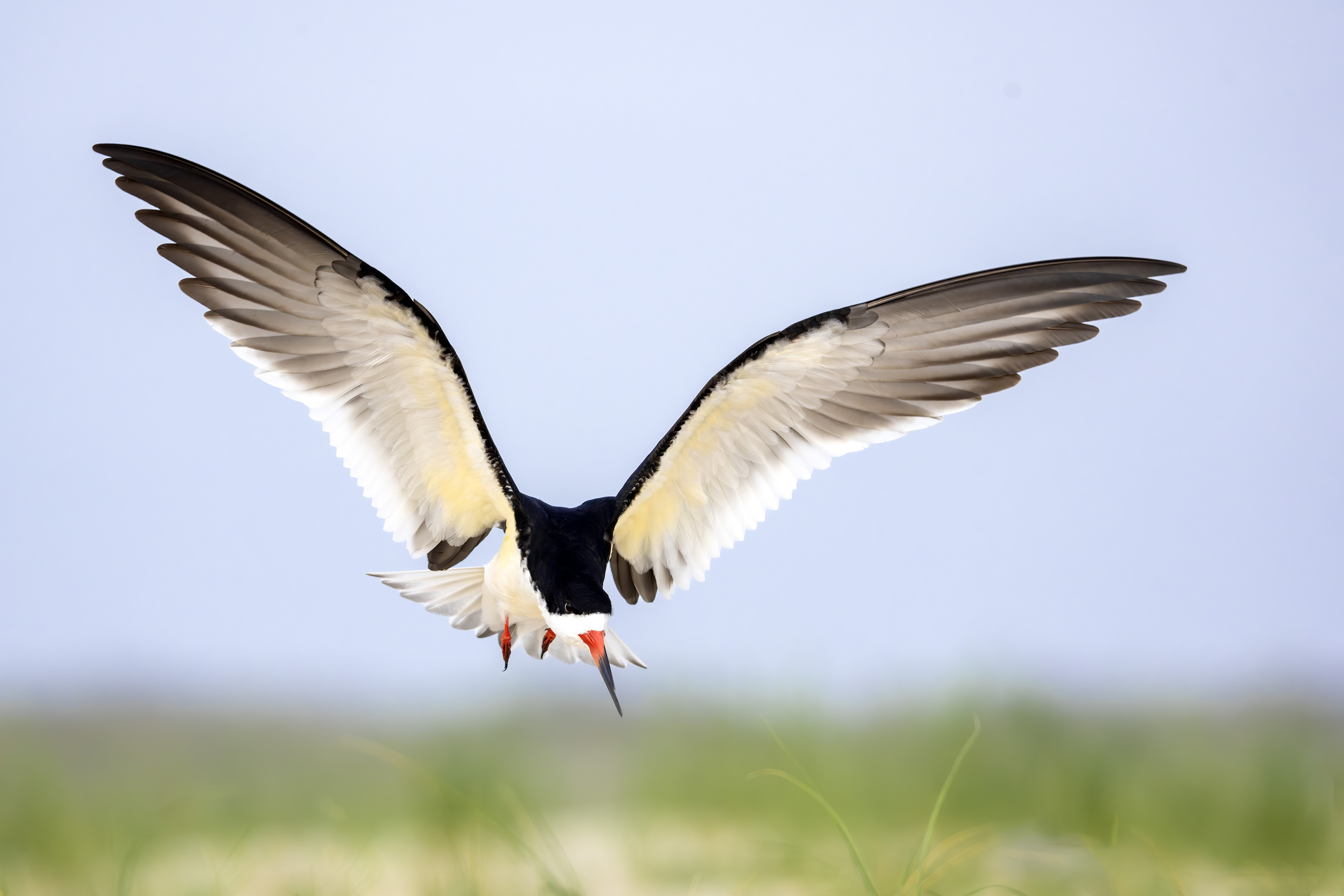
This image was created on 25 May 2026 at Nickerson Beach Park, Lido Beach, Long Island, NY. Seated on dry sand outside the colony ropes, I used the hand held Sony FE 400-800mm f/6.3-8 G OSS lens (Sony E) (at 519mm in full frame mode) and The Latest Greatest Sony Flagship Body, the a1 II Mirrorless Camera. The exposure was determined by Zebras with ISO on the rear wheel — ISO 2500: 1/3200 second at f/8 (wide open?) in Manual mode. RawDigger showed that the exposure was perfect. AWB at 4:33:35pm on a variably sunny afternoon. Wide/AF-C with Bird-Eye/Face Detection performed perfectly. Click on the image to enjoy the larger, inexplicably sharper high-res version. Image #1: Black Skimmer — breeding plumage adult braking to land |
Afternoons are for Skimmers
Sunny afternoons with southwest, west, and best of all, northwest winds, are great for photographing incoming skimmers. Southeast winds are common in the summer and make sunny afternoon flight photography very difficult as the birds are angling away as they land. Like the bird in the image above, many of the skimmers are now sporting the yellow flanks and underwing coverts that signify full breeding plumage. Later in the season, as afternoon temperatures rise, there are lots of midair territorial squabbles.
While I love the pose and the yellow and the beach grasses, this one would have been a bit better if the bird had been an inch or two higher for a bit more separation between the bill tip and the grasses.
|
|
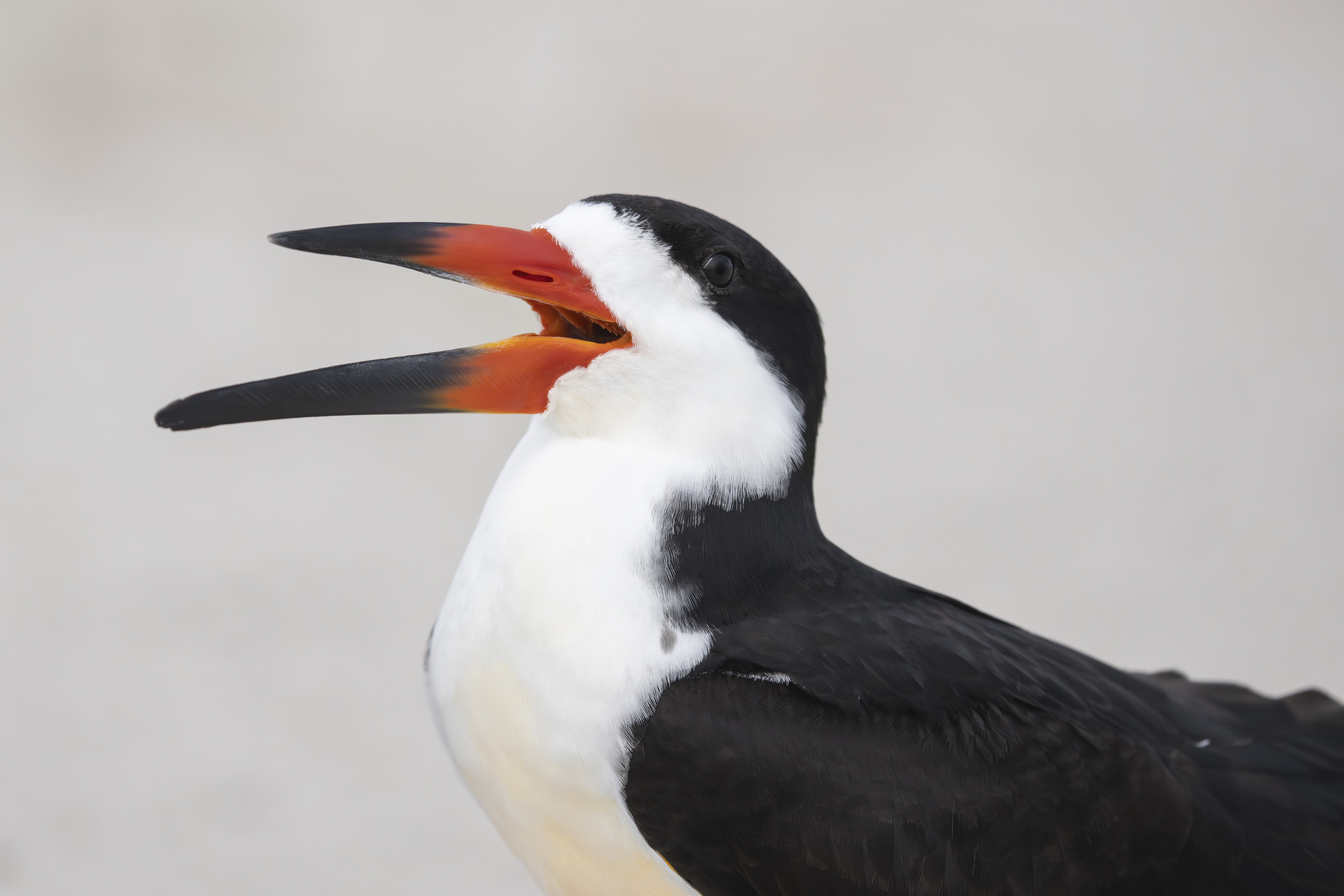
This image was also created on 25 May 2026 at Nickerson Beach Park, Lido Beach, Long Island, NY. Seated on dry sand outside the colony ropes, I used the hand held Sony FE 400-800mm f/6.3-8 G OSS lens (Sony E) (at 800mm in full frame mode) and The Latest Greatest Sony Flagship Body, the a1 II Mirrorless Camera. The exposure was determined by Zebras with ISO on the rear wheel — ISO 2500: 1/4000 second at f/8 (wide open?) in Manual mode. RawDigger showed that the exposure was dead solid perfect. AWB at 4:41:19pm on a variably sunny afternoon. Tracking: center Zone/AF-C with Bird-Eye/Face Detection performed perfectly. Click on the image to enjoy the larger, inexplicably sharper high-res version. Image #1: Black Skimmer — breeding plumage adult head portrait of calling bird |
Stay Low and Sit Still
By staying low and sitting very still, a few skimmers will almost always land near you with impunity. Later in the season, they will often land near you with a nice fish. Close focus for this lens is 11.5 feet at the long end and a very impressive 5.6 feet at 400mm.
|
|
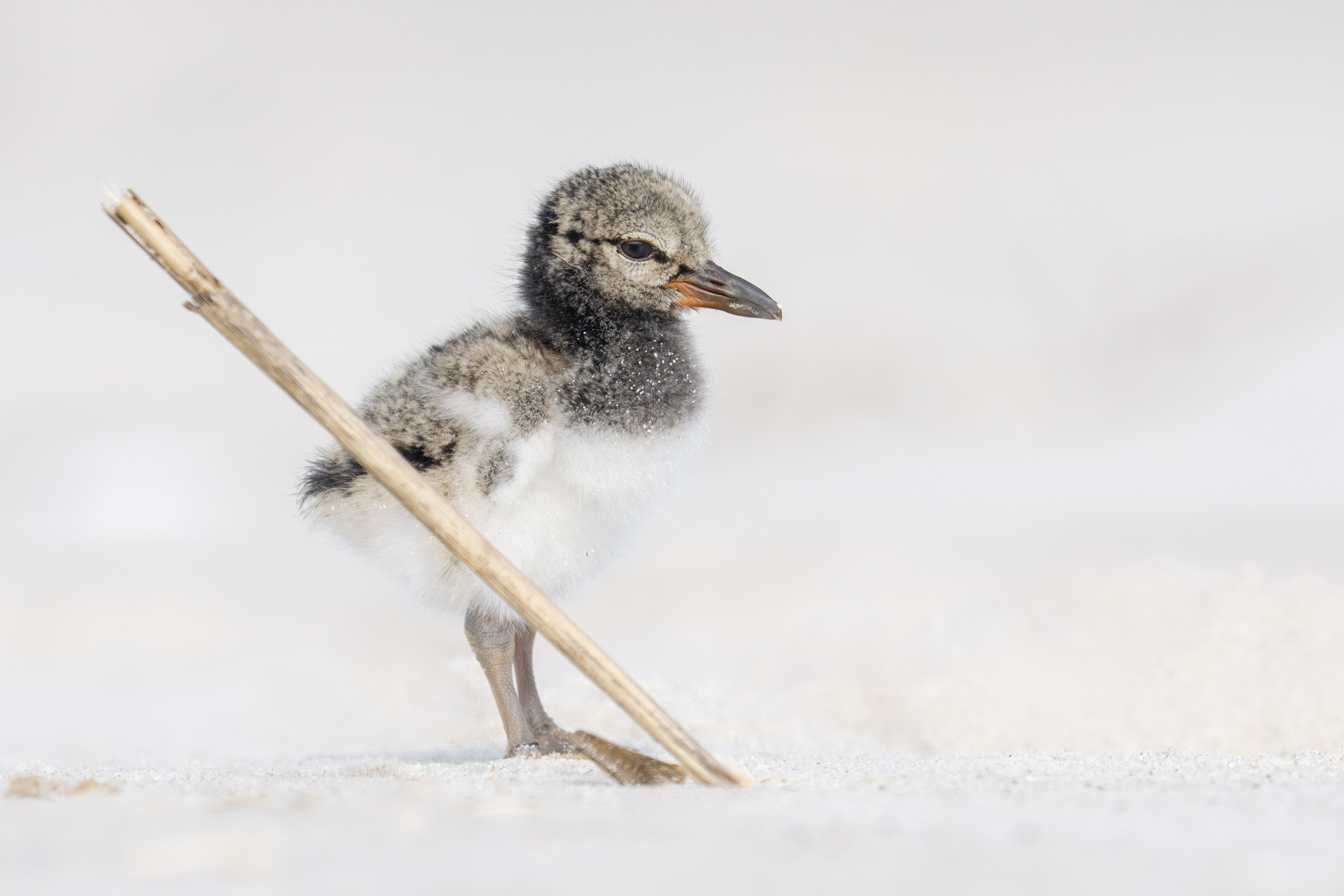
This image was also created on 25 May 2026 at Nickerson Beach Park, Lido Beach, Long Island, NY. Seated on dry sand, I used the hand held Sony FE 400-800mm f/6.3-8 G OSS lens (Sony E) (at 696mm in APS-C crop mode) and The Latest Greatest Sony Flagship Body, the a1 II Mirrorless Camera. The exposure was determined by Zebras with ISO on the rear wheel — ISO 2000: 1/1250 second at f/11 (stopped down one stop) in Manual mode. RawDigger showed that the exposure was perfect. AWB at 5:22:18pm on a variably sunny afternoon. Tracking: center Zone/AF-C with Bird-Eye/Face Detection performed perfectly. Click on the image to enjoy the larger, inexplicably sharper high-res version. Image #3: American Oystercatcher — week old chick next to a stalk stuck in sand |
My Main Reason For Going
The south/southwest winds on Monday after were OK, but not perfect. Why? The sun sets well to the north of west at this time of year. The deciding factor was the three small chick oystercatcher family that I had seen on Saturday morning. I wanted more of them, found them in the exact same spot, and was able to approach them fairly easily. Working in APS-C crop mode had me working at an effective focal length of 1044mm. Do you like the angled stalk or do you find it distracting.
Why f/11?
I stopped down one full stop because I was relatively close to a small subject. It is when you are working close to the Minimum Focus Distance (MFD) of a lens that stopping down can add a bit of additional sharpness. And that goes for double when the subject is a fuzzy chick. Notice that the diagonal stalk is totally unsharp. The total depth of field at about 12 feet at f/8 when working at 696mm is less than 3/5 of a single inch. Understand also that if the distance to the subject is the same, the depth of field will be identical whether you are working in full frame mode or APS-C crop mode. Questions as always are welcome.
In the same vein, understand that resisting the urge to get closer and closer will result is additional depth of field.
|
|
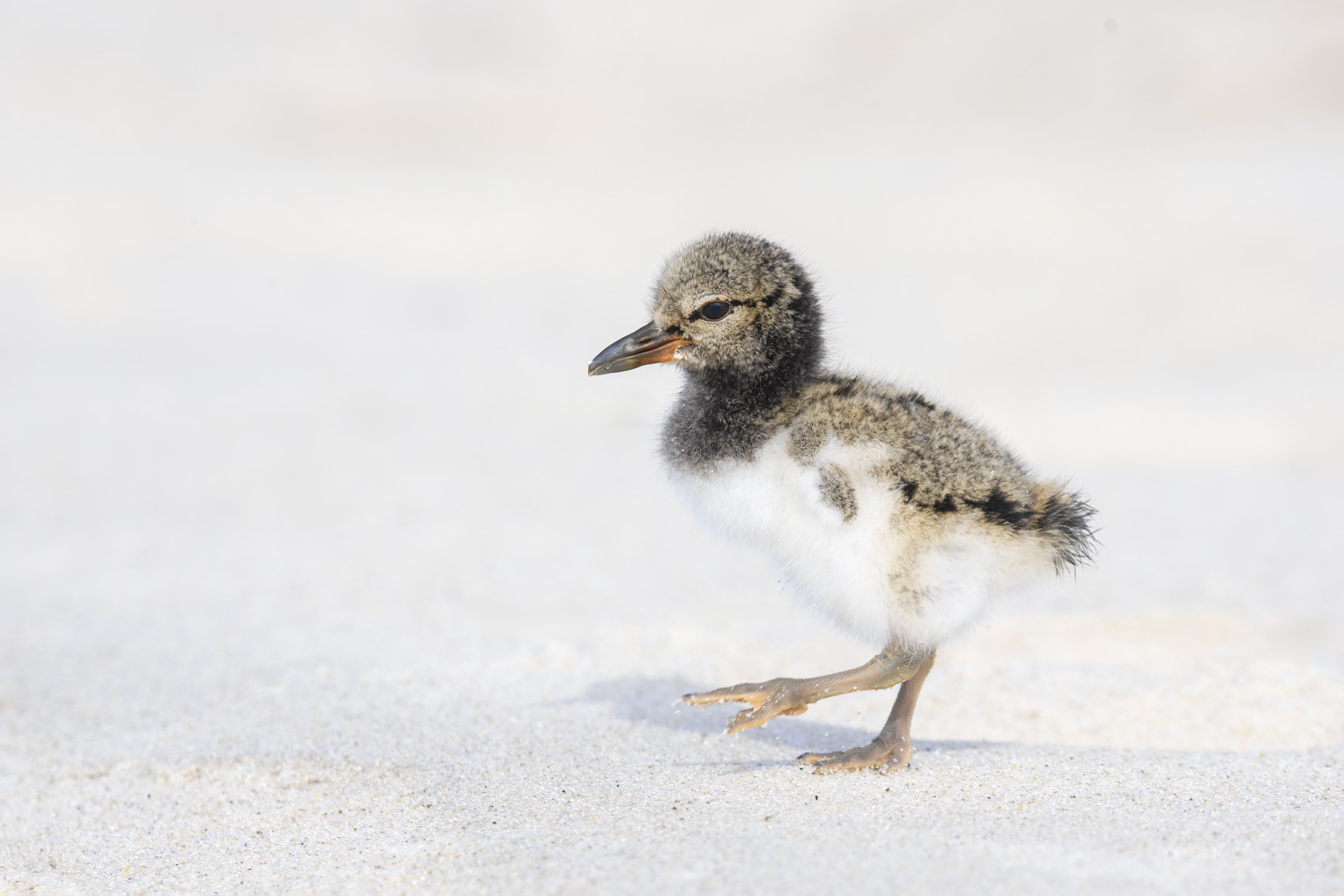
This image was also created on 25 May 2026 at Nickerson Beach Park, Lido Beach, Long Island, NY. Seated on dry sand, I used the hand held Sony FE 400-800mm f/6.3-8 G OSS lens (Sony E) (at 696mm in full frame mode) and The Latest Greatest Sony Flagship Body, the a1 II Mirrorless Camera. The exposure was determined by Zebras with ISO on the rear wheel — ISO 2000: 1/1250 second at f/11 (stopped down one stop) in Manual mode. RawDigger showed that the exposure was perfect. AWB at 5:24:13pm on a variably sunny afternoon. Tracking: center Zone/AF-C with Bird-Eye/Face Detection performed perfectly. Click on the image to enjoy the larger, inexplicably sharper high-res version. Image #4: American Oystercatcher — week old chick on bare sand |
Friendly Chick
When this chick began walking towards me, I hit the Trash Can button to toggle back to full frame mode. Image #3 is a small crop from the original. Had I stayed in APS-C crop mode I would have had trouble fitting the chick in the frame from top to bottom. Do you prefer this one or Image #2?
|
|
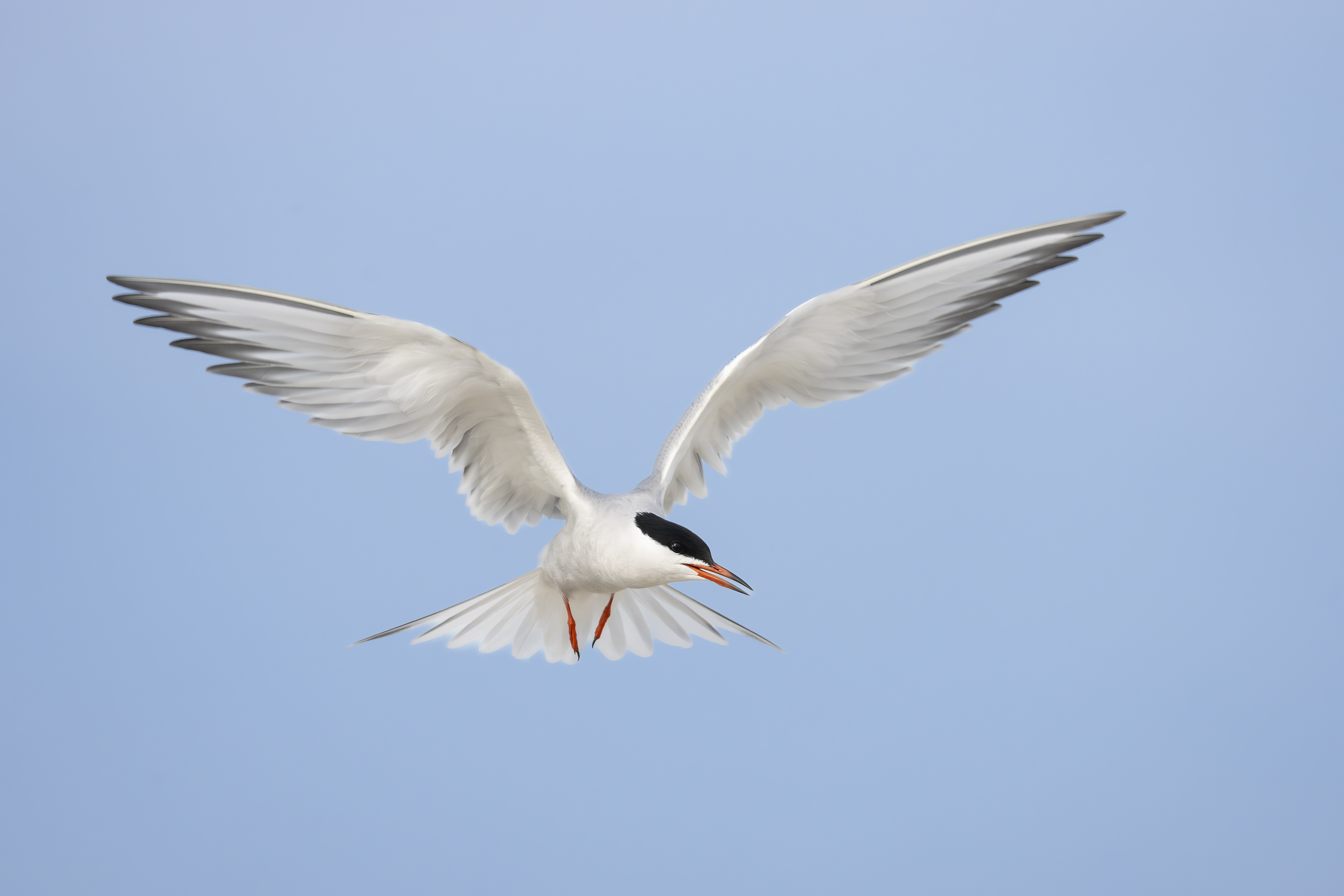
This image was also created on 25 May 2026 at Nickerson Beach Park, Lido Beach, Long Island, NY. Standing at full height I used the hand held Sony FE 400-800mm f/6.3-8 G OSS lens (Sony E) (at 689mm in full frame mode) and The Latest Greatest Sony Flagship Body, the a1 II Mirrorless Camera. The exposure was determined by Zebras with ISO on the rear wheel — ISO 2500: 1/3200 second at f/8 (wide open?) in Manual mode. RawDigger showed that the exposure was perfect. AWB at 5:37:35 pm on a variably sunny afternoon. Wide/AF-C with Bird-Eye/Face Detection performed perfectly. Click on the image to enjoy the larger, inexplicably sharper high-res version. Image #5: Common Tern adult hovering above colony |
400-800 Reach
The incredible reach of the 400-800 (even in full frame mode) allowed me to stand well back from the colony ropes and make some fine images. Note that on bright afternoons with less than full sun getting to 1/3200 and 1/4000 second shutter speeds with the 400-800 (at f/8) usually means ISOs of 2000, 2500, and even higher. I never have a problem with ISOs of 2500 or lower. And I have made some decent images at ISO 10,000 with my a-1 ii bodies.
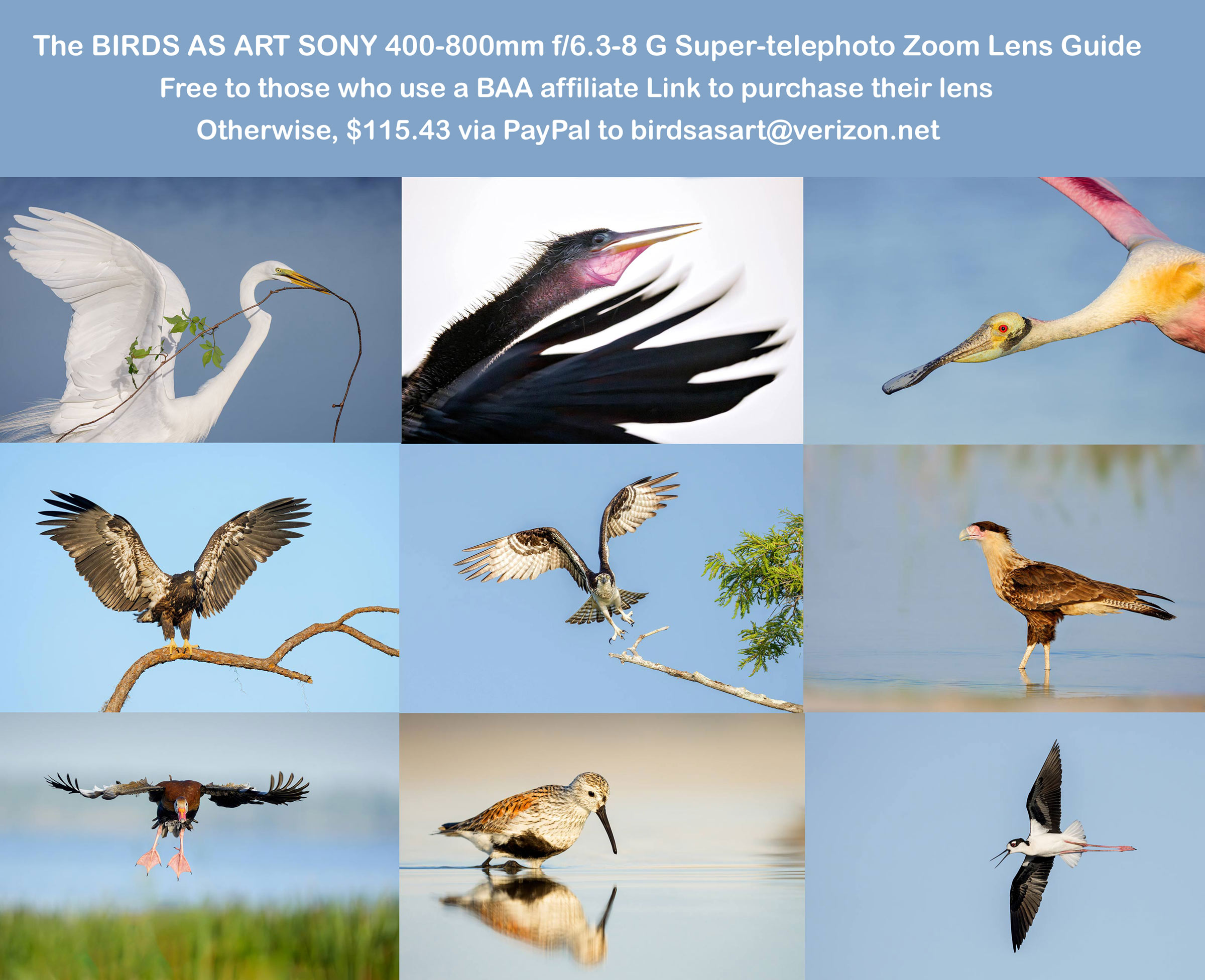
The BIRDS AS ART SONY 400-800mm f/6.3-9 G Super-telephoto Zoom Lens Guide
When I borrowed this lens from Sony, I assumed that at 5.45 pounds it was too heavy to handhold for long and that at f/8 at the long end (800mm,) it was too slow for most bird photography applications. In short, I did not want to like the lens. After a month of using it, I cannot live without it. After returning the loaner, I was miraculously able to get my own from Bedfords on 16 April 2025. In this guide I share everything that I have learned about using the 400-800. For best results, you need to know exactly what you are doing to get the most out of this zoom lens. It would be best, therefore, to consider and study the material in the guide so that you can begin making great images with your new lens.
You will learn how to deal with the relatively show apertures: f/6.3, f/7.1, and f/8 when working in Manual mode.
You will learn how to ensure that you are working at the widest aperture by working in Shutter Priority mode with AUTO ISO.
If you are able to hand hold the lens, you will learn proper hand holding techniques.
If you can’t, you will learn when, why, and how to employ other options. Those include:
1- The knee-pod, heel-pod, and toe-pod techniques
2- Using the lens on a monopod.
3- The best lens plate and low foot for your 4-8.
4- The best tripod and head for the 4-8 and how best to utilize them.
5- How to use the lens from your vehicle while supporting it on a BLUBB (or not and why not).
6- Detailed instructions on how to set and use the lens controls and buttons:
a- AF/MF
b- DMF Switch
c- Limit Range Switch
d- OSS (Optical Steady Shot) Switch
e- OSS Mode Switch
f- Focus Hold Buttons
The guide also includes a Hand Holding Shutter Speed Primer and an illustrative, educational, and inspiring 67-image gallery.
This guide is free to folks who use one of my two affiliate links to purchase their Sony 400-800 G lens. Otherwise, please send a PayPal for $115.43 to birdsasart@verizon.net. and include the words “400-800 Lens Guide” in your e-mail.
Typos
With all blog posts, feel free to e-mail or to leave a comment regarding any typos or errors.








Continued blessings over your recovery and it’s amazing that the surgery hasn’t diminished your enthusiasm for shooting. Chicks are cute, although I am always partial to skimmers. They are a blast to watch and tricky to expose properly because of the stark black and white contrast. Do you bring up your blacks in post to provide some detail in the feathers and eye?
Thanks, Adam. We’ve had this discussion before 🙂 I do not find getting the right exposure for starkly black and white subjects tricky or difficult because I use Sony Zebra technology to push the exposure to the right without toasting the highlights. After that, the first thing I do during the raw conversion is to set the white and black points as detailed in all of the Digital Basics offerings. After that, my standard workflow almost always includes moving the Shadow slider to the right and the Highlight slider to the left. Easy peasy.
a
ps: I do have a new trick with dark eyes set in black feathers that I need to share at some point. Maybe a DB V Video Series 🙂
Hi Artie
All the shots are great – my favorites are the chicks.
In the May 2026 ABA magazine, for the story “The Art of Seeing- technology and connection in the digital age”, written by Julian Hough, you are mentioned! Julian wrote “I was enticed into the art of bird photography by two great photographers, Kevin Karlson and Arthur Morris, and, for me, taking pictures was an extension of artistic creativity rather than a primary ID tool.”
Nice shout out!
Thanks Kerry. Julian is a great friend, a great birder, and a great writer. I loved that article.
I first met Julian in Cape May, NJ a zillion years ago. He, and other British university students (including the very accomplished Richard Crossley) would fly to JFK when school was out and head south to wait tables at various high end Cape May restaurants and take advantage of the great birding while honing their ID skills.
Julian and friends often slept on the floor of our (my late wife Elaine’s and my) tiny apartment in Howard Beach, NY before their return flights to the UK the next day.
with love, artie
Typo (ISO 200)? shutter speeds with the 400-800 (at f/8) usually means ISOs of 200, 2500, and even higher.
Good catch. Thanks and fixed.
a
Hmmm, this is a difficult one for me. I like 3 for the scale the tiny stick provides, 4 for the cleanliness of the scene and the raised foot, and 5 for the dynamic pose and open bill. I guess I’ll go with 4 simply because it’s a once-a-year opportunity.
Well I understand the other choices – and all are obviously great images, but for me it’s the first one. That image is far more unique than the others, both in showing the yellow areas under the wings (which I had not seen before) and the angle of the bird.
Great minds think …
a
I would give my vote for image #1, but you called it, I’d like a bit more separation. So my favorite is image #5. I love the tern with the soft blue background. The color combination tends to grab for me. I agree with Patricia, nice wing position, head angle, along with the fanned tail. It just works.
Glad you on the road to recovery. I like #4 the best. I am a sucker for the babies.
I don’t mind the reed in #3, but I like the catching the foot in full movement in #4.
I also prefer #5. Head angle, simplicity, blue sky.
So glad to hear that you are recovering so well. My favorite today is #5, the common tern hovering. I really like the position of the bird’s wings and tail vis-a-vis it’s head — the black wing tips, whisp of black on the tail and the black cap — lovely! Your other question: I much prefer the little oystercatcher without the stalk — the cleaner the better for me!