
In The Last Blog Post
Thanks to the many who commented. My favorite by a mile was Image #1, the incoming Black Skimmer, because of the sharpness, the wing position, and the yellow underwing linings and flanks. Yes, it would have been a bit better with more separation between the bill tip and the beach grasses but that was not a problem for me in my overall evaluation of the photo.
Your Call?
Which of today’s six South American Canon images is your favorite? Why?
Canon EF 400mm f4 DO IS II USM Lens
William Dummitt is offering a Canon EF 400mm f4 DO IS II USM lens in excellent condition (pristine glass, minor cosmetic wear on the body) for a BIRDS AS ART record low by far $2499.00. The sale includes the lens, front and rear lens covers, the lens trunk (with key), and insured ground shipping via major courier to lower-48 US addresses only. Photos available upon request.
Please contact Bill via e-mail.
Featuring a unique optical design and paired with advanced image stabilization technologies, the Canon EF 400mm f/4 DO IS II USM is a super telephoto lens characterized by its relative light weight and compact form factor. Housed within a weather-resistant barrel, this lens features fluorine coatings on the front and rear elements for protection against fingerprints and other elements that might affect image quality. Canon
I owned, used, and loved this lens for many years when I was a Canon Explorer of Light (one of the original 55!). At 4.63 pounds and with its relatively small size (as mentioned above,) this lens is easily hand holdable for most folks. It performs superbly with a 1.4X TC. I made many memorable images with mine. Folks using Canon mirrorless gear can add one of the EF-R Adapters and expect superbly sharp results even with a 2X TC. A quick internet search for used copies of the 400 DO II found prices ranging from $3,698.35 to $3999.00! Get in touch with Bill and save a slew of dollars. artie
|
|
iPhone image CitiField scoreboard 5/31/2026 |
What’s Up?
On Sunday I took three of my four grandchildren to the Mets/Marlins game. The Mets led the whole game and Juan Soto’s grand slam in the bottom of the sixth put the seal on the deal.
While doing third and fourth edits of old image files to clear additional space on my new suped up Apple 16″ MacBook Pro (M5 Max, Space Black), I came across some neat images from a 2016 trip to The Falklands that had never been optimized. Until Saturday past. On the way to The Falklands, we would always stop in Santiago, Chile for a day. We’d always hire a guide and do some photography on our layover.
I have not been to Nickerson since last Monday afternoon. My hand has been feeling fine but the winds have been terrible: NW in the mornings and E/SE in the afternoons.
Today is Monday 1 June 2026. I will drop by the beach on the way to JFK to pick up my younger daughter Alissa and husband Ajiniyaz after a much-deserved ten-day vacation in Spain. Whatever you opt to do, I hope that you too choose to have fun and enjoy life. Please remember that happiness is a choice — Byron Katie, The Work.Com
If an item — a Delkin flash card or reader, a Levered-clamp FlexShooter Pro, or a Wimberley lens plate or low foot — for example, that is available from B&H and/or Bedfords, is also available in the BAA Online Store, it would be great, and greatly appreciated, if you would opt to purchase from us. We will match or beat any price. Please remember also to use my B&H affiliate links or to earn 3% cash back at Bedford by using the BIRDSASART discount code at checkout for your major gear purchases. Doing either often earns you free guides and/or discounts. And always earns my great appreciation.
Gear Questions and Advice
Too many folks attending BAA IPTs and dozens of photographers whom I see in the field and on BirdPhotographer’s.Net, are — out of ignorance — using the wrong gear, especially when it comes to tripods and more especially, tripod heads. And the same is true in spades when ordering new camera bodies or lenses. My advice will often save you some serious money and may help you avoid making a seriously bad choice. Please know that I am always glad to answer your gear questions via e-mail. If you are desperate, you can try me on my cell at 863-221-2372. Please leave a message and shoot me a text if I do not pick up.

B&H Simplified
To ensure that I get credit for your B&H purchases, you can always click here. The tracking is invisible. Using my affiliate links is greatly appreciated. And, with B&H, you can use your PayBoo card. You must use the website to order. You cannot get your free guides if you make a phone order. Once you have an item in your cart, you must complete the order within two hours. Huge thanks!
B&H
Many folks have written recently stating that they purchased a Sony a1 from B&H and would like their free membership in the Sony 1 Info and Updates Group, a $150.00 value. But when I check my affiliate account, their orders have not been there. When I let them know that they get credit for B&H purchases only if they use one of the many B&H affiliate links on the blog or begin their searches with this link, they are always disappointed. If in doubt, please contact me via e-mail and request a BH link. I am always glad to help and to guide you to the right gear.

Bedfords Simplified
Click here to start your search. Choose standard shipping, and when you get to the payment page, enter BIRDSASART in the discount code box and hit apply. You will be upgraded to free second day air Fed-Ex and receive 3% cash back on your credit card once your stuff ships. Using either my affiliate links is greatly appreciated and will often earn you free guides or discounts. To receive a free guide or free entry into a Sony Set-up and Info Notes e-Mail group, you need to shoot me your receipt via e-mail. The B&H receipts need to include the order number.
Bedfords Amazing BAA Discount Policy
Folks who have fallen in love with Bedfords can always use the BIRDSASART coupon code at checkout to enjoy a post-purchase, 3% off-statement credit (excluding taxes and shipping charges) on orders paid with a credit card. The 3% credit will be refunded to the card you used for your purchase when your product ships. Be sure, also, to check the box for free shipping to enjoy free Second Day Air Fed-Ex. This offer does not apply to purchases of Classes, Gift Cards, or prior purchases.
You can visit the Bedfords website here, shoot Steve Elkins an e-mail, or text him on his cell phone at (479) 381-2592.
|
|
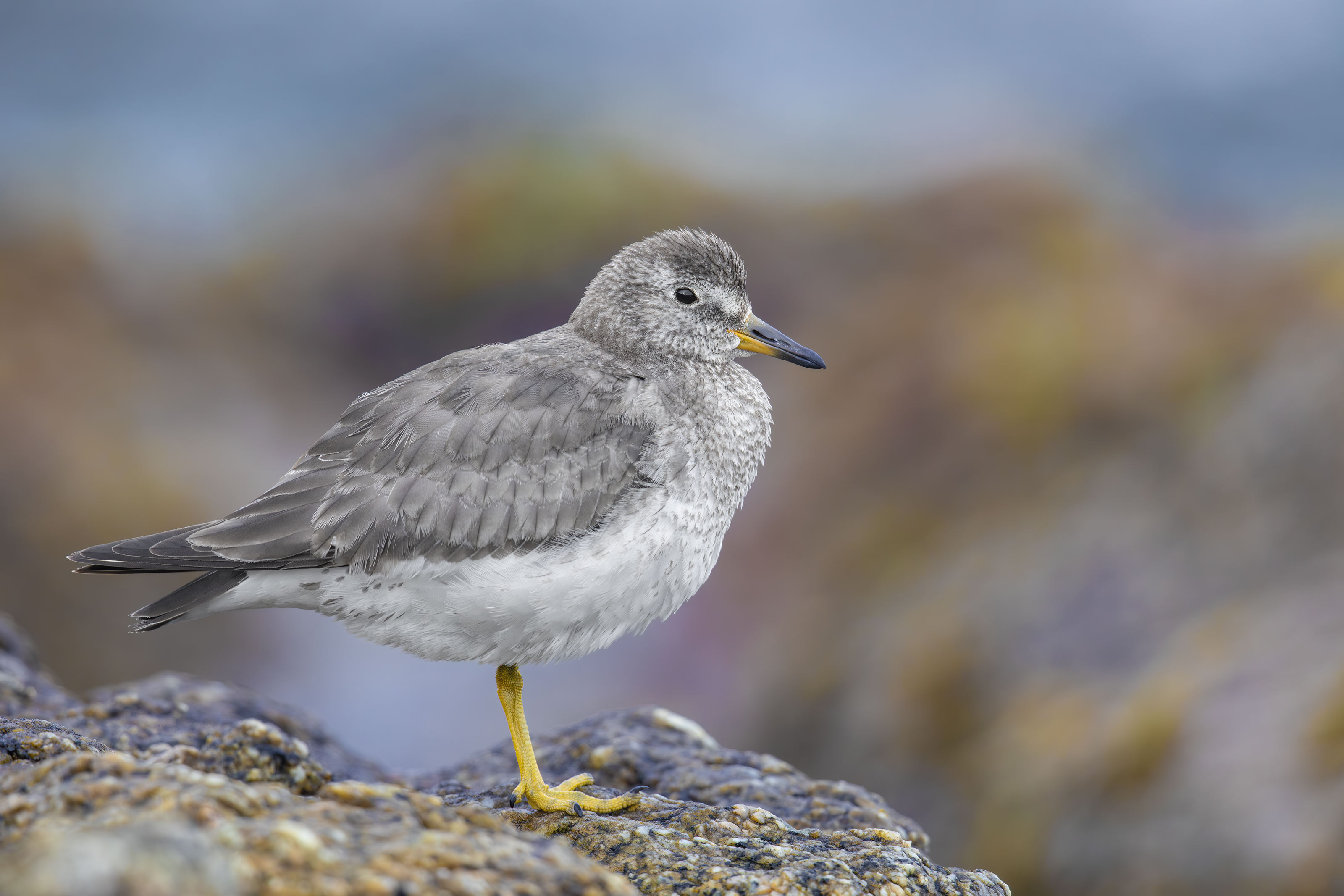
This image was created on 14 October 2016 at Vina Del Mar, Chile. I used the tripod-mounted Canon EF500mm f/4L IS II USM Lens, the Extender 2X III, and the EOS 5D Mark IV. ISO 800: 1/1250 second at f/9 (stopped down 1/3 stop) in Manual mode. Click on the photo to view a larger and inexplicably sharper high resolution version. Image #1: Surfbird in first winter plumage |
This Just In
Not a Knot!
Thanks to old friend Blair Nikula who pointed out that the bird in Image #1 is a Surfbird, not a Red Knot as it was originally labeled. Aside from carelessness and failure to think, my only excuse is that the bird is gray. I just realized that when I saw the worn sub-terminal fringes my brain went directly to Red Knot and never looked back. I have never seen a juvenile Surfbird. Anyhoo, Surfbird is also a long distant migrant.
Red Knot Breeding and Migration
The Red Knot is a champion long-distance migrant. Its range spans across the globe with distinct breeding and wintering grounds for its six subspecies. It nests only above the Arctic Circle on the extreme high Arctic tundras of northern Canada, Alaska, Greenland, and northern Eurasia. They winter along the coasts of southern South America (such as Tierra del Fuego), Africa, Australia, New Zealand, and some milder coastal regions of the US, Mexico, and the Caribbean. They travel up to 9,000 miles each way, making critical stopovers along coastlines and inland bays (like the Delaware Bay) to refuel.
The above is adapted from AI Overview.
Red Knot is one of my favorite shorebirds. I saw literally tens of thousands of them along the Delaware bayshore in the latter part of the last century before Horseshoe Crab populations were decimated by humans. I’ve photographed breeding plumage adults at Fort DeSoto Park in Florida in May just before they depart for their breeding grounds. And I have made images of them in fresh juvenile plumage in New York and in Florida. So, it was a big thrill for me to see and photograph the bird in Image #1 in first winter plumage on the coast of Chile. Note the faint, worn sub-terminal bands on the retained median coverts.
|
|
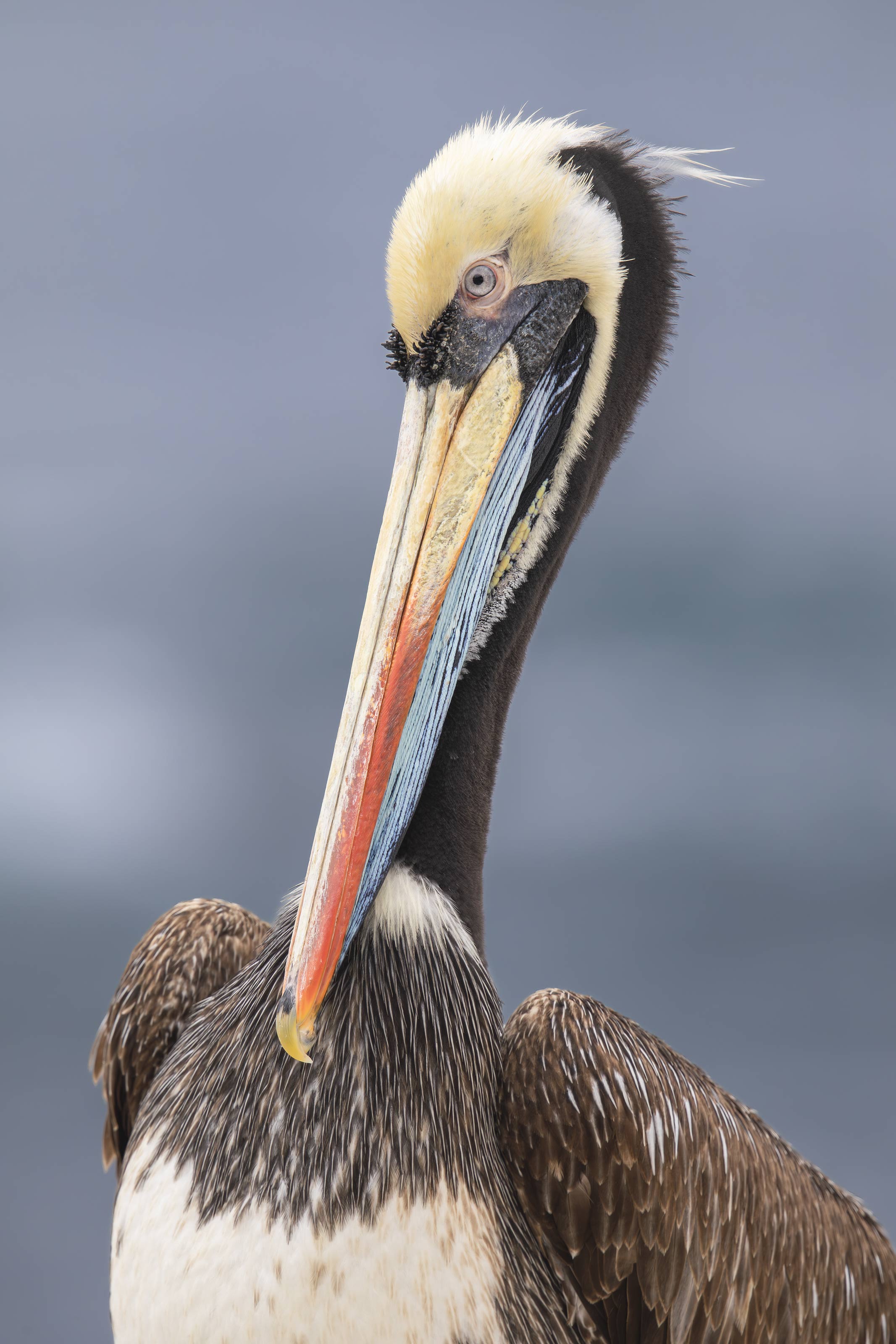
This image was created on 2 December 2016 at Vina Del Mar, Chile. I used the tripod-mounted Canon EF500mm f/4L IS II USM Lens, the Extender 2X III, and the EOS 5D Mark IV. ISO 800: 1/1000 second at f/9 (stopped down 1/3 stop) in Manual mode. Click on the photo to view a larger and inexplicably sharper high resolution version. Image #2: Peruvian (or Chilean) Pelican — Pelecanus thagus
|
Peruvian Pelican (NT: near threatened)
Though closely related, the Peruvian Pelican is almost twice as large as its northern congener, Brown Pelican (Pelecanus occidentalis). This species breeds along the Pacific Coast of South America in Peru and Chile. Though still common, with about half a million breeding adults, the population has been negatively affected by strong El Niño fluctuations and changes in food fish populations, particularly anchoveta. Peruvian Pelican is easily observed from shore as they fly back and forth in nearshore waters by means of soaring interrupted by deep, methodical wingbeats.
The above is adapted from Cornell Lab, Birds of the World.
What can I say? I love pelicans any where any time.
|
|
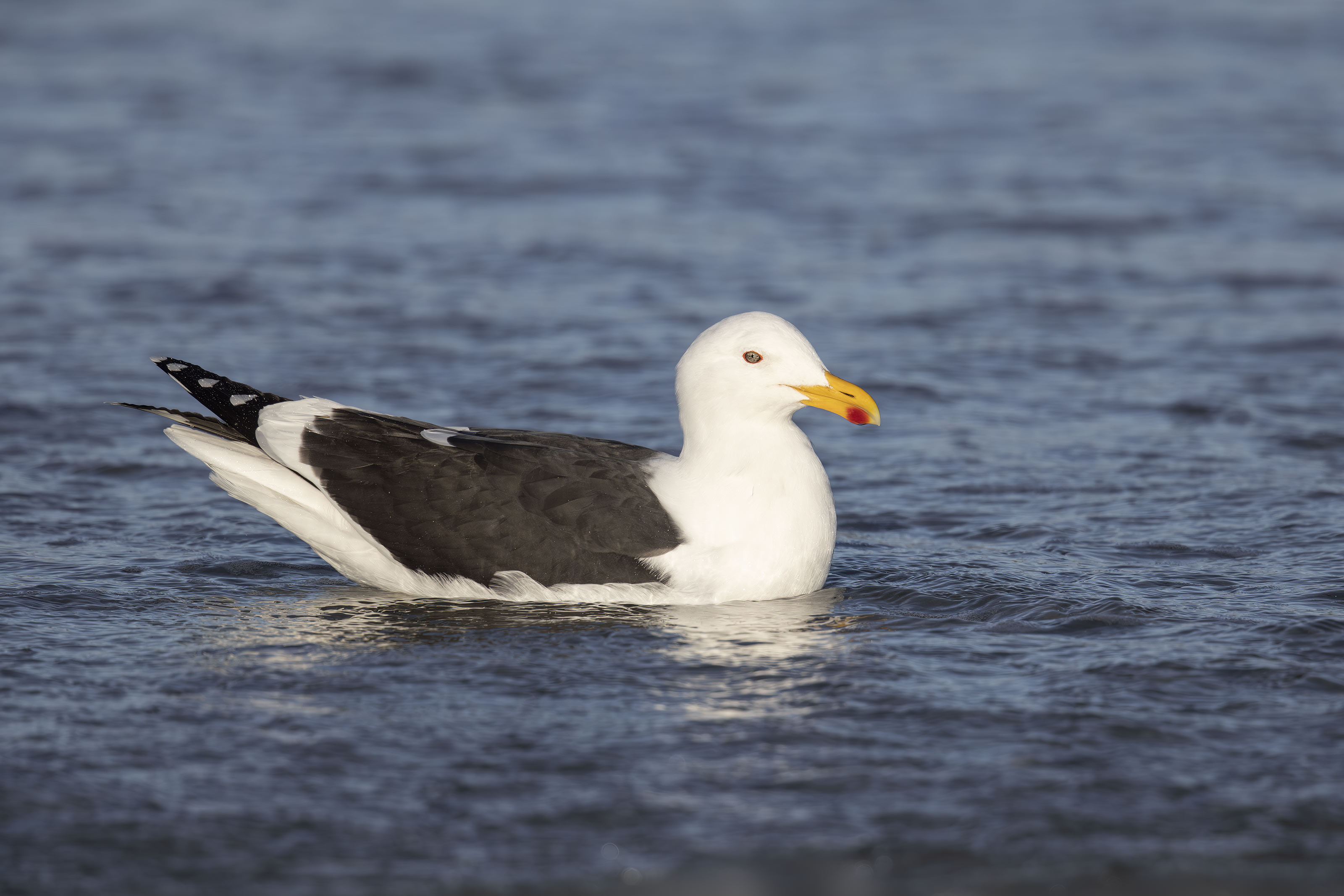
This image was created on 16 October 2016 at The Rookery, Saunders Island, The Falklands. I used the tripod-mounted Canon EF500mm f/4L IS II USM Lens, the Extender 2X III, and the EOS 5D Mark IV. ISO 400: 1/1600 second at f/9 (stopped down 1/3 stop) in Manual mode. Click on the photo to view a larger and inexplicably sharper high resolution version. Image #3: Kelp Gull — breeding plumage adult
|
Kelp Gull
Kelp Gull (Larus dominicanus) is the dominant large gull species of the Southern Hemisphere. It is common throughout the southern part of the South American continent and extends north along the coasts to Ecuador in the west and Brazil in the east, though it is also known as a vagrant and occasional breeder north to the United States as well. Large, with very dark black upperparts and pale yellow-green legs. With close study, this species can be distinguished from other similar gulls in its range. The Kelp Gull feeds on a variety of land and marine animals and also feeds at garbage dumps.
The above is adapted from Cornell Lab, Birds of the World.
This species is seen only rarely in the US. Most amazing was one that nested on a rooftop in Milwaukee, WI in 2025 (and lost its chick). See the FB post here. The same bird returned this spring.
|
|
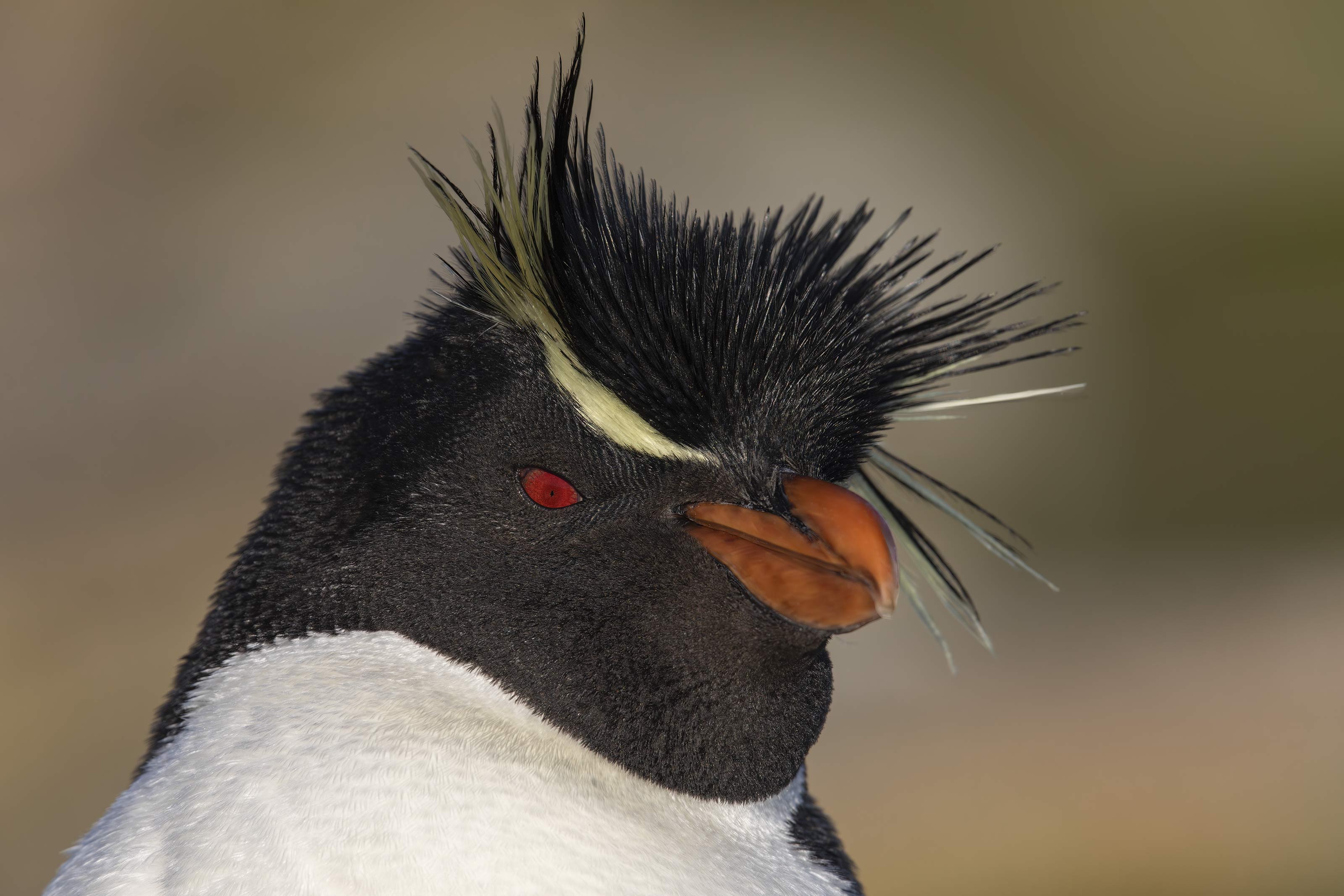
This image was created on 17 October 2016 at The Rookery, Saunders Island, The Falklands. I used the tripod-mounted Canon EF500mm f/4L IS II USM Lens, the Extender 2X III, and the EOS 5D Mark IV. ISO 400: 1/640 second at f/13 (stopped down 1 1/3 stops) in Manual mode. Click on the photo to view a larger and inexplicably sharper high resolution version. Image #4: Southern Rockhopper Penguin with crest raised
|
Southern Rockhopper Penguin (Eudyptes chrysocome)
I have photographed this species on all of my many visits to The Falklands. With their shaggy crests and quirky behaviors — jumping off cliffs!, they are quite charismatic. Stopping down to f/13 here actually helped to sharpen the bill tip (though not completely). When I used Canon gear (for more than 3 decades), I owned both the 500mm f/4 and the 600m f/4 and often chose to travel with the smaller and lighter 500. As always, I have been a huge fan of teleconverters to get more pixels on the subject.
The Rockhopper penguins are three closely related taxa of crested penguins that have been traditionally treated as a single species and are sometimes split into three species. Not all experts agree on the classification of these penguins. Some consider all three to be distinct species, while others separate the western and eastern forms as the southern rockhopper penguin and regard the northern rockhopper as a separate species. Still, some experts view all three as varieties of a single species.
The above is from Wikipedia.
Clipped Crest
I clipped perhaps 1/8 inch of the longest crest feather in the raw file. I expanded canvas using Content-Aware Crop and was stunned to see that the single clipped crest feather was perfectly repaired. As detailed in the The BIRDS AS ART Digital Basics Collection
|
|
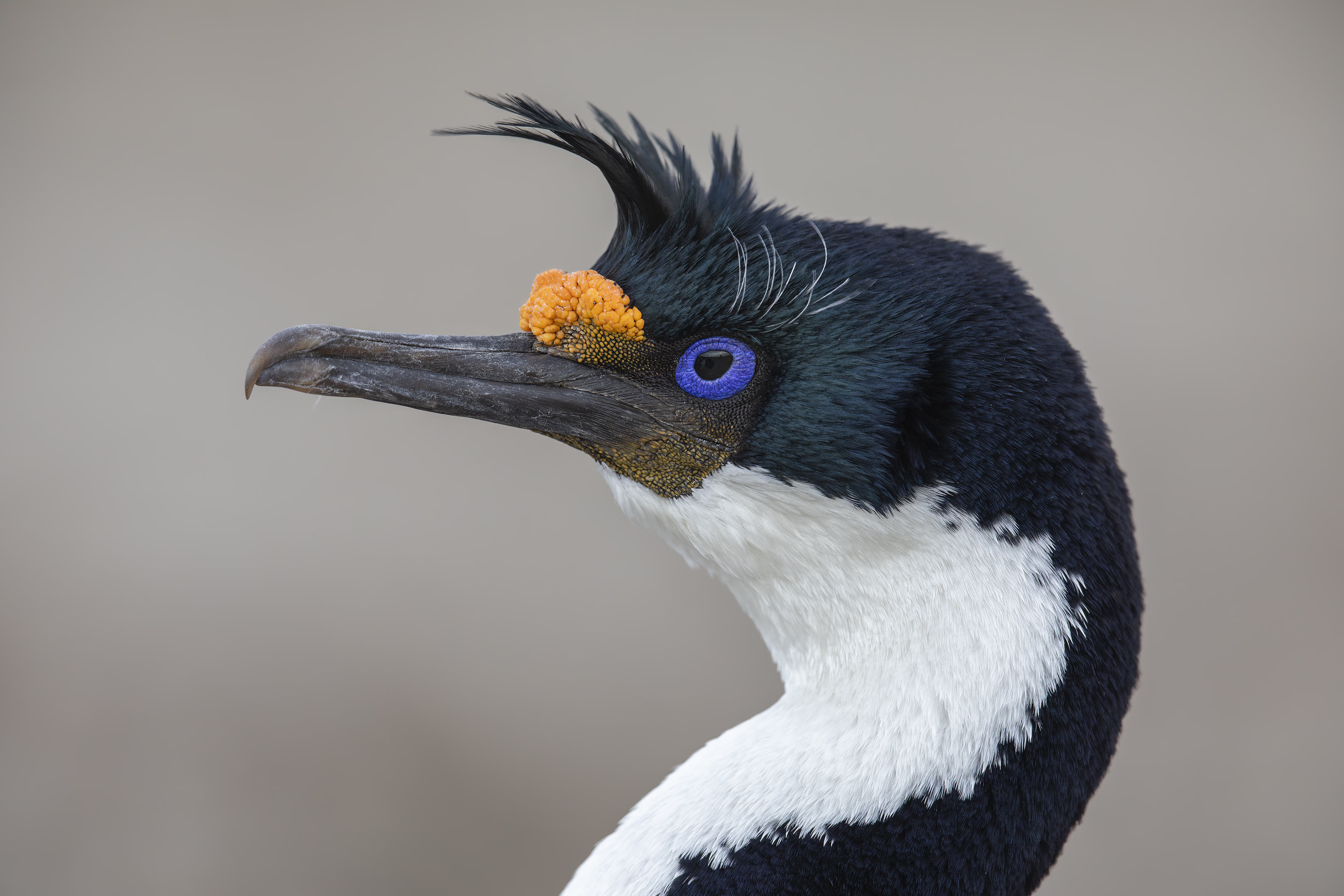
This image was created on 18 October 2016 at Bleaker Island, The Falklands. I used the tripod-mounted Canon EF500mm f/4L IS II USM Lens, the Extender 1.4X III, and the EOS 5D Mark IV. ISO 800: 1/250 second at f/6.3 (stopped down 1/3 stops) in Manual mode. Click on the photo to view a larger and inexplicably sharper high resolution version. Image #5: Blue-eyed Shag — head portrait
|
Blue-eyed Shag
Leucocarbo is a genus of birds in the cormorant and shag family, Phalacrocoracidae. Several species within the genus are collectively known as blue-eyed shags. This is a group of closely related cormorant taxa. Many have a blue, purple or red ring around the eye (not a blue iris); other shared features are white underparts (at least in some individuals) and pink feet.
They are found around the colder parts of the Southern Hemisphere, especially near southern South America, Antarctica, and New Zealand. Many are endemic to remote islands. Determining which types are species and which are subspecies of what larger species is problematic; various recent authorities have recognized from 8 to 14 species and have placed them in a variety of genera. The common names are even more confusing, “like myriad footprints criss-crossing in the snow and about as easy to disentangle.”
The above is from Wikipedia.
The most numerous cormorant in The Falklands is the Blue-eyed Shag (Leucocarbo atriceps albiventer), also know as King Shag, Imperial Cormorant, or some combination of the preceding. They nest along cliffs in very large colonies often numbering thousands of pairs. They are relatively easy to photograph while nesting, in flight, or just hanging out on the edge of a cliff as in Image #5.
|
|
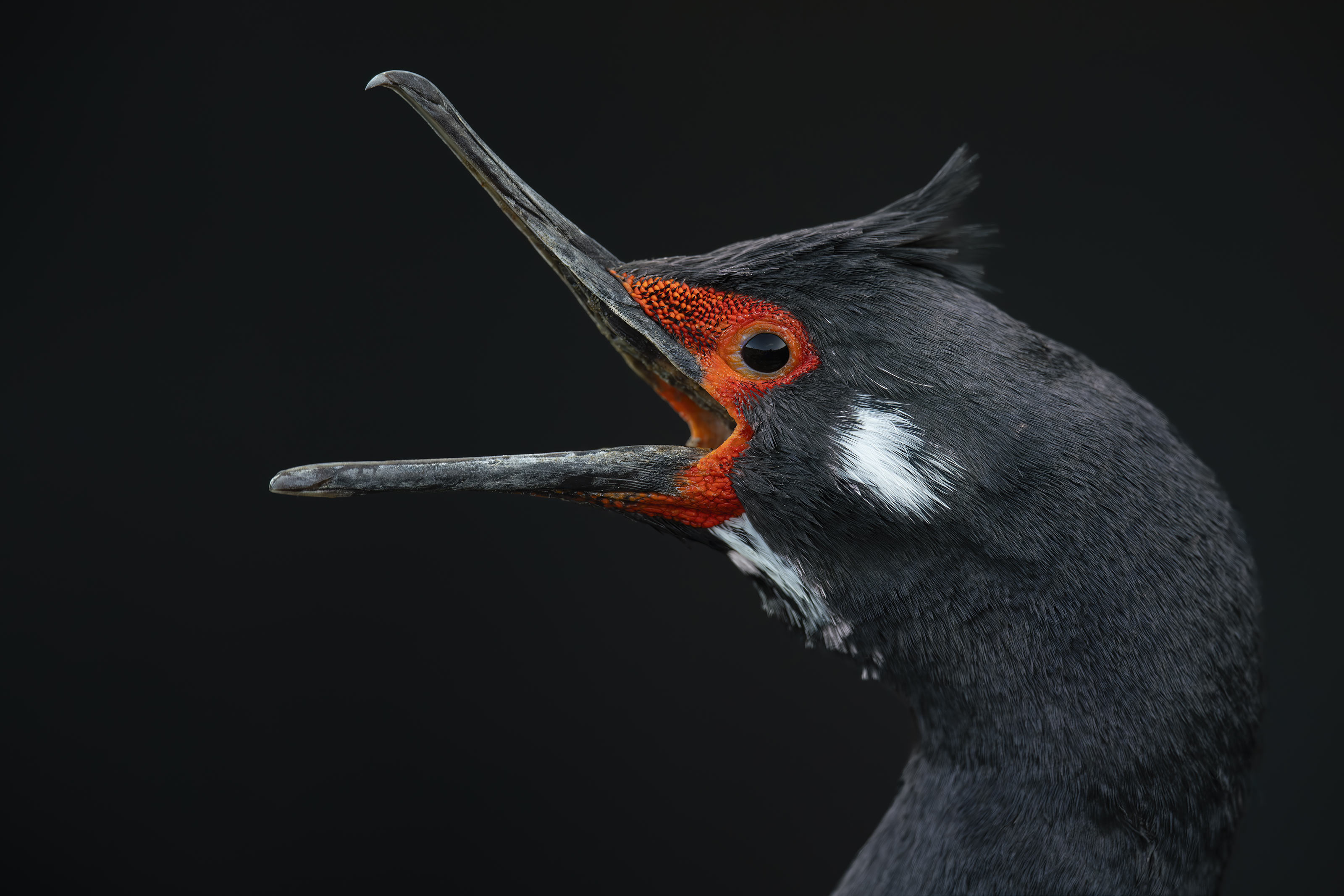
This image was created on 19 October 2016 at Bleaker Island, The Falklands. I used the tripod-mounted Canon EF500mm f/4L IS II USM Lens, the Extender 1.4X III, and the EOS 5D Mark IV. ISO 800: 1/500 second at f/5.6 (wide open) in Manual mode. Click on the photo to view a larger and inexplicably sharper high resolution version. Image #6: Rock Shag — head portrait
|
Rock Shag
The Rock Shag, also known as the Magellanic Cormorant (Phalacrocorax magellanicus), is a distinctive marine bird inhabiting the rugged southern coasts of South America. Belonging to the cormorant family, these seabirds are well-adapted to life along rocky shorelines, where they forage for fish and breed on steep cliffs. Their striking black-and-white plumage, specialized diving behavior, and colonial nesting habits make them a fascinating subject for birdwatchers, naturalists, and wildlife photographers alike.
The above from Earth Life. Learn more about this species here.
In the Falklands, this species is much more difficult to photograph than the Blue-eyed Shag as they nest in small groups often in difficult to access locations. I find that photographing the shags and cormorants (or whatever you call them) is much easier on cloudy days or in the shade than in bright sun. And that goes for double when photographing the white-washed splashed nests.
Head Angle
You can learn a lot about head angles in bird photography by carefully studying today’s six featured images. They range from almost parallel in Image #1 (maybe 1° toward us?) to almost 45° facing in the rockhopper image. The other four photos feature ideal head angles with the bird’s head turned 2 to 4° toward the viewer. When photographing with others, I can tell the inexperienced bird photographers as they will often create images while the bird’s head is turned away. With practice and a bit of concentration it is easy to make a series of images when the head angle is ideal.
|
The Cleanup
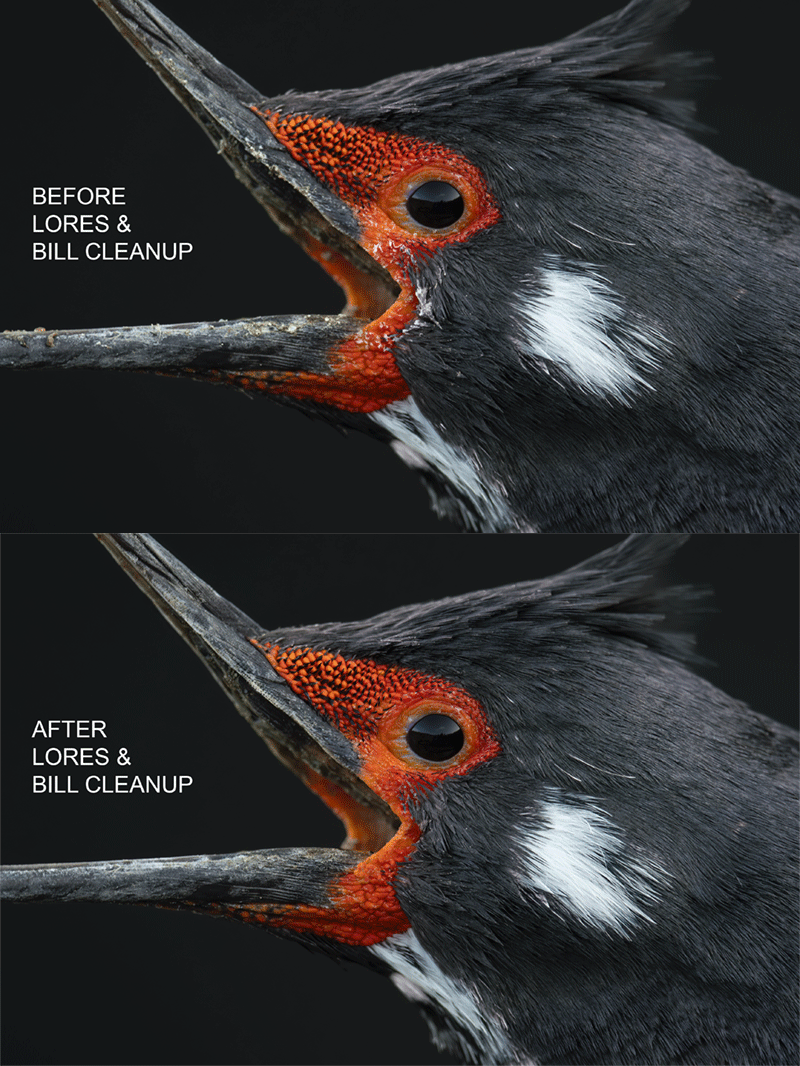
The lores and the base of the bill of this Rock Shag were a mess. The cleanup was done using my usual cadre of cleanup tools: the Remove Tool and the Clone Stamp Tool. The process was tedious but rewarding.

|
The BIRDS AS ART Digital Basics Collection: $199.00. |
The BIRDS AS ART Digital Basics Collection
The best news is that learning to use these tools and techniques to improve your images is made fairly simple for those who purchase, use and study the Digital Basics offerings from BIRDS AS ART. One of the great skills that I have been blessed with is writing coherent how-to instructions that can be followed easily by a third grader. Learn to unlock the potential in your images by purchasing the Digital Basics Collection here. The collection includes the Digital Basics II PDF, and all the videos in the Digital Basics III and the Digital Basics IV Video Series.
The original Digital Basics file was created in the mid-aughts when I saw countless numbers of folks creating sharp, nicely designed, well exposed images and then ruining them in Photoshop. I sold enough copies at $20.00 a pop to pay for my $68,000 lap pool. As my workflow changed and improved, various versions of Digital Basics were created to help folks learn to improve their images at the computer during post processing. Save an incredible $86.00 by purchasing the Digital Basics Collection here. Folks who own one or two of the three afore-mentioned products are invited to contact me via e-maill for personalized discount information.
Typos
With all blog posts, feel free to e-mail or to leave a comment regarding any typos or errors.








Good to know you are human and occasionally (very rarely) make a rushed? mistake. But, hey your crew has your back caught it for you and loves you all the more for how you handle it. Great long ago pic’s. Thanks for sharing. Glad your hand and fingers are doing so well. I have an appt with my Kaiser family doctor to address my trigger finger issues. Any advice or guidance on questions that I should have would be much appreciated. I’m assuming she’ll just refer me to a hand specialist. I’ve watched some YouTube videos. Seems there are different procedures. Any thoughts on what’s best and why in your opinion would be welcomed.
Thanks again for sharing the photos from Canon days long past.
Thank you Jeff for your kind words. Here is what I know: about 70% of trigger fingers disappear after a single cortisone injection. But those are very painful.
I am not aware of any “different” types of surgery other than a-1 pulley release. I will ask Dr. Puopolo about it on Friday and get back to you.
My pleasure.
with love, a
Artie hard to decide between image 4 and image 5. Like the crest and head angle of the rock hopper and the facial and eye colors of the blue eyed shag. The cleanup in image 5 must have taken a while.
Thanks Monte. I hope that you are doing well. About 20 minutes 🙂
with love, artie
Some really lovely portraits and maybe it’s a bit nostalgia but the colors and “look” of the 5dmkiv and 500 IS II images were special. Sure the AF, FPS, etc. pale in comparison to modern bodies, but…
I agree that raw files from different cameras have a slightly different look and color (and often color casts). However, the final look and color is a result of the processing and individual tastes and preferences.
artie
Great Rock Shag clean-up! Goes to show a 10 yo 30mp sensor is no slouch. That’s when we had to work for the keepers when shooting action.
Agree. And that is why I was not good at photographing flight and action — the AF is a thousand times better today 🙂
a
#5, the portrait of a shag — which I’ve never seen before. What a gorgeous bird with it’s black and white coloring, enhanced by the crest, blue eye and yellow above bill. So, this time, I’m voting for the bird — not the photography (although that’s great too!).
Thanks! There are some neat birds down there.
a
Hi Artie,
I hesitate to question you on a shorebird i.d., but look at that bill on the bird in image #1. That’s not a knot bill. And those bright yellow legs don’t fit either. How about a Surfbird?
Thanks, Blair. Total brain damage caused by an incorrect mind set and failing to open my eyes and see. The bird is indeed a first winter Surfbird, another long distance migrant.
That is quite an embarrassing error 🙂
with love, artie