
Your Call?
Which of today’s eight featured songbird images best floats your boat? Why did you make your choice? OK to pick two if you wish.
In the Last Blog Post
Thanks for all the excellent comments at the A Strange But Very Happy Birthday Gift blog post here. Most folks preferred Image #2 because it provided a good view of the bird’s tail. I far preferred image #1 for several reasons, the most important being the more diagonal flow that added tension in the image. And the bird in #1 used a great portion of the frame.
Tom Redd agreed:
I’ll take image numero uno. I like the more vertical wing position and the intense forward lean of the head with its stare.
The always erudite Cliff Beittel went both ways when he wrote:
I’m not sure about the 100:1 difference. Image #2 is the classic pose, more pleasing because of the balance provided by the visible tail, the kind of pose traditionally put on coins to show strength and reliability. But #1 is the image that shows a young Osprey fighting for balance, precarious because the missing tail and lower head suggest it might tip forward.
The funny thing is that when the image was made the wind had dropped away pretty much to nothing.
Summary
In early May, artie spent three mornings photographing at the water feature near the SE corner of the South Padre Convention Center building. He used the tripod-mounted 600mm f/4 GM lens with and without the 1.4X TC. He used both full frame mode and APS-C crop mode depending on the situation. Many migrant songbirds hung around for days after the second fallout and stopped by to drink and bathe. Though all of the species featured today are larger and usually not as fast moving as the warblers featured in the last South Padre post, they still presented a big challenge in part because the area was so cluttered and the light was mixed.
For Sale
Price Reduced $200.00 on 18 June
Souped Up Super-Fast MacBook Pro M2
Yours truly is offering a used, 100% suped up, 2023 MacBook Pro M2 Max in excellent plus condition that was recently refurbished by Apple with a new Logic Board (motherboard) and a new Touch ID Board (track pad). The screen is also in excellent plus condition. Space Gray. Memory: 96GB. macOS Tahoe 26.4.1. Built in Liquid Retina XDR display. — 16-in (3456 X 2234). 8TB Solid State Hard Drive. Apple M2 Max with 12-core CPU, 38-core GPU (MAX Option). I pay the insured Fed-Ex ground shipping. Price: $2,800.00 (was #3,000) or the best offer by 10 July 2026. $2300 minimum offer. Buy it today for $3100.00. Pay by Zelle and we will ship it the next day.
You can see all the technical specifications here.
Virtually the same machine is being offered here for $3999.00. Plus the shipping.
Please contact artie via e-mail or by text to 863-221-2372.
What’s Up?
Bird photography in the morning has been interesting but challenging because of the predominantly SW winds. I lucked out for an hour with the baby Ospreys on Tuesday a.m. thanks to a large bank of marshmallow clouds in the east; the soft light allowed me to shoot well of what sun angle would have been. Once the sun prevails, I have been working the whistling ducks and White Ibises in the bay south of the pier. A few days ago I counted 13 Limpkins feeding in that spot, an ILE record by far. The young spoonbill that had been visiting most mornings last week was joined by a second one for a day but has now disappeared.
I was glad to learn that Bill Dummitt’s Canon EF 400mm f4 DO IS II USM lens sold for $2400.00 this week. Thanks to great friend Kevin Hice for using my B&H link to purchase his maxed out up M5 MacBook Pro. I am glad too that the tendon in my surgically repaired right ring finger is loosening up nicely.
Get well fast wishes to Brian “The Mailman” Bower who fell near his hospital bed after double bypass heart surgery on June 12th hitting his head and possibly breaking his left wrist …
Today is Thursday 18 June — double check that, and I will be headed down to the lake for a morning session. I have been and will be working hard to reverse two cases of online fraud involving more than $48,000.00. I will share the details when all is resolved. Whatever you opt to do, I hope that you too choose to have fun and enjoy life. Please remember that happiness is a choice — Byron Katie, The Work.Com
If an item — a Delkin flash card or reader, a Levered-clamp FlexShooter Pro, or a Wimberley lens plate or low foot — for example, that is available from B&H and/or Bedfords, is also available in the BAA Online Store, it would be great, and greatly appreciated, if you would opt to purchase from us. We will match or beat any price. Please remember also to use my B&H affiliate links or to earn 3% cash back at Bedford by using the BIRDSASART discount code at checkout for your major gear purchases. Doing either often earns you free guides and/or discounts. And always earns my great appreciation.
Gear Questions and Advice
Too many folks attending BAA IPTs and dozens of photographers whom I see in the field and on BirdPhotographer’s.Net, are — out of ignorance — using the wrong gear, especially when it comes to tripods and more especially, tripod heads. And the same is true in spades when ordering new camera bodies or lenses. My advice will often save you some serious money and may help you avoid making a seriously bad choice. Please know that I am always glad to answer your gear questions via e-mail. If you are desperate, you can try me on my cell at 863-221-2372. Please leave a message and shoot me a text if I do not pick up.
|
|
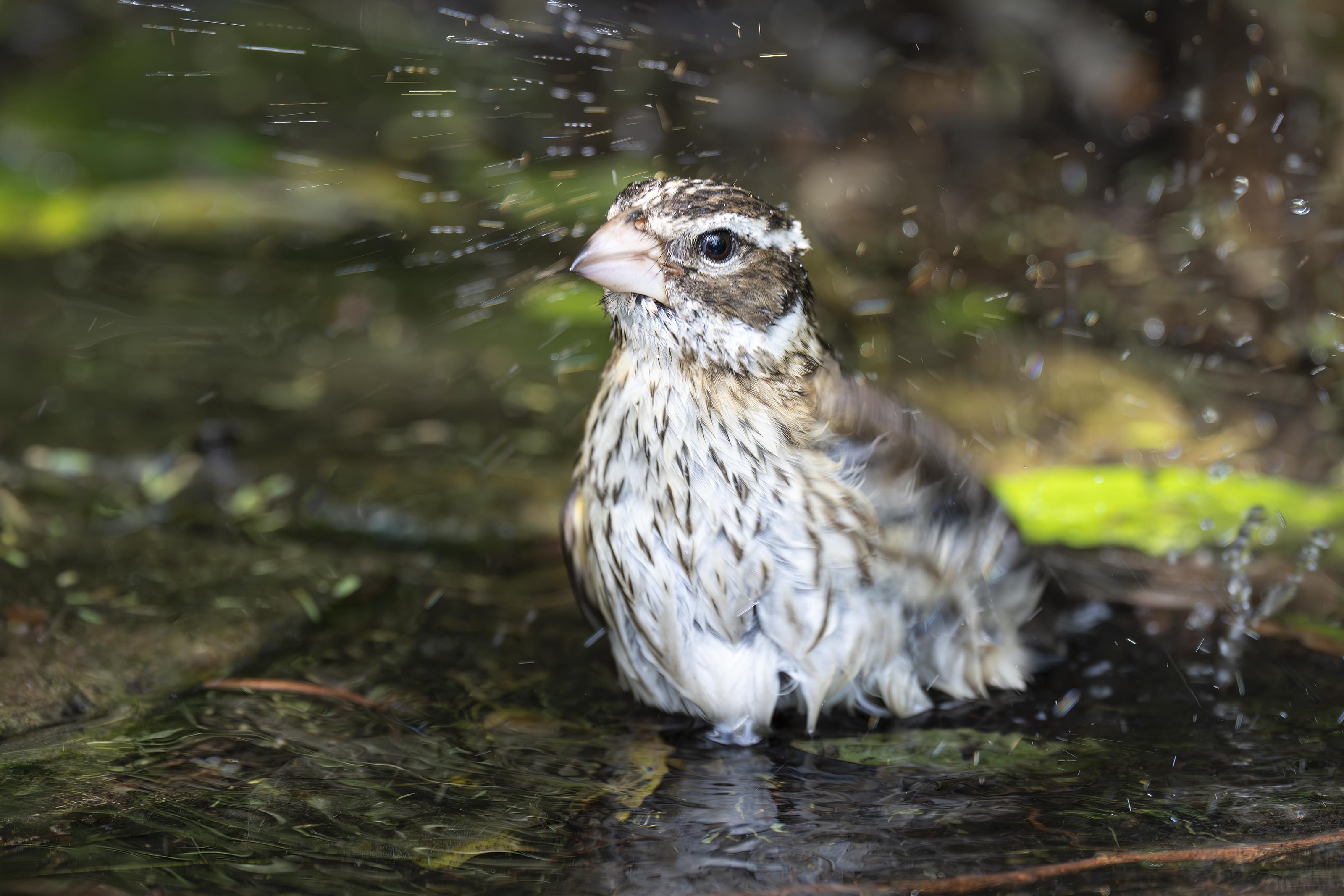
This image was created on 3 May 2026 by yours truly at the water feature at the Convention Center on South Padre Island, TX. Standing at full height, I used the Robus RC-5570 Vantage Series 3 Carbon Fiber Tripod/Levered-Clamp FlexShooter Pro-mounted Sony FE 600mm f/4 GM OSS lens and the Latest Greatest Sony Flagship Body, the a1 II Mirrorless Camera in APS-C crop mode. The exposure was determined by Zebras with Exposure Compensation (EC) on the thumb wheel. Multi Metering -1.3 stops. AUTO ISO set ISO 640: 1/400 second at f/4 (wide open) in Shutter Priority mode. AWB at 9:59:17am on a sunny morning. Tracking: Zone/AF-C with Bird-Eye/Face Detection performed perfectly. Click on the image to enjoy a larger, inexplicably sharper high-res version. Image #1: Rose-breasted Grosbeak female bathing |
Why Shutter Priority?
A Rehash/Review
Lighting conditions at the water feature can vary dramatically from deep shade to bright sun. I realized immediately that for me, working in Shutter Priority Mode with AUTO ISO and Exposure Compensation (EC) on the Thumb Dial would be faster by a mile than working in Manual mode. Why? Because once I selected a workable shutter speed, the only thing I needed to adjust was the EC. And Sony’s Zebra technology always made it easy to get to the right neighborhood in what can only be described as difficult conditions for making perfect exposures. Note that with the very dark backgrounds I wound up under-exposing the subjects a bit so that I did not toast any of the highlights.
|
|
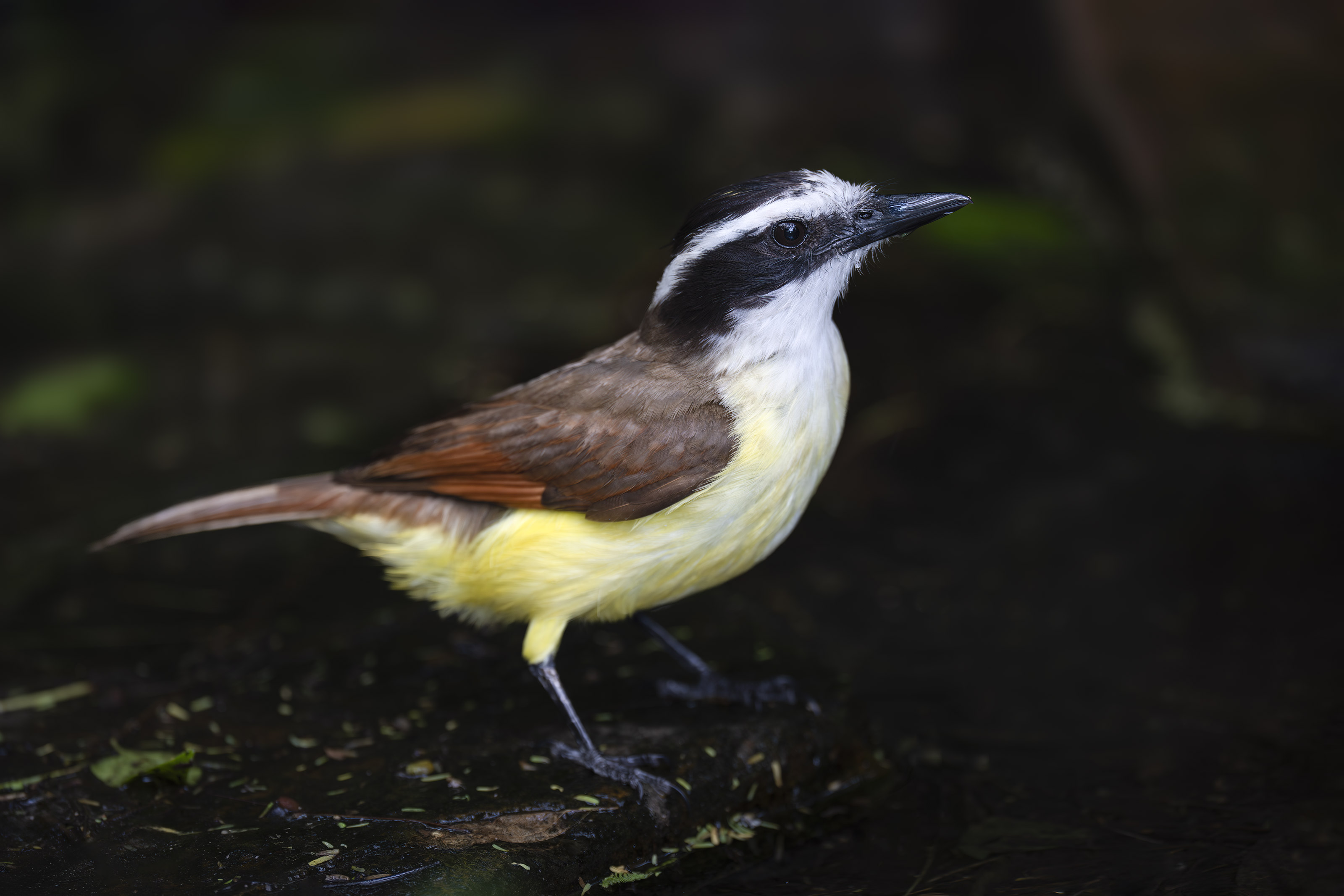
This image was created on 3 May 2026 by yours truly at the water feature at the Convention Center on South Padre Island, TX. Standing at full height, I used the Robus RC-5570 Vantage Series 3 Carbon Fiber Tripod/Levered-Clamp FlexShooter Pro-mounted Sony FE 600mm f/4 GM OSS lens and the Latest Greatest Sony Flagship Body, the a1 II Mirrorless Camera in full frame mode. The exposure was determined by Zebras with Exposure Compensation (EC) on the thumb wheel. Multi Metering -1.7 stops. AUTO ISO set ISO 500: 1/160 second at f/4 (wide open) in Shutter Priority mode. AWB at 8:22:07am on a sunny morning. Tracking: Zone/AF-C with Bird-Eye/Face Detection performed perfectly. Click on the image to enjoy a larger, inexplicably sharper high-res version. Image #2: Great Kiskadee |
Not a Migrant
Great Kiskadee is a permanent, year-round resident throughout its entire geographic range that includes the Lower Rio Grande Valley in southern Texas south through Mexico, Central America, and most of South America down to central Argentina. Though there are several nesting pairs on South Padre Island, they are very difficult to photograph. I was thrilled when this bird came in for a drink. As soon as I saw it come down to the upper pool I quickly toggled out of APS-C crop mode. That done I barely fit the bird in the frame; I needed to add a bit of canvas to the images as presented above.
|
|
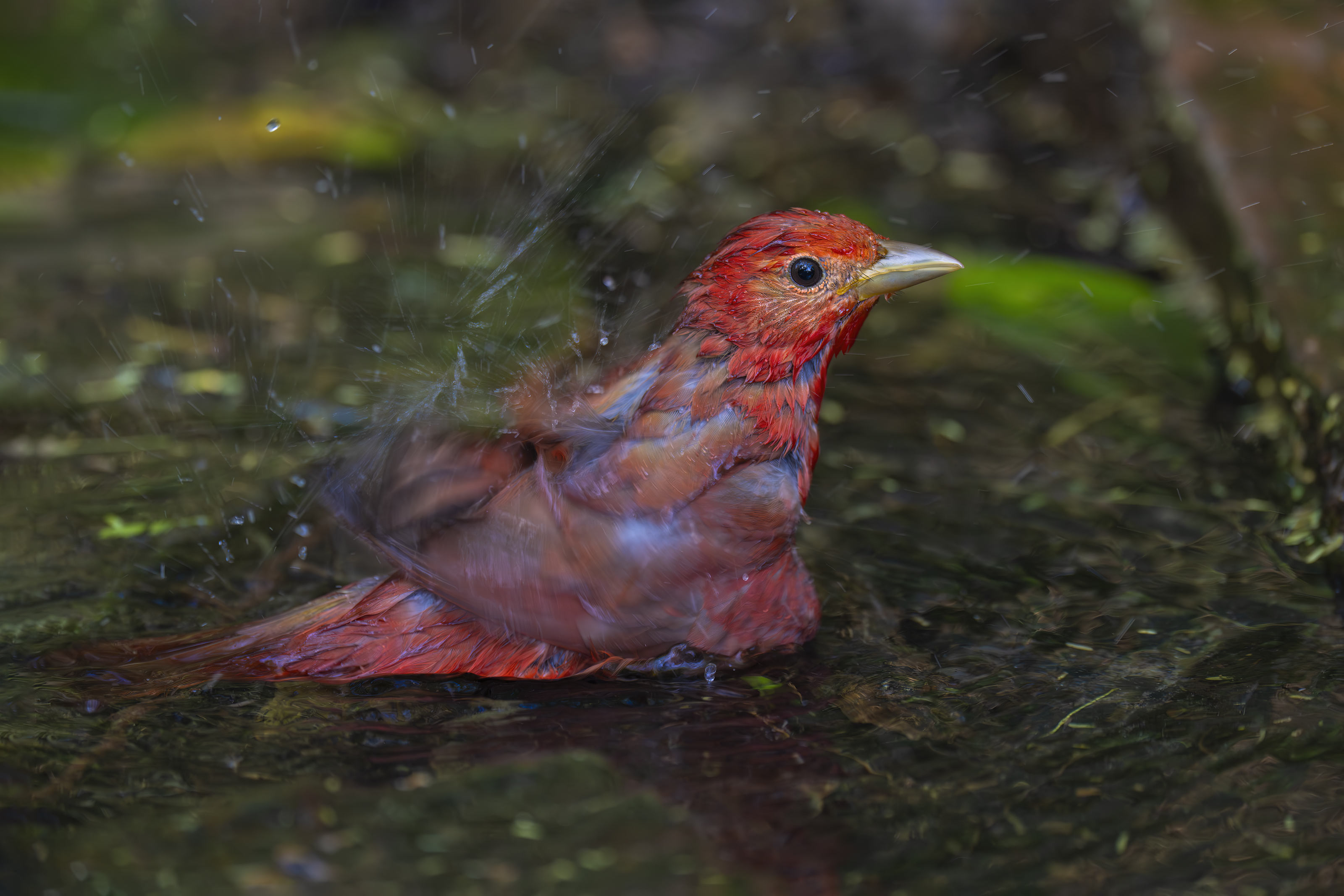
This image was created on 4 May 2026 by yours truly at the water feature at the Convention Center on South Padre Island, TX. Standing at full height, I used the Robus RC-5570 Vantage Series 3 Carbon Fiber Tripod/Levered-Clamp FlexShooter Pro-mounted Sony FE 600mm f/4 GM OSS lens with the Sony FE 1.4x Teleconverter, and the Latest Greatest Sony Flagship Body, the a1 II Mirrorless Camera in full frame mode. The exposure was determined by Zebras with Exposure Compensation (EC) on the thumb wheel. Multi Metering -1.3 stops. AUTO ISO set ISO 2000: 1/250 second at f/5.6 (wide open) in Shutter Priority mode. AWB at 9:25:04am in the shade on a sunny morning. Tracking: Zone/AF-C with Bird-Eye/Face Detection performed perfectly. Click on the image to enjoy a larger, inexplicably sharper high-res version. Image #3: Summer Tanager male bathing |
Are You Wondering Where the Blue Came From?
Most or all birds have a base layer of feathers — I’ve always thought of them as body feathers. This base layer primarily composed of grey down semiplume feathers. When wet and in the shade, these feathers will often appear blue.
|
|
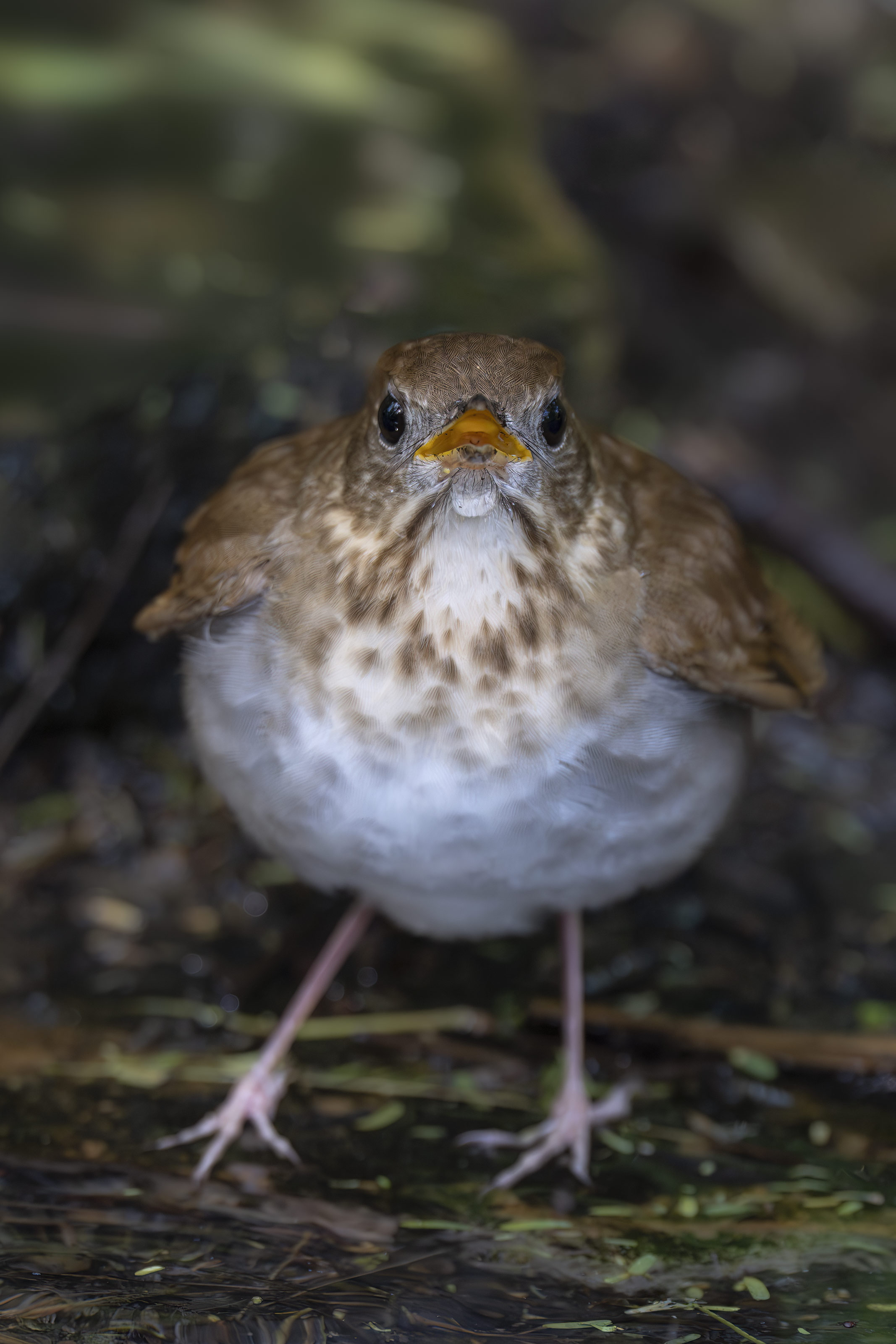
This image was also created on 4 May 2026 by yours truly at the water feature at the Convention Center on South Padre Island, TX. Standing at full height, I used the Robus RC-5570 Vantage Series 3 Carbon Fiber Tripod/Levered-Clamp FlexShooter Pro-mounted Sony FE 600mm f/4 GM OSS lens with the Sony FE 1.4x Teleconverter, and the Latest Greatest Sony Flagship Body, the a1 II Mirrorless Camera in full frame mode. The exposure was determined by Zebras with Exposure Compensation (EC) on the thumb wheel. Multi Metering -1.3 stops. AUTO ISO set ISO 2500: 1/250 second at f/5.6 (wide open) in Shutter Priority mode. AWB at 9:26:00am in the shade on a sunny morning. Tracking: Zone/AF-C with Bird-Eye/Face Detection performed perfectly. Click on the image to enjoy a larger, inexplicably sharper high-res version. Image #4: Veery after a drink |
Cropped From a Horizontal Original
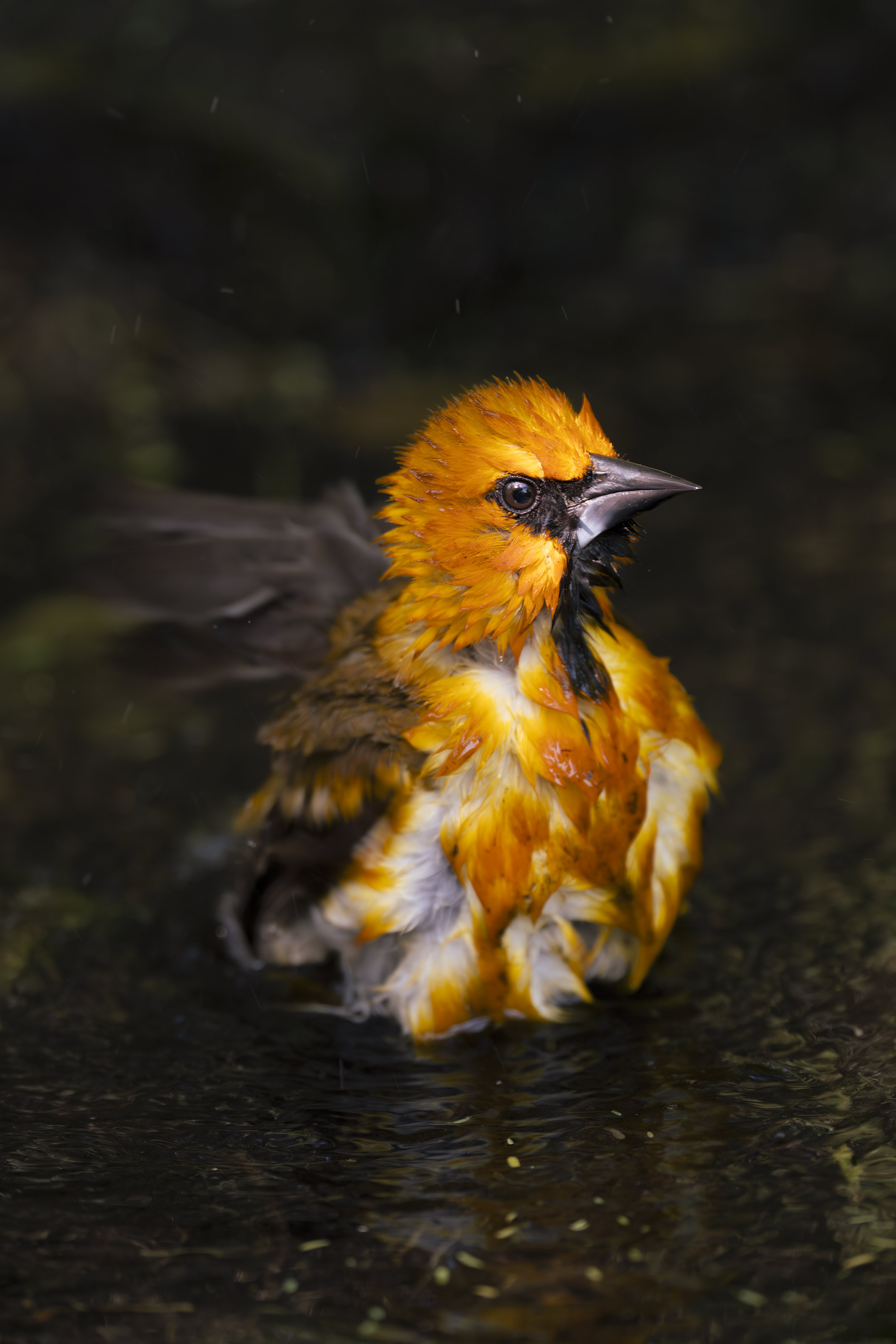
It is rare to shoot songbirds after turning the camera on end. With the huge drop of water hanging from the lower mandible, a tight crop to a vertical was fairly obvious. Veery is a plain reddish brown thrush with delicate features.
|
|
This image was created on 4 May 2026 by yours truly at the water feature at the Convention Center on South Padre Island, TX. Standing at full height, I used the Robus RC-5570 Vantage Series 3 Carbon Fiber Tripod/Levered-Clamp FlexShooter Pro-mounted Sony FE 600mm f/4 GM OSS lens with the Sony FE 1.4x Teleconverter, and the Latest Greatest Sony Flagship Body, the a1 II Mirrorless Camera in full frame mode. The exposure was determined by Zebras with Exposure Compensation (EC) on the thumb wheel. Multi Metering -1.3 stops. AUTO ISO set ISO 1250: 1/250 second at f/5.6 (wide open) in Shutter Priority mode. AWB at 10:12:48 am in the shade on a sunny morning. Tracking: Zone/AF-C with Bird-Eye/Face Detection performed perfectly. Click on the image to enjoy a larger, inexplicably sharper high-res version. Image #5: Altimira Oriole bathing |
Another Stay At Home Species
The Altamira Oriole is a year-round resident primarily found in the subtropical lowlands of Mexico and northern Central America, with the northernmost tip of its range reaching the Lower Rio Grande Valley in southern Texas. We saw several of their huge, woven nests hanging either from a tall tree limb or a utility wire. This species only came to bathe once during my three long morning visits.
|
|
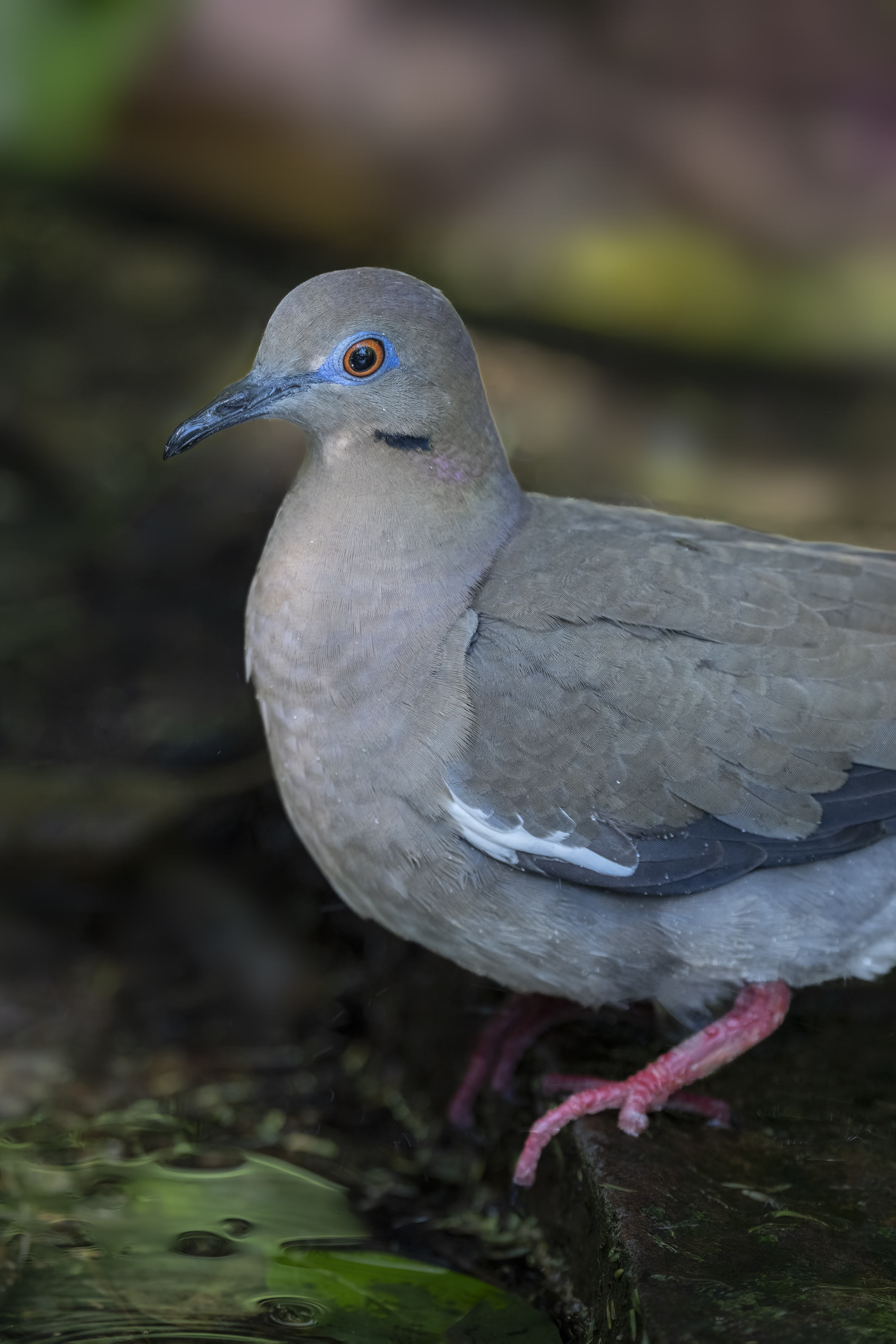
This image was created on 4 May 2026 by yours truly at the water feature at the Convention Center on South Padre Island, TX. Standing at full height, I used the Robus RC-5570 Vantage Series 3 Carbon Fiber Tripod/Levered-Clamp FlexShooter Pro-mounted Sony FE 600mm f/4 GM OSS lens with the Sony FE 1.4x Teleconverter, and the Latest Greatest Sony Flagship Body, the a1 II Mirrorless Camera in full frame mode. The exposure was determined by Zebras with Exposure Compensation (EC) on the thumb wheel. Multi Metering -1.7 stops. AUTO ISO set ISO 800: 1/250 second at f/5.6 (wide open) in Shutter Priority mode. AWB at 10:16:26am on a sunny morning. Tracking: Zone/AF-C with Bird-Eye/Face Detection performed perfectly. Click on the image to enjoy a larger, inexplicably sharper high-res version. Image #6: White-winged Dove, front end vertical |
Backyard Bird
Though White-winged is one of four species of doves that devours about $50.00/week of seed from my backyard feeders, I do not have a single good image of any of those birds. So again, it was exciting when this rather large bird came in for a sip.
|
|
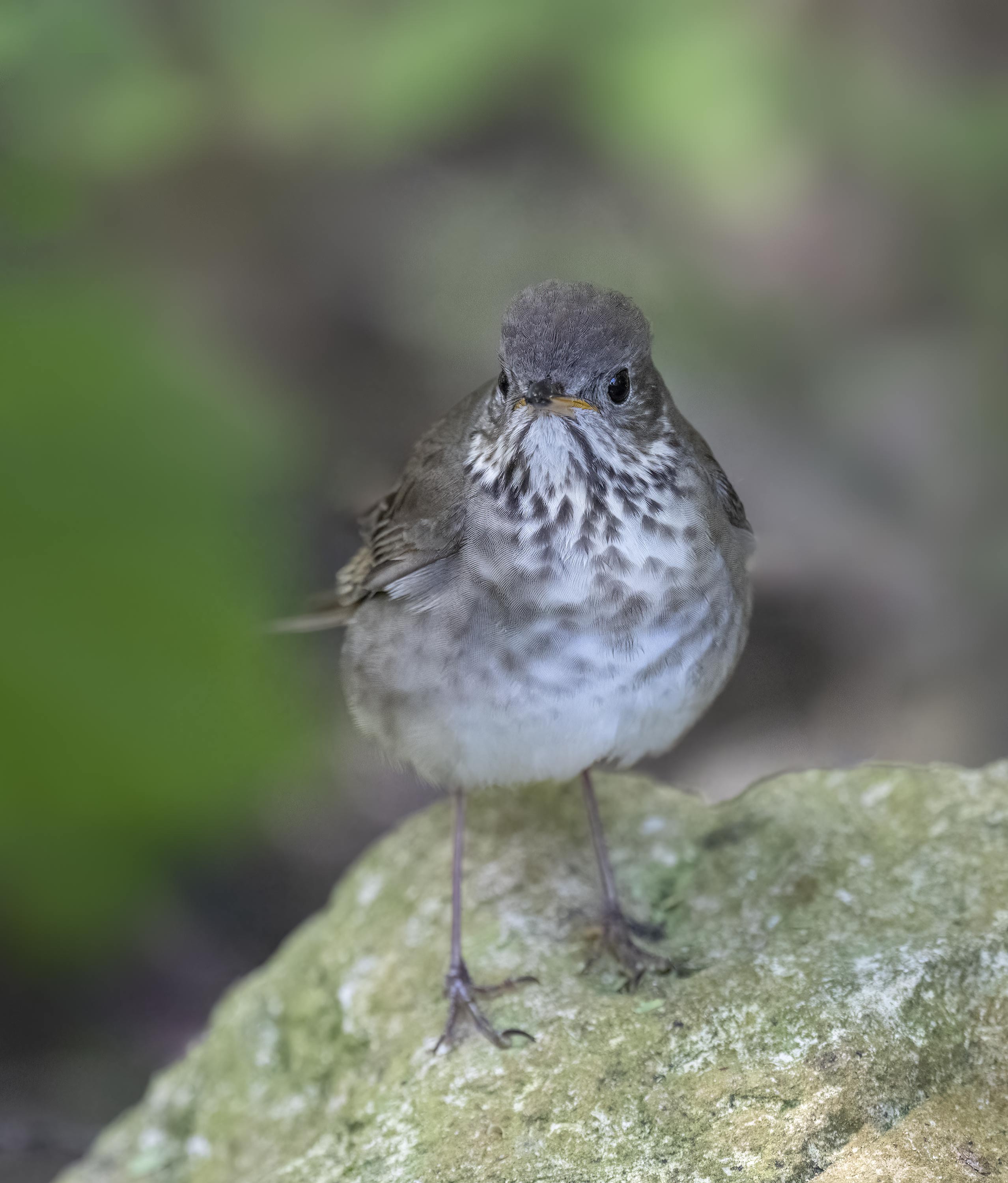
This image was also created on 4 May 2026 by yours truly at the water feature at the Convention Center on South Padre Island, TX. Standing at full height, I used the Robus RC-5570 Vantage Series 3 Carbon Fiber Tripod/Levered-Clamp FlexShooter Pro-mounted Sony FE 600mm f/4 GM OSS lens with the Sony FE 1.4x Teleconverter, and the Latest Greatest Sony Flagship Body, the a1 II Mirrorless Camera in full frame mode. The exposure was determined by Zebras with Exposure Compensation (EC) on the thumb wheel. Multi Metering +0.3 stops. AUTO ISO set ISO 6400: 1/250 second at f/5.6 (wide open) in Shutter Priority mode. AWB at 10:20:43am in the shade on a sunny morning. Tracking: Zone/AF-C with Bird-Eye/Face Detection performed perfectly. Click on the image to enjoy a larger, inexplicably sharper high-res version. Image #7: Grey-cheeked Thrush |
North American Thrush Species
North American migrant thrushes are medium-sized songbirds famous for their flutelike songs and nocturnal migrations. These species largely breed in the deep forests of the northern U.S. and Canada, and endure incredible journeys to winter in Central and South America.These iconic woodland songbirds rely on large stopover habitats during their spring and fall migrations. Primary species include the following:
Wood Thrush: Known for its complex, bell-like song. It is a long-distance migrant that crosses the Gulf of Mexico in a single night to winter in Central America.
Swainson’s Thrush: Identified by its bold, buffy eye-ring, they migrate through woodlots and parks. They sing a spiraling, upward-fluting song.
Hermit Thrush: The only brown-backed thrush that regularly winters in the southern United States. It is known for its pensive, flute-like song and habit of nervously flicking its tail. In spring, they head north weeks earlier than the other thrush species.
Veery: Breeds primarily in the northern tier of the U.S.. It has uniform reddish-brown coloring with faint smudgy spots, and travels all the way to South America for the winter.
Gray-cheeked Thrush: A shy, elusive breeder in the subarctic and boreal forests of Alaska and Canada that migrates to northern South America. But for its plain face, it strongly resembles Swainson’s. Uncommon and secretive along the Texas coast on their way north and south.
Bicknell’s Thrush: A highly vulnerable, rare species that breeds in the high-elevation mountains of the Northeast and winters mainly in the Dominican Republic. Bicknell’s and the Gray-cheeked Thrush were long considered the same species. Until 1995, the Bicknell’s Thrush was classified merely as an isolated, smaller subspecies of the Gray-cheeked. Ornithologists reclassified them as two completely separate species based on distinctions in their DNA, songs, plumage, and breeding ranges. Virtually identical in appearance, they are best separated by their unique songs. Bicknell’s migrates primarily along the Atlantic Flyway making them essentially absent from Texas.
Note: On our first wave day on South Padre, April 20, we had dozens of the five regularly occurring migrant thrushes on the grass just south of the Convention Center Building. Wood Thrushes predominated.
|
|
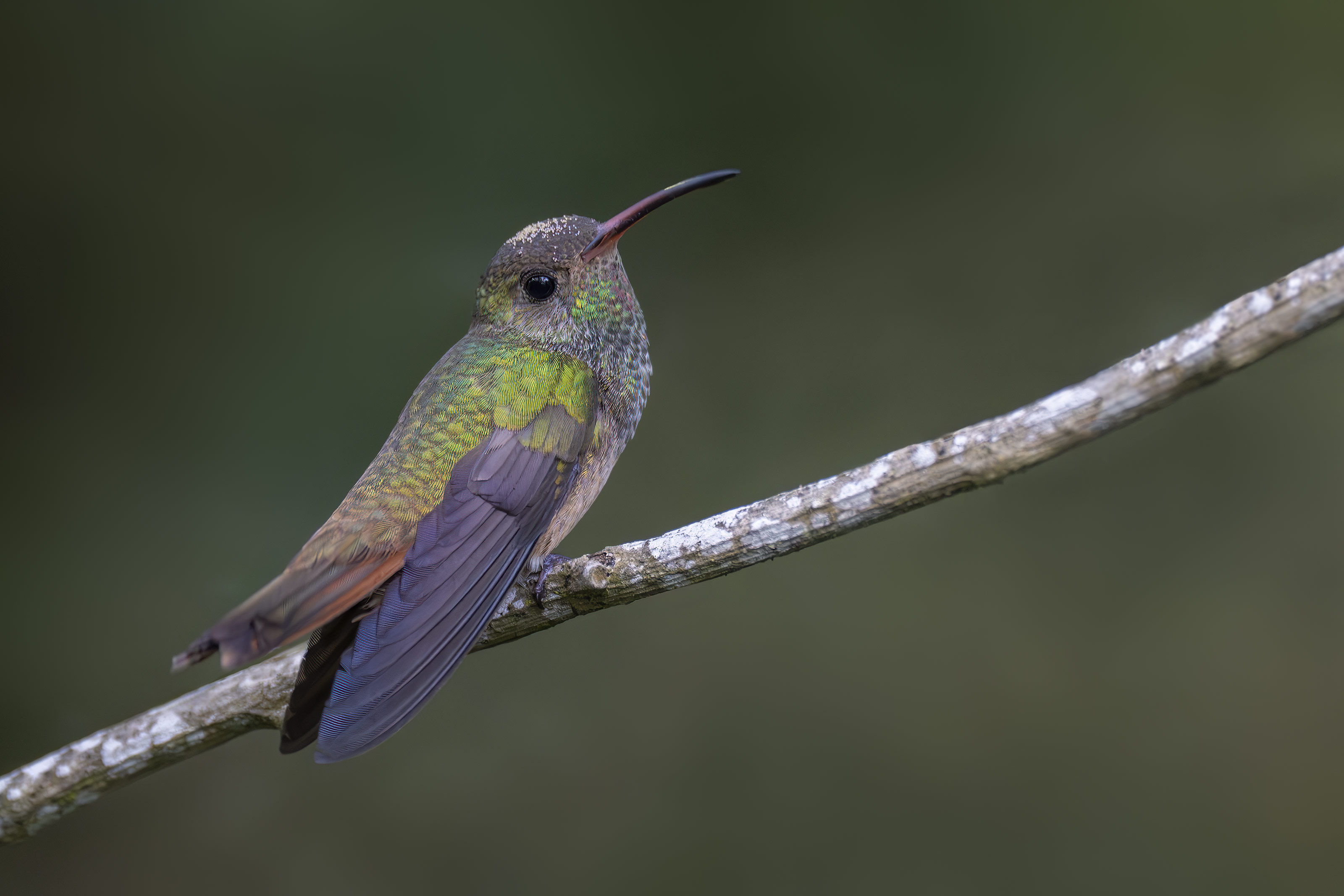
This image was created on 5 May 2026 by yours truly at the water feature at the Convention Center on South Padre Island, TX. Standing at full height, I used the Robus RC-5570 Vantage Series 3 Carbon Fiber Tripod/Levered-Clamp FlexShooter Pro-mounted Sony FE 600mm f/4 GM OSS lens and the Latest Greatest Sony Flagship Body, the a1 II Mirrorless Camera in APS-C crop mode. The exposure was determined by Zebras with Exposure Compensation (EC) on the thumb wheel. Multi Metering -1.0 stops. AUTO ISO set ISO 4000: 1/320 second at f/4 (wide open) in Shutter Priority mode. AWB at10:16:26am in the shade on a sunny morning. Tracking: Zone/AF-C with Bird-Eye/Face Detection performed perfectly. Click on the image to enjoy a larger, inexplicably sharper high-res version. Image #8: Buff-bellied Hummingbird with pollen on crown |
Buff-bellied Hummingbird
On the peak migration days in South Texas, you will see a hundred ruby-throateds for every buff-bellied. The former are legendary for their trans-Gulf migrations. On the other hand, Buff-bellied Hummingbird has a highly unusual migratory pattern as compared to most North American hummingbirds: instead of all moving strictly south for the winter, some populations actually travel north and east.
Typos
With all blog posts, feel free to e-mail or to leave a comment regarding any typos or errors.









Artie wrote: >> I like the overall look of the images of the birds on the ground at the water. <<
Of the downward-looking shots, my favorite is #2.
Thanks for re-visiting 🙂
a
#5, bright colored bird on dark background with very sharp eye/beak.
Thanks, Pat. I have three favorites. But not #5 though it is a strong image.
with love, a
#3 & #5 for the color, movement, and the darker theme created by under exposing the meter (which is probably dead on exposure, maybe?)
The overall darker themes are not a factor of the exposure. With dark backgrounds and/or and black rocks and some highlights on the bird’s feathers you need to under-expose to prevent toasting the highlights. That said, I emphasized the dark backgrounds using ACR masks to make the bird’s pop a bit more.
a
>> I far preferred image #1 for several reasons, the most important being the more diagonal flow that added tension in the image. <<
I still like #2 better. The bird in #1 looks cramped and uncomfortable.
Different strokes.
a
My favorite is #8. One criticism I have of most of the rest of the images is that we are looking, (and shooting) down at the bird, a perspective which is generally discouraged in wildlife photography.
Thanks for leaving a comment, Steve. However, when I have a chance to photograph a variety of colorful, difficult to shoot songbirds and I cannot get any lower than the railing, I will never pass up the chance. I set up as low as possible with my lens just above the railing and by using relatively long focal lengths the angle of declination is minimized. More importantly, I like the overall look of the images of the birds on the ground at the water.
a