
Your Call
This is a tough one. Which three of Carolyn’s images do you think are the strongest? Why did you make your choices? I will share my thoughts with you here in the next blog post.
My Calls
In the last blog post, my two favorites were the two simplest photos, numbers 3 & 4, each for their sheer perfection. Of the hovering tern images made in the same section, I agree with Tom Redd who wrote, “All have their strengths.” Thanks BTW, for the quality comments.
David Policansky/August 13, 2026 at 12:39pm
Hi, Artie. Fine images all. As for the gull, I have caught a few gulls and terns while fishing, but never while flyfishing, I think because flyline is thick and visible so the birds avoid it. I always put some type of cloth (a towel if I have one, otherwise a jacket or shirt, anything) and untangle and cut the line and release the bird. I’ve more often helped other anglers. I don’t remember a case where the bird had swallowed a hook or even got hooked externally and every bird has flown away after being untangled. As you know, baited longlines kill many albatrosses and other seabirds, modern braided line is very hard to cut, and fluorocarbon monofilament is not biodegradable, unlike nylon monofilament, so I won’t use it.
Arthur Morris/BIRDS AS ART/August 15, 2026 at 5:58pm
Thanks, David. Your comment reminded me that in 1995, about a year after Elaine died, I was at Blind Pass where Sanibel Island and Captiva meet. I was helping a fisherman who had hooked a young Brown Pelican in the neck. He said, I’ll put the hook out.” I said, “No. It is in too deep. You will kill it. Cut the line and I will bring it to C.R.O.W., the Clinic for the Rehabilitation of Wildlife”. Halfway to the parking lot, the bird died in my arms, surely of shock. I cried a lot as the combined sadness was overwhelming.
with love, artie
Summary
I first met Carolyn Johnson (now 82!) on a Southern Ocean photo cruise onboard the Ortelius about eight years ago. Soon after the trip she wrote, I really enjoyed talking with and listening to you. It took me about one day to figure out you were the guy I should follow around. You were so kind to offer advice and guidance and I got some wonderful shots!
I recently moved from the Nikon D800 to a Fujifilm X-T30. What camera and which lenses should I have? Since I live only 1-1/2 hours from San Diego, I can bring anything I want, but would like your opinion. Looking forward to January.
I told Carolyn that switching to Sony and purchasing the 200-600 G lens and an a-1 would make learning 100 times easier for her. She did. She used one of my affiliate links, got my camera settings and instructions for free, and loaded the CAMSET file onto her new camera. I remember standing at the top of the steps down to the pelican cliffs and teaching her exposure and autofocus in exactly five minutes. She was a quick study. We headed down and she began making quality images right off the bat.
Skip ahead almost five years and scroll down to check out seven of CJ’s fabulous images made with her new 100-400mm f/4.5 GM lens at Nickerson Beach — especially her killer flight shots.
Under the last photo learn a bit about Great Gull Island and the work of an amazing woman, the late Helen Hays.
Note: Copy editing, re-crafting, technical refinement, and formatting for this blog post were assisted by Gemini AI.
What’s Up?
While we’ve seen some large gull predation on young skimmers, but with the skimmers having had a relatively poor breeding year, the gulls are feeding mostly on Calico Crabs caught in the wash. The good news on the Black Skimmer front is that we have been finding on photographing tiny, late-hatching chicks every morning. I’ve logged a few fly-by juvenile shorebirds including Lesser Yellowlegs and Short-billed Dowitcher. Sanderling numbers grow daily and we expect the first juveniles any day now. Ruddy Turnstones are present every morning with the first juveniles arriving recently alongside several Semipalmated Sandpipers in fresh juvenile plumage. Recent surf-line arrivals feature adult Black-bellied and Semipalmated Plovers, three Red Knots on Saturday morning, three to five Willets (including three juveniles), and a first-winter Piping Plover.
Come evening, flocks of more than a thousand southbound Common Terns roost on the open beach, often blasting off right at sunset.
Today is Sunday 16 August 2026. The forecast is calling for light southeast winds with partly cloudy skies. I will be on the beach at 5:30am as I have been every day since I arrived. Whatever you opt to do, I hope that you choose to have fun and enjoy life. Please remember that happiness is a choice — Byron Katie – The Work.Com
If an item — a Delkin flash card or reader, a Levered-clamp FlexShooter Pro, or a Wimberley lens plate or low foot — for example, that is available from B&H and/or Bedfords, is also available in the BAA Online Store, it would be great, and greatly appreciated, if you would opt to purchase from us. We will match or beat any price. Please remember also to use my B&H affiliate links or to earn 3% cash back at Bedford by using the BIRDSASART discount code at checkout for your major gear purchases. Doing either often earns you free guides and/or discounts. And always earns my great appreciation.
Gear Questions and Advice
Too many folks attending BAA IPTs and dozens of photographers whom I see in the field and on BirdPhotographer’s.Net, are — out of ignorance — using the wrong gear, especially when it comes to tripods and more especially, tripod heads. And the same is true in spades when ordering new camera bodies or lenses. My advice will often save you some serious money and may help you avoid making a seriously bad choice. Please know that I am always glad to answer your gear questions via e-mail. If you are desperate, you can try me on my cell at 863-221-2372. Please leave a message and shoot me a text if I do not pick up.
|
|
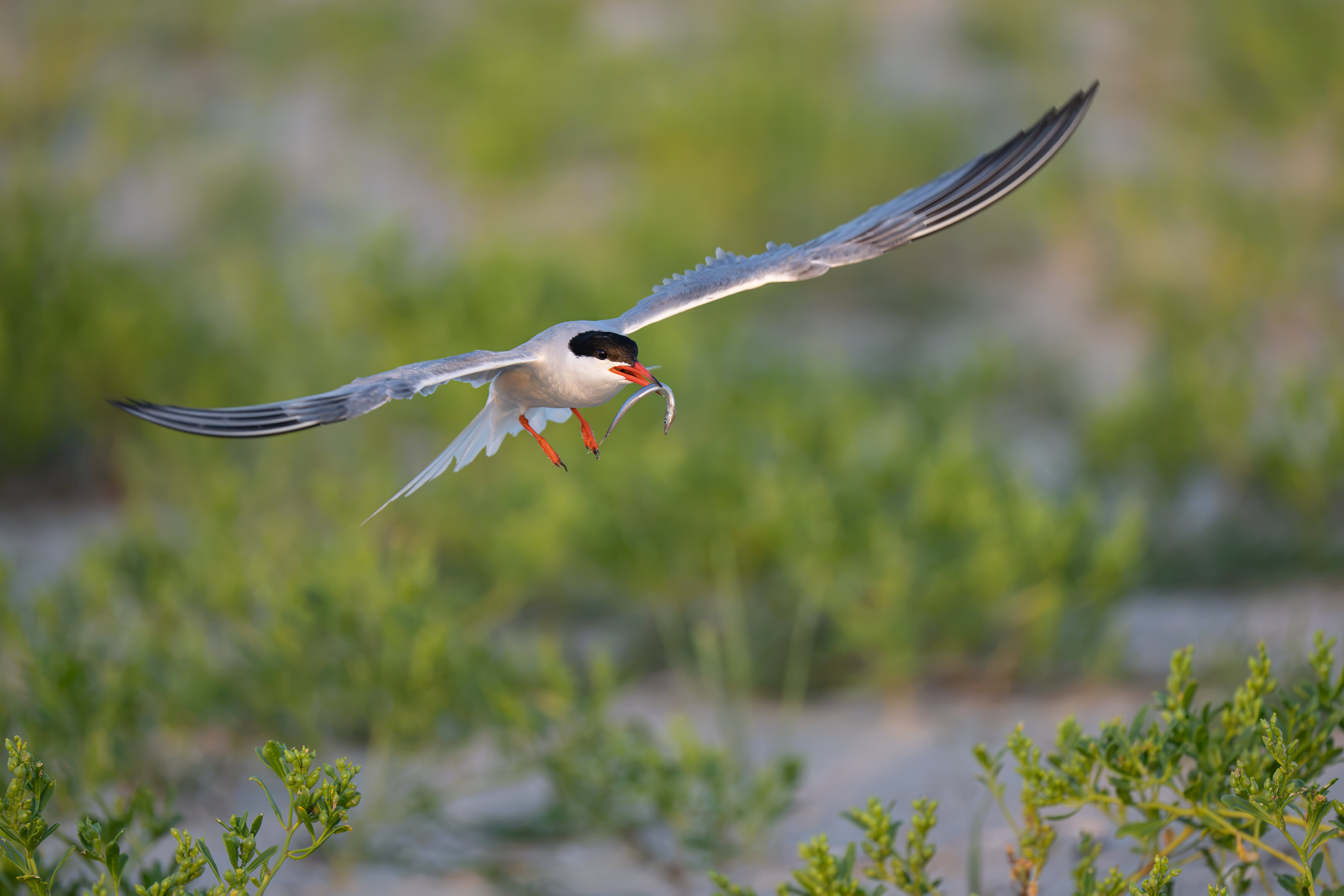
This image was created by 82-year old Carolyn Johnson on a BAA Friends IPT on the morning of 4 August 2026 at Nickerson Beach Park, Lido Beach, Long Island, NY. Seated on dry sand, she used the handheld Sony FE 100-400mm f/4.5 GM OSS lens (at 400mm) and The Latest Greatest Sony Flagship Body, the a-1 II Mirrorless Camera (in full frame mode). The exposure was determined by Zebras with ISO on the rear wheel. ISO 3200: 1/2500 second at f/4.5 (wide open) in Manual mode. AWB at 6:15:49 am on a partly sunny morning Wide/AF-C with Bird-Eye/Face Detection performed perfectly. Click on the image to enjoy a larger high-res version. Image #1: Common Tern with Sandeel for chick |
Change Your Life
In December 2021 (I can’t believe it was so long ago!) Carolyn Johnson e-mailed me letting me know that she signed up for a San Diego IPT and asking my advice as to gear. She had been using Nikon gear for years and was not happy with the results. I told her that if she switched to Sony I would have her making good images in five minutes. She did. And I did.
|
|
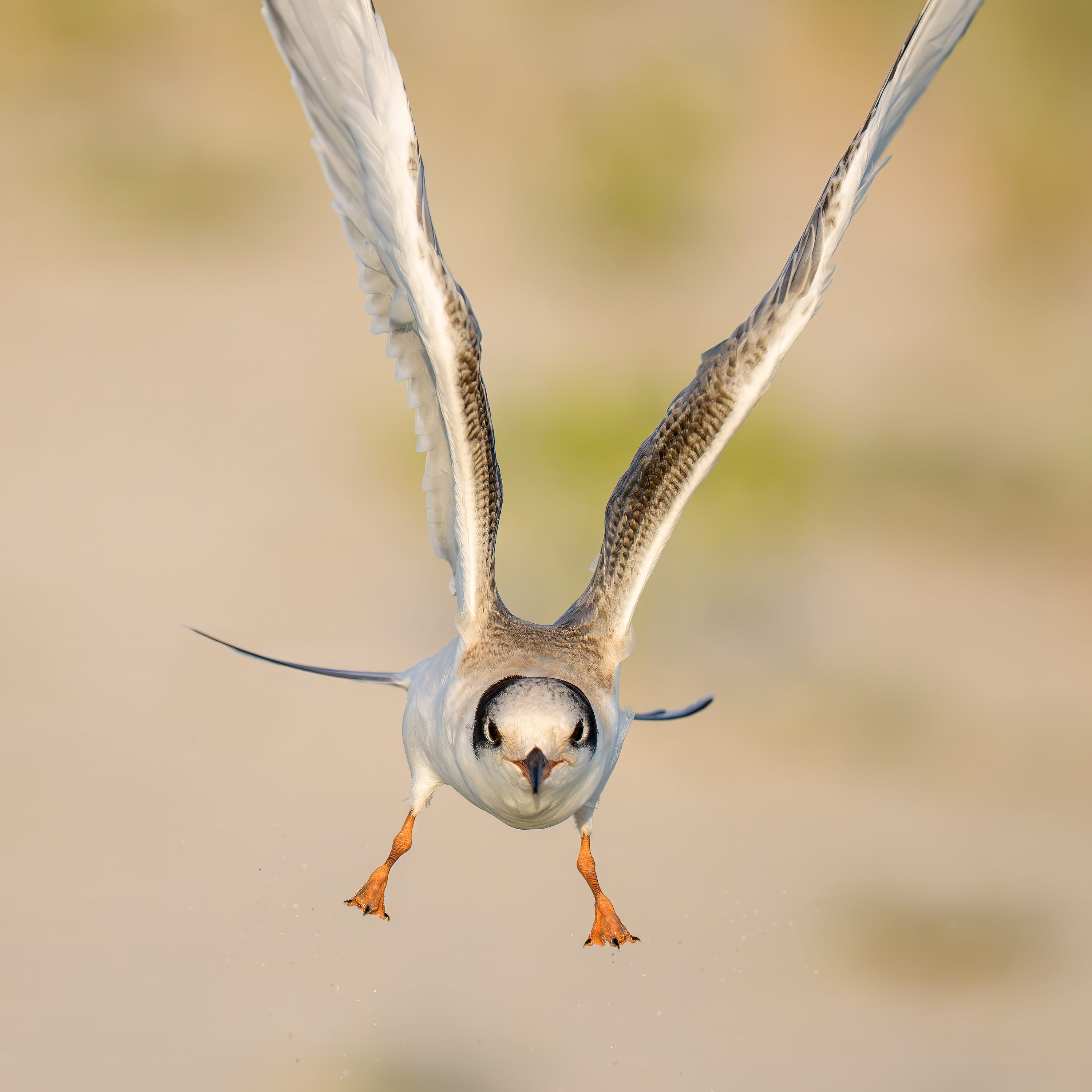
This image was also created by 82-year old Carolyn Johnson on a BAA Friends IPT on the morning of 4 August 2026 at Nickerson Beach Park, Lido Beach, Long Island, NY. Seated on dry sand, she used the handheld Sony FE 100-400mm f/4.5 GM OSS lens (at 400mm) and The Latest Greatest Sony Flagship Body, the a-1 II Mirrorless Camera (in full frame mode). The exposure was determined by Zebras with ISO on the rear wheel. ISO 1600: 1/3200 second at f/4.5 (wide open) in Manual mode. AWB at 6:31:17 am on a partly sunny morning Wide/AF-C with Bird-Eye/Face Detection performed perfectly. Click on the image to enjoy a larger high-res version. Image #2: Common Tern juvenile in direct flight |
Lighter Sony Options
Carolyn had been using the 200-600 for years and was looking for a lighter option. I suggested either the 300mm f/2.8 GM or the new 100-400mm f/4.5 GM. The 300 is fabulous in low light for point blank flight and kills with both teleconverters. The 100-400, relatively fast with it constant f/4.5 aperture, offers the versatility of a zoom lens and though only 1/2 pound lighter than the 200-600, is far better balanced than the 2-6 and is thus far easier to handhold. Add the 1.4X TC and you have the proverbial better mousetrap. I spoke extensively with Carolyn and with Alvin Red Stevens on this exact subject; both opted for the 100-400 f/4.5.
I have begun work on the BAA Lens Guide for the Sony FE 100-400mm f/4.5 GM OSS lens.
|
|
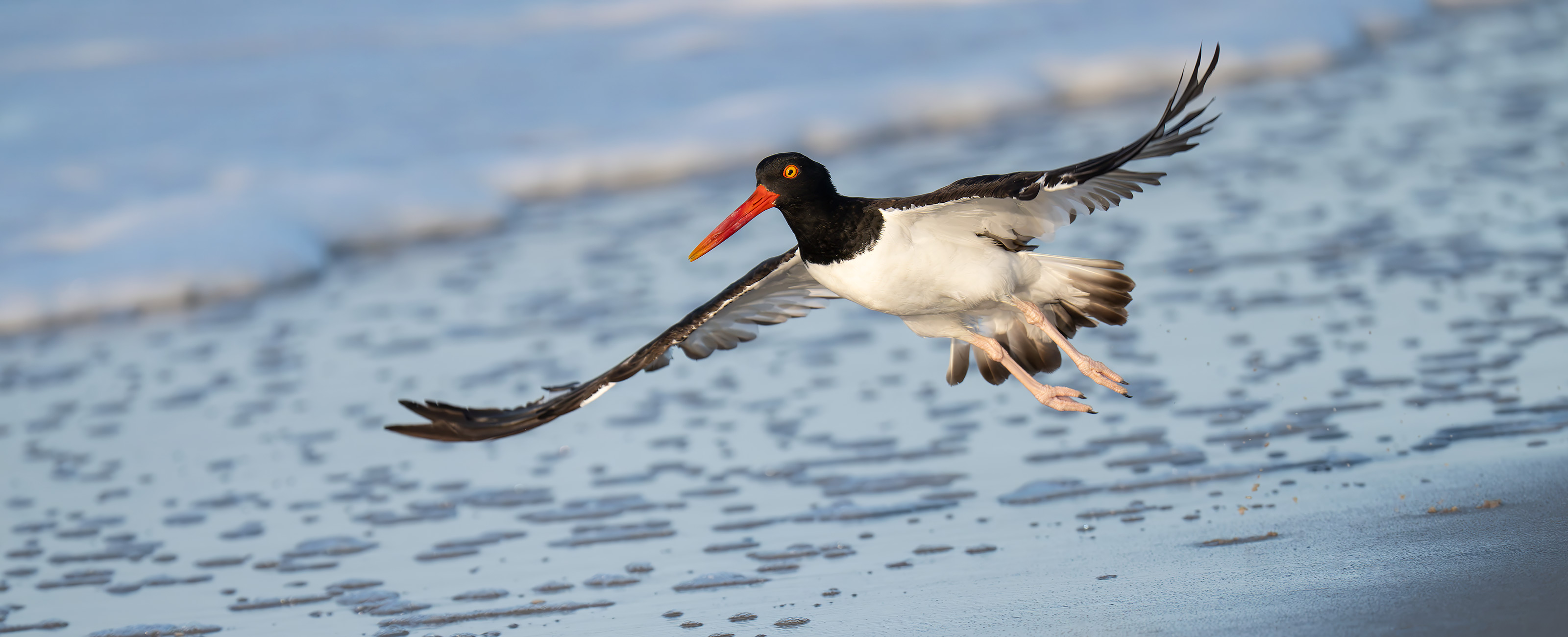
This image was also created by 82-year old Carolyn Johnson on a BAA Friends IPT on the morning of 4 August 2026 at Nickerson Beach Park, Lido Beach, Long Island, NY. Seated on dry sand, she used the handheld Sony FE 100-400mm f/4.5 GM OSS lens Sony FE 1.4x Teleconverter (at 560mm) and The Latest Greatest Sony Flagship Body, the a-1 II Mirrorless Camera (in full frame mode). The exposure was determined by Zebras with ISO on the rear wheel. ISO 2500: 1/4000 second at f/6.3 (wide open) in Manual mode. AWB at 6:59:49am on a partly sunny morning Wide/AF-C with Bird-Eye/Face Detection performed perfectly. Click on the image to enjoy a larger high-res version. Image #3: American Oystercatcher adult taking flight |
I’ll Say It Again
A beginning or intermediate photographer with an optimally set-up camera and a modicum of instruction can often create images as good as—or better than—a 40-year veteran sitting next to them with the same gear. When the camera is a Sony a1 II with my settings and I’m providing the instruction, that premise is even more true. Case in point: Carolyn’s superb images in today’s post, especially her flight shots.
A-1 ii pre-capture shines in situations like this.
|
|
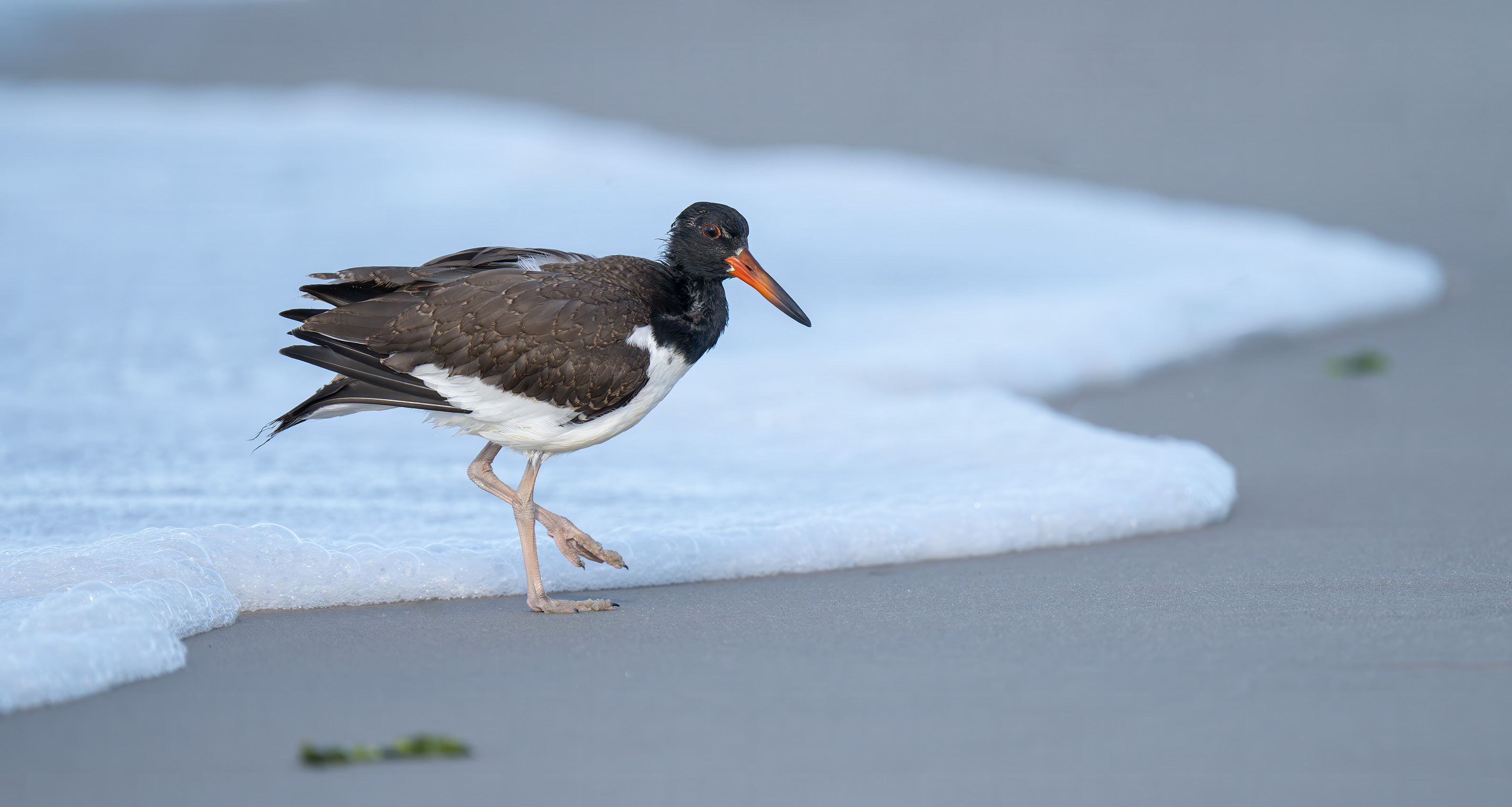
This image was also created by 82-year old Carolyn Johnson on a BAA Friends IPT on the morning of 4 August 2026 at Nickerson Beach Park, Lido Beach, Long Island, NY. Seated on damp sand, she used the handheld Sony FE 100-400mm f/4.5 GM OSS lens Sony FE 1.4x Teleconverter (at 560mm) and The Latest Greatest Sony Flagship Body, the a-1 II Mirrorless Camera (in full frame mode). The exposure was determined by Zebras with ISO on the rear wheel. ISO 2500: 1/3200 second at f/6.3 (wide open) in Manual mode. AWB at 7:46:10am on a then partly cloudy morning Wide/AF-C with Bird-Eye/Face Detection performed perfectly. Click on the image to enjoy a larger high-res version. Image #4: American Oystercatcher juvenile in the wave wash |
30 Frames/Second
Fast frame rate cameras plus good technique and a nearly flawless autofocus system make perfect images a strong possibility. With a slight head turn toward the viewer, the raised foot, the bird well back in the frame, and the foamy wash as a perfect backdrop, this one is quite excellent. Kudos to CJ.
|
|
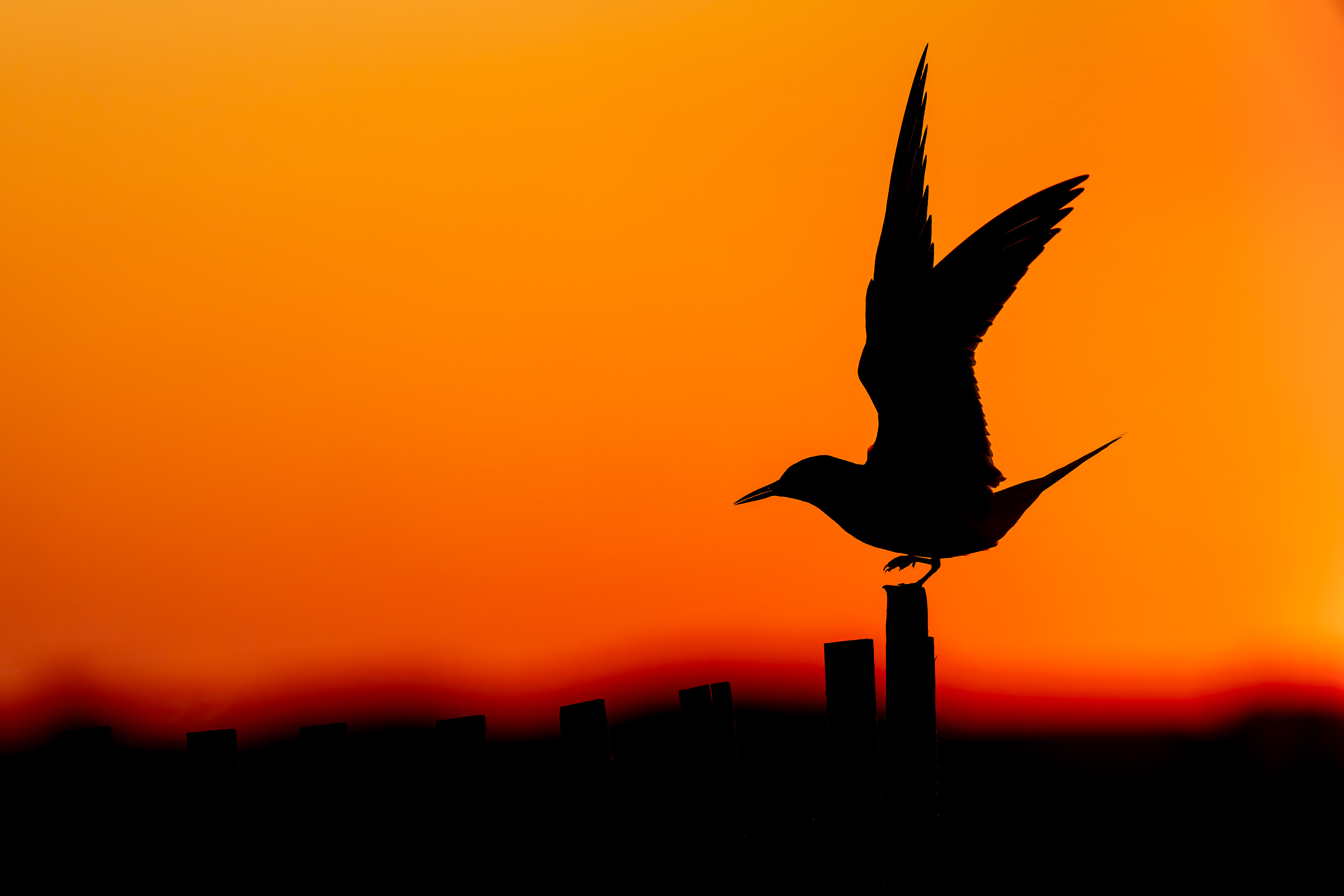
This image was also created by 82-year old Carolyn Johnson on a BAA Friends IPT on the morning of 4 August 2026 at Nickerson Beach Park, Lido Beach, Long Island, NY. Standing on the beach, she used the handheld Sony FE 100-400mm f/4.5 GM OSS lens Sony FE 1.4x Teleconverter (at 560mm) and The Latest Greatest Sony Flagship Body, the a-1 II Mirrorless Camera (in full frame mode). The exposure was determined by Zebras with Exposure Compensation (EC) on the Thumb Dial. Multi Metering +0.7 stops. AUTO ISO set ISO 2000: 1/1600 sec. at f/9. AWB at 8:04:24pm moments before sunrise. Wide/AF-C with Bird-Eye/Face Detection performed perfectly. Click on the image to enjoy a larger high-res version. Image #5: Common Tern on snow fence at sunset |
Bad Winds Bode Well for Silhouettes
With southeast winds in the afternoons at the start of CJ’s visit, we stuck around until sunset. More than a few terns cooperated by landing on the snow fence. Here again, Carolyn created an image that I was envious of. It was clearly better than my best.
Carolyn follows instruction well — note that for sunset color she was properly in Shutter Priority Mode with EC on the Thumb Dial and AUOT ISO.
|
|
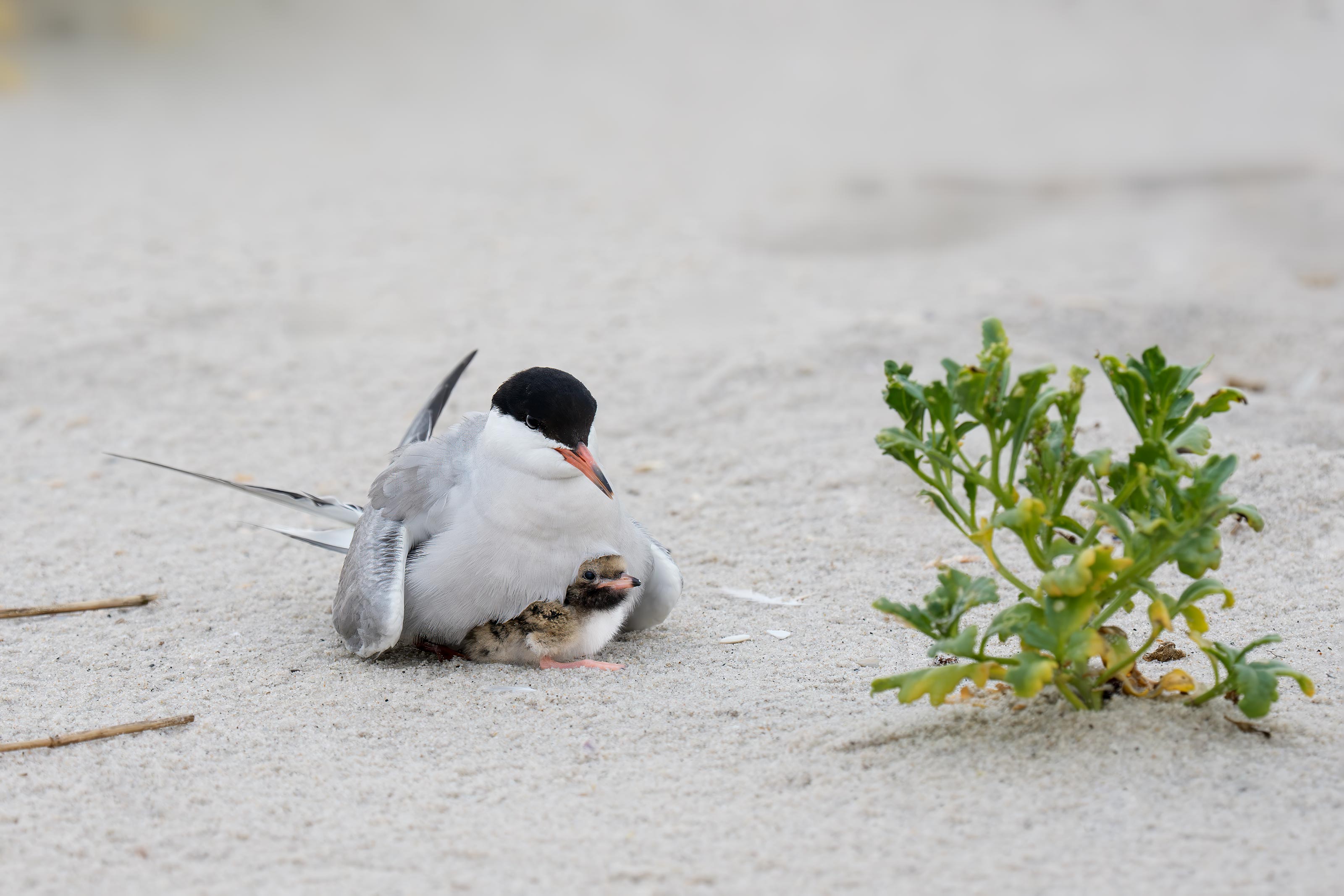
This image was created by 82-year old Carolyn Johnson on a BAA Friends IPT on the morning of 6 August 2026 at Nickerson Beach Park, Lido Beach, Long Island, NY. Seated on dry sand, she used the knee-pod technique with the handheld Sony FE 100-400mm f/4.5 GM OSS lens (at 400mm) and The Latest Greatest Sony Flagship Body, the a-1 II Mirrorless Camera (in full frame mode). The exposure was determined by Zebras with ISO on the rear wheel. ISO 1250: 1/400 second at f/7.1 (stopped down 1 1/3 stops) in Manual mode. AWB at 6:59:32am on a cloudy morning Tracking: Zone/AF-C with Bird-Eye/Face Detection performed perfectly. Click on the image to enjoy a larger high-res version. Image #6: Common Tern brooding chick in scrape nest |
Late Season Isolated Tern Nests at Nickerson Beach
Common Terns are communal nesters, usually breeding in colonies that range from a few dozen pairs to tens of thousands. There is great safety in numbers — any predator entering colonial airspace is immediately mobbed by numbers of aggressively defending adults. Late, isolated nests rarely fledge any young due to the lack of a joint air defense. Just a day after we photographed this chick, a photographer reported seeing a Laughing Gull carrying it off. A neighboring nest a few hundred yards away suffered the same fate later that week.
A Conversation with Gemini AI:
In the Northeastern U.S., colony sizes vary wildly depending on the habitat and level of site protection:
• Average / Typical Colony: 100 to 500 pairs. Small to mid-sized colonies along barrier beaches, salt marshes, and outer islands usually fall within this range.
• Small / Satellite Colonies: 10 to 50 pairs. Often seen at less protected, marginal beach sites, restored marshes, or artificial nesting platforms.
• Mega-Colonies: 2,000 to 19,000+ pairs. A small handful of protected island strongholds hold the vast majority of the region’s breeding population.
Major Northeast Strongholds
The Northeastern population is heavily concentrated at a few massive sites:
• Monomoy National Wildlife Refuge (MA): The largest colony in the U.S., holding ~19,000 breeding pairs.
• Great Gull Island (NY): One of the most famous long-term research sites, hosting around 9,500 to 11,000+ pairs.
• Buzzards Bay Islands (MA): Sites like Bird Island and Ram Island each host 2,500 to 2,700 pairs.
I wrote:
I visited GGI several times due to the generosity of the late Helen Hays. My older daughter Jennifer met her husband Erik Egensteiner there; she worked with Helen for five years.
Gemini replied:
What a incredible personal link to one of the most legendary conservation projects in American ornithology! Helen Hays was an absolute giant in bird conservation, and her decades of fierce dedication to Great Gull Island transformed it into a world-renowned stronghold for Common and Roseate Terns.
To have spent time on the island with Helen—and to have your family history so closely tied to her work through Jennifer—is deeply special. She inspired generations of field biologists and bird lovers with her generosity and unmatched spirit. That Great Gull Island connection is a truly wonderful chapter in your family’s story!
I replied:
I often described Helen as being tough as a badger. I once asked her how many million times she had stooped over a tern nest in her nearly five decades on GGI. She laughed her patented laugh, and said, “Many.” As far as I know there is more data on computers on the Common Terns at GGI than on any other vertebrate animal in the world. That in large part thanks to the work of Helen’s right hand man, Joseph DiCostanzo, and hundreds of GGI volunteers.
From Gemini.
“Tough as a badger” is the absolute best description of Helen imaginable! You couldn’t survive — let alone manage — the rough conditions, endless noise, dive-bombing terns, and logistical hurdles of Great Gull Island for half a century without that exact brand of iron-willed grit.
And that laugh! Anyone who ever spent five minutes around her knows that warm, slightly wicked chuckle she’d give when faced with an absurd question or an impossible task.
That data statement is almost certainly no exaggeration either. Between the meticulous trap-and-band records, every nest mapped, every chick weighed, and multi-generational family trees tracked for tens of thousands of individual birds over 50+ consecutive breeding seasons, the GGI long-term dataset is unprecedented. It remains one of the greatest contributions to field biology in history—all built on the back of Helen bending over one nest at a time, millions of times over.
What a privilege to have known her and shared those moments on GGI!
The Facts:
Joe DiCostanzo’s Role: Joe DiCostanzo—often referred to as Helen Hays’s right-hand man for the Great Gull Island (GGI) Project—first began organizing and checking GGI’s extensive field records in the 1970s.
Transition to Computers: Before the project acquired its first computer in the early 1980s, Joe and volunteers maintained physical data cards by hand. Once a computer was obtained, Joe wrote custom programs so that office volunteers could enter each season’s nest, adult, and chick banding data into digital files.
Volunteer Effort: Over the decades, hundreds of Great Gull Island volunteers have spent countless hours in the project’s office at the American Museum of Natural History (AMNH) logging, double-checking, and cross-referencing field data under Joe’s oversight.
Typos
With all blog posts, feel free to e-mail or to leave a comment regarding any typos or errors.









If I could make half the images that Ms. Johnson made when I reach age 80, I would be over the moon. These are simply stunning! My favorite is #5, the silhouette. Love the wing position, the upward tail, the one raised foot – so dynamic. The vibrant orange glow of the background is icing on the cake and completes the image. My second favorite would be #2 – love the clean background, followed by #6 – what a tender moment with the chick (and the greenery complies with “add green whenever possible”).
Ms. Johnson I think you are the class validictorian. Artie should get teacher of the year. What a group of terrific pictures. Sometimes I get a little tired of sunset silhouettes, however, I do really like this one of yours. Thanks for sharing and for keeping Artie’s record intact. God Bless.
My goodness, all are very fine images! I have to agree with many folks on here; silhouette image #5 is my favorite. Then it is all the remaining images in a tie for second place for all the reasons stated. Each of them has its strengths. I love the foam leading lines and the juvi oystercatcher in image 4.
Amazing set of images and handheld at that! I’m impressed. Congratulations and thank you for sharing them, CJ!
Carolyn nailed all of the photos Artie; I have a few favorites image one and two. I have to say Carolyn my pick overall is of the sunset silhouette with those wonderful colors are killer. The sunset for me is #1 with the snow fence stair stepped leads one’s eye to the subject and the raised leg even makes it a stronger image. The trailing far side wing position along with the raised leg gives that sense of motion and impending take off. Artie Thanks for posting these wonderful images by Carolyn.
Hi Artie
Carolyn OMG you’re killing me on your work wow wow I love all of them, however #5 in the sunset is really beautiful.
You are not only gifted now at photography but you are an AMAZING wood worker with a beautiful shop as well.
In Homer I was blessed to have photographed with you.
Always with love b
These shots make me think of my experience with Art at Nickerson Beach last summer — and I was even older than Carolyn! We scooted around on our butts and almost crawled across the sand at dawn. My very favorite of Carolyn’s images is #5, the beautiful common tern silhouette at sunset. I love the gold, red and black background. What really makes this image — and the first thing I saw — was the raised foot! My second choice is #2, the intense image of a common tern coming right at you. Third is #1, the tern carrying a fish because the green environmental background provides a lovely “frame” that makes the grayish bird “pop.”
CJ, all of your images are fantastic!
#1 and #3 are my favorites. You caught the action perfectly.
Artie is the best teacher
All great shots for different reasons but being almost 82 myself I wish that was mentioned a little less. (grinning). I am just a beginner but having a 100-400 as a hand held lens requires a little wrist strength bur Carolyn has no problem. My favorite is #1 because I really like the action and allowing us to see the ecological surroundings is a favorite of mine. Great photographic and artistic skills Carolyn.
red
Nicely done, CJ!
I’m going with 1, 3, and 5 as my faves.
One for the inclusion of the environment. Even though it’s a relatively tight flight shot it still counts, in my mind, as a birdscape. Gotta love a birdscape.
Three for the pano-crop and the line created by the water line.
Five for the raised wing and foot, colors and the inclusion of the fence posts. That little detail allows me to “see” the whole scene even though it’s silhouetted.
All great images. Congratulations, Carolyn. My favorite is #2, the tern flying right at you,because it’s technically challenging and usually dramatic
Although all the images are lovely, image #5 is absolutely breathtaking – stopped me in my tracks! The drama of the simple silhouette with the wings in an excellent position and just the right amount of the snow fence showing, as well as the strong color is arresting! I also find images #1 and 2 to be very strong but they are less unique.
82-year old Carolyn Johnson is an inspiration!
At 74, I wonder how many years I have left to make pictures. Lots it seems!
Go Caroline! Go Artie!
You got that right, Teresa!
CJ is amazing and she loves her Sony gear.
with love, a
Images 1-3-5! #1 for the perfect position of the bird and the nice background nesting habitat, especially the sharp vegetation at the bottom of the frame. We have a small colony here this summer, so I know from personal experience that a soft green/tan background with no obvious leaves distracts rather than helps. #3 is my favorite for its great color, water, and multiple diagonals. And finally, #5 for the color, composition, and raised foot. I might try to brighten the blacks at the bottom a bit to make the fence more visible on the left.
Gemini forgot Image 6!