
Summary
The Atlantic was stormy on Thursday morning past. In the wind and the drizzle, there were lots of good low-light blastoff chances. Check out the images and keep reading to learn how I wound up in the surf. Twice. And might have lost my life.
Note: General information, copy editing, re-crafting, technical refinement, and formatting for this blog post were assisted by Gemini AI.
In the Last Blog Post
Thanks to the few who commented on Rob DeBartolo’s images in the last blog post. My two favorite were the preening young oystercatcher and the juvie turnstone going down the berm. The former for the dead solid perfect head angle and the latter because I really wish it were mine.
Your Call?
Which of today’s three pleasing blurs do you like best? Why? (Sorry, Pat Fishburne.)
If you have ever been close to death and would like to share your story, please leave a comment below.
What’s Up?
When I finally got back in action after the stomach flu, the tennis match that ended at 3:33am, and the small claims court case mediation that went on for hours, the late-season bird photography at Nickerson Beach turned out to be quite excellent (even though many of the birds have left. After four days without creating a single image, Thursday morning was looking fabulous — until I almost died in the heavy surf. Right after my near-death adventure, a Marbled Godwit, rare on open ocean beaches, landed right in front of us in a tidal pool. While I was still indisposed, Anke made a great flight shot of the bird that changed my life some fifty years ago. We saw nearly a thousand Sanderlings that afternoon and enjoyed a nice sunset and lots of tern and skimmer blasts. We had a nice sunrise on Friday morning, but photography was difficult. We had had many more Sanderlings, but only a few were present. Anke spotted a juvenile Whimbrel, another rare visitor to the south shore of Long Island and we both managed a few decent photos.
We headed back to the AirBnb early to finish packing. I dropped her off at her apartment in NYC and continued on to Wilmington, DE where I grabbed a room in a Courtyard Marriott. I woke early on Saturday, began work on a second edit of my July/August Nickerson photos, and drove less than three hours to the Auto Train Station in Lorton, VA.
Today is Sunday 13 September 2026 and I am feeling fine. And alive. We should be pulling into Sanford Station in Florida before 9:00am and after a quick stop at Publix, I am hoping to be home by noon on Sunday, in time for a quick nap before the NFL games while continuing work on the second edit and the new BAA Sony 100-400 f/4.5GM Lens Guide. Whatever you opt to do, I hope that you choose to have fun and enjoy life. Please remember that happiness is a choice — Byron Katie – The Work.Com
If an item — a Delkin flash card or reader, a Levered-clamp FlexShooter Pro, or a Wimberley lens plate or low foot — for example, that is available from B&H and/or Bedfords, is also available in the BAA Online Store, it would be great, and greatly appreciated, if you would opt to purchase from us. We will match or beat any price. Please remember also to use my B&H affiliate links or to earn 3% cash back at Bedford by using the BIRDSASART discount code at checkout for your major gear purchases. Doing either often earns you free guides and/or discounts. And always earns my great appreciation.
Gear Questions and Advice
Too many folks attending BAA IPTs and dozens of photographers whom I see in the field and on BirdPhotographer’s.Net, are — out of ignorance — using the wrong gear, especially when it comes to tripods and more especially, tripod heads. And the same is true in spades when ordering new camera bodies or lenses. My advice will often save you some serious money and may help you avoid making a seriously bad choice. Please know that I am always glad to answer your gear questions via e-mail. If you are desperate, you can try me on my cell at 863-221-2372. Please leave a message and shoot me a text if I do not pick up.
|
|
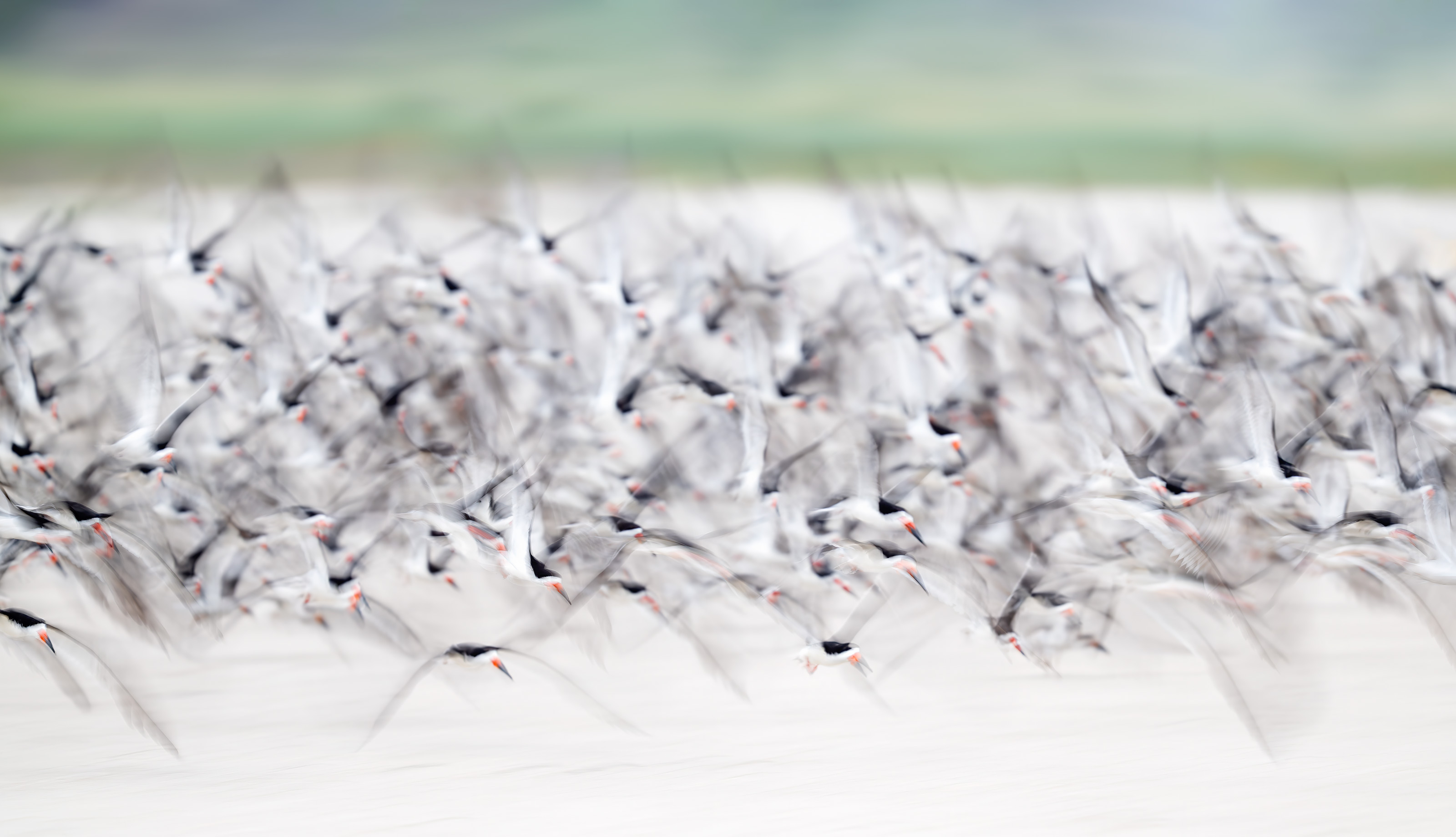
This image was created on 10 September 2026 at Nickerson Beach Park, Lido Beach, NY. Standing on the beach, I used the handheld Sony FE 300mm f/2.8 GM OSS Lens (Sony E) with the Sony FE 1.4x Teleconverter (at 420mm) and The Latest Greatest Sony Flagship Body, the a-1 II Mirrorless Camera. The exposure was determined by Zebras with Exposure Compensation (EC) on the Thumb Dial. Multi Metering +2.0 stops. AUTO ISO set ISO 400: 1/13 second at f/4 (wide open) in Shutter Priority mode. AWB at 6:38:05am just before the time of sunrise on a cloudy morning. Tracking: Zone/AF-C with Bird-Eye/Face Detection performed perfectly. Click on the image to enjoy a larger high-res version. Image #1: Black Skimmer flock blastoff |
Doing Flock Blurs With a Fixed Focal Length Lens
Many of the best blastoff blurs are created in the first one or two seconds and that was the case with Image #1. The skimmer flock — there were about 500 remaining on Thursday– was well up on the beach, surrounded by three yellow lifeguard stands reminder of the recently ended summer season 🙁 The first thing you need to do is consider the wind as that would determine the direction of the takeoff. Then you pick a clear slot in hopes of eliminating manmade yellow background blurs from your photo. With a fixed focal length, you must consider the distance to the flock when you choose where you will stand.
For this blastoff, I judged everything perfectly. And even managed a nice strip of green colony vegetation at the top as a border. Had I framed a bit higher, I would have had more out of focus green. That would have been better than having to crop away lots of boring sand at the bottom.
Note: zoom lenses are generally best for blastoff and flock blurs. But fixed focal length lenses can perform admirably if you either put yourself in the right spot or get lucky.
|
|
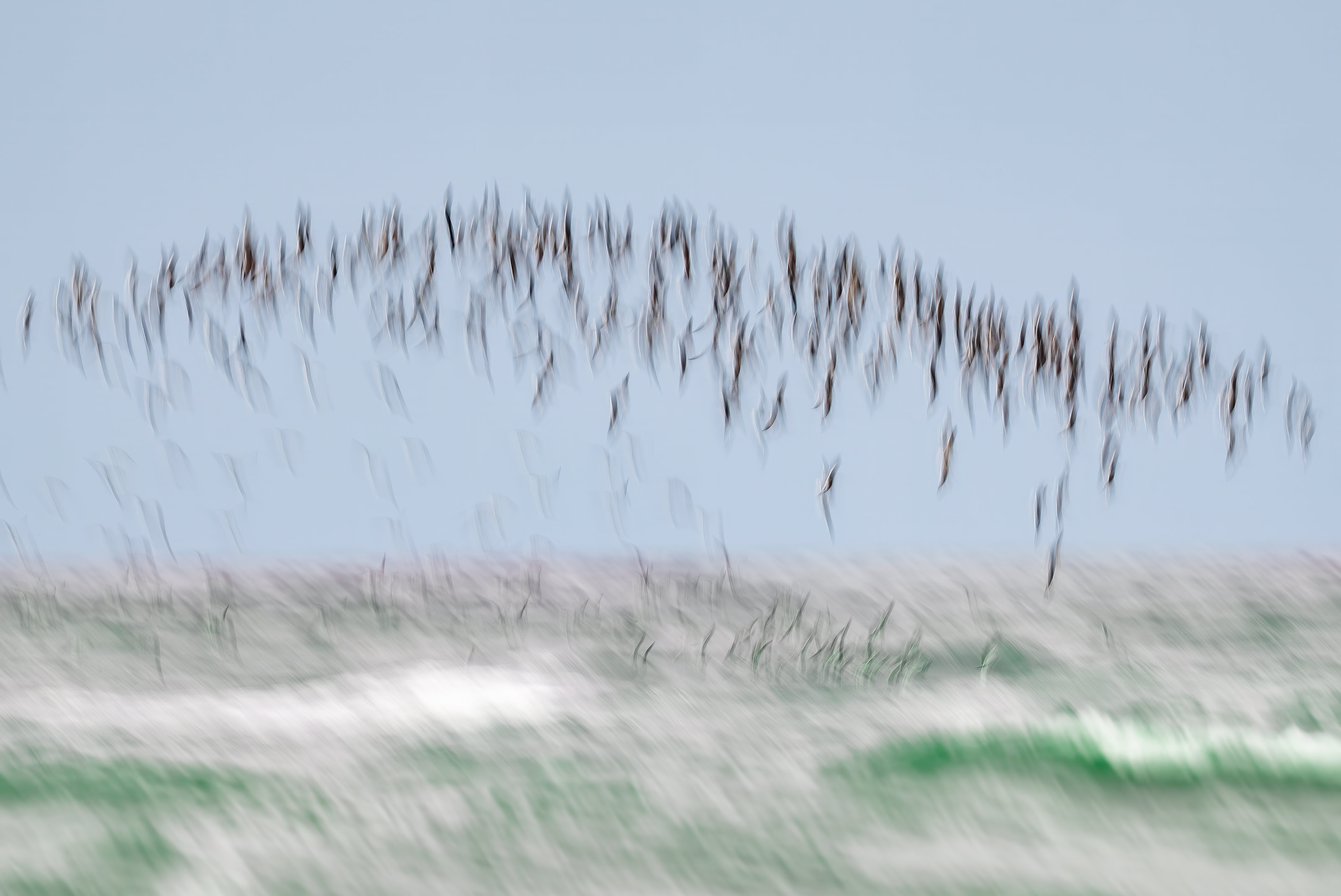
This image was also created on 10 September 2026 at Nickerson Beach Park, Lido Beach, NY. Standing on the beach, I used the handheld Sony FE 300mm f/2.8 GM OSS Lens (Sony E) with the Sony FE 1.4x Teleconverter (at 420mm) and The Latest Greatest Sony Flagship Body, the a-1 II Mirrorless Camera (in APS-C crop mode yielded and effective focal length of 630mm). The exposure was determined by Zebras with Exposure Compensation (EC) on the Thumb Dial. Multi Metering +2.0 stops. AUTO ISO set ISO 125: 1/13 second at f/4 (wide open) in Shutter Priority mode. AWB at 6:45:05am on a cloudy morning. Tracking: Zone/AF-C with Bird-Eye/Face Detection performed perfectly. Click on the image to enjoy a larger high-res version. Image #2: Black Skimmer flock over the ocean blur |
Green Water on a Blah Morning
Properly exposed to the right, the raw file for this on was absolutely flat and boring. My regular workflow brought the image to life. Then, I created an Adobe Camera Raw mask of the ocean. I moved the Hue slider to the right to bring up the green and followed that up with the Dehaze slider to further improve things.
Learn about the power of the ACR masking feature in the Digital Basics IV Video Series. Or, if you are new to BAA and Photoshop, consider saving $86.00 by grabbing The BIRDS AS ART Digital Basics Collection.
The point of the image was to show that the ocean was rough, so the ACR filter work was the bomb. The plan was to build to the finale: me in some danger of dying.
Note that the framing at effective 630mm for this one was also perfect.
From Gemini
Increasing the Dehaze slider (moving it to the right) in Adobe Camera Raw or Photoshop’s Camera Raw Filter boosts three main visual attributes:
1-Local and Midtone Contrast: It analyzes the image to estimate light transmission through atmospheric haze and selectively boosts contrast, particularly in flat, low-contrast midtone areas.
2- Color Saturation and Vibrance: It deepens color intensity and saturation across the affected areas (often acting similarly to a polarizing filter on skies and foliage).
3- Shadow Density/Dark Tones: It deepens dark tones and lowers exposure slightly in washed-out areas to cut through atmospheric glare, smoke, or fog.
|
|
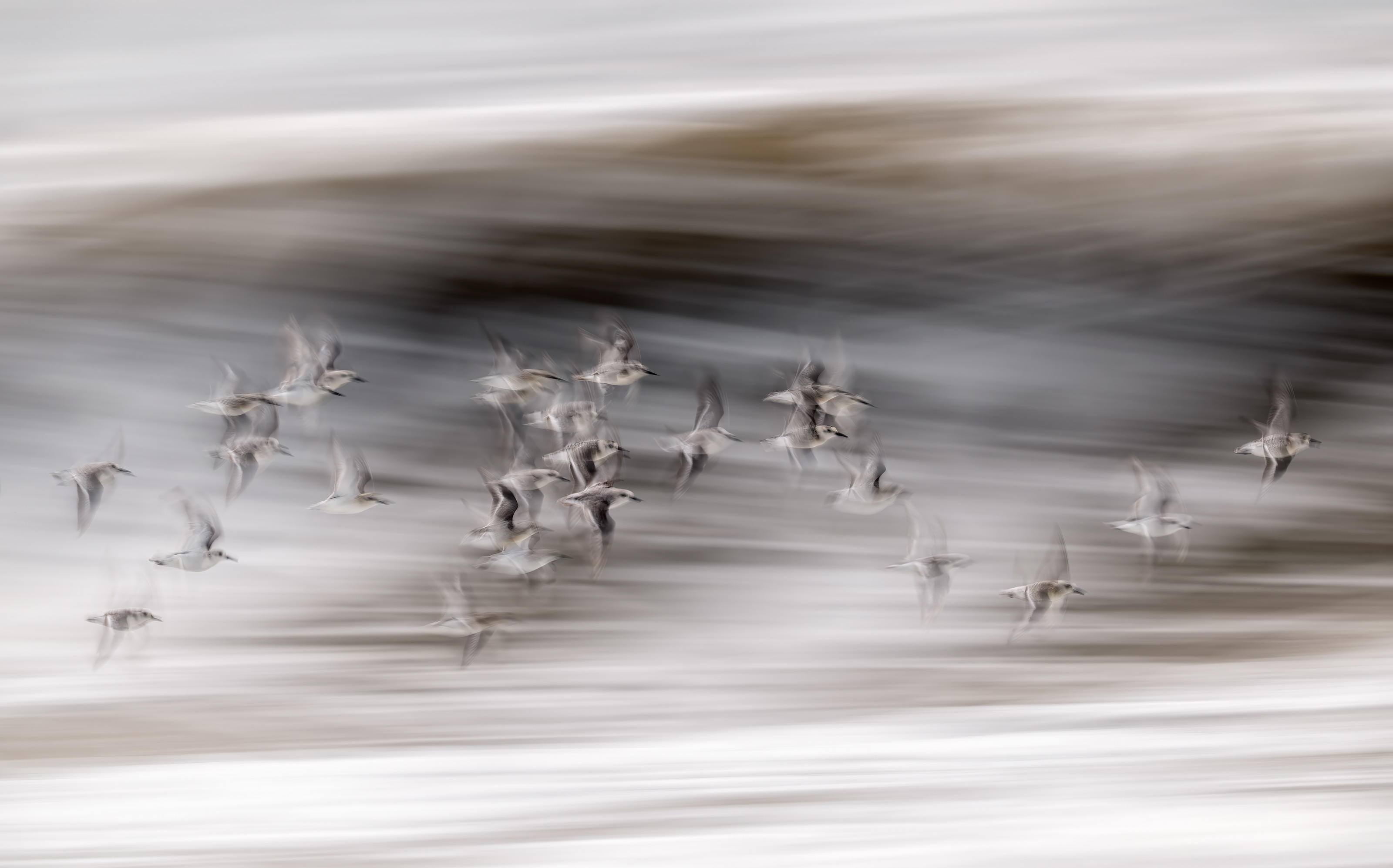
This image was also created on 10 September 2026 at Nickerson Beach Park, Lido Beach, NY. Standing on the beach, I used the handheld Sony FE 300mm f/2.8 GM OSS Lens (Sony E) with the Sony FE 1.4x Teleconverter (at 420mm) and The Latest Greatest Sony Flagship Body, the a-1 II Mirrorless Camera. The exposure was determined by Zebras with Exposure Compensation (EC) on the Thumb Dial. Multi Metering +2.0 stops. AUTO ISO set ISO 125: 1/20 second at f/4 (wide open) in Shutter Priority mode. AWB at 6:53:20am on a cloudy morning. Tracking: Zone/AF-C with Bird-Eye/Face Detection performed perfectly. Click on the image to enjoy a larger high-res version. Image #3: Sanderling flock in front of face of wave blur |
A Sanderling Morning
Until the tenth of September, I had never seen so few Sanderlings during the summer at Nickerson. On Thursday, a flock of about a hundred landed right in front of me while I was still doing skimmer blurs. I make it a habit to keep my Rubbermaid Roughneck Step-Stool at my side in case I need to get low instantly. As I moved a few feet to my right, I bent to grab the stool. The flock blasted off right at me and I was caught with my pants down for the first time that day.
This much smaller flock flew by a few minutes later right in front of the face of a breaking wave. Again, it gives you an idea that it was not a calm day.
On the Human Condition at Nickerson Beach and An Exhilarating Near-Death Experience
For real.
“The sea was angry that day, my friends.” That’s Jason Alexander playing George Costanza in the famous Seinfeld marine biologist episode.
Well, last Thursday morning, the sea was indeed angry. A 25-knot southwest wind had blown all night long and continued right through the morning. Massive four- to five-foot rollers piled in one after another. As the light slowly broke, we noticed a narrow, 200-yard long overflow tidal pool just west of the West Colony. Anke spent the rest of the morning capturing great images of the bathing shorebirds, while I concentrated on Sanderlings on the clean, wave-washed sand.
I’d been feeling fine since Sunday’s stomach trouble, but suddenly, reality hit: I needed a restroom immediately. The problem? The men’s room was nearly a mile away, across soft, energy-sapping sand.
I took about ten steps east and instantly realized I wasn’t going to make it. There was no other choice. I set my lens down safely on the step stool, made sure my phone and fanny pack were also on it, and strode straight into the surf to handle business.
Heading into waist-deep water, I knew I was taking a risk. But growing up, I was completely at home in the ocean — as a young teenager, I spent every July and August bodysurfing the Atlantic at the Capri Beach Club just down the road in Atlantic Beach. Still, the ocean can kill a careless person in a heartbeat. (Ask me sometime about how I nearly was killed while working as a mate on Ron Grandinetti’s charter boat, the Julie II, back in the mid-70s.)
I loosened my belt as I waded into the surf, but almost immediately, a heavy wave slammed into me, followed by an even bigger one. For a terrifying moment, I lost my footing and felt the undertow pull me out. If there’s a rip current, I’m done, I thought. Fortunately, the next set pushed me back toward the shore. I sat down in the water, lowered my pants, and let the incoming whitewash do the cleaning. I pulled my pants back up, stood, and walked back toward dry sand.
I barely made it ten steps back to my step stool before realizing I wasn’t done — a second wave hit. Back into the ocean I went.
That was when a massive set of waves crashed down one after another in rapid succession and really did a number on me. With my belt still unfastened, I was knocked down repeatedly. Every time I fought to get my feet under me, another wave smashed me upside down. I was swallowing seawater with every wave. It was like being trapped inside a giant washing machine. I knew that my pants would be completely clean. I kept my head, stayed calm, and eventually was able to make my way out of danger.
After the very few tense minutes, I managed to make my way back into shallow water, thoroughly exhausted. I stayed down sitting in a foot of water facing out to sea, letting the small waves wash over me as I caught my breath, deeply grateful just to be alive.
As I sat there recovering, I turned to get up and who should happen to drive by on the completely deserted beach? Five lifeguards in a truck. They all exited the vehicle and ran up to me asking, “Do you need help.” I said, “I was in a bit of trouble but I am fine now. I could use some help getting up.” They were all young, fit, and athletic. They looked at me quizzically, clearly wondering what on earth an old photographer was doing tumbling around in heavy surf fully clothed.
Always honest, I replied, “I had diarrhea. Twice.” They nodded in quiet understanding, walked back to their truck, and drove off without another word. I never did ask if they had seen me struggling.
The craziest thing was that for the next six hours — fueled by a massive, exhilarating rush of adrenaline, I felt completely supercharged. It was a morning that I won’t soon forget.
The only casualty was the new pair of reading glasses I’d forgotten to take out of the pocket of my long-sleeved Ex-Officio shirt – I still have several of those from the six episodes of the Canon Photo Safari TV show days. That was a small price to pay: far better that the reading glasses were lost to the sea than me.
Typos
With all blog posts, feel free to e-mail or to leave a comment regarding any typos or errors.








Now u know why bears poop in the woods!!! TMI but I guess we can learn from your surf adventures. Yes, what a way to go! Glad it all came out alright! Far better than worse.
Artie, you survived because, when you found yourself in a situation you couldn’t control, you relied upon your experience to keep calm and recognize your chance to escape when the surf was done pounding on you. Those who panic or get injured can have a different experience.
Yes, I have been there too—not in the surf, but in the air. I had no previous experience surviving an A-7E after it had been hit by North Vietnamese anti-aircraft fire that ruptured the main fuel tank feeding the TF41 Rolls-Royce engine, resulting in a fuel-fed fire that historically always ends badly. But I did have considerable training in how to possibly survive.
Unfortunately, when this situation first developed, I was far from the perceived safety of the ocean, so I chose not to eject immediately, as the handbook’s emergency procedures demanded in bold type, but to value not being captured over possibly not surviving. Although I could clearly see flames reflecting off the port-side wing pylons in the left rear-view mirror, and I had lost all electrical power, rendering me unable to communicate with anyone, my plan was to eject after crossing the beach outbound and take my chances floating around in my survival raft, assuming the ejection seat, parachute, raft, and other gear all worked as advertised.
When I got there, the number of fishing boats just offshore surprised me. There was a bounty on recovered American aircrew, so I knew that was not helpful. However, I could now see the USS Jouett (CG-29) manning the North SAR station a few more miles in the distance, so I eased into a gentle turn toward it, planning to eject alongside the ship so they would surely see me and the aircraft wouldn’t hit the ship.
However, that’s the point where the fuel tank must have emptied, with the external fire flashing inside it and resulting in a catastrophic explosion that separated everything aft of the wing—including the engine, vertical tail, and horizontal tail—from the wing and forward fuselage.
I was somewhere around 10,000 feet and 400 knots with zero control when my plan ended so abruptly. The immense amount of kinetic energy in the piece of aircraft I occupied had to dissipate before it could find some steady-state condition in which I wasn’t pinned against the upper-left canopy surface by extreme negative G-forces. It seemed to be unending.
So there I was… unable to reach either ejection handle and knowing that, if I could reach one, the seat would likely kill me when its rocket fired because I was so far out of position. I was calmly watching the sea surface rapidly rotating in my view through the front bulletproof glass, thinking, “This is just like the movies!” followed by, “So this is how it’s going to end for me,” when a voice in my consciousness that I didn’t recognize said clearly and matter-of-factly, “No, not yet!”
At that moment, positive G-forces suddenly returned, and I was slammed backward into the seat, where I pulled the ejection-seat’s face-curtain handle as fast as I could move. That was the beginning of an E-ticket Disneyland ride like none other, but, to my amazement and profound gratitude to all the many people who made that moment possible, everything worked, and I was soon in my raft, floating in the relative safety of the ocean just as I had hoped. The fully inflated parachute canopy above me is a sight I’ll never forget.
It turned out that the ship had no problem seeing the fireball coming out from enemy territory, the explosion, and the parachute. They were getting two rescue helicopters in the air probably as I was struggling to get into my raft. In the high sea conditions that existed, they temporarily lost sight of me, but my survival training again paid off. I popped a smoke flare I had in my vest, which allowed the helo crew to reacquire my position and judge the prevailing wind conditions. They put a rescue swimmer in the water (he jumped). The helo backed off while the he assessed my condition before signaling the helo to approach our position. He attached my harness to the lowered hoist, and we were soon on our way back to the CG.
I believe the other helo fired on my raft to sink it so none of the enemy boats could recover it and use it as a decoy.
I went back to my starting point that day, USS Kitty Hawk (CV-63) on another helo about dusk, where I found out how badly beat up I was. After a few weeks to recover, and with the help of crutches, I was happily flying missions again, only needing some assistance from my willing plane captains to make that initial first big step up the boarding ladder.
The crew of the H-53 “Big Mother” that day were from Helicopter Combat Support Squadron 7 (HC-7) and the three aircrew in the back were awarded Navy Commendation Medals some years later for fishing me out of the Gulf of Tonkin that September afternoon in 1972—a day I call “My bad day at the office.”
That NDE has changed my view on death ever since. I since have learned that the voice I heard has often experienced in similar circumstances. In his book on NDEs, John Geiger calls it “The Third Man Factor.”
But the takeaway from each of our stories is this: when the unexpected happens, keep your wits about you and rely on your training and experience to maximize your chances of survival. If it’s not your time to go, you may survive until it is.
Good heavens, I’m glad you survived that! What an ordeal! The ocean can be brutal. Many years ago, in Hawaii, I had to be dragged out after getting knocked off my feet by a rogue wave and a massive undertow. I had a backpack on and was holding a camera with a wide angle lens … Definitely memorable…
First, I’m glad to know your episode came out ok. I mean turned out ok. After the washing machine experience in the churning waves, I’d have been pooped. Seriously, I’m glad you’re safe.
My favorite is #3 for reasons mentioned. However, image #2 with its vertical pattern of the flock is awesome. I assume they were banking?? Well done.
Thanks, Tom! Most of the comments today are hilarious include your “pooped”!
Yes, banking hard.
much love, artie
I thought the same thing as Steve (mating, what a way to go!) and agree with Patricia and everyone else about Image 3. In addition to the #3 birds being sharper, and nicely fit between the waves, there’s more apparent DOF, whereas in Image 1 only one skimmer in front looks sharp. Which raises the question, instead of dropping ISO so low, why not go with a higher ISO, a bit higher shutter speed, and a smaller aperture? With flying shorebird blurs, I’ve had nice results at 1/50-1/125. And with the R5, shots at 5000 ISO that look like 200.
No scares like yours–you did well to stay calm in uncalm conditions. Mine have usually been over in as little as half a second (broken pelvis, knew for that half second it was going to hurt) or else three months trying to find the right surgeon for what I thought was an 80% mortality operation (learned later only 5% when an aneurysm hasn’t already burst). In the slow-motion cases, you at least get to review your favorite photos!
Thanks on all counts, Cliff. Great to see you here.
You put a new arrow in my quiver for next year: when close to the flocks, I will go to Aperture Priority with AUTO ISO and shoot smaller apertures and likely wind up with some mid-range blurs shutter speeds. I hope I remember to remember 🙂
Unfortunately, I never got to mate while on Captain Midnight’s boat …
with love, a
#3 is absolutely killer. My winner!
Glad you made it out of that surf – it’s no joke! You could pass-off your story as a Bob Eastman.
Thanks, Pugs. Most of Bob’s serious problems were the result of accidents. Mine would have been the result of my choice 🙂
with love, artie
Surprise, Art, you finally captured a blur that I actually like (#3) — probably because the birds are more in focus than they usually are in your blurs. Also, the colors of the wave blur echo the color of the birds.
Glad to know you are home — and safe!
Typos:
(1) we had HAD
(2) you MUCH consider
(3) for this ON
Thanks, Pat.
Great on #3. I was hoping for that. Do note that 99% all of the blurs I post are in sharp focus. The difference with #3 is that the birds are better defined, looking a bit more real.
I fixed the typos — the “had had” was correct but mis-typed “for” instead of the intender “far.”
Thanks for the catches; you have a great proofreader’s eye!
with love, artie
Artie: I have discovered that waves knock me down now that I would barely have noticed 20 years ago. I too was comfortable swimming and fishing in rough water but at 81 I am just not as strong as I used to be. I’m glad you made it. That would have been a shitty way to die.
I like the blurs, the sanderlings are my favorite, I think. With love, Dr Fish
Thanks, Dr. Fish. Me too. Your pun was not a crappy one! Folks really have their funny hats on today 🙂
I was never strong but am certainly weaker at 80 than I was last week or last year or last decade 🙂
much love, artie
>> “I had diarrhea. Twice.” They nodded in quiet understanding, walked back to their truck, and drove off without another word. <<
In California they would have fined you for dumping raw sewage.
100% correct. You are in rare form this morning Steve!
a
>> “The sea was angry that day, my friends.” That’s Jason Alexander playing George Costanza in the famous Seinfeld marine biologist episode. <<
Would you say the Sony 100-400 f/4.5 GM lens is spongeworthy?
Absolutely. Don’t believe me? Ask Elaine Benes!
with love, artie
>> Ask me sometime about how I nearly was killed while mating on Ron Grandinetti’s charter boat <<
I'm not sure the meaning of this sentence came out the way you intended it to. = 0
That’s funny.
a
ps: I re-crafted that to “I nearly was killed while working as a mate on Ron Grandinetti’s charter boat, the Julie II, back in the mid-70s.”
Number two of course 🙂
Very glad you survived that fight!
My favorite image is really #3 but #2 was more appropriate for the story.
I prefer the sanderling flock blur because it looks like a painting with every stroke perfectly placed.
Good morning, Sandy. Thanks for your kind words. Me too! I love #3 also as that was like one of the five footers that smacked me upside down!
with love, artie
ps: toward the end of the Long Island trip, I began using some slightly higher shutter speeds, 1/20 sec. for #3, in an effort to better define the birds.