
I’m Proud To Be An American (Bird Photographer and Blogger)
I’m proud to be an American and very glad to be alive and healthy. Kudos to Lee Greenwood. He sang this song at Yankee Stadium on September 11, 2026, the 25th anniversary of the 9/11 attacks.
Summary
In my last post, I invited anyone who’s ever had a brush with death to share their story in the comments section. When I read what photographer/friend Warren Robb posted, I was floored by his incredible and harrowing combat survival story. Keep reading and I am pretty sure that you will be too.
Note: General information, copy editing, re-crafting, technical refinement, and formatting for this blog post were assisted by Gemini AI.
In the Last Blog Post
In the last blog post most folks went with Image #3, the Sanderling flock in front of the large wave blur as their top pick for a variety of good reasons. I loved Image #2, the banking skimmer flock blur over the rough sea. Why? I loved the green water brought to life via an ACR mask and because it most reminded me of the power of the ocean that day.
|
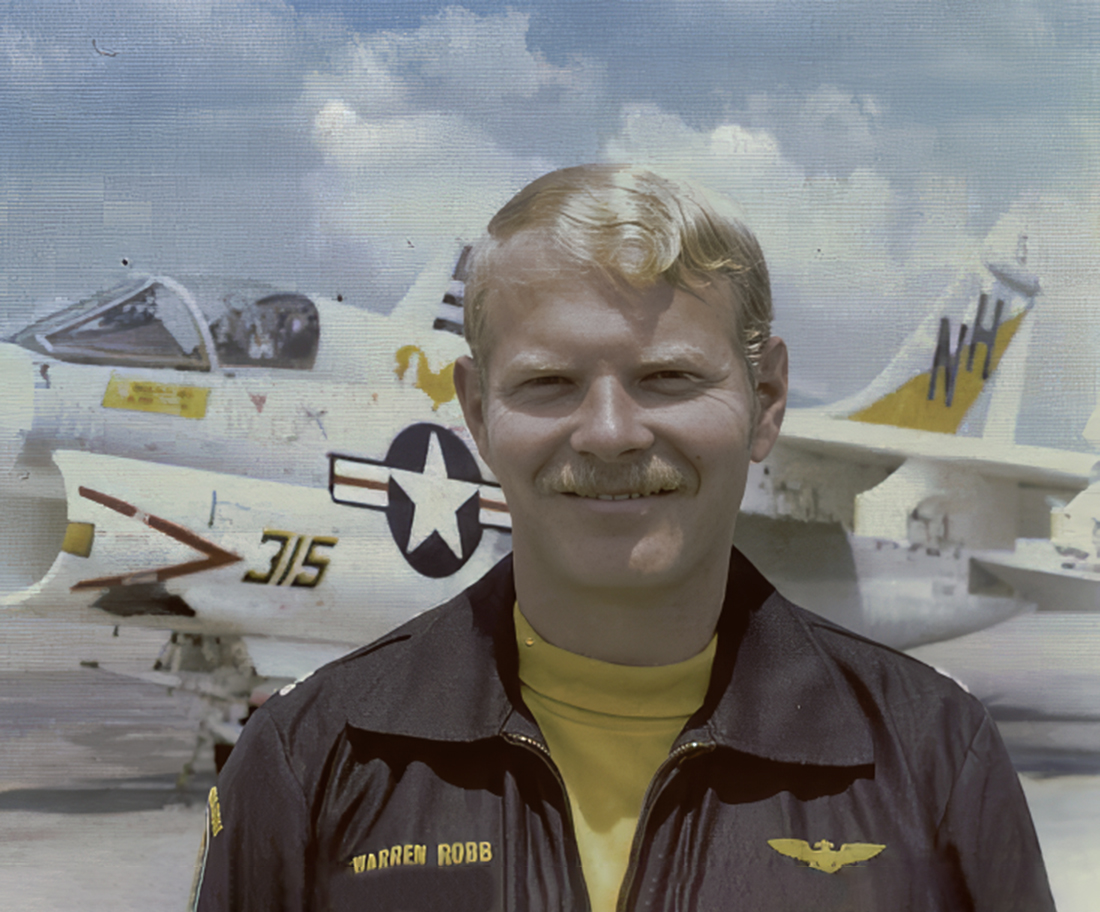
Image #1: LT Warren Robb, USN
|
LT Warren Robb, USN
This photograph was made in 1973 at NAS Cubi Point, Philippine Islands, a year after Warren’s jet was shot down over Vietnam. He was 29 at the time.
Warren Robb/September 13, 2026 at 8:44pm
Artie, you survived because when you found yourself in a situation you couldn’t control, you relied on your experience to stay calm and recognize your chance to escape once the surf stopped pounding on you. Those who panic or get injured often have a very different outcome.
I’ve been there too — not in the surf, but in the air. I had no prior experience surviving an A-7E after taking a hit from North Vietnamese anti-aircraft fire. The burst ruptured the main fuel tank feeding the TF41 Rolls-Royce engine, resulting in a fuel-fed fire—a scenario that historically always ends badly. But I did have extensive training on how to survive.
When the situation first developed, I was far from the relative safety of the ocean. I chose not to eject immediately — despite the handbook’s emergency procedures demanding it in bold type — because I valued avoiding capture over possibly not surviving. Although I could clearly see flames reflecting off the port-side wing pylons in my left rear-view mirror, and I had lost all electrical power and communications, my plan was to eject after crossing the coastline outbound. I figured I would take my chances in my survival raft, assuming the ejection seat, parachute, and gear all worked as advertised.
When I reached the coast, the large number of fishing boats just offshore surprised me. Knowing there was a bounty on recovered American aircrew, that wasn’t encouraging. However, I could now see the USS Jouett (CG-29) manning the North SAR station a few miles in the distance. I eased into a gentle turn toward her, planning to eject alongside the ship so they would clearly see me and the jet wouldn’t hit them.
That’s when the fuel tank must have emptied, allowing the external fire to flash inside and trigger a catastrophic explosion. The blast instantly separated everything aft of the wing — including the engine, vertical tail, and horizontal tail — from the wing and forward fuselage. I was at roughly 10,000 feet and 400 knots with zero control when my plan ended so abruptly. The immense kinetic energy in the remaining section of the aircraft had to dissipate before settling into any kind of steady state where I wasn’t pinned against the upper-left canopy by extreme negative G-forces. It felt unending.
So there I was, unable to reach either ejection handle, knowing that even if I could, the rocket seat would likely kill me because I was so far out of position. I was calmly watching the sea surface rapidly spinning through the front bulletproof glass, thinking, “This is just like the movies,” followed by, “So this is how it ends for me.”
Then, a voice in my consciousness that I didn’t recognize said clearly and matter-of-factly: “No, not yet.”
At that exact moment, positive G-forces returned and slammed me backward into the seat. I pulled the ejection seat’s face-curtain handle as fast as I could move. That was the start of an E-ticket ride like no other. But to my amazement — and with profound gratitude to the many people who made that moment possible — everything worked. Seeing the fully inflated parachute canopy above me is a sight I’ll never forget. Soon, I was floating in my raft in the relative safety of the ocean as I had envisioned.
The ship had no problem seeing the fireball emerging from enemy territory, the explosion, and my parachute. They had two rescue helicopters airborne while I was still struggling to get into my raft. In the rough sea conditions, they temporarily lost sight of me, but my survival training paid off again: I popped a smoke flare from my vest, allowing the helicopter crew to reacquire my position and gauge the wind.
They dropped a rescue swimmer into the water, and the helo backed off while he assessed my condition before signaling the aircraft to approach. He hooked my harness to the lowered hoist, and we were soon on our way back to the cruiser. Meanwhile, I believe the second helo fired on my abandoned raft to sink it so enemy boats couldn’t recover it as a decoy.
I returned to my starting point that evening — the USS Kitty Hawk (CV-63) — on another helicopter, which is where I finally realized how badly beaten up I was. After a few weeks of recovery and some time on crutches, I was happily flying missions again, needing only a little help from my willing plane captains to make that big first step up the boarding ladder.
The crew of the H-53 “Big Mother” that day was from Helicopter Combat Support Squadron 7 (HC-7). The three aircrew in the back were awarded Navy Commendation Medals some years later for fishing me out of the Gulf of Tonkin on that September afternoon in 1972 — a day I call “my bad day at the office.”
That near-death experience permanently changed my view on death. I’ve since learned that many people in similar extreme circumstances experience that same voice. In his book on NDEs, John Geiger calls it “The Third Man Factor.”
The takeaway from both of our stories is clear: when the unexpected happens, keep your wits about you and rely on your training and experience to maximize your chances of survival. If it’s not your time to go, you just might survive until it is.
Arthur Morris/BIRDS AS ART/September 14, 2026 at 8:56am
Hey Warren, Huge thanks for sharing the above. And thanks for your service to your country. I was in tears half way down. Your “bad day at the office” made mine seem like a day at the beach. Which it was . And your tale brought to mind my Dad, Private First Class Robert Edward Morris, getting his right arm shot off in Okinawa and then spending 19 months in the hospital recovering from numerous additional injuries and wounds.
And thanks also for the great advice.
Much love, artie
ps: a single comment like yours above leaves me feeling that all of the hours I put into the blog are well worth it. In spades.
ROBERT DEBARTOLO/September 14, 2026 at 10:45am
Good Morning. Well first off, thank you for your service Warren Robb and for sharing your experience with us. Many lessons to be learned from that and I’m so happy that you were able to survive and be able to share this incredible experience with us. Clearly your extensive training and quick thinking was the key to your survival. God bless you and thank you for your service again! It pays to be tough when you need to …
Artie is a tough cookie too. I got to work with him last weekend on Long Island, and despite being extremely ill, and I do mean extremely ill, he still showed up for our instructional session at 6:00am! He needed to stay in his car to be close to the facilities but he still came to meet me and try to help. He also had Anke there to help where he couldn’t due to his illness. He even took us all out for coffee and bagels afterwards! Never have seen such dedication to his craft and exceptional teaching ability. I learned so much and was hoping to get just “one” great shot. Artie help me get several. He changed the way I thought about this bird photography thing. This new perspective is incredible, He was recovering and still managed to get out again later in the week — hence round #2 of being ill. He’s UNSTOPPABLE!
My favorite is #3 Blast off. Great composition and I like the birds somewhat more in focus. Beautiful image.
Thanks for everything Artie!
|
|
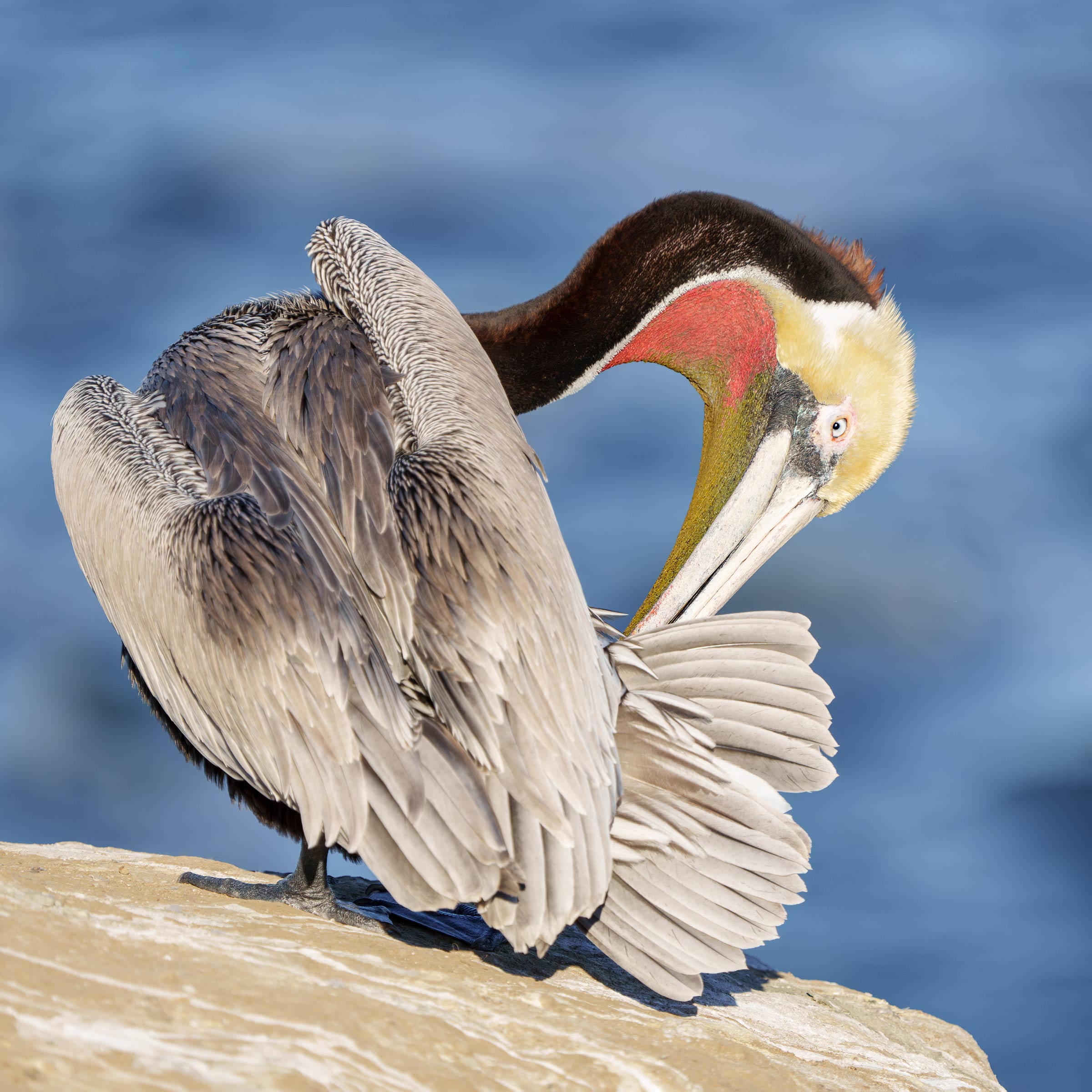
This image was created by Warren Robb on 10 January 2025 on a BIRDS AS ART San Diego IPT. Tracking: Zone/AF-C with Bird-Eye/Face Detection performed perfectly. Click on the image to enjoy a larger, inexplicably sharper high-res version. Image #2: Brown Pelican — Pacific race preening
|
Fighter Pilot/Photographer
Warren Robb has been on numerous IPTs with me over the years including Homer, San Diego, Fort DeSoto, Morro Bay, and my very last IPT to the Ramirez Ranch in Roma, TX. In 2020 Warren was one of the first to follow my advice, sell all of his Canon gear, and switch to Sony. He is a happy convert.
During a group dinner on a 2025 BAA San Diego IPT, Warren, a retired US Navy fighter pilot, had us all on the edge of our seats at dinner in the AirBnB as he told the harrowing story of taking off and landing on his carrier in a driving rainstorm during the Vietnam War. The cockpit was drenched when he entered his aircraft (an A-7E) and got strapped in. Not surprisingly, he could not see the target for his load of ten 500 pound bombs. As you cannot land on a carrier with your bombs, he was told to jettison them over the jungle. None of several bomb release methods worked so he was ordered to fly 200 miles south, land at the airbase in Danang, and have the bombs off-loaded. He was surprised when they ordered him back to the USS Kitty Hawk as all the other planes had already been landed.
When he got back to the ship, he couldn’t see a thing as the rain still poured down. During an instrument landing the rule is that if you cannot see the carrier at 1/2 mile 200 feet, you must abort the landing. He told the landing officer that he could not see the ship. The Landing Signal Officer (LSO) told him to keep coming. So, on blind faith, he did after turning on his taxi lights as instructed. The first things he saw were other planes on the deck as the plane’s hook caught the three wire! Later, Warren thanked the LSO and told him that having him turn on the taxi light was a great idea. The guy confessed that he had never seen the plane until it landed but that it had sounded good!
Warren summed things up by saying that his scariest landing ever had been quite an e-ticket ride.
|
|
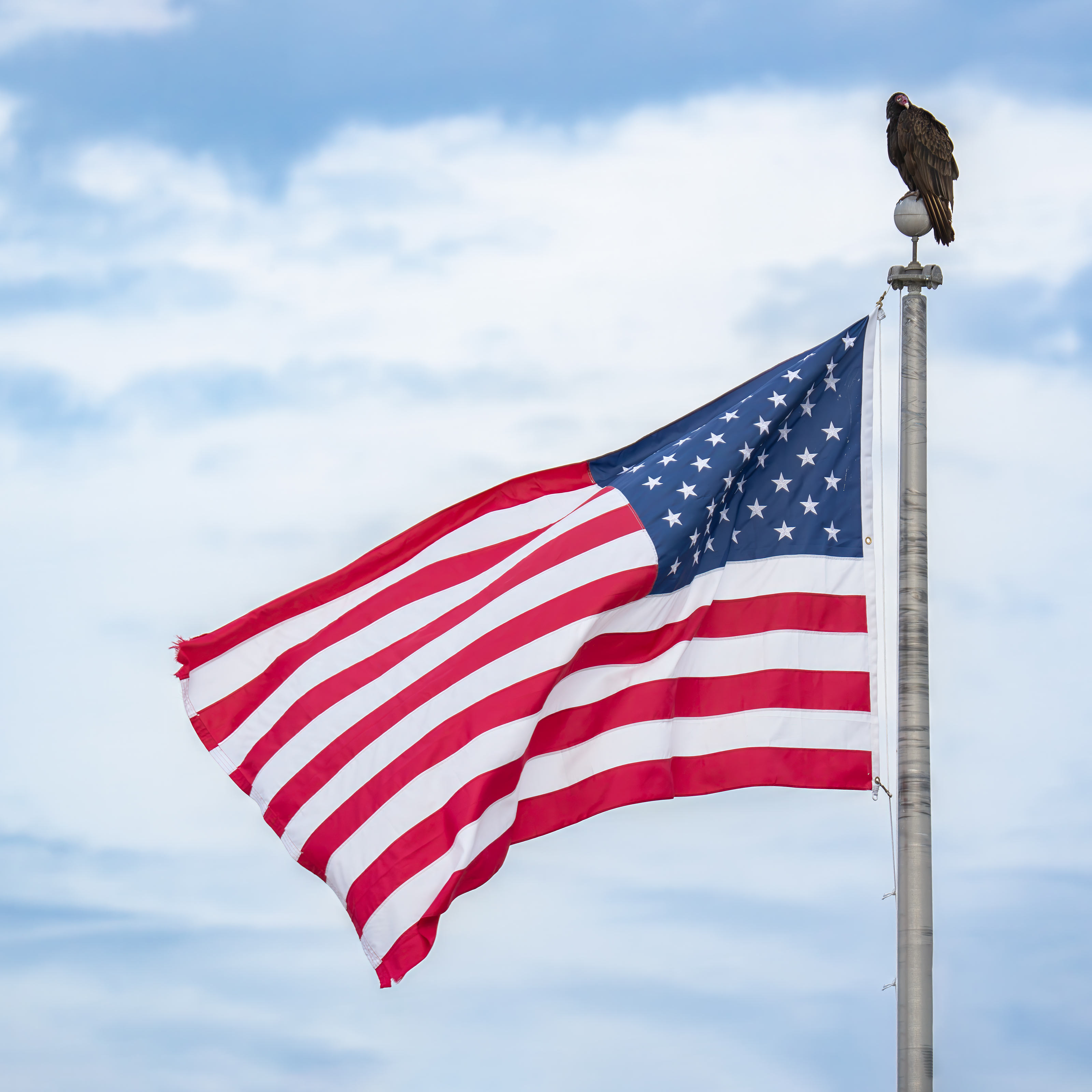
This image was created on 8 January 2024 by the pier parking circle at Indian Lake Estates, FL. Seated in the front seat of my X5, I used the handheld Sony FE 200-600mm f/5.6-6.3 G OSS lens (at 362mm) and The Latest Greatest Sony Flagship Body, the a1 II Mirrorless Camera. The exposure was determined by Zebras with ISO on the rear wheel — ISO 2500: 1/1000 second at f/6.3 (wide open) in Manual mode. AWB at 8:08:03am on a barely sunny morning. Upper right Tracking: Zone/AF-C with Bird-Eye/Face Detection performed perfectly. Click on the image to enjoy a larger, inexplicably sharper high-res version. Image #3: Turkey Vulture on flagpole flying the American flag
|
Created as a Stock Photograph
I shot this one thinking that I would submit it to Getty but have not yet gotten around to doing that. The image, however, goes well with today’s post.
AF Tip
By moving the Zone AF brackets around in the frame, Sony folks can improve autofocus performance and efficiency and reduce the time of initial focusing acquisition. Here I used the Joystick to shift the brackets to the upper right position. You can do the same thing with any of the single AF points. You can always return to center by pressing the Joystick straight in.
Typos
With all blog posts, feel free to e-mail or to leave a comment regarding any typos or errors.







Leave a Reply