
Summary
In a perfect world, the wind would always be blowing directly away from the sun so that the birds are flying right at us. When the sun, however, is more than 90° off the wind direction on a sunny day, bird photography will always be difficult. Learn how artie dealt with such conditions last Wednesday at Nickerson Beach until the bad wind became the perfect wind.
What’s Up?
For a change, conditions were close to perfect for two sessions in a row — there was a brisk north by northwest wind (WNW would have been spot on) on a sunny Sunday afternoon at Nickerson Beach and an absolutely ideal northeast wind the next clear morning. I created nearly 3,000 images during each of those two sessions. Including a few good ones.
Today is Tuesday 9 June 2026. Double check on that. With the forecast calling for sunny skies and a SW wind I am opting to stay in and pack up for my early morning flight to Orlando on Wednesday. With the forecast clear skies and a brisk SSW wind, I will — if I get most everything done, probably head out for a final afternoon session. I hope that you too choose to have fun and enjoy life. Please remember that happiness is a choice — Byron Katie, The Work.Com
If an item — a Delkin flash card or reader, a Levered-clamp FlexShooter Pro, or a Wimberley lens plate or low foot — for example, that is available from B&H and/or Bedfords, is also available in the BAA Online Store, it would be great, and greatly appreciated, if you would opt to purchase from us. We will match or beat any price. Please remember also to use my B&H affiliate links or to earn 3% cash back at Bedford by using the BIRDSASART discount code at checkout for your major gear purchases. Doing either often earns you free guides and/or discounts. And always earns my great appreciation.
Gear Questions and Advice
Too many folks attending BAA IPTs and dozens of photographers whom I see in the field and on BirdPhotographer’s.Net, are — out of ignorance — using the wrong gear, especially when it comes to tripods and more especially, tripod heads. And the same is true in spades when ordering new camera bodies or lenses. My advice will often save you some serious money and may help you avoid making a seriously bad choice. Please know that I am always glad to answer your gear questions via e-mail. If you are desperate, you can try me on my cell at 863-221-2372. Please leave a message and shoot me a text if I do not pick up.

B&H Simplified
To ensure that I get credit for your B&H purchases, you can always click here. The tracking is invisible. Using my affiliate links is greatly appreciated. And, with B&H, you can use your PayBoo card. You must use the website to order. You cannot get your free guides if you make a phone order. Once you have an item in your cart, you must complete the order within two hours. Huge thanks!
B&H
Many folks have written recently stating that they purchased a Sony a1 from B&H and would like their free membership in the Sony 1 Info and Updates Group, a $150.00 value. But when I check my affiliate account, their orders have not been there. When I let them know that they get credit for B&H purchases only if they use one of the many B&H affiliate links on the blog or begin their searches with this link, they are always disappointed. If in doubt, please contact me via e-mail and request a BH link. I am always glad to help and to guide you to the right gear.

Bedfords Simplified
Click here to start your search. Choose standard shipping, and when you get to the payment page, enter BIRDSASART in the discount code box and hit apply. You will be upgraded to free second day air Fed-Ex and receive 3% cash back on your credit card once your stuff ships. Using either my affiliate links is greatly appreciated and will often earn you free guides or discounts. To receive a free guide or free entry into a Sony Set-up and Info Notes e-Mail group, you need to shoot me your receipt via e-mail. The B&H receipts need to include the order number.
Bedfords Amazing BAA Discount Policy
Folks who have fallen in love with Bedfords can always use the BIRDSASART coupon code at checkout to enjoy a post-purchase, 3% off-statement credit (excluding taxes and shipping charges) on orders paid with a credit card. The 3% credit will be refunded to the card you used for your purchase when your product ships. Be sure, also, to check the box for free shipping to enjoy free Second Day Air Fed-Ex. This offer does not apply to purchases of Classes, Gift Cards, or prior purchases.
You can visit the Bedfords website here, shoot Steve Elkins an e-mail, or text him on his cell phone at (479) 381-2592.
|
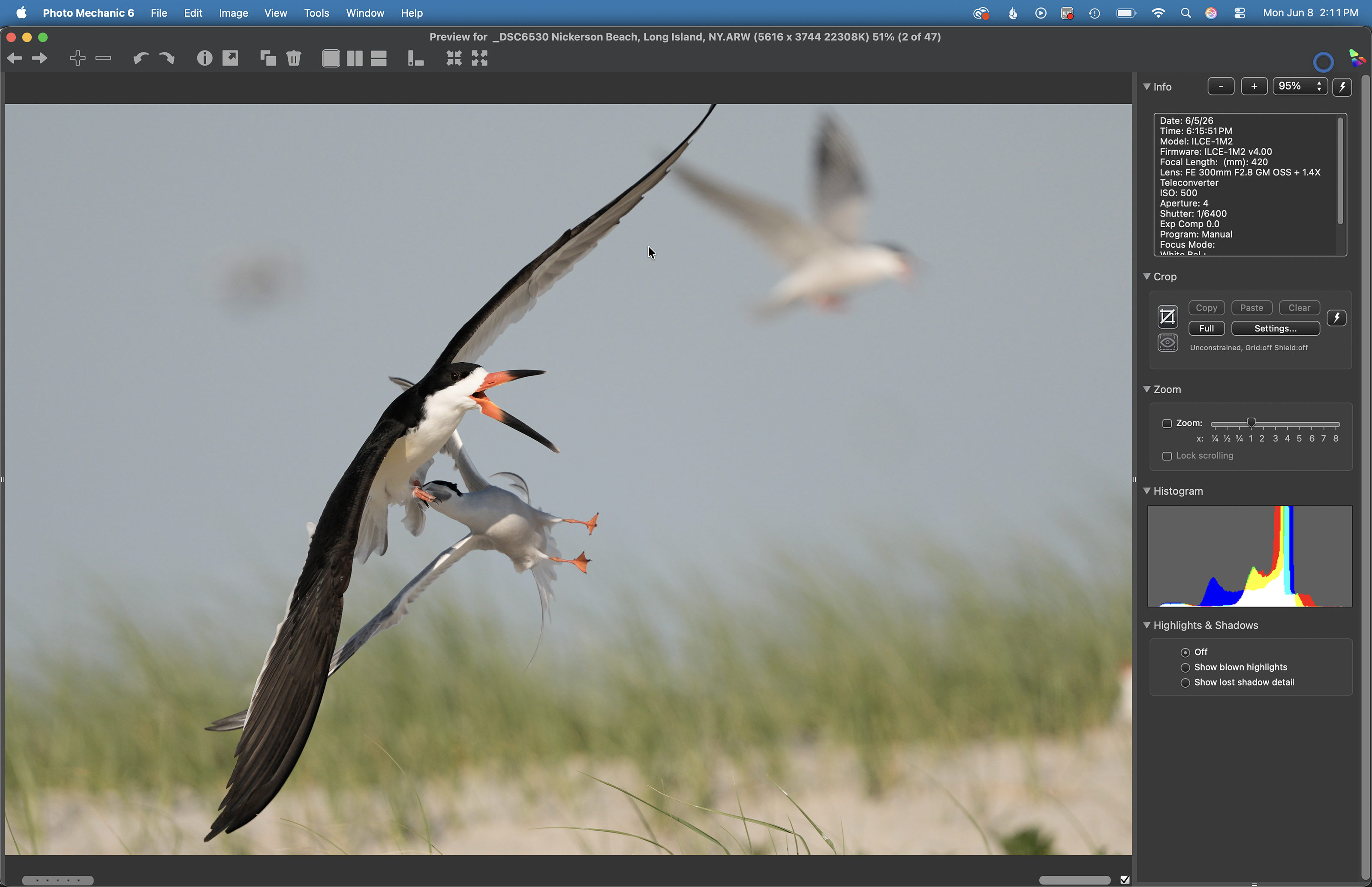
The Photo Mechanic screen capture for the original — Common Tern attacking Black Skimmer |
Too Good to Trash
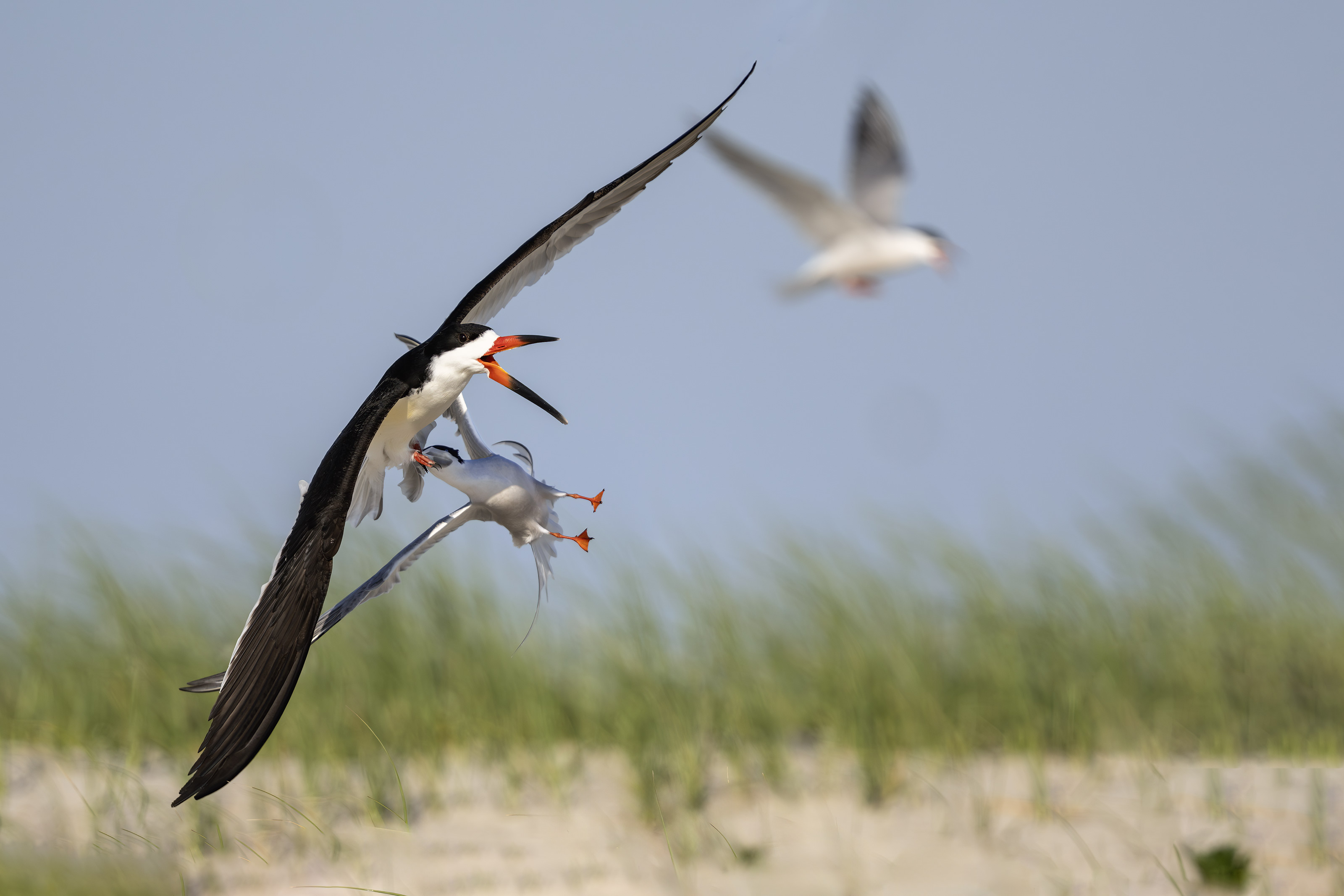
Clipped wing tip. Crooked horizon line. A good part of the attacking bird is in the shade. Rather harsh light. Cyan sky. Would you try to save this one?
|
|
This image was created on 5 June 2026 by yours truly at Nickerson Beach Park, Lido Beach, Long Island, NY. Seated by the colony ropes on dry sand, I used the hand held Sony FE 300mm f/2.8 GM OSS Lens (Sony E) the Sony FE 1.4x Teleconverter (at 420mm) and the Latest Greatest Sony Flagship Body, the a1 II Mirrorless Camera in APS-C Crop Mode. The exposure was determined via Zebras with ISO on the Thumb Wheel. ISO 500: 1/6400 sec. at f/4 (wide open) in Manual mode. AWB at 6:15:51pm on a then mostly sunny afternoon. Tracking Zone/AF-C with Bird Eye/Face Detection enabled performed perfectly. Click on the image to enjoy a larger, inexplicably sharper high-res version. Image #1: Common Tern attacking Black Skimmer |
The Image Optimization
During the raw conversion I used two ACR masks to open up (lighten) the shaded parts of the attacking bird and the belly of the skimmer. Color mixer did well on the sky. After the raw conversion I brought the image into Photoshop, ran Topaz Denoise, and leveled the horizon using Content Aware Crop. Next I want to work adding the clipped wing tip; it took a good deal of time getting that perfect. Last was cleaning up some of the grasses along the bottom frame edge.
One Last Question
Should I have removed the tern in the background?
A Much Easier Fix…
We have seen before that while APS-C crop mode can make your day, it can — on occasion — ruin it. Had I been in full frame mode for this one things would have been a lot easier. On the other hand, APS-C crop mode helped with four of the other images.
|
|
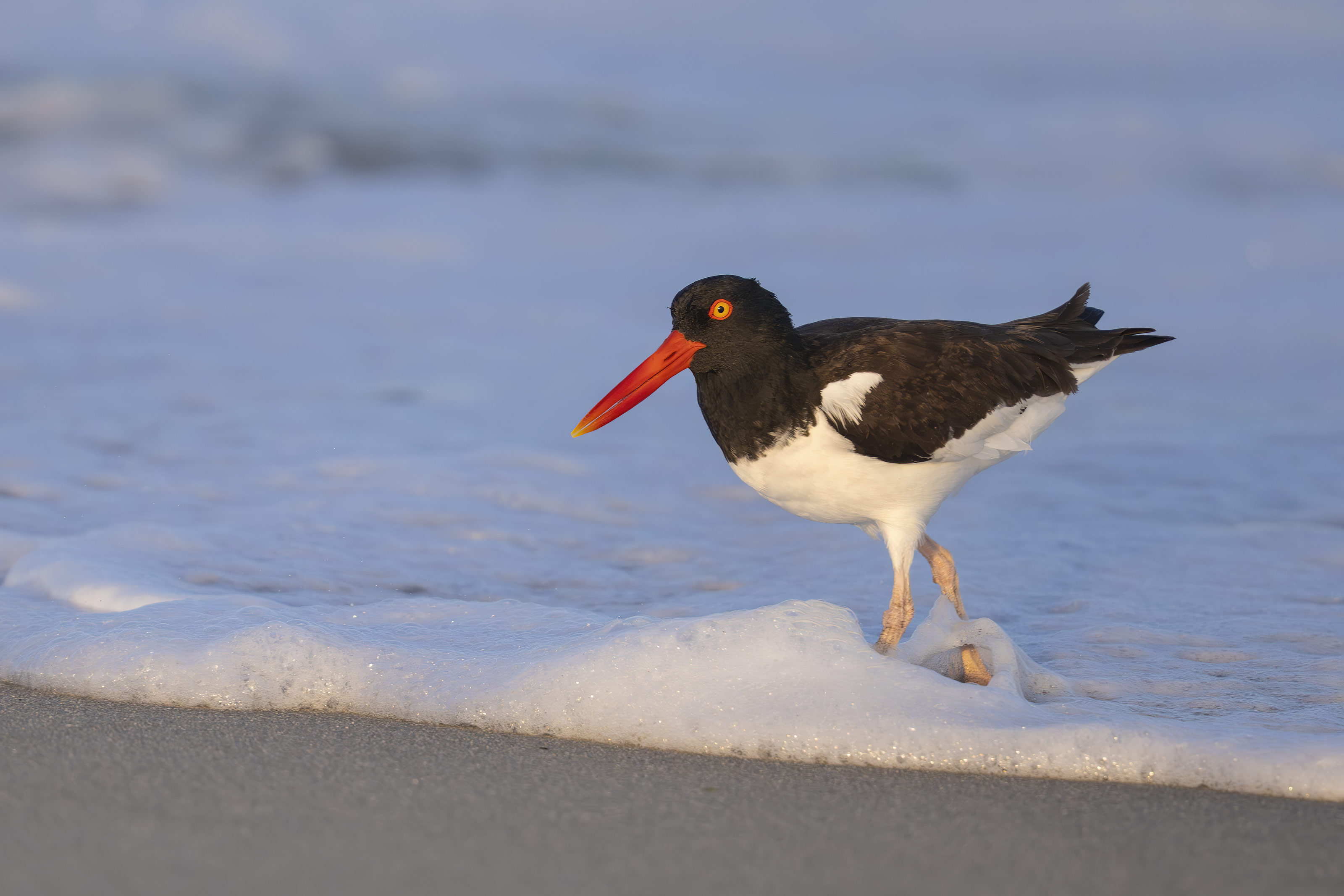
This image was created on 3 May 2026 by yours truly at Nickerson Beach Park, Lido Beach, Long Island, NY. Seated on damp sand at the top of the berm, I used the hand held Sony FE 300mm f/2.8 GM OSS Lens (Sony E) with the Sony FE 2x Teleconverter and the Latest Greatest Sony Flagship Body, the a1 II Mirrorless Camera in APS-C crop mode. The exposure was determined via Zebras with ISO on the Thumb Wheel. ISO 2000: 1/2500 sec. at f/5.6 (wide open) in Manual mode. AWB at 7:38:18pm on a then sunny afternoon. Tracking: Zone/AF-C with Bird-Eye/Face Detection performed perfectly. Click on the image to enjoy a larger, inexplicably sharper high-res version. Image #2: American Oystercatcher foraging in surf |
Finally
On my two previous afternoon Nickerson visits, I had a lovely unbanded oystercatcher feeding in the surf in gorgeous light. But with my surgically repaired right hand still bandaged and the stitches in place, I did not want to risk getting down on the ground and then up again. I was not happy with any of the images. On Wednesday past, however, with my stitches removed and a steri-strip protecting the pretty-much-healed incision, I was able to get down onto the beach right on sun angle. And get up again without a problem.
|
|
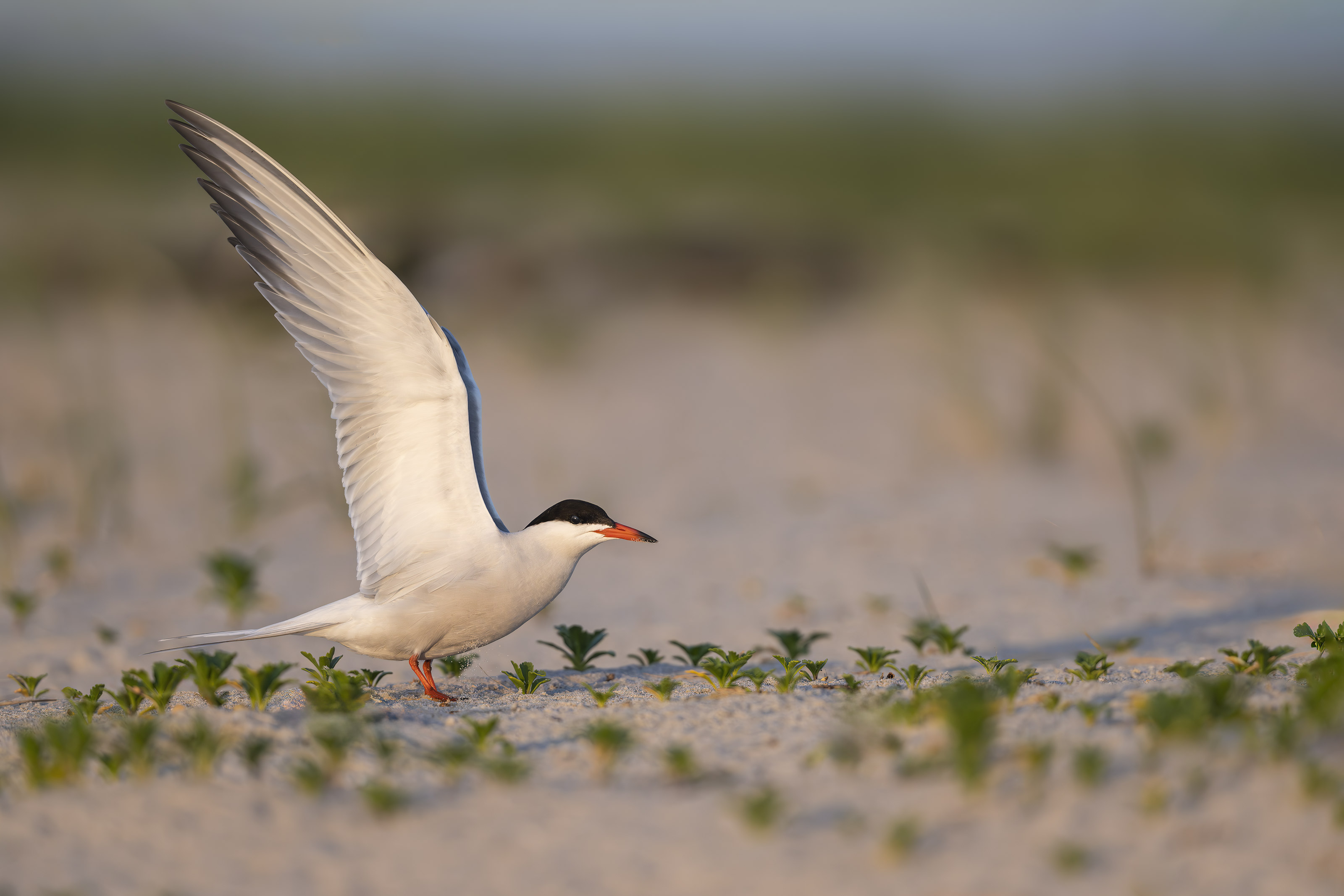
This image was created on 5 June 2026 by yours truly at Nickerson Beach Park, Lido Beach, Long Island, NY. Seated on dry sand, I used the hand held Sony FE 300mm f/2.8 GM OSS Lens (Sony E) the Sony FE 1.4x Teleconverter (at 420mm) and the Latest Greatest Sony Flagship Body, the a1 II Mirrorless Camera in full frame mode. The exposure was determined via Zebras with ISO on the Thumb Wheel. ISO 1600: 1/4000 sec. at f/4 (wide open) in Manual mode. AWB at 7:45:54pm on a then sunny afternoon. Tracking Zone/AF-C with Bird Eye/Face Detection enabled performed perfectly. Click on the image to enjoy a larger, inexplicably sharper high-res version. Image #3: Common Tern landing near nest with wings raised |
Understanding Bird Behavior
Knowing that when terns land near their nests the will alight with their wings raised enabled me to plan for this image by hitting the Trash Can button to switch from APS-C crop mode to full frame mode.
Check out the bird’s shadow and note that I was working well off sun angle. See the explanation in the text below the next image of the same bird made less than five minutes later.
|
|
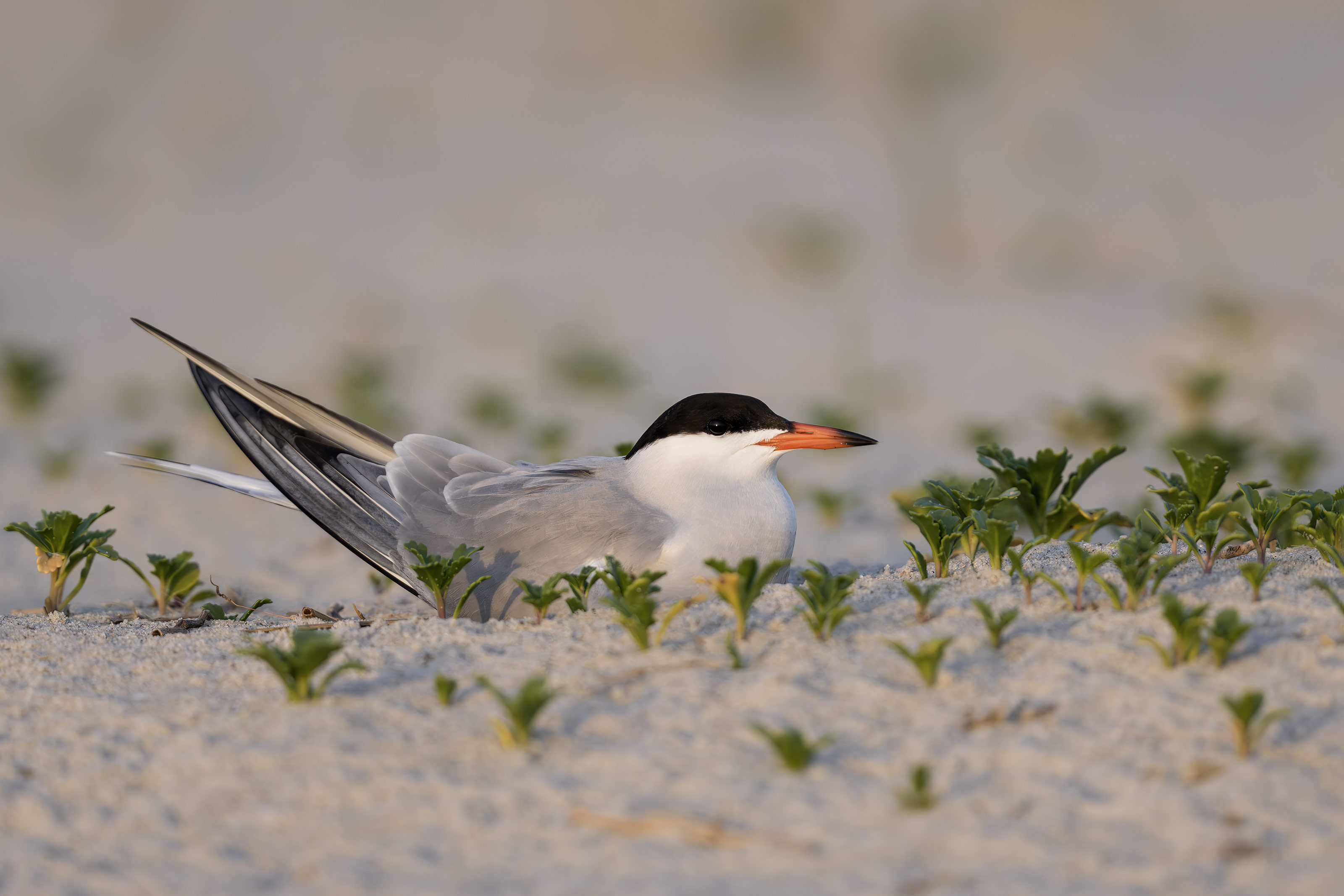
This image was created on 5 June 2026 by yours truly at Nickerson Beach Park, Lido Beach, Long Island, NY. Seated on dry sand, I used the hand held Sony FE 300mm f/2.8 GM OSS Lens (Sony E) the Sony FE 1.4x Teleconverter (at 420mm) and the Latest Greatest Sony Flagship Body, the a1 II Mirrorless Camera in APS-C Crop Mode. The exposure was determined via Zebras with ISO on the Thumb Wheel. ISO 1250: 1/2000 sec. at f/4 (wide open) in Manual mode. AWB at 7:50:48pm on a then partly sunny afternoon. Tracking Zone/AF-C with Bird Eye/Face Detection enabled performed perfectly. Click on the image to enjoy a larger, inexplicably sharper high-res version. Image #4: Common Tern on scrape nest with two eggs |
Working Off Sun Angle
With the wind 10° west of south and the sun 25°north of west, my primary concern was to parallel the subject. Had I stayed exactly on sun angle the tern would have been angled 15° away from me.
|
|
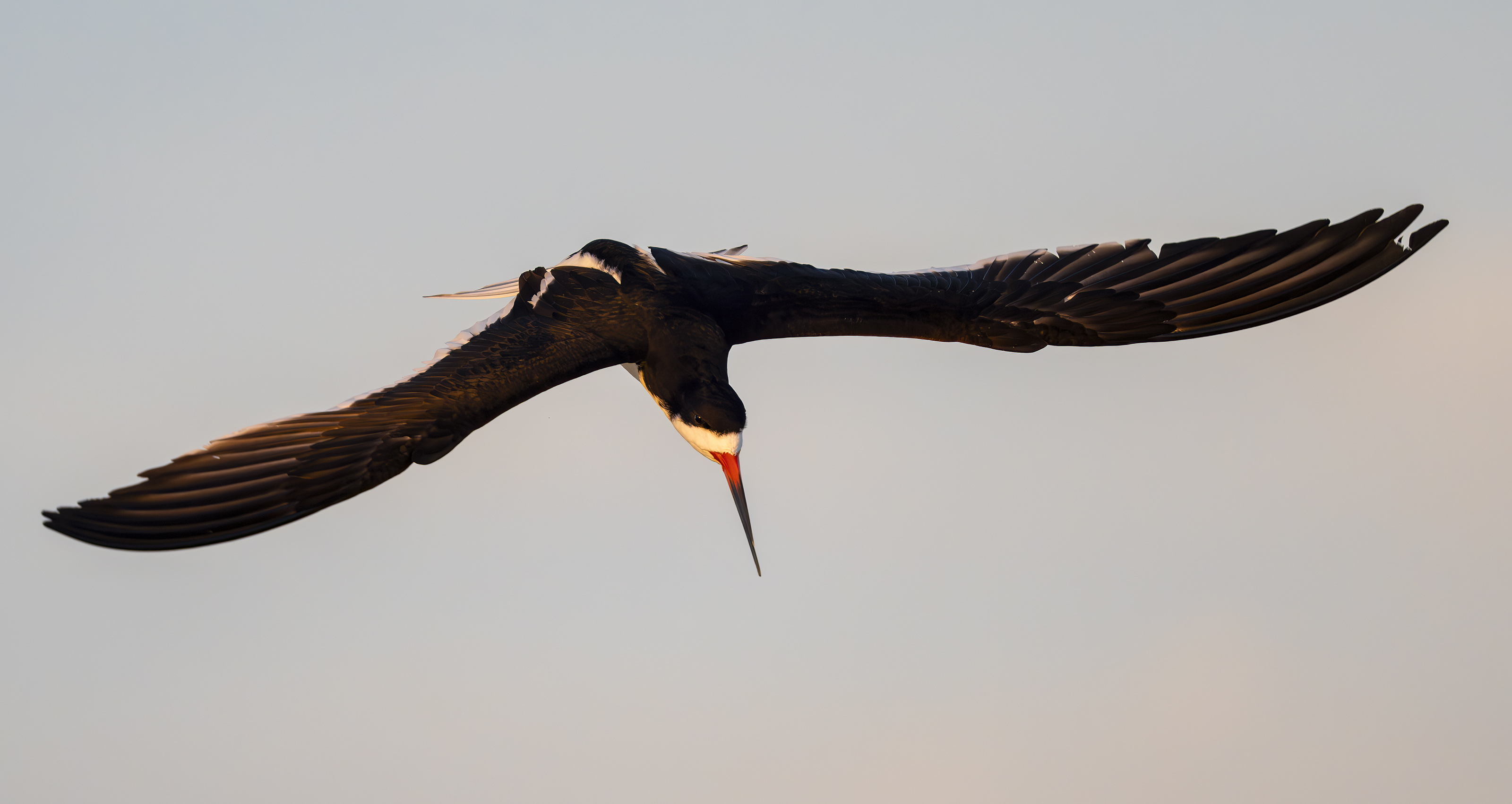
This image was created on 5 June 2026 by yours truly at Nickerson Beach Park, Lido Beach, Long Island, NY. Seated on dry sand, I used the hand held Sony FE 300mm f/2.8 GM OSS Lens (Sony E) the Sony FE 1.4x Teleconverter (at 420mm) and the Latest Greatest Sony Flagship Body, the a1 II Mirrorless Camera in APS-C Crop Mode. The exposure was determined via Zebras with ISO on the Thumb Wheel. ISO 1600: 1/2500 sec. at f/4 (wide open) in Manual mode. AWB at 7:59:15pm on a then partly sunny afternoon. Tracking Zone/AF-C with Bird Eye/Face Detection enabled performed perfectly. Click on the image to enjoy a larger, inexplicably sharper high-res version. Image #5: Black Skimmer in flight — dorsal view |
Flight Photography When the Wind is Less Than Ideal
When the wind is more than 90° off sun angle, the trick to making good flight images is to keep a sharp eye out for subjects that are not flying directly into the wind. I tracked this bird as it took flight to the north and then turned left and dove affording a nice look at both upper wing surfaces.
|
|
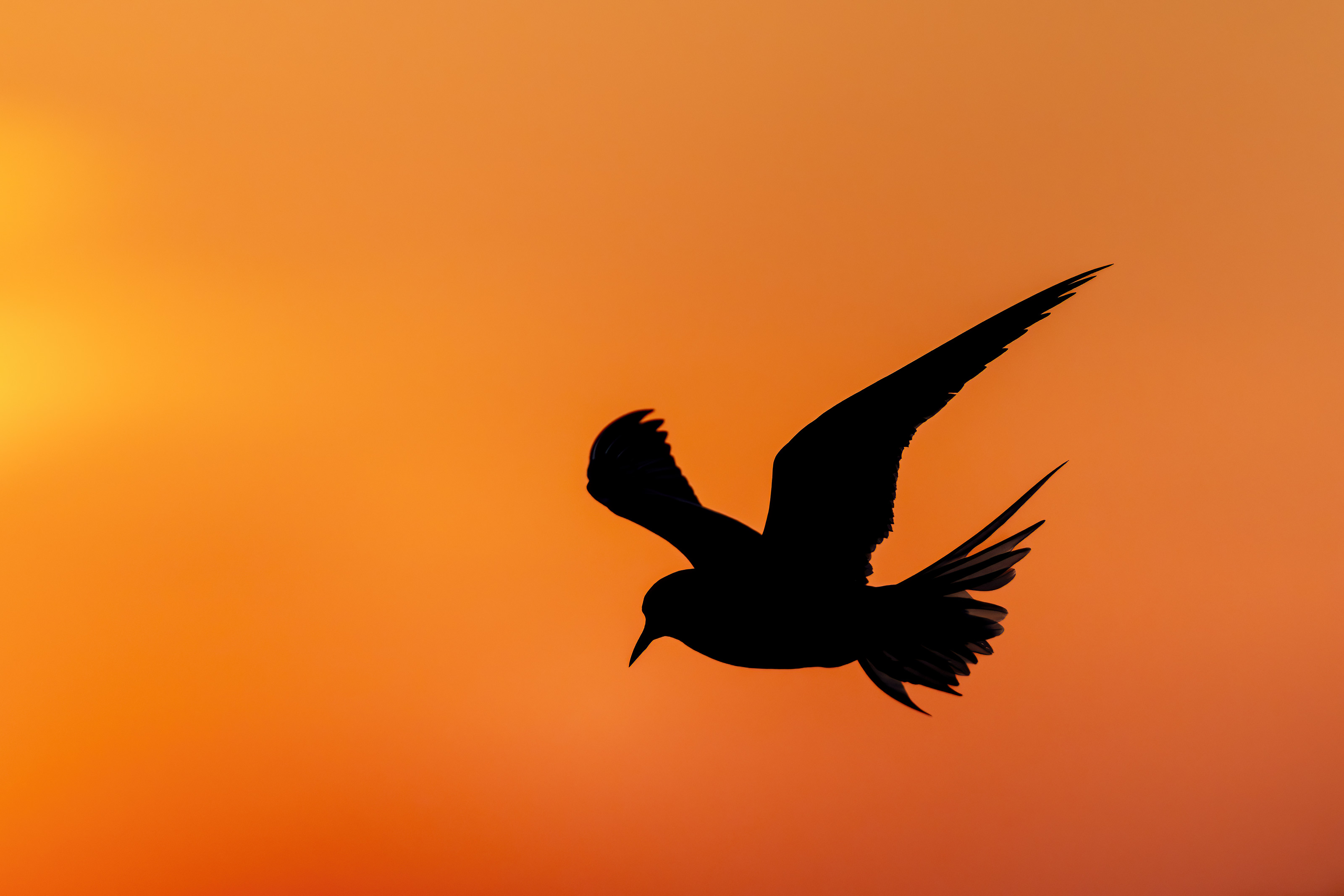
This image was created on 5 June 2026 by yours truly at Nickerson Beach Park, Lido Beach, Long Island, NY. Seated on dry sand, I used the hand held Sony FE 300mm f/2.8 GM OSS Lens (Sony E) the Sony FE 1.4x Teleconverter (at 420mm) and the Latest Greatest Sony Flagship Body, the a1 II Mirrorless Camera in APS-C Crop Mode. The exposure was determined by Zebras with Exposure Compensation (EC) on the thumb wheel. Multi Metering =1.3 stops. AUTO ISO set ISO 1600: 1/4000 second at f/4 (wide open) in Shutter Priority mode. AWB at 8:16:31pm moments before sunset. Tracking Zone/AF-C with Bird Eye/Face Detection enabled performed perfectly. Click on the image to enjoy a larger, inexplicably sharper high-res version. Image #6: Common Tern landing at nest at sunset –SILHOUETTE |
When a Bad Wind is a Good Wind
If a south by slightly west wind is less than ideal for traditional front-lit flight photography, then the converse must be true: it is great for backlit sunset silhouettes. Several terns have laid eggs practically against one of the snow fences, far outside of the colony ropes. On the way back to my vehicle I noticed some of those birds landing against a nice orange sky.

|
|
For those who did not use my link to purchase their Sony 300mm f/2.8 GM lens, you can order your a copy here for $209.93. Click on the image to enlarge and to be able to read the fine print. |
The BAA Sony 300mm f/2.8 Lens Guide
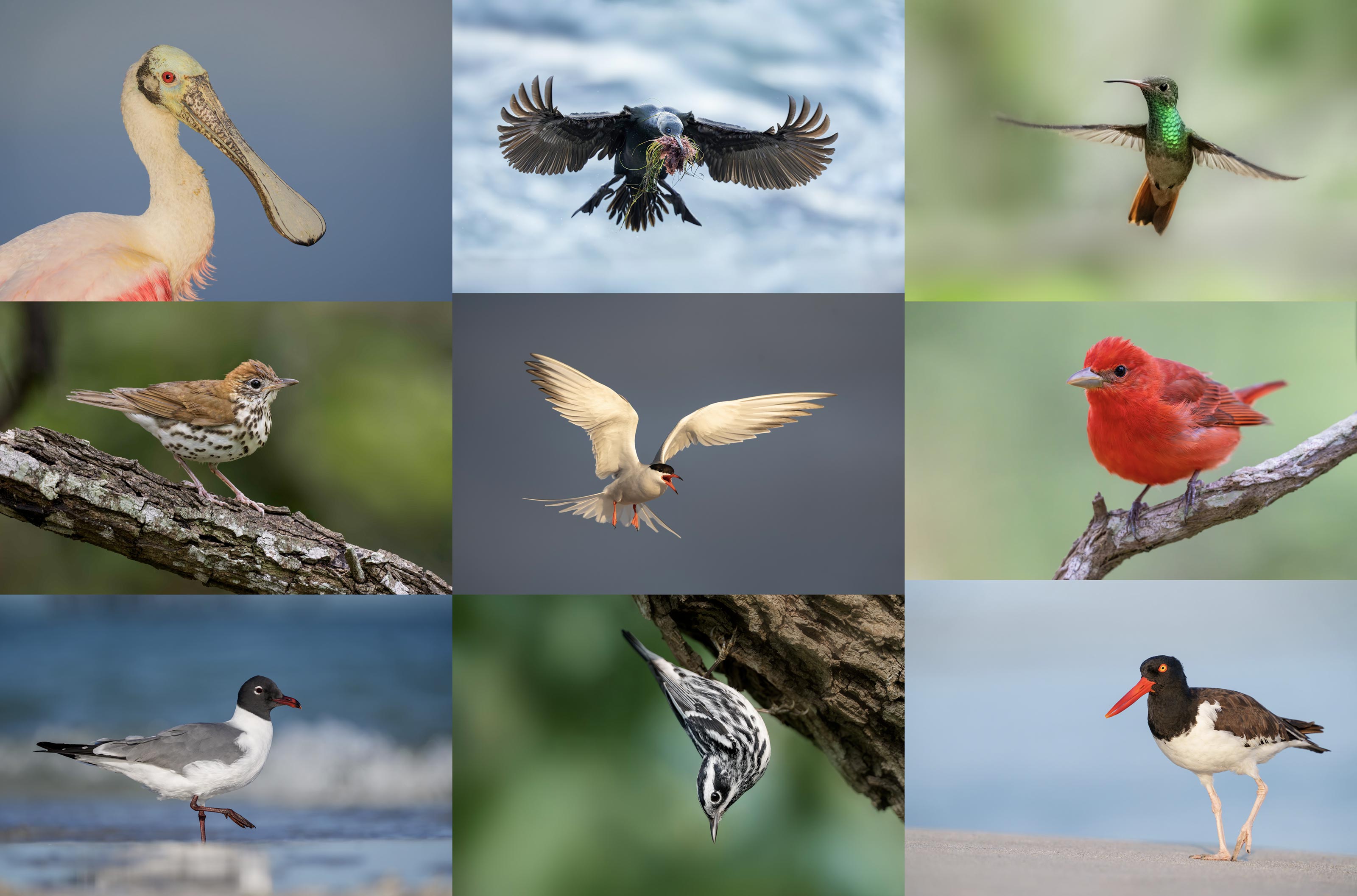
Impressed by my Sony FE 300mm f/2.8 GM OSS Lens (Sony E) images? Use either my Bedfords or B&H affiliate link to purchase your Sony 300mm f/2.8 GM lens and shoot me your receipt via e-mail and request a copy of the first-ever BAA Lens Guide. I thought that it would take only minutes to create this guide, but I was dead wrong. In the process of creating it, I learned a ton about the lens. And even better, I discovered a simple yet potentially fatal flaw that was resulting in sporadically unsharp flight images. The set-up fix is simple. Just be sure to use one of my affiliate links and get the guide for free.
|
|
From top left around to center clockwise: Roseate Spoonbill — 300/2X/a9 iii; Brand’t Cormorant — 300/a-1 ii; Buff-bellied Hummingbird — 300/2X/a-1 ii; Summer Tanager — 300/2X/a-1 ii; American Oystercatcher — 300/2X/a-1; Black and White Warbler — 300/1.4X/a-1 ii; Laughing Gull — 300/1.4X/a-1 ii; Wood Thrush — 300/2X/a-1 ii; Common Tern — 300/2X/a-1 ii. |
Did Not Use My Link?
If you did not, you can purchase a copy here for $209.93. Yes, it never hurts to use my links and it never costs you one penny more. And if you contact me via e-mail before you make a major purchase, I can often save you some money.
|
|
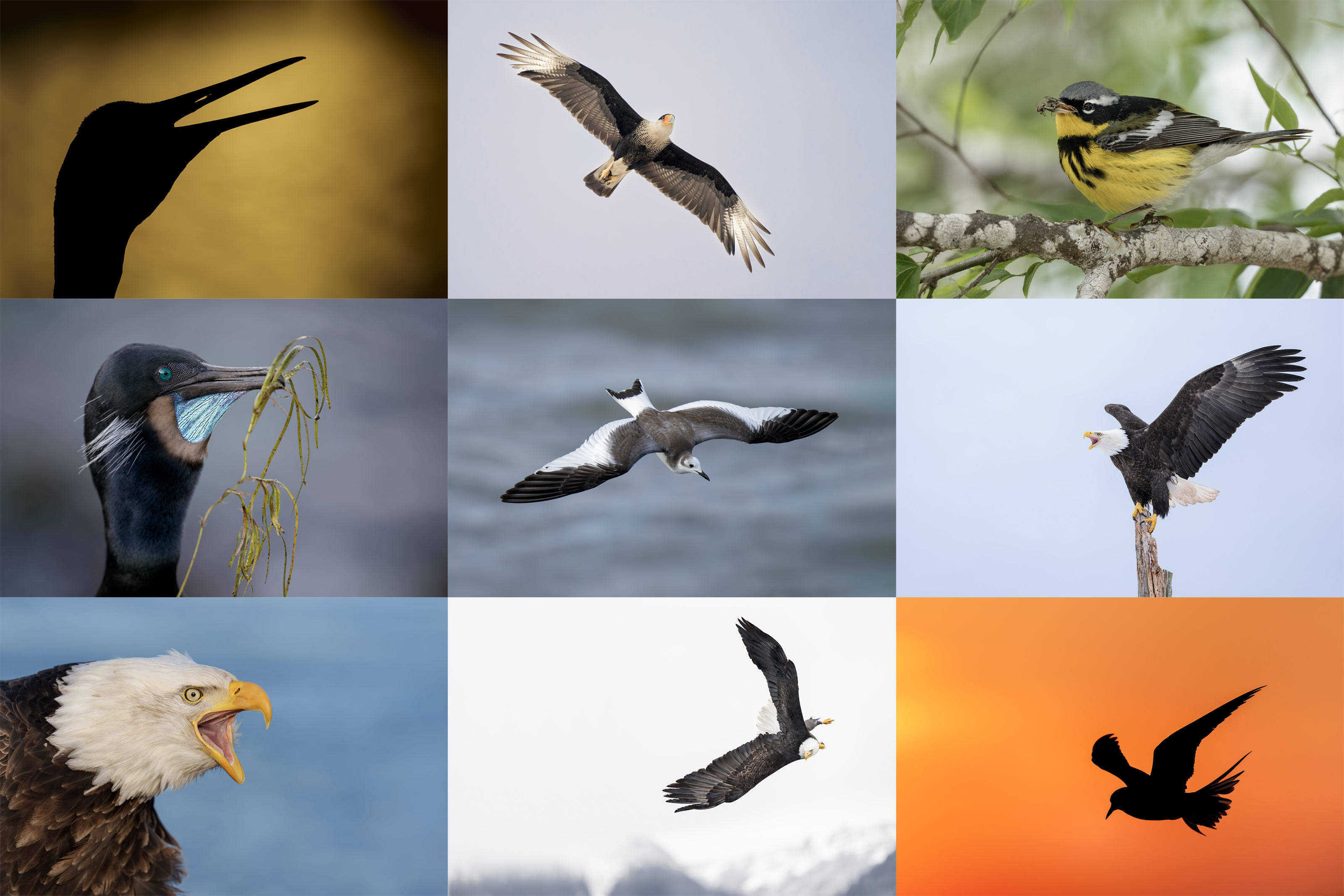
From top left around to center clockwise: Sandhill Crane — 300/2X/a-1; Crested Caracara– 300/1.4X/a-1 ii; Magnolia Warbler — 300/1.4X/a-1 ii; Bald Eagle — 300/a-1 ii; Common Tern — 300/2X/a-1 ii; Bald Eagle — 300/a-1 ii; Bald Eagle screaming — 300/a-1; Brandt’s Cormorant — 300/1.4X/a-1 ii; Sabine’s Gull juvenile — 300/1.4X/a-1. |
Typos
With all blog posts, feel free to e-mail or to leave a comment regarding any typos or errors.










Artie,
All lovely images. #1 is my favorite for the action, and I’d take out the extra tern for most uses, keep it for any concerning competition/aggression at colonies. My second choice is Image #2 for the wonderful color and water, but I suspect it was made at Nickerson, as you discuss regarding your hand, rather than the Convention Center as you say in the caption. Copy/paste, I imagine.
Thanks, Cliff. You are correct. It is difficult to be in two places at once.
with love, artie
ps: fixed thanks to you!
Hi, Artie. You wrote this: “I had a lovely unbounded oystercatcher feeding in the surf…” I’ve never seen a bounded oystercatcher, but I have seen a banded one. 🙂 I do like the image. As for the tern attacking the skimmer, did you try a very tight framing, say including the skimmer’s body and right wing but cutting off most of the left wing? Including the attacking tern, of course. I think that would be more dramatic. In your framing, I’m not sure whether there’s much difference between including or removing the tern in the background. I recently had this same wind/light combination problem. There was a western meadowlark on a post singing its heart out, perfectly aligned with a wonderful background. The sun was hgh overhead and the light was harsh. But I took what I was given and made the photo, and like it anyway. With love, David
Thanks David, You gotta hate auto spell check 🙂
I might try your suggestion.
with love, artie
ps: when the birds head is angled away I delete them 100% of the time 🙁
Yes on keeping and saving and yes on removing the tern in the background.
What an amazing shot! Perfect timing
Thanks, Sandy. Hoping that you make it to Nickerson this summer 🙂
with love, artie
The background tern distracts IMO
Tanks, AA.
am
As you know, I usually go for “clean” images. But in image #1, I would have done — as you did — and kept the extra tern because it helps to tell the story of the attacking terns. By the way, I really like the tern silhouette at sunset.
Thanks Pat. You’ve been there at sunset!
with love, a