
For Sale
Suped Up MacBook Pro M2
Yours truly is offering a used, 100% suped up, 2023 MacBook Pro M2 Max in excellent plus condition that was recently refurbished by Apple with a new Logic Board (motherboard) and a new Touch ID Board (track pad). The screen is also in excellent plus condition. Space Gray. Memory: 96GB. macOS Tahoe 26.4.1. Built in Liquid Retina XDR display. — 16-in (3456 X 2234). 8TB Solid State Hard Drive. Apple M2 Max with 12-core CPU, 38-core GPU (MAX Option). I pay the insured Fed-Ex ground shipping. Price: $3,000 or the best offer by 10 July 2026. $2500 minimum. Buy it today for $3300.00. Pay by Zelle and we will ship it the next day.
You can see all the technical specifications here.
Virtually the same machine is being offered here for $3999.00. Plus the shipping.
Please contact artie via e-mail or by text to 863-221-2372.
Your Call?
Which of today’s featured images do you like best? Why? Which do you prefer, 4 or 4A? Why?
My Calls
In the Tips on Working With a Bad Wind That Became the Perfect Wind. Sony 300mm f/2.8 GM: A Lightweight Deadly Weapon blog post here, my favorite image was the the silhouette, Image #6, because I made it.
In the South Padre Convention Center Water Feature Warblers blog post here, my favorite image was Anke Frohlich’s male Blackburnian Warbler for the beauty of the bird and the sharpness of the image. Not to mention the difficulty of photographing warblers.
What’s Up?
I headed back to Nickerson Beach with just the 300mm f/2.8 GM lens and both TCs on Tuesday afternoon. I photographed two oystercatcher chicks less than one day old; when I left the beach on Monday afternoon there were two eggs in the nest. Photos soon.
My early Wednesday morning flight from Islip to Orlando was productive — I began work on this blog post, and blessedly uneventful. And, I even slept for a bit. Jim Litzenberg graciously met my flight and after a stop at Publix we were home before 11:00am. I spent most of the rest of the day working on new photos.
Today is Thursday 11 June 2026. Double check that. Whatever you opt to do, I hope that you too choose to have fun and enjoy life. Please remember that happiness is a choice — Byron Katie, The Work.Com
If an item — a Delkin flash card or reader, a Levered-clamp FlexShooter Pro, or a Wimberley lens plate or low foot — for example, that is available from B&H and/or Bedfords, is also available in the BAA Online Store, it would be great, and greatly appreciated, if you would opt to purchase from us. We will match or beat any price. Please remember also to use my B&H affiliate links or to earn 3% cash back at Bedford by using the BIRDSASART discount code at checkout for your major gear purchases. Doing either often earns you free guides and/or discounts. And always earns my great appreciation.
Gear Questions and Advice
Too many folks attending BAA IPTs and dozens of photographers whom I see in the field and on BirdPhotographer’s.Net, are — out of ignorance — using the wrong gear, especially when it comes to tripods and more especially, tripod heads. And the same is true in spades when ordering new camera bodies or lenses. My advice will often save you some serious money and may help you avoid making a seriously bad choice. Please know that I am always glad to answer your gear questions via e-mail. If you are desperate, you can try me on my cell at 863-221-2372. Please leave a message and shoot me a text if I do not pick up.
|
|
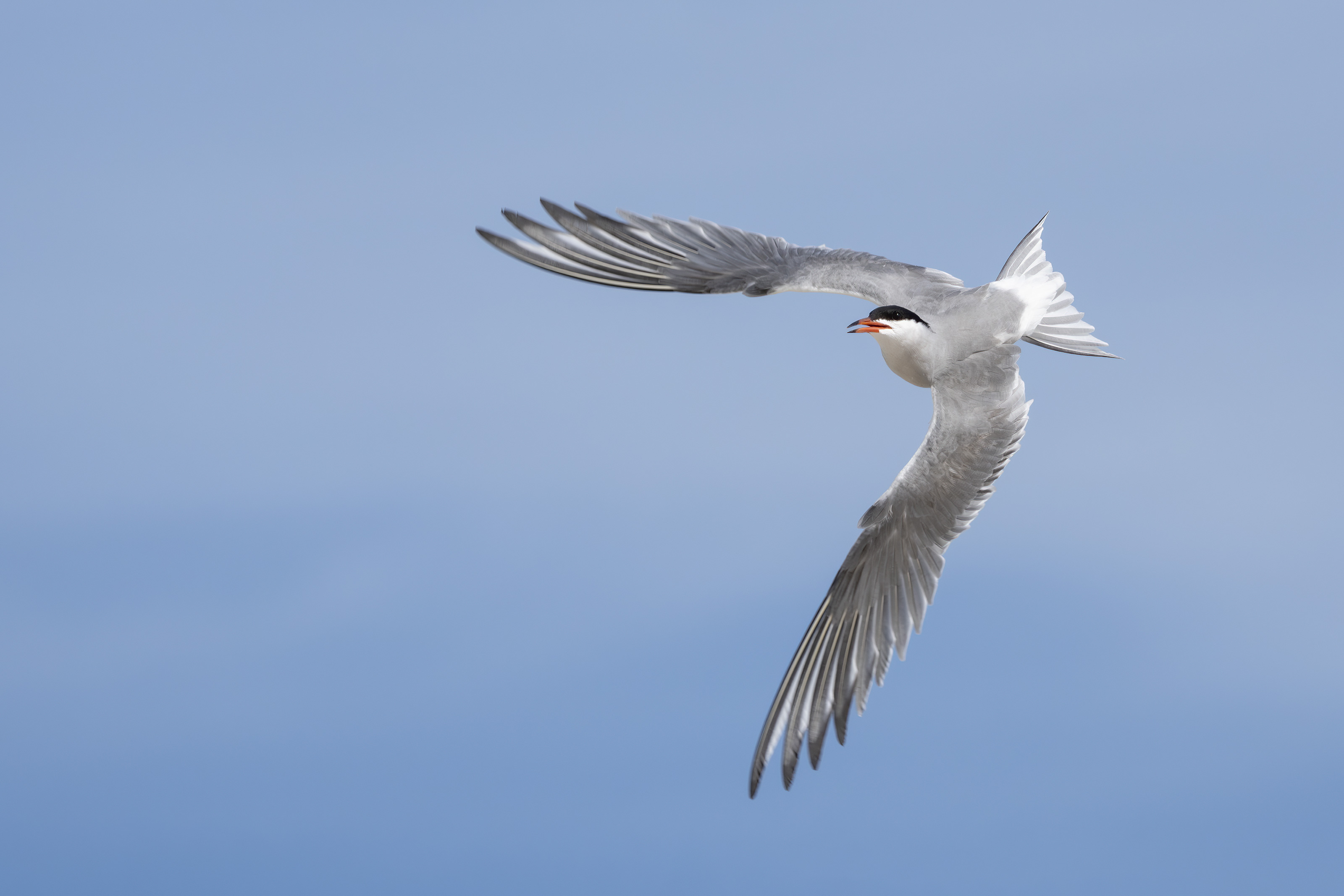
This image was created on 2 June 2026 at Nickerson Beach Park, Lido Beach, Long Island, NY. Seated on dry sand outside the colony ropes, I used the hand held Sony FE 400-800mm f/6.3-8 G OSS lens (Sony E) (at 400mm) and The Latest Greatest Sony Flagship Body, the a1 II Mirrorless Camera in full frame mode. The exposure was determined by Zebras with ISO on the rear wheel — ISO 1000: 1/4000 second at f/8 (stopped down 2/3 stop) in Manual mode. AWB at 4:45:03pm on a variably sunny afternoon. Wide/AF-C with Bird-Eye/Face Detection performed perfectly. Click on the image to enjoy the larger, inexplicably sharper high-res version. Image #1: Common Tern wheeling in flight |
Why 400mm and a Substantial Crop?
The bird in Image #1 was one of two terns in the frame that were engaged in an aerial dogfight. The bird above this one was facing away. With the wicked wings-swept-back diving pose, a crop down to one bird was the obvious choice. When trying for aerial battles, it is almost always best to be in full frame mode and to zoom well out.
|
|
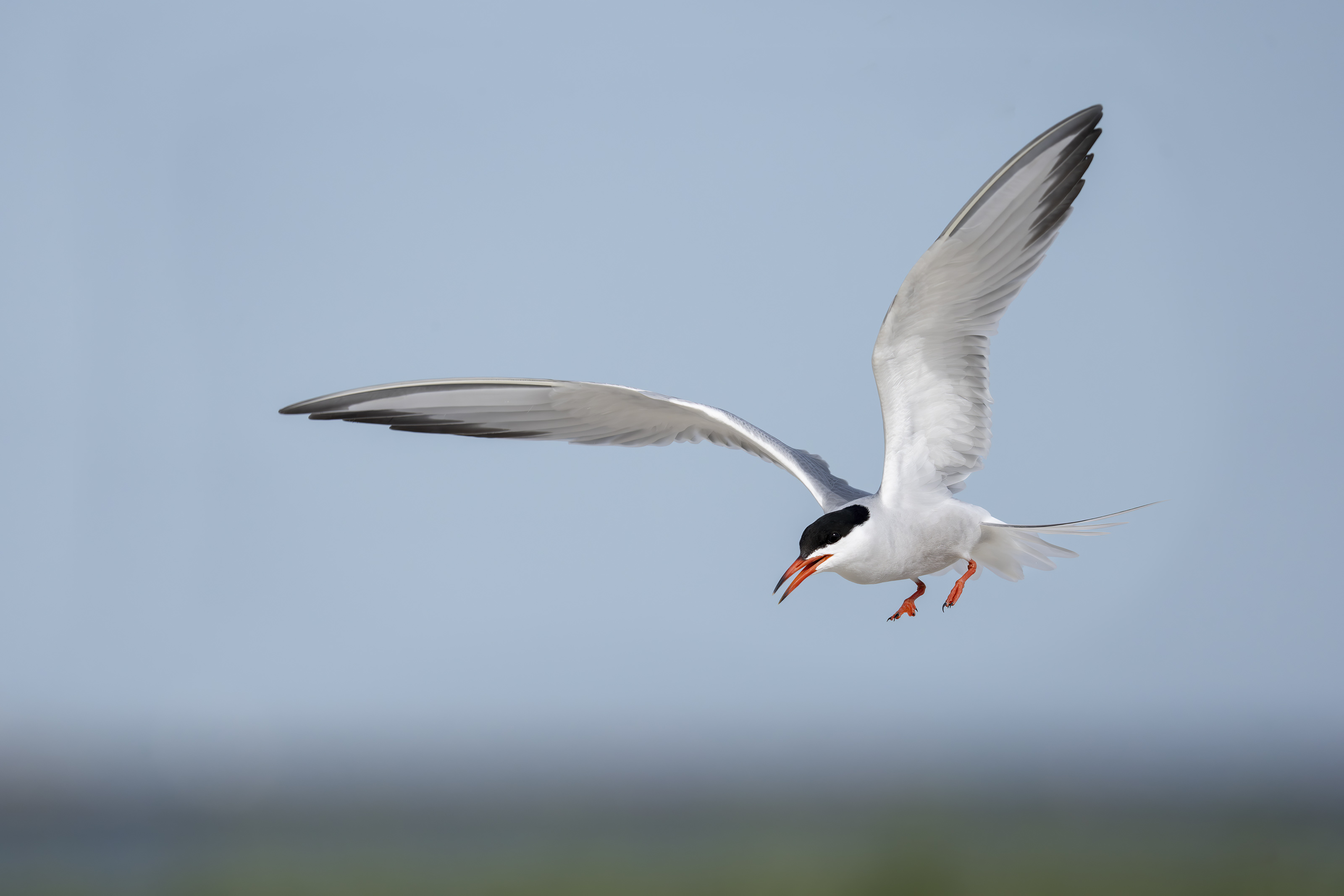
This image was also created on 2 June 2026 at Nickerson Beach Park, Lido Beach, Long Island, NY. Still seated on dry sand outside the colony ropes, I used the hand held Sony FE 400-800mm f/6.3-8 G OSS lens (Sony E) (this time at 755mm) and The Latest Greatest Sony Flagship Body, the a1 II Mirrorless Camera in full frame mode. The exposure was determined by Zebras with ISO on the rear wheel — ISO 1600: 1/4000 second at f/8 (wide open) in Manual mode. AWB at 4:58:00pm on a variably sunny afternoon. Wide/AF-C with Bird-Eye/Face Detection performed perfectly. Click on the image to enjoy the larger, inexplicably sharper high-res version. Image #2: Common Tern getting ready to land into the north wind |
North Wind + Soft Light = Success
The forecast had called for a NW wind that would have been dead solid perfect; the birds would have been landing directly at me. The wind however, did not read the forecast and was pretty much directly from the north. A faint cloud produced the soft light and eliminated any sun angle problems. With the sun well to the north of west at this time of year, a north wind on a sunny afternoon is actually much better than a south wind, even those with a bit of a westerly component.
|
|
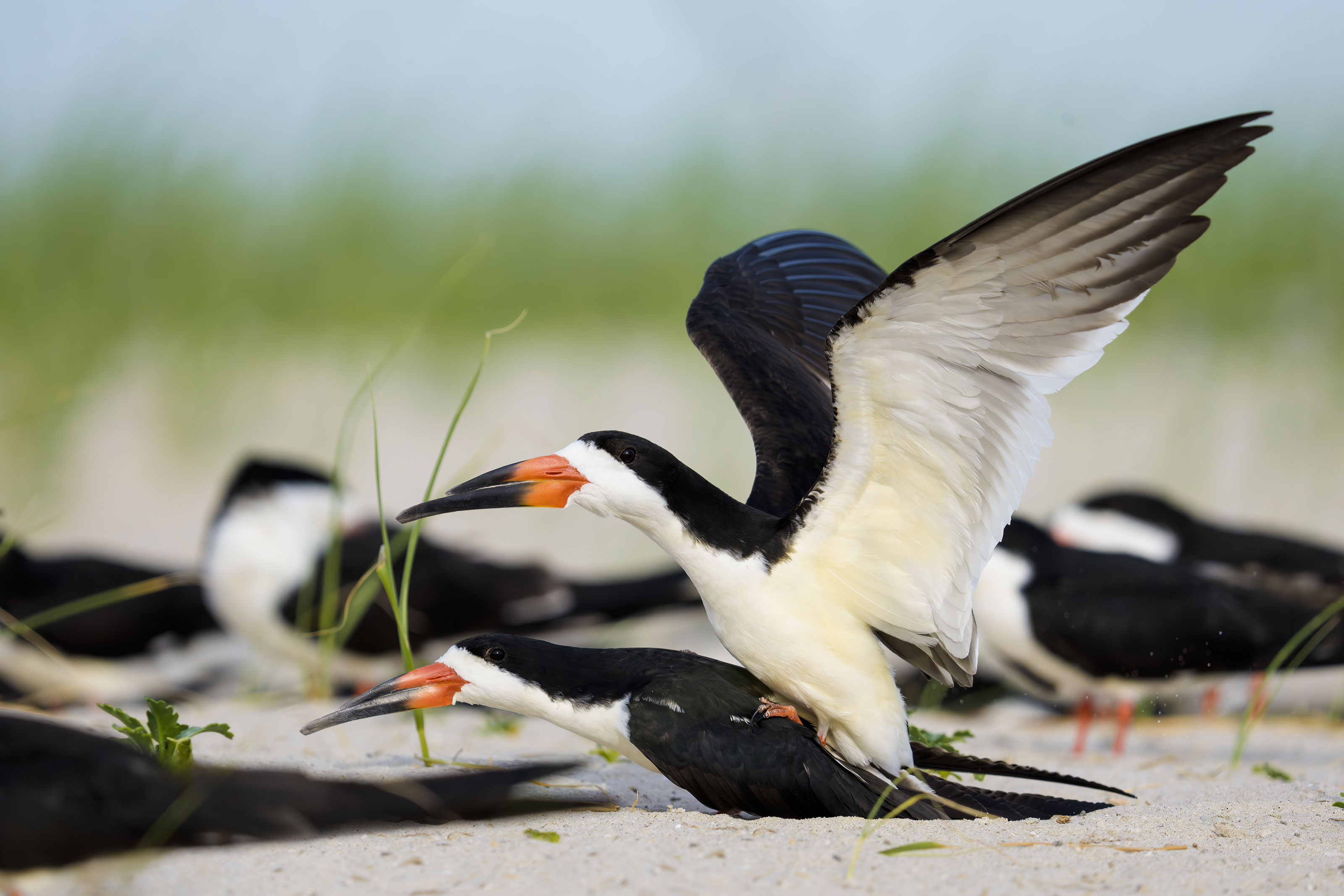
This image was also created on 2 June 2026 at Nickerson Beach Park, Lido Beach, Long Island, NY. Still seated on dry sand outside the colony ropes, I used the hand held Sony FE 400-800mm f/6.3-8 G OSS lens (Sony E) (this time at 780mm) and The Latest Greatest Sony Flagship Body, the a1 II Mirrorless Camera in full frame mode. The exposure was determined by Zebras with ISO on the rear wheel — ISO 2000: 1/3200 second at f/8 (wide open) in Manual mode. AWB at 6:24:11pm on a variably sunny afternoon. Tracking: Spot S (small/AF-C with Bird-Eye/Face Detection performed perfectly. Click on the image to enjoy the larger, inexplicably sharper high-res version. Image #3: Black Skimmers copulating in a crowd |
300 Copulations!
One the afternoon of 2 June there were about 250 Black Skimmers on a large area of open sand at the SW corner of the East Colony. Most were jostling for position and setting up on freshly excavated scrapes. There were no midair squabbles. In the two hours that I sat by the ropes, I estimated that there were at least 300 copulations. Those included seven pairs copulating in less than one minute. It seemed strange that I did not see a single skimmer carrying a baitfish as Striped Killfish and silversides (spearing) are often offered to the females just prior to copulation.
At first I did not even try to photograph any of the copulations as there were so many birds packed into a relatively small area. But with so many pairs going at it, I decided to give it the old college try. In addition to the crowded conditions, skimmer copulations usually last less than four seconds at most. My first move was to put the lens back on the tripod. Then, I opted to shoot every copulation no matter how cluttered the scene. Next I went to Tracking: Spot S to eliminate or at least reduce the chance of the AF system grabbing the beach vegetation. After that it was just a matter of scanning the flock and reacting as quickly as possible even to the point of assuming that the AF system would acquire focus properly as you fired. In most cases, it did. The result? I made one halfway decent on sun angle image.
Note: the back of a single skimmer was removed from the middle of the lower frame edge.
|
|
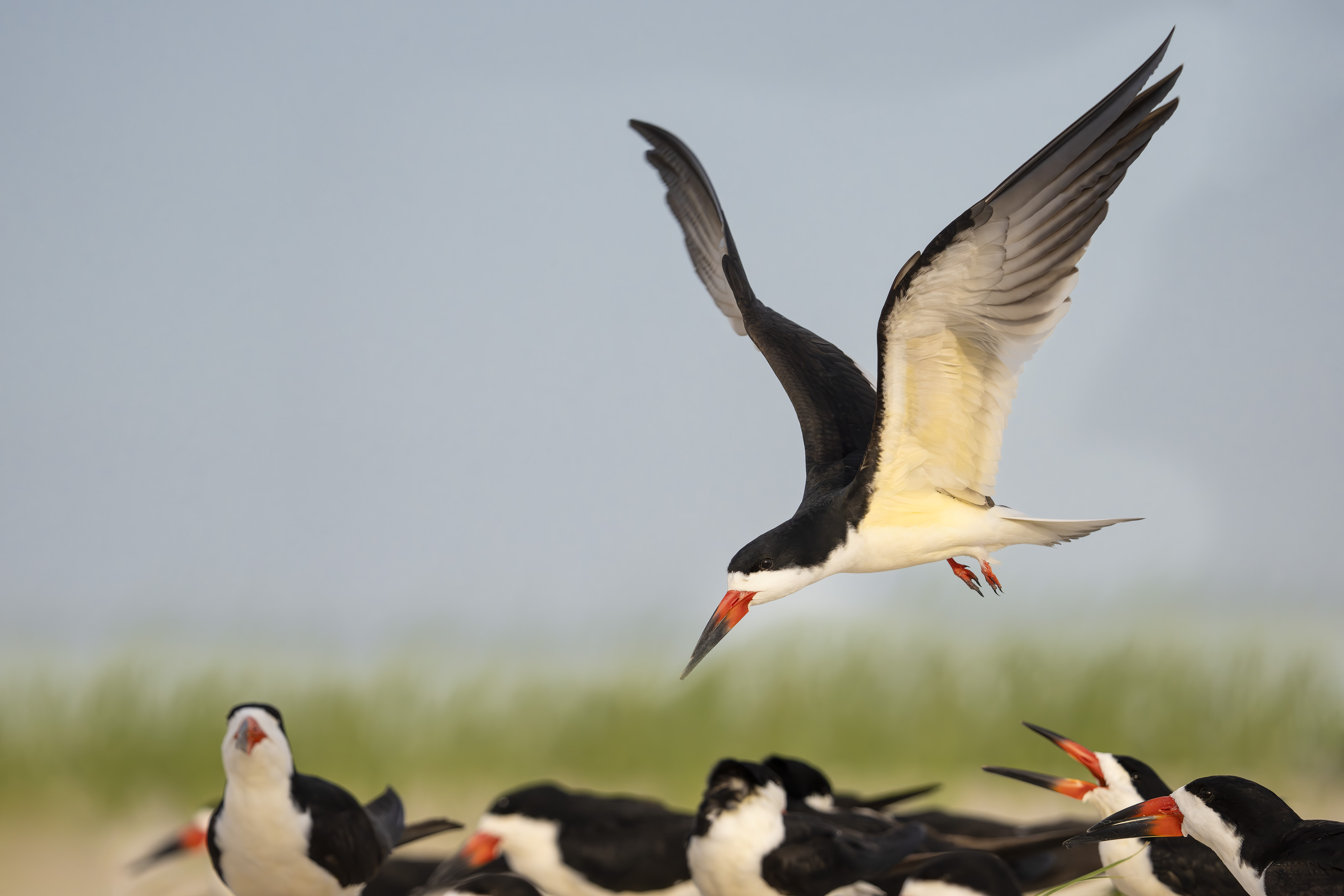
This image was also created on 2 June 2026 at Nickerson Beach Park, Lido Beach, Long Island, NY. Still seated on dry sand outside the colony ropes, I used the hand held Sony FE 400-800mm f/6.3-8 G OSS lens (Sony E) (this time at 780mm) and The Latest Greatest Sony Flagship Body, the a1 II Mirrorless Camera in full frame mode. The exposure was determined by Zebras with ISO on the rear wheel — ISO 2000: 1/2500 second at f/8 (stopped down 1/3 stop) in Manual mode. AWB at 6:49:20pm on a variably sunny afternoon. Wide/AF-C with Bird-Eye/Face Detection performed perfectly. Click on the image to enjoy the larger, inexplicably sharper high-res version. Image #4: Black Skimmer in flight above welcoming committee |
Low Flying Skimmers
No matter how strong the wind, skimmers flying back to the colony almost always come in low , just above the beach grasses and the many birds on the ground. Isolating these low incoming skimmers is a challenge. The only time they are guaranteed to be well up in the sky is when they are squabbling. Even when blasting off in large groups, perhaps in response to a predator, the flock generally remains close to the earth. Later in the season big flocks will often fly out over the near-shore Atlantic.
Aperture Question
How is it possible that f/8, the same aperture, can be stopped down 2/3 stop in Image #1, stopped down 1/3 stop in Image #4, and wide open in Images 2, 3, and 5?
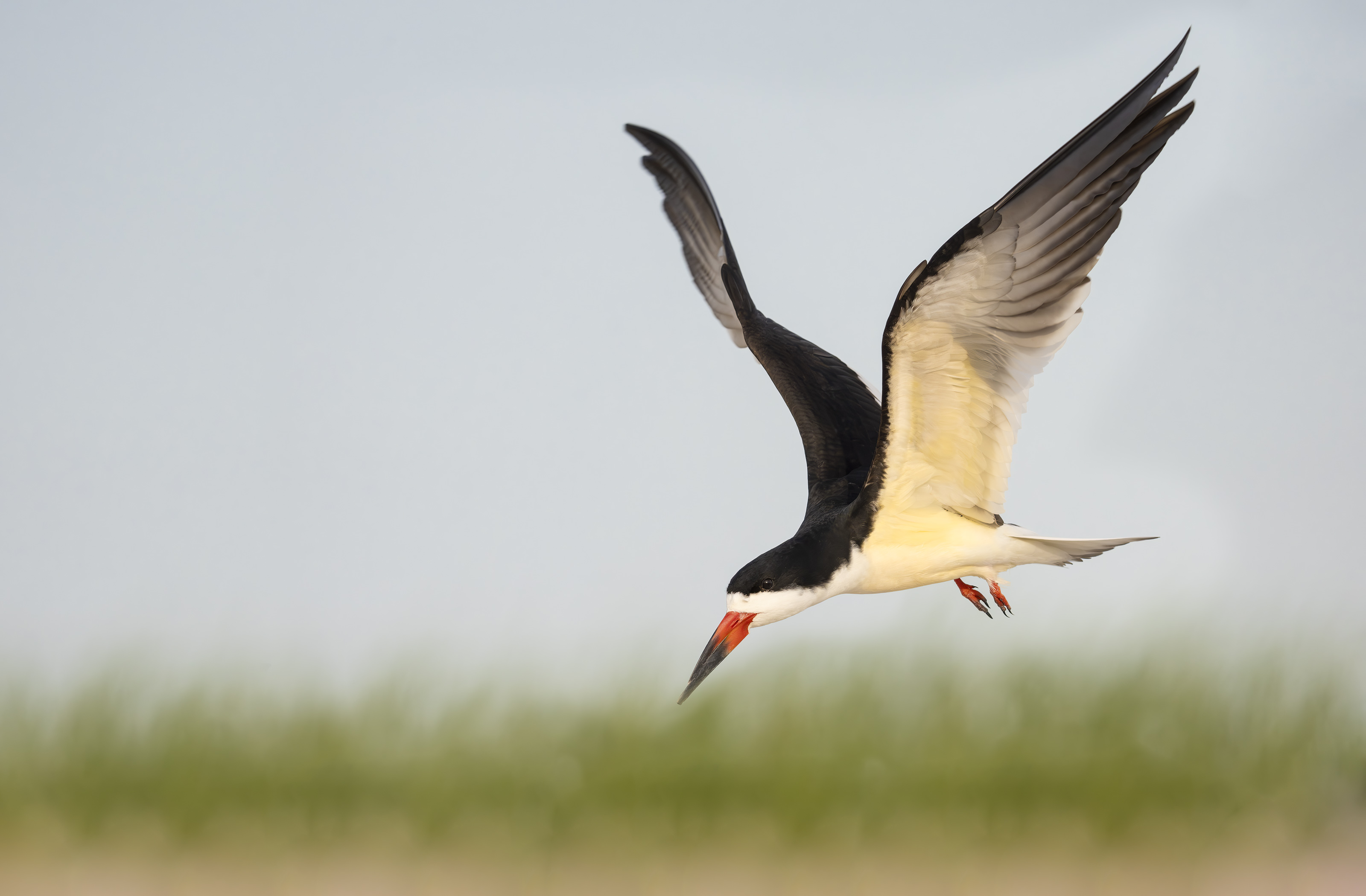
|
|
This image was also created on 2 June 2026 at Nickerson Beach Park, Lido Beach, Long Island, NY. Still seated on dry sand outside the colony ropes, I used the hand held Sony FE 400-800mm f/6.3-8 G OSS lens (Sony E) (this time at 780mm) and The Latest Greatest Sony Flagship Body, the a1 II Mirrorless Camera in full frame mode. The exposure was determined by Zebras with ISO on the rear wheel — ISO 2000: 1/2500 second at f/8 (stopped down 1/3 stop) in Manual mode. AWB at 6:49:20pm on a variably sunny afternoon. Wide/AF-C with Bird-Eye/Face Detection performed perfectly. Click on the image to enjoy the larger, inexplicably sharper high-res version. Image #4A: Black Skimmer in flight — welcoming committee removed |
Your Preference?
Do you like Image #4 best, despite the fact that the birds at the bottom of the frame are cut off by the lower frame edge? Or do you like Image #4A best?
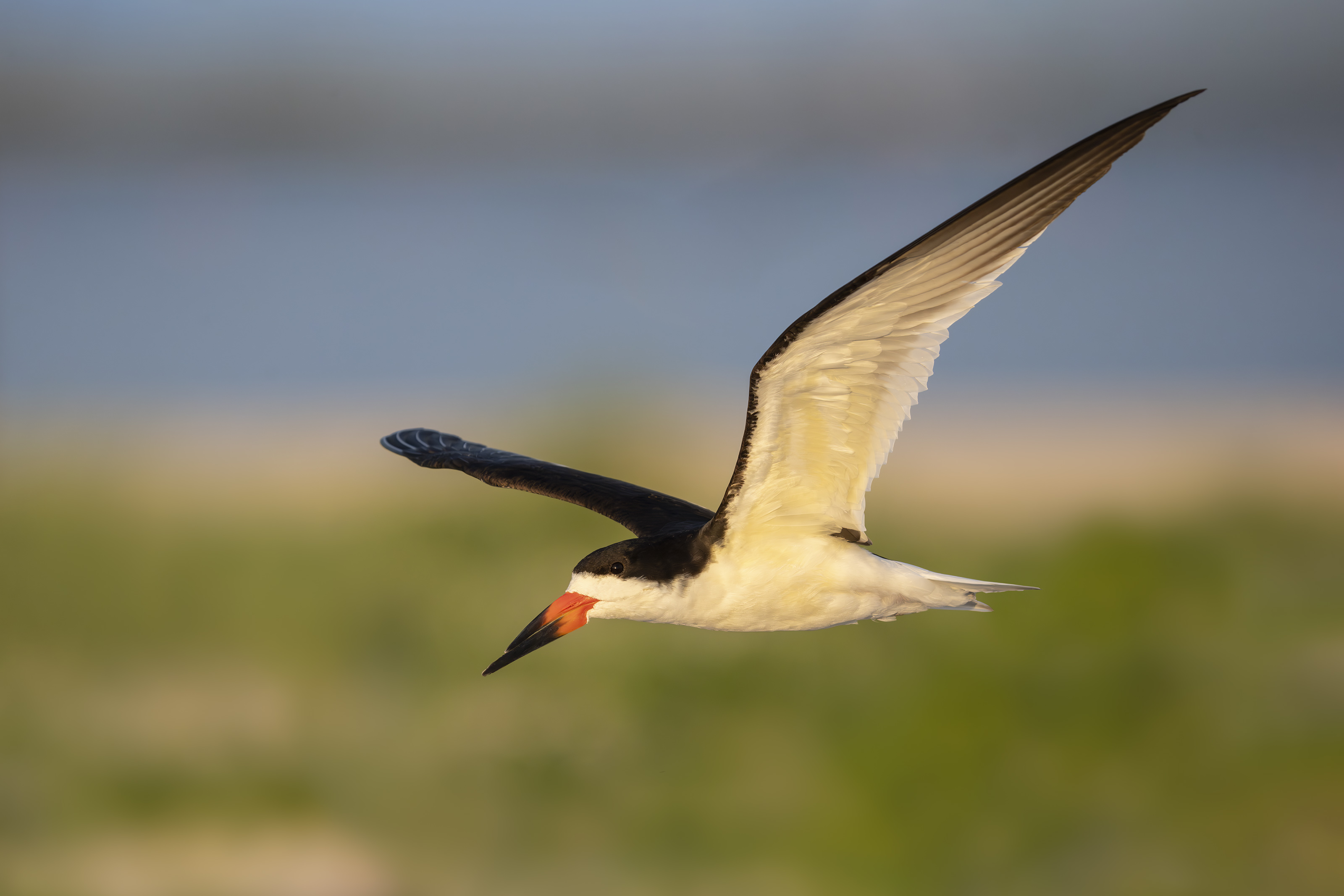
|
|
This image was also created on 2 June 2026 at Nickerson Beach Park, Lido Beach, Long Island, NY. Still seated on dry sand outside the colony ropes, I used the hand held Sony FE 400-800mm f/6.3-8 G OSS lens (Sony E) (this time at 780mm) and The Latest Greatest Sony Flagship Body, the a1 II Mirrorless Camera in full frame mode. The exposure was determined by Zebras with ISO on the rear wheel — ISO 2000: 1/2500 second at f/8 (stopped down 1/3 stop) in Manual mode. AWB at 6:49:20pm on a variably sunny afternoon. Wide/AF-C with Bird-Eye/Face Detection performed perfectly. Click on the image to enjoy the larger, inexplicably sharper high-res version. Image #5: Black Skimmer in flight in sweet light with inlet background |
Improving the Image Design With Your Feet
Late in the afternoon I noticed some skimmers flying back to the colony over the rope that protects the long southern boundary of the east colony. I thought that if I moved 50 yards or so to the south that I might be able to include a sizable strip of blue water in the frame. So, I moved. And it worked exactly as planned. The water is actually in Jones Inlet and the brown strip in the distant background is the West End Jetty!
The BIRDS AS ART SONY 400-800mm f/6.3-9 G Super-telephoto Zoom Lens Guide
When I borrowed this lens from Sony, I assumed that at 5.45 pounds it was too heavy to handhold for long and that at f/8 at the long end (800mm,) it was too slow for most bird photography applications. In short, I did not want to like the lens. After a month of using it, I cannot live without it. After returning the loaner, I was miraculously able to get my own from Bedfords on 16 April 2025. In this guide I share everything that I have learned about using the 400-800. For best results, you need to know exactly what you are doing to get the most out of this zoom lens. It would be best, therefore, to consider and study the material in the guide so that you can begin making great images with your new lens.
You will learn how to deal with the relatively show apertures: f/6.3, f/7.1, and f/8 when working in Manual mode.
You will learn how to ensure that you are working at the widest aperture by working in Shutter Priority mode with AUTO ISO.
If you are able to hand hold the lens, you will learn proper hand holding techniques.
If you can’t, you will learn when, why, and how to employ other options. Those include:
1- The knee-pod, heel-pod, and toe-pod techniques
2- Using the lens on a monopod.
3- The best lens plate and low foot for your 4-8.
4- The best tripod and head for the 4-8 and how best to utilize them.
5- How to use the lens from your vehicle while supporting it on a BLUBB (or not and why not).
6- Detailed instructions on how to set and use the lens controls and buttons:
a- AF/MF
b- DMF Switch
c- Limit Range Switch
d- OSS (Optical Steady Shot) Switch
e- OSS Mode Switch
f- Focus Hold Buttons
The guide also includes a Hand Holding Shutter Speed Primer and an illustrative, educational, and inspiring 67-image gallery.
This guide is free to folks who use one of my two affiliate links to purchase their Sony 400-800 G lens. Otherwise, please send a PayPal for $115.43 to birdsasart@verizon.net. and include the words “400-800 Lens Guide” in your e-mail.
Typos
With all blog posts, feel free to e-mail or to leave a comment regarding any typos or errors.









I like 4 over 4a. Seeing the other birds relating to the flying bird enhances the photo for me and does not distract from the main subject. Thanks for sharing.
My favorite is #1 — lovely wing/tail position and head raised. For me, definitely #4A over #4 because — as you know — I like “clean” images.
Image #1 is my favorite by a long shot! Great job artie!
I agree with Steve. I don’t know your lens, but on my RF 100-400 f/5.6-8 IS, f/8 is wide open at 400 mm but stopped down one stop at 100 mm and stopped down between one stop and 1/3 stop in between. So I think that’s why you posted those numbers. I miss my EF 100-400 f/5.6L IS II lens, where f/8 would be stopped down one stop at all focal lengths, but it is very heavy and no sharper than, if as sharp as, my much lighter and less expensive RF lens. Image #1 is my favorite.
My favorite is image #1, I like the position of the wings and head.
I will give the exposure question a try.
In both images the subjects are lighter than the background and if you didn’t stop down you would have overexposed the whites.
I’m assuming that when f/8 is wide open, it’s because you are at 800mm where that is the maximum aperture of the lens, and when you get to f/8 by stopping down, you are using a shorter focal length.
Image 4>4a because it is more dynamic.