Arthur Morris/BIRDS AS ART
April 23rd, 2013

Centers of Attraction

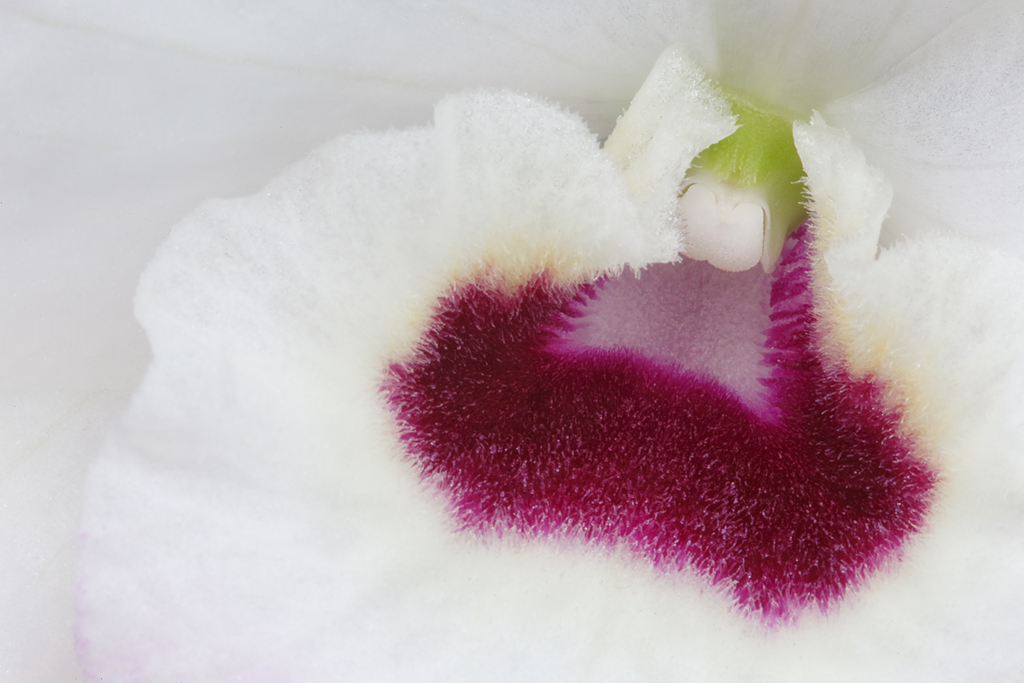
This image was created at the Beatrix Pavilion at Keukenhof, Lisse, Holland with the tripod-mounted Canon Telephoto EF 180mm f/3.5L macro lens, a Canon Extension Tube EF 25 II, and the Canon EOS 5D Mark III Digital camera body. ISO 400. Evaluative metering +1 1/3 stops: 2.5 seconds at f/32 in Manual mode.

Manual focus on the base of the the pistil. Click on the image to enjoy a larger size.

Image #1: Orchid Dehoog

Centers of Attraction

On our first day at Keukenhof we spent most of our time in the Willem-Alexander Pavilion with the amazing tulips. We did make one brief foray over to the Beatrix Pavilion to check out the orchids. Though the orchids were beautiful, I was so captivated by the tulips that we soon headed back to Willem-Alexander. The center of the Dehoog orchid above however did catch my attention.

This image required one layer of NIK’s Detail Extractor painted in selectively via a Hide-All Mask at 33% on the WHITEs and a separate layer of Detail Extractor on the purples and the pistil also via a Hide All Mask. My usual 50/50 combo would not have worked well with this image.
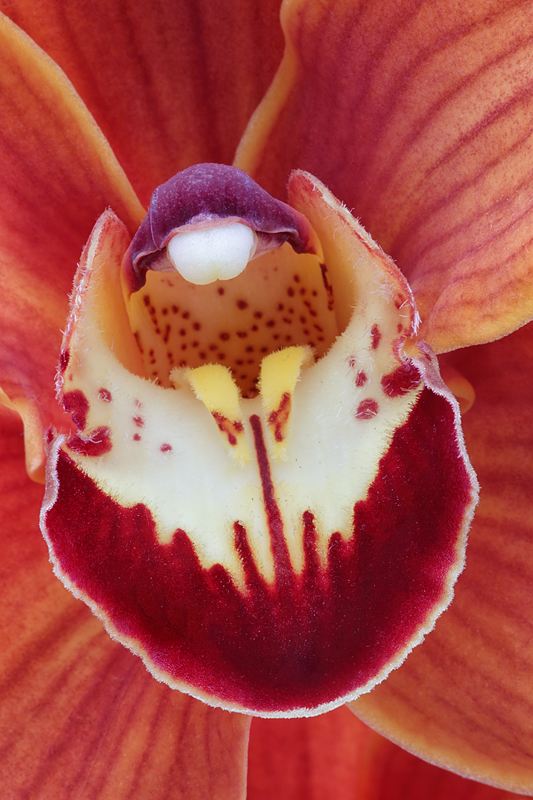
This image was created at the Beatrix Pavilion at Keukenhof, Lisse, Holland with the tripod-mounted Canon Telephoto EF 180mm f/3.5L Macro USM Autofocus lens and the and the Canon EOS-5D Mark III. ISO 800. Evaluative metering +2/3 stop: 1/25 sec. at f/8 in Av mode.

Central sensor AI Servo/Rear Focus on the closest large tulip petal on the left and re-compose. Click here if you missed the Rear Focus Tutorial. Click on the image to see a larger version.

Image #2: Orchid Cymbidium Manon

Sensor Cleaning and Dust Spotting

Even though I have been using my Sensor Scope and Lens Pen religiously with good success (see here for details), do understand that when working at f/22 or f/32 that microscopic dust will be a problem. My dust spotting techniques are detailed in Digital Basics, a PDF sent via e-mail. DB includes my complete digital workflow, dozens of great Photoshop tips, all of my time-saving keyboard shortcuts, and free updates.
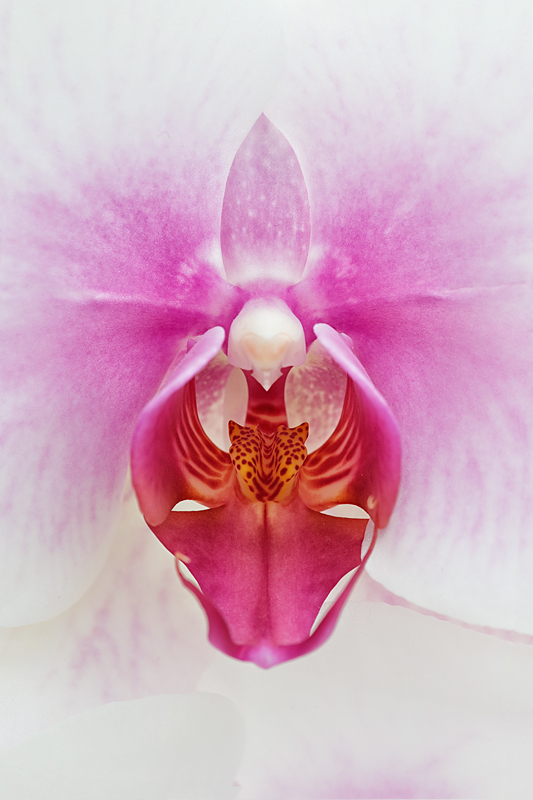
This image was also created at the Beatrix Pavilion at Keukenhof, Lisse, Holland this one with the tripod-mounted Canon Telephoto EF 180mm f/3.5L macro lens, Canon 1.4x EF tele-extender III, and the Canon EOS 5D Mark III Digital camera body. ISO 400. Evaluative metering +1 stop: 1/13 sec. at f/11 in Av mode.

Manual focus on the base of the the pistil. Click on the image to enjoy a larger size.

Image #3: Orchid Sion

Flower Sharpness Techniques

For virtually all of my flower images I activated Live View and set the 2-Second Timer. Live View gives you mirror lock and, if you press the info button once or twice, a live histogram. The latter lets you avoid clipping the RED channel by adjusting your exposure compensation as needed. The 2-second timer gives the rig a chance to settle down after you press the shutter button. Note: I do not compose the images using Live View. At times, however, I may bend the lens to make miniscule adjustments in framing after pressing the shutter button. Once you practice doing this it can actually help you to create sharper images with exposures in the 1/30 to 1/4 sec. range.
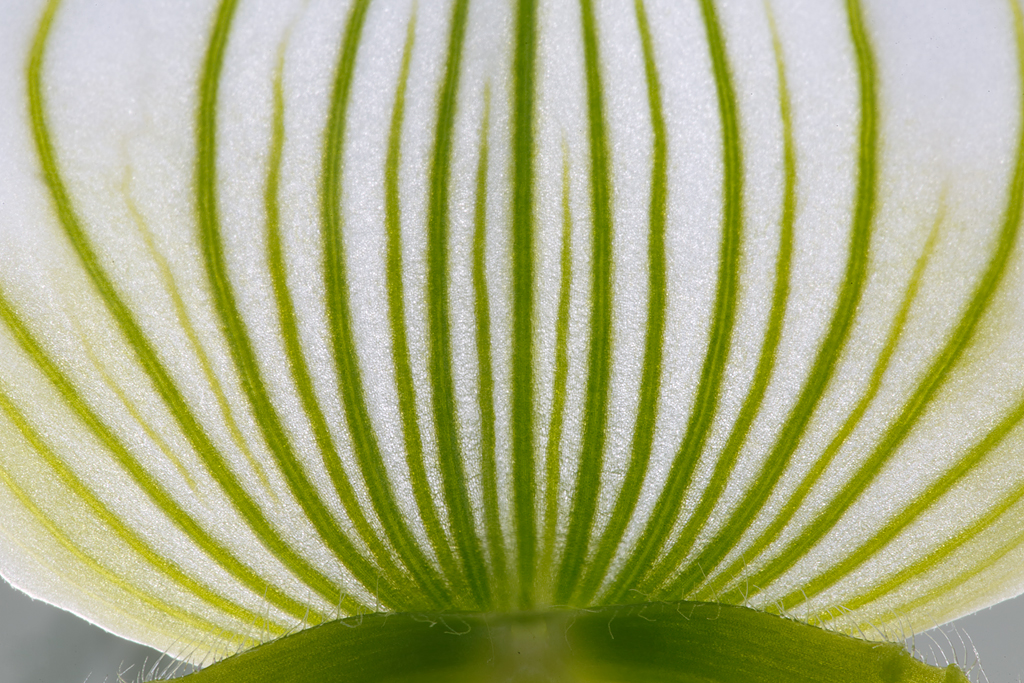
This image was created at the Beatrix Pavilion at Keukenhof, Lisse, Holland with the tripod-mounted Canon Telephoto EF 180mm f/3.5L macro lens, a Canon Extension Tube EF 25 II, and the Canon EOS 5D Mark III Digital camera body. ISO 100. Evaluative metering +1 2/3 stops: 2 seconds at f/32 in Av mode.

Manual focus 2/5ths of the way up from the bottom. Click on the image to enjoy a larger size.

Image #4: Orchid, rear view of petal: Cymbidium Dorothy Stockstill

Photograph Me!

Though we were concentrating on photographing the centers of most of the orchids, the pattern of the rays on the back side of this orchid petal attracted lots of folks. Several of us including co-leader Denise Ippolito and participant Pat Lillich, made similar images. In this rare instance no image sharing was involved as each of us proceeded unbeknownst to the others.

The back of this flower simply screamed, photograph me!
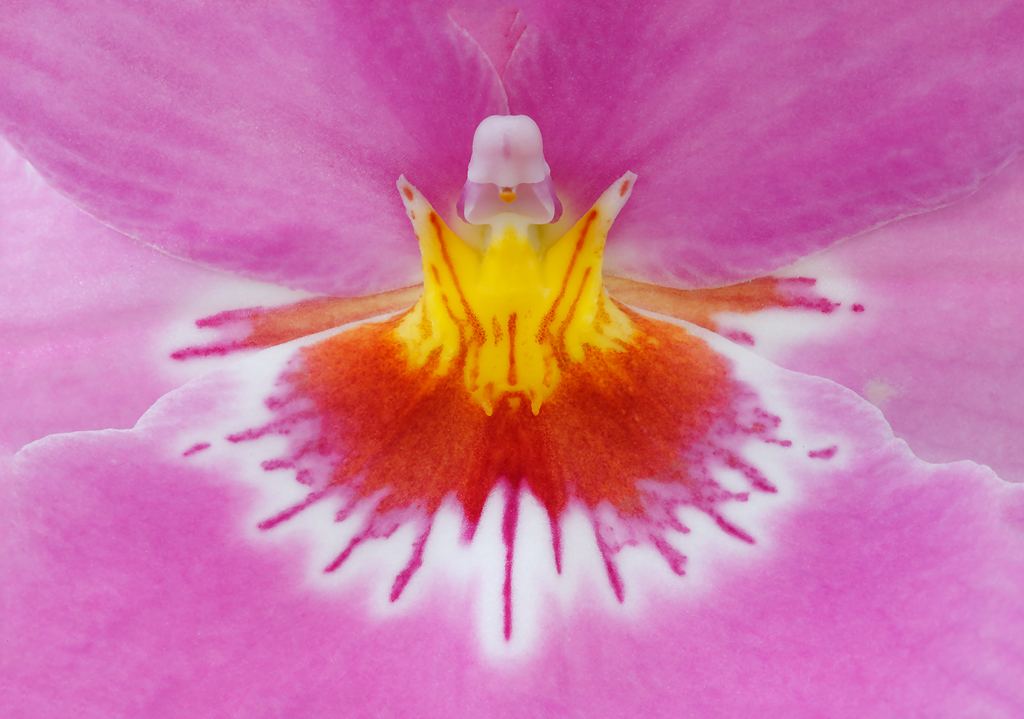
This image was also created at the Beatrix Pavilion at Keukenhof, Lisse, Holland with the tripod-mounted Canon Telephoto EF 180mm f/3.5L macro lens, a Canon Extension Tube EF 25 II, and the Canon EOS 5D Mark III Digital camera body. ISO 100. Evaluative metering +1 stop: 2.5 seconds at f/22 in Av mode.

Manual focus on the distal tip of the pistil. Click on the image to enjoy a larger size.

Image #5: Orchid: unnamed

Next Year

Despite a 100-year record cold spring with very few tulip fields in bloom this trip has been a spectacular success. The colors and variety of tulips at Keukenhof simply stun the mind and the senses. As we get ready to head off to Texel for a week of bird photography, we are planning our Holland trip for next year: the Keukenhof Creative Tulip IPT with a Touch of Holland. If you are a Happy Camper who is interested in joining us, please shoot me an e-mail. If you have never been on an IPT or a Creative Adventure Photography Tour, do know that preference will be given to those who have.

Your Favorite?

Take a moment to leave a comment and let us know which of the five images above is your favorite. And why.

Like Flower Photography?

If you like photographing flowers, be sure to see the “Creative Flower Photography: blog post here.

All images courtesy of and copyright 2012: Denise Ippolito. Click for a larger version.

A Creative Adventure/BIRDS AS ART Swan Island Dahlia Farm Instructional Photo-Tour, September 11-15, 2013: 5 FULL DAYS: $1649

Join Denise Ippolito and Arthur Morris at the Swan Island Dahlia Farm in Canby, Oregon (just south of Portland) for a great learning and photography experience. Swan Island features more than 40 acres with over 350 varieties of dahlias in a plethora of colors, shapes and sizes, making it one of the largest growers in the United States.

Daily Photo Schedule

We will enjoy four morning (7:00am till 10:30am) and five afternoon (3:30pm till 6pm) photography sessions. While we will do most of our photography at the Swan Island Dahlia Farm, we will also visit the Portland Rose Garden and/or the Portland Japanese Garden on this IPT. The in-the-field instruction will include seeing the situation, the use of selective focus, creative use of depth of field, histogram and exposure guidance, designing creative images, choosing your background, isolating your subject, lens options, and the use of reflectors and diffusers. Our field sessions will include challenging photography assignments geared to make you think creatively. Both personalized and small group instruction will be provided. All times are tentative and subject to change based on the weather and on local conditions.

Seminar Morning: Friday, September 13: 8:30am till 12:30pm

Denise will begin by presenting her “Bloomin’ Ideas” program, an overview of the in-the-field and post-processing techniques that she has used and developed over the past few years to create her signature look. Artie will follow with a Photoshop session that will be geared towards all levels. He’ll be sharing some of his favorite techniques and tips while working on images from the first two days of the IPT. Denise will conclude the seminar portion of the IPT with a Photoshop demo; she will share her creative workflow using a variety of Photoshop filters and effects. The entire morning is designed to give you a peek into the minds of two very skilled and creative folks.

The group will have lunch together daily. All are invited to bring their laptops for image sharing. We hope that you can join us for an intense five days of learning and some of the best flower photography to be had in North America.

Deposit Info and Cancellation Policies:

A $449 non-refundable deposit is required to hold your slot for this IPT. Your balance is due 4 months before the date of the IPT and is also non-refundable. If the trip fills, we will be glad to apply a credit applicable to a future IPT for the full amount less a $100 processing fee. If we do not receive your check for the balance on or before the due date we will try to fill your spot from the waiting list. If your spot is filled, you will lose your deposit. If not, you can secure your spot by paying your balance.

Please print, complete, and sign the form that is linked to here and shoot it to us along with your deposit check (made out to “Arthur Morris.”) You can also leave your deposit with a credit card by calling the office at 863-692-0906. We will be short-handed in the office until January 21 so please leave a message and we will call you back. If you register by phone, please print, complete and sign the form as noted above and either mail it to us or e-mail the scan.

If you have any questions, please feel free to contact me via e-mail

Pavilion

Thanks to the many folks who politely let us know of typos and cut and paste errors via either and e-mail or by leaving a comment. Do note that thousands of us missed my misspelling of pavilion (immediately above). The is just one “l.”

Typos

On all blog posts, feel free to e-mail or leave a comment regarding any typos, wrong words, misspellings, omissions, or grammatical errors. Just be right. 🙂

Support the BAA Blog. Support the BAA Bulletins: Shop B&H here!

We want and need to keep providing you with the latest free information, photography and Photoshop lessons, and all manner of related information. Show your appreciation by making your purchases immediately after clicking on any of our B&H or Amazon Affiliate links in this blog post. Remember, B&H ain’t just photography!

If you are considering an item for purchase or comparison shopping be sure to place an item in your cart to see the too-low-to show the actual price. In many cases the prices are so low that B&H is forbidden from publicizing them!

If you are considering an item for purchase or comparison shopping be sure to place an item in your cart to see the too-low-to show the actual price. In many cases the prices are so low that B&H is forbidden from publicizing them!


B&H Search Engine Banner


B&H Photo - Video - Pro Audio


And from the BAA On-line Store:

LensCoats. I have a LensCoat on each of my big lenses to protect them from nicks and thus increase their re-sales value. All my big lens LensCoat stuff is in Hardwood Snow pattern.
LegCoat Tripod Leg Covers. I have four tripods active and each has a Hardwood Snow LegCoat on it to help prevent further damage to my tender shoulders :) And you will love them in mega-cold weather....
Gitzo GT3532 LS CF Tripod. This one replaces the GT3530LS Tripod and will last you a lifetime. Learn more about this great tripod here.
Mongoose M3.6 Tripod Head. Right now this is the best tripod head around for use with lenses that weigh less than 9 pounds. For heavier lenses, check out the Wimberley V2 head.
Double Bubble Level. You will find one in my camera's hot shoe whenever I am not using flash.
The Lens Align Mark II. I use the Lens Align Mark II pretty much religiously to micro-adjust all of my gear an average of once a month and always before a major trip. Enjoy our free comprehensive tutorial here.
BreezeBrowser. I do not see how any digital photographer can exist without this program.
Delkin Flash Cards. I use and depend on Delkin compact Flash Cards and card readers most every day. Learn more about their great 700X and 1000X cards here or about my favorite Delkin card here.

April 21st, 2013

A Lens First?

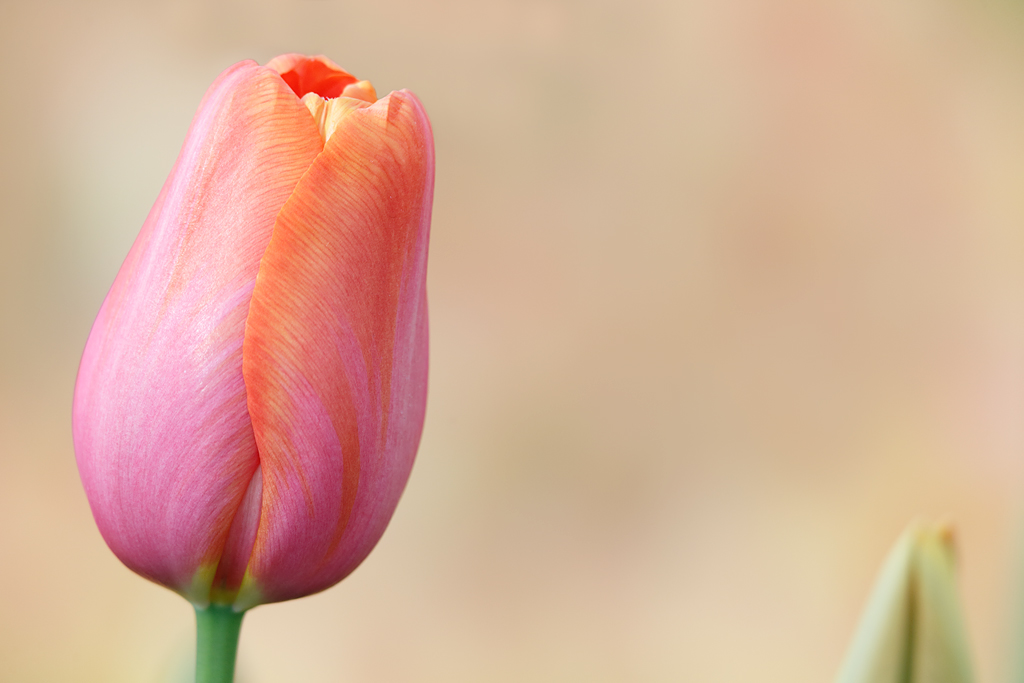
This tulip image was created at the Willem-Alexander Pavilion at Keukenhof, Lisse, Holland with the tripod-mounted Canon EF 600mm f/4L IS II USM lens,a Canon Extension Tube EF 25 II,
the Canon 1.4x EF tele-extender III, and the Canon EOS 5D Mark III Digital camera body. ISO 400. Evaluative metering +1 stop: 1/125 sec. at f/4 in Manual mode.

Manual focus on the distal end of the pistil. The image above was created in the usual BIRDS AS ART style: clean background with shallow depth-of-field. Click on the image to enjoy a larger size.

Image #1: pink tulip

A Lens First?

After spending one full day at Keukenhof using primarily the Canon Telephoto EF 180mm f/3.5L Macro lens I decided to bring the 600 II into the conservatory (in this case, a very large greenhouse) to change things up.

It is likely that my 600 was the first ever in the Willem-Alexander Pavilion.

This tulip image was created at the Willem-Alexander Pavilion at Keukenhof, Lisse, Holland with the tripod-mounted Canon EF 600mm f/4L IS II USM lens,a Canon Extension Tube EF 25 II,
the Canon 1.4x EF tele-extender III, and the Canon EOS 5D Mark III Digital camera body. ISO 400. Evaluative metering +2/3 stop: 1/5 sec. at f/16 in Manual mode.

Again, manual focus on the distal end of the pistil. Click on the image to enjoy a larger size.

Image #2: tulip flower center: “Beauty of Spryng”

TC/Extension Tube Order

When using an extension tube and a teleconverter, when photographing birds–for instance, it is customary to mount the TC on the lens with the extension tube behind it. With this set-up, you usually will have active AF. The extension tube allows you to focus inside of the lens’s minimum focusing distance. To get even closer, swap the TC and the tube, i.e., mount the tube on the lens with the TC behind it. This will gain you another foot or two of close focus. To create the image above I needed just that.

This tulip image was created at the Willem-Alexander Pavilion at Keukenhof, Lisse, Holland with the tripod-mounted Canon EF 600mm f/4L IS II USM lens,a Canon Extension Tube EF 25 II,
the Canon 1.4x EF tele-extender III, and the Canon EOS 5D Mark III Digital camera body. ISO 50. Evaluative metering -1/3 stop 1/4 sec. at f/8 in Tv Mode.

Manual focus on the closest tulip. Click on the image to enjoy a larger size.

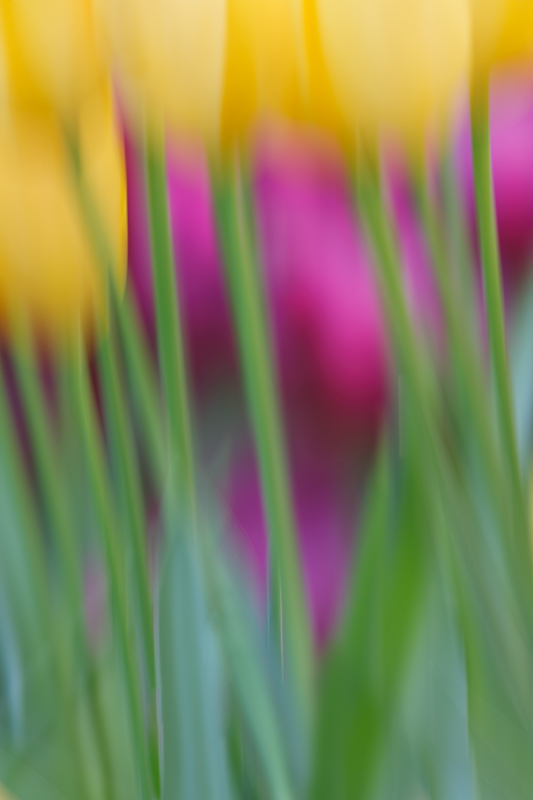
Image #3: purple and yellow tulip vertical pan blur

Vertical Pan Blurs

When I saw the combination of purples and yellows I moved back, set the lowest ISO, went to TV mode, took a test frame and corrected the exposure, and created about a dozen images while panning the lens down vertically. The image above was my favorite. To learn more check out A Guide to Pleasing Blurs by Denise Ippolito and yours truly.

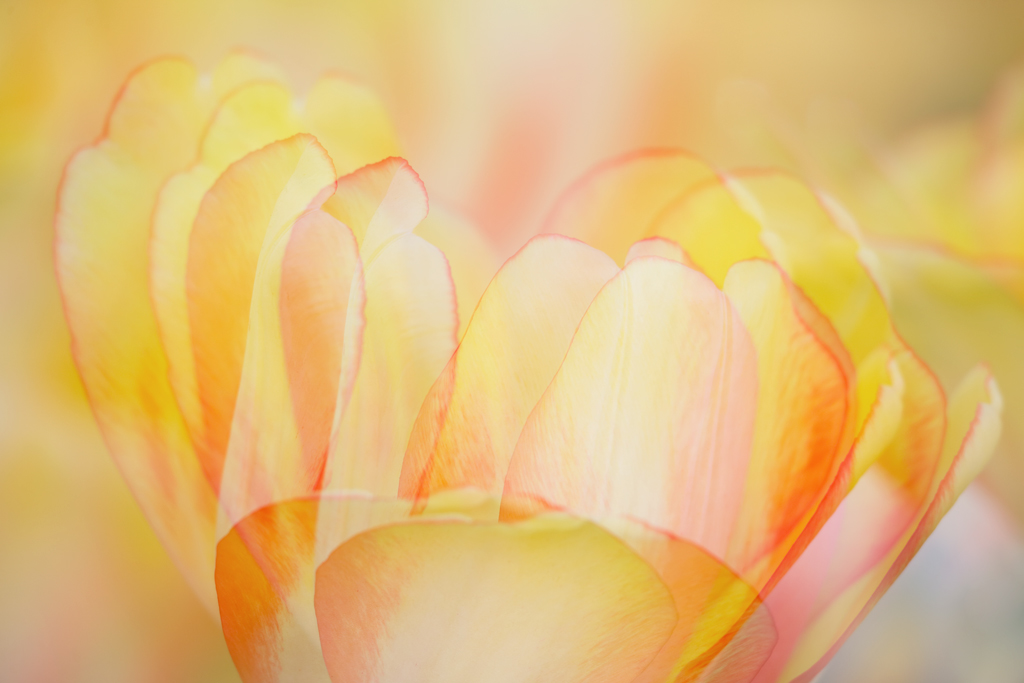
This tulip image was created at the Willem-Alexander Pavilion at Keukenhof, Lisse, Holland with the tripod-mounted Canon EF 600mm f/4L IS II USM lens and the Canon EOS 5D Mark III Digital camera body. ISO 400. Evaluative metering +2/3 stop: 1/5 sec. at f/16 in Manual mode.

Again, manual focus on the distal end of the pistil. Click on the image to enjoy a larger size.

Image #4: Tulip Multiple Exposure: “Beauty of Spryng”

Multiple Exposures with the EOS-5D Mark III

One of my two favorite 5D III features is the ability to create in-camera Multiple Exposures. This is a simple two-frame ME. Learn more in the EOS-5D Mark III User’s Guide and in Denise Ippolito’s great MP4 video tutorial, Creative Multiple Exposures. See all of our MP4 Photoshop Tutorial Videos here.

Vertical Pan Blurs

When I saw the combination of purples and yellows I moved back, set the lowest ISO, went to TV mode, took a test frame and corrected the exposure, and created about a dozen images while panning the lens down vertically. The image above was my favorite. To learn more check out A Guide to Pleasing Blurs by Denise Ippolito and yours truly.

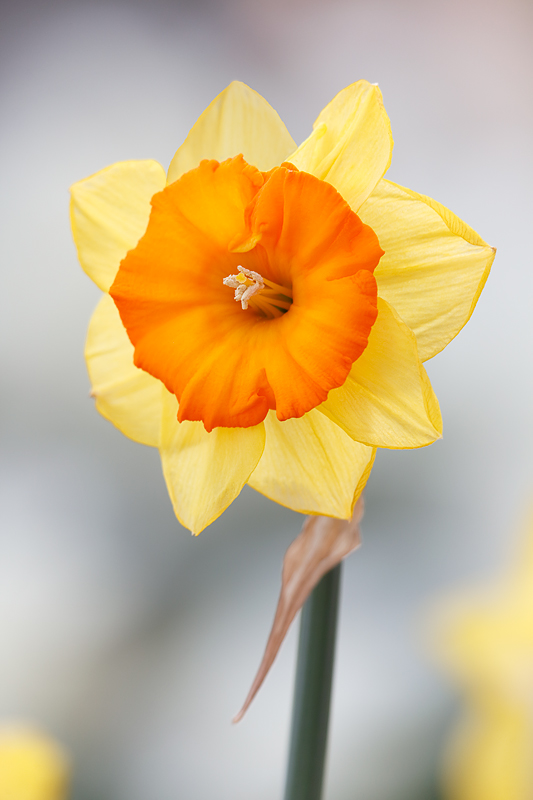
This daffodil image was created at the Willem-Alexander Pavilion at Keukenhof, Lisse, Holland with the tripod-mounted Canon EF 600mm f/4L IS II USM lens and the Canon EOS 5D Mark III Digital camera body. ISO 400. Evaluative metering +1 1/3 stops: 1/80 sec. at f/4 in Manual mode.

Again, manual focus on the distal end of the pistil. Click on the image to enjoy a larger size.

Image #5: Yellow Daffodil

Self Timer & Live View

For all of the images above but for the vertical pan blur I used Live View and the 2-second timer. Live View gives me mirror lock and a live histogram and the former in conjunction with the use of the 2-second timer assured razor sharp images unless someone opened the greenhouse door and created a breeze.

Your Favorite?

Take a moment to leave a comment and let us know which of the five images above is your favorite. And why.

Like Flower Photography?

If you like photographing flowers, be sure to see the “Creative Flower Photography: blog post here.

All images courtesy of and copyright 2012: Denise Ippolito. Click for a larger version.

A Creative Adventure/BIRDS AS ART Swan Island Dahlia Farm Instructional Photo-Tour, September 11-15, 2013: 5 FULL DAYS: $1649

Join Denise Ippolito and Arthur Morris at the Swan Island Dahlia Farm in Canby, Oregon (just south of Portland) for a great learning and photography experience. Swan Island features more than 40 acres with over 350 varieties of dahlias in a plethora of colors, shapes and sizes, making it one of the largest growers in the United States.

Daily Photo Schedule

We will enjoy four morning (7:00am till 10:30am) and five afternoon (3:30pm till 6pm) photography sessions. While we will do most of our photography at the Swan Island Dahlia Farm, we will also visit the Portland Rose Garden and/or the Portland Japanese Garden on this IPT. The in-the-field instruction will include seeing the situation, the use of selective focus, creative use of depth of field, histogram and exposure guidance, designing creative images, choosing your background, isolating your subject, lens options, and the use of reflectors and diffusers. Our field sessions will include challenging photography assignments geared to make you think creatively. Both personalized and small group instruction will be provided. All times are tentative and subject to change based on the weather and on local conditions.

Seminar Morning: Friday, September 13: 8:30am till 12:30pm

Denise will begin by presenting her “Bloomin’ Ideas” program, an overview of the in-the-field and post-processing techniques that she has used and developed over the past few years to create her signature look. Artie will follow with a Photoshop session that will be geared towards all levels. He’ll be sharing some of his favorite techniques and tips while working on images from the first two days of the IPT. Denise will conclude the seminar portion of the IPT with a Photoshop demo; she will share her creative workflow using a variety of Photoshop filters and effects. The entire morning is designed to give you a peek into the minds of two very skilled and creative folks.

The group will have lunch together daily. All are invited to bring their laptops for image sharing. We hope that you can join us for an intense five days of learning and some of the best flower photography to be had in North America.

Deposit Info and Cancellation Policies:

A $449 non-refundable deposit is required to hold your slot for this IPT. Your balance is due 4 months before the date of the IPT and is also non-refundable. If the trip fills, we will be glad to apply a credit applicable to a future IPT for the full amount less a $100 processing fee. If we do not receive your check for the balance on or before the due date we will try to fill your spot from the waiting list. If your spot is filled, you will lose your deposit. If not, you can secure your spot by paying your balance.

Please print, complete, and sign the form that is linked to here and shoot it to us along with your deposit check (made out to “Arthur Morris.”) You can also leave your deposit with a credit card by calling the office at 863-692-0906. We will be short-handed in the office until January 21 so please leave a message and we will call you back. If you register by phone, please print, complete and sign the form as noted above and either mail it to us or e-mail the scan.

If you have any questions, please feel free to contact me via e-mail

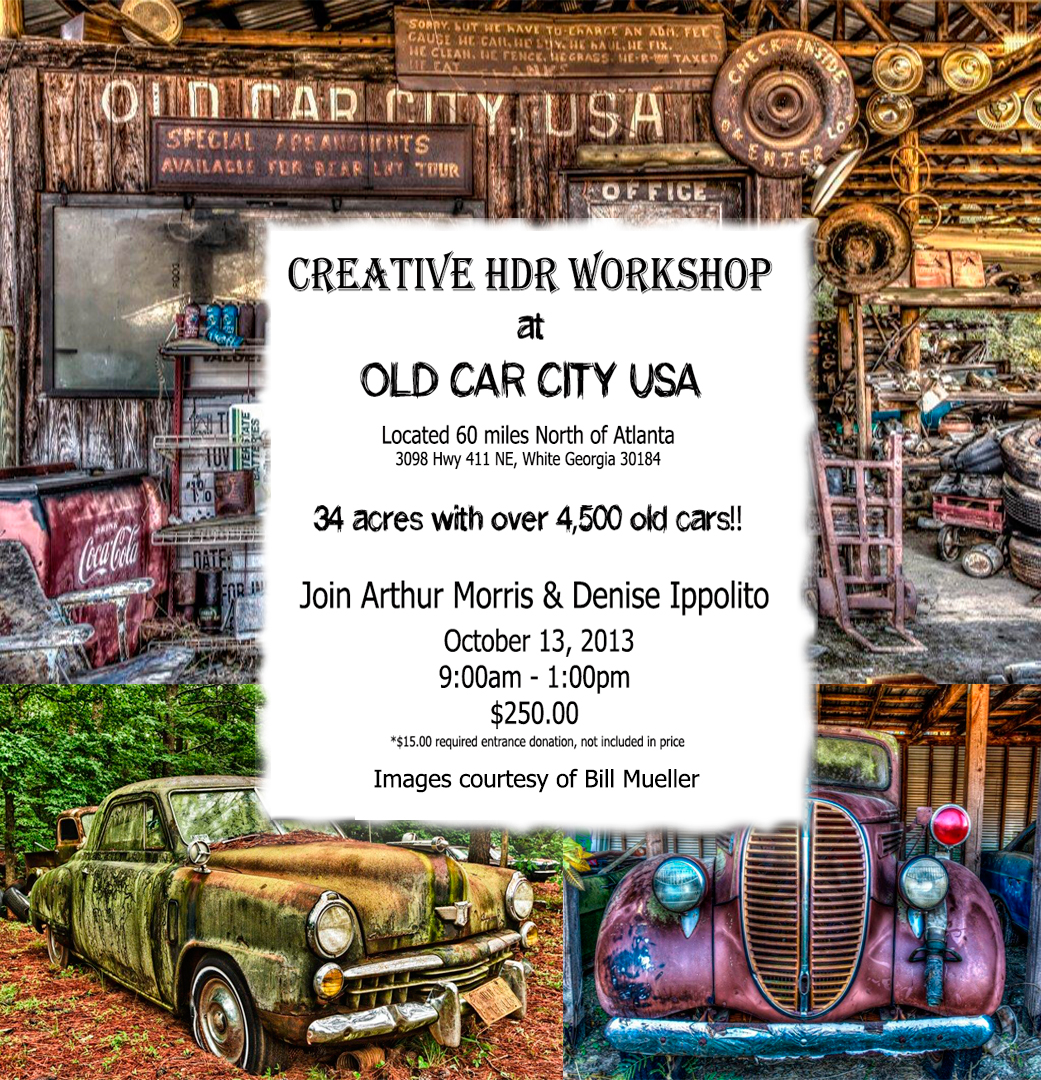
Images courtesy of and copyright 2012: Bill Mueller. Card design by Denise Ippolito.

Old Car City Creative Photography In-the-Field HDR Workshop: Sunday, October 13, 2013/ 9am till 1pm.

White, Georgia: $250 plus a $15 entrance fee donation (cash only on the day of the event) that will go to charity. Limit: 16 photographers.

On October 13, 2013, Arthur Morris/BIRDS AS ART and Denise Ippolito/A Creative Adventure will be conducting an In-the-Field HDR Workshop at Old Car City in White, Georgia. Old Car City is about an hour north of Atlanta, GA and an hour south of Chattanooga, TN where they will, as noted above, be doing a full day seminar for the Photographic Society of Chattanooga on Saturday, October 12th. Click here for complete details.

Typos

On all blog posts, feel free to e-mail or leave a comment regarding any typos, wrong words, misspellings, omissions, or grammatical errors. Just be right. 🙂

Support the BAA Blog. Support the BAA Bulletins: Shop B&H here!

We want and need to keep providing you with the latest free information, photography and Photoshop lessons, and all manner of related information. Show your appreciation by making your purchases immediately after clicking on any of our B&H or Amazon Affiliate links in this blog post. Remember, B&H ain’t just photography!

If you are considering an item for purchase or comparison shopping be sure to place an item in your cart to see the too-low-to show the actual price. In many cases the prices are so low that B&H is forbidden from publicizing them!

If you are considering an item for purchase or comparison shopping be sure to place an item in your cart to see the too-low-to show the actual price. In many cases the prices are so low that B&H is forbidden from publicizing them!


B&H Search Engine Banner


B&H Photo - Video - Pro Audio


And from the BAA On-line Store:

LensCoats. I have a LensCoat on each of my big lenses to protect them from nicks and thus increase their re-sales value. All my big lens LensCoat stuff is in Hardwood Snow pattern.
LegCoat Tripod Leg Covers. I have four tripods active and each has a Hardwood Snow LegCoat on it to help prevent further damage to my tender shoulders :) And you will love them in mega-cold weather....
Gitzo GT3532 LS CF Tripod. This one replaces the GT3530LS Tripod and will last you a lifetime. Learn more about this great tripod here.
Mongoose M3.6 Tripod Head. Right now this is the best tripod head around for use with lenses that weigh less than 9 pounds. For heavier lenses, check out the Wimberley V2 head.
Double Bubble Level. You will find one in my camera's hot shoe whenever I am not using flash.
The Lens Align Mark II. I use the Lens Align Mark II pretty much religiously to micro-adjust all of my gear an average of once a month and always before a major trip. Enjoy our free comprehensive tutorial here.
BreezeBrowser. I do not see how any digital photographer can exist without this program.
Delkin Flash Cards. I use and depend on Delkin compact Flash Cards and card readers most every day. Learn more about their great 700X and 1000X cards here or about my favorite Delkin card here.

April 19th, 2013

Keukenhof Tulip Petal Dreams

This image was created at the Willem-Alexander Pavilion at Keukenhof, Lisse, Holland with the tripod-mounted Canon Telephoto EF 180mm f/3.5L Macro USM Autofocus lens and the and the Canon EOS-5D Mark III. ISO 800. Evaluative metering +2/3 stop: 1/25 sec. at f/8 in Av mode.

Central sensor AI Servo/Rear Focus on the closest large tulip petal on the left and re-compose. Click here if you missed the Rear Focus Tutorial. Click on the image to see a larger version.

Image #1: Tulipa “Washington Orange”

Keukenhof Tulip Petal Dreams

While the outdoor tulip fields are currently 3-4 weeks behind average due to the coldest spring in 75-100 years, the tulips o+f the Willem-Alexander Pavilion (Conservatory) at the justly famous Keukenhof Gardens were in pristine condition during our visits. The variety of colors, shapes, and patterns of hundreds of types of tulips was indeed staggering. Denise and our 8 participants have been in tulip heaven and I had a ton of fun as well.

This image was created at the Willem-Alexander Pavilion at Keukenhof, Lisse, Holland with the tripod-mounted Canon Telephoto EF 180mm f/3.5L Macro USM Autofocus lens, the Canon 1.4x EF Extender III (Teleconverter)
and the and the Canon EOS-5D Mark III. ISO 400. Evaluative metering +1 stop: 1/13 sec. at f/20 in Av mode.

Manual Focus on the base of the stem and re-compose. Click on the image to see a larger version.

Image #2: Tulip “Beauty of Spryng”

Seeing the Image

I would stroll around looking for a display of a particularly gorgeous tulip. Once I found one that interested me for whatever reason I would sit right down on the brick or tile floor behind my lowered tripod and see what was there to be seen. Once I spotted something of interest I would vary my perspective by moving left of right or raising or lowering the tripod a bit.

This image was created at the Willem-Alexander Pavilion at Keukenhof, Lisse, Holland with the tripod-mounted Canon Telephoto EF 180mm f/3.5L Macro USM Autofocus lens and the and the Canon EOS-5D Mark III. ISO 400. Evaluative metering +1 stop: 1/60 sec. at f/3.5 in Manual mode.

Manual Focus on the left-hand petal knife-edge and re-compose.

Image #3: Tulip “Beauty of Spryng”
. Click on the image to see a larger version.

The Mechanics

Once I got in position and framed the image, I would lock up all the tripod controls and tighten the tripod collar. Then I would re-check the framing and tweak my set-up as needed. Most of the time I was working in Live View with the 2-second timer to ensure sharp images at any shutter speed. Then press the shutter button and smile. Most of the time I would make a series of images from wide open to the smallest aperture. As you can see here sometimes wide open or close to it was best at other times stopping down a little or a lot was the key. Finding the right perspective and setting everything up took lots of time but cranking out six or seven versions with vary depths-of-field was a relative snap.

This image was created at the Willem-Alexander Pavilion at Keukenhof, Lisse, Holland with the tripod-mounted Canon Telephoto EF 180mm f/3.5L Macro USM Autofocus lens, the Canon 1.4x EF Extender III (Teleconverter)
and the and the Canon EOS-5D Mark III. ISO 400. Evaluative metering +1 1/3 stops: 1/20 sec. at f/13 in Av mode.

Manual Focus on the tip of the pistil and re-compose. Click on the image to see a larger version.

Image #4: Tulip “Lingerie”

Broken Petal Paradise

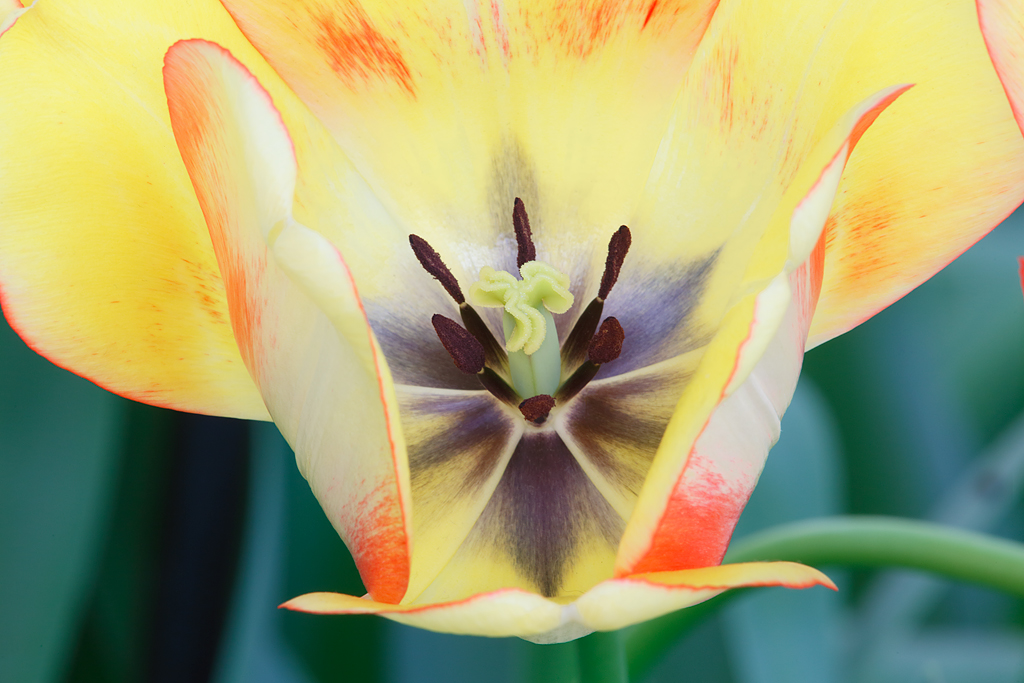
Denise Ippolito taught me and others to look for damaged tulips for wonderful views of the flower centers. This particular tulip has one drooping petal that provided a spectacular view of the pistil and the anthers.

This image was created at the Willem-Alexander Pavilion at Keukenhof, Lisse, Holland with the tripod-mounted Canon Telephoto EF 180mm f/3.5L Macro USM Autofocus lens and the and the Canon EOS-5D Mark III. ISO 400. Evaluative metering +2 stops: 1/10 sec. at f/13 in Av mode.

Manual Focus on the right hand petal kife-edge and re-compose. Click on the image to see a larger version.

Image #5: Tulip “Beauty of Spryng”

Your Favorite?

Take a moment to leave a comment and let us know which of the five images above is your favorite. And why.

All images courtesy of and copyright 2012: Denise Ippolito. Click for a larger version.

A Creative Adventure/BIRDS AS ART Swan Island Dahlia Farm Instructional Photo-Tour, September 11-15, 2013: 5 FULL DAYS: $1649

Join Denise Ippolito and Arthur Morris at the Swan Island Dahlia Farm in Canby, Oregon (just south of Portland) for a great learning and photography experience. Swan Island features more than 40 acres with over 350 varieties of dahlias in a plethora of colors, shapes and sizes, making it one of the largest growers in the United States.

Daily Photo Schedule

We will enjoy four morning (7:00am till 10:30am) and five afternoon (3:30pm till 6pm) photography sessions. While we will do most of our photography at the Swan Island Dahlia Farm, we will also visit the Portland Rose Garden and/or the Portland Japanese Garden on this IPT. The in-the-field instruction will include seeing the situation, the use of selective focus, creative use of depth of field, histogram and exposure guidance, designing creative images, choosing your background, isolating your subject, lens options, and the use of reflectors and diffusers. Our field sessions will include challenging photography assignments geared to make you think creatively. Both personalized and small group instruction will be provided. All times are tentative and subject to change based on the weather and on local conditions.

Seminar Morning: Friday, September 13: 8:30am till 12:30pm

Denise will begin by presenting her “Bloomin’ Ideas” program, an overview of the in-the-field and post-processing techniques that she has used and developed over the past few years to create her signature look. Artie will follow with a Photoshop session that will be geared towards all levels. He’ll be sharing some of his favorite techniques and tips while working on images from the first two days of the IPT. Denise will conclude the seminar portion of the IPT with a Photoshop demo; she will share her creative workflow using a variety of Photoshop filters and effects. The entire morning is designed to give you a peek into the minds of two very skilled and creative folks.

The group will have lunch together daily. All are invited to bring their laptops for image sharing. We hope that you can join us for an intense five days of learning and some of the best flower photography to be had in North America.

Deposit Info and Cancellation Policies:

A $449 non-refundable deposit is required to hold your slot for this IPT. Your balance is due 4 months before the date of the IPT and is also non-refundable. If the trip fills, we will be glad to apply a credit applicable to a future IPT for the full amount less a $100 processing fee. If we do not receive your check for the balance on or before the due date we will try to fill your spot from the waiting list. If your spot is filled, you will lose your deposit. If not, you can secure your spot by paying your balance.

Please print, complete, and sign the form that is linked to here and shoot it to us along with your deposit check (made out to “Arthur Morris.”) You can also leave your deposit with a credit card by calling the office at 863-692-0906. We will be short-handed in the office until January 21 so please leave a message and we will call you back. If you register by phone, please print, complete and sign the form as noted above and either mail it to us or e-mail the scan.

If you have any questions, please feel free to contact me via e-mail

Like Flower Photography?

If you like photographing flowers, be sure to see the “Creative Flower Photography: blog post here.

Images courtesy of and copyright 2012: Bill Mueller. Card design by Denise Ippolito.

Old Car City Creative Photography In-the-Field HDR Workshop: Sunday, October 13, 2013/ 9am till 1pm.

White, Georgia: $250 plus a $15 entrance fee donation (cash only on the day of the event) that will go to charity. Limit: 16 photographers.

On October 13, 2013, Arthur Morris/BIRDS AS ART and Denise Ippolito/A Creative Adventure will be conducting an In-the-Field HDR Workshop at Old Car City in White, Georgia. Old Car City is about an hour north of Atlanta, GA and an hour south of Chattanooga, TN where they will, as noted above, be doing a full day seminar for the Photographic Society of Chattanooga on Saturday, October 12th. Click here for complete details.

Typos

On all blog posts, feel free to e-mail or leave a comment regarding any typos, wrong words, misspellings, omissions, or grammatical errors. Just be right. 🙂

Support the BAA Blog. Support the BAA Bulletins: Shop B&H here!

We want and need to keep providing you with the latest free information, photography and Photoshop lessons, and all manner of related information. Show your appreciation by making your purchases immediately after clicking on any of our B&H or Amazon Affiliate links in this blog post. Remember, B&H ain’t just photography!

If you are considering an item for purchase or comparison shopping be sure to place an item in your cart to see the too-low-to show the actual price. In many cases the prices are so low that B&H is forbidden from publicizing them!

If you are considering an item for purchase or comparison shopping be sure to place an item in your cart to see the too-low-to show the actual price. In many cases the prices are so low that B&H is forbidden from publicizing them!


B&H Search Engine Banner


B&H Photo - Video - Pro Audio


And from the BAA On-line Store:

LensCoats. I have a LensCoat on each of my big lenses to protect them from nicks and thus increase their re-sales value. All my big lens LensCoat stuff is in Hardwood Snow pattern.
LegCoat Tripod Leg Covers. I have four tripods active and each has a Hardwood Snow LegCoat on it to help prevent further damage to my tender shoulders :) And you will love them in mega-cold weather....
Gitzo GT3532 LS CF Tripod. This one replaces the GT3530LS Tripod and will last you a lifetime. Learn more about this great tripod here.
Mongoose M3.6 Tripod Head. Right now this is the best tripod head around for use with lenses that weigh less than 9 pounds. For heavier lenses, check out the Wimberley V2 head.
Double Bubble Level. You will find one in my camera's hot shoe whenever I am not using flash.
The Lens Align Mark II. I use the Lens Align Mark II pretty much religiously to micro-adjust all of my gear an average of once a month and always before a major trip. Enjoy our free comprehensive tutorial here.
BreezeBrowser. I do not see how any digital photographer can exist without this program.
Delkin Flash Cards. I use and depend on Delkin compact Flash Cards and card readers most every day. Learn more about their great 700X and 1000X cards here or about my favorite Delkin card here.
April 17th, 2013

Tulip Field Painting

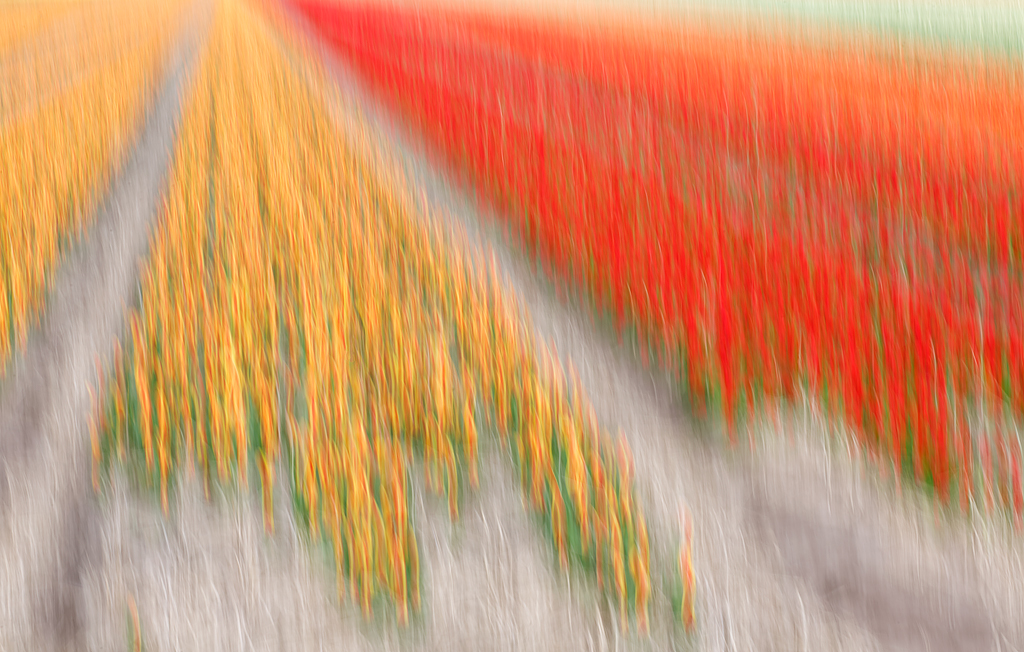
This tulip image was created at Lisse, Holland with the hand held Canon EF 70-200mm f/2.8L IS II USM zoom lens and the Canon EOS-5D Mark III. ISO 50. Evaluative metering +1/3 stop: 4/10 sec. at f/29 in Manual mode.

Central sensor AI Servo/Rear Focus on the tulips 1/3 of the way up in the frame and re-compose. Click here if you missed the Rear Focus Tutorial. Click on the image to see a larger version.

Image #1

Tulip Field Painting

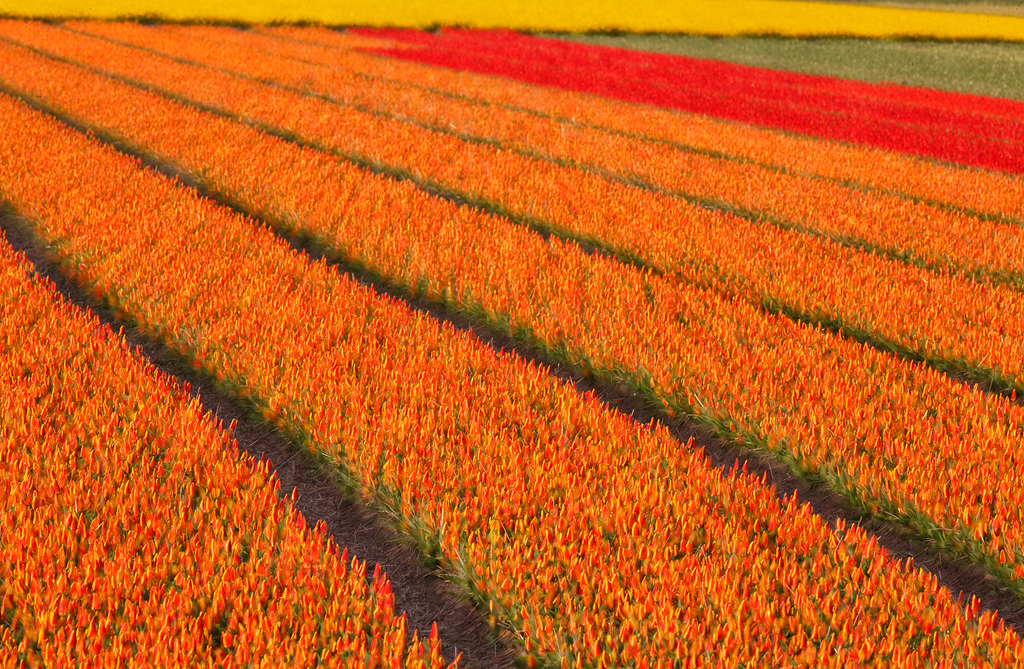
Relying on the local knowledge and great interpersonal skills of Peter Kes we gained access to pretty much the only tulip fields in bloom on the first afternoon of the Holland Creative Instructional Photography Tour. Then Denise and I instructed the group on the art of painting with light, creating pleasing blurs using the tulips as our oils.

Denise’s fabulous tip to pan along the diagonal rows helped even me.

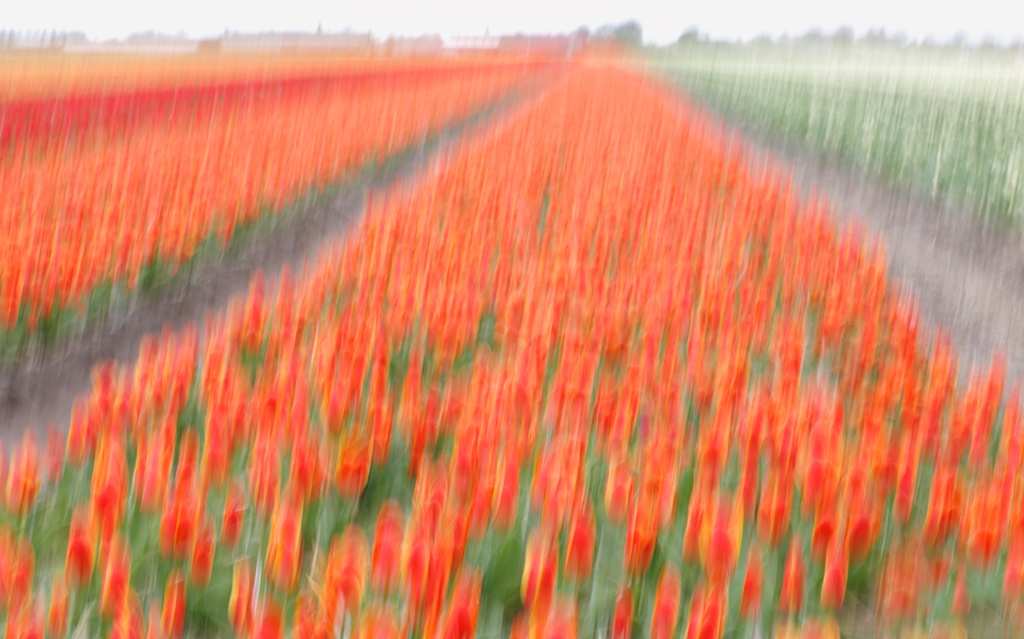
This tulip image was created at Lisse, Holland with the hand held Canon EF 70-200mm f/2.8L IS II USM zoom lens and the Canon EOS-5D Mark III. ISO 50. Evaluative metering +1/3 stop: 4/10 sec. at f/25 in Manual mode.

Central sensor AI Servo/Rear Focus on the tulips 1/3 of the way up in the frame and re-compose. Click here if you missed the Rear Focus Tutorial. Click on the image to see a larger version.

Image #2

For the image above I panned vertically. Note especially the ISO and the shutter speed. Learn everything that you need to about create pleasing blurs in “A Guide to Pleasing Blurs” by Denise Ippolito and Arthur Morris.

At lunch we ran into some friends on another photo-tour and naturally–big show-off that I am–began sharing some images on my laptop. After a series of oohs and ahs one woman asked, “I can I learn to do that?” I said partly tongue in cheek, “Come on a Creative Instructional Photography Tour with Denise and me. Barring that, get your self a copy of A Guide to Pleasing Blurs. Then of course I gave her a few quick tips for creating pleasing blurs: ISO 50, a slow, slow shutter speed, and the experiment by moving the lens.

Monet?

This tulip image was created at Lisse, Holland with the hand held Canon EF 70-200mm f/2.8L IS II USM zoom lens and the Canon EOS-5D Mark III. ISO 50. Evaluative metering +1/3 stop: 1/2 sec. at f/25 in Manual mode.

Central sensor AI Servo/Rear Focus on the tulips 1/3 of the way up in the frame and re-compose. Click here if you missed the Rear Focus Tutorial. Click on the image to see a larger version.

Image #3

The image above is a vertical pan blur with a bit of a jiggle added. Yet another technique that Denise taught me. I usually work hard to eliminate the human hand in my images but this one simply looked better with the line of buildings included.

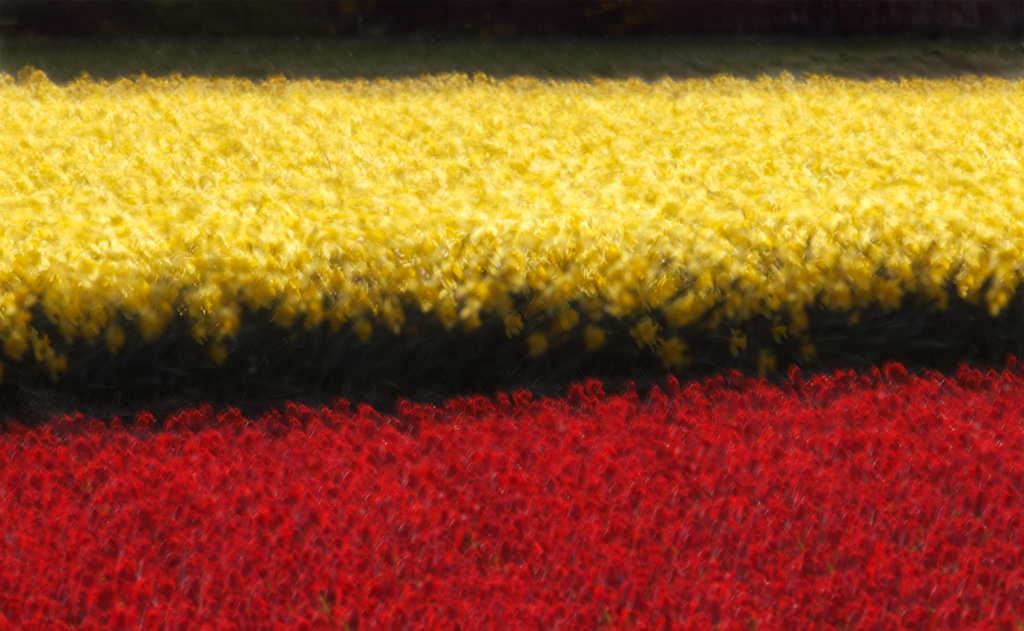
This image was created with the tripod-mounted Canon EF 600mm f/4L IS II USM lens, the Canon 2x EF Extender III (Teleconverter), and the Canon EOS 5D Mark III Digital camera body. ISO 400. Evaluative metering -2/3 stop: 1/2 sec. at f/64 in Manual mode.

Image #4

As we approached the red field of tulips with the field of yellow daffodils behind it I struggled briefly with the strong back-lighting. Then I added the 2X III TC to my 600II/5D III rig, focused manually, set the exposure, and framed what would be a very pleasing image. The moment I saw the dark and moody image on the back of the camera I thought “Rembrandt.” The processing helped as I darkened all the neutral and dark tones in the two dark strips. This image is wind-blurred.

This image was created once we made our way to the sun-angle side of the field with the tripod-mounted Canon EF 600mm f/4L IS II USM lens, the Canon 1.4x EF tele-extender III, and the Canon EOS 5D Mark III Digital camera body. ISO 100. Evaluative metering +1/3 stop: 1/4 sec. at f/45 in Manual mode.

Image #5

This blur here was a result of both the blowing flowers and my jiggling the camera during the exposure. Maybe a bit of Seurat?

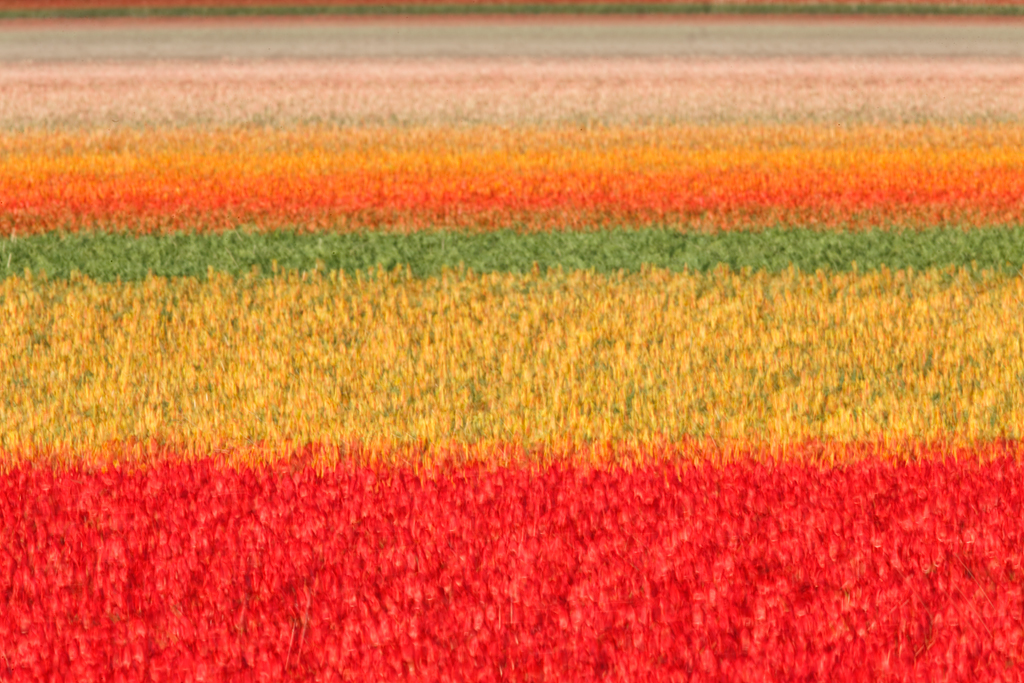
This image was created from the same spot as the previous image also with the tripod-mounted Canon EF 600mm f/4L IS II USM lens, the Canon 1.4x EF tele-extender III, and the Canon EOS 5D Mark III Digital camera body. ISO 100. Evaluative metering +1/3 stop: 1/4 sec. at f/45 in Manual mode.

Image #6

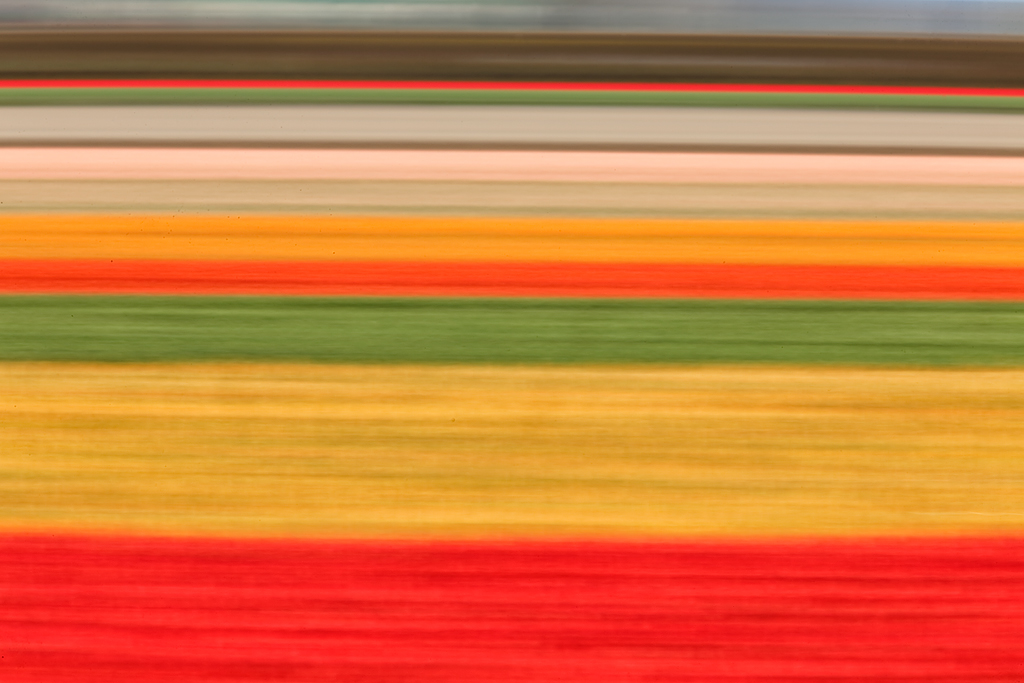
To create this image I carefully leveled the tripod head, carefully framed the image, leveled the camera, and panned horizontally to create the strips of glorious color.

Your Favorite?

Please take a moment to let us know which is your favorite image and why you like it.

All images courtesy of and copyright 2012: Denise Ippolito. Click for a larger version.

A Creative Adventure/BIRDS AS ART Swan Island Dahlia Farm Instructional Photo-Tour, September 11-15, 2013: 5 FULL DAYS: $1649

Join Denise Ippolito and Arthur Morris at the Swan Island Dahlia Farm in Canby, Oregon (just south of Portland) for a great learning and photography experience. Swan Island features more than 40 acres with over 350 varieties of dahlias in a plethora of colors, shapes and sizes, making it one of the largest growers in the United States.

Daily Photo Schedule

We will enjoy four morning (7:00am till 10:30am) and five afternoon (3:30pm till 6pm) photography sessions. While we will do most of our photography at the Swan Island Dahlia Farm, we will also visit the Portland Rose Garden and/or the Portland Japanese Garden on this IPT. The in-the-field instruction will include seeing the situation, the use of selective focus, creative use of depth of field, histogram and exposure guidance, designing creative images, choosing your background, isolating your subject, lens options, and the use of reflectors and diffusers. Our field sessions will include challenging photography assignments geared to make you think creatively. Both personalized and small group instruction will be provided. All times are tentative and subject to change based on the weather and on local conditions.

Seminar Morning: Friday, September 13: 8:30am till 12:30pm

Denise will begin by presenting her “Bloomin’ Ideas” program, an overview of the in-the-field and post-processing techniques that she has used and developed over the past few years to create her signature look. Artie will follow with a Photoshop session that will be geared towards all levels. He’ll be sharing some of his favorite techniques and tips while working on images from the first two days of the IPT. Denise will conclude the seminar portion of the IPT with a Photoshop demo; she will share her creative workflow using a variety of Photoshop filters and effects. The entire morning is designed to give you a peek into the minds of two very skilled and creative folks.

The group will have lunch together daily. All are invited to bring their laptops for image sharing. We hope that you can join us for an intense five days of learning and some of the best flower photography to be had in North America.

Deposit Info and Cancellation Policies:

A $449 non-refundable deposit is required to hold your slot for this IPT. Your balance is due 4 months before the date of the IPT and is also non-refundable. If the trip fills, we will be glad to apply a credit applicable to a future IPT for the full amount less a $100 processing fee. If we do not receive your check for the balance on or before the due date we will try to fill your spot from the waiting list. If your spot is filled, you will lose your deposit. If not, you can secure your spot by paying your balance.

Please print, complete, and sign the form that is linked to here and shoot it to us along with your deposit check (made out to “Arthur Morris.”) You can also leave your deposit with a credit card by calling the office at 863-692-0906. We will be short-handed in the office until January 21 so please leave a message and we will call you back. If you register by phone, please print, complete and sign the form as noted above and either mail it to us or e-mail the scan.

If you have any questions, please feel free to contact me via e-mail

Like Flower Photography?

If you like photographing flowers, be sure to see the “Creative Flower Photography: blog post here.

Images courtesy of and copyright 2012: Bill Mueller. Card design by Denise Ippolito.

Old Car City Creative Photography In-the-Field HDR Workshop: Sunday, October 13, 2013/ 9am till 1pm.

White, Georgia: $250 plus a $15 entrance fee donation (cash only on the day of the event) that will go to charity. Limit: 16 photographers.

On October 13, 2013, Arthur Morris/BIRDS AS ART and Denise Ippolito/A Creative Adventure will be conducting an In-the-Field HDR Workshop at Old Car City in White, Georgia. Old Car City is about an hour north of Atlanta, GA and an hour south of Chattanooga, TN where they will, as noted above, be doing a full day seminar for the Photographic Society of Chattanooga on Saturday, October 12th. Click here for complete details.

Typos

On all blog posts, feel free to e-mail or leave a comment regarding any typos, wrong words, misspellings, omissions, or grammatical errors. Just be right. 🙂

Support the BAA Blog. Support the BAA Bulletins: Shop B&H here!

We want and need to keep providing you with the latest free information, photography and Photoshop lessons, and all manner of related information. Show your appreciation by making your purchases immediately after clicking on any of our B&H or Amazon Affiliate links in this blog post. Remember, B&H ain’t just photography!

If you are considering an item for purchase or comparison shopping be sure to place an item in your cart to see the too-low-to show the actual price. In many cases the prices are so low that B&H is forbidden from publicizing them!

If you are considering an item for purchase or comparison shopping be sure to place an item in your cart to see the too-low-to show the actual price. In many cases the prices are so low that B&H is forbidden from publicizing them!


B&H Search Engine Banner


B&H Photo - Video - Pro Audio


And from the BAA On-line Store:

LensCoats. I have a LensCoat on each of my big lenses to protect them from nicks and thus increase their re-sales value. All my big lens LensCoat stuff is in Hardwood Snow pattern.
LegCoat Tripod Leg Covers. I have four tripods active and each has a Hardwood Snow LegCoat on it to help prevent further damage to my tender shoulders :) And you will love them in mega-cold weather....
Gitzo GT3532 LS CF Tripod. This one replaces the GT3530LS Tripod and will last you a lifetime. Learn more about this great tripod here.
Mongoose M3.6 Tripod Head. Right now this is the best tripod head around for use with lenses that weigh less than 9 pounds. For heavier lenses, check out the Wimberley V2 head.
Double Bubble Level. You will find one in my camera's hot shoe whenever I am not using flash.
The Lens Align Mark II. I use the Lens Align Mark II pretty much religiously to micro-adjust all of my gear an average of once a month and always before a major trip. Enjoy our free comprehensive tutorial here.
BreezeBrowser. I do not see how any digital photographer can exist without this program.
Delkin Flash Cards. I use and depend on Delkin compact Flash Cards and card readers most every day. Learn more about their great 700X and 1000X cards here or about my favorite Delkin card here.
April 15th, 2013

Dire Tulip Forecast Update Plus Super Bonus Bird

This tulip image was created at Lisse, Holland with the tripod-mounted Canon EF 600mm f/4L IS II USM lens and the Canon EOS 5D Mark III Digital camera body. ISO 800. Evaluative metering +1/3 stop: 1/60 sec. at f/32 in Manual mode.

Central sensor AI Servo/Rear Focus on the tulips 1/3 of the way up in the frame and re-compose. Click here if you missed the Rear Focus Tutorial. Click on the image to see a larger version.

Dire Tulip Forecast Update

“The coldest spring in 75 years.” “Nothing in bloom in the fields.” Those were among the early reports that we had been hearing. Peter Kes and wife Leslie along with co-leader Denise Ippolito and I headed out to look for some tulips. It was not long before we spotted some distant bright red fields; by taking the back roads Peter had us right in position just as the light was getting gorgeous.

The image above was a two-frame/in-camera/Multiple Exposure that combined one soft and one very de-focused image, a sort of in-camera Orton effect. Learn how and tons more in Denise’s Creative Multiple Exposures MP4 video. Only $4! Heck, Denise taught me, she can teach you.

What’s?

Leave a comment and let us know what is your very favorite part of the image above.

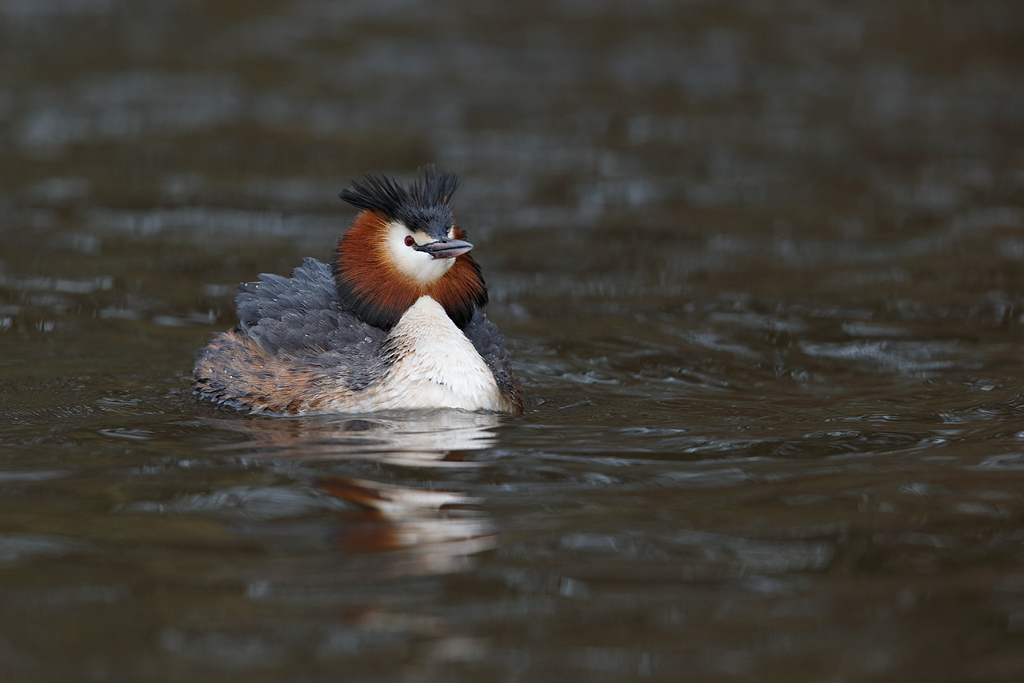
This Great-crested Grebe was photographed in a roadside while I was seated behind my lowered tripod with the Canon EF 600mm f/4L IS II USM lens, the Canon 1.4x EF tele-extender III, and the Canon EOS-1D X. ISO 800: 1/500 sec. at f/6.3 in Manual mode. The exposure was confirmed previously while the bird was swimming in light-toned water. Thus the huge advantage of working in Manual mode.

One sensor below the central sensor/AI Servo-Surround/Rear Focus AF on bird’s neck active at the moment of exposure. Click here if you missed the Rear Focus Tutorial. Click on the image to see a larger version.

Super Bonus Bird

Before we found the tulips we found and photographed a pair of beautiful Great-crested Grebes included the displaying male above.

Jam Session I: Photoshop Video Tutorial: $9

On the first Fort Desoto/Hooptie Deux Short Notice IPT we drove from St. Pete to my home in Indian Lake Estates for a chance to photograph Sandhill Crane chicks of various sizes. We succeeded admirably. See “What No Itinerary” here for the whole story.

After our morning photo session the group gathered in my office for a Photoshop session. I worked on one image from the previous morning and on one from that morning, the latter the image above. The session was recorded with Camtasia. We are offering you a chance to join the group and look right over my shoulder as I processed the images above and below. Techniques covered include the following: the RAW conversions in DPP, using Detail Extractor from NIK’s Color Efex Pro to bring up the detail in the ibis’s white feathers, creating and using Layer masks, and using the Quick Selection Tool, the Spot Healing Brush, the Patch Tool, and Content Aware Fill for image clean-up. Selective sharpening with a Contrast Mask, Background clean-up with a soft Clone Stamp Tool, cloning on a Layer, using Quick Masks, using Select/Color Range to make selections (including the little used Range slider), and lots more.

To order yours through the BAA store, click here. Or call Jim or Jen weekdays between 9am and 5pm (3pm on Fridays) at 863-692-0906 with your credit card in hand. Please leave a message in the rare event that we miss your call and we will get back to you. Easiest is to send us a Paypal for $9.00 to birdsasart@verizon.net with the words “Jam Session I” cut and pasted into the subject line. Sorry, no checks are accepted for the MP4 videos.

Learn more about our MP4 Photoshop Tutorial Videos here. See the whole collection here.

All images courtesy of and copyright 2012: Denise Ippolito. Click for a larger version.

A Creative Adventure/BIRDS AS ART Swan Island Dahlia Farm Instructional Photo-Tour, September 11-15, 2013: 5 FULL DAYS: $1649

Join Denise Ippolito and Arthur Morris at the Swan Island Dahlia Farm in Canby, Oregon (just south of Portland) for a great learning and photography experience. Swan Island features more than 40 acres with over 350 varieties of dahlias in a plethora of colors, shapes and sizes, making it one of the largest growers in the United States.

Daily Photo Schedule

We will enjoy four morning (7:00am till 10:30am) and five afternoon (3:30pm till 6pm) photography sessions. While we will do most of our photography at the Swan Island Dahlia Farm, we will also visit the Portland Rose Garden and/or the Portland Japanese Garden on this IPT. The in-the-field instruction will include seeing the situation, the use of selective focus, creative use of depth of field, histogram and exposure guidance, designing creative images, choosing your background, isolating your subject, lens options, and the use of reflectors and diffusers. Our field sessions will include challenging photography assignments geared to make you think creatively. Both personalized and small group instruction will be provided. All times are tentative and subject to change based on the weather and on local conditions.

Seminar Morning: Friday, September 13: 8:30am till 12:30pm

Denise will begin by presenting her “Bloomin’ Ideas” program, an overview of the in-the-field and post-processing techniques that she has used and developed over the past few years to create her signature look. Artie will follow with a Photoshop session that will be geared towards all levels. He’ll be sharing some of his favorite techniques and tips while working on images from the first two days of the IPT. Denise will conclude the seminar portion of the IPT with a Photoshop demo; she will share her creative workflow using a variety of Photoshop filters and effects. The entire morning is designed to give you a peek into the minds of two very skilled and creative folks.

The group will have lunch together daily. All are invited to bring their laptops for image sharing. We hope that you can join us for an intense five days of learning and some of the best flower photography to be had in North America.

Deposit Info and Cancellation Policies:

A $449 non-refundable deposit is required to hold your slot for this IPT. Your balance is due 4 months before the date of the IPT and is also non-refundable. If the trip fills, we will be glad to apply a credit applicable to a future IPT for the full amount less a $100 processing fee. If we do not receive your check for the balance on or before the due date we will try to fill your spot from the waiting list. If your spot is filled, you will lose your deposit. If not, you can secure your spot by paying your balance.

Please print, complete, and sign the form that is linked to here and shoot it to us along with your deposit check (made out to “Arthur Morris.”) You can also leave your deposit with a credit card by calling the office at 863-692-0906. We will be short-handed in the office until January 21 so please leave a message and we will call you back. If you register by phone, please print, complete and sign the form as noted above and either mail it to us or e-mail the scan.

If you have any questions, please feel free to contact me via e-mail

Like Flower Photography?

If you like photographing flowers, be sure to see the “Creative Flower Photography: blog post here.

Images courtesy of and copyright 2012: Bill Mueller. Card design by Denise Ippolito.

Old Car City Creative Photography In-the-Field HDR Workshop: Sunday, October 13, 2013/ 9am till 1pm.

White, Georgia: $250 plus a $15 entrance fee donation (cash only on the day of the event) that will go to charity. Limit: 16 photographers.

On October 13, 2013, Arthur Morris/BIRDS AS ART and Denise Ippolito/A Creative Adventure will be conducting an In-the-Field HDR Workshop at Old Car City in White, Georgia. Old Car City is about an hour north of Atlanta, GA and an hour south of Chattanooga, TN where they will, as noted above, be doing a full day seminar for the Photographic Society of Chattanooga on Saturday, October 12th. Click here for complete details.

Tigers

Good luck to Todd Gustafson who is leading a tiger photo trek in India right now. And good luck to Tiger Woods in the Masters.

Typos

On all blog posts, feel free to e-mail or leave a comment regarding any typos, wrong words, misspellings, omissions, or grammatical errors. Just be right. 🙂

Support the BAA Blog. Support the BAA Bulletins: Shop B&H here!

We want and need to keep providing you with the latest free information, photography and Photoshop lessons, and all manner of related information. Show your appreciation by making your purchases immediately after clicking on any of our B&H or Amazon Affiliate links in this blog post. Remember, B&H ain’t just photography!

If you are considering an item for purchase or comparison shopping be sure to place an item in your cart to see the too-low-to show the actual price. In many cases the prices are so low that B&H is forbidden from publicizing them!

If you are considering an item for purchase or comparison shopping be sure to place an item in your cart to see the too-low-to show the actual price. In many cases the prices are so low that B&H is forbidden from publicizing them!


B&H Search Engine Banner


B&H Photo - Video - Pro Audio


And from the BAA On-line Store:

LensCoats. I have a LensCoat on each of my big lenses to protect them from nicks and thus increase their re-sales value. All my big lens LensCoat stuff is in Hardwood Snow pattern.
LegCoat Tripod Leg Covers. I have four tripods active and each has a Hardwood Snow LegCoat on it to help prevent further damage to my tender shoulders :) And you will love them in mega-cold weather....
Gitzo GT3532 LS CF Tripod. This one replaces the GT3530LS Tripod and will last you a lifetime. Learn more about this great tripod here.
Mongoose M3.6 Tripod Head. Right now this is the best tripod head around for use with lenses that weigh less than 9 pounds. For heavier lenses, check out the Wimberley V2 head.
Double Bubble Level. You will find one in my camera's hot shoe whenever I am not using flash.
The Lens Align Mark II. I use the Lens Align Mark II pretty much religiously to micro-adjust all of my gear an average of once a month and always before a major trip. Enjoy our free comprehensive tutorial here.
BreezeBrowser. I do not see how any digital photographer can exist without this program.
Delkin Flash Cards. I use and depend on Delkin compact Flash Cards and card readers most every day. Learn more about their great 700X and 1000X cards here or about my favorite Delkin card here.
April 14th, 2013

Locked & Loaded and Pushing the Limits

NSTA Brandwein Lecture

The NSTA Brandwein lecture went very well. About 200 were in attendance. The talk was followed by lots of warm applause and more than a few hugs. And best of all, the Brandwein board members and fellows were thrilled. The lecture was professionally videoed: I will provide a link to A Lifetime of Nature and Photographic Education/Teaching Children About Birds when the video is posted online. Huge thanks again to old friend Jack Padalino for the invite. San Antonio is a wonderful city abn dinner at Bliss was beyond superb.

Locked & Loaded and Pushing the Limits

Holland Birds and Tulips was planned after I accepted the NSTA invitation so it was necessary to fly to Texas with everything that I will e bringing to Amsterdam; I take a red eye tonight from Newark, NJ. I over-nighted at the very fine Airport Marriott.

I am bringing a record amount of foot-gear including lightweight waders and surf booties, my hiking boots, a pair of sneakers, a pair of Ugs for walking around the city and Keukenhof Gardens, and an XXXL pair of NEOS–be sure to go two sizes larger than your shoe size so that they fit easily over your hiking boots. Learn about both types of NEOS here. I am taking the Adventurer Overshoes.

With a brand new Gitzo 3532 LS tripod taken from stock, my Mongoose M3.6, the Giottos MH 1302-655 “tiny” ballhead, three lens hoods, rain gear, coats, sweatshirts, clothing, diabetic supplies, two bottles of reduced sugar ketchup, and lot more who-knows-what?, I have two 50.0 pound checked bags. My laptop bag weighs about 25 pounds. My Xtrahand vest has only three items: a plastic bag with frozen gel icepaks and insulin, my supps for the long travel night, and my very well padded Canon EF 300mm f/2.8L IS II lens in the rear pouch. Total weight of the vest and items is about 15 pounds. See here and here for BAA info on this great vest or here to get to the Vested Interest web site. I recently heard it through the grapevine that this great product may or may not be available for much longer….

Now on to the rolling bag. Without the great Think Tank Airport Security™ V 2.0 Rolling Camera Bag it would simply not be possible for me to bring all the lenses, cameras, and accessories that I want and need for this trip. Here is what is in my Airport Security bag as I type: 2 Canon EOS-1D X camera boides, 1 Canon EOS 5D Mark III, the Canon EF 600mm f/4L IS II, the Canon EF 70-200mm f/2.8L IS II zoom lens, the Canon 24-105mm f/4L IS zoom lens, the Canon EF 180mm f/3.5L macro lens, the Canon TS-E 90mm f/2.8 Tilt Shift lens,
2 Canon 1.4x teleconverters, 2 Canon 2x teleconverters, and 1 Canon Extension Tube EF 12 II, 1 Canon Extension Tube EF 25 II. I think that that is it but I am not opening the bag to check!

Be sure to click here to purchase a Think Tank Rolling Bag or backpack and receive a free small accessories bag.

I have not been hassled so far and do not expect to be hassled getting out of Newark. Flying from Amsterdam might be a problem as you are much more likely to get busted for over-weight carry-ons when flying home from overseas. You can learn how I pack my rolling bag here.

Though I am in pretty good shape hauling all that stuff to and from San Antonio has made me feel well older than my 66 years.

[Not a valid template]

This is an image of my Think Tank Bag packed to the gills for a previous trip. Click here to learn about the process. Notice that the first thing that I do is to remove all the dividers.

By Popular Demand

I added the image above as folks were curious to see what the packed bag looks like. Click here to see the step by step packing details for that trip.

Jam Session I: Photoshop Video Tutorial: $9

On the first Fort Desoto/Hooptie Deux Short Notice IPT we drove from St. Pete to my home in Indian Lake Estates for a chance to photograph Sandhill Crane chicks of various sizes. We succeeded admirably. See “What No Itinerary” here for the whole story.

After our morning photo session the group gathered in my office for a Photoshop session. I worked on one image from the previous morning and on one from that morning, the latter the image above. The session was recorded with Camtasia. We are offering you a chance to join the group and look right over my shoulder as I processed the images above and below. Techniques covered include the following: the RAW conversions in DPP, using Detail Extractor from NIK’s Color Efex Pro to bring up the detail in the ibis’s white feathers, creating and using Layer masks, and using the Quick Selection Tool, the Spot Healing Brush, the Patch Tool, and Content Aware Fill for image clean-up. Selective sharpening with a Contrast Mask, Background clean-up with a soft Clone Stamp Tool, cloning on a Layer, using Quick Masks, using Select/Color Range to make selections (including the little used Range slider), and lots more.

To order yours through the BAA store, click here. Or call Jim or Jen weekdays between 9am and 5pm (3pm on Fridays) at 863-692-0906 with your credit card in hand. Please leave a message in the rare event that we miss your call and we will get back to you. Easiest is to send us a Paypal for $9.00 to birdsasart@verizon.net with the words “Jam Session I” cut and pasted into the subject line. Sorry, no checks are accepted for the MP4 videos.

Learn more about our MP4 Photoshop Tutorial Videos here. See the whole collection here.

Images courtesy of and copyright 2012: Bill Mueller. Card design by Denise Ippolito.

Old Car City Creative Photography In-the-Field HDR Workshop: Sunday, October 13, 2013/ 9am till 1pm.

White, Georgia: $250 plus a $15 entrance fee donation (cash only on the day of the event) that will go to charity. Limit: 16 photographers.

On October 13, 2013, Arthur Morris/BIRDS AS ART and Denise Ippolito/A Creative Adventure will be conducting an In-the-Field HDR Workshop at Old Car City in White, Georgia. Old Car City is about an hour north of Atlanta, GA and an hour south of Chattanooga, TN where they will, as noted above, be doing a full day seminar for the Photographic Society of Chattanooga on Saturday, October 12th. Click here for complete details.

Tigers

Good luck to Todd Gustafson who is leading a tiger photo trek in India right now. And good luck to Tiger Woods in the Masters.

Typos

On all blog posts, feel free to e-mail or leave a comment regarding any typos, wrong words, misspellings, omissions, or grammatical errors. Just be right. 🙂

Support the BAA Blog. Support the BAA Bulletins: Shop B&H here!

We want and need to keep providing you with the latest free information, photography and Photoshop lessons, and all manner of related information. Show your appreciation by making your purchases immediately after clicking on any of our B&H or Amazon Affiliate links in this blog post. Remember, B&H ain’t just photography!

If you are considering an item for purchase or comparison shopping be sure to place an item in your cart to see the too-low-to show the actual price. In many cases the prices are so low that B&H is forbidden from publicizing them!

If you are considering an item for purchase or comparison shopping be sure to place an item in your cart to see the too-low-to show the actual price. In many cases the prices are so low that B&H is forbidden from publicizing them!


B&H Search Engine Banner


B&H Photo - Video - Pro Audio


And from the BAA On-line Store:

LensCoats. I have a LensCoat on each of my big lenses to protect them from nicks and thus increase their re-sales value. All my big lens LensCoat stuff is in Hardwood Snow pattern.
LegCoat Tripod Leg Covers. I have four tripods active and each has a Hardwood Snow LegCoat on it to help prevent further damage to my tender shoulders :) And you will love them in mega-cold weather....
Gitzo GT3532 LS CF Tripod. This one replaces the GT3530LS Tripod and will last you a lifetime. Learn more about this great tripod here.
Mongoose M3.6 Tripod Head. Right now this is the best tripod head around for use with lenses that weigh less than 9 pounds. For heavier lenses, check out the Wimberley V2 head.
Double Bubble Level. You will find one in my camera's hot shoe whenever I am not using flash.
The Lens Align Mark II. I use the Lens Align Mark II pretty much religiously to micro-adjust all of my gear an average of once a month and always before a major trip. Enjoy our free comprehensive tutorial here.
BreezeBrowser. I do not see how any digital photographer can exist without this program.
Delkin Flash Cards. I use and depend on Delkin compact Flash Cards and card readers most every day. Learn more about their great 700X and 1000X cards here or about my favorite Delkin card here.
April 13th, 2013

Dealing With a North/Northwest in Early Morning

Wish Me Luck

In exactly one hour I go on stage to present “A Lifetime of Nature and Photography Education/Teaching Children About Birds” at the NSTA (National Science Teacher’s Association) 2013 National Conference on Science Education in San Antonio, TX. Thanks to an invite from old friend (he knew Elaine!) Jack Padalino, retired director of Pocono Environmental Education Center, I am in the prestigious Paul F. Brandwein Lecture Series slot. I am a bit nervous as Jack told me last night that attendance has varied from just eleven folks to more than 1,000–I am of course hoping for a record crowd. There are more than 10,000 folks at the conference but there are a zillion programs in each time slot. In addition I am doing a brand new program and have not been in a classroom for more than two decades. I look forward to the challenge of doing well.

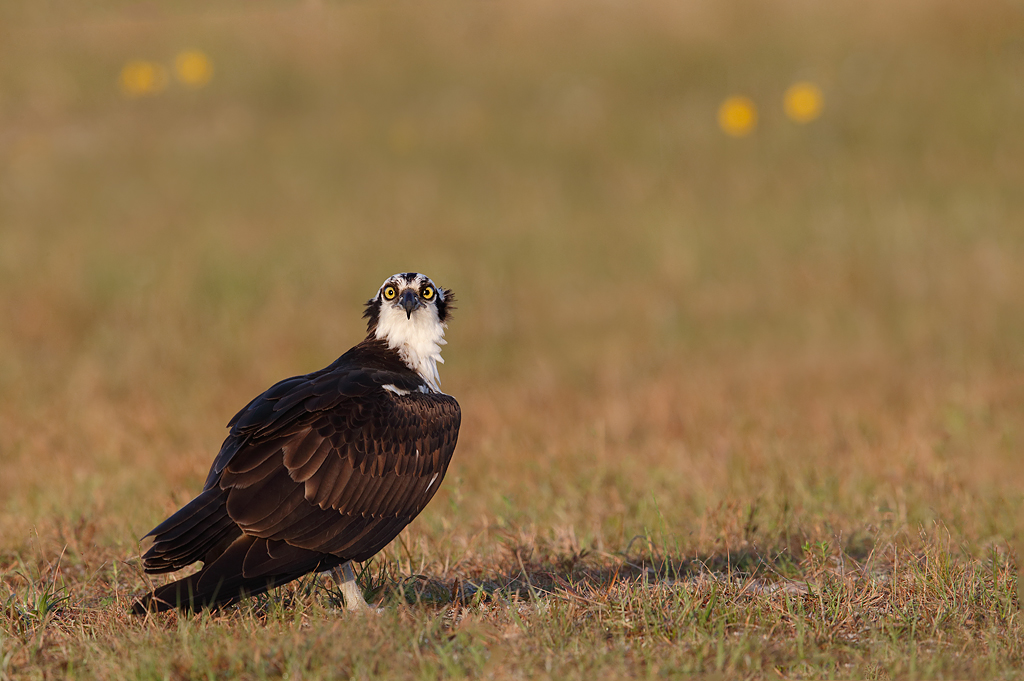
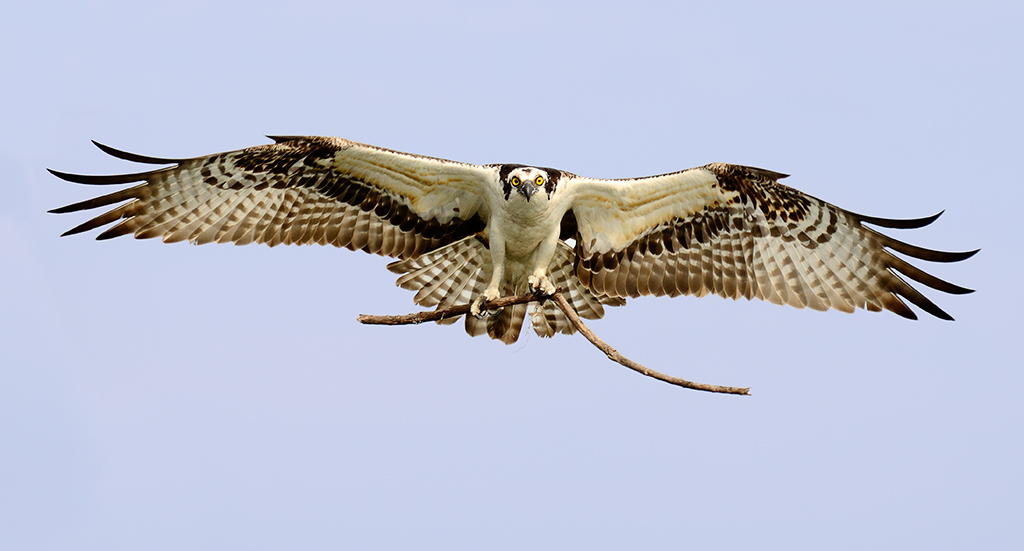
This Osprey image was created at Indian Lake Estates, FL with the Canon EF 600mm f/4L IS II USM lens, the Canon 2x EF Extender III (Teleconverter), and the Canon EOS-1D X Digital SLR camera. ISO 800. Evaluative metering at zero as framed: 1/500 sec. at f/11 in Manual Mode; exposure confirmed via histogram check.

Central sensor (by necessity) Expand/AI Servo/Rear Focus AF on the face and re-compose. Click here if you missed the Rear Focus Tutorial. Click on the image to see a larger version. Canon users cannot beat the 600II/2XIII TC combo for reach (with phase detection AF).

As it almost always is when I am working from the car the lens was supported on the lowered window of my Sequoia on a BLUBB, the Big Lens Ultimate BeanBag that I designed myself. It is available only from BAA. See the BLUBB and learn more here. Beware of cheap knock-offs; all are seriously lacking in size, heft, and quality materials. None have the non-skid material on the inside of the ears and none have the noise-less fabric top.

Dealing With a North/Northwest in Early Morning

A north/northwest wind on a clear morning makes bird photography quite difficult unless you like photographing birds’ rear ends. In the situation here, I simply could not get close enough to attempt an over the shoulder portrait. How did I solve the problem?

1-Knowing that a front had come through that night I made it a point to get out into the field early. Why? In soft early morning light working well off light angle does not create the problems that it does later on in harsher light. Note the bird’s shadow: with the light well from the left that I am working about 85 degrees off light angle. Not also that the bird’s body is indeed facing into the wind. Imagine the view that I would have had if I worked right on light angle with my shadow pointing right at the bird. It would not have been very pleasant….

2-Note that with the Osprey’s body angled about 15 degrees away from the plane of the imaging sensor and the light from the hard left that I made the image when the bird was staring at me with his head turned back toward the light.

The next time that you are confronted by a north/northwest wind in the morning remember to get out early so that you can give up light angle and make sure to press the shutter button when the bird turns its head back into the light.

If You Like This Image…

If you like this image as I do, please leave a comment and let us know what you think are its strengths. I will chime in in a future blog post.

All images courtesy of and copyright 2012: Denise Ippolito. Click for a larger version.

A Creative Adventure/BIRDS AS ART Swan Island Dahlia Farm Instructional Photo-Tour, September 11-15, 2013: 5 FULL DAYS: $1649

Join Denise Ippolito and Arthur Morris at the Swan Island Dahlia Farm in Canby, Oregon (just south of Portland) for a great learning and photography experience. Swan Island features more than 40 acres with over 350 varieties of dahlias in a plethora of colors, shapes and sizes, making it one of the largest growers in the United States.

Daily Photo Schedule

We will enjoy four morning (7:00am till 10:30am) and five afternoon (3:30pm till 6pm) photography sessions. While we will do most of our photography at the Swan Island Dahlia Farm, we will also visit the Portland Rose Garden and/or the Portland Japanese Garden on this IPT. The in-the-field instruction will include seeing the situation, the use of selective focus, creative use of depth of field, histogram and exposure guidance, designing creative images, choosing your background, isolating your subject, lens options, and the use of reflectors and diffusers. Our field sessions will include challenging photography assignments geared to make you think creatively. Both personalized and small group instruction will be provided. All times are tentative and subject to change based on the weather and on local conditions.

Seminar Morning: Friday, September 13: 8:30am till 12:30pm

Denise will begin by presenting her “Bloomin’ Ideas” program, an overview of the in-the-field and post-processing techniques that she has used and developed over the past few years to create her signature look. Artie will follow with a Photoshop session that will be geared towards all levels. He’ll be sharing some of his favorite techniques and tips while working on images from the first two days of the IPT. Denise will conclude the seminar portion of the IPT with a Photoshop demo; she will share her creative workflow using a variety of Photoshop filters and effects. The entire morning is designed to give you a peek into the minds of two very skilled and creative folks.

The group will have lunch together daily. All are invited to bring their laptops for image sharing. We hope that you can join us for an intense five days of learning and some of the best flower photography to be had in North America.

Deposit Info and Cancellation Policies:

A $449 non-refundable deposit is required to hold your slot for this IPT. Your balance is due 4 months before the date of the IPT and is also non-refundable. If the trip fills, we will be glad to apply a credit applicable to a future IPT for the full amount less a $100 processing fee. If we do not receive your check for the balance on or before the due date we will try to fill your spot from the waiting list. If your spot is filled, you will lose your deposit. If not, you can secure your spot by paying your balance.

Please print, complete, and sign the form that is linked to here and shoot it to us along with your deposit check (made out to “Arthur Morris.”) You can also leave your deposit with a credit card by calling the office at 863-692-0906. We will be short-handed in the office until January 21 so please leave a message and we will call you back. If you register by phone, please print, complete and sign the form as noted above and either mail it to us or e-mail the scan.

If you have any questions, please feel free to contact me via e-mail

Like Flower Photography?

If you like photographing flowers, be sure to see the “Creative Flower Photography: blog post here.

Typos

On all blog posts, feel free to e-mail or leave a comment regarding any typos, wrong words, misspellings, omissions, or grammatical errors. Just be right. 🙂

Support the BAA Blog. Support the BAA Bulletins: Shop B&H here!

We want and need to keep providing you with the latest free information, photography and Photoshop lessons, and all manner of related information. Show your appreciation by making your purchases immediately after clicking on any of our B&H or Amazon Affiliate links in this blog post. Remember, B&H ain’t just photography!

If you are considering an item for purchase or comparison shopping be sure to place an item in your cart to see the too-low-to show the actual price. In many cases the prices are so low that B&H is forbidden from publicizing them!


B&H Search Engine Banner


B&H Photo - Video - Pro Audio


Support the BAA Blog. Support the BAA Bulletins: Shop Amazon here!

Consider doing all of your Amazon.com shopping using the search link below. You'll be getting the same low prices and great service that you are accustomed to and at the same time, supporting my efforts in the Bulletins and on the Blog to bring you great images, timely product news and info, and tons of free educational articles on an almost daily (and sometimes almost back-breaking) basis :) Just type your search in the little white box and hit Go.

And from the BAA On-line Store:

LensCoats. I have a LensCoat on each of my big lenses to protect them from nicks and thus increase their re-sales value. All my big lens LensCoat stuff is in Hardwood Snow pattern.
LegCoat Tripod Leg Covers. I have four tripods active and each has a Hardwood Snow LegCoat on it to help prevent further damage to my tender shoulders :) And you will love them in mega-cold weather....
Gitzo GT3532 LS CF Tripod. This one replaces the GT3530LS Tripod and will last you a lifetime. Learn more about this great tripod here.
Mongoose M3.6 Tripod Head. Right now this is the best tripod head around for use with lenses that weigh less than 9 pounds. For heavier lenses, check out the Wimberley V2 head.
Double Bubble Level. You will find one in my camera's hot shoe whenever I am not using flash.
The Lens Align Mark II. I use the Lens Align Mark II pretty much religiously to micro-adjust all of my gear an average of once a month and always before a major trip. Enjoy our free comprehensive tutorial here.
BreezeBrowser. I do not see how any digital photographer can exist without this program.
Delkin Flash Cards. I use and depend on Delkin compact Flash Cards and card readers most every day. Learn more about their great 700X and 1000X cards here or about my favorite Delkin card here.
April 11th, 2013

Five Really Good Images; None Of Them Mine...

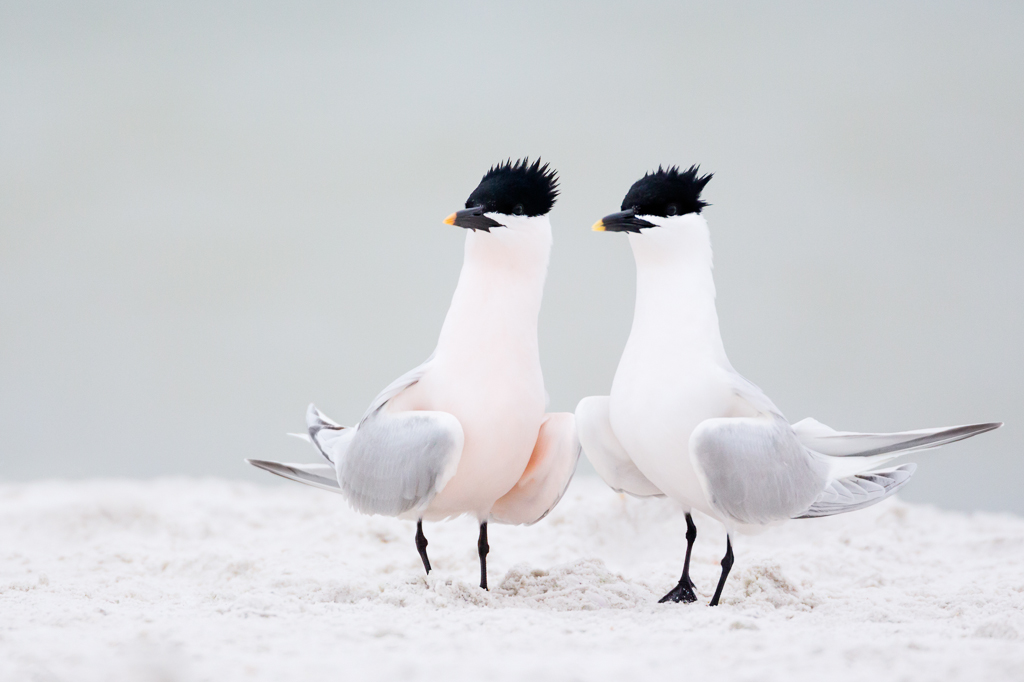
This image of a pair of Sandwich Terns was created at Fort Desoto on the recently concluded Fort Desoto/Hooptie Deux Short Notice IPT II with the tripod mounted Canon 500mm f/4L EF IS II lens, the Canon 1.4x EF tele-extender III, and the Canon EOS 5D Mark III. ISO 1600: 1/1000 sec. at f/5.6.

This image courtesy of and copyright 2013: Ken Canning.

Ten Really Good Images; None Of Them Mine…

The First Five: Ken Canning

Ken was the only one who joined the Fort Desoto/Hooptie Deux Short Notice IPT for all five days. We rode together, yakked a lot, and had an overall great time. Ken had been on several previous IPTs. After the IPT, he wrote, Thank you, Artie, for a great IPT. I learned a lot and made some super images. Though I have been doing wildlife photography for a while now I still come out of your IPTs a better photographer than when I went in. Best, Ken

After each IPT I send a thank you e-mail and invite folks to send me five of their favorite images for critiquing. In a future blog post I will share my critiques. In the meantime, you get to enjoy some fine photography. The first five images here are Ken’s. He is obviously a very good photographer.

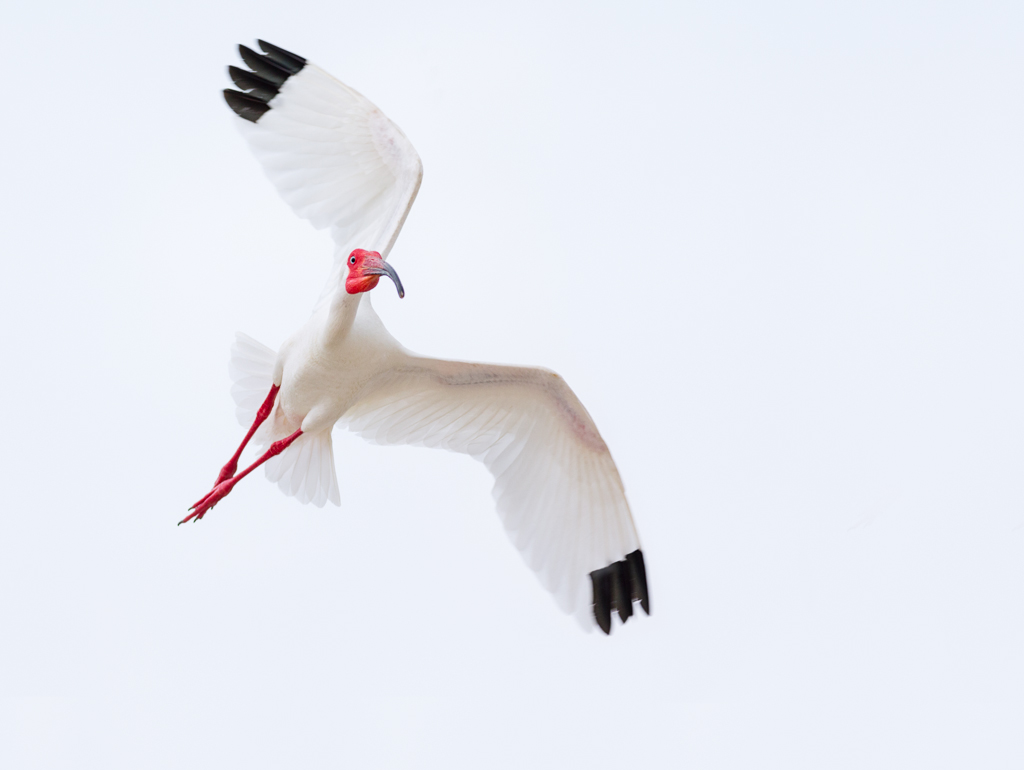
This image of a White Ibis was created at the Dit Dot Dash rookery on the Braden River aboard the Hooptie Deux with the hand held Canon EF 400mm f/5.6L lens and the Canon EOS 5D Mark III. ISO 1600: 1/1250 sec. at f/5.6.

This image courtesy of and copyright 2013: Ken Canning.

My Old Toy Lens: The Canon 400mm f/5.6L

It was well more than a decade ago that I put the Canon EF 400mm f/5.6L lens on the map as the bird photography flight lens. Though I no longer own one, it is still a great flight lens especially for those with a steady hand who do not need IS. And it makes a great starter lens for beginning bird photographers. For folks who know that thy will be hand holding I would recommend the 300 f/4L IS along with the 1.4X TC. I had thought that both were still in production but a search does not turn up the 300mm f/4L IS so good luck finding a used on if that one is right for you. IAC, it was good to see Ken using the old toy lens.

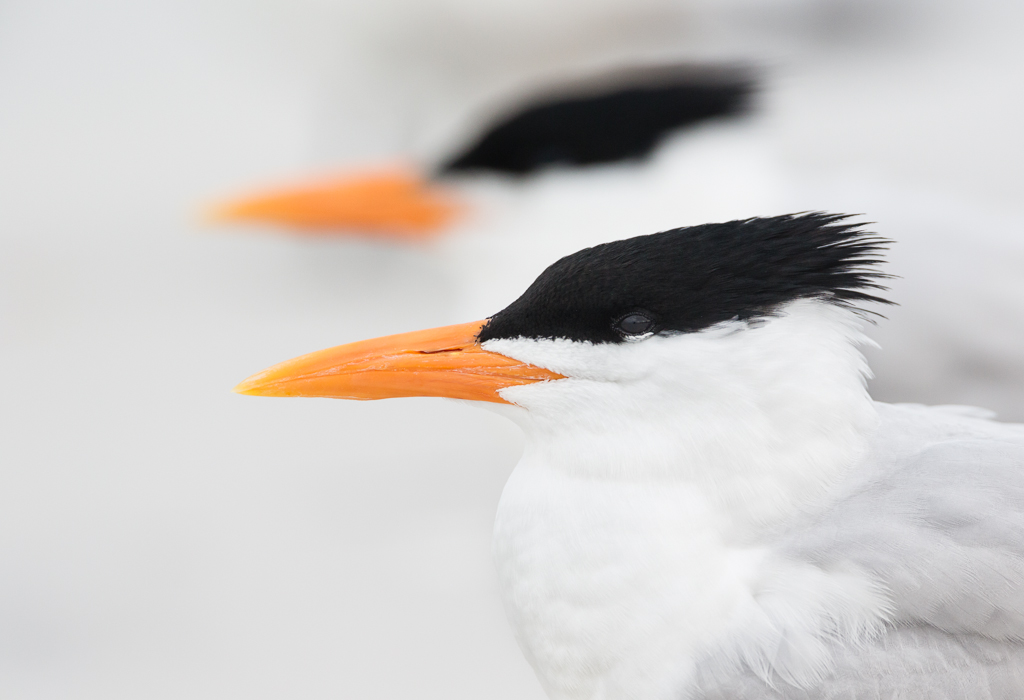
This image of two Royal Terns was created at Fort Desoto on the recently concluded Fort Desoto/Hooptie Deux Short Notice IPT II with the tripod mounted Canon 500mm f/4L EF IS II lens, the Canon 1.4x EF tele-extender III, and the Canon EOS 5D Mark III. ISO 1600: 1/1250 sec. at f/8.

This image courtesy of and copyright 2013: Ken Canning.

Juxtaposition Images

As we have been teaching here and elsewhere for years, juxtaposition images can be quite successful. Early on I refused to have a second subject in my backgrounds but I realized that if the are carefully placed, the results can be magic.

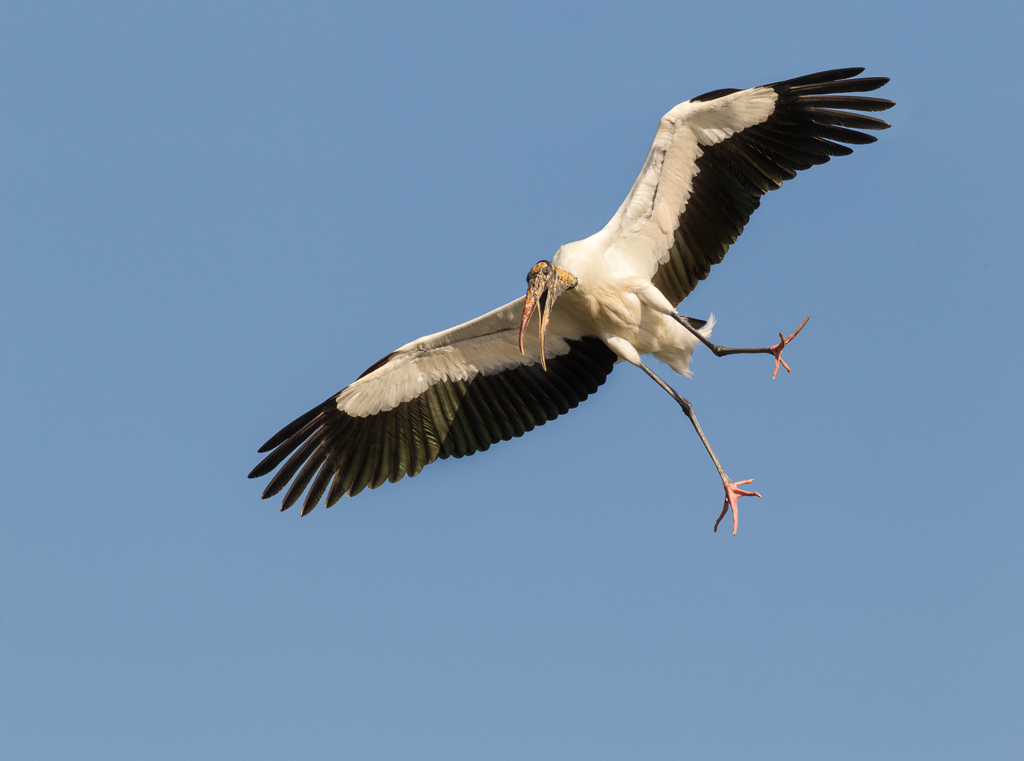
This image of a Wood Stork in flight was created at the Dit Dot Dash rookery on the Braden River aboard the Hooptie Deux with the hand held Canon EF 400mm f/5.6L lens and the EOS-1D Mark IV (now replaced by the Canon EOS-1D X). ISO 400: 1/2000 sec. at f/9.

This image courtesy of and copyright 2013: Ken Canning.

IPT Exposure Education

With great flight photography I am constantly yakking exposure into everyone’s ears. Most get it eventually :). At Dit Dot Dash we were constantly reviewing the manual exposure settings for the Great Egrets, for the Wood Storks, for the Great Blue Herons, and for the Double-crested Cormorants. Each required a different exposure.

This image of a Roseate Spoonbill getting ready to land in the mangroves was created at Alafia Banks on a Hooptie Deux trip with the hand held Canon EF 400mm f/5.6L lens and the EOS-1D Mark IV (now replaced by the Canon EOS-1D X). ISO 800: 1/1000 sec. at f/6.3.

This image courtesy of and copyright 2013: Ken Canning.

Want Spoonbills?

Alafia Banks is the place to photograph Roseate Spoonbills. And the best way to get there is by arranging a trip on the Hooptie Deux with James Shadle. If you would like to get out with James to enjoy some of the great actiongoing on right now, call or e-mail him to inquire about dates and rates. You can get in touch with James for additional info or to schedule a Custom Workshop or Tour via e-mail, by cell phone at (813) 363-2854 or on his home phone (early evenings best) at (813-689-5307). If by cell phone it is best to call back rather than to leave a message. If you plan on joining James make sure to read “Hooptie Deux Practicalities” by scrolling down here. If you have trouble getting in touch with James please shoot me an e-mail as I should have reliable e-mail in Holland.

Image Critquing

Feel free to critique one or all of the images above. Let us know which is your favorite, and why. Remember, crtique does not neceessarily mean criticize. It is not required that all good critiques contain negatives or suggestions; sometimes the best critique says simply, “That is a great image and I like it because….” If you are really into it, you can rank the images from 1-5 with 1 being your favorite.

Thanks!

Thanks to Ken Canning for allowing me to share his work with you here.

Jam Session I: Photoshop Video Tutorial

Jam Session I: Photoshop Video Tutorial: $9

On the first Fort Desoto/Hooptie Deux Short Notice IPT we drove from St. Pete to my home in Indian Lake Estates for a chance to photograph Sandhill Crane chicks of various sizes. We succeeded admirably. See “What No Itinerary” here for the whole story.

After our morning photo session the group gathered in my office for a Photoshop session. I worked on one image from the previous morning and on one from that morning, the latter the image above. The session was recorded with Camtasia. We are offering you a chance to join the group and look right over my shoulder as I processed the images above and below. Techniques covered include the following: the RAW conversions in DPP, using Detail Extractor from NIK’s Color Efex Pro to bring up the detail in the ibis’s white feathers, creating and using Layer masks, and using the Quick Selection Tool, the Spot Healing Brush, the Patch Tool, and Content Aware Fill for image clean-up. Selective sharpening with a Contrast Mask, Background clean-up with a soft Clone Stamp Tool, cloning on a Layer, using Quick Masks, using Select/Color Range to make selections (including the little used Range slider), and lots more.

To order yours through the BAA store, click here. Or call Jim or Jen weekdays between 9am and 5pm (3pm on Fridays) at 863-692-0906 with your credit card in hand. Please leave a message in the rare event that we miss your call and we will get back to you. Easiest is to send us a Paypal for $9.00 to birdsasart@verizon.net with the words “Jam Session I” cut and pasted into the subject line. Sorry, no checks are accepted for the MP4 videos.

Learn more about our MP4 Photoshop Tutorial Videos here. See the whole collection here.

Images courtesy of and copyright 2012: Bill Mueller. Card design by Denise Ippolito.

Old Car City Creative Photography In-the-Field HDR Workshop: Sunday, October 13, 2013/ 9am till 1pm.

White, Georgia: $250 plus a $15 entrance fee donation (cash only on the day of the event) that will go to charity. Limit: 16 photographers.

On October 13, 2013, Arthur Morris/BIRDS AS ART and Denise Ippolito/A Creative Adventure will be conducting an In-the-Field HDR Workshop at Old Car City in White, Georgia. Old Car City is about an hour north of Atlanta, GA and an hour south of Chattanooga, TN where they will, as noted above, be doing a full day seminar for the Photographic Society of Chattanooga on Saturday, October 12th. Click here for complete details.

Tigers

Good luck to Todd Gustafson who is leading a tiger photo trek in India right now. And good luck to Tiger Woods in the Masters.

Typos

On all blog posts, feel free to e-mail or leave a comment regarding any typos, wrong words, misspellings, omissions, or grammatical errors. Just be right. 🙂

Support the BAA Blog. Support the BAA Bulletins: Shop B&H here!

We want and need to keep providing you with the latest free information, photography and Photoshop lessons, and all manner of related information. Show your appreciation by making your purchases immediately after clicking on any of our B&H or Amazon Affiliate links in this blog post. Remember, B&H ain’t just photography!

If you are considering an item for purchase or comparison shopping be sure to place an item in your cart to see the too-low-to show the actual price. In many cases the prices are so low that B&H is forbidden from publicizing them!

If you are considering an item for purchase or comparison shopping be sure to place an item in your cart to see the too-low-to show the actual price. In many cases the prices are so low that B&H is forbidden from publicizing them!


B&H Search Engine Banner


B&H Photo - Video - Pro Audio


And from the BAA On-line Store:

LensCoats. I have a LensCoat on each of my big lenses to protect them from nicks and thus increase their re-sales value. All my big lens LensCoat stuff is in Hardwood Snow pattern.
LegCoat Tripod Leg Covers. I have four tripods active and each has a Hardwood Snow LegCoat on it to help prevent further damage to my tender shoulders :) And you will love them in mega-cold weather....
Gitzo GT3532 LS CF Tripod. This one replaces the GT3530LS Tripod and will last you a lifetime. Learn more about this great tripod here.
Mongoose M3.6 Tripod Head. Right now this is the best tripod head around for use with lenses that weigh less than 9 pounds. For heavier lenses, check out the Wimberley V2 head.
Double Bubble Level. You will find one in my camera's hot shoe whenever I am not using flash.
The Lens Align Mark II. I use the Lens Align Mark II pretty much religiously to micro-adjust all of my gear an average of once a month and always before a major trip. Enjoy our free comprehensive tutorial here.
BreezeBrowser. I do not see how any digital photographer can exist without this program.
Delkin Flash Cards. I use and depend on Delkin compact Flash Cards and card readers most every day. Learn more about their great 700X and 1000X cards here or about my favorite Delkin card here.
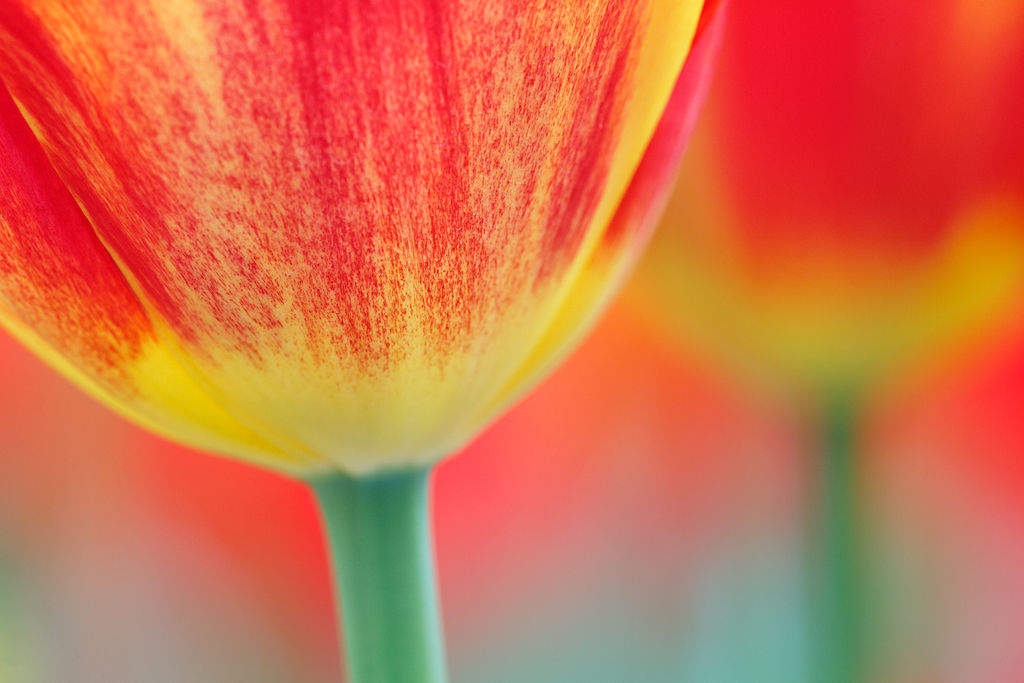
April 9th, 2013

1200mm Flight Photography in the Dark: Tips

This Roseate Spoonbill flight image was created at Alafia Banks on the Fort Desoto/Hooptie Deux IPT on the rain-soaked Thursday morning Hooptie trip with the tripod-mounted Canon EF 600mm f/4L IS II USM lens, the Canon 2x EF Extender III (Teleconverter), and the Canon EOS-1D X Digital SLR camera. ISO 1600. Evaluative metering -1 2/3 stops as framed: 1/640 sec. at f/8 in Manual Mode; exposure confirmed on resting spoonbills via histogram check.

Central sensor (by necessity) Expand/AI Servo/Rear Focus AF on the bird’s neck active at the moment of exposure. Click here if you missed the Rear Focus Tutorial. Click on the image to see a larger version.

If you want spoonbills you need to get yourself on the Hooptie Deux. Canon users cannot beat the 600II/2XIII TC combo for reach (with phase detection AF).

1200mm Flight Photography in the Dark: Tips

Wide Open

Click here and scroll down to item 3 if you missed the details of the very rainy IPT morning.

We had some spoonbills in the lee of some mangroves when more began to fly in. It was pretty darned dark. I went with 1/640 sec. at f/8, ISO 1600 rather than 1/1250 sec. at f/8 at ISO 3200. Note that working wide open was the way to go as with the birds at a distance depth-of-field was not an issue.

Same place, same time. This Cattle Egret carrying nesting material was photographed with the tripod-mounted Canon EF 600mm f/4L IS II USM lens, the Canon 2x EF Extender III (Teleconverter), and the Canon EOS-1D X Digital SLR camera. ISO 1600: 1/1000 sec. at f/8 in Manual Mode; exposure confirmed on resting White Ibises via histogram check.

Central sensor (by necessity) Expand/AI Servo/Rear Focus AF on the bird’s neck active at the moment of exposure. Click here if you missed the Rear Focus Tutorial. Click on the image to see a larger version.

Pre-focus Manually

It is imperative when shooting flight with an f/4 super-telephoto and a 2X TC that you pre-focus manually by turning the focus ring before engaging AF. For me, that means to pre-focus before hitting the back button.

This incoming Roseate Spoonbill image was also created at Alafia Banks on the Fort Desoto/Hooptie Deux IPT on the rain-soaked Thursday morning Hooptie trip with the tripod-mounted Canon EF 600mm f/4L IS II USM lens, the Canon 2x EF Extender III (Teleconverter), and the Canon EOS-1D X Digital SLR camera. ISO 1600: 1/800 sec. at f/8 in Manual Mode; exposure previously confirmed on resting spoonbills via histogram check.

Central sensor (by necessity) Expand/AI Servo/Rear Focus AF on the bird’s neck active at the moment of exposure. Click here if you missed the Rear Focus Tutorial. Click on the image to see a larger version.

If you want spoonbills you need to get yourself on the Hooptie Deux. Canon users cannot beat the 600II/2XIII TC combo for reach (with phase detection AF).

Lens Drive When AF Impossible

You will find Lens Drive When AF Impossible on the fourth Purple menu, AF 4. The big problem is that folks simply have no clue how to set this for normal shooting and how to set it for flight photography. And to make matters worse, the Info tutorials on the camera are quite confusing at best. Setting Lens Drive When AF Impossible correctly when using the 2X II TC for flight photography is of paramount importance. To learn when and why to set this to Continue Focus Search ON and when and why to set it to Stop Focus Search: OFF, see page 27 of the EOS-1D X AF Guide and/or pages 32 and 33 of the EOS-5D Mark III User’s Guide.

Surface Blur

Each of the images above was converted in DPP with Chrominance Noise Reduction set to 16. Image/Blur/Surface blur as taught to me by Denise Ippolito and as detailed in Digital Basics, did a great job of smoothing the dark, ISO 1600 backgrounds.

Digital Basics includes my complete digital workflow, dozens of great Photoshop tips and techniques, all of my time-saving Keyboard Shortcuts, Quick Masking, Layer Masking, and NIK basics, and free updates. Learn how and why I am converting all of my images in Canon DPP (Digital Photo Professional) in our DPP RAW Conversion Guide here.

Which is Your Favorite Image?

Take a moment to leave a comment and let us know which is your favorite image. And why. Which is your least favorite? Why?

Typos

On all blog posts, feel free to e-mail or leave a comment regarding any typos, wrong words, misspellings, omissions, or grammatical errors. Just be right. 🙂

Support the BAA Blog. Support the BAA Bulletins: Shop B&H here!

We want and need to keep providing you with the latest free information, photography and Photoshop lessons, and all manner of related information. Show your appreciation by making your purchases immediately after clicking on any of our B&H or Amazon Affiliate links in this blog post. Remember, B&H ain’t just photography!

If you are considering an item for purchase or comparison shopping be sure to place an item in your cart to see the too-low-to show the actual price. In many cases the prices are so low that B&H is forbidden from publicizing them!


B&H Search Engine Banner


B&H Photo - Video - Pro Audio


Support the BAA Blog. Support the BAA Bulletins: Shop Amazon here!

Consider doing all of your Amazon.com shopping using the search link below. You'll be getting the same low prices and great service that you are accustomed to and at the same time, supporting my efforts in the Bulletins and on the Blog to bring you great images, timely product news and info, and tons of free educational articles on an almost daily (and sometimes almost back-breaking) basis :) Just type your search in the little white box and hit Go.

And from the BAA On-line Store:

LensCoats. I have a LensCoat on each of my big lenses to protect them from nicks and thus increase their re-sales value. All my big lens LensCoat stuff is in Hardwood Snow pattern.
LegCoat Tripod Leg Covers. I have four tripods active and each has a Hardwood Snow LegCoat on it to help prevent further damage to my tender shoulders :) And you will love them in mega-cold weather....
Gitzo GT3532 LS CF Tripod. This one replaces the GT3530LS Tripod and will last you a lifetime. Learn more about this great tripod here.
Mongoose M3.6 Tripod Head. Right now this is the best tripod head around for use with lenses that weigh less than 9 pounds. For heavier lenses, check out the Wimberley V2 head.
Double Bubble Level. You will find one in my camera's hot shoe whenever I am not using flash.
The Lens Align Mark II. I use the Lens Align Mark II pretty much religiously to micro-adjust all of my gear an average of once a month and always before a major trip. Enjoy our free comprehensive tutorial here.
BreezeBrowser. I do not see how any digital photographer can exist without this program.
Delkin Flash Cards. I use and depend on Delkin compact Flash Cards and card readers most every day. Learn more about their great 700X and 1000X cards here or about my favorite Delkin card here.
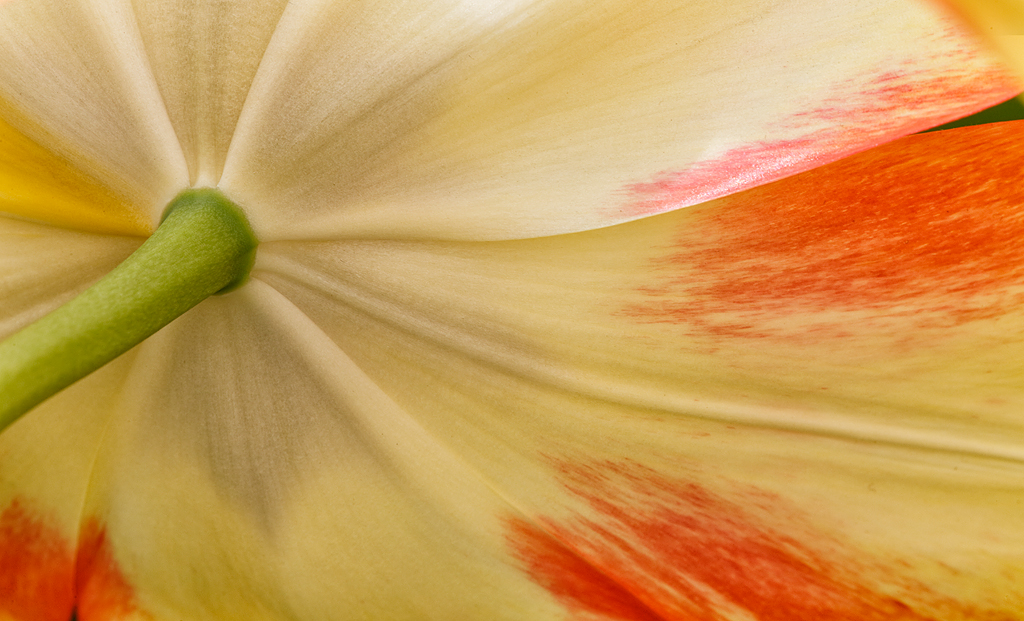
April 8th, 2013

Criminal Transformation?

This is the out of camera original image of a preening Roseate Spoonbill. It was created on the Fort Desoto/Hooptie Deux IPT on the Saturday morning Hooptie Deux trip with the tripod-mounted Canon EF 600mm f/4L IS II USM lens, the Canon 2x EF Extender III (Teleconverter), and the Canon EOS-1D X Digital SLR camera. ISO 400. Evaluative metering -1 stop as originally framed: 1/1000 sec. at f/10 in Manual Mode.

Central sensor (by necessity) Expand/AI Servo/Rear Focus AF on the bird’s eye and re-compose. Click here if you missed the Rear Focus Tutorial. Click on the image to see a larger version.

If you want spoonbills you need to get yourself on the Hooptie Deux. Canon users cannot beat the 600II/2XIII TC combo for reach (with phase detection AF).

The Original Capture

I made this image knowing full well that it would need extensive clean-up. For starters, I would need to lose the White Ibis and the bright out-of-focus yellow leaf between the two birds. That leaf was a real problem with virtually all of the images that I created with this wonderfully cooperative bird. In addition, I should have placed the bird farther back in the frame…. But the exposure was perfect, the image was sharp, and the pose was delectable.

This is the optimized image that was created from the original above.

If you want spoonbills you need to get yourself on the Hooptie Deux. Canon users cannot beat the 600II/2XIII TC combo for reach (with phase detection AF).

The Optimized Image

To create the optimized TIFF immediately above I converted the image in DPP adding just a bit of Contrast +1). In Photoshop I leveled the image using the Ruler Tool and the Straighten command. Then I used an 80% Opacity Clone Stamp Tool to eliminate the White Ibis and the yellow leaf. Additional background clean-up was done with the Patch Tool, the Spot Healing Brush, and the Clone Stamp Tool. I blackened the BLACKS with a Selective Color Adjustment on a Layer and applied a round of Linear Contrast. Next I used the Quick Selection Tool to work on the face and bill. I lightened it, ran some NIK Color Efex Pro Tonal Contrast and Detail Extractor, and applied a Contrast Mask (Unsharp Mask at 15/65/0). Then I moved the bird to our left using the techniques detailed in APTATS II. Lastly I used a small, reduced opacity Clone Stamp Tool to eliminate the pink reflections that touched the bottom frame edge. Did I miss anything?

Most of the rest above is described in detail in Digital Basics which includes my complete digital workflow, dozens of great Photoshop tips and techniques, all of my time-saving Keyboard Shortcuts, Quick Masking, Layer Masking, and NIK basics, and free updates. Learn how and why I am converting all of my images in Canon DPP (Digital Photo Professional) in our DPP RAW Conversion Guide here.

Laslty, you can learn everything that I know about the great AF system of the 1D X in our 1D X AF Guide here.

Criminal Transformation?

Take a moment to let us know your thoughts on the extensive image clean-up that we did here. Do remember that when I enter a contest I follow the rules.

Jam Session I: Photoshop Video Tutorial

Jam Session I: Photoshop Video Tutorial: $9

On the first Fort Desoto/Hooptie Deux Short Notice IPT we drove from St. Pete to my home in Indian Lake Estates for a chance to photograph Sandhill Crane chicks of various sizes. We succeeded admirably. See “What No Itinerary” here for the whole story.

After our morning photo session the group gathered in my office for a Photoshop session. I worked on one image from the previous morning and on one from that morning, the latter the image above. The session was recorded with Camtasia. We are offering you a chance to join the group and look right over my shoulder as I processed the images above and below. Techniques covered include the following: the RAW conversions in DPP, using Detail Extractor from NIK’s Color Efex Pro to bring up the detail in the ibis’s white feathers, creating and using Layer masks, and using the Quick Selection Tool, the Spot Healing Brush, the Patch Tool, and Content Aware Fill for image clean-up. Selective sharpening with a Contrast Mask, Background clean-up with a soft Clone Stamp Tool, cloning on a Layer, using Quick Masks, using Select/Color Range to make selections (including the little used Range slider), and lots more.

To order yours through the BAA store, click here. Or call Jim or Jen weekdays between 9am and 5pm (3pm on Fridays) at 863-692-0906 with your credit card in hand. Please leave a message in the rare event that we miss your call and we will get back to you. Easiest is to send us a Paypal for $9.00 to birdsasart@verizon.net with the words “Jam Session I” cut and pasted into the subject line. Sorry, no checks are accepted for the MP4 videos.

Learn more about our MP4 Photoshop Tutorial Videos here. See the whole collection here.

All images courtesy of and copyright 2012: Denise Ippolito. Click for a larger version.

A Creative Adventure/BIRDS AS ART Swan Island Dahlia Farm Instructional Photo-Tour, September 11-15, 2013: 5 FULL DAYS: $1649

Join Denise Ippolito and Arthur Morris at the Swan Island Dahlia Farm in Canby, Oregon (just south of Portland) for a great learning and photography experience. Swan Island features more than 40 acres with over 350 varieties of dahlias in a plethora of colors, shapes and sizes, making it one of the largest growers in the United States.

Daily Photo Schedule

We will enjoy four morning (7:00am till 10:30am) and five afternoon (3:30pm till 6pm) photography sessions. While we will do most of our photography at the Swan Island Dahlia Farm, we will also visit the Portland Rose Garden and/or the Portland Japanese Garden on this IPT. The in-the-field instruction will include seeing the situation, the use of selective focus, creative use of depth of field, histogram and exposure guidance, designing creative images, choosing your background, isolating your subject, lens options, and the use of reflectors and diffusers. Our field sessions will include challenging photography assignments geared to make you think creatively. Both personalized and small group instruction will be provided. All times are tentative and subject to change based on the weather and on local conditions.

Seminar Morning: Friday, September 13: 8:30am till 12:30pm

Denise will begin by presenting her “Bloomin’ Ideas” program, an overview of the in-the-field and post-processing techniques that she has used and developed over the past few years to create her signature look. Artie will follow with a Photoshop session that will be geared towards all levels. He’ll be sharing some of his favorite techniques and tips while working on images from the first two days of the IPT. Denise will conclude the seminar portion of the IPT with a Photoshop demo; she will share her creative workflow using a variety of Photoshop filters and effects. The entire morning is designed to give you a peek into the minds of two very skilled and creative folks.

The group will have lunch together daily. All are invited to bring their laptops for image sharing. We hope that you can join us for an intense five days of learning and some of the best flower photography to be had in North America.

Deposit Info and Cancellation Policies:

A $449 non-refundable deposit is required to hold your slot for this IPT. Your balance is due 4 months before the date of the IPT and is also non-refundable. If the trip fills, we will be glad to apply a credit applicable to a future IPT for the full amount less a $100 processing fee. If we do not receive your check for the balance on or before the due date we will try to fill your spot from the waiting list. If your spot is filled, you will lose your deposit. If not, you can secure your spot by paying your balance.

Please print, complete, and sign the form that is linked to here and shoot it to us along with your deposit check (made out to “Arthur Morris.”) You can also leave your deposit with a credit card by calling the office at 863-692-0906. We will be short-handed in the office until January 21 so please leave a message and we will call you back. If you register by phone, please print, complete and sign the form as noted above and either mail it to us or e-mail the scan.

If you have any questions, please feel free to contact me via e-mail

Tanzania Photo Safari with Todd Gustafson and Arthur Morris

Africa/Tanzania/Serengeti Summer Migration Safari: 12 full and two half-days of photography: $12,999/person double occupancy. Limit: 12/Openings: 1.

Leaders: Todd Gustafson (he does use Nikon gear) and Arthur Morris. Leave the US AUG 3, 2013. Fly home from Arusha, Tanzania on the evening of August 18. Day 1 of the safari is August 5. Our last morning of photography is August 18. We will be visiting Tarangire National Park, Seronera Lodge–aka Leopard City!–twice, an exclusive mobile tented camp in the Serengeti, and at the end, the spectacular wildlife spectacle that is Ngorongoro Crater. Please e-mail for itinerary.

Please click here for complete IPT info.

Announcing the 2013 Bosque IPT/New Dates

BOSQUE del APACHE 2013 IPT: “The Complete Bosque Experience.” NOV 26-DEC 2, 2013. 7-FULL DAYS: $3399. Co-leader: Denise Ippolito. Introductory Slide program: 6:30 pm on 11/25. Limit: 12.

Tens of thousand of Snow Geese, 10,000 Sandhill Cranes, ducks including point-blank American Wigeon and Wood Duck, amazing sunrises, sunsets, and blast-offs. Live, eat, and breathe photography with one of (if not the) world’s premier photographic educators at one of his very favorite locations on the planet. Top-notch Photoshop instruction. This will make 19 consecutive Novembers at Bosque for me. Nobody knows the place better than I do. Join us to learn to think like a pro, to recognize situations and to anticipate them based on the weather, especially the sky conditions, the light, and the wind direction. Every time we make a move we will let you know why. When you head home applying what you learned will prove to be invaluable. Includes all lunches and the Thanksgiving Buffet at the Crowne Plaza in Albuquerque. I hope that you can join me for what will be an unparalleled learning experience.

A $500 non-refundable deposit is required to hold your slot for this IPT. Your balance is due 4 months before the date of the IPT and is also non-refundable. If the trip fills, we will be glad to apply a credit applicable to a future IPT for the full amount less a $100 processing fee. If we do not receive your check for the balance on or before the due date we will try to fill your spot from the waiting list. If your spot is filled, you will lose your deposit. If not, you can secure your spot by paying your balance.

Please print, complete, and sign the form that is linked to here and shoot it to us along with your deposit check (made out to “Arthur Morris.”) You can also leave your deposit with a credit card by calling the office at 863-692-0906. If you register by phone, please print, complete and sign the form as noted above and either mail it to us or e-mail the scan. If you have any questions, please feel free to contact me via e-mail

EOS-1D X AF Guide

You can learn exactly how I set up and use this camera’s great new AF system in our EOS-1D X AF Guide. And you can learn about our other camera User’s Guides here.

BIRDS AS ART Bulletin #437

>BIRDS AS ART Bulletin #437 is online and can be accessed here.

  • Jam Session: A Brand New MP4 Photoshop Tutorial Video
  • Criminal Transformation?
  • The Fort Desoto/Hooptie Deux–Roseate Spoonbill IPT Report
  • Announcing the 2013 Bosque IPT/New Dates
  • Affiliate Links
  • Alan Murphy’s “Guide to Songbird Set-up Photography”
  • Alan Murphy’s “The Photographer’s Guide to Attracting Birds”
  • Used Camera Gear
  • IPT Info

Typos

On all blog posts, feel free to e-mail or leave a comment regarding any typos, wrong words, misspellings, omissions, or grammatical errors. Just be right. 🙂

Support the BAA Blog. Support the BAA Bulletins: Shop B&H here!

We want and need to keep providing you with the latest free information, photography and Photoshop lessons, and all manner of related information. Show your appreciation by making your purchases immediately after clicking on any of our B&H or Amazon Affiliate links in this blog post. Remember, B&H ain’t just photography!

If you are considering an item for purchase or comparison shopping be sure to place an item in your cart to see the too-low-to show the actual price. In many cases the prices are so low that B&H is forbidden from publicizing them!

B&H Search Engine Banner


B&H Photo - Video - Pro Audio


Support the BAA Blog. Support the BAA Bulletins: Shop Amazon here!

Consider doing all of your Amazon.com shopping using the search link below. You'll be getting the same low prices and great service that you are accustomed to and at the same time, supporting my efforts in the Bulletins and on the Blog to bring you great images, timely product news and info, and tons of free educational articles on an almost daily (and sometimes almost back-breaking) basis :) Just type your search in the little white box and hit Go.

And from the BAA On-line Store:

LensCoats. I have a LensCoat on each of my big lenses to protect them from nicks and thus increase their re-sales value. All my big lens LensCoat stuff is in Hardwood Snow pattern.
LegCoat Tripod Leg Covers. I have four tripods active and each has a Hardwood Snow LegCoat on it to help prevent further damage to my tender shoulders :) And you will love them in mega-cold weather....
Gitzo GT3532 LS CF Tripod. This one replaces the GT3530LS Tripod and will last you a lifetime. Learn more about this great tripod here.
Mongoose M3.6 Tripod Head. Right now this is the best tripod head around for use with lenses that weigh less than 9 pounds. For heavier lenses, check out the Wimberley V2 head.
Double Bubble Level. You will find one in my camera's hot shoe whenever I am not using flash.
The Lens Align Mark II. I use the Lens Align Mark II pretty much religiously to micro-adjust all of my gear an average of once a month and always before a major trip. Enjoy our free comprehensive tutorial here.
BreezeBrowser. I do not see how any digital photographer can exist without this program.
Delkin Flash Cards. I use and depend on Delkin compact Flash Cards and card readers most every day. Learn more about their great 700X and 1000X cards here or about my favorite Delkin card here.
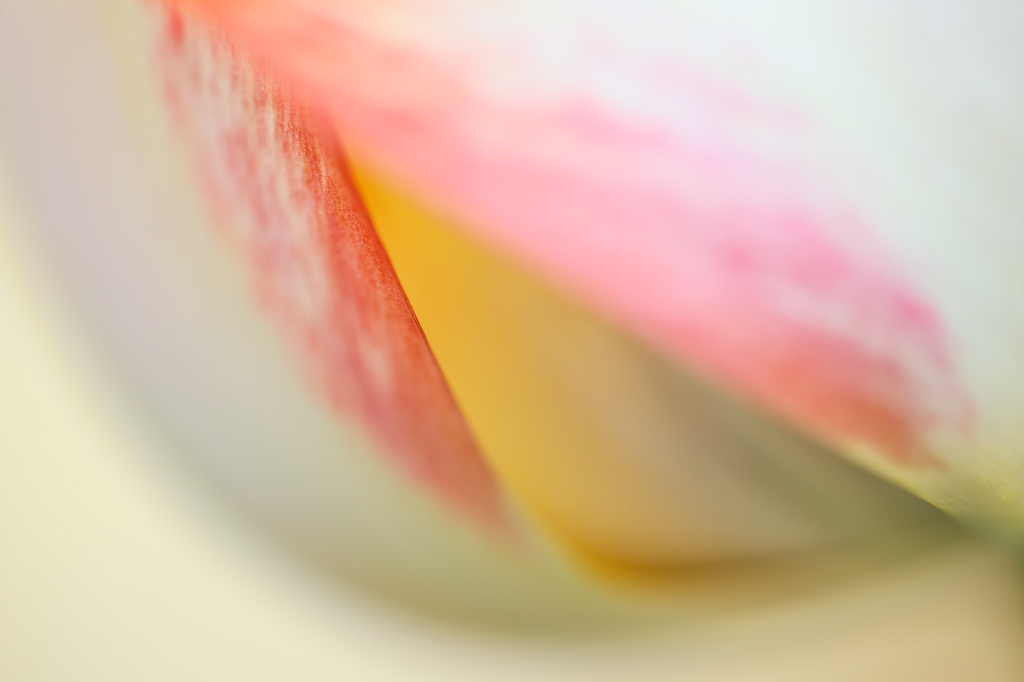
April 6th, 2013

Long, Spectacular, and Exhausting 1445 Image Day

These Marbled Godwits were photographed at Fort Desoto with the tripod-mounted Canon EF 600mm f/4L IS II USM lens, the Canon 1.4x EF tele-extender III, and the Canon EOS-1D X. ISO 800. Evaluative metering +1 2/3 stops as framed : 1/200 sec. at f/6.3 in Manual mode.

Central sensor Surround/AI Servo/Rear Focus AF on front bird’s eye and re-compose. Click here if you missed the Rear Focus Tutorial. Click on the image to see a larger version.

Long, Spectacular, and Exhausting 1445 Image Day

On Friday, April 5 the Fort Desoto/Hooptie Deux Short Notice IPT II started at Fort Desoto and ended on the Hooptie Deux at the Dit Dot Dash Rookery on the Bradenton River. I have all five mix and match participants with me all day. And what a day it was. We began with the dependable Long-billed Curlew posing in the surf. The two Marbled Godwits in the image above flew in to join him and walked towards us. I explained to the group that the bird with the longer bill with the pink base was a female in winter plumage and that the bird with the short bill with the orange base was a male beginning to come into breeding plumage, the bill color being the only indication of that. I said, “It would be nice if the two of them stood side by side for a nice comparison shot.” A minute later, they did just that.

Want to learn tons more like the stuff above about shorebirds? Get yourself a copy of my Shorebirds; Beautiful Beachcombers.

This image of a pretty sweet dark morph breeding plumage Reddish Egret was created at with the Canon EF 600mm f/4L IS II USM lens and the Canon EOS-1D X Digital SLR camera. ISO 800. Evaluative metering +2 stops as framed: 1/1600 sec. at f/4 in Manual mode.

61-Point/AI Servo/Rear Focus AF active at the moment of exposure. Click here if you missed the Rear Focus Tutorial. Click on the image to see a larger version.

Ted Thelin, who signed up at the last minute for FRI/SAT/SUN and flew down to join us, was fervently hoping to see a Reddish Egret. He got his wish granted in spades. We walked to his regular haunts but he was elsewhere. Two minutes later he flew in. He was absolutely unconcerned with us as we followed him for more than two hours. He gave us a good workout as he flew one hundred yards at a clip looking for the best fishing spot.

I dreamed that the bird would stand still for a few minutes and pose for tight head portraits.

This tight vertical portrait was created with the tripod-mounted Canon EF 600mm f/4L IS II USM lens, the Canon 2x EF Extender III (Teleconverter), and the Canon EOS-1D X Digital SLR camera. ISO 800. Evaluative metering +1 1/3 stops as framed: 1/320 sec. at f/14 in Manual Mode.

Central sensor (by necessity) Expand/AI Servo/Rear Focus AF on the bird’s left eye and re-compose. Click here if you missed the Rear Focus Tutorial. Click on the image to see a larger version.

You cannot beat the 600II/2XIII TC combo for reach (with phase detection AF).

So of course, he did. I was sitting in the water behind my lowered tripod for the image above.

This image was created at the Dit Dot Dash Rookery on the Bradenton River aboard the Hooptie Deux with the hand held Canon 500mm f/4L EF IS II lens, the Canon 1.4x EF tele-extender III, and the Canon EOS-1D X. ISO 400: 1/2500 sec. at f/5.6 in Manual mode confirmed in advance via histogram check. IS Mode 2.

Central Sensor Surround/AI Servo/Rear Focus AF active at the moment of exposure. Click here if you missed the Rear Focus Tutorial. Click on the image for a larger version.

Learn everything that I know about the great AF system of the 1D X in our 1D X AF Guide here. Learn how and why I am converting all of my images in Canon DPP (Digital Photo Professional) in our DPP RAW Conversion Guide here.

With a roaring west/northwest wind conditions were amazing as we enjoyed practically non-stop flight photography with Wood Stork, Great Egret, Snowy Egret, Double-crested Cormorant, Great Blue Heron, White Ibis, Cattle Egret, and Roseate Spoonbill.

This Roseate Spoonbill image was also created at the Dit Dot Dash Rookery on the Bradenton River aboard the Hooptie Deux with the hand held Canon 500mm f/4L EF IS II lens, the Canon 1.4x EF tele-extender III, and the Canon EOS-1D X. ISO 400: 1/2000 sec. at f/5.6 in Manual mode confirmed in advance via histogram check. IS Mode 2.

Central Sensor Surround/AI Servo/Rear Focus AF active at the moment of exposure. Click here if you missed the Rear Focus Tutorial. Click on the image for a larger version.

Learn everything that I know about the great AF system of the 1D X in our 1D X AF Guide here. Learn how and why I am converting all of my images in Canon DPP (Digital Photo Professional) in our DPP RAW Conversion Guide here.

We had an amazing chance with this gorgeous bird returning to its nest. Though I was happy with this image I mis-framed two spectacular poses as after more than two hours fatigue had set in….

Another last minute FRI/SAT/SUN sign-up, George Golumbeski, asked me why someone would own both the 600 II and the 500 II. “At times I need the 500II for hand holding for flight in situations where I simply could not hand hold the 600 II for extended periods of time.” Note: as above, hand holding the 500 II is not a walk in the park for me.

Your Favorite?

Please take a moment to let us know which of the five images above is your personal favorite, and why.

Tanzania Photo Safari with Todd Gustafson and Arthur Morris

Africa/Tanzania/Serengeti Summer Migration Safari: 12 full and two half-days of photography: $12,999/person double occupancy. Limit: 12/Openings: 3.

Leaders: Todd Gustafson (he does use Nikon gear) and Arthur Morris. Leave the US AUG 3, 2013. Fly home from Arusha, Tanzania on the evening of August 18. Day 1 of the safari is August 5. Our last morning of photography is August 18. We will be visiting Tarangire National Park, Seronera Lodge–aka Leopard City!–twice, an exclusive mobile tented camp in the Serengeti, and at the end, the spectacular wildlife spectacle that is Ngorongoro Crater. Please e-mail for itinerary.

Please click here for complete IPT info.

Announcing the 2013 Bosque IPT

BOSQUE del APACHE 2013 IPT: “The Complete Bosque Experience.” NOV 26-DEC 2, 2013. 7-FULL DAYS: $3399. Co-leader: Denise Ippolito. Introductory Slide program: 6:30 pm on 11/25. Limit: 12.

Tens of thousand of Snow Geese, 10,000 Sandhill Cranes, ducks including point-blank American Wigeon and Wood Duck, amazing sunrises, sunsets, and blast-offs. Live, eat, and breathe photography with one of (if not the) world’s premier photographic educators at one of his very favorite locations on the planet. Top-notch Photoshop instruction. This will make 19 consecutive Novembers at Bosque for me. Nobody knows the place better than I do. Join us to learn to think like a pro, to recognize situations and to anticipate them based on the weather, especially the sky conditions, the light, and the wind direction. Every time we make a move we will let you know why. When you head home applying what you learned will prove to be invaluable. Includes all lunches and the Thanksgiving Buffet at the Crowne Plaza in Albuquerque. I hope that you can join me for what will be an unparalleled learning experience.

A $500 non-refundable deposit is required to hold your slot for this IPT. Your balance is due 4 months before the date of the IPT and is also non-refundable. If the trip fills, we will be glad to apply a credit applicable to a future IPT for the full amount less a $100 processing fee. If we do not receive your check for the balance on or before the due date we will try to fill your spot from the waiting list. If your spot is filled, you will lose your deposit. If not, you can secure your spot by paying your balance.

Please print, complete, and sign the form that is linked to here and shoot it to us along with your deposit check (made out to “Arthur Morris.”) You can also leave your deposit with a credit card by calling the office at 863-692-0906. If you register by phone, please print, complete and sign the form as noted above and either mail it to us or e-mail the scan. If you have any questions, please feel free to contact me via e-mail

EOS-1D X AF Guide

You can learn exactly how I set up and use this camera’s great new AF system in our EOS-1D X AF Guide. And you can learn about our other camera User’s Guides here.

Typos

On all blog posts, feel free to e-mail or leave a comment regarding any typos, wrong words, misspellings, omissions, or grammatical errors. Just be right. 🙂

Support the BAA Blog. Support the BAA Bulletins: Shop B&H here!

We want and need to keep providing you with the latest free information, photography and Photoshop lessons, and all manner of related information. Show your appreciation by making your purchases immediately after clicking on any of our B&H or Amazon Affiliate links in this blog post. Remember, B&H ain’t just photography!

If you are considering an item for purchase or comparison shopping be sure to place an item in your cart to see the too-low-to show the actual price. In many cases the prices are so low that B&H is forbidden from publicizing them!

B&H Search Engine Banner


B&H Photo - Video - Pro Audio


Support the BAA Blog. Support the BAA Bulletins: Shop Amazon here!

Consider doing all of your Amazon.com shopping using the search link below. You'll be getting the same low prices and great service that you are accustomed to and at the same time, supporting my efforts in the Bulletins and on the Blog to bring you great images, timely product news and info, and tons of free educational articles on an almost daily (and sometimes almost back-breaking) basis :) Just type your search in the little white box and hit Go.

And from the BAA On-line Store:

LensCoats. I have a LensCoat on each of my big lenses to protect them from nicks and thus increase their re-sales value. All my big lens LensCoat stuff is in Hardwood Snow pattern.
LegCoat Tripod Leg Covers. I have four tripods active and each has a Hardwood Snow LegCoat on it to help prevent further damage to my tender shoulders :) And you will love them in mega-cold weather....
Gitzo GT3532 LS CF Tripod. This one replaces the GT3530LS Tripod and will last you a lifetime. Learn more about this great tripod here.
Mongoose M3.6 Tripod Head. Right now this is the best tripod head around for use with lenses that weigh less than 9 pounds. For heavier lenses, check out the Wimberley V2 head.
Double Bubble Level. You will find one in my camera's hot shoe whenever I am not using flash.
The Lens Align Mark II. I use the Lens Align Mark II pretty much religiously to micro-adjust all of my gear an average of once a month and always before a major trip. Enjoy our free comprehensive tutorial here.
BreezeBrowser. I do not see how any digital photographer can exist without this program.
Delkin Flash Cards. I use and depend on Delkin compact Flash Cards and card readers most every day. Learn more about their great 700X and 1000X cards here or about my favorite Delkin card here.
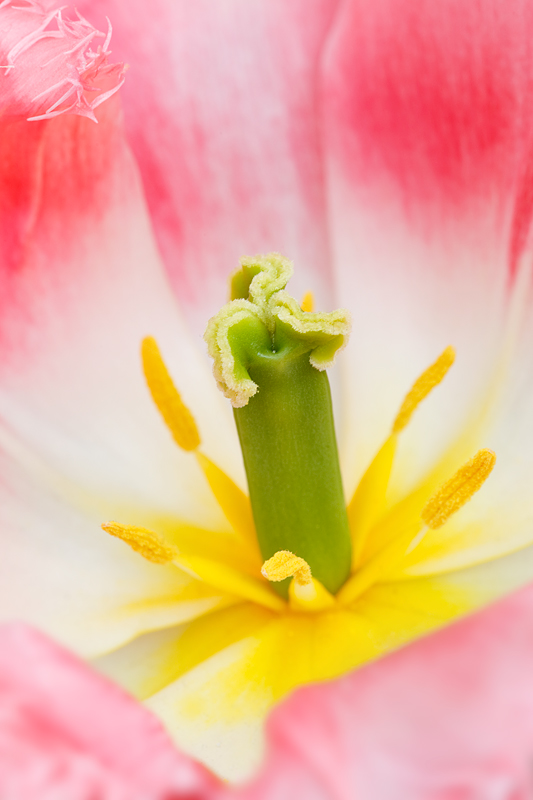
April 4th, 2013

The Fractastic eGuide and April Fool's Day Updates

This Macaroni Penguin preening its mate was photographed at Hercules Bay, South Georgia, with the tripod-mounted Canon 300mm f/2.8 L IS II lens, the 2X III teleconverter, and the EOS-1D Mark IV now replaced by the Canon EOS-1D X.

ISO 400. Evaluative metering -2/3 stop: 1/200 sec. at f/10 in Manual mode. This is still one of my favorite images from the trip. The birds were so tame that I rarely if ever felt limited by my longest effective telephoto length of “only” 780mm (300mm X 2 X 1.3). An upper left-hand sensor was chosen manually: AI Servo Rear Focus active at the moment of exposure. Click here if you missed the Rear Focus Tutorial. Click on the image for a larger version.

Coming Soon: the Fractastic eGuide

The image above was one of my very favorite images from my January 2012 Falklands, South Georgia, Antarctica expedition with Cheesemans’ Ecology Safaris.

My first Fract of the Macaroni Penguin image. Click on the image for a larger version.

The Original Fractalius Creation

The image above is the Fractalius image that I created about a year ago. I started with the Glow 100 preset on its own layer, tweaked it a bit, added a Layer Mask, and revealed the original eye. I’ve always liked this one.

Coming Soon: the Fractastic eGuide

Denise Ippolito and Andrew McLachlan have written a fantastic new Creative User eGuide for Fractalius, the great Photoshop plug-in that creates “unusual, eccentric artworks in a single step. The effects are based on the extraction of the so-called hidden fractal texture of an image. You can also simulate various types of exotic lighting and high-realistic pencil sketches.”

I have been hard at work during my free time editing this great new guide. Andrew is now working on the 2nd draft. Denise was and is the driving force behind Fractastic, which will be the first-ever guide to the Fractalius interface. Most folks who are enchanted by Fractalius–the cover of this eGuide includes the phrase, “Beware; Content Addictive”–open the program, are immediately confused by the sliders and the various other buttons and controls, play around a bit, try some of the presets, and wind up creating something nice. With this great new eGuide you will be unguided no longer.

The new Fract! Click on the image for a larger version.

The New Fract!

The image above is a new Fract that I created with a single click from the original Fract using a tip that I learned while editing Fractastic. This new Guide, which will be well under-priced at $27, should be available from BIRDS AS ART (we are the publisher) in a month or less.

Your Favortie?

Take a moment to leave a comment and let us know which is your favorite Macaroni Penguin pair preening image, the original, the first Fract, or the second Fract. And do let us know why?

To Purchase Fractalius

To purchase Fractalius–for PCs only and those Mac folks using Parallels Desktop and VMWare/VMWare-Fusion–please use the Fractalius Fun logo link (the Fracted Brown Pelican) on the right hand side of each blog page. Thanks.

April Fool’s Day Updates

Arthur Morris Switches to Nikon

Many again were taken in by my personal April Fool’s Day humor here despite the fact that that blog post included this item towards the end:

A Second Admission

The press release above is of course an April’s Fool’s joke. Have a great month everyone :).

Boys and girls, you gotta read the whole thing.

The new Canon EOS-7D L for left-handed photographers.

The Left-Handed EOS-7D

To see the announcement of this great new camera, click here. To follow up, please click here.

Tanzania Photo Safari with Todd Gustafson and Arthur Morris

Africa/Tanzania/Serengeti Summer Migration Safari: 12 full and two half-days of photography: $12,999/person double occupancy. Limit: 12/Openings: 4.

Leaders: Todd Gustafson (he does use Nikon gear) and Arthur Morris. Leave the US AUG 3, 2013. Fly home from Arusha, Tanzania on the evening of August 18. Day 1 of the safari is August 5. Our last morning of photography is August 18. We will be visiting Tarangire National Park, Seronera Lodge–aka Leopard City!–twice, an exclusive mobile tented camp in the Serengeti, and at the end, the spectacular wildlife spectacle that is Ngorongoro Crater. Please e-mail for itinerary.

Please click here for complete IPT info.

BOSQUE del APACHE 2013 IPT: “The Complete Bosque Experience.” NOV 26-DEC 2, 2013. 7-FULL DAYS: $3399. Co-leader: Denise Ippolito. Introductory Slide program: 6:30 pm on 11/25. Limit: 12.

Tens of thousand of Snow Geese, 10,000 Sandhill Cranes, ducks including point-blank American Wigeon and Wood Duck, amazing sunrises, sunsets, and blast-offs. Live, eat, and breathe photography with one of (if not the) world’s premier photographic educators at one of his very favorite locations on the planet. Top-notch Photoshop instruction. This will make 19 consecutive Novembers at Bosque for me. Nobody knows the place better than I do. Join us to learn to think like a pro, to recognize situations and to anticipate them based on the weather, especially the sky conditions, the light, and the wind direction. Every time we make a move we will let you know why. When you head home applying what you learned will prove to be invaluable. Includes all lunches and the Thanksgiving Buffet at the Crowne Plaza in Albuquerque. I hope that you can join me for what will be an unparalleled learning experience.

A $500 non-refundable deposit is required to hold your slot for this IPT. Your balance is due 4 months before the date of the IPT and is also non-refundable. If the trip fills, we will be glad to apply a credit applicable to a future IPT for the full amount less a $100 processing fee. If we do not receive your check for the balance on or before the due date we will try to fill your spot from the waiting list. If your spot is filled, you will lose your deposit. If not, you can secure your spot by paying your balance.

Please print, complete, and sign the form that is linked to here and shoot it to us along with your deposit check (made out to “Arthur Morris.”) You can also leave your deposit with a credit card by calling the office at 863-692-0906. If you register by phone, please print, complete and sign the form as noted above and either mail it to us or e-mail the scan. If you have any questions, please feel free to contact me via e-mail

EOS-5D Mark III User’s Guide

In the EOS-5D Mark III User’s Guide You can learn everything that I know about the following important topics: 5D III exposure fine points, handling the WHITEs, the top LCD and all camera control buttons, 5D Mark III drive modes, how to manually select an AF sensor, choosing an AF Area Selection Mode, and Menu Item access. Coverage of almost all Menu Items and Custom Functions including: Image Quality, Auto Lighting Optimizer, Highlight Tone Priority, AF Configuration Tool (includes details on the custom Case setting that I use), Acceleration/deceleration tracking, Tracking sensitivity, Lens drive when AF impossible, Orientation linked AF point (I love this feature on the 5D III!), Highlight alert, Histogram display, Auto rotate, Custom Shooting Mode set-up, Safety shift, using the Q button, and setting up rear focus.Plus detailed instructions on how to set up for both in-camera HDR and in-camera multiple exposures.

The guide is–of course–written in my informal, easy-to-follow style. Learn more or purchase here.

EOS-1D X AF Guide

You can learn exactly how I set up and use this camera’s great new AF system in our EOS-1D X AF Guide. And you can learn about our other camera User’s Guides here.

Typos

On all blog posts, feel free to e-mail or leave a comment regarding any typos, wrong words, misspellings, omissions, or grammatical errors. Just be right. 🙂

Support the BAA Blog. Support the BAA Bulletins: Shop B&H here!

We want and need to keep providing you with the latest free information, photography and Photoshop lessons, and all manner of related information. Show your appreciation by making your purchases immediately after clicking on any of our B&H or Amazon Affiliate links in this blog post. Remember, B&H ain’t just photography!

If you are considering an item for purchase or comparison shopping be sure to place an item in your cart to see the too-low-to show the actual price. In many cases the prices are so low that B&H is forbidden from publicizing them!

B&H Search Engine Banner


B&H Photo - Video - Pro Audio


Support the BAA Blog. Support the BAA Bulletins: Shop Amazon here!

Consider doing all of your Amazon.com shopping using the search link below. You'll be getting the same low prices and great service that you are accustomed to and at the same time, supporting my efforts in the Bulletins and on the Blog to bring you great images, timely product news and info, and tons of free educational articles on an almost daily (and sometimes almost back-breaking) basis :) Just type your search in the little white box and hit Go.

And from the BAA On-line Store:

LensCoats. I have a LensCoat on each of my big lenses to protect them from nicks and thus increase their re-sales value. All my big lens LensCoat stuff is in Hardwood Snow pattern.
LegCoat Tripod Leg Covers. I have four tripods active and each has a Hardwood Snow LegCoat on it to help prevent further damage to my tender shoulders :) And you will love them in mega-cold weather....
Gitzo GT3532 LS CF Tripod. This one replaces the GT3530LS Tripod and will last you a lifetime. Learn more about this great tripod here.
Mongoose M3.6 Tripod Head. Right now this is the best tripod head around for use with lenses that weigh less than 9 pounds. For heavier lenses, check out the Wimberley V2 head.
Double Bubble Level. You will find one in my camera's hot shoe whenever I am not using flash.
The Lens Align Mark II. I use the Lens Align Mark II pretty much religiously to micro-adjust all of my gear an average of once a month and always before a major trip. Enjoy our free comprehensive tutorial here.
BreezeBrowser. I do not see how any digital photographer can exist without this program.
Delkin Flash Cards. I use and depend on Delkin compact Flash Cards and card readers most every day. Learn more about their great 700X and 1000X cards here or about my favorite Delkin card here.
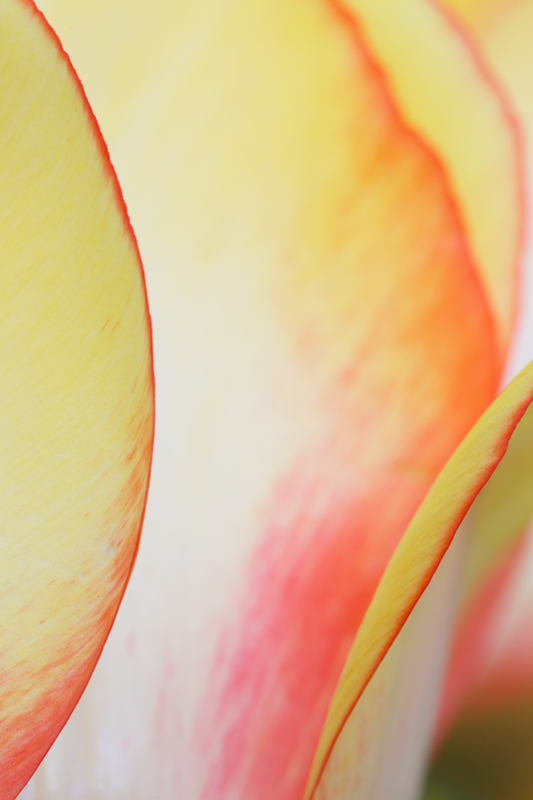
April 1st, 2013

It Wasn't Easy... Arthur Morris Switches to Nikon!

Press Release

April 1, 2013. Indian Lake Estates, FL: Arthur Morris Switches to Nikon

After a lifetime of using Canon gear, and after lengthy consideration, Arthur Morris announced today that he was–enticed by a war chest of Nikon gear–switching to Nikon. He looks forward to making lots of great images with his new gear. Please take a moment to welcome him to the dark side.

This Sandhill Crane image was created at Indian Lake Estates with the Canon EF 600mm f/4L IS II USM lens and the Canon EOS-1D X Digital SLR camera. ISO 400. Evaluative metering +2/3 stop as framed in early morning light: 1/640 sec. at f/6.3 in Manual mode.

Central sensor Surround/AI Servo/Rear Focus AF on the bird’s face and re-compose carefully. Click here if you missed the Rear Focus Tutorial. Click on the image to see a larger version.

As it almost always is when I am working from the car the lens was supported on the lowered window of my Sequoia on a BLUBB, the Big Lens Ultimate BeanBag that I designed myself. It is available only from BAA. See the BLUBB and learn more here. Beware of cheap knock-offs; all are seriously lacking in size, heft, and quality materials. None have the non-skid material on the inside of the ears and none have the noise-less fabric top.

It Wasn’t Easy…

It wasn’t easy to photograph the same bird in the exact same pose with both the 600 II and a full frame camera body and then again with the 500 II also with a full frame camera body. But yesterday morning I succeeded. Part of the trick was setting up both rigs with the same exposure before making a single image. Then it was frame and fire with the 500 II, grab the 600 II, and frame and fire. Ah, success. Both the image above and the image below are unprocessed and were created from the extracted JPEGs.

This image of the same bird was created less than 15 seconds after the image above was created, this one with the Canon 500mm f/4L EF IS II lens and the Canon EOS 5D Mark III. ISO 400. Evaluative metering +2/3 stop as framed in early morning light: 1/640 sec. at f/6.3 in Manual mode.

Central sensor Surround/AI Servo/Rear Focus AF on the bird’s face and re-compose carefully. Click here if you missed the Rear Focus Tutorial. Click on the image to see a larger version.

As it almost always is when I am working from the car the lens was supported on the lowered window of my Sequoia on a BLUBB, the Big Lens Ultimate BeanBag that I designed myself. It is available only from BAA. See the BLUBB and learn more here. Beware of cheap knock-offs; all are seriously lacking in size, heft, and quality materials. None have the non-skid material on the inside of the ears and none have the noise-less fabric top.

Let’s Keep It Simple

In the first post on this subject, “The Size of the Subject in the Frame is Directly Proportional to the Square of the Focal Length: A Practical Example,” many of the folks who left comments were either confused, had a different way of saying the same thing, or wanted to play semantic games. So let’s keep it simple here. There we looked at a horizontal image. Bill Richardson mentioned that he would love to see a vertical comparison and so I set out to accomplish just that.

All of the following are 100% true:

1-The size of the subject in the frame, as measured by the area that the subject covers, is directly proportional to the square of the focal length. With the 500 and the 600 the math is simple. 5 squared is 25, 6 squared is 36. An image created with the 600 will be 44% larger in the frame as measured by the area that the subject covers.

2-The same subject photographed with 500mm and 600mm lenses from the same distance will be 20% longer and 20% wider with the 600mm than with the 500mm.

3-Viewing the two images is the simplest way to compare subject size in the frame regardless of which way you choose to do the math.

Which Series II Super-telephoto Lens is Best for You?

To answer that question, see the March 2nd blog post here.

An Admission

I will admit that when I am heading into the field I choose the 600 II over the 500 II despite the fact that it weighs 1.61 pounds more than the 500 II. That even though most of the birds in Florida are inordinately tame….

A Second Admission

The press release above is of course an April’s Fool’s joke. Have a great month everyone :).

Africa/Tanzania/Serengeti Summer Migration Safari: 12 full and two half-days of photography: $12,999/person double occupancy. Limit: 12/Openings: 6.

Leaders: Todd Gustafson (he does use Nikon gear) and Arthur Morris. Leave the US AUG 3, 2013. Fly home from Arusha, Tanzania on the evening of August 18. Day 1 of the safari is August 5. Our last morning of photography is August 18. We will be visiting Tarangire National Park, Seronera Lodge–aka Leopard City!–twice, an exclusive mobile tented camp in the Serengeti, and at the end, the spectacular wildlife spectacle that is Ngorongoro Crater. Please e-mail for itinerary.

Please click here for complete IPT info.

BOSQUE del APACHE 2013 IPT: “The Complete Bosque Experience.” NOV 26-DEC 2, 2013. 7-FULL DAYS: $3399. Co-leader: Denise Ippolito. Introductory Slide program: 6:30 pm on 11/25. Limit: 12.

Tens of thousand of Snow Geese, 10,000 Sandhill Cranes, ducks including point-blank American Wigeon and Wood Duck, amazing sunrises, sunsets, and blast-offs. Live, eat, and breathe photography with one of (if not the) world’s premier photographic educators at one of his very favorite locations on the planet. Top-notch Photoshop instruction. This will make 19 consecutive Novembers at Bosque for me. Nobody knows the place better than I do. Join us to learn to think like a pro, to recognize situations and to anticipate them based on the weather, especially the sky conditions, the light, and the wind direction. Every time we make a move we will let you know why. When you head home applying what you learned will prove to be invaluable. Includes all lunches and the Thanksgiving Buffet at the Crowne Plaza in Albuquerque. I hope that you can join me for what will be an unparalleled learning experience.

A $500 non-refundable deposit is required to hold your slot for this IPT. Your balance is due 4 months before the date of the IPT and is also non-refundable. If the trip fills, we will be glad to apply a credit applicable to a future IPT for the full amount less a $100 processing fee. If we do not receive your check for the balance on or before the due date we will try to fill your spot from the waiting list. If your spot is filled, you will lose your deposit. If not, you can secure your spot by paying your balance.

Please print, complete, and sign the form that is linked to here and shoot it to us along with your deposit check (made out to “Arthur Morris.”) You can also leave your deposit with a credit card by calling the office at 863-692-0906. If you register by phone, please print, complete and sign the form as noted above and either mail it to us or e-mail the scan. If you have any questions, please feel free to contact me via e-mail

EOS-5D Mark III User’s Guide

In the EOS-5D Mark III User’s Guide You can learn everything that I know about the following important topics: 5D III exposure fine points, handling the WHITEs, the top LCD and all camera control buttons, 5D Mark III drive modes, how to manually select an AF sensor, choosing an AF Area Selection Mode, and Menu Item access. Coverage of almost all Menu Items and Custom Functions including: Image Quality, Auto Lighting Optimizer, Highlight Tone Priority, AF Configuration Tool (includes details on the custom Case setting that I use), Acceleration/deceleration tracking, Tracking sensitivity, Lens drive when AF impossible, Orientation linked AF point (I love this feature on the 5D III!), Highlight alert, Histogram display, Auto rotate, Custom Shooting Mode set-up, Safety shift, using the Q button, and setting up rear focus.Plus detailed instructions on how to set up for both in-camera HDR and in-camera multiple exposures.

The guide is–of course–written in my informal, easy-to-follow style. Learn more or purchase here.

EOS-1D X AF Guide

You can learn exactly how I set up and use this camera’s great new AF system in our EOS-1D X AF Guide. And you can learn about our other camera User’s Guides here.

Typos

On all blog posts, feel free to e-mail or leave a comment regarding any typos, wrong words, misspellings, omissions, or grammatical errors. Just be right. 🙂

Support the BAA Blog. Support the BAA Bulletins: Shop B&H here!

We want and need to keep providing you with the latest free information, photography and Photoshop lessons, and all manner of related information. Show your appreciation by making your purchases immediately after clicking on any of our B&H or Amazon Affiliate links in this blog post. Remember, B&H ain’t just photography!

If you are considering an item for purchase or comparison shopping be sure to place an item in your cart to see the too-low-to show the actual price. In many cases the prices are so low that B&H is forbidden from publicizing them!

B&H Search Engine Banner


B&H Photo - Video - Pro Audio


Support the BAA Blog. Support the BAA Bulletins: Shop Amazon here!

Consider doing all of your Amazon.com shopping using the search link below. You'll be getting the same low prices and great service that you are accustomed to and at the same time, supporting my efforts in the Bulletins and on the Blog to bring you great images, timely product news and info, and tons of free educational articles on an almost daily (and sometimes almost back-breaking) basis :) Just type your search in the little white box and hit Go.

And from the BAA On-line Store:

LensCoats. I have a LensCoat on each of my big lenses to protect them from nicks and thus increase their re-sales value. All my big lens LensCoat stuff is in Hardwood Snow pattern.
LegCoat Tripod Leg Covers. I have four tripods active and each has a Hardwood Snow LegCoat on it to help prevent further damage to my tender shoulders :) And you will love them in mega-cold weather....
Gitzo GT3532 LS CF Tripod. This one replaces the GT3530LS Tripod and will last you a lifetime. Learn more about this great tripod here.
Mongoose M3.6 Tripod Head. Right now this is the best tripod head around for use with lenses that weigh less than 9 pounds. For heavier lenses, check out the Wimberley V2 head.
Double Bubble Level. You will find one in my camera's hot shoe whenever I am not using flash.
The Lens Align Mark II. I use the Lens Align Mark II pretty much religiously to micro-adjust all of my gear an average of once a month and always before a major trip. Enjoy our free comprehensive tutorial here.
BreezeBrowser. I do not see how any digital photographer can exist without this program.
Delkin Flash Cards. I use and depend on Delkin compact Flash Cards and card readers most every day. Learn more about their great 700X and 1000X cards here or about my favorite Delkin card here.
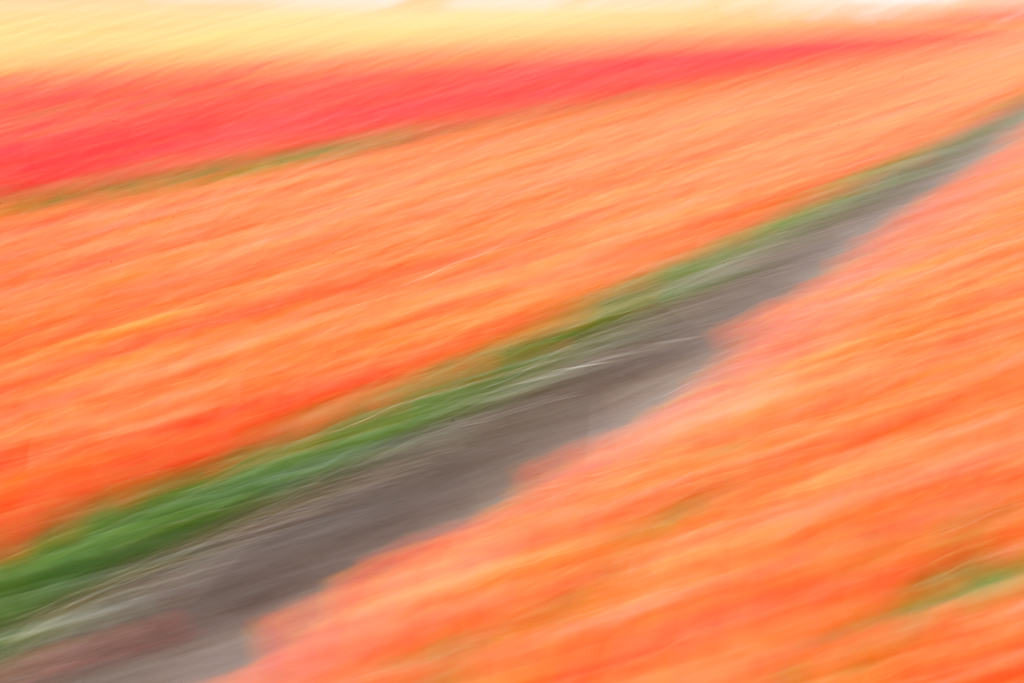
March 31st, 2013
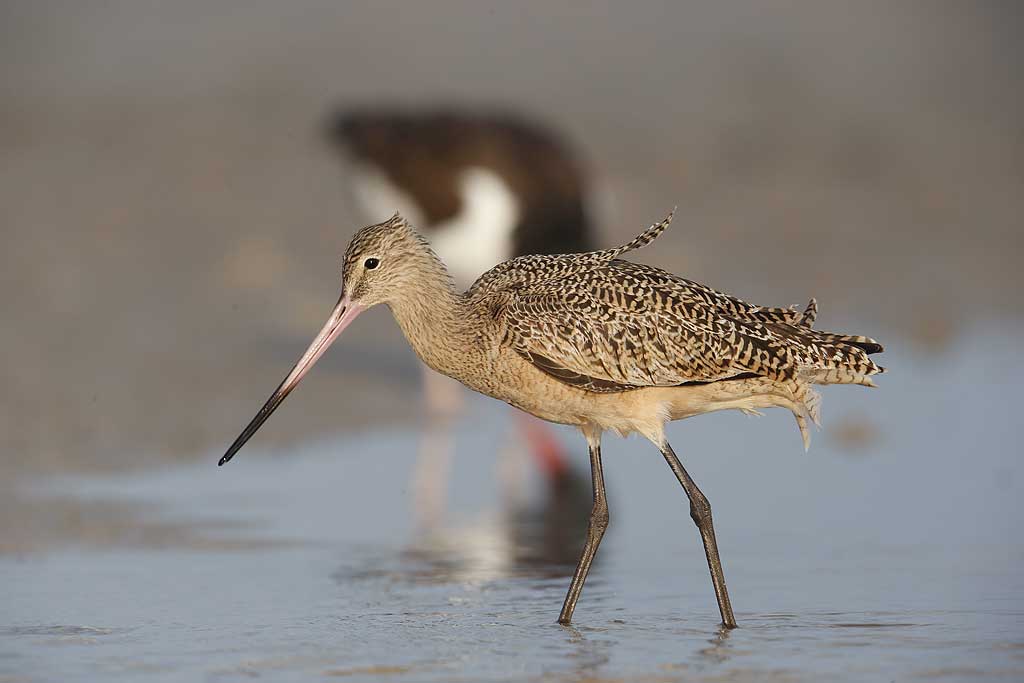
Mapping Your Way to Success, Favorite Froggie Image, & Time is Running Out

Composition Maps: Visual Design Aids for Nature Photographers

Many new folks may be unaware of “Composition Maps: Visual Design Aids for Nature Photographers” an e-Guide by Gloria Hopkins (with photographs by Arthur Morris). Gloria’s first BAA e-book was Natural Design: Image Design for Nature Photographers. The book received positive reviews from many happy customers and everyone (including me) raved about her composition maps. I still have no clue as to how she knows exactly what is going on in my brain when I press the shutter button and optimize my images. But she does and shares that ingeniously in her second offering, “Composition Maps.”

Click here to order your copy now.

The E-book features more than 80 BIRDS AS ART IMAGES and 61 composition maps–some of the maps deal with two or more images. In the e-book you simply click on the map and hold the cursor down: the image is revealed! Give the animated GIF below a few moments to play and you will get the idea.

The simplest and fastest way to order your copy of “Composition Maps: Visual Design Aids for Nature Photographers” is through the BAA On-line Store by clicking here. Or, you can order your copy by sending a check for $30 made out to “Arthur Morris” to us at BIRDS AS ART, PO Box 7245, Indian Lake Estates, FL 33855. Be sure to include your e-mail address (written legibly). If you prefer PayPal you can send $30 to us via e-mail; be sure to include the title of the book.

Click here to order your copy now.

Gloria first introduced here innovative Composition Maps in “Natural Design; Image Design for Nature Photographers.” Learn more here.

Brilliant

Gloria’s composition maps are simply brilliant–the simplest and easiest way to study and learn the principles of image design.

My Favorite Froggie Image

This Roseate Spoonbill image was created at Alafia Banks in Tampa Bay on a Hooptie Deux trip with the tripod-mounted Nikon AF-S NIKKOR 600mm f/4G ED VR AF lens (in stock!), the Nikon TC-14E II 1.4x Teleconverter for D-AF-S & AF-I Lenses ONLY, and the Nikon D-700 replaced by the Nikon D800 Digital SLR. ISO 640: 1/1600 sec.at f/8 in Manual mode.

Image courtesy of and copyright 2013: James Shadle/Wild Florida Photography

My Favorite Froggie Image

The image above was my favorite among James Shadle’s 4 images here. Why? The spoonbill is in killer breeding plumage with the fine black calligraphy lines on the bill and I am a sucker for the combination of bright pink and powder blue.

Time is Running Out/Join Us

Do consider joining James and me next week on the 2nd Short Notice Fort Desoto/Hooptie Deux/Roseate Spoonbill IPT. Details immediately below. Learn more about James here. Note: all of James images above were created on Hooptie Deux trips over the past few weeks. There will be two more in the next Bulletin.

The 2nd New Concept IPT: the Fort Desoto/Hooptie Deux–Roseate Spoonbill Short Notice IPT/April 3-7, 2013/5 DAYS: $2399. Strict limit: six photographers/ openings 4. Early April can be superb at Alafia Banks. Early April is almost always superb at Fort DeSoto. Click here for complete details.

With only two registrants, this one is shaping up to be a practically private affair and represents an amazing opportunity for you to grow as a photographer. For more info on the complete IPT, click here.

Two Short Versions of the Fort Desoto/Hooptie Deux–Roseate Spoonbill IPT

Can’t make the whole thing? Consider one of the two abbreviated versions below.

Short Version #1: Fort Desoto/Hooptie Deux–Roseate Spoonbill IPT/April 3-5, 2013/3 FULL DAYS: $1399. Strict limit: six photographers/Openings: 5.

Early April can be superb at Alafia Banks. Early April is almost always superb at Fort DeSoto.

Here is the structure and schedule: I will be leading all three days of this Short Version 3-DAY IPT. We will spend one full day on the Hooptie Deux, either Thursday or Friday. The first day and one of the next two full days will be at Fort Desoto where the Laughing Gulls will be in splendid breeding plumage with their full black hoods, their wine-red bills, and white eye crescents. They are one of our most under-appreciated species. The Royal, Sandwich, and Forster’s Terns will also be in breeding plumage. And all of these species will be displaying, courting, and mating. You can also expect a variety of wading birds, especially Reddish Egret, and a variety of shorebirds including Long-billed Curlew, Marbled Godwit, Dunlin, American Oystercatcher, and many more. And you will need to beat the Willets off with a stick. The additional possibilities are too numerous to mention.

As above, we will spend a full day on the Hooptie Deux with James Shadle on either Thursday or Friday depending on the weather. The morning will be at Alafia Banks with spoonbill as the main target species. There will be lots of great flight photography not only with spoonbills, many of which will be in full breeding plumage, but with Brown Pelicans and Double-crested Cormorants, Reddish Egret and White Ibis in full breeding plumage, Great Egret, Great Blue Heron, Turkey and Black Vultures, and lots more. The afternoon Hooptie trip will be at one of several fresh water heronries. James will trailer his customized pontoon boat to the best rookery. Subjects, depending on location, will likely include Cattle Egret, Snowy Egret, Little Blue Heron, Great Blue Heron, White Ibis, Black-crowned Night-heron, and Double-crested Cormorant. All nesting and in flight. Most but not all of the photography on a boat trip to the Banks with James is done while standing in the water with your tripod. James has lightweight chest waders and surf booties on board for all at no charge. Folks who wish to keep their expensive Gitzo tripods saltwater free often opt to use Drypods. Learn more here.

Short Version #2: With James Shadle/Roseate Spoonbill/Osprey IPT/April 6-7, 2013/2 FULL DAYS: $899. Strict limit: six photographers/Openings: 5.

Saturday and Sunday with James Shadle will feature a morning on the Hooptie Deux at Alafia Banks and one or more sessions at Honeymoon Island State Park where many dozens of pairs of Osprey are nesting. There will of course be lots of flight photography. Depending on the winds and weather there may be an afternoon session at a Wood Stork rookery or some local beaches that James knows well. All subject to change depending on the weather including wind and sky conditions as well as local conditions. James has an intimate knowledge of each location and has visited them regularly for many years.

Deposit Info

A $500 deposit is needed to hold your spot; call Jim or Jennifer asap at 1-863-692-0906. Your deposit may be placed with a credit card. Your payment in full by personal check will then be due along with your completed paperwork both sent via US Mail. Please print, read, and sign the release form here and include it with your check. If you would rather pay in full via personal check, please call or e-mail immediately to save your spot. With one registrant, both of these will run. Yeah, I know that it might seem nuts but neither James nor I can live with telling folks who have arranged to take time off from work and made travel plans that we are cancelling a trip because we will not be making enough money to justify running it…. Please e-mail with questions or for additional details.

March 28th, 2013

Froggie, & the Best Out-of-Camera Image Comments

This Roseate Spoonbill image was created at Alafia Banks in Tampa Bay on a Hooptie Deux trip with the tripod-mounted Nikon AF-S NIKKOR 600mm f/4G ED VR AF lens (in stock!), the Nikon TC-14E II 1.4x Teleconverter for D-AF-S & AF-I Lenses ONLY, and the Nikon D-700 replaced by the Nikon D800 Digital SLR. ISO 640: 1/1600 sec.at f/8 in Manual mode.

Image courtesy of and copyright 2013: James Shadle/Wild Florida Photography

Froggie

Froggie is Captain James Shadle, friend and my founding co-partner at BirdPhototogapher’s.Net (BPN). I forget how he got his nickname. Perhaps he will be kind enough to leave a comment here and let us know.

This Brown Pelican with nesting material was photographed at Alafia Banks in Tampa Bay on a Hooptie Deux trip with the tripod-mounted Nikon AF-S NIKKOR 600mm f/4G ED VR AF lens (in stock!), the Nikon TC-14E II 1.4x Teleconverter for D-AF-S & AF-I Lenses ONLY, and the Nikon D-700 replaced by the Nikon D800 Digital SLR. ISO 800: 1/2000 sec. at f/8 in Manual mode. This was a vertical original.

Image courtesy of and copyright 2013: James Shadle/Wild Florida Photography

Flight Photographer Extraordinaire

As you can see by the images here, Froggie is about as good a tripod-mounted flight and action photographer as there is, far more skilled than me. He uses Nikon gear and I use Canon gear. And though we also use different methods of determining the correct exposure it is uncanny, borderline amazing, that we wind up with the exact same exposure more than 90% of the time. Our settings are never more off by more than 1/3 stop.

Tamron SP 70-300mm f/4-5.6 Di VC USD Telephoto Zoom Lens for Nikon Digital SLRs & 35mm Film Cameras

This Osprey image was created on Tampa Bay with the hand held Tamron SP 70-300mm f/4-5.6 Di VC USD Telephoto Zoom lens and the Nikon D5200 Digital SLR. ISO 400: 1/1000 sec. at f/8.

Image courtesy of and copyright 2013: James Shadle/Wild Florida Photography

Proof Positive

Regular readers have heard me say dozens of times that good photographers make good images with whatever gear they have in their hands. James created the killer Osprey image above with a lightweight budget-friendly rig that many would look down their noses at….

You can check out the Canon version of this inexpensive lens here.

This Roseate Spoonbill image was created at Alafia Banks in Tampa Bay on a Hooptie Deux trip with the tripod-mounted Nikon AF-S NIKKOR 600mm f/4G ED VR AF lens (in stock!) and the Nikon D-700 replaced by the Nikon D800 Digital SLR. ISO 800: 1/500 sec.at f/6.3 in Manual mode.

Image courtesy of and copyright 2013: James Shadle/Wild Florida Photography

Your Favorite?

Which of Jame’s 4 images above is your favorite. And why?

Join Us

Do consider joining James and me next week on the 2nd Short Notice Fort Desoto/Hooptie Deux/Roseate Spoonbill IPT. Details immediately below. Learn more about James here. Note: all of James images above were created on Hooptie Deux trips over the past few weeks. There will be two more in the next Bulletin.

Fort Desoto/Hooptie Deux–Roseate Spoonbill Short Notice IPT

The 2nd New Concept IPT: the Fort Desoto/Hooptie Deux–Roseate Spoonbill Short Notice IPT/April 3-7, 2013/5 DAYS: $2399. Strict limit: six photographers/ openings 4. Early April can be superb at Alafia Banks. Early April is almost always superb at Fort DeSoto. Click here for complete details.

With only two registrants, this one is shaping up to be a practically private affair and represents an amazing opportunity for you to grow as a photographer. For more info on the complete IPT, click here.

Announcing Two Short Versions of the Fort Desoto/Hooptie Deux–Roseate Spoonbill IPT

Can’t make the whole thing? Consider one of the two abbreviated versions below.

Short Version #1: Fort Desoto/Hooptie Deux–Roseate Spoonbill IPT/April 3-5, 2013/3 FULL DAYS: $1399. Strict limit: six photographers/Openings: 5.

Early April can be superb at Alafia Banks. Early April is almost always superb at Fort DeSoto.

Here is the structure and schedule: I will be leading all three days of this Short Version 3-DAY IPT. We will spend one full day on the Hooptie Deux, either Thursday or Friday. The first day and one of the next two full days will be at Fort Desoto where the Laughing Gulls will be in splendid breeding plumage with their full black hoods, their wine-red bills, and white eye crescents. They are one of our most under-appreciated species. The Royal, Sandwich, and Forster’s Terns will also be in breeding plumage. And all of these species will be displaying, courting, and mating. You can also expect a variety of wading birds, especially Reddish Egret, and a variety of shorebirds including Long-billed Curlew, Marbled Godwit, Dunlin, American Oystercatcher, and many more. And you will need to beat the Willets off with a stick. The additional possibilities are too numerous to mention.

As above, we will spend a full day on the Hooptie Deux with James Shadle on either Thursday or Friday depending on the weather. The morning will be at Alafia Banks with spoonbill as the main target species. There will be lots of great flight photography not only with spoonbills, many of which will be in full breeding plumage, but with Brown Pelicans and Double-crested Cormorants, Reddish Egret and White Ibis in full breeding plumage, Great Egret, Great Blue Heron, Turkey and Black Vultures, and lots more. The afternoon Hooptie trip will be at one of several fresh water heronries. James will trailer his customized pontoon boat to the best rookery. Subjects, depending on location, will likely include Cattle Egret, Snowy Egret, Little Blue Heron, Great Blue Heron, White Ibis, Black-crowned Night-heron, and Double-crested Cormorant. All nesting and in flight. Most but not all of the photography on a boat trip to the Banks with James is done while standing in the water with your tripod. James has lightweight chest waders and surf booties on board for all at no charge. Folks who wish to keep their expensive Gitzo tripods saltwater free often opt to use Drypods. Learn more here.

Short Version #2: With James Shadle/Roseate Spoonbill/Osprey IPT/April 6-7, 2013/2 FULL DAYS: $899. Strict limit: six photographers/Openings: 5.

Saturday and Sunday with James Shadle will feature a morning on the Hooptie Deux at Alafia Banks and one or more sessions at Honeymoon Island State Park where many dozens of pairs of Osprey are nesting. There will of course be lots of flight photography. Depending on the winds and weather there may be an afternoon session at a Wood Stork rookery or some local beaches that James knows well. All subject to change depending on the weather including wind and sky conditions as well as local conditions. James has an intimate knowledge of each location and has visited them regularly for many years.

Deposit Info

A $500 deposit is needed to hold your spot; call Jim or Jennifer asap at 1-863-692-0906. Your deposit may be placed with a credit card. Your payment in full by personal check will then be due along with your completed paperwork both sent via US Mail. Please print, read, and sign the release form here and include it with your check. If you would rather pay in full via personal check, please call or e-mail immediately to save your spot. With one registrant, both of these will run. Yeah, I know that it might seem nuts but neither James nor I can live with telling folks who have arranged to take time off from work and made travel plans that we are cancelling a trip because we will not be making enough money to justify running it…. Please e-mail with questions or for additional details.

This image was created while seated behind the tripod-mounted Canon EF 600mm f/4L IS II USM lens, the Canon 1.4x EF tele-extender III, and the Canon EOS-1D X. ISO 400. Evaluative metering +1/3 stop as framed : 1/2000 sec. at f/7.1 in Manual mode. The sun had gotten a lot brighter here.

One sensor right of central sensor Surround/AI Servo/Rear Focus AF on the base of the bird’s bill active at the moment of exposure. Click here if you missed the Rear Focus Tutorial. Click on the image to see a larger version.

The Best Out-of-Camera Image

In the March 26th blog post, “Poor Conditions/Great Photography: New Concept 10 Out-of Camera Images,” I wrote, “My strong belief is that one of the ten images above clearly stands out as the best of the morning. Which is it? And why?

My clear choice as the best image of the ten presented is the American Osytercatcher with the still unknown prey item. Brian Small left a comment that echoed my feelings accurately. He wrote, “O.K., I’ll join in just for fun. Far and away the feeding oystercatcher is the best image of the 10. Other than the scratching godwit it’s the only image with action. All the others while nice, are simple portraits and are pretty similar to each other (headshot or not). The oystercatcher depicts a real “natural history” moment showing feeding behavior along with the birds choice of prey item. It also shows most of the birds legs whereas the scratching godwit is in deeper water which is less desirable IMHO. The oystercatcher is more colorful and a bit more interesting to my eye. Finally, the open bill of the oystercatcher gives the bird a more lively, expressive look that none of the others show. My two cents–take it for what it’s worth.

Thanks to all who commented.

Note: when working with the RAW file it was evident that the blue material was in fact cutting into the bird’s leg.

Image optimization was straightforward. A Quick Mask fine-tuned with a Layer Mask was used to cover the fine blue string or whatever it was on the bird’s leg, NIK Color Efex Pro’s Detail Extractor was applied judiciously (20%) only to the black hood and the bright white feathers. A 15% Linear Burn toned down the light flesh-colored legs and some Eye Doctor work put the finishing touches on a fine image. I almost forgot: the one bit of fancy stepping was using my Selective Color trick to tone down the bird’s red bill. This bird, one of a pair, has been both dependable and tame.

All of the above as detailed in Digital Basics that includes my complete digital workflow, all of my time-saving Keyboard Shortcuts, Quick Masking, Layer Masking, and NIK Color Efex Pro basics, and dozens of great Photoshop tips. You can learn the advanced Quick Masking techniques that I used here in APTATS I and learn advanced Layer Masking in APTATS II.

Typos

On all blog posts, feel free to e-mail or leave a comment regarding any typos, wrong words, misspellings, omissions, or grammatical errors. Just be right. 🙂

Support the BAA Blog. Support the BAA Bulletins: Shop B&H here!

We want and need to keep providing you with the latest free information, photography and Photoshop lessons, and all manner of related information. Show your appreciation by making your purchases immediately after clicking on any of our B&H or Amazon Affiliate links in this blog post. Remember, B&H ain’t just photography!

If you are considering an item for purchase or comparison shopping be sure to place an item in your cart to see the too-low-to show the actual price. In many cases the prices are so low that B&H is forbidden from publicizing them!

B&H Search Engine Banner


B&H Photo - Video - Pro Audio


Support the BAA Blog. Support the BAA Bulletins: Shop Amazon here!

Consider doing all of your Amazon.com shopping using the search link below. You'll be getting the same low prices and great service that you are accustomed to and at the same time, supporting my efforts in the Bulletins and on the Blog to bring you great images, timely product news and info, and tons of free educational articles on an almost daily (and sometimes almost back-breaking) basis :) Just type your search in the little white box and hit Go.

March 27th, 2013

Hard to Believe, Rear End Opinion, & Happy Passover/Happy Easter

Having not attracted a single taker, I pretty much had the birds and the gorgeous light all to myself at Fort Desoto this morning. Brrr. This image was created with the Canon 24-105mm f/4L IS EF USM AF lens (hand held at 55mm) with the Canon EOS-1D X digital SLR . ISO 400. Evaluative metering +1/3 stop: 1/1000 sec. at f/13 in Manual mode was a slight underexposure as I was worried about burning the Laughing Gull’s bright whites.

Central sensor/AI Servo Surround Rear Focus AF on the nearest bird and recompose. Click here if you missed the Rear Focus Tutorial. Be sure to click on the image to enjoy a larger version.

Seen here are 22 of the flock of 40 Marbled Godwits, 1 of the pair of American Oystercatchers, 1 Laughing Gull, 5 Black Skimmers, and one large sea shell. As for the 24-105, I never leave home without it as it supremely useful when it comes to creating B roll images like this. Not present for this photo were several unusually approachable Fish Crows, 1 Willet, 1 Ring-billed Gull, 1 Great Blue Heron, 3 Great Egrets, 1 Tricolored Heron, and one of the most beautiful Snowy Egrets I have ever seen. More on that bird and the wonderful morning that everyone missed coming soon. Missing from the previous day’s cast of characters was a flock of Royal Terns, several Sandwich Terns, and a likely Elegant Tern/Royal Tern hybrid.

Hard to Believe: Google/NIK Price Slash

Thanks to the many who notified me of the the NIK price slash. I believe that Leo Miller was the first when he sent me this link: Google to offer all of Nik’s software plugins for $149.

Here, in part, is the gist of it: Today the company announced the Nik Collection by Google, which is every single one of Nik’s desktop plugins in a single bundle, for just $149. This marks the end of them being sold as separates, and for that flat fee, you get Dfine® 2.0, Viveza® 2, HDR Efex Pro™ 2, Color Efex Pro™ 4 Complete Edition, Silver Efex Pro™ 2, and Sharpener Pro™ 3.0. Previously, individual plugins would run around the $100 mark, with a bundle of all of them costing as much as $500. The new, $149 bundle will not just feature all six plugins, but will work on all supported applications from a single installer: Photoshop, Photoshop Elements, Lightroom, and Apple Aperture.

Then, it got even better. IPT veteran Rachel Hollander sent me this via e-mail:

Hi Artie – Happy Passover! I hope all is well with you. So far, so good with my new 300 II. I’m not sure if you saw that Google is now offering the complete suite of Nik Plug-ins for only $149. When I clicked in through your portal it also gave me an additional 15% discount bringing it down to under $130. Just thought you might want to let people know. All the best, Rachel

So there you have it. Price is no longer an excuse for not using Color Efex Pro. Click here, enter BAA in the Promo Code box at check-out, and then hit Apply to see your savings, and purchase the entire Suite for $126.65. Hard to believe indeed. Jeez, I forgot to mention that, as regular readers well know, NIK Color Efex Pro has drastically improved my digital workflow and the look and quality of my processed images in the past year.

This image was created at Indian Lake Estates on the morning that the IPT group made the early trip from Fort Desoto to my home. I used the hand held Canon 500mm f/4L EF IS II lens, the Canon 1.4x EF tele-extender III, and the Canon EOS-1D X. ISO 800. Evaluative metering +1 stop as framed in soft light: 1/640 sec. at f/5.6 in Manual mode confirmed in advance via histogram check. IS Mode 1. Left knee as tripod.

61-Point/AI Servo/Rear Focus AF active at the moment of exposure performed perfectly. Click here if you missed the Rear Focus Tutorial. Click on the image for a larger version. Learn everything that I know about the great AF system of the 1D X in our 1D X AF Guide here. Learn how and why I am converting all of my images in Canon DPP (Digital Photo Professional) in our DPP RAW Conversion Guide here.

Rear End Opinion

I very much prefer the image above with the Gaussian blurred rear end of the adult to either the one with the sharp rear end or the one with no rear end. And there is no way I would Quick Mask over the rear end in the image above. All of the early comments were from folks who disagreed with me 100%. That is fine. 🙂 Both Doug Bolt and Josh liked the blurred tail as I do but it was friend multiple IPT veteran Charles Scheffold was stated my case most eloquently when he commented: “After thinking about this for a while, I definitely prefer the version with the blurred adult rear end. The sharp one distracts me from the juvenile. I think the blurred one adds interest without pulling my eye away from the main subject – a cute, fluffy, baby crane.

I couldn’t agree more! Thanks to all who commented.

One thing that nobody commented on is the swirly green patterns in the lower right corner in the images with the rear end. I just love that to death. It is not present in the no rear end original.

This 2-day old Sandhill Crane chick was photographed at Indian Lake Estates with the tripod-mounted Canon EF 600mm f/4L IS II USM lens and the Canon EOS-1D X Digital SLR camera. ISO 800. Evaluative metering +2/3 stop as framed: 1/6400 sec. at f/4 in Manual mode.

Central sensor Surround/AI Servo/Rear Focus AF on the chick’s face and re-compose. Click here if you missed the Rear Focus Tutorial. Click on the image to see a larger version.

There are many problems with this image starting with the adult facing away but as eggs are an important part of both the Easter and Passover holidays I opted to share it here.

Happy Passover/Happy Easter

Steve Bein kindly sent me the cut and pasted Passover missive below. For those who know a bit of Yiddish it is quite funny, at least the ones that I understand. I would like to wish all a Happy Passover, a Happy Easter, and a wonderful spring. It surely has been long in coming to Florida.

Steve is a multiple IPT veteran and a long-time friend. He has traveled with me often to faraway places, usually with his good friend Lillian Roberts. Steve just lowered the price on his old 600 f/4. I have updated it in BAA Bulletin #435; scroll down here if you might be interested. The lens is in mint condition. The new price is $6800.

Here is the Passover pass along:

Leading medical researchers have published data indicating that Seder participants should NOT partake of both chopped liver and charoses (chopped walnuts and sweet red wine); it seems that this combination can lead to Charoses of the Liver.

At our seder, we had whole wheat and bran matzoh, fortified with Metamucil.The brand name, of course, is…’Let My People Go.’

Old Jewish men in Miami get hernias from wearing chai charms that are too heavy. This condition is called chaiatal hernia!

If a doctor carries a black bag and a plumber carries a tool box, what does a mohel (say “moil”) carry? A briskit! (A mohel is trained to do circumcisions; the ceremony is call as bris.)

JEWISH JEOPARDY – I give the answer, you give the question

A: Midrash Q: What is a Mideast skin disease? (Midrashim is a Hebrew term for the body of stories told by Jewish rabbinic sages to explain passages in the Bible.)

A: The Gaza Strip Q: What is an Egyptian Belly Dance?

A: A classroom, a Passover ceremony, and latke Q: What are a cheder, a seder, and a tater? (A cheder is a traditional elementary school teaching the basics of Judaism and the Hebrew language. I had to look that one up. A seder is the ceremonial Passover dinner. And latkes are thin, crispy potato pancakes made with lots of chopped onions; best served with applesauce.)

A: Babylon Q: What does the rabbi do during some sermons?

A: Filet Minyan Q: What do you call steaks ordered by 10 Jews? (A minyan is the ten adult males required for a communal religious service.)

A: Kishka, sukkah, and circumcision. Q: What are a gut, a hut, and a cut? (Kishka is a beef or fowl intestine or skin stuffed with flour, onion, etc., and boiled and roasted. A sukkah is a temporary structure with a roof of branches in which orthodox Jews eat and, if possible, sleep during the festival of Sukkoth.)

And speaking of circumcisions: An enterprising Rabbi is offering circumcisions via the Internet. The service is to be called…’E-Mohel.”

Thanks for sharing Steve!

Fort Desoto/Hooptie Deux–Roseate Spoonbill Short Notice IPT

The 2nd New Concept IPT: the Fort Desoto/Hooptie Deux–Roseate Spoonbill Short Notice IPT/April 3-7, 2013/5 DAYS: $2399. Strict limit: six photographers/ openings 5. Early April can be superb at Alafia Banks. Early April is almost always superb at Fort DeSoto. Click here for complete details.

With only a single registrant, this one is shaping up to be a practically private affair and represents an amazing opportunity for you to grow as a photographer. For more info on the complete IPT, click here.

Announcing Two Short Versions of the Fort Desoto/Hooptie Deux–Roseate Spoonbill IPT

Short Version #1: Fort Desoto/Hooptie Deux–Roseate Spoonbill IPT/April 3-5, 2013/3 FULL DAYS: $1399. Strict limit: six photographers/Openings: 5.

Early April can be superb at Alafia Banks. Early April is almost always superb at Fort DeSoto.

Here is the structure and schedule: I will be leading all three days of this Short Version 3-DAY IPT. We will one full day on the Hooptie Deux, either Thursday or Friday. The first day and one of the next two full days will be at Fort Desoto where the Laughing Gulls will be in splendid breeding plumage with their full black hoods, their wine-red bills, and white eye crescents. They are one of our most under-appreciated species. The Royal, Sandwich, and Forster’s Terns will also be in breeding plumage. And all of these species will be displaying, courting, and mating. You can also expect a variety of wading birds, especially Reddish Egret, and a variety of shorebirds including Long-billed Curlew, Marbled Godwit, Dunlin, American Oystercatcher, and many more. And you will need to beat the Willets off with a stick. The additional possibilities are too numerous to mention.

As above, we will spend a full day on the Hooptie Deux with James Shadle on either Thursday or Friday depending on the weather. The morning will be at Alafia Banks with spoonbill as the main target species. There will be lots of great flight photography not only with spoonbills, many of which will be in full breeding plumage, but with Brown Pelicans and Double-crested Cormorants, Reddish Egret and White Ibis in full breeding plumage, Great Egret, Great Blue Heron, Turkey and Black Vultures, and lots more. The afternoon Hooptie trip will be at one of several fresh water heronries. James will trailer his customized pontoon boat to the best rookery. Subjects, depending on location, will likely include Cattle Egret, Snowy Egret, Little Blue Heron, Great Blue Heron, White Ibis, Black-crowned Night-heron, and Double-crested Cormorant. All nesting and in flight. Most but not all of the photography on a boat trip to the Banks with James is done while standing in the water with your tripod. James has lightweight chest waders and surf booties on board for all at no charge. Folks who wish to keep their expensive Gitzo tripods saltwater free often opt to use Drypods. Learn more here.

Short Version #2: With James Shadle/Roseate Spoonbill/Osprey IPT/April 6-7, 2013/2 FULL DAYS: $899. Strict limit: six photographers/Openings: 5.

Saturday and Sunday with James Shadle will feature a morning on the Hooptie Deux at Alafia Banks and one or more sessions at Honeymoon Island State Park where many dozens of pairs of Osprey are nesting. There will of course be lots of flight photography. Depending on the winds and weather there may be an afternoon session at a Wood Stork rookery or some local beaches that James knows well. All subject to change depending on the weather including wind and sky conditions as well as local conditions. James has an intimate knowledge of each location and has visited them regularly for many years.

Deposit Info

A $500 deposit is needed to hold your spot; call Jim or Jennifer asap at 1-863-692-0906. Your deposit may be placed with a credit card. Your payment in full by personal check will then be due along with your completed paperwork both sent via US Mail. Please print, read, and sign the release form here and include it with your check. If you would rather pay in full via personal check, please call or e-mail immediately to save your spot. With one registrant, both of these will run. Yeah, I know that it might seem nuts but neither James nor I can live with telling folks who have arranged to take time off from work and made travel plans that we are cancelling a trip because we will not be making enough money to justify running it…. Please e-mail with questions or for additional details.

Images courtesy of and copyright 2012: Bill Mueller. Card design by Denise Ippolito.

Old Car City Creative Photography In-the-Field HDR Workshop: Sunday, October 13, 2013/ 9am till 1pm.

White, Georgia: $250 plus a $15 entrance fee donation (cash only on the day of the event) that will go to charity. Limit: 16 photographers.

On October 13, 2013, Arthur Morris/BIRDS AS ART and Denise Ippolito/A Creative Adventure will be conducting an In-the-Field HDR Workshop at Old Car City in White, Georgia. Old Car City is about an hour north of Atlanta, GA and an hour south of Chattanooga, TN where they will, as noted above, be doing a full day seminar for the Photographic Society of Chattanooga on Saturday, October 12th. Click here for complete details.

Typos

On all blog posts, feel free to e-mail or leave a comment regarding any typos, wrong words, misspellings, omissions, or grammatical errors. Just be right. 🙂

Support the BAA Blog. Support the BAA Bulletins: Shop B&H here!

We want and need to keep providing you with the latest free information, photography and Photoshop lessons, and all manner of related information. Show your appreciation by making your purchases immediately after clicking on any of our B&H or Amazon Affiliate links in this blog post. Remember, B&H ain’t just photography!

If you are considering an item for purchase or comparison shopping be sure to place an item in your cart to see the too-low-to show the actual price. In many cases the prices are so low that B&H is forbidden from publicizing them!

B&H Search Engine Banner


B&H Photo - Video - Pro Audio


Support the BAA Blog. Support the BAA Bulletins: Shop Amazon here!

Consider doing all of your Amazon.com shopping using the search link below. You'll be getting the same low prices and great service that you are accustomed to and at the same time, supporting my efforts in the Bulletins and on the Blog to bring you great images, timely product news and info, and tons of free educational articles on an almost daily (and sometimes almost back-breaking) basis :) Just type your search in the little white box and hit Go.

March 26th, 2013

Poor Conditions/Great Photography: New Concept 10 Out-of Camera Images Blog Post

This Double-crested Cormorant head portrait was created with the tripod-mounted Canon EF 600mm f/4L IS II USM lens, the Canon 2x EF Extender III (Teleconverter), and the Canon EOS-1D X Digital SLR camera. ISO 400. Evaluative metering +2/3 stop: 1/500 sec. at f/8 in Manual Mode.

Central sensor (by necessity) Expand/AI Servo/Rear Focus AF on base of the bird’s bill active at the moment of exposure. Click here if you missed the Rear Focus Tutorial. Click on the image to see a larger version.

You cannot beat the 600II/2XIII TC combo for reach (with phase detection AF).

Poor Conditions/Great Photography

Fort Desoto this morning. Cold. Blustery winds from the north increasing in velocity and switching to the northwest. Mixed sun and clouds. That was the weather not the forecast. I knew just where the birds would be and went directly there. Created 410 images. Kept 43. Processed none so far…. See more on that below.

This Marbled Godwit with American Oystercatcher in the background image was created with the tripod-mounted Canon EF 600mm f/4L IS II USM lens, the Canon 2x EF Extender III (Teleconverter), and the Canon EOS-1D X Digital SLR camera. ISO 400. Evaluative metering +1/3 stop as framed was a bit of an underexposure as the sun slipped behind a cloud: 1/640 sec. at f/8 in Manual Mode.

Central sensor (by necessity) Expand/AI Servo/Rear Focus AF on base of the bird’s upper breast active at the moment of exposure. Click here if you missed the Rear Focus Tutorial. Click on the image to see a larger version.

You cannot beat the 600II/2XIII TC combo for reach (with phase detection AF).

New Concept 10 Out-of Camera Images Blog Post

As I need to get this posted soon in hopes of having one or two folks join me in the morning I decided to post ten unprocessed images here. Each was created via my JPEG action from the extracted JPEG. With the image above I am not crazy about the position of the oystercatcher but I love the ruffled feathers of the godwit.

This image was created while seated behind the tripod-mounted Canon EF 600mm f/4L IS II USM lens, the Canon 1.4x EF tele-extender III, and the Canon EOS-1D X. ISO 400. Evaluative metering +2/3 stop as framed in soft light: 1/1250 sec. at f/6.3 in Manual mode.

Central sensor Surround/AI Servo/Rear Focus AF on the bird’s upper breast active at the moment of exposure. Click here if you missed the Rear Focus Tutorial. Click on the image to see a larger version.

Scratching Birds

When photographing scratching birds always opt for more shutter speed and less depth of field to ensure stopping the action.

This image was created while seated behind the tripod-mounted Canon EF 600mm f/4L IS II USM lens, the Canon 1.4x EF tele-extender III, and the Canon EOS-1D X. ISO 400. Evaluative metering +1/3 stop as framed in soft light: 1/2000 sec. at f/6.3 in Manual mode.

Central sensor Surround/AI Servo/Rear Focus AF on the bird’s upper breast active at the moment of exposure. Click here if you missed the Rear Focus Tutorial. Click on the image to see a larger version.

Manual Mode Exposure Lesson

This image was made moments after the scratching Marbled Godwit image immediately above. As this Laughing Gull has bright white on it’s breast I simply went two clicks higher on the shutter speed to make sure that I did not burn the highlights.

This image was also created while seated behind the tripod-mounted Canon EF 600mm f/4L IS II USM lens, the Canon 1.4x EF tele-extender III, and the Canon EOS-1D X. ISO 400. Back to the godwit exposure: Evaluative metering +2/3 stop as framed in soft light: 1/1250 sec. at f/6.3 in Manual mode.

Central sensor Surround/AI Servo/Rear Focus AF on the side of the bird’s lower neck active at the moment of exposure. Click here if you missed the Rear Focus Tutorial. Click on the image to see a larger version.

Lots of Missed Lessons & A Question

There was a disjointed group of about 10 Brits who came to enjoy warm and sunny Florida. Not…. On the whole they had pretty good gear for Brits: mostly 300 f/2.8s and a 500 or two. But most of them had no clue. I had to shout out to two of them who were about to walk right through the middle of the flock. They kindly detoured. Their biggest mistakes: working well off sun angle. Failing to get as close as they could have.

All those who did not join me this morning missed a great learning opportunity as the light was changing from minute to minute…. Most of the morning was about getting low and isolating the subject.

How will I deal with the white reflection in the upper left corner during post processing?

This image was created while seated behind the tripod-mounted Canon EF 600mm f/4L IS II USM lens, the Canon 1.4x EF tele-extender III, and the Canon EOS-1D X. ISO 400. The sun brightened a bit/Evaluative metering +2/3 stop worked out to 1/600 sec. at f/6.3 in Manual mode.

Central sensor Surround/AI Servo/Rear Focus AF on the edge of the bird’s breast active at the moment of exposure. Click here if you missed the Rear Focus Tutorial. Click on the image to see a larger version.

The Good and the Bad

I love the bird’s super-alert posture just before the flock took flight. What do I not like about this image?

This image was created while seated behind the tripod-mounted Canon EF 600mm f/4L IS II USM lens, the Canon 1.4x EF tele-extender III, and the Canon EOS-1D X. ISO 400. Evaluative metering +1/3 stop as framed : 1/2000 sec. at f/7.1 in Manual mode. The sun had gotten a lot brighter here.

One sensor right of central sensor Surround/AI Servo/Rear Focus AF on the base of the bird’s bill active at the moment of exposure. Click here if you missed the Rear Focus Tutorial. Click on the image to see a larger version.

Miscellaneous Stuff

Not sure what the prey item here was but both the godwits and the oystercatchers were chowing down on them. Any clues?

Images like this are much more possible with the amazing frame rate of the 1D X. Unlike most other cameras that I have used, the frame rate does not seem to slow down when you are in AI Servo AF….

This image was created while lying flat on the ground behind the tripod-mounted (legs fully splayed) Canon EF 600mm f/4L IS II USM lens, the Canon 1.4x EF tele-extender III, and the Canon EOS-1D X. ISO 400. Evaluative metering at zero: 1/2000 sec. at f/8 in Manual mode.

Four sensors to the right of the central sensor Surround/AI Servo/Rear Focus AF on the bird’s lower neck active at the moment of exposure was needed to fit the bird into the frame. Click here if you missed the Rear Focus Tutorial. Click on the image to see a larger version.

Standard ISO 400/Bright White/Full Sun Exposure.

1/2000 sec. at f/8 is my standard ISO 400/bright white/full sun exposure. On some clear mornings you may need to go to 1/2500 sec. at f/8. Rarely darker. It is always your responsibililty to check for blinkies.

This sleeping Royal Tern head portrait was created with the tripod-mounted Canon EF 600mm f/4L IS II USM lens, the Canon 2x EF Extender III (Teleconverter), and the Canon EOS-1D X Digital SLR camera. ISO 400. Evaluative metering +1/3 stop as framed: 1/2000 sec. at f/9 in Manual Mode.

Central sensor (by necessity) Expand/AI Servo/Rear Focus AF on base of the bird’s bill active at the moment of exposure. Click here if you missed the Rear Focus Tutorial. Click on the image to see a larger version.

You cannot beat the 600II/2XIII TC combo for reach (with phase detection AF).

Super Bright Whites

Here I made one image at 1/2000 sec. at f/8, checked for blinkies, and saw that I needed to go 1/3 stop darker. So I did.

This tight Marbled Godwit head portrait was created with the tripod-mounted Canon EF 600mm f/4L IS II USM lens, the Canon 2x EF Extender III (Teleconverter), and the Canon EOS-1D X Digital SLR camera. ISO 400. Evaluative metering +q q/3 stops: 1/200 sec. at f/11 in Manual Mode.

Central sensor (by necessity) Expand/AI Servo/Rear Focus AF on base of the bird’s bill one inch from the head active at the moment of exposure. Click here if you missed the Rear Focus Tutorial. Click on the image to see a larger version.

You cannot beat the 600II/2XIII TC combo for reach (with phase detection AF).

Changing Light

Two minutes after I needed my super bright white exposure a big cloud came over the sun so I went to +1 1/3 as framed. I went to f/11 as depth of field at point blank range is measured in tiny fractions of an inch if that.

Which is the Best Image Here?

My strong belief is that one of the ten images above clearly stands out as the best of the morning. Which is it? And why?

Though these were my ten favorite images from the morning please note that all of the exposures are pretty darned good right out of camera and that only one or two require anything fancy in Photoshop.

Tomorrow Morning

Imagine how much you could learn if you are able to join me in the morning. See here for up to the minute details.

Images courtesy of and copyright 2012: Bill Mueller. Card design by Denise Ippolito.

Old Car City Creative Photography In-the-Field HDR Workshop: Sunday, October 13, 2013/ 9am till 1pm.

White, Georgia: $250 plus a $15 entrance fee donation (cash only on the day of the event) that will go to charity. Limit: 16 photographers.

On October 13, 2013, Arthur Morris/BIRDS AS ART and Denise Ippolito/A Creative Adventure will be conducting an In-the-Field HDR Workshop at Old Car City in White, Georgia. Old Car City is about an hour north of Atlanta, GA and an hour south of Chattanooga, TN where they will, as noted above, be doing a full day seminar for the Photographic Society of Chattanooga on Saturday, October 12th. Click here for complete details.

Fort Desoto/Hooptie Deux–Roseate Spoonbill Short Notice IPT

The 2nd New Concept IPT: the Fort Desoto/Hooptie Deux–Roseate Spoonbill Short Notice IPT/April 3-7, 2013/5 DAYS: $2399. Strict limit: six photographers/ openings 5. Early April can be superb at Alafia Banks. Early April is almost always superb at Fort DeSoto. Click here for complete details.

With only a single registrant, this one is shaping up to be a practically private affair and represents an amazing opportunity for you to grow as a photographer.

Typos

On all blog posts, feel free to e-mail or leave a comment regarding any typos, wrong words, misspellings, omissions, or grammatical errors. Just be right. 🙂

Support the BAA Blog. Support the BAA Bulletins: Shop B&H here!

We want and need to keep providing you with the latest free information, photography and Photoshop lessons, and all manner of related information. Show your appreciation by making your purchases immediately after clicking on any of our B&H or Amazon Affiliate links in this blog post. Remember, B&H ain’t just photography!

If you are considering an item for purchase or comparison shopping be sure to place an item in your cart to see the too-low-to show the actual price. In many cases the prices are so low that B&H is forbidden from publicizing them!

B&H Search Engine Banner


B&H Photo - Video - Pro Audio


Support the BAA Blog. Support the BAA Bulletins: Shop Amazon here!

Consider doing all of your Amazon.com shopping using the search link below. You'll be getting the same low prices and great service that you are accustomed to and at the same time, supporting my efforts in the Bulletins and on the Blog to bring you great images, timely product news and info, and tons of free educational articles on an almost daily (and sometimes almost back-breaking) basis :) Just type your search in the little white box and hit Go.

March 25th, 2013

Busy Tomorrow? Or Wednesday Morning?

Fort Desoto Practically Private Day Offer

I will be photographing at Fort Desoto all day on Tuesday and then again on Wednesday morning. If you would like to join me for any and/or all of the three sessions, please e-mail or call my cell at 1-863-221-2372 before 5pm today or between 11 and 2pm on Tuesday. If you call, please leave a message if I do not pick up.

I have a 500 II for rent if you would like to try one.

Morning session with lunch and image review: $350

Tuesday afternoon only: $250: Sold Out

I am still open for Wednesday morning and the wind and sky conditions are looking perfect right now for tomorrow am. Best is to e-mail or call my cell at 1-863-221-2372 before 2pm of after 3pm on Tuesday. INT from 2-3pm.

The per session limit is 2 photographers.

BAA Bulletin #435

BAA Bulletin #435 is online here.

Features include:

  • Which IS Mode for Series II Canon Super-telephoto Lenses?
  • The CRX-5 Low Foot/Plate for Series II Canon Super-telephoto Lenses
  • The Blog is the Bomb!
  • Announcing Two Short Versions of the Fort Desoto/Hooptie Deux–Roseate Spoonbill IPT
  • Composition Maps
  • Used Camera Gear
  • IPT Info
March 24th, 2013

Like the Rear End or Not?

This image was created at Indian Lake Estates on the morning that the IPT group made the early trip from Fort Desoto to my home. I used the hand held Canon 500mm f/4L EF IS II lens, the Canon 1.4x EF tele-extender III, and the Canon EOS-1D X. ISO 800. Evaluative metering +1 stop as framed in soft light: 1/640 sec. at f/5.6 in Manual mode confirmed in advance via histogram check. IS Mode 1. Left knee as tripod.

61-Point/AI Servo/Rear Focus AF active at the moment of exposure performed perfectly. Click here if you missed the Rear Focus Tutorial. Click on the image for a larger version. Learn everything that I know about the great AF system of the 1D X in our 1D X AF Guide here. Learn how and why I am converting all of my images in Canon DPP (Digital Photo Professional) in our DPP RAW Conversion Guide here.

The Image Optimization

In the image above, the rear end of the adult standing nearby appears in the upper right corner. As you can see by looking at the BreezeBrowser Screen capture below, the adult’s rear end was fairly sharp in the original capture. To soften it I painted a Quick Mask of the rear end, put it on its own layer (Control J), and applied a 30 pixel Gaussian Blur. Other than that just the usual 50/50 NIK Color Efex Pro stuff (Tonal Contrast and Detail Extractor) at 25% opacity, a tiny bit of Eye Doctor work, and sharpening of the face and upper neck with a 15/65/) Contrast Mask.

All of the above as detailed in Digital Basics that includes my complete digital workflow, all of my time-saving Keyboard Shortcuts, Quick Masking, Layer Masking, and NIK Color Efex Pro basics, and dozens of great Photoshop tips.

61-Point AF

Above is the BreezeBrowser Main View screen capture for the opening image. The illuminated red squares on the bird’s neck indicates that AF sensors that were active at the moment of exposure. Make sure to check Show Focus Points under View to activate this feature. To see the focus points in DPP check AF Point under View or hit Alt L.

Note also the sharpness of the adult’s rear end.

Only when using 61-Point AF will more than a single AF point be illuminated. The trick with 61-point is to know exactly when to use it. There have been lots of great examples of when in various blog posts over the past six months. For the whole story in a neat package see our 1D X AF Guide or the 5D Mark III User’s Guide. All of my 1D X and 5D Mark III images are converted in Canon’s Digital Photo Professional. See our DPP RAW Conversion Guide to learn why and how.

Regular readers know that I use and depend on BreezeBrowser every day of the year. It allows me to sort my keepers and deletes the rejects faster than any other browsing program. We use it on the main computer in the home office to catalog our images file-drawer style. And the companion program, Downloader Pro allows me to download my images quickly and conveniently. It automatically adds my IPTC data and the shooting location. I have it set up to create a folder named by the Month/date/year. The Breezebrowser/Downloader Pro combo saves me many hours each week. To learn earn more or to purchase this great PC only program, click here.

This image was also created at Indian Lake Estates on the morning that the IPT group made the early trip from Fort Desoto to my home, just moments after the opening image in this blog post. Again I used the hand held Canon 500mm f/4L EF IS II lens, the Canon 1.4x EF tele-extender III, and the Canon EOS-1D X. ISO 800. Evaluative metering +1 stop as framed in soft light: 1/640 sec. at f/5.6 in Manual mode confirmed in advance via histogram check. IS Mode 1. Left knee as tripod.

61-Point/AI Servo/Rear Focus AF active at the moment of exposure performed perfectly. Click here if you missed the Rear Focus Tutorial. Click on the image for a larger version. Learn everything that I know about the great AF system of the 1D X in our 1D X AF Guide here. Learn how and why I am converting all of my images in Canon DPP (Digital Photo Professional) in our DPP RAW Conversion Guide here.

Like the Rear End or Not?

Take a moment to leave a comment and let us know which image you like best and why. If there is something additional that you like about one image or the other, be sure to let us know that too. I am assuming that nobody prefers the original capture with the sharp rear end but if you do feel free to chime in.

Images courtesy of and copyright 2012: Bill Mueller. Card design by Denise Ippolito.

Old Car City Creative Photography In-the-Field HDR Workshop: Sunday, October 13, 2013/ 9am till 1pm.

White, Georgia: $250 plus a $15 entrance fee donation (cash only on the day of the event) that will go to charity. Limit: 16 photographers.

On October 13, 2013, Arthur Morris/BIRDS AS ART and Denise Ippolito/A Creative Adventure will be conducting an In-the-Field HDR Workshop at Old Car City in White, Georgia. Old Car City is about an hour north of Atlanta, GA and an hour south of Chattanooga, TN where they will, as noted above, be doing a full day seminar for the Photographic Society of Chattanooga on Saturday, October 12th. Click here for complete details.

Fort Desoto/Hooptie Deux–Roseate Spoonbill Short Notice IPT

The 2nd New Concept IPT: the Fort Desoto/Hooptie Deux–Roseate Spoonbill Short Notice IPT/April 3-7, 2013/5 DAYS: $2399. Strict limit: six photographers/ openings 5. Early April can be superb at Alafia Banks. Early April is almost always superb at Fort DeSoto. Click here for complete details.

With only a single registrant, this one is shaping up to be a practically private affair and represents an amazing opportunity for you to grow as a photographer.

Typos

On all blog posts, feel free to e-mail or leave a comment regarding any typos, wrong words, misspellings, omissions, or grammatical errors. Just be right. 🙂

Support the BAA Blog. Support the BAA Bulletins: Shop B&H here!

We want and need to keep providing you with the latest free information, photography and Photoshop lessons, and all manner of related information. Show your appreciation by making your purchases immediately after clicking on any of our B&H or Amazon Affiliate links in this blog post. Remember, B&H ain’t just photography!

If you are considering an item for purchase or comparison shopping be sure to place an item in your cart to see the too-low-to show the actual price. In many cases the prices are so low that B&H is forbidden from publicizing them!

B&H Search Engine Banner


B&H Photo - Video - Pro Audio


Support the BAA Blog. Support the BAA Bulletins: Shop Amazon here!

Consider doing all of your Amazon.com shopping using the search link below. You'll be getting the same low prices and great service that you are accustomed to and at the same time, supporting my efforts in the Bulletins and on the Blog to bring you great images, timely product news and info, and tons of free educational articles on an almost daily (and sometimes almost back-breaking) basis :) Just type your search in the little white box and hit Go.

March 23rd, 2013

Living in the Box Remedy & Image Optimization Revelations Part II

This image was created when I visited Lunen, Germany as the keynote speaker at the 2004 GDT International Nature Photography Festival. Man, does time fly or what? You can learn more about the GDT here. As fate would have it, the most memorable thing about my visit is that I had to jump off the train with my suitcase and my Think Tank rolling bag at the airport train station. I landed poorly and put the final touches on a left knee injury. In a scene right out of a movie I had to chase down the train in order to grab my laptop bag from the guy I was sitting next to. My passport and my plane tickets were in the bag…. The injury required arthroscopic knee surgery soon aferwards.

This image was created with the hand held Canon 24-105mm f/4L IS EF USM AF lens
and the old Canon EOS-Mark II.

Image courtesy of and copyright 2004 in the name of the creating photographer. If you are that photographer please get in touch so that I can properly credit you. Your contact info is not in the EXIF. BreezeBrowswer Pro automatically includes my name and all contact and copyright info with each downloaded RAW file. Details on setting that up Downloader Pro (and BreezeBrowser Pro) are contained in Digital Basics along with my complete digital workflow, all of my time-saving Keyboard Shortcuts, Quick Masking, Layer Masking, and NIK Color Efex Pro basics, and dozens of great Photoshop tips. To learn more about the fabulous BreezeBrowser Pro/Downloader Pro Combo click here.

The Canon 24-105mm f/4L IS zoom lens is my never-leave-home-without-it, all purpose, B-roll lens. On the rare occasion that I fail to put it in one of the large pockets of my Xtrahand Vest, I usually come to regret it very quickly.

My Laptop and Me

Three things are evident in the image above. I don’t go anywhere without my laptop. I love to teach–can’t help myself in fact. I am a big show-off. Heck, it’s good for business.

What might very well be evident to some but possibly not so obvious to others is the fact that whether I am home or on the road, I spend many hours each day at the computer, actually, on my laptop where I optimize all of my favorite images. Right-hand man Jim Litzenberg optimizes many of my second favorite images on one of our two office computers. Each blog post, even seemingly short ones like this, takes about three hours–the longer ones may take five to eight hours. Each Bulletin takes about five to eight or more hours. And I spend at least an hour or two each day answering your e-mails, setting up IPT logistics, and simply taking care of business.

Pain Free

I first became aware of the term “living in the box” in Pete Egoscue’s great book, “Pain Free: A Revolutionary Method for Stopping Chronic Pain.” Following his advice enabled me to rid myself of the severe pain in my left hip that had plagued me for more than 20 years. It took three months of doing the positions every day but the time was well spent as the pain simply vanished and has never returned. You gotta love that. There are chapters on back, knee, hip, shoulders, and more. Oftentimes reading and living Pain Free can help you avoid surgery….
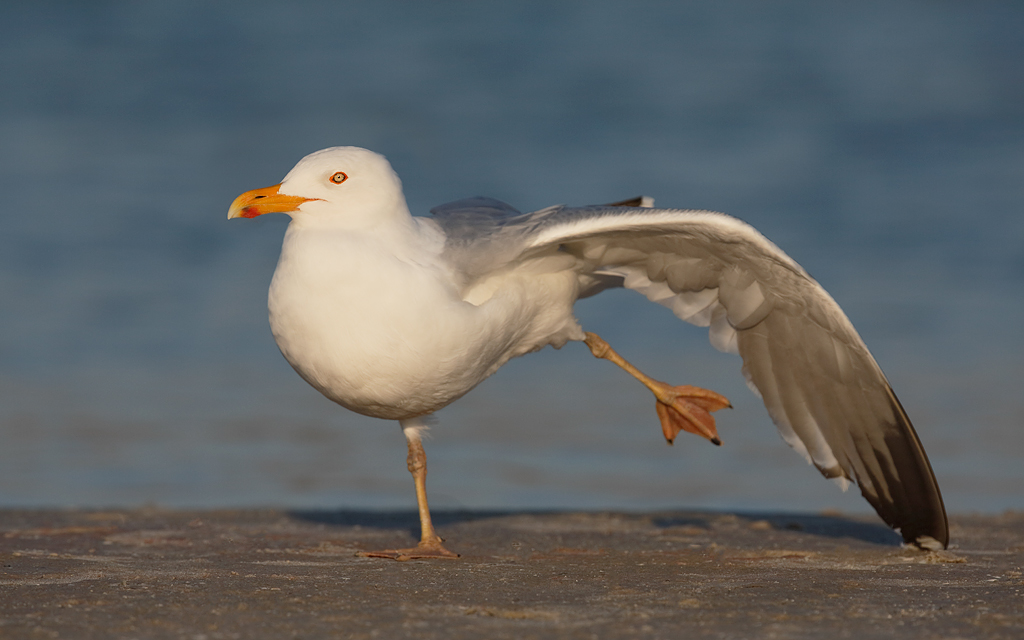
Living in the Box

Living in the box refers to much of the stuff that modern man does on a daily basis: working on a computer; watching TV with the clicker in hand; and driving a car. All with our shoulders rounded and our heads much too far forward. Many days at home I am up working by 4 or 5am. And working means working on the laptop. Many days I sit working without taking a break for two hours. When I stand up I feel very old. It takes me halfway to the kitchen to be able to stand up straight. It’s ugly, perhaps a reminder or our mortality.

Living in the Box Remedy

About a month ago while surfing the web in my free time, I came across this great video but I do not remember how. Yes, you will need to sit through the obligatory advertisement. The video is somewhat poorly titled “Exercises for Posture–Pull Shoulders Back.” There are three simple exercises that anyone can do. They are free. I do them every day. The first one, Cross/Crawl, is absolutely miraculous. I do it once in the morning stand up straight right off the bat for the whole day no matter how long I am sitting. Most days I do this one twice. I do Backwards Circles twice a day and External Rotations once a day. On the latter I only get to about 45 degrees while Dr. Neil King who is demonstrating these simple exercises, easily gets to 90 degrees…. Tight, tight shoulders. Dr. King does a great job of simplifying things in the video. Click on the “Videos by This Expert” button for more great stuff by him. Not to worry, I have never met the guy; his practice is located in Maryland.

If you live in the box, you gotta give this a go. Don’t forget to contract your stomach muscles during each of the exercises and down forget to belly breathe. I just did an extra set and feel great!

This image was made on March 8 at Fort Desoto on the Fort Desoto/Hooptie Deux Short Notice IPT with the hand held Canon EF 300mm f/2.8L IS II USM Telephoto Lens, the Canon 2x EF Extender III (Teleconverter), and the Canon EOS 5D Mark III Digital Camera (Body Only). ISO 400; 1/2000 sec. at f/8 in Manual mode was a slight underexposure.

Central sensor/AI Servo Surround/Rear Focus AF on the bird’s eye and recompose. Lots more on that in a future blog post soon. Click here if you missed the Rear Focus Tutorial. Click on the image for a larger version.

Image Optimization Revelations Part II

In the “How are Your Eagle Eyes?” blog post here, I presented three images including the one above and asked if anyone could detect any Photoshop hanky panky. In the “Image Optimization Revelations Part I” post here, I revealed that I did lots of work on the face and eye of the spoonbill image and that the high key pelican flight image was as is, pretty much right out of the camera except for a bit the usual NIK Color Efex Pro magic.

As expected, pretty much everyone failed miserably. Good Photoshop work should be pretty much undetectable.

After reading the very popular “Best Hand Holding Tip Ever” blog post here, the Photoshop hanky panky used to create this image became fairly obvious. I painted a Quick Mask of the sharp face and head of the bird in the far wing stretch image, put it on its own layer, moved it (V) onto the original for the image above, the one with the very soft face and out-of-focus eye, reduced the Opacity to 50%, used the left and right arrow keys to position it perfectly, hit Control T for the Transform Tool, rotated, sized, and warped the layer as needed, hit Enter, added a Regular Layer Mask, and fine-tuned the layer to perfection. And left no trace.

All of the above is detailed in our amazing Digital Basics File that includes my complete digital workflow, all of my time-saving Keyboard Shortcuts, Quick Masking, Layer Masking, and NIK Color Efex Pro basics, and dozens of great Photoshop tips. You can learn the advanced Quick Masking techniques that I used here in APTATS I and learn advanced Layer Masking in APTATS II.

Images courtesy of and copyright 2012: Bill Mueller. Card design by Denise Ippolito.

Old Car City Creative Photography In-the-Field HDR Workshop: Sunday, October 13, 2013/ 9am till 1pm. White, Georgia: $250 plus a $15 entrance fee donation (cash only on the day of the event) that will go to charity. Limit: 16 photographers/Openings: 13.

On October 13, 2013, Arthur Morris/BIRDS AS ART and Denise Ippolito/A Creative Adventure will be conducting an In-the-Field HDR Workshop at Old Car City in White, Georgia. Old Car City is about an hour north of Atlanta, GA and an hour south of Chattanooga, TN where they will, as noted above, be doing a full day seminar for the Photographic Society of Chattanooga on Saturday, October 12th. Click here for complete details.

Fort Desoto/Hooptie Deux–Roseate Spoonbill Short Notice IPT

The 2nd New Concept IPT: the Fort Desoto/Hooptie Deux–Roseate Spoonbill Short Notice IPT/April 3-7, 2013/5 DAYS: $2399. Strict limit: six photographers/ openings 5. Early April can be superb at Alafia Banks. Early April is almost always superb at Fort DeSoto. Click here for complete details.

With only a single registrant, this one is shaping up to be a practically private affair and represents an amazing opportunity for you to grow as a photographer.

Typos

On all blog posts, feel free to e-mail or leave a comment regarding any typos, wrong words, misspellings, omissions, or grammatical errors. Just be right. 🙂

Support the BAA Blog. Support the BAA Bulletins: Shop B&H here!

We want and need to keep providing you with the latest free information, photography and Photoshop lessons, and all manner of related information. Show your appreciation by making your purchases immediately after clicking on any of our B&H or Amazon Affiliate links in this blog post. Remember, B&H ain’t just photography!

If you are considering an item for purchase or comparison shopping be sure to place an item in your cart to see the too-low-to show the actual price. In many cases the prices are so low that B&H is forbidden from publicizing them!

B&H Search Engine Banner


B&H Photo - Video - Pro Audio


Support the BAA Blog. Support the BAA Bulletins: Shop Amazon here!

Consider doing all of your Amazon.com shopping using the search link below. You'll be getting the same low prices and great service that you are accustomed to and at the same time, supporting my efforts in the Bulletins and on the Blog to bring you great images, timely product news and info, and tons of free educational articles on an almost daily (and sometimes almost back-breaking) basis :) Just type your search in the little white box and hit Go.